




Abstract
Arthur Stanley Eddington (1882–1944) was one of the leading astrophysicists of the first half of the 20th century. He is remembered today chiefly for his research into stellar structure and general relativity, both of which he began to explore in the mid-1910s. He was also a key participant in the famous eclipse expeditions of 1919 that tested Einstein’s theory of gravity. Rather than consider these topics, in this paper I will instead examine Eddington’s early astronomical career, that is, from 1906 to about 1915. In this period, he became a well-trained practical astronomer. Eddington also established himself as a brilliant theoretical astronomer, and in so doing helped to create the role of theoretical astrophysicist through his research into star streaming. He was also, unusually for astronomers of this period, an enthusiastic advocate of the use of “working hypotheses” as crucial tools in astronomical practice. The study of Eddington’s early career therefore has much to tell us about the nature of astronomy in the years around 1910 and about Eddington. The paper underlines, for example, the continuing relevance of the “Greenwich-Cambridge Axis” for the power structure of British astronomy, and the importance of the so-called Sidereal Problem for astronomers at this time even though today it is largely forgotten.
Introduction
The career of A.S. Eddington has drawn a substantial literature. It is, however, noteworthy that those accounts have concentrated overwhelmingly on the second half of the 1910s and later with the emphasis on Eddington’s studies of stellar structure, general relativity, fundamental theory, his popular works, and the relationship for him between science and religion. Eddington’s research on stellar movements in the years 1906 to 1915 has drawn scant attention from historians. His endeavors as an observational astronomer at Greenwich have also prompted little interest, even though he went on to spend 30 years as director of a working observatory, albeit a small one. 1
In this paper I will consider the first decade of his astronomical career and so his years at the Royal Observatory, Greenwich, 1906–1913, as well as the 2 years after he left Greenwich for Cambridge during which he spent much of his time on investigations begun at Greenwich. His early career, as we will see, does not make sense unless we take into account what has been termed the Greenwich-Cambridge Axis. The central subjects will be Eddington’s work with instruments and analyses of astronomical data, as well as the evolution of his research program on the motions of the stars. Eddington, I will argue, was a well-trained practical astronomer who rapidly established himself as an outstanding theoretical astrophysicist. Eddington also early expressed views on what constituted appropriate scientific practice and on the connection between observation and theory, issues that would be key for his later career. Matthew Stanley has examined the relationship between Eddington’s personal religious experiences—Eddington was a lifelong Quaker—and his scientific practice. He has emphasized Eddington’s commitment to Quaker views of physics, and at the heart of this commitment was the notion of “seeking.” For Stanley, just as “Quakers argued that the import of the spiritual life was not in dogma or final truth, Eddington was comfortable with a scientific method that functioned without certainty.” 2 Stanley has centered his case on Eddington’s studies of stellar structure and general relativity that he began in the mid-1910s. We will see that Eddington’s research on star streaming between 1906 and 1915 agrees well with Stanley’s argument. For many practitioners, late 19th and early 20th century astronomy involved fact collecting as an end in itself with little emphasis on interpreting the evidence collected. Eddington’s willingness to employ and to proclaim the worth of working hypotheses to provide guidance for his research is therefore striking.
The Royal Observatory
Eddington was born in Kendal, England, in 1882. His mathematical talents were evident early, and he won a scholarship to Owens College, Manchester, when he was 16, and graduated with a first-class degree in physics. He entered the University of Cambridge in 1902 and became the Senior Wrangler (i.e. top) after sitting the Mathematics Tripos examinations after only 2 years instead of the usual three. There followed a short period as a mathematics tutor 3 during which he also pursued some experiments at the Cavendish Laboratory, before Eddington left Cambridge in 1906 to become Chief Assistant at the Royal Observatory, Greenwich. 4 Greenwich was arguably the leading institution in the world for positional astronomy at that time.
At the start of the 20th century, most astronomical research fell into three main areas. These were: (1) the determination of the positions and proper motions of astronomical objects to the greatest level of accuracy possible, (2) qualitative astrophysics (empirically observing spectra and star magnitudes as well as calculating masses where possible), and (3) celestial mechanics (also known sometimes as dynamical astronomy, the explanation of the motions of bodies in the solar system using universal gravitation). 5 Astrophysics would draw the bulk of the resources and the efforts of astronomers within two to three decades, but in 1906, many astronomers saw it as overly qualitative and lacking in the sort of mathematical and observational rigor expected of research in the other two areas. 6 Of these three areas, Eddington was relatively little concerned with the motions of bodies in the solar system, but he was very much engaged with the marriage of the determination of positions and proper motions of stars, the investigations of which had been transformed in the late 19th century by the introduction of photographic techniques.
I have argued elsewhere that the history of the first 90 years or so of astrophysics, can be divided into three main periods, c. 1860–1890, c. 1890–1920, and c. 1920–1950. The second period, c. 1890–c. 1920, is the phase of interest for this paper. A “growing number of practitioners and increased professionalization” characterized this period. Researchers generally focused on “large surveys, collecting spectra and radial velocities of stars, with more emphasis [than in period one] on tackling specific problems rather than merely collecting data. Various attempts were made to correlate different bodies of evidence, with the most significant example being the development of what would become called the Hertzsprung-Russell Diagram.” 7 Eddington distinguished himself as what can be referred to as a second period astrophysicist who did tackle specific problems, although it might at first seem surprising he was doing so at Greenwich.
King Charles II had chartered Greenwich in 1675 to solve the problem of longitude, particularly for ships at sea. The 19th century was a period of expansion for the Royal Observatory in terms of its staff and instrumental resources. Much of this growth came in the 46-year term of George Biddell Airy as Astronomer Royal from 1835 to 1881. In Airy’s tenure the great bulk of the Observatory’s work was directed toward astronomy for utilitarian purposes (including the rating of chronometers), but Airy introduced some lines of research related to new developments in astrophysics. Airy’s successor, William Christie, further developed these latter investigations. A number of state-of-the-art instruments were added during Christie’s tenure (1881–1910), including a 26-inch photographic refractor. 8 In 1900, Christie and the Observatory’s Board of Visitors persuaded the Admiralty that there was a need for a second Chief Assistant rather than just the one then in position, and it was as a Chief Assistant that Eddington joined the Royal Observatory in 1906.
Christie’s own career, like that of Eddington, is an example of what has been termed the “Greenwich-Cambridge Axis,” that is, there was a steady flow of staff between Cambridge University and the Royal Observatory with senior positions at Greenwich generally going to Cambridge men. 9 Christie had been fourth Wrangler in 1868 (i.e. the person with the fourth highest marks in the Cambridge mathematics exams), was elected a fellow of his college, Trinity College, a year later, and became Chief Assistant to Airy at Greenwich in 1870. Hence, when Frank Dyson vacated his Chief Assistant position in 1905 to become Astronomer Royal for Scotland, history strongly indicated that the replacement would be a Cambridge man who had excelled in the Mathematics Tripos. Indeed, Christie explained to the Secretary of the Admiralty on 6 January 1906 that “I have followed the precedents of previous appointments to the office of Chief Assistant and have been making enquiries respecting gentlemen who would be qualified for the post, and in particular High Cambridge Wranglers, and I hope to be shortly in a position to submit a definite proposal.” 10 As he sought a position, Eddington benefited enormously from his Cambridge connections and his performance in the Tripos, as well as the established power structure of British astronomy. Several dons had sought ways to land him an engineering position, 11 but Eddington instead became an astronomer.
On 15 January 1906, Christie wrote to Eddington offer him the post of Chief Assistant at the Royal Observatory. 12 Although initially somewhat cool to the prospect, Eddington reported to his mother there were several reasons for changing his mind. As he put it, “for one thing the fact of the post being offered to me, instead of being a possibility, makes an unconscious difference in one’s point of view; then I found that they were anxious for and seemed to have room for a physicist, and they do not particularly want anyone acquainted with the ordinary Part II [of the Cambridge Mathematics Tripos] dynamical astronomy. But especially I was influenced by the enthusiasm of the Dons here; [E.T.] Whittaker most strongly recommended it; I think it was a good deal his influence which has got me the post. Finally I have been down to Greenwich [he was there from January 18th to the 20th] and to a certain extent seen for myself.” 13 Whittaker would be an important patron for Eddington. Whittaker nominated him for membership of the Royal Astronomical Society a few months later and in 1914 proposed Eddington for fellowship in the Royal Society at the extremely early age of 31. 14
Eddington, then, had not become an astronomer through the pursuit of, for example, a youthful enthusiasm for the science continuing into his career, but because an opportunity had opened up at Greenwich at an opportune moment, Christie was looking for a Cambridge Wrangler to fill the post, and several Cambridge dons enthusiastically supported Eddington. As late as the autumn of 1909, Arthur Schuster, one of his old teachers at Manchester, asked Eddington if would consider switching back to physics if a Chair in Theoretical Physics could be established at Manchester. Eddington carefully considered the matter, but in the end decided that he “was unwilling to give up astronomy” and also felt doubtful that he would be successful in “this line of research.” 15
Eddington at Greenwich
In early 1906, Eddington settled into the routine of the Royal Observatory. His work would be mostly in the day, but he would also make nighttime observations, particularly in his first year, in order to be properly acquainted with the available instruments. A significant portion of his time at Greenwich was therefore spent manipulating astronomical instruments, seeking to better understand, and improve, their operations, as well as examining the possibilities and limitations of the data they produced.
He observed, for example, with one of the most famous of the Greenwich telescopes, the Transit Circle, “assisted in the observations for tremors from the [London County Council] generating station,” 16 “tried to get a Reversion Prism eyepiece to work, with moderate success,” and studied “Azimuth error (in connection with Latitude Variation).” 17 He wrote one of his earliest papers, “On the Errors of a Photographed Réseau,” with the Astronomer Royal and another Greenwich staff member. Their investigation concerned the Greenwich photographs of the minor planet Eros in 1900 and 1901, from which the aim was determine solar parallax, one of the key issues in positional astronomy at the turn of the century. As the authors argued, the “determination of the division errors 18 of the réseau as imprinted on the photographic plates to the very high degree of accuracy required, is in some respects a new problem, so that some of the methods and results may be of interest.” 19 Eddington investigated too the variation of star images with position on the photographic plates secured by the Greenwich Astrographic Equatorial telescope. 20
Eddington also worked at length on the errors of two versions of a zenith tube (a type of telescope designed to observe objects that pass directly overhead). 21 The second of these instruments was the Cookson Floating Zenith-Telescope, loaned by the Royal Observatory from Cambridge, again underlining the very close links between Greenwich and Cambridge. Eddington was responsible for the erection of the telescope at Greenwich, as well as the preliminary adjustment, trials, and observing program. Eddington’s investigation was were fully in line with one of Greenwich’s central goals over its long history: the improvement of the accuracy of observations, an enterprise that was shaped by moral concerns for the virtue of accuracy, as well as utilitarian demands for improved navigational techniques. 22 In the summer and autumn of 1910, Eddington observed too with the 28-inch equatorial refractor and “favoured by some fine nights, got to be fairly familiar with the instrument” 23 (Figure 1).
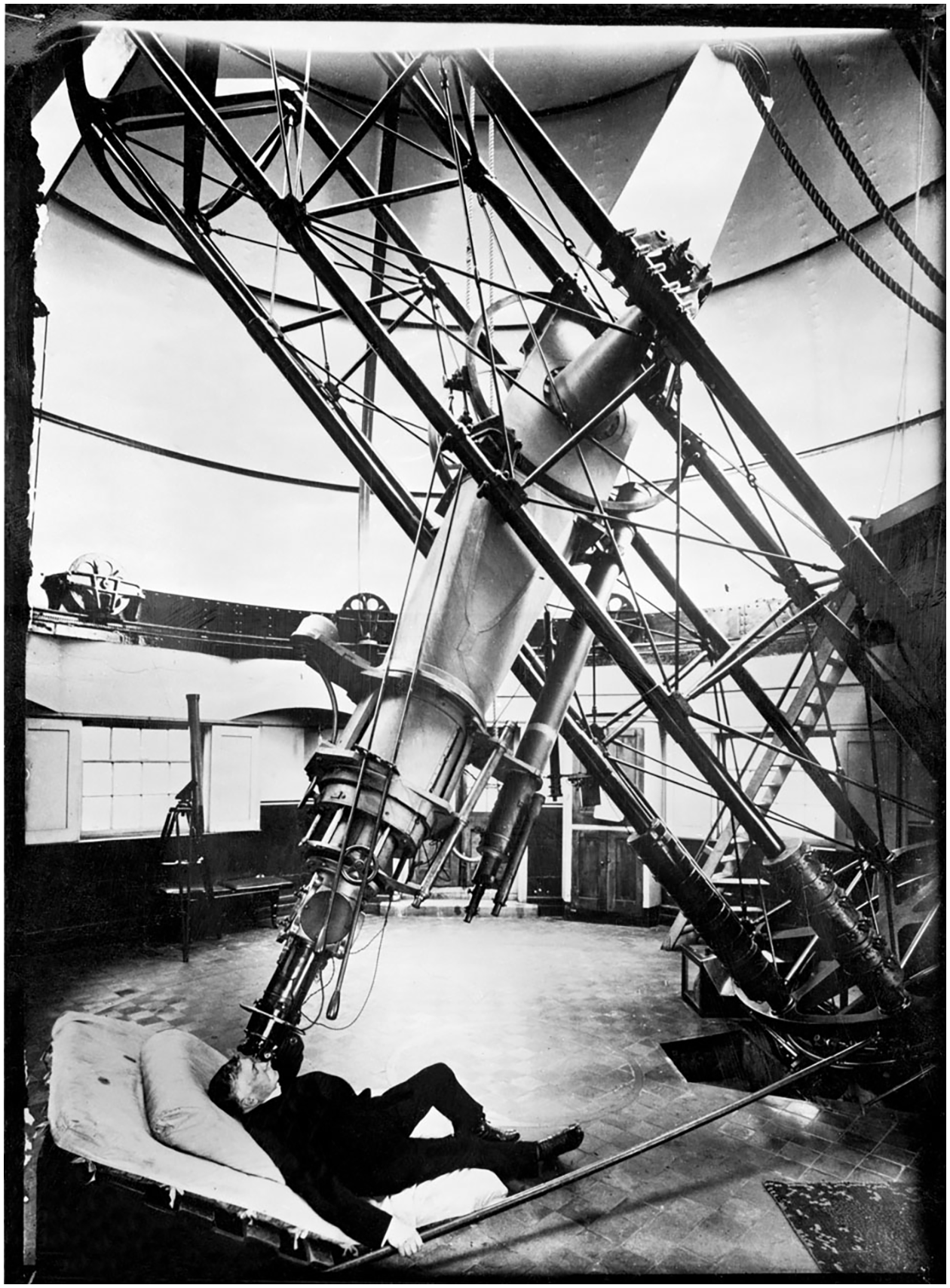
The 28-inch refractor at Greenwich. Installed in 1893, Eddington observed extensively with it in 1910.
A major part of astronomical practice in the early 20th century involved expeditions, most notably expeditions to observe solar eclipses and to determine the longitudes of various geographical locations. Eddington participated in both of these sorts of expeditions during his years at the Royal Observatory. In 1909, Eddington and the Astronomer Royal’s son, Harold Christie, together with a ton of baggage consisting of instruments and an observing hut, journeyed to Malta, an important naval station for Britain and a key point for Mediterranean surveys, to measure the longitude of a geodetic station there. There were two discrepant values for this longitude and the task of Eddington and Christie was to produce a third, and, hopefully, decisive determination.
Eddington worked hard in the autumn of 1908 on preparing for Malta trip, including practicing transit observations. 24 After arriving in Malta in February 1909, Eddington quickly got to work: “There was the pillar to set up correctly oriented, the telescope to cement to it, the hut to set up and the clock, and all the electrical connections to make. I was at work from 8.30 to 6.30 almost every day.” 25 With everything in place, the redetermination entailed a series of straightforward observations but ones that, in the opinion in 1956 of H. Spencer Jones (a former Chief Assistant at Greenwich and then Astronomer Royal), had required care and attention. Eddington observed every night between February 20 and March 8, and Spencer Jones further argued to Eddington’s biographer that the “results of this programme show that Eddington was a careful and accurate observer. He is always thought of as pre-eminently a theoretical astronomer, and it is often overlooked that while at Greenwich he received training in observation and shared in various observing programmes, thereby acquiring a familiarity with observational astronomy that later stood him in good stead.” 26
In 1912, Eddington, along with a colleague and a volunteer assistant, traveled to Passa Quatro, a village in Brazil some 180 miles from Rio de Janeiro, to observe a solar eclipse on October 10. They erected the huts transported from Greenwich at the site and the preparation of the instruments began in late September. Eddington was in charge of the Thompson coronograph. Eddington was up at 5 am on the day of the eclipse to load the plate carriers. At 7.30 am, a train arrived. Aboard were the President, the Foreign Minister, the American Ambassador, and about 30 other people, and they were greeted by a band. All of Eddington’s efforts came to naught, however, as rain fell throughout eclipse day and even became heavier as totality approached. 27
Eddington’s observational training also helped him land the Plumian Professorship at Cambridge following the death of the incumbent, Sir George Darwin, in 1912. According to the prominent and well-connected English astronomer H.C. Plummer, the electors meant by appointing Eddington to give more emphasis to observational astronomy than had been the case with Darwin. 28 Eddington’s training as a practical astronomer familiar with a wide range of instruments was therefore seen as a plus in the selection process. Following the death of the Director of the Cambridge Observatory, R.S. Ball, in 1913, Eddington was also appointed as Ball’s replacement the following year. 29
Eddington’s practical training also meant that when in the last 2 years of the First World War both of his assistants at the Observatory left for military service, he was able to continue some observational work for a zodiacal catalogue through his own efforts. 30 As is now well-established, the Astronomer Royal, F.W. Dyson, sought to protect Eddington from possible imprisonment because of his Quaker beliefs by using his involvement in the planned 1919 solar eclipse expeditions. But that Eddington should have been involved in the first place made good sense given his Greenwich connections, practical experience with expeditions and his interest in general relativity. 31 Indeed, not only was he one of the leading experts on general relativity in the late 1910s, Eddington had experience of an eclipse expedition, he was thoroughly familiar with the often tricky issues of measuring star images on photographic plates, and, unlike many of his colleagues, he was not in the military so was available.
Stellar motions
When Eddington joined the staff of the Royal Observatory in early 1906, his first substantial task was to check the places of about 12,000 stars for a new Greenwich catalogue. In these early weeks he also hunted for a suitable research problem to tackle. He soon settled on a project on star-streams and “star-drifting,” and to assist in this investigation he could regularly call on half the time of one of the Greenwich computers. 32
What did this project entail? At the start of the 20th century astronomers assumed that the motions of the stars are random. To this point, astronomers had chiefly used proper motions to determine the direction of the Sun’s motion with respect to the system of stars, that is, the solar apex. Eddington argued in 1910 that astronomers had not been happy with the hypothesis that the motions of the stars are random, but had expended little effort in examining it, chiefly perhaps because they expected the deviations, if any, from a haphazard distribution, would be complicated and different in different parts of the sky. 33 However, in 1904, the well-known Dutch astronomer J.C. Kapteyn announced a new theory of stellar motions: the stars form two great streams moving through one another. 34
Professor of Astronomy since 1878 at the poorly funded outpost of Dutch astronomy of the University of Groningen, Kapteyn was an astronomer without a telescope, but he had escaped these limits by cooperative efforts with other astronomers. He was also “an astronomer with a grand passion: the solution of the Sidereal Problem.” 35 In other words, Kapteyn wanted to solve the problem of the present positions and motions of the stars as a stage in the history of the galactic system (often referred to at the time as the stellar universe because it was generally believed that it was the only such star system visible in even the largest telescopes), whether in a steady state or not, “and the deduction of the presumable history of the system in the past and in the future.” 36 The Astronomical Laboratory at Groningen was designed to allow Kapteyn to tackle the Sidereal Problem.
During the 1890s, Kapteyn analyzed some 3200 proper motions in G.W. Auwers’ 1888 Catalogue that took as its base James Bradley’s famous star catalogue compiled at Greenwich in the 18th century. These investigations led Kapteyn to the so-called velocity law, which related the velocities of the stars to their luminosities. Through the velocity law, Kapteyn hoped to then proceed to derive both the density and luminosity laws, that is, the number of stars per unit volume of space in different parts of the stellar system and the proportion of stars between different limits of absolute brightness. 37 With these different laws established he would be able to solve the Sidereal Problem. Nevertheless, as he announced at two meetings—the St. Louis World Exhibition in 1904 and the Cape Town meeting of the British Association for the Advancement of Science in 1905—the motions of the stars are not random. Instead, Kapteyn proposed that there are two-star streams, that is, that the stars tend to move in two distinct and diametrically opposite directions. Maybe, he suggested, these motions arose from two once distinct but now intermingled streams of stars moving relative to one another. 38
For a few astronomers, earlier studies of stellar motions had suggested systematic motions, but astronomers did not judge these investigations as persuasive. 39 Kapteyn, however, was one of the leading astronomers in the world and he was widely reckoned to be now offering evidence of a different order of plausibility to the previous researches. Not all astronomers accepted Kapteyn’s arguments about the two-star streams, however.
Eddington decided to test Kapteyn’s theory shortly after he arrived at Greenwich in 1906. To this end, Eddington scrutinized the Greenwich-Groombridge catalogue of around 4500 proper motions. Not only was this a different catalogue from the Auwers-Bradley Catalogue used by Kapteyn, but it also included more stars, as well as many that were fainter. Eddington also examined the Greenwich-Carrington catalogue of proper motions (of about 1100 stars). In his first paper on star streaming (published in 1906), Eddington wrote that he had set out “to show that there exist anomalies of a remarkable and systematic character in the proper motions (or what are believed to be the proper motions) of the stars; and that these anomalies are, so far as our evidence goes, entirely explained if we suppose the visible universe to consist in the main of two streams of stars crossing through one another.” 40 His basic technique consisted of dividing those parts of the sky covered by the proper motion catalogues into a number of regions and examining the directions of the proper motions in each of the regions. When he tried to fit the observations into the form of a single drift—and by a “drift” he meant “a system of stars whose velocities relative to some system of axes are quite haphazard” 41 —Eddington reported he found big discordances between theory and observation. If he analyzed the data in terms of two drifts, however, he instead found much better agreement. Eddington nevertheless cautioned that the two drifts were best seen as a good first approximation to the proper motion data and that he expected local irregularities. There was perhaps even a smaller third drift, or maybe one of the two main drifts might prove to be compound. 42 When he presented his paper to the Royal Astronomical Society in November 1906, David Gill, one of the leading astronomers at this period, was enthusiastic and the paper was well received. 43
Eddington also represented his data in a visually compelling way in his 1906 paper (Figure 2). He produced a set of diagrams “obtained by drawing the radius vector in any direction proportional to the number of stars having proper motions in that direction.” 44 The shape of the resulting plots then provided information on the direction of the motions of the stars in a particular part of the sky. These diagrams became known as Eddington’s rabbits or bunnies because of the supposed rabbit like shape of some of them. 45 Eddington delivered a paper on star streaming at the November 1910 meeting of the Royal Astronomical Society and an attendee, W.W. Bryant, 46 asked, “Can Mr. Eddington give us any reason for the existence of the ‘rabbit’s ear’, which is such a marked feature in all of the diagrams?” In the published report of the meting a footnote was added stating “The reference is to the diagrams representing the proper motions, which have some general resemblance to a rabbit.” 47 Here is perhaps the earliest reference to Eddington’s rabbits. The following year, in speaking on “The Sidereal Universe” to the Victoria Institute in London, the prominent astronomer David Gill showed some of Eddington’s diagrams and noted that “facetious astronomers” referred to them as “Eddington’s rabbit show.” As you see, Gill went on, “they are very irregular figures; some are more irregular than others. Mr. Eddington discussed all these by very beautiful mathematical processes.” 48
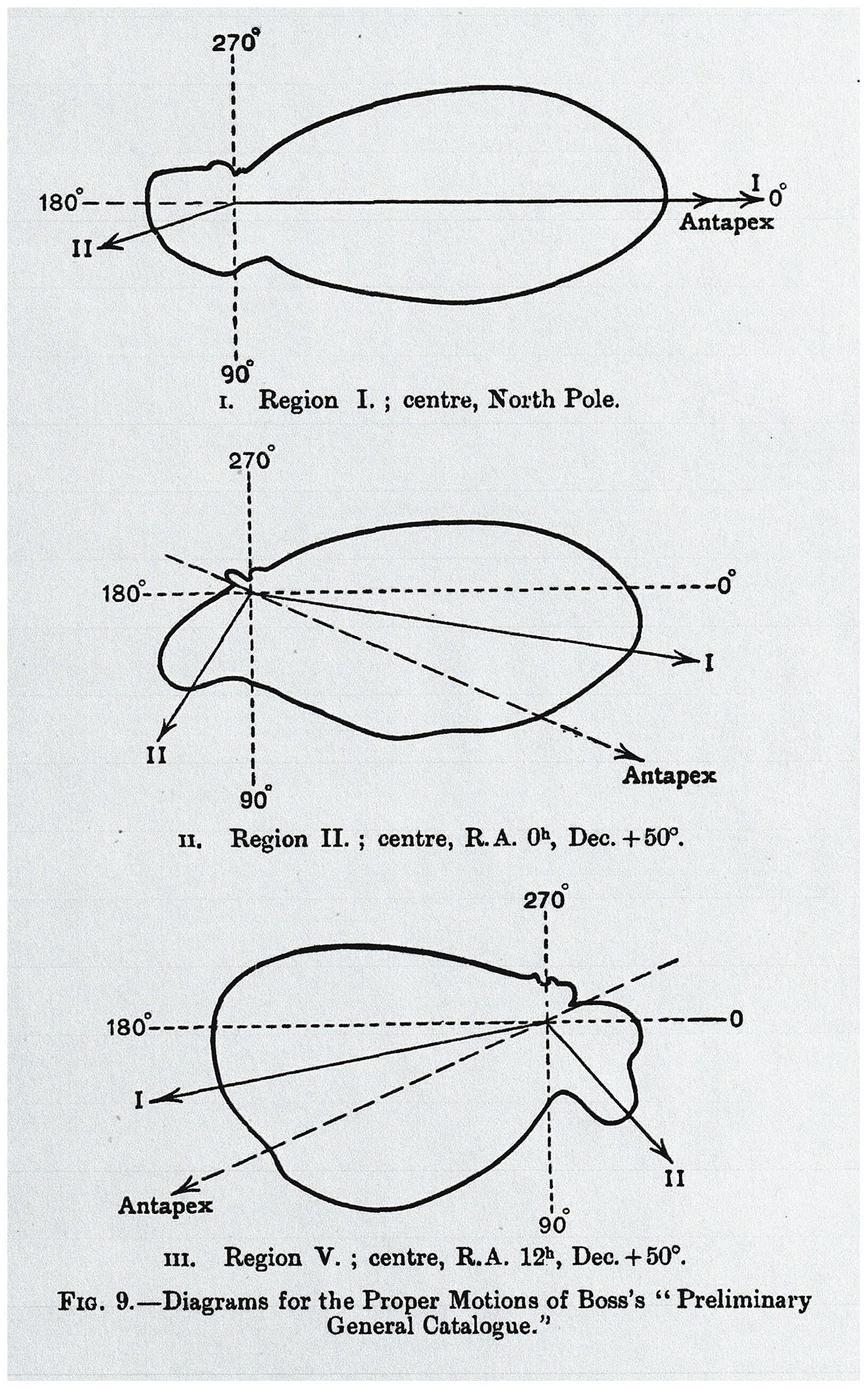
Examples of “Eddington’s rabbits.” These examples are from his 1914 book, Stellar Movements and the Structure of the Universe.
The example of eponymy–perhaps the most prestigious kind of recognition institutionalized in early 20th century science—with “Eddington’s rabbits” linked Eddington’s name to the phenomenon of star-streaming. When the President of the Royal Astronomical Society, J. L. E. Dreyer, presented the Gold Medal of the Society—and one of the highest awards in astronomy at the time—to Eddington in 1924, he recounted that this long 1906 paper “at once raised Kapteyn’s announcement to the rank of an important discovery.” 49 The 1906 paper meant too that Eddington had, by the age of 24 and despite being a novice astronomer, tackled successfully a demanding state-of-the-art problem within months of taking up his position at Greenwich. It was a remarkable debut.
Eddington won a fellowship at Trinity College in 1906 for a thesis on star drifting, and in 1907, he won another important prize at Cambridge, the Smith’s Prize. 50 Most of Eddington’s research between 1906 and 1913 centered on star drifting. He followed up his 1906 paper with a string of others on the subject in which he addressed three main issues. These were: (1) the refinement of his own account of the phenomenon, including investigating how, if at all, the results he found in 1906 changed when different star catalogues were employed, (2) responding to criticisms of the two-stream theory of stellar motions, and (3) exploring the implications of other accounts of the motions of the stars. Under the first heading, for example, in 1907 he calculated the mean distances of the stars in Groombridge’s catalogue in order to compare the distances of the two star-drifts, as well as to again test the two-drift hypothesis. 51
Probably the most important response by Eddington to criticism of the two-stream theory was a long 1910 paper on “The Systematic Motions of the Stars of Professor Boss’s ‘Preliminary General Catalogue.’” The American astronomer Lewis Boss was a leading student of proper motions and an early critic of Kapteyn’s two-stream theory. By general consent, Boss’s catalogue of the proper motions of some 6188 stars well distributed over the whole sky was of unprecedented accuracy. When Eddington analyzed these motions, he concluded that Boss’s proper motions did indeed show two favored directions of motion in the same manner as other catalogues. 52 By the time Eddington completed this paper, Frank Dyson had returned to Greenwich to replace Christie as Astronomer Royal. Dyson himself worked on star-streaming, and Christie’s retirement made a “great difference” to Eddington as it meant for him the “removal of obstacles to progress and activity” 53 that resulted from the frequent absences of Christie from his Observatory duties due to ill-health.
Here it is worth considering Eddington’s methodology as he developed his ideas on star-streaming, particularly his views on hypotheses and the “crucial test.” In his 1906 paper on “The Systematic Motion of the Stars,” he explained that he was attempting to subject Kapteyn’s theory to a quantitative test by scrutinizing the Greenwich-Groombridge proper motions. He also argued that: The test of a hypothesis is its power of predicting facts. It is easy to pick out half-a-dozen stars, which, our theory predicts, will have an average velocity towards the sun, and another half-dozen away from the same part of the sky which will have a velocity away from the sun. Until some such simple test is applied, it would be wrong to regard the theory as established. On the other hand, it must not be forgotten that, should the two-drift theory fail when the crucial test is applied, some other explanation will have to be found for the remarkable phenomena to which Kapteyn has called attention.
54
By 1910 and the completion of his investigation of the proper motions of the stars in Boss’s catalogue, Eddington claimed that the existence of two streams of stars was “beyond doubt,” although he conceded when “this phenomenon is expressed as a quantitative law, and the amount of the streaming is measured, some approximation is necessary.” 55
These early views of Eddington on the notion of a “crucial test” and the value of “hypotheses” are in line with his later opinions. Eddington did not refer solely to hypotheses or working hypotheses, but used both terms and he does not appear to have explicitly distinguished between the two, at least in this early period in his career. However, “working hypotheses” is perhaps closer to his meaning as there is the added emphasis that if the hypothesis is not working, it should be abandoned or changed. Other remarks by Eddington underline that he was early committed to the notion of the “crucial test.” In 1915, for example, he authored a report on gravitation for The Observatory. Here Eddington contended that while there had been no lack of mechanisms advanced to explain gravitational attraction, all of them had led nowhere. While these mechanisms removed the problem of action at a distance, “that is all they accomplish. Gravitation, produced by a special mechanism invented for this one purpose only, presents no points of contact with any other natural phenomena.” 56 In the same article, however, he noted that Einstein had shown on the basis of his theory of gravity that a wave of light would travel more slowly if it entered an intense gravitational field, meaning that light would be refracted passing near a massive body. As an example, Eddington pointed out that a star seen close to the limb of the Sun would be apparently displaced 0.″83 away from the limb of the Sun (Eddington of course was writing before Einstein had corrected his earlier calculation of the deflection of light by the Sun. The later value was about twice this amount, 1”.75.). The determination of the actual shift would be a crucial test for Eddington. A definite result, either positive or negative, would be of “remarkable importance—the first definite advance in our knowledge of gravitation for over two hundred years.” Eddington reckoned the measurements would be extremely difficult even during an eclipse, but if Einstein’s prediction proved accurate then “gravitation has been pulled down from its pedestal, and ceases to stand aloof from the other interrelated forces of nature.” 57 In 1919, Eddington would of course be centrally involved in an expedition to pursue this crucial test. 58
Stellar Movements and the Structure of the Universe
In 1914, Eddington published his first book. Stellar Movements and the Structure of the Universe drew together the research on star-streaming by himself as well as other astronomers. It was very much an outgrowth of his research while at Greenwich and he was at work on it before he returned to Cambridge as Plumian Professor. 59 His aim was to present the state of knowledge on the structure of the stellar system for both working astronomers and those he termed general scientific readers. 60 Eddington expected some in that audience to regard it as premature to provide an overview of the field, but he disagreed.
Kapteyn’s great demand was for more data to solve the Sidereal Problem. As he told George Ellery Hale in 1915, his investigations had turned him into more and more of a statistician, and for statistics there needed to be great masses of data. 61 Between 1908 and 1914, Kapteyn spent part of each year as a Research Associate at the Mount Wilson Observatory, of which Hale was the director. In 1915, in an exchange of letters with Hale, Kapteyn warned against putting deduction ahead of induction as a means of making progress in stellar studies, although he did in the end agree with Hale on the worth of hypotheses. 62
Eddington was far more positive about the use of hypotheses. He argued in Stellar Movements, the “knowledge that progress will inevitably lead to a readjustment of ideas must instill a writer with caution; but I believe that excessive caution is not to be desired. There can be no harm in building hypotheses, and weaving explanations which seem best fitted to our present partial knowledge. These are not idle speculations if they help us, even temporarily, to grasp the relations of scattered facts, and to organize our knowledge.” 63 Here, in 1914, Eddington was in-effect giving a preview of the opinions Hale would expound in 1915 in his exchanges with Kapteyn, as well as reflecting the views at this time of a relatively small number of astronomers, some of whom, however, were, or were to become, leaders of the discipline. Thus, Henry Norris Russell, who was to become known as the Dean of American Astronomy, was of like mind in his pursuit of problem-driven astrophysical research, in particular in his explorations of stellar evolution (which were in turn to be immensely important for Eddington’s own investigations). But Russell, as DeVorkin has emphasized, was also well aware that to get a sympathetic hearing for his theories from “rank and file” American astronomers who stressed the value of collecting facts, it was essential he be seen to rest his arguments on an imposing and carefully fashioned observational base. 64 DeVorkin argues that while, if pressed, these astronomers would suggest their researches could inform “big” questions to do with, say, how stars form and age, “few tackled them head-on since such matters required a facility for physical theory and a willingness to speculate. It was far safer merely to collect data, as one observer wryly put it in 1900: ‘American astronomers were more the ‘stonecutters’ than the ‘architects’ of their profession.’” 65
Eddington, like Russell, made clear the observational foundations of his studies, at least at this stage of his career, and the first chapter of Stellar Movements discussed “The Data of Observations.” Here he carefully ran through the relatively limited amount of information on the stars to do with their positions in the sky, magnitudes, type of spectra or color, distances, proper motions, and radial velocities. With the observational foundations laid, Eddington turned to the two-star streams and the required mathematical theory.
Eddington here described the German astronomer Karl Schwarzschild’s mathematical account of star-streaming, the so-called ellipsoidal theory. For Eddington, there was no fundamental difference between his own account and Schwarzschild’s, and he quoted approvingly the opinion of the then Astronomer Royal, Frank Dyson (who had himself worked extensively on star streaming and had returned to Greenwich in 1910 to replace Christie): “The dual character of Kapteyn’s system should not be unduly emphasized. Division of the stars into two groups was incidental to the analysis employed, but the essential result was the increase in the peculiar velocities of stars toward one special direction and its opposite. It is this same feature, and not the spheroidal character of the distribution, which is the essential of Schwarzschild’s representation.” 66 Some other astronomers were to be left bloodied on the field in later disputes with Eddington, 67 but with his research on stellar movements he took a non-combative line despite differences with Schwarzschild’s view. Schwarzschild rejected Eddington’s theory because for him it implied there was a definite physical difference between the stars in the two streams while no such differences were found. 68 But as Eddington told Schwarzschild in 1908: “The main difference between the two laws [Eddington’s and Schwarzschild’s] must be that mine leads to more of a neck in the figures[in an Eddington rabbit]. . . and I cannot help thinking that the observations tend to support my law—though that is merely a matter of opinion . . . although your theory is mathematically simpler than mine, it appears to me much less simple physically.” 69
In Eddington’s technical papers on star streaming between 1906 and 1913 he did not explore what such a phenomenon meant for the overall structure of the stellar system. However, as he would note in 1916, the need to secure accurate data for large numbers of stars inevitably prompted thoughts about “the great problems of the structure of the stellar universe.” 70 In 1911, he had addressed the British Association for the Advancement of Science and spoken in favor of what was sometimes known at this time as the “island universe theory,” that is, the theory that our own stellar system is only one of many galaxies of stars in space. 71 Here Eddington was in opposition to the great majority of astronomers who rejected the existence of visible galaxies beyond our Milky Way. 72 The term “Universe” was therefore often applied to our own stellar system. Eddington could title his book Stellar Movements and the Structure of the Universe, and it was understood by his readers that he was referring to stellar movements in our stellar system. In Stellar Movements, Eddington nevertheless followed up the 1911 discussion on island universes in a few pages in a chapter he called “General Outline,” as well as in the book’s chapter on “The Milky Way, Star-Clusters, and Nebulae.” Eddington practiced what he preached in the volume’s introduction to avoid excessive caution and offered a sweeping view of the overall arrangement of the visible universe at a time when astronomers generally eschewed such broad, and to many of them highly speculative, statements. He again justified this approach in terms of the value of working hypotheses “to assist the mind to grasp the interrelations of the facts and to prepare the way for a further advance.” 73
The picture Eddington painted had the great mass of the stars arranged in the form of a lens- or bun-shaped system considerably flattened toward one plane with the Sun located quite close to the center. He emphasized the large uncertainties in the estimates, but suggested that in the direction toward the galactic poles the density of the stars is practically uniform for 100 parsecs, then declines rapidly so that at a distance of 300 parsecs it is perhaps only a fifth of the density close to the Sun. In terms of the extension along the galactic plane, Eddington reckoned it is at least three times larger 74 (Figure 3).
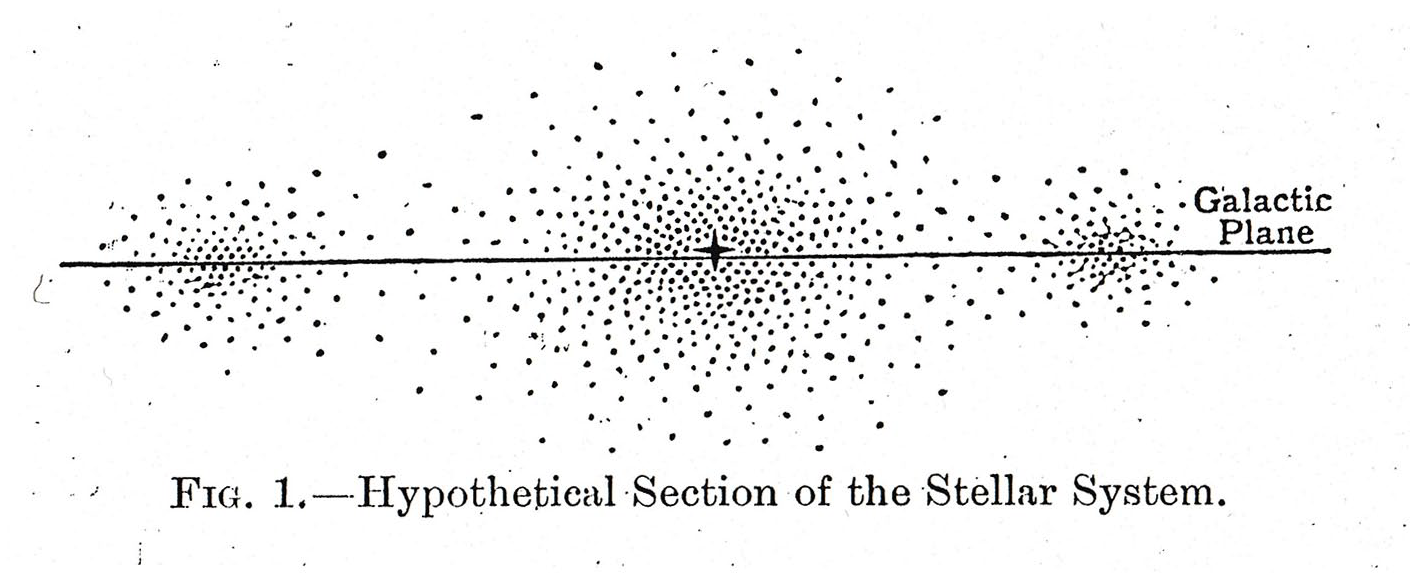
A “Hypothetical Section of the Stellar System,” as represented in Eddington’s 1914 book, Stellar Movements and the Structure of the Universe. For the majority of astronomers at this time, this was also a cross-section of “The Universe.”
When he came to discuss the possibility that other star systems, or galaxies, might lie beyond our own Milky Way he again used the notion of working hypotheses. After a long period during which nearly all astronomers had rejected the existence of external galaxies, a few astronomers had speculated in the early 1910s that the so-called spiral nebulae might form such galaxies. We saw Eddington had adopted this view in 1911. Now, in 1914, he suggested that if the spiral nebulae are within the stellar system, then “we have no notion what their nature may be. That hypothesis leads to a full stop.” While it “is true that according to one theory the solar system was evolved from a spiral nebula, [. . .] the term is here used only by remote analogy with such objects as those depicted in the [photographic] plate. The spirals to which we are referring are, at any rate, too vast to give birth to a solar system, nor could they arise from the disruptive approach of two stars; we must at least credit them as capable of generating a star cluster.” 75 On the other hand, Eddington argued, if it is assumed that these nebulae are external to the stellar system, and are systems coequal with our own, here was a hypothesis that could be pursued and could thereby illuminate various problems. The island universe theory was therefore “much to be preferred as a working hypothesis; and its consequences are so helpful as to suggest a distinct probability of its truth.” 76
If our own stellar system was such a spiral nebula, Eddington then contended that there was then a ready explanation for star-streaming: It is clear too that matter is flowing into the nucleus from the spiral branches or it is flowing out from the nucleus into the branches. It does not at present concern us in which direction the evolution is proceeding. In either case we have currents of matter in opposite directions at the points where the arms merge in the central aggregation. These currents must continue through the centre, for, as will be shown in the next chapter, the stars do not interfere with one another’s paths. Here then we have an explanation of the prevalence of motions to and fro in a particular straight line; it is the line from which the spiral branches start out. The two star-streams and the double-branched spirals arise from the same cause.
77
The last chapter of Stellar Movements dealt with the interactions of stars in a star system such as our own galactic system or in globular clusters, gigantic collections of stars of which over a hundred were known by 1914. He continued these investigations into globular clusters with a series of six papers between 1914 and 1917 in which he suggested that these clusters might themselves be island universes. 78
By the mid-1910s, Eddington had also studied, and criticized, a new theory of stellar evolution advanced by Henry Norris Russell. In exploring the dynamics of globular clusters by likening the stars within them to molecules in a gas, he had also investigated Emden’s models of spheres of gas. In bringing these two interests together, as well as in his attempt to understand why Cepheid variable stars pulsate, Eddington had started to ponder how a star behaves as a thermodynamical system. 79
Eddington’s construction of stellar models and the development of general relativity would be at the heart of the next phase of his astronomical career. 80 He would not publish another technical paper on star-streaming. In fact, the picture of the stellar universe Eddington had presented in Stellar Movements was, as he soon realized, made obsolete within a few years by Harlow Shapley’s research on the stellar system. In late 1917 and early 1918, Shapley argued that the globular clusters outline the entire stellar system, a stellar system far different from the one Eddington had portrayed in 1914, and in which the Sun was displaced tens of thousands of light years from the center. Shapley calculated that the stellar system has a diameter of around 300,000 light years (about a decade later this size would be reduced by a factor of three as a result of studies of interstellar absorption and galactic rotation 81 ), and so was vastly larger than Eddington had envisioned it in Stellar Movements. As Eddington told Shapley in 1918; “I think it is not too much to say that this marks an epoch in the history of astronomy, when the boundary of our knowledge of the universe is rolled back to a hundred times its former limit.” 82 The researches on stellar positions and motions Eddington had described in Stellar Movements, then, had not addressed the stellar system as a whole, but only a small region within it. 83
Conclusions
The first decade of Eddington’s astronomical career was concerned principally with stellar movements, as well as mastering a number of astronomical instruments and becoming skilled at the manipulation of large amounts of astronomical data. His research on star-streaming placed him within a remarkably short period at the cutting-edge of astronomy and won for him an international reputation. Eddington had successfully married the concern for the diversity of stars, which was so important to astrophysicists, to the traditional values of mathematical astronomers of exactness and rigorous mathematics. Eddington, like Kapteyn, Russell, and Hale, was highly sympathetic to research that bridged via statistical methods the older traditional astronomy and the newer astrophysics. Eddington had also set himself apart from the great majority of his colleagues by his desire to offer an overall view of the stellar system, as well as the stellar system’s place within a universe of galaxies.
For Eddington, as Stanley has shown, his views on scientific practice were in line with his Quaker belief in an experiential, open-ended quest for knowledge through “seeking” that applied to both his religion and his science. Stanley investigated Eddington’s researches in stellar structure and general relativity, both of which Eddington started in the mid-1910s. Eddington’s research in star-streaming shows the same sort of approach and the importance for him of working hypothesis as a means to bring order out of partial knowledge or scattered facts.
In so doing, Eddington had also expressed views on scientific practice and methodology, especially the use of working hypotheses, which put him among a small but leading group of astronomers, and again he joined Hale and Russell. This group was committed to problem-driven astrophysical research, rather than the sorts of observational surveys and celestial mechanics that had dominated astronomy for much of the 19th century and well into the 20th. Although he had begun his astronomical career at Greenwich, a bastion of positional astronomy, Eddington had quickly demonstrated himself to be a very modern sort of astronomer, that is, a theoretical astrophysicist, indeed, he had helped to create this novel role.
Footnotes
Acknowledgements
This paper has its origins in part in a conference on Eddington that was held some years ago at the University of Cambridge, and I am grateful to the organizers and participants for their encouragement and interest. I am also indebted to David DeVorkin, Florian Laguens, and an anonymous referee for helpful comments on an earlier draft of this paper. I am very grateful too to Florian for providing a number of documents.