




Abstract
The instrument collection at the Royal Swedish Academy of Sciences houses a historically significant 10-foot achromatic refractor crafted by London instrument maker John Dollond. The telescope came into use at the Academy’s Observatory in Stockholm in 1761 and remained in service into the 1820s. This paper aims to add to the biography of this instrument, encompassing its six decades of active service and, after 150 years in storage, its transformation into an exhibition showpiece. The paper begins by introducing the telescope, its maker and the conflict involving Dollond and the Swedish mathematician and physicist Samuel Klingenstierna over the discovery of the achromatic lens. This dispute ultimately resulted in the telescope finding its way to the Stockholm Observatory. Subsequently, the paper delves into how Academy astronomer Pehr Wargentin perceived and utilized this state-of-the-art refractor, along with brief mentions of its use by his successors. The final section narrates how the telescope ended up in the permanent exhibition of the Stockholm Observatory Museum.
Keywords
Introduction
In the wee hours of 18 August 1825, Swedish astronomer and director of the Stockholm Observatory Simon Anders Cronstrand got his first glimpse of Comet Encke. Astronomers had sighted the rather unassuming comet many times before, but just a few years earlier it had become famous as the second comet to be proven periodic.
1
In his observation journal, Cronstrand noted: [. . .] lacking instruments, I could not bring about any observations. It was with certainty only visible in the Dollondian Achromat, round, without a tail and at times signs of a nucleus could be discerned.
2
The entry at first seems contradictory, but the missing instrument was the transit instrument, which was unavailable due to the comet’s position above the north-eastern horizon, and with which he could have made ‘proper’ observations, that is, measurements of its position on the celestial sphere. Cronstrand had to settle for merely qualitative observations using the Dollond refractor. Even though he went to the trouble of making a pencil drawing to mark the comet’s position and also made a couple of follow-up observations on subsequent nights, he did so without any further comments or measurements and without forwarding his observations. As an astronomer who worked primarily in geodetics, observations of celestial events (such as a passing comet) are rarely seen in his observation journals. They seemed to have been more of a professional obligation, even a distraction, than an opportunity for actual research. 3
However, putting Cronstrand’s research inclinations aside, the observations of Comet Encke are noteworthy because these are the last recorded observations using an instrument that had been an observatory workhorse for more than six decades. The 10-foot Dollond achromatic refractor had been installed at the observatory in 1764 and was used well into the 1820s. Several generations of astronomers had worked with it, and they had used the instrument for a multitude of purposes. This article aims to contribute to the history of this particular instrument and to use it as an example to discuss how a state-of-the-art refractor of this calibre came to be used under the stars in late 18- and early 19-century astronomy, and in addition how it much later was transformed into a museum object. Drawing on the concept of object biography, developed by Igor Kopytoff in 1986 and employed in many different settings since then, the focus is on the telescope’s trajectory from its ‘birth’, via its ‘retirement’ from research, to its ‘re-birth’ as an exhibition showpiece. 4
The first part of the article introduces the telescope, its maker John Dollond and the conflict with Samuel Klingenstierna over the discovery of the achromatic lens, which eventually led to the telescope ending up at the Academy Observatory. The second section discusses in some detail how it was put to use by the Academy’s astronomer, Pehr Wargentin, and gives a few examples of observations done with it. Furthermore, it seeks to address how he perceived the introduction of achromatic lens telescopes, exploring the impact of this new technology. The third section briefly sketches the role of the telescope under Wargentin’s successors. Lastly, the fourth section gives an overview of the instrument’s afterlife.
The Dollond telescope
At a July meeting with the Royal Swedish Academy of Sciences in 1754, permanent secretary and academy astronomer Pehr Wargentin had raised the question of instruments for the Academy Observatory, recently inaugurated on the outskirts of Stockholm. 5 Daniel Ekström gave the Academy access to a highly skilled instrument maker, and it was decided to commission the much-needed instruments from him. 6 Later the same year, his contract was read to the Academy. Ekström was to construct a 3-foot mobile quadrant, a 4-foot transit instrument, an 8-foot mural quadrant, a ‘Machine Parallactiqve’, a big reflector and a big levelling instrument. 7 The list discloses the kind of astronomy Wargentin was planning: the mobile quadrant and the levelling instrument were to be used in geodetic surveys, the transit instrument and the mural quadrant for time determinations and positional astronomy, and the reflector, possibly on some kind of equatorial mount, for observations away from the meridian.
However, due to Ekström’s sudden and unexpected death the subsequent year, nothing came of this. Since there were no other Swedish instrument makers equal to Ekström, Wargentin had to look abroad. At that time, the Academy was well connected in London’s scientific circles, and in 1757 a mobile quadrant was commissioned from John Bird. 8 The instrument arrived the following year and Wargentin immediately used it to measure the Observatory’s polar distance. 9 A couple of years later, and through the envoy of Uppsala astronomer and telescope aficionado Bengt Ferner (later knighted as Ferrner), a 3.5-foot transit instrument was commissioned, also from Bird, and a 9-foot achromatic refractor was ordered from John Dollond. 10 In addition, several chronometers, including a temperature-compensated pendulum clock, were bought from Stockholm’s master clockmaker Petter Ernst. When the Bird transit was installed – the process dragged out for many years – it would serve the astronomers well into the 19th century. Due to high demand, Dollond could not deliver the 9-foot refractor, so Wargentin had to make do with a 5.5-foot telescope. 11 However, after it was installed at the observatory in 1760, the refractor did not see much use, mainly because it was soon to be replaced by the more powerful instrument that is the focus of this paper. That story starts with a conflict.
Conflict
In 1757, John Dollond published a paper in the Philosophical Transactions of the Royal Society. The paper contained the solution to an optical problem that had haunted telescope makers since the days of Galilei and, on top of that, had been claimed to be unsolvable by Newton: Dollond had discovered that the chromatic aberration inherent in the design of the traditional single element objective lenses could be counteracted by a combination of lenses made out of glass with different refractive indexes (e.g. flint and crown glass). 12 This not only started a new era of refractor design but also sparked controversy with Swedish mathematician and physicist Samuel Klingenstierna. 13 The background was a paper published by Klingenstierna 3 years earlier, in which he had solved the same problem, but on more or less theoretical grounds. 14 The paper was published in Swedish in 1754, but to accommodate an international audience Klingenstierna had written an abridged version in Latin. The manuscript was carried to London later the same year by a previous student, the Uppsala astronomer Fredric Mallet, with instructions to have the argument reviewed by suitable ‘mathematical gentlemen’. Reporting back, Mallet suggested that he should show the manuscript to Dollond, to which Klingenstierna somewhat reluctantly agreed. ‘Who is Dollond? I have never heard the name before. If he is not a passable Geometrician he will not understand my paper, since it is without demonstrations’. 15 Mallet insisted and, in early 1755, he let Dollond read the paper.
With this background, and from Klingenstierna’s perspective, Dollond, before starting to experiment with different glass qualities at the workbench, had drawn inspiration from his work but failed to mention this in his 1757 paper. From his correspondence, it is clear that Klingenstierna was deeply hurt by this slight, and amongst Swedish colleagues it was seen as somewhat scandalous. Some, like Bengt Ferner, even tried to put things right. Approaching Dollond directly in London, Ferner managed to have Dollond pen an acknowledgement: I acknowledge that Mr Mallet when he was in London shew’d me a Letter which he had receiv’d from Mr Klingenstierna of Upsala, relating to Sr Isaac Newton’s Laws of Refraction, in which it was evidently demonstrated that such Laws were inconsistent with the Nature of things. As soon therefore as I saw Reason to doubt of Sr Isaac, I thought it high time to begin to think for myself, and endeavour to find out the truth by Experiment. I therefore immediately enter’d upon the Experiment which I have had the Honour to communicate to the Royal Society of London [. . .].
16
With Dollond’s acknowledgement, the controversy was settled, at least for the time being. The conflict would flare up again a few years later, but we need not follow further developments in this paper. 17
Acquisition
The thus-negotiated peace allowed Klingenstierna to do business with Dollond. According to a letter from Ferner, Klingenstierna had asked him to buy a 9-foot achromatic telescope on his behalf, and for ‘a certain grand Lord’.
18
This grand Lord was Swedish crown prince Gustav, for whom Klingenstierna was a tutor. Dollond, Ferner continues, was working on several instruments at the time, but they were all built for other customers. However, Ferner’s eye had been caught by one of the bigger instruments, a 10-foot achromatic refractor of exquisite quality. Intended for the Prince of Wales, Ferner explains how he managed to secure it for Klingenstierna: [I have] with much toil bribed him for it since I found it better than both Lord Macclesfield’s, and the one which is for the 10-foot sector which Maskelyne will bring with him to St Helena to observe the Sirii parallaxis. Besides, I am not sure if the individual flint glass for a 10-foot tube that Dollond now has [. . .], could be as good as the present one. Old man Dollond did not at all want to let this [telescope] away from the Prince, whom he said had waited long enough. But my reasonings worked better on the son [Peter], who helped me to persuade the old man.
19
So, the Prince of Wales had to wait for his telescope and, through Ferner’s cunning and good relations with the Dollond family, the 10-foot refractor ended up in Stockholm. However, it came with a substantial price tag, 21 guineas. Ferner had hesitated but eventually decided to go for it: the quality of the objective, the tube and the eyepieces included, was excellent and on top of that, he told Klingenstierna, it ‘can serve as a model for our craftsmen’. 20
When Ferner wrote his letter in September 1760, the telescope had already been shipped to Stockholm. Before we venture onward, it may be useful to explain what Klingenstierna was about to unpack.
The telescope, which now resides in the Academy’s instrument collection, has a square body tube made from mahogany (Figure 1). The main tube has two drawtubes that are fixed with spring catches when fully extended. All the original fittings are made of brass, including two knobs in the middle of the main tube, which are intended to secure the telescope to a tripod. However, a later addition in the form of a large and rather clumsy steel fitting, attached away from the centre of mass, suggests that the telescope was mounted differently. Unfortunately, no mount has been passed on to us, but a much later inventory suggests that it was built by academy member Baron Peter Niclas von Gedda. 21 The two-element objective lens has an aperture of 100 mm (f/30) and is mounted in a brass cell that screws into a fitting at the front end of the tube. At the working end of the telescope, a retractable brass cylinder is used as a focuser. The telescope came with three eyepieces and three eye caps.
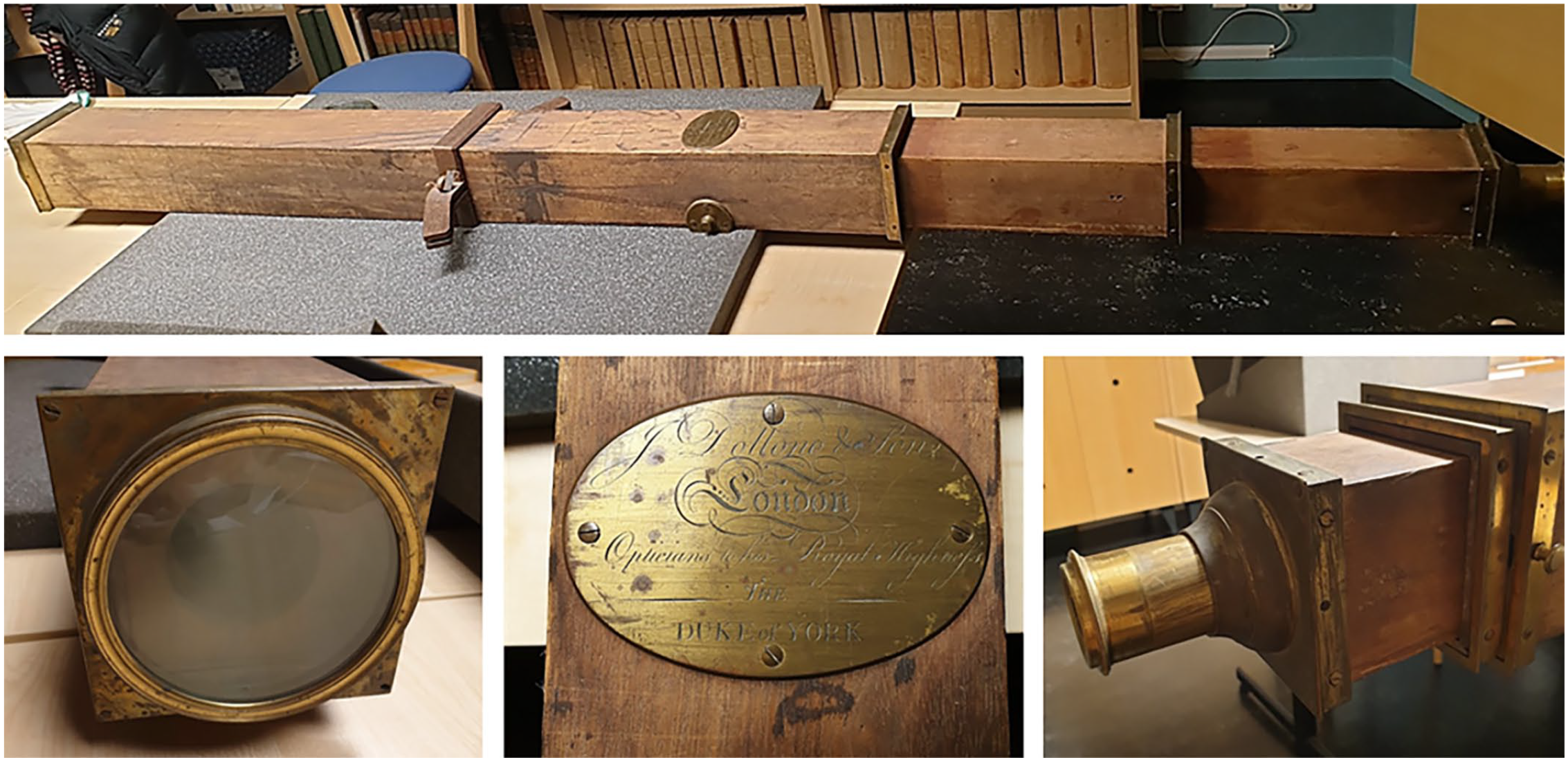
Pictured above is the 10-foot Dollond refractor of the Stockholm Observatory. The telescope is preserved at the Center for the History of Science, Royal Swedish Academy of Sciences.
Klingenstierna’s telescope arrived in Stockholm in late 1760. No preserved documentation sheds any light on his first impressions, but we know from his correspondence with Dollond that he was impressed enough to try to grind his own achromatic lenses. 22 Ferner’s correspondence also makes it clear that other Swedish astronomers were more than curious about the new instrument. 23 When Klingenstierna’s telescope arrived, they also had the opportunity to judge it first-hand.
Who funded the telescope – the royal family or Klingenstierna himself – is not clear, but it seems that Klingenstierna was in full command of the instrument and that he made sure it would be used not only by curious royalty but also by actual astronomers. Pehr Wargentin at the Stockholm Observatory was the obvious choice; the observatory was not far from the Royal Palace, and Wargentin, who had studied under Klingenstierna in Uppsala, was among his group of protégées. Accordingly, in the early 1760s, the Dollond telescope resided most of the time at the Observatory and was only moved to the Royal Palace when the royal family wanted a tour of the night skies. For example, in anticipation of a lunar eclipse on 18 May 1761, Klingenstierna, by way of his valet, tells Wargentin: I have the honour to let You know that the Observatory will not receive the blessing tomorrow, as was intended, by reason that the Lord has located his occultation at such an uncomfortable time [totality at midnight]. Now, as I have reason to believe, that the Authority [the royals] will desire to see what I can show here, I ask You to send the English tube back with my valet. I would not ask for him if it wasn’t ordered from a higher station, and I couldn’t say no. Excuse Your Humble servant [. . .].
24
A month later, it was back at the Observatory. Together with several other telescopes, it was used during the greatly anticipated Venus transit of 6 June 1761. Sometime later, Klingenstierna asked for its return, instructing Wargentin to let his valet first carry the telescope to an instrument maker to make a smaller repair to the focus tube. 25
At this time, Klingenstierna’s health was deteriorating. His lungs were damaged from severe pneumonia in 1751 and, in 1759, a bout of yellow fever left him with a range of health problems. 26 In February 1764, when it became clear that Klingenstierna was not going to recover, Wargentin suggested to the Academy that the Dollond refractor should be bought for the Observatory. Klingenstierna, apparently positive to the affair, signed the receipt for 2000 riksdaler later that year (the amount corresponded to one-third of Wargentin’s annual salary). 27 Klingenstierna died in October 1765.
Pehr Wargentin
Pehr Wargentin was an active observer during his years as Academy astronomer, averaging 50 observing nights per year. 28 Taking the Swedish climate and his demanding duties as permanent secretary into account, this must be regarded as quite an impressive performance.
Working through Wargentin’s neatly kept observation journals, the lack of qualitative observations is striking. There are, for example, numerous observations of the motions of Jupiter’s moons but, with few exceptions, the constantly changing surface features of the planet are not mentioned. 29 However, this is typical of the astronomy conducted in the age of celestial mechanics. It was all about angles and times – where and when, not what and how. To observe Jupiter was to track its motions relative to the celestial sphere and, more importantly, to clock the moon’s movements in and out of the planet’s shadow (immersions and emersions).
To aid his endeavours Wargentin had access to several instruments, in addition to the observatory clocks. To begin with, the 3.5-foot Bird transit mentioned above was used for observations on the meridian, including observations of the sun’s meridian transit, which, weather permitting, were made daily and used to set the astronomical clocks. He also had access to two smaller single-element refractors (5- and 8-foot, both by Daniel Ekström) equipped with micrometres. These were used to measure angular distances within the field of view (e.g. to measure the apparent diameter of a planet), as well as during lunar and solar eclipses when low magnification and a larger field of view were preferable. The question is now how the more powerful Dollond 10-foot achromatic refractor was used in relation to these instruments, and in addition, how this new type of telescope performed. To answer these questions, we will turn to Wargentin’s observation journals.
Three journals are housed in the archive: the first, documented in Swedish, was maintained until Wargentin’s appointment as Academy astronomer, spanning the years 1749–1756. The second journal commences with a condensed translation into Latin of the initial one, subsequently covering the years 1757–1766. The last journal, also in Latin, encompasses the period from 1767 until his demise in 1783. The journals will provide a backbone for this narrative, but will be enriched with published papers and archival materials. In the upcoming sections, we will start with the Venus transit of 1761, the first time the telescope was put to a proper test. Following this, we will spotlight a couple of noteworthy instances from Wargentin’s body of work, commencing with his enduring exploration of the motions of Jupiter’s moons.
The Venus transits
In the wee hours of 6 June 1761, the Stockholm Observatory was bustling with activity. Wargentin, who for several years had meticulously been planning for observations to be carried out at various locations across Sweden, had himself assembled a group of colleagues at the Observatory. 30 They were joined by Crown Prince Gustav, his mother Queen Lovisa Ulrika, several councillors and a crowd of curious onlookers. Among the fellows, Klingenstierna was present with his new telescope, while Academy physicist Carl Johan Wilcke, councillor and archivist Johan Gabriel von Seth, and opticians and brothers Pehr and Carl Lehnberg were preparing smaller instruments. Physicist and politician Jakob Gadolin stood by the pendulum clock, ready to announce the time. As the sun emerged on the horizon at 3 o’clock, everyone took their positions (Figure 4). Although the sky was clear, the horizontal haze made it challenging to observe the beginning of the transit. Wargentin recorded the first contact, or exterior ingress, at 3h 21′ 37″, followed by Klingenstierna a few seconds later, and then the rest of the group. 31
Later, when composing his report for the Academy proceedings, Wargentin began by detailing the instruments employed in the observations. He himself used an ‘ordinary’ 21-foot single-lens refractor, built by Daniel Ekström, which had been stopped down to an aperture of 5 cm. In this context, this was the instrument against which Klingenstierna’s new telescope was measured. Wargentin describes it as: [. . .] a Refractions Tube of 10 feet focal length, made by the famous English Instrument-maker Mr Dollond, after his own new invention, with an Objective-glass which is composed of two lenses, one convex and one concave [. . .]. To this was now applied an eyepiece, consisting of two glasses; one of 2 Swedish decimal inches [59 mm], and one of only 5 ½ lines [16 mm] of focus, as this tube makes at least as great an effect as an ordinary one of 50 feet in length. It has, moreover, the advantageous property of preventing to a greater extent the irregularity of the objects, and the colours, which in the ordinary Refraction Tubes may be caused by the different refractions of heterogeneous rays; wherefore also Tubes of this new kind are particularly useful for Observations of the Sun.
32
Thus, the Dollond refractor was in Wargentin’s view more powerful than standard refractors, the image it produces was sharper, and to some extent colour corrected. Let us see how this ‘particularly useful’ instrument behaved.
The timing of the first through to the fourth contact does not reveal much – Wargentin and Klingenstierna recorded times that differed by just a few seconds. 33 However, there was one instance where the outcome was differed. About a minute before the second contact, Wargentin noted something peculiar. Writing in the third person singular he explains that ‘he saw clearly the whole curve’ of the planet silhouetted on the solar disc, ‘though with a fainter light on the outer side, which was last to enter’. 34 Wargentin hesitated but believed he saw hints of an atmosphere around Venus. 35 The procedure repeated itself during the emersion, when Wargentin, with Venus more than halfway through the emersion, still could trace a shining faint outline of the planet on the half that was outside the solar disc. In both instances, he asked Klingenstierna to collaborate on the observations, but Venus’ atmosphere did not reveal itself in the more powerful telescope. This might be explained by differences in experience or in magnification (Wargentin observed in 90×, Klingenstierna in 140×), but it is also possible that in this particular setting, Wargentin’s telescope outperformed the Dollond achromat.
During the second Venus transit, 3 June 1769, observing conditions in Stockholm were not as favourable. The sky was reasonably clear, but when the transit started it was after 8 o’clock in the evening and the setting sun stood just a couple of degrees above the north-western horizon. The crowd that had attended the first transit failed to appear. Gathered at the observatory, Wargentin tells us, were only Johan Carl Wilcke, Colonel Alexander von Strussenfelt and the aforementioned Bengt Ferner, now risen to Chancellery Council [kansliråd]. 36 To maintain consistency between the two transits, Wargentin opted for the same 21-foot refractor which he had used during the 1761 transit. The Dollond refractor, then handled by Klingenstierna, was now in the hands of Ferner. Strussenfelt and Wilcke used smaller 1.5-foot refractors.
The horizontal haze and aerial unrest caused some difficulties for the observers, but after Wargentin observed first contact at 8h 23′51″ they all followed suit within 26 seconds. When the second contact occurred, the sun had dropped even further, making it more difficult to determine. Wargentin and Ferner, using the larger tubes, timed the event almost simultaneously: Wargentin at 8h 41′47″, Ferner a second later. Their colleagues were off by almost a minute. Even if Wilcke, observing with a smaller refractor, claimed to see hints of an atmosphere around Venus, neither Wargentin nor Ferner could corroborate the observation.
The setting sun only allowed observations of the beginning of the transit, but the short Swedish summer nights meant that sunrise was due as early as half past three in the morning, well before the transit ended. The rest of the party had left for home by then, but Wargentin was ready. Unfortunately, the sun rose completely hidden by clouds. However, a few hours later Ferner and Wilcke were back, in anticipation of a partial solar eclipse. Observations of the eclipse were an important addendum to the Venus transit since they could be used to determine the meridian distances between northern observers, an important factor when combining Venus observations from different sites. Wargentin now switched to the 8-foot micrometre refractor, while Ferner remained at the Dollond telescope and Wilcke again used his 1.5-foot refractor. 37 The clouds cleared a few minutes after the eclipse began and the three made a successful observation of the event, focusing on how different sunspots were eclipsed by the moon. 38
The moons of Jupiter
If the Dollond achromatic refractor did not show its full potential during the Venus transits, it fared much better when aimed at Wargentin’s favourite target, Jupiter. Let us start with an example, taken from the third of Wargentin’s preserved journals. The first mention of the Dollond telescope in this volume is on 20 February 1767. The short note states: Immersio 1i Satellites, coelo satis sereno, notata Tubo Doll. 10 pedum, cum Oculari 1. aliqvot secundis dubia, propter Horologium non satis verificatum.
39
Jupiter’s first satellite, Io, is moving into the shadow of Jupiter (at 11h 14′44″). The weather conditions are fine, and Wargentin is using his number one eyepiece (which gives a magnification of 87). However, the exact time of the immersion is in doubt. This was due to clouds that partly obstructed the solar transit observed earlier the same day, which did not allow Wargentin to set the clock properly.
This is a typical observation, and he made literally hundreds of them. Most of these concerned Jupiter’s first moon, Io. Revolving closest to the planet, the moon needs less than 2 days to complete an orbit, which means that its immersions and emersions can be observed regularly. Wargentin had been occupied with observations of Jupiter’s moons since his dissertation De Satellitibus Jovis (1741), in which he had determined their orbits. 40 Throughout his career, he continuously tried to improve the precision of his tables, and the observation above is one small part of that endeavour. This kind of research might seem detached, but Wargentin’s tables, in combination with observations of Jupiter’s moons, could be used to calculate longitude, a pressing problem at the time. To reach out to the astronomical community he published his tables in leading ephemerides, and also repeatedly published compilations of Jupiter observations made by himself and others. 41 In international circles, Wargentin was known as a leading expert in this area of astronomical research. 42
From Wargentin’s journal it becomes evident that he had regular access to the Dollond refractor several years before it was acquired from Klingenstierna in 1764. The first mention of the telescope in his journals is from 29 November 1760 and concerns an emersion of Io. The observation is accompanied by at short assessment: ‘Observations made with the new Dollondian Telescope, 10 feet, very excellent. It is certainly superior in many respects to my former 25-footer’. 43 Following the test run, a year elapsed before the telescope returned to the observatory. However, from that point onward and for over two decades, all observations of Jupiter’s moons were exclusively carried out using the refractor. 44 Wargentin did observe other planets, especially Saturn with its satellites, but his primary focus was on Jupiter. On one particular occasion, he even managed to capture an emersion of Jupiter’s first satellite while simultaneously monitoring the progress of a partial lunar eclipse. 45
The optical excellence and light-gathering capability of the telescope made the Dollond refractor exceptionally well-suited for this kind of work. Being considerably shorter than the older single-lens refractors, it was easier to manage, particularly for tracking celestial objects. However, of greater significance was the quality of the image it produced, allowing for accurate timings of the satellite’s immersions and emersions. That this telescope surpassed the performance of older refractors in the case of Jupiter, becomes evident in a 1775 publication in Nova Acta Regiae Societatis Scientiarum Upsaliensis.
In this paper, Wargentin departs from his usual focus on immersions and emersions to explore the insights into the relative sizes of Jupiter’s moons that can be gained from observing the shadows they cast as they pass across the planet. After an introductory section highlighting the limited attention this matter had so far had received, he elucidates how the Dollond refractor facilitated this line of investigation: [. . .] from the time I began to devote myself to astronomical observations, I often sought the shadows of Jupiter’s satellites in its disc, but I was unable to see them through a two-foot Catoptric [reflection] telescope or Dioptric [refraction] telescopes of 20 and 25 feet, although they were of good quality for their kind, excepting the shadow of the third satellite, which I barely saw a few times. However, as the year 1760 was drawing to a close, equipped with a ten-foot Dollondian achromatic tube, I easily observed these shadows and other spots or faculae on the disc of Jupiter, not only by applying to this tube an eyepiece that increases the diameters of objects a hundred and eighty times, but also by eyepieces that increase them a hundred and twenty, forty, and ninety times.
46
Although the Dollond refractor had an adequate aperture for the necessary high magnification, it lacked a micrometre. As a result, Wargentin had to depend on visual comparisons when multiple moon shadows were simultaneously visible on Jupiter’s disc. Presenting a series of such observations, made between 1761 and 1775, he arrived at his conclusions: the second satellite (Europa) is the smallest, followed in ascending order of size by the first (Io), the fourth (Callisto) and the largest being the third (Ganymede). Additionally, based on his best estimation that Ganymede is 1/25 of Jupiter’s diameter, he inferred that the moon must be larger than Mercury. 47 Despite the method’s limitations, his findings align perfectly with modern values.
The 1769 comet
During his years at the Academy Observatory, Wargentin observed four comets with the Dollond refractor: the great comet of 1769, which we will use as an example here, and three lesser comets in 1766, 1771 and 1773, the latter of which he chanced upon, but soon lost track of. 48
The 1769 comet was first discovered by Charles Messier on 8 August. During the autumn, it developed into one of the all-time greats (many years later Messier nicknamed it Napoleon’s Comet, due to it appearing close to his birth on 15 August).
49
When news of it, forwarded by Erik Prosperin at Uppsala Observatory, reached Wargentin at the end of August, he was returning to Stockholm from a trip to the countryside.
50
He got his first chance to observe the comet in the early morning of 3 September: It then stood in the left [west] arm of Orion, somewhat below the star [1] Orionis, and stretched a straight, thin and faint Tail, beyond [Nu] Tauri, towards the head of the Whale [Cetus], to about 30 degrees length. With Tubes I could not see a solid core where the actual body was supposed to be, instead it looked like a small pale-white nebulous spot, slightly brighter in the middle. With the big Dollondian Tube, the tail was seen emanating from the Comet’s body in two branches [. . .]. With smaller Tubes or naked eyes, no such thing was noticeable.
51
The comet was at the time heading sunwards for its perihelion passage and, in the 2 weeks before it disappeared in the light of dawn, Wargentin observed the comet every clear morning, often accompanied by the aforementioned physicist Wilcke. Under exceptionally clear skies on the morning of 9 September, the tail reached its maximum length of 50° (Figure 2). The coma was very diffuse and thus difficult to measure. Even if it was larger to the naked eye, the micrometre tube put it at 3″. To establish the size of the nucleus, Wargentin continuously used the Dollond refractor to monitor any field stars that might be occulted by the nucleus. However, this was to no avail, mainly due to ‘the number of foreign spectators, that every night appeared at the Observatory, and were such a hindrance for us’. 52
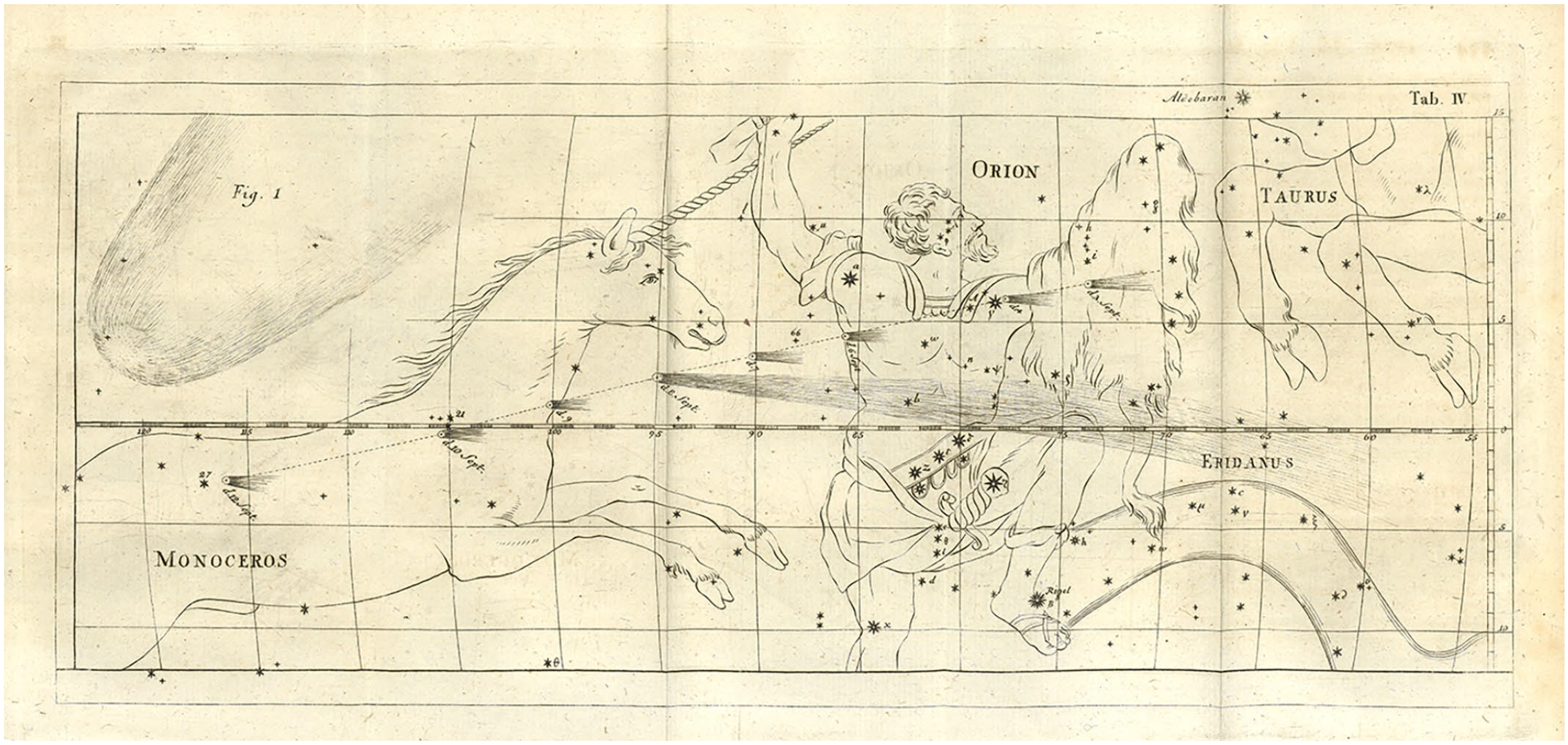
Sketch made by Johan Carl Wilcke and published with Wargentin’s 1770 paper (Note 42). It shows the comet’s trajectory 3–12 September 1769. The full length of the tail is only drawn on 8 September.
Wargentin got his last glimpse of the comet on 12 September, seeing it return after the perihelion passage on 28 October. However, it was now a lot dimmer and continued to dim until his last sighting in early December. He monitored the comet throughout this period but focused on measuring its positions relative to different fixed stars. Thus, the Dollond refractor became idle, and he worked with the 5-foot micrometre refractor instead. His measurements were forwarded to Prosperin in Uppsala, who used them and his own observations to calculate the comet’s orbit. 53 From this it followed, according to Wargentin, that the orbit was elliptical and that the tail at its maximum stretched at least 5 million Swedish miles (around 50 million km). 54
Uranus 1781–82
‘[I]n the quartile near [Zeta] Tauri the lowest of two is a curious either Nebulous Star or perhaps a Comet’.
55
These oft-quoted words were jotted down by William Herschel in his journal on 13 March 1781. Over the following months, this discovery aroused great interest among astronomers. It immediately became clear that the object was moving in relation to the fixed stars, but was it a comet or, as some began to suspect, a seventh planet revolving around the sun? News of the discovery, Wargentin tells us in his journal, reached him in the early summer of the same year, but due to bright Swedish summer skies, observations had to be postponed until August. From his correspondence, we can establish the source as being Anders Johan Lexell, astronomer at the Russian Academy of Sciences, who was visiting London at the time.
56
Through his connections, Lexell also provided data from observations made at Greenwich Observatory during April and May. With the aid of these, Wargentin calculated a trajectory that would place the object in ‘the foot of Castor, a little above the stars [Eta] and [Mu] Gemini’ in August.
57
However, clouds and moonlight interfered, and he did not have favourable conditions until 16 August. He writes: I easily saw [Eta] and [Mu] Gemini, and in their neighbourhood more little stars, a little northerly, and among them a nebula, which I believed at first sight to be a comet. But using a larger tube, I found that this nebula was only a collection of very small stars. If there were any comet or a new planet amongst the others, it would have been impossible to distinguish, for they were all altogether alike, although differing slightly from greater to lesser brightness.
58
His calculation was almost spot on, but his search using one of the smaller refractors had led him astray, so he ended up with a star cluster he had not seen before and which he first took for a comet (Messier 35). However, changing to the more powerful Dollond refractor allowed him to resolve this. The potential planet was nowhere to be seen.
Stockholm was more or less overcast for the following few weeks, hindering further observations. It was not until a week into September that he got a second chance. In the morning of 9 September: [. . .] I saw again the little stars in Castor’s foot, and one between them in a different location than the previous time. This appeared somewhat larger, a little below [Mu] Gemini (inverted in position), and lines drawn to [Mu] and [Eta], made a nearly right angle at [Mu] [. . .].
59
He had found his target.
Over the following months, he made numerous observations, tracking the movements of the planet well into the subsequent year. 60 As soon as Gemini rose high enough to be within reach of the Bird transit instrument, he abandoned the refractor. To calculate its orbit, positions and timings were needed, and that could only be achieved at the transit. Now and then he returned to the 10-foot refractor to try to visually decide the object’s status, but the impressions were contradictory. In mid-December he gave the only qualitative description of the planet to be found in his journal: ‘It seems to me precisely like a fixed star, without a perceptible diameter, its light, proportionate to the small size of its body, scintillating ruddily’. 61 Apparently, a 10 cm aperture (at 90×) was not enough to resolve the planet’s disc.
Wargentin’s changing conception of the object can also be sensed through the development of his vocabulary: the celestial body arrives in September as a ‘Cometa’, but after just a few nights of observing it is rebranded as ‘Stella Mobilis’; in November it becomes ‘Stella Nova’; in February the next year it turns into a ‘Novus Planeta’ or just ‘Planeta’; and finally in November it gets a proper name, ‘Neptunus’. The name, suggested by Uppsala astronomer Eric Prosperin, was in vogue for some time before the astronomical community, on the recommendation of Johann Elert Bode, finally decided on Uranus. 62 By then Wargentin had passed away and, on his last recorded observation of the planet in 1783, it was still Neptune.
The successors
Wargentin had been blessed with good health throughout most of his life but, in the spring of 1783, he suffered from kidney stones and severe constipation, after which his health deteriorated rapidly. He made his last observation on 9 November 1783, again with the Dollond refractor (the Moon eclipsing the star Electra in the Pleiades), and a month later, on 13 December, he passed away. 63
With Wargentin’s death, an era in the history of the Academy, as well as in Swedish astronomy, ended. The instruments were worn down, even outdated, with little funding for modernization; his successors in the post of Academy astronomer would not reach the international renown of Wargentin and their priorities were not in observational astronomy. 64 However, the Dollond refractor lingered on.
Wargentin’s immediate successor as both Academy astronomer and secretary, Henrik Nicander, had worked for many years as Wargentin’s assistant secretary and often accompanied him during observations. None of Nicander’s observation journals has been preserved, but judging from a published paper, he tried for some years to uphold Wargentin’s legacy by making regular observations of the moons of Jupiter. 65 The 10-foot Dollond refractor was used on all these occasions. The refractor also came into use for observing a Mercury transit (1786), a lunar occultation of Jupiter (1788) and a couple of solar and lunar eclipses (1787, 1788 and 1789; 1791). 66 However, in 1791, Nicander, in addition to his other duties, became involved in the Board of Population Statistics, and his observational labours more or less ground to a halt.
To accommodate this, Jöns Svanberg was employed as assistant secretary, with special responsibility for Observatory matters, including observations. When Nicander retired from the post of Academy astronomer in 1803, Svanberg succeeded him. Svanberg’s interest lay mainly in theoretical astronomy and geodetics, but his neatly kept observation journals reveal that he was also an active observer. He seems to have favoured the Bird transit instrument, and the bulk of his observations are either solar or star transits. 67 However, the Dollond refractor was used now and then, for an occasional eclipse or lunar occultation, and especially in 1809–1810, when Svanberg suddenly started monitoring the motions of Jupiter’s moons. 68
To support Svanberg in his labours an assistant astronomer, Jonas Öfverbom was hired in 1805. However, he soon left and was replaced by the astronomer we met in this paper’s introduction, Simon Anders Cronstrand, in 1809. As Svanberg was appointed permanent secretary of the Academy the same year, observatory business was more or less left in the hands of Cronstrand. Two years later, Cronstrand succeeded Svanberg as Academy astronomer.
At the time, the Dollond refractor was half a century old but still in operation. However, the Academy had attempted to replace it. Under Nicander’s direction, a 16 cm speculum mirror for a 210 cm reflector was commissioned from William Herschel. The mirror was received as agreed upon, but due to miscommunications and bad judgement within the Academy, the mount which finally reached the hands of Cronstrand in 1812, after more than 20 years of delay, was a total disaster. 69 The telescope just didn’t work, and Cronstrand had to make do with the old Dollond refractor. And so he did.
Cronstrand’s observation journals, covering the years 1813 through to 1828, tell a very different story to that of Wargentin. 70 To begin with, they are kept in a minimalistic fashion, with few notes, most of them made in pencil, and often leaving out the instruments used. Further, the lion’s share of all observations are solar transits, sometimes supplemented by observations of stars with well-known positions. Timekeeping was a priority for Cronstrand. Other types of celestial observations are thus rare, and it seems that the Dollond refractor was only pulled out a couple of nights per year, to observe an eclipse, a lunar occultation or a comet. As stated in the introduction, the very last recorded observation made with the telescope was that of Comet Encke, in August 1825.
Afterlife
Primarily known for his significant contributions to geodesy, Cronstrand’s impact on the field of astronomy did not measure up to that of Wargentin. However, his enduring influence on the history of the Stockholm Observatory was established in 1819 when he authored a persuasive memorandum that emphasized the urgency of acquiring new instrumentation. 71 When presented to the Academy, this document marked the beginning of a process that spanned several years but resulted in a comprehensive upgrade to the observatory’s equipment. Commissions for a new transit instrument, a meridian circle and an altazimuth-mounted achromatic refractor were all initiated in the 1820s. Despite some delays, these instruments were fully operational by 1834.
Following these changes, the old Dollond refractor became obsolete, and it appears that neither the astronomers nor the Academy showed any further interest in it. It might have been stored away, or it might have been on display somewhere at the Observatory reminding of bygone days, but from 1825 the archives fall silent. The telescope is not to resurface until a hundred years later.
From the early 1920s until his passing in 1934, geophysicist and Academy fellow Vilhelm Carlheim-Gyllensköld tried to realize a Museum for the Exact Sciences. 72 This was the first attempt on Swedish soil to create a museum for the history of science. Although the museum never came to fruition, Carlheim-Gyllensköld was instrumental in raising awareness within the Swedish scientific community about its material heritage. At the time, various defunct instruments, some dating back to the 17th century, lay hidden within attics, basements and various storage facilities at diverse institutions, suffering significant damage due to neglect and falling victim to the ravages of ‘dust, moisture, and rust’. 73 With the Academy’s approval, but lacking adequate funding or a suitable location for a collection, Carlheim-Gyllensköld initiated the process of gathering and cataloguing interesting items. It is in this context that the 10-foot Dollond refractor once again emerges in the historical sources.
As part of the project, Carlheim-Gyllensköld actively contacted directors of different departments to inquire about equipment suitable for the collection. In response to such a request, Bertil Lindblad, the director of Stockholm Observatory, in 1925 provided an inventory of astronomical equipment housed at the observatory. Categorized under ‘transportable astronomical instruments’, and at the very end of the list, accompanied by no further specifications, we find ‘a square wooden tube’. 74 Lindblad, it appears, was unaware of the pedigree of this particular instrument. A few years later, the Dollond refractor, along with other decommissioned equipment, was deposited in the collection of the Museum for the Exact Sciences. 75 Subsequently, it was relocated to a temporary storage room at the Academy’s Natural History Museum in Frescati, on the outskirts of Stockholm (Figure 3). When the lease for this room concluded in 1964, the collection underwent examination, documentation and another move – this time to the attic of the Academy’s building across the road from the Museum.
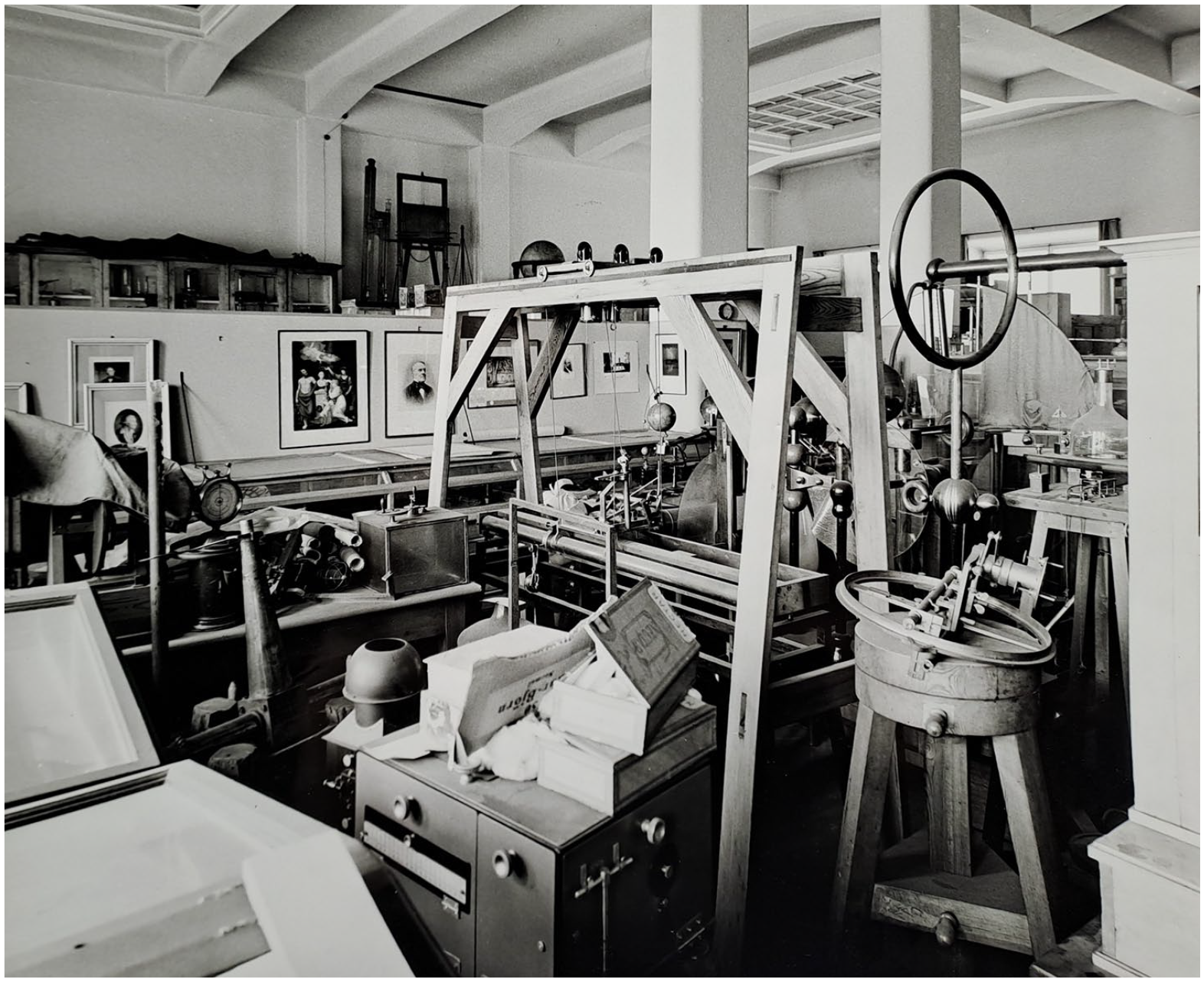
The storage room at the Natural History Museum in 1961. The Dollond refractor is hidden in the jumble of objects, but the Bird transit instrument can be seen sticking up to the left.
As previously mentioned, the Museum for the Exact Sciences did not come to fruition. Nevertheless, items from the collection were showcased in a few exhibitions. One notable exhibition, titled The Heritage from Newton and Linnaeus, was curated by Academy Librarian Wilhelm Odelberg and historian of science Carl-Otto von Sydow. It opened at the Nordiska Museet in Stockholm in 1962 and was marked by its ambitious scope. 76 The exhibition aimed to highlight the numerous connections between Swedish and British science in the 17th, 18th and 19th centuries. Astronomy featured prominently, with a special focus on the achromatic lenses produced in Dollond’s workshop. It featured oil paintings of both Dollond and Klingenstierna, copies of Dollond’s paper in the Philosophical Transactions and of Klingenstierna’s paper in the Academy’s proceedings, as well as Dollond’s previously discussed acknowledgement of Klingenstierna’s role in the development of the achromatic lens. Several achromatic telescopes were exhibited to provide tangible context for these items. However, the 10-foot Dollond refractor was notably absent from the exhibition. Instead, it was replaced by the smaller and little-used 5.5-foot achromatic refractor purchased by Wargentin from Dollond in 1760. Additionally, a few later achromatic instruments on loan from Lund and Uppsala observatories were included in the display.
This oversight is noteworthy, especially considering that the exhibition showcased both the Venus transits and Wargentin’s contributions to the study of Jupiter’s moons – instances where the 10-foot refractor played a pivotal role. Regrettably, the exhibition archive lacks additional information on this matter. 77 However, as we will see, this could have been due to the straightforward issue of wear and tear. The refractor was not in a suitable condition for display, a fact that became evident when it was eventually included, three decades later, as a permanent exhibit in the new Observatory Museum.
In 1931, Stockholm Observatory was closed, and the Academy astronomers relocated to a new, state-of-the-art observatory in Saltsjöbaden, just outside Stockholm. Subsequent to this move, the vacated building served as the home for Stockholm University’s Department of Physical Geography. Many years later, when the geographers decided to find more suitable premises, the concept of transforming the former observatory into a museum took shape. An Observatory Hill Foundation, representing various academies, universities and museums, was established with the overarching goal of restoring the Observatory and establishing a museum on the premises. In 1984, the Foundation formally approached the Stockholm City Council with a request, accompanied by a basic museum plan formulated by Gunnar Pipping. 78 Upon receiving approval from the city council, in 1987 Olov Amelin was appointed to develop the museum. Expanding on Pipping’s initial museum sketch, Amelin developed an exhibit that encompassed the first floor of the observatory building and the museum officially opened its doors in 1991. 79
The exhibition was organized as several thematically focused rooms, such as Wargentin’s Study, the Old Meridian Room and the Clock Room. Various telescopes dating from the 18th and 19th centuries were displayed but, as they had been kept in storage for an extended period, they required extensive restoration before being exhibited. Of particular concern was the 10-foot Dollond refractor, a crucial component in the narrative surrounding the 1761 Venus transit, which was in a notably distressed condition. To address this, Olov Amelin enlisted Nordiska Museet’s conservator Maria Brunskog in saving the instrument. Brunskog’s conservation report revealed that the telescope was not only dirty but also speckled with later paint splashes. An additional and more challenging issue was that the main mahogany tube had cracked along its entire length, and was held together only by some screws from a previous makeshift repair. 80 After thorough cleaning and meticulous repair, the telescope was proudly displayed in the Main Observation Hall.
To provide visitors with a tangible understanding of the impact of achromatic technology, Amelin commissioned the creation of two replica instruments, each at a 1:2 scale – one featuring an achromatic lens and the other with a single lens objective. These replicas were available for hands-on exploration during museum tours. Optician and amateur astronomer Sven O. Rehnlund expertly ground the lenses, while carpenter Per Lindroos crafted the tubes. 81 Additionally, Amelin enlisted museum model maker Eva Rahmqvist to recreate the scene where Wargentin, Klingenstierna and others observed the 1761 Venus transit (Figure 4). 82
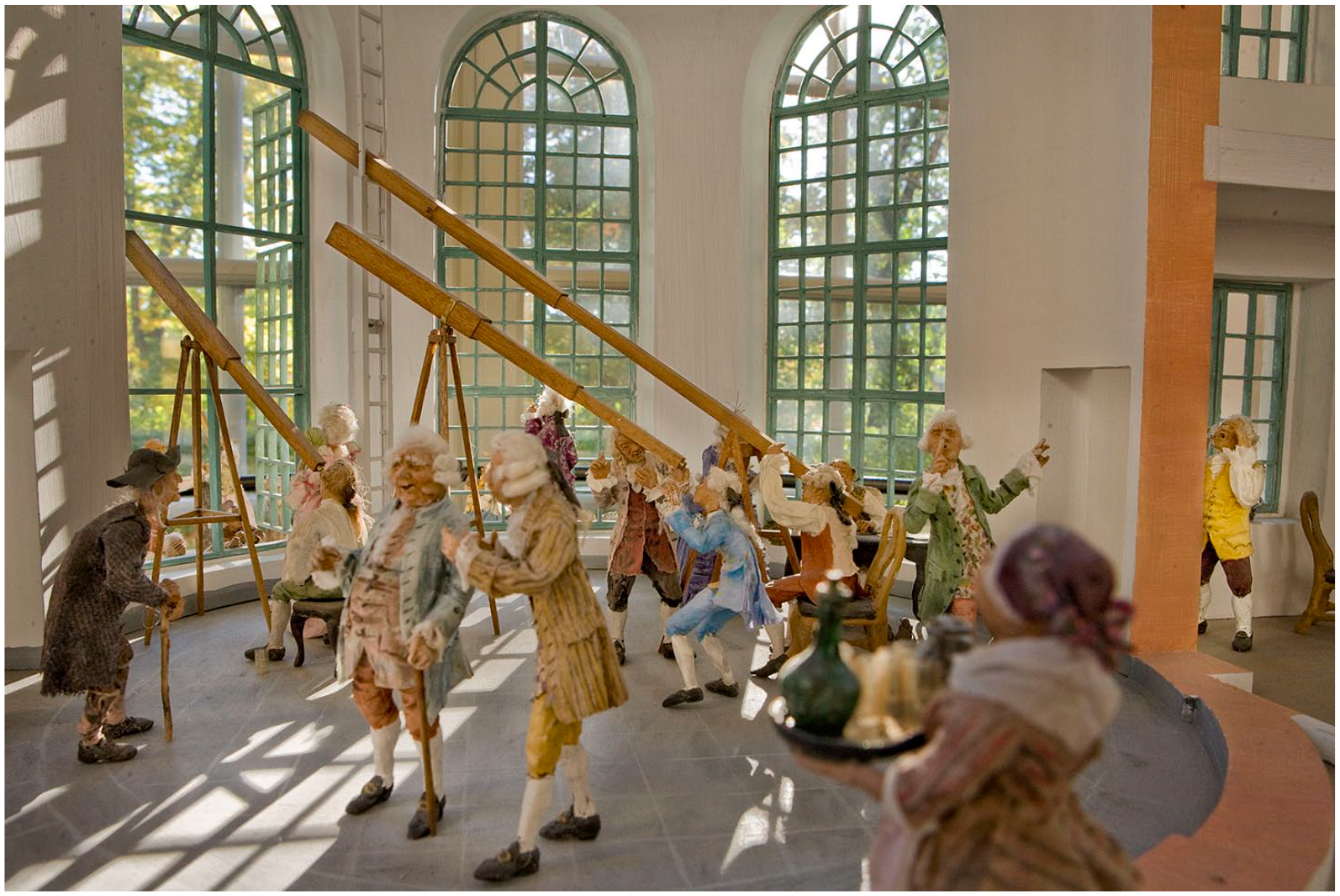
Model by Eva Rahmqvist showing the 1761 Venus transit. The model was, together with the Dollond refractor, on display in the Main Observation Hall at the Museum. Wargentin is seated to the right, observing with his 21-foot tube, the Crown Prince, dressed in blue, is at the Dollond refractor while his teacher Klingenstierna next to him is giving instructions, Gadolin in yellow is to the right at pendulum clock (hidden behind the wall) and the Queen is at the window, back turned, observing the transit through darkened glasses.
With the Dollond refractor once again installed at the Observatory, we reach the end of this story. In 2014, the Observatory Museum was closed. The Academy, having assumed full responsibility for the Museum in 1999, deemed it too costly to maintain and consequently opted to discontinue its operation. A few years thereafter, the building was sold to the City of Stockholm, and a declaration of intent was signed, in which the city pledged to reopen the museum. Regrettably, at the time of writing, the museum remains closed. A significant part of the exhibition remains on the premises, but the 10-foot Dollond refractor has been returned to the Center for the History of Science.
Concluding remarks
In the frail light of Comet Encke, the scientific career of the Dollond refractor came to a close. For a short while, back in the 1760s, the 10-foot Dollond refractor had been state-of-the-art and one of the most powerful instruments to leave Dollond’s workshop. Wargentin was, as we have seen, impressed by the ‘excellentissimis Tubis Dollondianis’. 83 The refractor improved the precision of his observations, not least regarding the moons of Jupiter, and enabled certain kind of observations unattainable with older single lens telescopes. Other Swedish astronomers were equally impressed by the optical qualities of the achromatic telescopes, and following Klingenstierna’s example they ordered similar refractors for their observatories: Lund Observatory bought a 9-foot achromatic refractor in 1778, and Uppsala Observatory a 10-foot in 1779, both from Dollond. These instruments were used well into the 19th century before eventually being replaced.
As we have seen in this paper, there were limited uses for an instrument of this type. Lacking a micrometre, the 10-foot Dollond refractor was not fit for positional astronomy; for this, other instruments had to be engaged. Since qualitative observations of celestial bodies were not yet in vogue, its uses were limited even further. However, together with an accurate regulator clock, its resolving power and image quality could be harnessed for the precise timing of transits, eclipses, occultations, immersions and emersions, producing data that could be churned in the machinery that was celestial mechanics. This was a brand of observational astronomy mastered by astronomers such as Wargentin.
What actually came of all this? Eighteenth-century Swedish scientists published most of the work intended for a Swedish audience in the proceedings of the Royal Swedish Academy of Sciences (Kungl. Vetenskapsakademiens Handlingar) and, if they wanted to reach a broader audience, in Latin in the Uppsala journal Nova Acta Societatis Regiæ Scientiarum Upsaliensis, or sometimes in international journals like Philosophical Transactions. 84 In this respect, Wargentin was by far the most productive of the astronomers who got to use the Dollond refractor. Searching through the sources mentioned above, we find close to 30 published papers in which the 10-foot Dollond refractor had been used for observations. Nineteen of these are by Wargentin, six by Nicander and one each by Svanberg and Cronstrand. In addition, Wargentin more or less annually submitted his (and others) observations, particularly of Jupiter’s moons, to international journals, such as Ephemerides Astronomicae ad Vindobonensem and Berliner Astronomische Jahrbuch. 85 His Jupiter tables, to a large part building on observations done with the refractor, were also widely disseminated and appeared in several international publications. 86 However, gauging impact by publication metrics is not readily applicable to a historical setting, as communication patterns were different. Data, tables, calculations, theories and research ideas were, at the time, more likely to circulate by correspondence. Wargentin was in regular contact with all the leading astronomers across Europe and, due to this vast correspondence, the scientific output of the instrument multiplies in ways that are impossible to estimate.
The scientific significance of the 10-foot Dollond refractor, however, does not align with its fate after retirement. For over 150 years, it languished, more or less forgotten, in storage at the Observatory, later at the Museum for the Exact Sciences. It was not until the late 1980s that efforts were made to clean, repair and exhibit the telescope. However, since the Observatory Museum’s closure in 2014, the refractor has returned to a shelf in the Academy’s instrument collection. There is hope that this important instrument will, at some point, reclaim the spotlight.
Footnotes
Notes on contributor
Funding
The author(s) disclosed receipt of the following financial support for the research, authorship, and/or publication of this article: This research has been funded by a grant from Swedish Research Council (Dnr: 2022-01940).