




Abstract
While the clay used to write cuneiform tablets is well suited to impressing the wedges of cuneiform signs it is not an ideal medium for the curved lines and detailed marks needed to create illustrative diagrams of the heavens well known in neighboring cultures. Yet, in a selection of examples, cuneiform scholars of astronomy and astrology used clay to sketch out complex diagrams of celestial arrangements and schematic representations of astrological concepts. This article will survey the corpus of astronomical and astrological diagrams preserved from cuneiform sources and summarize key observations about the relation of diagrams to texts and tablets and the representation of theoretical knowledge.
Introduction
The purpose of this article is to survey diagrams drawn on cuneiform tablets from the large corpus of astrological and astronomical literature in Ancient Mesopotamia. Together with diagrams from Egyptian sources, the material from the cuneiform world provides some of the earliest evidence of astral theories and paradigms portrayed in visual form on textual media. The other major importance of this corpus is that the diagrams themselves are contemporary to and often written on the primary texts that make up the corpus of astral science in Mesopotamia. This fact allows us to treat the diagrams as witnesses to scholars thinking both in textual and visual ways at the same time; which is particularly useful for genres of knowledge, like astrology, that rely so heavily on paradigms. Within cuneiform scholarship the diagrams represent a small but important corpus that stands in contrast to the normative tradition of scholarly knowledge recorded in list format.
The importance of list making in cuneiform scribal culture cannot be overstated. Early school education began with students copying lists and continued into the upper echelons of highly specialized sub-fields of cuneiform knowledge where advanced students copied lists of technical vocabulary and omens. Modern scholars have long acknowledged the role lists and list-making has played not only in preserving knowledge but in forming it; specifically in creating a certain cultural identity codified early in education and extending throughout the rest of a career as a member of the Mesopotamian scribal elite. 1 The way these lists, representing a wide variety of genres of knowledge, were formatted and structured is key to understanding how scribes thought, and how they materialized, in clay, the interconnections and relationships between genres of knowledge. For the vast majority of cuneiform scholarship the list was a main method of reproduction. Whether a scribe was learning through reading and copying or creating new texts, lists of words, names, or numbers in cuneiform were the primary way to display scholarly interconnections between terms and concepts. 2
By contrast, drawings and diagrams on clay represent a different way of conveying scholarly knowledge. Students and professional scribes used their styli to scratch curves, lines, and impress dots in their tablets (often accompanied by text). These marks form the corpus of drawings and diagrams preserved on cuneiform tablets from the wide temporal span of cuneiform writing in Mesopotamia. 3 Many examples of diagrams and illustrations from Mesopotamia were produced by students tasked with replicating a field drawing or calculating the area of a complex shape. 4 Apart from these drawings, a small subset are attempts to represent complex concepts in graphical form such as paradigms of esoteric knowledge. Of this subset a smaller group of cuneiform diagrams preserve depictions of astronomical and astrological ideas. These astral diagrams are the subject of this article; a total corpus of under twenty unique material objects dating between the end of the second millennium BCE and the end of the first millennium BCE recovered in either controlled or illicit excavations in Iraq and now in museum collections. Not surprisingly most of the astral diagrams discussed below take the form of circles with further illustrations and text inscribed within. In a few unique cases constellations are drawn out in figural or conceptual form. This paper will show how these diagrams offer insight into the practices of Mesopotamian scholars associating forms of astral knowledge in graphical configurations that diverged from lists of terms.
Related cuneiform genres
Alongside astral diagrams there are three closely related visually oriented modes of depiction, which for the purposes of this article are considered distinctly separate; these are: maps, mathematical diagrams, and finally a collection of ekphrastic uranology texts (which describe methods to draw constellations). The astral diagrams could be considered a form of map, but rather than depicting the landscape around the mapmaker they depict the configuration of the heavens. Likewise, mathematical diagrams are certainly diagrammatic in the way they present schematic information, but the context of their use is predominantly schooling and bureaucracy. Finally, the uranology texts are not images, rather, they are descriptions of images of the constellations, details of which match the some of the following diagrams.
It would be remiss not to connect the development of diagrams to the history of mapping on cuneiform tablets. The attempt to portray real world objects in relation to each other is obviously at the heart of both diagrammatic and mapping processes. However, most cuneiform maps represent shapes on the ground that can be measured and walked by humans, the need to diagram them is governed by the need to document nearby “real” space as it pertains to ownership and property rights. 5 The points and markers on the map do not represent abstract concepts or bodies far removed from daily terrestrial experience. Rather maps are usually a representation of physical knowledge in a two-dimensional space. 6 Maps need not represent physical space in some direct proportion (although they often do), but rather maps describe spaces that are usually geographical in nature. 7 Therefore the line between maps and diagrams is perhaps more one of a restricted subject matter for the former, and an overarching category assigned to the latter.
Similarly, a comparison must be made between diagrams in astronomical and astrological contexts and their near-neighbors in mathematical texts. There are a (comparatively) large number of mathematical diagrams, most dating from the Old-Babylonian period. These mathematical diagrams depict shapes as abstract concepts as well as field plans. They often include labels annotating the diagram with numerical values, sometimes written directly on the lines of the diagram itself. However, Eleanor Robson has noted that we should not expect these diagrams to have any quantitative basis in the reality they represent:
“In short, Mesopotamian depictions of ’realia’ . . . were not intended to be realistic drawings; neither were they scale replicas. Rather, they present an alternative view of numerical data which is visually logical and consistent with the textual description and which may also augment the text by providing information about spatial relationships.”
8
However these mathematical diagrams are removed both temporally and contextually from the astral diagrams of this article. They serve as an antecedent to the astral diagrams in that they represent the marking and labeling of shapes onto clay. 9 Unlike the astral diagrams discussed below, these mathematical diagrams, as Robson mentions, often have a very explicit relationship to a description contained within text often inscribed on the same physical object. 10
Finally, the uranology texts represent a non-graphic relation of text to image where the text itself gives instructions for the production of images or diagrams of the constellations. These texts describe some of the very images found in the astronomical and astrological diagrams under consideration here. 11 While they are not visual in nature, the ekphrastic language attests to a visual form of knowledge. The fact that at least one of the descriptive passages aligns closely with a section of a constellation diagram (4.1.2.1) indicates the close relationship between the uranology texts and the production of astral diagrams. They suggest the existence of missing diagrams that may have been drawn on perishable materials like wax writing boards.
In sum, cuneiform scribes were familiar with the process of drawing shapes in clay and pairing them with descriptive text. These shapes could either be abstract mathematical constructions or real mapped space. This drawing practice started in the earliest phases of schooling and proceeded down to the end of cuneiform writing. At the same time, scribes also wrote highly ekphrastic works that could describe the unique appearance of a configuration of stars in the sky. Despite the limited size, the corpus of astral diagrams does not exist in a vacuum, rather it is part of a larger practice of drawing on cuneiform texts.
Text and image
In the entire corpus of cuneiform astral diagrams, the diagram is never mentioned within the accompanying cuneiform text. If any connection is to be found between text and diagram it is in recognizing some paradigmatic sequence in the text which happens to also be illustrated in the diagram, but this is not a direct reference, as one might refer to a figure in a text. There are some mentions of “drawings” but these unfortunately only appear on texts which lack any illustration, suggesting that diagrams were intended but never added or completed. In another case, discussed below, a Micro-zodiac tablet has a small space set aside for where diagrams exist on another tablet of the same text. The scribe copied only the labels found on the larger diagram into this smaller segment of the text, thus clearly implying knowledge of the larger diagrams present on the other tablet.
One example of diagram making is preserved on a letter to the Neo-Assyrian king, in which a scribe instructs an official to draw “the stars, 3 of each” based on a tablet that had been before the king. This almost certainly refers to the astrolabe texts discussed below:
“Let them bring in that polyptych of Enūma Anu Enlil which we wrote, (and) let the king, my lord, have a look. Also, let them give us the Akkadian tablet of the king; the stars, 3 of each, should be drawn therein after (its model). An eunuch should be appointed to open the seal (and) to supervise the drawing.”
12
Despite a lack of direct reference, the diagrams that are preserved have a close relationship with existing texts if not necessarily with the texts that are written adjacent to them. The text which perhaps has the largest connection to the corpus of diagrams is, not surprisingly, the composition
Corpus
While diagrams exist on cuneiform sources from at least the latter part of the third millennium onward their use for describing the astronomical and astrological world does not begin until roughly the first millennium BCE. 15 The distribution in the first millennium is concentrated on the Neo-Assyrian period and the later Achaemenid and Hellenistic periods. In sum, there are currently thirteen attested diagrams, although that number is likely to expand slightly with further scholarship. The total corpus can be divided in a number of ways. First of which is the nature of the interaction between the diagram and any text which shares the tablet on which it is incised (as discussed above). Some diagrams take up the entire face on which they are placed, leaving no room for text wrapping around their edges. In other cases the diagram might be surrounded by text which either offers some explanatory information or is otherwise not directly related.
Astral diagrams are also either circular or linear in overall shape. Both formats offer advantages for visualizing patterns in the heavens. Circular diagrams offer an obvious illustration of the contiguous nature of the heavens. While linear diagrams are able to offer closer detail for bands of the sky, for instance the ecliptic. Linear diagrams also more readily mirror the–often linear–text from which commonalities were evinced. A few of the examples mentioned below lack any imagery but are reconfigurations of text into a circular pattern. Despite the lack of illustration these are still novel and important pieces of evidence for astronomical diagrams. Placing the text in a structure which does not reflect that innate direction of reading in and of itself is a graphical representation of relationships hidden within the text. 16 In all of these cases they represent a conceptual understanding of astronomical or astrological knowledge placed within a novel layout. While in some ways the layout or structure of the diagrams might seem self-evident—for instance, their use of space and formatting seem to be a natural fit for our conception of how the heavens are organized—it is important to remember that the construction of these diagrams was a conceptual leap and a significant achievement. The cognitive work required to completely restructure a text that was composed or copied in a linear layout into a new format, especially when that new format attempted to illustrate a fundamental truth of the contained knowledge (i.e. the circular nature of the heavens) was hard work. 17
The diagrams discussed below can be roughly dated by whether only stars and constellations are described or the signs of the zodiac are explicitly named. This division segments the corpus into texts which are attested before the Achaemenid period (primarily Neo-Assyrian) and those which date to the Achaemenid and Hellenistic eras. Because the zodiac was probably invented around the end of the fifth c. BCE this allows us to give a rough terminus post quem for the diagrams which use zodiac signs. 18 However, the conflation of zodiac signs and month names present in much of the astronomical and astrological literature complicates this dating to some degree.
While only a few of the diagrams are illustrated in this article, the reader will be directed to the notes for each diagram which indicate where an original image can be found.
Circular diagrams
Circular diagrams make up the majority of astronomical and astrological diagrams preserved on cuneiform sources. 19 In most cases, the circular diagrams take the form of tables of data (presumably originally in rows and columns) wrapped around a central point. They are diagrammatic because they can illustrate, through their circular nature, connections between the rows and columns of the source data that would otherwise be impossible to visualize in a linear or two-dimensional form. As for their content, four of the diagrams contain information about stars or constellations without mentioning the zodiac. The rest use signs of the zodiac as their organizing principle. One commonality across all of the circular diagrams is that they are all meant to be read starting from the outside and moving inward. 20 One possible exception is the text K. 8538 (4.1.2.2) where the text is oriented in a wide range of directions. In all but one case (4.1.4.1) the circular diagrams proceed clockwise when listing months, zodiac signs, or stars in the sky.
The circular diagrams can be distinguished in two ways. The first is the number of radii into which the circles are subdivided; at least five of the examples are divided into 12 equal parts, and one into eight. The second is whether they attempt to depict any configuration of stars as they are arranged in the sky; here four diagrams preserve different ways to depict configurations of stars, and the rest make no attempt to depict stars or constellations. All nine diagrams contain text within their borders used as both labels and supporting information.
Of course Mesopotamian astronomers understood that these lists of stars were themselves a contiguous circle, but these diagrams represent a manifestation of that understanding in visual form. Evidence, of that understanding, is found on at least one (non-diagrammatic) tablet of ziqpu-stars where an initial group of stars is given and then summed up with the statement, “A total of 12 leagues of the circle of (those that) culminate amidst the stars of the Path of Enlil.” 21
Circular astrolabes
Two of the circular diagrams are the so-called “astrolable” texts from the Neo-Assyrian period (roughly 900–611 BCE), Sm. 162 (4.1.1.1) and K. 14943+ (4.1.1.2). Both tablets are fragmentary but are remarkable not only for their diagrams, but for the fact that the tablets themselves conform to the shape of the diagram itself. The vast majority of cuneiform tablets, with or without diagrams, are rectangular. As mentioned above, this style of diagram may in fact be referenced in a letter to the Neo-Assyrian king where an official is instructed to draw a diagram from a source text and show it to the king.
The two Neo-Assyrian circular astrolabe diagrams are closely related to a complex genre of texts generally also known as “astrolabes.” The earliest exemplars date to the Middle Assyrian period during the second millennium BCE, but texts exhibiting astrolabe content are found in a wide variety of later periods and contexts. Generally the astrolabes contain lists of stars in different configurations, some of which are useful for time-keeping. Both circular diagrams take the third list of stars from Astrolable B and format the linear list of stars into a circular contiguous pattern. The two diagrams also added inset numbers into each of the cells of their radii. The numbers follow a well known pattern of assigning the ratio of 2:1 for the length of daylight and nighttime at the yearly solstices. Each path of the sky (Ea, Anu, Enlil) is given a number, with the path of Ea receiving the largest number, Anu half of that, and Enlil half of that again (a quarter of Ea). The maximum therefore is 4.0 for the length of the day during the summer solstice, which is found in the path of Ea in month III. The minimum of 2.0 is found in the path of Ea during the winter solstice in month IX. The half and quarter numbers found in the paths of Anu and Enlil for each radii might indicate the weight of water needed to measure a half or quarter part of the day in a water clock.
Sm 162
The text Sm. 162 is a small fragment of a larger tablet. Its original context is probably one of the various ancient libraries and private collections from the Neo-Assyrian city of Nineveh that now make up the group known as “Assurbanipal’s Library.” 22 The obverse contains a small part of a large circular diagram of the three paths of stars in the sky. The reverse contains a section of “The Hilprecht Text,” a mathematical problem text concerning stellar distances attested on one text from the Kassite period and another small fragment also dating to the Neo-Assyrian period (Figure 1). 23
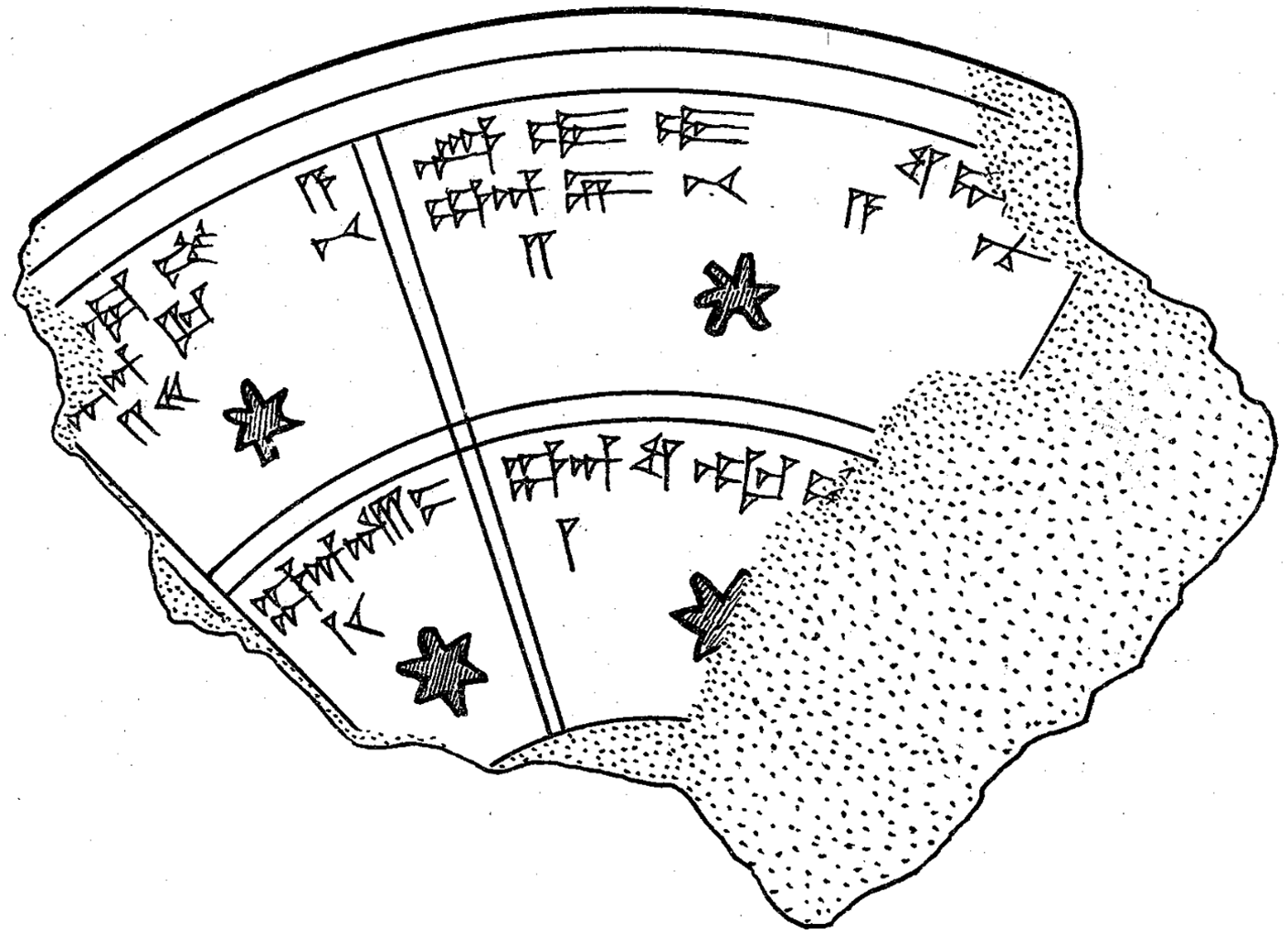
Sm. 162 detail, fragment of circular astrolabe with incised star (from CT 33 11).
The fragment preserves two out of a presumed 12 radii of the circular diagram. The outermost ring of the diagram is assigned to stars in the path of Ea, the middle ring contains stars in the path of Anu, and while it is not preserved, presumably a final inner ring contained stars in the path of Enlil. This well known division of the sky into three paths is found in the text
Each radius of the circle contains the aforementioned three rings. In the outermost ring, the path of Ea, a month name is written followed by a star name, and a number. After the text, and slightly below it, there is a six-pointed star incised roughly into the middle of the cell. The middle cell (and presumably the inner also) contains the name of a star as well as an incised six-pointed star.
The contents of each cell exactly match the third section of the Astrolabe B text, with the addition of numbers in this diagram. The third section of Astrolabe B is a table of 12 months and associated stars found in the paths of Ea, Anu, and Enlil (in that order). Each month is assigned three stars, one from each path. The two radii preserved on Sm. 162 contain the first two rings of month 8 and month 9 and the associated stars as found in Astrolabe B.
K 14943+
The second of the two circular astrolabes, K. 14943+, only differs in small ways from the previous text. Like the tablet above, its archaeological context was also probably the ancient city of Nineveh. It consists of two fragments which do not physically join but certainly come from the same original tablet. Like Sm. 162 it also has three rings divided into presumably 12 radii. On the existing object roughly six radii are partially preserved (Figure 2). 24
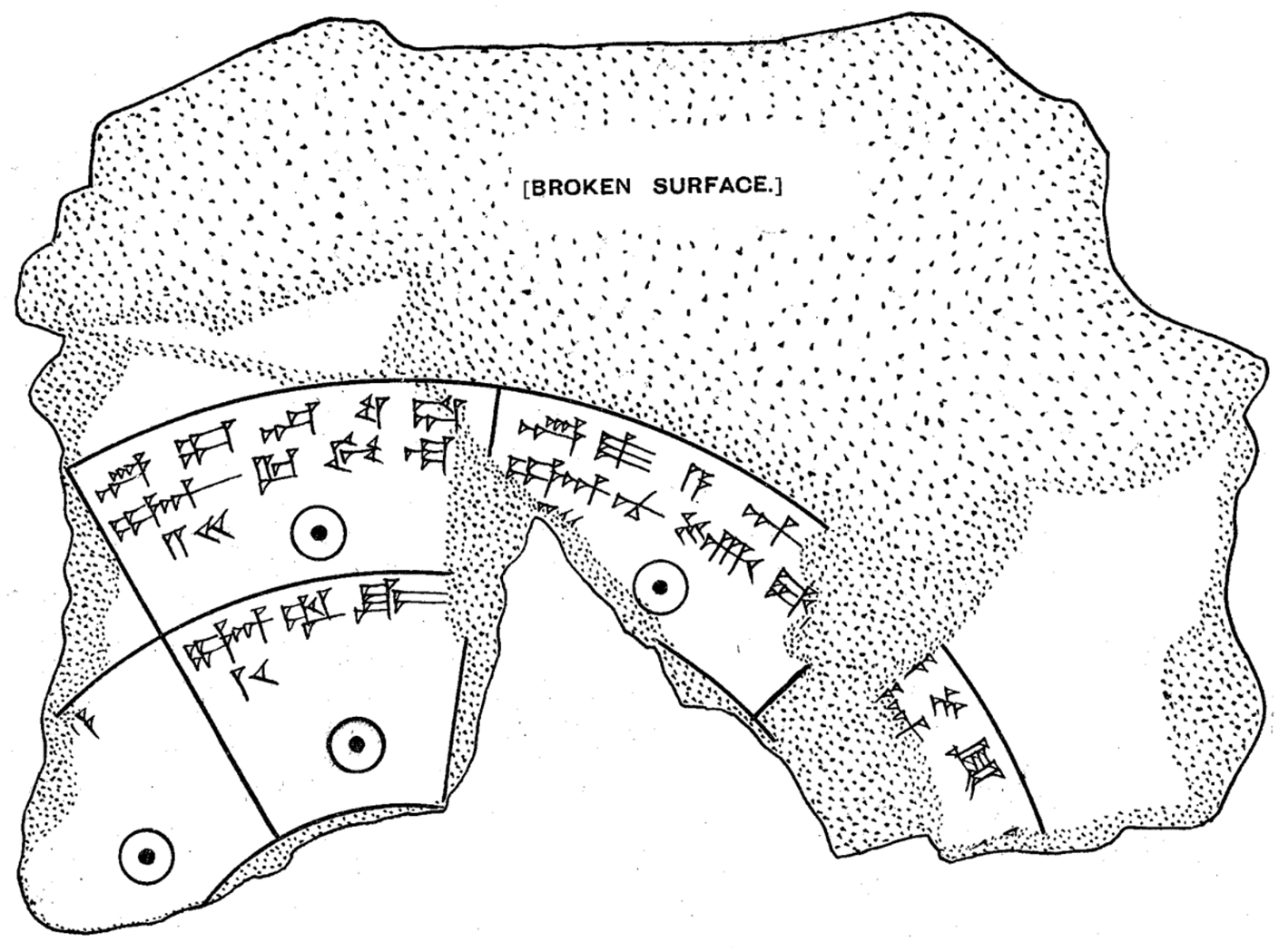
K. 14943+ detail, fragment of a circular astrolabe with incised circles (from CT 33 12).
Each radius contains in its outer ring the name of a month, a star in the path of Ea, and an incised circle (not a star as in Sm. 162). In the middle ring there is a star in the path of Anu and an incised circle. Finally the inner ring, which is preserved on the smaller of the two fragments (not inculded in Figure 2), contains a star in the path of Enlil and an incised circle. The three incised small circles inside each radial cell also exhibit a curious pattern, the outer two have clear points in the centers of the circle, whereas the circles in the inner ring have no center points.
Circular star catalogs
Distinct from the astrolabe texts there are two more circular diagrams that depict stars or constellations which predate the invention of the zodiac. These are the so-called Sippar Planisphere (4.1.2.1) and tablet K. 8538 (4.1.2.2). These two texts do not share the similarity present between the previous two diagrams. Each diagram presents information about stars and constellations in different ways. Most notably K. 8538 is divided into only eight segments instead of the 12 divisions that all of the other circular diagrams use. On the other hand, the Sippar Planisphere keeps the 12 radii division but instead of listing stars in the three “paths” of the sky, it describes, in rough terms, their appearance with key stars that make up the constellation depicted beneath the textual description.
Sippar Planisphere
The Sippar Planisphere is a Neo-Babylonian circular diagram similar in some ways to the two circular astrolabe texts above but deriving from a different tradition. It is divided into 12 radii each roughly 30°. Each radius contains a short cuneiform text identifying two or more stars and constellations. Below the text the scribe has incised a number of small dots in configurations that resemble the celestial objects mentioned in the text for that segment. The center of the diagram contains a stylized rosette. The reverse of the circular tablet contains a list of stars and distances that parallels other known ziqpu-star lists. 25
The short text in each segment describes the stars that make up part of a constellation in the sky. For instance the segment for the constellation Leo reads, “The four (stars) of its (Lion’s) chest, the two (stars) of its flank.” Beneath this line of text there are four dots impressed near the beginning of the line, indicating the four stars of the constellation’s chest, and two dots impressed under the end of the line, indicating the two stars of its flank. This pattern of descriptive text and impressed dots representing stars is found in the rest of the preserved segments.
The depiction of the constellation “The Crab” in this diagram is paralleled exactly by a section from one of the uranology texts. The description from the text reads, “Four stars at its sides are drawn; inside it six stars straddle one another. . .” 26 This section of the diagram has four larger dots arranged in a box formation and within them are six smaller dots arranged in pairs. The close parallelism between the uranology text and this diagram is remarkable and clearly illustrates a common understanding of the description and layout of constellations in Mesopotamian astral science.
K 8538
While at first glance this object might closely resemble the previous three circular diagrams it is quite different. The most obvious difference is the division of the object into eight radii rather than 12. This presents a problem because this diagram does not conform to the standard division of the heavens into 12 equal segments of 30° each. 27 The diagram itself is rich with imagery and text, and while the whole diagram is meant to be read counter-clockwise, the actual orientation of the cuneiform signs is flexible. Out of the eight segments, six preserve at least some evidence for incised drawing, and all preserve text (Figure 3). 28
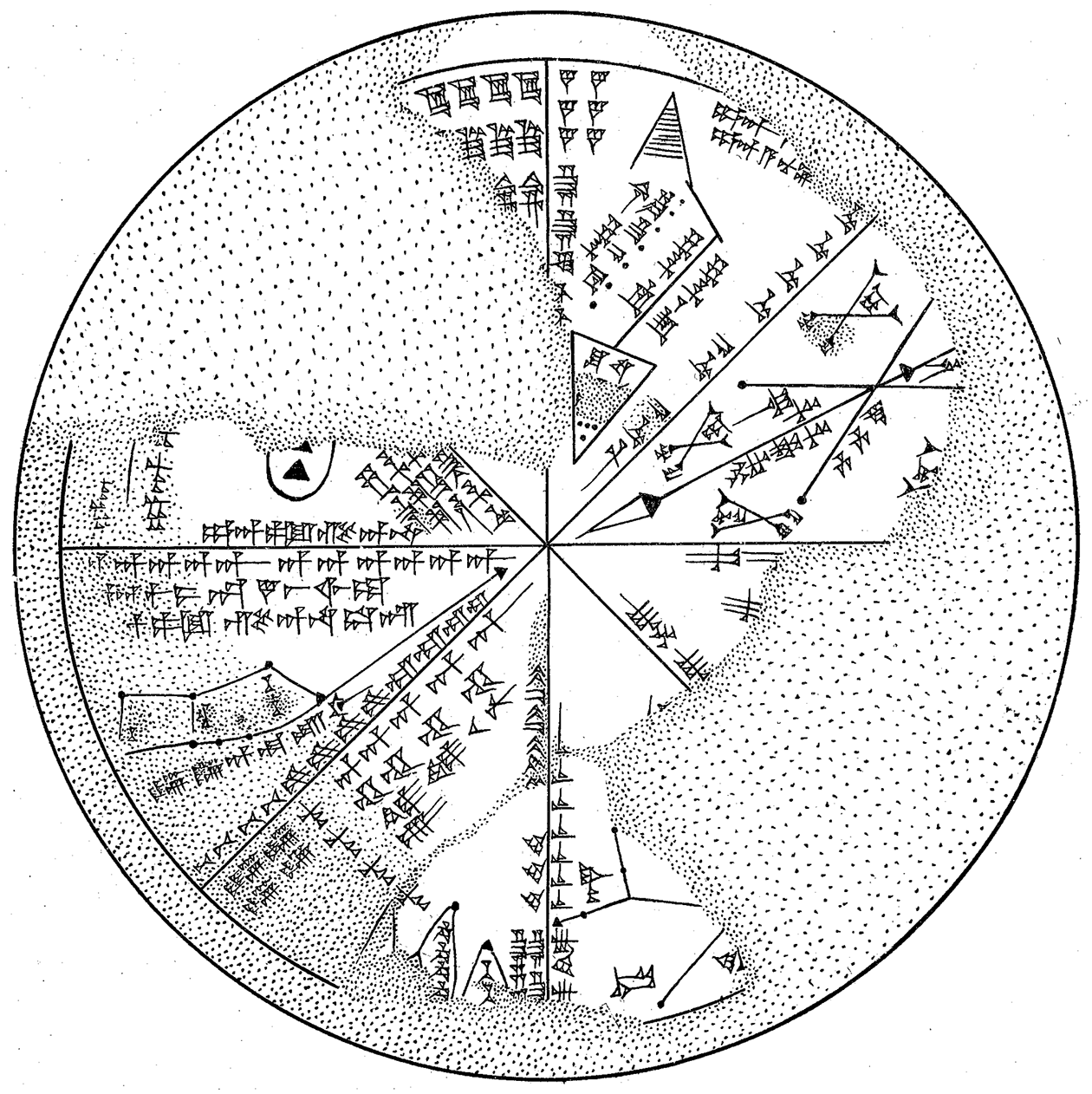
K. 8538, circular astrolabe with eight sections (from CT 33 10).
The clear incised lines and figural content of the diagram meant that this text has a long history of scholarship and much work has gone to linking the schematic drawings with known constellations. The most complete of these is the edition by Koch (Note 27) which offers an exhaustive and convincing identification of the eight sectors with parallels in the astronomical series
Circular zodiacs
The other five circular diagrams use the signs of the Zodiac as their organizing principle. Unlike the circular astrolables these diagrams are generally found on other texts, that is, they are placed alongside cuneiform text that relates, in part, to the contents of the diagram. The first three diagrams represent some sort of astronomical or astrological text reformatted into a circular layout (4.1.3.1–4.1.3.3), where as the last two diagrams illustrate relationships between the signs, in a trine configuration (4.1.4.1) and in connection to certain winds (4.1.4.2).
VAT 7851
This tablet preserves a fragment of a circular diagram consisting entirely of text arranged into an (original) 12 segmented circle. It appears on the reverse of a Micro-zodiac tablet (see 4.2.2) concerning the sign Taurus. While the original archaeological context of the tablet is lost, it most likely comes from the city of Uruk and dates to the Hellenistic period. The text content of each radius is partially preserved but the general understanding is clear enough from what remains. Each segment represents the fate of a child conceived at certain period of time. 29
A total of four segments are preserved, two only partially. Each one begins with a number identifying the segment, the preserved sections are numbered, 6, 7, 8, and 9, and are likewise identified in the accompanying text with the zodiac signs Pisces, Aries, Taurus, and Gemini respectively. This at first seems strange, as one would expect Aries to be connected to the first number of the series. Instead, the first number of the series is presumably the sign Libra, and thus the seventh month Tašrītu. This is most likely connected with the celebration of the second New Years festival in Uruk in the same month. 30
The textual contents of the diagram concern the fate of a child conceived during an eclipse of the moon under a certain zodiac sign. Each apodosis involves an attack by a specified demon or malevolent force on the unborn child. These omens are connected to a wider divinatory literature concerning evil forces preying upon children before their birth. It is also thematically connected to the idea that the moon, when eclipsed, was attacked by demons. 31 This potential connection might explain its placement on this particular Micro-zodiac tablet, as the Moon’s hypsoma is in Taurus.
BM 47762
This text, similar to VAT 7851 (4.1.3.1), preserves an astrological scheme reformatted to fit within a circular diagram. While the tablet has no archaeological context, the proveance is likely from the vicinity of Babylon. 32 The diagram was divided into an original 12 radii but only four remain at least partially preserved. This diagram contains a numerical scheme that subdivides signs of the zodiac into roughly 7 day partitions. 33 It also references other signs, stars, and planets that are nine zodiac signs distant from the main sign for the segment or otherwise associated with the current sign. In some ways the scheme preserved within this diagrams parallels the well attested Kalendertext scheme but not in its exact parameters.
W 22285
This small fragment from a private house in Uruk contains two interesting layouts. 34 On the obverse of the tablet the upper left corner of an incised table is preserved containing column headings naming the months of the Babylonian calendar. Each row contains a short heading which might indicate certain astronomical occurrences. 35 The interior of the table, the cells under each column, are blank and lack any content.
On the reverse of the tablet very partial slice of a circular diagram is preserved. The text within this circular diagrams is badly preserved. No incised lines demarcate the text and it is unclear if the preserved section represents a complete radius or multiple radii. The fragmentary text as preserved mentions a few astral phrases, the planet Mars is in Aries, the planet Mercury, and the sign Leo. The text was edited in the first volume of SpTU. 36
Other circular diagrams
O 176
This larger tablet contains a lengthy and enigmatic astrological text on both sides. In addition to the text there are two circular diagrams, one of the obverse, and a second on the reverse. 37 The diagram on the obverse is an incised circle inside of which there are two lines which span the diameter of the circle that meet in the center at a not quite 90° angle forming a slightly skewed cross. These two lines subdivide the circle into four segments of unequal size. Within three of these quadrants there are four distinct groups of text, the top right quadrant contains two text groups oriented in different directions, the bottom right segment contains one short text, and the bottom left quadrant contains the longest piece of contiguous text. The orientations of each of the text segments do not readily indicate a directionality to the diagram. Each of the segments seems to be a list of star or planet names, however on the whole the text is “frustratingly opaque.” 38 One segment might reference the diagram itself as it begins with a mention of a “cross” perhaps indicating the crossed nature of the quadrants within the circle. The planet Mars is mentioned in all three segments, and Venus is mentioned in one, but otherwise the text resists comprehension. It should be noted that like many of the late astrological diagrams and texts it is very abbreviated in nature. The diagram might, in some way, serve to illustrate some of the thematic principles found in the omens contained on the obverse of the tablet (Figure 4).
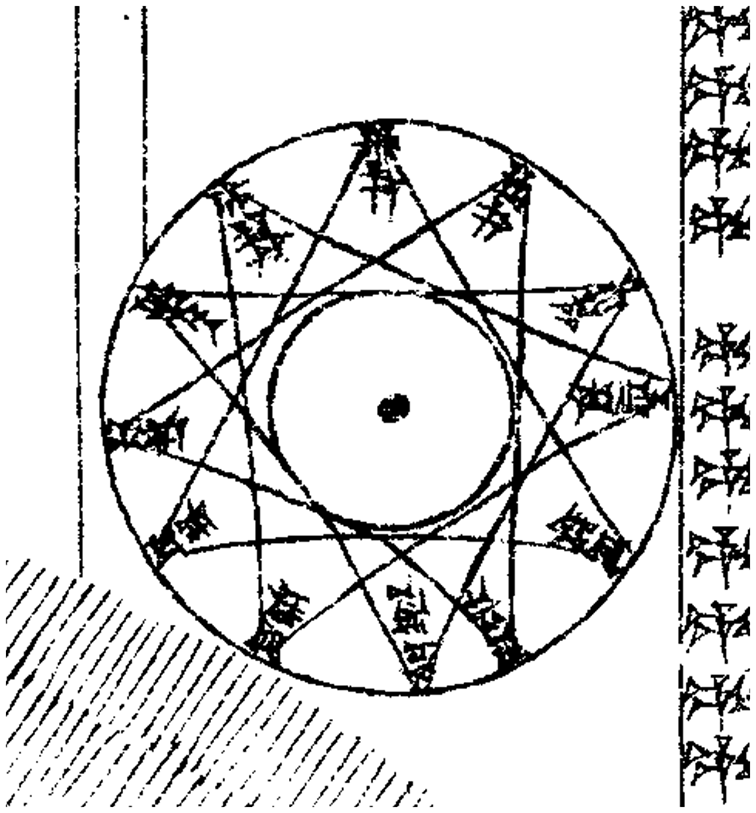
O 176 detail, small circular diagram with trine aspect (from TCL 6 13).
The diagram on the reverse is perhaps more easily understood. It is also a circular diagram but there are 12 incised lines within it that demarcate four triangles connecting points on the circumference 120° apart. This configuration should be familiar as a way to designate trines or triplicities within the zodiac. Each point where a triangle intersects the edge of the circle is labeled with a month and planet. The equivalence between month names and signs of the zodiac is well established. 39 The diagram is to be read counter-clockwise, this orientation both follows the direction of the writing as well as the sequence of the months. However, the pattern of which planets are associated with which signs is unclear; Jupiter, the Sun, and Moon are all absent. Interestingly, groupings of planets found within text sections elsewhere on the tablet do not find congruence with the pattern in this diagram.
W 20030/121
This complex diagram consists of multiple shapes representing the directions of winds and sunrise (and presumably sunset). 40 It was found during the excavations at Uruk conducted in the mid 20th century. This tablet and others were discovered scattered near a series of illicitly excavated trenches in the south-eastern corner of the Rēš-temple. 41 It is highly likely that the material (physically more complete than the fragments excavated) published in TCL 6 was looted from a neighboring context. 42 It is fragmentary but much can be reconstructed from the assumed symmetry of the component parts. The diagram consists of a large circle containing other shapes and text. Inside this circle a square is inscribed, each face of which has an associated label which gives a sequence of dates that cover 3 months of the year. Within the square four triangles are drawn each labeled with a the name of a wind. In addition, the direction of sunrise and sunset are labeled within the square. Only the triangles and associated labels are preserved for the western and southern winds, and puzzlingly the label between these two winds reads “sunrise.” Possible explanations for this incongruous placement range from scribal error to indication of shadow direction. 43 On each of the outer edges of the square a short text is inscribed that relates a unit of time and portentous winds that might blow during that period.
Other diagrams
The rest of the examples below are non-circular in layout. The first is an early text that might function as a parapegma, a term borrowed from the Greco-Roman world referring to an object used to track cyclical events (4.2.1.1). The second is a series of rectangular drawings of 30° sections of the zodiacal band (4.2.2). These were drawn above tables of astrological material organized by an astrological paradigm known as the Micro-zodiac. The continuity between segments makes it clear that they were drawn from a larger conception of a continuous band of zodiac signs. The last two diagrams are less informative; the first is too fragmentary to make much sense of its lines and text (4.2.1.2), and the second depicts the Zodiac sign Taurus together with a number of other figures describing the proper arrangement of a ritual (4.2.1.3).
VAT 15377 (Babylon 39029)
The singular example in this corpus which dates before the first millennium is a tablet excavated from a Kassite (mid-to-late second millennium BCE) context in Babylon which contains an interesting arrangement of vertical lines and illustrated figures. 44 It was excavated from a private house in the west side of the inner town of Babylon; the small finds associated with its context suggest that the house was used by a stone carver who produced boundary stones (kudurru) and cylinder seals from precious materials. 45 Along with a group of lively terracotta plaques featuring animals, a small archive of tablets was found within the house, one of which preserves an interesting configuration of vertical lines and illustrations strikingly reminiscent of much later depictions of the zodiac. 46 Each side of the tablet preserves two bands of lines divided into three groups of 30 (six groups of 30 per side, total of 12 on the entire text). Drawn alongside the bands of lines are small images including a scorpion, lion, and other images suggestive of the later signs of the zodiac. There is some evidence that there are small incisions marked on the majority of lines which offers a potential comparison with parapegma. 47 It should be noted that the combination of the number of groupings (12) and the number of lines (30) within each group coupled with certain images present on the tablet are highly suggestive of an astronomical or astrological purpose but it is not a forgone conclusion especially considering the archaeological and archival context of the find. 48
BM 37171
An unpublished small fragment of a late tablet containing lines on the reverse. The obverse preserves fragments of numbers that may be related to eclipses. The lines of the reverse are hard to interpret. There are some indistinct remnants of text alongside a few of the lines but no obvious connection can be drawn. While the lines do not clearly indicate a connection to known astronomical concepts, the fact that they are all aligned on either 90° or 45° axes means that this diagram is not closely connected to the other circular diagrams.
O 175
This enigmatic text dates to the Late Babylonian period and was found in Uruk. 49 The text on the obverse of the tablet describes the theological and ritual underpinnings of a ceremony to cover a bronze kettle drum with a hide. 50 The reverse of the tablet preserves a highly annotated diagram of the layout of gods, objects, and materials needed to perform the ritual. One of the objects illustrated is a figure of Taurus, presumably included because of the use of cow leather in covering the drum. The diagram is especially interesting because the rich annotations include details like the directions different statues and figures should be facing and how they should be arranged in relation to each other. 51
CBS 1766
This diagram is included for completeness. It is a circular diagram that has in the past been proposed relate to astronomical or astrological schemes. 52 It consists of a seven pointed star inscribed within a outer circle drawn directly above a large table. However, more recent scholarship has rejected its connection to astronomy or astrology. 53 Friberg has suggested that the diagram instead has geometric meaning and the table of numbers (as preserved) describe how to draw the chords that are found illustrated within the circle of the diagram. 54 Despite its non-astronomical content, the clear relationship between the table directly beneath the circular diagram and the diagram itself is remarkable and shows that in certain cases diagrams could interact directly with the text found nearby on the tablet.
Micro-zodiac imagery
The Micro-zodiac tablets from Uruk offer perhaps the most visually impressive form of celestial diagrams in Mesopotamia. This text series is known from both Babylon and Uruk, but for reasons discussed below the imagery only appears on tablets from Uruk. The images are large and detailed and depict segments of the ecliptic roughly equivalent to the 30° of each zodiac sign. Other celestial bodies and constellations are depicted and labeled within the bands. The planets are placed within their bīt niṣirti or hypsoma. One remarkable feature of these images is that they exhibit a visual continuity between each band. Two of the examples represent neighboring signs in the zodiac, Leo and Virgo, and the constellation Hydra (located just off the ecliptic) which spans both signs in the night sky can be found with its head in the Leo image and with its tail located in the next image for Virgo. This suggests that perhaps these images were originally conceived of as a complete circle and it was subdivided for the purposes of placing it onto these tablets. However, the orientation of the signs is reverse to how they appear in the night sky. The images on the tablets are read from left-to-right following the orientation of the text, with the signs of the zodiac facing the left edge of each tablet.
The Micro-zodiac tablets themselves are a fascinating window into the heights of Mesopotamian astrology. These texts contain a wide variety of scholarly knowledge, derived from traditional genres of scribal practice, reformatted and combined into large incised tables relating all the contained information to a zodiacal scheme. As mentioned above tablets are found in Babylon and Uruk, although only the examples from Uruk contain the large diagrams. At least one example from Babylon contains the labels (present in the Uruk diagrams) written in their own section without an accompanying illustration.
The Uranology texts mentioned in the introduction show a close parallel with the imagery contained in the three preserved diagrams discussed below. It seems likely that the entities included, and the details of their depiction borrow heavily from the descriptions found within the Uranology texts. 55 This is particularly interesting because the earliest exemplars of the uranology corpus date back to the Neo-Assyrian period, preceding the Micro-zodiac texts by at least 300 years. This suggests that not only was there a tradition of drawing that existed prior to the Micro-zodiac texts but that the depiction of these constellations, planets, and signs were codified early on and remained relatively stable.
VAT 7851—Taurus
The Micro-zodiac text VAT 7851 preserves a band of the ecliptic that includes the Pleiades, the moon in its bīt niṣirti, as well as the zodiac sign Taurus. The moon is depicted as a large circle within which a mythological figure is grappling a beast.
56
The Pleiades are found to the left of the moon, and labeled “
AO 6448 + VAT 7847—Leo
The next two images are found on the obverse and reverse (respectively) of one micro-zodiac tablet that is split between two museums. The obverse side of the reconstructed artifact contains the section of the ecliptic assigned to Leo. The image portrays the zodiac sign Leo standing on top of the back of the constellation Hydra, the planet Jupiter is also depicted in its hypsoma. Jupiter is the left-most object illustrated, it takes the form of an eight pointed star with a small inscribed circle in the middle, it is labeled with “
AO 6448 + VAT 7847—Virgo
The reverse of this text depicts the ecliptic assigned to the zodiac sign Virgo. The diagram begins on the left side with the continuation of the constellation Hydra—the tail end of the snakes body appears out of the left hand edge and ends soon afterward. Perched on the tail, and pecking and its end is a depiction of the constellation Corvus, labeled “mul
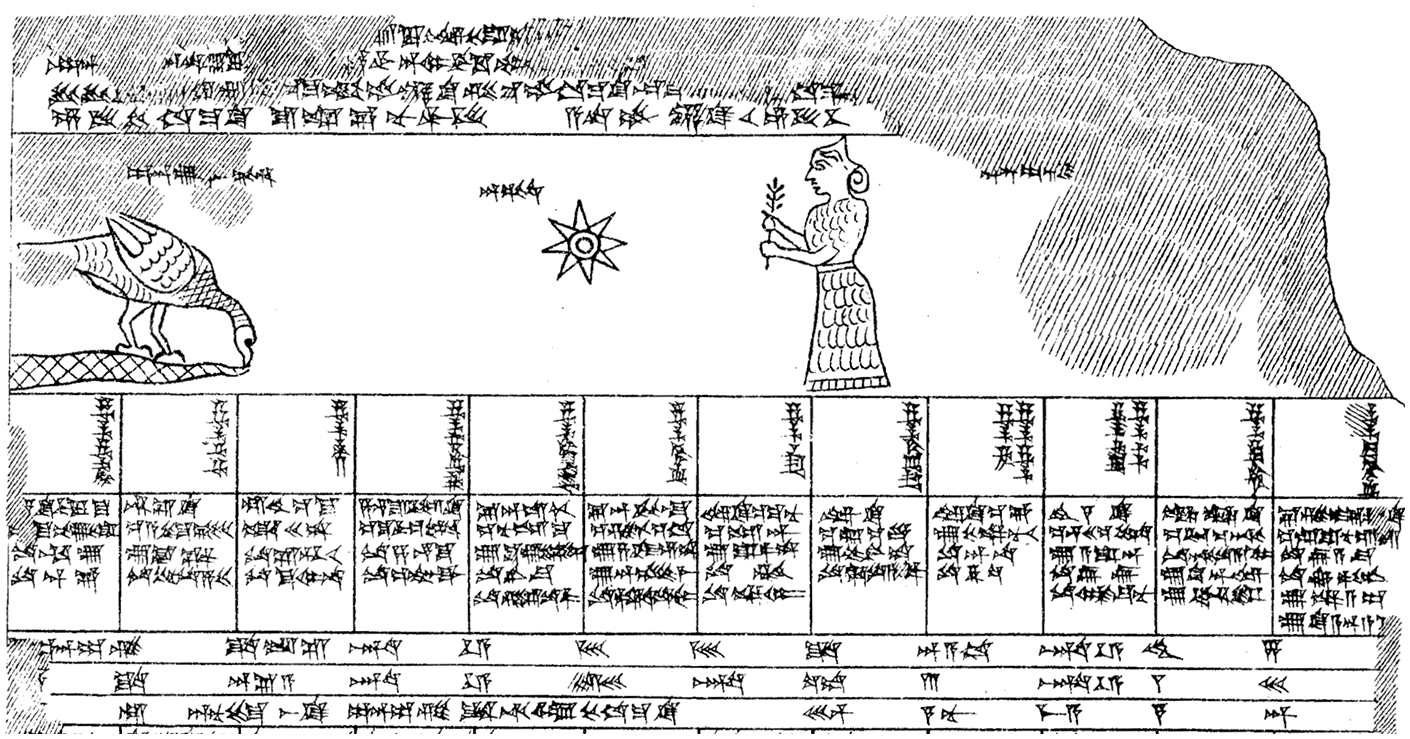
AO 6448, illustrated section of the ecliptic showing the constellations Virgo, Hydra, Corvus, as well as the planet Mercury (see TCL 6 12).
Missing diagrams
We know in some cases that diagrams were intended for a text but never added. The case of the micro-zodiac images mentioned above are a good example where images are clearly present on certain examples and conspicuously absent on others. The inclusion of the labels on the texts without images gives even more support for the idea that the diagrams were intended but never implemented. Two examples illustrate this phenomenon well, they appear on the pair of texts LBAT 1494 (BM 347199) and 1495 (BM 34067 + 35010) both of which describe shadow casting devices for measuring time: the first example includes a large, otherwise unexplained, empty space between sections that might have been intended for a diagram, and the other includes at the end of a section the phrase
Summary
The diagrams outlined above form a small corpus of objects which preserve graphical depictions of conceptual relationships within the fields of astronomy and astrology. Naturally, the corpus is not complete and more diagrams are likely to come to light, thought, it would be surprising if they presented a totally new diagrammatic practice. More likely they would resemble the circular diagrams above. It is unlikely that a whole genre of highly mathematical astronomical diagrams is awaiting discovery either under the soil of Iraq or in a museum cabinet. The broad themes present in the preserved diagrams suggest that diagrams were used to make apparent the relationships between celestial bodies and astrological theories and not used as devices for calculation or reckoning. New relationships between different pieces of knowledge could be discerned by inspecting the diagram and realizing connections perhaps not intended by the creator. 59 This function of diagrams, the ability to create knowledge through viewing, is an important development in the history of documenting scientific thought. Drucker uses the term “knowledge generators” to describe physical layouts of text or diagram which create knowledge through the physical relationships present on the object itself. 60
Similar to the idea of diagrams as generating new knowledge, Netz describes the difference between a diagram and prosaic text in the Greek world as exhibiting inspectable versus opaque relations. 61 Phrases in cuneiform texts like “[the result] is 0;0,9,39,20; you multiply it by 2,30(°, i.e.) 5 [bēru] it is 0;24,8 (and) a little,” 62 have no ready graphical analog in clay that could be subject to “inspection.” 63 However, there are relations present in diagrams which would not be readily apparent in texts; relationships that are exhibited through the structured layout of the content. This makes the diagram “inspectable” whereas the text is opaque, as far as relations are concerned. 64 It should not be surprising then that the majority of the diagrams examined above relate to content that derives its meaning from the association of omens and objects with the signs of the Zodiac. It follows then that there are no diagrams of the complex methods and theories of Mesopotamian astronomy, that is, zig-zag and step-functions, since diagrams would not assist in these calculations. 65 Steele has convincingly argued that there was no “coordinate” system in Babylonian mathematical astronomy. 66 Instead, astronomers used two orthogonal systems of measurement that were not connected like celestial longitude and latitude. It follows then that we should not expect to find star maps drawn out on a grid, and the circular diagrams above fit well within the Babylonian conception of space in the celestial sphere. Returning to the mathematical diagrams mentioned at the beginning, it is noteworthy that none of the astral diagrams label their lines with numerical values. The labeling of numerical values is a common feature of “inspectable” mathematical diagrams that has no purpose in the paradigmatic relationships depicted in the astral diagrams.
The cuneiform astronomical and astrological diagrams represent around 1000 years of scholars thinking about relationships between celestial objects. The most common form being the circular diagram, replicating the cyclical nature of patterns in the heavens, and other less common forms including: diagrams of single objects, or linear stretches of ecliptic. Written text is ever-present, quite a few of the diagrams are made up entirely of text reformatted into a circular layout, but even those with drawn imagery use textual labels to identify celestial objects. Interestingly, the diagrams are never referred to by the text which occupies the same tablet. The relationship between text and diagram is often thematically closely interlinked but never made explicit. This is perhaps to be expected as the diagrams played the same role as commentary texts, elucidating and stretching systems of analogical reasoning to new heights. Of course one of the fundamental issues with this corpus is deciding how and where these diagrams might have influenced later scholarship. Crisostomo puts it nicely when he talks about the “potential” of these forms of reasoning in the cuneiform record (in his case primarily lexical texts), here we might argue that a circular diagram offers much potential meaning through their novel layout. 67
In comparing cuneiform mapping traditions both on earth and in the sky Rochberg makes the observation that “. . . celestial mapmaking, as we would recognize it, is not well represented.” 68 Mapping, and diagramming for that matter, in the manner of “projecting” configurations onto two-dimensional space was not a common activity of cuneiform scribes. Rather, as Rochberg remarks, they had a wide range of textual tools for recording the relationships and configurations of entities both on the ground and in the sky—that is, lists of stars and locations with numerical information indicating distance and scale. The fact that these types of texts are found over a longer period than the diagrams suggests that using lists to “visualize” patterns was far more productive for the cuneiform scribes than a graphical diagram of the same data. This is important to note because the development of Babylonian predictive astronomy (and complex astrology) was not hampered by a lack of diagrams, in fact it reached remarkable levels of complexity by utilizing the traditional methods of recording information (i.e. lists) and procedures. Ossendrijver points out that the complex methods for calculating the velocity of Jupiter involved geometric methods but no diagram was implied (or needed) in order to record the procedure. 69
The small corpus of astral diagrams on cuneiform tablets indicates the degree to which recording and developing astrological and astronomical concepts was not dependent on diagrams. Yet, the history of celestial diagrams in the cuneiform tradition spans a remarkable amount of innovation in the celestial sciences and indicates the creativity with which Mesopotamian scribes could make their theories and conceptual schema manifest visually.
Footnotes
Acknowledgements
I would like to thank John Steele, Kathryn Kelley, and Jeffrey Kotyk for reading earlier versions of this paper and offering useful suggestions, and Hayley Monroe for editorial assistance, any mistakes of course remain my own. I would also like to acknowledge the helpful comments of two anonymous reviewers who gratefully assisted in clarifying this paper and offered useful suggestions on mathematical diagrams.
Abbreviations
General abbreviations for Assyriology can be found in the The Assyrian Dictionary of the Oriental Institute of the University of Chicago (CAD) specific abbreviations used in the text are found below.
AO: Sigla of text in the Musée du Louvre.
BM: Sigla of text in the British Museum.
CBS: Sigle of text in the University of Pennsylvania Museum.
CT: Cuneiform Texts from Babylonian Tablets in the British Museum
K.: Sigla of text from the site of Kuyunjik (modern Mosul) in the British Museum.
LBAT: A. J. Sachs, Late Babylonian Astronomical and Related Texts, (Providence: Brown University Press, 1955)
O: Sigla of text in Musée du Louvre.
Sm.: Sigla of text collected by George Smith in the British Museum.
SpTU: Spätbabylonische texte aus Uruk
TCL: Textes Cunéiformes, Musée du Louvre
VAT: Sigla of text in the Vorderasiatisches Museum in Berlin.
W: Sigla of text excavated from Warka (Uruk).
