




Abstract
This article examines the role of memory techniques in medieval astronomy. Using a mnemonic written by a Franciscan friar c. 1330 as a case study, it shows how astronomers and astrologers simplified the sky for practical purposes, using verses and codes to make their science memorable. The article decodes the mnemonic and its underlying astronomical data, assessing its usefulness, memorability and adaptability alongside some other popular astronomical and calendrical mnemonics of the later Middle Ages. It argues that astronomical learning could be a creative, playful activity. And it situates the astrological practices of this particular friar, who made wide-ranging annotations in a 13th-century astronomical compendium, within the scientific and educational traditions of his order.
Introduction
How did medieval people make sense of the heavens? This is a central question in the history of early science. It has traditionally been answered in terms of theories and texts, but few historians today are satisfied with pure narratives of ideas. 1 Practices have recently received increased attention, as scholars have made efforts to reconstruct the methods of ancient and medieval astronomy, asking how and why resources such as instruments and tables were made and used. 2 However, while attention has been paid to the higher-level practices of mathematics and observation, to calculation and discovery, there has been less focus on the lower-level practices of teaching and learning. Learning in particular is hard to reconstruct, since most medieval evidence was produced by the teachers who imparted knowledge, rather than the pupils who had to master it. 3
One thing we do know about medieval learning is that memory was fundamental. Memorisation was a tool for mastery of complex material and a valuable aid to – even the foundation of – creative processes. For the 12th-century teacher Bernard of Chartres, memorisation was an essential way of cementing each day’s learning, and evidence of careful reading. 4 Practised in the monastery and the university, it was both a devotional activity and an essential scholarly skill. 5 Among the weapons in the arsenal of medieval memorisation were many mnemonics, devised and used for purposes ranging from chronology to grammar. Mnemonics had practical utility, helping their users navigate the daily, seasonal and annual patterns of agricultural and religious life. But their production and communication also had broader value as part of a liberal arts education.
This article shows the fertility of mnemonics in medieval astronomy. Using a 14th-century Franciscan example as a case study, it shows that the production of a mnemonic could be both an intellectual exercise and a playful personal diversion. Discussing the origins and usefulness of a mnemonic raises important questions. How did medieval students navigate the tension between making a mnemonic widely usable and incorporating necessarily specific information? What can mnemonics tell us about the relationship between observation and calculation of celestial phenomena? What expertise was necessary to compose an astronomical mnemonic, and how widespread was that expertise? Critical engagement with mnemonics as historical sources allows us to broach such questions, and reveals medieval astronomy as a creative, living, even playful practice, rather than the static Ptolemaic discipline depicted in some accounts. 6 It also casts new light on the practice of astronomy and astrology within Franciscan houses.
Structures of the skies, structures of the year
If ancient and medieval astronomy was based around the identification, or invention, of patterns in celestial phenomena, it was natural for memorisation of those patterns to form part of astronomical education. Although ancient farmers had doubtless found it useful to understand seasonal shifts in the weather through memorable phrases, the greatest use of mnemonics in astronomy came when calendrical science was placed at the heart of astronomical education. 7
The use of mnemonics in computus and the calendar is well documented. A century of historians have analysed an enormous range of verses and tables: it seems the composition or compilation of such mnemonics was an almost obligatory part of any treatise on the calendar.
8
Some, such as the influential Massa compoti of Alexander of Villedieu, used mainly verses and rhymes to enable students to master large quantities of calendrical data.
9
Others made extensive use of hand-based mnemonics (‘Computus manualis’), allocating dates and numbers to the joints on the student’s hands.
10
Many incorporated alphanumeric substitution to turn numerical data into memorable words; we shall see this technique put to effective use in the mnemonic that is the principal subject of this article.
11
The most popular rhymes were widely disseminated, often through vernacular languages: for example, the rhyme beginning ‘thirty days has September, April, June, and November’, which remains well known today, is first attested in English in the 15th century.
12
The same information can be found in various Latin verses, such as this distich: Sep. No. Iun. Ap. triginta dato, reliquis magis uno Ni sit bissextus Februus minor esto duobus.
13
These lines are found within the Latin Computus of John of Sacrobosco (c. 1232). In some 14th-century copies of this popular textbook, these verses were highlighted in a larger hand to call the reader’s attention and permit easier memorisation. 14 But this distich was not Sacrobosco’s invention; it seems it was widely known. 15 The same information could be found in various forms, including a five-line version in the popular Computus manualis of Master Anianus. 16
To understand what makes a mnemonic successful, let us look briefly at the most popular medieval calendrical mnemonic. This was a verse known by its first two words: the Cisio Janus. First recorded in 12th-century Germany and widely copied and adapted, this laid out the year in 24 lines of verse, 2 for each month. 17 In one English version from the 15th century, it begins thus:

Those thirty-one syllables lay out the structure of the 31 days of January. Eighteen days are highlighted, from the Feast of the Circumcision on the first day of the year, to Epiphany on 6 January, St Sulpitius’ day on the 17th and finally Balthild on the 30th. Like all the best mnemonics, the Cisio Janus had a simple structure. Each line was a rough hexameter, with dactyls (one long and two short syllables) and spondees (two long) adding up to between 12 and 18 syllables. Each couplet comprised as many syllables as there were days in that month; the two lines above are 17 plus 14, making the requisite 31 days of January. The complete mnemonic thus had precisely 365 beats. And it was certainly useful, in an era when Christians were more likely to identify any day with reference to a nearby saint’s day than to count from the start of the month, as we do now. Importantly, however, in no extant copy are the names written out in full. Someone learning the mnemonic would hence have to seek guidance on its meaning as well as, perhaps, assistance with memorisation. Thus mnemonics like the Cisio Janus have an in-built social function; we must view them within the context of a pedagogical relationship.
As well as being useful and simple, the Cisio Janus mnemonic had a third essential characteristic: it was highly adaptable. Any feast could be removed or inserted, as long as the lines maintained their basic syllabic structure. For example, in early versions of the mnemonic the second line began ‘Prisca Fab Ag’ – in fact, Prisca was the only saint whose name appeared in full – but after it arrived in England, her name was truncated to make room for Wulfstan. This 11th-century bishop of Worcester was evidently an important addition for English users. 19
The Cisio Janus mnemonic is usually presented as 12 couplets, but it was useful enough that calendar makers occasionally squeezed it into their narrow columns. For example, in one calendar based on the 1380 Kalendarium of John Somer, the scribe omitted the usual wide column of feast days. Instead, just to the right of the standard double column showing numbers counting down to Nones, Ides and Kalends, there is a narrow column reading ‘Ci/si/o/ Ja/nus/ E/pi/ me/mo/rat/ si/mul/ Hil/ Fe/ Mau’ and so on. Each name – or its first syllable – falls in the correct row of the calendar, and the scribe highlighted those in red. Subsequent syllables and filler words are in black ink (Figure 1). 20 This column, naturally much narrower than writing the saints’ names in full, left much more room on the crammed double page for astronomical and astrological data such as the day-lengths and oblique ascensions, the qualities of the triplicities and the degrees of fortune. 21 Thus astronomers’ familiarity with such popular calendrical mnemonics could lend efficiency to their texts and computational practices.
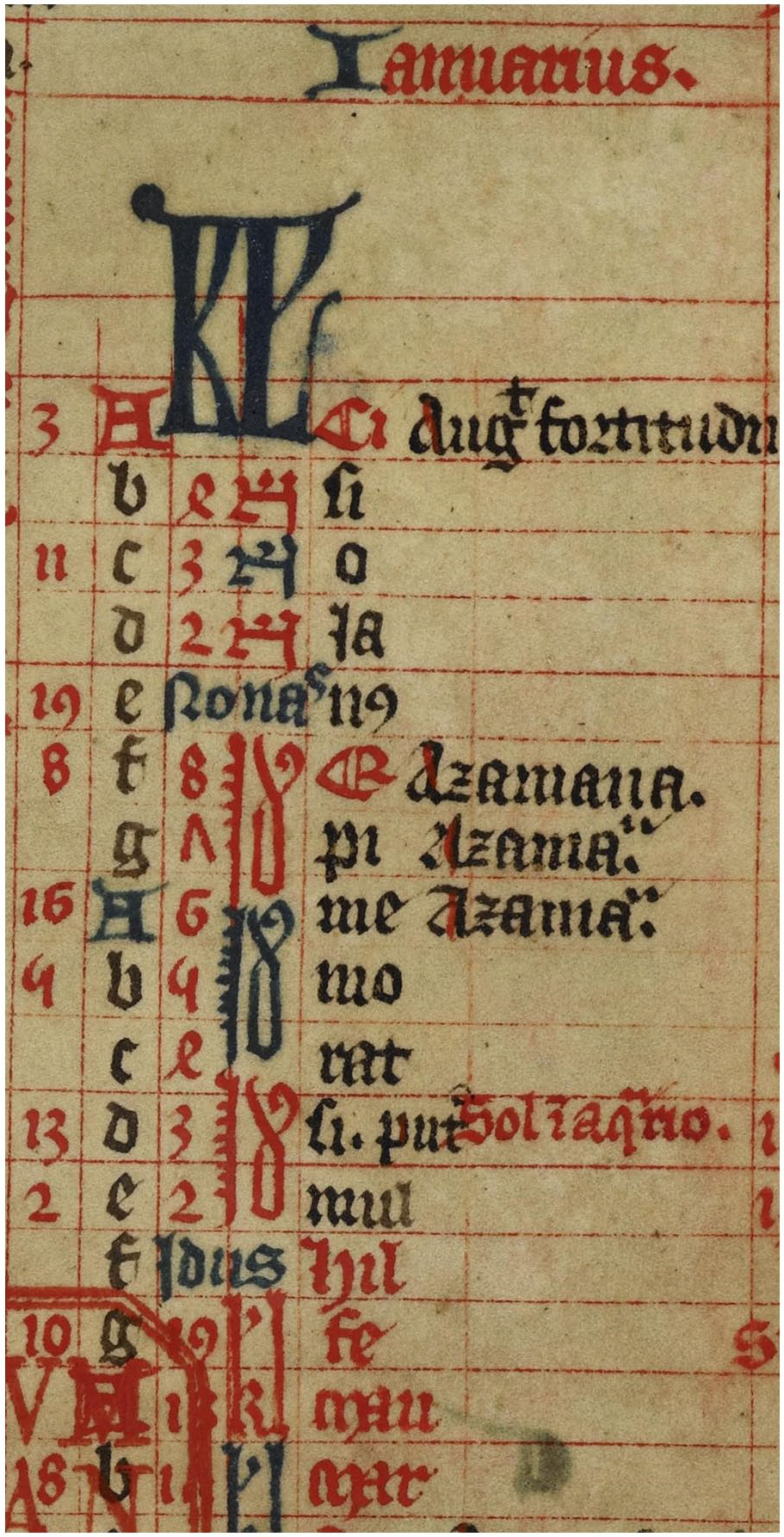
Cisio Janus mnemonic, from a calendar based on the Kalendarium of John Somer. London, British Library Harley MS 321, f. 2v. © British Library Board.
Many other calendrical mnemonics could be cited.
22
We see them spread readily through popular textbooks, and move into vernacular languages by the 15th century.
23
Yet one might ask: how astronomical are these mnemonics? Sacrobosco, whose Computus was mentioned above, also included a few basic mnemonics in his more popular astronomical treatise On the Sphere, laying out the order of the zodiac signs or reminding readers where the equinoxes and solstices occurred. The mnemonic quality of the verses is heightened by his repetitive use of the phrase ‘in hiis patent versibus’.
24
Yet their scientific contents remain quite simple and general. One much-copied computistical text that does contains notable astronomical mnemonics is the Computus chirometralis by Johannes Algeri, an astronomer who taught in Erfurt in the second quarter of the 14th century.
25
Algeri’s mnemonics not only cover the luni-solar cycles integral to the Christian calendar, giving the times of new moons to the nearest minute, but also encode details of less immediate computistical relevance. For example, this verse charts the progress of the Sun through the signs: Gre . at . ser . phi . a . sump . nic . lix . ci . lu . cat . las hec vera. Ri . ti . et dul-gar . yp . ti . que bric . lu-cat ti . medii sunt.
26
These lines use syllables from the Cisio Janus mnemonic to give the entries of the mean and true Sun into each sign of the zodiac. The first line gives the true Sun, which enters Aries on the feast of St Gregory the Great (12 March). The entry into Taurus is represented by ‘at’, the start of the word ‘atque’, which was allocated to 12 April in popular German versions of the Cisio Janus; next is ‘ser’ for St Servatius (13 May), and so on. The latter part of the verse offers the entries of the mean Sun, beginning with the ‘ri’ of ‘Gre-go-ri-o’ (14 March) and ending with the ‘ti’ of ‘Sco-las-ti-ca’ (12 February). In this way the popular Computus chirometralis, which survives in over 150 manuscripts, extended its material well beyond the Easter reckoning on which computus had been founded. 27
In the rest of this article, I will examine a mnemonic, composed around the same time as the Computus chirometralis, which contains arguably more complex astronomical data. We shall consider how its complexity might affect its mathematical precision, its practical value, its ease of memorisation and its transferability. By asking how well it measures up to the three key characteristics of a mnemonic already identified – usefulness, memorability and adaptability – we can judge its effectiveness; we can also ask if those criteria require refinement. We can also examine how it sits alongside mnemonics which were clearly part of a pedagogical relationship.
A Franciscan nonsense rhyme?
Cambridge University Library MS Hh.6.8 is an astronomical compendium in two volumes. It belonged to the Bridgittine abbey of Syon in Middlesex by the 16th century, was owned by the bibliophile bishop of Ely John Moore (1646–1714), and was presented to Cambridge University Library along with this rest of Moore’s books in 1715. Although for some centuries it was bound as a single volume, it was clearly produced in two parts, and when it was rebound in the 20th century those parts were separated. The first volume, produced in southern France in the early 13th century, does not concern us here. 28 The second, comprising 134 smallish quarto leaves of moderate-quality parchment, was written in England towards the end of that century. It is a standard compilation of astronomical tables and texts on instruments such as the quadrant and astrolabe; but it is really the 14th-century annotations which deserve our attention. They were made, in large quantities, by someone identifying himself as ‘Frater Stephanus’. 29
The word ‘Frater’ (brother) indicates that Stephen was a friar, rather than a monk; monks tended to prefer the title ‘Dompnus’ (master) in this period. (In any case, he certainly was not a member of Syon Abbey, which was only founded in 1415 and was largely populated by high-status women.) 30 Membership of a mendicant order is also suggested by his mobility: he made a host of astronomical observations in the 1320s and 1330s, recording their locations from Weymouth to Worcester, Shrewsbury to Stafford. Stafford had one house of friars in this period: the Franciscans, who were under the custody of Worcester. 31 Franciscans moved freely from one house to another, and from this, as well as notes he made on matters dear to the Minorites, we can be reasonably confident that Stephen was a Franciscan. 32
It was at Stafford that he made the observations that most concern us. On the final few folios of the book he added several short notes. One in particular stands out, written in an unusually large and well spaced hand, and clearly laid out as an abbreviated verse with its four lines bracketed together: Enfe le nones Alde vi gones Alge vi vones Algo li kymas Corle sco dimas, Cauda sco zimas Arra sag ylex El capri kylex Al aqua tylex Alta ta nonas Delf gemi zonas Alfe ca monas.
33
None of these words is recognisable as Latin or English – yet immediately we see that there is a structure: ‘nones . . . gones . . . vones/kymas . . . dimas . . . zimas’, and so on. But what does it mean? Fortunately, Stephen himself tells us immediately below: The explanation of these four lines is as follows: Enfer being on the meridian, the 18th degree of Leo is rising; Aldebaran being on the meridian, the 7th degree of Virgo is rising; Algeuze being on the meridian, the 19th degree of Virgo is rising. . .
34
The explanation continues through twelve well-known stars, fairly evenly spread around the ecliptic. 35 In each case we learn the ascending degree of the ecliptic at the moment when a given star crosses the meridian.
The mnemonic is simply constructed. Each line contains three triplets of words. The first word is an abbreviated form of the star name, and the second word gives us the ascendant sign. For the verse to flow, these two words always have three syllables in total. The third word indicates the degrees within the sign, according to an alphanumeric substitution: A = 1, B = 2 and so on. Thus ‘Alde vi gones’ places Aldebaran at the seventh degree of Virgo, because G was (and is) the seventh letter of the alphabet. 36
Although simple, these verses have a certain elegance. The three by three by four structure is clear; the rhymes are straightforward and easily chanted. The uniqueness of the words, like nonsense poetry, added to their memorability. 37 One wonders whether it is fortunate or deliberate that no ascendant degree exceeds the 22 letters of the alphabet; but leaving that aside, such alphanumeric substitution codes were popular in the Middle Ages. Mnemonic techniques often involved conversion between letters, numbers, and sometimes musical notes, partly to cement one’s knowledge, but also to demonstrate how securely it was known and how flexibly it could be accessed. As Mary Carruthers has noted, facility with memory required learners to know their material backwards – quite literally in some cases. 38 Alphanumeric mnemonics like this one might not seem helpful to us, but medieval learners typically knew the order and number of the alphabet better than most people today: they would practise pairing up the first and last letter, the second and penultimate and so on. Presentation in sequences and grids such as we find here was also common practice, as one could remember an item by what was before or after it. 39
Stephen’s mnemonic does differ in an important way from the typology explained by Carruthers. As she notes, many mnemonics work by moving from the abstract or aural to the visual. One example is the Guidonian Hand, which assigned the tones of the musical gamut to parts of the learner’s hand; another is the famous ‘memory palace’ (architectural mnemonic) technique popularised through texts by or ascribed to Cicero, which received a great deal of attention and commentary in the Middle Ages. 40 However, Stephen’s mnemonic works in the opposite direction: it encodes something visual in a verbal form. Carruthers suggests that such verses were too limited or specific to be a worthwhile memory technique – but it seems that Friar Stephen found it suited his purpose well enough.
What was that purpose? Knowing the rising degree of the ecliptic would not directly allow one to tell the time, which is measured by the rising of the celestial equator, but it was of vital importance to astronomy. The Sun, Moon and other planets move on the ecliptic; since the ecliptic is inclined to the equator, the signs vary in the time they take to rise. An understanding of this was essential to calendrical and planetary calculations (and, through awareness of seasonal shifts in day length, it was relevant to timekeeping). Above all, the mnemonic focused on the two positions essential to division of the astrological houses: midheaven (where any star reaches its maximum altitude as it crosses the north-south meridian) and the ascendant point (where the ecliptic crosses the eastern horizon). It provided results only to the nearest degree, but even if an astrologer aimed to lay out a horoscope with greater precision than that, he could still use the mnemonic for initial orientation of the sky. It would help him get his celestial bearings on a dark night, and provide a sense of what was where, perhaps as a prelude to more precise computation with tables and instruments.
The relationship with instruments is a key feature of this mnemonic, as of medieval astronomy more generally. The easiest way to identify midheaven and the ascendant, the first step in dividing the astrological houses, was with an astrolabe (see Figure 2). 41 And an astrolabe or similar device was essential to identify that the star was indeed on the meridian, at its highest point. Indeed the information in this mnemonic could all be obtained directly from an astrolabe. Although this might suggest that memorisation is unnecessary, it points to the importance of such mnemonic verses as tools for embedding understanding more securely. This might well be necessary for such a complex and multifaceted instrument as the astrolabe: as Chaucer wrote in his Treatise on the Astrolabe, ostensibly to his son Lewis, ‘all the functions that have been found, or else possibly might be found, in so noble an instrument as an astrolabe are not perfectly known to any mortal man in this region . . . and some of them are too hard for your tender age of ten to grasp.’ 42
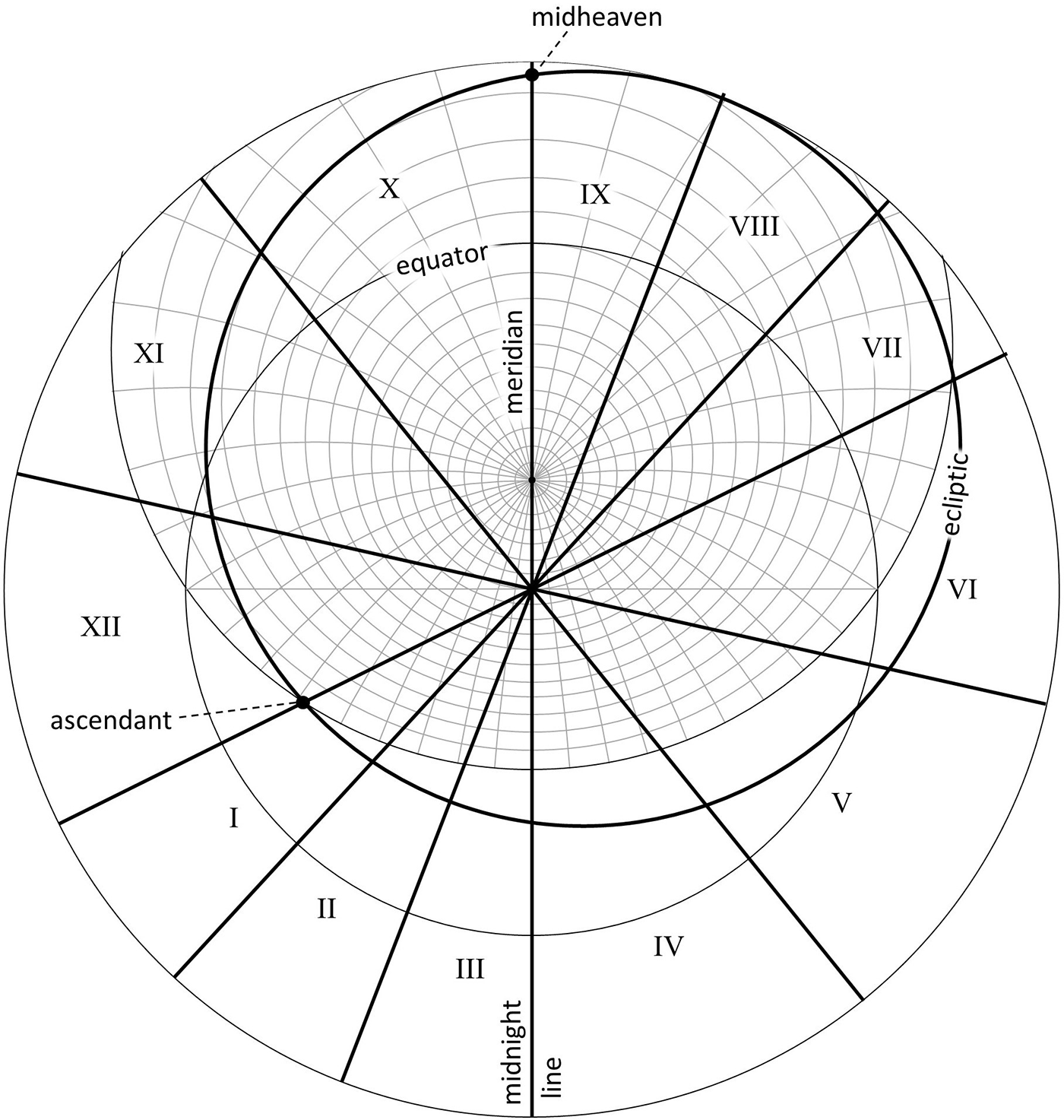
The 12 astrological houses, divided according to the standard medieval method, laid out on an astrolabe plate.
All 12 of the stars in this mnemonic are invariably found on astrolabes. This is hardly surprising, since the usefulness of both the mnemonic and an astrolabe depended on their containing familiar, easily recognisable stars. Of the roughly 1022 stars listed by Ptolemy, the same few dozen appear again and again in medieval lists and on instruments. 43 But these stars are more than simply present on medieval astrolabes. Let us look, for example, at an astrolabe produced c. 1340 in East Anglia (probably Norwich or perhaps Bury St Edmunds) (Figure 3). 44 The first thing we notice is that all the mnemonic stars are indeed present (though two cannot be identified with certainty, as will be discussed below). But beyond that, they are well spaced all around the ecliptic. All are north of the equator (the quarter-circle towards the bottom of the equator), so will be visible more often than not. But they are not so far north as to be bunched up together around the pole; this means that they will vary substantially in altitude, making their movements easier to observe. Furthermore, their fairly consistent declination, in a band between 7° and 29° north of the equator, and their even spread around the sky, make them ideal ‘clock stars’, useful markers of right ascension that could help an astronomer find the time quickly. All in all, the 12 stars have been well chosen for practical purposes. Stephen, or whoever wrote the mnemonic, was drawing on the work of centuries of earlier astronomers, who had radically simplified the miscellaneous multitude of visible stars to make the heavens meaningful.
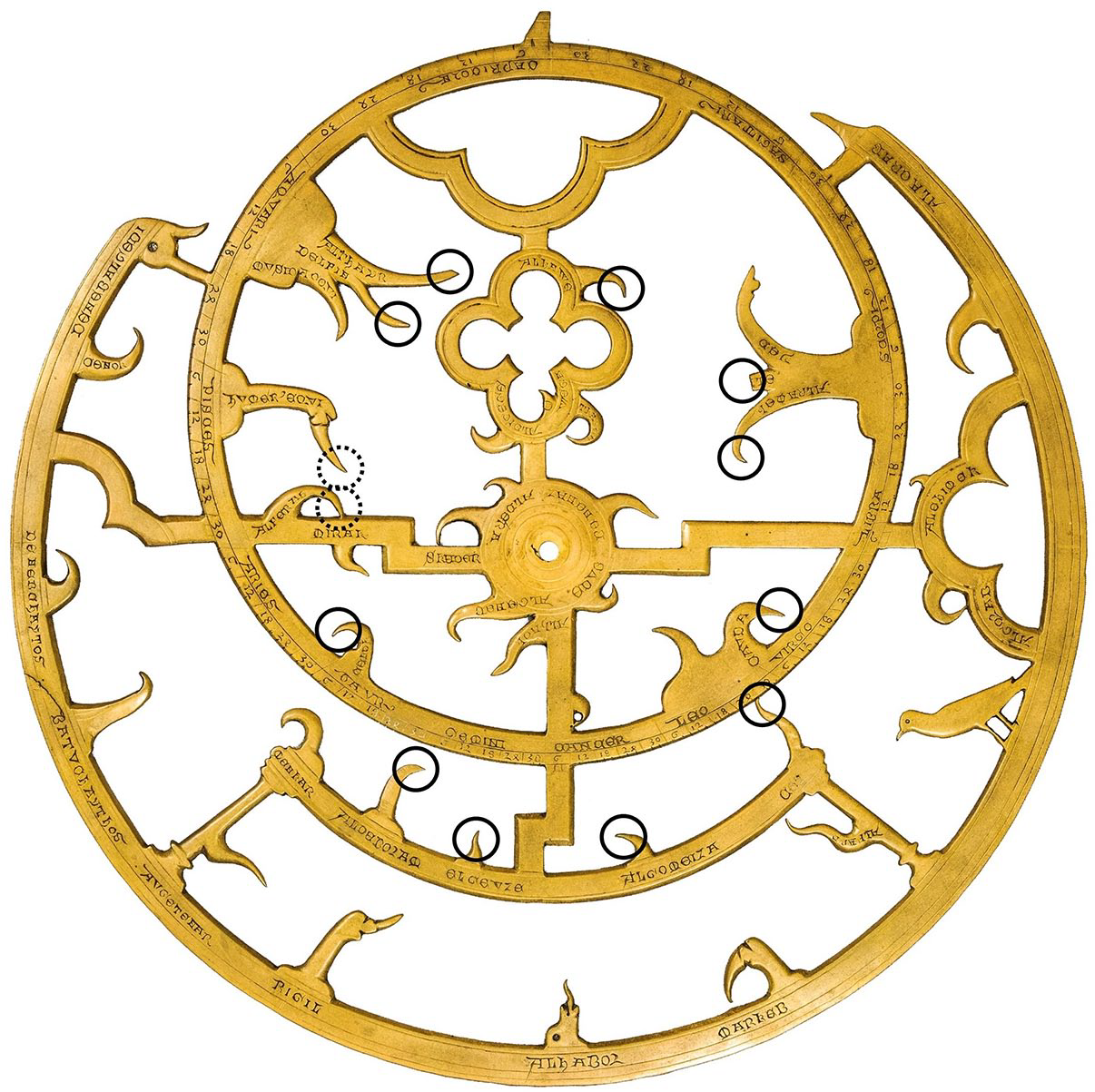
Rete of an astrolabe made in East Anglia c. 1340. Black circles indicate the stars in Stephen’s mnemonic, all north of the equator. Cambridge, Whipple Museum of the History of Science, Wh.1264. Photograph: John Davis.
We can be sure that Stephen himself had used an astrolabe, and was alert to its possibilities and pitfalls. On the previous page, he asks us to ‘note that the star that is called Alferaz below is called Humerus Equi on our astrolabe’. Just to the right, he gives the meridian altitude of half a dozen stars ‘according to the astrolabe’. 45 The confusion between Alferaz and Humerus Equi (β and α Pegasi, respectively) was common in late-medieval texts and instruments; both names mean, or derive from, ‘horse’s shoulder’. 46 This confusion arose, it seems, when the compiler of a Latin star list inserted β Pegasi twice under two versions of the name from two different sources, and later astronomers struggled to disentangle the mess. 47 Sure enough, the two stars identified as ‘Alferas’ and ‘Humerus Equi’ on the Whipple Museum astrolabe (circled with dashed lines in Figure 3) were labelled the wrong way round. It is the upper one, ‘Humerus Equi’, that fits the position Stephen gives for Alferaz.
We can be quite sure which star Stephen meant, since immediately below his clarification he wrote out a table of the same 12 stars as in his mnemonic. 48 With carefully ruled rows and columns, it appears as below:
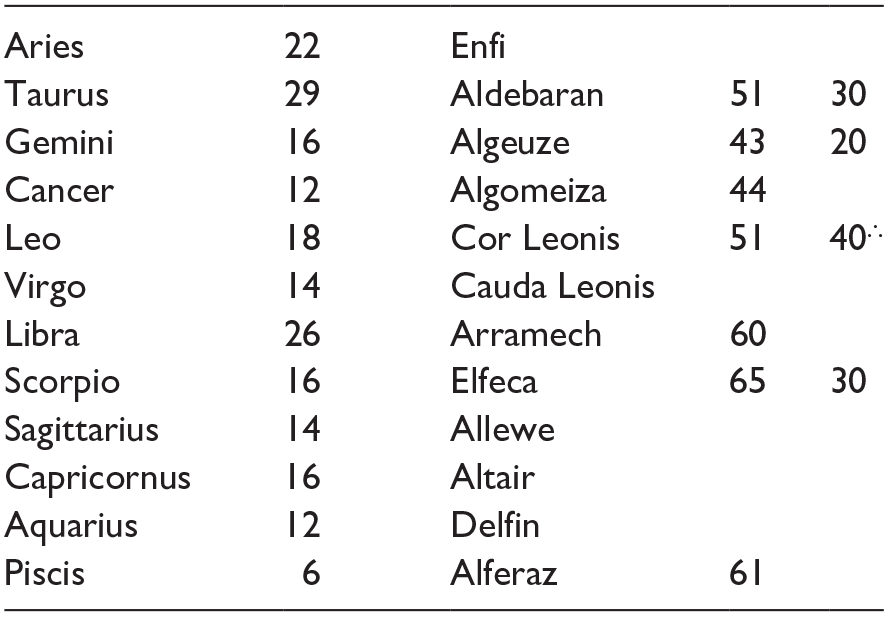
Further confirmation that these data relied at least partly on Stephen’s own observations can be found in his note in the margin, marked with a ∴ symbol matching the one next to ‘Cor Leonis’: ‘which I carefully checked at Stafford’. 49 This is vital information, since historians sometimes assume that the daily practices of medieval astronomers involved rather more calculation and (indoor) manipulation of instruments than observation of the skies. 50 Even where astronomers state that they ‘checked’ a number (probare, examinare or considerare), it is not always possible to be sure whether they did so via observation of the sky, or merely against an astrolabe or table. But in this case, by stating his location, Stephen does make it clear that he had himself observed the meridian altitude of Cor Leonis.
The layout of this little table is striking. Where one might expect to find the star names in the left-hand column, this table shows the zodiac signs. So rather than a simple star list, it is really a list of signs, with one star given in each: emphasising, perhaps, that these stars have been chosen for their capacity to represent segments of the sky. This is different from the mnemonic, which does start with the stars. But in order to understand how the two fit together, we must look a little more closely at the astronomical data they contain.
Mediations and ascensions
Stephen’s mnemonic, you may recall, gave the degree of the ecliptic that was ascending above the horizon (also known as the rising correspondent) at the moment that a named star crossed the meridian. The table, complementarily, gives the location of each star: specifically, it tells us the degree of the ecliptic that crossed the meridian at the same time as the star. This parameter, given for each star in the second column of Stephen’s table, is its mediation. This was the most commonly used coordinate in late-medieval star tables and in texts referring to astrolabes. Although the Latin word was longitudo, this was not the same thing as ecliptic longitude (Figure 4). 51 The figures given for some stars on the right of the table are their maximum altitudes in degrees and minutes.
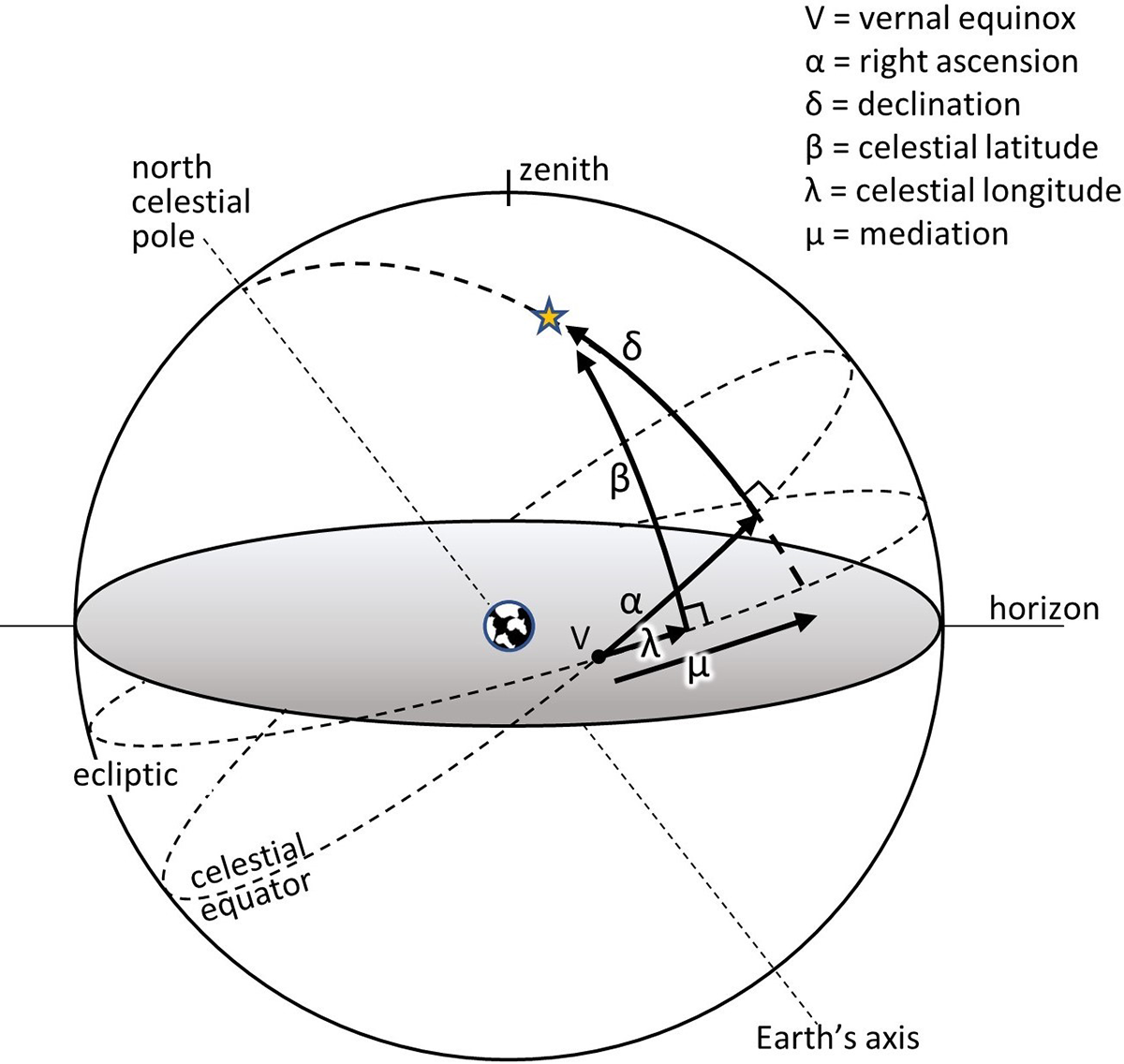
Celestial coordinates, showing the relationship between mediation, longitude and right ascension.
Taken together, the data in the mnemonic and table permit us to delve more deeply into Stephen’s location and ways of working. The ascendant degree which the mnemonic gives for each star was specific to his local horizon. (The mediation is not locally specific.) Thus, knowing the mediation Stephen used for each star, we can attempt to pinpoint his horizon. Using tables of oblique ascensions for multiple latitudes, we input the mediation he gives for each star and see which latitude results in the closest match to the ascendants he lists. 52 As the graph (Figure 5) indicates, a latitude of 53° provides the closest match to Stephen’s mnemonic. The latitude of the modern town of Stafford is 52°48′, but in the table of geographical latitudes and longitudes in MS Hh.6.8 it is given as 53°. 53
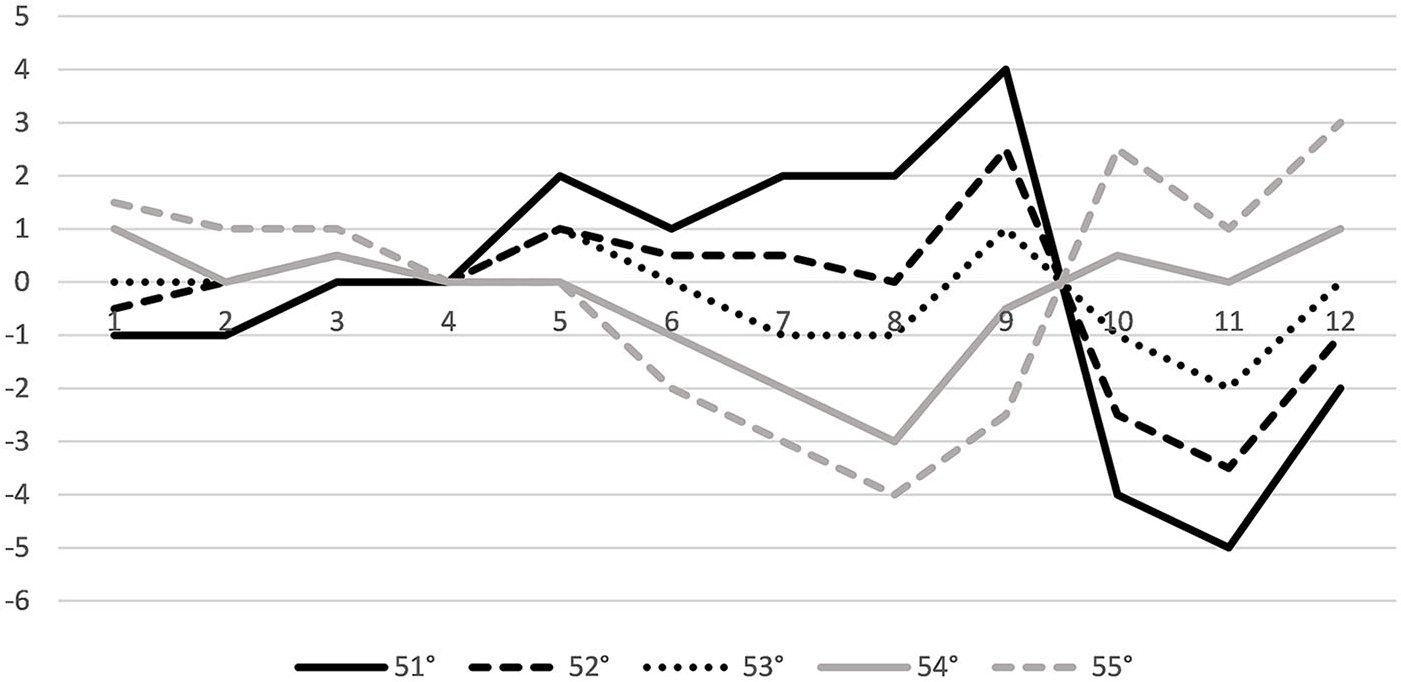
Graph of the rising correspondents for each of the twelve stars in Stephen’s mnemonic, computed for five English latitudes. The Y-axis shows the difference between the value in the mnemonic and that computed for a given latitude. Thus 53°, staying closest to zero, is the best match.
One must emphasise that this result was not inevitable: Stephen’s data did not have to match his location. Medieval astronomers obtained the best results they could using the tools they had available; but those tools, be they instruments or tables, were often not perfectly matched to their situation. They were thus forced to compromise or approximate. Moreover, we often find that data purporting to be original calculations or observations was in fact copied, or lightly edited, from elsewhere. 54 And not all astronomers were competent to check that the latitude or ecliptic obliquity underlying their tables was suitable for their purpose. 55 So the fact that Stephen’s mnemonic matches his location is valuable confirmation that he himself had created it, or at least adapted it.
Given the accuracy and consistency of Stephen’s mnemonic, it is very likely that he computed it directly from tables rather than using an astrolabe. Alternatively, if he originally devised it with an astrolabe, he could easily have checked and amended it with the help of tables. He would have needed a table of right ascensions, and one of oblique ascensions for his latitude. Both the necessary tables are in MS Hh.6.8.
Indeed, the table of right ascensions is in a form particularly suitable for his purpose. 56 Celestial longitude is measured from the vernal equinox, the beginning of the sign of Aries, so most astronomical tables run from that equinox too. However, some astronomers saved themselves a little labour by producing tables beginning at the start of Capricorn, the winter solstice. 57 These so-called ‘normed’ right ascension tables were helpful precisely for procedures such as finding the ascendant from midheaven. With a standard right ascension table, Stephen would have had to enter the table with the mediation, read off the right ascension and then add 90°. This normed table adds the 90° automatically. All he then had to do was turn to the oblique ascensions table for his latitude, find the closest value to the one he had found and take out the degree of the ecliptic corresponding to it. MS Hh.6.8 contains two such tables of oblique ascensions, written out in the same late-13th-century hand: one for 50° and one for 52°50′. Using the latter produces results very close to the ones we find in Stephen’s mnemonic.
Further evidence of Stephen’s use of a table of oblique ascensions can be found in a second, simpler mnemonic, which he wrote in a faintly traced table just below the first one. It appears as follows:

Stephen crammed an explanation into the right-hand margin: ‘The meaning of this line is such that the whole figure of Aries rises with 12 degrees of the equator, Taurus with 16, and thus for the others’. 58 These are the rising times of the signs: the numbers would be easily found by taking the final value in each column of a table of oblique ascensions, and subtracting the final value in the column immediately to its left. Again, these values fit well with a latitude of around 53°, though they do not quite match the table of oblique ascensions for 52°50′ in MS Hh.6.8.
What of the pairs of letters in the final row of the table? These, it seems, are simply a recasting of the numbers directly above, presumably for mnemonic purposes. Twelve becomes ‘Ba’ by reversing the positions of the digits, then converting each digit into the corresponding letter of the alphabet. Similarly, 16 becomes 61 becomes ‘Fa’. The vowels are numbered separately, so that A = 1, E = 2, I/Y = 3 and O = 4. Just as before, we find locally specific astronomical information of moderate complexity encoded into nonsense syllables for easy recitation and memorisation.
Quadrants and chessboards
It remains to briefly examine the other scientific interests apparent in this manuscript, in order to reach a better understanding of the purpose of these materials and how they fit with the range of Friar Stephen’s interests, as well as the scholarly traditions of the Franciscan order more generally. Most obviously, there is plenty of evidence of his interest in instruments. 59 Throughout the manuscript we find he has made notes on their construction and use: how to identify the latitude for which an astrolabe plate has been engraved; how to identify an unknown star on an astrolabe; how to use a plumb-bob on a quadrant, and so on. 60 A brief note comparing the methods of finding the ascendant using an astrolabe and tables is further evidence of his experimentation with methods of astronomical calculation and learning. 61
Elsewhere in the manuscript we find Stephen turned his hand to a different mathematical art: pure arithmetic. Underneath a table for dividing the astrological houses (at the latitude of Toledo), we find the following note: Memo: that I, friar Stephen, proved by certain experience that 609,000 grains of wheat make a bushel, and that in doubling a chessboard the thirty-second point with the preceding points contains 4,294,967,295 grains, which make 881 and a half quartaria of wheat, plus a quarter bushel, plus 147,045 grains; and I say this of a quartarium: that it contains 8 bushels. If then you want to know how many quartaria the whole doubling of a chessboard contains, multiply 881 by 4,294,967,295 and they show the quartaria, to which you add all the quartaria which are comprised in half of the said multiplied number, to which you then add all the quartaria which are comprised in the 32nd part of the said multiplied number. And finally multiply the said grains left over, that is 147,045, by the same multiplied number, and it will make the quartaria of it which results, and you will have what you want.
62
This ‘chessboard problem’ is familiar to generations of schoolchildren. It was the subject of a treatise by the Central Asian astronomer Muḥammad ibn Mūsā al-Khwārizmī, and was a frequent motif in Islamicate mathematics from the ninth century. 63 Stephen’s explanation of it matches what Jens Høyrup has called ‘the riddle-character of recreational mathematics’. 64 In notes on three pages of his manuscript, Stephen teased at this problem, apparently using it as an opportunity to practise his handling of large numbers and conversion of quantities. On another page, he jotted down a note on the difference of two square numbers, which ‘I, Stephen, found written in the hand of the Lincolnian in a certain book called Compotus’. 65
Although that Compotus does not contain any such arithmetical explanation, it is not surprising to find Stephen citing Robert Grosseteste, bishop of Lincoln (r. 1235–53). 66 Grosseteste was not himself a Franciscan, but he had been a teacher to the Franciscans at Oxford, and was held in high esteem by subsequent generations of friars. 67 Franciscan teaching of scientific subjects emphasised their use for preaching; for that purpose, flexibility and facility with knowledge were considered paramount. 68 Thus, although the topic Stephen chose to cover may not have seemed immediately useful to a Franciscan, the methods he used could justify it, and that justification would be enhanced by the purported link to the great Grosseteste.
Of course, Grosseteste’s writings ranged beyond scientific topics – and so did Stephen’s. On the folio immediately preceding his mnemonic, Stephen wrote some notes, possibly for a sermon, on the poverty of Christ. He remarked that ‘He called paupers friends and brothers’ – a statement with obvious appeal to a Franciscan. He concluded by citing his source: the sermon on the lovers of the world and the lovers of God, which served as a preface to the translation of the works of John of Damascus by none other than Robert Grosseteste. 69
Nevertheless, it is clear that Stephen was particularly interested in astronomy. He was not alone among Franciscans in this respect. A long line of late-medieval Minorites studied the stars with a range of scholarly and practical motivations, from Roger Bacon in the 13th century to the medical astrologer Ralph Hoby in the 15th. 70 Bronach Kane has shown how the Doncaster friar Michael Dawnay, who had studied at Cambridge in the 1410s, cast astrological nativities for his relatives. 71 Some books from Doncaster friary ended up in the library of the Elizabethan astronomer John Dee; they included works on arithmetic, geometry and astrology. 72 In Stephen’s own century the Franciscan friar John Somer was a noted astronomer. Somer entered the order at Bridgewater but moved to the convent at Oxford, where in 1380 he produced a 76-year astronomical calendar for Joan, mother of Richard II. 73 This Kalendarium was copied and adapted quite widely, surviving wholly or partially in 33 manuscripts, and was cited by Chaucer as a source for his Treatise on the Astrolabe (c. 1391). Furthermore, Franciscans often put astrology to medical use, most notably in ascertaining the appropriate time and technique for phlebotomy; texts on the practice of bloodletting were sometimes appended to astronomical calendars like Somer’s Kalendarium. 74 Memory was put to practical use in late-medieval medical practice – including through charms to heal particular complaints – and Franciscans were at the forefront of this. 75 The practices of astronomy were thus deeply entangled with those of both medicine and the Church.
Conclusion
On Good Friday of 1333, while he and his brothers were chanting the Psalms, Stephen was also practising astronomy. ‘As I experienced’, he wrote in a note at the foot of a page of canons on computing planetary positions, ‘the time in which one Psalter can be said, from the start up to “Let everything that has breath praise the Lord” [Psalm 150], contains the passage of 38 degrees on the equinoctial, that is, two and a half hours’. 76 The measurement of time and space via the lengths of prayers or readings was commonplace in the Middle Ages, but Stephen’s emphasis on his own experience may seem slightly at odds with a style of scholarship that set greater store by authoritative texts. 77 Yet ‘the science of experience’ had a place within Franciscan learning and praxis since the time of Roger Bacon, and Stephen was evidently a creative thinker. 78 We see that creativity as much in the mnemonics which helped cement his – or his students’ or teachers’ – knowledge of astronomy, as in his experimental approach to instruments or to recreational mathematical problems.
Such recreational problems and riddles – which, as Heinrich Hermelink has explained, ‘use the language of everyday but do not much care for the circumstances of reality’, seem common across learned cultures. Many of those found in late-medieval Europe came from the Islamic world, India or even China. 79 They seem to have a universal appeal to the human instinct for problem-solving. In that sense, the practical usefulness (or otherwise) of Friar Stephen’s mnemonic may be a moot point.
For it must be admitted that ingenious though his ‘Enfe le nones’ verse was, it fails on at least one of the three criteria we set for an effective mnemonic: memorability, adaptability and usefulness. Its effective rhythmic pattern may well make it memorable. And one can certainly argue that an ability to quickly find the essential coordinates of the sky at any time was useful for astronomy and astrology; as Chaucer wrote, ‘The ascendant, truly, for all nativities as well as questions and selections of times, is a thing that these astrologers seriously observe’. 80 But Stephen’s mnemonic was not adaptable. Like an astrolabe, it was only accurate at the latitude for which it was devised; and while an astrolabe could be made with multiple plates for different horizons, updating the mnemonic would require returning to the table of right ascensions that had been used for its original composition, and finding a new table of oblique ascensions for the new latitude.
But to belittle Stephen’s efforts on those grounds would surely be missing the point. As medieval scholars were well aware, the most effective mnemonics were personal: someone else’s mnemonic could never be as memorable as one you had devised yourself, filled with your own emotions and associations. 81 If Friar Stephen wanted to make sense of the sky for himself, it did not, in the final analysis, matter how transferable his tool was. Nevertheless, this does not mean that he was working alone (regardless of whether his mnemonic derives from a pedagogical setting). From the thousands of visible stars, astronomers over centuries had narrowed down and narrowed down again, filtering out the noise to create clear, practicable patterns, passed down through tables and astrolabes. Stephen, or whoever created this mnemonic, was drawing on and repurposing their labour. Thus he took part in a vibrant medieval tradition, and made it his own.
Footnotes
Acknowledgements
I am grateful to participants at the ALFA Research Seminar, University College London’s IMARS Seminar and the Leeds International Medieval Congress, who helped me understand the mnemonics and refine my argument. Particular thanks to John Davis, Peter Jones, Conor McDonough, Philipp Nothaft, Lea Olsan and Liba Taub, as well as to the journal referees who provided helpful suggestions on earlier drafts of this article.