




Abstract
The continuing depletion of the world’s aquifers has given rise to a profound intergenerational inequity, as prospects for future generations have been diminished through the actions of the current and earlier ones. We explore what can be done to confront this depletion-induced inequity, propose a theological framework that supports efforts to address it, and consider possible roles that the pastoral community could play in charting paths to a more sustainable future.
Keywords
The earth is the Lord’s and all that is in it, the world, and those who live in it, for he has founded it on the seas and established it on the rivers. (Ps 24:1–2) Water is the most critical resource issue of our lifetime and our children’s lifetime. The health of our waters is the principal measure of how we live on the land.
1
Luna Leopold
Introduction
Water is an essential substance for humanity. It exists in various forms, but some are more difficult to access than others. One of water’s most useful forms is as groundwater residing in aquifers (geologic formations that readily yield water to wells). Often of high quality, suitable for drinking and irrigating crops, water in aquifers across the globe has become an important source for agricultural use and human consumption. Many aquifers, however, are under great stress after decades of intensive pumping amid ongoing climate change. Although the majority of aquifers were relatively untapped until the middle of the last century, many are now in danger of being depleted before 2100. Given that the major use of groundwater is for supporting irrigated agriculture, the consequences of that depletion for global food supplies could be significant. 2
This continuing depletion of the world’s aquifers has given rise to a profound intergenerational inequity, as prospects for future generations have been diminished through the actions of the current generation and its predecessors. This essay will explore what can be done to confront this depletion-induced inequity and to encourage clergy and their congregations to consider what role they can play in the face of this global challenge. We address these issues in the context of one of the world’s largest and most important aquifers, the High Plains aquifer of the central United States.
The essay begins with a brief primer on groundwater, after which the focus turns to water management in the High Plains aquifer in the state of Kansas to illustrate the intricate challenges that groundwater depletion can present. We describe conditions in the aquifer, the inequity that over-pumping has produced, and the vexing complexities that hinder efforts to improve prospects for the aquifer and for those who will live on the overlying land in the coming decades. We then identify critical elements that should be part of attempts to address this inequity, regardless of location. The essay concludes with consideration of a theological framework that supports efforts to address this inequity and possible roles that faith communities can play in charting paths to a more sustainable future.
Groundwater and Aquifers
A system called the hydrologic cycle describes the many paths that water can travel above, on, and below the land surface. For this discussion, we will focus on water at the land surface and below. Water in rivers, streams, lakes, and ponds is called surface water. The annual flow volume of surface water is huge, but storage for later use is difficult. The largest volume of usable water in storage is underground. This groundwater typically resides in small openings (pores) in rock or in the small pore spaces between loose sediment grains, such as gravel, sand, and silt. Groundwater is more difficult to access than water on the surface but is widely available for those with the means of reaching it. 3
The primary means of accessing groundwater is through wells. A pump is typically used to remove water from a well; the removal of water lowers the water pressure and induces flow inward from the areas outside of the well. In general, the rate at which groundwater flows is much slower than surface water. In systems such as the High Plains aquifer, for example, in which the water resides in the minute pore spaces between uncemented sediment grains, it may take ten to twenty years for water to travel a mile because of the great amount of friction that is generated by water moving through very small spaces. 4 It is only near pumping wells that groundwater picks up speed due to the large pressure change created by rapid removal of water from the wells.
The pore spaces in an aquifer are completely filled (saturated) with water. The top of the zone with saturated pores is called the water table and may be close to or hundreds of feet or more below the land surface. The water in the interval between the land surface and the water table is called soil moisture or unsaturated zone water. This water may be moving downward to eventually replenish or recharge the aquifer. The rate of recharge, however, is often many times less than the rate at which water is removed by pumping; this is the underlying cause of aquifer depletion.
Groundwater is considered a common-pool resource. In that conceptual framework, an aquifer is viewed as a large pool from which many people are pumping. This situation can result in the tragedy of the commons, as self-interest and the fear of losing out can lead to widespread overpumping. 5 Aquifers are structurally diverse, so areas that readily yield water to wells may be geologically isolated from one another, even over short distances. This geologic reality, coupled with the slow rate of groundwater movement, results in an aquifer that consists of a multitude of relatively small common pools. “Local” should thus be the primary scale of focus for aquifer management. 6
The High Plains aquifer
The High Plains aquifer (HPA) is one of the world’s largest and most productive aquifer systems. It extends over portions of eight states in the central United States (Figure 1) and is the most heavily pumped aquifer in the country. 7 Most of the pumped water (approx. 95%) is used to support irrigated agriculture, with alfalfa, corn, cotton, sorgum, soybean, and wheat being the major crops. 8
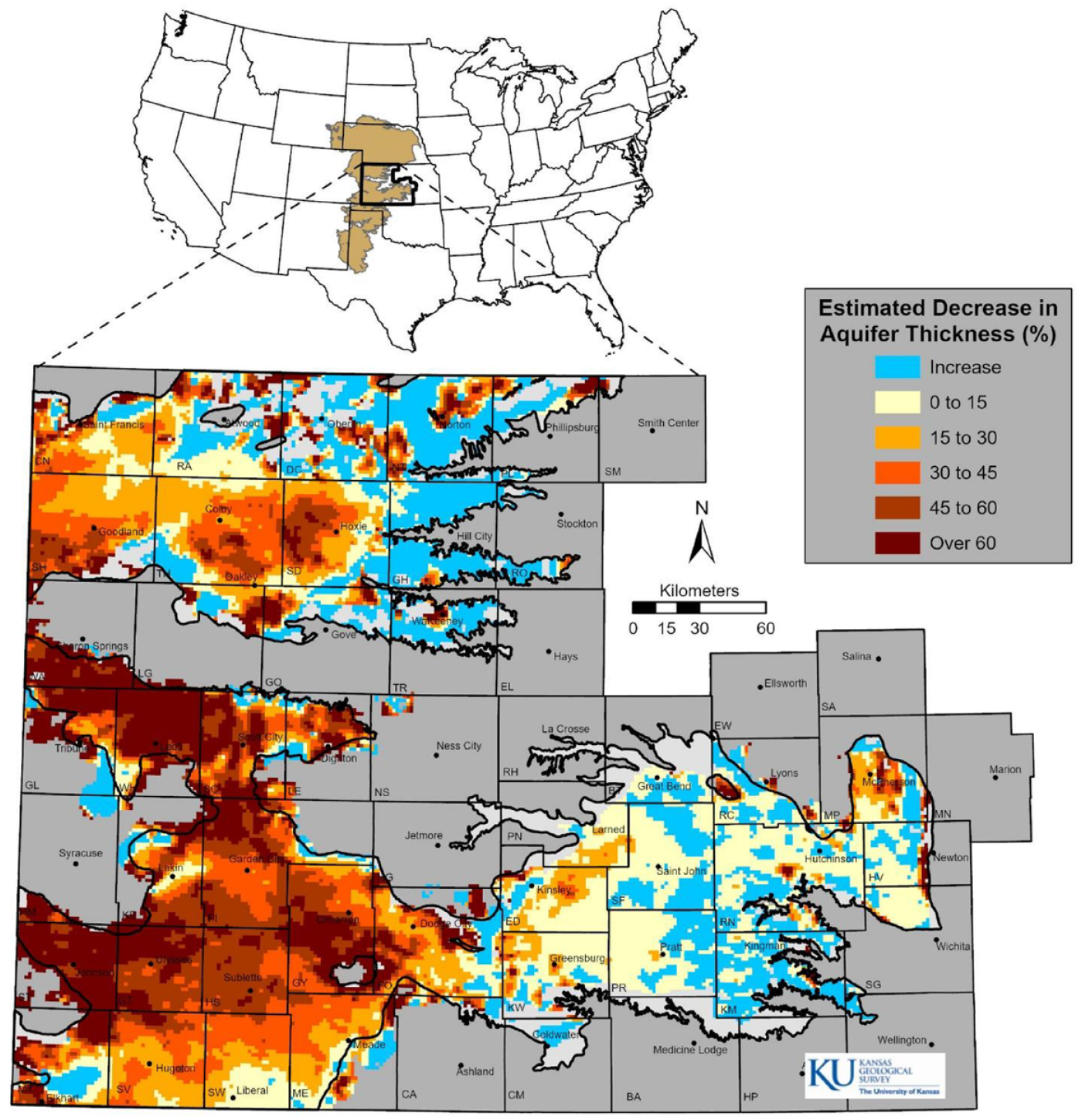
Location of the High Plains aquifer (HPA) in the United States with an expanded view of the percent change in aquifer thickness from predevelopment to present for the HPA in Kansas. Predevelopment is defined as the period prior to onset of widespread pumping for irrigated agriculture (mid-1950s and earlier); present is defined as the average of 2020–2022 winter conditions. In just a little over sixty years, huge volumes of groundwater that took thousands of years to accumulate have been removed from the aquifer. The areas of increase in the western third of the state are areas of thin aquifer that are of little practical importance.(See footnote 10.) Note that the portion of the HPA in the western third of the state is often called the Ogallala aquifer, a name that is less commonly used for the HPA as a whole.
As in the other states overlying the aquifer, the portion of the HPA in Kansas has been heavily pumped for decades. 9 This intensive use has come at a price in terms of aquifer conditions. That price is illustrated in the inset in Figure 1, a map of the percent change in aquifer thickness since the onset of widespread pumping for irrigated agriculture. 10 The semi-arid western third of the state has experienced the greatest decreases in aquifer thickness. In some areas, more than sixty percent of the aquifer has been lost, posing an existential threat to the continued viability of irrigated agriculture and the rural communities that depend on it. 11 Other components of the hydrologic cycle have not been immune from this depletion. Most of the rivers and streams in the western third of the state were originally groundwater-fed, as water levels in the aquifer were higher than those in the stream, so water flowed from the aquifer to the stream. Pumping-induced declines in the aquifer reversed that process, leading to the drying up of most surface water bodies in western Kansas (Figure 2). 12
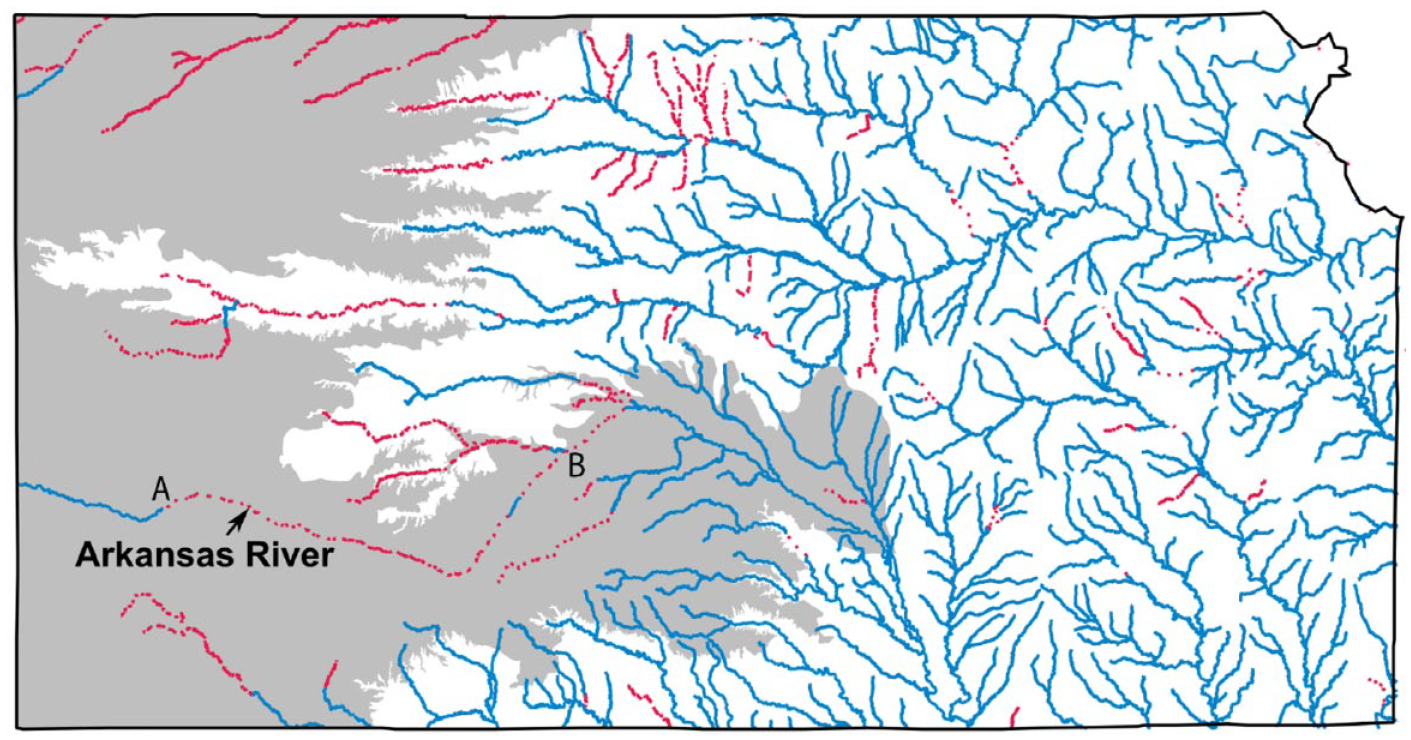
Map of the major perennial (always flowing) streams in Kansas as of 1961. The solid blue lines are the streams that were classified as perennial in 1961 and then again in 2009; the red dashed lines are the streams that were classified as perennial in 1961 but not in 2009. The shaded area marks the High Plains aquifer. Most of the streams overlying the High Plains aquifer no longer flow because of the declines in aquifer water levels. The Arkansas River, one of the major rivers in the state, has been dry in the stretch from point A to point B for more than two decades (figure adapted from Zipper et al. See footnote 13). Note that Kansas extends 660 kilometers (410 miles) east-west at its widest point.
A logical question to ask is: How did we end up here? The answer requires a short discussion of the legal framework in which water is managed in Kansas. Water in Kansas is considered a public resource. It is not owned by any individual, but individuals can obtain a right to use a specified annual volume of water for beneficial purposes, such as irrigation. The management of these water rights is done through a permitting system based on the ”prior appropriation doctrine,” in which water rights are classified by seniority (date of assignment) with the more senior rights having a higher legal priority. 13
The system seems straightforward, but two problems have arisen. First, the number of assigned water rights vastly exceeds the supply that the aquifer can annually provide (over-appropriation), as the focus for decades was on economic development with little attention given to the long-term ramifications for aquifer conditions. 14 However, built into the legal system is a check to prevent severe depletion by allowing senior right holders to shut down those more junior to them when they are unduly affected by the pumping of those junior rights. The second problem has arisen because few senior right holders have defended their rights. This counterintuitive response is not unreasonable considering the circumstances. Requesting that nearby water right holders curtail groundwater pumping is not viewed as a neighborly act in semi-arid agricultural areas that depend on irrigation. Moreover, many irrigators hold multiple rights with vastly different seniorities, so they could end up shutting down some of their own wells through such requests. The result is continued depletion. State regulators have the authority to shut down junior right holders but have not pursued that path in western Kansas. Their preference, undoubtedly influenced by political expediencies, has been to respond to requests from senior right holders and not initiate actions. 15
The take-away message from the inset in Figure 1 is clear: the prospects for future generations in western Kansas have been diminished relative to those of the recent past, as less water availability translates into reduced opportunities for financial success in an agricultural economy. This intergenerational inequity is profound and widespread. Continuation of current rates of water-level decline, coupled with the warmer conditions expected under climate change, will further worsen the situation, leading to conversion of irrigated land to dryland agriculture over broad swaths of the region and the resulting impact on local economies (lower crop yields and/or less-lucrative crops). 16
There is no mystery about what needs to be done—pumping must be reduced to levels more appropriate to what the aquifer can provide. Three possible approaches have been proposed. First, replace the groundwater with surface water, either through direct use or recharge. This may be viable in areas with excess surface water, but there is no excess surface water to be had in western Kansas. In that case, water must be brought in from outside areas. A project has been proposed to take excess flows from the Missouri River and transport them 350+ miles west (1600-ft vertical lift) to recharge the aquifer. The economics of using that water to grow corn and other row crops do not make sense in the absence of huge agricultural subsidies. Given the legal challenges that will undoubtedly arise, this project is not going to move forward in the next several decades, if ever. 17
Second, an intuitively appealing solution is to provide subsidies to irrigators to deploy more water-efficient irrigation equipment. However, our analysis of the last quarter of a century of water use in western Kansas, a period in which there were great strides in improving irrigation efficiency, cannot detect a statistically significant reduction in water use over that time. 18 This result is consistent with previous work that has shown that use of more efficient irrigation technologies typically does not produce a reduction in groundwater pumping. 19 Instead of being conserved, the additional water is used to grow more water-needy crops or to irrigate larger areas. This response to efficiency improvements has been observed across the spectrum of natural resources utilization and has been termed “Jevons’ Paradox” by economists. 20
The third and only viable approach over the next several decades is to reduce pumping in conjunction with modification of agricultural practices. In 2012, the Kansas Legislature approved a new program for groundwater management, the Local Enhanced Management Area (LEMA), to enhance prospects for large-scale pumping reductions. 21 In 2015, the Legislature approved an additional program, the Water Conservation Area (WCA), to further enhance prospects for pumping reductions. 22 In both cases, these are voluntarily developed local programs that then become binding by order of the state regulatory agency to ensure that all follow the agreed-upon rules.
The first LEMA was established in 2013 in a 99-square-mile area in northwestern Kansas (Sheridan-6 [SD-6] LEMA) and has been a resounding success—water use has been reduced by approximately thirty percent, the water-level decline rate has been reduced by over sixty percent, and the irrigators report that their income has not diminished. 23 Many in the water resources community would agree that the LEMA and WCA programs, if widely adopted in western Kansas with reduction goals of twenty to thirty percent, could significantly extend the lifespan of the aquifer and, in certain areas, come close to attaining sustainable conditions. The critical element of these programs is the combination of voluntary, locally generated plans with a binding regulatory order.
What is the potential to achieve widespread adoption? The reported economic success of the SD-6 LEMA should help ease fears of a detrimental economic impact. 24 In addition, Kansas water planners have worked with irrigators to support a network of water technology farms to help educate the community about tools that can help them achieve reduction goals. 25 However, despite the widespread recognition of the severity and ramifications of continued depletion, the successful experiences of others with water-use reductions, and access to the technology that can make those reductions possible, enthusiasm for adopting these programs has been limited.
Why is this so? One can point to structural and financial factors that may limit prospects for large-scale pumping reductions. In terms of structural factors, water management in Kansas is the responsibility of the Division of Water Resources in the Kansas Department of Agriculture. Kansas is the only state in the American West that has placed water management under a department of agriculture, a structure that many view as rife with the potential for conflicts of interest, which may have led to a hesitation to implement all available measures in the past. In addition, federal agricultural incentive programs often have led to less-sustainable farming practices. 26 Moreover, little appears to have been done to develop financial instruments that would encourage pumping reductions to extend the aquifer lifespan. Without such instruments, financial exigencies will likely drive continuation of business-as-usual activities.
The most important factor limiting prospects for large-scale reductions may be the internally conflicting viewpoints in the irrigation community. Surveys of irrigators in western Kansas have found a widespread recognition that the aquifer is being depleted and that this is not in the region’s best interest. Although most irrigators agree that aquifer depletion is not fair to future generations, they do not feel personally responsible for the depletion. Moreover, a large percentage say that they are doing everything they can to conserve groundwater. This recognition of the severity of the situation coupled with unwillingness to accept some responsibility for it appears to have significantly dampened enthusiasm for efforts to address the ongoing depletion. 27
Discussion
The previous section described current conditions, their historical roots, what is being done to address them, and the vexing complexities that constrain progress. The intergenerational inequity that has arisen in the Kansas HPA is not unique to that region. Although the details of the geologic, legal, regulatory, and social frameworks differ, analogous situations can be found across the globe in aquifers in semi-arid areas that are heavily pumped in support of irrigated agriculture. 28 The complexities of each situation constrain paths forward. We have used the Kansas example to illustrate the intricate challenges faced by those seeking to address aquifer depletion and the intergenerational inequity that it induces. Promising paths forward, whether in Kansas or elsewhere, can be characterized by a set of common elements. Those elements and their status in western Kansas are as follows:
Leadership and fit: effective local leadership is critical for uniting the community to address the challenge. Strong local leadership has been an important factor for the success of the SD-6 LEMA. Such leadership will be most influential when conservation areas, such as LEMAs, are tailored to local conditions. Sociological studies have found that the effectiveness of conservation programs is greatest when they are organized in relatively small areas of homogeneity in terms of aquifer conditions and producer attitudes. 29
Education: outreach efforts to educate the local populace are of great importance. In areas where LEMAs have been adopted, numerous public meetings were held by local and state agencies to develop support for the program. Education efforts should convey a sense of urgency, as the needed pumping reductions become more difficult to implement as the aquifer thins. Figure 1 shows that the window of opportunity to make a difference is beginning to close in many areas of western Kansas.
Science-based decisions and the data to support them: scientists have developed a good understanding of how aquifers are affected by pumping and what needs to be done to diminish rates of depletion. That understanding, when coupled with data on aquifer conditions, is a powerful tool, allowing decisions on paths forward to be founded on the reality that we face. For far too long in western Kansas, the policy of planned depletion was in place. Depletion seemed to be in the hazy, distant future, so the policy endured. It was only in December 2022 that the Kansas Water Authority, the entity charged with making recommendations to the governor and legislature regarding Kansas’s water resources, decided that the policy of planned depletion for the western Kansas HPA is no longer in the state’s best interest. 30 We are fortunate in Kansas to have excellent data on aquifer conditions. Reliable estimates of annual pumping, typically the greatest stress on an aquifer, are often scarce, even in the developed world. Kansas is unique in this regard, as meters are required on every high-capacity pumping well. 31 We are thus able to characterize the major stress on the HPA in western Kansas with confidence and chart future paths for the aquifer with a reliability that is not possible elsewhere. 32
Institutional frameworks: a legal and regulatory framework should be in place to control groundwater extraction; this framework must be paired with a willingness and a structural arrangement that makes implementation possible when conditions call for it. The financial framework is also of great importance. Better loan terms in areas that are implementing meaningful measures to extend the aquifer lifetime could be an important means to help direct efforts toward water conservation. Financial instruments, such as new crop insurance arrangements, could also be helpful in this regard. The irrigation community in western Kansas is known for its resourcefulness and adaptability, but, without structural and financial encouragement to better channel those traits, little will be accomplished. Resource economists have long held that the solution to aquifer depletion is the rational pricing of water, i.e. pricing to reflect water’s true value. 33 However, the possibility of implementing such pricing is highly unlikely in western Kansas.
Balance between “sticks” and “carrots”: achieving a balance between penalties and incentives is critical. The potential for regulatory measures can prompt action in communities that value individual independence and tend to resent governmental regulation. Such a “stick” should be combined with a “carrot” to help lower the cost of adopting new practices and overcome the resistance to doing so. This could be in the form of subsidies for purchasing the new generation of tools for precision agriculture. 34 Linking those subsidies to a binding agreement for a certain percent reduction in water use is necessary, as history has shown that subsidies alone will have little impact. 35
Balance between “bottom-up” and “top-down”: achieving a balance between local-based control and regulatory oversight is important to enhance prospects for pumping reductions. Locally generated plans that are supported by binding regulatory orders appear to be an appropriate marriage of the two and are the basis for the well-received conservation area programs in western Kansas.
Innovation in agricultural practices: pumping reductions in a financially viable framework are going to require innovation in agricultural practices. Standard practices when coupled with pumping reductions will likely lead to diminished profits or financial losses. Thus, agricultural producers will need to work with new methods, crops, etc., to prolong the lifespan of the aquifer and the regional economy that it sustains. 36 The producers in the SD-6 LEMA and other conservation areas in western Kansas are blazing a promising path forward in this regard. 37
These critical elements combined with the technical principles delineated by Butler et al. 38 could have a significant impact. However, this is not a problem that is going to be solved solely through technical and structural measures.
Theology and Stewardship
In addressing this scientific reality, we want to pose two questions that are pertinent for the readership of Interpretation: first, how should this intergenerational inequity be viewed from a theological perspective? Second, is there a role for communities of faith to help us make progress in reducing the impact of this inequity?
We recognize that the world is full of difficult, multi-faceted issues with which the pastoral community must wrestle. We are not theologians, so we also recognize that it could be viewed as presumptuous for us to venture into the areas of biblical studies and theology. However, this inequity is an existential threat to the continued improvement of the human condition, so we, with some trepidation, offer up a few thoughts for consideration.
Theological Framework
Based on our readings, we suggest two fundamental principles rooted in the Bible that speak to conservation of resources and intergenerational justice. First, Gen 1: 26–28 describes the status and role of humans in God’s creation: they are created “in the image of God.” One view of what it means for humans to bear God’s image points to the function or vocation of humans as God’s representatives in creation. 39 Because humans serve as God’s representatives, they are called to rule (or have dominion) over God’s creation in the manner that God would—taking care of all of creation. Another word for this type of rule is stewardship. 40 Thus, in contrast to the utilitarian right to the earth’s resources that humans claim all too often, Genesis 1 states that humanity’s role is to take charge wisely as God’s earthly representatives. The creation story in Genesis 2 provides additional insight into how to rule as God rules. Again, we find that the role of humans is stewardship; the goal is to care for God’s creation, using it responsibly so that it will be preserved. The narrative seems to suggest that unsustainable practices, including depletion of groundwater resources, are counter to the intended role of humans as caretakers of God’s creation.
Second, Leviticus 25 institutes the concept of the Sabbath year. Every seventh year no crops are to be planted so that the land, livestock, and wild animals can have Sabbath rest. The practice of the Sabbath year thwarts overuse of the land and its resources. The land is given by God, but not unconditionally. Agriculture is not to be pursued aggressively to extract the greatest yield possible. Rather, steps are instituted for sustainability. The promised outcome of the observance of the Sabbath year is that “the land will yield its fruit, and you will eat your fill and live there in safety” (Lev 25:19). The promise is accompanied with a warning. Failure to follow God’s instructions can result in removal from the land so that the land could “rest and enjoy its Sabbath years” (Lev 26:34).
These two concepts point to care of God’s creation continuing over the generations. The land belongs to God (e.g., Ps 24:1–2) and is not ours to do with as we please or to extract as much as we can from it. It is God’s and must be cared for on God’s behalf. We recognize that there is another line of thought linked to an eschatology where the present earth will be disposed of and replaced by a new one, giving rise to a lack of concern about preservation of our planet’s resources. 41 However, many biblical scholars have questioned the basis of that line of thought. 42 They say that we are living in the in-between time, waiting for the promised renewal of all creation. The question thus arises “What are human obligations during this time?” There are clear admonitions in Scripture for lives in the present. Jesus sets love for one’s neighbor at the same level as love for God (Mark 12:29–31 and parallels). In the context of natural resources, this standard suggests that love for God should manifest itself in care for aquifers that are shared with neighbors and future generations.
Role for Clergy and Their Congregations
Pastors have the potential to play an important role in both education and leadership. They typically are respected voices in their communities, so they can bring these issues to the attention of their congregations without necessarily advocating paths forward. It is crucial that communities that overlie heavily stressed aquifers begin to give serious consideration to what they want to leave for their descendants. Pastors can be of great assistance in overcoming the inertia that exists with such difficult issues and begin to get needed discussions moving forward. Pastoral messages and Sunday school activities that focus on creation care as part of the God-given vocation of humans and on the biblical mandate to love our neighbors in concrete ways, now and in the future, could be an appropriate starting point. Testimonials by local irrigators who are implementing measures to extend aquifer lifetimes would demonstrate the economic viability of those measures and their consistency with the role that God has assigned to humans. These testimonials could be paired with those from the congregation’s youth about their desires for the area’s future, an important consideration given the ongoing hollowing out of many rural communities.
Conclusions
The desire to ensure that future generations have a better situation than our own has long been a constant of the human condition. The aquifer depletion shown in Figure 1 demonstrates that this concern needs to come to the fore in western Kansas. The contradiction between the professed desire to extend the aquifer lifespan to benefit future generations and the unwillingness/hesitation to adopt the measures that are required to realize that goal has impeded progress. However, there are glimmers of hope. In many of the conservation areas in western Kansas, participants state that a prime motivation has been the desire to save the resource and the lifestyle that it enables for future generations. This desire is also reflected in surveys of irrigators in western Kansas. The key question is how to channel that aspiration, which is undoubtedly not isolated to irrigators in western Kansas, into actions that will lead to more sustainable aquifer futures. The pastoral community could play a valuable role in this context.
We end with a final question that haunts us: how will future generations view us? We fear that they will ask what we were thinking by continuing business as usual when the outcome and ramifications for future generations were clear. Our only response to this question from the future is to try to chart a more responsible path going forward. Conditions in the High Plains aquifer in western Kansas have been characterized as “The hour is late, but all is not lost,” a phrase that undoubtedly rings true for many heavily stressed aquifers. 43 Thus, across the globe, we must recognize that the time for handwringing is over; we need to move forward with realistic measures to make a difference for us and our descendants. We strongly encourage faith communities to join in this effort, as the world needs all the help that its inhabitants can muster.
Footnotes
1
Proceedings of the Western Association of Fish and Wildlife Agencies (2001), 35. https://www.google.com/books/edition/Proceedings_of_the_Western_Association_o/ldVMAAAAYAAJ?hl=en&gbpv=0
2
William M. Alley and Rosemarie Alley, High and Dry: Meeting the Challenges of the World’s Growing Dependence on Groundwater (New Haven: Yale University Press, 2017); Jay S. Famiglietti, “The Global Groundwater Crisis,” Nature Climate Change 4 (2014): 945–48.
3
George M. Hornberger and Debra Perrone, Water Resources: Science and Society (Baltimore: Johns Hopkins University Press, 2019).
4
Rex C. Buchanan, B. Brownie Wilson, and James J. Butler, Jr., “The High Plains Aquifer,” Kansas Geological Survey Public Information Circular 18 (2023).
5
Robert Jerome Glennon, Water Follies: Groundwater Pumping and the Fate of America’s Fresh Waters (Washington, D.C.: Island, 2002).
7
John K. Lovelace, Martha G. Nielsen, Amy L. Read, Chid J. Murphy, and Molly A. Maupin, “Estimated Groundwater Withdrawals from Principal Aquifers in the United States, 2015,” U.S. Geological Survey Circular 1464 (October 16, 2020), https://doi.org/10.3133/cir1464,  .
.
8
Samuel J. Smidt, Erin M. K. Haacker, Anthony D. Kendall, Jillian M. Deines, Lisi Pei, Kayla A. Cotterman, Haoyang Li, Xiao Liu, Bruno Basso, and David W. Hyndman, “Complex Water Management in Modern Agriculture: Trends in the Water-Energy-Food Nexus over the High Plains Aquifer,” Science of The Total Environment 566–567 (2016): 988–1001.
9
Buchanan, Wilson, and Butler, “The High Plains Aquifer.”
11
Buchanan, Wilson, and Butler, “The High Plains Aquifer”; Lucas Bessire, Running Out: In Search of Water on the High Plains (Princeton: Princeton University Press, 2021).
12
Sam Zipper, Ilinca Popescu, Kyle Compare, Chi Zhang, and Erin C. Seybold, “Alternative Stable States and Hydrological Regime Shifts in a Large Intermittent River,” Environmental Research Letters 17 (2022): 074005.
13
Reed D. Benson, Burke W. Griggs, and A. Dan Tarlock, Water Resource Management: A Casebook in Law and Public Policy, 8th ed. (Mineola, NY: Foundation, 2021), 1153.
14
Bessire, Running Out: In Search of Water on the High Plains.
15
Burke W. Griggs, “Reaching Consensus About Conservation: High Plains Lessons for California’s Sustainable Groundwater Management Act,” University of the Pacific Law Review 52 (2021): 495–547.
16
Jillian M. Deines, Meagan E. Schipanski, Bill Golden, Samuel C. Zipper, Soheil Nozari, Caitlin Rottler, Bridget Guerrero, and Vaishali Sharda, “Transitions from Irrigated to Dryland Agriculture in the Ogallala Aquifer: Land Use Suitability and Regional Economic Impacts,” Agricultural Water Management 233 (2020): 106061; Edward C. Rhodes, Humberto L. Perotto-Baldivieso, Evan P. Tanner, Jay P. Angerer, and William E. Fox, “The Declining Ogallala Aquifer and the Future Role of Rangeland Science on the North American High Plains,” Rangeland Ecology and Management 87 (2023): 83–96.
17
18
Donald O. Whittemore, James J. Butler, Jr., and Blake B. Wilson, “Precipitation and Pumping Relationships: A Simple Approach to Assess the Effectiveness of Groundwater Conservation Measures” (paper presented at the American Geophysical Union Hybrid Fall Meeting, New Orleans, LA, 2021), Abstract H12C-05.
19
Frank A. Ward and Manuel Pulido-Velazquez, “Water Conservation in Irrigation Can Increase Water Use,” Proceedings of the National Academy of Sciences of the United States of America 105 (2008): 18215-20; Lisa Pfeiffer and C. Y. Cynthia Lin, “Does Efficient Irrigation Technology Lead to Reduced Groundwater Extraction? Empirical Evidence,” Journal of Environmental Economics and Management 67 (2014): 189–208.
20
Louis Sears, Joseph Caparelli, Clouse Lee, Devon Pan, Gillian Strandberg, Linh Vuu, and C.-Y. Cynthia Lin Lawell, “Jevons’ Paradox and Efficient Irrigation Technology,” Sustainability 10 (2018): 1590.
21
23
Buchanan, Wilson, and Butler, “The High Plains Aquifer.”
24
Bill Golden, “Monitoring the Impacts of Sheridan County 6 Local Enhanced Management Area: Report for 2013 – 2020.” Report to the Kansas Water Office (2021).
26
Rhodes et al., “The Declining Ogallala Aquifer and the Future Role of Rangeland Science on the North American High Plains,” 83–96.
27
28
Alley and Alley, High and Dry.
29
Adam Zwickle, Brockton Chandler Feltman, Allyson Jane Brady, Anthony D. Kendall, and David W. Hyndman, “Sustainable Irrigation through Local Collaborative Governance: Evidence for a Structural Fix in Kansas,” Environmental Science & Policy 124 (2021): 517–26.
30
Kansas Water Authority, “2023 Annual Report to the Governor and Legislature.”
31
James J. Butler Jr., Donald O. Whittemore, Blake B. Wilson, and Geoffrey C. Bohling, “A New Approach for Assessing the Future of Aquifers Supporting Irrigated Agriculture,” Geophysical Research Letters 43 (2016): 2004–10; US Department of Agriculture, “2017 Census of Agriculture, 2018 Irrigation and Water Management Survey,” AC-17-SS-1 (2019): 269. .
32
James J. Butler, Jr., Geoffrey C. Bohling, Sam P. Perkins, Donald O. Whittemore, Gaisheng Liu, and Blake B. Wilson, “Net Inflow: An Important Target on the Path to Aquifer Sustainability,” Groundwater 61 (2023): 56–65.
33
David Zetland, The End of Abundance: Economic Solutions to Water Scarcity (Mission Viejo, CA: Aguanomics, 2011).
34
Bruno Basso and John Antle, “Digital Agriculture to Design Sustainable Agricultural Systems,” Nature Sustainability 3 (2020): 254–56.
35
Matthew R Sanderson and Vivian Hughes, “Race to the Bottom (of the Well): Groundwater in an Agricultural Production Treadmill,” Social Problems 66 (2018): 392–410; Sears et al., “Jevons’ Paradox,” 1590.
36
Rhodes et al., “The Declining Ogallala Aquifer” 83-96; Basso and Antle, “Digital Agriculture to Design Sustainable Agricultural Systems,” 254–56.
37
Jillian M. Deines, Anthony D. Kendall, James J. Butler, and David W. Hyndman, “Quantifying Irrigation Adaptation Strategies in Response to Stakeholder-Driven Groundwater Management in the US High Plains Aquifer,” Environmental Research Letters 14 (2019): 044014.
38
James J. Butler Jr., J. Jaime Gomez-Hernandez, Debra Perrone, and David W. Hyndman, “Introduction to Special Section: The Quest for Sustainability of Heavily Stressed Aquifers at Regional to Global Scales,” Water Resources Research 57 (2021): e2021WR030446.
39
John H. Walton, The Lost World of Genesis One: Ancient Cosmology and the Origins Debate (Downers Grove, Ill.: IVP Academic, 2009); Theodore Hiebert, “Reclaiming the World: Biblical Resources for the Ecological Crisis,” Int 65 (2011): 341–52.
40
Richard Bauckham outlines several limitations of the use of “stewardship” to describe the role of humans (Richard Bauckham, The Bible and Ecology: Rediscovering the Community of Creation (Waco, TX: Baylor University Press, 2010)). Nevertheless, we will use the term for lack of a better word to describe the human vocation.
41
Hal Lindsey and Carole C. Carlson, The Late Great Planet Earth (Grand Rapids: Zondervan, 1970); Tim LaHaye and Jerry Jenkins, Left Behind: A Novel of the Earth’s Last Days (Wheaton, IL: Tyndale House, 1995), and subsequent volumes.
42
Douglas J. Moo and Jonathan A. Moo, Creation Care: A Biblical Theology of the Natural World (Grand Rapids: Zondervan, 2018), 153–161; Steven Bouma-Prediger, For the Beauty of the Earth: A Christian Vision for Creation Care, 2nd ed. (Grand Rapids: Baker Academic, 2010), 3.
43
Gugelmeyer, “It’s Not Too Late.”