




Abstract
This study examined the factors, including indigenous knowledge, which influence practitioners’ attitudes towards the international exchange of social work ideas. A total of 228 valid questionnaire responses were obtained from self-identified social workers in selected Asian countries, and quantitative analysis was mainly employed to examine the factors shaping participants’ knowledge of and expectations for international exchange in social work. The findings revealed that, alongside past experiences of international exchange and residence abroad, participants’ understanding of indigenous social work practices and knowledge significantly shaped their perceptions of international exchanges. The findings indicate the importance of sharing a diverse range of indigenous knowledge and local perspectives.
Keywords
Introduction
While international exchange has historically served as a cornerstone of social workers’ professional development and international cooperation, its re-examination and reinterpretation from diverse perspectives are necessary. This study contends that international exchange in social work – or international social work exchange (ISWEx) – is neither a neutral nor uniform process; rather, it is often shaped by historical, cultural and political influences (Higashida, 2024a). Within Western-dominated discourses, the values and assumptions underlying such exchange frequently reflect those of the Global North, including individualism, competitiveness and a preference for standardisation (Gray and Coates, 2010). These assumptions do not always align with the values, priorities and contextual realities of social workers in the ‘rest’ of the world, including Asia (Das et al., 2023; Hugman, 2022). For instance, collective, indigenous and community-oriented approaches, which are deeply embedded in many Asian cultures, offer alternative frameworks for meaningful international exchange in the field of social work (Higashida et al., 2022). This study focuses on international exchange among social work practitioners, incorporating international social work (ISW) and indigenous perspectives within Asian contexts.
The concept of exchange, or international exchange, has been widely discussed across disciplines, including economics, anthropology and sociology (Cook, 2000). While international exchange can hold multiple interpretations, it is commonly defined as ‘an arrangement when two people or groups from different countries visit each other’s homes or do each other’s jobs for a short time’ (Oxford Advanced American Dictionary, 2025). 1 Its scope may vary according to context, encompassing elements such as ‘structural, social relationship, research, technology and virtual exchange’ (Link and Vorgrinčič, 2012: 343).
Such exchanges in contemporary social welfare and social work are perhaps rooted in 19th-century Europe, as exemplified by the 1856 European International Conference on Charity and Welfare (Healy and Thomas, 2021). In the current context of ISW, one dimension is professional exchange, defined as ‘the capacity to exchange social work information and experiences internationally and to use the knowledge and experience to improve social work practice and social welfare policy at home’ (Healy and Thomas, 2021: 8). This definition is a widely acknowledged conceptualisation of international exchange in the profession. Drawing from these historical and academic understandings, this study focuses primarily on the international exchange of knowledge and experience among social work practitioners, including those who may not be ‘professionals’ in the narrow, formalised sense.
Existing research has yielded various insights into the meaning and scope of international exchange, particularly within social work education. Scholars have proposed a model that categorises ISWEx into study abroad programmes, mutual distance exchange, academic exchange and practice- or internship-based exchange (Link and Vorgrinčič, 2012). In contemporary discussions, mutuality and reciprocity grounded in equality are emphasised as foundational to all forms of ISWEx (Healy and Thomas, 2021). For instance, international educational experiences have been found to promote critical engagement with issues such as cultural diversity, imperialism, discrimination and privilege, offering more than simple cultural adaptation (Jones et al., 2018). In addition, specific initiatives have promoted cultural sensitivity through remote social work education partnerships between Western and non-Western countries (Lee et al., 2024).
Contemporary discussions of social work remain largely dominated by perspectives rooted in the Global West and North (Gray and Coates, 2010; Hugman, 2022; Midgley, 1981, 2016). This mirrors the long-standing neglect of insights from non-Western contexts within the social work discourse (Higashida, 2024b; IFSW and IASSW, 2014). A Western-centric orientation has also shaped the structure and values of international exchange programmes (Bodhi, 2023; Carranza, 2022; Gray, 2005). In recent years, the need to broaden this discourse has gained increasing recognition, particularly regarding the inclusion of perspectives from historically under-represented regions (Das et al., 2023; Higashida, 2024c).
A key issue in this area is how indigenous knowledge or indigenous social work intersects with Western-rooted professional social work in the context of international exchange. Although limited findings are available, some insights are emerging. Literature on indigenous social work (Akimoto et al., 2020; Das et al., 2023; Gray, 2005; Higashida et al., 2024b) identifies at least three key approaches: applying Western-rooted knowledge to specific local contexts (indigenisation), blending Western and indigenous knowledge and exploring indigenous knowledge on its own terms. Other scholars have documented practical examples of the exchange of indigenous knowledge in the South Pacific (Mafile’o and Vakalahi, 2018). Similarly, as another example, the African philosophy of Ubuntu, meaning ‘I am because we are’, has been incorporated into the global agenda of social work (IFSW, 2021), suggesting that collective indigenous knowledge may also influence Western-rooted professional social work discourses (Xiang and Leung, 2023). Mathebane and Sekudu (2018) argue that combining indigenisation with decolonisation and critical awareness enhances understanding across diverse global experiences while fostering meaningful dialogue between different knowledge systems. These trends underscore the need for social work stakeholders to remain sensitive to such developments across global contexts.
Asia offers a unique context for examining the dynamics of international exchange. In this region, characterised by diverse histories and cultures, social work theory and knowledge have largely been introduced from Europe and the United States since the post-World War II period, with only a few exceptions (Akimoto, 2024; Das et al., 2023; Higashida et al., 2022). At the same time, major social, cultural and political transformations in many Asian countries in recent decades have created opportunities to explore alternative paradigms for ISWEx (Higashida, 2024b; Higashida et al., 2024b). The emergence of global decolonisation movements and indigenous theoretical contributions has sparked renewed dialogue on addressing and overcoming colonial legacies in areas such as education, professional training and multicultural or transnational collaboration (Das et al., 2023; Higashida et al., 2023, 2024b; Mafile’o and Vakalahi, 2018). However, Western-rooted professional knowledge remains structurally embedded in the education and research of social work across many countries, making it difficult to recognise or implement indigenous models in practice (Das et al., 2023).
Despite recent advances and emerging discourses, there remains a lack of systematic research into how ideas such as indigenous knowledge are exchanged and what insights can be gained from such processes. Healy (2003) outlined elements of what is exchanged through international collaboration in social work education and the factors that influence it, though this discussion has not matured in the context of specific regions. In the Asia-Pacific region – particularly in Australia, where English is the official language – academic interest in ISWEx has grown, but this interest has not extended as strongly to the practitioner level (Fox and Hugman, 2019; Harris et al., 2017; King et al., 2023; Zuchowski et al., 2019). Bridging these gaps is essential to developing a more inclusive and equitable understanding of ISWEx (Higashida et al., 2024b). It is therefore necessary to examine the factors that influence ISWEx to promote its practices in Asian contexts. It is equally important to examine the perceptions and practices of social workers themselves. Emphasising the role of non-Western indigenous and local viewpoints may significantly enrich ISW perspectives (Akimoto, 2024; Higashida et al., 2024a; Jaswal and Kshetrimayum, 2023).
This study therefore aims to examine the factors influencing Asian social workers’ knowledge of and expectations for ISWEx, including the relationship with indigenous knowledge. It offers exploratory insights into the complexities and possibilities of international exchanges in the Asian context, thereby contributing to a more comprehensive and holistic understanding of global social work collaboration.
Methods
Study design
This study primarily employed a quantitative research design while incorporating complementary qualitative analysis. An online survey formed the core of the methodology, supplemented by a qualitative analysis of open-ended responses to clarify the multifaceted dimensions of social workers’ perspectives on ISWEx. The survey followed an embedded design, whereby qualitative data played a secondary role in supporting the primary quantitative dataset, in line with a mixed methods approach (Creswell and Clark, 2017).
Survey implementation
Prior to launching the survey, the authors explained its objectives to professionals and stakeholders and requested their cooperation. Relevant organisations across Asia were approached. Although regional social work organisations did not participate, multiple domestic organisations within the region were contacted regarding the survey. These included, for example, the Sri Lanka Association of Professional Social Workers, the Japanese Association of Social Workers, the Japanese Association of Mental Health Social Workers, the Faculty of Social Administration at Thammasat University and other schools of social work and social welfare in Thailand, the Social Work Professions Council in Thailand, the Thailand Association of Social Workers and the National University of Mongolia. Organisations and individuals who agreed to cooperate were invited to complete the online survey via email or social networking services (SNS).
In total, 458 individuals accessed the survey by clicking the consent button. As explained in the introductory instructions, the survey was programmed to terminate if a respondent answered ‘No’ to the question, ‘I am a social work practitioner (I self-identify as a social worker)’ (n = 153). A total of 305 participants responded ‘Yes’. The survey was conducted from July to December 2024.
Ethical considerations
A research brief and explanatory text were provided in the invitations sent via email and SNS. Additional information was presented at the beginning of the survey, stating that participation was anonymous, responses would be statistically processed and anonymised and non-participation would not incur any penalty. Participation could proceed only after confirming their consent to these conditions. The study was approved by the Research Ethics Review Committee of Shukutoku University (No. 2024-103), with additional approval obtained from the Research Ethics Review Committee of Shimane University (No. 2024-09).
Survey items
The questionnaire explored participants’ attitudes in a broad sense towards ISWEx, demographic characteristics, self-assessed social work knowledge and skills, international experiences and general attitudes regarding international exchange. Some survey items were developed with reference to previous comparative research on ISW (Lalayants et al., 2015). The survey was administered primarily in English. Supplementary translations were provided in Thai, Sinhala, Japanese and Mongolian by the co-authors and collaborating researchers.
Demographics and experience
The survey included mandatory questions about participants’ age; gender (female, male or other); country of origin; and the current type, status and area of their social work activities. Respondents were asked whether they met local criteria for professional qualification, such as holding a national qualification or a social work-related degree, as these standards vary between countries. A question regarding religious beliefs was also included but was not mandatory.
Participants’ practical experience was similarly explored. They answered ‘Yes’ or ‘No’ to questions regarding whether they had received social work education or training, lived abroad for more than one month or had worked abroad for over one month.
International social work exchange
Participants were also asked whether they had experience of ISWEx. Those who responded ‘Yes’ were further asked to specify the types of activities they had engaged in, including training or seminars, conferences, cooperative activities, personal interactions, study abroad programmes and committee membership (Healy and Thomas, 2021).
An 11-item ISWEx scale was developed and applied, with partial reference to Lalayants et al. (2015). Respondents were measured using a four-point Likert-type scale ranging from ‘strongly disagree’ [1] to ‘strongly agree’ [4] The four-point format was chosen because, in the Asian context, five-point scales tend to encourage moderate selections such as ‘neither’ or ‘neutral’ (Wang et al., 2008).
Indigenous/local and Western social work
Seven items assessed participants’ perceptions of general social work knowledge and skills. The aim was to explore their views on both Western-rooted professional social work and indigenous/local social work (Akimoto, 2017). These items included general statements (e.g. ‘I have theoretical knowledge of social work practice in the field’; ‘I have social work practice skills’), as well as statements focused on Western-rooted social work (e.g. ‘Western social work knowledge and skills are important for my social work practices’).
In addition, the survey included items addressing indigenous and local social work (e.g. ‘Knowledge and skills rooted in local social culture are important for my social work practices’; ‘I am using local and indigenous knowledge in social work practices’) and statements on religion and cultural competence (e.g. ‘Religion is an important element in my social work field practice’; ‘Cultural competence is important in my social work practices’). All items were rated using the same four-point Likert-type format (‘strongly disagree’ [1] to ‘strongly agree’ [4]).
As supplementary qualitative data, participants were invited to respond voluntarily to an open-ended prompt: ‘Please feel free to describe any expectations you have through exchanges with practitioners from other countries’.
Analysis
Descriptive statistics were calculated for participants’ demographic characteristics, professional experience and ISWEx experiences, based on the country in which they were working at the time of the survey.
To explore the factor structure of the 11 ISWEx items, factor analysis was conducted using the principal factor method with promax rotation. Internal consistency of the scale was confirmed through reliability coefficients, including Cronbach’s alpha. Total scores for items comprising each identified factor were calculated and treated as subscales.
Multiple regression analysis was conducted to examine the factors influencing participants’ attitudes towards international exchange. The dependent variable was the total score for ISWEx-related factors, while independent variables included demographic characteristics, professional experience and Local and Western Social Work (LWSW)-related experiences. A stepwise method was applied.
These analyses were conducted based on the hypothesis that participants’ attitudes towards ISWEx are influenced by their experiences and perceptions of LWSW. The null hypothesis that these variables have no significant effect on their attitudes was statistically tested. SPSS for Windows, version 28, was used for statistical analysis. A two-tailed test with p < .05 was adopted as the significance threshold.
As a supplementary analysis, open-ended responses were coded using a single content analysis approach. A single code was applied to organise each response, using MAXQDA2022.
Results
Of the 305 individuals who undertook the survey, 228 responses (74.8%) were considered valid. This section presents the respondents’ demographics and social work experience, their engagement in ISWEx, a descriptive analysis of responses by country and a multivariate analysis of their attitudes towards ISWEx. Based on the number of valid responses per country, separate analyses were conducted for Thailand, Japan, Sri Lanka and the Other group. Finally, supplementary findings from the qualitative content analysis of the open-ended responses are presented.
Demographics and experience
As shown in Table 1, the overall mean age (standard deviation [SD]) was 41.6 (±12.6) years, ranging from 36.7 (±11.4) years in Sri Lanka to 50.1 (±11.1) years in Japan. Over 60% of all respondents were women, who also comprised the majority in each country. In total, 90% of participants were actively engaged in social work at the time of the survey, although all self-identified as social workers. More than 90% held professional qualifications for practising social work in their respective countries.
Demographics and experiences.
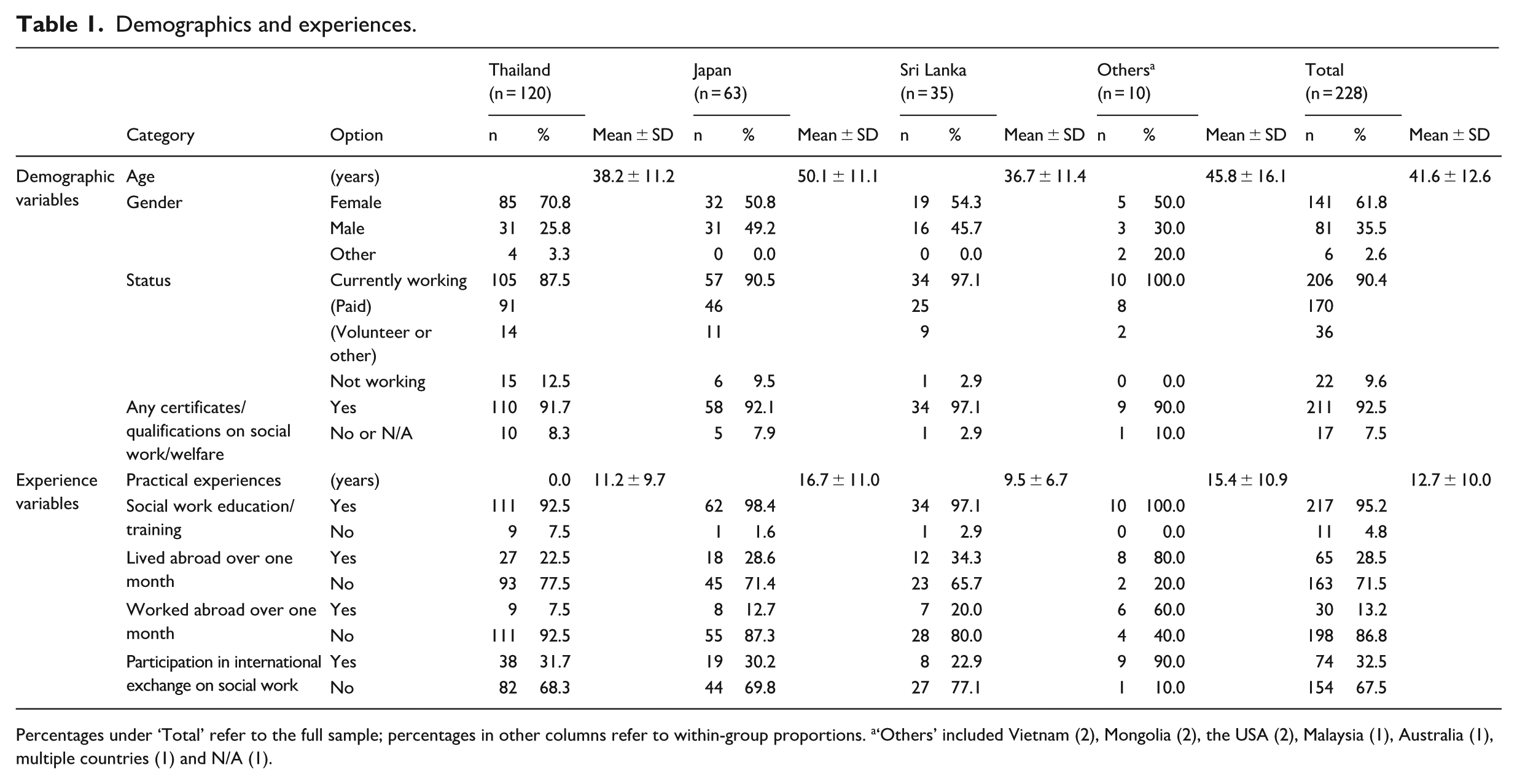
Percentages under ‘Total’ refer to the full sample; percentages in other columns refer to within-group proportions. a‘Others’ included Vietnam (2), Mongolia (2), the USA (2), Malaysia (1), Australia (1), multiple countries (1) and N/A (1).
When asked about areas of activity (multiple responses permitted), the most commonly reported were: disability (106), community work (105), medical/health (89), mental health (82), poverty/low income (80), policy and administration (79), older adults (78), children/mothers (77), disaster mitigation/prevention (30), migrants, refugees and multiculturalism (28), environmentalism (25) and international/global welfare (17).
Respondents’ experiences
The overall mean (SD) for years of practical experience was 12.7 (±10.0), ranging from 9.5 (±6.7) in Sri Lanka to 16.7 (±11.0) in Japan (see Table 1). More than 90% of respondents (n = 217) had received social work-related education, both overall and by country. Of these, 134 (61.8%) reported having received ISW education: Thailand (73, 65.8%), Japan (27, 43.5%), Sri Lanka (26, 76.5%) and Other (8, 80.0%). In total, 90 respondents (39.5%) reported studying international development at some point: Thailand (51, 42.5%), Japan (19, 30.2%), Sri Lanka (13, 37.1%) and Other (7, 70.0%). Overall, 65 respondents (28.5%) had lived abroad for more than one month. This ranged from 22.5% in Thailand to 34.3% in Sri Lanka (excluding the Other group). Fewer respondents had worked abroad for over one month compared to those who had lived abroad. Approximately 32.5% of respondents answered questions regarding their ISWEx experiences. This ranged from 22.9% in Sri Lanka to 31.7% in Thailand (excluding other countries). Among those who participated in ISWEx (n = 74), the majority selected ‘training/seminars’ and ‘conferences’ (see Table 2).
Participation in ISWEx (multiple responses allowed).
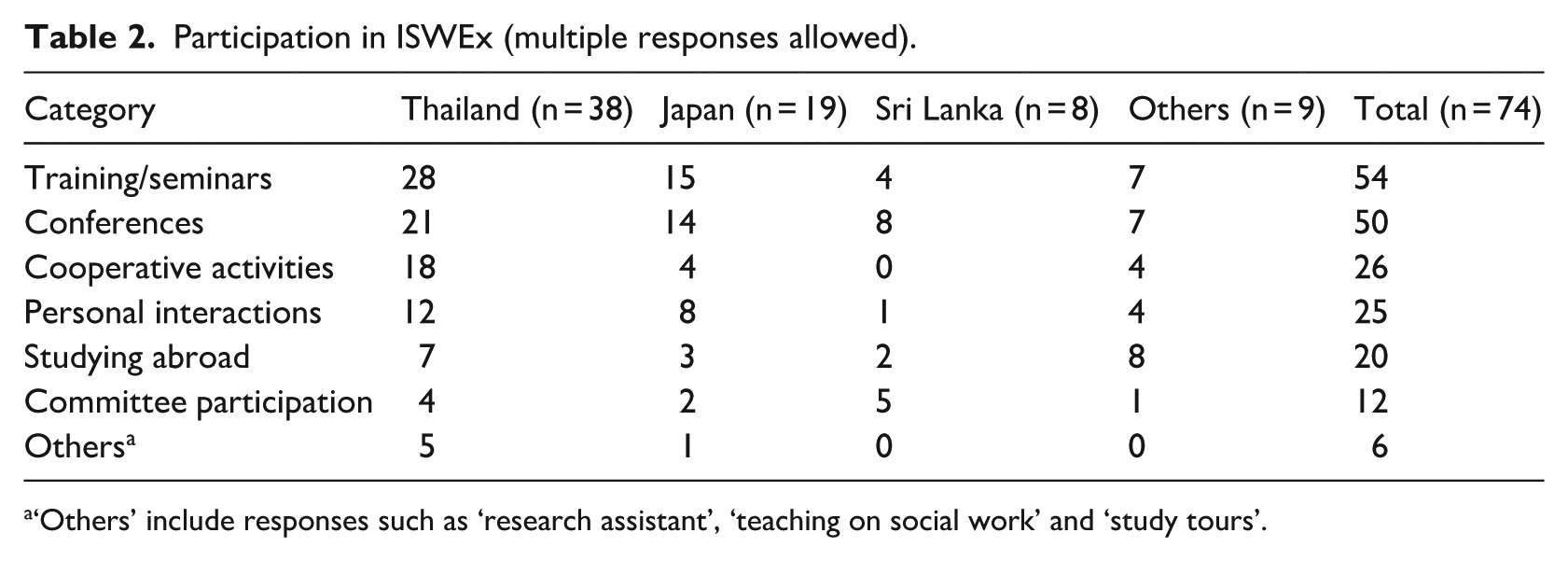
‘Others’ include responses such as ‘research assistant’, ‘teaching on social work’ and ‘study tours’.
ISWEx and indigenous/local social work
One ISWEx-related item (‘English must be the standard language for international exchange in social work’) was excluded from analysis due to weak correlation with other items. The remaining items underwent factor analysis to identify their underlying structure (see Table 3). The eigenvalues decreased sharply (4.328, 1.630, 0.822, . . .), and interpretability supported a two-factor solution. Items with factor loadings below 0.45 were removed, and exploratory factor analysis was repeated to confirm the structure of the final item (see Table 4).
Descriptive analysis: ISWEx and LWSW.
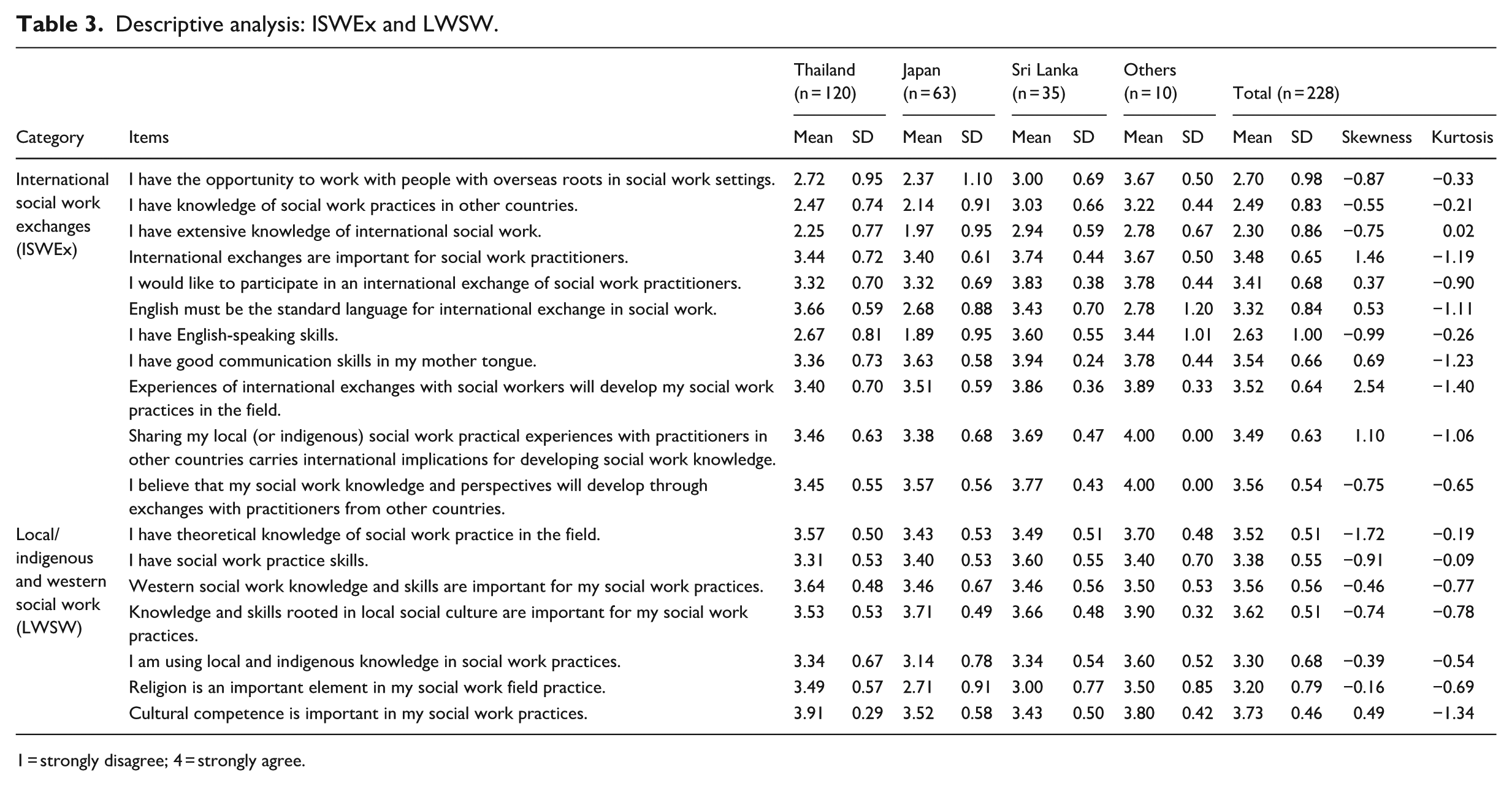
1 = strongly disagree; 4 = strongly agree.
Exploratory factor analysis of ISWEx items.
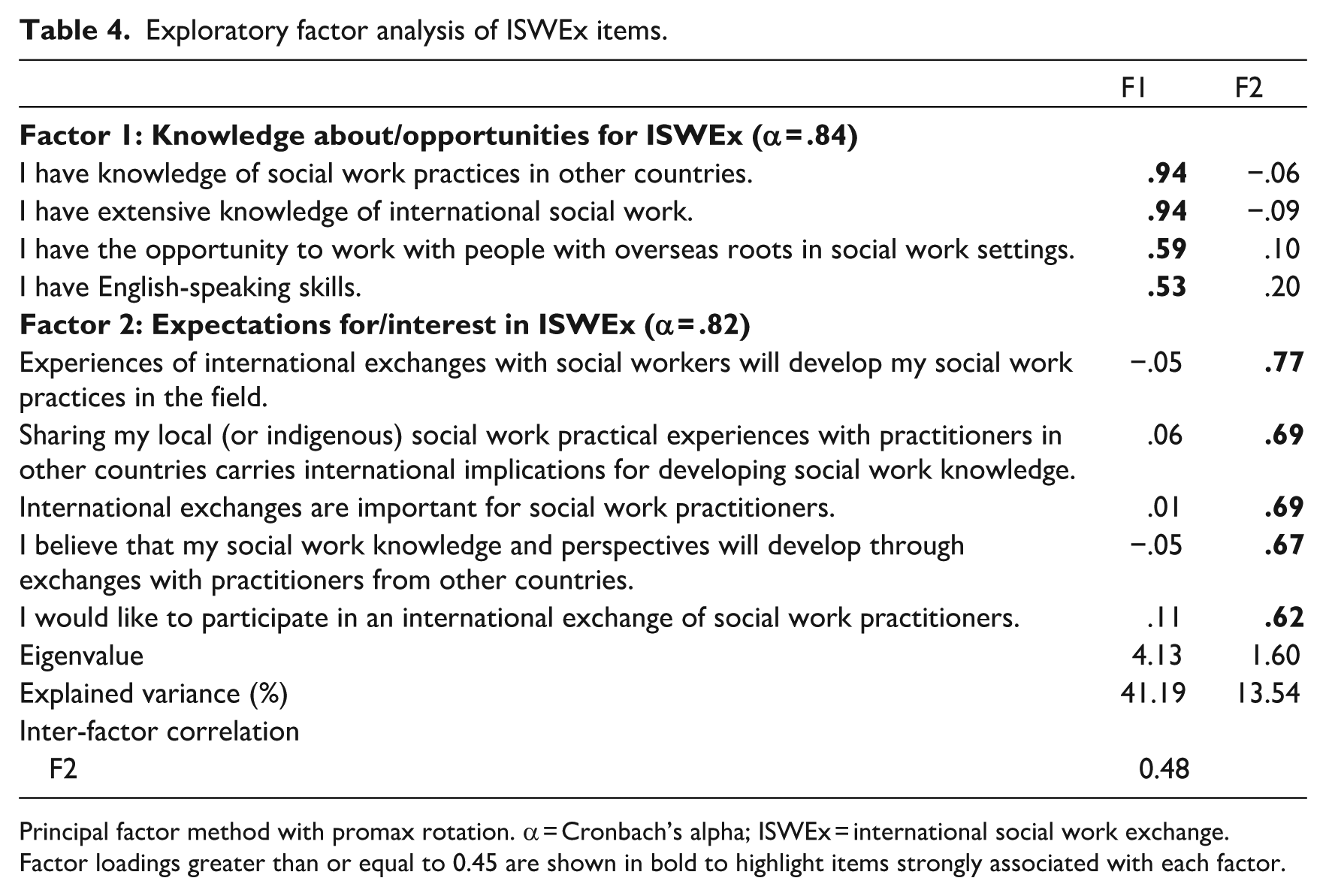
Principal factor method with promax rotation. α = Cronbach’s alpha; ISWEx = international social work exchange.
Factor loadings greater than or equal to 0.45 are shown in bold to highlight items strongly associated with each factor.
The first factor (F1) was labelled ‘Knowledge about/opportunities for ISWEx’ (α = .84), and the second factor (F2) was ‘Expectations for/interest in ISWEx’ (α = .82). The reliability coefficients indicated good internal consistency. Subscale scores were calculated by summing the total scores for each factor.
The overall means (SD) of F1 and F2 were 10.1 (±3.0) and 17.5 (±2.4), respectively; and the item mean scores were 2.5 and 3.5, respectively. Country-specific means were Thailand, 10.1 (±2.7) and 17.1 (±2.5); Japan, 8.4 (±3.0) and 17.2 (±2.4); Sri Lanka, 12.6 (±1.9) and 18.9 (±1.5); and Other, 13.1 (±1.6) and 19.3 (±1.0). Statistically significant differences were observed among the three primary countries for F1 (F(2, 215) = 27.6, p < .01) and F2 (F(2, 215) = 8.6, p < .01). Tukey’s post hoc test revealed significant differences (p < .05) in both F1 and F2 scores across all country pairs, except between Thailand and Japan for F2.
Influential factors
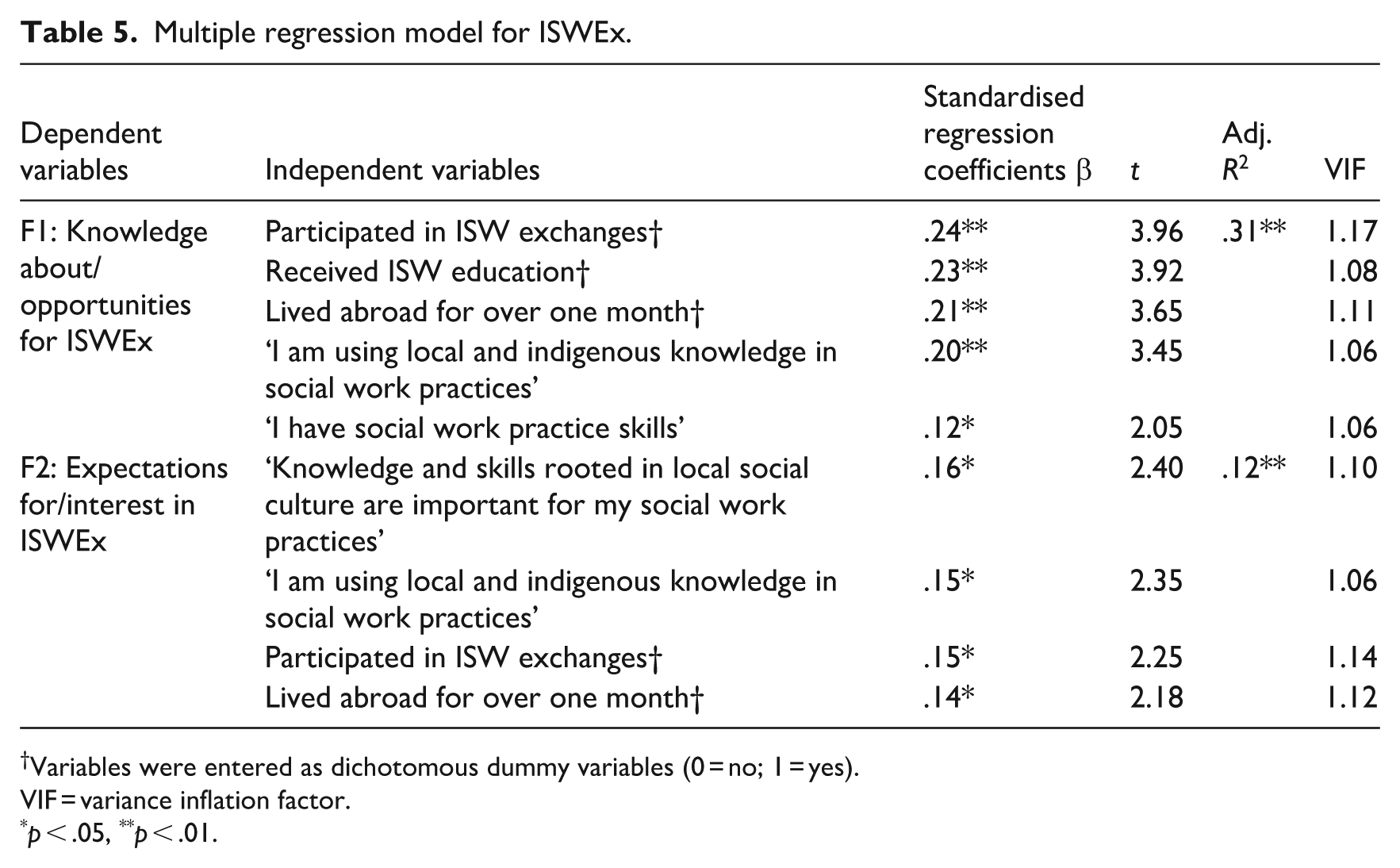
To examine the factors influencing participants’ attitudes towards ISWEx, a multiple regression analysis was conducted (see Table 5). For the total score of F1, the following had a significant positive effect: ‘Participated in ISW exchanges’ (β = .24, p < .01), ‘Have received international social work education’ (β = .23, p < .01), ‘Lived abroad for over one month’ (β = .21, p < .01), ‘I am using local and indigenous knowledge in social work practices’ (β = .20, p < .01) and ‘I have social work practice skills’ (β = .12, p < .05). The adjusted coefficient of determination (R2) was .31 (p < .01).
Multiple regression model for ISWEx.
Variables were entered as dichotomous dummy variables (0 = no; 1 = yes).
VIF = variance inflation factor.
p < .05, **p < .01.
For F2, the following variables has a significant positive impact: ‘Knowledge and skills rooted in local social culture are important for my social work practices’ (β = .16, p < .05), ‘I am using local and indigenous knowledge in social work practices’ (β = .15, p < .01), ‘Participated in ISW exchanges’ (β = .15, p < .05) and ‘Lived abroad for over one month’ (β = .14, p < .05). The adjusted R2 was .12 (p < .01). A positive inter-factor correlation was observed between F1 and F2 (.48), with a correlation coefficient of r = .46 (p < .001). No multi-collinearity issues were identified, with variance inflation factors (VIFs) ranging from 1.06 to 1.17. 2
Qualitative analysis
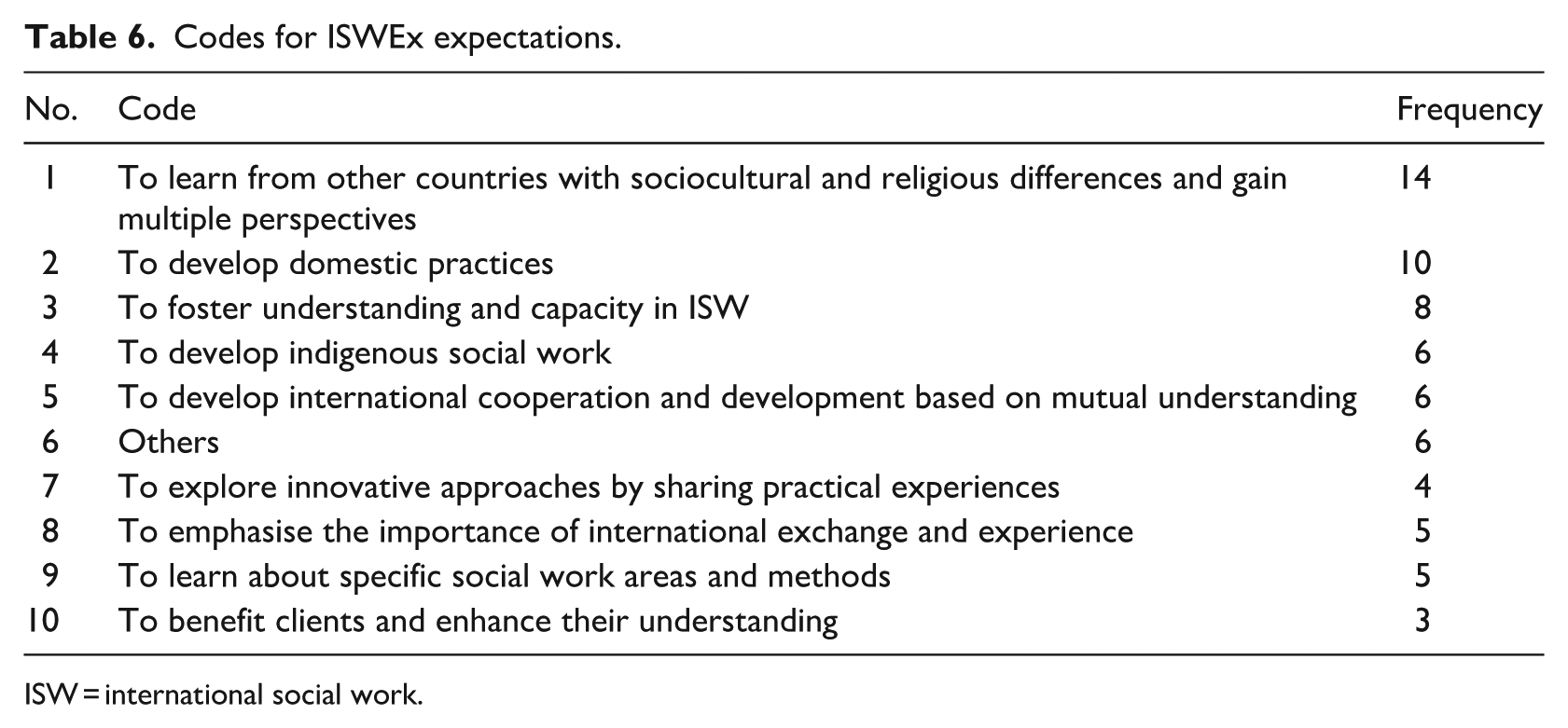
A total of 69 participants (30.3%) responded to the open-ended question: ‘Please feel free to describe any expectations you have through exchanges with practitioners from other countries’. Among them, 25 were from Thailand, 17 from Japan, 23 from Sri Lanka and 4 from Other countries. Valid responses (n = 67) were coded and grouped into 10 categories (see Table 6). To explore the relationship between international exchange and indigenous perspective, selected codes and their descriptions are presented below, followed by an integrated interpretation.
Codes for ISWEx expectations.
ISW = international social work.
The most frequently occurring theme was Code 1, which emphasised the importance of learning international and diverse perspectives as a social worker. For example, a participant from Thailand stated,
Studying outside our country means that we open up the world to ourselves. We will see more perspectives on different dimensions. If the opportunity arises, I would like to learn about social workers in other countries and have the chance to interact with them.
Statements coded under Code 3 reflected a global outlook in social work. One participant from Thailand highlighted the need for cross-border and cross-regional collaboration:
Social work is a collaborative effort with society, and it should not be viewed merely as social workers functioning within the context of Thailand. Rather, they should be seen as global social workers working with cases that represent the world’s population. Therefore, expanding the knowledge framework through exchanges with practitioners from other countries will allow social workers to learn from others’ experiences and apply that knowledge more widely.
Code 4 pertained to culturally and religiously informed understanding in social work. Closely related to Code 2, this code emphasised indigenous or community-based social work, in contrast to Western-oriented professional frameworks. Participants expressed a desire to explore culturally relevant practices while recognising the limitations of Western theories. For instance, a respondent from Japan noted:
We expect to refer to initiatives in other countries, as we recognise the limitations of using social work theories of Western origin.
Code 5 addressed the enhancement of service quality through international cooperation and mutual understanding. A participant from Sri Lanka shared:
When working with international social work professionals, collaboration is essential. This includes sharing knowledge, resources and best practices to effectively address common challenges. It is expected that partnerships will be established that utilise the strengths and expertise of each party while fostering an environment of mutual learning. Such collaborations will improve service delivery models and the quality of assistance to clients across borders.
Some respondents reiterated the limitations of Western-rooted theories and expressed interest in practices not found in their own country. However, participants from Thailand and Japan also voiced concerns about superficial exchanges and language barriers. One participant from Thailand remarked:
Learning the local context has been an ongoing process since after WWII, and scholars from abroad have shown interest in this issue. However, exchanging only the perspectives of each country may not capture the depth of the specific characteristics of that society. The value of underlying ideas in each society is also something that should be exchanged and debated.
Another participant from Japan added:
I cannot adequately communicate in English.
Although participants expressed a wide range of ideas in their responses, several participants stressed the importance of deepening cultural and religious understanding alongside an international perspective. While acknowledging the limits of applying Western-rooted theories in their contexts, they advocate for culturally appropriate practices and learning from unfamiliar models. Others emphasised that ISWEx is neither simple nor automatic, highlighting the need to address superficiality and language challenges.
Discussion
Experiences
This study explored Asian social workers’ experiences with and attitudes towards ISWEx, presenting both demographic profiles and basic data. Approximately 30% of the respondents reported previous experiences with ISWEx, with country-specific rates ranging from around one-quarter to one-fifth. As no comparative data were available, a precise cross-national comparison could not be made. However, the findings offer a valuable foundation for future comparison studies.
Among those who had participated in ISWEx, the majority reported involvement in international training or conferences. In contrast, relatively few had experience with international committees, studying abroad or collaborative activities. This disparity may suggest that practitioners from certain socioeconomic backgrounds face limited opportunities to engage in such exchanges.
Moreover, even when working in developing countries, a practitioner’s individual background or the institutional relationships of their organisation, with international actors or donors, may significantly shape their opportunities for ISWEx. Despite long-standing calls for mutuality and reciprocity in ISW (Midgley, 2016), these findings may echo earlier critiques regarding the often one-directional nature of the exchange between the Global North and Global South (Hugman, 2010, 2022), and the predominance of international engagement among privileged individuals (Higashida, 2024b).
Although the actual content of international exchange experiences was not directly observed, this online survey offered indirect insight into the relationship between indigenous knowledge and ISWEx. Descriptive statistics from the quantitative data, alongside qualitative analysis of the open-ended responses, showed that some respondents expected to gain multifaceted perspectives, engage in mutual sharing of community-based practices and indigenous knowledge and learn from peers across national borders.
These insights move beyond the scope of developing intercultural understanding or cultural sensitivity grounded in Western-rooted professional social work (Akimoto, 2024; Higashida et al., 2024a), and point to broader academic and practice-oriented concerns. Specifically, they underscore the importance of focusing on indigenous knowledge within local contexts, challenging the implicit dominance of Western paradigms and fostering knowledge exchange across varied social, cultural and religious settings.
Furthermore, expectations for deeper exploration of indigenous social work and knowledge among practitioners were partially reflected in participants’ responses. These align with existing conceptual studies (Akimoto, 2017; Akimoto et al., 2020; Higashida et al., 2024a) and recent work on the international exchange of indigenous knowledge (Mafile’o and Vakalahi, 2018).
As mentioned in the introduction, the international exchange of indigenous knowledge in social work, including its interface with Western-rooted professional paradigms, can manifest in various forms. The current findings suggest that attention should not be limited to macro-level discourse but extended to include the lived experiences of international exchange among individual practitioners or their smaller professional communities.
Attitudes and influential factors
The multiple regression analysis identified several factors influencing respondents’ attitudes towards ISWEx. The variance explained by Knowledge about/opportunities for ISWEx (F1) was the highest, at 41.19, indicating its central role in the ISWEx scale. A positive correlation was observed between F1 and Expectations for/interest in ISWEx (F2), suggesting a relationship between participants’ knowledge and expectations regarding ISWEx.
F1 was positively influenced by participation in ISWEx, receipt of ISW education and having lived abroad. This finding suggests that previous international exchange experiences, international learning and living in another country contribute to a deeper understanding of ISW. Similarly, F2 was positively influenced by participation in ISWEx and living abroad. In other words, the more international exposure participants have, the greater their expectations will be for further exchange.
A moderate positive correlation between F1 and F2 was observed, indicating that knowledge and expectations regarding international exchange were meaningfully linked among the cohort. This underscores the potential for increased international knowledge and experience to elevate expectations for future engagement.
Another variable that positively influenced F1 was the use of indigenous/local knowledge in social work practices. Similarly, F2 was positively associated with the belief that ‘Knowledge and skills rooted in local social culture are important for my social work practices’. This finding indicates interest in and engagement with indigenous/local knowledge contributed to higher understanding and expectations regarding ISW.
Although this study did not directly examine how international experiences were reflected in participants’ domestic practice, the results suggest that interest in indigenous knowledge may promote knowledge of, and expectations for, ISWEx. Indigenousness in ISW is often closely tied to broader discourses such as universalism and imperialism. While sometimes viewed as a paradox, these findings highlight the importance of advancing indigenous perspectives through reflective dialogue (Gray, 2005).
In practice, it may be less productive to ask whether international experience or interest in indigenous knowledge comes first. Rather, the focus should be on fostering international exchanges that integrate both perspectives. The integration of diverse knowledge systems, including indigenous knowledge, is vital to the future of ISW. This is reflected in Gray’s (2005: 235) symbolic characterisation:
Rather than a static body of knowledge, international social work should be seen as an emerging discourse – a moveable feast with Eastern, Western and Indigenous cuisine – to which new flavours might be added and in which new combinations might be made to produce deliciously edible and highly desirable new dishes!
Practical implications
This study revealed various factors that positively influence attitudes towards ISWEx and may guide efforts to promote further exchanges. Based on the findings regarding participants’ experiences and expectations, it is valuable to provide diverse and accessible ISWEx opportunities, such as international conferences, studying abroad and ISW education programmes, which may enhance knowledge and expectations among social workers.
Notably, only around 30% of respondents had prior experience with ISW. Language remains a major barrier to participation, particularly given the global dominance of English (Akimoto, 2010; Gray and Coates, 2010). While financial consideration must also be acknowledged, it is essential to explore and expand ISWEx opportunities for social workers who may otherwise lack access.
Improved access also necessitates a critical re-examination of existing opportunities. Various formats, such as international training, seminars and conferences, must be made more broadly accessible. In addition, the use of hybrid or remote technologies presents new potential for ISWEx and warrants further discussion regarding its unique methods and impacts (Lee et al., 2024).
Analysis of the open-ended responses revealed several expectations for ISWEx, particularly concerning the further exploration of social work in indigenous contexts (Akimoto, 2017; Akimoto et al., 2020; Higashida et al., 2023). Respondents expressed a desire to share practices and learn from others to deepen their understanding of ISW. The potential benefits of international exchange for social workers and how these benefits are realised remain areas for further exploration.
Limitations
This study is preliminary in nature and carries several limitations worth noting. Although it drew on previous research into ISWEx studies, no scale with confirmed validity and reliability was available at the time of the study. Accordingly, future research should focus on refining item accuracy and developing a psychometrically sound scale that allows for objective measurement.
This study primarily drew on a sample of social workers from three Asian countries. Possible response bias must be considered, as participants’ backgrounds may vary not only across the three countries but also within each country. Given the limited sample size, the findings cannot be generalised, and several areas merit further discussion. The coefficient of determination in multiple regression analysis was .31 and .12, suggesting that additional influential factors may exist beyond those examined in this study.
Conclusions
This study analysed the factors influencing social workers’ attitudes in the broad sense towards ISWEx within an Asian context. Despite its limitations, the findings from the online questionnaires revealed that, in addition to previous international experiences, social workers’ interest in sharing and learning indigenous perspectives had a notable influence on their attitudes towards ISWEx.
This study addressed questions surrounding the inclusiveness of international exchanges among social work practitioners, an issue relevant not only in Asia but globally (Akimoto, 2024; Higashida et al., 2024a). To deepen understanding, future research should employ qualitative approaches, such as interviews and focus groups, to explore participants’ subjective experiences in greater depth.
Further exploration is also needed on related themes, such as the international amplification of under-represented voices and strategies to ensure that exchanges are mutually beneficial. ISWEx should not be confined to the Asia-Pacific region but expanded to include engagement with regions such as the Middle East, Africa and Latin America. There is also a need to reconceptualise such exchanges beyond fixed geographic frameworks, embracing their global potential.
Moreover, exchanges should not be restricted to the dissemination of mainstream social work knowledge but must also incorporate a diverse range of indigenous knowledge. Future studies should contribute to developing a more inclusive and equitable model of ISWEx that reflects pluralistic perspectives. Importantly, exchanges must broaden access and opportunity, not only for those from privileged backgrounds but for all practitioners.
Footnotes
Acknowledgements
We are grateful to the organisations who supported and promoted this survey, especially the SLAPSW, the Japanese Association of Social Workers, the Japanese Association of Mental Health Social Workers, the Faculty of Social Administration of Thammasat University, the Social Work Professions Council in Thailand, the Thailand Association of Social Workers and National University of Mongolia.

Funding
The authors disclosed receipt of the following financial support for the research, authorship, and/or publication of this article: This work was supported by the JSPS KAKENHI under grant number JP24K16556.
Declaration of conflicting interests
The authors declared no potential conflicts of interest with respect to the research, authorship, and/or publication of this article.
Ethical approval and informed consent statements
The research brief and explanatory text were provided in the e-mail and SNS invitations. Further explanation was provided at the beginning of the survey, indicating that participation would be anonymous, the results would be statistically processed and anonymised and there would be no penalties for not participating. The survey could only be completed if the participants agreed to these conditions. The survey was conducted after gaining approval from the Research Ethics Review Committee of Shukutoku University (No. 2024-103); additional approval was granted by the Research Ethics Review Committee of Shimane University (No. 2024-09).
Statement on AI
The author confirms that no content in this manuscript was searched, summarised, generated, or translated with the assistance of artificial intelligence (AI) tools, except for the citation of ScienceDirect’s AI definition in Notes 1.