



Abstract
East Asian adolescents have been facing increasing bullying in schools as a result of anti-Asian racism emerging from the COVID-19 pandemic. In this article, we adopt Canadian multiculturalism, scapegoat theory and dominance theory to understand this social issue in the macro-Canadian social context, mezzo intergroup interactions and micro-individual adolescents’ experience. A conceptual model that integrates these three levels of theories and the roles of social workers on these levels is also presented. This conceptualization aims to help social work researchers and practitioners better understand bullying faced by East Asian adolescents in schools and to protect them amid anti-Asian racism.
Introduction
Racism has been a systemic issue in Canada and can significantly impact the well-being and integration of racialized communities (McElhinny, 2016; Thobani, 2007). Particularly, anti-Asian racism that re-emerged from the COVID-19 pandemic has resulted in unprecedented effects on East Asian communities in Canada (Zhang et al., 2024). Individuals of East Asian descent or originally from East Asian countries such as China, Korea and Japan were regarded as ‘virus carriers and spreaders’ during the pandemic (Zhao et al., 2022). Numerous reports have documented rampant verbal and physical attacks targeting East Asian communities in Canada (e.g. Chau, 2021; Premji, 2023). Vancouver Police Department also disclosed that anti-Asian racism incidents in 2020 increased by over 800 percent (Kotyk, 2020). Discriminatory remarks such as ‘China virus’ from politicians further exacerbated anti-Asian racism experienced by East Asian communities in Canadian society (Larsson, 2020). With this large-scale and unprecedented influence, anti-Asian racism can be seen as a collective trauma faced by East Asian communities in Canada (Wu, 2022). In addition, East Asian adolescents face anti-Asian racism and experienced bullying, including racial slurs, name calling or even physical attack (CBC Kids News, 2021; Wong, 2022). As adolescence is an important stage of identity development, race-based bullying may have detrimental consequences on their sense of belonging and identity building in the long term (Chen et al., 2021). It may also put victimized adolescents at heightened risks for poor mental health, lower academic achievement and increased risk of delinquency (see Sapouna et al., 2023 for a review). For example, Huynh et al. (2023) found that Asian adolescents’ mental health was affected by anti-Asian racism incidents during the COVID-19 pandemic, as some participants reported feeling less safe and experiencing depression. East Asian adolescents also experienced identity issues amid anti-Asian racism such as self-doubt and fear (CBC Kids News, 2020; Chen et al., 2021). These potential consequences show how severe anti-Asian racism in schools can be and underscore the urgent need to address this social issue.
Despite the fact that anti-Asian racism faced by East Asian adolescents is a serious concern for East Asian parents and schools (Liu et al., 2024; Wang et al., 2023), empirical research on the Canadian context is still limited, as most of the studies were conducted in the American context. Cheah et al. (2020) found that 76.5 percent of Chinese American youth (between 10 and 18 years old) experienced racist incidents related to COVID-19 either in-person or online. In terms of parents’ perspectives, Wang et al. (2023) found that in their interviews, out of 40 Chinese American parents, 12 reported direct bullying associated with the COVID-19 pandemic experienced by their children, and 28 worried about race-based bullying faced by their children in schools. Some parents also pointed out how vulnerable adolescents can be when transitioning to secondary schools, as they started to be more aware of racial differences and were likely impacted by race-based discrimination and bullying (Liu et al., 2024). Compared with the literature on anti-Asian bullying in the American context, research in the Canadian context, especially on how schools should understand anti-Asian bullying, has been lacking. Available studies indicated that Asian youth in Canada already experienced forms of anti-Asian racism in their elementary years before the pandemic (Fang et al., 2024). The prevalence of such racism also increased during the COVID-19 pandemic, particularly in its earlier stages (Fang et al., 2024; Wong, 2022). Building onto this limited body of work is important for informing school policies and improving school environment to better address anti-Asian bullying in the Canadian context.
To guide future research, we propose a theoretical framework by first adopting Canadian multiculturalism as a macro-contextual lens to uncover how anti-Asian racism, embedded in Canadian society, has been hidden under the policy of multiculturalism. We then use scapegoat theory as a mezzo-level theory to understand how anti-Asian racism escalated during the COVID-19 pandemic, as COVID-19 has been used to stigmatize East Asian communities. Building upon these contextual theories, dominance theory is utilized as a micro-individual level theory to understand how anti-Asian racism has permeated schools and is expressed through bullying targeting East Asian adolescents. In the meantime, how social workers can participate at each level and promote the well-being of East Asian adolescents is not widely discussed either. We thus consider the roles of social workers on the macro, mezzo and micro levels in supporting future prevention and interventions that aim to reduce anti-Asian bullying in the long term. Through this theoretical analysis, schools can also better understand the formation of anti-Asian bullying and further design policies to address such bullying.
Canadian multiculturalism and hidden racism
Canadian multiculturalism was officially incorporated into Canadian legislation in 1988 to ensure that racialized individuals and communities in Canada can practise their own cultures without discrimination and prejudice (Lee and Johnstone, 2021; McElhinny, 2016). It was a step forward compared with Canada’s racist immigration policies over half a century ago that only allowed Caucasian immigrants from Europe to enter the country (Chakraborty, 2022). However, Canadian multiculturalism has been considered as a convert form of settler colonialism and racism (Thobani, 2007). Specifically, it was the white English and French settlers who ultimately designed and implemented the multiculturalism policy (Lei and Guo, 2022), as a response to the independence movements worldwide and the shortage of the labour force in Canada (Kenyeres, 2015; Thobani, 2007). Therefore, this reform in Canada’s cultural policy does not seem willing, but rather a forced reaction to the dramatic global transformation in that historical context. The settler colonialism is often perceived as crafty, as the corresponding policy not only helps Canada preserve its ‘whiteness’ without damaging its relations with those newly independent countries (also former British and French colonies), but also profits from human capital and economic benefits exported from those countries through immigration (McElhinny, 2016; Zhao et al., 2022). Under these circumstances, a multicultural hierarchy that features the ‘top’ position of white Canadian cultures is formed (Fleras, 2014). When immigrants and migrants from non-Western countries settled in Canada, they were automatically incorporated into this hierarchical multiculturalism (Fleras, 2019). For example, although immigrants and migrants to the country can maintain and practise their cultures, white English and French cultures are still recognized as a standard to evaluate their integration in Canada (Lei and Guo, 2022; Li, 2003).
Perpetuating settler colonialism, the multiculturalism policy in Canada further severs the connection between Indigenous cultures and racialized immigrants by degrading the distinct status of Indigenous cultures and categorizing them as one of other cultures (McElhinny, 2016). Immigrants and migrants are required to acquire English and French, learn more about white Canadian cultures and live in Canada as expected by the white settlers, so that they can contribute to Canadian society as stable social capital while maintaining the system designed by settler colonialism (Kwak, 2018). Immigrants’ ‘incapacity’ to acquire English and French languages and cultural values upheld by white settlers is often ascribed to immigrants’ own problem (e.g. unwilling to fit in), rather than the limitation of the multiculturalism policy (Li, 2003). This policy thus creates a docile image of racialized immigrants that are easily governed by the Canadian government (Lee and Johnstone, 2021). This inequity between white Canadian cultures and racialized immigrants’ cultures, combined with the nature of integrating racialized immigrants into the ‘mainstream’ white Canadian cultures, further becomes a hotbed for racism to exist and grow (Chen and Wu, 2021; Fleras, 2014). Sugarcoated by multiculturalism, racism in Canada is also justified as sporadic and as happening mainly on the interpersonal level, as this policy has already ‘reframed’ Canada institutionally as a welcoming and equal society to immigrants from different cultural backgrounds (Simpson et al., 2011). Nevertheless, the constant re-emergence of anti-Asian racism throughout Canadian history (e.g. from SARS in 2003 to COVID-19 in 2020), uncovers how multiculturalism never addresses racism. The roles of contagious diseases in stigmatizing Asian groups and exacerbating anti-Asian racism can also be clearly seen in these re-emergences, as these diseases are often used to justify how racialized communities’ cultures are ‘inferior’ (e.g. unhygienic lifestyles) and there is still a distance between them and the mainstream cultures (Larsson, 2020). Facilitated by the stigmatization of infectious diseases, anti-Asian racism during the COVID-19 pandemic is an example of how multiculturalism, which is supposed to protect East Asian minorities in Canadian society, can be easily shattered, due to the fundamental power differentiation between white settlers and East Asian communities exposed by the stigma attached to these communities during the pandemic.
To sum up, multiculturalism disguises the ongoing racism in Canadian society and allows racism to operate in a more covert manner (Thobani, 2007). This hidden racism has been waiting for the ‘proper’ time (e.g. the SARS epidemic, the COVID-19 pandemic) to re-emerge (Lam, 2020; Larsson, 2020; Zhao et al., 2022). The following section further analyses the COVID-19 pandemic and anti-Asian racism through scapegoating theory, so that problematic intergroup interactions in this multicultural hierarchy leading to anti-Asian racism can be better understood.
Scapegoating theory and anti-Asian racism
The APA Dictionary of Psychology (n.d.) defines scapegoating theory as a theoretical analysis that helps us understand aggressive and violent conducts committed by individuals who deliberately blame other individuals or groups for bringing unpleasant experiences in social events. Similarly, the racial prejudice that one ethnic group expresses to the other groups in these negative social events can also be considered as scapegoating (APA Dictionary of Psychology, n.d.). Originating from atonement in the biblical context (i.e. goats were sacrificed to atone for humans’ sins) (Schaefer, 2015), scapegoating was further developed and elaborated based on the work of scholars such as Emile Durkheim and Rene Girard (Denike, 2015; Mestrovic, 2019). This theory explains how societal members often attribute the misfortune associated with disastrous social events to the presence of other groups to express their frustration or anger, and to minimize the harm caused to social stability (Bashaw, 2023; Goldberg, 2008; Stowe, 2012). In addition to scapegoating on the group level, it is also common for scapegoating to happen on the individual level in which some individuals intentionally blame other innocent individuals for tragic events (e.g. death). These baseless accusations are made to help perpetrators re-obtain the sense of integration when experiencing those tragic events (Lulat, 2022; Stowe, 2012). Scapegoating theory has been gradually applied to understand how intergroup interactions, particularly in a multicultural society, can be problematic. In essence, scapegoating shows the ‘otherness’ of racialized minority groups in multicultural societies (Denike, 2015). This ‘otherness’ reflects a systemic barrier for racialized minorities to be truly integrated into a white settler society and can constantly emerge to damage the integration of these minorities (Ahmed, 2000). The image of racialized immigrants being the ‘perpetual foreigners’ is thus created, and when this image is being attached to diseases that are seen as exotic, immigrants will also be connected to these diseases and seen as a menace (Williams et al., 2023). Heidt (2018) elaborated on the relationship between scapegoating and racism and shared that the rhetoric used by Donald Trump during his presidential campaign to scapegoat minorities in American society undoubtedly contains racist undertones.
Similar to this scapegoating process in the United States, anti-Asian racism in Canada has also long been a product of scapegoating. The ‘yellow peril’ myth has emerged since the first generation of Chinese immigrants came to Canada (Leung, 2008). The residential areas of Chinese communities such as Chinatown were often regarded as ‘filthy’ and ‘disease-ridden’ (Chakraborty, 2022; Leung, 2008). The SARS epidemic that happened over two decades ago is also an example of how Chinese communities are scapegoated and dehumanized whenever there is a disease that can be related to them (Keil and Ali, 2006). Similarly, the anti-Asian sentiment arising from the recent COVID-19 pandemic and its consequences (e.g. death, economic recession) ‘justifies’ and ‘solidifies’ the scapegoating of East Asian communities in Canadian society (Zhao et al., 2022). The fundamental power differentiation between white settlers and East Asian communities, combined with the complicity of other cultural groups, exacerbates the scapegoating faced by East Asian communities (Chen and Wu, 2021; Zhao et al., 2022). Discourse such as ‘Chinese virus’, ‘China virus’ and ‘Kung flu’ exemplifies the scapegoating process, as the Chinese descent is blamed for the disastrous consequences brought by the COVID-19 pandemic and is targeted by other groups through their frustration and hostilities (Omori and Stitt, 2023). It is also worth noting that this scapegoating process can be catalysed through the ongoing tensions between China and Canada and illustrated through the political hostility towards Chinese communities in Canada (Angus Reid Institute, 2023), which shows how scapegoating has also been evolving based on the contemporary geopolitics.
These problematic intergroup interactions that result in anti-Asian racism can permeate into school settings and impact how adolescents perceive and react to race-based bullying. For instance, Dixon (2007) found that scapegoating affected bullying in groups and can be a significant cause of bullying. This empirical evidence provides a possibility of connecting scapegoating to race-based bullying in schools. The following section further introduces dominance theory and aims to elaborate on how anti-Asian bullying, shaped by the scapegoating during the COVID-19 pandemic and the problematic Canadian multiculturalism, is operated on the individual level.
Dominance theory and anti-Asian bullying in schools
Dominance theory provides a theorical analysis to understand how the power imbalance between perpetrators and victims can ignite and accelerate bullying among adolescents (Mishna, 2012; Rigby, 2022). This focus on power imbalance between adolescents provides a flexibility of understanding anti-Asian bullying in both online and in-person settings. Although bullying often takes place in schools and is influenced by the school climate (Astṭor and Benbenishty, 2019), the rapid changes during the pandemic (e.g. online education) have shifted bullying contexts, as adolescents may receive misinformation on COVID-19 and conduct anti-Asian bullying in online settings (Wong, 2022). In addition, despite the emerging literature on the important role of school climate in addressing anti-Asian racism (Gee et al., 2024; Wang et al., 2023), its exact role is still not clear. Dominance theory can help schools better understand how interactions between adolescents lead to anti-Asian bullying, and provides valuable insights into the improvement of the school climate to address such bullying, especially when there is still a lack of policies on handling anti-Asian bullying after in-person learning has resumed in schools (Eizadirad et al., 2025).
Dominance as a social hierarchy is typically applied to understand bullying among individuals, particularly adolescents, especially when the group has just formed or there are new members joining the group (Kolbert and Crothers, 2003; Long and Pellegrini, 2003). It focuses on power dynamics among individuals within their social groups and aims to find out the cause of bullying based on the interactions of group members (Mishna, 2012). It is worth noting that in addition to dominance theory, there is also a social dominance theory. Particularly, social dominance theory believes that there are different kinds of social hierarchies because of power imbalances between different groups such as gender and social class in the macro social context, and socially dominant groups usually impose oppression on other more vulnerable groups (Evans and Smokowski, 2016; Volk et al., 2021). Bullying, according to social dominance theory, can reflect this oppression caused by these social hierarchies within social groups (Nishina, 2004). Hence, social dominance theory focuses more on the macro social and group contexts that possibly shape bullying, whereas dominance theory focuses more on the interpersonal context and its influences on bullying (Evans and Smokowski, 2016).
In order to help us form a comprehensive understanding of bullying dynamics, dominance theory is reframed as an overarching theoretical framework in this discussion that includes both. Previous research has validated social dominance theory and suggested that there is a strong relationship between school bullying and social dominance (Long and Pellegrini, 2003; Volk et al., 2021). For example, Goodboy et al. (2016) found that social dominance significantly related to four types of bullying (i.e. attacks on property, physical victimization, social manipulation and verbal victimization). While validating the relationship between school bullying and dominance, dominance theory also indicates three characteristics of bullying. The first one is social control, as group members tend to compete through bullying in order to obtain the control of their groups (Long and Pellegrini, 2003). The second one is access to resources, since the most powerful members often aim to obtain extra resources through bullying to maintain their leadership of the group (Reijntjes et al., 2013). The third one is power hierarchy, as the ultimate result of dominance is to form a hierarchy that features the most powerful group members (Long and Pellegrini, 2003). In addition, Evans and Smokowski (2016) suggested that perpetrators often commit school bullying to increase their social dominance in schools. The hierarchical school context also increases the chance of perpetrators conducting school bullying and enhancing their dominance (Pan et al., 2020).
Dominance theory offers important insights into understanding anti-Asian bullying among adolescents in multicultural Canada. In the Canadian context, the hierarchy in Canadian multiculturalism that features white settlers already lays the ground for the potential power imbalances in Canadian schools (Ng, 2022). Amid the anti-Asian racism that emerged from the COVID-19 pandemic, adolescents might receive misinformation on social media and be exposed to anti-Asian attitudes and remarks that are rampant in the Canadian social context (Wong, 2022). Adolescents from other cultural backgrounds may be instigated in this ongoing scapegoating of East Asian communities for the spread of COVID-19, and when this notion is brought by them to schools, adolescents may tolerate the scapegoating and justify anti-Asian bullying as it seems to be ‘tolerated’ by society (Wong, 2022). During this process, the ingrained power imbalances between white settlers and East Asian communities in Canadian multiculturalism are exposed and other cultural groups might become complicit in anti-Asian racism in schools (Ng, 2022; Wong, 2022). In these circumstances, degrading East Asian adolescents to obtain more power in the groups of adolescents and maintain the power hierarchy within the groups can emerge, as depicted by the characteristics of bullying in dominance theory and social dominance theory (Long and Pellegrini, 2003; Mishna, 2012; Nishina, 2004). Perpetrators might believe that they have more power when interacting with East Asian adolescents and by implementing scapegoating, they might be able to obtain more power. Conversely, East Asian adolescents, who are also exposed to the large-scale scapegoating of Asian communities for the COVID-19 pandemic, might feel powerless to fight back when facing anti-Asian racism. Their identity issues (e.g. self-doubt) (CBC Kids News, 2020) emerging from this process may put them in a more disadvantageous situation (e.g. escalated frequency or severity of bullying events) for bullying victimization. Overall, both social dominance theory and dominance theory help us understand different contexts that result in anti-Asian bullying on the individual level.
Discussion
Based on the theoretical analyses of Canadian multiculturalism on the macro level, scapegoating theory on the mezzo level, as well as dominance theory on the micro level, a conceptual model that integrates these theories and the roles of social workers engaging with each context to protect East Asian adolescents from anti-Asian bullying is put forward. This type of integration that aims to view and solve social issues in a holistic manner has been widely discussed in the social work literature (e.g. Zhao and Bhuyan, 2024; Zhao et al., 2024) and provides a direction for social workers to better understand and address anti-Asian racism in schools.
In this model (see Figure 1), the concentric circles on the left visualize how three theories form a comprehensive understanding of anti-Asian bullying faced by East Asian adolescents in schools. Anti-Asian racism is embedded in Canadian society and is cloaked in the multiculturalism policy (Lei and Guo, 2022). When the COVID-19 pandemic emerged, the covert racism faced by East Asian communities was expressed overtly and became rampant (Chakraborty, 2022). Propelled by the scapegoating of East Asian communities that happened during the COVID-19 pandemic (Omori and Stitt, 2023), racial bullying targeting East Asian adolescents can intensify and impact their well-being. East Asian adolescents might also internalize the scapegoating, reinforce the stereotypes about their own identity (e.g. they are responsible for the pandemic) and be in a more disadvantageous situation when dealing with bullying in schools (Chen et al., 2021; Trent et al., 2019). These three levels of theories also match the specific contexts on each level (e.g. schools, communities, policies) that influence adolescents, and social workers can make efforts to reduce anti-Asian bullying faced by East Asian adolescents on each level. Particularly, social workers need to realize the central role of East Asian adolescents in tackling anti-Asian bullying, as these adolescents have their own lived experiences of facing and dealing with anti-Asian bullying. This acknowledgement of clients’ voices in the interactions between social workers and clients has been emphasized in social work practice and shown improvements in services provided by social workers (e.g. Lee and Bhuyan, 2013; Lee et al., 2019). This central role of East Asian adolescents has thus been displayed in the centre of the model, and how social workers can collaborate with them to reduce bullying on each level is further introduced in the following sections.
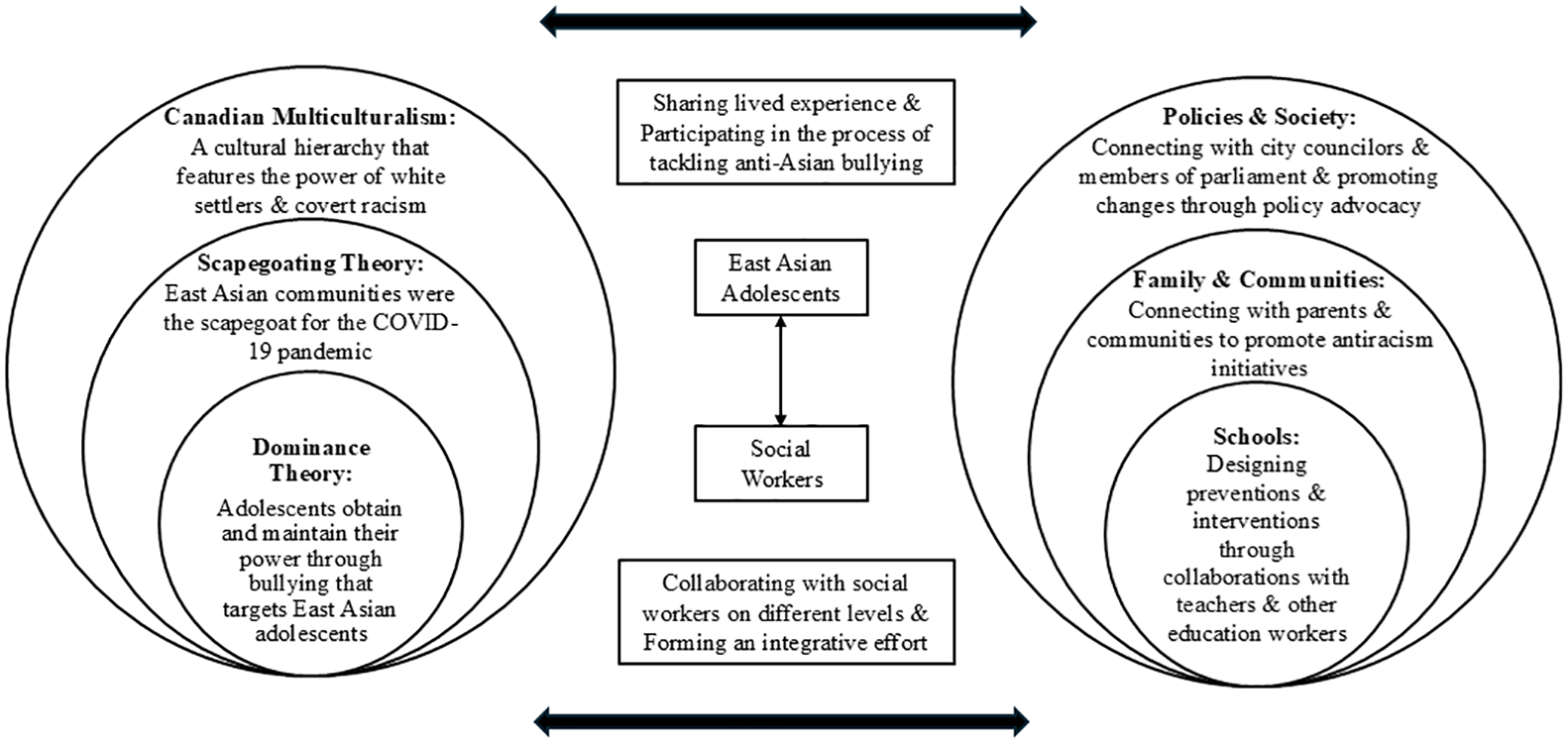
The conceptual model to understand and address anti-Asian bullying in Canadian schools.
The three levels that social workers can work on are visualized in the concentric circles on the right. At the micro level, schools are the primary setting where anti-Asian bullying takes place. By building a rapport with East Asian adolescents and understanding bullying experienced by them, school social workers can work with teachers and other education workers to design and implement preventions and interventions to reduce the frequency of anti-Asian bullying. For example, they can deliver workshops that introduce anti-Asian racism, strategies for East Asian adolescents to speak up when facing anti-Asian bullying incidents, and suggestions for adolescents from other cultures to form solidarity with East Asian adolescents. Social workers can also design and distribute brochures to raise adolescents’ awareness of addressing anti-Asian racism and promoting diversity, equity and inclusion in schools. In terms of interventions, school social workers need to take the initiative to conduct various interventions to address anti-Asian bullying. For example, they can utilize Cognitive Behavioural Therapy (CBT) to intervene in race-based bullying victimization, as CBT has been proved effective in tackling mental health issues (e.g. suicidal intent, trauma) emerging from bullying from the client-centred and developmental perspectives (Ferraz De Camargo et al., 2023; Lydecker, 2022). At the school-wide level, the transformative social-emotional learning (SEL) approach could be adopted as it invites students and adults to critically examine the underlying causes of inequity and ways to address them (Jagers et al., 2019). This approach highlights the importance of cultivating a healthy sense of identity, exercising agency, fostering a sense of belonging, engaging in collaborative problem-solving, and nurturing curiosity to pursue knowledge and diverse perspectives (Jagers et al., 2019). Previous research also indicates that adolescents with greater social-emotional capacities are less likely to engage in bullying (You et al., 2023).
Expanding from schools, families and communities can be seen as the mezzo level for social workers to work on to reduce anti-Asian bullying. Connecting with East Asian adolescents and school social workers, social workers who work with families can reach out to East Asian parents to understand their concerns about anti-Asian racism in schools and explore possible ways of reducing anti-Asian racism in schools with them. This outreach has been supported by the empirical evidence. For example, Wang et al. (2023) found that Asian parents hope to see more outreach efforts from schools to help them and their children better navigate racism in schools during the pandemic. Social workers also need to reach out to parents who are from other cultural backgrounds to raise the awareness of reducing anti-Asian racism in schools and seek the collective support from these parents to address not only anti-Asian racism but also other types of racism in schools. This initiative is crucial, as family has been found to be one of the major contexts that shape children’s bullying behaviours in schools (Wang et al., 2021). Bearing in mind East Asian adolescents’ experiences of dealing with bullying, community social workers can brainstorm possible programmes and advocacy projects to reduce problematic intergroup interactions in Canada that shape anti-Asian bullying in schools. This type of community work has shown the effectiveness of promoting justice and equity for racialized communities. For example, community rallies across Canada that helped Asian communities voice their concerns about anti-Asian racism have raised the public’s awareness of this serious social issue (Tsekouras, 2021). In terms of anti-Asian racism in schools, by organizing events such as townhall meetings and conversation circles that feature East Asian adolescents’ struggles with anti-Asian bullying in schools, social workers can guide the communities to reflect on the negative influences of systemic racism on the younger generation and form alliances with parents to promote equity and justice for their children.
Society and policies are the macro level that social workers can engage with to reduce the influence of anti-Asian racism on East Asian adolescents in schools. Informed by East Asian adolescents’ experiences, social workers who have been engaging with policy change and advocacy can delve deeper into Canadian multicultural and educational policies to identify potential limitations that lead to anti-Asian racism in schools. They can then put forward positive changes in the current policies by incorporating feedback from East Asian adolescents, social workers on other levels, parents and teachers, derived from activities such as writing open letters to school boards, seeking media exposure, as well as connecting to city councillors and members of parliament. The previous literature has also indicated the important role of policy analysis and advocacy in solving social issues and facilitating positive changes in the long term (Cummins et al., 2011; Zhao and Bhuyan, 2024). The efforts on these three levels reflect the perspective of person-in-environment that features the central role of the clients to guide social work practice (Green and McDermott, 2010; Kondrat, 2002); these efforts can further be integrated to form a dynamic and comprehensive circle to understand and tackle anti-Asian bullying in schools.
However, this model also has limitations. For example, the sustainability of addressing anti-Asian racism in schools needs to be explored. Although COVID-19 is no longer a global pandemic (Roknuzzaman et al., 2024), anti-Asian racism arising from it might still have a lasting influences. Hence, the effort of addressing anti-Asian racism in schools should not be a one-time attempt, but rather a sustainable force that delves deeply into Canadian society to investigate and reduce systemic inequity that causes anti-Asian racism in schools. Future research and practice should explore possible ways of maintaining this sustainability. In addition, the ways to maintain the dynamics of these initiatives and implement the principles of diversity, inclusion and equity in different contexts (e.g. schools, communities) need to be constantly explored. Overall, this model provides a solid theoretical foundation to understanding and reducing anti-Asian racism faced by East Asian adolescents. It also provides an important reference for future research and practice to better understand different cultural, social and individual factors that shape racism faced by different racialized communities.
Conclusion
The well-being of East Asian adolescents, as racialized minorities in Canadian schools, needs more attention from the public, especially amid anti-Asian racism. Considering the unprecedented damage caused by the COVID-19 pandemic in Canadian society, the negative impact of anti-Asian racism may last for a long time and dramatically change the public’s perceptions of intergroup relations. Under these circumstances, East Asian adolescents might also be profoundly affected by race-based discrimination and bullying in schools. Given the importance and urgency of this topic, this conceptual analysis delves into this social issue and shows that anti-Asian bullying is not simply formed on the individual level, but rather shaped by the Canadian social context. In order to better understand and tackle such bullying in schools, social workers who practise on different levels need to collaborate with adolescents and forge joint efforts with parents and teachers to facilitate positive changes in schools, so that adolescents from racialized backgrounds can be better protected.
Footnotes
Funding
The author(s) received no financial support for the research, authorship and/or publication of this article.

AI statement
The authors declare that AI was not used in this work.