




Abstract
This study explored and compared conceptualizations of social work research across Anglophone and Latin American countries. Open-ended survey responses (n = 46) from participants in three Anglophone countries and three Latin American countries were analyzed. Three themes emerged: (1) social work research seeks solutions or actions; (2) social work research integrates an ecological approach; and (3) social work research is upheld by ethics and social justice. The themes highlighted unique contributions of social work research, with nuances between Latin American and Anglophone respondents. Implications include expanding the study to other countries and highlighting ethics and transformation in social work research.
Introduction
The social work profession continually explores ways to enhance its research capacity, culture, infrastructure, and identity (McRoy et al., 2012; Orme and Powell, 2008; Palinkas and Soydan, 2012). Across the globe, social work has experienced tension in setting itself apart from other disciplines and creating a professional identity (Daly et al., 2024). On the one hand, some scholars seek to increase the ‘science of social work’ from a positivist lens, focusing on building evidence for specific interventions that target human behavior (McNeece and Thyer, 2004). On the other hand, another group of scholars argue that social work is inherently intertwined with social justice, anti-oppressive practices, and a duty to transform society (Nicotera, 2019; Pease, 2020), hence the argument for a ‘critical consideration’ of evidence-based practice to integrate scientific inquiry with the social justice and critical framework of social work (Maynard, 2007).
Research and scientific inquiry have been identified as key components that set social work aside as a unique discipline and profession apart from charity and philanthropy (Thyer, 2010), while a commitment to social justice and equity differentiate social work from other social science disciplines (Finn, 2021; Thompson and Stepney, 2022). The International Association of Schools of Social Work (IASSW) approved a recent declaration stating that the purpose of social work research is to support the profession through developing knowledge, theory, social policies, and practice-based interventions. Social work research also targets multiple stakeholders, including policymakers, communities, and clients (IASSW, 2024). This statement reflects the ongoing quest to define and characterize social work research.
The question about social work’s unique contributions as a discipline has been raised since the early 20th century (Tannenbaum and Reisch, 2001), particularly by Flexner (1915), who claimed social work was not a profession as it failed to derive material from learning and science to inform the activities of the profession. Since then, social work has engaged in numerous initiatives to address the quality and quantity of social work research and to define and promote social work research as distinctive (McRoy et al., 2012; Orme and Powell, 2008; Palinkas and Soydan, 2012; Shaw, 2007). This debate is particularly relevant as new technology such as artificial intelligence is being introduced and implemented across the discipline. Although ethical concerns related to the use of artificial intelligence in social work have been raised including confidentiality, systemic bias, and surveillance (Reamer, 2023), the explosion of available tools also brings new questions to the breadth and depth of possible research, particularly at a global scale.
While formal social work has emerged from a place of scientific inquiry (Moya, 2023; Rubilar, 2015), this relationship has not always been visible. The evolution of social work over time has also depended largely on historical, social, and political factors, which vary across cultures, countries, and regions. In their global study of social work research, Martínez et al. (2015) used science mapping to identify key themes and periods of social work research over time. Martínez et al. (2015) concluded that the ‘first period’ of social work research (1930–1989) largely focused on topical areas such as children and vulnerable families, while the ‘second period’ (1990–2002) was influenced by the emerging HIV pandemic and health-related research, followed by a ‘third period’ (2003–2012) of research that included more outcomes related to mental health. While this added a dimension of time to consider when exploring social work research, they did not differentiate findings by geographic region.
In parallel, some researchers have followed social work researchers and professionals over time to explore the contributions of social work research, including the trajectories and visions of professionals who conduct research as part of their practice (Rubilar, 2009; Teater, 2017). This is particularly relevant in the United States, United Kingdom, and Chile, as these three countries have the longest history of formalized schools of social work (Ehrenreich, 1985). While formal social work emerged in the United States and the United Kingdom at the beginning of the 20th century, the first formalized school of social work outside of these two countries was established in 1925 in Chile. In the 100 years since its inception, formal social work in Chile has guided the formalization of social work as a discipline in several other Latin American countries (Moya, 2023). To date, few studies have compared formal social work and how research has evolved over time in these different cultural contexts and settings.
In a seminal study for Chile, Rubilar (2009) used a qualitative longitudinal research design to follow a group of Chilean social workers; this project began in 2008 and has had over 100 participants across the country explore their research trajectories and transitions. In the United States, Teater (2017) interviewed 20 social work academics to explore their research agendas, approaches, and connections to social work practice. Teater found the social work academics to minimally connect their research to social work practice where research questions were rarely derived from social work practice and there was a lack in disseminating research to the social work practice community. These two studies provide insight into trajectories and changes over time in social work research priorities and foci. However, to date, few studies have directly compared conceptualizations of social work research among different regions or groups that may approach social work from diverse lenses. Notably, Roche and Flynn (2018) found that less than 10 percent of articles written about social work were in languages other than English. Indeed, much of the literature on social work research focuses on Western perspectives (Muñoz-Arce et al., 2021), highlighting a need to more actively engage and compare the role of social work in the Global North and Global South.
A gap in this quest to highlight the relevance and distinctiveness of social work research is the inclusion of how social work researchers from across the globe conceptualize social work research. Gathering and consolidating the views and perspectives of social work researchers can strengthen the discipline of social work in defining itself and its contribution to the profession through knowledge creation. Thus, this study addresses a gap by comparing Anglophone (Global North) and Latin American (Global South) social workers’ conceptualizations of social work practice and research. Furthermore, this study situates itself at the ongoing debate of ethics and social justice in social work research and practice, and how increased technology and artificial intelligence may shape the field’s trajectory. It is guided by the premise that social work researchers share common elements and key differences in their approach to research, while their research trajectories shape how they conceive and understand their work. Furthermore, this study offers an opportunity to critically rethink connections between research and practice and advance future research agendas from lines of research that emerged among the participants in the study, adding to the current debate about knowledge generation through social work research.
Current study
This study explores conceptualizations of social work research among social work researchers across the globe by asking the following research questions: 1) What differentiates social work research from other research? and 2) How do Latin American and Anglophone respondents characterize social work research? The focus of comparing Latin American and Anglophone countries was selected given the long history of formal social work in both areas. As formal social work emerged, it integrated a scientific approach, distinguishing it from other charity work by its use of science and evidence. Therefore, it is important to understand how research and scientific inquiry in social work have evolved over time in both contexts – as US- and UK-based schools have guided other Western-based social work, while Chile has led the way in Latin America (Moya, 2023).
The present study also expands on an informal inquiry conducted by Teater in 2022 that involved analyzing the responses of 18 social work researchers from 14 different countries on the following two questions: (1) What is social work research? and (2) What makes social work research distinctive from other research produced in other disciplines? From the informal inquiry, Teater (2022) identified the following three themes on what makes social work research distinctive: (1) Touches reality, participatory approaches, and transformative and developmental in nature; (2) Applied, community-driven approaches that improve social well-being in general; and (3) System changes and advocacy, to develop a fairer, more democratic, sustainable world. The themes pointed to social work research as distinctive by being multifaceted, by focusing on real-world problems, often involving the inclusion of participants/community in the research and/or research process, and seeking to be transformative by advocating and moving toward social justice. This inquiry led to further questions around how social work research is defined and conceptualized as distinctive from other disciplines. Thus, this study built on the informal inquiry to formally survey social work researchers across the globe to compare and contrast visions of social work, connect diverse agendas, identify research activities, and propose future research agendas. The aim is to administer this survey annually; results from the first initial survey are presented in this article.
The main premise in this exploratory study is that social work research across the globe shares common elements that characterize it despite different methodological foci and approaches, while there may be unique components among respondents in the Global South and Global North. These characteristics are shaped by debates about the legitimacy of social work as its own discipline and its close ties to social justice and transformation.
Method
Data collection and recruitment
Data for this study came from an online survey administered to social work researchers across multiple countries. The goal of the project was to explore definitions of social work research across the globe and perceptions of how social work research is distinctive from research produced in other disciplines. In addition to seven socio-demographic questions, respondents were administered a series of open-ended questions related to differentiating social work research (e.g. ‘What makes social work distinctive from research produced in other disciplines?’), defining social work research (e.g. ‘In your own words, how would you define social work research?’), and identifying unique contributions of social work research (e.g. ‘How and in what ways does social work research contribute to knowledge?’). The first two open-ended questions were derived from the informal inquiry by Teater (2022).
A team of social work academics from Chile and the United States developed a questionnaire to address the main research questions that could reach diverse respondents across several countries. The questions were initially drafted in Spanish and then translated to English, with active input from researchers in both the United States and Chile. After the draft was complete, the questions were translated into Portuguese. The Qualtrics questionnaire was distributed through listservs (e.g. European Social Work Research Association [ESWRA]; Red de Investigadoras e Investigadores en Trabajo Social Chile), contacts of the research team, and social media (e.g. X; Facebook). An anonymous link was provided in the flyers distributed on the research-focused listservs and any social worker who consented was eligible to complete the survey. The information and flyer could also be forwarded/shared more broadly by individuals who received it on one of the initial listservs. Social workers could opt to complete the survey, resulting in a convenience sample of social workers connected to various international social work networks.
The main sample frame was social work researchers given the focus of this study on exploring and comparing definitions of social work research, and could include both academic and practitioner researchers. The questionnaire began with the following statement: ‘you are being asked to participate in this research study because you engage in social work research’. In addition, after the respondents provided consent, they were asked, ‘Do you participate in social work research?’
Data were collected between October 2023 and January 2024 and data collection finished based on the study time frame and once there were over 60 open-ended responses. Respondents were able to read the informed consent and click on an ‘I consent’ button on the online survey prior to beginning the survey. In the case that they did not consent, the survey automatically routed to the ‘end’ page. All data collection procedures and study design were vetted and approved by the third author’s Institutional Review Board. Special considerations were given to ensure respondent confidentiality; no individually identifiable information was asked on the survey (e.g. names, email addresses). For respondents who wanted to opt-in to future studies, they had an option to click on a link at the end of the survey that redirected them to a separate form to enter their contact information so that this information would not be linked to any individual survey responses.
Study sample and research setting
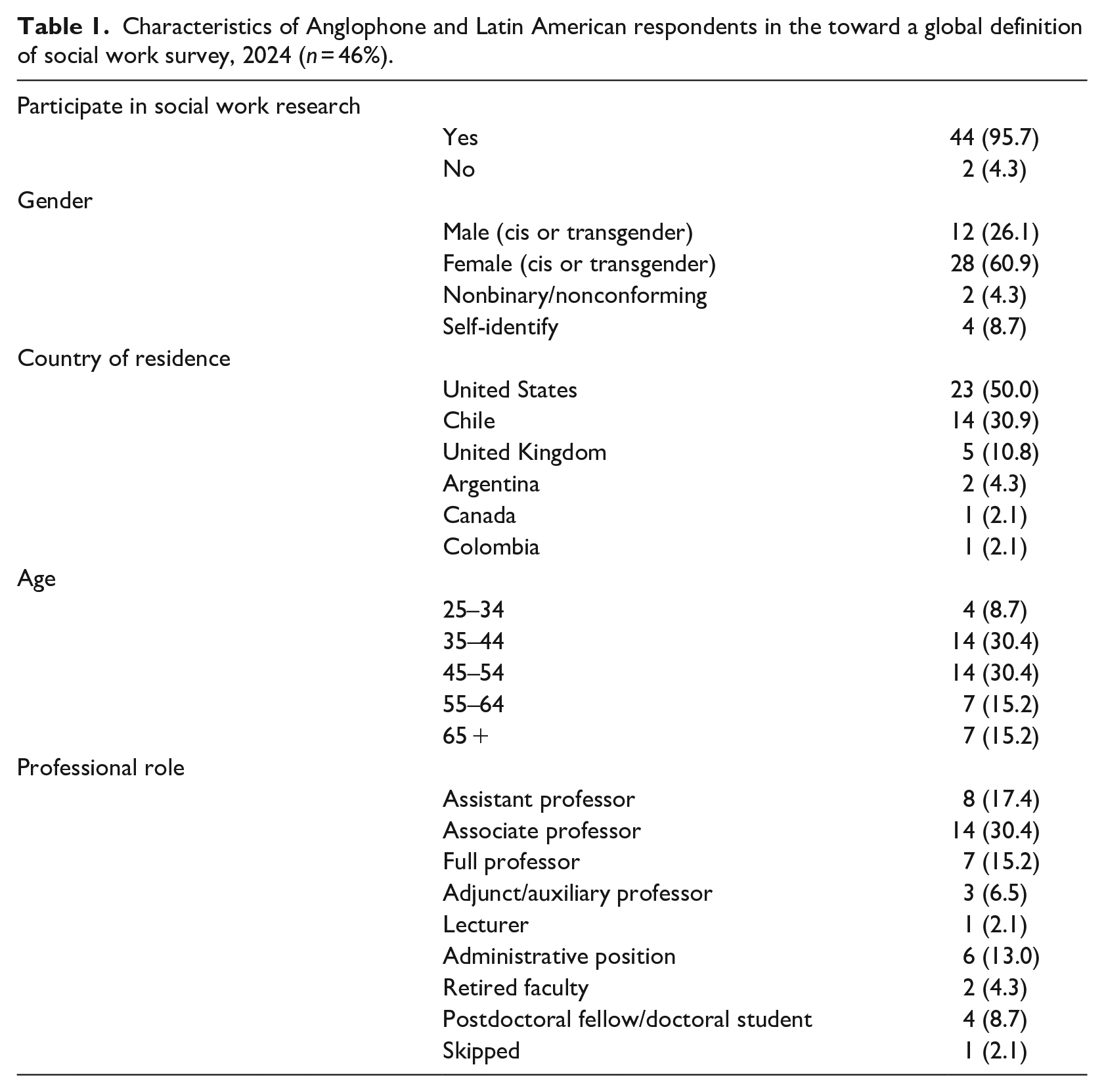
A total of n = 121 started the survey, of whom n = 118 individuals consented to participate and n = 88 individuals completed the online survey. Among individuals who completed the survey, n = 46 resided in an Anglophone or Latin American country and thus were included in the analytic sample. The only individuals who responded in Portuguese (n = 2) resided in Portugal; therefore, considering likely cultural differences, we only included responses from Latin American or Anglophone countries in this analysis. Table 1 displays the socio-demographics of survey respondents for the subsample of Anglophone and Latin American respondents used to address the research questions of this study. Most Latin American respondents resided in Chile (n = 14; 30.9%), followed by Argentina (n = 2; 4.2%) and Colombia (n = 1; 2.1%), whereas most Anglophone respondents resided in the United States (n = 23; 50.0%), followed by the United Kingdom (n = 5; 10.8%) and Canada (n = 1; 2.1%). The majority (n = 44; 95.7%) of respondents in our analytic sample reported that they participated in social work research. Most identified as female, which is consistent with the gender distribution of the discipline and reflective of the feminization of care professions (Sands and Nuccio, 1992).
Characteristics of Anglophone and Latin American respondents in the toward a global definition of social work survey, 2024 (n = 46%).
Data analysis
All survey data were exported from Qualtrics to a csv file and analyzed in Excel. Closed-ended questions related to demographics were analyzed using frequencies and percentages with Pivot Tables. The research questions of interest were addressed from open-ended questions where the authors sorted and coded the open-ended items in Excel using a thematic analysis approach (Guest et al., 2012). To answer the research questions of this study, the focus was on analysis of the open-ended responses, particularly the question, ‘What makes social work distinctive from research produced in other disciplines?’ To reduce the risk of bias and increase the trustworthiness of the data, two PhD-level social work researchers independently coded the data using a two-stage approach. The open-ended responses were coded in the original language of the survey (English or, Spanish) and were later translated by the corresponding author (who is fluent in English and Spanish). In the development of the survey, a native Portuguese speaker also reviewed the text.
In the first stage of the data analysis, and consistent with an applied thematic analytic approach (Guest et al., 2012), each researcher identified the main concept or idea underlying each response. In this stage, each open-ended response (86 total) was analyzed, and the key idea or concept was extracted. Thirteen initial codes were developed, including ‘scientific method’, ‘generating knowledge’, ‘action-oriented’, ‘multidisciplinary’, and ‘applied’, among others. In the second stage, the researchers used a constant comparison method to group codes from the first stage by larger themes. During this process, the two researchers met monthly to discuss emerging themes and resolve any discrepancies. As in other recent thematic analyses (Roberts et al., 2019), discrepancies were resolved by discussing the decisions the two researchers had made and coming to a consensus; as the larger themes emerged in the second phase of coding, two additional researchers involved in the design of the study provided feedback and identified similarities and potential ways to further collapse and combine themes. The results from this iterative process yielded three main themes.
Trustworthiness was addressed in the following ways: (1) To enhance credibility, the authors engaged in reflection and discussion about emerging themes, used actual words from the data, and connected literature to the concepts that began to emerge from the data (Chiovitti and Piran, 2003); (2) To enhance transferability, the researchers reported the results using thick descriptive data, particularly through the use of direct quotes; and (3) To enhance dependability, the researchers maintained an audit trail, which involved detailed field notes and a thorough description of the data collection and the stages of data analysis (Lincoln and Guba, 1986; Shenton, 2004).
Results
Respondents overwhelmingly identified components of social work research that distinguished it from research in other disciplines. Across the sample, only three individuals responded that they were ‘not sure’ or that there ‘was nothing’ that differentiated social work research from other disciplines’ research. All three individuals who reported no difference completed the survey in Spanish and worked for universities in Chile. All remaining respondents identified differences and those differences were analyzed and grouped into the following three themes: (1) Social work research seeks solutions or actions; (2) Social work research integrates an ecological approach; and (3) Social work research is upheld by ethics and social justice. At the core, all three themes reflected values that recognized the role and contributions of the research subjects as active participants in the process and the importance of context in understanding human behavior. This aligns with findings from prior studies that have concluded social work research is guided by professional ethics that shapes the research questions and interactions with research participants (Rubilar, 2009; Shaw, 2007). Together, the themes also evidence the legitimacy social workers place on research unique to the discipline and identify core components that set it apart from other research.
Social work research seeks solutions or actions
The first theme that emerged, social work research seeks solutions or actions, encompassed the idea that there were practical applications that informed the research and a bridge between research and practice (Gray et al., 2015; Heinsch et al., 2016). Several respondents, both from Anglophone and Latin American countries, reported that social work research was ‘applied’ and had a focus on ‘betterment’ or ‘solutions’ to real-world problems. In this sense, there were similarities among Anglophone and Latin American respondents with regard to the applied, solution-focused nature of social work research. As one respondent signaled, ‘in my experience, social work research has a specific location in relationship to social problems and issues, as well as a stronger sense of relationship with and responsibility to our research respondents’ (respondent 19, completed survey in English). Another respondent reported social work research being ‘change-oriented’ (respondent 33, completed survey in English).
For other respondents, social work research generated knowledge or evidence that had real-world, practical implications. For example, respondent 21 (completed survey in English) indicated that social work research contributed ‘by defining problems, identifying causes, and offering solutions that are not based on the hegemonic paradigm’. Another Latin American respondent noted, social work research ‘produces evidence to make decisions about social programs and policies’ (respondent 25, completed survey in Spanish).
Similarly, an Anglophone respondent indicated:
Social work research provides evidence to both practice and policy. Social work has become increasingly evidence based, and research is needed to contribute towards this [. . .] not just empirical research, but also qualitative research that provides a platform for those who use services to contribute, (respondent 66, completed survey in English)
Notably, several Anglophone respondents tended to report ‘building evidence’ to evaluate existing programs and policies. In contrast, multiple respondents from Latin America tended to mention producing evidence ‘to make decisions’ about developing or implementing programs and policies. In both cases, data and knowledge generation through social work research was considered as a means to a more applied solution or tangible action that could improve practice or policy. Respondents from both Anglophone and Latin American countries noted that social work research ‘provides scientific evidence about certain social problems and their complexity and proposes improvements or collective resolutions’ (respondent 64, completed survey in Spanish.). Another participant noted that social work research ‘collects data and organizes it through the lens of relevant topics for social work (e.g. justice, equality, peace’) (respondent 48, completed survey in English). Thus, beyond generating data or knowledge for the sake of research, this theme overlapped with other themes related to the holistic and applied approach and focus on ethics/social justice as those pillars guided knowledge generation.
In these cases, social work research went beyond other social science research in identifying or learning about issues; rather, it sought solutions or actions either through interventions or policies that could best address social issues at hand. In parallel, several respondents reported that social work research was ‘practice-based’ and differentiated itself from other social science research based on its practical applications and grounding. One respondent indicated that social work research ‘has a practical layer that other disciplines do not’ (respondent 1, completed survey in Spanish).
Social work research integrates an ecological approach
The second theme that emerged was that social work integrates an ecological approach. The ecological or ‘person-in-environment’ approach emerged more among Anglophone respondents, while some Latin American respondents mentioned multiple ‘layers’ or ‘factors’ to consider such as individual and structural factors. Both Anglophone and Latin American respondents referred to ‘socio-political’ contexts and factors that social work research considers.
In contrast to some other social science research, respondents reported that social work research incorporated a ‘person-in-environment’ framework that focused on individuals within their socio-political contexts to understand social issues at hand. Some respondents reported this as a ‘holistic’ or ‘systems approach’ that was ‘unique’ (respondent 24, completed survey in English). One respondent stated that social work research could ‘address the complicated and complex social, cultural, and political factors that have impacted individual and social well-being’ (respondent 79, completed survey in English).
As one respondent stated, social work research ‘is typically collaborative in nature, with elements of ecological perspective (micro, mezzo, and macro lenses) as a framework’ (respondent 42, completed survey in English). Thus, by examining multiple lenses, respondents reported gaining a more holistic understanding of human behavior and social issues. This included recognition that ‘individual behavior and outcomes are dependent on several intersecting factors and dimensions’ (respondent 57, completed survey in English). This connects with the complexity of the social issues investigated through social work research that require diverse and multidimensional perspectives. A Latin American respondent indicated: ‘It is an intellectual and political exercise that is key to strengthening and constantly updating the discipline and is shaped by historical contexts, (respondent 72, completed survey in Spanish). This aligned with other Latin American responses that focused on the inclusion of ‘dimensions of time and space’ or ‘geography’ in exploring various research questions.
Social work research is upheld by ethics and social justice
The third and final theme that emerged was that social work research is upheld be ethics and social justice. In this theme, respondents focused on values such as human rights, social justice, and dignity that differentiated social work research from other social science research. As one Latin American respondent reported, social work research had ‘a clear focus on transformation’ (respondent 22, completed survey in Spanish). Similarly, an Anglophone respondent stated that social work research ‘addresses social injustice’ (respondent 18, completed survey in English). Several Anglophone and Latin American respondents mentioned the commitment of social work research to ‘human rights’ and ‘social work values’ (respondent 25, completed survey in Spanish, and respondent 32, completed survey in English), identifying these as unique components.
Within this theme, one key value of social work research identified was the ‘value’ and ‘worth’ placed on each individual. Anglophone respondents often recognized individuals with lived experience as experts in their own narratives. As one participant noted, ‘in the best instances. [social work research] fills in static concepts with lived experience and other examples’ (respondent 31, completed survey in English). In contrast, Latin American respondents more frequently reported ‘ethical considerations’ and ‘values’ when engaging research participants as components that set social work research apart (respondent 25, completed survey in Spanish, and respondent 43, completed survey in English).
In addition to recognizing the value of individuals with lived experience, respondents also identified values of equity and justice and repairing harm that differentiated social work research. For example, one researcher reported:
Research that is grounded in equity and justice and is conscious of the damage that research has caused in the past and intentionally works to avoid perpetuating any form of data violence, coercion, and misinformation. Ideally, social work research is in partnership with, never research on, and is participatory when possible. (respondent 34, completed survey in English)
This theme has highlighted the importance researchers place on adhering and upholding the ethics and values of work both within the development and design of the research and in the purpose of the research findings.
Discussion
This study explored how social work researchers across the globe defined social work research, with a focus on comparing Anglophone and Latin American researchers. Respondents identified key pillars of social work research that differentiated it from other social science research, including its applied approach, ecological perspective, and adherence to social work values and ethics, such as active participation and transformation of society. While each of these three themes alone may not distinguish social work research from research of other disciplines, together they provide a formula of the distinctiveness of social work research. Together, these themes reflect the ethical and values-driven nature of social work research with the aim to improve society or social problems and transform the profession of social work and the lives of people. Further, they reflect the implicit or explicit values related to social justice, transforming society, and human rights, all of which guide and differentiate social work research from other social science research. All themes related to core values in the Social Work Code of Ethics, such as social justice, dignity and worth of people, human rights, and the importance of human relationships (International Federation of Social Workers [IFSW], 2018; National Association of Social Workers, 2021).
Notably, most of the themes emerged from both Anglophone and Latin America, which may reflect certain similarities in how social work research is understood, taught, and conducted in diverse contexts. However, it is important to note that in some of the themes, such as social work seeks actions or solutions, there were some differences in how respondents in Latin American and Anglophone contexts conceptualized evidence generation. Anglophone-based respondents tended to focus on building the evidence for existing programs and policies, whereas respondents from Latin America tended to focus on generating evidence to inform decision-making about program and policy development and implementation. This aligns with a focus in Anglophone-based research on building the ‘evidence-base’ for practices and that have been evaluated using rigorous experimental or quasi-experimental designs and then having the collective body of research rated by clearinghouses (Zheng et al., 2022). Though some research from Latin America has found a lack of social work perspectives in policy debates, as well as critical perspectives about how knowledge is produced, findings from this study highlight potential to include social work research in these arenas (Muñoz Arce et al., 2021; Muñoz Arce and Rubilar, 2021).
Questions associated with ethical and political debates are also found in Latin perspectives, which raise questions about justice and human rights. These ‘sensitive topics’ (Cornejo et al., 2019) cover conflicts with the state, excessive use of force, and unequal application of rights – issues often addressed by social work research. While Anglophone respondents tended to focus on social work ethics such as the ‘unique value’ and ‘worth’ of individual clients, Latin American respondents tended to have a more reflexive approach of incorporating ethics and human rights into their interactions as professionals with research participants. While some Anglophone respondents did recognize the importance of larger transformation and social justice, many focused on the inherent value and dignity of each individual, taking a more individualistic approach to understanding complex phenomena. This may align with a more humanistic and individualistic focus of micro and clinical social work in Anglophone countries that has been critiqued as failing to enter into larger critical discussions about the role of power, privilege, and structural barriers (Whitaker et al., 2021).
Themes from our study also highlight ideals of social work research, such as centering individuals with lived experiences and ensuring that research is focused on solutions to real-world issues. It is worth noting that other researchers have concluded a need to increase the practical applications of social work research (Teater, 2017) and to ensure that it does take an anti-oppressive approach (Pease, 2010). Despite the fact that several respondents mentioned social transformations (aligning the conceptualization of social work research with international definitions), the responses largely focused on individuals and individual change. Although several respondents mentioned an ecological approach to social work research, few focused on structures, structural mechanisms, or systems that produce inequality and oppression. This speaks of a particular conception of ‘the social’, which distances itself from the most critical approaches in the discipline (Dunk-West and Saxton, 2024; Healy, 2001).
Notably, Anglophone and Latin American respondents did not reference the theoretical basis of social work research. It seems that the research ‘springs’ from what is required by practice – either to ‘test’ a model of practice (Anglo Social Work) or to raise knowledge from practice that can be seen by policymakers or other decision makers (Latin American Social Work). There were no references in the responses to the place of theory in the production of knowledge. The silence regarding the relationship between theoretical bases and research may reinforce the place of sub-alternity that is sometimes attributed to social work compared to other social sciences. This may inhibit Social Workers from reaching positions of power that make decisions related to social justice (Briskman et al., 2020; Howe, 2017).
While participation appears as a component in one theme, this is an area that may require more in-depth exploration. Although some respondents mentioned a co-production of knowledge, transdisciplinary perspectives of knowledge creation, or active knowledge development with research participants, the role of knowledge generation and contribution remains understudied. Debates about knowledge construction and the role of the researcher and participants are relevant debates in the disciplinary agenda of social work (McGlade et al., 2020) and have high visibility in the international definition of social work. Furthermore, these debates are important as artificial intelligence begins to permeate the field and generates new discussions about how knowledge is created and shared (Reamer, 2023). Future research could explore the interactions and transactions among researchers and participants, particularly in light of international definitions of social work research that focus on its ‘interdisciplinary and transdisciplinary’ nature and the ‘co-construction’ of theory through ‘interactive process[es]’ (IASSW, 2024).
There is also nothing about ‘indigenous’ or non-hegemonic knowledge in the respondents’ accounts. Part of the legacy of colonialism is that Western theories and knowledge have been exclusively valorized and in contrast local knowledge has been devalued, discounted, and hegemonized by Western theories and knowledge. This is interesting, even in the responses of participants from Chile, Argentina, and Colombia, there was a lack of mention about indigenous, popular, or non-hegemonic knowledge, which contrasts with visions that attribute a critical character and the decolonial potential of Latin American social work (Alicea-Rodríguez, 2019; Garrett, 2021).
Limitations
This exploratory study has several strengths, such as including responses from social work researchers across the globe. However, there are also notable limitations. First, the convenience sample and relatively small number of responses by geographic region are not necessarily representative of all social work researchers. While we noted some general trends in our results and compared themes in the English and Spanish responses, these are not necessarily transferable beyond the sample. Furthermore, although respondents from six countries were included, 50 percent of the sample resided in the United States and the majority of Spanish-speaking respondents resided in Chile. Therefore, results are not necessarily transferrable or reflective of all Latin American or Anglophone countries. Second, there were several countries that only had one or two responses. Future research could strategically recruit and sample to compare and contrast experiences within each country or geographic region. Third, the few respondents who reported no differences between social work research and other social science research could be considered conflicting/contradictory cases. Future research could explore these perspectives in more depth and specifically sample other Latin American countries to compare and contrast themes.
Implications for social work practice and research
The findings of this study have moved the profession forward in articulating the distinctiveness of social work research. The three themes from this study can be used to promote social work research with clarity and purpose in social work education, practice, and academic communities. Specifically, the message on how social work research is distinctive can be simply stated with the following statement: ‘Upheld by ethics and social justice, social work research integrates an ecological approach to seek solutions and actions to real-world problems’. This message can be integrated into social work education research courses to provide a foundational context for students to learn and engage in social work research. Doctoral programs could include the statement in their program’s mission and vision statements to specify the purpose and aim of social work research, thus assisting future social work researchers to articulate their future research agendas.
By incorporating this statement in social work education, future social workers can have a clear understanding of research for their practice. Practitioners can use the statement to guide their practice-informed research and research-informed practice by ensuring they are upholding the values and ethics of the profession in their research endeavors, and conducting research that aims to seek solutions and actions that will move toward social justice. Practitioners can better articulate why they are conducting research with individuals and communities and how their research findings can be used to advance practice and promote better lives for individuals, families, groups, communities, organizations, and society.
Having a specific statement on the distinctiveness of social work research can help to legitimize and promote the uniqueness of social work research within academic spaces across the globe. It can also help establish global research agendas and trajectories that permeate borders. The statement can help to support funding for social work research as it demonstrates the ways in which social work research has impact and is unique. Clarity on social work research can also help in tenure, promotion, and academic advancement opportunities and decisions where professionals from other disciplines may have limited knowledge of social work research. Finally, as this study was exploratory, future research should build upon these initial findings and probe for specific components such as the relationship between researcher and participant, co-construction of knowledge, and social transformations.
Footnotes
Declaration of conflicting interests
The author(s) declared no potential conflicts of interest with respect to the research, authorship, and/or publication of this article.
Funding
The author(s) disclosed receipt of the following financial support for the research, authorship, and/or publication of this article: This work was supported by ANID/CONICYT/FONDECYT under Grant 1230605 Viajes centenarios y trayectorias de las ideas: Geopolítica, producción de conocimiento y agendas de investigación del Trabajo Social and the PSC CUNY Grant (66145-00 54) at the City University of New York.
Ethical approval
Approval provided by the College of Staten Island, City University of New York. Research was approved as exempt on 10/31/2023 (protocol # 2023-0687-CSI). Recruitment of participants began in November 2023.
