




Abstract
Professional socialisation is a complex and interactive process through which professional roles and skills are learned and internalised. In social work, this complexity is due to a changing professional landscape, contested discourses and differing organisational contexts. This article reports on an Australian study exploring the perceptions and experiences of early career social workers and supervisors on professional socialisation. The study used qualitative methods to interview 18 participants. The findings highlighted the importance of recognition of subjective experiences, negotiating power and supervision. The findings can inform practice guides and policies for graduate programmes and practice settings.
Keywords
Introduction
Professional socialisation is a dynamic process through which new graduates develop their professional identity, integrating and adopting values, skills and knowledge into practice (Fitzgerald, 2020). Identity formation is a gradual and interactive process where idealism meets the complexity of practice and graduates have to navigate emotional challenges and ethical principles (McGill et al., 2020). After graduation, social work professional identity takes shape through a social process of transition, and adjustment within the workplace context (Moorhead, 2019: 214; Pullen Sansfaçon and Crête, 2016).
In Australia, social work programmes aim to prepare students with the professional capabilities to work in complex areas of human services, policy and community development. The Australian Association of Social Workers (AASW, 2023) stipulates practice standards and regulates accredited education (Long et al., 2024). Social work education and practice standards have promoted emancipatory knowledge, praxis and approaches to address oppressive social arrangements and structural change and social justice (Morley et al., 2019). Yet, graduates can encounter uncertainty when navigating the constraints and demands of their practice which may impact their capacity and job satisfaction and might result in losing motivation (Benner and Curl, 2018).
A group of researchers at Deakin University designed and conducted an exploratory research project to understand the journey of professional socialisation for early career social workers in Victoria, Australia. This article presents early career social workers’ and supervisors’ perspectives on professional socialisation and uncertainties of practice. Both cohorts were included in the research as anecdotal reflections suggested that new social workers struggled with challenging organisational experiences and implementing critical social work in the early stages of their practice. Indications from supervisors questioned the pedagogical intent of higher education in preparing students for social work roles.
The process of professional identity and socialisation
Professional identity is shaped through shared values and attributes, a sense of belonging and connection among a group of professionals (Daly et al., 2024). While social work professional identity is contested and socially constructed, it can be defined by the profession’s status and the process of ‘the acquisition of discipline-specific knowledge, skills, and values and the recognition of being different to others’ (Papadopoulos and Egan, 2023: 606). Identity formation and a sense of belonging are achieved through a gradual process of professional socialisation, learning how to think, act and feel like a social worker (Webb, 2017). The professional socialisation process assists new graduates to internalise a shared sense of professional identity (Moorhead, 2019: 206). The process of socialisation into the social work profession starts from a novice level, towards becoming an expert with additional years of experience (Moorhead, 2019: 207; Tham and Lynch, 2021). This can be more complex than it sounds.
Research indicates the first 5 years of practice are paramount in framing professional identities and becoming capable and competent professionals in the long term (Harrison and Healy, 2016; Hunt et al., 2017). Social work practice is often accompanied by stress, time pressures, ethical dilemmas, uncertainties and conflicting legislative and policy constraints. Hyslop (2018) argued that social work itself entails a degree of social control, maintaining orders and rules. The challenging nature of practice is usually coupled with restrictive budgets and heavy workloads, posing additional risks of burnout, emotional exhaustion, compassion fatigue and attrition from the profession (Alston et al., 2022).
Social work involves a diverse range of theoretical frameworks and practice fields. This diversity and fluidity means that social workers might construct their identities differently (Hobbs and Evans, 2017; McLean and Price, 2019). The current political and economic dimensions of social welfare systems in Australia can also influence social workers’ professional identities, particularly as reductions in services and tight eligibility criteria impact service provision under the ‘neoliberal regime’ (Harrison and Healy, 2016; Hunt et al., 2017). In this context, social workers who strive to achieve social justice might face the stark contrast between the ideals embraced in social work education and the realities of social work practice (Tham and Lynch, 2021).
Neoliberalism, a multifaceted and contested term, however, is the dominant, state-sponsored discourse of contemporary corporate capitalism that has reframed state–private sector relations prioritising competitive market models as optimal for public and private decision-making (Horsell, 2024; Venugopal, 2015). Garrett (2018) described how neoliberalism’s basic logic is to maximise profit and commodify all aspects of personal relationships and labour. This is certainly evident in social work in Australia, as successive governments increased moves to privatise services and work with clients on short-term ‘interventions’ where measuring outcomes are ubiquitous. Internationally, in the United Kingdom, for instance, Hill and Laredo (2020) noted that there is a ‘concerted agenda to depoliticise social work, and simultaneously to present it as a more neutral, benign and technocratic profession’ (p. 971). The current climate of the Australian neoliberal system, focusing on ‘measurable outputs’, might contribute to shaping professional identity to become ‘professional compliance’ (Hunt et al., 2017: 142). This contradicts the reflexive and critical approach that aims to achieve social justice purposes. Social workers’ inclinations to be ‘loyal’ to the system and organisation can deter them from critiquing the status quo (Ylvisaker and Rugkåsa, 2022). Through techniques such as funding and surveillance, the neoliberal capitalist system legitimises a form of social work practice that reinforces individual responsibilities, aiming to encourage social workers to gradually accept, internalise and reinforce the neoliberal agenda (Kamali and Jönsson, 2019). These constraints might present a challenge for new graduates as they strive to develop a sustainable identity and for supervisors who endeavour to support them in achieving their mission.
Nevertheless, social work identity can be resilient, sustainable and strong, which requires active reflection on professional identity within a ‘good’ supervision process (Long et al., 2024). Smith et al. (2022) argued the role of supervision has had the strongest influence on students’ developing sense of a social work identity. Indeed, reflexive practice with ongoing supervision and mentoring in the early stage of practice can respond to the current tensions (Moorhead, 2019; Toh et al., 2022), and help social workers address contradictions, fostering resilience and promoting professional growth. Supervision and mentoring could be pivotal in nurturing and sustaining the commitment to structural change and social justice while forming a professional identity. By implication, the role of organisations and supervisors in building resilient and reflective socialisation and identity development post-graduation remains significant (Moorhead, 2019).
However, studies on supervisors’ perspectives on social work graduates’ readiness for practice are somewhat limited (Yu et al., 2016). Further research is needed to capture both supervisors’ perspectives and new graduates’ experiences of socialisation into the profession and their ongoing identity formation in the novice phase of their careers. It is crucial to include the voices of social workers alongside supervisors to understand the diversity of experiences and viewpoints. To this end, this study explored graduates’ experiences and supervisors’ perceptions of professional socialisation.
Methodology
A social constructivist epistemology with a critical social work theory lens underpinned this research. Social constructivism epistemology identifies that human knowledge is built through discourse, and how people interpret the world (Burr, 2015). Critical social work (Fook, 2023) informed the research to examine power dynamics and social justice and hear the voices of new graduates. The qualitative design of this research included semi-structured interviews undertaken by the research assistant (RA) to gather in-depth data on participants’ experiences of professional identity. The research question was: What are social work graduates’ professional socialisation experiences and identity development in the first 5 years of practice?
The demand for qualified social workers in Australia has increased due to workforce capability that requires frontline workers to hold a social work qualification in sectors such as family violence, child protection, the National Disability Insurance Scheme, public health and mental health (Victoria Government, 2018). There has been a call to prepare social workers for the realities of social work settings to be ‘work-ready’ graduates (Burns et al., 2020). The research team was critical social work educators who were aware that neoliberal capitalist services may not always be aligned with the mission of social justice and structural change. We identified the need to broaden and deepen the understanding of new graduates’ experiences of personal journey as well as supervisors’ viewpoints to bridge the chasm between the mission of social justice and the demands of social work practice.
The inclusion criteria for participation were early career social workers who were employed for up to 5 years post-graduation and supervisors who supervised early career social workers within their organisation in Victoria. Ethics approval was obtained from Deakin University (project number ID HEAG-H 204_2022). Ethical principles of the AASW (2020) underpinned the research’s design, data collection and data analysis. For example, to manage potential power imbalances, a research assistant outside the academic team was employed for data collection. Also, a confidentiality protocol was maintained by using pseudonyms and removing all identifying information during data analysis. Participants reviewed transcripts to ensure accuracy and confidentiality.
Recruitment process and participants
The study applied two forms of non-probability sampling: purposive sampling and snowballing (Liamputtong, 2020). Following ethics approval, the researchers emailed the research flyer to the relevant organisations. Based on inclusion criteria, all qualified social workers, up to 5 years post-graduation as well as supervisors who supervised new social work graduates in Victoria, were eligible to participate in the interviews. Eligible employees included those from statutory human services, public health systems and community organisations across Victoria. Participants were also invited by advertising the research flyer on social media such as LinkedIn, Facebook and X.
Following the initial contact from those who expressed interest, the research assistant sent a copy of the research information sheet and the informed consent form via email. The prospective participants were informed that they could raise any questions about the research before the interview. Following the signing of the informed consent, an online meeting was scheduled to conduct the interview. The rights of participants were clearly outlined and prioritised in the plain language statement. Participating in this research was voluntary, and the researchers protected the participants’ confidential information. A written consent was obtained to record interviews prior to the interview taking place and explained that recording the interview was for the purpose of data analysis and would remain confidential. Interviews were audio or video recorded. A small gift voucher ($30) was given to participants as recompense for any costs associated with their participation in an interview (e.g. taking 1 hour leave from work). The interviews were approximately 45 minutes to an hour in length.
Nine supervisors and nine early career social workers were interviewed for this project. Participants were not paired in dyads, and they were interviewed independently. The recruitment was stopped when no new information or themes were observed in the data collection. Among supervisors, eight identified as female, and one identified as male. Their ages ranged from 25 to 65 years, and all identified as Anglo Australians. Most supervisors were employed in community, public and mental health organisations. Regarding the early career social workers, seven identified as female and two as male. Many had graduated less than a year prior to the study. They had diverse ethnic backgrounds, including Anglo Australian, Sri Lankan, Pakistani, Southeast Asian and British. The sectors where new graduates were employed included mental health, family violence, child and family well-being and disability. More information can be found in Table 1.
Participants’ demographic information.

Transcription and data analysis
All interviews were transcribed using Zoom captions, and transcripts were checked. The research assistant returned a copy of the interview transcript to participants for review. These transcripts were anonymised and forwarded to the research team for coding. The first author used the qualitative research software programme NVivo for the data analysis, while the third author used pen and paper to highlight keywords and themes.
The data were analysed and interpreted through inductive thematic analysis, following the six steps outlined by Braun and Clarke (2019): (1) Familiarisation with the data: during this initial stage, two authors (One and Three) read and reread transcripts separately, immersing themselves in the data to find meanings, patterns and key points, while taking notes. (2) Generating initial codes: both authors looked for initial patterns and interesting features, organising and listing codes separately. This process helped reduce the researchers’ biases in making sense of the data. (3) Searching for themes: at this stage, the research team met to discuss and compare codes and construct overarching themes. (4) Reviewing themes: the research team refined and reorganised themes to enhance clarity and validation. (5) Naming themes: the research team finalised themes with meaningful, brief and concise names. (6) Producing the report: this article presents three themes on professional socialisation and additional themes focusing on social work education will be articulated in another article.
Results
The thematic analysis identified three key themes from the data: (1) Integration of personal identity and professional identity, a subjective experience; (2) Enablers to socialisation; and (3) Navigating ideals and reality and theme, power and voice. In the Results section, early career social workers will be referred to as ‘social workers’.
Theme 1 – Integration of personal identity and professional identity, a subjective experience
An evolving process
Most participants, both social workers and supervisors, described social work identity as a gradual building of capacity that helps social workers to integrate theories, ethical codes, skills and principles learnt at university. For many participants, the professional identity was ‘continuing development’. While it might be assumed that social workers would further develop their social work identities in the workplace, the evidence indicated that this took some time to occur. A supervisor provided the following as a definition of professional identity, which reflected most participants’ perspectives:
[Professional identity] is about the connection between what you’ve learned in your academic studies and how you bring that into your work profession. It’s around the core values and ethics that align with being a social worker and finding a way to . . . have them merge and meet with the work you’re doing. (Supervisor, Marg)
Although most participants agreed that professional identity is evolving and would be achieved eventually, early in their social work practice many participants (social workers) did not feel that they ‘belonged’ to the profession. As such, some expressed quite high levels of hesitation, uncertainty and self-doubt, as new social workers. Annie described herself as a ‘baby social worker’. Sam expressed his anxiety as ‘imposter syndrome’, as he was not confident in the early stage of practice.
Likewise, Matt was not confident in his identity as a social worker and noted:
I used to be frightened of the clients, because they were so [. . .] very different to me. I see my [professional] identity as not being formed at all. (Social worker, Matt)
Likewise, building a professional identity was challenging for Maria, an international student at university, and placement opportunities were limited to obtain practice experiences. After practising for almost 5 years, she described her early experiences of practice as follows:
If I had a client in front of me and . . . she was becoming emotional and teary, I would become emotional and teary. It was so hard . . . I feel like maybe you get control over your feelings as [an experienced] worker. (Social worker, Maria)
Here Maria seems to be describing a shift from personal responses to a professional and client-centred focus as her professional identity developed over time. These subjective experiences of social workers were a reminder of the emotional impacts on novice practitioners that more experienced practitioners and educators can easily overlook.
Personal and professional identity
Both supervisors and social workers described a delicate equilibrium between personal and professional identity development. Social worker Sarah commented that social workers’ personal identity is paramount in establishing professional identity. Shae stated that:
The professional identity for me personally is difficult to separate from my personal because it involves so much of my morals and values, and I really feel that they carry out into many areas of my life. So I think it’s really about the way that we work with people, the way that we see the world. (Social worker, Shae)
As a supervisor, Ally acknowledged the role of ‘self’ and ‘personal attributes’ in adapting professional identity, including emotional regulation, empathy, confidence and integrity; she said, ‘You have to maintain professionalism, but you have to have that nice balance of having a personal self in there’. Similarly, supervisors Eve and Susie expressed that social workers integrate their own personal identity and attributes into social work identity. Another supervisor, Gemma, viewed social workers’ lived experiences as the contributors that eventually shaped social workers’ professional unique identity.
However, aligning personal experiences and perspectives with professional judgement may not always be straightforward. Supervisors stated that the misalignment might lead some social workers to express personal viewpoints within their professional practice or become uncertain about their capacities. Supervisor Aria, for instance, observed a social worker who referred to ‘their parenting style to provide recommendations to parents’. In addition, the difficulty of balancing personal capacity and professional competency led a few social workers to doubt their readiness. Matt, who has been unable to find the social work job he wished for, emphasised, ‘You’ve got to be fit for work . . . . I’m not fit to be a part of the group’. In his view, professional identity was more demanding than his personal capacity, which he felt he could not fulfil based on his abilities and skills. This raises questions about what might have supported Matt to feel more ‘fit for work’ and when this can be achieved in professional socialisation.
Theme 2 – Enablers in the process of socialisation
The role of supervision and critical reflection
Participants universally identified balanced, trusting and supportive supervision and critical reflection as pivotal to effective professional socialisation. Supervisor Gemma pointed out supervisors should not be ‘overly critical’ to allow the early career social workers to ‘find their feet and explore for themselves’.
It’s got to be a very trusted space . . . more like a mentoring kind of coaching space where you’re looking at what’s going well. (Supervisor, Gemma)
Given social workers could be hesitant to ask questions for fear of appearing incompetent, permission for uncertainty and affirmation of instances and practices of growing strength are important in supervision. Gemma suggested social workers have ‘got to be brave in that supervision space [. . .] it’s a really important space’. Social worker Carly similarly indicated critical reflection needs a trusting and comfortable space in which social workers can explore their own thoughts, feelings and biases in addition to setting goals and navigating pathways for learning.
Many social workers in this small sample were happy about the support and supervision they received, although they knew this was not always available to other new graduates. Social workers’ experiences of supervision ranged from receiving supervision fortnightly to a few times a year, with internal group supervision sometimes an addition, depending on the type of organisation and how many social workers are employed within the organisation. Sam suggested having more social workers as colleagues can provide access to more mentors and informal supervision.
While supervision has been identified as important, Sally is aware sufficient supervision is often not available to early career social workers due to a lack of funding, particularly in the last 10 years, including in her organisation. Supervisor Gemma provided external supervision self-funded by social workers because they did not get adequate supervision at work or because it was their preference. Social worker Matt sought external supervision to ensure more adequate supervision than what was available to him in his organisation.
With the small sample represented in this study, it seems that supervisors and social workers alike were aware of the importance of supervision and emotional support in the socialisation process and social workers were accessing it to meet their needs, sometimes at their own expense.
The role of graduate development programmes
Many participants, supervisors and social workers affirmed the role of government-supported graduate development programmes in helping new graduates build their professional capacity and a sense of belonging. Graduate development programmes in Australia are paid roles in some sectors that provide 12 months of gradual entry into the workforce, supported by mentoring, placement experience in different work areas/contexts, tailored professional development and network opportunities, followed by an ongoing role in the organisation after 1 year. Supervisors Ally and Gemma believed graduate programmes could encourage new graduates to be more open to receiving feedback in a trusting relationship. However, as Gemma indicated, the funding was limited to support such pathways. Marg welcomed the government funding of graduate development programmes as they provide a space for more supervision and reduce caseloads. She stated:
The additional supervision makes the world of difference. When you compare my new grad who’s doing that program to somebody else who started at a similar time that hasn’t had that support, they’re worlds apart. (Supervisor, Marg)
Despite the benefits of new graduate development programmes, the lack of funding remained a challenge and reduced the opportunities for many new graduates.
Theme 3 – Navigating ideals and reality, power and voice
Power relationships
Participants expressed the challenge for social workers negotiating their position within their employing organisations in the early stage of practice. In this transition, social workers may be challenged by hierarchical dynamics and organisational demands while striving for autonomous decision-making. One supervisor noted it is challenging for social workers to assert their perspectives with other team members, even if in the clients’ interests. Ally’s observation as a supervisor described early career social workers as ‘people pleasers’. Another supervisor discussed negotiating the power imbalances with senior staff:
There can be that perception of power over, or an imbalance, so it can be quite tricky for new graduates [. . .] particularly if you’re a new graduate coming in and you’re working with someone from a welfare background. (Supervisor, Marg)
Supervisors also emphasised the importance of holding the title of social worker to foster a sense of identity and maintain professional power. With the weight of new learning, settling into an organisational culture and carrying a more fragile sense of social work identity, awareness and care are required of all players in the education and post-graduation space to ensure social workers are adequately supported in the socialisation process.
Expectations and reality
Some participants – both supervisors and graduates – highlighted a lack of alignment between early career social workers’ expectations and the realities of practice. The flavour of this varied across service contexts. Social worker Shae experienced the medical model of service delivery as pathologising service users, undermining her social work values and principles. To resist this was challenging as the medical team was considered ‘superior’ and the medical model was the dominant framework.
Molly was not expecting to have as many diverse service users in an agency that did not specialise in providing services to migrant and refugee populations. Ultimately, she found this positive, but it was a steep learning curve. Sarah, another social worker, felt she needed to educate people about what social workers could offer, as this was very unclear in her organisational context.
From supervisors’ perspectives, Aria described early career social workers’ attitudes as academically focused. Susie highlighted the tendency of some new graduates to feel they know more than other practitioners:
I don’t know whether the universities are training them that way or whether they’re just coming in idealistic but [. . .] in some it is [. . .] this feeling that we know better. (Supervisor, Susie)
Susie also pointed out some social workers know little about other disciplines and suggested the social model that they bring to practice is not realistic or applicable when working with other disciplines. Several supervisors, including Susie, emphasised the importance of multidisciplinary work and recommended social workers adopt the current model of service delivery, consistent with the multidisciplinary team.
The broader context
Supervisor Susie referred to a ‘flaw effect’ of the profession in Australia that does not require registration. She felt this resulted in social work identity being vague and undetermined. Cassie, another supervisor, suggested the AASW could do more to help support the formation of a unique professional identity, although she did not elaborate on how.
Many supervisors expressed that professional status and autonomy have been undermined by neoliberal influences, that have reduced social work processes to numerable outputs and imposed unrealistic workloads to meet economic ends. This has impacted the professional power, which might influence early career social workers’ feelings of being valued and respected. Max, a supervisor, suggested the neoliberal approach to service delivery contributed to this risk. The demands of workplaces on early career social workers result in them feeling isolated and overwhelmed with the workload. He commented, ‘We’ve [. . .] commodified all these human beings into generating money for the organisation [. . .] but time is money by the hour’. The supervisors’ views reflected that financial ends were prioritised over clients’ needs and social workers’ well-being. This point was less prevalent in social workers’ interviews, suggesting that it may require some time for new graduates to name their experiences in terms of commodifying service delivery.
Challenges of specific contexts
Despite the placement requirement of social work programmes in Australia (1000 hours), some supervisors observed that early career social workers still struggled with their responsibilities when they began practising. More specifically, both social workers and their supervisors emphasised the difficulties of addressing trauma and crisis for new graduates. A few social workers stated it was difficult to fill in risk assessments for service users displaying signs of self-harm. Supervisor Marg noted recent graduates might not be ready to cope with vicarious trauma.
Residing in rural and regional areas also added additional layers to the complexity of practice. Social workers and supervisors, such as Annie and Gemma, mentioned social workers often leave their jobs in rural and regional areas and move to metropolitan contexts.
Having English as an additional language impacted social workers’ socialisation experience. Three participants, for whom English was an additional language, found integration into social work education and practice challenging. Annie shared her experience:
It’s a real challenge for me. And because I was from a different country, [and] English is my second language [. . .] I am not proficient in language, so like I had some challenges getting accustomed to the new role, new office . . . All of staff or mostly are Australians. (Social worker, Annie)
Maria, another social worker who was an international student, highlighted a lack of opportunity in placement options for her because agencies preferred someone fluent in English. In addition, she had to wait 1 year after graduation to get permanent residency to practise as a social worker, which interrupted the socialisation process. Sarah, fluent in English, noted that cultural differences and a feeling of being different impacted her sense of belonging to the team. These instances suggest additional factors will impact social workers’ experiences in building their confidence in the professional socialisation process.
Discussion
This study found that the process of professional socialisation was multifaceted and complex, which required a gradual alignment and balance between personal values and attitudes, and adopting professional skills and knowledge. In line with the existing literature (Harrison and Healy, 2016; Pullen Sansfaçon and Crête, 2016), the close connection between personal and professional identities suggests that personal attributes, lived experiences, values, feelings and viewpoints – with their fluctuating possibilities – contribute to the socialisation process. The study indicated the critical role of personal capacities in building a professional identity towards autonomous decision-making (Duan et al., 2021; Van Robaeys et al., 2018). The findings reflect the complexity of the process for social work graduates, given a wide range of social work service contexts, multiple players, individuals’ identities, lived and professional experiences and ethnic backgrounds. Nevertheless, this needs attention as the current neoliberal welfare system in Australia fails to adequately address the unique needs of social workers due to prioritising cost-effectiveness goals, promoting this narrative as the ‘reality of practice’. The demand for fulfilling the neoliberal agenda intersects with the internal emotional and lived experiences, creating tension for early career social workers to develop an identity that perpetuates dominant discourses or is aligned with a value-driven social work identity. The neoliberal system of social work service delivery has already impacted the morale and retention of the profession in Australia (Wallace and Pease, 2011). If new graduates are not supported in navigating these tensions and are advised to conform to the current context, they might face ethical conflicts, burnout, a lack of empathy and the risk of being oppressive themselves.
The strength of the data analysis has implications for three key domains in the process of developing professional identity that overlap in the early career social workers experience, as illustrated in Figure 1.
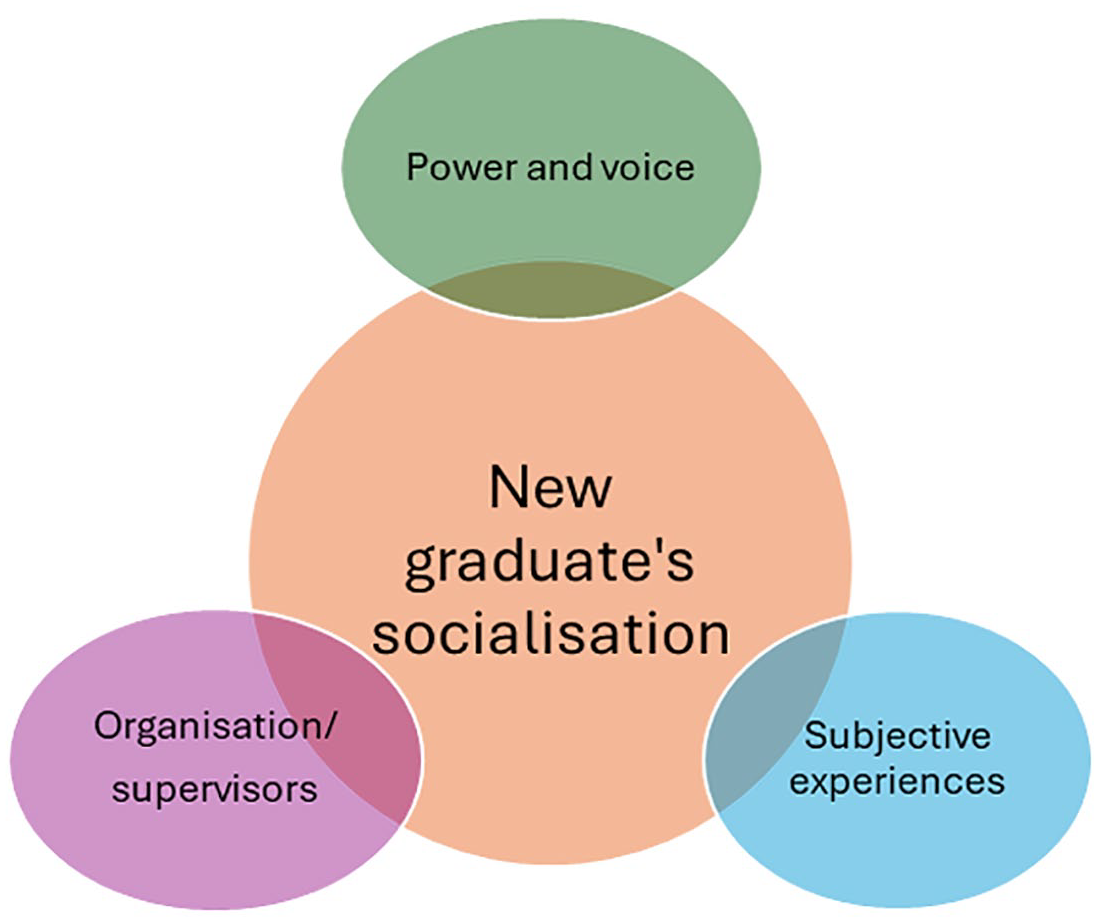
The process of developing professional identity and key elements.
Subjective experiences
The decision to become a social worker is often motivated by personal experiences, political views and the desire to ameliorate social injustice. To this end, one of the key learning outcomes of the social work degree is to reconcile one’s values and ethics with the professional role of social work. The subjective experiences and the internal process of emotional development and integrating values into the reality of practice are critical elements in the early stage of social work identity development. However, even though subjective experiences were central in social workers’ socialisation, both social workers and supervisors did not fully recognise how these elements could cultivate a sense of belonging, resulting in no indication that new graduates ‘belonged’ to the profession. This is not surprising given the dominant discourses of becoming a social worker have centred around the ‘hard elements’ and technical knowledge, with little attention to personhood, self and emotional responses in social work education and practice (Kwan and Reupert, 2019: 257). The findings of this study demonstrated the importance of a dialogical supervisory space, which is open, reflective and collaborative dialogue, for critical self-reflection to ensure that personal and professional selves are nurtured within the socialisation process (Morley and Crawford, 2022).
Power and voice
Many early career social workers struggled with identifying their unique identity and becoming competent and autonomous social workers while navigating systemic pressures. In this process, they might negotiate power and positionality to balance their jobs’ requirements with the mission of social work. In fact, social workers and supervisors identified the importance of supervision, observing colleagues and organisational processes and culture in obtaining knowledge and insights but rarely referred to the lived experiences and voices of service users as a source of knowledge. Indeed, supervisors described early career social workers as ‘people pleasers’, who desire to gain approval from colleagues and supervisors, which can indicate how they negotiate power and professional status. This finding raises the question of how social workers are committed to the central element of critical social work, ‘working alongside service users’ and considering them as experts by experience. While social workers should acknowledge their professional power in an anti-oppressive way to benefit service users and marginalised communities (Morley et al., 2019), our findings provided limited evidence of negotiating power between social workers and employers to include the voices of service users. Even though caution should be exercised given the small sample size of this study, the evidence suggests a possibility of constructing service users as ‘passive, dependent, lacking in knowledge or experience’ (Skoura-Kirk, 2022: 704). This can be further explored in future research.
In addition, consistent with Duddington et al.’s (2023) and Matscheck and Piuva’s (2022) studies, service users’ lived experiences are often marginalised in managerial and neoliberal service delivery. So perhaps it is not surprising the neoliberal narrative has impacted social workers’ professional development and capacity for service users’ involvement. This is despite the importance of ‘a process of solidarity’ that Hill and Laredo (2020: 970) highlighted as an important element for social workers to disrupt the neoliberal framework and cultivate a more dynamic practice within a community-based and relational approach. Findings echo studies conducted by Kam (2019) and Duncanson et al. (2023) who called for social work education and practice to further incorporate service users’ lived experiences and voices as core elements of nurturing professional identity.
Organisation/supervisors
The current workload regime in contemporary social work organisations with high levels of stress, increased caseloads, fewer resources and the strict structure of service delivery, particularly within interdisciplinary contexts, points to multiple challenges for the profession (Morley et al., 2019). The tension between ‘compliant’ social workers (Pease et al., 2016) and critical social workers, who challenge power dynamics, may also contribute to the limited confidence of new graduates, as modelled by supervisors. Harrison and Healy (2016) note:
In recent decades, the work environment in Australia has been marked by occupational instability, decreased job security, and an increase in temporary and contract-based work. In such an uncertain work environment, the quest to enhance employability may assume more importance than professional identity per se. (Harrison and Healy, 2016: 83)
It was evident that supervisors’ roles were central for new graduates to take up advocacy and social change, but a lack of supervision, whether due to time constraints or an overemphasis on line management, often comes at the expense of effective supervision. Furthermore, it appears that supervisors embrace the current context of practice as a reality of service provision, considering new graduates as idealistic. Indeed, some supervisors endorsed a pathway to manage new graduates’ expectations to align with the current system of service delivery. This is despite the mission of social work as a profession to enhance human rights and social justice, which are often the motivating aims of those entering social work (Robinson and Afrouz, 2023).
Limitations
This study provided valuable insights into new graduates’ professional identity and socialisation; however, it is important to recognise a few limitations. The study was conducted in Victoria, Australia and the sample size was relatively small (due to limited funding and timeframe of the project) which could limit the generalisability of the findings. Also, while the research flyer invited all new graduates and social work supervisors across Victoria to take part in this study, social workers and supervisors employed in health and community-based organisations chose to participate. A more diverse range of participants (i.e. ethnicity, gender, ability, sectors) could reflect a deeper understanding of the diversity of new graduates and supervisors’ experiences.
Conclusion and implications for practice
This study presents the unique viewpoints of early career social workers and supervisors on professional socialisation in Australia. The study found that the gradual process of professional identity involves initial uncertainty and self-doubt that evolve over time. Nevertheless, the external socio-political context and the pressure to conform to organisational demands and values were daunting tasks for new graduates.
Social work aims to promote social change globally, but without an awareness of how and the support of social workers to enact this in the early stage of their practice, this might seem unachievable. Importantly, supervisors’ role can be pivotal in guiding new graduates to become anti-oppressive and critical and resist the expectations and demands of the neoliberal system. Working in partnership with the community and service users as allies for social change is essential. Building capacity and longevity of social work to tackle deepening inequality and human rights abuses internationally is a collaborative effort and requires partnerships across industry and education.
Our study suggests that a significant shift is needed in organisational discourses and priorities to make professional socialisation a liberating process to help social workers become confident, client-centred and anti-oppressive professionals. As highlighted by Fitzgerald (2020), this shift can happen in collaboration by building communities of practice of social workers, with professional associations, higher education and organisations to disrupt the powerful neoliberal agenda. Indeed, many supervisors identified an urgent need for further government support for new graduate programmes to build sustainable and resilient social workers, and the community of practice can be a part of these programmes.
Footnotes
Acknowledgements
The authors wish to acknowledge the contributions of Dr Sevi Vassos, for her early work in conceptualising this article, and Christie Welsh who worked as the Research Assistant collecting data.
Declaration of conflicting interests
The author(s) declared no potential conflicts of interest with respect to the research, authorship, and/or publication of this article.
Funding
The author(s) disclosed receipt of the following financial support for the research, authorship, and/or publication of this article: This project has been funded by an ANZSWWER Scholarship of Learning & Teaching grant.
Ethical approval
This project has received Deakin University ethics approval (reference number: HEAG-H 204_2022).
