




Abstract
This exploratory study examines the impact of fly-in fly-out (FIFO) and the difficulties facing male workers. The results are based on data gathered through a semi-structured interview guide from 22 men working in the FIFO mining sector. The participants’ comments show that certain factors stemming from family and couple dynamics influence workers’ perception of their work/family balance. This study shows that FIFO workers are confronted with realities that, when they ask for help, require the worker to have specific knowledge of this lifestyle.
Introduction
Fly-in fly-out (FIFO), known as aerial commuting, remains a common reality in many oil, gas, mining and construction projects (Albrecht and Anglim, 2017). FIFO was introduced in Canada in the 1960s, during the post-war period, particularly within the oil industry (Ostigny et al., 2019). The need for labour under the purview of oil companies and the remote location of the oil wells where drilling took place justified during this period the birth of FIFO (Markey et al., 2011). The use of this system accelerated in mid-1970s to provide labour in remote areas, which was also beneficial to mining companies considering the lower cost associated with FIFO compared to building, managing or even closing a town (Markey et al., 2011).
In Quebec (Canada), more than 5000 employees work in FIFO jobs (Simard et al., 2019). Therefore, the typical scenario of a FIFO worker is to be flown or driven to a remote location to work for a predetermined period based on a rotating day or night schedule with a 12-hour shift per day (Albrecht and Anglim, 2017). The schedule is predominantly 14 or 21 days of work and 14 or 7 days of rest, including transportation time (Beauchemin, 2020). Most FIFO workers are young or middle-aged males, representing a group particularly vulnerable to mental health issues and a higher risk of death by suicide (Brouillette et al., 2022; Gardner et al., 2018). Some scientific literature on this topic finds that young men represent a subgroup where help-seeking is reported at its lowest level due to a lack of awareness of wellness-supportive mental health services and high expectations of masculinity (Rice et al., 2018; Tang et al., 2014).
FIFO jobs and family dynamics
The FIFO lifestyle can generate a dichotomy between the professional and the family sphere (Gardner et al., 2018). In fact, for many men who pursue this type of employment, work and family become two distinct worlds in which the lifestyle, responsibilities and roles differ significantly, requiring a constant ability to adjust (Asare et al., 2021; Gardner et al., 2018; Ostigny et al., 2019; Parker et al., 2018).
For single men whose lifestyle is similar to that of FIFO, circumstances with respect to the sphere of work (e.g. rotating shifts) sometimes make it difficult to enter into a long-lasting romantic relationship (Brouillette et al., 2022). Incidentally, this would not be unrelated to the fact that these workers would be more likely to face situations of divorce and infidelity (Baril and Lévesque, 2020; Torkington et al., 2011). In this sense, the circumstances around FIFO work would create tensions in workers’ relationships, which would lead them to feel a disconnection of sorts between themselves and their family members (Barclay et al., 2013; Gardner et al., 2018; Pini et al., 2012). In this regard, the partners of these workers indicate more communication problems than the partners of workers in the general population (Gardner et al., 2018; Kaczmarek and Sibbel, 2008).
Incidentally, this context obliges certain partners to ask for more help from sources outside of the family when a partner who has a FIFO job is absent (Mette et al., 2019). This also creates additional stress and sometimes a feeling of solitude among partners, exposing them to situations of vulnerability, which could have a negative impact on their physical and mental health (Brouillette et al., 2022; Cooke et al., 2019; Mayes, 2020; Wilson et al., 2020). In this regard, a study by Asare et al. (2022) shows that partners of men with a FIFO job have a psychological distress rate that is higher than that of the general population. Several qualitative studies conducted in the United States, Japan, the Netherlands and the United Kingdom confirm the assertion that women experience additional stress due to the absence of their partner for extended periods (Bassani, 2007; Nicholas and McDowall, 2012; van der Klis and Karsten, 2009). In addition, the level of stress of pregnant women with a partner who has a FIFO job is higher than that of women whose partner does not have a FIFO job (Cooke et al., 2019; Talge et al., 2007).
In addition to the psychosocial elements highlighted above, several partners also express a certain degree of frustration in response to the lack of involvement of men with a FIFO job with respect to domestic tasks when they are home (Gardner et al., 2018; Rebar et al., 2018; Taylor and Simmonds, 2009). They also add that they sometimes experience resentment due to the fact that their partner is not always fully aware of the sacrifices made to maintain a certain degree of family balance (Gardner et al., 2018).
Several issues related to the role of parents in the FIFO context characterize family dynamics. A case study conducted in Canada states that FIFO families face several challenges that involve not just the transition of roles, responsibilities and others, but also with respect to parenting (Gardner et al., 2018; Whalen and Schmidt, 2016). FIFO workers mention feeling uncomfortable with sometimes having to be absent for important family events (e.g. their child’s birthday) or also with not always being able to be there with their child and maintaining a good relationship (Baril and Lévesque, 2020; Dittman and Rathbone, 2022; Taylor and Simmonds, 2009). Consequently, many children experience negative emotions with respect to the FIFO parent’s absence, including missing them, and some exhibit behavioural issues, particularly boys, when the parent is absent for an extended period (Brouillette et al., 2022; Meredith et al., 2014; Ostigny et al., 2019). Other children might even experience bullying at school and feel additional pressure to do well in school, which could be due to the absence of a FIFO parent, among others (Meredith et al., 2014; Ostigny et al., 2019).
Some partners verbalize that the absence of a FIFO parent allows children to become more responsible and independent (Ostigny et al., 2019). Although the absence of a parent is experienced with difficulty by various children, other children still find that extended time at home with a FIFO parent proves beneficial (Meredith et al., 2014). Indeed, various workers also believe that the FIFO work schedule creates difficulties for the men (Brouillette et al., 2022; Ostigny et al., 2019). Parenting thus represents a challenge at different levels for FIFO families, particularly for partners at home who must balance transitions in their routine in addition to parenting full time when the FIFO parent is absent (Beauchemin, 2020; Dittman et al., 2016; Gardner et al., 2018; Lester et al., 2016; Mayes, 2020; Meredith et al., 2014). According to various partners whose primary role is that of being the authoritarian parental figure with respect to the child, family adaptation has been shown to be essential, particularly regarding discipline, as the parent with a FIFO job does not really take on this role (in other words, he does not participate in disciplining the child/children) (Ostigny et al., 2019). In this context, FIFO workers can experience feelings of being excluded, as they have the impression of playing a less important role within the family due to their extended absence (Dittman and Rathbone, 2022; Torkington et al., 2011). Some men thus confide that they sometimes feel like a stranger when they return home, in addition to also having to adapt to the family routine, which is different from that of FIFO work (Torkington et al., 2011). This gap represents a potential source of conflict, although other families state the opposite and maintain that they enjoy satisfactory day-to-day family dynamics in which it is easy to adapt to the change of roles (Taylor and Simmonds, 2009).
The scientific literature shows that men with a FIFO job can experience imbalances within their family dynamics, which can negatively affect their well-being. In this context, this study is intended to be original, because it is carried out in a northern and French-speaking region of Quebec, different from that of Australia where there are some studies already started on the subject. In addition, this study is particularly interested in the family dynamics of men who do FIFO, a theme that has not been previously examined in Quebec. This study aims to describe the protective factors and obstacles experienced by men with FIFO work in achieving a balanced family dynamic.
Conceptual framework
This study is inspired by von Bertalanffy’s general systems theory (GST). This theory offers substantial insight into, among others, human behaviour when interacting with their environment (von Bertalanffy, 1986) – in our case, the family reality of men in the context of FIFO.
A system is a set of entities constituted of interconnected elements (Frye and Hemmer, 2012; Roig, 1970; Tramonti et al., 2019; Turner and Baker, 2019). GST shed a light on environmental interactions and interconnections by affirming that systems are interdependent, in an exchange with their environment (Bertalanffy, 1968) and are defined by their interactions (Roig, 1970). They require inputs and outputs to organize themselves into existence. However, due to the complexity of their surroundings, open systems develop a ‘sensitivity to selected fragments of environmental complexity along with the simultaneously growing insensitivity to the rest of this complexity’ (Roth, 2019: p. 282) which can be analysed through the GST framework (Hammond, 2010).
General system theory has influenced social intervention with families, mostly from 1950 to 1960 with the emergence of systemic approaches and practices (Bonin et al., 2014; Masten, 2018). A systemic practice model based on general system theory would define a family system as being responsive to what happens to one of its members – a component (Bonin et al., 2014). This approach allows a better understanding of the impact of the family system and subsystems on family members and their relationships (Bouabdallah and Hamaidia, 2016). The GST sheds light on several systems within which (FIFO men) evolve, which constitutes the participants’ immediate environment. However, here, the individual at the centre of the ecological system refers to the participants. The microsystem, that is, the primary networks, consists of the family, friends and acquaintances of the men participating in the study. The mesosystem refers to interactions between the microsystems, that is, between the primary networks. The exosystem consists of secondary networks, made up of all people united around the same function in an institutional setting. However, this study is more specifically interested in working men in a FIFO context in interaction with their environment, which can be summarized as the sphere of work–family balance. The systems theory will be used to understand this reality from the perspective of analysing the family environment within which FIFO men evolve. More specifically, it is a matter of studying the realities of the systems and their repercussions on each other, where FIFO men remain at the centre of the following systems: the conjugal/family relationship and the parent–child relationship.
Methodology
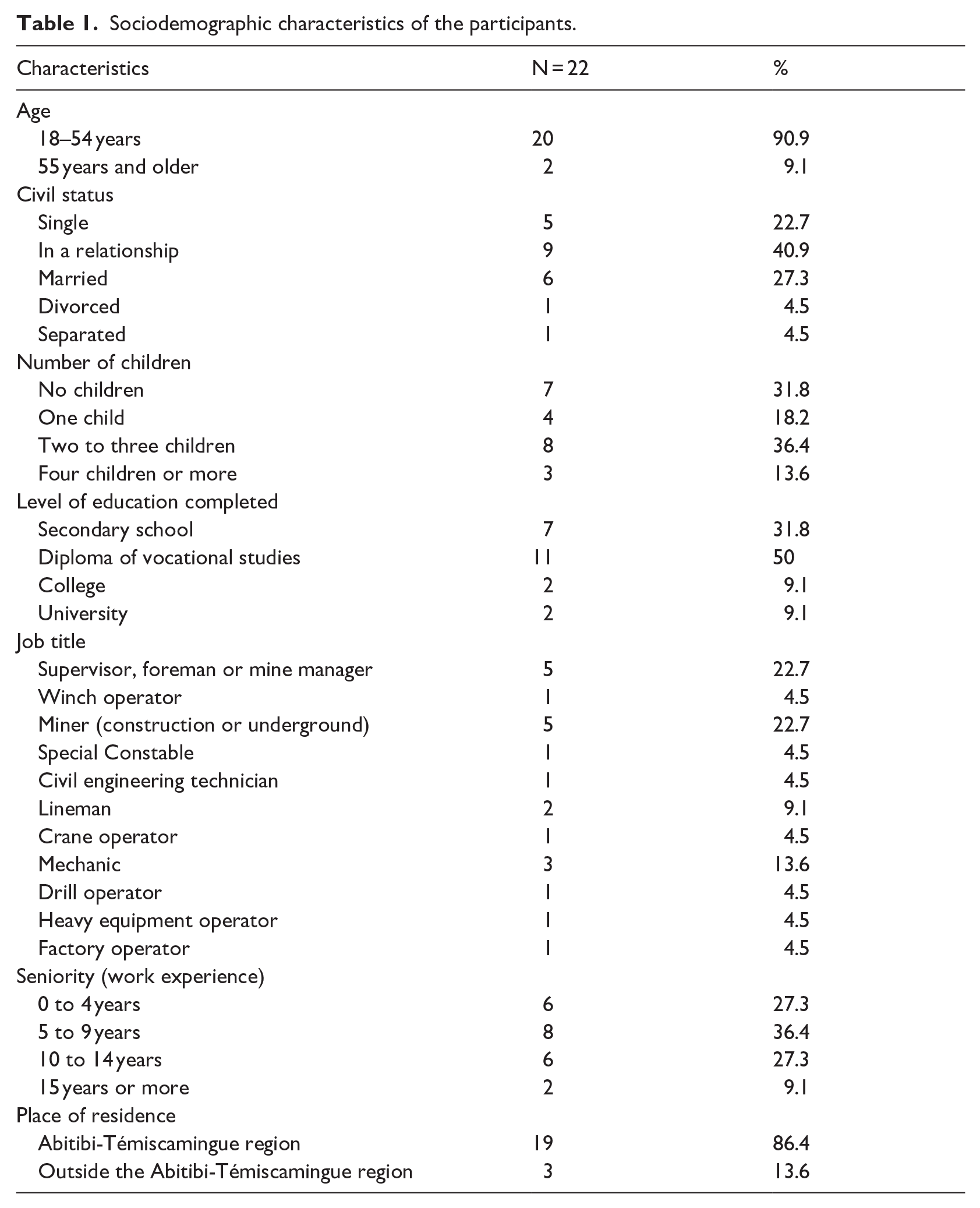
In this study, the qualitative approach coming from the phenomenological paradigm (Paillé and Mucchielli, 2021) was chosen since the phenomenon surrounding the reality of men who do FIFO remains very little known in the scientific literature and more particularly in Quebec and even in (Albrecht and Anglim, 2017; Baril and Lévesque, 2020; Gardner et al., 2018; Labra et al., 2022 Torkington et al., 2011). More specifically, this study draws on the complexity of the FIFO lifestyle, and the way workers perceive their work experience, which can lead to different visions considering the subjective nature of the phenomenon under study (Bourgeois, 2021). This article is also the product of a larger study dealing with the living conditions of FIFO men (Labra et al., 2021) (Table 1). However, this article only deals with men’s perception of their family life.
Sociodemographic characteristics of the participants.
Participant recruitment
Participants were recruited through letters, Facebook and snowball sampling. For the interviews, we planned for over-the-phone meetings with the men interested in participating in the study, and these participants were asked to read and sign the written consent form. The objective of the over-the-phone meeting was to present the project to the participants, and answer their questions about the study.
The semi-structured interview guide was inspired by the study by Torkington et al. (2011) as well as other scientific studies from the literature review. The main questions that guided the ‘family dynamics’ interview of men who do FIFO are: (1) What are the impacts of FIFO on your life (personal, family etc.)? (2) How does FIFO affect your relationships (friends and romantic relationships)? (3) Does FIFO influence the well-being of anyone in your family? Inclusion criteria were as follows: (1) be 18 years of age or older; (2) be hired directly by a FIFO company, regardless of job title; (3) be an active worker in a FIFO context; (4) be currently resident in Quebec (citizenship not required). Main exclusion criterion was (1) not working in a FIFO company.
Data analysis
For this study, we analysed thematic content. This is based on five stages: (1) becoming familiar with the data collection, (2) generating initial codes or transforming raw data into central codes, (3) researching topics or categorizing elements that have already been coded, (4) revising topics by connecting them to identified categories, and (5) defining and designating study topics making it possible to integrate an analysis framework (Labra et al., 2020; Paillé and Mucchielli, 2021). Following the interviews, verbatim coding of the data was done using NVivo15® software. Coding similar to the Tang et al. (2014) study was used to ensure participant confidentiality by changing their names to letters and numbers (e.g. H1-H2-H3-H4). This reflective step allowed the research assistant to step back and exercise analytical and critical thinking of both individual and collective perspectives by noting similarities and differences between participants (Deslauriers and Groulx, 2014).
In addition, NVivo15 software was used to process the data. Through this dynamic process, the research assistant was able to capture the meaning of the testimonies, particularly in feedback with the conceptual framework of the study (Fereday and Muir-Cochrane, 2006). This rigorous and recognized thematic analysis in qualitative research significantly helped the research assistant to identify various deductive and inductive data that enabled the completion of this study (Fereday and Muir-Cochrane, 2006).
The transcriptions of interviews, written consent forms as well as note-taking guides were stored on servers. The consent form was given to men (electronic version) prior to the interview who had contacted the research assistant. For men who were unable to send signed consent via email, they were asked for verbal consent prior to the interview. Thus, the consent form was read aloud at the beginning of the recording (on the Zoom platform). All verbal consents will be accessible for at least 7 years in a locked filing cabinet in the office of the study project director. No financial compensation was offered during this study. Participation was free and voluntary.
Ethical considerations
A request for an ethical evaluation was submitted to the research ethics committee. This ethics certification was granted by the committee on 12 February 2021 (Labra et al., 2022).
Sociodemographic characteristics of participants
The participant population consisted of 22 men. They were between the ages of 18 and 54 (n = 20 out of 22), either in a relationship or married (n = 15 out of 22/100%) with at least one dependent child (n = 15 out of 22). The respondents’ education level was mostly at the professional level (n = 11). A majority of the men had an on-site job (n = 17), whereas a minority (n = 5) had management jobs. Sixteen respondents had more than 15 years of experience. Finally, most of the men (n = 19/86.3%) lived in the (Labra et al., 2022).
The participants have a very variable rotating schedule, for example, 7/7, 14/14, 21/7. Mostly on 12-hour shifts, sometimes day, other times night. Some men may work continuous day/night rotations and other men may only work day shifts depending on their job title. The male participants work mainly underground (n = 16), but also in the open air (n = 6). They are exposed in their work to total darkness with headlamps (underground), significant dust despite the installation of a ventilation system in some places (this does not go underground), heat (underground) or extreme cold (on the surface), regular diesel fuel boilers (underground) through the use of large machinery, limited access to water and toilets due to the distance – sometimes a few kilometres – from the workplace to these basic services and so on.
Results
The impact of FIFO on the family life of FIFO workers in the mining sector is presented according to the sphere of work–family balance.
Difficulties the men are facing
Several men report having difficulties with respect to working in the FIFO context, although others indicate their satisfaction when the family routine is well established.
I think that what’s hardest about working in the north is really, you know, managing family and work. When you’re home, it’s about trying to benefit as much as possible. Then when you’re at work, well, it’s really about focusing on work, and hoping that everything is going well at home. But still, I think that companies have gotten a lot better, if I think back to my parents’ time. When they headed out on a run back then, the runs were a lot longer, and I think that companies didn’t have much in place to help. I still think there has been a big improvement. (H7) On the family end, it’s going super, because we’ve established a great routine. We have two weeks of quality time when I’m home. (H20)
In the FIFO context, workers live two routines and two lives – work and family represent two completely different lifestyles.
The routine is completely different. It really feels like you have two lives. You have one life there, and one life here. Really, it’s like there’s a distinct line separating the two. It’s unbelievable. It’s a totally different life rhythm. And you can’t adapt in just two weeks. It actually takes several months. (H7) [FIFO] is your second home. (H9)
Furthermore, some participants point out that their workday in the mine is such that their responsibilities around the home accumulate while they’re away:
So often, when you return, well you have two weeks to catch up on all the stuff that you missed. So there are appointments, you have to change the tires, do this, do that. See the doctor, the dentist. It’s been two weeks since the kids have done whatever. And suddenly you’re back in a routine, you get back to business, you’re home for four, five, six days and you get back on top of stuff. You have stuff to do outside. The house. Winter, spring. And before you know it, geez, there’s just a few days left and you go back. You don’t know where the two weeks went. You didn’t really have the time to settle, you know. (H6)
Despite the repercussions at home, FIFO also has an impact on workers during their shifts. Two men indicate that at work, they are methodical and serious, which differs from at home, where they are more relaxed. Here is how they express this:
Well at work, I’m really the opposite. I’m really a lot more serious than I usually am. Yeah, it’s really a noticeable difference! When it’s time to work and when it’s time to be at home, well, I’m really way more relaxed. For sure when you’re gone for a long period, and you’re just with people to work, well there’s not lots of affection, or you know, we’re all here to work, so you’d say we’re more like machines. (H16)
In this context of balancing work and family, we can identify factors as protective for a good family dynamics and other factors that are obstacles to family relationships.
Factors that hinder family dynamics
This section presents the seven obstacles for functional family dynamics identified among participants. This first obstacle is the length of their roster. This is an element that preoccupies some men, who see it as a trigger for potential relationship issues.
When I started working, when I left school, I worked with old guys who were close to being retired and who had done James Bay on those runs. Then they’d come back, and then they’d fight with their wife. The guys left for five years to work. They came back. Their wife had gotten the hell out of there, with the household and everything. Yeah, well it’s understandable. There’s not a spouse. Me, personally, my wife, she’ll leave or she’ll go crazy, you know! Raising kids all by yourself for 54 days. That’s two whole months! And then you’re back for 10 days. It was 54-10. So when they offered me that, I said, ‘I’m not going there!’ They said, ‘It’ll be worth it!’ I said, ‘There’s nothing that makes that worth it! You’re out of your mind!’ (H8)
Participants also feel some difficulties switching routines, getting the sense that when they get home and impose rules, it seems to bother the family. This would be the second obstacle.
I was seen as the guy who came home and yelled. It was hard because they had a set routine, and when I got home, after spending time away [at the mine], well, I changed the routine, so it was hard for them [the family]. (H11)
According to the men’s statements, they worry about their lack of regular contact with their kids. In this regard, one participant said that his return home sometimes disrupts the parent–child relationships, particularly when it comes to school:
Having a routine at home is drummed into us. The kids, and also my spouse, my girlfriend. They have their routine when I’m there, and they have their routine when I’m not there. But when I’m there, I disrupt their daily routine, especially with school. The first two or three years, they were for sure the hardest. (H1)
For some men, the physical distance – for extended periods – brought about through FIFO can negatively impact a couple in contexts where the man leaves on a rotation in the middle of a marital fight or dispute. This would be a significant issue because the resolution of the problem has to wait until the man returns home after being away for several weeks.
For sure when you have a fight with our spouse, it’s harder to resolve from far away (. . .) For sure when, as I told you, when we have an argument, it’s harder to resolve (. . .). We have to tone things down, learn to manage our emotions. (H20) When the wife cries over the phone, ‘I miss you, I miss you’, well, you can’t focus on work. (H19)
Despite the satisfaction some men pointed out with respect to their current romantic relationship, FIFO exposes some men to infidelity in their relationship. This is another obstacle identified by participants. Men stated having witnessed or experienced this situation, even several times. The following excerpts from two respondents nicely express this reality:
Some guys have a tough time with their girlfriend and they’re maybe not married, but it doesn’t go well anyways because they find the long distance thing hard, you know. There has been a lot of infidelity [that I witnessed]. (H10) I don’t want to generalize, but sometimes, me, I work, and it’s easy to disconnect from someone when that person isn’t there for six months of the year, eh. So . . . basically, I was cheated on (. . .) and when you leave when you’re fighting . . . Basically, when you’re on leave, and there’s a little fight, then when you leave to go work, well, the fight pretty much lasts 14 days (. . .) When I learned that my ex was cheating on me, all I wanted to do was smash the walls down. I was so pissed off. But I was here. It’s pretty hard [on your morale]. That’s it. (H14)
In conjunction with the preceding statement, FIFO work also exposes men to break-up situations. Two of the interviewed participants state having witnessed or even experienced a marital separation, more than once.
I went through two separations at two different jobs that I was doing fly-in fly-out because I said to myself that my priorities, my life, those were more . . . my decisions, I was the one who made them, and then I [experienced] the consequences of that. I was living with a girlfriend before, and it was the same, and she was jealous and all that. Then, you know, I came to work and it was the same as if I was seeing someone. You know, it’s hard, really hard on someone who does runs, you gotta believe it. It’s not the life for all couples. (H13)
One final obstacle is missed family events. For most participants, not being present for important family activities (Christmas, New Year’s, birthdays) seems difficult.
Me, I’d say the impact is that I often miss celebrations, birthdays, sometimes Christmas, New Year’s, you know. You still get time off, and I tell myself that it’s a sacrifice we make, working hard so we can have our two weeks. But I find that it’s . . . You put your life on hold for two weeks when you get here [at work]. (H13) Psychologically I had a tough time once, when it was the Christmas holidays, you know, the first Christmases, and those things. Me, I worked over Christmas, like always. And I had a young family (. . .) And then for Christmas dinner, when you’re all alone. And even if you call home, in the evening. . . Let’s say it’s Christmas or New Year’s Day, and you’re not there. So I ended up finding that it was a bit difficult (. . .) It’s a family sacrifice. (H8)
Protective factors for good family dynamics
Based on statements made by the men who participated in the study, it was possible to identify five protective factors for functional family dynamics in a context where men leave their homes to work highly variable rotating shifts, such as 7/7, 14/14, and 21/7. Most of the time they are on 12-hour shifts, sometimes day shifts, sometimes night shifts.
An initial protective factor that emerges based on participants’ statements tells us about a couple’s relationship that is stable over time. For these men, this quality in the relationship is an element that keeps the family united throughout in face of adversity or during the man’s absence from home.
We’ve been in love for a long time, it’s going really well. I’ve been with my wife for six years, then we got married, had a little girl, all that. That helped us get through my extended time away from home. (H20) It’s going well at home. Nothing to say about my romantic relationship. You know, I’ve been leaving on runs for 8 years, but still, we’ve been together for 15 years. So you know, after 15 years, we end up knowing each other. (H1)
The first protective factor leads to the second. These reports about stable relationships between couples are based on trust and communication between two people. For the men who were interviewed, these aspects are important for life as a couple in the FIFO context.
We have to trust our partner. That’s it. Of course I think that for many couples, fly-in fly-out is supposed to be hard on couples. But it requires communication. (H7)
Another element that, according to the participants’ statements, helps them stay side by side and united as a family is the fact that they have built a solid parent–child relationship. This reality was very common among most of the men interviewed.
The impacts aren’t that significant. The impacts, you know, I started, but I’ve already been doing fly-in fly-out for eight years. For sure at the start, it was hard to adjust, especially with the kids at home. What helps me a lot as a dad is having a solid connection with my kids. But I have to tell you that for several years now, the routine at home is going really well. I have nothing more to say. (H1)
Playing the role of an involved father is identified as a protective factor for participants. FIFO men interviewed mentioned that for them, it is important to collaborate in taking care of their children, especially while they are home. This gives them satisfaction on a personal and a family level.
When I wasn’t at home, I wasn’t at home. When I was at home, I was 100% present, so, you know, I helped with homework, cooked, did dishes, took the kids to school. I feel that this contributes to things being positive at home, and it’s a win-win situation. (H20)
Enjoying quality time with their kids is another protective factor in the family life of FIFO men.
I find that when I’m at home, I have lots of time to see the kids, especially to play with them. We have lots of time to travel or, you know, to go camping. Me, I take my holidays then, so I’m off almost all summer. So I find that I get closer to my kids this way. (H4)
Finally, some of the men indicated that most of the spouses of a FIFO worker have a resilient attitude which helps them regularly cope at home both in terms of outside and inside responsibilities.
It takes pretty exceptional women to do that, to be married to guys who do that, who can manage the whole household. (H16) I have an amazing girlfriend who doesn’t need me for everything, you know. She’s very independent. She can do everything without me. You know, she uses the leaf blower, there’s nothing that stops her, then . . . You know, she’s good, she’s really good at all that. Plus she also likes my schedule. She’s OK with that, you know, when I leave, she’s like, ‘Well, yeah, you know, go off and work your shift’. You know, yeah, she says, ‘I’ll miss you’, but at the same time, she’s pretty happy to be at home all by herself, and have her little routine all to herself, you know. (H21)
Discussion
The results show that participants perceive some factors as stepping stones to positive family dynamics, and others as barriers that lead to negative dynamics, which are detrimental to their well-being.
Communication as protective for a good family dynamic
This study confirms that stable relationships in the couple’s microsystem are beneficial to men who do FIFO work and to their families. This translates as long-lasting marital satisfaction over time (5–15 years of living together). Incidentally, this finding was highlighted in previous studies (Beauchemin, 2020; Ostigny et al., 2019). Also with respect to the couple’s microsystem, this study confirms that a relationship of trust and communication continue to be key elements in maintaining long-lasting marital satisfaction.
As for the familial system, several FIFO men mentioned having harmonious and fluid communication with their children as being a positive element; this communication is transformed into a protective factor for the familial system. This would be the case for men who have been doing FIFO work for years. This finding was not evident in the scientific literature.
Paternal involvement as protective for a good family dynamic
In addition, our results allow us to confirm that men who are involved as fathers (active) within the familial system state that their family relationship with their children is satisfying and they feel less like ‘visitors’ in their home. This allows us to maintain that this type of father experiences feelings of worth in his role as a father, which contributes to the construction of his identity as a father (Hofferth, 2003). We can affirm that the more the father is involved within the familial system, the greater his feelings of closeness with them and the microsystem of the couple, which would give rise to feelings of worth and belonging to his family unit.
It was interesting to note that some FIFO men in the study see their work schedule as the opportunity to spend quality time with their children, something they greatly appreciate. Studies must be conducted on the ways in which involved fathers can have a positive impact on the microsystem of the family of FIFO men, which represents an as-yet little-studied aspect.
A final protective factor in the family dynamics of FIFO men arises through the couple’s microsystem. This is associated with a capacity for resilience evidenced among the women (spouses), to support their partner and keep the family microsystem united. This resilience is indicated by a few men, who see their spouses as a real pillar of support within their family microsystem.
Absence as a barrier to family dynamics
The length of the work day and a change in routine are factors that result in some participants feeling as though they are strangers within their own homes because they live two distinctly different lifestyles (work and family) (Asare et al., 2021; Parker et al., 2018): A lifestyle based on work routines in which family roles are virtually non-existent (between 14 and 21 days), and a lifestyle in which family commitment is in the foreground, but weakened due to prolonged absence (between 7 and 14 days).
As a result, participants feel excluded (Dittman and Rathbone, 2022). This study reflects feelings of neglect among certain men when they leave their homes for their respective runs. Leaving the familial microsystem is sometimes a heartbreaking moment for them. According to the testimonies of some men, several children react to their extended absence by missing them, crying or even exhibiting behavioural issues while the FIFO parent is away. In this context, spouses are also affected by the situation (Meredith et al., 2014; Ostigny et al., 2019), which was confirmed in statements made by participants. The absence of a FIFO parent can be a difficult experience for the familial microsystem, whereas other members of this microsystem develop the ability to adapt, becoming responsible and independent much more quickly.
Incidentally, the requirement of FIFO professions, such as being temporarily absent from the family microsystem, chronic fatigue, the part-time involvement of the FIFO parent, produces tension or conflict within the couple’s microsystem, which makes the family microsystem fragile. This observation corroborates with the results of other studies that mention more communication problems in FIFO families compared to military families or the general population (Gardner et al., 2018; Kaczmarek and Sibbel, 2008). Even if FIFO men and partners have many qualities indispensable to maintaining a satisfying relationship in the microsystem of the couple, the fact remains that some men who do FIFO work suffer infidelity, and that thereby, the couple’s sexual life is severely tested (Torkington et al., 2011). This reality could be a serious reason behind suicide attempts, which could be caused by extended absences in the FIFO context (Institut national de santé publique du Québec[INSPQ], 2018; Léveillée, 2015).
Finally, FIFO men must deal with missing events pertaining to the family microsystem (New Year, anniversaries, the birth of children, etc.). This finding corresponds to observations made in previous research in which some men pointed out feelings of discomfort by not always being able to be present for important events within the familial microsystem (Dittman and Rathbone, 2022; Taylor and Simmonds, 2009; Torkington et al., 2011). For the men interviewed, this constitutes one of the most difficult aspects of FIFO work that could have repercussions on the stability and feelings of family belonging among study participants.
With regard to the participants’ individual ecological system, single life also represents another reality to be considered in the FIFO context. The study by Torkington et al. (2011) points out that for single men, it is difficult to meet women, to build long-lasting romantic relationships, which corroborates with the results of our study where not being present remains a significant obstacle to building a stable couple’s microsystem. This is definitely the case for five of the men interviewed. In short, von Bertalanffy’s (1986) theory of systems allows us to note that FIFO men navigate across several spheres of life: the exosystem (work), the microsystem of the couple and the familial microsystem (parent–child relationship).
Avenues of intervention for social work
Several avenues for social work intervention with FIFO men and their families can be explored: (1) setting up support services at home during the absence of a FIFO parent, such as offering domestic help in daily tasks (cleaning, meal preparation or other) to avoid family exhaustion and additional complications during the absence of a FIFO parent; (2) making future workers and their families aware of the realities experienced in FIFO; which would involve informing new employees and their families about FIFO realities, including offering the possibility of a concrete visit to the site to minimize staff turnover; (3) offering families the opportunity to visit the FIFO workplace and harmonize this service across all FIFO companies, which would mean being able to include the families of workers in the FIFO environment and to create a network allowing FIFO to shine and improve attendance at work; (4) establishing a babysitting service for families in shared custody where a parent works in a FIFO context, which would help mitigate difficulties that men are facing and reduce staff turnover when a FIFO worker may experience family tensions regarding childcare; (5) offering help with budget management according to the needs of the FIFO men – the aim being to support families in better planning their expenses according to their income to avoid indebtedness or even bankruptcy; (6) improving Internet connection to help workers maintain regular contact with their families. These avenues of intervention require social workers to (1) use language that respects traditional masculinity (e.g. using action-oriented vocabulary); (2) start from the concrete, because ‘traditional men are centred on doing and acting’ (Tremblay, 1996: 26); (3) use specific questions and make suggestions through open-ended questions; (4) avoid confronting the values stemming from traditional masculinity, such as autonomy, independence and stoicism (Courtenay, 2011) through an awareness of the needs of men. Thus, social workers have a key role to play in the intervention in a FIFO context.
Finally, FIFO men and their families constitute a field of intervention in which the contribution of social work can be very promising for the development of a social protection policy since few social workers are trained to intervene in this type of masculinity whether in the workplace or the family environment.
Conclusion
The goal of this study is to provide clarification on the difficulties facing men who do FIFO work in the mining sector. The statements made by participants reveal both protective factor and constraints faced by the men and their microsystem (family, couple, familial). The positive and negative implications most often mentioned affect the entire family microsystem (couple and offspring). Dysfunctional interactions in one or several of the microsystems mentioned above, such as infidelity and relationship break-ups, can put the mental health of FIFO men at risk. This study contributes to showing the issues faced by men who do FIFO work and shows the complexity in the family dynamics to which they are exposed through the very nature of FIFO work: regular absences from home.
As the family dynamics of men who do FIFO work are little known and studied in social work, we offer social workers an approach with men and their families that is well framed and sensitive to the values of masculinity, which focuses more on the protective factor of the family dynamics of FIFO men. Moreover, intervening with the family dynamics of FIFO men would in particular mitigate the consequences on their overall health in a work environment characterized by (1) low responsiveness to seeking mental health help (Cooke et al., 2019; Lasevitz, 2017), (2) a gender identity based on a traditional model of masculinity (Laplonge and Albury, 2013) and (3) difficult working conditions in the mining sector (Albrecht and Anglim, 2017; Gardner et al., 2018). Thus, the intervention framework must take into consideration these three types of logic (Brouillette et al., 2022).
Limitations
This study presented several limitations, one of which was the time required for participation. In this sense, the length of the interviews was very variable, ranging from 15 minutes to over an hour, at the convenience of the participants. A second limitation in this study revolves around the anticipated unease connected with the stigma surrounding mental health in the mining world. Despite this anticipation, collaboration with the men was very active given the atmosphere of trust, and as a result, conversations with most of the participants during the recorded sessions were very open. A third limitation was due to the COVID-19 pandemic. Because of pandemic restrictions, none of the men was seen in person. One final limitation was the attempt to contact mining operations without relying on a predefined trajectory, which was offset by using snowball sampling. Recruitment via social media was particularly successful in allowing us to contact men in the mining environment.
Footnotes
Funding
The author(s) disclosed receipt of the following financial support for the research, authorship, and/or publication of this article: This research was funded by MITACS, and the Health and wellness table for men in the Abitibi-Témiscamingue region.
