



Abstract
In this Voices from Practice article, we present the process for adapting a 12-week mind-body group mental health intervention from development and implementation in Uganda for implementation with human trafficking survivors in the Philippines. We summarize key steps in the intervention adaptation process, outlining recommendations for other social work practitioners interested in culturally adapting community mental health interventions. This Voices from Practice piece provides guidance to social workers regarding an intentional and client-centered approach to adaptation of interventions across cultural contexts.
Introduction
Broad recognition exists for the need to consider culture and context in the implementation of community mental health interventions. Cultural adaptation involves identifying areas of misalliance between an intervention and its prospective participants and modifying the intervention to match participants’ cultural identity, including adaptations to goals, language, content, and methods. Cultural adaptation can lead to heightened intervention accessibility, satisfaction, retention, and efficacy (Oh and Lee, 2016). When adapting programs to different cultural contexts, it is essential to strike a balance between preserving the intervention’s core elements while also making necessary adjustments to ensure relevance and applicability in the new setting (Castro et al., 2010; Garabiles et al., 2019). In this Voices from Practice brief article, we outline the process utilized to modify a trauma-informed mind-body intervention originally developed in Uganda, Move with HaRT, for implementation with human trafficking survivors in the Philippines.
Move with HaRT is a 12-week group intervention originally developed by Healing and Resilience after Trauma (HaRT) for implementation with women and girls who experienced human trafficking in Kampala, Uganda. The intervention utilizes mindfulness practices, breathing exercises, yoga poses, and supportive group discussions to enhance the physical, psychological, and social well-being of participants (Namy et al., 2022). A mixed-methods evaluation of Move with HaRT in Uganda demonstrated reductions in participants’ symptoms of post-traumatic stress disorder (PTSD), depression, anxiety, and overall improvements in general well-being (Carlson et al., 2022).
Survivors of human trafficking experience elevated risk for anxiety, depression, PTSD, and self-harming behaviors (Evans et al., 2022; Rani and Manglam, 2016; Ravi et al., 2022). Limited research, however, exists regarding mental health interventions for human trafficking survivors specifically. In the Philippines, mental health services are limited, expensive, and largely inaccessible, particularly to marginalized communities; rates of formal help-seeking for mental health services remain low despite high rates of psychological distress (Martinez et al., 2020). This, combined with the limitations of utilizing conventional biomedical treatments, has resulted in a demand for accessible alternative mental health interventions for human trafficking survivors centered within the community. In response, the Eleison Foundation, a nonprofit organization in Cebu, Philippines, which supports survivors of human trafficking in their recovery, launched a partnership with HaRT to explore cultural adaptation of Move with HaRT for implementation with human trafficking survivors in the Philippines. In this Voices from Practice brief, we outline, first, the process utilized to culturally adapt this social work intervention; second, key changes made for culture and context; and, third, implications and future directions for cultural adaptation of other social work interventions.
Intervention adaptation process
HaRT and Eleison collaborated on a multistage process for the adaptation. This partnership between the program originator (HaRT) and the ultimate implementing organization with cultural and contextual expertise (Eleison) reflects good practice in mental health programming adaptation (Sharma et al., 2022). Shared values guided the collaboration between the two organizations, specifically trauma-informed care, survivor-centeredness, and holistic healing. The team followed a process largely consistent with the four-phase Ecological Validity Model (EVM) for cultural adaptation, including (1) expert consultation and stage setting, (2) initial content adaptation, (3) iterative content adaptation with community members, and (4) final adaptation with community feedback meetings (Sit et al., 2020). This process also broadly aligns with the IPV-ADAPT+ framework, a flexible yet systematic process for adapting intimate partner violence (IPV) prevention programming across cultural contexts. The IPV-ADAPT+ framework for cultural adaptation entails assessing the context, determining the adaptation approach, adapting the program, piloting and refining the adapted intervention, and eventual targeted implementation and evaluation (Sharma et al., 2022).
As a first step, Eleison staff and select community partners with cultural and population-specific expertise participated in an internal pilot of the Move with HaRT program to determine modifications needed for the cultural context. Systematic feedback was obtained via weekly open-ended questionnaires and two closing focus group discussions with staff who participated in the pilot. Second, Eleison staff reviewed all written feedback, identifying themes for intervention adaptation which were discussed in consultation with the HaRT team. Third, the Eleison team revised the Move with HaRT curriculum for review by the HaRT team. Following these preliminary adaptations from the staff-based pilot, programmatic adaptations were also discussed collaboratively with a technical advisory group comprised of social workers, mental health professionals, and mind-body intervention practitioners with relevant cultural expertise. Fourth, Eleison gathered client input by piloting content with members of Eleison’s client advisory board, the Survivor Leadership Council (SLC). SLC members provided further feedback regarding programmatic accessibility and cultural resonance. Finally, the adapted intervention was piloted with three cohorts of human trafficking survivors in a convergent mixed-methods pilot evaluation (Cordisco Tsai et al., forthcoming).
Key intervention adaptations
A variety of influences affecting a unique Filipino cultural identity were taken into account, including local Indigenous knowledge; the impact of Southeast Asian, Chinese, and Austronesian settlements; and the legacy of Spanish and American colonial occupation. In addition to cultural differences, two significant distinctions between the implementation contexts were considered. First, while the intervention was conducted within a shelter-based setting in Uganda, Eleison planned to implement the intervention in a community-based (non-residential) setting in the Philippines. Second, the Move with HaRT facilitation in Uganda was led by a yoga instructor, whereas the intervention would be implemented in the Philippines by direct service staff with a mental health background. Given these factors, several key change areas were identified (summarized in Table 1).
Adaptations from original Move with HaRT intervention to HaRT Cebu intervention (Italics highlight areas of change).
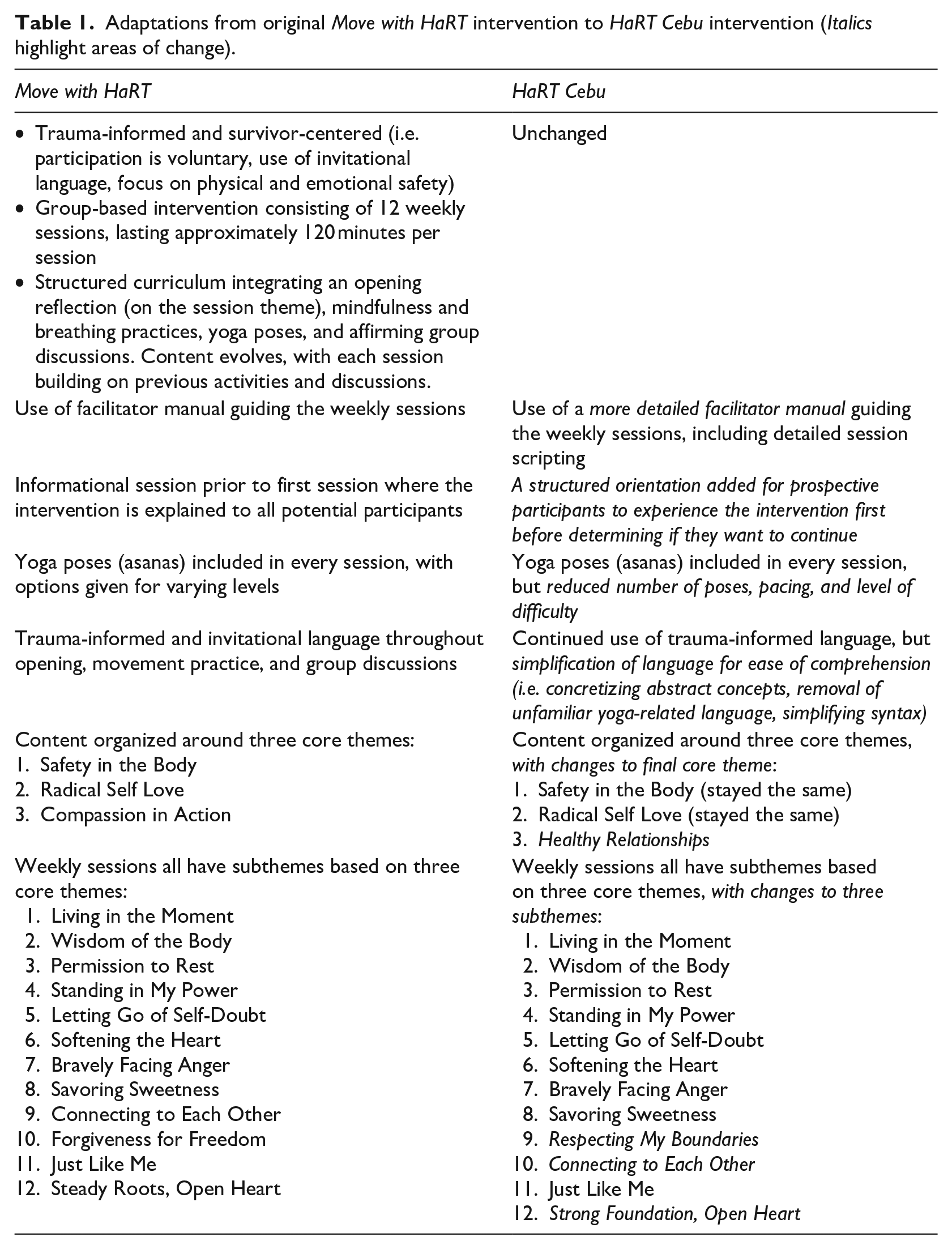
First, translating the program content to fit local dialects was integral in creating a mind-body intervention well suited to the cultural context of the Philippines. Mindfulness interventions and empirical research on mindfulness are limited in the Philippines (Centeno and Fernandez, 2020; Fernandez et al., 2022), making a careful adaptation even more critical. The adaptation process highlighted the potential inaccessibility of terms specific to mindfulness and yoga as well was the difficulty of directly translating yoga terminologies into the Cebuano language. Subsequently to ensure understandable and culturally congruent terms, some curriculum language was revised to concretize abstract ideas and account for untranslatable words (e.g. ‘feeling energy’ and ‘feeling grounded’). Prior research on adaptation of mental health interventions for Filipino populations has also highlighted the need to simplify language, concretize abstract ideas, shorten syntax, and utilize a combination of English words and Filipino languages (Garabiles et al., 2019). As a part of this process, the name of the intervention was changed for the Filipino context from Move with HaRT to HaRT to further simplify the terminology.
Second, adjustments were made to some of thematic content. The three guiding themes in the original Move with HaRT curriculum are safety in the body, radical self-love, and compassion in action. Within the ‘compassion in action’ theme, Move with HaRT includes a session called ‘forgiveness for freedom’ which invites participants to explore the idea of forgiveness as a deliberate decision to release inner feelings of hatred, resentment, or vengeance. While this session has been positively received by participants in Uganda, the adaptation process raised concerns about the interpretation of this theme by Filipino participants. In the Philippines, individuals’ needs are often deeply intertwined with those of their family and community (Carlson et al., 2023; Asis et al., 2004; Quisumbing and McNiven, 2010). The indigenous principle of kapwa emphasizes an interconnection between the self and others, highlighting the necessity of reciprocity and solidarity within interpersonal relationships (Enriquez, 1994). A related cultural concept, utang na loob, which is translated to ‘debt of one’s inner self’, highlights a deep bond of gratitude and self-sacrifice owed to those in familial or emotionally connected relationships (Pe-Pua and Protacio-Marcelino, 2000). Given the intertwining of cultural perceptions of familial duty and self-sacrifice in the Filipino context, content pertaining to forgiveness could unintentionally reinforce the idea that forgiveness is necessary, even at the expense of one’s own physical and mental health, particularly for human trafficking survivors who often experience violence from family members. As such, for implementation in the Philippines, the third theme was changed to ‘Healthy Relationships’ and the session on forgiveness was replaced with a new session titled ‘Respecting my Boundaries’, highlighting the importance of also caring for one’s own emotional needs in relationships. These adaptations were founded on a commitment to place client mental, emotional, and physical safety first, recognizing that the concept of forgiveness may complicate or hinder the healing process in the Filipino context.
Third, several adaptations were made to account for the new intervention context and implementing organizational partner (Sharma et al., 2022). Specifically, given that the facilitator did not have prior experience guiding a movement-based practice, concerns were identified regarding some of the physical aspects, such as the number and pace of yoga poses and other movements. As a result, adaptation involved streamlining the intervention pacing and flow by reducing and simplifying some of the yoga poses, a change that was ultimately beneficial for both the facilitator and participants. An enhanced facilitator training and mentorship component was also added, to ensure the facilitator had ample time to learn and practice prior to running sessions with clients.
Finally, the Eleison team integrated adaptations to make the intervention more resonant with cultural norms and standard practices within the organization. For instance, to further ensure trauma-informed care, a formal pre-orientation session was added to support the informed consent process, particularly given cultural unfamiliarity of body-based, mindfulness interventions. In the Filipino context, yoga has not been widely integrated into public health and mental health care. Yoga is commonly perceived as an activity exclusively for wealthy communities, which requires high levels of physical fitness and/or may be inconsistent with religious beliefs in a predominately Catholic country (Ampoyas-Hernani and Hernani, 2020). The integration of formal orientations provided opportunities for prospective participants to raise questions, clarify misconceptions, and experience the intervention firsthand before making a decision about participation. In addition, in-depth scripting was added to the facilitator’s guide to enhance facilitator comfort and accessibility, as well as better align with organizational practices around program design.
Implications and future directions
The intervention adaptation process outlined in this practice brief holds implications for the cultural adaptation of social work programming in the field of mental health. First, partnership based on clearly defined, shared values and a joint commitment to enhancing the cultural resonance, accessibility, efficacy, and safety of the intervention is essential from the beginning. Social work organizations benefit from well-defined processes for adaptation, including clear, complementary roles and responsibilities for engaged parties, as well as a shared understanding of the core elements of the intervention that are to remain unchanged in the adapted version. Thoughtful adaptation takes both time and financial resources, underscoring the importance of expectation management and allocation of proper resourcing for adaptation from the outset. Our process commenced with an internal pilot first, highlighting the value of ‘starting from within’, which can also enhance buy-in from organizational personnel for eventual programmatic implementation. Adaptation involved the integration of feedback from service users as well as experienced service providers (Sit et al., 2020). Consultation, participation, and input from clients and affected communities were essential in ensuring safety, cultural, and contextual resonance and should be considered integral to any adaptation (Sharma et al., 2022). These guiding principles are relevant for social workers adopting a variety of interventions across cultural contexts and fundamentally reinforce core social work values and ethics.
Following the adaptation process, the HaRT and Eleison teams collaborated on a convergent mixed-methods pilot evaluation of the adapted intervention with three cohorts of survivors of human trafficking in Cebu, Philippines. Survivors were interviewed at three points: baseline, end-of-program, and 2-month post-intervention follow-up. Preliminary quantitative findings demonstrate significant reductions in symptoms of anxiety, depression, and PTSD over time among HaRT Cebu participants (Cordisco Tsai et al., forthcoming). In addition, preliminary qualitative findings reveal enhanced feelings of physical relaxation, social acceptance, emotional support, and self-kindness among participants. Future implementation should continue to center the perspectives and recommendations of program participants in determining further adaptations needed to the intervention.
Footnotes
Funding
The author(s) received no financial support for the research, authorship, and/or publication of this article.
