



Abstract
Unlike qualifying education, forensic social work education is heterogeneous. This review provides a cross-national comparison of 10 countries: the United States, Brazil, England, the Netherlands, Hungary, Kenya, South Africa, Thailand, India and Australia. It aims to understand education models across diverse contexts and encourage further reflection on forensic social work pedagogy. Findings revealed that there is little mandating of educational standards or curriculum requirements in forensic social work. Moreover, current modelling is drawn from Eurocentric epistemologies and has a duty to incorporate and celebrate First Nations, non-Western and culturally inclusive paradigms. Opportunities exist to develop international standards for forensic social work education.
Keywords
Introduction
The structure and ethos of forensic social work education are endemic to its locality. Like generalist social work, forensic practice is not only subject to its nation’s socioeconomic, political and legal conditions but is also framed within a broader transnational and global context (Papadopoulos, 2018). This practice speciality’s affiliation with human rights and social justice intrinsically situates it, and its practitioners, within a global context (Maschi et al., 2017). Most forensic social work research has been single-country studies; there have been no cross-national comparisons of forensic social work practice standards, ethical codes or education models.
Social work is a global profession; it is taught at 3572 training institutions across 159 countries (Ioakimidis and Sookraj, 2021). The profession has developed a unique identity within each country due to the religious, historical, cultural and political contexts (Crisp, 2017). This project utilises the World Prison Project’s Ten-Country Prisons Project (2017) methodology to capture a broad international snapshot. These 10 countries represent disparate circumstances, and studying a social phenomenon across them offers a critical lens into the assumptions and underlying ideologies present. They represent the multitudinous nature of social work and how diverse political and cultural conditions impact conception and professionalisation. This study aims to make sense of national differences, engage forensic social work within a global discourse and promote further reflection on forensic social work pedagogy.
What is forensic social work
The definition of forensic social work is evolving; as recognition and endorsement of the specialisation grows, further analysis and development from educational and research findings are added. The domains, boundaries and conceptions of social work differ globally (Weiss, 2005). As such, the role and responsibilities of those operating in a forensic environment, and as a specialisation within social work, are dependent on geographical location. Each nation conceives jurisprudence differently. As such, their conceptualisation of forensic social work and its relevant institutional and educational policies vary with context.
Summary of findings.
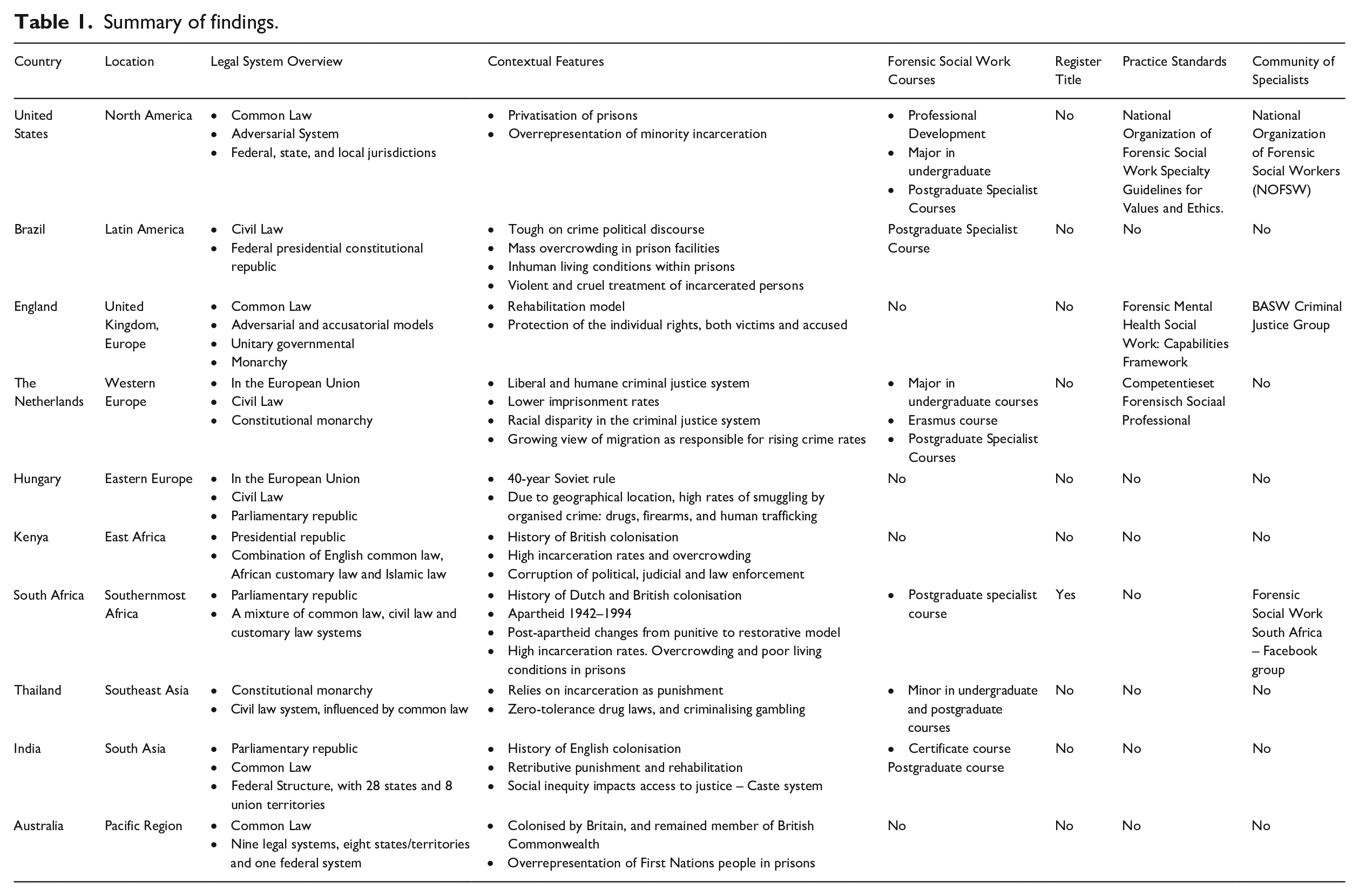
Forensic social work is defined as social work support and intervention for persons who are engaged with legal and criminal justice systems (Lattas and Davis, 2023). It is a specialty area of practice (Maschi et al., 2019; Sheehan, 2016). It is a field of practice and has been positioned as a specialisation due to high-performance requirements, specific knowledge, and advanced skills that lie beyond, or supplementary to, generalist practice (Sheehan, 2016). Forensic knowledge includes understanding the law and its procedures, human rights, social justice, mental health, comorbidity and intersectionality, offending, victimology, and various other theories of crime. Indeed, Sheehan’s (2016) research suggested that further training was needed to navigate the complications of practising generalist skills, such as ethical decision-making and critical reflexivity, within the heightened conditions in most forensic settings.
Globally, forensic social workers operate in a myriad of practice settings, including, but not limited to, holistic support of persons during criminal proceedings, correctional services, youth justice, domestic and family violence programmes, forensic medical and coroners courts, forensic mental health services, human trafficking and immigration services (Maschi et al., 2019; Schaffer, 2021). These roles span systems, working with individuals, families, social policy, and the law; from a direct practitioner micro to the macro level call for structural change. Maschi et al. (2017: 4) called forensic social work the ‘ideal vehicle’ to navigate a sociolegal setting due to its combination of social work ethics, familiarity with the law, evidence-based practice, interprofessional collaboration and use of intra-, inter- and multi-disciplinary knowledge.
Forensic social work requires highly trained practitioners because they support clients with a wide range of vulnerabilities and needs. Their practice is often positioned within tense bureaucratic and often ethically compromised and politically hostile organisational contexts (Schaffer, 2021). Much of forensic social work education research has been single-country studies that focus on the professional attributes and skills needed by the practitioner, such as court documentation and courtroom appearances (Kheibari et al., 2021; Maschi et al., 2017). This research is often intrinsically linked to that nation’s current socio-political and cultural contexts. However, despite the differences between different jurisdictions, there are common themes experienced transnationally by forensic social workers, including over-incarceration, managerialism, and the privatisation and reduction of the welfare state (Jarldorn, 2020). Understanding the structure, function and intention of forensic social work education is critical in formulating knowledge about what is forensic social work, its successes and challenges, and building a professional identity.
Forensic social work education
Social work education varies across jurisdictions; education models are often specified and endorsed by relevant national professional organisations. Qualifying social work education is influenced by the International Association of Schools of Social Work’s (IASSW) global social work education standards. Generalist social work is the most widely taught form of social work education, and the minimum level university professional qualification is now recognised internationally (Hokenstad, 2012). In several countries, including Australia, India and the United States, concerns have been raised about the competencies of generalist degree students for forensic and criminal justice settings (Kheibari et al., 2021; Maschi et al., 2019; Sheehan, 2016; Sinha, 2019). These include questions about students’ exposure to specialised practice elements, including forensic interviewing and testifying in court (Casey and Powell, 2022; Kheibari et al., 2021). But also, whether sufficient attention has been paid to understanding the law within the social work curriculum (Copeland et al., 2022). Much of this research has called for further development of that nation’s specialist social work education model.
Social work specialisation is a relatively contentious topic (Lattas and Davis, 2023). Criticisms of specialisation phrase it as a weakening of the collective voice of social work, as it is seen to unnecessarily divide, isolate and reduce the profession. For example, the IASSW decry in their global standards: ‘curriculum specialisations’ contribution to fragmentation in education and practice’ (Ioakimidis and Sookraj, 2021: 163). This has meant that the development of social work specialisation, and its education models, have been much more heterogeneous than generalist practice. Each country has a unique relationship to and adoption of social work specialisation. But there is a dearth of international or cross-national research in relation to forensic social work. This article aims to systematically describe and compare forensic social work in 10 countries.
Methodology
This study uses a cross-national comparison methodology by replicating the countries used in the World Prison Brief’s 10-county prison project: the United States, Brazil, England, the Netherlands, Hungary, Kenya, South Africa, Thailand, India and Australia (Jacobson et al., 2017). These 10 countries encapsulate a wide geographical space and diverse contexts, including economic, legal and criminal justice systems. The 10 jurisdictions vary in population size, wealth dispersion, poverty and inequality, geopolitical, political and legal systems, and have unique criminal justice practices. In addition, these countries represent the five IASSW regions, and reflect social work within diverse social, economic and cultural contexts. This study gathered data to map the infrastructure of forensic social work education within disparate circumstances and policy approaches. Information about each country’s forensic social work education model was collected from relevant websites and secondary research. A broad search strategy was used with key terms, including
forensic/criminal justice/crime/probation social work;
education/course/training/programme;
university/vocational/professional development;
country name.
Searches were initially completed in English but then translated using Google Translate, and subsequent searches were conducted.
Cross-national comparison studies in social work remain scarce, and these studies are often shadowed by criticism of inherent biasing and one-sided generalisations (Meeuwisse and Swärd, 2007). However, cross-national comparisons are a common methodology within the social sciences, which involves the observation of social phenomena across two or more countries and aims to understand these within their sociocultural contexts (Gómez and Kuronen, 2011). This methodology is useful in social work by enriching definitions, promoting alternative paradigms, and encouraging reflection on dominant discourses (Beck and Hämäläinen, 2022). A methodological challenge of this research was language and terminology (Campbell et al., 2019). All authors are monolingual English speakers. As such, not all forensic social work educational offerings, nor cultural nuances which underpin these, would be identifiable. There was no scope or funding for translating services in this project.
Findings
United States
The United States has three levels of jurisdiction: federal, state and local (Patterson, 2019). In the last five decades, the United States has seen significant changes to its legal systems and a dramatic rise in its prison population (Cox and Augustine, 2018). Studies show disparities in arrests and sentencing outcomes for diverse minorities and vulnerable persons (Cox and Augustine, 2018; Kheibari et al., 2021). US-based forensic social workers operate throughout the legal and criminal justice systems, in both criminal and civil court systems, including duties to advocate against unjust processes and sentencing (Kheibari et al., 2021).
The United States has one of the most developed conceptualisations of forensic social work; it has a professional association, multiple training and education pathways and a flourishing research community (Vaughan-Eden, 2022). Nevertheless, forensic social work is not a licensed specialisation nor a recognised credential through the National Association of Social Work (NASW). The NASW recognises court social work as a specialty practice but not forensic social work. The United States has the largest professional forensic social work organisation, the National Organization of Forensic Social Workers (NOFSW), which is an independent organisation sitting outside of the NASW. The NOFSW, established in 1984, has grown successfully over the last four decades; they provide vocational training qualifications, professional membership, speciality guidelines and research opportunities (NOFSW, 2020; Vaughan-Eden, 2022). The NOFSW established the Journal of Forensic Social Work and is currently working towards a research centre of excellence. Its ethical guidelines are supplementary to the NASW generic code of ethics; the NOFSW attempts to give guidance on forensic specific issues, for example, recommending that social workers not use legal labels, such as felon or inmate, on clients because it unconsciously cooperates and supports procedures founded on dehumanising and oppressive ideologies (NOFSW, 2020). The establishment of ethical guidance and a scholarly journal is unique to this country.
The United States has university and vocational training options for forensic social workers. The Bachelor of Social Work tends to be a 4-year generalist social work programme, but various opportunities exist to complete dual degrees or to incorporate a major or minor in criminal justice studies, criminology, legal studies and forensics. However, this is often considered an entry-level qualification, and most US forensic social work positions require further qualifications. Specialisation is possible within the Master of Social Work (MSW)/ Master of Social Work Studies (MSS). This research found nine CSWE-accredited institutions that offer forensics as a specialisation pathway in their MSW/MSS programmes. Five institutions offer forensic social work qualifications, like advanced certificates. Some universities, such as the University of Tennessee, offer these certificates within their MSW. The MSW is generally 2 years full-time, while certificates can be completed within 1 year. These courses generally offer students a series of units specific to forensic related issues, including in-depth studies of the law, ethical forensic practice, skills for forensic practice, working with other legal professions and forensic social work research. These programmes use a combination of experiential learning and written, oral, and practice-based assessments, including role-plays, simulated mock trials and debates (Maschi et al., 2019). In a forensic social work curricula review, Maschi et al. (2019) noted a dearth of cultural knowledge within US forensic social work education. All US master’s programmes include a field education component. Finally, several universities offer dual degrees, MSW and Juris Doctor (JD) or MSW and Master of Legal Studies. An example is Arizona State University, which manages this programme through the Office of Forensic Social Work Research and Training, an office that promotes the development of forensic social work research.
Outside of university, the NOFSW offers a Certificate and Advanced Certificate in Forensic Social Work. Both courses are 2-day programmes. Their programme covers specific content on testifying in court, working with legal professionals, and the social work role in court and mitigation. In addition, forensic social work professional development opportunities are advertised as existing in a myriad of universities and vocational organisations. These vary in duration and content, ranging from general forensic social work introductions to specific advanced skills. Due to forensic social work not being a licensed specialisation, there is no mandate or guideline on how much professional development or study is required to be officially a forensic social worker in the United States.
Brazil
Brazil’s criminal justice system is heavily influenced by a tough-on-crime political discourse (Median, 2016). As such, detention facilities are fraught with social injustices, including mass overcrowding, inhuman living conditions and violent/cruel treatment of those incarcerated. In addition, a number of barriers exist to accessing justice, including low education levels and awareness of rights and denial of custody hearings (Bernardes et al., 2022; Median, 2016). Forensic social work has existed for several decades in Brazil; social workers hold an important sociolegal role (Bernardes et al., 2022). Brazilian social work education is regulated by the Brazilian Association of Teaching and Research in Social Work (Haanwinckel et al., 2018). Their undergraduate courses are a 4-year generic qualifying pathway: Faculdade de Serviços Sociais. Brazil does have postgraduate social work specialisation courses. This research found two sociolegal postgraduate options: Social Service in Sociolegal and Human Rights at Centro Universitário Santo Agostinho, and one forensic social work specific course, Postgraduate Course in Forensic Social Work at Centro Universitário Dom Pedro II. This course is three semesters in duration and covers general sociology and crime theory, human rights, legal and political structures, restorative justice, cybercrime and professional performance in a judiciary setting. This research did not find a professional association or competency standards specific to forensic social work.
England
England has a rich history and heritage attached to its criminal justice system (Hirschel et al., 2008). It is a rehabilitation model, where crime is seen as a choice, but offenders are worthy of humane and just treatment. Social workers are positioned as assistants to the rehabilitation process; they find causes for criminal behaviour and support people to make prosocial decisions (Barry, 2000). Social work education in England is regulated by the British Association of Social Workers (BASW). Social work registration is mandatory, and members must hold a qualifying degree, BSW or MSW. The BASW hosts a Criminal Justice Group for forensic practitioners to disseminate and share knowledge and professional development opportunities, but it does not recognise specialist credentialing through any official process. In 2016, the BASW published a Forensic Mental Health Social Work: Capabilities Framework (Bogg and Barcham, 2016). This document defined forensic mental health social work as working within a multidisciplinary context, delivering interventions and conducting statutory duties within a context of safeguarding, mental health, working with victims and public protection. It outlines the nine professional forensic capabilities from three different experience practitioner levels: beginning, experienced and advanced/strategic. In addition, it provides national standards for the provision of social work within a secure hospital context. In 2020, Health Education England ‘New Roles in Mental Health’ social work group recommended that a clear post-qualifying pathway was needed for forensic social workers; this would consolidate and specify educational and professional standards (Daly, 2020).
Predominantly, English social work education is a generalist model, but some specialised postgraduate courses exist. This research found courses in advanced generalist practice, leadership and management, social policy, international social work, trauma-informed care, and applied practice. Several postgraduate courses included the abovementioned forensic skill safeguarding as a unit of study, but no forensic social work specific courses or units of study were identified.
The Netherlands
The Netherlands is known for having a liberal and humane criminal justice system, with lower imprisonment rates than its Western counterparts (Tonry and Bijleveld, 2007). Historically, it has been a politically stable and homogeneous nation, but in recent years, waves of migration have changed the population makeup and affected attitudes to crime (Tonry and Bijleveld, 2007). Notably, there has been a rise in discussions on ethnic groups as responsible for crime and racial disparity within the criminal justice system (Boon et al., 2019). Forensic social work is a thoroughly developed specialisation in the Netherlands. There is a set of competencies for forensic social work published by Movisie, the Dutch national knowledge institute on social issues (Radema et al., 2017). These competencies set the expectations of forensic practitioners.
Dutch social work education follows a similar model to the United States; a generic bachelor’s, with master’s programme students being able to study advanced generalist practice or a specialisation (Kloppenburg and Hendriks, 2021). There are three tertiary pathways to study forensic social work in the Netherlands. The first pathway is undertaking a ‘Working in Forced Framework (WIGK)’ as a minor during the bachelor’s programme (BSW) (Bosker et al., 2018). This is the first introduction to forensic social work for undergraduates, and it is currently offered by 11 institutions.
The second pathway occurs in an exchange programme (Erasmus) offered by Avans University of Applied Sciences: Criminal Justice and Social Work. This programme is offered as part of the BSW and is one semester in duration. This programme teaches criminal justice throughout Europe, specifically probation and incarceration; it is not localised to Dutch issues. The course includes units on working with other legal professions, assessment and report writing, managing the complexity of working within a statutory organisation, human and social capital, juvenile justice and general forensic social work.
The third pathway is a master’s programme that specialises in forensic social work: Master Forensic Social Professional offered by Utrecht University of Applied Sciences. This 2-year part-time programme is designed for the working professional and requires students to have 3 years of work experience before enrolling. The programme is comprised of five modules, covering decision-making, risk, working within a justice organisation, collaborating with other professions and a research component.
While specifically for probation officers rather than forensic social workers, it is notable that the Netherlands features (Avans and Utrecht) in a project set up to specify competencies in a European curriculum (Confederation of European Probation, 2015). At the time of writing, no further initiatives have been detected for founding a European forensic social work competency framework.
Hungary
Hungary is an independent democratic country but is still heavily influenced by its 40-year Soviet rule. Hungary has a growing incarceration rate, which is among the highest in Europe. Crime in Hungary is impacted by its geographical location; it is used as a smuggling pathway for organised crime syndicates, seeing drugs, firearms and human trafficking occurring. Hungarian social work is seen within the rehabilitation and post-incarceration space (Miklósi and Juhász, 2019). Hungarian social work education has both generalist and specialised social work education models (Török and Korazim-Kőrösy, 2012). They have the standard generalist practice model, including BSW, MSW and doctoral programmes. Littered throughout the generalist course structures are forensic orientated units, including child protection and human trafficking. Like most generalist BSW programmes, elective courses are built within the structure, allowing students to study crime theories or other forensic related content. Several social work specialisations are offered alongside or within the bachelor’s and master’s courses, specialisations including physical and mental health, social innovations, community development, social economy, addictions, clinical social work and school social work. This research did not find any forensic social work specialisation courses.
Kenya
Kenya has a combination of English common law, African customary law and Islamic law systems (National Council on the Administration of Justice [NCAJ], 2016). Several issues exist within Kenya’s criminal justice system, including mass incarceration, and corruption of political, judicial and law enforcement agencies (NCAJ, 2016). Kenyan social workers are employed in correctional facilities, courts, probation and community policing services (Wairire, 2014). They are largely seen in a rehabilitative and restorative role. Kenyan social work education is taught through tertiary institutions (universities) and vocational mid-level colleges (Technical and Vocational Training Institutes – TVETs); qualifications range from certificate, diploma, bachelor’s and master’s degrees (Owuor et al., 2022). There are currently 100 TVET programmes in social work, 10 institutions offering undergraduate degrees and two institutes offering postgraduate programmes. Programmes are taught through a generalist practice model or under the ‘social work and community development’ title. This research project only found evidence of one social work specialisation within the Kenyan model: medical social work, which had a specialist pathway. It found no obvious forensic social work specialist pathways. One diploma from MOI University included a unit, ‘Social Work in Corrections’, within their programme structure, and the Africa Nazarene University’s Bachelor of Arts in Criminal Justice Security Studies featured a unit on social work.
South Africa
South Africa is influenced by its history of Dutch and English colonisation and apartheid. Post-apartheid South Africa saw a change from punitive to restorative models (Cameron, 2020). However, crime and imprisonment rates have continued to rise. Many prisons are overcrowded, and conditions are inadequate or inhumane. More forensic social workers are needed within the criminal justice system, specifically to protect the human rights of prisoners, support vulnerable incarcerated groups, and help support post-release recidivism risks (Mangezi, 2014). Forensic social work is a regulated specialisation in South Africa; it is recognised by the South African Council for Social Service Professions (SACSSP), and professional requirements are set in the Social Service Professions Act 1978. This regulation occurred in 2017. The minimum education for a generalist social worker is the 4-year BSW programme. The Social Service Professions Act 1978 mandates that forensic social workers have an approved master’s degree and 2 years of practical experience or 5 years of appropriate practical experience. Practitioners must apply and demonstrate their attainment of the assessment criteria set by SACSSP. Currently, there is only one specific forensic social work education avenue in South Africa, from North West University, where students can study a MSW in Forensic Practice. This master’s programme has the BSW as a prerequisite and is 1 year in duration. The programme includes units on trauma, assessments and investigations, sexual and physical abuse, the law, working within a court and a research component. This course engages with simulation, using mock trials to expose and build court appearance skills.
Frank and Makhubele (2018) note that South Africa is still developing its own identity and research basis for forensic social work. The curriculum heavily draws on material from the United States. Their research calls for developing and embedding Afrocentric theory within forensic social work practice, citing Eurocentrism as entrenched and carrying with it oppressive and harmful conceptions of African culture and people. Post-colonial insight would help to create a more appropriate basis for forensic social work education in Africa.
South Africa does not have a professional organisation for forensic social workers, but the community is united through a Facebook page, ‘Forensic Social Work South Africa’. The page has nearly 2000 followers and shares accessible professional development options, relevant newspaper articles and other forensic and social work related information.
Thailand
Thailand has a civil law system which is heavily influenced by common law systems but has never been colonised by a Western nation (Junlakan et al., 2012). Its criminal justice model relies on punishment, namely through incarceration. Thai social workers are seen to have a role in protecting vulnerable persons within the criminal justice system. Thai social work education has modelled itself on the Western standard three-tier generalist social work degree model: BSW, MSW and doctorate programmes. It offers specialisation pathways within its generalist degrees, called minors. Thammasat University offers a forensic social work pathway known as Social Work in the Justice Process; this is a specialist minor in their BSW and MSW programmes. The specialist BSW programme includes units on crime theories and victimology, social work and criminal justice, working within correction, direct practice skills for working with offenders, and justice issues with vulnerable persons and minors. Sungkawan and Engstrom (2019) noted a disparity between forensic education and what occurs within forensic institutions; Thai forensic social workers need more opportunities to provide the appropriate support and interventions. Sungkawan and Engstrom (2019) argued that there needs to be further support from Thai social work educators to help bridge this classroom–field gap.
India
India predominantly uses retributive punishment and rehabilitation criminal justice models (Bhatt et al., 2017). It is impacted by social disadvantage and the Caste system. Forensic social workers are seen to have duties in moral/spiritual guidance, safeguarding vulnerable groups, supporting rehabilitation, health-related activities, education, legal guidance and generic support to justice-involved persons (Bhatt et al., 2017). Criminal justice social work has been a specialisation for seven decades in India (Sinha, 2019). Several criminal justice social work education pathways exist across the spectrum of higher education. Most social work schools across India offer a criminal justice elective (Sinha, 2019). Specific criminal justice courses are also available, including Indira Gandhi National Open University’s certificate in Social Work and Criminal Justice System. This is a 6-month diploma course on social work in a correctional setting. Postgraduate students can study a Master of Arts in Social Work (Criminology and Justice) from the Tata Institute of Social Sciences. This 2-year programme covers victimology and crime prevention, criminology trends, advanced social work theories and skills, rural crime and justice, rights of the child and juvenile justice, social policy, a field education component and a research project.
Australia
Australia was colonised by Britain in 1788 and has remained in the British Commonwealth. Australia has seen a steady rise in its incarceration rate, and research has shown substantial racial disparities in Australia’s criminal justice system, most notably in the overrepresentation of the Aboriginal and Torres Strait Islander people in prisons (Lattas and Davis, 2023). Australia has very limited forensic social work education, despite calls for it in research (Lattas and Davis, 2023; Sheehan, 2016). Australian social work education is regulated through the Australian Association of Social Workers (AASW) (AASW, 2020). It is primarily taught through a generalist practice lens: BSW, MSW, or a higher research degree. There are no Australian forensic social work courses. One course, the MSW (Forensic Studies), was available from Monash University from 2013 to 2017. Currently, students can study dual degrees such as BSW and Bachelor of Law, BSW and Bachelor of Criminology/Criminal Justice. In 2018, RMIT offered a dual degree in MSW/JD, but this offering is no longer available.
Social work specialisation exists in Australia; for example, Accredited Mental Health Social Workers play an integral role in providing mental health services (AASW, 2020). However, the training and credentialing for this specialisation sits within the AASW. Forensic social work is not a recognised specialisation or credential in Australia (Lattas and Davis, 2023). There have been various practice-led initiatives for Australian forensic social work, including one-off professional development workshops, such as ‘A Day in the Life of a Forensic Social Worker’, or the National Forensic Mental Health Social Work Conference, which occurred in 2023 and planned for 2024.
Discussion
As expected, generalist practice, specifically a variation of the BSW, was found in every country. However, forensic social work was diverse. It was primarily taught through professional development and tertiary courses. The professional development courses are shorter in duration and typically one-off workshops intended to upskill the working practitioner. Their content covers a general introduction to forensic social work or a specific skill within forensic social work, such as forensic interviewing. Tertiary courses were longer in duration and identified learning outcomes, course structures and assessment processes.
Tertiary courses are linked to qualifications, and provided by higher education institutions. Criminal justice or forensic related electives and units were often present in programmes across the countries. However, explicit specialisation programmes were found only in 6 of the 10 countries: the United States, Brazil, South Africa, the Netherlands, Thailand and India. Of these, the majority tended to be postgraduate. The exception being India and Thailand, where specialisation was studied within and alongside the generalist content. Tertiary forensic social work programmes included the greatest depth of study and were much longer in duration. The curricula of these courses highlight national priorities: North West (South Africa) focuses on child abuse, investigations and assessment writing; Utrecht University of Applied Sciences (the Netherlands) focuses on assessing risk, behaviour change, working with other professionals; Tata Institute of Social Sciences (India) focuses on correctional work and criminology; University of St Francis and University of Tennessee (USA) focus on law, legal writing and working within a court. The transnational skills seen across these courses were understanding the law, professional writing (assessment and report writing, court documentation, clinical records), forensic interviewing, working with vulnerable clients like the indigenous, victims of violence and children, being an expert and testifying in court, and working within a legal parameter or framework. The role of field education varied across the institutions; many programmes included no field education component. The use of simulation varied across institutions and countries. This study suggests that the practice-based element of forensic social work education still requires further pedagogical development. Most programmes did include a research unit of study as a cornerstone of effective and ethical practice and to allow for the special interests of students and teaching staff. Scholarship, in general, is essential to developing forensic social work education and practice (Maschi et al., 2019). It is positive to see many tertiary institutes promoting forensic social work research.
This global comparison of forensic social work education highlights the vast differences in duration, syllabi, and expected curricula learning outcomes and competencies. None of the countries in this article had a forensic social work specific accreditation process. Forensic professional competencies were seen in the United States (NOFSW Specialty Guidelines), the Netherlands (Movisie’s Professional Competencies) and England (BASW Professional Competencies). However, the relationship between these professional standards and their respective countries’ forensic social work training is complex. In the United States and the Netherlands, an associated link can be seen between professional competencies and course content, but in England, these competencies do not have a clear or direct link to their education model. No country in this review had professional competencies that enforce and mandate specific educational content, skills or minimum achievements in forensic social work.
The lack of regulation around forensic social work education is quite different when compared with generalist social work. Most qualifying programmes are subject to accreditation processes through the presiding national organisations and guided by IASSW global standards (Ioakimidis and Sookraj, 2021). Generalist social work education is a well-discussed and researched concept. However, forensic social work, by comparison, lacks that same research attention, institutional rigour, professional oversight, and standards set for education and qualification. In this project, forensic social work was not found to have any mandatory educational minimum standards, required curriculum, or systematic professional development, including supervision requirements for forensic social workers.
Each country had a unique approach to forensic social work as a community of specialists. South Africa was the only one to require a BSW as an entrance to its forensic programmes and to have forensic social work as a licensed credential. This community is connected through social media. In the United States and England, specialist communities are linked through their professional associations. By comparison, Hungary, Kenya and Australia situate forensic social work within a wider generalist network, and there is no clear pathway to develop one’s identity and community as a forensic practitioner.
Of the countries studied in this project, very little training or education was found for forensic social work from a First Nations or culturally diverse perspective. Researchers from South Africa, India and Australia have noted concerns about forensic social work education being dominated by a Eurocentric perspective (Baffour et al., 2020; Frank and Makhubele, 2018). With most of the research coming from North America and Europe, forensic social work education runs the risk of endorsing a perspective derived with little question from imperialist and ethnocentric forms of knowledge. There is a need to broaden forensic social work as a concept and an educational model to embrace First Nations, non-western and post-colonial knowledge. This is particularly concerning in countries such as Australia, where over-incarceration specifically affects its Aboriginal and Torres Strait Islander population (Baffour et al., 2020).
Opportunities exist to develop an international and collective voice of forensic social work education. Including an expectation that forensic curricula and scholarship includes cultural knowledge and competencies. This could follow the IASSW’s Global Standards (Ioakimidis and Sookraj, 2021), through international consultation with education institutions. Such processes involve a critical review of the epistemological, political, ethical and cultural underpinnings of forensic social work, and develop guidelines and mechanisms for forensic social work educational programmes.
Conclusion
This article has completed the first cross-national comparison of forensic social work education, providing a systematic description and comparison of 10 national education models. The relationship between forensic social work education and professional standards varies across countries. There was very little mandating of educational standards or curriculum requirements in the countries studied. Further research is needed to understand the role professional competencies play in specialist social work education.
Postgraduate forensic social work education provided the greatest depth of content and applied study for students. Each curriculum was found to reflect specific national priorities, but transnational pedagogical concerns can be seen, including a greater understanding of the law, skill in writing legal and court documents, effective testifying and advocacy in court settings, ability to work with other legal professionals, and forensic assessment and interviewing. Given the limited access to this critical knowledge and skill development, social work educators around the world need to increase opportunities for social work students at all levels to develop the skills necessary to work within a forensic setting. This study also found a need for First Nations and non-Western knowledges in forensic social work education. Thus, developing and including culturally inclusive forensic social work curricula is necessary.
Footnotes
Funding
The authors received no financial support for the research, authorship and/or publication of this article.
