




Abstract
As climate disasters increase, social workers will increasingly be called upon to help communities with the related dislocations, eco-anxieties, and social transformations. This article explores the extent to which Canadian social work schools are preparing social workers to advance socio-ecological justice. It examines the coursework in these programmes as new standards come into effect in 2023. We consider radical, eco-social, feminist and Indigenous pedagogies, and focus on how experiential learning and transformative hope can address the manifold systemic challenges we now face. Rather than bolting eco-education onto existing programming, radical perspectives and transformative praxis must be embedded into social work.
Keywords
Introduction
The gulf between the haves and have-nots continues to widen at a rapid pace in countries around the globe. The enabling policies of global capitalism have facilitated vast wealth accumulation in the hands of an infinitesimally small elite (Hickel, 2017), while the middle class is actively being winnowed out (Sithraputhran, 2021). The costs of food and housing have skyrocketed in the aftermath of the COVID-19 pandemic, making the provision of basic needs more difficult for already ‘vulnerable’ groups (Statistics Canada, 2022). Concomitantly, the planet is wrestling with the effects of a changing climate, as extreme weather patterns increasingly take hold, and floods, droughts, heatwaves, wildfires and tropical storms grow in frequency (Intergovernmental Panel on Climate Change [IPCC], 2021).
The consequences of anthropogenic climate change are, and will continue to be, borne by countries and people that have contributed the least to its making (IPCC, 2021). For example, extreme weather events such as British Columbia’s heat dome in 2021 led to the deaths of more than 619 people, mostly older adults living alone with chronic health issues (Das and Martiskainen, 2022). This perfect storm of injustice will continue unabated unless checks are put in place to curb widening income inequality, private actors are reined in through more democratic governance systems (Hickel, 2017) and helping professionals, including social workers, become more engaged in contesting the neoliberal forces that reproduce the injustices that are at the centre of their work. This conceptual article explores the extent to which schools of social work in Canada are equipping future social workers with the knowledge and skills to advance socio-ecological justice, and provides theoretical and pedagogical directions for educators to consider as they seek to prepare social workers to respond within a climate-changed world.
Literature on environmental and climate justice has proliferated over the past three decades (MacArthur et al., 2020). So too has the theoretical dimensions of fairness, equity and social justice. As both fields have developed, they are increasingly being understood as inextricably interlinked and irreducible to each other (Newell et al., 2021). Yet social workers have tended to adopt a narrow focus on the injustices wrought by inadequate health and social welfare programming in a neoliberal environment of austerity and retrenchment that has so sorely ravaged these systems (Mulvale, 2017). Climate change is seldom addressed centrally in social work (Greig and Wu, 2022). As such, the profession, while well-positioned to be a leader in interdisciplinary efforts to tackle climate and environmental threats, has regrettably proven ‘silent or less than relevant’ (Zapf, 2010: para. 1).
This inquiry is timely as new standards requiring the incorporation of environmental training into Canadian social work curricula are being rolled out in 2023. Furthermore, from the perspective of international climate responsibility and climate debt, Canada stands as one of the highest emitters per capita globally (Canada, 2022). Radical approaches are thus necessary, as the coming changes will affect all beings, albeit unequally, fundamentally reshaping life as we know it.
Study approach
Despite the call for social work educators to include ecological considerations into social work curricula broadly, and educators’ own instructional repertoires specifically, research on how to do so remains thin. This article aims to fill this gap. Jones (2011: 3) suggests that social work education to date has typically employed one of three responses: changes that add ecological content within the extant curriculum, changes that embed content on ecology and sustainability into the existing curriculum and changes that transform the entire curriculum to fully reflect a holistic and intersectional ecological orientation. While the first two are the most common, Jones (2011) argues that the third shows the greatest promise in transforming future social workers and preparing them to work alongside others to create a more sustainable world.
Conceptual papers aim to ‘offer new insights for methods of teaching social work, conducting social research, or reconceptualizing a theory, viewpoint, or philosophy’ (Bender and Windsor, 2010: 153). In this conceptual article, we (a) assess the extent to which schools of social work are preparing future social workers to advance social and ecological justice, and (b) explore possible avenues for educators to consider in advancing radical and ecological pedagogies that have the power to instil ecological consciousness and galvanize agents of change into action. We recognize that there is significant fluidity, porousness and overlap within and between the various eco-social work domains below. We construct these as a means of structuring our article, not to suggest that these are mutually exclusive or exhaustive categories or bodies of work.
Canadian social work education
The Canadian Association for Social Work Education (CASWE) governs the educational policies and accreditation standards of schools of social work in Canada, at the undergraduate and graduate levels. There are two sets of accreditation standards currently employed across accredited schools: the 2014 Accreditation Standards and the 2021 Educational Policies and Accreditation Standards. Effective in July 2023, all accredited schools of social work in Canada will be required to abandon the 2014 set of standards in favour of the 2021 standards (CASWE, n.d.). The 2014 accreditation standards refer exclusively to (Bachelor of Social Work) students gaining ‘knowledge related to human development and human behaviour in the social environment’ (CASWE, 2014: 13), yet the physical environment is entirely overlooked. Far more substantive content can be found in the 2021 standards, which consider ‘environmental sustainability and ecological practice’ as key areas of concentration for the profession (CASWE, 2021: 16).
The 2021 social work accreditation standards recognize that social workers must have opportunities to (a) understand the need to create ecologically sustainable communities, economies, and built and natural environments in which all life forms and ecosystems can survive and thrive, (b) identify and challenge environmental injustice and racism, (c) advance environmental sustainability across individual, organizational and professional contexts and (d) embrace their role in advocating for policies and practices that ensure ecological health and environmental sustainability at the local, regional, national and global levels (CASWE, 2021: 16). As noted, however, schools of social work are not required to fully adopt, as a condition of their school/programmatic accreditation, the 2021 standards until the summer of 2023. In the interim, social work students in Canada, as elsewhere (e.g. Australia; Reu and Jarldorn, 2022), confirm that social work curricula continue to present a dearth of green content at a time when this material is more crucial than ever.
Although there is robust literature recognizing the importance of social workers in adopting green (Dominelli, 2013), deep ecological (Besthorn, 2003) and eco-social work or eco-spiritual (Coates et al., 2006) frameworks in their practice, no Canadian school of social work has expressly identified (one or several of) these as their primary area(s) of focus or programme specialty. Indeed, only a few offer courses that explicitly grapple with environmental justice issues. Table 1 (using data available from DesignSafe by Greig and Wu (2022)) presents a list of environmental social work courses and identified faculty with environment-related interests by school. The data presented show that of 45 Canadian social work accreditation programmes only 24 (53%) had at least one current course offered mentioning the natural environment. Institutions in Quebec and Alberta (i.e. Université du Quebec en Chicoutimi and University of Calgary) have the most extensive offerings. In terms of faculty interests, University of Calgary (again), University of Manitoba, and Université Laval have the largest concentrations of environment-related interests. Small institutions are over-represented in the list, with large research universities being the least likely to include environmental programming.
Schools of social work in Canada with green-related courses and faculty researchers. a
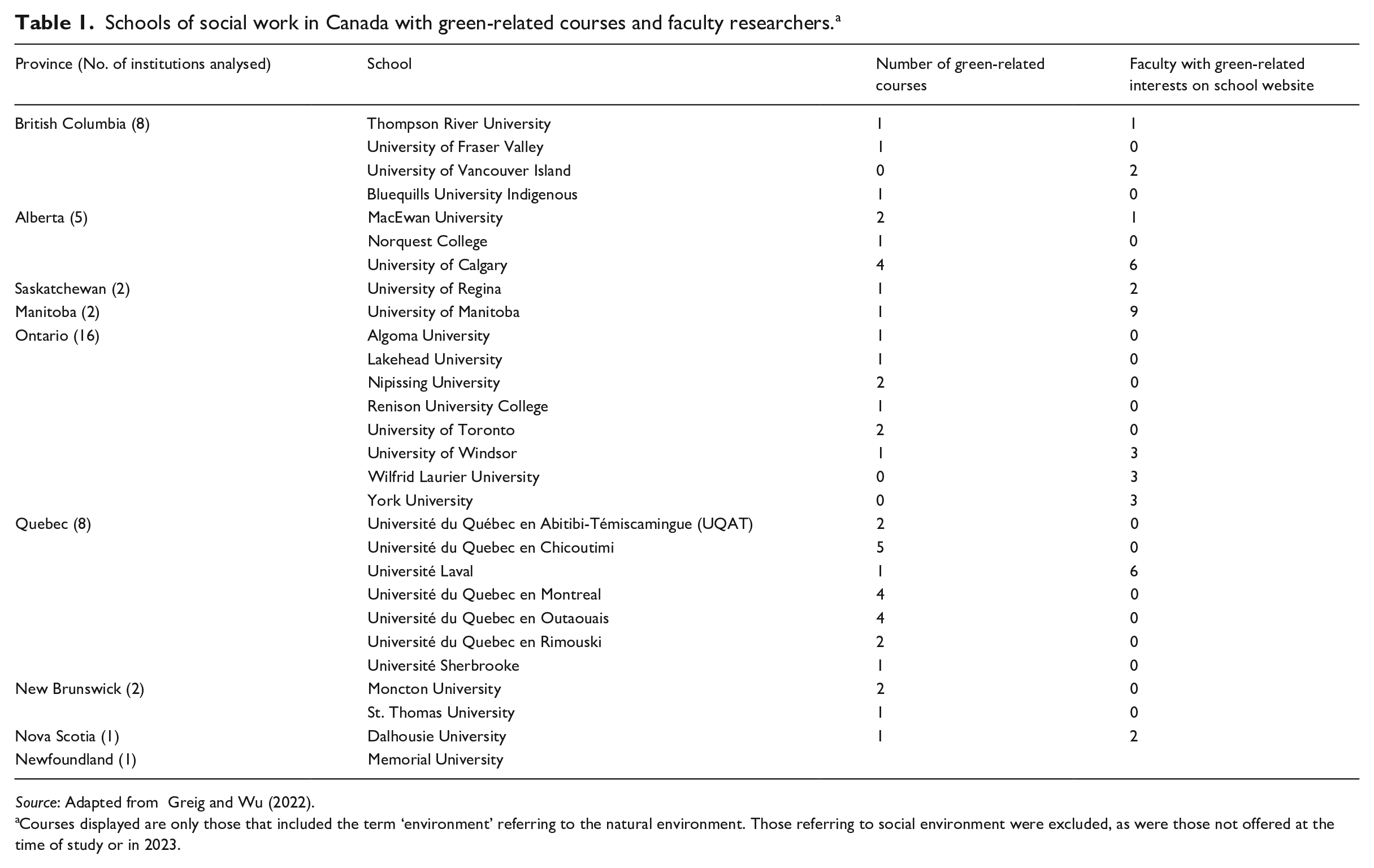
Source: Adapted from Greig and Wu (2022).
Courses displayed are only those that included the term ‘environment’ referring to the natural environment. Those referring to social environment were excluded, as were those not offered at the time of study or in 2023.
The overall number of faculty members (Table 1) that have indicated a research/practice interest in environment-related social work is sparse, with some faculties not having any members identifying such areas as subjects of research or teaching interest. Moreover, while there are several courses offered in social work programmes that consider the ‘environment’ in their description, many of these (excluded from Table 1) do not explicitly identify the natural environment as a site of concentration; rather this could be narrowly drawn to reflect the social environment alone (Greig and Wu, 2022). While there may be some debate as to whether eco-social work content is best infused within and across the curricula rather than given distinct expression within a stand-alone course (e.g. Reu and Jarldron, 2022), it seems apparent that eco-social work content is not being paid adequate attention in schools of social work. This may be set to change with the implementation of new standards for environmental training, but its transformative potential has yet to be revealed.
Changing course in social work
The social sciences are replete with theories that have been largely split into two camps: those concerning the individual and those pertaining to society and social change. Research also documents this bifurcation in social work, constructing a macro–micro dualism in education and practice. Given the rise of professionalization in the wake of neoliberal hegemony, focus on the natural environment in social work waned (Teixeira and Krings, 2015) and specialized treatment modalities achieved marked primacy. Assuming the adoption of clinical skills would lead to more securely paid employment opportunities, social work students have increasingly gravitated towards ‘micro-level’ placements to practice with individuals and families (Smith-Carrier and Sethi, 2021). Brady et al. (2019) thus challenge the ‘radical’ orientation of the profession, reminding us that social work has had an ongoing predilection to embrace individual deficit and medical model approaches in its orientation to social problems. The authors maintain that social work pioneers have made way for a profession that has taken an active role in (re)producing and sustaining oppression, rather than resisting and dismantling it (Brady et al., 2019). Consequently, the history of social work has revealed numerous occasions when the profession has aligned with and conformed to the hegemonic ideas of the day, permitting social workers to collude with the state to enslave, control and subjugate specific groups, and to extend the exercise of governmentality to place all things under neoliberal market control (Ferguson, 2009).
Although often anchored to a person-in-environment approach, micro social work has had a regrettable fixation on developing new ways to treat or remedy individual (couple or family) problems. With a focus on individual adjustment, not communal change, some social workers have increasingly embraced psychological and behavioural remedies, with a penchant for short-term (brief) interventions and the presumed certainties and efficiencies of evidence-based practice interventions (Drake and Hodge, 2022). Aligning with welfare states’ preoccupation with personal responsibility (not community, state or rights-based provision), some have acquiesced to social service provision bent on regulation, management and control (see Beddoe, 2010). Consequently, the profession has, in its diverse field settings, provided paternalistic and coercive services, regulated ‘abnormal’ or noncompliant populations, colluded with corporations and governments valuing profit over people and engaged in ongoing colonial practices. Brady et al. (2019) argue then that the profession must recognize its complicity in contributing to the societal problems we now face and make meaningful efforts to change course. In Canada, this shift is vital with respect to the obligations to implement the UN Declaration of the Rights of Indigenous Peoples (UNDRIP) and the calls to action of the Truth and Reconciliation Commission (TRC).
Some researchers suggest that social work is at an important crossroads or ‘critical inflection point’ (Drake and Hodge, 2022). The tensions surrounding the alleged existential crisis have largely to do with competing ontological and epistemological orientations. The first leans towards the modernist, humanist and positivist roots of the profession (Boetto, 2017), drawing its legacy from the (Eurocentric) Western Enlightenment tradition, and the second, bearing towards post-modern, post-structural, Indigenous and critical/radical directions (Morley and Macfarlane, 2014). The modern (post)positivist paradigm has understood the nature of knowledge and truth to be rational and objective, and has animated a material existence, shaped in and by relentless resource extraction and consumption. In contrast, critical realist, post-modern and post-structural approaches have embraced subjective, interpretive and constructed manifestations of reality, and have theorized and critiqued various expressions and experiences of it, at times stymying a clear change agenda (Boetto, 2017).
Calls for action are reverberating across the globe, as leaders increasingly warn that the world is not on track to meet the targets set out in the Paris Agreement (IPCC, 2021). Thus, in addition to re-examining the ontological and epistemological roots of the profession, social workers are also urged not to see environmental justice as merely additive, or as a new layer fused to existing ecological or systems frameworks. Rather, alternative, and more transformative, approaches are required. Even when emerging (and seasoned) social workers are grounded in ecological systems (Bronfenbrenner, 1992) and general systems theoretical frameworks (Kondrat, 2002) in their community, policy or casework, broader attention to the physical environment has often elided their consideration (Beltrán et al., 2016). Sadly, too, this orientation has often hierarchically arranged smaller systems within boxes (or concentric circles) of larger ones, negating a critical lens that sees social workers, and the people with whom they work, not as acted upon or merely having interactions within the extant ecosystem, but as essential co-constructors of it, through recursive processes that shape and are shaped by enactments of power and human agency (Kondrat, 2002). Kondrat (2002), in summarizing Giddens, cogently argues that micro and macro realities conceptually coalesce, as ‘social structure is both medium and outcome of the patterned activity of individuals over time’ (p. 444). Here, the boundaries of macro–micro social work are revealed to be porous, imprecise and arguably, impractical. Consequently, as Agpar (2021) argues, it is likely time to discard these practice distinctions, as their maintenance has led some to believe that not all social workers are equally charged with the ethical duty to advocate for social change.
Radical social work
Critical and radical approaches seek to address the fundamental roots of social problems. Adopting these lenses, social workers are encouraged to not only help improve the lives of individuals and families, but to remedy the structural forces and conditions that adversely affect health and wellbeing. Pease (2013) notes that some have employed the terms critical and radical interchangeably, given that both are grounded in a structuralist analysis, with the former frequently anchored to post-modern theories, and the latter to (neo)Marxist approaches. Such lenses recognize that poverty, and its symptoms (e.g. homelessness, hunger) are systemic problems, requiring systemic remedies. Poverty is a political choice. The lack of political will to address financial insecurity increases people’s vulnerability to climate-related shocks, and the same lack of will to remedy climate change amplifies people’s susceptibility to poverty (Levy and Patz, 2015). While radical social work literature has been slow to draw attention to ecological considerations (Rao et al., 2022), recent research calls upon social workers to adopt eco-social and degrowth strategies that urge for a dramatic departure from status quo pro-growth narratives (Powers et al., 2019).
Central to a critical study of neoliberal hegemony is an analysis of power that illuminates how state and non-state actors alike can endorse aspirational platforms to end poverty and constrain climate change on one hand, while sustaining and exacerbating the determinants of impoverishment and climate devastation on the other. Rather than identifying social problems as ‘wicked problems’, imbued with indeterminate complexities, climate justice advocates point to the fundamental ‘wicked governance problem’ (Newell et al., 2021), and the apparent intractability of international, national and subnational legal and policy frameworks to effectively hold the transnational corporate elite responsible for their destructive practices (Hickel, 2017). Although the language of justice is often included in legal and policy documents, considerable effort has been applied to ensure that the veritable enactments and practices of justice comply with, and pose little threat to, those who profit immensely from global capitalism (Newell et al., 2021).
The impulse towards individual responsibility is profoundly rooted in discursive and material relations. It deflects responsibility away from (heavily polluting) corporate actors, and the states that support them, and onto individuals with calls to reduce one’s personal carbon footprint (Byskov, 2019). Not all contributions to the climate crisis are the same, however, with significant inequalities visible across both income groups and regions (Frumhoff et al., 2015). Heede (2014) documents that roughly 90 companies (including Exxon, Shell, BP and Chevron) are responsible for causing two-thirds of anthropogenic greenhouse gas (GHG) emissions; half of these were produced over the past 25 years when evidence about the threat posed by climate change was certain. The inequity of this system not only perpetuates certain groups’ vulnerability to economic and climate-related shocks (Kahn, 2010), but then also marks them as ‘vulnerable’, reifying marginalized populations as ‘lacking in ability, capacity, or character’ (Fineman, 2021: 5).
Critical reflective practice
Contesting the immense power of the corporate elite at the epicentre of climate destruction can be daunting, even immobilizing (see Davis, 1992). Yet, through a post-modern paradigm, power is seen as ‘something that is exercised through control of discourse, rather than something that resides exclusively in social structure or is possessed’ (Morley, 2008: 416). With this understanding, social work learners can challenge assumptions that they are powerless to act, because, irrespective of their positioning in the extant hierarchy, they can participate in defining, shaping and delimiting discourse. Such contributions open opportunities to challenge, resist and structurally alter the status quo (Morley, 2008). Learning how to do such work, however, requires ongoing critical reflective practice.
Teaching radical social work requires a commitment to critical reflective practice (Morley and Macfarlane, 2014) that considers the (meta-)narratives, discourses and discursive strategies of language employed to construct and reify power relations (Fraser et al., 2017). For instance, as Chihota (2017: 59) points out, ‘inviting a client for “a chat” raises very different expectations than asking them to attend “an interview” or “assessment”’. Regrettably, neoliberalization has infiltrated social work practice and education, implanting a fatalistic resignation to a dystopian future, and stifling the imaginative scope to envisage and work towards alternatives. Fraser et al. (2017: 342) posit that the teaching of critical reflection of practice:
[T]ranscends an exclusive focus on interpersonal skills that assumes practice to be separate from theory and devoid of context, to engage students in deep awareness of the political nature and implications of their work and critical consciousness of the social conditions of people’s lived experience. The integration of a critical analysis of society with personal experience has been shown to be one of the most effective approaches to bringing about transformative change in learners.
Considering how social work could reorient itself to become a radical profession – which in so doing would not be radical but would in fact mean it fulfils its ethical obligation to actively pursue equity and justice – would invariably involve, not merely the teaching of skills, tools and techniques, but instruction on how to engage an ongoing critical reflective practice that leads to a deep interrogation of one’s own values, beliefs, judgements and attitudes, the deconstruction of implicit assumptions within dominant narratives, and increased understanding of one’s agency in shifting and reorienting power relations in one’s everyday activities (Kamali and Jönsson, 2019: 302).
Not all reflective practice involves ‘critical’ reflection. For the latter, as Fook (2015) instructs, one must engage in ongoing processes involving reflective practice (considering one’s professional practice, including how closely the ‘theory’ underlying it is enacted), reflexivity (recognizing the ways in which we use and make knowledge in our physical and social contexts), post-modernism and deconstructionism (identifying the ways in which knowledge and power are constituted, shaped in and by language and how we can de/construct dominant discourses) and critical social theory (exposing dominant discourses, including the political or ideological functions that sustain them, and choosing to enact one’s power to change them) (Askeland and Fook, 2009). Critical theory, as Fook (2015: 445) clarifies:
[R]ecognizes that domination is both personally experienced and structurally created. Therefore, individuals can participate in their own domination, by holding self-defeating beliefs about their place in the social structure, their own power and possibilities for change.
To move beyond such deep-seated assumptions, one’s reflective practice must feature iterative processes of analysis, including a conscientization that moves beyond fatalism to a new critical awareness of the possibilities for action and an acceptance of the invitation to change society for the better (Askeland and Fook, 2009). Asking social work learners to identify ‘critical incidents’ (stories, narratives, journal entries, case-notes or observations) from their practice can provide the raw material from which they can begin to practise these processes (Fook, 2015). Recent work includes spirituality as another domain to challenge taken-for-granted assumptions and prompt transformational change (Béres and Fook, 2020).
Eco-social work
Eco and green social work perspectives redefine social work practice to be inclusive of environmental concerns (Dominelli, 2021). These lenses illuminate the aggravated vulnerabilities of marginalized groups to climate and environmental disasters, and their differentiated experiences of them. Calling for a fundamental transformation of the economy, including its redistributive mechanisms, use of resources, and treatment of labour, plants and animals, green social work seeks alternatives that will engender a decent quality of life for all species, while safeguarding the Earth’s regenerative capacity and preserving its resources for future generations (Dominelli, 2018). Dominelli (2013) suggests that an ethics of care is required, which urges people to better care for each other and for the environment to assure the wellbeing of all.
The privileging of the economy, above all else, has led to the ‘ideology of modernity’ (Coates and Leahy, 2006), featuring relentless industrialism, consumerism, materialism, individualism and anthropocentricism, which has adversely impacted people and the planet. Moving beyond anthropocentric approaches, deep ecology draws on various religious, philosophical and scientific ideas to develop a ‘experiential philosophy of nature’ (Besthorn, 2003: 70). Influenced by political activism in the 1960s, specifically the Environmental Revolution, deep ecologists seek an expanded sense of self-consciousness in which ontological distinctions between the human and nonhuman realms are blurred. Themes reflect a focus on self-realization, moving beyond the satisfaction of personal desires to identify and connect with more than the self; deep questioning, which troubles dominant paradigms and embraces a ‘relational total view’ (Naess, 1988: 96); and biocentric equality, which posits that all entities in the ecosphere have inherent value and each has the ‘equal right to flourish and grow, and reach their self-realization within the greater Self-Realization of whole-earth development’ (Besthorn, 2003: 74).
Social work education that fosters environmental awareness, political involvement and even spiritual awareness is therefore crucial. Eco-spirituality is not restricted to one’s personal journey, but also involves a ‘spirituality of resistance’ (Baskin, 2007: 200) that links spiritual transformation to social change. Eco-spirituality transcends any one religious or theological tradition, blending spirituality ‘what gives people a sense of meaning’ with an awareness of the environment – encompassing the interdependent relationships between nature and all living beings – to engender a creative process that promotes personal growth, and social and eco-justice (Ferreira, 2010: 5).
Experiential problem-based learning
Problem-based learning techniques have been recommended to provide social work learners opportunities to develop the adaptive skills necessary to respond to changing conditions (Dale and Newman, 2005). Problem-solving activities generate learning through application, challenging students to take ownership of their learning experience (Steinemann, 2003). By affording time and space to work through personally and socially relevant challenges, based on real-time and real-world problems, students develop collaborative problem-solving methods that build communication and cooperation skills. Asking students to develop (individual and group) mind maps, case studies and group presentations that delve deeper into the interconnections between social, economic and ecological implications of identified problems can be valuable (Drolet et al., 2015).
To prepare social workers for eco-social work, some educators are harnessing the benefits of direct engagement with organizations working in the field and using experiential approaches, including service-learning approaches (Lucas-Darby, 2011). Such opportunities allow learners to ‘test the waters’ of their skills in a supported environment (Crawford et al., 2015: 597). A transformative learning framework can be applied to facilitate critical reflection and prompt collaborative dialogue, to both develop students’ knowledge and skills and bolster their confidence in effecting change (Crawford et al., 2015).
Eco-pedagogies are often built on transformative learning theory to fundamentally rethink current practices. Illuminating a Freirean approach that centres critical social analysis (Kahn, 2010) and challenges neoliberal discourses that point to the inevitability of our collective demise, such theory transforms:
[P]roblematic frames of reference ‘sets of fixed assumptions and expectations (habits of mind, meaning perspectives, mindsets)’ to make them more inclusive, discriminating, open, reflective, and emotionally able to change. (Mezirow, 2003: 58)
Ecofeminist social work
Ecofeminism emerged as a response to criticisms about sexism in the green movement and the lack of ecological consciousness in the women’s movement, which failed to recognize the interconnectivity of forms of oppression (Plumwood, 2004). Underscoring the connections (historical, symbolic and theoretical) between the domination of women and of nonhuman nature, ecofeminists, such as Warren (1990), contend that a distinctly feminist environmental ethic is required to contest capitalist patriarchal relations.
According to Plumwood (2004), women in Western culture were historically connected to the ‘lower’ order of nature, associated with materiality, animality and physicality, while men supposedly engaged the ‘higher’ order, inclusive of the mind, reason and culture. The disparate orders of male/female, mind/body, reason/emotion and nature/culture (Hawkins, 1998) were typecast as dualisms occupying opposing spheres. Male humans, given their purported higher order of mind and spirit, were deemed to have transcended physical labour. Such labour was believed to be the natural domain of women (slaves or inferior Others), presenting the body, emotionality, animality and deficient reasoning as rationalizations for their ostensible fitness for this work. Although ecofeminism draws from divergent ideological strands, ecofeminists often centre their analytic work on the categories of gender and nature, foregrounding a critique of the dominant theories and worldviews that perpetuate androcentric, Eurocentric, colonial and anthropocentric Western capitalist enterprises (Plumwood, 2004).
Community-based learning and storytelling
Ecofeminist classrooms also tend to afford ample opportunities for experiential and community-based learning. This includes moving outside the confines of the classroom into the outdoors, in alternative learning environments including parks, gardens, cemeteries and environmental degradation sites. Such learning environments disrupt the inherent hierarchies of traditional classrooms, offering space for a feminist liberatory consciousness to emerge, while providing natural spaces from which learners can draw healing, restoration and self-care. Taking time to hike, walk, listen to nature and dialogue can be even more fruitful when first primed for discussion and reflection. Bakhmetyeva (2021) prepares learners for the journey by having them read stories and articles from queer walkers and racialized women, and asking them to reflect on how their accounts compare with the learner’s own.
Research suggests that storytelling can be a useful eco-pedagogical tool, particularly when used to unmask diverse assumptions, experiences and expectations central to critical social analysis and ecofeminism. Stories are ‘repositories of deeply held values and attitudes’ (Nita, 2020: 156), so inviting learners to (re)interpret such stories can help foster new understandings that depict humans as stewards, with duties to protect and care for the Earth. Contemplative practices (e.g. mindfulness exercises, walking meditations, rituals, songs, dances, ceremonies; Nita, 2020), simulations and scenario-based learning (Jones, 2014), as well as arts-based approaches can supplement storytelling approaches in deepening ecological consciousness (Peterson, 2019). These approaches focus on unearthing the lived experiences of diverse actors in collective, environmentally embedded learning opportunities.
Indigenous ecologies
Western knowledge systems, ideologies and approaches espouse a humanistic focus on the individual, enacted through an economic order that renders all things subject to market control. Commodifying everything, including people and the planet, neoliberal social relations are based solely on capital, providing some with tremendous security, wealth and privilege, and positioning others for structural violence, impoverishment and marginalization (Paul, 2016). Valorizing greed and materialist consumption, capitalism has indelibly forged a long history of colonization, exploitation, slavery and environmental destruction (Hickel, 2017). With a harrowing legacy of genocide and ecocide, the ongoing colonial project has had particularly egregious effects on Indigenous peoples (Crook et al., 2018). Both the UNDRIP and TRC’s calls to action provide recommendations that mark the way forward based on Indigenous sovereignty, anti-racism and instructive history at all programme levels.
Although historically reticent to introduce Indigenous forms of helping and healing into dominant social work practice frameworks (Coates et al., 2006), nascent social work research is beginning to recognize the cooperative and collective focus of Indigenous ways of knowing, being and doing. Indigenous perspectives acknowledge the centrality of the land and the importance of place (Wildcat et al., 2014), and embrace a wholistic healing worldview that recognizes the interdependency of relationships with the Creator and all living things in the natural world. Seeking to awaken a spiritual consciousness that affirms the sacredness of Mother Earth and the delicate balance of the symbiotic relationships that encircle it, eco-spirituality creates a welcoming space for Indigenous social work and spirituality in the profession (Gray et al., 2016; Coates et al., 2006).
Sinclair (2004) highlights that the deficiencies of current anti-oppressive and cross-cultural approaches in social work education have given rise to a culture of silence; not hearing from Indigenous peoples, understanding their contexts and the ways in which racism and an ethic of blaming the victim have been perpetuated, and an awareness of oppression devoid of agency. Indeed, cross-cultural learning recurrently positions ‘minorities’ (marked with inferior status) as ‘the client’ in need of assistance, as rarely are white people required to see themselves as the cultural Other (the culture one is expected to learn, as the Western subjectivity is the one from which all relative claims are anchored). Rather, Indigenous epistemologies make space for ‘all my relations’ (acknowledging the shared relationships between all living beings), inviting everyone to the sacred circle and to partake in the healing energies of the medicine wheel. They also highlight the importance of holistic ontologies and, as Mutu (2022: 49) argues, a ‘deep, location-specific understanding of how to maintain the delicate balance between humans and our relations who are the other elements of the natural world’.
Holistic place-based learning
Literacy in Indigenous environmental epistemologies can help educate learners about the challenge of objectivity within science, and its racist and sexist history, exposing the choices and challenges of deciding who and what is worthy of study. Programmes led by Indigenous knowledge-keepers themselves represent a positive shift from the previous model, wherein postsecondary education remained almost exclusively the purview of white middle-class academics (Henry et al., 2017).
Applying place-based Indigenous educational techniques involve learning the geographic history of a place, including about the original peoples who inhabited and stewarded the land, engagement with community members and Indigenous experts, and field trips that engender critical thinking skills and disrupt the colonial narratives that have traditionally excluded Indigenous history and knowledges (Billiot et al., 2019). The outdoor classroom – including class trips to local cultural and historical sites – invites eco-social work learners to harness physical connections to space and place that generate embodied, experiential and sensory learning experiences that foster learning by doing (Bayer and Finley, 2022). Basso (1996) argues that knowledge of places is intertwined with knowledge of the self.
Place-based eco-pedagogies in action thus seek to engender a shift in awareness ‘from living in places to being in-relation with places’ (Bayer and Finley, 2022: 4) that is central to a critical pedagogy of place. ‘Place-making is an active, ongoing process that adds individual experiences to the collective imagining of place-worlds’ (Bayer and Finley, 2022: 4). Through these processes, doing history and constructing the past also create social traditions and the processes that forge and shape personal and social identities. Basso (1996: 7) argues that ‘we are the place worlds we imagine’, thus we must create new imaginaries that envisage alternative futures.
Pedagogies of hope: Transforming social work practice
Social workers are well-suited to work collectively with others to advance the aims of ecological justice. Indeed, the International Federation of Social Workers (2022) has recently identified the need for radical transformative societal shifts that demand the inclusion of eco-social work perspectives. Yet, as Cox et al. (2021) caution in observing trends in social work education internationally, the human services are becoming more statutory and instrumental at a time when problems requiring social and collective responses are being consigned individual and market solutions; universities, deprived of public funding, are becoming more commercially and vocationally driven; and students, in social work programmes hard-pressed to prepare social workers to challenge extant systems and structures of unequal privilege, are more likely to prioritize immediate employment (not systems change) upon graduation. These trends, of course, emerge within the context of the pervasive penchant among liberal welfare states for conditional, marketized and managerial welfare provision (Cox et al., 2021), and the maintenance of redistributive mechanisms ill-resourced to meet the threats of the climate crisis (Dominelli, 2021). Consequently, in the absence of profound systems-altering change, the inequities evident across the globe are expected to only intensify. Here, social workers are asked to consider alternative approaches that embrace the ‘interdependence and relatedness of all life, connectedness to nature, and the importance of place’, values consistent with traditional Indigenous knowledges and practices of healing and helping (Coates et al., 2006: 389).
A shift of this magnitude, from deeply anthropocentric, modernist and individualist approaches of social work to holistic, systemic and radical ones can be overwhelming. Just as values need to be rethought, so too do the pedagogies used to re-evaluate them. Freire’s (1994) Pedagogy of Hope, rousing both the language of critique and possibility, offers a theoretical anchor for generating the kinds of critical hope (inspiring the critique of oppressive structures and relations) and transformative hope (envisaging ‘utopia plus a sense of possibility grounded in the confidence in the powers of human agency’; Webb, 2013: 409) essential to a critical pedagogical approach. At a classroom level, social work learners can be encouraged to engage in a critical reading of popular culture so that they can better understand the world, ascertain how it should and could be changed, and initiate acts to transform it (Ichikawa, 2022). Giroux (2015: 80) claims that
[W]ithout hope, even in the most dire of times, there is no possibility for resistance, dissent, and struggle. Furthermore, agency is the condition of struggle, and hope is the prerequisite of all modes of critically engaged agency. Hope expands the space of the possible, and becomes a way of recognizing and naming the incomplete nature of the present while providing the foundation for informed action.
Opening dialogue on the dimensions of critique and possibility, learners can co-create hope, and learn to use it to articulate a new vision and counter-hegemony that can shape new realities (Ichikawa, 2022).
Conclusion
In Canadian social work education, climate change is seldom addressed centrally. This must change if the profession is to remain relevant and effective. Social workers have long been tasked with addressing the effects of dislocations at the end of the pipeline – these will continue unabated unless change is both swift and efficacious. Social workers can no longer be passive bystanders, accepting current incremental approaches that do little to address the existential threat we now face. Rather, they must become active and radical agents of social change, taking up Blackstock’s call to embrace an activist-oriented practice (Rynor, 2023). Raising ecological consciousness and applying pedagogies of hope, together with the radical potential of social work practice, social workers must contest and resist neoliberal tropes promoting futility in efforts to alter the status quo, and critically reflect on and rapidly mobilize for alternative futures.
The structural inequalities underlying the global economic system, (re)producing both social and climate injustices, are imbricated in the historic and ongoing project of global capitalism. The neoliberal political economy is the overarching cause of systemic inequities and the climate crisis, providing a common platform from which social workers and other activists can mobilize for justice (Smith-Carrier and Manion, 2022). The ‘solutions’ then, grounded in critical, Indigenous, eco-feminist, anti-racist, post- and de-colonial scholarship, must be found in its undoing and redress (Sultana, 2022). Pedagogies of critical and transformative hope, grounded in experiential, holistic, critical and place-based learning, can support the transition to more relevant social work education in Canada.
Footnotes
Declaration of conflicting interests
The authors declared no potential conflicts of interest with respect to the research, authorship and/or publication of this article.
Funding
The authors disclosed receipt of the following financial support for the research, authorship and/or publication of this article: The Canada Research Chairs Program, jointly administered through the Government of Canada’s Tri-Council funding agencies.
Ethics approval
This study did not involve research with human subjects, and as such, no ethics approval was required.
Consent to participate
As data were not collected from human subjects, no consent procedures were applied.
