




Abstract
This article is intended to explore the link between the study of defamilisation and that of the adult worker model. To meet this purpose, a defamilisation framework for studying issues concerning the adult worker model and defamilisation is developed. To show the empirical significance of these issues, evidence is drawn from a childcare gap typology covering eight European countries. Conducting these analytical tasks provides insights into the development of social work practices for enhancing women’s welfare.
Introduction
Recent decades have witnessed a decline in support for the male breadwinner model and its usefulness in informing the design of family policies, due to significant demographic and societal changes in societies, namely women’s increased labour force participation and changing attitudes towards family roles (Ciccia and Bleijenbergh, 2014; Johnson, 2019; Lewis, 2001). These changes have been accompanied by a growing volume of studies of the adult worker model, which stresses that both men and women should have the opportunities to join the workforce (Annesley, 2007; Daly, 2011; Lewis and Giullari, 2005; Marceno and Pera, 2017). To uphold this model, analysts suggest that the government should play an active role in supporting women to reconcile paid work with care responsibilities (Annesley, 2007; Daly, 2011). This way of promoting the adult worker model is widely discussed and explored (Lewis and Giullari, 2005). For example, the European Commission (2014, 2019) stresses that Early Childhood Education and Care (ECEC) should be developed in order to support working parents. However, this kind of strategies for upholding the adult worker model is not without criticism. Analysts point out that there is no guarantee that governments commit themselves to the provision of family–work reconciliation services (Annesley, 2007; Lewis and Giullari, 2005). Instead, they may prefer to use a low-intervention approach to encourage people to take part in the labour market. Some analysts argue that people may prefer to play the role of a full-time care provider in the family instead of taking part in the labour market (Saraceno, 2015). There is also a view that not all children prefer to receive ECEC; some may wish to receive informal care from their parents (Chau and Yu, 2022). Coupled with more and more discussions of the adult worker model, an expanding volume of defamilisation studies has emerged (Kroger, 2011; Kurowska, 2018; Lohmann and Zagel, 2016; Podesta and Marzadro, 2017). Defamilisation studies raise concerns about how to increase people’s opportunities of choosing their ways of responding to family relationships. These studies particularly draw attention to issues concerning whether women have sufficient autonomy to choose how to organise their family life and working life (Daly, 2011).
Against this background, this article is intended to explore the link between the study of defamilisation and that of the adult worker model. To meet this purpose, we carry out several analytical tasks. The first is to explore different foci of the defamilisation studies. The second is to develop a ‘defamilisation framework’ for drawing attention to important issues concerning the adult worker model and defamilisation. The third is to show the empirical importance of these issues. To do so, we examine the evidence drawn from a childcare gap typology. The fourth is to discuss how the defamilisation framework informs the development of macro social work practices for enhancing women’s welfare.
Defamilisation studies
Analysts have identified two different foci of the defamilisation studies (Bambra, 2007; Kroger, 2011). Each focus taps into different definitions of defamilisation. The first is concerned with reducing the family’s care responsibilities (‘care-focused defamilisation’). In relation to this focus, Esping-Andersen (1999) defines defamilisation as ‘the degree to which households’ welfare and care responsibilities are relaxed either via welfare provision, or via market provision’ (p. 51). Leitner (2003) defines defamilisation as ‘unburdening the family in its caring function’ (p. 358). If the family can outsource care responsibilities to other sectors, it may be able to achieve a high degree of defamilisation.
The second focus is concerned with whether and how individuals (especially women) can achieve economic independence in the family (‘economic defamilisation’) (Bambra, 2007; Kroger, 2011). In relation to this focus, Lister (1994) defines defamilisation as ‘the degree to which individual adults can uphold a socially acceptable standard of living independently of family relationships either through paid work or through the social security system’ (p. 37). Based on this definition, it can be said that individuals will secure a high degree of defamilisation if they are able to gain sufficient resources (from the government or the labour market) to maintain a socially acceptable standard of living.
The discussion of the two different foci of defamilisation literature provides insights into different threats to women’s welfare, and the usefulness of government policy measures in reducing these threats. This is shown by the following two examples:
Some women prefer to work full-time but fail to do so because they are required to take up most of the care responsibilities in the family. To tackle this problem, the government may need to take actions to outsource the care responsibilities in the family to the formal sector.
Some women prefer to take care of their children full-time but fail to do so. It is because they need to go out to work to gain sufficient resources to maintain a reasonable standard of living. To tackle this problem, the government may need to provide generous parental leave benefits.
In the light of women’s different preferences for their work and family lives, we develop the ‘defamilisation framework’ covering different relationships between three elements: the government policy measures, different types of defamilisation, and the implications of defamilisation for women’s chance of organising their life according to their preferences (see Figure 1). Examples of the first element are parental leave benefits and ECEC. The second element is concerned with care-focused defamilisation and economic defamilisation. The third element is concerned with the opportunities for women to choose to be a worker or an informal care provider in the family.
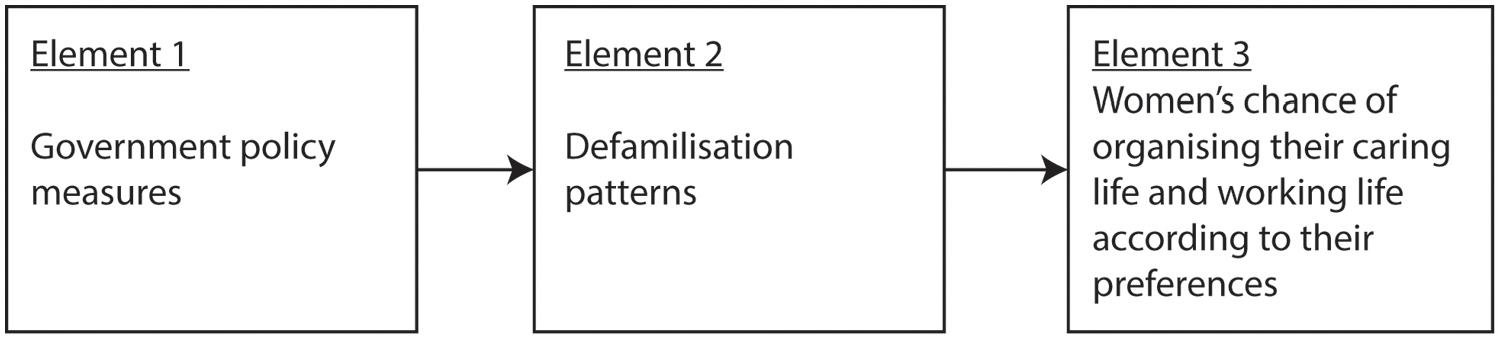
The defamilisation framework.
This framework is useful for drawing attention to important issues concerning the studies of the adult worker model. First, government policy measures may support both the adult worker model and defamilisation at the same time. By promoting care-focused defamilisation, the government may be able to give women more time to take part in formal employment. If their wage is sufficient to support a reasonable standard of living, women can achieve a high degree of economic defamilisation. This implies that the ways that the government promotes the adult worker model have the potential to enhance defamilisation. Second, not all women prefer to organise their life based on the adult worker model. As mentioned, some women may prefer to provide informal care in the family full-time while securing a reasonable standard of living. If the government only focuses on strengthening care-focused defamilisation, it may overlook the difficulties these women face in achieving economic defamilisation. Third, the care relationship in the family involves both care providers and care receivers (such as children and older people). If the government over-emphasises the importance of the adult worker model and does not financially support people to provide informal care in the family, the care receivers may not be able to receive sufficient informal care even if they prefer informal care to formal care. Fourth, government policy measures can have important impacts on the adult worker model. Therefore, to examine the development of this model, it is important to pay attention to the government’s commitment to the provision of policy measures (especially work–family reconciliation measures). However, as discussed in the introduction, there is no guarantee that the government is willing to take an active role in supporting the adult worker model. That is why analysts have drawn attention to two different types of the adult worker model: the supported adult worker model and the unsupported adult worker model (Annesley, 2007; Lewis and Giullari, 2005). The supported adult worker model stresses that the government should play an active role in supporting people to take part in formal employment (Annesley, 2007). In contrast, the unsupported adult worker model emphasises that the government should take as limited action as possible to assist adults to become workers (Lewis and Giullari, 2005).
The defamilisation framework is also useful for drawing attention to issues concerning defamilisation. The first issue is concerned with whether women have sufficient opportunities to choose how to organise their family life while having sufficient resources to maintain a reasonable standard of living. This issue has received widespread concern (Kurowska, 2018; Chau and Yu, 2019). For example, Article 16 of the Universal Declaration of Human Rights stresses these ideas (United Nations, 2023): The references have been updated.
‘Men and women of full age, without any limitation due to race, nationality or religion, have the right to marry and to found a family. They are entitled to equal rights as to marriage, during marriage and at its dissolution’.
‘Marriage shall be entered into only with the free and full consent of the intending spouses’.
‘The family is the natural and fundamental group unit of society and is entitled to protection by society and the State’.
If the government is willing to promote both economic defamilisation and care-focused defamilisation, people will have more opportunities to choose different forms of family life and receive protection from the state. As mentioned above, economic defamilisation stresses the importance of helping individuals to choose how to organise their family life and gain sufficient resources to maintain a reasonable standard of living. As suggested by Lister (1994), this can be achieved through the provision of welfare by the government. With government support, men and women may have more freedom to choose to perform or not to perform different roles in the family, such as the role of the care provider and provider of financial support. They may also be able to make different responses to family relations. These may include rejecting an arranged marriage and stressing equal rights between spouses when dealing with divorce issues. Care-focused defamilisation emphasises the importance of outsourcing care responsibilities from the family to other sectors. By achieving this type of defamilisation, we can protect the family against being overloaded by care responsibilities.
The second issue is concerned with how the government recognises the diverse needs of different types of families. Analysing family change in Europe, Daly (2005: 380) highlights how family is itself ‘a wellspring of change’ in regard to family forms (e.g. a decline in the number of marriages and a growth in lone parenthood), family organisation (e.g. a move towards two-income families), and family relationships and values (e.g. changes in spousal roles). Scholarship highlights the importance of exploring whether and how governments respond to people’s needs and risks arising from these family changes (Daly, 2005, 2020). In this article, we approach the family as a changing institution and as a collection of individuals among those bound together by ties of kinship, marriage, civil partnership, or other forms of arrangements (Daly, 2020; Papadopoulos and Roumpakis, 2019). We posit that families receiving inadequate recognition from the government can be marginalised in the policy-making process and thus vulnerable to risks. For example, if the government only supports parents to organise their life based on the adult worker model, it may overlook the needs of some single-parent families in which the parent mainly wants to be a full-time care provider in the family.
Searching for empirical evidence
This section is intended to present evidence to demonstrate the empirical significance of the issues concerning the adult worker model and defamilisation identified through the discussion of the defamilisation framework. This can provide insights into the discussion of the empirical significance of the government’s pro-adult worker model strategies. To fulfil these goals, we examine the evidence generated from a childcare gap typology. Below we illustrate how this typology was developed before we move on to discuss the evidence.
Childcare gap typology
Three steps were taken to develop this typology: selecting the countries to be covered by the typology, identifying the variables for measuring the childcare gap, and categorising the countries.
The childcare gap typology built for this article covers eight countries (Belgium, Denmark, Germany, France, Austria, Finland, Sweden and the UK). In the welfare typology developed by Esping-Andersen (1990) based on the concept of labour market decommodification, the selected countries differ in their ways of organising welfare in response to market risks. For this reason, they were classified into different groups – Denmark, Finland and Sweden were seen as members of the social democratic group; Austria, Belgium, France and Germany were seen as members of the conservative groups; and the UK was seen as a member of the liberal group. Building on this study by Esping-Andersen (1990), it is reasonable to believe that these eight countries provide a useful observation ground for exploring diverse responses to the adult worker model. It is important to note that there are high-quality comparative data about the childcare leave policies and ECEC policies carried out in these eight countries. These data are provided by the European Commission (2019).
Two variables were selected to measure the childcare gap – the adequately compensated childcare leave and the policy on early provision of ECEC. According to the European Commission (2014), the notion of adequate compensation implies that parents continue to receive a substantial part of their prior earnings during their leave and will not face significant financial difficulties while taking time off work to look after their children. The Eurydice Reports suggest that leave can be seen as adequately compensated if parents receive at least 65% of their previous earnings during the paid period (European Commission, 2019). The policy on the early provision of ECEC refers to the starting age of a guaranteed place in ECEC. There are two ways governments guarantee children an ECEC place – a legal right to a place (legal entitlement) or compulsory attendance.
Table 1 provides the data concerning the adequately compensated childcare leave policy and the policy on the early provision of ECEC carried out in the eight countries. The data show that Denmark, Finland, Germany and Sweden belong to the group marked by a zero childcare gap; whereas in Austria, Belgium, France and the United Kingdom, there are childcare gaps of various degrees.
ECEC and childcare leave (2018).
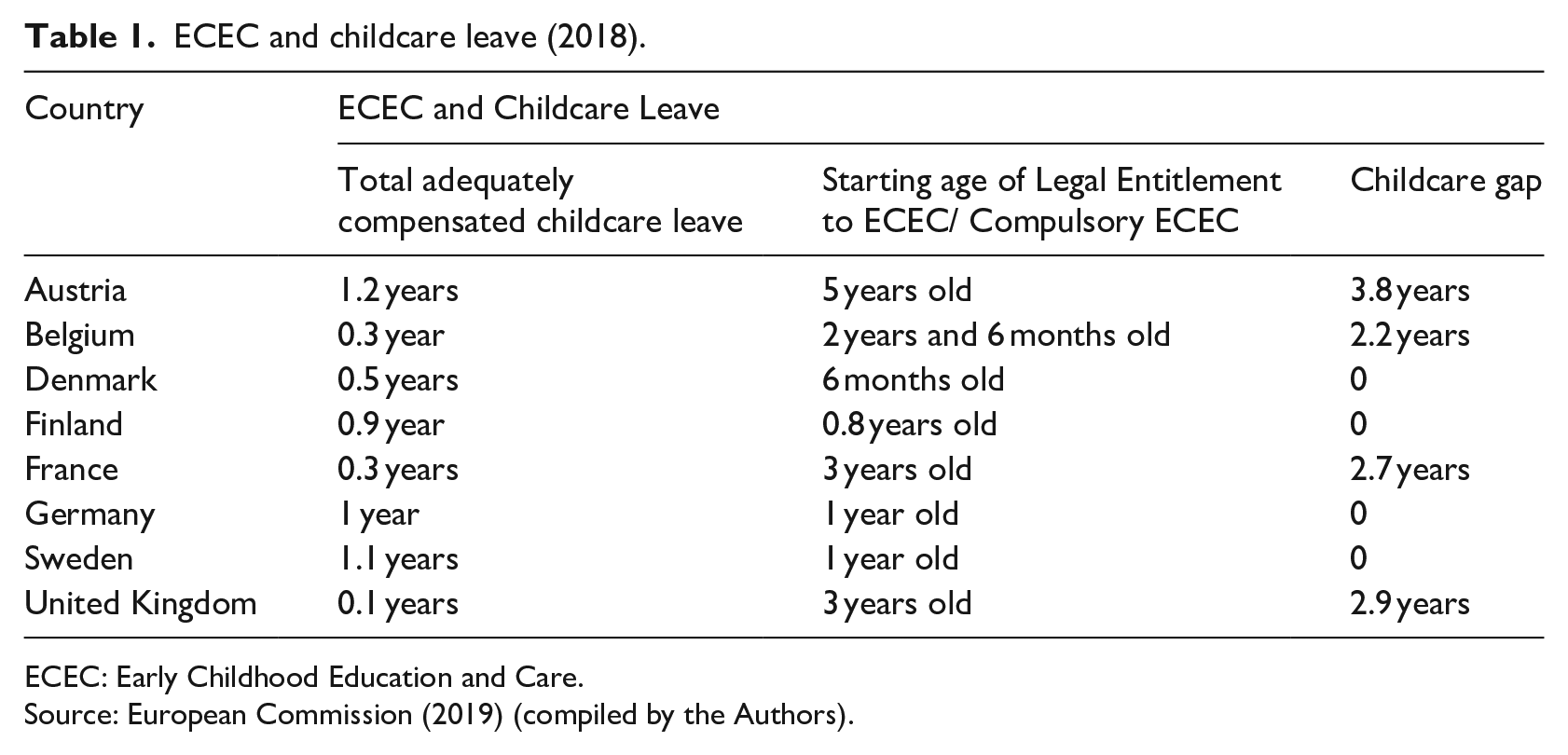
ECEC: Early Childhood Education and Care.
Source: European Commission (2019) (compiled by the Authors).
It is possible that those countries without a childcare gap are keen to achieve a high degree of care-based defamilisation or economic defamilisation or both. To support this view, we provide a more detailed analysis of the childcare leave policies and the policies on early provision of ECEC carried out in the eight countries. This analysis is done by categorising the eight countries’ commitment to the childcare leave policies and policies on early provision of ECEC into three types (the highly committed, the moderately committed, and the lightly committed). The highly committed childcare leave policy provides users with 8 months of adequately compensated childcare leave. The moderately committed childcare leave policy provides users with less than 8 months but more than 4 months of adequately compensated childcare leave. The lightly committed childcare leave policy provides users with less than 4 months of adequately compensated childcare leave. 1 The highly committed policy on early provision of ECEC refers to the policy that guarantees an ECEC place for each child on or before their first birthday. The moderately committed ECEC policy offers an ECEC place for each child between their first and third birthday. The lightly committed ECEC policy guarantees young children an ECEC place after their third birthday (See Note 1).
Based on the data shown in Table 1, it is found that Germany, Austria and Sweden carry out a highly committed childcare leave policy; Denmark, France and Finland implement a moderately committed childcare leave policy; and Belgium and the United Kingdom carry out a lightly committed childcare leave policy. The data also show that Denmark, Germany, Finland and Sweden implement a highly committed policy on early provision of ECEC; Belgium, France and the United Kingdom carry out a moderately committed policy on early provision of ECEC; and Austria provides a lightly committed policy on early provision of ECEC.
In view of these findings, it is evident that countries without a childcare gap have a greater commitment to the provision of childcare leave policy and policy on early provision of ECEC compared with countries with a childcare gap. More details about the eight countries are shown as follows:
Germany and Sweden (highly committed childcare leave policy plus highly committed policy on early provision of ECEC).
Denmark and Finland (highly committed policy on early provision of ECEC plus moderately committed childcare leave policy).
Austria (highly committed childcare leave policy plus lightly committed policy on early provision of ECEC).
France (moderately committed childcare policy plus moderately committed policy on early provision of ECEC).
Belgium and the United Kingdom (lightly committed childcare leave policy plus moderately committed policy on early provision of ECEC).
Discussion
The evidence drawn from the childcare gap typology provides insights into the empirical significance of the issues concerning the adult worker model and defamilisation identified through the discussion of the defamilisation framework.
The first issue is concerned with the role of the government in promoting the adult worker model. The European Commission (2019) stresses that a long childcare gap is likely to lead to one parent (usually the mother) being obliged to drop out of the labour market to take care of the child without adequate compensation. This implies that, by reducing the childcare gap, the government may play an important role in creating favourable conditions for parents to take part in formal employment. However, we should refrain from presuming that governments are willing to do so. The childcare gap typology shows that only four countries have a zero childcare gap.
The second issue is concerned with the connection between the adult worker model and defamilisation. As mentioned in the previous sections, ECEC can serve as a policy instrument for promoting care-focused defamilisation, whereas leave benefits can function as a policy tool for directly enhancing economic defamilisation. Therefore, by using ECEC and leave benefits to reduce the childcare gap, the government can promote both the adult worker model and different types of defamilisation. However, we should not rule out the possibility that the government may pay much more attention to care-focused defamilisation than economic defamilisation. This can occur if the government only stresses the importance of using ECEC to reduce the childcare gap and refuses to provide any childcare leave benefits to parents.
The third issue is concerned with meeting people’s diverse preferences for their roles in the family. As discussed above, some people may prefer to provide informal care in the family full-time instead of taking part in the labour market. One of the ways to meet their preference is to provide childcare leave benefits. However, there is no guarantee that governments are willing to do so. As shown in the childcare gap typology, Belgium and the United Kingdom commit themselves only to a lightly committed childcare leave policy. It is important to note that even the length of the leave benefits provided by those countries committed to a highly committed childcare leave policy is no more than 1.2 years. This means that the financial needs of parents who want to take care of their children full-time until their children start receiving formal education are overlooked. 2
The fourth issue is concerned with the diverse preferences of care receivers. Different care receivers may have different views on the relative desirability of formal care and informal care. It is found that those who prefer to receive formal care through ECEC are given more attention by most of the eight countries than those who prefer to receive informal care. For example, the evidence drawn from the childcare gap typology shows that both Germany and Sweden carry out highly committed childcare leave policies plus highly committed policies on early provision of ECEC. In view of the design of their policies on childcare leave benefits and ECEC, it is clear that the governments in these two countries stress the importance of supporting children to spend more years attending ECEC than financially supporting their parents to provide informal care to their children full-time. 3
The fifth issue is concerned with whether women have sufficient opportunities to choose how to organise their family life while having sufficient resources to maintain a reasonable standard of living. An important way to increase these opportunities is to give parents the options to choose whether to arrange formal care for their children or to provide care by themselves. This can be done by giving a long duration of adequately compensated childcare leave (for example, five years) and supporting those who do not want to receive adequately compensated childcare leave to use ECEC. However, as shown in the childcare gap typology, only Finland and Sweden give parents the choices to use ECEC or adequately compensated childcare leave in a very short period (0.1 year). 4
The sixth issue is concerned with the government’s recognition of the diverse needs of different types of families. As shown in the childcare gap typology, all of the eight governments only provide adequately compensated childcare leave for 1.1 years or less. This suggests that they support parents to become an informal care provider only for a transitional period. This also means that some single-parent families in which the parent prefers to provide informal care full-time are not given sufficient attention in the eight countries.
The discussion of these six issues enables us to explore the empirical significance of the government’s ways for promoting the adult worker model. On the one hand, the importance of government policy measures in shaping people’s working life and caring life and promoting the two types of defamilisation should not be overlooked, given that some countries have achieved the zero childcare gap. On the other hand, attention should be paid to two issues. First, half of the eight countries have not achieved the zero childcare gap. Second, there is no guarantee that those countries (such as Sweden and Germany) with the zero childcare gap can meet the diverse preferences of women and care receivers regarding how to organise their life.
Limitations
The defamilisation framework developed in this article is not without limitations. This framework only covers the input side but not the output side of government policy measures. That is, it focuses on the policy measures used by the government to create favourable conditions for people to choose to organise their life based on the adult worker model. However, there is no guarantee that these policy measures can ensure people’s (especially women’s) active participation in formal employment. To further illustrate this point, we compare the evidence drawn from a ‘women’s relative participation in employment’ typology with the evidence drawn from the childcare gap typology.
To examine the extent to which different countries are keen to facilitate female employment, Bambra (2007) compared women’s participation in the work economy with men’s participation in the work economy instead of focusing only on women. Bambra (2007) explained that this comparison could reduce the influence of different national unemployment rates. With reference to this approach, our study of women’s chances of participating in formal employment is also based on a relative standard. Our focus is on the difference between the male full-time equivalent (FTE) employment rate and the female FTE employment rate. According to the European Institute for Gender Equality (2019), the FTE employment rate provides a useful instrument for conducting comparisons between employed persons despite the variance in their weekly working hours. The FTE unit is obtained by comparing an employee’s average number of working hours to the average number of working hours of a full-time worker.
Table 2 provides information about the ‘women’s relative participation in employment’ typology. 5 When it comes to the difference between female and male FTE employment rates, Denmark, Finland, France and Sweden show lower gap scores than the average of the eight countries. This implies that their differences from the other four countries (Austria, Belgium, Germany and the United Kingdom) should not be overlooked.
Gender full-time equivalent employment rate gaps.
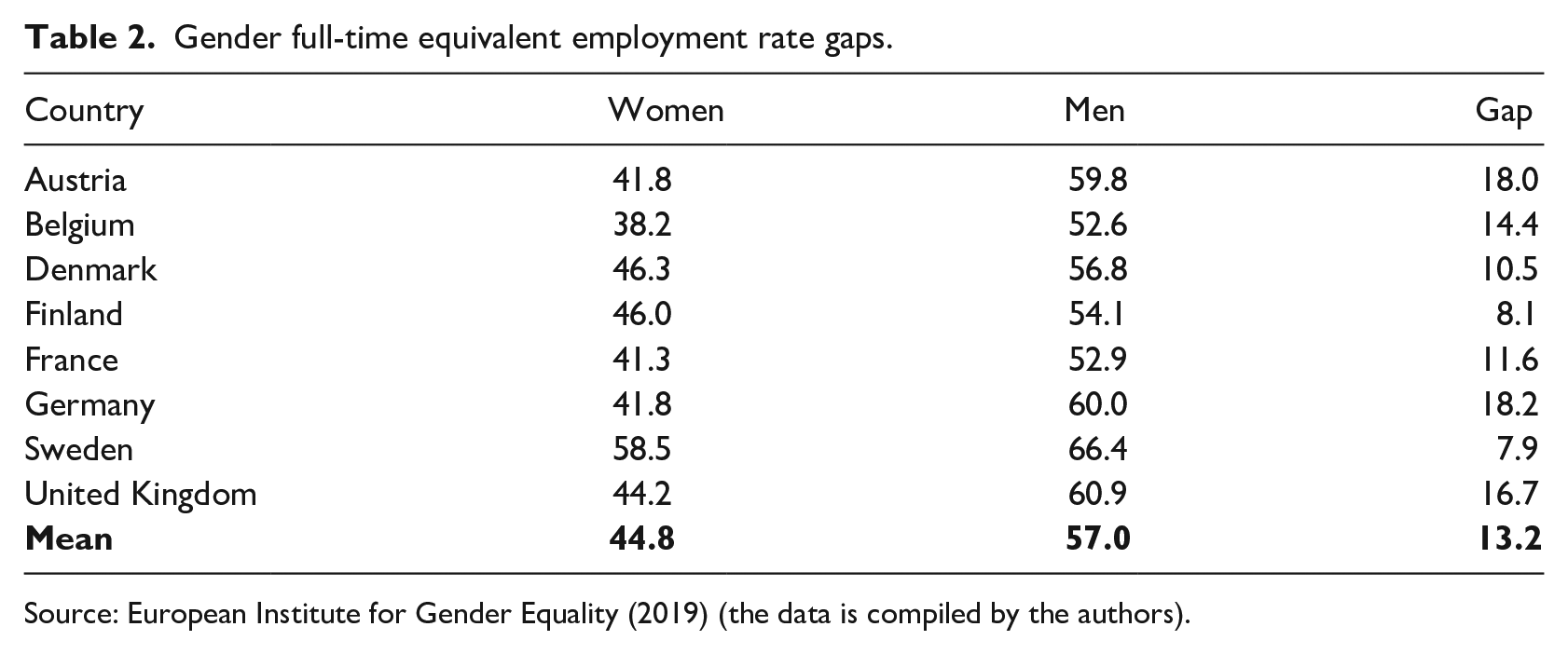
Source: European Institute for Gender Equality (2019) (the data is compiled by the authors).
By comparing the information in Tables 1 and 2, it is found that the classification of the eight countries based on women’s relative participation in employment is not quite the same as that based on childcare gaps. Germany has a zero childcare gap but its gender FTE employment rate gap is wider than the average of the eight countries. France has a childcare gap but its gender FTE employment rate gap is lower than the average of the eight countries. The case of Germany suggests that we should not presume that the government’s proactive intervention strategy can guarantee women’s high participation in formal employment. The case of France suggests that we should not rule out the possibility that the government’s low intervention strategy can be associated with women’s high participation in formal employment.
Macro social work practices
This section is concerned with how the defamilisation framework can inform the development of macro social work practices for enhancing women’s welfare. Facilitating individuals’ self-realisation and addressing social problems are commonly seen as social workers’ missions (Hong Kong Social Workers Registration Board, 2023). It is thus reasonable to expect that social workers contribute to facilitating women to explore the opportunities for choosing different ways of engaging in family relations and formal employment. Marco social work practices can play an important part in meeting this expectation. These practices are concerned with searching for solutions to social inequalities and various forms of oppression that go beyond individual resilience (Reisch, 2016). Their focus is on the community at large and system-level functioning (Lesley University, 2023; Netting et al., 1998; Tice et al., 2019). Tasks undertaken by macro social workers include investigating social issues, advocating for underserved populations, conducting policy analysis, and carrying out community work (Dickens, 2016; Netting et al., 2013).
Investigating the empirical significance of the issues concerning the adult worker model and defamilisation based on the defamilisation framework provides the basis for social workers to carry out macro social work practices. To illustrate this point, we explore how this investigation can help us to set up a policy-analysis-based community project for promoting women’s welfare. This project covers important areas of social work practices used by social workers to influence the policy agenda setting and the search for policy solutions (Corte and Roose, 2020; Pincus and Minahan, 1973). These areas include the implementation of four types of tasks: helping people enhance their problem-solving capacity, establishing initial linkages between people and societal resource systems, building new relationships between people and societal resource systems, and facilitating interaction between people within societal resource systems. 6
Policy-analysis-based community project
The childcare gap typology developed in this article shows that the government’s childcare policies based on the adult worker model do not necessarily provide sufficient opportunities for women to choose to be full-time workers or be informal care providers in the family. To enhance women’s welfare, it is necessary to pressurise the government to do more in addition to the implementation of the pro-adult worker model strategies. To fulfil this purpose, social workers may need to set up a policy-analysis-based community project, which involves the implementation of four types of tasks:
Enhancing women’s problem-solving capacity
One of the ways to carry out this task is to develop a forum for discussing women’s welfare. Social workers may gather women with different preferences regarding how to organise their adult lives and facilitate them to explore shared goals. An example of shared goals is to pressurise the government to give women more opportunities to choose how to organise their family and working lives. In organising the forum for discussing women’s welfare, social workers are also expected to raise awareness that women have the right to voice their views on the definitions of the childcare gap, ways of reducing the gap, and the relative desirability of different combinations of the policies on ECEC and childcare leave benefits.
Establishing initial linkages between women and societal resource systems
To carry out this task, social workers may need to promote community education. Through running community education programmes, social workers can potentially help women identify which government departments and organisations they can contact to discuss issues arising from the childcare gap and the contents of the government policies on ECEC and childcare leave benefits.
Facilitating interaction between women and societal resource systems
An important way to carry out this task is to encourage women to express their views through such activities as holding press conferences and organising petitions. By doing so, women may be able to enhance policymakers’ understanding of the importance of recognising women’s different preferences regarding how to organise their life.
Facilitating relationship-building between people within societal resource systems
One of the possible ways to implement this task is to provide staff training programmes for the government. By doing so, social workers may gain the opportunity to discuss with policymakers how to respond to women’s different views on the childcare gap and the desirability of the government policies on ECEC and childcare leave policies. This may enable social workers to persuade the government to commit more to ECEC and childcare leave benefits.
In summary, the implementation of the four types of tasks provides social workers with opportunities to make important changes – these include enhancing more women’s awareness of their rights to revise government policies and enabling policymakers to understand more about the importance of facilitating women to choose to be a worker or to be an informal care provider through revising the existing policies on ECEC and leave benefits. The difficulties in bringing these changes, however, should not be overlooked. The government may not be willing to devote sufficient resources to the provision of ECEC and leave benefits. Vested interests may be reluctant to make changes. Despite that, it is still worth trying to implement the above-mentioned tasks. By doing so, we may be able to increase the chance of making the public become more aware of the importance of using the defamilisation framework to identify women’s preferences regarding how to organise their life and to assess government policies on the adult worker model and defamilisation.
Conclusion
This article presents the defamilisation framework and reveals how this framework can contribute to the discussion of important issues concerning the adult worker model and defamilisation. It explores the empirical significance of these issues based on evidence drawn from the childcare gap typology and offers directions for developing macro social work practices for enhancing women’s welfare.
Future studies can build on the defamilisation literature to extend existing discussions of the adult worker model and macro social work practices. Family provides care for not only young children but also other family members, such as middle-aged and older people. It is thus recommended that the discussion of care-based defamilisation should be extended to cover care arrangements for different groups of people. There is also an urgent need to develop more high-quality and comparable data concerning how different countries organise different kinds of welfare. This can enable us to find out more empirical examples of the issues drawn from the discussion of the defamilisation framework, which, in turn, can provide a stronger empirical basis for the development of macro social work practices.
Footnotes
Declaration of conflicting interests
The authors declared no potential conflicts of interest with respect to the research, authorship, and/or publication of this article.
Funding
The authors received no financial support for the research, authorship, and/or publication of this article.
