




Abstract
This study used nationally representative data from the China Longitudinal Aging Social Survey 2018 to investigate correlations between older people’s productive aging activities and their life satisfaction. The results show that volunteering and grandparenting are positively associated with life satisfaction in older adults, although more so in the rural sample. Furthermore, working is positively associated with life satisfaction in urban older adults, while an opposite relationship was found among rural older adults. The findings imply that properly encouraging the productive engagement of older adults might be a win-win strategy in actively coping with the challenges of population aging.
Keywords
Introduction
Due to the large and rapidly growing older population, actively coping with population aging has become China’s latest national strategy (Lin, 2021). Productive engagement by older adults (e.g. working, volunteering, and caregiving) is one of the global solutions to meet the challenges of population aging (Morrow-Howell et al., 2001). In some respects, however, the idea of increasing the involvement of older adults in paid or unpaid work is probably at odds with traditional perspectives on the role of elders in China (Sherraden, 2010). Therefore, a more comprehensive understanding of the relationship between productive engagement and the well-being of older adults is necessary.
The productive aging agenda is not to exploit older adults (Hinterlong and Morrow-Howell, 2001). It is important to pay attention to the outcomes and subjective well-being of older people who participate in productive aging activities (Lum, 2013). Although previous studies have documented the positive association between certain kinds of productive activities and life satisfaction in older adults (Arpino et al., 2018; Russell et al., 2019; Tang et al., 2018), few have compared the influences of different forms in a single study. There is even less information available on how different forms of productive engagement will affect life satisfaction among older Chinese adults. In addition, it is unclear whether and how urban–rural differences in employment, volunteering, and intergenerational relationships will be related to the life satisfaction of older Chinese adults, given the large gaps in urban–rural lifestyles.
Accordingly, the main objective of the present research is to understand the associations between different forms of productive engagement and life satisfaction in older Chinese adults and to further identify whether the aforementioned relationships differ across urban and rural residential areas.
Factors influencing life satisfaction among older adults
Life satisfaction is a person’s subjective cognition toward life quality (Kanning and Schlicht, 2008). It denotes a person’s evaluation and judgments of their own life which compare real circumstances with what is thought to be an appropriate standard (Diener et al., 1985). Previous studies have shown that lower levels of life satisfaction in adults are associated with poorer psychological health (Tate et al., 2003), higher risks of mental health problems, mortality (Koivumaa-Honkanen et al., 2000), and suicide (Koivumaa-Honkanen et al., 2001). Life satisfaction has therefore been regarded as an important comprehensive indicator of happiness and subjective well-being in older adults (Gana et al., 2013), and understanding the factors influencing life satisfaction is, therefore, necessary.
The existing literature suggests that sociodemographic characteristics, physical and psychological health, social relationships, living environment, and social participation are the main factors that influence life satisfaction in older adults. Among the sociodemographic characteristics, age was found to be negatively associated with life satisfaction (Kim and Sok, 2012). The education level was reported to be positively related to older people’s life satisfaction (Liao et al., 2012). Older adults who are married reported higher life satisfaction (Lee and Lee, 2013), which was also strongly predicted by higher levels of economic satisfaction and financial adequacy (Katz, 2009). However, it was observed to be lower for older adult individuals living alone, compared to those living with family members (Liao et al., 2012).
Health and physical and psychological functioning abilities are also strong predictors. Life satisfaction was positively affected by older persons’ mobility (i.e. ability to move, drive, and independently use transportation; Lee and Choi, 2020) and self-rated health (e.g. Borg et al., 2006; Ng et al., 2017). It can also be positively explained by psychological well-being and resilience (Reyes et al., 2020) and determined by social and family support (Lee et al., 2020). In addition, older adults’ perceptions of environmental age-friendliness were associated with their life satisfaction (Xie, 2018).
Some studies have also suggested that regularly participating in physical, leisure, and voluntary activities may significantly increase life satisfaction among older adults. For instance, in the Philippines, participation in physical activities (e.g. walking, dancing, playing) and activities with formal support networks (e.g. church/religious and community/organizational activities) are statistically significant predictors of life satisfaction among older adults (Blace, 2012). Older adults in China with higher mobility impairments are often less satisfied with their life since they do not usually participate in social activities (Li and Loo, 2017). In the next section, we further delineate the relationships between older adults’ participation in productive activities and their subjective well-being.
Productive aging and subjective well-being among older adults
A productive aging perspective means addressing the challenges of an aging population by drawing on the capacity, abundant human capital, and other social-cultural values of the older population (Morrow-Howell and Wang, 2013). Specifically, older adults can continue to contribute to society through market activities, non-market activities with economic value, formal social and civic activities, and informal social assistance (Sherraden et al., 2001). In a cross-cultural framework on productive engagement in later life proposed by Morrow-Howell and Wang (2013), volunteering, working, and caregiving are suggested as three productive behaviors that can affect an individual’s quality of life. Many empirical studies also support that these forms of productive engagement in the later stages of life have significant positive effects on older adults’ physical and mental health and psychological well-being (e.g. Hinterlong et al., 2007; Sherraden et al., 2001).
Volunteering is an important facet of productive aging. Several studies have shown a positive relationship between volunteering and subjective well-being in older adults. For instance, Van Willigen (2000) discovered that older adult volunteers experienced a greater increase in life satisfaction over time, especially when volunteering more frequently. Moreover, Russell et al. (2019) found that volunteering can mitigate the negative effects that low self-esteem has on adults’ sense of belonging and life satisfaction. In addition, Greenfield and Marks (2004) deemed that being a formal volunteer was associated with more positive effects and moderated the negative effect of having more major role-identity absences on respondents’ sense of life purpose.
Extensive research supports the positive relationship between employment and life satisfaction. Those aged 65 years and older who are still active in the labor market are more satisfied with their lives than their retired peers (Conner et al., 1985). A more recent study by Tang et al. (2018) found a significant positive relationship between employment and life satisfaction among middle- and old-aged adults in rural and urban China. However, poor work environments and excessive work had negative effects on older adults’ quality of life (Westerlund et al., 2009).
Conclusions about the relationship between grandparenting and grandparents’ life satisfaction have been inconsistent. For instance, in a comparative study covering 20 countries in Europe, Arpino et al. (2018) found that grandparental childcare, regardless of intensity, is generally associated with higher life satisfaction. Young and Alice (2014) reached a similar conclusion about satisfaction with being grandparents. Other studies, however, have contradicted the aforementioned views on grandparenting. Some researchers found that caregiving grandparents reported higher levels of physical tiredness, having less privacy and time for themselves (Jendrek, 1993), and even harboring feelings of exploitation (Goodfellow and Laverty, 2003).
The literature review suggests that productive aging activities, such as grandparenting, volunteering, and paid work, are closely associated with subjective well-being in older adults. But the influences of different forms of productive aging activities on life satisfaction in older adults remain inconsistent. In addition, most previous studies have focused on one or two activities, and the effects of all three activities have not been discussed in a single study. However, investigating multiple activities in a single study has become a trend, since most older adults engage in multiple activities simultaneously in daily life (Morrow-Howell et al., 2014). Therefore, it is necessary to compare the different roles of productive engagements in older adults’ life satisfaction.
Productive aging and the division of rural and urban regions in China
China’s population aged 60 years and older exceeded 10 percent of the total population in 2000. China has been experiencing rapid population aging since then. According to China’s National Bureau of Statistics (CNBS, 2020), the country has more than 250 million citizens aged 60 years and older in 2020, accounting for 18.1 percent of the total population. To meet the challenges of the transition of population age structure, actively coping with population aging has been established as a national priority in China (Xi, 2020). Encouraging older adults to participate in the social, economic, and family domains becomes one of the primary policy responses (The State Council of the PRC, 2017). However, engagement in productive activities is not the final outcome; whether participating in these activities has positive associations with well-being among the older Chinese population is also the focus of the active aging strategies. Therefore, this study will focus on the effects of working, volunteering, and grandparenting on older adults’ life satisfaction in China.
While the average life expectancy in China reached 77.3 years in 2019, the mandatory retirement age is lower than that in most aging societies (60 years for male workers; 50 years for female workers, and 55 years for female cadres). More importantly, due to China’s special economic and social background, the long-standing dualistic urban–rural system has resulted in great differences in labor and pension systems in China. For most urban laborers, retirement is mandatory, which leaves them with only a few working opportunities, but generous pension support after retirement. In contrast, retirement is not a necessity for older adults in rural areas, but they usually earn a low income and are covered by a significantly lower level of pension support during old age (Ravallion and Chen, 2007). Thus, continuing to work after retirement is more of a self-fulfilling or self-actualizing process for the better-secured urban older adult, while older adults in rural areas are more likely to continue working for a living (Sun et al., 2014). Considering this, working into old age may have different impacts on life satisfaction in urban and rural older adults.
Due to the early retirement age and restricted opportunities for paid work, participating in voluntary activities is an alternative for older adults in China to lead more productive lives. However, the urban–rural differences in voluntary activities are also stark in China (Sun et al., 2014). In recent years, a growing number of formal and large-scale voluntary organizations have sprung up in urban areas, providing better chances and more choices for urban residents to formally engage in volunteerism. In rural areas, where formal channels for civic participation are not well developed, older adults usually participate in various informal activities, such as taking care of the eldest in the village or helping their neighbors organize weddings or funerals (Li, 2019).
In addition, due to under-developed social care services for children under 3 years, grandparenting becomes a common arrangement for maximizing the family’s welfare. According to CNBS, although the average household size in China is decreasing, the proportion of linear families with three or more generations has been holding steady. Especially in rural areas, where a large number of young parents migrate to cities for work and leave their children behind, grandparents usually take full responsibility for raising their grandchildren.
According to the literature review, there are abundant studies suggesting productive aging activities (i.e. working, volunteering, and grandparenting) are associated with better life satisfaction in older adults. Nevertheless, related studies on Eastern cultural traditions are relatively insufficient. Particularly, it is unclear which form(s) of productive engagement is/are associated with better life satisfaction among the older Chinese population. Even less is known about how urban–rural differences in employment, volunteering, and grandparenting are linked to life satisfaction. In this study, we employed a series of regression models based on survey data from a nationally representative sample of older Chinese adults to answer these questions. Answering these questions is of great practical and theoretical importance for improving the subjective well-being of older adults. Furthermore, the findings can provide implications for policymakers to promote productive aging in response to population aging.
Methods
Data
Data for the present analyses were obtained from the China Longitudinal Aging Social Survey CLASS 2018 conducted between October 2018 and January 2019 by the National Survey Research Center at the Renmin University of China, which used a multistage, stratified probability sampling method. A total of 134 counties were selected from 29 provinces as the primary sampling unit, from which 462 urban and rural communities were randomly chosen as the secondary sampling unit (SSU). Due to the population migration trend, the separation of registered and actual residence is not unusual in China. Therefore, CLASS used a mapping sampling method to obtain a complete list of households with older adults in each SSU. Then, they utilized the list as the sampling frame to sample households first, and after that, one older adult over 60 years would be randomly selected within each household for a face-to-face interview. A total of 11,550 participants were chosen, and 11,418 answered the questionnaire, of which 6529 were from urban areas and 4889 were from rural areas. The response rate was 98.86 percent for the total sample. This study used a sample of 9095 after participants with missing responses in any of the necessary variables were excluded.
Measures
Life satisfaction
Following previous studies (Li et al., 2015; Yu et al., 2020), we used the question, ‘Overall, how satisfied are you with your life at the moment?’ to measure older adults’ life satisfaction. The interviewees could choose from among five answers from 1 (not at all satisfied) to 5 (completely satisfied).
Productive activities
Based on the cross-cultural framework of productive engagement in later life, we measured three aspects of productive activities: paid work, volunteering, and grandparenting. In this study, paid work indicates any work that provides monetary payment to the respondents, including both full-time and part-time jobs. Participants were asked, ‘How often do you participate in a paid working activity?’ Those who did not work at all were coded as 0; otherwise, they were coded as 1. Volunteering refers to formal voluntary services that are undertaken by willing individuals and structured by an organization (Cnaan et al., 1996). Participants were asked about how frequently they participated in community security patrolling, environmental protection, and voluntary services that require professional skills in the past year. Those who had participated in at least one voluntary activity were coded as 1, while 0 indicates no participation at all. Grandparenting means grandparents providing care to their grandchildren to support the parents, whether it is daily babysitting or custodial, and whether they live together or not (Duflos and Giraudeau, 2021; Jang et al., 2022). Respondents were asked, ‘How much time did you spend taking care of a grandchild in the past 12 months?’ Grandparents who provided childcare at least 1 hour a day, on average, were coded as 1, while those who had no grandchildren or did not provide childcare were coded as 0.
Covariates
Age is a continuous variable ranging from 60 to 101 years (mean age = 71.41 years, SD = 7.33). Gender (0 = female, 1 = male), marital status (0 = no spouse, 1 = spouse), and residential area (0 = rural, 1 = urban) are binary variables. Educational attainment was measured on a 5-point scale from ‘illiterate’ to ‘college and above’. Self-rated health was also measured on a 5-point scale from ‘very unhealthy’ to ‘very healthy’. The abbreviated version of the Lubben Social Network Scale (LSNS-6; Lubben et al., 2006) was used to measure family relationships (range, 0–15) and friendships (range, 0–15); the higher the score, the more social networks and social support the participants had.
Analytical approach
We first conducted univariate and bivariate analyses to describe the sociodemographic characteristics, life satisfaction, and productive activities in the total sample, and the urban and rural subsamples. Chi-square tests and t tests were employed to test the significant differences between rural and urban samples. We then used t tests to examine the relationships between different productive activities and life satisfaction. Finally, we conducted a series of regression models. Model 1 examined the effects of all the covariates on life satisfaction. Models 2–5 included three kinds of productive activities. Models 6–9 introduced the interaction forms of residency and productive activities to assess the moderating effect of the living area. We used Stata version 14.0 for all analyses.
Results
Productive engagement profile of older Chinese adults
As shown in Table 1, the participation rates in volunteering (24.50%), paid work (24.95%), and grandparenting (26.50%) were very close to each other in the total sample. However, the distribution of each activity by residential area was very different. The results were statistically significant in both volunteering (χ2 = 115.86, p < 0.001) and paid work (χ2 = 1300, p < 0.001). In the urban sample, the participation rate in volunteer work was 29.77 percent, which was almost 10 percent higher than that of the rural sample (20.03%). Nevertheless, the opposite could be observed for paid work, which had a participation rate of 39.72 percent in the rural sample and 7.49 percent in the urban sample. No difference was found between urban and rural samples in grandparenting (χ2 = 0.09, p = 0.759). These results followed social and institutional development in rural and urban China.
Description of analytic variables of the sample.
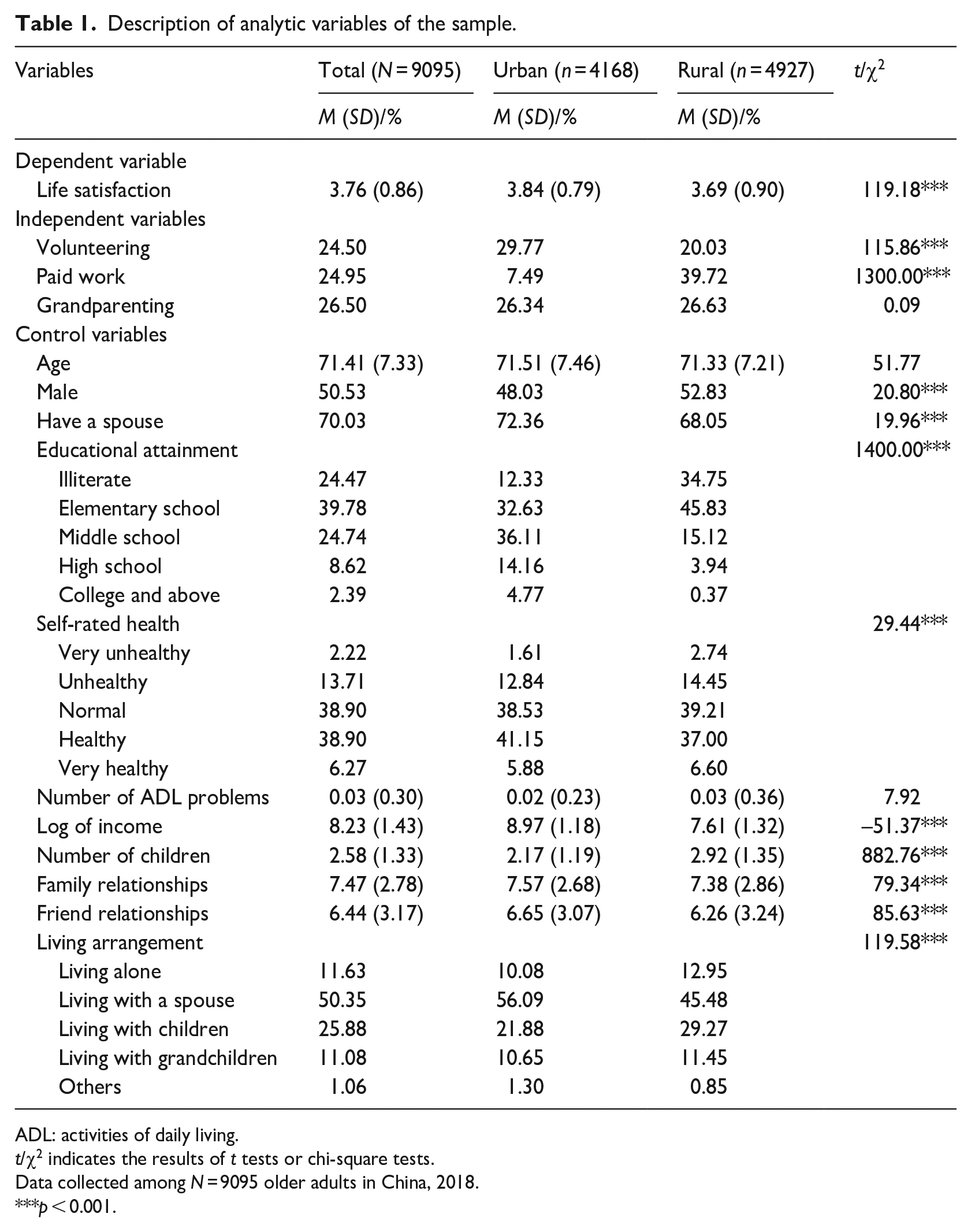
ADL: activities of daily living.
t/χ2 indicates the results of t tests or chi-square tests.
Data collected among N = 9095 older adults in China, 2018.
p < 0.001.
Productive engagement and life satisfaction
Table 2 shows the results of the descriptive analysis for life satisfaction and productive activities. Those who participated in one or more of the three kinds of productive activities in the total sample had higher levels of life satisfaction than those who did not (volunteering: 3.97 vs 3.70; paid work: 3.97 vs 3.70; grandparenting: 3.85 vs 3.73). The same relationships were found in the urban sample (volunteering: 3.97 vs 3.79; paid work: 4.03 vs 3.82; grandparenting: 3.89 vs 3.82). In the rural sample, similar results were found in all activities except paid work (3.67 vs 3.71), which suggested that rural older adults who participated in paid work tend to be less satisfied with their life than those who did not.
Significant relationship between life satisfaction and productive activities.
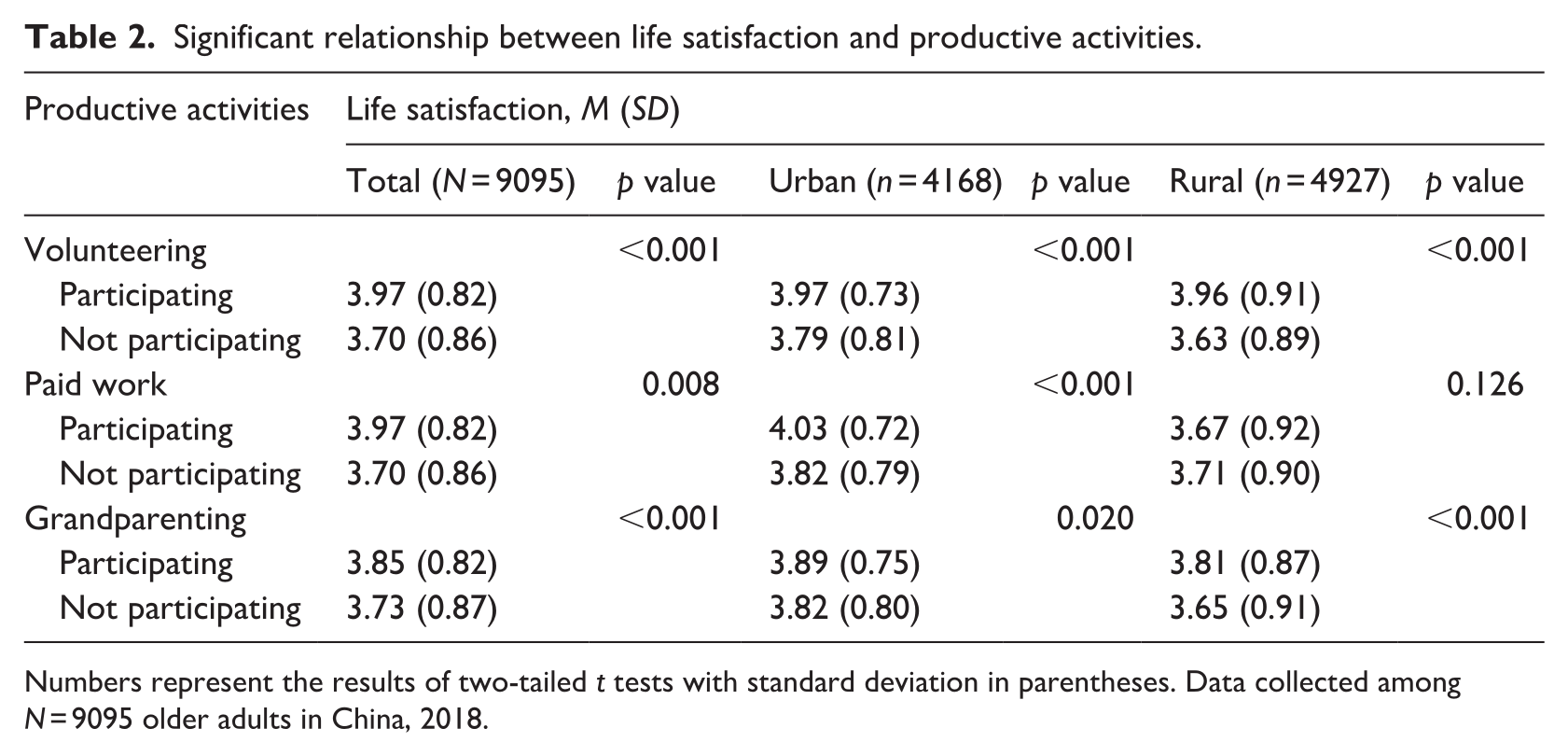
Numbers represent the results of two-tailed t tests with standard deviation in parentheses. Data collected among N = 9095 older adults in China, 2018.
Table 3 shows the results of the regression analyses of life satisfaction on productive activity. Model 1 only includes the control variables and explains 13.4 percent of the total variance. After including volunteering in Model 2, R2 rose to 0.141, which indicates that voluntary activity did explain part of the variance in life satisfaction after controlling for other factors. The coefficient (β = 0.176, p < 0.001) also suggests a significantly positive association between volunteering and life satisfaction. Similarly, grandparenting (β = 0.073, p < 0.001) was positively associated with life satisfaction, while no significant correlation was found between paid work and life satisfaction (β = −0.031, p = 0.149). Given that older adults may simultaneously engage in multiple activities (Chen et al., 2018; Morrow-Howell et al., 2014), we put the three productive activities into Model 5 to examine the independent impact of each activity. The results indicate that after considering participation in other activities, volunteering and grandparenting showed stably positive relationships with life satisfaction in older adults.
Linear regression results of productive activities and life satisfaction.
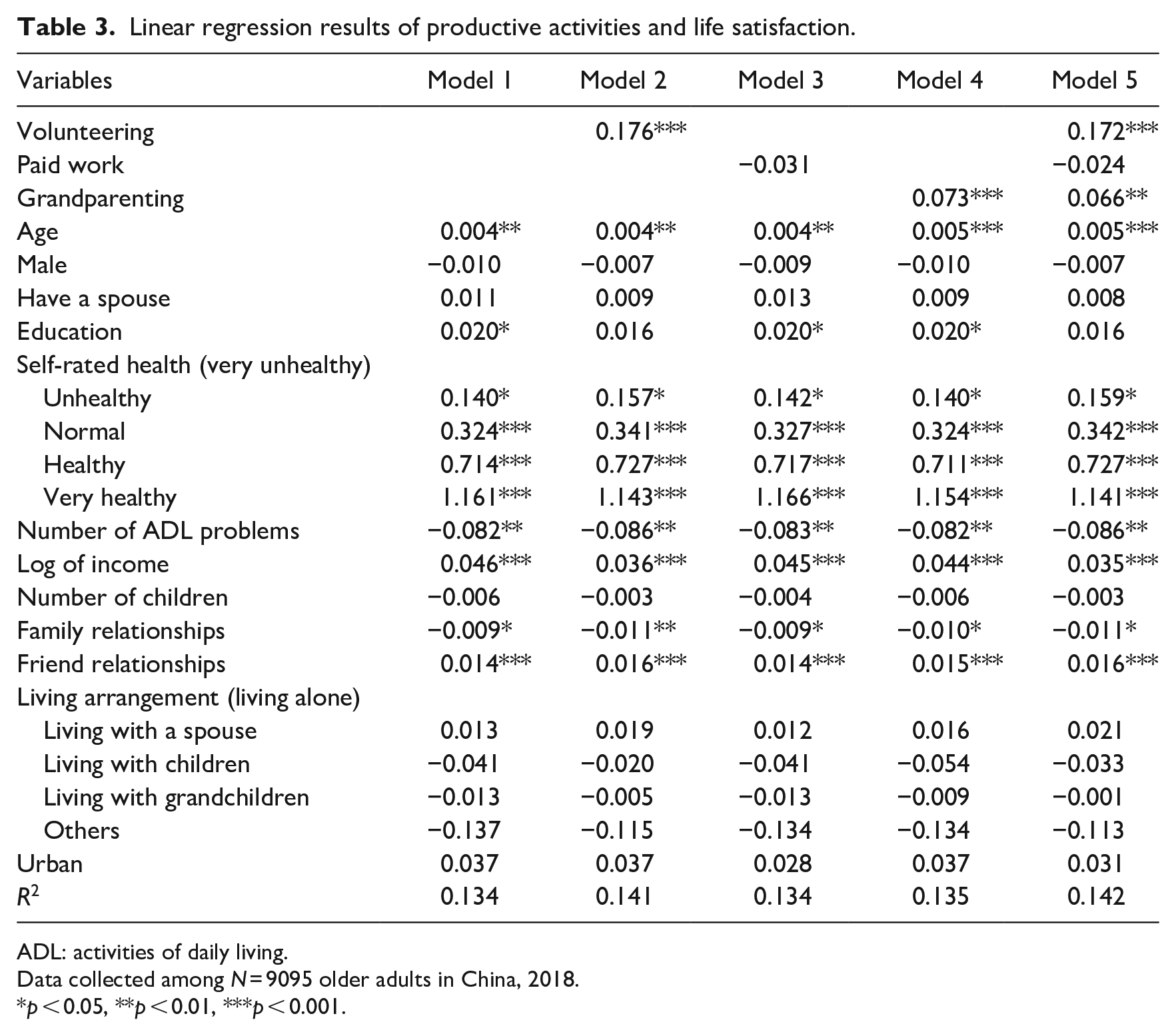
ADL: activities of daily living.
Data collected among N = 9095 older adults in China, 2018.
p < 0.05, **p < 0.01, ***p < 0.001.
Differences between urban and rural areas
To examine the moderation effect of residency, we included three interaction terms in Models 6–9 (see Table 4). These three interaction terms were all statistically significant, which suggests that the effects of volunteering, paid work, and grandparenting on life satisfaction differed by the living area. In rural areas, volunteering and grandparenting had a positive relationship with life satisfaction, while paid work was negatively associated with it. Quite in contrast, the total effect of paid work on life satisfaction in the urban sample was opposite to that in the rural sample, indicating that working might be beneficial to the life satisfaction of older adults in urban areas. In addition, even though volunteering and grandparenting were positively associated with life satisfaction in urban areas, the impact was smaller than that in the rural sample.
Moderating effects of living area on the relationship between productive activities and life satisfaction.
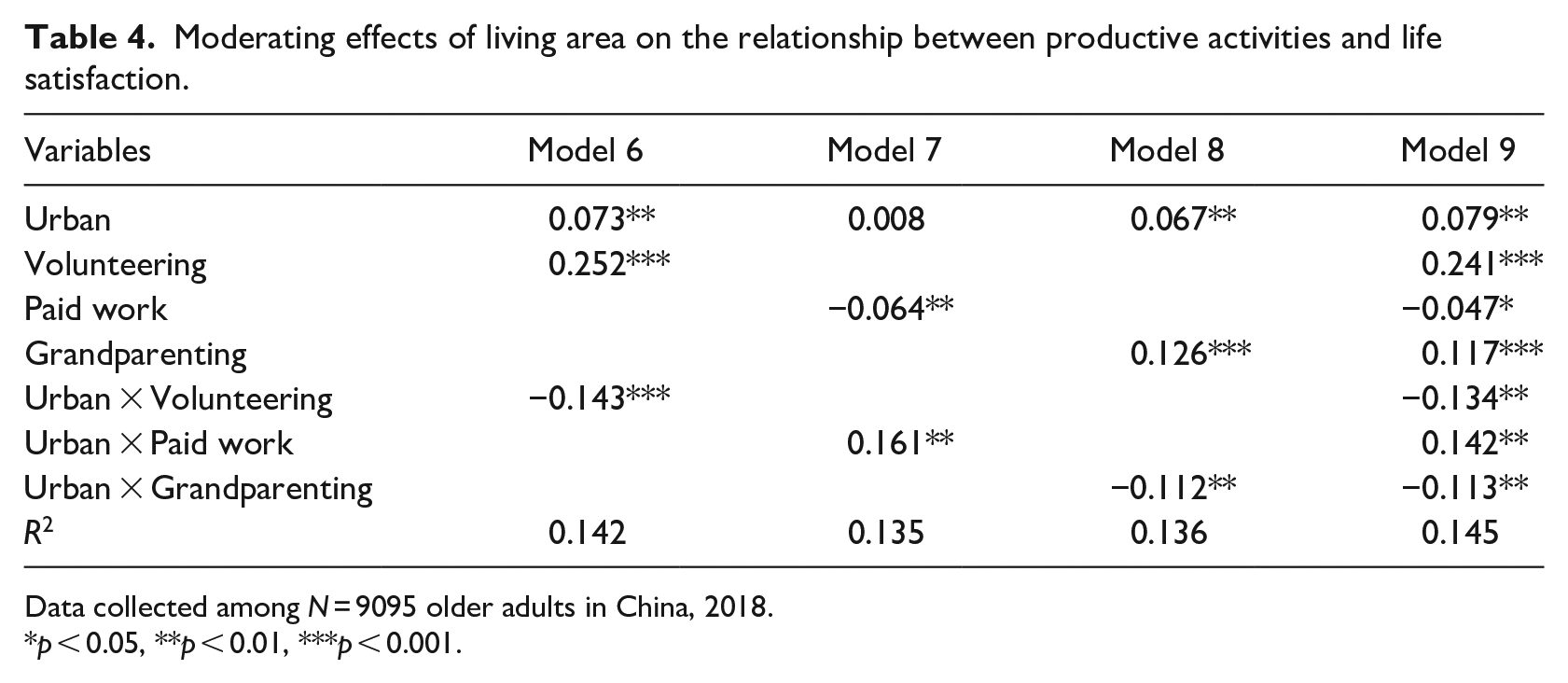
Data collected among N = 9095 older adults in China, 2018.
p < 0.05, **p < 0.01, ***p < 0.001.
Discussion
This study used national data from the CLASS (2018) to explore the associations between productive activities (i.e. volunteering, paid work, and grandparenting) and life satisfaction among older Chinese adults. The findings partly supported the positive associations between productive engagement and life satisfaction among older adults in China. In general, volunteering was positively associated with life satisfaction in older adults. In rural areas, older adults’ life satisfaction was positively associated with grandparenting but negatively influenced by working. In urban areas, however, grandparents’ life satisfaction was marginally better than that of non-grandparents, while working older adults’ life satisfaction was significantly better than that of non-working older adults.
Consistent with previous studies (Russell et al., 2019; Van Willigen, 2000), our findings indicated that older adults could benefit most from participating in voluntary activities. Due to retirement restrictions and the passing of relatives and friends, older adults are more likely to suffer from losing roles (Havighurst et al., 1968). Therefore, becoming a volunteer may compensate for these losses and provide a sense of belonging and purpose (Hooyman, 2002). Especially in China, where the collectivist culture matches the spirit of utter devotion in volunteering to a large extent, many older volunteers are motivated by altruism to help others (Du et al., 2015). Interestingly, although urban areas have more voluntary institutions and programs that provide older adults in urban areas with more opportunities, older adults in rural areas benefited more from volunteering in our sample. One potential explanation is that urban older adults have better pension security and living environments so that they have multiple alternatives to volunteering, such as participating in lifelong learning or other leisure activities, which may also contribute to life satisfaction (Blace, 2012). Another possible reason is that most rural older adults still live in an acquaintance society, where they have a smaller range of daily life activities and strong neighborhood ties (Li, 2019). Hence, they are more likely to participate in voluntary services with people they know or to help people they know, as compared to their counterparts in urban areas. In other words, the line between formal volunteering and informal mutual help is less clear in a rural village. Thus, volunteering might play a more important role in strengthening core social relationships with friends that promote life satisfaction.
Paid work had no significant effect on the total sample. This result was largely due to the contradictory influences of working on life satisfaction in rural and urban samples. Most older adults living in urban areas have to retire when they turn 60 years, even though a growing number of older adults wish to work longer owing to increasing life expectancy and higher educational attainment (Sun et al., 2014). On the contrary, there is no mandatory retirement age in rural villages and people can work as long as they want. Over the last three decades, China has experienced a large rural-to-urban migration (Liang, 2016). Many young people migrated to urban cities for superior employment and opportunities, leaving their older parents in the village to work on the farm. Moreover, due to a low level of old-age pensions in rural areas, rural older adults usually have to continue working as long as their health conditions allow them to earn a living. The different working industries in urban and rural areas represent another main reason behind these contradictions. Older adults in rural areas mainly engage in the first industry, which requires more intensive labor but provides a low level of income. However, those who wish to work longer usually do so in government organizations, or as professional technical personnel, which requires a low level of labor intensity and better income (Guo, 2018). Combined with the findings of Westerlund et al. (2009), this finding suggests that China faces dual contradictions in that older adults in urban areas have insufficient employment opportunities, while those in rural areas feel more compelled to work.
Our findings support the idea that taking care of grandchildren is good for the subjective well-being of older adults (Arpino et al., 2018; Triadó et al., 2014; Wang, 2018; Young and Alice, 2014), even though this relationship is at a very marginal level among urban samples. Generally, urban older adults with higher educational attainment are likely to have more resources and opportunities to participate in other activities (Arpino et al., 2018). Thus, the positive impact of grandparenting on their life satisfaction may be partly offset by depriving them of the time and opportunities to participate in activities they prefer. More importantly, due to the outflow of the rural young labor force to cities, rural older adults are more likely to live in skipped-generation households. Their children’s migration to cities might disrupt family ties, while taking care of grandchildren could hopefully provide them with better emotional support to a large extent. In addition, taking care of grandchildren may increase their interactions with their children and receive more social support from them, which can further contribute to better life satisfaction (Li and Zhang, 2022).
This study has several limitations. First, although some researchers argue that using the narrowest definition of productive engagement will advance knowledge more quickly (Morrow-Howell and Wang, 2013), it might be challenged by a broader view considering other kinds of productive activities outside of those included in the narrow definition. For instance, some researchers take capacity-developing activities such as learning and training into consideration, since they can develop skills for narrowly defined activities (Bass, 1995). Future studies can consider other activities, such as lifelong learning and vocational training. Second, this study divided the total sample into rural and urban subsamples by the type of household registration. We could not distinguish older adults with a rural hukou 1 who migrated or were left behind. Jin and Liu (2017) concluded that although grandparenting can improve the life satisfaction of both floating and left-behind older adults, a high caring intensity would impede floating older people’s social integration, thus reducing their life satisfaction. Grandparenting patterns and problems faced by migrating older adults might more closely resemble those of urban residents. However, the influence on our results is acceptable, considering that this group is rather small.
Implications and conclusion
It should be noted that the total explanatory powers of our models are not strong. One explanation is due to the complex influential mechanisms of each activity on life satisfaction which we have discussed before. Another possible reason is that implementing an active aging strategy is at the initial stage in China, and more policies and programs that could ensure more positive outcomes for older adults are needed to support the development of productive aging activities. The findings of this study have important implications for social policies that encourage the productive engagement of older adults in actively coping with the challenges of population aging.
As suggested by the 14th 5-year national plan published in 2021, China will progressively postpone the legal retirement age. Our findings support that this policy may be a win-win strategy by showing that paid work is positively associated with life satisfaction in urban older adults. Thus, postponing the legal retirement age, implementing a flexible retirement system, reducing age discrimination in the labor market, and providing vocational skills training to older adults are necessary to optimize urban older adults as human resources. In rural areas, improving the social security level could protect older adults from ‘compelled labor participation’. In addition, our findings indicate that the value of having older volunteers in rural areas has been underestimated. A large number of young and middle-aged rural laborers have migrated to urban areas because of urbanization, and those older adults who have been left behind in the village may play a bigger role in home care and community governance through volunteering. In addition, our findings suggest that the productive role and value older adults provide need to be acknowledged, particularly in China, where grandparenting is a typical form of assistance offered to families (Settles et al., 2009). However, social services for child care should be developed to ensure that grandparenting is a choice, not a responsibility for older adults.
In conclusion, encouraging older adults to play a productive role in old age is not only beneficial for the sustainable development of our aging society but also provides the older adult a legitimate right to enrich their lives. Due to the dualistic Chinese system and differences in opportunities and resources, urban and rural older adults may have different feelings about the same social participation type. We can only promote productive engagement activities by differentiating the effects they have on life satisfaction in older adults. Doing this can stimulate their motivation and willingness to lead productive lives within their means during old age.
Footnotes
Declaration of conflicting interests
The authors declared no potential conflicts of interest with respect to the research, authorship, and/or publication of this article.
Funding
This research was conducted by the research fund of the National Office for Philosophy and Social Sciences (21ZDA106).
