




Abstract
Although the number of studies on burnout in social work has increased in recent years, research is still scarce. A similar situation occurs in the area of studies on the effects of mindfulness in this profession, although the research topic has increased exponentially. Based on a quantitative analysis, our study proposes a structural equation model that relates the constructs of burnout, areas of worklife, and dispositional mindfulness among social workers. Results suggest that high levels of mindfulness as well as consistency in the areas of worklife have predictive and preventive effects on the incidence of burnout in social work.
Theoretical framework
Although the number of investigations on burnout in social work has grown in recent years, most of them have focused on the health and education professions (Gil-Monte, 2011). Research about the effects of mindfulness on burnout, empathy, self compassion (Gracia Gonzalo et al., 2019), perceived stress (DiCarlo et al., 2020), and job satisfaction (Choi and Koh, 2015) has also grown widely (Tovar García and García-Campayo, 2017), but only a few studies have focused specifically on the profession of social work (Crowder and Sears, 2017; Harker et al., 2016; Samios, 2018; Thomas and Otis, 2010).
This study intends to provide a contribution to the analysis of the relationship between burnout and mindfulness, specifically in the social work profession. Based on a contextualization of the body of research carried out in recent years, we present the results of a quantitative analysis on a descriptive level, as well as analysis of the correlation among three variables: burnout, six areas of worklife, and mindfulness. Based on those three variables, we designed a structural equation model to measure the influence of mindfulness and of the six areas of worklife on burnout prevention. Our article concludes with a discussion and main conclusions. Among those conclusions, in the structural equation model we observed a negative influence between dispositional mindfulness and levels of burnout. This study reports the positive influence of high levels of mindfulness and congruence in the areas of worklife on the burnout levels of social workers. Mindfulness could thus act as a preventive element to avoid or mitigate burnout in social work.
Maslach and Jackson (1981) define burnout as a syndrome that principally emerges in those who work helping other people and which is composed of three dimensions: (1) emotional exhaustion, manifested as tension, anxiety, or insomnia, among others; (2) depersonalization or cynicism, characterized by disillusionment, frustration, or lack of confidence in organizations or in people; and (3) low personal achievement, associated with perceptions of low productivity, low effectiveness, and incompetence (Maslach et al., 1981). Burnout is a subjective phenomenon of psychological erosion, generated by a mismatch between what people are and the work they have to perform; it unravels gradually and tends toward chronification (Maslach et al., 2001). The Maslach Burnout Inventory (MBI) scale developed by Maslach and Jackson (1981) exists in several versions and is regarded as a benchmark in the measurement of the dimensions of burnout.
Burnout is not an individual phenomenon, but emerges in an organizational setting (Maslach et al., 2001). To analyze the burnout triggers that are generated in the work environment, Leiter and Maslach (1999) developed the Areas of Worklife Scale (AWS), a questionnaire that ‘measures the three opposing dimensions of burnout – energy, implication, and effectiveness – as well as areas of worklife that could contribute positively or negatively to those three dimensions’ (Gascón et al., 2013: 2). Leiter and Maslach (2003) verified the relationship of all areas of worklife in the AWS with the construct of burnout and showed that the analysis of these areas could act as an early predictor of burnout (Maslach and Leiter, 2008). This relationship has also been evidenced in studies that had social workers in their sample (Lasalvia et al., 2009; Ray et al., 2013).
As a help-oriented profession based on direct contact with users, social work has traditionally been considered a profession whose members are at risk of burnout (Acker, 2010; Crowder and Sears, 2017). Studies on burnout in social work have appeared since the 1980s (Cherniss, 1980), although most research has tended to focus on the health and teaching professions (Gil-Monte, 2011).
The number of studies on burnout and social work is currently growing, thus reflecting increasing concern for the analysis of professional practice, as well as for the development of personal and professional resources designed to address the needs of the social work environment (Esteban-Ramiro and Fernández-Montaño, 2017).
Social work presents specific characteristics that determine the risk of burnout: contextual elements, such as the profession’s underrated image, along with great need for improvement in terms of professional status (Lázaro, 2004); a strict bureaucracy that can limit professional capacity (Zamanillo, 2011); a series of tasks that become routine (Ander-Egg, 1993); and instability and precariousness of employment, as well as resource shortages that make it difficult to intervene according to professional criteria (Kadushin and Harkness, 2014). It is important to point out that social work recognizes social justice, peace, and human rights as fundamental values and concerns (Lundy and Van Wormer, 2013), with the hope of transforming society to increase the well-being of individuals, families, groups, and communities (Boddy et al., 2017). Such adopted values can paradoxically generate more chances of developing burnout, since the syndrome develops especially among those who love and feel a vocational orientation toward their profession (Ferrer Puig, 2005).
The influence of sociodemographic factors on the emergence of burnout among social workers has also been analyzed, with divergent results. Some studies have found higher levels of emotional exhaustion among women (Caravaca Sánchez et al., 2019; Vilá Falgueras et al., 2015), and others among men (Domínguez Alonso et al., 2017). A similar situation occurs with marital status. Some studies show significant associations between not having a partner and burnout among social workers (Caravaca Sánchez et al., 2019), while others indicate higher levels of burnout among married people (Barría, 2003). Furthermore, some results show a relationship between higher education level and a lower degree of burnout (Alfaro de Prado Sagrera, 2009).
In terms of the labor sector, studies indicate a high level of burnout among professionals in the public sector (De la Fuente Roldán and Sánchez Moreno, 2012), as well as in the separate dimensions of burnout: emotional exhaustion (Facal-Fondo, 2012), depersonalization (Caravaca Sánchez et al., 2019), and a sense of low professional efficacy (Caravaca Sánchez et al., 2019; Gómez García et al., 2019), surpassing the level of burnout experienced by workers in the private sector (Acker, 2010). Within the public sector, general social service professionals have a greater sense of low efficacy (Aragón, 2006), while in specialized social services there tends to be a lower risk of emotional exhaustion and depersonalization, as well as a greater sense of personal achievement (Gómez Garcí et al., 2019). While Soto Rosales and González Losada (2018) find that social workers with a stable contract suffer less exhaustion, other authors such as Vilá Falgueras et al. (2015) affirm the opposite.
The importance of the job environment is increasingly singled out as an important modulating variable that plays a role in the onset of burnout (Blanco Montilla, 2006). A negative work environment with interpersonal conflicts, inadequate communication (Lázaro, 2004), or a lack of teamwork (Vilá Falgueras et al., 2015) can lead to burnout among social workers.
For all these reasons, it is considered highly important to develop caring habits that allow social workers to face stressful situations, thereby helping them to prevent burnout (McGarrigle and Walsh, 2011), starting in the initial training phase (Warren and Chappell Deckert, 2019). Various studies on self-care have shown the importance of leisure and free time for the health of social workers (Lee and Miller, 2013), as well as social support (family, friends, relevant people) and professional support in the workplace (Hombrados-Mendieta and Cosano-Rivas, 2011) as basic tools for self-care and burnout prevention (Martin et al., 2020).
As one of these ‘caring practices’, the adoption of mindfulness practices is increasingly common: they have shown benefits in health and quality of life (Hick, 2009; McGarrigle and Walsh, 2011). These caring practices have turned out to be especially relevant during the COVID-19 pandemic, in which social workers have faced particularly daunting challenges in terms of providing customer service. To ensure remote interventions, social workers have made significant efforts to adapt technologically to new circumstances (European Social Network, 2020). They have also had to adopt a more intense work pace while showing a greater degree of commitment and dedication, sometimes without sufficient protection or adequate recognition (Fantova, 2020). All of these factors tend to increase their sense of overload. Mindfulness can decrease stress in challenging contexts such as these while increasing workers’ mental capacity to cope with their fear of COVID-19 as well as with other mental health issues (Majeed et al., 2020).
Mindfulness can be defined as ‘awareness that arises through paying attention, on purpose, in the present moment, non-judgementally to the unfolding of experience moment by moment’ (Kabat-Zinn, 2003: 145). These practices were introduced progressively in the 1960s in the West, through the works of Hanh (1988), and Kabat-Zinn (2003), a pioneer in the creation of mindfulness-based interventions (MBIs) that include practices adapted to Western culture. These tools can contribute to social work in three dimensions (Hick, 2009): in professionals’ own self-care and self-knowledge (the internal dimension); in interventions with individuals, families, groups, and communities (the micro dimension); and in community and political interventions (the meso and macro dimension). Further contributions of mindfulness to the area of social work can be noted by a greater awareness of the importance of care (McGarrigle and Walsh, 2011), an increase in compassion or acceptance (Yan Ho et al., 2019), and a decrease in judgmental attitudes (Kinnunen et al., 2020).
Studies that analyze the effects of mindfulness on social workers are still scarce (Trowbridge and Lawson, 2016), although they are currently on the rise. These investigations have found a significant relationship between the practice of mindfulness and the reduction of burnout (and its individual dimensions) in social workers in general (Crowder and Sears, 2017; Thomas, 2012; Thomas and Otis, 2010), in geriatric social workers (Pandya, 2019), and in human service professionals in general (Hanna and Pidgeon, 2018). Among these professionals, mindfulness practice has additionally been associated with lower levels of compassion fatigue (Thomas, 2012; Thomas and Otis, 2010), greater resilience (Hanna and Pidgeon, 2018), greater compassion satisfaction (Pandya, 2019), and a greater degree of mental well-being (Goodman and Shorling, 2012).
It is important to note that, in addition to research on the effects of mindfulness practice, further studies have analyzed dispositional or trait mindfulness, many of them with the help of the Mindfulness Attention Awareness Scale (MAAS) by Brown and Ryan (2003). Dispositional or trait mindfulness can be described as an innate tendency present in the daily life of individuals, which include, among others, the ability to not act with reactivity to internal experiences, to observe, to pay attention and to deal adequately with sensations, perceptions, thoughts, and feelings, to act with awareness and to not judge the experience. (Cepeda-Hernández, 2015: 5)
Dispositional or trait mindfulness is a construct that is different from the state of mindfulness achieved during meditation (Thompson and Waltz, 2007).
Among the later studies, Samios (2018) concluded that a higher level of dispositional awareness in the moment leads to less burnout, dampens the negative effects of burnout, and is likewise a predictor of life satisfaction. Harker et al. (2016) showed a relationship between trait mindfulness and lower levels of burnout and psychological distress. For their part, In Park and Kyung Nam (2020) showed that remaining in a state of mindfulness is an effective strategy to mitigate role conflict and thereby reduce burnout. Puolakanaho et al. (2018) found that mindfulness and acceptance skills are significant predictors of well-being on the job; they associated burnout symptoms not only with workplace conditions but also with those skills.
Method
Sample and procedure
Participants in this study were a convenience sample of 271 social workers currently working in the Region of Aragón, Spain. According to the information provided by the Aragón Association of Social Workers, 785 social workers were actively working in the Region of Aragón at the time of the study.
For the distribution of the questionnaires, we requested the collaboration of the Aragón Association of Social Workers. They included a link to the questionnaires in their monthly email bulletin distributed to all members. In addition, questionnaires were delivered in printed form and collected in person at several centers. In all cases, participants received an information sheet, questionnaires, and a letter of informed consent and data protection. Before distributing the questionnaires, the study design was approved by the Research Ethics Committee of the Community of Aragón (CEICA).
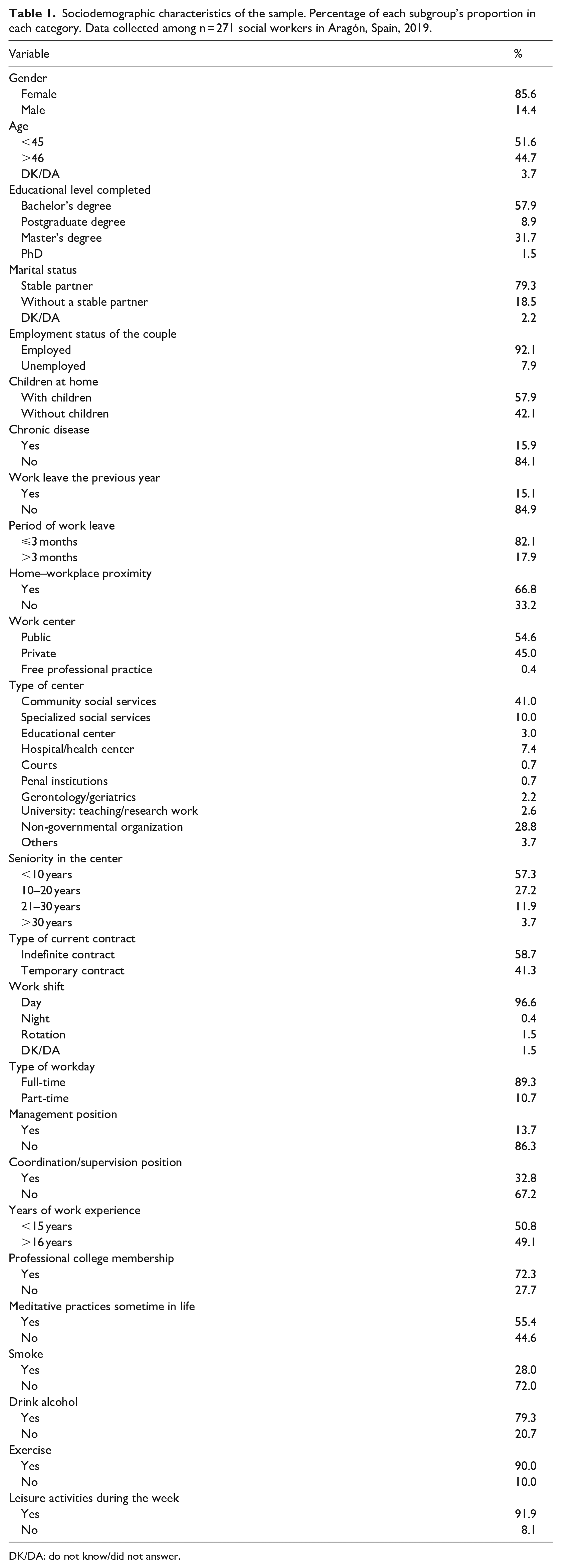
Of those 271 professionals, 232 were women and 39 were men. The average age was 42.97 (SD = 10.04; range = 23–63) years. The average age of the women was 43.08 (SD = 9.73) years and that of the men was 42.37 (SD = 9.73) years. Table 1 shows the sample’s sociodemographic characteristics.
Sociodemographic characteristics of the sample. Percentage of each subgroup’s proportion in each category. Data collected among n = 271 social workers in Aragón, Spain, 2019.
DK/DA: do not know/did not answer.
Measures
Demographic questionnaire
A self-elaborated sociodemographic questionnaire was provided, which included a series of sociopersonal, educational, and work variables. Participants’ features are described in Table 1.
Burnout: AWS
The AWS was created by Leiter and Maslach (2003) with the purpose of ascertaining the extent to which certain organizational environment factors can influence the emergence and development of burnout. The tool used in this study was the Spanish version of the survey, elaborated by Gascón et al. (2013).
The survey is composed of 45 items distributed among two questionnaires. A first, 16-item questionnaire assesses the three dimensions opposed to burnout, namely, energy (the contrary of exhaustion), efficacy (as opposed to inefficacy), and implication (as opposed to depersonalization or cynicism), on a 7-point Likert-type scale ranging from 0 (‘never’) to 6 (‘daily’). This subscale has shown high correlation with the MBI dimensions, as well as adequate psychometric properties in both Spanish and English (Gascón et al., 2013).
A second questionnaire of 29 items measures the level of an individual’s congruence or incongruity with their work in six areas (workload, control, reward, community, fairness, and values) on a 5-point Likert-type scale that ranges from 1 (‘strongly disagree’) to 5 (‘strongly agree’). An incongruity perceived by the individual between their values and those six areas serves as a detection indicator for burnout; a higher degree of congruence indicates a greater probability of work motivation (Gascón et al., 2013). Cronbach’s alpha for this scale lies between 0.71 (values) and 0.89 (workload). The alpha values for the scales meet the 0.70 criterion (Gascón et al., 2013).
Mindful Attention Awareness Scale
The MAAS is a brief scale that assesses the individual’s dispositional capacity to be aware and conscious in daily life experiences (Soler et al., 2012). It consists of 15 items focused on attention/awareness components of the mindfulness construct on a 6-point Likert-type scale from 1 (‘almost always’) to 6 (‘rarely’). High scores in the average of the total of the items indicate a greater state of mindfulness. The scale can be used on individuals who have and who do not have meditation experience and is used frequently in mindfulness research.
In our study, we used the Spanish version of the MAAS (Soler et al., 2012). Cronbach’s alpha for this scale yielded 0.89, comparable with the results attained by the English version.
Analysis
First, we carried out a descriptive analysis of the variables used in the subsequent structural model, taking into account the mean and standard deviation of the MAAS, the AWS, and the Burnout scales. In this initial exploration, we also took into account a series of sociopersonal and work variables, as well as their influence on the mean of those scales, by running an analysis of variance (ANOVA and Pearson test for correlations). In addition, we used the eta-squared test to calculate effect size and the 95 percent confidence interval in relation to the mean of the values for each of the variables that turned out to be significant. We then analyzed the correlation coefficients among the three variables that would subsequently form the structural equation model.
Derived from our theoretical review, the fundamental objective of this research was to test the influence of mindfulness and the six areas of worklife on the prevention of burnout. For this purpose, we carried out an analysis using a structural equation model with the IBM-SPSS program and its AMOS extension (v.22). We tested the proposed structural model, including the observed variables and latent variables. In the hypothetical model, influences of sociopersonal and job covariates were also tested: as they were not significant, they were eliminated from the final model. In order to ascertain which values of the parameters make the observed data more likely, we chose maximum likelihood estimation (MLE). Standardized regression coefficients (beta) were included to report the results and their level of significance (p < .001). Finally, we tested our model’s goodness of fit using χ2/df, root mean square error of approximation (RMSEA), comparative fit index (CFI), Tucker–Lewis index (TLI), and goodness-of-fit index (GFI) as indicators, following Byrne (2010).
Results
First, the statistically significant relationship and correlations among the burnout constructs (BURN), the six areas of worklife (AWS), and mindfulness (MAAS) are presented in this section. In addition, those analyses are presented for each of the dimensions or areas that make up the scales. Supplemental Appendix 1 shows the lower and upper levels of each of the means at a 95 percent confidence interval.
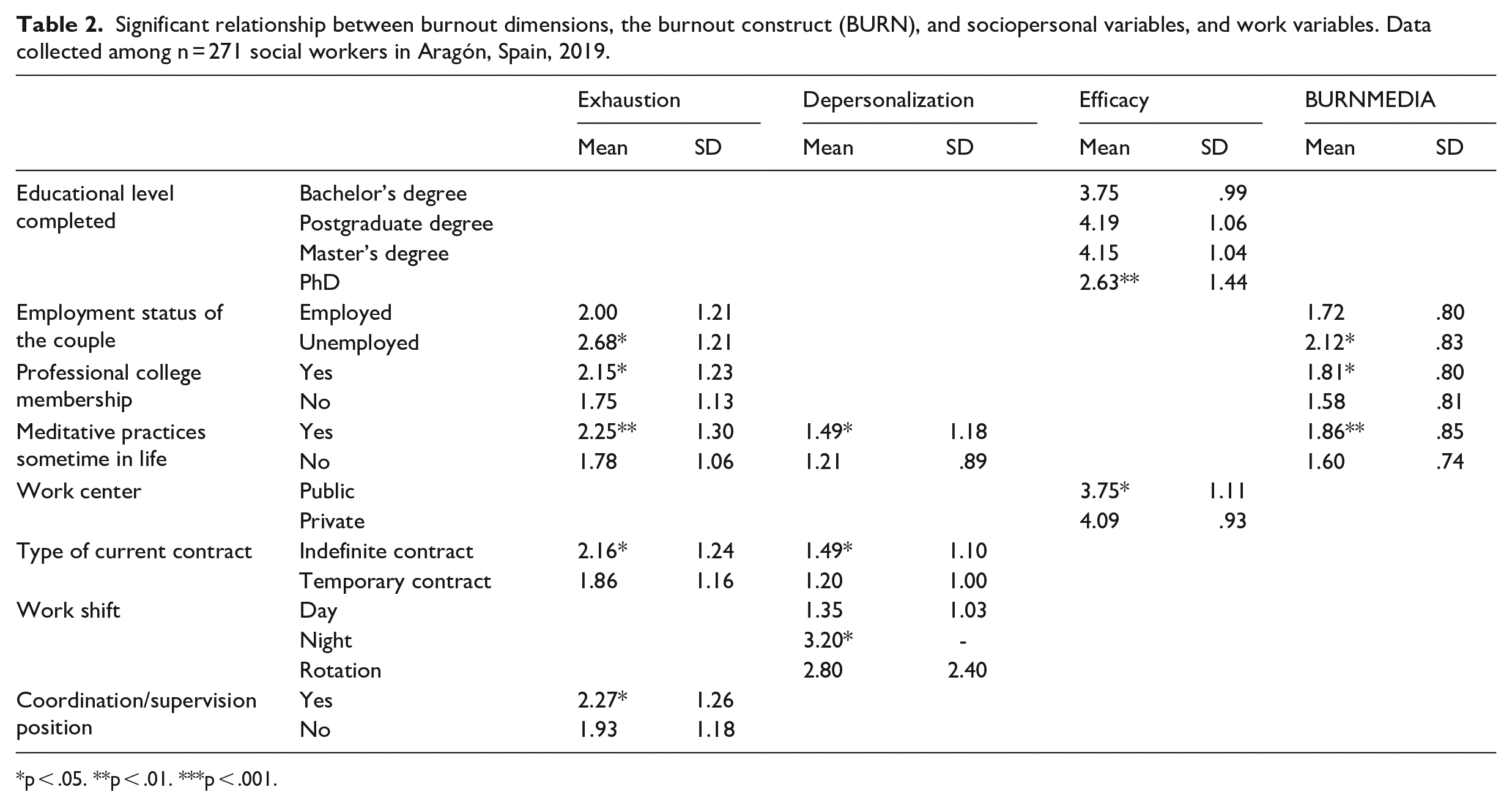
In the case of the burnout construct, as shown in Table 2, a significant relationship was found with sociopersonal and employment variables: weak evidence about employment status of the couple (p = .048; η2 = .018) and professional college membership (p = .035; η2 = .016); and strong evidence about having performed meditative practices sometime in life (p = .009; η2 = .025).
Significant relationship between burnout dimensions, the burnout construct (BURN), and sociopersonal variables, and work variables. Data collected among n = 271 social workers in Aragón, Spain, 2019.
p < .05. **p < .01. ***p < .001.
As shown in Table 2, weak evidence of a significant relationship was obtained between the exhaustion dimension and the variables: employment status of the couple (p = .027; η2 = .023); professional college membership (p = .016; η2 = .022); type of contract (p = .044; η2 = .015); and the performance of coordination and supervision positions (p = .033; η2 = .017). Also, the results show strong evidence of relations with the variable of having performed meditative practices sometime in life (p = .002; η2 = .036). In the depersonalization dimension, the analysis shows weak evidence of a relationship with the variables of having performed meditative practices sometime in life (p = .032; η2 = .017), type of current contract p = .026; η2 = .018), and work shift (p = .017; η2 = .044). Finally, weak evidence of a statistically significant relationship was obtained between the efficacy dimension and the variable type of work center (p = .022; η2 = .028), and very strong evidence of a relationship with the variable educational level completed (p = .000; η2 = .60). The lower mean scores in this dimension were taken into account, since they indicate a sense of low efficacy.
Significant correlations can be observed between the burnout construct, the sociopersonal and work variables, and the practice of exercise (r = –.13*), the performance of leisure activities during the week (r = –.12*), and the assessment of the work environment (r = –.43***).
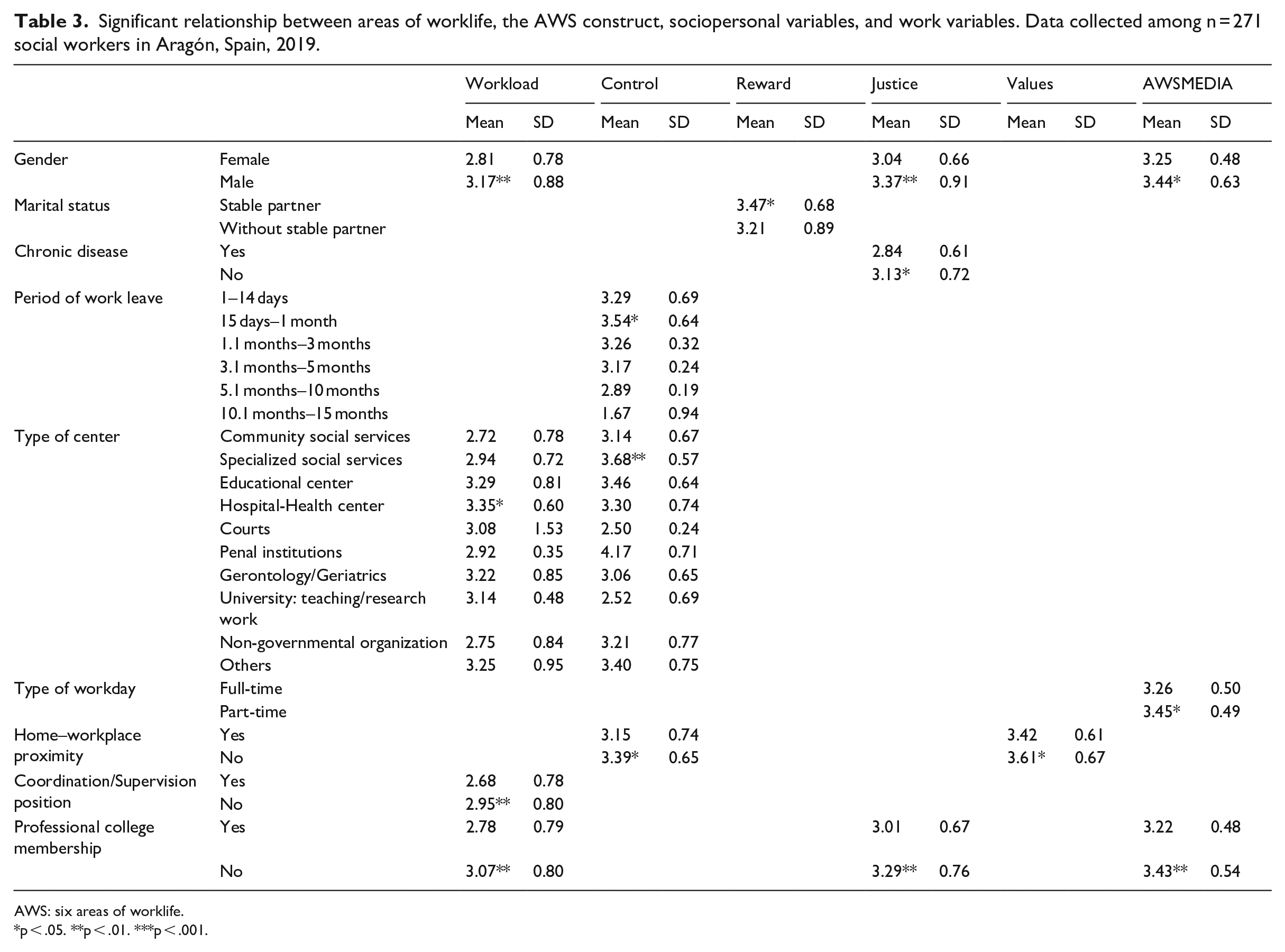
The AWS construct has weak evidence of a relationship with the variables gender (p = .032; η2 = .017) and type of workday (p = .49; η2 = .014), and also shows strong evidence of a relationship with the variable professional college membership (p = .003; η2 = .033), as shown in Table 3.
Significant relationship between areas of worklife, the AWS construct, sociopersonal variables, and work variables. Data collected among n = 271 social workers in Aragón, Spain, 2019.
AWS: six areas of worklife.
p < .05. **p < .01. ***p < .001.
In terms of analysis by areas, as likewise indicated in Table 3, the workload area presents weak evidence of a statistically significant relationship with the variable type of center (p = .020; η2 = .072). This area also shows strong evidence of a relationship with the variables gender (p = .001; η2 = .024), coordination/supervision position (p = .008; η2 = .026), and professional college membership (p = .008; η2 = .026).
In the control area, weak evidence of a significant relationship is obtained with the variables period of work leave (p = .049; η2 = .348) and home–workplace proximity (p = .012; η2 = .025), as well as very strong evidence with the variable type of center (p = .000; η2 = .097). In the reward area, weak evidence of a relationship can be observed with marital status (p = .022; η2 = .020), while the justice area shows weak evidence related to the variable chronic disease (p = .012; η2 = .023), and strong evidence related to the variables gender (p = .007; η2 = .027) and professional college membership (p = .003; η2 = .032). Finally, the values area only shows weak evidence of a relationship with the variable home–workplace proximity (p = .025; η2 = .019), while the community area does not show evidence of a relationship with any of the sociopersonal and work variables analyzed. Supplemental Appendix 2 shows the lower and upper limits of each of the means obtained at a 95 percent confidence interval.
Moreover, our analysis shows significant correlations between the AWS construct and the variables: exercise practice (r = .13*), leisure practice during the week (r = .15*), and work environment (r = .59***).
Finally, regarding the MAAS mindfulness construct, statistically significant relations are only obtained with the variable of having performed meditative practices sometime in life, with strong evidence by those who have not performed this type of practice (p = .002; η2 = .034). In addition, statistically significant correlations are observed between this construct and the performance of leisure activities during the week (r = .13*), as well as with the work environment variable (r = .16**).
In the descriptive statistics of the constructs of the three scales, the burnout construct (BURN) shows a mean of 1.74 (SD = 0.81), the construct of six areas of worklife (AWS) reaches an average of 3.28 (SD = 0.50), and the mindfulness construct (MAAS) presents a mean of 3.89 (SD = 0.89).
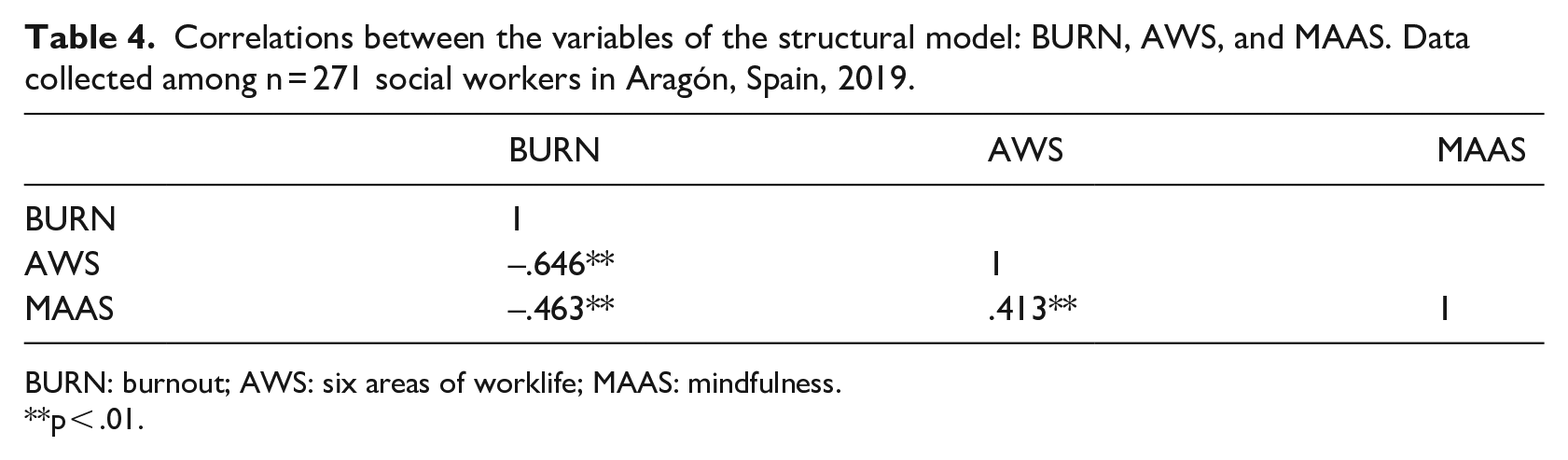
Before analyzing the structural model, we carried out a correlation analysis among the model’s latent variables. As can be seen in Table 4, the correlation coefficients among the three variables are strong and significant (r > .03; p < .01). Both the AWS and the MAAS correlate negatively with Burnout, showing an inverse relationship. The correlation between the AWS and the MAAS is positive.
Correlations between the variables of the structural model: BURN, AWS, and MAAS. Data collected among n = 271 social workers in Aragón, Spain, 2019.
BURN: burnout; AWS: six areas of worklife; MAAS: mindfulness.
p < .01.
We proceeded to test the structural model of relationship between these latent variables: the graphic representation and structural coefficients are shown in Figure 1. As can be observed, mindfulness has a high, positive, and significant influence on the six areas of worklife, and a negative influence on burnout levels. It is relevant to note that congruence in the six areas of worklife has a thoroughly positive effect on the prevention of burnout by exerting a high negative impact on this latent variable. In addition, in terms of indirect effects, the effect of the MAAS mediated by the AWS in the Burnout scale would be –.296 ***. This model explains 18.3 percent of the variance of the AWS and a highly relevant 70.2 percent of Burnout, so that high levels of mindfulness and a great degree of congruence in the six areas of worklife would be predictive variables for the prevention of burnout.
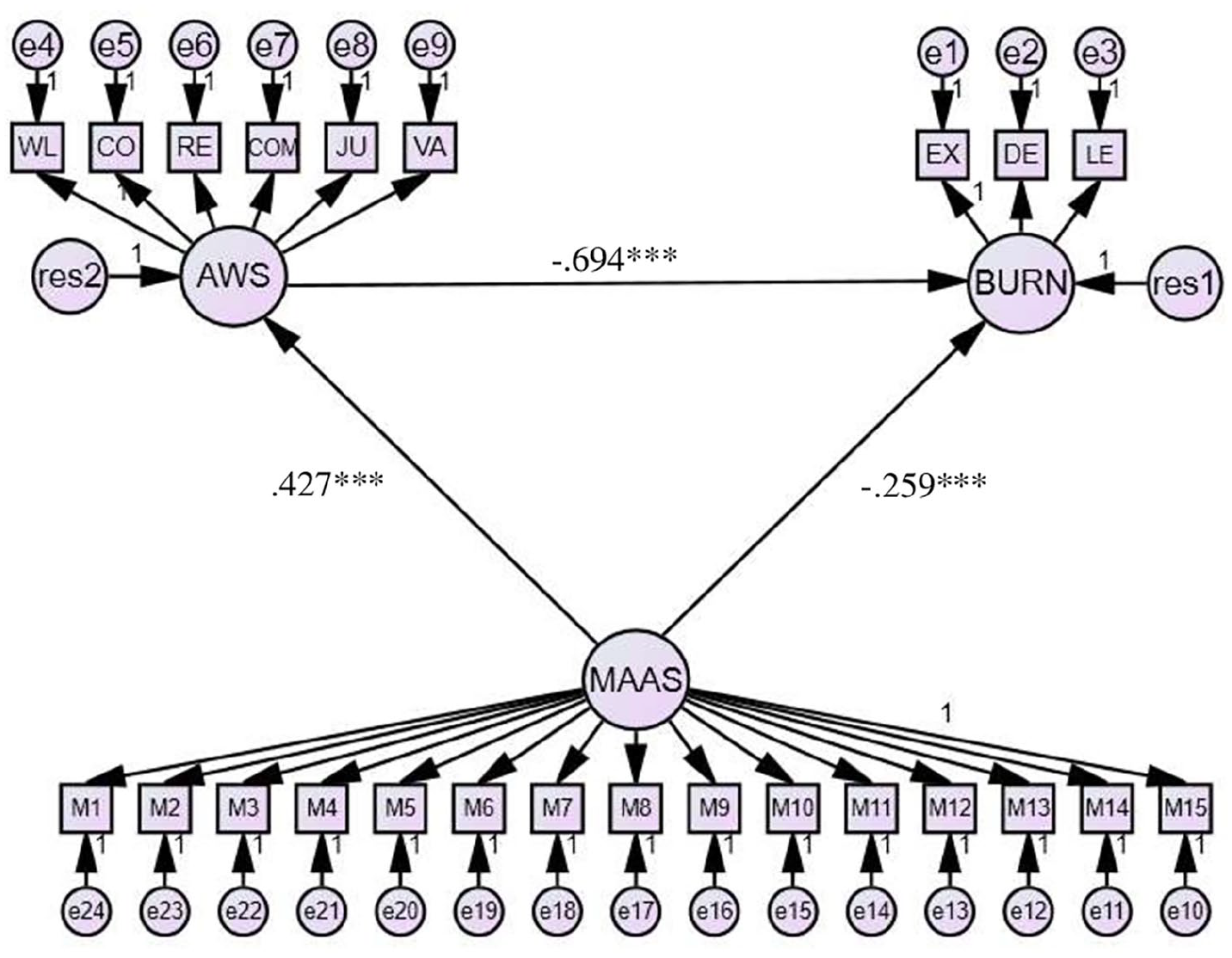
Structural model of relationship between the MAAS, the AWS, and the BURN. Data collected among n = 271 social workers in Aragón, Spain, 2019.
Discussion
First of all, this study has attempted to verify the relationship between burnout, areas of worklife, and dispositional mindfulness in social work.
In this way, our correlation analysis between the model’s three latent variables shows high and statistically significant correlation coefficients. The MAAS shows an inverse relationship with the burnout scale, coinciding with the results of Thomas and Otis (2010) as well as Thomas (2012). Their results could be related to the correlations between the AWS and MAAS detected in our study, such as the correlation we found between a higher level of mindfulness as a dispositional state or trait, on one hand, and greater congruence in the areas of worklife, on the other.
In the testing of the structural model of the relationship among latent variables, a positive influence of mindfulness on the six areas of worklife is obtained, along with a negative influence on burnout. This could indicate that a greater presence of mindfulness as a trait or dispositional state could increase the levels of congruence in the different aspects measured by the AWS in each of its areas (manageable workload, control, reward, community, justice, and values). Furthermore, the areas in this scale would help prevent the dimensions of burnout (exhaustion, depersonalization, and low efficacy). This last result is in line with studies that show that a higher level of trait mindfulness leads to a lower level of burnout (Harker et al., 2016; In Park and Kyung Nam, 2020), also cushioning its negative effects (Samios, 2018). Trait mindfulness can thus be regarded as an effective tool for burnout prevention (Puolakanaho et al., 2018).
The results of the equation model presented in Figure 1 also show that congruence in the six areas of worklife has a thoroughly positive effect on the prevention of burnout by exerting a negative impact on this latent variable. This result would reinforce the notion of the importance of the six areas of worklife as early predictors of burnout (Maslach and Leiter, 2008), also in social workers (Ray et al., 2013). It would also underscore the importance of the congruence of the areas of worklife as protective factors against burnout (Lasalvia et al., 2009). The study of these areas is especially relevant in the midst of the current pandemic situation, where social workers have been on the frontline and their overload as well as lack of protection have become more evident (European Social Network, 2020; Fantova, 2020).
In addition, the model developed herein explains statistically the variance of burnout to a very large extent (70.2%) and the variance of the AWS construct (18.3%).
Moreover, a statistically significant relationship can be observed between the burnout construct along with two of its dimensions (exhaustion and depersonalization), on one hand, and the performance of meditative practices on the other, so that those who have carried out this type of practice present more exhaustion and depersonalization. These results are at odds with research that indicates the positive effects of different practices based on mindfulness in reducing burnout (Goodman and Shorling, 2012; Hanna and Pidgeon, 2018; Pandya, 2019; Thomas, 2012; Thomas and Otis, 2010). A similar situation occurs in the analysis of the mindfulness construct (MAAS), which again presents a statistically significant relationship with the fact of not having practiced meditative techniques at any time in life.
These results may be due to the fact that the research question ‘Have you ever performed meditative practices or mind-body techniques in your life?’ does not specify when they were last performed or were last practiced, the duration of the practices, or their frequency; thus, there is a limitation in the analysis of their possible benefits. In this sense, various studies indicate that the benefits derived from mindfulness practices require long-term commitment (Hick, 2009).
Second, we deemed that it would be relevant to analyze the influence of sociodemographic factors on burnout in social work. In our analysis of sociodemographic factors, we observed (in the p values and in the eta-squared test) some weak statistical evidence of a relationship in the analyzed sample between temporary work contracts and the exhaustion and depersonalization dimensions of the burnout construct (BURN), in line with other studies that show a greater relationship between job instability and exhaustion (Vilá Falgueras et al., 2015).
The low-efficacy dimension yields statistically strong evidence of a relationship with the subject’s educational level: thus, those who have doctorates display a greater degree of burnout, in contrast with studies that found a relationship between a higher academic level and a lower degree of burnout (Alfaro de Prado Sagrera, 2009). Moreover, the sensation of low efficacy presents weak evidence related to work in public-sector centers. This result is in line with previous studies that have shown a relation between social work in public centers and a sensation of low efficacy (Caravaca Sánchez et al., 2019; Gómez García et al., 2019) as well as with overall burnout levels (Acker, 2010; De la Fuente Roldán and Sánchez Moreno, 2012).
Regarding the significant relationship between sociopersonal factors and areas of worklife that can influence burnout, the results show statistically weak evidence of a relationship between the feeling of control at work and the performance of work activity in specialized social services, as well as between the workload and work activity in hospitals and health centers (which could be considered specialized centers). These results would be in line with other studies that show a higher level of burnout in general service social workers (Aragón, 2006), or a lower emotional exhaustion, depersonalization, and greater personal achievement among social workers of specialized social services (Gómez García et al., 2019).
Our analysis also shows strong statistical evidence of relationship between the gender variable and two areas of worklife: workload and justice, which could lead to less burnout. In addition, weak evidence of a relationship is also obtained between the male gender and the results of the general AWS construct. These results could be consistent with the higher levels of emotional fatigue observed in female social workers (Caravaca Sánchez et al., 2019; Vilá Falgueras et al., 2015).
In addition, the fact of having a stable partner has been statistically associated with higher levels of congruence in the reward area, which could lead to lower levels of burnout, according to previous research indicating a relationship between the lack of a partner and higher levels of burnout (Caravaca Sánchez et al., 2019).
It should be noted that the three constructs analyzed herein show statistically significant correlations with the performance of leisure activities during the week. These correlations are also present between the burnout construct (BURN), the AWS construct, and the practice of exercise. These results show the importance of such practices oriented toward a healthy lifestyle, including time spent with family and friends (Martin et al., 2020; McGarrigle and Walsh, 2011), as a tool for self-care and burnout prevention in the social work profession (Lee and Miller, 2013).
Finally, the three constructs show very strong statistical evidence of correlation with the work environment, in the p values and in the eta-squared test. A positive assessment of the work environment would lead to lower levels of burnout, a greater degree of congruence in the areas of worklife, and improved mindfulness levels among social workers. This result is similar to those obtained by Blanco Montilla (2006) and it is in line with authors who highlight the importance of reducing interpersonal conflicts or improving communication and teamwork (Lázaro, 2004; Vilá Falgueras et al., 2015) in order to improve the work environment in the social work profession.
Conclusions
Many previous investigations have studied the relationship between mindfulness and burnout prevention. This article’s specific contribution is the presentation of a structural equation model that aims to simultaneously relate the burnout constructs, the areas of worklife, and mindfulness as a dispositional trait specifically in the social work profession.
We conclude that high levels of mindfulness along with congruence in the six areas of worklife would act as predictive variables and therefore be effective in preventive terms of burnout syndrome.
It would be important to go into further depth on the subject of burnout and social work, as the latter is a profession involving special risk, especially in view of the organizational environments within which it takes place. Since mindfulness is a potentially effective variable in preventive terms, it is also important to continue analyzing the implications of its use in the advancement of self-care, the prevention of burnout, and the promotion of health in social workers, as part of overall caring for the internal dimension (self-care and self-knowledge), as described by social workers such as Hick (2009), but also in the context of professional interventions and, furthermore, within the framework of public health policies.
The prominence displayed by the sociopersonal variables related to leisure and free time, exercise, and positive assessment of the work environment is remarkable in the three analyzed constructs, thereby underscoring the relevance of these self-care tools for social workers. It is thus of vital importance for organizations to commit themselves to the promotion of work–life balance measures in order to prevent burnout in their employees.
This study analyzed the relationship between burnout, areas of worklife, and mindfulness as a dispositional state or trait. It likewise took into account the eventual practice of mindfulness tools at some earlier point in life; the information collected in the corresponding question was nevertheless incomplete regarding the time of practice, duration, and frequency. This limited the analysis of the results pertaining to that factor.
The COVID-19 pandemic has increased the overload and uncertainty of social work professionals around the world, revealing weaknesses of the social service systems. The repercussions of this new scenario for social workers are still being analyzed – also in terms of burnout. In any case, the need to invest more resources in developing care tools for professionals has become evident and such care tools could include mindfulness approaches. Perhaps this new context could represent a turning point: an opportunity to reconceive social services by ascribing greater importance to the care of their professionals.
Supplemental Material
sj-docx-1-isw-10.1177_00208728221112733 – Supplemental material for Burnout and mindfulness among social workers in Spain: A structural equation model of mindfulness and areas of worklife as burnout predictors
Supplemental material, sj-docx-1-isw-10.1177_00208728221112733 for Burnout and mindfulness among social workers in Spain: A structural equation model of mindfulness and areas of worklife as burnout predictors by Sandra Romero-Martín, Carmen Elboj-Saso and Tatiana Íñiguez-Berrozpe in International Social Work
Supplemental Material
sj-docx-2-isw-10.1177_00208728221112733 – Supplemental material for Burnout and mindfulness among social workers in Spain: A structural equation model of mindfulness and areas of worklife as burnout predictors
Supplemental material, sj-docx-2-isw-10.1177_00208728221112733 for Burnout and mindfulness among social workers in Spain: A structural equation model of mindfulness and areas of worklife as burnout predictors by Sandra Romero-Martín, Carmen Elboj-Saso and Tatiana Íñiguez-Berrozpe in International Social Work
Footnotes
Declaration of conflicting interests
The authors declared no potential conflicts of interest with respect to the research, authorship, and/or publication of this article.
Funding
This study was carried out with the collaboration of the Department of Innovation, Research and University of the Government of Aragon (Spain).

Supplemental material
Supplemental material for this article is available online.
Author biographies
References
Supplementary Material
Please find the following supplemental material available below.
For Open Access articles published under a Creative Commons License, all supplemental material carries the same license as the article it is associated with.
For non-Open Access articles published, all supplemental material carries a non-exclusive license, and permission requests for re-use of supplemental material or any part of supplemental material shall be sent directly to the copyright owner as specified in the copyright notice associated with the article.
