




Abstract
This article focuses on social work professionals from both sides of divided Cyprus. Cyprus presents a very interesting, yet under-explored, case study as it remains an island de facto divided. The division has resulted in the physical and political separation of the two most populous ethnic communities (Greek Cypriots and Turkish Cypriots) for over 50 years. This article offers an exploration of the views of social workers on both sides. Through a quantitative approach, participants in the study were able to express their thoughts and beliefs on the ‘other’ and on social work in a post-conflict environment.
Introduction
In recent years, there has been a renewed interest in studies exploring the impact of political and ethnic conflict upon social work policy and practice. Societies emerging from political ethnic conflict experience transition to peace as a complex and often protracted process. The island of Cyprus constitutes an example of a society that has experienced ethnic conflict in different forms and intensity for a period of over 60 years (Ioakimidis et al., 2021). The result of this conflict was the war that eventually led to the division of the island between the two communities. To date, there have been few attempts to explore the effects of this conflict on the Cypriot social work practice. Greek Cypriot (GC) and Turkish Cypriot (TC) social workers have never established formal links and social work agencies and organizations have avoided any form of collaboration. The only form of collaboration that can be identified is an unofficial initiative by a group of GC and TC social workers. This initiative took place in 2016 where the first bicommunal social work platform was created, to bring together social workers from both communities. This team of social workers, encouraged by the overall pro-peace movement, was determined to reclaim the role of social work as a peace-building, rather than divisive, institution (Ioakimidis et al., 2021). To do so, the team decided to explore Cypriot social workers’ views of the conflict, trauma and peace. A key aspect of the study was to understand emotions, perceptions, thoughts and ideas about social work triggered through a shared space; an understanding of the structural ‘otherization’ that post-war divisions had inflicted on social work. The findings of this research are presented in this article.
After 31 years of complete physical and political separation, several checkpoints across the green line were re-opened in 2003. For the first time, Cypriots from both communities were able to cross the line and visit their hometowns, meet their friends or merely witness what the ‘other side’ and its people ‘look like’. The opening of checkpoints led to a rejuvenation of the peace (Ioakimidis and Trimikliniotis, 2019) and reconciliation movement.
Under the new circumstances created by the checkpoint opening and the subsequent revival of United Nations (UN) brokered peace negotiations, the importance of education, health care and social services institutions was re-defined as key in the prospect for a re-united Cyprus. For example, research in the field of social work is still very frail, despite the fact that social work practitioners will be expected to implement and deliver policies aiming at a sustainable peace process. The current study is the first of its kind as no researchers have previously attempted to document the perspectives of social work practitioners in relation to the peace process and bicommunal matters (Ioakimidis et al., 2021).
Social work practice in the context of conflict
Violent political and ethnic-driven conflicts as well as disputes create negative long-lasting impacts on the population and might distort social workers’ role, in regions in which ethnic-political violence is commonplace (Bar-Tal and Teichman, 2005; Cohen, 2001; Coulter et al., 2013). As Ramon (2008) stated, ethnic conflict tends to be severe, protracted and intractable. A culture of conflict has a severe impact at many levels and in many forms – individual, social, cultural, psychological, political, economic and international. Social workers, as their profession dictates, are committed to attend and provide support to vulnerable people, regardless of their ethnic background. However, their professional code of ethics such as values and principles can be tested (Cohen, 2001; Dekel et al., 2004; Peled-Avram et al., 2004). In such particular cases, the social work profession might be compromised by the need to demonstrate group cohesion and, conversely, when the ‘other’ is demonized and perceived to be the enemy (Campbell and McCrystal, 2005; Cohen, 2001). The enormous political influence and pressure imposed in such cases make it easier in the context of an ethnic-political conflict to treat the victims of one’s own social-ethnic group with the respect and care they require and to adopt a similar stance towards members of the other social groups in the dispute (Campbell and McCrystal, 2005; Ramon, 2004). Therefore, it can be seriously questioned whether it is feasible for social workers to achieve separation of professional, personal and political dimensions in their lives as social workers within the contexts of acute social and political conflicts (Shamai and Boehm, 2001).
Ramon et al. (2006) corroborated that social work practitioners in areas divided by ethnic-conflict are faced with numerous complex moral and ethical dilemmas as well as challenges that might interfere with their daily practice. In particular, Campbell and McCrystal (2005) indicated that such conflict divisions negatively infuse most state and social structures. Social work practitioners are likely to confront such divisions on multiple levels, including individual, institutional and cultural or ideological levels. At the individual level, identity is formed through group cohesion, self-censoring and the denial of prejudice and discrimination. At institutional level, the state enforces discriminatory practices through the legal system, and the provision of social welfare services, whereas the cultural and ideological level is where discrimination is enhanced through negative stereotypes, beliefs or myths about the other group (Adams et al., 2002; Ramon et al., 2006).
Within such a context, social workers’ ability to conform to their traditional professional roles and, at the same time, preserve a neutral stance can be seriously questioned and tested. Social work practitioners usually have difficulty in separating their professional, personal and political ideologies, especially when unity with a social or ethnic group is required during violent outbreaks. A number of studies indicated that social work practitioners in these conflict settings experienced multiple levels of stress. They have emphasized the need for resilience. However, the ethical, emotional and societal pressures about how to coexist with colleagues or with service users of the other group are an important deterrent to performing their daily social practice (Baum, 2011; Pinkerton and Campbell, 2002; Ramon et al., 2006).
Moreover, for social work practitioners, working in communities affected by ethnic and political violence, even at a ‘post-war’ or ‘post-conflict’ stage, their practice is heavily influenced and guided by mechanisms of political control (Coulter et al., 2013; Ioakimidis et al., 2021). Post-conflict communities are characterized by high levels of insecurity and uncertainty, as well as difficulties to define boundaries. This happens because the experience of conflict not only causes actual physical and material damage through acts of calculated violence, but it also inscribes itself in the memories of individuals, families and communities long after the traumatic events have occurred (Coulter et al., 2013; Ioakimidis et al., 2021). The damage incurred in communities, groups and individuals is often used to shape social identity, beliefs, values, knowledge and social reality (Humphrey, 2000). Yet, it is within this context that social workers must harness the contradictory and competing strands of their histories, traditions and values, and the multiple identities to develop vibrant, locally specific social work interventions (Sewpaul, 2007a, 2007b). To elaborate even further, Ramon et al. (2006) contended that social workers in ethnic-divided societies should attempt to adjust their professional behaviour to provide a value-free, neutral and professional service in the face of violence. Social work practitioners in these conflict settings have emphasized the need for resilience in the face of complex challenges, but the ethical, emotional and societal pressures about how to coexist with colleagues or with service users of the other group remain challenging (Baum, 2006, 2011).
In the case of Cyprus, there are limited references to whether the above-mentioned challenges have been adequately addressed within the area of social work practice. One could argue that Cyprus constitutes an example of how constant ethnic-political conflicts between the two communities, GCs and TCs, have affected the course of social work history and practice. It is worth mentioning that Cyprus has experienced the devastating effect of ethnic conflict in all of its forms and types. However, there is a major gap in the international bibliography regarding the development of Cypriot social work and the effects of the ethnic conflict. This conflict eventually led the country to war and subsequently to the division of the island. In the following section, an attempt will be made to enquire about the impact of the ethnic conflict on the area of social work.
Social work in the context of the Cypriot conflict
The island of Cyprus, for more than five decades, has experienced political instability. Ethnic conflict started during the last decade of the British colonial era. 1 The post-colonial years were marked by an unrealistically multi-layered political system that encouraged segregation rather than integration. These periods are characterized by the opposed ethnic nationalism, violence and conflict between nationalist, paramilitary groups from the two ethnic communities of GCs (EOKA B′) and TCs (TMT). In July 1974, a military coup organized and executed by the Greek junta and its local GC partners of EOKA B′ led to a Turkish military invasion, leading to the physical, political and psychological division of the two communities (Avtzaki, 2012). The result was the Turkish occupation of 37 percent of the island in the north, while in the south GCs retained representation of the recognized Republic of Cyprus (Campbell et al., 2019). During that period, major forced displacement of the population took place between the two communities, which had devastating negative effects on their psychosocial conditions (Campbell et al., 2019; Ioakimidis et al., 2021; Papadakis et al., 2006).
Throughout all these years, various attempts and peace-enhancing efforts have been implemented without any meaningful success (Anastasiou, 2002; Avtzaki, 2012; Hadjipavlou, 2003). According to Fisher (2001), these attempts could be characterized as models of intervention that lack continuity and willingness from both sides at official mediation efforts and decision-making level. Therefore, the GC and TC communities are struggling to reach consensus about the ‘Cypriot problem’ which might eventually lead to a viable solution. As Papadakis et al. (2006) commented, both communities are still at the stage of antagonism instead of the later stages of dialogue, problem-solving and reconciliation. Moreover, it can be argued that the resources allocated to unofficial interventions have been weak, very small and very selective in specific groups; thus, substantial progress cannot be realized (Avtzaki, 2012; Anastasiou, 2002; Hadjipavlou, 2003; Papadakis et al., 2006).
Consequently, after 50 years, it is worth mentioning that the Cypriot problem, hence the ethnic conflict, is well preserved within the various social layers of the population. In particular, the younger generations of Cypriots, those who did not experience war, are affected. They indirectly experienced the aftermath of this destructive conflict. Makriyiannis and Psaltis (2007) stated that this generation has been moulded in the educational system, in which history teaching, at least on the Greek side, has been described as heritage rather than history. They emphasized that strong elements of a monolithic and mono-perspectival nationalist orthodoxy are quite dominant in the education system (Avtzaki, 2012). Therefore, future and young generations are in danger of falling short of reconciling with people from the other community; the contradictory persistence of reviving old glories and not ‘forgetting’ is aligned with the blurred aspirations for reunification (Avtzaki, 2012; Christou, 2006). To corroborate even further, a number of authors cited that the status quo, even after all these years, preserves strong feelings of fear, mistrust and psychological distance towards each other, while mutual victimization and reciprocal blaming still take place (Avtzaki, 2012; Christou, 2006). This is consistent with the research of Ioakimidis et al. (2021), that educational systems, political discourse and media moral panics are further deepening the psychological, social and emotional distance, and negativity between the two communities.
Taking into consideration all the above, social work practice was negatively influenced by the political and social circumstances that shaped the island’s turbulent history. One could argue that these negative effects on social work practice are often neglected and under-researched. Social workers are reluctant to engage with research and practice linked to sensitive political issues in relation to the ethnic conflict in Cyprus (Ioakimidis et al., 2021). Moreover, a significant number of authors indicated that societies divided by ethnic conflict and violence create further complications in the area of social work practice (Campbell et al., 2019; Coulter et al., 2013; Duffy et al., 2019).
At a professional level, the GC and TC social workers have not yet established any official contacts with the aim to bridge the divide and form meaningful channels of communication. On the contrary, a notable apathy can be observed on conflict discussions in social work education (Nadan and Ben-Ari, 2015; Segev and Nadan, 2016). Some authors suggested that social work practice in divided societies tends to become more bureaucratic and technocratic, essentially ignoring the conflicts and sectarianism by hiding behind the pretext of neutrality and disassociation from the war (Campbell et al., 2019; Coulter et al., 2013; Duffy et al., 2019). Although some individual efforts of dynamic peace-building can be identified among social workers between the two communities, the majority of them have not been socialized towards a culture of resolution and peace. Strong feelings of uncertainty, fear, prejudice, negative predispositions and antagonism towards the past are still preserved, despite the assumption that social workers are committed to promote the value of respect and selflessness regardless of the ethnic background and political preferences (Bar-Tal and Teichman, 2005; Duffy et al., 2019; Ioakimidis et al., 2021).
Furthermore, social work education constitutes an important factor, which may distort prospective social workers’ attitude towards the ‘other’. Although the Cypriot problem and division of the island overshadow and permeate almost all legal and institutional issues in the political agenda, there are no references, training programmes or academic discussion regarding potential bicommunal approaches. Instead, social work in Cyprus took a more ethnocentric character, and education of social workers relied has almost exclusively on the so-called motherlands, Greece and Turkey. In the south side of Cyprus, Greek curricula were imported, whereas social work in the north side took the direction of ethnocentric provision, fully and exclusively supported by the Turkish Republic. The island’s division politically, ideologically and culturally defines social work, and there is little or no discussion about the impact of conflict and violence on social work practice and theory. A ‘mandate to silence’, it can be argued, works in favour of a hidden curriculum that allows the nurturing of nationalist, divisive notions that quite often discourage an open discussion on the ethnic conflict and its influence on social work practice (Campbell et al., 2019; Ramon et al., 2006).
In a nutshell, the perceptions of social work practitioners in Cyprus might be regarded as ‘ignorant’ on the particular issue due to the strong institutionalization of the politics of division or even to sustain a negative image of the ‘other’, who mostly have never seen or come into contact with each other. A possible explanation is the fact that professional, personal and political identities are intertwined, thus making them more difficult to disentangle even in post-conflict situations (Ioakimidis et al., 2021; Ramon et al., 2006). It is evident that a substantial gap in the literature seems to exist in regard to the level, nature and complexities of collaborations and interaction among social work practitioners between the two communities of Cyprus, and further research is called for.
Rationale of the research methodology
The overall aim of this study has been to understand the complexities Cypriot professional social workers deal with in the context of a geographic and ethnic separation and to create a platform for social workers to de-mystify the ‘other’ through bicommunal collaboration and contact. More specifically, our research team focused on (a) understanding the beliefs, experiences, attitudes and consequently responses of GC and TC professional social workers in relation to the division of the island, (b) documenting barriers that prevent interaction, reconciliation and bicommunal social work collaboration and (c) exploring tangible ways of collaboration among the two communities within the social work context.
Research model
After several meetings and discussions over the methodology, the research team followed a quantitative/correlational method of research. This methodology allows researchers to determine the extent of a relationship between two or more variables using statistical data. In this type of design, relationships between and among a number of facts are sought and interpreted. Quantitative research methods focus on objective measurements, with statistical analysis or numerical data collection. Data are gathered through different methods such as polls and questionnaires (Creswell, 2009). Interpreting previous statistical data using different techniques can also be undertaken in quantitative studies. This approach is centred on gathering statistical data to generalize it across groups of people to provide details on a particular phenomenon (Babbie, 2010).
The questionnaire was written in both languages, Greek and Turkish, and was administered online. Participants were recruited through a snowball approach, making use of popular social media platforms, as well as mailing lists. Participants with whom contact had already been made through social media and emails were also invited to use their social networks to refer the researcher to other people who could potentially participate in the study. Snowball sampling is often used to find and recruit ‘hidden populations’, that is, groups not easily accessible to researchers through other sampling strategies (Family Health International, n.d.).
The use of a survey as a first data-collection layer was informed by two factors: (a) the need to ‘map out’ the diverse uncertainties, conflicts and dilemmas our participants may face before a direct engagement with each other and (b) a need to challenge the culture of silence and suppression of all meaningful discussions towards the Cypriot issue. The research was therefore conducted in two separate yet complementary phases. In the first stage of research, we made use of personally administered structured questionnaires, one written in the Greek language and the other one in the Turkish language. The construction of the questionnaires was a complicated process since the researchers had to initially construct an English version of the questions and then translate them into the two native languages. English is the language we use to communicate with each other, since none of the researchers speaks the native language of the other community. For the sake of understanding, we include the English version of the questionnaire (see Supplementary Table S1).
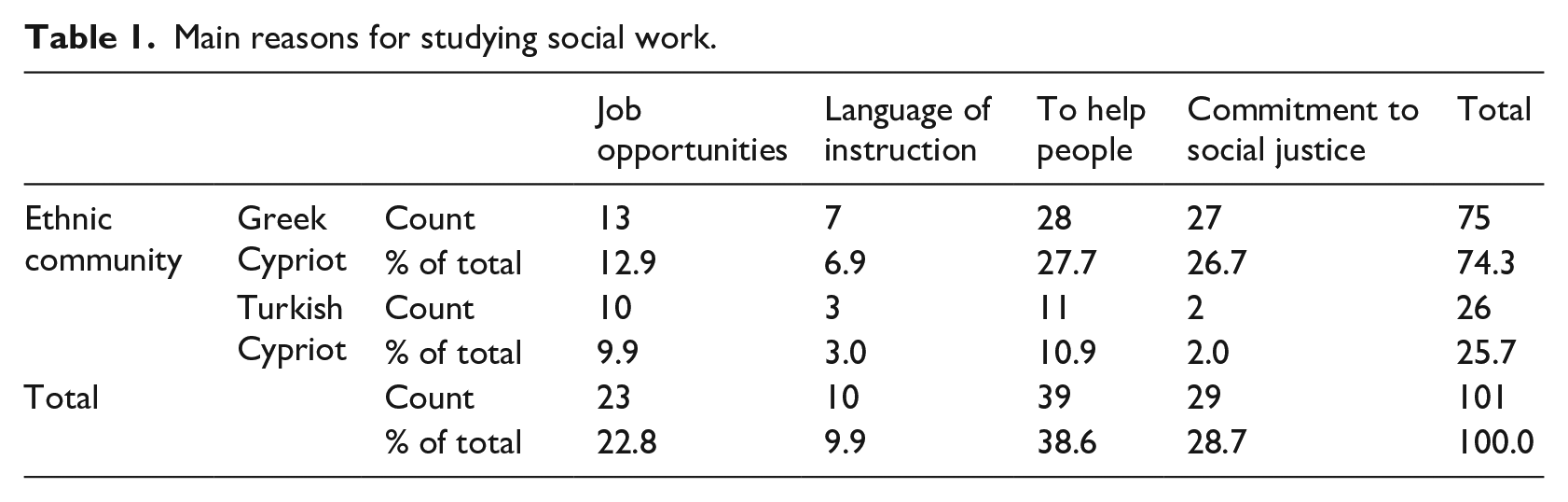
Main reasons for studying social work.
Questionnaires generally have low validity because they do not explore questions in any detail or depth. Where there is little opportunity to qualify the meaning of answers, the fact that questionnaires can be anonymous means that respondents may be encouraged to answer questions truthfully in the knowledge that they cannot be identified. This may increase the validity of their responses (Trueman, 2015). It is worth noting that structured questionnaires allow researchers to easily standardize them since every respondent is asked the same question in the same way. Therefore, researchers can be sure that everyone in the sample answers exactly the same questions, which makes this a very reliable method of research (Trueman, 2015).
The rationale behind the current survey methodology was based on our desire to allow social workers to take their time while answering the questions. Since this was the first time that they had responded to this kind of bicommunal survey, we wanted to make them feel as comfortable as possible. Our experience from bicommunal activities with social work students showed us that they are hesitant to express their feelings. It should be noted that they belong to a generation that grew up with stories about the enemy who is on the other side of the fence.
Sample
Through the questionnaires, we attempted to document the perceptions participants broadly tended to hold about the conflict, the ‘other’ and the role of social work. Seventy-five GC and 26 TC professional social workers participated in the survey. The overall number of Cypriot social workers, at the time of the research, was approximately 860 (800 in the south and 60 in the north). Although this was not a large sample, we are confident that the responses ensure representativeness and validity of the total social work population in both communities.
Data collection and analysis
Mapping Cypriot social workers’ perspectives on social work in the context of division
Findings
Before proceeding to the comparative analysis of the study, it would be useful to present some descriptive statistics based on crosstabs. The numbers given should allow the reader to understand the participants’ culture and professional background, as well as other important elements of the survey. For instance, the majority of participants in the survey work for non-governmental organizations (73% GCs and 50% TCs) as opposed to central government, local government (municipalities) and other agencies. Similarly, the majority of the participants have worked as social workers for 0–5 years (77% GCs and 69% TCs). This situation indicates that although questionnaires were sent to all social workers, regardless of age, those who responded tended to belong to the younger generation of professionals (83% of GCs and 96% of TCs were between 23 and 35 years of age). Not surprisingly, the majority of the participants were females (73% GCs and 92% TCs). Interestingly, Table 1 indicates the reasons behind their decision to study social work.
As Table 1 indicates, the majority of social workers chose social work as their profession because of their desire to help people (38.6%) and their commitment to social justice (28.7%). As we proceed further with the presentation and analysis of the survey, it is important to keep in mind this percentage (67.3%) to examine it from the different aspects discussed below.
Independent-samples t-tests
A series of independent-samples t-tests were applied to examine any significant effects among GC and TC social workers. In the initial model, the two variables of ethnic community (GCs, TCs) were entered as dependent variables and various perceptions and attitudes (friends from the other side, opening of checkpoints, provide services to clients from the other community, etc.) were entered as independent variables. It is worth noting that it is likely that the different work status of professionals played an important role in the way they responded to the various questions.
Opening of checkpoints
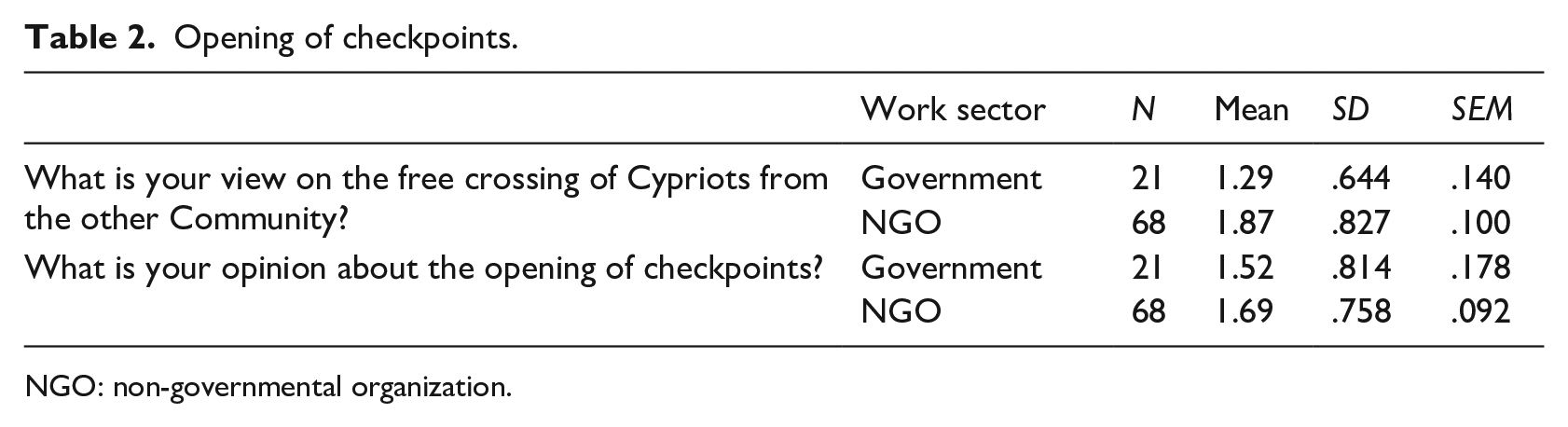
To examine attitudes towards the opening of checkpoints in 2003 and after 29 years of complete division and lack of communication between the two communities, a series of independent-samples t-test were performed. To examine whether work sector affected their views on the free crossing of Cypriots from the other community, independent-samples t-tests were also executed. They indicated a significant main effect for GC and TC government employees (M = 1.29, SD = .644, N = 21) (t(87) = −2.96, p = .004) and non-government employees (M = 1.87, SD = .827, N = 68) (t(42.30) = −3.37, p = .002) (Table 2).
Opening of checkpoints.
NGO: non-governmental organization.
On the contrary, no significant main effect was found on government employees’ opinion about the opening of checkpoints (M = 1.52, SD = .814, N = 21), (t(87) = −.869, p = .387) and non-government employees (M = 1.69, SD = .8758, N = 68) (t(31.491) =−.837, p = .409).
Crossing to the other side
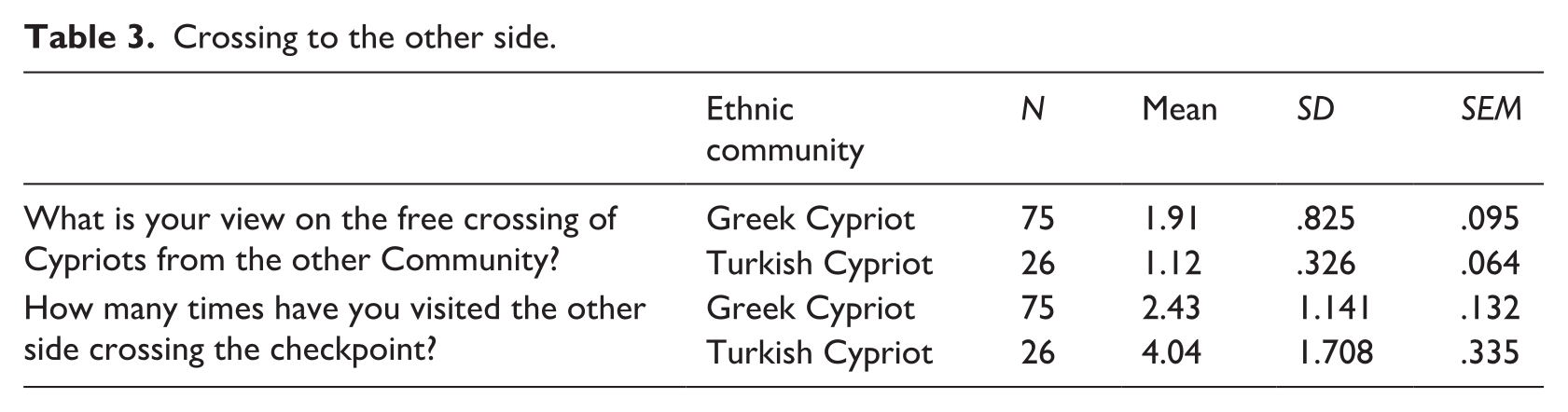
A significant main effect is also shown on the responses for crossing to the other side and to what extent (how many times) that occurred until the moment of their response. An independent-samples t-test for free crossing indicated a significant difference between GCs (M = 1.91, SD = .825, N = 75) and TCs (M = 1.12, SD = .326, N = 26) (t(97.275) = 4.752, p = .000). Similarly, an independent samples t-test was applied to their responses on the number of times they crossed the other side, showing significant differences among GCs (M = 2.43, SD = 1.141, N = 75) and TCs (M = 4.04, SD = 1.708, N = 26) (t(33.064) = −4.477, p = .000) (Table 3).
Crossing to the other side.
Offering services to the ‘other’
To examine how social workers from both communities responded to clients from the other community, an independent-samples t-test was performed. A significant main effect was found between GCs (M = 2.55, SD = 1.96, N = 75) and TCs (M = 1.50, SD = 1.00, N = 4) (t(99) =−4.366, p = .00). No significant main effect was found regarding their responses to clients from the other side (t(4.35) = 1.91, p = 1.23).
A significant main effect was also found on the question about the views of the participants (t(99) = 2.40, p = .018). The mean for the GC social workers (M = 3.41, SD = 1.84, N = 75) was significantly different from TC social workers (M = 1.73, SD = 1.002, N = 26).
Raising awareness / educational activities
A significant main effect was found for the issue on whether awareness seminars could promote solidarity and cooperation among social workers from the two communities between GCs (M = 1.24, SD = 4.30, N = 75) and TCs (M = 1.04, SD = .196, N = 26) (t(91.70) = 3.21, p = .002) (Table 4).
Raising awareness / educational activities.
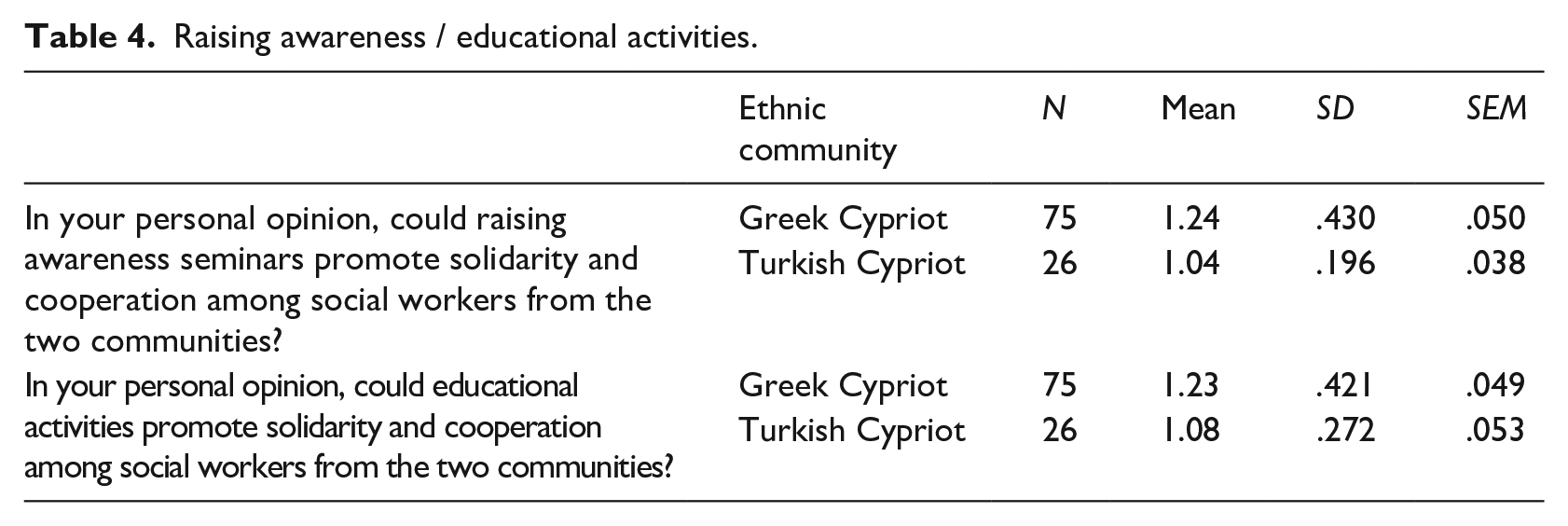
Similarly, a significant main effect was also found on whether educational activities could promote solidarity and cooperation among social workers from the two communities between GCs (M = 1.23, SD = .421, N = 75) and TCs (M = 1.08, SD = .272, N = 26) (t(68.090) = 2.075, p = .042) (Table 4).
Bicommunal recreational activities and workshops
A significant main effect was found in the responses for participation in recreational activities (M = 1.32, SD = .470, N = 75) (M = 1.08, SD = .272, N = 26) (t(76.030) = 3.197, p = .002) and bicommunal workshops (M = 1.24, SD = .430, N = 75) (M = 1.04, SD = .196, N = 26) (t(91.705) = 3.209, p = .022) (Table 5).
Bicommunal activities.
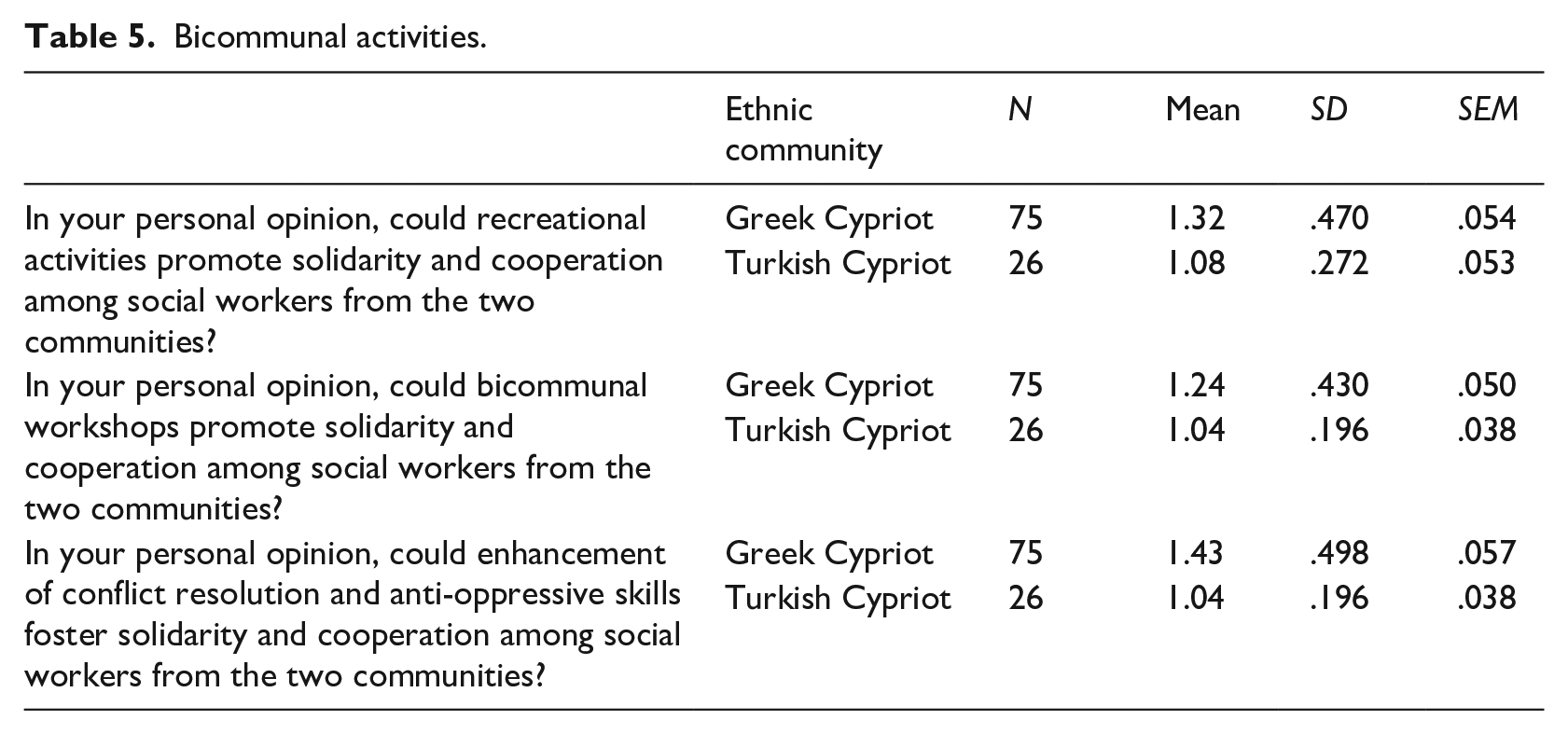
A significant main effect was found in the responses for participation in the enhancement of conflict resolution and anti-oppressive skills training (M = 1.43, SD = .498, N = 75) (M = 1.04, SD = .196, N = 26) (t(97.346) = 5.612, p = .000) for GCs and TCs, respectively (Table 5).
Working together
No significant difference was found in the question about working together in the same professional team between GCs (M = 1.67, SD = .949, N = 75) and TCs (M = 1.73, SD = 1.151, N = 26) (t(70.86) = 2.401, p = .019) (Table 6).
Working together.
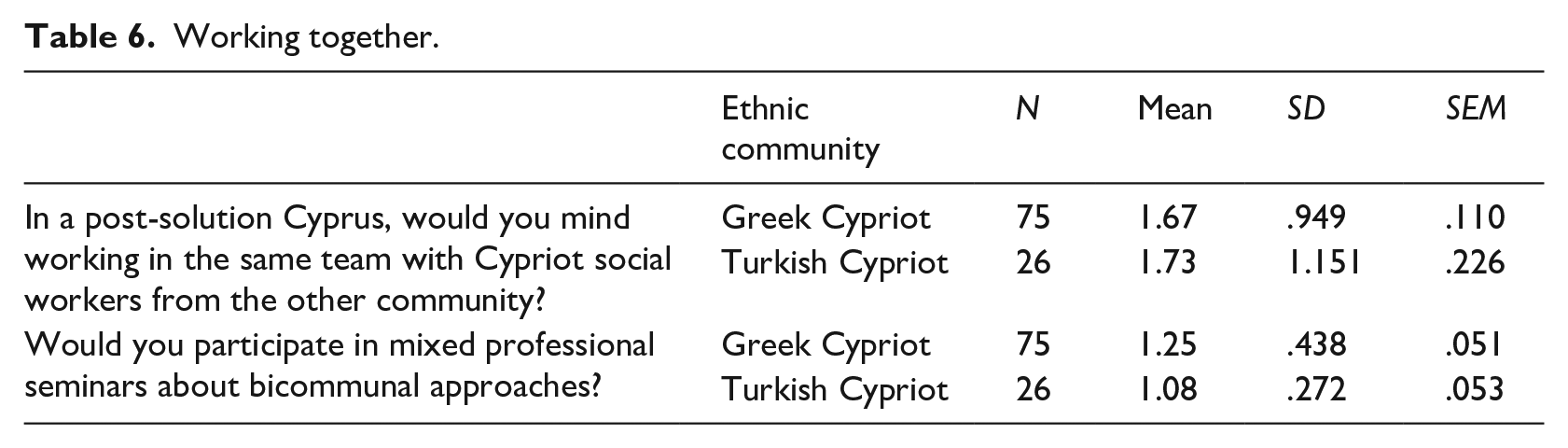
A significant main effect was found in the responses for mixed professional seminars about bicommunal approaches for GCs (M = 1.25, SD = .438, N = 75) and TCs (M = 1.08, SD = .272, N = 26) (t(37.475) =−.255, p = .800) (Table 6).
Discussion and conclusion
This study attempted to understand the complexities Cypriot professional social workers deal with in the context of a geographic, ethnic and political separation and to create a platform for social workers to de-mystify the ‘other’ through bicommunal collaboration and contact.
To comprehend the above-mentioned issues, the researchers focused on understanding the beliefs, experiences, attitudes and, consequently, responses of GC and TC professional social workers in relation to the division of the island, documenting barriers that prevent interaction, reconciliation and bicommunal social work collaboration and exploring tangible ways of collaboration among the two communities within the social work context.
Further to the above, what has been extracted from the survey is that the Cypriot society is divided in its views. Although negotiations have been held for almost 50 years now, not much has been done by the leaderships of the communities of the island towards unification. The lack of any psychosocial preparation among the people of the island and especially among professional groups, like social workers, is obvious in the current survey. Moreover, the responses of professional social workers demonstrate that there is dearth of social work education on bicommunal issues (Ioakimidis et al., 2021). It should be noted that although for almost half a century there have been ongoing negotiations between the two communities, not much has been achieved towards the preparation of the people of the island. The current survey findings prove this contradiction. Social workers’ responses indicate that there has been no preparation from above (e.g. political leadership, professional organizations) towards the possibility that one day Cyprus might reunite again. Social workers’ associations are responsible for educating their members regarding the possibility of the reunification of the island. Similarly, as a recent survey on social work students in Cyprus revealed, not a single social work programme has included a module that openly discusses the Cyprus conflict (Ioakimidis et al., 2021). This is not uncommon among tertiary and higher education in Cyprus. As various authors have stated, the Cypriot social work educational model was constructed on a post-colonial ideology (Askeland and Payne, 2006; Neofytou, 2011; Triseliotis, 1977).
The survey indicates that social workers are positive with regard to bicommunal training and participation in bicommunal activities that would bring them closer to the other community. As Ioakimidis and Trimikliniotis (2019) suggested, Cypriots must learn from the past and learn from other experiences as learning is the key in the processes of struggles ahead. However, it is simultaneously essential that identities are not ethnicized and essentialized. Yet, so far they have not had the opportunity to do so. The survey results reveal the lack of education on bicommunal issues (Ioakimidis et al., 2021) since professional social workers received no previous training on these topics and they are ignorant in terms of knowledge on social work practice in the other community. It is, therefore, critical for social work organizations to promote the establishment of bicommunal initiatives towards training, education, trust building, common synergies and professional collaboration among Cypriot social workers under their common cultural and indigenous identity within the context of a reunified social work.
Future endeavours: Working for peace
The findings of the survey focus very much on the past traumas and the powerful stereotypes underpinned by opposing nationalist narratives. Although a recent research study about co-habitation of the two communities indicated that younger GCs are reluctant to live together with Turkish-Cypriots (Psaltis et al., 2017), our survey indicates that social workers would welcome bicommunal professional activities, like training. Similar findings were also extracted in a recent bicommunal survey on the views and perspectives of Cypriot social work students (Ioakimidis et al., 2021).
Social workers on both sides of the divide have not been allowed spaces for critical exploration of the conflict and its legacies. Consequently, the specific political, economic and social conditions in the country need to be taken into consideration so as to possibly reshape and redesign the provision of social work.
A key aspect for social work that places the peace and reconciliation process in the epicentre of its activity would be reclaiming the Common. The Common, in sociological terms, should not only refer to the narrow spaces of the social work curricula. Instead, it needs to be seen holistically as an effort to reclaim public space, politics and human relationships and, most importantly, capture young people’s imagination about a shared future (Ioakimidis et al., 2021). Cypriots must learn from the past and learn from other experiences as learning is the key in the processes of struggles ahead. However, it is simultaneously essential that identities are neither ethnicized nor essentialized (Ioakimidis and Trimikliniotis, 2019).
Social workers are products of socio-political, economic and cultural worlds. The ideologies they hold are reflected in, and reinforced by, dominant social systems such as the family, education, culture, economics, politics and the media (Sewpaul, 2013). It is, therefore, important to develop awareness of cultural, political and capitalist ideological hegemony and appreciate how they can shift from being the ‘subjected being’ to a free subject that is the ‘author of and responsible for its actions’ (Althusser, 1971: 182). With the development of critical consciousness, there is a greater chance that social workers would use their voice and skills to contribute to socio-economic, political and cultural change and development (Freire, 1973).
Nevertheless, Said (1977: xiv) suggested that there is a ‘profound difference between the will to understand the purpose of coexistence and humanistic enlargement of horizons, and the will to dominate’. Social work must be directed to the former. While doing no harm and respect for human dignity are held as inviolable, universal principles in social work, they are not without contestation. The interpretations of these, mediated by culture and context, often extend the boundaries of moral relativism to the point of violating human rights. While policy and legislation can provide safeguards, they are often trumped by cultural beliefs and practices (Sewpaul, 2016). Yet, social workers have the requisite skills in empathy, active listening, facilitation, mediation and interpersonal relationships to engage people in such ways that the harmful aspects of culture are challenged while retaining those that are positive and that allow for inter-generational cultural continuity and human flourishing (Sewpaul, 2016).
The creation of the above-mentioned new, pro-peace momentum is not seen by the authors as wishful thinking. Studies and observations on the matter confirm that there is now a positive impetus and suggest that the majority of Cypriots among both communities are in support of the reunification of Cyprus through a Federal settlement. Yet, there is still a minority in both communities who seem to promote, directly or indirectly, the partition of Cyprus into two different states, even though this is unacceptable and out of any discussion by the UN and European Union (EU), as well as individual countries. A new study among social workers in the two communities seems to be needed to further examine the views and perceptions of professionals based on the new political agenda that has just appeared on the island. It is our contention that despite the structural barriers a viable peace process is within reach and social work has a key role to play in its design and implementation. Our current research has allowed for more hope about the social work role in this much-needed peace and reconciliation process in Cyprus.
Supplemental Material
sj-docx-1-isw-10.1177_00208728221104397 – Supplemental material for Working for peace: Conflict and social work practice in the divided Cyprus
Supplemental material, sj-docx-1-isw-10.1177_00208728221104397 for Working for peace: Conflict and social work practice in the divided Cyprus by Vasilios Ioakimidis, Gregory Neocleous, Agamemnonas Zachariades, Hanife Serin, Buse Erzeybek and Ayse Ozada in International Social Work
Footnotes
Declaration of conflicting interests
The authors declared no potential conflicts of interest with respect to the research, authorship and/or publication of this article.
Funding
The authors received no financial support for the research, authorship and/or publication of this article.

Supplemental material
Supplemental material for this article is available online.
Notes
Author biographies
References
Supplementary Material
Please find the following supplemental material available below.
For Open Access articles published under a Creative Commons License, all supplemental material carries the same license as the article it is associated with.
For non-Open Access articles published, all supplemental material carries a non-exclusive license, and permission requests for re-use of supplemental material or any part of supplemental material shall be sent directly to the copyright owner as specified in the copyright notice associated with the article.
