




Abstract
This study analyses welfare chauvinist attitudes in the generous welfare states of Sweden, Norway and Finland. We find that strict forms of exclusionary welfare chauvinism are near non-existent. However, Finland, Norway and Sweden are in the top tier in Europe when it comes to beliefs that immigrants need to obtain citizenship before being given equal rights to social benefits. This may indicate a future turn in social policy when it comes to inclusion of non-citizens, with significant implications for social workers. We further analyse welfare chauvinism by exploring socio-economic factors, satisfaction with the country, and attitudes towards both benefits and immigrants.
Introduction
The European welfare state has become an entrenched institution in modern European society. Europeans continually show strong support for the welfare state, and no political party would dare to propose a full dismantling of it (Greve, 2019). The Nordic welfare states in particular have a strong emphasis on universalism. Although other welfare regimes may be more generous, the Nordic welfare regime is considered unique in combining generosity with universalism (Kangas and Kvist, 2018). In a universal system, all citizens are endowed with similar rights irrespective of class or market position, thus promoting equality of status (Esping-Andersen, 1990). A more comprehensive and universal welfare state also limits a widespread feeling of ‘us’ and ‘them’, which, in turn, can be associated with a higher tolerance towards immigrants (Crepaz and Damron, 2009). This may explain why the Nordic countries continually exhibit more tolerant attitudes towards immigrants than most other European countries (Bell et al., 2021; Bello, 2017).
However, immigration has become more salient in recent years in the Nordic countries and all these countries have prominent right-wing populist parties who are highly critical of immigration and immigrants (Jungar and Jupskås, 2014). It was these parties who, in many ways, pioneered what is often regarded as welfare chauvinism, the concept that welfare services should be restricted to ‘our own’ people and not to foreigners (Andersen and Bjørklund, 1990; Van der Waal et al., 2013). Studies on welfare chauvinism maintain that it is not only a political strategy, but it can also be a particular form of anti-immigrant attitude placed in the context of social policy (Careja and Harris, 2020).
Welfare chauvinistic attitudes have become more salient in welfare states across the world (Koning, 2021). The common welfare chauvinist view is that immigrants place an excessive burden on the welfare state, making it unaffordable. The solution to this problem is either to totally exclude immigrants from the welfare benefits, or to minimise immigrants’ opportunity to acquire these welfare benefits (Schumacher and Van Kersbergen, 2016). This distinction between totally excluding and making it very difficult for immigrants to gain the same level of benefits as the majority population is an important one to emphasise to fully understand the particular Nordic welfare chauvinism that will be presented later in the analysis of this study.
This study uses the European Social Survey round 8 (ESS8) collected in 2016–2017 to analyse and test four different explanations for understanding the causes of welfare chauvinism and explain how stricter and moderate forms of welfare chauvinism may be important for understanding the phenomenon in three of what is often regarded as the most generous and tolerant welfare states, Norway, Sweden and Finland. Unfortunately, Denmark was not included in the dataset and Iceland had too few respondents to conduct a satisfactory analysis, so we have limited our study to three out of the five Nordic countries. The four proposed explanations relate to socio-economic factors, satisfaction with the state of the country, general attitude towards welfare benefits and attitudes towards different immigrant groups. The main aim of this study is therefore to investigate these four explanations, while also examine the nuances of welfare chauvinism in a Nordic context.
The welfare chauvinist attitudes we explore in this article are of significant relevance to social work and social welfare policy. These sentiments are in stark contrast to public support for universalist welfare policies. It is maintained that social work and social welfare policies in Nordic countries are based on universalist values and each social worker is expected to challenge inequalities and discrimination in all its forms (International Federation of Social Workers, 2021). However, these values are often contested by different exclusionary policies, especially in cases regarding certain categories of immigrants and refugees (Valenta and Strabac, 2011). Social workers and service providers implement welfare policies considering who deserves various welfare benefits. Diminishing support for universalist welfare state policies may therefore have long-term consequences for social work practice in Nordic countries, forcing service providers to be more complacent to the differential inclusion of marginalised immigrant groups (Könönen, 2018).
These attitudes can also have repercussions for the health care sector, which is especially relevant during the ongoing Covid-19 pandemic. Immigrants may be faced with a second rate health care assistance when compared with the majority population. Larsen and Schaeffer (2021) found in their vignette-study of health care chauvinism in Denmark that immigrants, particularly immigrants with a Muslim sounding name, were seen as less deserving of health care than native citizens. If large portions of the population wishes to roll back welfare services for immigrants until they become citizens, there may be dangerous repercussions for the immigrant populations both in the Nordic countries, and on a global level if this tendency is to be found outside of the Nordic countries.
Literature review
The term ‘welfare chauvinism’ was created to explain the structural changes and new cleavages of Western European politics of the 1990s. Right-wing nationalist parties became supportive of a welfare state that should primarily exist for the native populations (Andersen and Bjørklund, 1990). It has since become a staple of right-wing populist parties’ social policy agenda (Fenger, 2018; Ketola and Nordensvard, 2018), and has influenced mainstream political parties to be more sceptical of multiculturalism (Leruth and Taylor-Gooby, 2021; Schumacher and Van Kersbergen, 2016). Around the 2010s, more research interest was established towards welfare chauvinistic attitudes (Crepaz and Damron, 2009; Van der Waal et al., 2010). This has coincided with a significant increase in media attention towards focussing on the burden immigrants place on the welfare state (Koning, 2021). As Koning points out, a newspaper reader is now around 50 percent more likely to read about the burdening of immigration on welfare states than 30 years ago (Koning, 2021).
Several factors have been found to influence welfare chauvinistic attitudes. It is argued that economic insecurity and other socio-economic factors increase welfare chauvinism (Ford, 2016; Hjorth, 2016; Mewes and Mau, 2012). Group belonging is also an important predictor of welfare chauvinism, as some immigrant groups are more prone to be stereotyped as a burden for the welfare state (Edwards et al., 2021; Ford, 2016; Reeskens and Van der Meer, 2017). These factors will be explained further in the next section.
When comparing welfare chauvinism across welfare regimes, Van der Waal and colleagues (2013) found that the social democratic welfare regimes are distinctly different from both conservative and liberal welfare regimes when it comes to welfare chauvinism. The authors attribute this to the lower levels of social inequality that are common to the social democratic welfare regimes. However, as they find that there is a distinct form of welfare chauvinism in this region, we believe it is important to further explore the welfare chauvinism that can be found in the Nordic countries. In what follows, we therefore present four possible explanations for understanding the welfare chauvinism that can be found in the Nordic region.
Theoretical framework: Explanations for welfare chauvinism
We expect socio-economic factors such as education, income level and unemployment to have an effect on an individual’s welfare chauvinistic attitude. We base this largely on intergroup threat theories (see, for example, Blalock, 1967; Blumer, 1958; Stephan et al., 2016), which posit that anti-immigrant attitudes can be explained by a feeling that the immigrant poses a perceived threat towards the majority ethnic group. According to Blumer (1958), members of the dominant group feel that they have a proprietary claim to certain areas of privilege, and they fear that the subordinate group will threaten their position. These threat perceptions may have a symbolic or a realistic dimension (Ben-Nun Bloom et al., 2015; Stephan et al., 2016). We are primarily interested in the realistic threat perceptions, as they are related to concerns of the loss of material resources (Stephan et al., 2016). Here, it is posited that natives may perceive immigrants as competitors for jobs, benefits, affordable housing and so on. Central to this explanation is that individuals with a lower socio-economic status will perceive immigrants as economic threats, as they often occupy the same socio-economic status (Greve, 2020). Competition for welfare benefits is therefore perceived as a zero-sum game where one group wins at the other’s expense (Heizmann et al., 2018; Mewes and Mau, 2012).
The second possible explanation regards individuals’ satisfaction with society. This explanation follows the logic of the scapegoat theory. The implication is that some outgroups innocently attract the aggression generated by the frustrations suffered by members of the ingroup (Allport, 1954). It is not ‘we’ who are responsible for the misfortunes; it must be someone else’s fault. Historically, Jews have often been subject to blame for the problems in society (Allport, 1954; Bethencourt, 2015), whereas more recently, immigrants are often blamed for problems and issues which arise on a macro level (Cecchi, 2019). Bello (2017) argues that decreased public expenditure in several OECD countries in the 1990s and 2000s combined with an increase in immigration made immigrants an easy scapegoat. She asserts that vulnerable groups saw deteriorating living standards combined with a rising immigrant population in their neighbourhoods and concluded it had to be the fault of the immigrants that living standards deteriorated (Bello, 2017). This process can also be described as ‘Neoliberal Multiculturalism’ (Kymlicka, 2020). Following the 2008 financial crisis, immigrants also became a convenient scapegoat in countries that were most affected by the crisis (Isaksen, 2019).
Based on the scapegoat theory, we expect that individuals who are more dissatisfied with the state of the country will be more likely to blame immigrants for the problems of the welfare state and therefore be less willing to share the benefits of the welfare state with immigrants. As with the socio-economic explanation, individuals who are dissatisfied with the state of the country may regard immigrants as a cause of resource scarcity and believe that increased benefits and rights to immigrants may further exhaust the welfare state.
We also assume that individual attitudes towards benefits in general may affect welfare chauvinistic attitudes. We build on the notion that neoliberalism and welfare chauvinism share a similarity, as their core idea is to constrain solidarity and to separate the ‘deserving’ from the ‘undeserving’ (Grdešić, 2019). Here, we follow the explanation that neoliberalism is linked to a general position that market forces are beneficial, and that it glorifies individualism, competition and private initiative (Grdešić, 2019).
To support the welfare chauvinistic logic, neoliberalism is often combined with cultural othering (Keskinen et al., 2016). To our knowledge, few quantitative empirical studies have explored this link (Careja & Harris 2022). Yet, it has been found that neoliberal attitudes are correlated with welfare chauvinistic attitudes in Germany, even overriding the effect of education, which tends to be the most consistent factor in decreasing negative attitudes towards immigrants (Grdešić, 2019). Based on the above-mentioned studies, we assume that an individual who is negative towards benefits in general would be more likely to be negative towards giving immigrants the benefits of the welfare state.
The fourth and final explanation we posit in this study is that anti-immigrant attitudes are likely to influence an individual’s attitude to whether immigrants should be excluded from or receive fewer welfare benefits than the majority population. This follows research that indicates that individuals distinguish between ‘deserving’ and ‘undeserving’ immigrants (Ford, 2016; Keskinen et al., 2016). Reeskens and Van der Meer (2017) find in their Dutch sample that individuals feel that certain nationalities ‘deserve’ welfare benefits more than other nationalities; for example, a Surinamese immigrant is considered more deserving of welfare benefits than an Afghan or a Moroccan immigrant.
Similarly, Ford (2016) posits that majority group voters in Great Britain are less willing to help claimants from minority groups. Furthermore, he finds that foreign birth alone prompts a hostile response in that Irish immigrant claimants receive less public support than a white native claimant. However, there is still significantly less sympathy for the more culturally distant Muslim immigrant than the more culturally similar Irish immigrant (Ford, 2016). More culturally dissimilar immigrants are also often the target of welfare chauvinistic rhetoric (Edwards et al., 2021). As we will soon see, explorations of these links are relevant to our comparisons of Nordic countries, whose immigrant population is of different sizes and compositions, and thus perceived differently regarding the use of welfare benefits and the distinctions between deserving and undeserving recipients of the welfare services.
The Nordic context: Universalism and welfare chauvinism
The idea of Norway, Sweden, Finland, Denmark and Iceland constituting a Nordic group of democratic welfare capitalist countries is widely accepted and can be traced back to the 1930s (Pedersen and Kuhnle, 2017). Universalism is central to their welfare model, and they are all characterised by a high degree of equality, an active labour market policy with high levels of employment for both genders, a low level of wage differentiation and a high level of taxes (Greve, 2007). Other welfare states may be more generous and benefits may be higher than in the Nordic welfare states; yet, the combination of generous welfare benefits and universalism is considered unique (Kangas and Kvist, 2018).
Both naturalised immigrants and foreign citizens with permanent residence in Norway, Sweden and Finland have access to the same social protection system and welfare benefits as the native population (Ahlén and Palme, 2020; Brochmann and Grødem, 2013; Kalliomaa-Puha, 2020). However, granting immigrants the same benefits as the general population is something that the right-wing populist parties in all three countries have exploited and heavily criticised to gain support among voters (Andersen and Bjørklund, 1990; Jungar and Jupskås, 2014). The Sweden Democrats and the Finns Party have, despite different historical legacies, converged ideologically, as they embrace an authoritarian position on socio-cultural policy while being economically rather centrist (Jungar and Jupskås, 2014). The Norwegian Progress Party are also anti-immigrant and anti-establishment, but they differ somewhat, as they are more right-wing economically and more aligned with a neoliberal view than the two other parties. However, all three parties focus much of their attention on refugees and the Muslim population, specifying ways that they strain the welfare state and highlighting their alleged cultural incompatibility with the national core values (Demker and Odmalm, 2022; Jungar and Jupskås, 2014; Widfeldt, 2018; Ylä-Anttila and Ylä-Anttila, 2015).
There are also both similarities and differences between the three countries when it comes to their immigrant populations. The immigrant numbers we present in this study are based on the UN international migrant (2017) stock. We use the numbers from 2015 as the data we analyse is from 2016. Probably the most obvious difference between the three countries is that Finland has a considerably smaller immigrant population than Sweden and Norway. Large-scale immigration to Finland is a relatively recent phenomenon, as until the 1980s it was a country of emigration (Kalliomaa-Puha, 2020). The immigrant population makes up around 5.8 percent of the population, with the majority coming from Estonia and Russia. Finland also has several smaller immigrant communities from countries in Asia and Africa, such as Iraq and Somalia. The Russian population is often subjected to prejudice and tends to be perceived as an economic threat to the majority population (Nshom and Croucher, 2014). The Somalis are, however, the main target of intolerance from both media and populist politicians (Ylä-Anttila and Ylä-Anttila, 2015). They are also perceived as making up a much larger share of the population than they actually do (Herda, 2015).
Sweden and Norway have a several times larger immigrant population than Finland. Although both Norway and Sweden have a relatively similar percentage of immigrant populations, with immigrants making up around 14.4 and 16.4 percent of the population, the composition of immigrant groups differs quite a lot. The largest immigrant groups in Norway are, for the most part, other EU-migrants, with Poles, Swedes and Lithuanians making up the three biggest immigrant groups. Many of these are migrant workers who temporarily work in the country (Cappelen and Midtbø, 2016). Norway also has a sizable Muslim population that originates from different countries in Asia and Africa. Studies show that the Norwegian majority population has stronger negative attitudes towards non-European and Muslim immigrants than towards Nordic and European immigrants (Brekke et al., 2020).
Sweden also has a sizable European immigrant population from Finland, Poland and other Scandinavian and European countries. However, contrary to Norway and Finland, some of the largest immigrant groups in Sweden are from outside of Europe, with Iraqis, Iranians and Syrians being among the largest immigrant groups in the country. Since the early 1990s, Sweden has had a comparatively more generous admission and settlement policy towards refugees and asylum-seekers than any other Nordic country (Valenta and Bunar, 2010; Valenta and Thorshaug, 2013; Garvik and Valenta, 2021). This may explain why Sweden has a larger number of immigrants coming from countries outside of Europe than Norway and Finland (Ahlén and Palme, 2020).
Swedes have been known to be supportive of immigration of refugees and of the generous state-assisted integration programmes (Valenta and Bunar, 2010). They were among the largest receivers of Syrian refugees during the European refugee crisis of 2015 (Valenta M and Jakobsen J, 2020). However, studies on attitudes towards refugee migrations in Sweden show that people are becoming more in favour of restricting refugee migration (Ipsos, 2015). It has also been detected that welfare chauvinist sentiments are on the rise (Ahmadi et al., 2016) and that welfare chauvinist attitudes are stronger towards culturally dissimilar immigrants (Hjorth, 2016).
Data and methods
This study uses data from the eighth wave of the European Social Survey (ESS) collected in 2016–2017. The dependent variable for this study is based on the question from the survey: ‘Thinking of people coming to live in [country] from other countries, when do you think they should obtain the same rights to social benefits and services as citizens already living here?’ The respondents had five different answers to choose from: (1) Immediately on arrival; (2) After living in [country] for a year, whether or not they have worked; (3) Only after they have worked and paid taxes for at least a year; (4) Once they have become a [country] citizen; and (5) They should never get the same rights. This variable is often used as a dependent variable in studies analysing welfare chauvinism (Greve, 2019; Heizmann et al., 2018; Reeskens and Van Oorschot, 2012).
To analyse the data, we use linear regression models in the three selected countries. We use nested models based on our proposed explanations to better explore how the variables affect welfare chauvinistic attitudes and to investigate the increased strength of the models when adding variables. The sample size is a total of 4366, of which there were 1282 respondents from Norway, 1131 respondents from Sweden and 1753 respondents from Finland. Individuals who were born in another country have been excluded, and post-stratification weights are applied throughout the analysis.
For the analysis, we have also added variables often used to explain attitudes towards immigrants as control variables; these variables include gender, age and urbanisation (see Ceobanu and Escandell, 2010 for review). For the socio-economic explanations, we include variables measuring education (in years), if the respondent is unemployed (1 = unemployed) and the respondents’ satisfaction with their household’s income (1 = very difficult on current income; 4 = living comfortably on current income). For satisfaction with society, we include two variables: the respondents’ satisfaction with the economy (0 = extremely dissatisfied; 10 = extremely satisfied) and satisfaction with state of health services (0/10) in the country. We expect that individuals who are either less satisfied with the state of the economy or the health services in the country will harbour a more welfare chauvinistic attitude. To measure the attitude towards benefits, we created a scale variable based on four questions where the respondents were asked if they disagree strongly (= 1) or agree strongly (= 5) with the following statements concerning social benefits/services: (1) Social benefits/services cost businesses too much in taxes/charges; (2) Social benefits/services make people lazy; (3) Social benefits/services make people less willing to care for one another; and (4) Social benefits/services place too great a strain on the economy. The four variables have a Cronbach’s alpha value of 0.71, 0.74 and 0.76 in Norway, Sweden and Finland, respectively.
The final possible explanation posits that welfare chauvinism can be explained by anti-immigrant attitudes. As we showed previously, individuals often distinguish between ‘deserving’ immigrants and ‘undeserving immigrants’ (Keskinen et al., 2016). We therefore explore how negative attitudes towards two different immigrant groups may elicit different levels of welfare chauvinism. Previous studies suggest that these so-called ‘undeserving immigrants’ are often the more culturally dissimilar immigrants (Ford, 2016; Hjorth, 2016). We therefore use two different variables that distinguish between attitudes towards a more culturally similar immigrant group and a more culturally dissimilar immigrant group. These variables measure whether respondents are willing to allow many or few immigrants of the same race/ethnicity as the majority group (1 = allow none; 4 = allow many) or immigrants from poor countries outside of Europe (1–4) to come and live in the country.
The use of these variables is not necessarily unproblematic. There is a possibility that welfare chauvinism and general anti-immigrant attitudes might be two aspects of the same phenomenon. Although they both are a form of discriminatory attitude towards immigrants, Gorodzeisky and Semyonov (2009) argue based on their findings that they are two distinct strategies of exclusion. They further argue that attitudes towards exclusion from the social system are viewed as dependent on attitudes towards exclusion of foreigners from the country and not vice versa. Other studies such as Hjorth (2016) or Magni (2021) have also included various forms of exclusionary attitudes as independent variables in their analysis of welfare chauvinism. We therefore continue with the proposed strategy of including two anti-immigrant attitudes in our models.
Results
Nordic welfare chauvinism in a European context
We begin our analysis with a simple distribution of the dependent variable measuring welfare chauvinistic attitudes in Norway, Sweden and Finland.
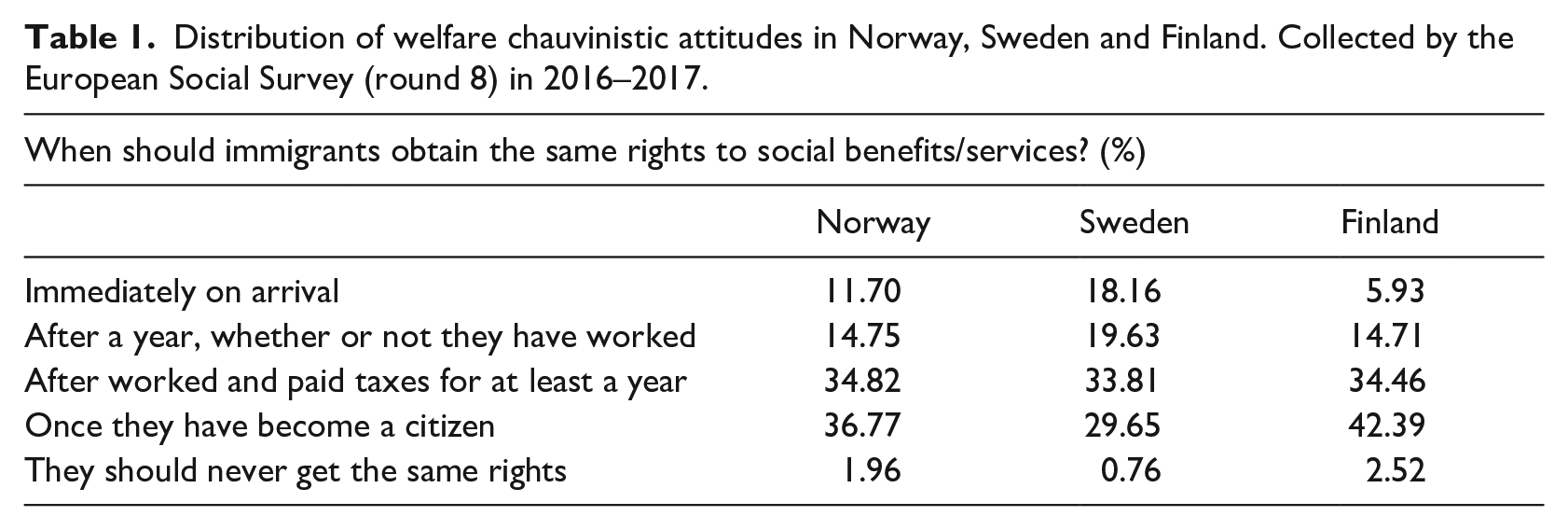
We have previously explained the distinction between a strict and a moderate form of welfare chauvinistic attitudes (see Van Oorschot and Roosma, 2017). Table 1 indicates that the strict form of welfare chauvinism, such as the stance that immigrants should never get the same rights as the majority population, is near non-existent in the three countries. The moderate form of welfare chauvinism posits that it should be very difficult to gain the same level of social benefits as the majority population. This moderate form of welfare chauvinism is represented in the table by the category ‘once they have become a citizen’. This form of welfare chauvinism is very prevalent in all three countries, with Sweden having the lowest level of the moderate form of welfare chauvinism. In Norway, around a third of the respondents believe that immigrants should obtain the same rights to social benefits only once they become citizens. Finland stands out among the three countries, with around 42 percent harbouring this moderate form of welfare chauvinism.
Distribution of welfare chauvinistic attitudes in Norway, Sweden and Finland. Collected by the European Social Survey (round 8) in 2016–2017.
We further contextualise our results in Figures 1 and 2 by showing how the Nordic countries are compared with the other European countries in our dataset.
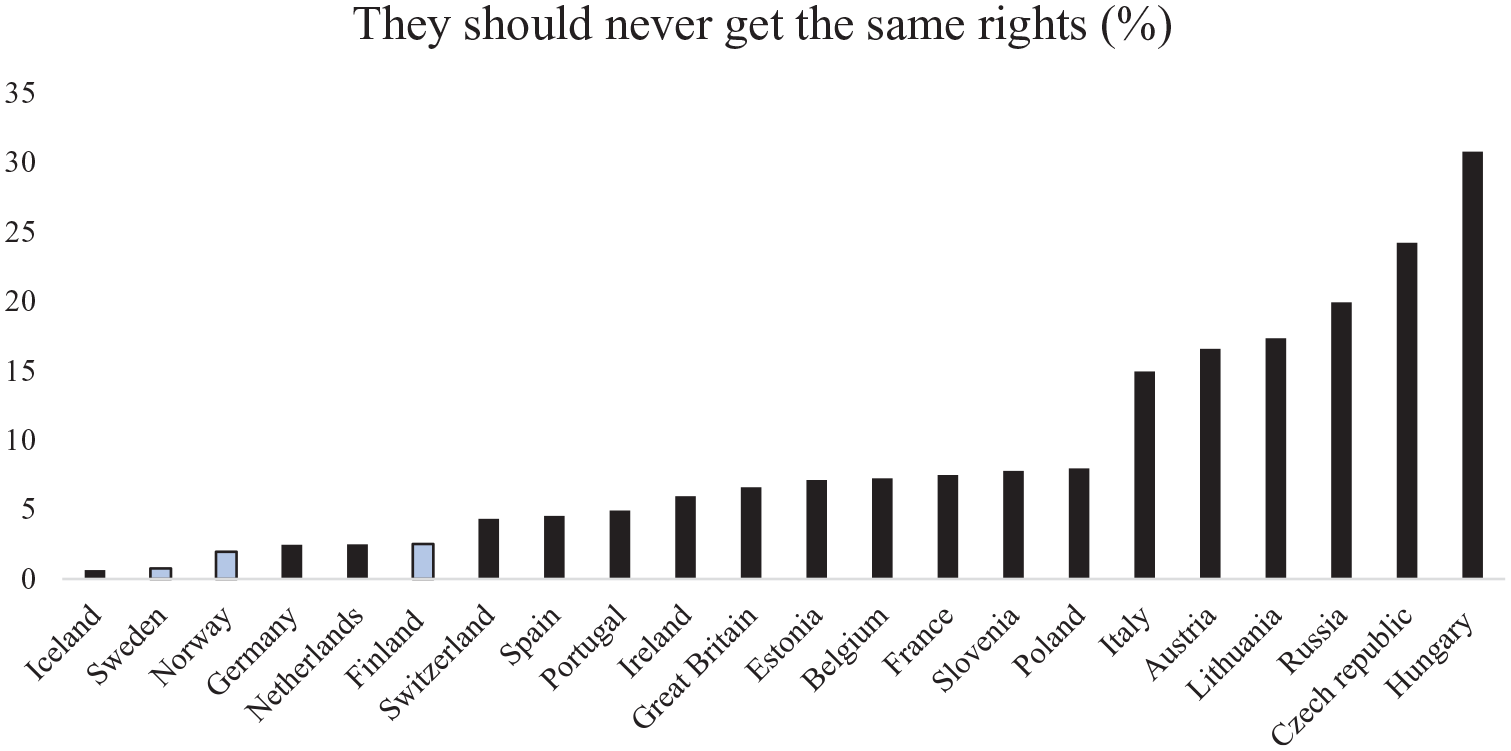
Respondents believing that immigrants should never get the same rights as the majority population across Europe (%). Data collected from 22 European countries by the European Social Survey (round 8) in 2016–2017.
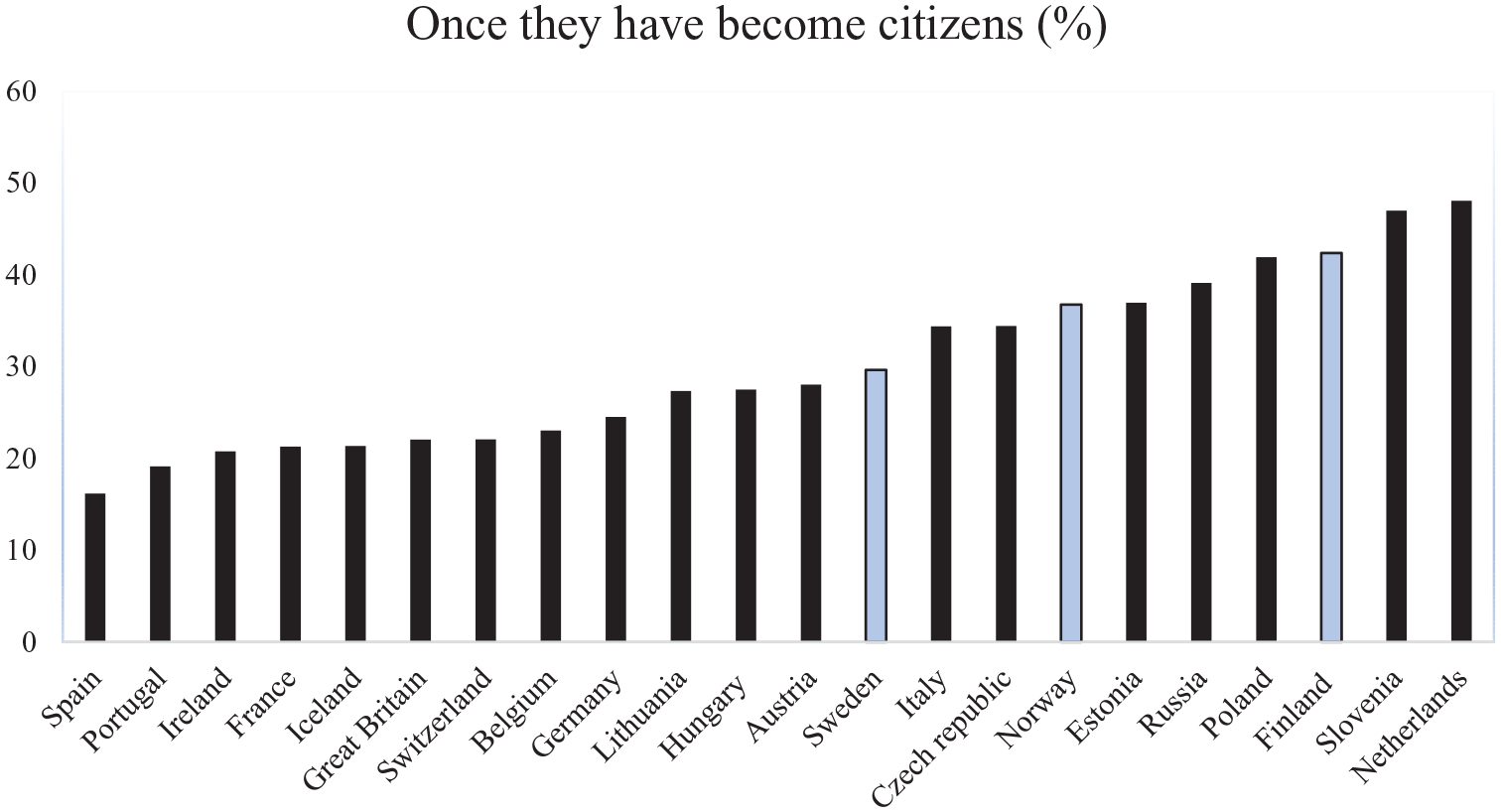
Respondents believing that immigrants must have citizenship before gaining the same rights as the majority population across Europe (%). Data collected from 22 European countries by the European Social Survey (round 8) in 2016–2017.
Figure 1 conveys a familiar trend, with the Nordic countries being among the most tolerant countries in Europe. Figure 2, however, nuances this picture somewhat, showing that respondents in the three Nordic countries are not necessarily as tolerant as Figure 1 suggests. As we may see in the figure, the respondents require citizenship as a precondition for social benefits, which is a much more restrictive stance than is currently prescribed in the existing policies in the three countries. As already mentioned, both naturalised immigrants and foreign citizens with permanent residence in Norway, Sweden and Finland have access to the same social protection system and welfare benefits as the native population. Yet, all three Nordic countries are in the top half of the moderate form of welfare chauvinism, with Finland ranking third among the European countries. We also examined the 2008 ESS dataset, and the levels of welfare chauvinism in the Nordic countries are remarkably stable, with virtually no change in the levels. This is particularly surprising in the case of Sweden, as the country was one of the main refugee destinations during the refugee crisis in 2015–2016.
Socio-economic factors and satisfaction with the state of the country
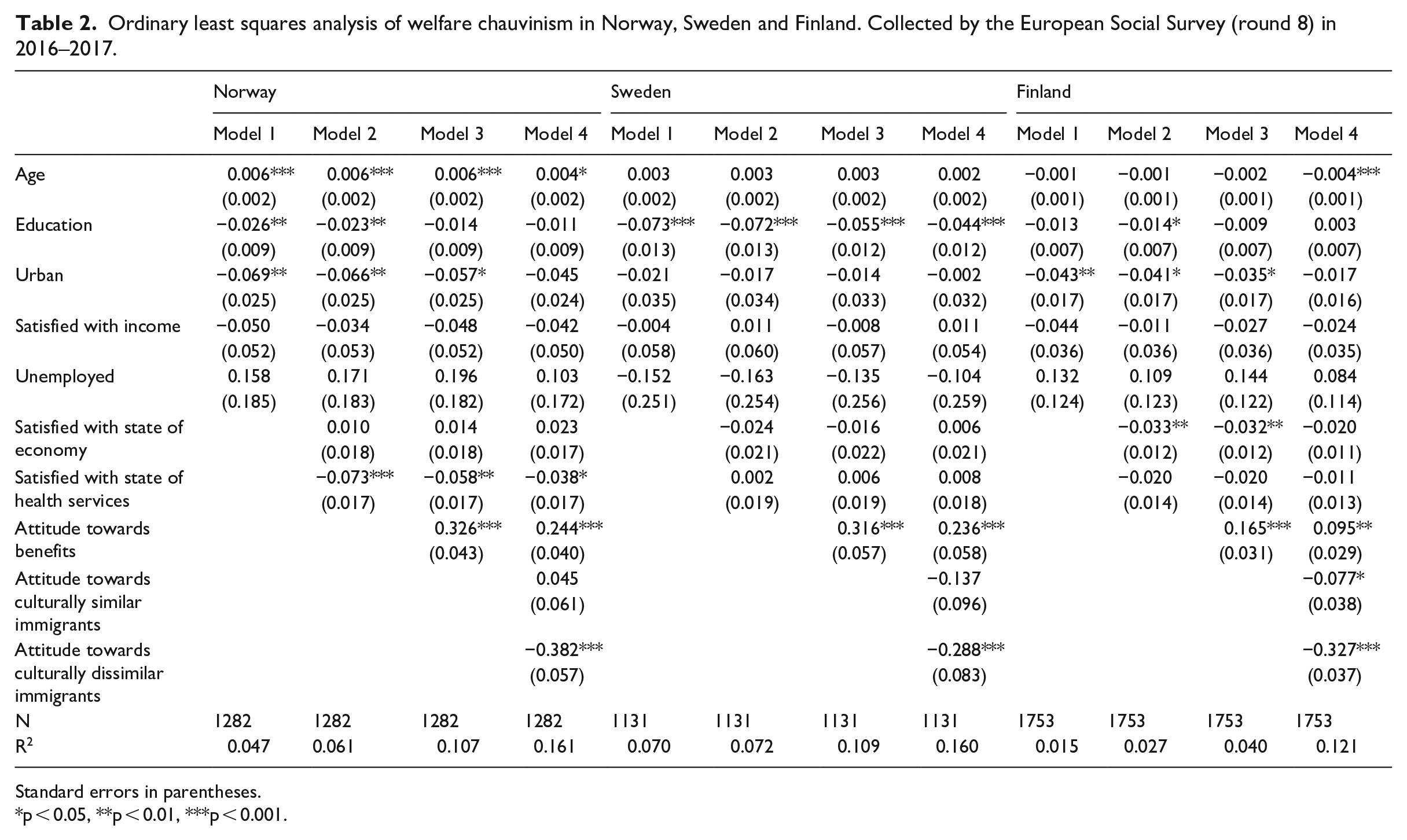
Having shown and contextualised the welfare chauvinistic attitudes in the three countries, we move on to Table 2, which shows the linear regression models for these countries. We have nested the models according to the possible explanations we outlined earlier in the article. Therefore, Model 1 includes the socio-economic variables and control variables, Model 2 adds the two variables measuring satisfaction with society, Model 3 includes the variable measuring attitude towards benefits and finally, Model 4 introduces the variables measuring different forms of anti-immigrant attitudes. The analysis will mainly be based on Model 4, which includes all variables, unless there are specific aspects of the previous models that are of interest.
Ordinary least squares analysis of welfare chauvinism in Norway, Sweden and Finland. Collected by the European Social Survey (round 8) in 2016–2017.
Standard errors in parentheses.
p < 0.05, **p < 0.01, ***p < 0.001.
As we can see from the ordinary least squares analysis in Table 2, the socio-economic variables represented by education, satisfied with income and unemployed are found to have little to no effect for welfare chauvinistic attitudes in the three countries. When all variables are added, education can only be found to have an effect in Sweden, whereas whether an individual is unemployed or dissatisfied with their current income has no effect across all three countries. By examining the R2 in Model 1 across the three countries, it is also clear that socio-economic factors are not the most important for understanding welfare chauvinism in the Nordic countries. This is especially the case in Finland, where the socio-economic variables and the control variables together only have an explanatory power of around 1.5 percent. Although economic explanatory variables have varying results in regard to their effect on welfare chauvinistic attitudes (see, for example, Heizmann et al., 2018; Van der Vaal et al., 2013), it is surprising that education only has an effect in Sweden, as education is known to be one of the more robust variables for explaining both attitudes towards immigrants and welfare chauvinism (Ceobanu and Escandell, 2010; Reeskens and Van Oorschot, 2012; Van der Waal et al., 2013). Education also has an effect in Norway before we control for attitudes towards benefits and different immigrant groups.
Model 2 includes the variables that measure satisfaction with society, which is captured by the two variables satisfaction with the state of the economy and health services. These variables have no effect in Sweden, whereas reduced satisfaction with the state of the health services has an expected negative effect across all models in Norway. In Finland, reduced satisfaction with the economy has the expected negative effect until the anti-immigrant variables are added. However, the explanatory power of the models barely increases in both countries with the inclusion of these variables, showing that, although it has an effect in Norway, and to some degree in Finland, satisfaction with society is of relatively little importance for understanding welfare chauvinism in the Nordic countries.
Discussing scepticism towards social benefits and immigrants
In contrast to the two previously proposed explanations, individuals’ attitudes towards benefits has an effect in all three countries. There are several interesting aspects regarding this finding. With a coefficient of 0.244 in Norway and 0.236 in Sweden, it has a similar effect in both these two countries. The effect is much weaker in Finland, where it has a coefficient of 0.095. This difference between Finland and the two Scandinavian countries is also pronounced when it comes to the explanatory power represented by the R2. In Norway and Sweden, it rises to almost 11 percent when the variable measuring attitudes towards benefits is added, while it rises to only 4 percent in Finland. This may appear surprising, since Finns are just as supportive of the welfare state and of different welfare benefits as other Northern citizens (Jæger, 2012). However, it may be argued that the detected variations relate to differences in the size of the immigrant populations in the three countries. This is in line with Eger (2009), who shows that increased immigration at the regional level has negative effects on support for the welfare state and attitudes towards universal spending. As already mentioned, Finland’s immigrant population is considerably smaller than in the other two countries, and it consequently occupies a less prominent place in debates on public spending and welfare benefits.
The strongest effects can be seen in how attitudes towards different immigrant groups affect welfare chauvinism. There is a substantial rise in the explanatory power of the models represented by R2 when these two variables are included. However, the effects of these variables differ in the three countries in an interesting way. In Norway, attitudes towards culturally similar immigrants have no effect on welfare chauvinistic attitudes. Attitudes towards culturally different immigrants have a very strong negative effect, showing that Norwegians view immigrants who are more culturally different than themselves as less deserving of welfare benefits. The two largest immigrant groups from outside of Europe are from Somalia and Iraq and are, coincidentally, the two immigrant groups with the lowest employment rate (Strabac and Valenta, 2015). These groups are also often exposed to negative attitudes (Brekke et al., 2020), which may explain the strong effect of the variable in Norway.
As already noted, the largest immigrant groups in Norway are migrant workers from the European Union and Scandinavian countries. Some studies have found both welfare chauvinistic attitudes and more general anti-immigrant attitudes towards some of these migrant workers (Cappelen and Midtbø, 2016). Researchers have also detected that Norwegians have considerably fewer negative sentiments towards European immigrants than towards non-European immigrants (Brekke et al., 2020).
We did not expect that these sentiments among respondents in our study would not have any effect on welfare chauvinist attitudes towards culturally similar immigrants. However, it may be argued that this indeed relates to Norway’s rather large population of EU-migrant workers and immigrants from Scandinavian neighbouring countries, who are usually perceived as hard workers and contributors to the maintenance of the Norwegian welfare state (Brekke et al., 2020).
The results in Sweden are similar to what we find in Norway. Negative attitudes towards culturally dissimilar immigrants indicate a more welfare chauvinistic attitude, while attitudes towards culturally similar immigrants do not have a statistically significant effect. This lack of statistical significance is, to a large degree, a consequence of larger standard errors in the Swedish sample (the Swedish sample being the smallest of the three). We nevertheless observe the same pattern as in the two other Nordic countries. The effect of attitudes towards culturally dissimilar immigrants is much stronger than the effect of attitudes towards culturally similar immigrants. This may partly be explained by Sweden experiencing the largest influx of refugees from Asian and African countries compared with any other Nordic country shortly before the data used in this study were collected. Furthermore, Swedish studies assert that immigrants from Muslim countries are the most exposed to negative attitudes and that individuals in Sweden have different preferences towards different immigrant and racial groups (Hjorth, 2016).
The results in Finland differ somewhat from the Norwegian and Swedish results, as welfare chauvinism is connected to attitudes towards both culturally similar and culturally dissimilar immigrant groups. However, there is a clear difference in the strength of the two variables, as attitudes towards culturally dissimilar immigrants have a more than four times stronger effect than those towards culturally similar immigrants. This is in line with previous studies that indicate that Finns take differential positions on different immigrant groups (Bohman, 2018). The Russian population in Finland is often perceived as a realistic threat (Nshom and Croucher, 2014), which may explain why attitudes towards culturally similar groups have an effect in Finland. However, the attitude towards culturally dissimilar immigrants has a much stronger effect. This may be because the Somali population is greatly overestimated by many Finns (Herda, 2015). The overestimation of the Somali population is often combined with media and populist politicians continuously labelling them as a burden for the welfare state and welfare misusers (Ylä-Anttila and Ylä-Anttila, 2015), which, in sum, may explain the strong effect that the above-mentioned variable has on welfare chauvinistic attitudes in Finland.
Discussion: Consequences for social policy and social work
This study has found that the strict form of welfare chauvinism is near non-existent in the Nordic countries, whereas a moderate form of welfare chauvinism is very much alive in Norway, Sweden and, particularly, Finland. Comparisons of the moderate form of welfare chauvinism in Europe show that all three Nordic countries are in the top half, with Finland ranking as number three among European countries. We may only speculate as to why so many people in Nordic countries are demanding that immigrants should gain citizenship before they obtain the same social benefits and services as the native population. However, we may note that in Nordic countries, the state is seen as the ultimate provider of welfare services. Indeed, the links between the state and welfare are known to be considerably stronger in Nordic welfare states than in many other countries where the public relies strongly on civic society, non-governmental organisations and family support. This in turn may explain why large segments of the Nordic population connect welfare benefits with citizenship.
If then, as our study suggests, a large proportion of the population wishes for stricter control of the services of the welfare state, this has clear consequences for social policies and social work. These sentiments are in clear contradiction to the universalist principles of the generous Nordic welfare states. As Schumacher and Van Kersbergen (2016) show, mainstream parties adapt to the right-wing populist parties’ stance on welfare chauvinism. A recent study also shows that in the Norwegian case when the voters of the two largest political parties, the Labour party and the Conservative party, were granted a higher degree of anonymity, their hostility towards Muslim immigrants increases considerably (Creighton and Strabac, 2020). As politicians have a strong electoral incentive to take into account public opinion when deciding social policy decisions (Brooks and Manza, 2006), our findings surrounding the considerable amount of the moderate form of welfare chauvinism in the Nordic region may suggest diminishing support for existing policies. This could indicate that future social policy may take a stricter turn when it comes to the inclusion of non-citizens, which would have significant implications for social workers who would have to deal with differential inclusion of non-citizens (Könönen, 2018). This would in reality mean the development of two systems within the same welfare states, where one set of policies are generous for the majority population, while the other set of policies are restrictive towards outsiders, that is, immigrants. Service providers in Nordic welfare states often react and oppose these tendencies (Authors, 2011) and some scholars even argue that it is the responsibility of social work and social workers to uncover, confront and resist these changing political realities (see Anand et al., 2021 for a good discussion on this).
Conclusion
To summarise, in the Nordic countries, it is primarily the moderate form of welfare chauvinistic attitudes that is prevalent. The proposed explanations connected to socio-economic factors and scapegoat theory seem to be of little importance for understanding welfare chauvinism in the three countries. Attitudes towards welfare benefits and different forms of anti-immigrant attitudes, however, seem to be important for predicting welfare chauvinism in all three countries. Despite the link between neoliberalism and welfare chauvinism having often been commented on (Keskinen et al., 2016; Kymlicka, 2020), the empirical link that is found in this study is quite a novel finding, as, to the best of our knowledge, the only other study to empirically confirm that attitudes towards welfare benefits influence welfare chauvinistic attitudes is Grdešić’s (2019) study of neoliberal attitudes on welfare chauvinism in Germany.
The link between neoliberal attitudes and welfare chauvinism may be of relevance to studies focussing on welfare chauvinism in other welfare regimes, such as, for example, the liberal welfare regimes which are not as universal or as generous when it comes to welfare benefits and services. Furthermore, there are nuances in welfare chauvinistic attitudes. Whereas the results in Norway and Sweden show that welfare chauvinism is primarily associated with culturally dissimilar immigrants, the results in Finland differ from both Norway and Sweden, showing that welfare chauvinistic attitudes are connected to both culturally similar and dissimilar immigrants. There are, however, much stronger welfare chauvinistic attitudes towards culturally dissimilar immigrant groups. In all three countries, we therefore find that welfare chauvinism is primarily associated with culturally dissimilar immigrant groups. This can be quite relevant internationally for other welfare regimes as well, as public demand for higher spending on health care following the pandemic risks cuts in other parts of the welfare state (Greve, 2021). This can be particularly worrying for the immigrant populations. Welfare chauvinistic attitudes are prominent in all surveyed countries, which, in turn, can put pressure on politicians to cut certain rights, benefits or services which benefit immigrants in return for higher expenditure on health care services for the native population. Especially culturally dissimilar immigrant groups are at risk, seeing how welfare chauvinistic attitudes seem to be particularly attributed to these immigrants, as we have shown in the Nordic context. This phenomenon also applies to other welfare regimes (Edwards et al., 2021; Ford, 2016; Reeskens and Van der Meer, 2017).
Our findings also have clear relevance to social work as one of its core responsibilities is to fight the exclusion of marginalised groups. However, we cannot take it for granted that social workers are entirely immune to some of the mentioned attitudes. This reminds us how important it is to advocate equality and keep promoting cultural competence and empathy to the different others in their social work education, and to train social workers to address and deal with deepening welfare chauvinist sentiments against culturally dissimilar immigrant groups.
Footnotes
Declaration of conflicting interests
The authors declared no potential conflicts of interest with respect to the research, authorship and/or publication of this article.
Funding
The authors received no financial support for the research, authorship and/or publication of this article.
