



Abstract
At the end of 2019, the presence of social workers became mandatory in Brazilian state-funded elementary schools. This brief note explores the challenges schools may have in translating the new legislation from paper to practice. The goal is to frame and advance the discourse of school social work in Brazil. Among other topics, this note discusses the role of social workers in educational environments in Brazil and identifies the barriers that may exist to the exercise of the profession in these institutional spaces. Ultimately, suggestions are made on how to develop effective social work interventions in Brazilian schools.
Social workers’ engagement in schools and the Brazilian experience
The practice of social work in schools, or simply put ‘school social work’, is a specific branch of the social work profession that aims at providing student learning support and socio-emotional adjustment through direct service, service coordination and advocacy in an academic setting, as defined by Franklin et al. (2008: 205). Nonetheless, this conceptualization of school social work does not exhaust the aims of the profession nor the roles that social workers may develop in schools at different intervention contexts. Given that social work has emerged as an international discipline and is now practised in many countries around the world, school social work is equally marked by diversity in practices, approaches and methodologies. Although this definition is more aligned with the US experience with school social work, it is intimately related to the goals set for social assistance intervention in Brazilian schools by the Brazilian Federal Council of Social Work in 2001. For other examples of the role of social workers in schools, see Chapter 15 ‘School Social Work in a Global Context’ in the book by Sosa et al. (2017).
The school social worker is a multi-layered professional who will usually work with multidisciplinary teams in order to address, among other things, the difficulties that keep students (especially marginalized ones) from performing well in school (Openshaw, 2008). The school social work profession has existed the longest mostly in the United States (where it has been practised professionally for over a century) (Kelly, 2008) but has significantly expanded to other countries as well (Sosa et al., 2017).
In Brazil, in 2001, the Brazilian Federal Council of Social Work (hereinafter ‘FCSW’) published a working paper titled ‘Serviço Social na Educação’ (Social Work in Education), and since then, different authors have discussed the role of school social work in the country (Cruz et al., 2016; Manima, 2015; Piana, 2009). The FCSW managed to advance the discussion, at least from an academic standpoint, on the role of social workers in educational facilities in Brazil through seminars, working groups and policy papers (FCSW, 2014). However, the country still lacks a more robust national strategy to guide and evaluate the practice of school social work, especially in public, state-funded schools.
In addition, there is no national database indicating how many social workers actually work in schools across the country. Although authors, the Government and specialized organizations (both governmental and non-governmental) have recognized the importance of school social workers and have advocated on their behalf, the country still lacks both quantitative and qualitative evaluation of the social work intervention in schools. What does exist are scattered and disconnected reports of individual practice in some municipalities and states.
Most certainly, the greatest achievement so far for school social workers in Brazil was the promulgation of Law no. 13,935 in 2019, which is a result of the activism and engagement of social workers, politicians and civil society grassroots organizations. The bill was approved after almost two decades in Congress and it promises to provide schools with psychology and social work services. Here, the legislation refers exclusively to no-fee schools at the elementary level that are maintained through public funds. Thus, the term ‘Brazilian schools’ used in the context of this brief note only encompasses this type of educational facility.
Background and scope
In late 2019, the Brazilian Congress approved Law no. 13,935, which established in Article 1 that students in elementary schools in Brazil would have psychological and social work assistance at their disposal in order to meet the needs and priorities defined by educational policies, through the help of multi-professional teams (Presidência da República, 2019).
The original legislation was proposed in November 2000 by Congressperson José Carlos Elias, who wanted the integration of social workers into the workforce of Brazilian schools. In the original text of the law, he argued that the constant monitoring of social workers in schools would aim at helping families and students reduce the negative consequences arising from existing socioeconomic inequalities which are responsible in many ways for increasing dropout rates (Diário da Câmara dos Deputados, 2000). After many years in Congress, the bill was amended three times and turned into law 19 years later after its first proposition.
It is important to point out that social services in Brazil have for long followed, especially since 2006, the welfare practice framework based on ‘integral action’ through multi-professional teams composed of social workers, psychologists and social scientists, among others (Oliveira and Spiri, 2006; Salgado, 2015; Xavier and Lopes, 2016). Interdisciplinary practice and multi-professional collaboration are often practised in Brazil especially in social assistance institutions such as CRAS (Reference Centre for Social Assistance) and CREAS (Specialized Social Assistance Reference Centre). However, this brief note will focus especially on the challenges and nuances of the social work profession in the school context.
Therefore, this short communication explores the challenges in making social work services a reality in Brazilian schools, at both the educational level of social workers and the more practical challenges to the exercise of the profession in educational institutions in Brazil. The objective is to critically explore the recently approved legislation and possible barriers to its effective implementation. Furthermore, suggestions are also made on how to advance the social work profession in Brazilian schools.
Critical assessment of the legislation and its implications for school social work in Brazil
The analysis of Law no. 13,935 is critical in the sense that it tries to both contextualize it and question what outcomes it can and cannot produce in terms of policy.
First, the legislation text occupies less than one page, with three short articles (see Presidência da República, 2019). This is not trivial at all, as ‘Brazilian legal culture is highly legalistic; society places great emphasis upon seeing that all social relations are regulated by comprehensive legislation’ (Rosenn, 1984: 19). Taking this into consideration, this law may lack breadth. It states that the presence of social workers in public, state-funded elementary schools will be mandatory across the country and that such schools would have a year from the publication of the legislation to comply with its provisions (which was due on 12 December 2020), but does not mention any mechanism to foster implementation or compliance.
In addition, the legislation does not specify under what regime social work professionals will be hired nor the source of funding for new hires. The problem of unpredictability in social services is a long-standing and well-known issue in Brazil, whereas the formal connection between social workers and public services is essentially unpredictable and insecure (Heitmann, 2017a). According to Ferraz-Silva (2016), social workers are ‘swimming against the tide’ in the country, facing budget cuts, shortages in social welfare policies, job insecurity and scarcity of resources (Santana et al., 2018). When Congress approved this legislative proposal, it failed to acknowledge these challenges. Therefore, it will be very difficult to guarantee long-lasting and effective social work interventions in Brazilian schools if these issues (among others) are not properly addressed.
The ecosystem of social assistance in Brazil is quite complex (see Figure 1), and since the launching of the National Policy of Social Assistance in 2004 – which established that social welfare services were to be based on principles of political/administrative decentralization, popular participation through advising/decision-making councils and interprofessional practice – the web of actors and services in the context of the Unified System of Social Assistance (better known as ‘SUAS’) has expanded significantly (Oliveira and Chaves, 2017). In this sense, challenges involving the more complex structure of the Brazilian federative state – such as co-financing of social policies, coordination between different levels of government, and institutional or budget capacity of subnational entities – which could potentially undermine an effective implementation (Teixeira and Costa, 2020) were also not addressed.
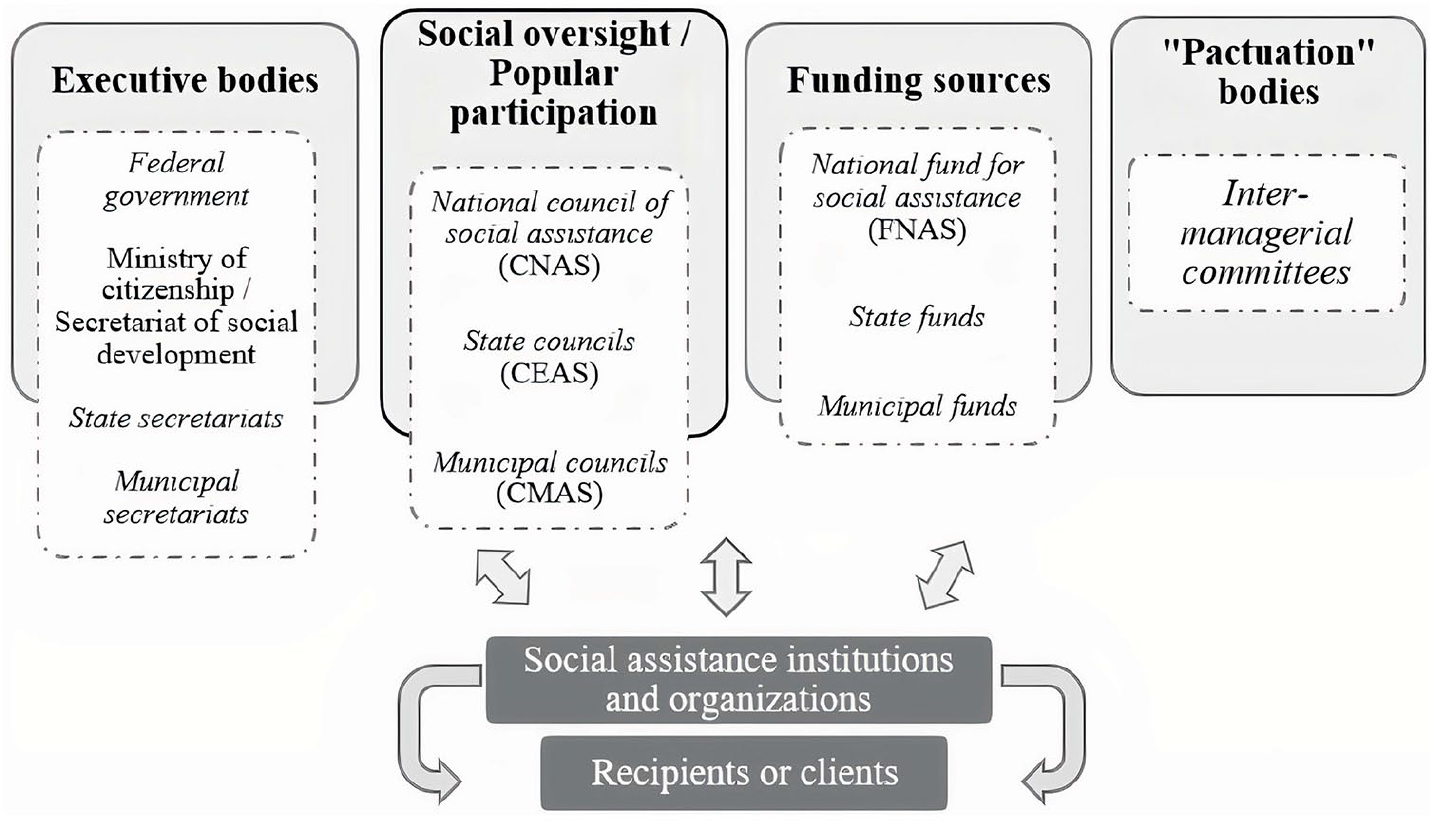
The key structure of the Brazilian SUAS outlined.
Given the complex and multifaceted structure of the Brazilian social welfare system, the fact that the new legislation does not designate which authority would be responsible for overseeing the implementation of its stipulations is preoccupying because the absence of a clear assignment of authority to enforce the legislation can lead to loopholes in implementation. Funding sources were not properly determined and responsibilities throughout the large net of stakeholders were not clearly established, leaving the impression that the legislation lacks both substantiality and practicality. Going forward, some suggestions are made on how to possibly overcome these challenges and strengthen the practice of school social work in Brazil.
Suggestions for advancing the social work profession in Brazilian schools
First and foremost, the Brazilian Congress could consider revising and expanding the legislation in terms of its scope and compliance mechanisms (which are virtually inexistent). Responsibilities need to be made clear, and information regarding its implementation strategies could be provided. On this note, it is important to take into account the experience and efforts that have been made by the Brazilian Federal Council of Social Work. The FCSW has deployed nationwide articulations with Brazilian Municipal authorities to discuss the implementation of the legislation in schools across the country (FCSW, 2020). Thus, the federal government could start by supporting and reinforcing the FCSW’s mandate in its efforts to make school social work a reality in Brazil.
In addition, Brazil also has many solid examples from its South American counterparts that can be taken into consideration when establishing a national directive/strategy for school social work. In Argentina, for example, school social work has been implemented since 1955 through the Directorate of School Psychology and Social Assistance in Buenos Aires (Acosta et al., 2008). There, social workers help schools reduce dropout rates and foster an atmosphere of diversity and inclusion through social services. Similarly, although more recent, Chile has also had experience with school social work, and social intervention in Chilean schools has grown significantly over the years (Villalobos, 2015). Here, the practice is aimed at generating support for students throughout their learning process, fostering positive academic environments and the development of social support systems for students and their families. Thus, Brazilian public authorities could learn from the experience of other nations as well as seek advice from neighbouring countries on how to operationalize the legislation and build a more robust implementation directive that takes into account challenges already experienced by others and the strategies used to overcome them.
Equally important is the accumulation of knowledge and experiences from research and practices developed in the area of School and Educational Psychology in public and private schools throughout Brazil, which have contributed to the promotion of teaching-learning processes and the full development of students (Nunes et al., 2019). Also, education professionals themselves – such as teachers and educational advisors/counsellors – are indispensable in the implementation of good social assistance practices in schools. Consequently, implementation strategies for school social work should also aim at the construction of interdisciplinary and multi-professional teams, given that collaborative, team-based efforts can provide better welfare services in different settings (Frost et al., 2005; Lewandowski and GlenMaye, 2002).
Moreover, the Brazilian Ministry of Education and the FCSW could join efforts to provide training and continuing education for acting school social workers in the field and for those who wish to practise the social work profession in schools across the country. Ultimately, evaluation tools can be created to assess the positive outcomes and the shortcomings of the social work intervention in Brazilian schools; otherwise, it may be very difficult to develop evidence-based practice.
The Brazilian experience with social work practice is not new; it is founded on strong values and ideals that have roots in the popular democratic movements that overthrew the dictatorship in the late 1980s (McPherson, 2014). Thus, even though the practice of school social work in the country may be relatively new, previous experiences from other areas of social assistance and multi-professional practice can and should be taken into consideration when designing a national framework for school social work in Brazilian schools. It is noteworthy that Brazilian social work – more generally speaking – has gained international attention, and some even argue that it has evolved to a specific field of knowledge (Heitmann, 2017b; Mota, 2013), given the importance of Brazilian social work and its contributions to global developments of the profession (Castro-Santos, 2016; Porto de Oliveira, 2020).
According to Estes (2009), international social work scholars and practitioners should focus on the international dimensions of practice in their own countries, which means that most of the international social work practice occurs in the domestic sphere, within individual countries. Considering that Brazil possesses well-established and powerful professional voices in the field of social work (International Social Work, 2014) and that the Brazilian framework for the profession encompasses global values such as human rights, social justice, and the overcoming of social inequalities (FCSW, 2010), the practice of school social work in the country can equally contribute to the advancement of global values, including the 4th UN Sustainable Development Goal of providing quality education for all. Thus, regardless of the geographical borders, Brazilian school social workers can become ‘global’ social workers ‘[. . .] by understanding how global issues impact [their] students, understanding [their] own identities as global citizens, and acting in ways that promote human rights locally and across international borders’ (Sosa et al., 2017: 221). In addition, school social work in Brazil, though being an internal affair, has international repercussions, especially related to social work with refugee children attending Brazilian schools (Martuscelli, 2017). Taking into account that Brazil already exercises a leadership role in the field of social work in Latin America and the Caribbean, and the fact that the FCSW has advocated for the ‘internationalization’ of the profession in the country (Diniz, 2019), there is fertile soil for school social work in Brazil to reach local, regional and global relevance.
Future research on the topic of school social work in Brazil (and elsewhere) could further explore the issues raised in this brief note as well as others not mentioned here: including (but not limited to) the challenges in building community partnerships, lack of adequate resources, overwork, management of trauma and emotional burdens carried by students, challenges in interprofessional collaboration and environmental constraints experienced by social workers.
Footnotes
Acknowledgements
I would like to thank the editor and anonymous reviewers for their very helpful comments on the manuscript.
Declaration of conflicting interests
The author declared no potential conflicts of interest with respect to the research, authorship and/or publication of this article.
Funding
The author received no financial support for the research, authorship and/or publication of this article.
