




Abstract
Despite the expansion of research on policy transfer, research on how international policy learning occurs in different environments remains limited. To address this gap, we explore the policy process of the Consumer Chemical Products and Biocides Safety Control Act in South Korea containing regulatory instruments of similar design to the EU's Biocidal Products Regulation. This study analyses the role of institutions and the impact of policy learning on policy design. It adopts policy isomorphism as a conceptual lens and complements the existing isomorphism literature by focusing on the design of a regulatory act. The methodology employs a historical case study and a thematic analysis, determining that institutions contribute to the occurrence of coercive isomorphism, while policy learning can be considered as a factor contributing to the occurrence of normative and mimetic isomorphism. These findings suggest that an effective emulation can occur in different contexts.
Points for practitioners
Transferring exemplary models from other countries often entails side effects and decoupling. In this context, this study illustrates that an effective policy emulation can occur even in different contexts by focusing on the South Korean biocidal regulation. By outlining a detailed isomorphic process revealing the impacts of institutions and policy learning, this study helps practitioners design an isomorphic policy tailored to the context of a specific country.
Introduction
Policy emulation primarily occurs between countries with analogous geographical and cultural backgrounds as it is challenging to obtain substantive effects of such emulation when there are considerable differences between systems or cultures (Carroll and Common, 2013; Massey, 2009). Accordingly, less attention has been paid to the analysis of the cases where similar designs were implemented in different systems. To fill the gap, this article examines the policy design of the biocidal regulation in South Korea, which resembles the EU's biocidal regulation.
Specifically, the EU and South Korea have different backgrounds. The EU is an economic community of 27 member states, whereas South Korea is a single country. The EU comprises member states with varying forms of government and has a multi-governance structure of policy decision-making (Wallace et al., 2015). In contrast, South Korea has a centralised policy decision-making structure focused on a strong president and government, although there is a separation of powers. Moreover, there are cultural and historical differences because the EU comprises Western countries, while South Korea is an East Asian country.
Despite these differences between the EU and South Korea, the Consumer Chemical Products and Biocides Safety Control Act (CCPBSCA) was designed similarly to the EU's Biocidal Products Regulation (BPR). The CCPBSCA is even referred to as K-BPR (Drohmann et al., 2019). Thus, this article explores the process of designing this policy and the impacting factors so as to gain a full understanding of this phenomenon. It adopts isomorphism as a conceptual lens to analyse the process since it is a suitable theoretical framework through which to analyse similarities between the policies in question.
Prior research on policy emulation is mostly focused on the approaches and methods, while few studies analyse the emulation process and the impacting factors (Minkman et al., 2018). In addition, unlike many other cases, South Korea's biocidal regulation has been implemented effectively since its enactment. Besides, unlike most isomorphism studies that typically focus on launching an innovative policy or a new approach to public service delivery, this study considers designing a new regulation act, a mandate. Hence, our study provides theoretical and practical contributions for policy researchers and practitioners.
Theoretical background
Isomorphism as a policy process
Isomorphism, approached from an institutional perspective by Meyer and Rowan (1977) and DiMaggio and Powell (1991), effectively explains the phenomenon when policies become analogous. According to DiMaggio and Powell (1991), isomorphism can be categorised into three types: coercive, normative and mimetic isomorphism. Coercive isomorphism arises from formal and informal pressures and leads to similarity between the structures or policies. Mimetic isomorphism arises to lessen uncertainty. When an organisation's goals are ambiguous or it is hard to predict the environmental changes, this organisation can mimic another organisation. Normative isomorphism is caused by professionalism since the ways that experts engage with the critical issues are similar. Education and professional networks are considered the sources of this isomorphism.
The prior research featuring isomorphism can be divided into four distinct categories: (1) research on the application of isomorphism to policy diffusion or transfer (Kong and Su, 2022; Sheppard and Beck, 2018); (2) studies that analyse both policy diffusion by isomorphism and constraints or decoupling (Benner, 2022; Massey, 2009); (3) research analysing the effects of isomorphism (Lodge, 2002; Yoon, 2022); and (4) studies analysing the causes and mechanisms behind isomorphism (Kezar and Bernstein-Sierra, 2019; Zhu and Meng, 2020). Among them, this study corresponds to the first and fourth categories.
Despite the categorisation, most isomorphism research focuses chiefly on innovation or new service provision programmes (Gómez-Villegas et al., 2020; Hernandez Ortiz and Appe, 2025; Rees et al., 2024). This may be because policy reforms are frequently made by external international organisations, to remove uncertainty, and by professionalism (Andrews, 2013). Accordingly, it is challenging to find research analysing isomorphism that appeared in the regulation design process, which constitutes a mandate. Thus, to address the gap, we analyse the types of isomorphism that occurred in the process of designing the CCPBSCA by focusing on the role of institutions and policy learning as the key impacting factors. By complementing existing literature, it is possible to expand its usefulness as a theoretical lens.
Role of institutions
As a major concept of neo-institutionalism, institutions have significant impact on policies (Peters, 2019; Scott, 2014). A host of empirical studies tend to primarily focus on its impact on policy directions and policy path formation (Dodds, 2018; Lockwood, 2022), while a comprehensive explanation of how institutions influence policy design and concurrently form isomorphism is still lacking. Hence, this study fills the gap in the existing knowledge by analysing the mechanism of isomorphism in the policy design process and considering the role of institutions.
As there are many different definitions of institutions in the field of public administration research, there is little agreement on how institutions can be considered as a constraining factor (Lockwood, 2022; Peters, 2019). Institutions may contain formal and informal constraints. Formal constraints mean the codified constraints, such as rules and procedures, and informal constraints refer to ideological constraints like customary practices (March and Olsen, 1984; Scott, 2014). By considering these points, we conceptualise institutions as formal and informal constraints on the design of the CCPBSCA and the relevant actors, namely the policymakers such as the National Assembly (NA), the President and the Ministry of Environment (MOE), and other stakeholders.
We focus particularly on private institutions among the types of institutions, considering the biocidal regulation case. ‘Private institutions’ as a term is adopted from organisational theory using the term private organisation. Previous studies define public organisations as those related to political power and government and private organisations mainly as those pertinent to business companies or trade (Ker et al., 2017; Vega, 2017). Based on this, the term ‘private institutions’ refers to those institutions concerning corporations and trade. Hence, we explore private institutions that focus on global trade structure regarding chemicals and the EU-South Korea Free Trade Agreement (FTA): formal institutions contain materialised industrial distribution; informal institutions include practices for import and export.
Policy learning
Studies on policy learning include theoretical and empirical research on learning types as well as studies analysing the impact of policy learning on the policy process. Existing studies, however, mostly focus on analysing the impact of policy learning on policy success and failure or on policy change (O’Donovan, 2017; Sandström et al., 2021). Thus, finding research that analyses the impact of policy learning on policy design and on isomorphism that occurred in this process is challenging. The impact of policy learning may be different because policy success, failure and change, and policy design are distinctive phenomena. Therefore, research is required to analyse the impact of policy learning on policy design and isomorphism.
Policy learning is defined differently according to researchers (Crow et al., 2018; Dunlop and Radaelli, 2013; Mah et al., 2021). However, based on prior literature, policy learning can be defined as either information acquisition through various methods or changes in policies or actors. Having considered both aspects, we conceptualised policy learning as a process in which actors reflect on information collected in the design of new policies. Specifically, the information for learning includes both case- and theories-related information, while methods of collecting them are diverse, such as benchmarking, peer review, evaluation and discussion (Dunlop, 2020). For instance, benchmarking is an instrument for policy learning and is a technique that systematically measures an object, which is best practice (Dominique et al., 2013; Passi, 2005; Room, 2005). In this study, information collection through the methods presented above, including benchmarking, is considered an integral part of policy learning.
There are various types of policy learning (Dunlop and Radaelli, 2013; Hall, 1993; Howlett, 2012). Considering existing studies and the case, we focus on instrumental learning discussed by May (1992) because regulatory instruments were frequently discussed during the design process of the CCPBSCA. In contrast, it was difficult to find fundamental rethinking on biocides related to social learning. Policymakers and stakeholders regarded biocides as having both risk and usefulness, and this idea has not changed throughout the process. Besides, it was not easy to find any change in the strategy of policy advocates regarding political learning. Consequently, policy learning is analysed by focusing on instrumental learning and, specifically, on the following three aspects: learning from the limitations of the former policy; learning from a related incident; and learning from other countries’ policies.
Methods
We used historical case analysis for this study. Historical case analysis is a method whereby the process of history and time is combined with a case (Zhu, 2017). The reason for using this method is that it provides causal and underlying explanation by showing events that occur in the time series flow (Vromen, 2018).
Data were collected from documents and in-depth interviews, pursuing data triangulation to ensure construction validity (Cresswell and Poth, 2018). Regarding documentary date, these were gathered from multiple sources, including official documents derived from the state and private sources and virtual documents. Interviews were conducted between 2019 and 2022. Sixteen key informants were interviewed via the semi-structured interview method (Yin, 2018). Interviewees were primarily the public officials who participated in the enactment of the biocidal regulation (for a list of interviewees, see Appendix 1). The snowball sampling strategy was employed because it was hard to accurately identify participants in the policy design due to the circular position system (Questionpro, 2021). Bias can occur when relying on a limited informants network, hence we conducted a purposive sampling to identify people with first-hand information (Zhang and Yu, 2021), and attempted to enhance representativeness by interviewing various seeds presented in the literature to increase the validity of the research results (Ting et al., 2025). The interviewees were selected among participants in the CCPBSCA design or the highest authority in this field. Bias was addressed by striving to interview all and randomly selecting initial responses presented in the literature.
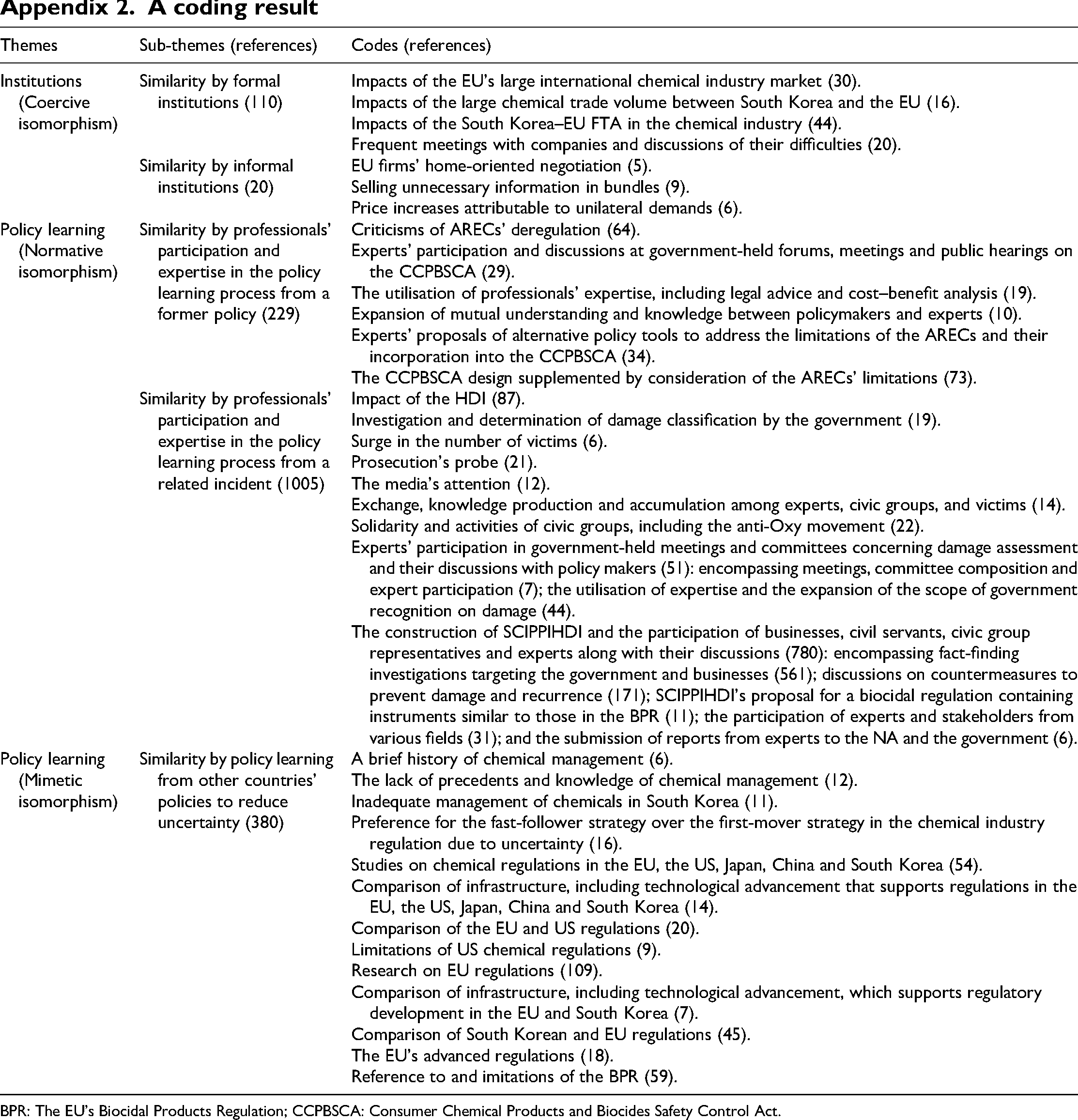
We also conducted a thematic analysis of documents and interview data because this method enables classification of isomorphism and impacting factors by grouping similar codes (for the coding result, see Appendix 2). Data were coded in NVivo 15 (Bryman, 2016). Specifically, after reading all data, we grouped impacting factors and corresponding types of isomorphism guided by the research question and prior literature. Coercive isomorphism was identified through codes linked to private institutions, distinguishing between similarity caused by formal and informal institutions. The connected data included both interviews and documents that demonstrated isomorphic patterns attributable to institutional pressure. For instance, the following statement from a corporate representative was included: ‘Even if companies in the EU make unreasonable demands, domestic companies have no choice but to comply with them’. Normative isomorphism was identified from professionals’ engagement and expertise in policy learning. It was evidenced from learning from former policies (social science expertise such as legal or economic analysis) and from related incidents (health and medical knowledge). Mimetic isomorphism was confirmed in references to EU regulations, owing to uncertainty reflecting Korea's short history of chemical safety management and lack of precedents. Finally, themes were reviewed, and labelling was confirmed.
South Korea's biocidal regulatory instruments similar to the EU's BPR
Various regulatory instruments
There are different classifications of the regulatory instruments (Lodge and Wegrich, 2012). We considered prior literature and the contents of the CCPBSCA to categorise regulatory instruments in this research. Accordingly, we divided regulatory tools into command-and-control, intensive-based and disclosure, depending on the degree of direct involvement (Baldwin et al., 2012; Gunningham and Grabosky, 2004). They are also divided into ex-ante regulation and post-ante regulation, focusing on the timing of regulation (Lee and Lee, 2010).
Command-and-control refers to the instruments in which a government directly presents standards concerning biocide. Incentive-based or market-based instruments relate to tools providing incentives to follow regulation, such as governmental subsidies or technical assistance (Baldwin et al., 2012). Disclosure refers to the information exposure on biocidal substances and products (Gunningham and Grabosky, 2004). Ex-ante regulations are those created to predict problems and prevent them from occurring in advance, while post-ante regulations refer to instruments for regulating penalties after the occurrence of problems (Lee and Lee, 2010).
Similarities between the BPR and the CCPBSCA
In the EU, the BPR was designed in 2012 to strictly regulate biocides and allows only safe biocides to be placed on the market (Elsmore, 2012; Park, 2014). In South Korea, the Act on Registration and Evaluation, etc. of Chemicals (ARECs) containing several biocides-related articles was enacted in 2014, but owing to the lack of virtual regulations, the articles concerning biocides were separated and expanded into the CCPBSCA in 2018. This CCPBSCA adopted similar regulatory instruments to the BPR, as shown in Table 1 (Park, 2018). The two regulations include command-and-control, intensive-based instruments, disclosure and ex-ante instruments. Both feature command-and-control and ex-ante regulations.
Similarities between the CCPBSCA and the BPR.
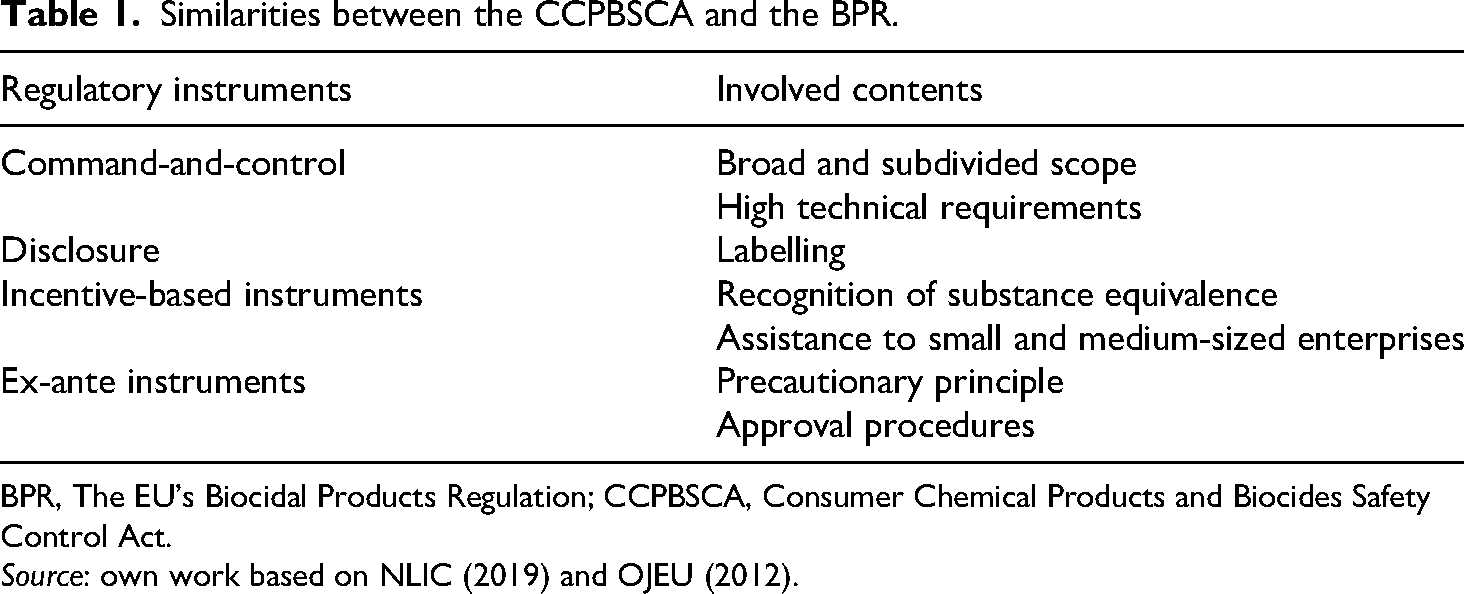
BPR, The EU's Biocidal Products Regulation; CCPBSCA, Consumer Chemical Products and Biocides Safety Control Act.
Source: own work based on NLIC (2019) and OJEU (2012).
Under the command-and-control instruments, the scope of the regulation subjects was wide and subdivided. By including not only biocidal substances and products but also treated articles, the subjects of regulation covered the entire range of biocides. Furthermore, the types of biocides were divided into 22 types across four categories in the BPR and 15 types across four categories in the CCPBSCA. In both regulations, four categories are disinfectants, preservatives, pest control and other biocidal products (Official Journal of the European Union (OJEU), 2012); National Legal Information Centre (NLIC), 2019. Moreover, in relation to data submission, companies were requested to supply data with advanced technology including hazard and risk assessment, exposure information, effectiveness and efficacy (Lee, 2018; OJEU, 2012).
Along with this, consumer-oriented labelling tools were applied. In Articles 58 and 69 of the CCPBSCA and Article 16 of the BPR, labelling on substances and products was stipulated. In addition, government provides technical assistance to business operators, especially small and medium-sized enterprises. Thus, incentive-based tools were also used as shown in Articles 76 and 80 of the BPR and Article 45 in the CCPBSCA (NLIC, 2019; OJEU, 2012).
Finally, Article 9 of the CCPBSCA and Articles 12 and 20 of the BPR stipulated that only safe biocidal substances and products can be placed on the market, showing the characteristics of ex-ante regulation. These features also appear through Article 1 of the CCPBSCA and Article 2 of the BPR, which are prescribed by the precautionary principle (Park, 2018).
Dynamics of policy isomorphism
Role of institutions and coercive isomorphism
Examining the formal institutions, the size of the global chemical industry in 2017, just before the enactment of the CCPBSCA, comprised chemical sales amounting to 3.475 trillion euros (3.763 trillion dollars) ‒ about 4.2% of the world's GDP (73.9938 trillion dollars), forming a huge market size (MOE, 2020). This chemical industry, led by China, the EU and the US, was also one of the key industries in South Korea. In addition, Korea's top 30 major export destinations from 2011 to 2019 included seven to 10 EU-member states (Korea Customs Service, 2021). Moreover, the EU–South Korea FTA, enacted in 2011, provided an opportunity to further promote their mutual international trade and improve corporate competitiveness (Hong and Lee, 2021). As such, South Korea may have paid attention to the EU's biocidal regulation as the EU occupies the global chemical market and is South Korea's principal export destination and a major channel for improving competitiveness.
Certainly, South Korea gathered information and studied related policies to identify the EU market, but whether such exploration led to imitation of the EU is another question because the EU was not the only target of exploration. However, as a formal institution was combined with an informal institution in customary trade practice, a pressure structure was formed (DiMaggio and Powell, 1991; Sheppard and Beck, 2018). Specifically, in the design process of the CCPBSCA, Korean companies perceived the EU's BPR as a real burden. As shown in Appendix 2, businesses mentioned that EU institutions either sold unnecessary data in bundles (number of references: nine) or unilaterally increased prices (six). Indeed, the representative of business explained that even if the EU companies make unreasonable demands, domestic companies have no choice but to comply (Environment and Labour Committee (ELC), 2017). The informally routinised practice among corporations constrained Korean companies.
Owing to the pressure, South Korean companies followed EU regulations more faithfully than South Korean regulations. If companies were to comply with the EU regulations, they might also progress to improving safety standards in South Korea, but this was not the case (ELC, 2017). There were frequent meetings between policymakers and companies as presented in Appendix 2 (20), and in those meetings, companies expressed their difficulties. For example, at the public hearings and meetings, corporations called on the deregulation of the CCPBSCA to the NA and the MOE, such as alleviation of their burden and extension of the moratorium (ELC, 2017). However, this was not allowed due to the humidifier disinfectant incident (HDI) and subsequent negative public opinion as further discussed in the policy learning section (Interview K13, 10 February 2022; Interview K10, 17 February 2022).
The combination of formal and informal institutions became a burden for companies and concurrently became a means of control that must be followed. From the government's own viewpoint, they explored and imitated more EU regulations to make companies pay greater attention to chemical regulation to ensure safety in South Korea and to simultaneously adjust the Korean regulation to the global standards (Interview K1, 30 May 2022). Thus, the CCPBSCA was designed similarly to the BPR. Hence, we argue that coercive isomorphism occurred in this process via a combination of formal and informal institutions within private institutions.
Policy learning and normative and mimetic isomorphism
Learning from a former policy and normative isomorphism
Although the regulation of biocides was initiated by the ARECs before the CCPBSCA, it was frequently criticised by experts and civic groups (Park, 2014). Professionals explained that the background to enacting the CCPBSCA stemmed from the underlying question of whether the existing Act had established a safe chemical management system (Interview K11, 15 February 2022; Interview K13, 10 February 2022). Policy evaluation and the exchange of opinions between experts and civil servants thus became inevitable in examining the ARECs (Interview K13, 10 February 2022), which enhanced mutual understanding about policy tools to effectively regulate biocides and the necessity of a new biocidal regulation, the CCPBSCA, in discussion. This is demonstrated in Appendix 2. Not only were ‘experts’ participation and discussions’ (29) included but also ‘the use of expertise’ (19) was conducted in the design process of the CCPBSCA. Policymakers listened to and reflected on the opinions of experts, which were identified in the process of the inclusion of basic principles under Article 2 of the CCPBSCA. One expert suggested that the CCPBSCA should adopt the precautionary principle that was applied in the BPR: As we know through many domestic and international cases, we need to consider the precautionary principle for the management of risks concerning chemicals. This is because there are many uncertain concepts used in our current Biocidal Act. (ELC, 2017)
By engaging in discussion and deliberation in the ELC, the opinion on the need to regulate the biocides more strictly than in the ARECs is reflected on Article 2 of the CCPBSCA. However, experts also learned from interaction with civil servants. An expert explained that his thoughts regarding the separate enactment of the CCPBSCA evolved through discussions: When I was asked for the separate enactment of the biocidal regulation from the ARECs, I was actually passive. But as I communicated and talked, I could understand more. Unlike ordinary chemicals, in the case of biocides or biocidal products, the usage itself kills living beings, so we should manage them more strictly than ordinary chemicals under the existing ARECs. It's more likely to be harmful to humans, so there is a higher need for some discriminatory regulation. (Interview K13, 10 February 2022)
The above explanation shows that experts and policymakers exchanged ideas and designed policies through persuasion. That is, real learning occurred, not just via mimicking or superstitious learning, in which design was made without discussion (Crow et al., 2018). As shown by the 34 references in Appendix 2, the CCPBSCA was designed to address the limitations of the ARECs through expert suggestions and reflections, thereby aligning more closely with the BPR. Therefore, the biocidal regulation and the Act concerning industrial chemicals were separated, and assessments and standards considering the unique characteristics of biocides were required for approval (Lee, 2018; Park, 2018). In addition, the ex-ante method was employed in which only safe products were placed on the market after the first stage of biocide approval and the second stage of product approval, as shown in Figure 1 (Interview K5, 2 October 2019; Interview K13, 10 February 2022). Namely, we identify that normative isomorphism occurred, in which policy similarity was made based on expertise (Kong and Su, 2022).
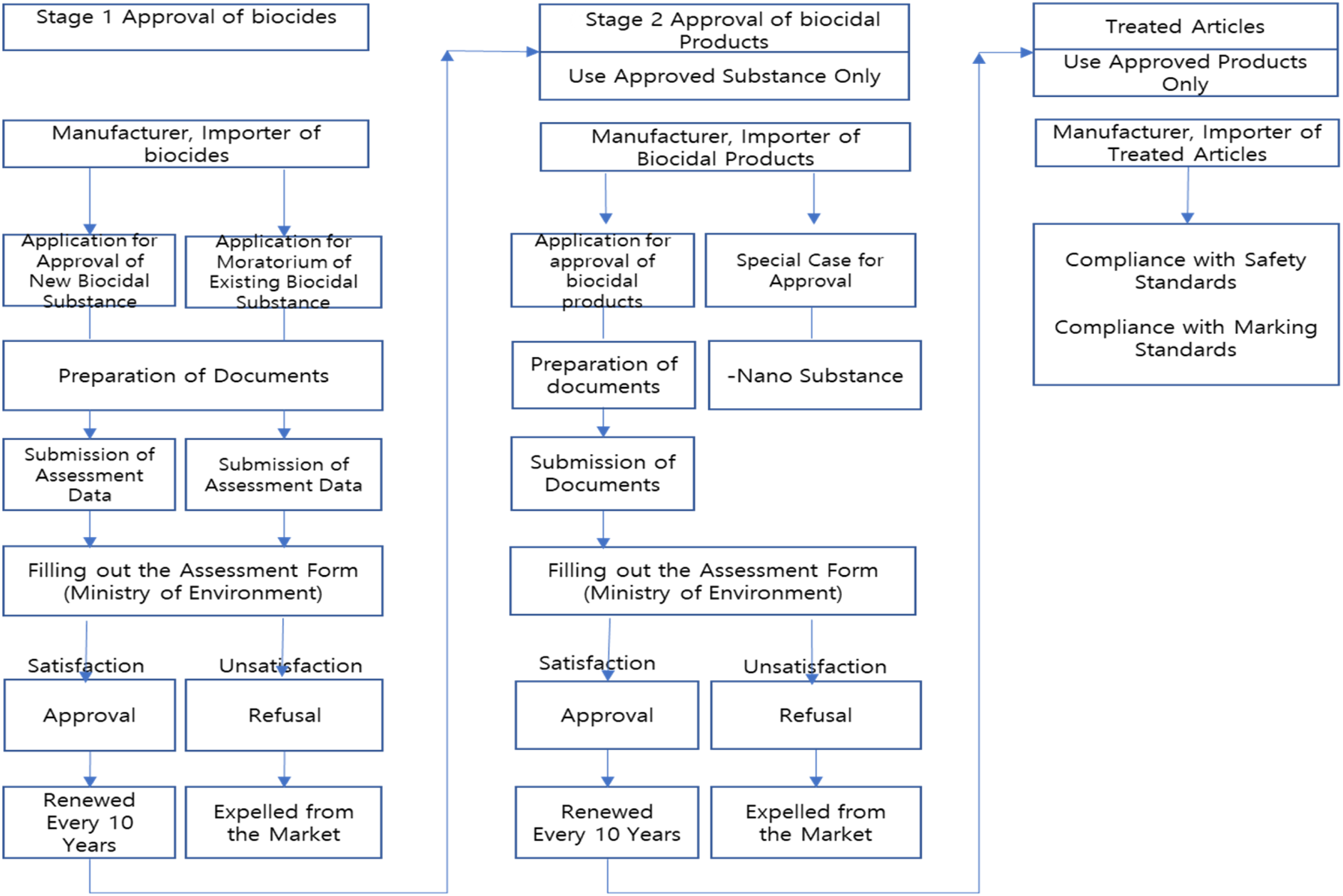
The approval system in the Consumer Chemical Products and Biocides Safety Control Act (CCPBSCA).
Learning from a related incident and normative isomorphism
As the 1005 references in Appendix 2 demonstrate, the impact of learning from related incidents was overarching. The HDI was a large-scale chemical incident first recognised in 2011 that caused 5703 victims, according to the government's announcement as of 2024 (Ko, 2024). Although polyhexamethyleneguanidine phosphate, oligo-[2-(2-ethoxy)-ethoxyethylguanidinium-chloride] and methylchloroisothiazolinone/methylisothiazolinone were approved as antibacterial agents for carpets or rubber, they were used as raw materials for humidifier disinfectants and were placed on the market from 1994, resulting in massive numbers of casualties (SCIPPIHDI, 2016).
Although the HDI was recognised in 2011, the CCPBSCA was not considered on the policy agenda at the time. However, as the number of official victims increased, the CCPBSCA emerged on the political agenda. A representative of a civic group explained that there was a notable difference in the public discourse around the incident before and after 2016 (Interview K10, 17 February 2022). Indeed, the number of the HDI casualties announced by the government increased after 2015, the third investigation, and the official number of victims increased drastically after 2016, as shown in Table 2. With the third investigation, the prosecution's probe began in September 2015. There was a large concentration of media content concerning the HDI in 2016, and the incident had a crucial impact on the enactment of the CCPBSCA (Kim, 2020).
Application and reception status (as of 31 October 2023).
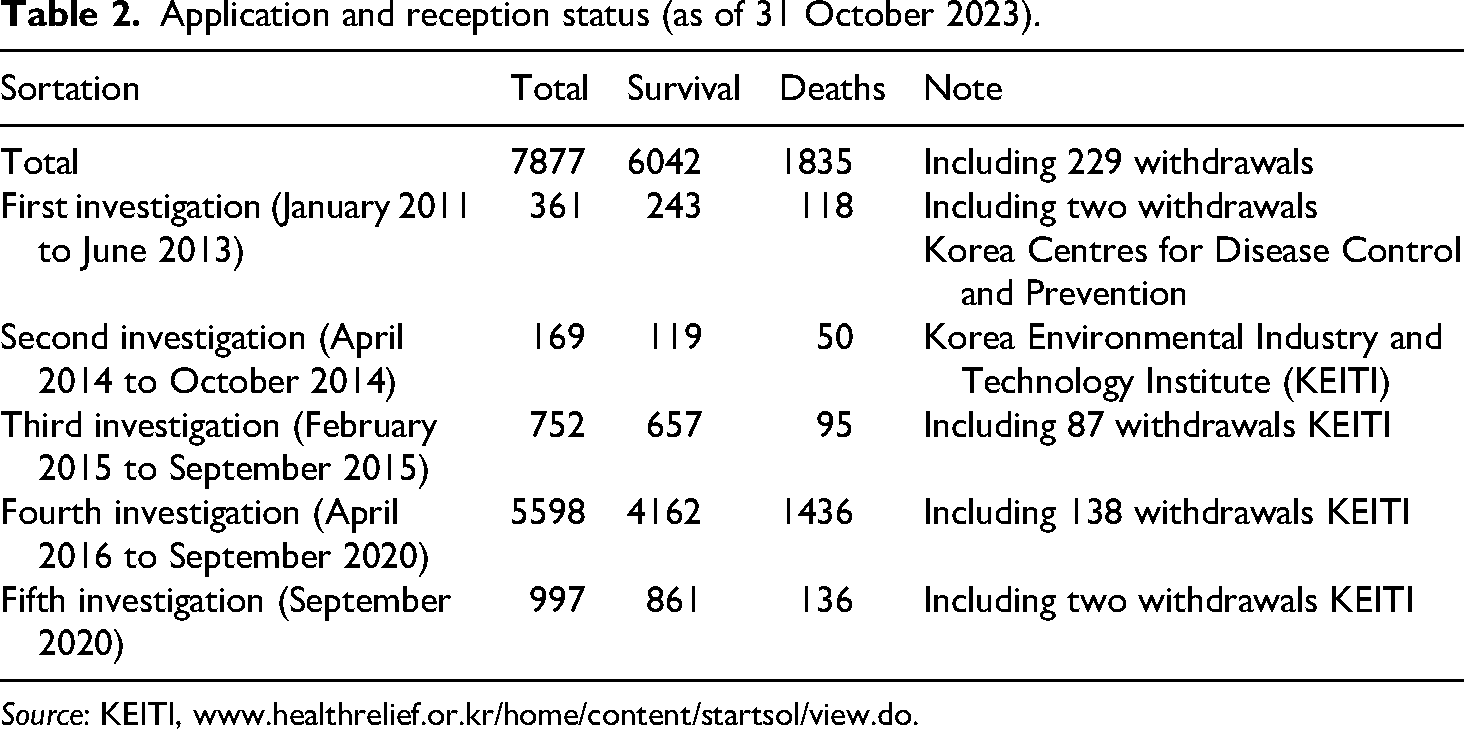
Source: KEITI, www.healthrelief.or.kr/home/content/startsol/view.do.
Behind the refocusing on the HDI, there were continuous efforts of civic groups and experts, and negative public opinion. Even after the enactment of the ARECs, civic groups continued to engage in solidarity with victim groups and experts, on the one hand, and continuously participated in meetings with the government on the other, seeking the next step (Interview K10, 17 February 2022). Officials also pointed out that civic groups’ continuous problem raising had become a driving force for learning how to relieve the victims and prevent a recurrence of the incident (Interview K5, 2 October 2019). From 2017, under the Moon Jae-in government, civic groups expanded their institutional participation and played a pivotal role in designing the CCPBSCA (Interview K11, 15 February 2022).
Public opinion was also negative during this period. The continuous increase in the official number of victims, despite the enactment of the ARECs, the transfer of the HDI to the prosecution and various harmful acts of companies and the government in the HDI appeared like a series of cases (Cho, 2024). The nationwide Oxy boycott in May 2016 was a direct and tangible expression of public dissatisfaction and a kind of demand (Interview K10, 17 February 2022). Hence, policymakers had no choice but to re-investigate the HDI and the management of biocides.
Also, as noted by the MOE, the role of experts and expertise was key in addressing the HDI, as health damage assessment relied on scientific analyses such as clinical and environmental health (MOE, 2017). Specifically, experts contributed to expanding the category of HDI victims (Im, 2021). Their role was significant, given that drawing the attention of policymakers and the public was pertinent to the increase in the recorded number of victims. As shown in Appendix 2, experts participated in government-held committees and meetings (51), presenting findings based on accumulated data and urging strict biocidal regulation. Consequently, in December 2015, the MOE raised the necessity of a new biocidal regulation in the first master plan on the evaluation of chemicals. The government sought to enact a far different biocidal regulation than before.
Subsequently, more extensive instrumental learning occurred in the NA, as shown by 780 references to SCIPPIHDI in Appendix 2. Responding to public outrage in 2016, the NA conducted an investigation into the HDI over 90 days from July to October 2016 by establishing the Special Committee for Investigative Power of Parliament on Investigation of the Humidifier Disinfectant Incident, the Relief from Damage, and the Preparation Measures to Prevent Recurrence (SCIPPIHDI). The SCIPPIHDI comprised members of the NA, experts from law and medical fields, representatives from civic groups and parliamentary staff (SCIPPIHDI, 2016). As a form of hearing, the SCIPPIHDI gathered information and, based on these data, probes and discussions were conducted (SCIPPIHDI, 2016). This is also evidenced in Appendix 2. Within SCIPPIHDI, the numbers of references to ‘investigation of HDI’ and ‘discussions on preventing recurrence’ were 561 and 171, respectively. Through this, we can see that problem-driven learning occurred, seeking alternatives based on problem diagnosis and investigation (Andrews, 2013). Thus, drawing on the investigation, the SCIPPIHDI recommended the enactment of the CCPBSCA. Furthermore, according to the SCIPPIHDI's suggestions, the policy agenda of enacting the CCPBSCA, containing new policy tools, could be linked to policy design. The contents were similar to the EU's BPR. Therefore, normative isomorphism occurred owing to learning centred on expertise (Massey, 2009).
Learning from policies of other countries and mimetic isomorphism
South Korea drew lessons from the EU's BPR because its own history of chemical safety management was only brief. It was difficult to find precedents; there was uncertainty, and it was hard to predict the policy environment and policy results. Accordingly, mimetic isomorphism occurred to lessen the uncertainty.
Specifically, at the 354th and 355th meetings of the NA's ELC, the EU, China, Japan and the USA were mentioned 16, 12, nine and four times, respectively (ELC, 2017). Concerning the contents, while Japan and China were referred to regarding relatively simple items such as terms, in the case of the EU, discussions addressed not only terms but also the biocide management methods (ELC, 2017). A similar pattern is also shown in Appendix 2. Although the number of references comparing regulations among the EU, the US, Japan, China and South Korea numbered 54, the number of references focusing on comparisons of regulations between South Korea and the EU and research regarding the EU's regulations were relatively high, at 45 and 109, respectively. This showed that there were more references to and discussions about the EU compared with other countries. However, the comparative research was focused more on the regulations than on the regulation contexts.
As regards the background whereby the EU was the key focus of the discussion, China and Japan were not reference points since they did not have an integrated biocidal regulation analogous to the EU's BPR at the time. The US Toxic Substances Control Act, which had previously influenced the Toxic Chemicals Control Act (the predecessor of the ARECs), also showed notable limitations underscored by the HDI (Interview K10, 17 February 2022). However, since the EU's regulation was considered more proactive and stricter, it was set as the model for lesson-drawing (Interview K13, 10 February 2022).
Indeed, the BPR was employed as a ground for supporting the mediatory proposal and adjusting the proposal of the MOE and of the representative members of the NA (ELC, 2018). The application was also shown in the classification regarding biocidal products (MOE, 2018). In the ARECs, only insect repellents, disinfectants and preservatives were included in the category of biocides, and it needed to be subdivided (MOE, 2018). The MOE explained that by referring to the types of the EU's BPR, it had classified four categories and 15 types (MOE, 2018). Namely, isomorphism occurred in which the CCPBSCA was designed in a similar way to the EU's BPR (Benner, 2022).
Regarding lesson-drawing by Korea from the EU's BPR, it had only a short history of chemical safety management. The government faced uncertainty since it was difficult to predict policy outputs and identify the proper regulatory tools. Accordingly, mimetic isomorphism was attempted to target the EU's BPR to lessen the uncertainty. This was confirmed through mention of the Ministry of Trade, Industry and Energy in relation to the HDI. In the NA investigation, the ministry explained it as follows: ‘New risks regarding chemicals can continue to emerge, and the history of safety management in South Korea is short. Hence, we should follow the safety management system of the developed countries’ (SCIPPIHDI, 2016). In a similar vein, since the CCPBSCA was substantially the first biocidal Act, the BPR was referred to in order to reduce the possibility of issues occurring. Regarding this, a civil servant explained the situation as follows: Because it was the first time, we referred to the EU's regulation to complement mistakes that can occur through the operation of regulations. (Interview K8, 23 October 2019)
Therefore, to control uncertainties and secure the EU's policy experience, South Korea benchmarked the EU's BPR. Accordingly, we found that there was lesson-drawing and mimetic isomorphism (Kong and Su, 2022; Rose, 1991).
Conclusion
In this article, we explored policy isomorphism occurring in the policy design process of biocidal regulation in South Korea. Owing to the impact of institutions, coercive isomorphism was shaped and normative isomorphism and mimetic isomorphism occurred through policy learning.
Having considered the design process of a regulatory act through the conceptual lens of isomorphism, we addressed a gap within the field since existing research on policy isomorphism typically considers innovative approaches to policy design and delivery rather than a mandate, as in our study. Thus, the findings and arguments presented in this study demonstrate that policy isomorphism can occur in the case of a regulatory act, even in different contexts, and shed light on the nuanced aspects of the process that transpired behind the scenes and resulted in the adoption of a new regulation. Importantly, this research contributes to the theoretical expansion of policy research by connecting isomorphism, institutions and policy learning. We confirm that institutions and learning complement each other as factors influencing isomorphism, which has provided a deeper explanation of the design of biocidal regulations.
Regarding the role of institutions, we determined the usefulness of the concept of private institutions and its impact on the design of biocidal regulation and coercive isomorphism. We also extend existing research by demonstrating that the interaction of formal and informal institutions within the arrangement of private institutions caused coercive isomorphism with the policy design of the CCPBSCA.
This study also finds that policy learning affected policy design as well as isomorphism, and the types of isomorphism differed depending on how policy learning occurred. By demonstrating the impact of each policy learning on policy design and isomorphism, this study theoretically supplements existing research.
Moreover, this paper provides two key recommendations to policymakers. These recommendations help in considering the impacting factors while engaging with a policy transfer in practice. Firstly, policymakers should not only consider institutions as impacting factors, but also find means to mitigate that impact, if needed. For example, if it is necessary to reduce the pressure on policy from informal institutions, policymakers should identify the business challenges faced by companies and determine the best option to address such challenges in the interest of business. Secondly, with respect to policy learning, policymakers should prioritise diagnosing problems in existing policies rather than trying to devise new policies and solutions for public issues. It is important to understand that policy learning involves not only policymakers and experts, but also a range of stakeholders. These channels of civic society can provide better grounds for effective policy design and efficient policy implementation.
Despite these implications, further theoretical and empirical studies are necessary to make a conceptual exploration of the role of private institutions. Moreover, regarding policy learning, this article focused on instrumental learning, but, in other cases, there could be different types of policy learning and impacts on isomorphism. Therefore, future research can be expanded by linking the impact of various types of policy learning.
Footnotes
Acknowledgements
The authors are especially grateful to Professor Andrew Massey, Dr Richard Common and Professor Martin Lodge for helpful comments. We also sincerely appreciate anonymous reviewers for their constructive comments. All errors are ours.

Funding
The authors received no financial support for the research, authorship, and/or publication of this article.
Declaration of conflicting interests
The authors declared no potential conflicts of interest with respect to the research, authorship, and/or publication of this article.
Author biographies
Appendix 1. List of interviews
Anonymous 1 – Civil servant (grade 4), 30 May 2022
Anonymous 2 – Civil servant (grade 5), 7 October 2019
Anonymous 3 – Civil servant (grade 4), 7 October 2019
Anonymous 4 – Civil servant (grade 4), 18 October 2019
Anonymous 5 – Civil servant (grade 4), 2 October 2019
Anonymous 6 – Civil servant (grade 4), 7 October 2019
Anonymous 7 – Civil servant (grade 4), 4 October 2019
Anonymous 8 – Civil servant (grade 4), 23 October 2019
Anonymous 9 – Civic group activist, 26 January 2022
Anonymous 10 – Civic group activist, 17 February 2022
Anonymous 11 – Civic group activist and expert, 15 February 2022
Anonymous 12 – Civic group activist, 14 February 2022
Anonymous 13 – Expert, 10 February 2022
Anonymous 14 – Expert, 28 January 2022
Anonymous 15 – Expert, 16 June 2022
Anonymous 16 – Expert, 12 July 2022
| Themes | Sub-themes (references) | Codes (references) |
|---|---|---|
| Institutions (Coercive isomorphism) | Similarity by formal institutions (110) | Impacts of the EU's large international chemical industry market (30). Impacts of the large chemical trade volume between South Korea and the EU (16). Impacts of the South Korea–EU FTA in the chemical industry (44). Frequent meetings with companies and discussions of their difficulties (20). |
| Similarity by informal institutions (20) | EU firms’ home-oriented negotiation (5). Selling unnecessary information in bundles (9). Price increases attributable to unilateral demands (6). |
|
| Policy learning (Normative isomorphism) | Similarity by professionals’ participation and expertise in the policy learning process from a former policy (229) | Criticisms of ARECs’ deregulation (64). Experts’ participation and discussions at government-held forums, meetings and public hearings on the CCPBSCA (29). The utilisation of professionals’ expertise, including legal advice and cost–benefit analysis (19). Expansion of mutual understanding and knowledge between policymakers and experts (10). Experts’ proposals of alternative policy tools to address the limitations of the ARECs and their incorporation into the CCPBSCA (34). The CCPBSCA design supplemented by consideration of the ARECs’ limitations (73). |
| Similarity by professionals’ participation and expertise in the policy learning process from a related incident (1005) | Impact of the HDI (87). Investigation and determination of damage classification by the government (19). Surge in the number of victims (6). Prosecution's probe (21). The media's attention (12). Exchange, knowledge production and accumulation among experts, civic groups, and victims (14). Solidarity and activities of civic groups, including the anti-Oxy movement (22). Experts’ participation in government-held meetings and committees concerning damage assessment and their discussions with policy makers (51): encompassing meetings, committee composition and expert participation (7); the utilisation of expertise and the expansion of the scope of government recognition on damage (44). The construction of SCIPPIHDI and the participation of businesses, civil servants, civic group representatives and experts along with their discussions (780): encompassing fact-finding investigations targeting the government and businesses (561); discussions on countermeasures to prevent damage and recurrence (171); SCIPPIHDI's proposal for a biocidal regulation containing instruments similar to those in the BPR (11); the participation of experts and stakeholders from various fields (31); and the submission of reports from experts to the NA and the government (6). |
|
| Policy learning (Mimetic isomorphism) | Similarity by policy learning from other countries’ policies to reduce uncertainty (380) | A brief history of chemical management (6). The lack of precedents and knowledge of chemical management (12). Inadequate management of chemicals in South Korea (11). Preference for the fast-follower strategy over the first-mover strategy in the chemical industry regulation due to uncertainty (16). Studies on chemical regulations in the EU, the US, Japan, China and South Korea (54). Comparison of infrastructure, including technological advancement that supports regulations in the EU, the US, Japan, China and South Korea (14). Comparison of the EU and US regulations (20). Limitations of US chemical regulations (9). Research on EU regulations (109). Comparison of infrastructure, including technological advancement, which supports regulatory development in the EU and South Korea (7). Comparison of South Korean and EU regulations (45). The EU's advanced regulations (18). Reference to and imitations of the BPR (59). |
BPR: The EU's Biocidal Products Regulation; CCPBSCA: Consumer Chemical Products and Biocides Safety Control Act.