




Abstract
Our study examines how public sector audit organisations are constituted through technology-enabled communication patterns. Employing the communicative constitution of organisations framework, we analyse longitudinal data from archived websites of all Brazilian Courts of Accounts during key periods of technological development. The findings reveal a significant evolution: initially, communication focused on administrative procedures targeted at internal stakeholders via websites; over time, it shifted to prioritise auditees; and more recently, citizens are central, with social media platforms and features built into their websites enhancing engagement. This transition suggests that ICT-enabled communication practices not only disseminate information but may also shape how public sector organisations operate – gradually becoming less isolated and more responsive to societal needs. We contribute to the literature by highlighting the constitutive role of ICT-enabled communication in transforming public sector organisations and underscoring the importance of strategic communication in promoting transparency, accountability and stakeholder engagement.
Treat communication as a core strategic element, not an afterthought. Public sector organisations should view every communication element as shaping how they present themselves and (re)define their societal role. Practitioners must ask what kind of organisation they want to be in the eyes of stakeholders and which communicative practices will help enact that identity. Adopt ICT to promote responsiveness and participation, not just information delivery. Digital tools should enable stakeholders to question, contribute, and interact rather than passively receive information.
Points for practitioners
Keywords
Introduction
The International Organization of Supreme Audit Institutions (INTOSAI) outlines the core principles public sector audit organisations (PSAOs) should follow, including the imperative to communicate effectively with stakeholders to demonstrate their relevance to parliaments and auditees, and ultimately make a difference to citizens, their most important stakeholder (Intosai, 2019a, 2019b). These principles resonate with a broader societal demand for greater transparency and engagement by governmental organisations (Baimyrzaeva and Kose, 2014; Twizeyimana and Andersson, 2019). In this context, the use of information and communication technologies (ICT) is widely promoted as a way for public sector organisations (including PSAOs) to enhance their government-to-citizen and government-to-government relations, facilitating information dissemination, improving public sector responsiveness and promoting engagement and interactivity between stakeholders (Agostino et al., 2022; Guida and Crow, 2009; Twizeyimana and Andersson, 2019).
Yet both INTOSAI guidelines and the broader ICT-based communication literature largely conceptualise communication in technocratic terms, i.e. a technical and instrumental function for achieving transparency, efficiency or legitimacy. For instance, González et al. (2008) showed that Supreme Audit Institutions’ (SAIs) websites were primarily used to publicise activities and mandates; González-Díaz et al. (2013) emphasised communication strategies as tools to legitimise institutional roles; and Torres et al. (2020) demonstrated that, despite the interactive potential of social media, most SAIs limited their online presence to publicity and one-way dissemination. Earlier ‘offline’ communication strategies (Bringselius, 2014; Pollitt and Summa, 1997) also portray communication as a means to publicise activities, disseminate information and demonstrate accountability. Common to previous analyses is a limited view of communication, framed within the logic of transparency and accountability and generally treated as the unidirectional transfer of information from PSAOs to stakeholders (Cordery and Hay, 2019; Torres et al., 2020). While such analyses have mapped information dissemination channels, they stop short of considering communication's broader significance, namely, its potential to shape organisational identity or influence how PSAOs are perceived by multiple stakeholders.
Against this background, what remains underexplored is how communication functions not only as a means of disclosure but also as a constitutive practice through which PSAOs craft their institutional identity, negotiate their legitimacy, and respond to shifting societal expectations. The ‘communicative constitution of organisations’ (CCO) approach offers a more dynamic view of communication, allowing us to move beyond traditional accountability narratives to examine how PSA are ‘established, composed, designed, and sustained’ through communication (Cooren et al., 2011, p. 1150). From this perspective, communication does not merely transmit information, but constitutes, (re-)produces and potentially transforms organisational forms and practices over time – ultimately shaping organisational identity, i.e. who PSAO ‘are’ (Cheney and Christensen, 2001; Cooren, 2004; Schoeneborn et al., 2019). This approach is both theoretically significant – for expanding the understanding of PSAO institutional dynamics – and practically important, as it sheds light on how PSAOs reposition themselves amid growing demands for public engagement and responsiveness.
Our study aims to analyse the constitution of public sector audit organisations via ICT-enabled communication patterns. We collected and analysed longitudinal data on the (archived) websites of all Brazilian Courts of Accounts throughout key periods of their technological development (see Brügger, 2008) to understand how PSAOs are constituted and reconstituted through their digital communications with citizens and other stakeholders. Departing from a descriptive analysis of the contents on websites and their potential target audience, we build up our discussion to engage with a CCO perspective.
Despite PSAOs, in Brazil and elsewhere, being traditionally viewed as isolated and unresponsive organisations with little or no engagement with civil society (Pollitt and Summa, 1997; Rocha et al., 2020; Torres et al., 2020), the Brazilian Courts of Accounts (CoAs) provide a particularly relevant context to examine how communicative practices evolve. Previous analysis of their institutional development indicates a shift in communication with stakeholders (Loureiro et al., 2009). Moreover, Aquino et al. (2021) highlights the increased usage of ICT and the development of data collection systems by the Courts, which affects their interactions with auditees. Finally, previous studies suggest that PSAO interaction with civil society and other stakeholders benefits from such technological advancements (González-Díaz et al., 2013). This sets the background for analysing, based on the Brazilian case, the constitution of public sector audit organisations through technological advancements.
Our findings highlight that, since the early 2000s, the communication patterns of the Brazilian Courts of Accounts have gradually evolved from administrative and procedural content delivered mainly through websites to more citizen-oriented practices, including the adoption of social media – while earlier elements have continued to coexist. This evolution can be understood through a CCO lens: communication practices do not merely change channels or content, but contribute to how CoAs present themselves, maintain legitimacy, and adapt to societal expectations. Our contribution lies in reframing the traditional focus of the literature, providing empirical evidence of how technological advancements may shape PSAOs’ communication strategies and constitutive processes. Methodologically, we introduce the innovative use of archived websites to analyse organisational change and technology adoption over time.
Public sector audit organisations (constituted via) communication
Research on PSAOs has largely framed communication in technocratic and instrumental terms. Early studies depicted PSAOs as bureaucratic and legalistic bodies, treating communication as a mechanism to demonstrate compliance and legitimise their existence (González et al., 2008; Pollitt and Summa, 1997). Subsequent analyses reinforced this view, portraying websites and online platforms as tools for disseminating audit outputs and publicising organisational mandates (González-Díaz et al., 2013). Even studies on social media have shown that it is used primarily for one-way broadcasting, reproducing a weak logic of transparency and accountability (Torres et al., 2020; Viegas et al., 2022).
This technocratic framing continues to shape academic understandings of PSAO communication, providing useful insights while simultaneously limiting attention to some aspects of communication. For instance, it notably allows an in-depth exploration of cultural, institutional and professional norms that foster bureaucratic insulation and discourages interaction with broader audiences (Baimyrzaeva and Kose, 2014; Canning et al., 2018; Viegas et al., 2022). For example, political capture and threats to independence have been found to constrain PSAOs from adopting dialogic or participatory forms of communication (Baimyrzaeva and Kose, 2014), or how ICT adoption – including websites and social media – has enabled wider dissemination of audit outputs, increased transparency, greater responsiveness and opportunities for public interaction (Agostino et al., 2022; Torres et al., 2020; Villodre, 2025). The extant literature shows that PSAOs can engage directly with the public (González-Díaz et al., 2013; Torres et al., 2020), yet, many times, following a one-way process – e.g. a push strategy (see Mergel, 2013) or guarantor model (Villodre, 2025) – where organisations broadcast rather than dialogue, which may limit the impact of their communication strategies and their relationships with broader stakeholders.
While these studies have offered important descriptions of information channels, outputs and transparency effects, they also reflect a narrow academic lens: communication is conceptualised as a neutral conduit for transferring information, aimed at securing accountability or legitimacy. This perspective, while valuable for highlighting PSAOs’ contribution to transparency, reduces communication to an auxiliary function and obscures its broader organisational significance. What this misses is that communication does not merely accompany PSAOs’ institutional role – it actively shapes how these organisations exist and evolve. Without recognising this constitutive dimension, scholarship risks overlooking how PSAOs craft their identity, negotiate their authority and adapt to societal expectations. The critical point is that while technocratic framings describe what PSAOs say and through which channels, little is known about what that saying does, i.e. how it constitutes PSAOs as public organisations situated within broader societal and political expectations (Cooren et al., 2011).
To address this gap, we draw on the CCO theory, which offers a dynamic and relational understanding of how communication shapes organisational existence. The CCO theory argues that communication not only conveys organisational identity but actively constitutes it, shaping the structures, relationships and practices that define the organisation (Chaput and Basque, 2022; Cooren et al., 2011). According to CCO, organisations emerge and evolve through four types of communicative flows (McPhee and Zaug, 2009). Notably, one of these flows, called ‘institutional positioning’, was from the outset designed to capture external communicative dynamics, illustrating that CCO never conceived of organisations as sealed-off entities but as constituted in relation to external publics (Schoeneborn et al., 2019). At the same time, while the other flows (see Table 1) were initially treated as mostly internal, scholarship has shown that organisational identity and legitimacy cannot be disentangled from external dynamics, as internal and external communication are in practice closely intertwined (Cheney and Christensen, 2001). Recent developments in CCO scholarship have continuously challenged a strict separation between internal and external communication. As Chaput and Basque (2022, 313) argue, ‘a CCO perspective on “identity matters” blurs boundaries, and bridges internal and external communication’. This is particularly relevant for public sector organisations like PSAOs, whose legitimacy and identity are increasingly shaped in interaction not only with internal actors but also with a broad range of external stakeholders – including citizens and media. As Dawson (2018) highlights, organisational identity is co-created through communicative interactions that span organisational boundaries; indeed, Cooren (2020) and Nathues et al. (2021) show that legitimacy itself is communicatively co-constructed, as organisations must ‘ventriloquise’ the voices of citizens, laws, principles and publics to exist as legitimate actors.
Communicative flows that constitute organisations.
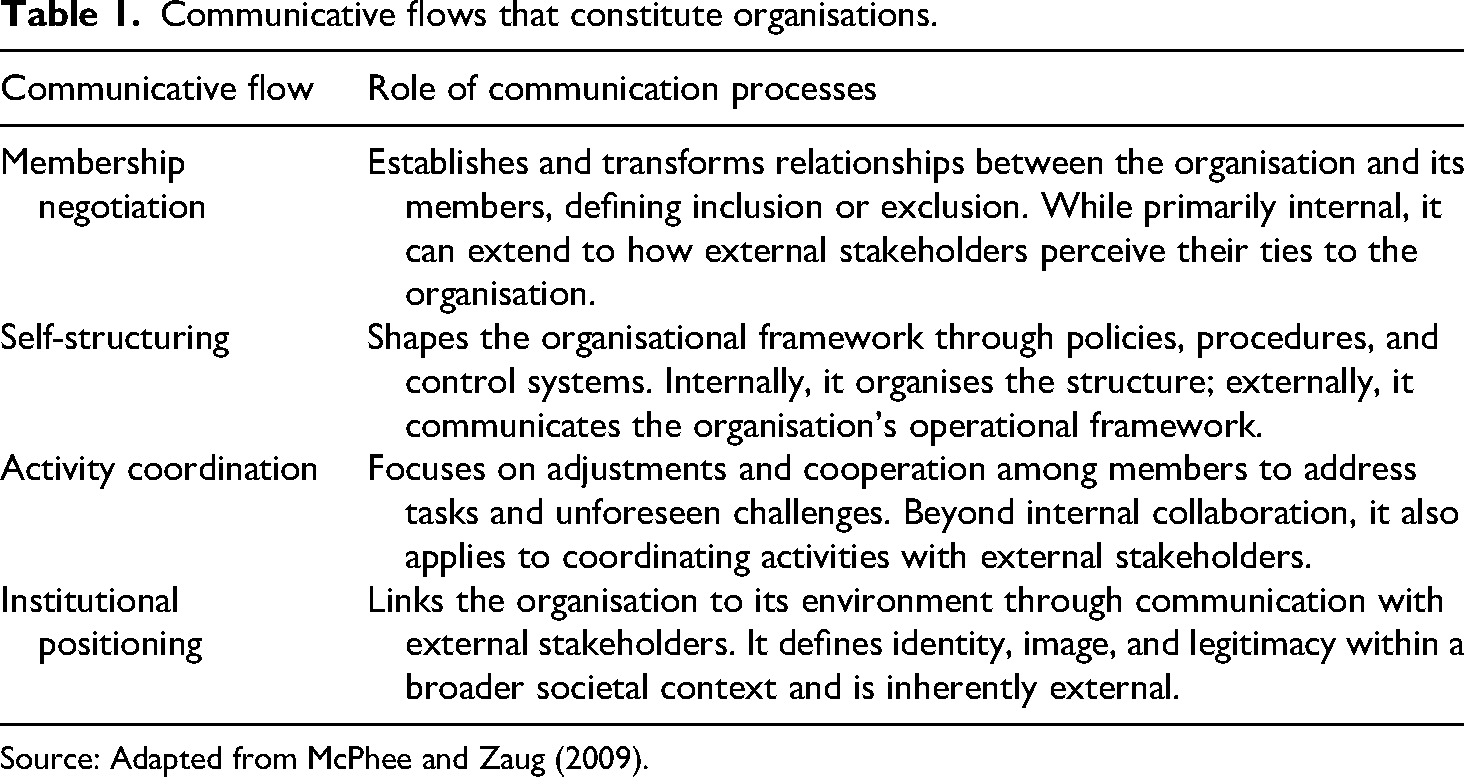
Source: Adapted from McPhee and Zaug (2009).
Building on this perspective, we adopt an extended view of the communicative flows of membership negotiation, self-structuring and activity coordination to include external audiences, recognising that these flows now operate in hybrid spaces of internal–external engagement. It also resonates with Koschmann's (2013) insight that collective identities in inter-organisational collaboration emerge through communicative practices that align diverse stakeholders, reinforcing that organisational constitution is always relational and cross-boundary. This extension enables us to more accurately analyse how PSAOs are constituted through communicative practices that respond to both internal dynamics and public-facing pressures.
The CCO theory suggests that PSAOs are not static entities but dynamic ones whose identity evolves through their communication practices (Cheney and Christensen, 2001; Cooren et al., 2011, 1150; Dawson, 2018), especially online (i.e. through websites, see Coupland and Brown, 2004). As Schoeneborn et al. (2019) note, organisations should be seen as ongoing accomplishments realised through communication, rather than stable containers in which communication merely occurs. This perspective aligns with institutional communication research, which shows that organisational legitimacy and accountability are sustained through communicative processes that link internal practices to broader societal discourses (Cornelissen et al., 2015). This shift towards a communication-based understanding positions PSAOs as organisations whose legitimacy, relevance and public accountability are continuously constructed through their communication with internal and external stakeholders (Cooren, 2004). By engaging in these communicative flows, PSAOs may actively shape their organisational reality, influencing their functioning and societal perceptions. A communicative lens enables us to explore how PSAOs adapt, sustain and sometimes transform their practices alligned to changing communication patterns and technological advancements. For example, as PSAOs communicate their actions and plans, they may redefine internal coordination mechanisms, adjust membership roles and reposition themselves institutionally to meet the evolving expectations of their stakeholders. If modern PSAOs are to address societal demands seriously, this approach helps to uncover nuances that go beyond mere informational exchange, highlighting their role in shaping identities, influencing stakeholder relationships and impacting the societal role of PSAOs.
Brazilian Courts of Accounts: context and institutional transformation
Courts of Accounts are autonomous public external control bodies, independent of the executive, legislative and judiciary, responsible for overseeing the use of resources by mayors, governors and public administrators (Lino and Aquino, 2018). Brazil currently has 32 subnational Courts of Accounts (hereafter CoAs).
Similar to other jurisdictions, ICT has enabled Brazilian CoAs to enhance communication with government entities and citizens (Loureiro et al., 2009; Rocha et al., 2020). Courts of Accounts are also expected to be transparent about their activities and processes, demonstrating integrity and accountability in their internal practices – as stated by the Brazilian auditing standards: ‘Courts of Accounts must inspire trust. Their credibility depends on being seen as independent, competent, and publicly accountable for their actions (…) they must lead by example’ (IRB, 2015).
In Brazil, three significant regulatory and institutional developments have been instrumental in reshaping CoAs’ communication practices, especially by encouraging increased ICT use. The Fiscal Responsibility Law fostered the adoption of ICT to enhance transparency (Aquino et al., 2021; Loureiro et al., 2009). Second, a large capacity-building program called PROMOEX, which took place from 2006 to 2012, included investments in personnel training, development of technology and organisational systems, achieving significant results, with 57% of participating CoAs meeting all targets (Silva and Mário, 2018). Finally, the standardised chart of accounts, developed by the National Treasury and implemented voluntarily from 2013 (Nunes et al., 2019), pushed CoAs to restructure and modernise layouts for financial data collection among their auditees.
Beyond these key regulatory changes, other legislative and technological shifts have influenced CoAs’ communication. The 2011 Freedom of Information Act has expanded public access to government records, encouraging CoAs to provide citizens with more open access to audit findings and operational information. Increased affordability and accessibility of digital technology also enhanced CoAs’ government-to-citizen communication. Digitalisation allows CoAs to publish audit reports online, create complaint portals, and establish mechanisms for citizens to report misuse of public resources, empowering them to engage in governmental oversight (Loureiro et al., 2009).
Methodology
We employed a documentary analysis to analyse the constitution of public sector audit organisations via ICT-enabled communication patterns (Bowen, 2009; Zeller, 2017), as described below.
Data collection
We rely on two main sources: (i) CoAs’ (archived) websites and (ii) social media platforms (Twitter (currently ‘X’), Facebook, Instagram and YouTube).
(i) Website data collection for CoAs. We intentionally sampled websites of all 32 Brazilian subnational CoAs at four distinct periods of regulatory change that may have impacted their interactions with other CoAs, their jurisdictions, and/or citizens (Patton, 2015). We started analysing archived websites (Brügger, 2008) via the Internet Archive (https://archive.org/web/) across three specific intervals with significant internal transformations in CoAs information technology use: (a) period 1, shortly after the enactment of the Fiscal Responsibility Law (from 2000 to 2004); (b) period 2, shortly after CoAs joined their modernisation programme (2006–2008); and (c) period 3, shortly after the adoption of the standardised chart of accounts (2012–2014). Using intervals rather than selecting a single year within these periods allowed us to choose the most functional version of each archived website (e.g. more information, active links, and images), as recommended by Brügger (2008).
After accessing the archived website collection, we examined the current versions of CoA websites to assess their current development stage (period 4, 2020–2024). Data were initially collected on all websites between 2020 and 2022, and in September 2024, we revisited them to check for the implementation of new communication technologies. Table 2 summarises the website years selected for analysis in each period.
Websites sampled, per year, in each period.
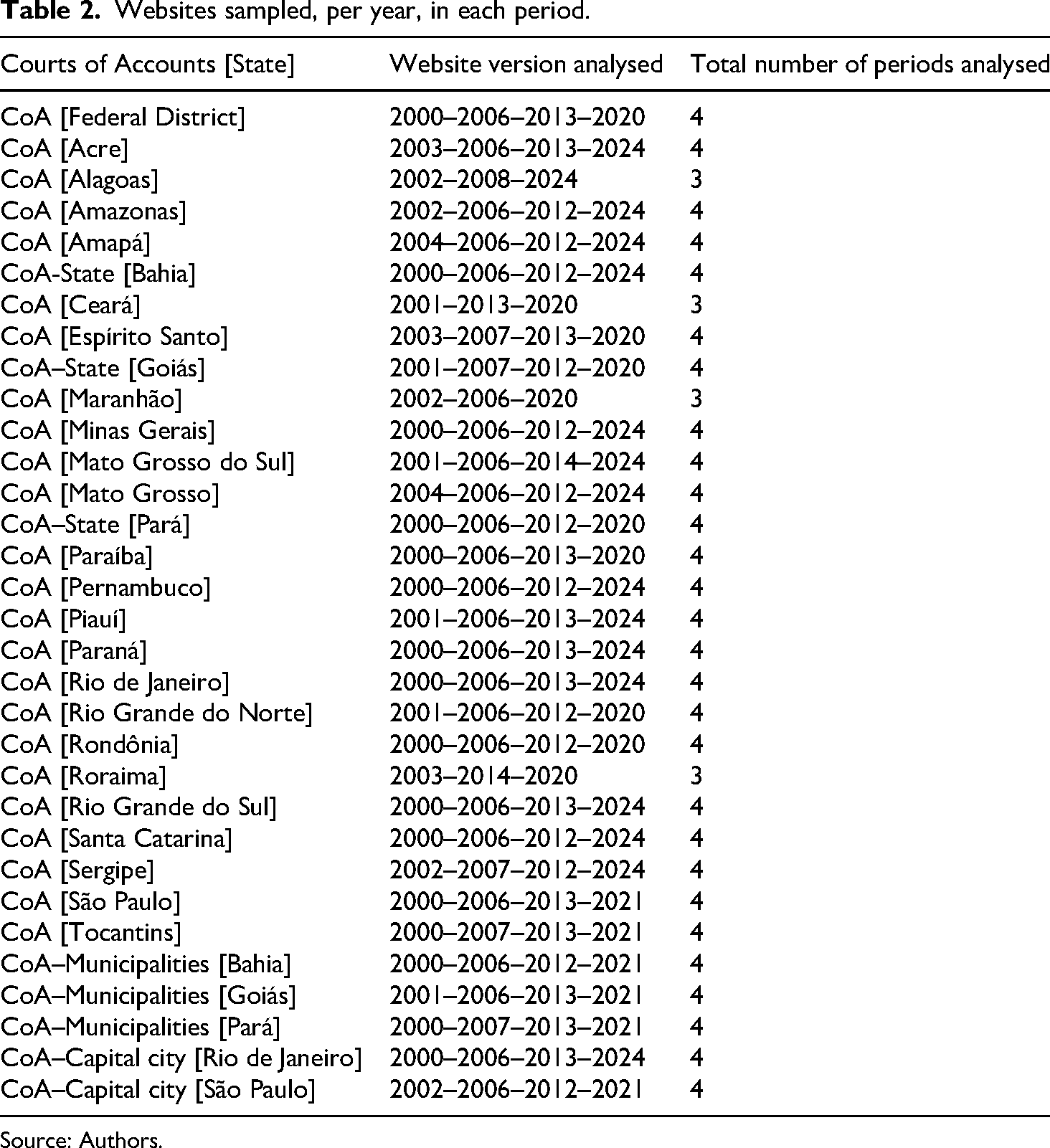
Source: Authors.
The data collected across the four periods were organised into a spreadsheet containing approximately 11,000 rows. Each row captured informational elements available on each website version analysed, for instance, written information (such as page titles, tabs, and body text) or text embedded in static images (Brügger, 2010) found on the homepage and pages accessible within one click. For each row, we also recorded metadata (e.g. CoA's name, screenshot capture data) to define each case, allowing for a structured comparison across organisations and periods. Elements requiring auxiliary software (e.g. video codecs) were excluded. Information was recorded to minimise non-essential content, thereby standardising the varied website layouts used by the CoAs.
(ii) Social media data collection for CoAs. We manually collected data following a multi-platform social media approach (Mayr and Weller, 2016). We selected the most common social media platforms linked on the CoAs websites in our sample: Facebook (linked by 93.75% CoAs), Instagram (90.63%), YouTube (87.50%) and Twitter (81.25%). Other social media platforms appeared only occasionally and were not deemed relevant for our analysis. All collected materials were created independently of any intervention from the research team (Salmons, 2017), including: (a) account creation date; (b) total number of posts; and (c) number of followers.
Data analysis
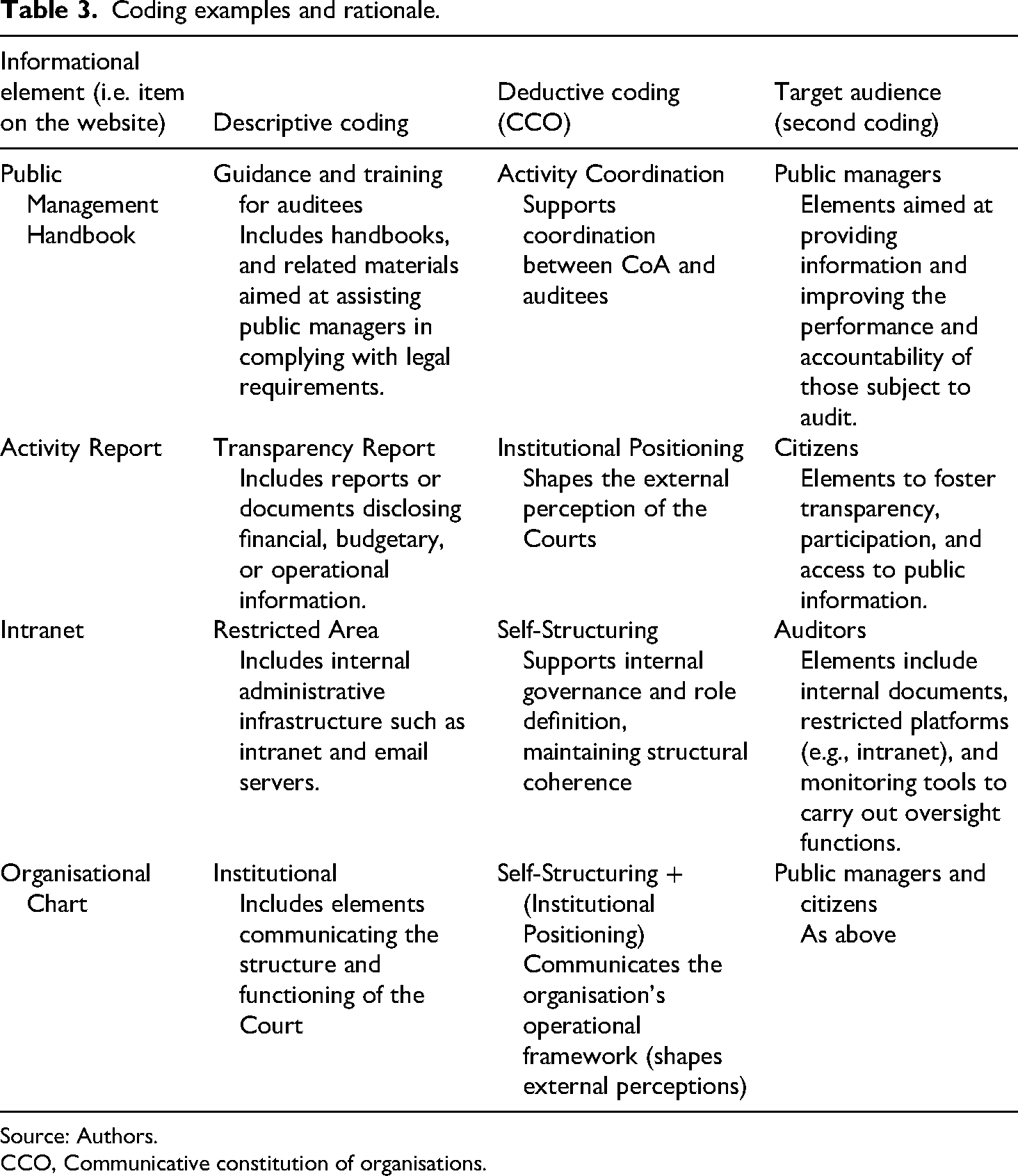
We first analysed (i) CoA websites and following (ii) social media information. One author conducted a content analysis of the website's informational elements (Bardin, 2011), categorising them descriptively into 31 categories. Subsequently, all authors discussed a sample of the codes for refinement (if needed). Table 3 exemplifies the descriptive coding (Saldaña, 2021) of such informational elements.
Coding examples and rationale.
Source: Authors.
CCO, Communicative constitution of organisations.
This analysis enabled us to identify the typical characteristics of websites within each timeframe (Brügger, 2008). Subsequently, via deductive coding, we linked the categories to the four types of communicative flows proposed by McPhee and Zaug (2009). In parallell, via simultaneous coding (Saldaña, 2021), we analysed how such elements were related to different target audiences (described in Table 3). While some elements are focused on a single audience, others can be used by multiple audiences, such as public managers and the public (e.g. contact information for the CoA) or public managers and auditors (e.g. normative instructions).
Regarding CoA's social media analysis, we first calculated how many days each social media account had been active. Since platforms were adopted at different times, we created a relative ranking per platform, indicating each CoA's position based on the date of account creation. For example, São Paulo's CoA was the first to create a Twitter account (position 1), while the state of Acre's CoA was the last (position 26). Courts of Accounts without a social media account on a particular platform were assigned last (e.g. 27 for Twitter). Next, we computed an average ranking for each CoA across all four platforms and grouped them into four quartiles: group 1 (early adopters); groups 2 and 3 (intermediate adopters); and group 4 (late or non-adopters). Finally, we calculated a posting frequency index by dividing total posts by the number of active days for each platform. We generated a chart for each CoA group's position relative to the communication patterns they adopted on social media.
Findings
In this section, we first describe the communication elements utilised and the target audience linked to the information disseminated by the CoAs at different points in time marked by technological advancements. Then, we observe the adoption of diverse communication technologies over the same periods of analysis. Finally, adopting the four flows of communication (McPhee and Zaug, 2009), we analyse the data focusing on the CoAs’ trajectory of development through their digital communication; i.e. the constitution of public sector audit organisations via ICT-enabled communication patterns.
The elements being communicated by CoAs on their websites from 2000 to 2024
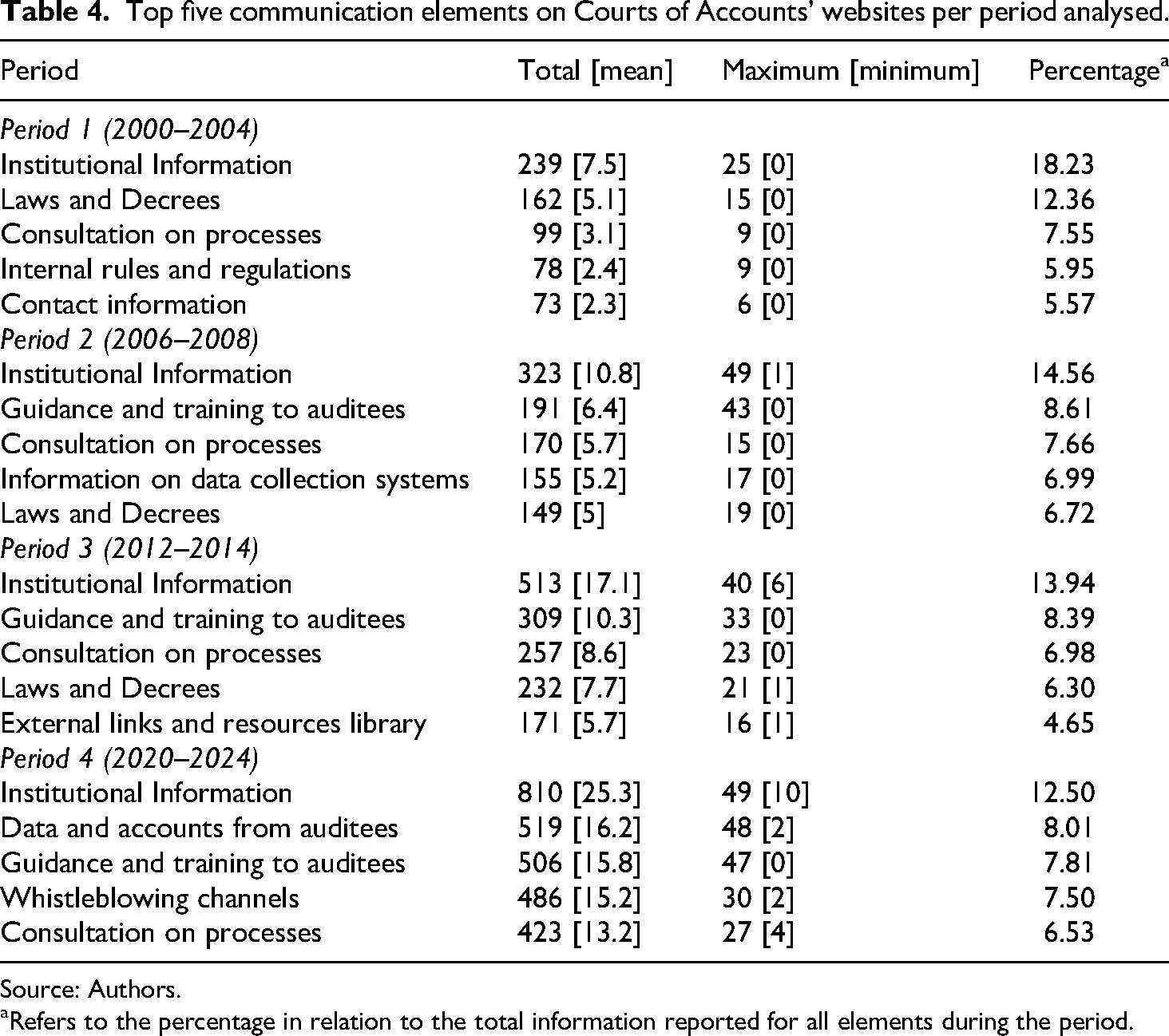
Table 4 shows the main communication elements on the CoAs’ websites through each analysis period (presentation of the top five themes). Despite Institutional Information consistently topping the list, its relative percentage decreases (from 18 to 12.5% of the total communication elements). Comparing the initial and final period of analysis, the results suggest that CoAs’ communication has shifted from broadcasting to more diversified and interactive elements. Following, we discuss the evolution in different periods.
Top five communication elements on Courts of Accounts' websites per period analysed.
Source: Authors.
Refers to the percentage in relation to the total information reported for all elements during the period.
In period 1 (2000–2004), the focus appears to be on providing basic organisational and legal information. For instance, Institutional Information and other key elements, such as laws, decrees and internal rules and regulations, account for around one-third of all elements communicated through the Courts’ websites. From period 2 (2006–2008), an apparent shift in communication priorities manifested through the rise in Guidance and training to auditees (8.61%). Moreover, Information on data collection systems (6.99%) appeared for the first time, indicating a growing emphasis on the relationship with auditees through the remote audit model (Aquino et al., 2021). Although institutional information (14.56%) remains dominant, it signals an evolution in providing unidirectional but relevant information to external stakeholders (in this case, auditees). Period 3 (2012–2014) is marked by an expansion in content; for instance, the volume of Institutional Information increased significantly compared to the previous periods. Elements such as Guidance and training to auditees (8.39%) and Consultation to processes (6.98%) showed steady growth, reinforcing a more externally oriented approach to communication. Finally, period 4 (2020–2024) represents a mature phase, characterised by a balance of transparency, accountability and stakeholder engagement. With 12.50%, Institutional Information still dominated, but data and accounts from auditees (8.01%) emerged as a key focus, emphasising accountability and leveraging data for transparency. Similarly, whistleblowing channels (7.5%) emphasised encouraging citizen engagement. Finally, the sustained focus on Guidance and training to auditees (7.81%) and Consultation on processes (6.53%) maintained their importance, supporting external stakeholders.
A deeper look at Institutional Information reveals significant changes. For instance, in the first three periods, the primary elements communicated were (i) the address and (ii) the history of the Court, with limited information about their mission or vision (i.e. only seven mission statements were available in period 1, and some of them were only available through PDF files). Strategic planning emerged after period 2 (driven by PROMOEX capacity-building programme). Comparing the mission statements over time, we noticed a stronger emphasis on ‘external oversight’ as a mechanism to improve public administration in the last period analysed, which was less explicitly highlighted in the first period's mission statements. Both periods’ mission statements aim to ensure proper management of public resources. However, period 4 explicitly mentions ‘improving public administration’ and ‘public policies’, while also highlighting transparency and the aim to improve the quality of life for citizens. In contrast, the first period focused more on accountability and waste avoidance. While both periods aim to ensure proper management of public resources, the tone has shifted. Period 4 statements are forward-looking and developmental, highlighting improvement and societal outcomes, whereas period 1 was more compliance-oriented and focused on oversight.
Overall, the most striking growth occurred in elements related to public engagement, monitoring and feedback. Whistleblowing and reporting channels increased from 17 items in period 1 to over 450 in period 4 (2700% increase), while data enabling Social Control (e.g. data and accounts from auditees) rose from eight items communicated in period 1 to 440 items in period 4 (5500% increase). This signals a shift towards creating new communication infrastructures for citizen oversight, potentially reconfiguring CoAs’ relationship with the public – from distant auditors to interactive accountability enablers – but the degree to which citizens actively use and influence these mechanisms remains an open question. Looking at the target audience of each communication element, Table 5 complements and validates the trends identified before, particularly the shift in focus from foundational transparency towards an approach that prioritises information exchange and potential engagement with external stakeholders over time. For instance, the steady rise in citizen-targeted communication, from 23% in period 1 to 39% in period 4, aligns with the introduction and expansion of tools such as whistleblowing channels and public transparency initiatives.
Percentage of communication elements per period by potential target audience.
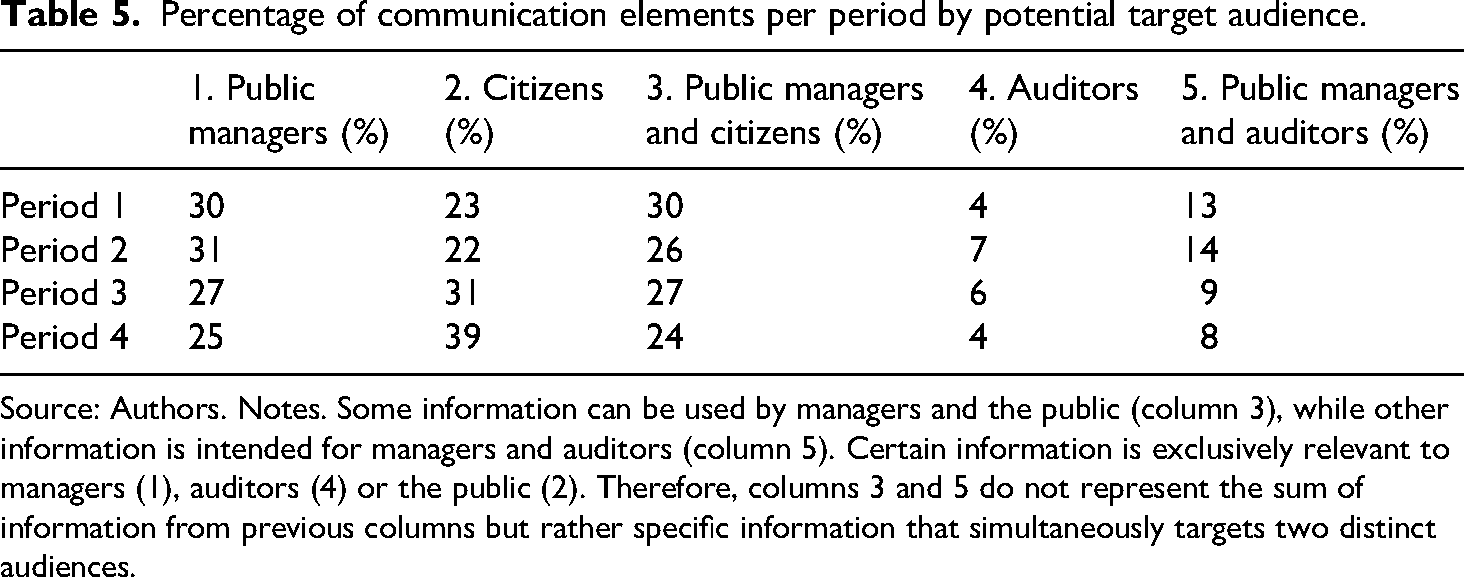
Source: Authors. Notes. Some information can be used by managers and the public (column 3), while other information is intended for managers and auditors (column 5). Certain information is exclusively relevant to managers (1), auditors (4) or the public (2). Therefore, columns 3 and 5 do not represent the sum of information from previous columns but rather specific information that simultaneously targets two distinct audiences.
More recently, COAs have been employing other technologies based on artificial intelligence in their operations, and this is also reflected on their websites and tools to improve citizen engagement. For instance, Bahia State's CoA recently introduced artificial intelligence to enhance communication with external stakeholders through its website. They developed TiCIAnE, a system enabling citizens to query audit documents. Below is an example of a query excerpt. Hello! I am ready to answer your questions about: Government Accounts 2022. What would you like to know? Was the governor's 2022 account rejected? No, the account of the Chief Executive of the State of Bahia for the 2022 fiscal year was not rejected. Although the audit team issued an opinion recommending disapproval, the Magistrate did not share this view.
The introduction of TiCIAnE marks a notable innovation and reflects a move from passive data disclosure towards interactive, citizen-oriented information access. While still in early stages, TiCIAnE demonstrates the potential of artificial intelligence to mediate complex audit knowledge, lower information asymmetries, and personalise communication.
Our analysis highlights a consistent increase in communication elements over time, indicating an expansion and diversification of CoAs website's content – gradually shifting from primarily providing static information (e.g. laws and decrees) to more dynamic and interactive content (e.g. guidance, data sharing and reporting channels). In turn, this leads to the potential for more relevant information and communication elements not only for auditors, but also for citizens and public managers.
Social media
Figure 1 presents the year of creation of social media accounts by the CoAs. The initial adoption occurred through Twitter (in 2009). Following our methodology, across all 32 Courts, 87.5% adopt Twitter, Facebook or YouTube, and 72% adopt Instagram, the most recent platform analysed. As of the time of analysis, an average of 5000 posts were made per Court, with an average of 0.6 posts daily. The most active Court averages of 1.46 posts daily, and the least active has an average of 0.10. The Courts have an average of 12,000 followers, with the highest followers at 42,000 across all social media platforms.
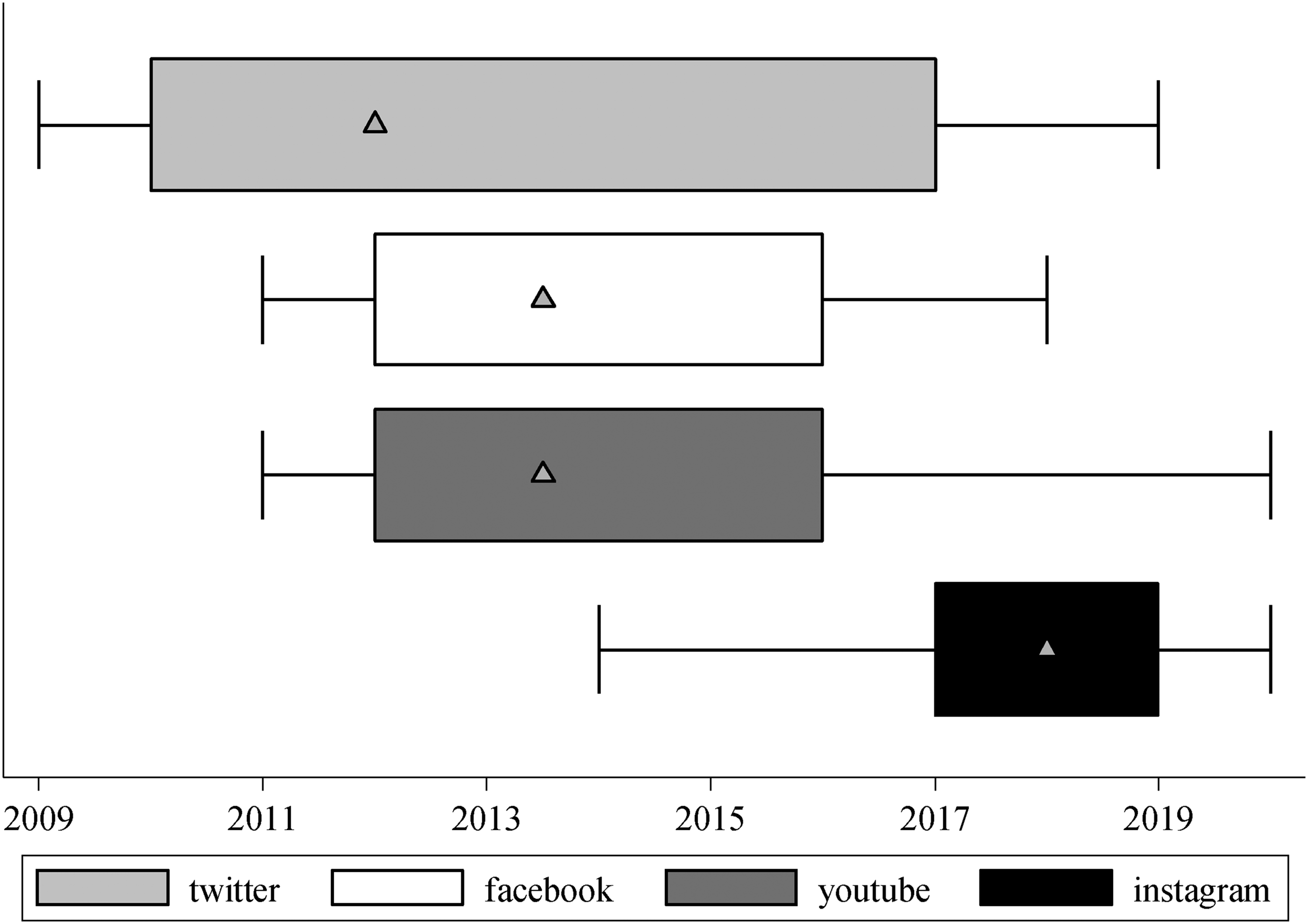
Courts of Accounts' social media established, by year.
Our data aligns with the evident use of social media platforms (Facebook and Twitter) by Regional Audit Institutions in the United States and the European Union (Torres et al., 2020). However, the CoAs stand out compared with these institutions overall, as the maximum adoption rate of the most used social media platform by Regional Audit Institutions (Twitter) was only 50% in the United States and 17.5% in the European Union, in contrast to the adoption of at least three social media platforms by 87.5% of CoAs in Brazil.
Finally, as social media has increasingly become the main channel of communication of organisations with their audiences, Figure 2 presents the activity of the CoAs on social media in comparison to the social control functionalities available on their websites, classified into four groups: (1) pioneers in social media; (2 and 3) intermediate groups, which adopted a mixed approach of social media communication and social control tools; and (4) late adopters, who have not yet adopted, or use only a few, social media platforms.
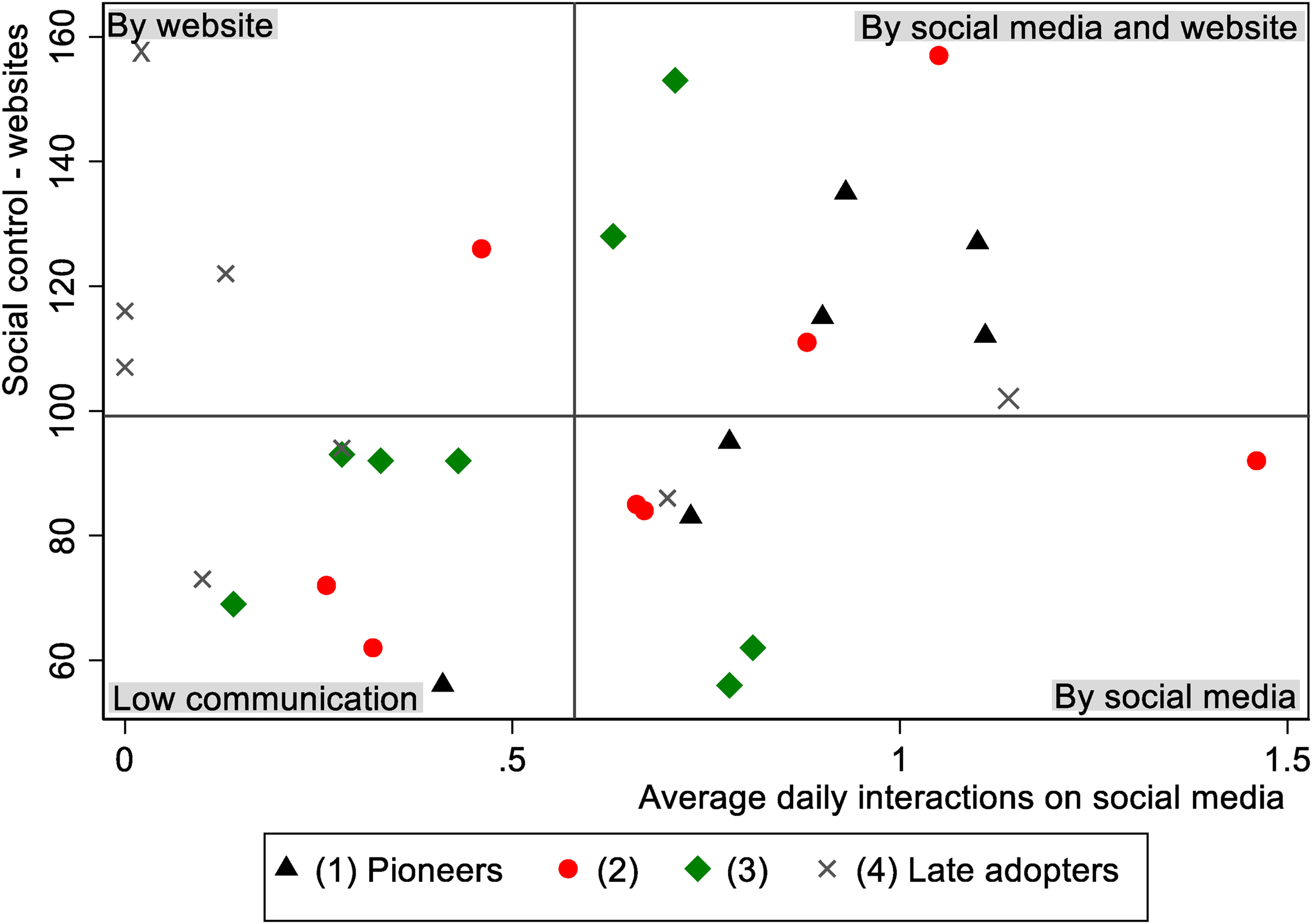
Communication patterns for interaction with external stakeholders. Notes: (i) the horizontal line represents the average daily interactions on social media; (ii) the vertical line represents the average social control functionalities available on websites; (iii) the symbols represent the four analysis groups – (1) pioneers in social media adoption, (2 and 3) intermediate groups and (4) the group of late-adopting Courts of Accounts.
Figure 2 illustrates the four communication quadrants employed by the CoAs to interact with external stakeholders. One group of Courts has low communication levels through their websites and social media (lower-left quadrant), which may reproduce opacity and distance, constituting themselves as closed or bureaucratic entities. In contrast, the third quadrant (upper-right) includes Courts that provide extensive social control functionality on their websites and exhibit high social media interaction – thus, potentially constituting organisations that engage in ongoing co-construction of meaning with stakeholders. There are two other groups of Courts. Some (upper-left) primarily communicate through their websites, offering extensive social control functionalities with limited use of social media, while others (lower-right) have significant social media interaction but limited social control functionalities on their websites.
The trajectory of development of the CoAs through their communication
Based on the elements of communication in websites and social media, CoAs' communication strategy appears to have evolved to encompass all four CCO communicative flows. Early periods (1 and 2) focused on Self-Structuring and Institutional Positioning, establishing the CoA's identity, legal framework and basic interaction channels. Over time, in periods 2 and 3, there is a shift towards Activity Coordination and continued Institutional Positioning, with increased resources for external stakeholders. The most recent period (4), marked by the emergence of whistleblowing channels and auditees’ data sharing, signifies a stronger emphasis on membership negotiation and activity coordination. This reflects a more participatory and transparent organisational approach, despite the degree to which these tools are actively utilised or lead to substantive engagement remains uncertain. Below we analyse the results through CCO lens.
Communicating ‘Institutional Information’ relates to the organisational self-structuring flow, as CoAs shape stakeholders’ understanding and expectations about the organisation, ensuring that its structure is not just internally coherent but also externally credible. Overall, websites heavily emphasised such elements, despite their declining prominence. Such an element also represents a rudimentary form of Institutional positioning, i.e. how Courts establish their identity within the broader societal and regulatory landscape.
Activity coordination extends beyond communicating internal processes to include how CoAs manage relationships with external stakeholders, such as other CoAs and their auditees. ‘Guidance and Training for Audited Entities’ emerged as a prominent feature, particularly during periods 2 and 3, ranking second among communicated elements. This reflects CoAs’ commitment to enhancing compliance and operational alignment with auditees. Additionally, the integration of data collection systems in period 2 emphasises streamlining information sharing. These systems aimed to bridge gaps between Courts and auditees, aligning with the broader goals of the PROMOEX capacity-building initiative.
Traditionally, Membership Negotiation focuses on internal processes such as recruitment and socialisation (McPhee and Zaug, 2009). However, organisations often engage external stakeholders in ways that resemble membership dynamics, i.e. through advisory boards or public consultations. These interactions blur the lines between internal and external participants, highlighting the organisation's permeability and the role of external voices in shaping its operations. Our data indicate that the CoAs’ target audience has undergone significant evolution. For instance, analysing the first period (2000–2004), CoAs' websites were primarily aimed at public managers, featuring legalistic content that was insufficient to promote societal accountability and engage citizens (i.e. 23% of information targeted society directly – Table 3). However, a shift towards societal engagement became evident during period 4 (2020–2024). Nearly 39% of information targeted the public, including public finance data and whistleblowing tools. This progression highlights the increasing importance of societal inclusion in CoAs’ communication strategies, promoting transparency and broader stakeholder engagement. Considering that CoAs work in overseeing public administration has important political implications (e.g. decisions can lead to the loss of office by public officials, the suspension of public policy implementation or the annulment of contracts), including more social actors and engaging external stakeholders may go well beyond increasing dialogue with society towards seeking public legitimacy for decisions that may affect the political interests of powerful groups.
All these flows are imbricated with Institutional positioning – which refers to how CoAs establish their identity within the broader societal and regulatory landscape. This dimension saw a marked transformation. For instance, period 4 presents a pivotal shift towards promoting societal accountability. For example, ‘Public Data and Accounts’ and ‘Whistleblowing Channels’ gained prominence, illustrating a commitment to transparent reporting and participatory oversight. Also, CoAs demonstrated agility in addressing atypical events such as the COVID-19 pandemic, as most websites provided comprehensive updates on pandemic-related expenditures, underscoring their responsiveness to societal needs. Since CoAs are not subject to electoral scrutiny, they become vulnerable to changes brought about by the political system whenever their decisions run counter to already established power structures (Lino et al., 2022). Gaining political support from society, therefore, depends heavily on a broad-reaching communication strategy with strong persuasive capacity.
This evolution illustrates how the CoA has expanded its communicative practices to not only define and structure itself but also to engage more actively with its members and environment. The increasing complexity and interactivity of communication elements suggest a maturing organisation that recognises the importance of all four communication flows in constituting and sustaining its operations.
Complementing this temporal analysis, the distribution of CoAs across the four communication quadrants (Figure 2) further illustrates that communicative evolution is not uniform but differentiated. From a CCO standpoint, these configurations represent distinct communicative constitutions of the CoA-citizen relationship: some Courts sustain authority through controlled, website-based communication, while others enact a potentially more dialogical and networked identity via social media engagement. This diversity reveals that the CoAs’ communicative transformation is both temporal and structural, reflecting multiple pathways through which institutional legitimacy and societal accountability are constituted. Consequently, while the communicative infrastructure increasingly enables participatory engagement, its realisation across CoAs remains uneven, signalling an ongoing negotiation of the Courts’ institutional identity within the public sphere.
Discussions and conclusion
This paper examines how public sector audit organisations are constituted through ICT-enabled communication patterns. Initially focused on internal and procedural information dissemination, CoAs have evolved towards greater engagement with external stakeholders, particularly citizens, including increased use of social media platforms. Our research contributes to the literature on PSAO communication by addressing the gap in which it has traditionally been viewed as a unidirectional information exchange (González-Díaz et al., 2013; Torres et al., 2020). By adapting and applying the CCO framework (Cooren et al., 2011; McPhee and Zaug, 2009), we provide empirical evidence that communication is not merely a functional tool but a constitutive process that may shape organisational identity and stakeholder relationships (Dawson, 2018). This perspective extends the understanding of PSAOs’ communication beyond their traditional technocratic and bureaucratic characterisation (Pollitt and Summa, 1997), highlighting a dynamic and evolving nature as they adapt to societal demands for transparency and engagement (e.g. Intosai, 2019a). Second, our longitudinal analysis of ICT-enabled communication patterns offers insights into how technological advancements have facilitated changes in organisational communication strategies. Prior literature has not fully explored how communication shapes the very existence and evolution of PSAOs (Torres et al., 2020). By examining how these technologies contribute to the constitutive processes of PSAOs, our findings suggest that adopting social media and other interactive elements on websites enables new forms of engagement with citizens, potentially contributing to gradual shifts in the organisation, while acknowledging that the actual extent of use of these technologies must be further investigated. Third, we have contributed methodologically by utilising archived websites to analyse organisational change and technology adoption over time – providing a longitudinal perspective that is often difficult to achieve in organisational research.
Despite focusing on PSAOs, our findings offer relevant lessons to different public sector organisations. First, recognising that communicative practices do not merely transmit information but also constitute organisational identity (Cooren et al., 2011; Schoeneborn et al., 2019) reinforces the importance of communication as a strategic tool in public management. Public managers should understand that their communication channels and practices shape how the organisation is perceived, legitimise its actions and establish connections with different audiences (Christensen and Lægreid, 2020). Our case suggests that even traditionally isolated and unresponsive bodies can gradually reposition themselves by explicitly rearticulating their communication practices. This indicates that ‘who we are’ can be actively shaped via communication, rather than assumed to be fixed.
Second, the use of ICT should go beyond digitalisation and be guided by a logic of responsiveness and engagement. Digital ombuds services, automated bots and active listening channels represent strategic resources for promoting and consolidating social accountability (Agostino et al., 2022). In the CoA context, adopting these appears to be accompanied by a redefinition of communicative flows, enabling effective external stakeholder engagement. This suggests that other SAIs and oversight bodies can expand their communicative reach by adding citizen-facing mechanisms that lower the barriers to complain, monitor, and question. Such mechanisms do not only ‘provide transparency’; they invite citizens to occupy a quasi-membership role in accountability processes, thereby redistributing who gets to speak in the accountability dynamics. Aligned to INTOSAI-P-12, the value of PSAOs should not be reactive and instrumental, but about communicating themselves into relevance. This implies that ‘relevance’ is not simply demonstrated ex post through audit reports, but actively constructed through continued presence in spaces where non-expert publics can interact with the organisation (e.g. social media channels, reporting portals).
Third, other public organisations – such as regulatory agencies, social care departments, public defender's offices, or even the judiciary – can adapt the practices analysed in this study to strengthen their democratic legitimacy and enhance the delivery of public value (Mergel, 2013; Twizeyimana and Andersson, 2019; Viegas et al., 2022). To that end, it is necessary to integrate both external and internal communication into an institutional culture that values transparency and pedagogical dialogue with different audiences, responsiveness to society and the joint construction of an organizational identity with various stakeholders – one that also takes into account the institutional vulnerabilities to which many organisations, such as the CoAs in Brazil, are subject within the political system. In other words, communication should not be treated as an auxiliary ‘outreach’ function, but as part of the organisation's efforts to protect its autonomy and legitimacy in politically contested environments.
Future research could explore whether similar communication shifts occur in public sector (audit) organisations globally, offering insights into the balance between ICT-enabled practices and context-specific factors. Second, the discontinuity in communication elements due to website changes warrants analysis, as redesigns may erase or redirect central aspects of organisational identity. Third, studies could examine external stakeholders’ perceptions, given that organisational identity is co-created (Dawson, 2018). Fourth, the role of AI in communication and its scalability – potentially dependent on factors such as digital literacy, institutional capacity and public trust in AI-generated responses – could be further explored. Finally, investigating the internal dynamics – such as how internal communication and culture adapt to external strategies – would further enrich understanding of the constitutive role of communication. Overall, this study underscores the importance of strategic communication in fulfilling the democratic mandate of PSAOs and contributes to a deeper understanding of how they evolve in response to technological and societal changes. Researchers, managers and policymakers should recognise the power of communication not just as a tool for information dissemination but as a foundational element that constitutes and reconstitutes organisational existence and relevance in the public sector.
Footnotes
Acknowledgements
We are grateful to the members of the Public Sector Accounting and Governance in Brazil group for their constructive review of earlier versions of the paper.
ORCID iDs

Funding
The authors received no financial support for the research, authorship, and/or publication of this article.
Declaration of conflicting interests
The authors declared no potential conflicts of interest with respect to the research, authorship, and/or publication of this article.