



Abstract
This article draws on theories of person–organisation fit and leadership behaviour to explore how supportive leadership is related to communication practices, collaborative working practices and performance management practices and how these three practices, in turn, relate to public servants’ job satisfaction. A model of supportive leadership's direct and indirect effects on employees’ job satisfaction is empirically tested using responses to a survey administered to the European Court of Auditors (ECA) staff. The findings show that communication and collaborative working practices mediate the relationship between supportive leadership and job satisfaction. Supportive leadership positively relates to performance management practices, but these practices have no significant association with job satisfaction. While addressing a theoretical void in the field, this study also makes an empirical contribution by unveiling how a professional European public audit institution manages its human resources and the means it uses.
Points for practitioners
Elaborating on the relationship between leadership behaviour and person–organisation fit in the context of a supranational public entity helps to explain what motivates public servants. The relationship between supportive leadership and public servants’ job satisfaction is mediated by two organisational practices: communication and collaborative working practices. Transparent performance management practices do not mediate the relationship between supportive leadership and job satisfaction. Public sector organisations with professional staff can centre their human resource management around effective communication and collaborative working practices to ensure greater employee satisfaction in the workplace.
Keywords
Introduction
Public servants’ work motivation is connected to several desirable outcomes, including job satisfaction, organisational commitment, and individual and organisational performance (Homberg et al., 2015; Huang, 2022; Mostafa et al., 2015). Motivating public servants can enhance public service quality, safeguard the public interest and positively impact civil society (Lim et al., 2022; Ritz et al., 2016). Thus, what makes public servants motivated and satisfied with their job has become an important topic of inquiry (Liu and Tang, 2011).
Leaders’ characteristics and styles are key triggers of job satisfaction (Banai and Reisel, 2007; Lane and Wallis, 2009). In public sector organisations, characterised by the shift from new public management to new public governance (Grossi and Argento, 2022), leaders need to rely on broad competencies and behaviours related to communication, collaboration and performance practices (Yeboah-Assiamah et al., 2019). Public leaders are increasingly responsible for delivering better performance through effective employee management and implementing managerial principles typically adopted in the private sector (Orazi et al., 2013; Kalgin et al., 2018).
Such leadership is necessary to ensure public sector organisations adequately motivate themselves to fulfil their mandated purposes (Behn, 1998). Therefore, managers must act as leaders who turn their subordinates into followers and support them in fulfilling organisational goals by preserving integrity and ethics (Orazi et al., 2013). To increase public servants’ motivation and reduce corruption, it has been recommended that rigid bureaucratic structures be relaxed and participatory practices implemented, allowing public servants to participate in decision making. It is also important to align public servants’ interests with organisational goals through proper incentive systems and help them experience a sense of accomplishment (Ritz et al., 2016).
Leadership styles affect individuals’ satisfaction with their work. Studies have explored how transformational, charismatic and shared leadership styles of public managers are related to public servants’ job satisfaction and performance (Andersen et al., 2018). However, few studies have explored the mechanisms or practices through which this relationship occurs (e.g. Chan, 2019). Furthermore, this relationship has not yet been explored in depth in the public management literature (Park and Hassan, 2018). This article seeks to fill this void and contribute to a deeper understanding of the relationship between leadership styles and public servants’ job satisfaction by exploring the role of three mechanisms: communication practices, collaborative working practices and performance management practices. It specifically focuses on the effects of a supportive leadership style (Rafferty and Griffin, 2006).
This article combines person–organisation fit theory (Terborg, 1981) and leadership behaviour theory (Yukl, 1971). It thereby contributes to filling the theoretical void in the relationship between leadership styles and job satisfaction. The theoretically derived model is explored empirically in the unique context of the European Court of Auditors (ECA), which acts as the external auditor of the European Union (EU) by carrying out financial, compliance and performance audits and is referred to as the ‘financial conscience of the EU’ (Stephenson, 2015).
While the public management literature includes several national supreme audit institution studies, the ECA is surprisingly understudied (Bonollo, 2019). Thus, by focusing on the ECA staff, this study also makes an empirical contribution by unveiling how a supranational audit institution manages its human resources and the means it uses.
Theory and development of hypotheses
Person–organisation fit and leadership behaviour
According to person–organisation fit theory, employees’ work behaviour and attitudes are a function of individual and situational characteristics (Terborg, 1981). A person–organisation fit exists when the congruence between individual and situational characteristics results in individual satisfaction. Consistently, person–organisation fit is defined as a match between the organisation's values and practices and an individual's values (e.g. O’Reilly et al., 1991). Values congruence is reflected in higher levels of individual job satisfaction and organisational commitment (Kristof, 1996). Hence, public servants who experience the fit will have positive attitudes towards their work. Those who do not fit their organisations may share feelings of incompetence and anxiety and are less satisfied with their work (Pervin and Rubin, 1967). While the person–organisation fit theory explains how organisational practices drive individuals’ job satisfaction, the role of leadership remains unclear (Li, 2006).
Leadership behaviour theory can help, as it explores how leadership behaviour manifests itself in ‘influencing and facilitating individual and collective efforts to accomplish shared objectives’ (Yukl, 2012). Leadership behaviour can be categorised as task oriented and relations oriented (Behrendt et al., 2017). Task-oriented leadership behaviour is represented by planning short-term activities, clarifying task objectives and role expectations, and monitoring operations and performance. Instead, relations-oriented leadership behaviour is defined as providing support, encouragement and recognition for achievements, and developing member skills and confidence and empowerment (Yukl et al., 2002). Relational leadership behaviour is more likely to be reflected in person–organisation fit and individual outcomes, an idea rooted in the assumption that person–organisation fit is achieved through more intensive interactions between the leader and subordinates that affect the subordinates’ values, attitudes and behaviours (Meglino et al., 1991), aligning them with organisational values (Li, 2006).
Supportive leadership and organisational practices
Supportive leadership has received considerable attention in the leadership (House, 1971) and mentoring literature (Allen et al., 2004) and recently in the public management literature as well (Park et al., 2021). It represents a relational leadership behaviour that provides followers with emotional, informational, instrumental and appraisal support (House et al., 2004; Rafferty and Griffin, 2006). Supportive leadership facilitates goal accomplishment by guiding subordinates to be effective and perceive their work as meaningful and stimulating (Banai and Reisel, 2007). Public managers who embody a supportive leadership style may inspire their subordinates, and public servants, to align their ambitions and goals with those of their organisations.
Supportive leadership is further associated with a concern for followers’ well-being by facilitating a desirable climate (Schyns et al., 2009), characterised by the adoption of instrumental elements (making their lives easier) and emotional factors (ease in talking with colleagues) (Khalid et al., 2012), which promote employee satisfaction and effectiveness (cf. Golabdost and Rezaei, 2016). Supportive leaders are prone to establishing effective communication practices, characterised by openness and fluidity, that trigger an effective exchange of ideas within work units (House, 1998). Supportive leadership predisposes individuals to see value in open and fluid communication with each other and the leader (Shadur et al., 1999).
Similarly, supportive leadership can encourage joint decision-making and collaboration (El-Nahas et al., 2013). Employees feel encouraged to participate in joint activities by having a goal orientation inspired by the supportive climate and feeling satisfied with their job (Scott-Ladd et al., 2006). Supportive leaders are responsible for establishing performance management systems that communicate expectations and subsequent rewards for performing specific tasks. In designing such systems, supportive leaders establish goals and help their subordinates attain them (Jung and Takeuchi, 2010) and recognise their own skills’ value (Judge and Bono, 2001). Empowering subordinates ultimately leads to a psychological contract between them and the organisation and is reflected in employees’ increased participation in organisational management and decision-making (Grandey, 2000).
In sum, supportive leaders have a pivotal role; they assist followers in accomplishing their goals in line with the goals of the organisation. Supportive leadership behaviour creates a workplace focused on successful results, which is beneficial for the well-being of both employees and the organisation (Khalid et al., 2012). Thus, supportive leadership can lead to the establishment of organisational practices that reflect the facilitative nature of such leadership style, leading us to hypothesise that:
Supportive leadership is positively related to effective communication practices.
Supportive leadership is positively related to establishing collaborative working practices.
Supportive leadership is positively related to transparent performance management practices.
Organisational practices and job satisfaction
Organisational practices established by leaders to allow individuals to feel fulfilled and part of the collective have been associated with employees’ increased job satisfaction (Parkes and Langford, 2008). For example, effective communication practices, especially when dealing with complex tasks, raise workers’ self-efficacy owing to the possibility of openly discussing and voicing challenges associated with those tasks (Somacescu and Barbu, 2016). Furthermore, a work climate characterised by open and frequent communication results in increased motivation and a feeling of belonging to the work unit, consequently leading to job satisfaction (Richmond et al., 1980).
Similarly, established collaborative working practices allow for responsibility sharing, improving organisational performance (Hoon Song et al., 2012). This results in a greater degree of comfort with the task and creates a feeling of mutual goal orientation, reflected in increasing job satisfaction (Brimhall et al., 2014).
Finally, the clarity and transparency of goals and their associated rewards, that is, performance management practices, are important for creating employee motivation and well-being (Wastell et al., 1994). Clear and transparent performance management can reduce the need for centralised control and increase public servants’ autonomy, leading to greater job satisfaction (Kalgin et al., 2018). Based on the discussion above, we thus hypothesise that:
Effective communication practices are positively related to public servants’ job satisfaction.
Collaborative working practices are positively related to public servants’ job satisfaction.
Transparent performance management practices are positively related to public servants’ job satisfaction.
Supportive leadership and job satisfaction
Arguments for H1 and H2 suggest that supportive leadership is positively related to the effectiveness of three specific practices, which are hypothesised to be related to public servants’ job satisfaction. The underlying arguments for these relations are embedded in theoretical assumptions of person–organisation fit (Terborg, 1981) and leadership behaviour (Yukl, 2012), suggesting that relation-oriented behaviour epitomised by supportive leadership is reflected in the emergence of communication, collaborative working and performance management practices. Public servants will perceive such supportive leadership-inspired organisational practices as congruent with their values and attitudes, ultimately increasing job satisfaction.
While this study provides arguments for the mediating effects of different practices, we cannot discount the direct relationship between supportive leadership and public servants’ job satisfaction, which fits with the argumentation provided by leadership behaviour theory (Yukl, 2012). Supportive leadership creates a sense of belongingness to an organisation and encourages employee empowerment and development (Schyns et al., 2009). The emotions and perceptions thus streaming from the presence of supportive leadership allow employees to have a sense of satisfaction in their employment (Whitener et al., 1998). Yet we maintain that while the arguments for the direct effect hold, the different practices developed by supportive leaders represent important mechanisms affecting that relationship. We thus hypothesise that:
Effective communication practices will mediate the relationship between supportive leadership and public servants’ job satisfaction.
Collaborative working practices will mediate the relationship between supportive leadership and public servants’ job satisfaction.
Transparent performance management practices will mediate the relationship between supportive leadership and public servants’ job satisfaction.
Method
Empirical context and participants
Established in 1977, the ECA became an EU institution with the Maastricht Treaty in 1993 (http://www.eca.europa.eu). It serves as an external auditor of the EU budget and collaborates with the national supreme audit institutions in a spirit of trust while maintaining its independence (Stephenson, 2017). The ECA is responsible for delivering accountability and oversight (Uman et al., 2022). It is a peculiar organisation whose leadership, organisational practices and treatment of employees are worth investigating to further our understanding of the relationship between supportive leadership and job satisfaction.
Elements of multi-cultural and multi-professional backgrounds characterise the ECA organisational structure. It comprises 27 members, one from each EU member state appointed for a renewable term of six years by the European Council after consultation with the European Parliament. The ECA is organised into five chambers, to which members and audit staff are assigned. The ECA has approximately 900 staff in audit, communication, translation and administration with broad professional backgrounds and experience in both the public and private sectors, including accountancy, financial management, audit, law, economics and information technology.
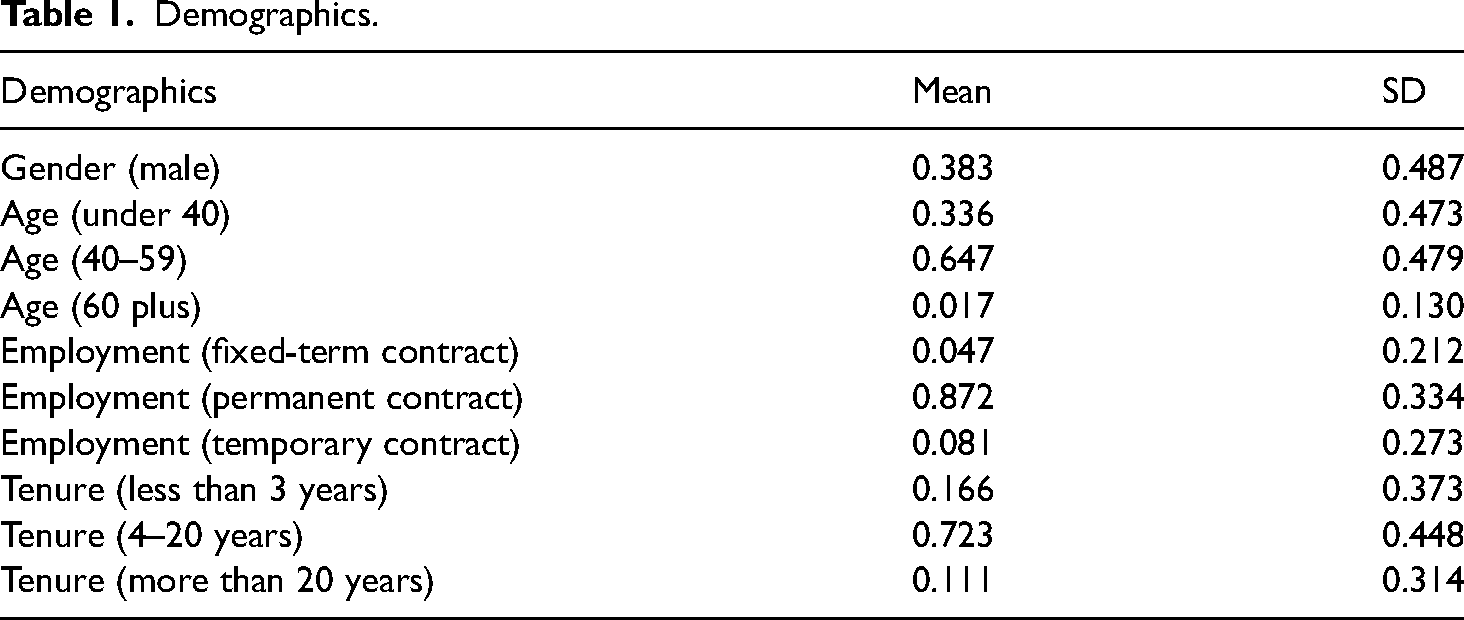
This study is based on the electronic survey distributed to 900 ECA employees in autumn 2018. The survey was administered by the ECA human resources (HR) department, and data provided for research purposes were anonymised. Complete responses were received from 235 individuals (response rate 26%), of whom 62% were female; 65% were aged between 40 and 59; 87% had a permanent contract, while 13% were temporary/contract staff; and 72% had worked at the ECA for between four and 20 years (see Table 1). The sample had a limited deviation in the above-mentioned dimensions (i.e. gender, age and terms of employment) from the total population. 1
Demographics.
Operationalisation
Most of the constructs used in this study have been adjusted to fit the ECA context, given that it both structurally (e.g. accountability structures) and strategically (goals and their attainment) differs from any public and private organisations in which the measurement instruments have been used. Table 2 presents the survey questions and reports the principal component analysis standardised factor loadings for the items and Cronbach α values for each composite construct.
Survey questions.
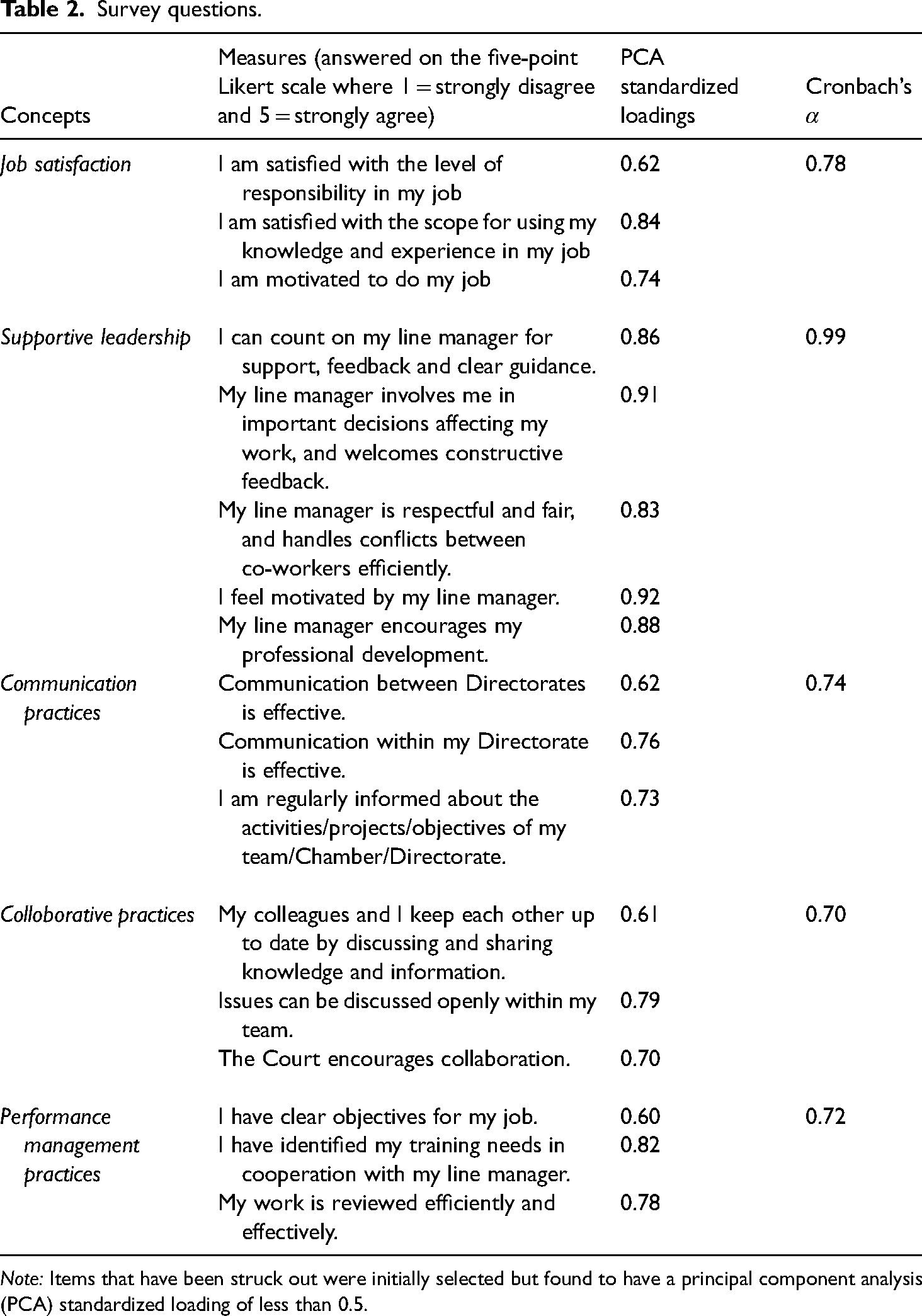
Note: Items that have been struck out were initially selected but found to have a principal component analysis (PCA) standardized loading of less than 0.5.
Dependent variable
Job satisfaction (JS) was measured by four statements. Respondents were asked to assess four different dimensions of their job satisfaction on a five-point Likert scale, where 1 = strongly disagree and 5 = strongly agree. A similar scale was applied to all other constructs. Instead of selecting an existing instrument, an eclectic selection fitting the ECA context was used. In developing the instrument, the influential review work of Danna and Griffin (1999) was used for inspiration. 2
Further instrument analysis revealed that one item was loading below the 0.5 threshold. It was thus removed and not used for the construction of the variable. After adjusting the instrument, we performed a reliability test on the remaining three items. Cronbach’s α indicates satisfactory reliability α = 0.78, which is above recommended 0.70 cut-off value (Pallant, 2020).
Independent variable
Supportive leadership (SL) was measured by five statements inspired by Banai and Reisel (2007), who developed questions related to a leader's creation of interest and motivation, assistance in decision-making and developmental goal orientation. The Cronbach α of the five items indicates satisfactory reliability, α = 0.99, which is above recommended 0.70 cut-off value (Pallant, 2020).
Mediating variables. Inspired by Downs and Hazen's (1977) communication satisfaction questionnaire, five statements were selected to measure communication practices (ComP). Further instrument analysis revealed two items with loading below the 0.5 threshold. They were thus removed and not used for the construction of the variable. After adjusting the instrument, we performed a reliability test on the remaining three items. Cronbach’s α indicates satisfactory reliability α = 0.74, which is above recommended 0.70 cut-off value (Pallant, 2020).
Four statements exploring different aspects of collaborative working efforts with colleagues and within their working environment were used to measure collaborative working practices (ColP). This measure was inspired by van der Vaart et al. (2012). Further instrument analysis revealed one item with loading below the 0.5 threshold. This item was thus removed and not used for the variable's construction. After adjusting the instrument, we performed a reliability test on the remaining three items. Cronbach’s α indicates satisfactory reliability, α = 0.70, which is just at the recommended cut-off value of 0.70 (Pallant, 2020).
Finally, performance management practices (PmP) were measured by four statements inspired by the work of Macky and Boxall (2007) and adjusted for the empirical context investigated. Further instrument analysis revealed one item with a loading below the 0.5 threshold. It was removed and not used for the variable's construction. After adjusting the instrument, we performed a reliability test on the remaining three items. Cronbach’s α indicates satisfactory reliability α = 0.72, which is above the recommended 0.70 cut-off value (Pallant, 2020).
Data analysis
The analysis employed a conventional two-step modelling strategy. The first step used confirmatory factor analysis with maximum likelihood ratio estimation to test the models by examining the construct validity of the latent variables. In the second step, a structural equation model was built to investigate the relationships between the variables and test the mediation hypotheses.
The analysis used SPSS 25.0 and AMOS 25.0 software. Conventional indices were employed to assess the model fit.
Results
The common method bias was assessed using Harman's single-factor test (Podsakoff et al., 2003). To check for bias, all independent and dependent variables were included in one unrelated factor analysis procedure. The results of the factor analysis suggest the presence of a multiple factor structure, i.e. four factors with eigenvalues more than 1.0 that accounted for 66% of the total variance. The results showed that when all items were constrained to one factor, the variance was equal to 41.3%, which is under the recommended threshold of 50% (Kassinis and Soteriou, 2003), indicating only limited common method bias. Thus, following Hair et al. (2009), a theory-driven approach was used to conduct further analysis using a confirmatory factor analysis to examine the hypothesised structure between scale items and the underlying constructs.
Validity and reliability
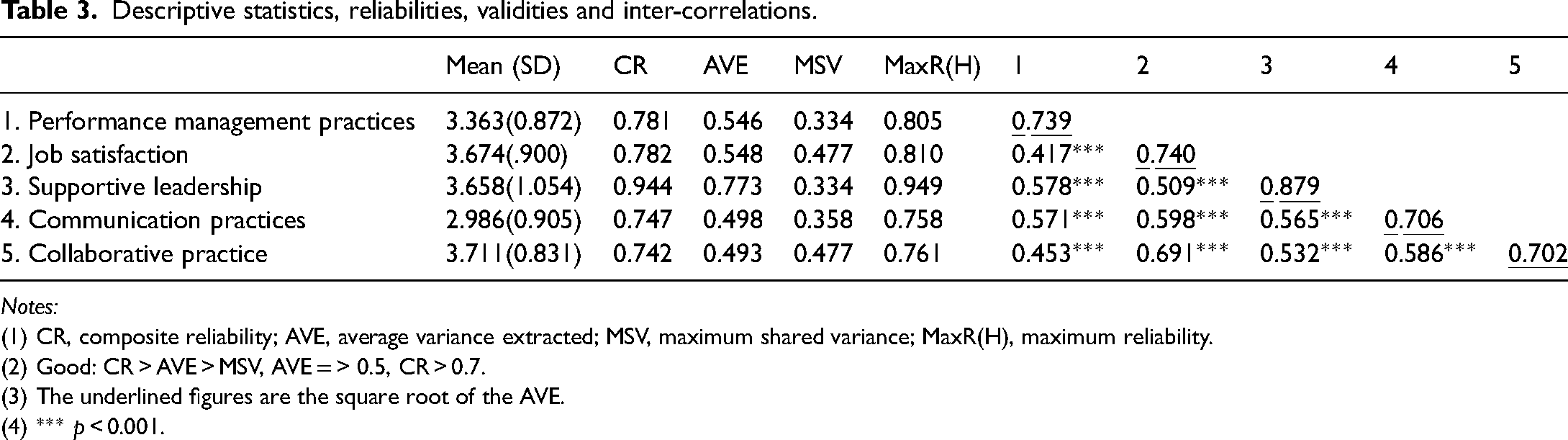
Table 3 presents the five latent variables’ means, standard deviations, reliabilities, validities and correlations. The composite reliability suggests that the reliability of the five constructs was good, between 0.742 and 0.944 (> 0.7). The average variance extracted (AVE) and maximum shared variable of all variables were acceptable, except for the AVEs of communication and collaborative working practices, which were marginally below the suggested values (0.493 and 0.498 < 0.5).
Descriptive statistics, reliabilities, validities and inter-correlations.
Notes:
(1) CR, composite reliability; AVE, average variance extracted; MSV, maximum shared variance; MaxR(H), maximum reliability.
(2) Good: CR > AVE > MSV, AVE = > 0.5, CR > 0.7.
(3) The underlined figures are the square root of the AVE.
(4) *** p < 0.001.
Confirmatory factor analysis
The confirmatory factor analysis was performed using inter-item variance and covariance matrices. Five latent variables fitted the data acceptably well (Relative χ2 [χ2/d.f.] = 1.884; standardized root mean squared residual [SRMR] = 0.0431; goodness of fit index [GFI] = 0.915; comparative fit index [CFI] = 0.955; relative fit index [RFI ρ 1] = 0.887; root mean square error of approximation [RMSEA] = 0.074).
Structural equation modelling
In line with the steps suggested by Holmbeck (1997), we first tested the direct effect model (SL → JS). The direct effect model indicated that supportive leadership has a significant relationship with job satisfaction (β = 0.43***) and had a good model fit (χ2/d.f. = 3.519; SRMR = 0.0377; TLI = 0.948, CFI = 0.965; RFI ρ 1 = 0.929; RMSEA = 0.001). Subsequently, we tested the fit of the overall model (SL → (ComP, ColP, PmP) →JS), which was good (χ2/d.f. = 2.188; SRMR = 0.0674; GFI = 0.899; CFI = 0.939; RFI ρ 1 = 0.868; RMSEA = 0.003). Given the adequate fit of the two models, we then examined path coefficients and their significance, i.e. hypotheses testing.
The results show that supportive leadership does not have a significant relationship with job satisfaction (i.e. no effect, β = 0.07) but is significantly and positively associated with communication practices (β = 0.35, p < 0.01), which are, in turn, significantly and positively associated with job satisfaction (β = 0.41, p < 0.01). The results further show that supportive leadership is significantly and positively related to collaborative working practices (β = 0.35, p < 0.01), which are, in turn, significantly and positively associated with job satisfaction (β = 0.62, p < 0.01). Finally, the results show that supportive leadership is significantly and positively associated with performance management practices (β = 0.37, p < 0.01). However, there is no statistically significant relationship with job satisfaction (β = 0.03; see Figure 1.
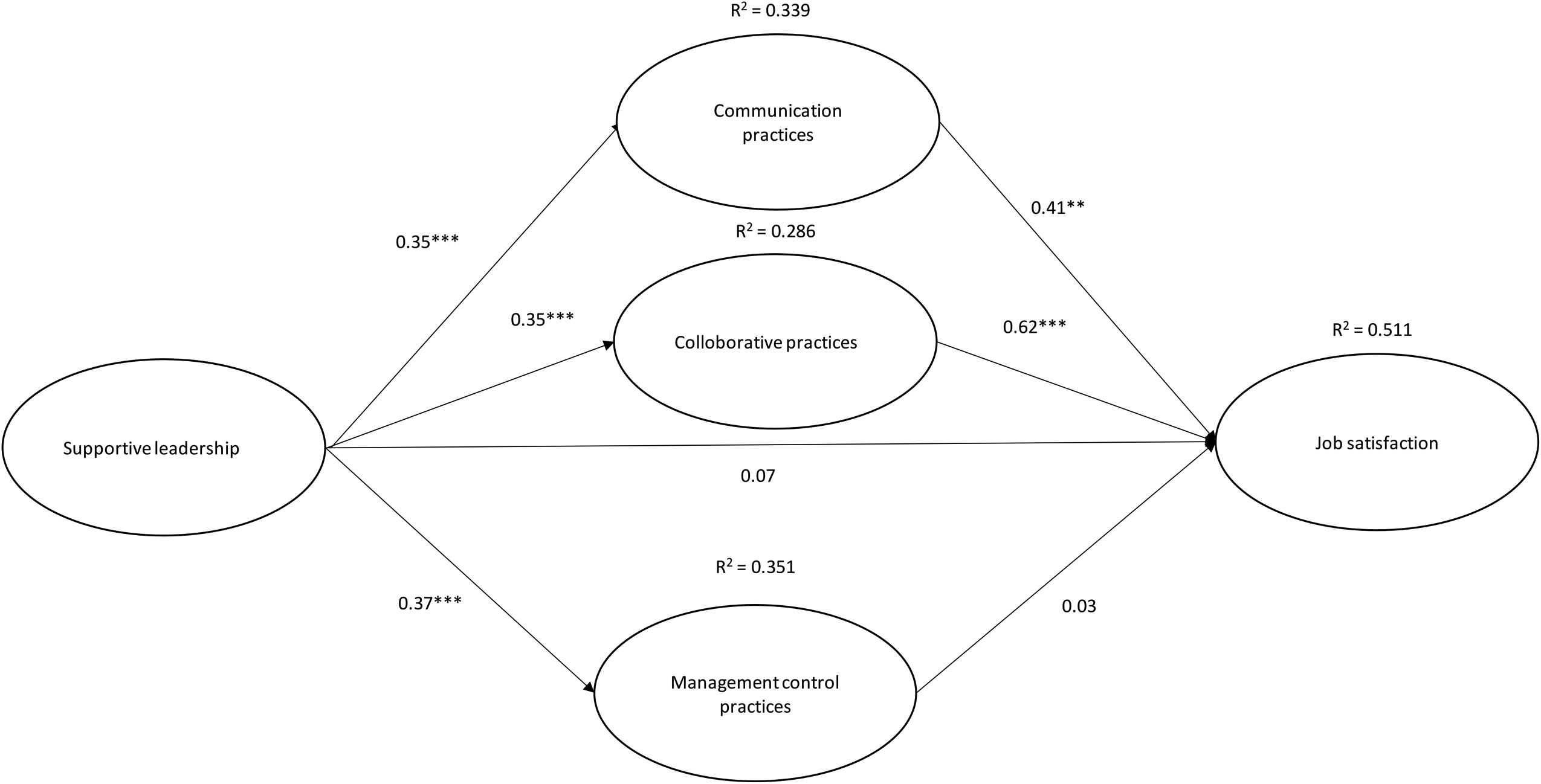
The results of the model.
Thus, our study finds support for hypotheses 1a, 1b and 1c and for hypotheses 2a and 2b. However, we find no support for hypothesis 2c.
Test of mediation effect
A theory-based structural model was developed and tested to explore the mediation model, which shows whether communication practices, collaborative working practices and performance management practices mediate the relationship between supportive leadership and ECA employees’ job satisfaction. A test of the mediation effect was done by means of bootstrapping. The recommended 95% confidence interval was used with 2000 bootstrap samples (Hayes and Preacher, 2010). We also followed Holmbeck (1997) and assessed the fit of the overall model under two conditions: (a) when the SL → JS path is constrained to zero and (b) when the SL→JS path is not constrained. The path (a) had a good model fit (χ2/d.f. = 2.174; SRMR = 0.0672; GFI = 0.898, CFI = 0.939; RFI ρ 1 = 0.869; RMSEA = 0.003) andχ2 = 241.273, while path (b) had a similarly good fit (χ2/d.f. = 2.188; SRMR = 0.0674; GFI = 0.899; CFI = 0.939; RFI ρ 1 = 0.868; RMSEA = 0.003) and χ2 = 240,640. The t-test results indicate the χ2 values in both models are not significantly different, and the addition of the path between SL and JS does not improve the fit. We further can observe that while the indirect effect (condition a) β = 0.410** is significant, the direct effect (condition b) β = 0.07 is not. These indicators thus suggest a full mediation effect for our overall model. Yet, since exploring the overall model found that the path between performance management practices and job satisfaction was insignificant, and this no-significant relationship might distort the overall model, we performed a further test on three separate models. The three models included SL, JS and each of the mediating variables one at a time. Similarly to the trials of the overall model, we performed bootstrapping (Hayes and Preacher, 2010) and followed Holmbeck's (1997) procedure. The results of the tests (see Table 4) suggest that when considered in separate models, communication and collaborative working practices partially mediate the relation between supportive leadership and job satisfaction provided that the direct effect (path b) in both models remains significant (β = 0.203* and β = 0.185*). In line with the overall model findings, the model performance management practices suggest that these practices do not mediate the relationship between leadership practices and job satisfaction. Thus, H3a and H3b are supported, while H3c is not.
Mediating effects.
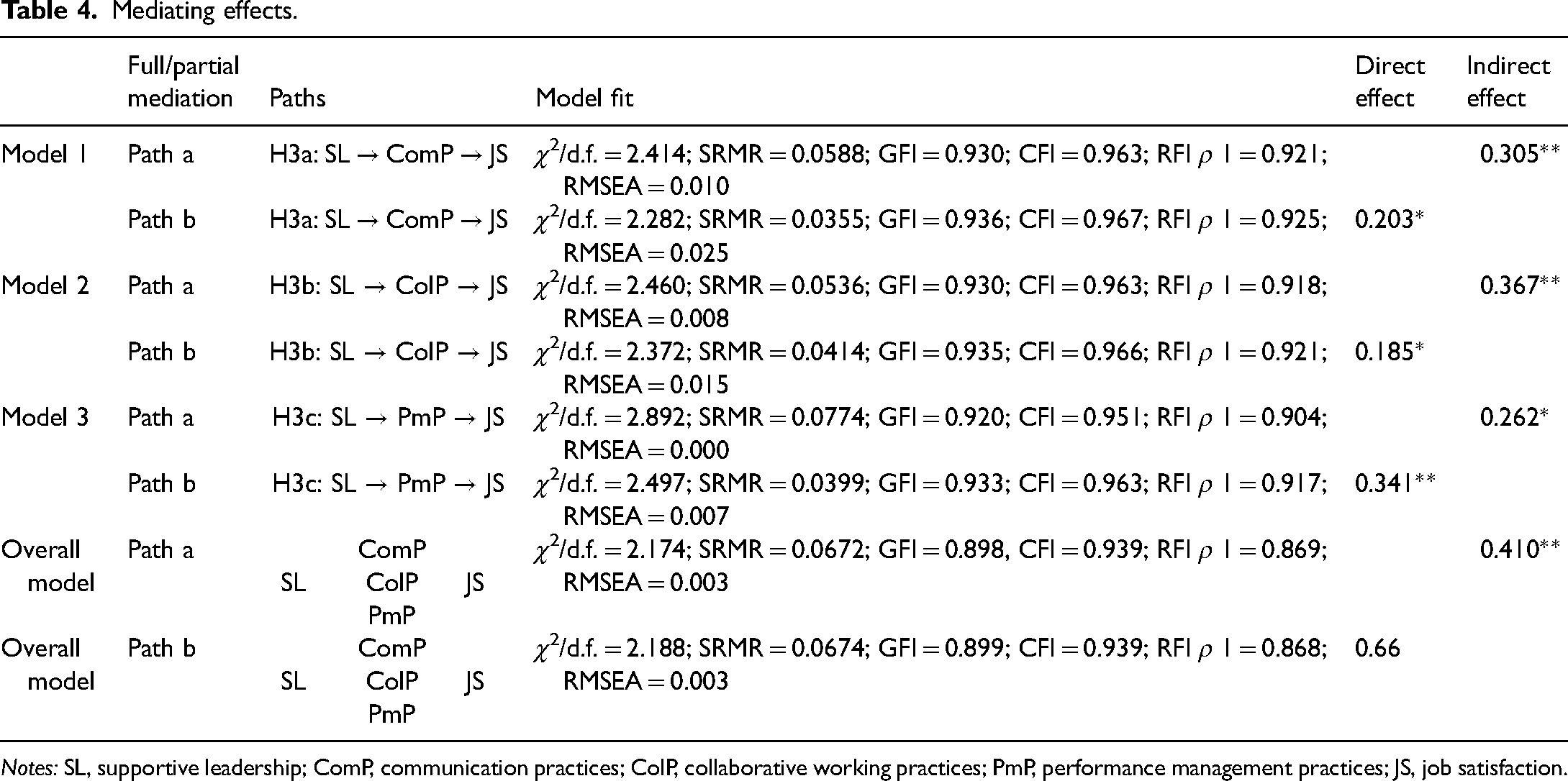
Notes: SL, supportive leadership; ComP, communication practices; ColP, collaborative working practices; PmP, performance management practices; JS, job satisfaction.
Discussion
The findings reveal that supportive leadership has an indirect positive relationship with ECA employees’ job satisfaction (cf. Golabdost and Rezaei, 2016). This relationship is mediated by communication and collaborative working practices. Specifically, supportive leadership is positively related to effective communication and collaborative working practices. These two practices, in turn, have a significant positive relationship with ECA employees’ job satisfaction. These results highlight the importance of communicating internal values and fostering collaboration to increase job satisfaction and add to previous knowledge in the field (e.g. El-Nahas et al., 2013; Scott-Ladd et al., 2006).
However, while supportive leadership has a significant positive relationship with performance management practices, the latter does not have a significant relationship with job satisfaction. This raises some questions about the role of performance management practices within public sector audit organisations like the ECA. In theory, clear and transparent performance management practices should increase public servants’ job satisfaction (Kalgin et al., 2018). It may be that the definition of clear objectives and effective reviewing systems (which are part of performance management) are not relevant to ECA employees. Since the participants in this study are professionals, their intrinsic motivation might be increased by open communication and a collaborative work climate rather than by systematic performance management systems. In a supportive leadership context, they might well pursue their mission and experience job satisfaction without needing performance management systems, which appears to be more in line with leadership behaviour theory (Yukl, 2012) and studies that explore the direct effect of supportive leadership on job satisfaction (e.g. Schyns et al., 2009).
These findings suggest that person-fit theory (Terborg, 1981) should be applied with caution in contexts dominated by professionals whose professional identities might not be fully aligned with organisational structures used in other administrative contexts (McNair, 1991). Thus, our results might relate to the effectiveness of the control systems implemented to manage professional organisations. Cultural and personnel controls that value individuals and groups within organisations seem to override results controls related to performance management practices. Practically, our findings and non-findings thus suggest that while organisations should encourage supportive leadership, they should be mindful of the practices they establish to enable their employees to be satisfied with their job.
Conclusions
To our knowledge, this is the first study exploring the mediating role of specific practices in the relationship between supportive leadership and job satisfaction in public sector audit organisations. This article makes several contributions by exploring the unique context of a supranational audit institution. The theoretical contribution uncovers the mechanisms underlying the relationship between supportive leadership and public servants’ job satisfaction (Banai and Reisel, 2007). The findings further contribute to the growing field of human resource management and leadership in the public sector (Boselie et al., 2021). They elaborate on the overlooked relationship between leadership behaviour and person–organisation fit (Dahleez et al., 2020) in a supranational public entity, adding to the discussion about what motivates public servants (Ritz et al., 2016). This article's empirical contribution lies in illuminating the ECA context and highlighting the interaction between leadership, organisational practices and job satisfaction. It also reveals how specific practices work in this unique public, professional organisation. Finally, the practical contribution lies in suggesting how public sector organisations can design their human resource management practices to ensure greater employee satisfaction in the workplace.
Apart from exploring a specific theoretical model, this study explored the under-researched context of the ECA (Bonollo, 2019). The ECA represents a unique context to be explored, given that the job satisfaction of its staff, or lack of it, could have profound consequences for the functioning of the institution in general and the organisations it audits.
This research has several limitations, indicating avenues for future research. First, the study was performed in one organisation with specific characteristics. This suggests that while our findings may not be generalisable, they could be extended to organisations with similar characteristics, i.e. where the organisation's core consists of professionals. Referred to as professional bureaucracies (Mintzberg, 1993), such organisations could represent an interesting context to explore models similar to the ones explored in this study. Second, the cross-sectional design of this study implies that a cause-and-effect relationship cannot be established. Future studies could thus adopt a longitudinal design to observe how leadership in public sector organisations or/and professional bureaucracies impacts various organisation practices over time and how such developments relate to the job satisfaction of their employees. Third, the unavailability of data on the characteristics of the total population represents another limitation of this study. However, this limitation was partly alleviated by the ECA HR department confirming that the sample was representative of the population when the data were collected. Fourth, although our measures for different constructs have been previously used for practical purposes at the ECA, they were not previously utilised in the same form for research purposes, which is another limitation of this study. Related to that, our analysis has found that AVE values of collaboration and communication practices were slightly below the recommended 0.5 value. The examination of the relation between these two constructs has suggested that they are significantly correlated with each other (p < 0.586***), yet below the suggested 0.8 cut off value (Pallant, 2020). This finding implies some overlap between the concepts and could indicate that collaborative working practices might be contingent on effective communication practices and vice-versa. Thus, future studies could explore the contingent nature of different practices on each other and try to explore how this potential co-dependence impacts employees’ job satisfaction. Furthermore, the data used in this study were derived from an employer-administered survey, suggesting potential respondent bias in answering questions. Future studies should consider researcher-driven data collection, which could alleviate such bias. Finally, while our research has focused on leadership, organisational practices and job satisfaction, it did not consider respondents’ perceptions of organisational climate or culture, aspects of particular interest in professional bureaucracies in the public sector (Lega and De Pietro, 2005). Thus, future studies could explore the moderating role of organisational culture and climate for the relations investigated in this study and in the context of organisations where professionals constitute the core.
Footnotes
Author note
Giuseppe Grossi is also affiliated at Kozminski University, Warsaw, Poland.
Declaration of conflicting interests
The author(s) declared no potential conflicts of interest with respect to the research, authorship, and/or publication of this article.
Funding
The author(s) disclosed receipt of the following financial support for the research, authorship, and/or publication of this article: This work was supported by the Research Platform Business Development in Collaboration of Kristianstad University (grant number 5-2020).
