



Abstract
The use of social media has promised to enhance administrative transparency. Whether having positive or negative impacts, some scholars agree that such impacts could come from the mediating effects of the perceived characteristics of social media. This is a similar idea to that proposed by the concept of computer-mediated transparency. However, social media has certain properties that might influence transparency in different ways. This article tries to understand social media-mediated transparency. The study uses the affordances theory to approach the perception of social media properties, conducting interviews with community managers from three Spanish city councils. The results show several ways of understanding social media-mediated transparency: the guarantor model (focuses on availability and accessibility of information, while ensuring neutrality), the conversational model (reinforces effective transparency through continuous conversations), and the proactive model (anticipates citizen informational needs). The article signals the differential nature of social media-mediated transparency and its limits, with implications for digital government–citizen interactions.
Points for practitioners
The article proposes three different ways of looking at social media-mediated transparency.
Social media-mediated transparency will vary depending on how public managers navigate through social media affordances.
Different models of social media-mediated transparency might link with different ways of institutionalizing these digital platforms, as well as with different considerations on citizens’ roles.
Transparency through social media is more than just pushing information, but also an opportunity to improve effective monitoring through continuous conversations.
Keywords
Introduction
The adoption of social media in the public sector promised to boost the openness and transparency of public organizations. Transparency can be defined as “the extent external actors are afforded access to information about the way public organizations operate” (Cucciniello et al., 2017: 36), which not only means the exchanging of information, but also the effective monitoring of organizations. Optimistic perspectives consider that social media can improve transparency through diffusion of information, interaction, and effective monitoring (Criado and Villodre, 2021; Silva et al., 2019; Wukich, 2022), while critics believe that the medium contains political and social biases (Feeney and Porumbescu, 2021), or that government social media messages are often targeted at self-promotion (DePaula et al., 2018). However, all of them point out as a differential fact that if social media generates any impact on transparency, this will be closely linked to how we perceive the properties of this medium. Although transparency has been one of the main goals of social media (Wukich, 2022), we still have a lack of understanding on how the characteristics of this digital medium influence transparency. Thus, this study tries to better understand the relationship between social media and transparency.
The study of the digital medium to understand modern forms of transparency is not something new. The impact of information and communication technologies led to the coining of the term “computer-mediated transparency” (Grimmelikhuijsen and Welch, 2012; Meijer, 2009), to reflect on how computerized means will make easy to monitor public organizations. One of the ideas behind this concept was that the characteristics of the technological medium (notably web portals) may have the potential to change the way we perceive information (Meijer, 2009). In contrast with web portals, social media has unique properties that allow highly interactive experiences between a multiplicity of actors, configuring malleable social environments that might affect information and monitoring (Stamati et al., 2015). While recent advances on Artificial Intelligence (AI) (e.g., chatbots) have added some layers of interactivity to traditional web portals, AI-driven artifacts are even more present in social media (Androutsopoulou et al., 2019). In addition, they have more differential challenges – for instance, on the construction and dissemination of misinformation (Aïmeur et al., 2023), derived from its interaction with certain social media properties. All this is enhanced by the sometimes anarchic nature of social media over which, in contrast with governmental web portals, public administrations have little control.
This article tries to understand social media-mediated transparency. The research question that guides the article is: how can social media-mediated transparency be understood? Due to the differential properties of social media, the ways of achieving effective monitoring of administrative activities might be different in contrast with computer-mediated transparency (Grimmelikhuijsen and Welch, 2012; Meijer, 2009). The study focuses on the impacts that perceptions of platforms properties have, by conceptualizing them through the affordances theory (Ronzhyn et al., 2023). It studies the impacts of five social media affordances (visibility, communicability, interactivity, collaborative ability, and anonymity) (Stamati et al., 2015), conducting semi-structured interviews to community managers from three Spanish city councils: El Prat de Llobregat (Catalonia), San Sebastián de los Reyes (Madrid), and Zaragoza (Aragón).
The main contribution of the article lies in the proposal of three different ways of understanding social media-mediated transparency: the guarantor model (focuses on availability and accessibility of information, while ensuring neutrality), the conversational model (reinforces effective transparency through continuous conversations), and the proactive model (anticipates citizen informational needs). These models signal some of the effects that these platforms might have on administrative transparency. The findings might contribute to the way we understand the role of citizens in digital government–citizen interactions (Wukich, 2021, 2022), and, ultimately, to the way social media institutionalization occurs (Criado and Villodre, 2022; Mabillard et al., 2024; Mergel and Bretschneider, 2013).
The article is structured as follows. First, the article reviews how the literature has understood the relationship between social media and administrative transparency, and how the affordances theory can help to understand social media-mediated transparency. Then, the article introduces the methods, starting with the justifications for case selection, and the explanation of the data gathering process and subsequent analysis. The results section shows the three models of social media-mediated transparency, while the discussion reflects on the differential nature of social media-mediated transparency, explains its contribution, and draws on its main limits.
Theoretical framework
Social media and administrative transparency
The relationship between social media and administrative transparency has aroused great interest among public administration scholars. With an optimistic view, Mergel (2013) highlighted that the fact that public administrations posting about their activities on social media could be seen as an act of transparency in itself. Local governments’ commitment to transparency seems to be also associated with the use of social media, particularly with its dialogic capabilities to establish conversations (Bonsón et al., 2015; Silva et al., 2019; Sivarajah et al. 2015) and, ultimately, to build community and trust (Maziashvili et al., 2023). However, for a majority of authors, the relationship between transparency and social media seems to be still related to more passive modes of engagement, focused on communication broadcasting (Contri et al., 2023). Also, some scholars would even conclude that a good part of the information that public administrations publish on social media should be treated as marketing and self-promotion (DePaula et al., 2018).
Moreover, transparency has been considered as an important communication goal for public administrations’ social media strategies. For example, as part of its content-structure framework, Wukich (2022) recognizes transparency as one of these potential goals, and links to it certain messages – particularly, those related to the organization operations and executive actions. Other frameworks have pointed out how social media makes it possible for citizens to monitor service delivery performance, as public administrations might also post information around the status of public services (Criado and Villodre, 2021). This monitoring could also be extended to messages around changes in regulations, expenditures, and deliberations (Bonsón et al., 2015; Calhan et al., 2021), among others.
All these perspectives have something in common. If social media has any impact on administrative transparency, it will be closely linked to the perceptions and relations around the medium and its properties. This idea was behind the conceptualization of computer-mediated transparency (Grimmelikhuijsen and Welch, 2012; Meijer, 2009). Web 1.0 technologies allow information to reach the citizenship more easily. However, the characteristics of the medium have the potential to change the way we perceive information, as “the medium is the message” (McLuhan, 1964: 14). Therefore, “to understand the meaning of computer-mediated transparency, we need to understand the characteristics of the new mediums” (Meijer, 2009: 259). Computer-mediated transparency has three main features (Meijer, 2009): (a) information is transmitted unidirectionally; (b) information is decontextualized, involving the publication of large volumes of data disconnected from its original meaning or context; and (c) it is calculative and structured, being more easily analyzable in quantitative terms.
However, unlike computer-mediated transparency, social media-mediated transparency might have some particularities. First, instead of unidirectionality, social media returns to the bidirectionality of traditional forms of transparency (Silva et al., 2019; Wukich, 2022). Additionally, even when web 1.0 portals adopt AI-driven technologies to improve interactivity, the very socially malleable nature of social media platforms creates differential challenges (proliferation of misinformation, echo-chambers, lack of control over agents, etc.), affecting the nature of information and interactions (Aïmeur et al., 2023). Second, social media allows limited contextualization, usually through the tagging that many of these platforms enable. Finally, in relation to the calculative and structured nature, many platforms allow an analysis of the data in quantitative terms, but also in textual.
The impacts of social media affordances
If the medium through which public information is published matters, then it is relevant to study the perceptions that public administrations and citizens have of social media properties. One way to approach these perceptions of platform properties is with the conceptualization of affordances. Social media affordances are “the perceived actual or imagined properties of social media, emerging through the relation of technological, social, and contextual, that enable and constrain specific uses of the platforms” (Ronzhyn et al., 2023: 3178). They are the principal component of the so called “affordances theory”. Their first proponent was Gibson (1986), whose main finding was to understand that we do not perceive what surrounds us as such, but the perceived possibilities to undertake courses of action. When applied to social media, affordances theory provides a holistic perspective to study social media use (Kim and Ellison, 2022). As such, the use of social media depends on how its properties and functionalities are shaped by individuals and organizations, while at the same time the actions of those individuals and organizations are possible thanks to the presence of these properties (Kim and Ellison, 2022; Ronzhyn et al., 2023; Senyo et al., 2021).
Although the conceptualization of computer-mediated transparency pointed out the importance of understanding how the characteristics of the medium might influence transparency, it did not provide a way to explore this influence and its outcomes. The affordances theory provides a way of approaching the entangled interaction between platform properties and actors (Senyo et al., 2021; Treem and Leonardi, 2013). It does so by rejecting the technological-deterministic postulates that sometimes dominate the debates around digitization (Kim and Ellison, 2022). This highlights that the possibilities and constraints for transparency are the outcome of a dynamic relationship involving not only technical properties, but also the visions, needs, and desires that individuals have (Kim and Ellison, 2022; Treem and Leonardi, 2013). Therefore, any effect of social media over transparency should not be taken for granted (DePaula et al., 2018; Wukich, 2022). Depending on how affordances emerge from the interaction between these actors and the material properties, we could have different considerations of social media-mediated transparency.
A common way to approach social media affordances has been through taxonomies. These taxonomies have usually centered around the potential actions or constraints these platforms allow (Kim and Ellison, 2022; Senyo et al., 2021; Treem and Leonardi, 2013). In that sense, an interesting categorization is the one proposed by Stamati et al. (2015) (Figure 1), which has been tested with public employees. Stamati et al. (2015) conceptualized the following affordances: (a) visibility, which not only makes the activity of a public organization appear to the audiences, but also allows public administrations to receive information on how citizens behave and interact; (b) communicability, understood as the potential of social media to provide both public administrations and citizens with a common syntax to speak; (c) interactivity, which allows bidirectional exchanges (conversations); (d) collaborative ability, that provides a space for knowledge sharing between public administrations and citizens; and (e) anonymity, partially hiding the identity of citizens.
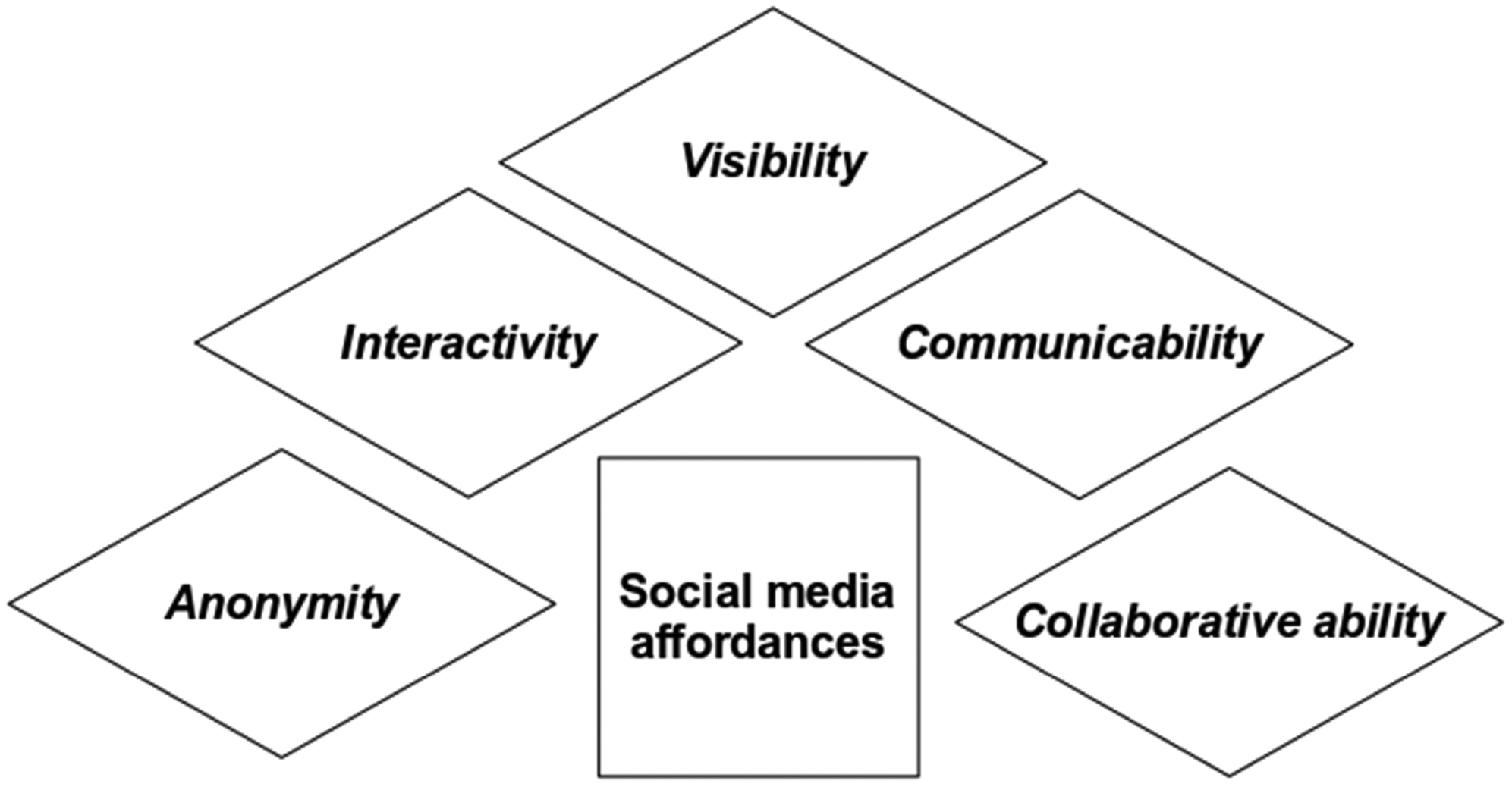
A taxonomy for social media affordances.
However, there is a lack of studies in relation to the impacts of social media affordances in administrative transparency. Visibility has been the most commonly explored affordance (Contri et al., 2023; Stamati et al., 2015). Visibility contributes to openness to the extent that it allows information sharing, but also visualizes citizen needs due to the potential of these platforms to reflect social information (Chen et al., 2016; Stamati et al., 2015; Waxa and Gwaka, 2021). Visibility may have dangerous effects for transparency as it could contribute to the spreading of misinformation (Aïmeur et al., 2023), as well as to information overload (Yavetz et al., 2023). Interactivity might provide spaces for public administrations and citizens to talk in and become more transparent through such conversations (Meijer et al., 2012; Silva et al., 2019; Waxa and Gwaka, 2021), generating new ideas and promoting a more direct democracy, while collaborative ability does something similar around knowledge exchange practices (e.g., crowdsourcing).
Communicability and anonymity are less clear. Communicability may impact on the ways governments connect with citizens (Stamati et al., 2015), through specific tones or even with content such as videos and pictures. On the other side, anonymity might be a useful way to encourage citizen interaction with public administrations; however, it could negatively interact with other affordances and generate a feeling of impunity (Chen et al., 2016; Stamati et al., 2015). Anonymity challenges could worsen if we consider the lack of control public administrations have over social media as third-party applications (Feeney and Porumbescu, 2021).
Implications for social media use and institutionalization
Perceptions on social media properties could have different effects on the consideration of transparency. Although with a special focus on collaborative practices such as co-production, Lember (2018) has explored the effects derived from the role of social media on some of its pretended goals. In that sense, social media might produce indirect effects when just used to improve information flows and complements the information available in web portals. It might have transformative effects when the focus is on enhancing transparency through continuous interactions on these socially complex environments. Finally, it could also entail substitutive effects, if public administrations partially automatize processes around the way citizens effectively monitor organizational activity.
As such, we could have different ways of handling social media-mediated transparency, depending on differences between social media affordances. This is in line with the fact that social media has been following different paths of adoption and institutionalization (Criado and Villodre, 2022; Mabillard et al., 2024; Mergel and Bretschneider, 2013), from centralized models (reliant on a top-down decision approach in which a central department – usually communication – controls interactions through structured policies, limiting experimentation around social media properties), to distributed models (that follow a peer-to-peer approach featuring collaborations through special decentralized coordination groups, where higher degrees of experimentation are allowed around guiding principles, encouraging “learn by doing” practices) (Villodre et al., 2021). It also links with the different considerations that public administrations have regarding citizen roles in social media, as co-producer partners, critical thinkers, or just mere clients (Wukich, 2021).
Methods
The main aim of this research is to understand social media-mediated transparency. The article resorts to an exploratory qualitative research design, around the experiences with social media of three Spanish city councils: El Prat de Llobregat (Catalonia), San Sebastián de los Reyes (Madrid), and Zaragoza (Aragón). To dig into these experiences, the article relies on semi-structured interviews with community managers from these city councils.
Case selection
This study focuses on a particular type of public organization: local governments, and more precisely, city councils in Spain. Social media has been widely used in municipalities, perhaps more than in any other level of government (Contri et al., 2023). This is supported by at least two reasons. On the one hand, city councils are very close to citizens and have received more pressure to improve transparency. On the other hand, city councils have faced more challenges related to the integration of citizens in the processes of participation and service delivery (Criado and Villodre, 2021). The article delves into the Spanish case, which is a highly digitized country, as evidenced by the Digital Economy and Society Index or the Digital Government Index.
This article has worked around the experiences with social media of three Spanish city councils: El Prat de Llobregat (Catalonia, 65,030 inhabitants during 2022), San Sebastián de los Reyes (Madrid, 91,083 inhabitants during 2022), and Zaragoza (Aragón, 673,010 inhabitants during 2022). Case selection followed two steps. The first step consisted of shortlisting city councils based on the results of an original questionnaire that focused on social media adoption (Criado and Villodre, 2022). The questionnaire was conducted between November 2018 and April 2019, targeting public employees in charge of social media strategies in Spanish municipalities with more than 50,000 inhabitants. The selection took into consideration if the city council had social media policy guides, if they had formal commitments with transparency, or if they had mechanisms for evaluating social media results, among other variables. This first step resulted in the selection of eight city councils, which can be considered as best practices for social media use.
A second step consisted of filtering based on the municipal use of Twitter/X, one of the most utilized social media platforms in Spanish city councils. The download was carried out during April 2019, based on the tweets posted by the main municipal accounts. The data were analyzed with an open-source tool (t-hoarder) according to an internal algorithm developed by Congosto (2018), which categorizes user behaviors depending on how they use Twitter/X. The selected cases were representative of three main behaviors. Zaragoza (@zaragoza_es) was a “speaker” (behavior oriented towards pushing content that is widely shared), while San Sebastián de los Reyes (@sansecomunica) was a “retweeter” (behavior oriented towards sharing other users’ content), and El Prat de Llobregat (@ajelprat) a “networker” (balanced behavior between pushing information, interacting, and sharing content).
Data collection and analysis
For gathering the perceptions on social media-mediated transparency, this study developed a total of 13 semi-structured interviews. The interview questions focused on collecting the perspectives and experiences of several public employees in the three selected municipalities. The interviews were built upon the relationship between social media and administrative transparency, with a total of 14 questions related to how civil servants consider the potential of social media to influence city councils’ transparency. The interview protocol can be provided upon request.
The interviews targeted public employees in charge of social media profiles. The interviewees were selected following the chain sample technique (snowball sampling) (Guest et al., 2006): the first interviewees recommended to interview other people in the organization who might be relevant for the study. The relevance of the recommended interviewees was considered, combining managerial and technical profiles whose work was linked to the social media strategy. Thirteen interviews were enough to reach saturation point. The interviews were carried out during April and May 2019, and were conducted in person, recorded, and later transcribed verbatim. Table 1 gives an overview of the interviews.
Relation of interviews.
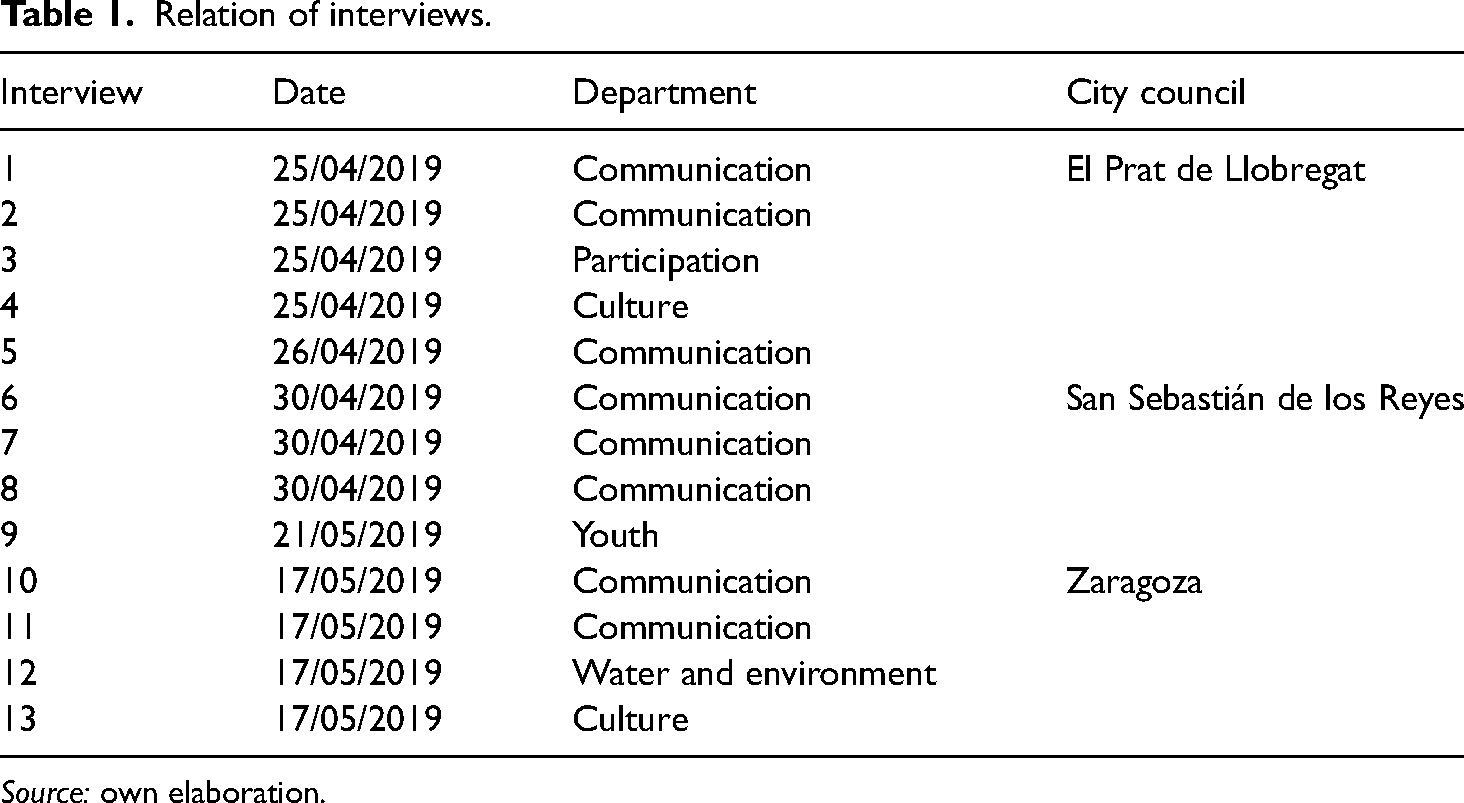
Source: own elaboration.
The conversation during the interviews revolved around the five social media affordances described during the literature review. The study follows the conceptualization and operationalization of Stamati et al. (2015). Visibility is considered twofold: as the ability of a public organization to make its information appear to the citizens (network position); and as the ability of public organizations to receive information on citizens’ behavior and needs (social information). Communicability is the ability to provide both public administrations and citizens with a common syntax to speak and interact, using a set tone and way of expressing. Interactivity is the ability to establish bidirectional conversations, which draws on the considerations that the city councils have on citizens’ roles (Wukich, 2021), and also on the main benefits of having these conversations for transparency. Collaborative ability refers to the role of the public administration on knowledge sharing processes. Finally, anonymity points to the benefits and risks of dealing with unidentified citizens and its behaviors. These categories have guided the coding strategy and subsequent analysis.
Results: unveiling social media-mediated transparency
There seem to be at least three different ways of understanding social media-mediated transparency: the guarantor model (represented by the case of Zaragoza), the conversational model (represented by the case of San Sebastián de los Reyes) and the proactive model (represented by the case of El Prat de Llobregat). Although each case seems to be more closely linked to a concrete model, this does not mean that they cannot present characteristics from others at a given time. It is important to note that the selected cases might have affected our answers (Geddes, 2003). The models presented below should be treated as ideal types based on these specific three cases. Thus, researchers considering additional cases might point towards alternative models. Moreover, these models should not be considered from being better or worse: each one might serve specific purposes and needs depending on the organization. Table 2 summarizes each of the models, which are explained and developed in the subsections below.
Models of social media-mediated transparency.
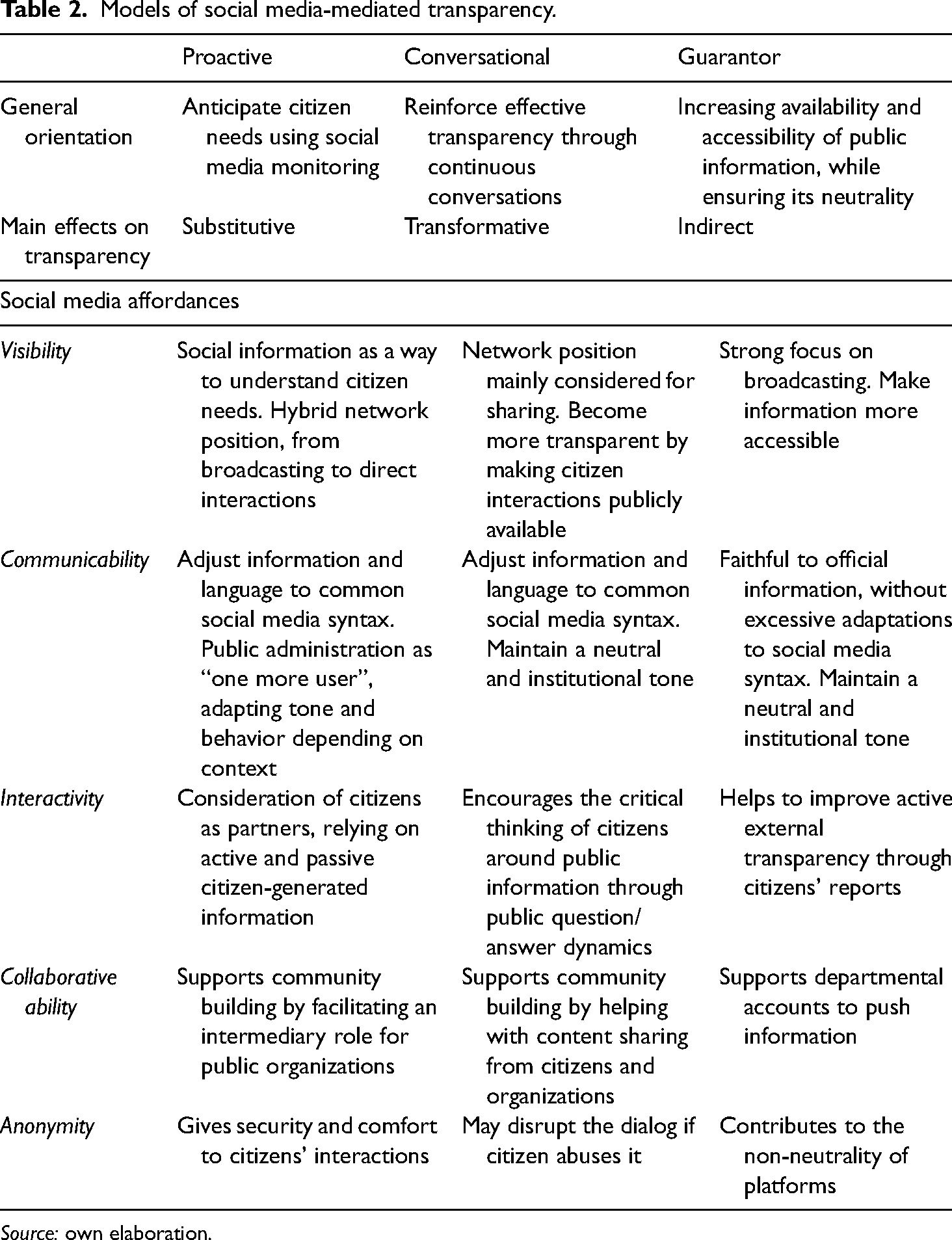
Source: own elaboration.
Guarantor model
The guarantor model sees social media as impacting transparency indirectly: these platforms might help complementing and improving information flows, accessibility, and availability of information. Social media makes information from municipal web portals, services, and institutional activities more accessible to citizens. This is seen as a way of enhancing transparency, because “the moment you disseminate things that happen in your institution, you are being transparent” (Interview 10). The guarantor model approaches visibility with a strong focus on broadcasting information. As seen with the case of Zaragoza, the information disseminated is usually fixed around a set of categories: from service information (updates on administrative procedures, subsidies, status of public services, etc.), to municipal agenda (cultural and social activities), and managerial agenda (“how the city council manages public resources, from the inauguration of new centers, new services, new programs . . .” (Interview 11)). The collaborative ability affordance is also here to serve broadcasting purposes, allowing main institutional accounts (which usually have more reach) to help departmental accounts (e.g., youth, social services, culture, etc.) gain visibility. This is made possible by resorting to the sharing mechanisms of social media platforms (e.g., retweets). But under the guarantor model, only content from departmental accounts is shared to avoid reliability and neutrality problems, as “users have a political bias that prevails” (Interview 11).
The reason for the guarantor model to limit content sharing and focus on broadcasting is rooted on protecting public information and public organizations from the non-neutral nature of digital platforms. The anonymity affordance is perceived as an important contributor for non-neutrality, as “with anonymity, lots of users… they just make a political use, a critical use, the trolls …” (Interview 11). Since public administrations have no control over social media and content moderation is limited, they must protect these communication channels as best they can. One way to do so is by profiting from the visibility affordance as a way of “becoming an official voice” (Interview 13), seen as a trusted source of information in a medium full of misinformation and algorithmically generated data. A second way is through the communicability affordance, disclosing information as similar as possible to the official information posted on the municipal web portals, without important adaptations to social media syntax. A neutral and institutional tone must always be maintained, as citizens “should not forget that we are a public administration, a public entity” (Interview 12).
Due to the non-neutral nature of these platforms, public administrations have to be very careful with the interactions they have with citizens. Of course, this does not mean they should not interact with them under some circumstances, as these interactions can still be valuable, especially for active external transparency. A clear example are citizen direct requests and demands, reporting what is not working well: “Citizens are being our eyes, they are sending us photographs, telling us ‘hey, this is wrong’” (Interview 11). With this, public organizations can resort to interactivity affordance to gain certain insights, process them, and make active information disclosure to the citizenship.
Conversational model
The conversational model sees social media as transforming how we understand transparency: as such, social media is not just a way of pushing information, but of maintaining conversations with citizens to enhance effective monitoring. The conversational model focuses on the potential of these bidirectional interactions, because “the fact that you can answer and people can ask you publicly, is a very clear symptom of transparency” (Interview 6). Thus, while the information the city council pushes might be similar category-wise to the guarantor model (service information, municipal and managerial agenda), the focus on citizen conversations forces public organizations to be more adaptative to what citizens publicly request, provided these requests are positive and/or do not require highly sensitive disclosure. This adaptation favors a logic of interdepartmental collaboration that improves internal flows of public information to generate more accurate and satisfactory responses.
As such, in the conversational model, the interactivity affordance is important and perceived as a way to generate effective monitoring, but also because it allows citizens to be critical about how public administrations work: “If we publish something not true, or they intuit is not entirely correct . . . they tell us publicly and we have a debate” (Interview 6). The visibility affordance also helps public administrations make these interactions available. This means that other citizens, even if they are not part of the conversations, can benefit from the publicly available results, which is strongly enhanced by a sharing strategy not just restricted to departmental accounts, but open to other organizations and to citizens. The visibility affordance makes not responding to citizen questions non-desirable (except when abuses occur), as non-responses are also visible to the public.
This process of building up critical thinking to enhance transparency occurs in many ways. The collaborative ability affordance is directed towards developing a community sense around the municipality. Within these communities, conversations not only occur with public organizations, but also between citizens that talk and reflect on city council activities, and even try to help each other: “Among the public they were answered. And that is also very transparent.” (Interview 6). The communicability affordance is seen as an opportunity to approach this community building, and information is adjusted to a plainer language, as it might reinforce understandability and generate more conversation. The city council tries to strike a balance between being closer to the citizens, while still maintaining an institutional tone: “I want to believe that we have a relationship with our neighbors that is not based on distance or authority, but this does not mean that we are just another user” (Interview 8).
The non-neutrality of social media platforms is also present in the conversational model, but seen as something to be lived with. Of course, sharing content from citizens as a way of enhancing transparency always means being very careful and establishing appropriate filters: “We are careful when sharing something that comes from an individual that we cannot verify” (Interview 7). As “it's much easier to make negative comments” (Interview 7), anonymity may sometimes disrupt the dialog. Citizens may use anonymity to break the conversation, and public administrations will need to rely on limited moderation tools to safeguard it. However, lack of resources (especially in terms of trained personnel) sometimes makes it very difficult to maintain this strategy.
Proactive model
The proactive model sees social media as a way to better understand citizen informational needs. With techniques such as social media monitoring, city councils might sometimes anticipate citizen requests by actively listening public conversations across different networks/communities. Then, city councils can offer better information as they “understand who the citizens are, what are they interested in, where they are” (Interview 2). With this, city councils can publish content in a smarter way: they can rely on predefined content categories as experienced in previous models (e.g., information on procedures, social events, status on service delivery, etc.), but they can also publish adaptable contents according to anticipated needs. Information is usually framed positively, although sometimes negative and reputation-sensitive information can also be disclosed if necessary: “Yes, we post positive things, but, well, sometimes we also have to report negative things” (Interview 2).
As such, visibility affordance is not just focused on enhancing the network position of the public organization (e.g., by broadcasting or sharing information), but it is also directed towards detecting citizens activities. This social information may indicate to city councils how to act even before citizens actually make a direct request. To better interpret and interact with citizens, city councils pursue deep internal changes, usually going from departmental to thematic organization: “We have changed how we work. We are dissolving the department concept, and we are working thematically” (Interview 2). This new organization usually relies on the creation of a specialized social media coordination team with representatives from the different themes. These groups also encourage experimentation with contents and social media properties, which might be important for developing more hybrid communication strategies.
For the proactive model, anonymity should not be seen as a problem. On the contrary, it gives citizens the basis for establishing conversations in a comfortable environment. This also contributes to transparency as, unlike municipal web portals, public administrations have no control on the conversations: “It couldn't be more transparent. Because it's a channel that you don't control, you can't control it” (Interview 1). This is ideal, as it guarantees citizens’ conversations will not be constrained, as the reliance on citizen-generated data is intense. The interactivity affordance is seen as a way of establishing conversations with citizens, both in their own circles and within municipal communities. This has also important repercussions on internal transparency, as organizational units are not silos any more, and informational flows between units are highly encouraged to appropriately address citizen-generated data.
The purpose of social media monitoring is to detect citizen profiles and send personalized responses according to citizen roles and behaviors. As such, public administrations adjust information and language to the common syntax of social media platforms, even changing the tone and behavior depending on context, although this adaptability is not without complications: “Depending on the answer we are given, we adapt it to the medium. Sometimes it is difficult, because the answers can be quite long, and we have to reduce them, or make a thread, etc.” (Interview 5). This allows city councils not only to enhance understandability and clarity of information, but also to create more trustworthy relations, presenting themselves as “one more person” (Interview 4) in the community. This also has important connections with the way the collaborative ability affordance is perceived, as the conversations established with the community are more natural, and the organization can even deploy a more intermediary role based on its social media monitoring results. This intermediary role is not only extended to citizens, but also to other public organizations: when a citizen need is detected, the city council may try to publicly pursue the collaboration of other public organizations to disclose certain information, serving as a bridge.
Discussion
Social media-mediated transparency differs from computer-mediated transparency in several ways. Although the idea of looking “clearly through the windows of an institution through the use of computerized systems” (Meijer, 2009: 259) is still present, the nature of the medium is different. The way social media influences perceptions of information and possibilities for effective monitorization diverge, as the affordances are not the same (Kim and Ellison, 2022; Ronzhyn et al., 2023; Senyo et al., 2021). Visibility may offer increased accessibility and availability of public information, but it can also allow public administrations to anticipate citizen behaviors and informational needs (Bekkers et al., 2013; Waxa and Gwaka, 2021). Interactivity and collaborative ability are not entirely present in computer-mediated transparency, but are essential elements for social media: they boost critical thinking through continuous conversations and debates (Wukich, 2021), they allow citizen reports (Wukich, 2022), force other organizations to disclose information, and might even punish non-responses to requests by making them visible to everybody. Anonymity reflects a lack of control of public administrations on social media (Feeney and Porumbescu, 2021), in contrast with its strict management over institutional web pages. Additionally, communicability might make information more understandable to citizens (Stamati et al., 2015), unlike the lack of clarity present in some electronically disclosed administrative documents.
However, social media-mediated transparency is not without some concerns. Broadly speaking, social media-mediated transparency seems to still refer to passive forms of engagement (Contri et al., 2023). While transparency usually means allowing effective citizen monitoring on public organizations’ performance and activities (Cucciniello et al., 2017), it can be deduced from the interviews that there is still a tendency towards considering social media-mediated transparency as a mere exchange of information (Criado and Villodre, 2021; Mergel, 2013). Moreover, and although proactive and conversational models show some inclination towards adaptability and hybridization of contents and communication strategies (Contri et al., 2023), the information public organizations disclose on social media is usually framed in a positive way, with service information probably the most neutral, and the managerial agenda the most prone to self-promotion practices (DePaula et al., 2018). Finally, the proactive model may suffer from the typical challenges of social media monitoring, and particularly, from a potential derivation towards surveillance (Bekkers et al., 2013). Thus, it will be important to assess how public administrations are also being transparent on how they work with citizen-generated data.
Having different perspectives around social media-mediated transparency connects with the idea that there is no one best way of adopting and institutionalizing social media (Mabillard et al., 2024; Villodre et al., 2021). Centralized models of social media institutionalization seem to have strong relations with the guarantor model, as it usually favors the presence of strong central departments for social media coordination that are able to easily enforce and supervise content policies in a unified and cohesive way (Villodre et al., 2021). Additionally, the guarantor model might limit organizational experimentation as a response to platform challenges (Mergel and Bretschneider, 2013). On the other hand, distributed models of social media institutionalization seem to connect better with both proactive and conversational models, as they usually favor an interdepartmental collaborative logic (e.g., specialized social media coordination teams) to better handle citizen requests. These teams often promote informal learning (Villodre et al., 2021) as a way to adapt to the ever-changing reality of technology. Future studies should dig deeper into this relationship to understand all potential effects: from how certain institutional designs might favor different models of social media institutionalization, to how attaching to certain models of social media-mediated transparency might drive institutionalization into different directions.
Moreover, each of the proposed models seem to have a concrete vision on the role of citizens and digital government–citizen interactions. The guarantor model connects well with a more customer-based perspective (Wukich, 2021), as it looks at citizens as clients to satisfy: social media makes information available (Bonsón et al., 2015; Mergel, 2013), and can also serve to make requests and limited transactions (Criado and Villodre, 2021). The conversational model seems to treat citizens as critical thinkers, and makes strong efforts to connect “vision” and “voice” (Meijer et al., 2012). Meanwhile, the proactive model looks at citizens as partners (Wukich, 2021), being a co-production of information useful to involve citizens in the openness process (Stamati et al., 2015), gathering conscious and unconscious generated information. Each of these roles might involve different community building processes (Maziashvili et al., 2023) and will require differential comprehensions of citizen behaviors (Yavetz et al., 2023). Future research should detail how social media-mediated transparency connects with each of these roles.
Derived from these results, it is possible to infer some practical recommendations for practitioners. First, city councils should start thinking about social media-mediated transparency as something more than just a channel to push information, but as an opportunity to improve effective monitoring through continuous conversations. Second, and understanding that hybrid communication strategies are important for dealing with the complexities and uncertainties of digital government–citizen interactions, city councils should not stick with one model but instead change their strategy depending on each context, bearing in mind what is best for being accountable with citizens. Finally, city councils should try to understand their communities and audiences in order to better anticipate citizen needs.
The consideration of social media-mediated transparency will ultimately depend on how public organizations understand the whole communication strategy. As such, social media strategies around transparency should not be seen as an isolated practice. It will require a more holistic vision on how social media is connected with the general communication toolkit.
Conclusions
There seem to be at least three different ways of understanding social media-mediated transparency. First, the guarantor model sees social media as affecting transparency indirectly: social media complements and improves information flow and the accessibility and availability of information, trying to ensure its neutrality. Second, the conversational model sees social media through a transformative lens, enhancing effective transparency through continuous conversations with citizens. Finally, the proactive model focuses on anticipating citizen informational needs, using social media monitoring to gather insights and adapt communications accordingly. As shown during the discussion, the models have different theoretical and practical implications on how we should understand social media use in the public sector: from the role of citizens in digital government–citizen interactions, to the ways in which social media institutionalization occurs.
The article is not without limitations. This study is based on a concrete administrative context (Spain). Also, it has focused on a particular layer: the local level of government. The article has only relied on three cases (selected as being best practices), which might weaken the generalization of the study. Moreover, the three models of social media-mediated transparency are ideal types just based on these three cases. This means that alternative models could be considered based on additional cases. Future researchers could apply affordances theory under other contexts and within other cases to validate current models, or even to discover new ones. Finally, the article centers around five common social media affordances. But there are others present in different theoretical frameworks (such as editability, or persistence), that should be researched, as they could influence the consideration of social media-mediated transparency.
Social media promised to promote the transparency of public organizations. However, it is not completely clear how it is doing this, if that is the case. The study of social media-mediated transparency from an affordances perspective helps reveal the effects of these digital platforms on administrative transparency. Future research should keep on conceptualizing social media-mediated transparency, also bearing in mind the advances in AI-driven technologies, and how they could alter our current understanding of the mediums through which effective citizen monitoring of public performance occurs.
Footnotes
Acknowledgements
The author would like to thank the two anonymous reviewers for all their useful comments, as well as the interviewees from the selected city councils for participating in the study.
Declaration of conflicting interests
The author(s) declared no potential conflicts of interest with respect to the research, authorship, and/or publication of this article.
Funding
The author(s) disclosed receipt of the following financial support for the research, authorship, and/or publication of this article: This study was supported by Research Grant PID2022-136283OB-I00 (Opening the Black-Box of Algorithm-mediated Public Governance. Artificial Intelligence Implications in Governments, Public Services, and People (#AIPublicGov)), Spanish Ministry of Science, AEI/10.13039/50110001103 and ESF+.
