



Abstract
This study uses semi-structured interviews to investigate 26 police officers’ insights on identifying and overcoming contemporary policing challenges in the UK. The findings reveal that the primary challenges include (a) public trust in the police, (b) police officers’ recruitment and retention, (c) resourcing and funding, (d) a lack of adequate training, (e) the undefined police role and (f) the prevention of complex crimes, mainly fraud and cybercrime. The study highlighted the reasons for these challenges and how they can be addressed, as seen through police officers’ eyes. The findings have implications for policing research, governance, leadership and legitimacy, which are later discussed.
Points for practitioners
Public management and administration practitioners must prioritise public trust, recruitment, training, resource allocation and addressing complex crime. Collaboration with police officers and their perspectives are vital in decision-making, policy development and police legitimacy. Strengthening accountability, integrity and officer training rebuilds public trust. Learning from attractive employers, broadening police roles to include intellectual abilities and improving pay and community trust address recruitment challenges.
Introduction
This study explores the challenges confronting UK policing in the twenty-first century from the unique perspective of police officers. Unlike previous studies that primarily relied on author-driven suggestions and focused on isolated contemporary issues, this research explores broader challenges and delves into the root causes of these challenges while amplifying the voices and concerns of police officers. By adopting an officer-centred approach, this study aims to provide a broader overview of the complex landscape that UK policing navigates in the twenty-first century. Furthermore, it goes beyond mere analysis by proposing potential solutions to address these challenges, as seen through police officers’ eyes.
Police officers’ perspectives are valuable for problem-solving and decision-making, as they possess firsthand knowledge and expertise. Ignoring their views can lead to frustration, demoralisation, and decreased job satisfaction, impacting performance (Neyroud et al., 2016). Their practical knowledge of communities and challenges allows for improvement, innovation, and effective law enforcement strategies. Policymakers and administrators must consider their views to develop policies aligned with job realities, enhancing public safety and effectiveness.
Twenty-six experienced UK police officers were interviewed, uncovering six primary challenges: public trust, recruitment and retention, resourcing and funding, inadequate training, undefined role, and preventing complex crimes like fraud and cybercrime. The study explores the reasons behind these challenges and proposes solutions from the officers’ perspective. The findings have implications for policing research, policy, and practice, which will be discussed further.
This study's primary contribution and significance for police officers is that it gives voice to police officers’ observations and offers a comprehensive overview of contemporary policing issues, their causes, and potential solutions. It guides police leaders and policymakers in improving practices and public perception. Additionally, it is the first to contribute with practice-based evidence on this issue, expanding the literature on policing and paving the way for future research.
Literature review
In pursuit of our study's objective, we focused on the contemporary issues and challenges in UK policing. Our review examined peer-reviewed academic articles published within the past five years that explicitly and directly addressed UK policing issues and challenges. To ensure the relevance and specificity of the sources, we scrutinised the article titles, abstracts, and content for their distinct focus on the subject matter at hand.
We found a significant gap in the literature – the absence of police officer perspectives. Existing studies on UK policing tend to overlook the invaluable insights of police officers, instead prioritising predetermined challenges and solutions derived from discussions, literature reviews, or secondary data analysis. This oversight hampers our understanding of the nuanced realities police officers face and their unique insights into the challenges and potential solutions within the field of policing. Addressing this gap is vital to gaining a more comprehensive and accurate understanding of the complexities surrounding UK policing, which has been the primary focus of our study.
Previous studies focused on isolated contemporary issues within UK policing, lacking a comprehensive overview of broader challenges. These issues include preventing complex crimes, public confidence, austerity, upskilling officers, increasing demands, and preserving police independence. While shedding light on specific aspects, a holistic understanding of the interconnected challenges is lacking.
Some studies criticise the police's effectiveness in combating fraud and cybercrime. Burruss et al. (2020) found that over half of the constabulary feels unprepared to handle cybercrime cases. Challenges include the lack of skills, resources, and information sharing, the complexity of reporting, the cross-border nature, and police reluctance to investigate fraud (Aplin, 2022; Bossler et al., 2019; Button, 2021; Loveday and Jung, 2021; Skidmore et al., 2020a, 2020b). Curtis and Oxburgh (2022) highlight under-reporting owing to perceived police lack of understanding and preparedness.
Public confidence and trust in the police have been eroded, influenced by incidents like the murder of Sarah Everard (Lowerson, 2022) and worsened during the pandemic owing to poorly drafted laws and ambiguous guidance, as reported by some (Charman et al., 2023; De Camargo, 2023; Johnson and Hohl, 2023). Determinants of public trust include procedural fairness, personal experiences, and the impact of social media (Bradford et al., 2022; Morrell et al., 2020; Ralph, 2022). Austerity measures have negatively affected policing performance and public confidence (Caveney et al., 2020; Greig-Midlane, 2019; Mann et al., 2020; O'Reilly, 2023; Topping, 2022).
Regarding the need for upskilling police officers, Cockcroft et al. (2021) found challenges in developing officers’ cyber skills, including differences in training effectiveness. Laufs and Borrion (2022) identified obstacles to technological innovation, such as cost, support, partnerships, and public acceptability. Wilson-Kovacs (2020) stressed the need for officers to understand digital forensics and have clear examination strategies for digital devices. Others highlight emerging policing issues, including political intervention (Roach, 2021; Shannon, 2021), non-crime demands on officers, particularly in mental health incidents (Lane, 2019), and the conceptualisation of policing and its alignment with citizen needs (Williams and Paterson, 2020).
In summary, this section showed critical literature gaps that the current study attempted to address. Unlike previous studies that focused on isolated contemporary issues, this study addresses literature gaps by examining broader challenges in UK policing from the perspective of police officers. It amplifies their voices, explores root causes, and suggests potential solutions.
Research method
This study examines the perspectives of experienced UK police officers on twenty-first-century policing challenges, their causes, and solutions. Semi-structured interviews were conducted with 26 officers with at least seven years of experience. Participants were recruited through snowball sampling, including personal contacts, LinkedIn, and the College of Policing website. Participant demographics are summarised in Table 1.
Participants demographics.
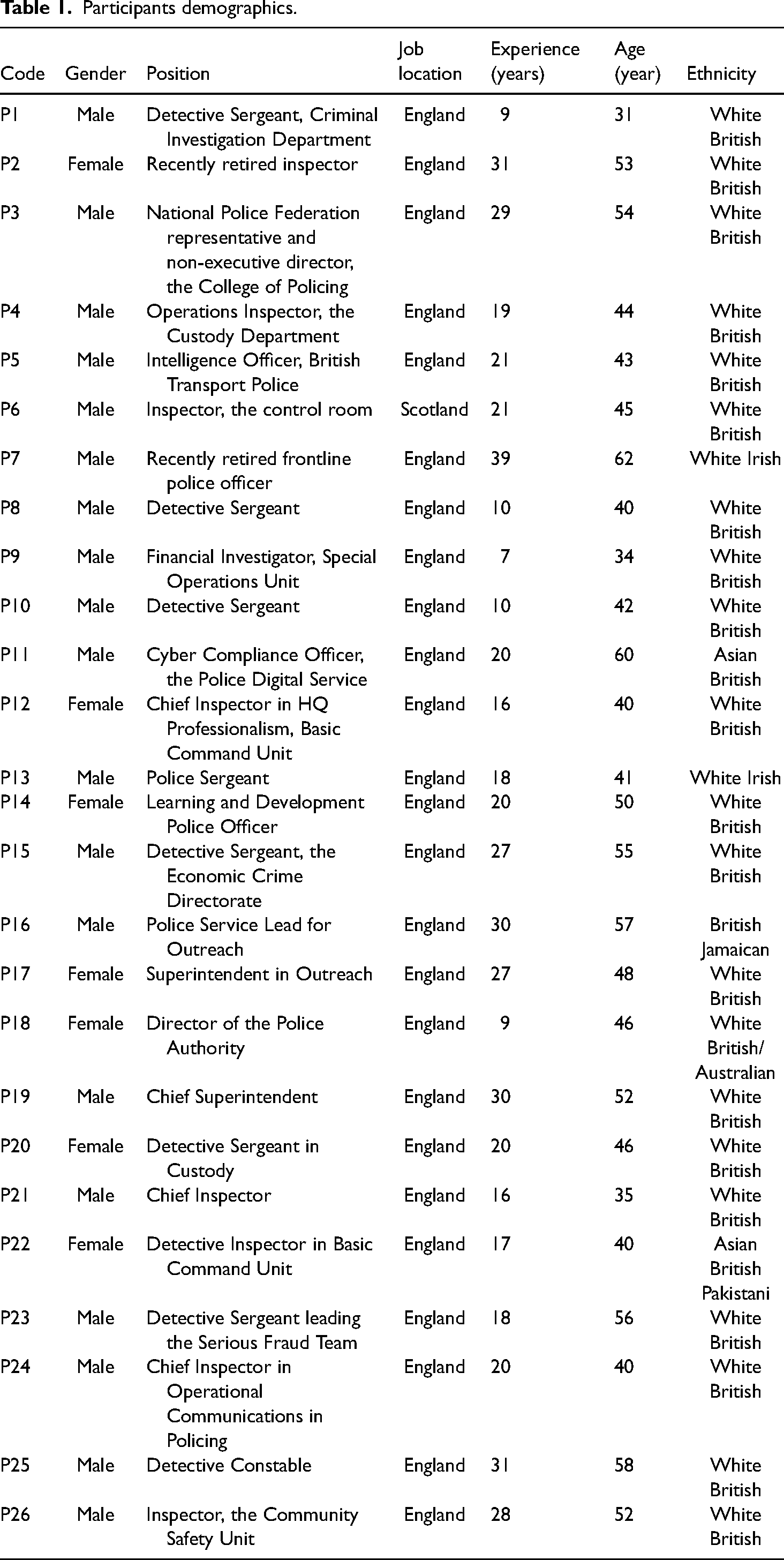
The study followed saturation sampling, with 26 interviews conducted until no new information emerged. Saturation is consistent with qualitative research guidelines (Malsch and Salterio, 2016). Participants received information sheets and consent forms, and their anonymity and confidentiality were ensured. The project received ethical approval from the university's ethics committee.
The interviews were conducted online via Microsoft Teams, recorded with permission, and transcribed by a trusted transcription company. Each lasted 45 minutes on average. The participants were first asked demographic questions for data analysis. Then, they were asked to share their views on the key challenges facing UK policing in the twenty-first century, their reasons, their consequences, and how they can be addressed.
To ensure internal validity, several measures were implemented: (i) a semi-structured interview script with open-ended questions promoted consistency while allowing for the exploration of new themes; (ii) a pilot study involving senior academics and experienced police officers refined the interview guide; (iii) interviews were conducted by an experienced qualitative researcher, following the interview guide and maintaining a neutral stance to minimise bias; (iv) preliminary findings were shared with participants for accuracy; (v) discussions with qualitative researchers provided alternative perspectives to reduce bias and enhance credibility; and (vi) the coding process was conducted by an experienced researcher, with an independent expert reviewing for consistency (Cohen's κ = 0.83).
The data were analysed using thematic analysis, which involves identifying, analysing, and reporting patterns or themes within data (Saldana, 2016). Two approaches to thematic analysis were considered: inductive and deductive. The inductive approach used in this study involves deriving meaning and creating themes from data without preconceptions, allowing themes to emerge from the data (Tracy, 2019).
Thematic analysis followed Braun and Clarke's (2006) six-step approach: (i) familiarisation with the data; (ii) generating initial codes; (iii) searching for themes; (iv) reviewing themes; (v) defining and naming themes; and (vi) producing the report. Initial codes were generated to label and summarise concepts in the interview data relevant to the research aim and questions (Tracy, 2019). Themes and codes were identified in the data, resulting in six key themes: (i) public trust and confidence; (ii) recruitment and retention; (iii) resourcing and funding; (iv) inadequate training; (v) undefined police role; and (vi) prevention of complex crimes (fraud and cybercrime). The analysis presents participant quotes to illustrate points and indicate the frequency of agreement on specific issues denoted by ‘n’.
Results
Theme 1: Public confidence and trust
Public trust and confidence in the police emerged as a significant concern (n = 11). Participants noted that the root causes pertain to (i) recent police misconduct, particularly violence against women and racial discrimination, (ii) negative police publicity, (iii) inadequate police skills, and (iv) insufficient funding for policing: The public’s trust and lack of confidence in reporting crimes to the police are the biggest challenges. Do women still trust police officers in plain clothes? Think of Black Lives Matter, the demonstrations from Sarah Everard. Every day, there's another bad news story. (P2) There is a lack of funding and a reduction in numbers. Unfortunately, when the government says that we’ve got an excess of officers coming in, those officers have to be trained and supported. And that’s just not happening. So, the public is meeting ill-prepared, ill-trained, and unsupported officers, and that's the view that they get. (P25) A different leadership style would improve public confidence. We need a leader who changes organisational culture and emphasises severe tolerance for unethical behaviour. It is also important to have a culture of real openness to say, I think there might be something wrong, and we will address that, and this is how we will address it. (P12) I think part of the issue is power tripping where individual officers go; I think I’m the police, so I’ve got powers, and I will use them. So, we need to curb that perception of officers and bring them back in line with responsibility, not power. This can be done through continuous education, monitoring, and transparency. So, when we find a bad apple, we will highlight the one we’re rooting out and let you know. And that will, I think, make us more appealing to the public. (P13) I think for years, we’ve tried to pretend it's one or two bad apples when police crimes come to light, and I think that's a really bad attitude of the police because it just means that we can say, well, most of us are great, and these are just really odd people. And it doesn’t look at the fact that we actually have a culture that encourages these people to behave in this way. (P12) Everything has been about numbers for many years, and nothing is focused on the quality of what's being delivered. We said we were coming away from a performance and target-driven culture based on numbers, and we’re now back to it. It’s easy for bosses to measure that, and I think we need to find ways to work out what service we deliver without relying on numbers. (P26)
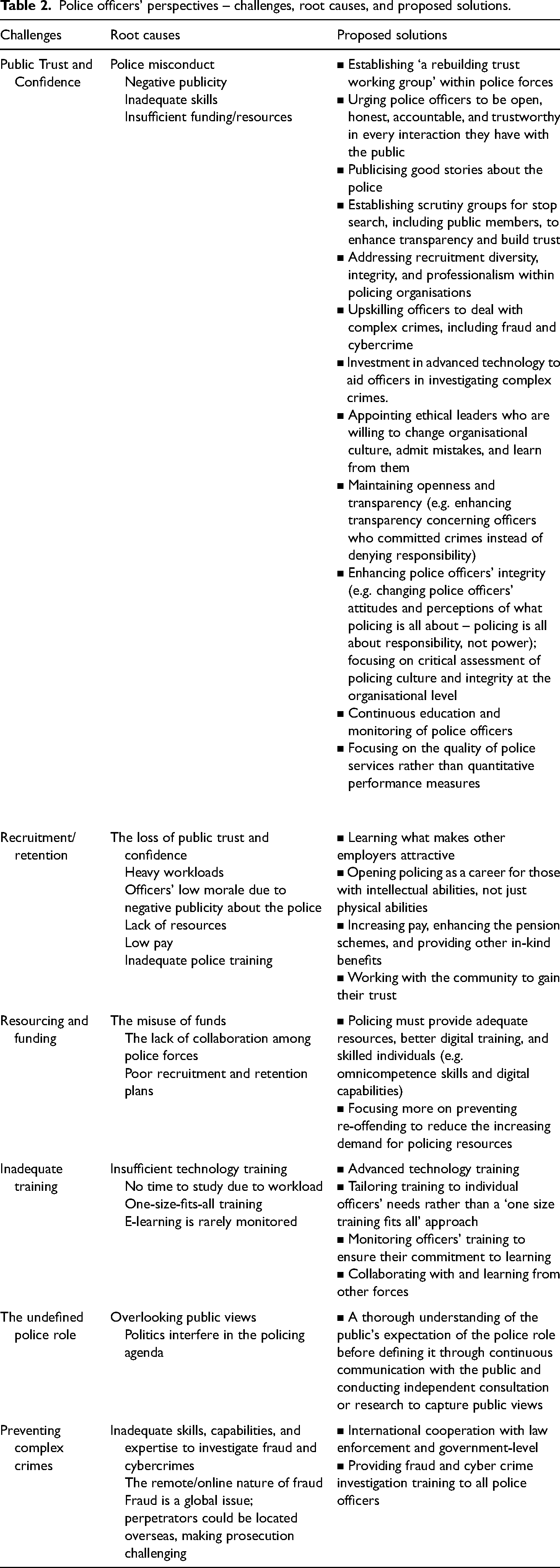
Police officers’ perspectives – challenges, root causes, and proposed solutions.
Theme 2: Recruitment and retention
Recruitment and retention of police officers, especially from diverse backgrounds, emerged as another significant challenge according to the study participants (n = 10): One of our key challenges at the minute is recruitment. We’re struggling to recruit, trying to increase recruitment from diverse backgrounds, but it is really challenging at the moment. (P13) Recruitment and retention are massive issues due to job demands such as working shifts and nights, low morale, lack of sufficient pay, and the increasing cost of living. Our pay hasn’t gone up, and in fact, it's gone down. And in that, who's going to want to stay? So, I think retaining officers will be a big challenge. (P14) We’re seeing more officers now doing ten to fifteen years, getting all the experience, qualifications, and accreditation they need, and then going off into the private sector, earning twice the amount of money and working less time. (P5) The police salaries are not financially viable. The cost of living is going up. And the pay freeze on police over the last five years just isn’t acceptable. History shows that when the cost of living goes up and police pay doesn’t, corruption in police rises. And then you’re going back down the route of insider threat. (P5) One of the biggest challenges is recruitment. People don’t trust or have confidence in the police, so people aren’t joining. Every police force that I know has had a recruitment crisis. And we won’t have officers on the streets due to the recruitment crisis. (P2) What they’re doing is increasing the number of officers that they recruit. But, without adequate vetting, they are not bringing officers suitable to do the role, which will impact operational effectiveness and is unfair to the people recruited and the public. (P14) People need to see a route in and out of the police, I think. People say, oh, you can join the fast track, but you still join at the lowest level of £22 000, which is unattractive for qualified recruits. So, you need people with intellectual abilities and those who are physically fit and pass certain standards. (P23)
Theme 3: Resourcing and funding
Some participants (n = 9) flagged understaffing, lack of expertise and skills, and funding issues in police forces as a policing challenge. They elucidated that the resource shortage creates difficulties in prioritising tasks, particularly with the growing workload, leading to increased staff sick leaves due to work burnout. Additionally, it led to a reduction in neighbourhood policing, potentially affecting public trust in the police: I think that lack of resources is a real challenge. There’s so much asked of the police these days that we don’t have the facility or the ability to manage the workload, which causes high levels of sickness and staff absence due to being unable to manage the workload. (P21) Reduction in neighbourhood policing has been a real problem; not having the police stand up to people who are being scary and intimidating will create some more distrust. (P10) There are always going to be funding concerns. Money is being spent, not spent wrongly, but not wisely. So, it could be that you’ve got individual forces, all doing things. But if you were to collaborate and do it as a smart customer, then you could potentially save money, and then that money could be used for other matters. If you’ve got better retention and recruitment, you won’t need to spend so much on overtime. (P24) More money should be given to police forces. While paying that out will cost money to the public purse, you will get a better-motivated force. And the more motivated you are, the more proactive you’ll be. The better service you’ll do. (P24) Learning and development and professional standards, for me, are everything. There is no point in focusing on crime statistics if you don’t have officers with the required skills and knowledge. Good investigations and good crime figures will follow from focusing on learning and development and professional standards. So, I will say we’ve got our priorities wrong. (P12)
Theme 4: Inadequate police training
The lack of sufficient technological training poses a challenge for UK policing, said some participants (n = 7). Additionally, there is a need for comprehensive training and development to equip recruits with the necessary skills to fulfil their duties effectively: I don't think the police are twenty-first-century-equipped. We are an antiquated organisation trying to manage in the twenty-first century. We are nowhere near where we need to be investigating anything technology-enabled; the police are just miles behind. So, I think that's one area they really need to focus on. They may have the tool sets, but do they know how to do it? So, digital capabilities will be critical in realising how they utilise the digital policing aspects. (P11; P21) I think omnicompetence in policing is really important; it's vital because that's the fundamental role of policing. So, an omnicompetent
1
police officer then builds on skills and abilities to specialise in certain areas. (P3) One-size training does not fit all. However, we need to come together organisationally and have that disciplined service, so we do need it sometimes. But we do need to be able to tailor our training to individuals. There's no point in delivering training if the receiver doesn’t receive it in a way that they can process it. (P3) The main issue with e-learning is that nobody checks whether you’re taking it in. So, you could just sit there and click through, which is what a lot of people do. It's a struggle to get people to do e-learning in the first place. Your day job just becomes all-consuming. I do not think we are looking after officers and giving them the time and space to develop due to the increasing workload. Resolving this comes down to that culture of learning and line managers saying, right, you've got an hour out of your day. You just sit there, do that e-learning, and you take it in, and maybe we have a team conversation about what we learned. (P12) At this moment, we have so many inexperienced recruits coming in, and they have to learn; we have to give them time to learn. We don’t give the people the right skills to do the role, and we don’t talk to other forces. We lack collaboration between police forces and seeing how other forces tackle different areas. If we collaborated more, we'd learn how to improve things. (P20)
Theme 5: The undefined police role
Some participants (n = 6) pinpointed the undefined police role as a significant obstacle, especially when meeting public expectations. They emphasised the detrimental effect of political influences on the policing agenda, arguing that it weakens the police's sense of identity: I think what the public wants from policing is a real challenge. We know what policing wants from the public, but should we not ask what the public wants from us? And I think politics is having more of an input into policing, which I don’t think is a good thing. The public should have an input, not necessarily politics. I think policing is struggling with its identity, what it should be, what it should be prioritising, and where it is placed. (P3; P7)
Participants stressed ongoing communication with the public as key to understanding their needs and satisfaction with policing. They suggested both regular feedback loops on service quality and independent consultations or research to gather comprehensive public views: We must address the things that matter to those people and ensure we do the right things for society. To achieve this, we need to be on top of the dialogue with societies and communities at all levels. I think an independent consultation engagement is needed to identify what the public wants. (P19; P23)
Theme 6: The prevention of complex crime
More complex crimes like fraud and cybercrime emerged as a concern for some participants. Four specifically highlighted limited capabilities for cyber and fraud investigations, emphasising the challenges of a global, tech-driven criminal landscape and the need to equip all officers with relevant training: Fraud is the biggest type of crime; the police don’t really have any capability to deal with it. Cybercrime, again, has limited capability to deal with it. So, I think that’s the challenge in terms of skills and the way policing’s organised. We don’t have a police structure that can investigate these internet-based crimes and cross-border crimes. (P8) So, if we take fraud, for example, quite a lot is perpetrated abroad, requiring different tactics to disrupt. So, I think greater international collaboration with law enforcement and at a government level is required. (P18)
Discussion, implications, and conclusion
This study explores broader challenges in UK policing, investigates their root causes, and proposes solutions based on police officers’ perspectives. The findings identify six primary policing challenges, which are discussed below.
Public trust
We found that eroded public trust was a key challenge. Previous studies (Bradford et al., 2022; Morrell et al., 2020; Ralph, 2022) and the House of Lords (House of Lords Library, 2023) share this view, emphasising the importance of public trust for policing legitimacy. The study reveals that the loss of public trust in UK policing can be attributed to factors such as police misconduct, negative media portrayal, inadequate skills and training, and insufficient funding. These results align with academic studies highlighting the impact of media on public trust in the police (Javid and Morrell, 2019; Ralph, 2022) as well as the relationship between trust and police integrity, ethical compliance, and competence (Albrecht, 2019; Goldsmith, 2005). Additionally, the findings support Tyagi et al.'s (2023) conclusion that addressing the training needs of police officers can enhance public trust in the police.
The study's police officers suggested various solutions to address the public trust challenge, summarised in Table 2. However, among them is strengthening accountability and integrity in policing, which aligns with a recent poll where 81% of the UK public believed that the police should be held more accountable for misconduct (Kimaram et al., 2023), emphasising this suggestion's significance.
Recruitment and retention of police office
The study's police officers noted that recruiting and retaining police officers is another challenge emerging owing to loss of public trust, demanding workload, low pay, and limited resources. This issue exacerbates three key challenges: (i) misconduct risk – low pay incentivises fraud and corruption, eroding trust; (ii) vetting concerns – rushed recruitment may compromise vetting, allowing unsuitable candidates; and (iii) experience drain – departing officers weaken services and satisfaction as untrained replacements struggle. These challenges demand urgent attention from police leaders and organisations as they undermine public trust. Police misconduct, as highlighted in this study, is a root cause of trust issues. Concerns about the quality of vetting in UK policing have also been raised by a recent UK parliament post (2023), and rushing the process owing to recruitment challenges will worsen the trust problem. A recent poll (Redgrave and Rolfe, 2023) found that improving the vetting of police candidates was favoured by the public as the most effective way to rebuild trust in the police.
The study's officers recommended the following to address recruitment: (i) learn from attractive employers; (ii) broaden policing to include intellectual abilities; (iii) improve pay, pensions, and benefits; and (iv) build community trust. Community collaboration is vital as recent polls show that the UK public feels unheard and disconnected from policing (Ipsos, 2023). Academic research emphasises citizen-focused initiatives centred on community engagement and communication to enhance confidence in policing (Merry et al., 2012).
PFEW Deputy National Chair Tiff Lynch highlighted the impact of low pay on police recruitment and public trust in the UK police. In a report by the Police Federation (2023), Lynch expressed concerns about the feasibility of recruiting and retaining sufficient officers without a pay increase that reflects the cost of living, the risks they face, and the limitations on strike action. Adequate funding, considering inflation and investing in the police force, is crucial to address the public's perception of police availability.
Inadequate training
We found that inadequate training, particularly in digital skills, is a third challenge for police officers. Previous studies (Cockcroft et al., 2021; Laufs and Borrion, 2022; Wilson-Kovacs, 2020) support this finding, highlighting technological skills as a hurdle in UK policing. Insufficient study time, generic training, heavy workloads, and ineffective e-learning oversight hinder officers’ ability to enhance their digital skills, as reported in the current study. Solutions proposed by officers include advanced technology training, personalised training, monitoring officers’ progress, and learning from other forces. Supporting officers’ training improves public trust in the police (Tyagi et al., 2023). A recent poll (Redgrave and Rolfe, 2023) reveals that the UK public believes that improving digital skills and expanding online powers are necessary to address emerging threats like online fraud.
Limited resources and funding
Another challenge is the impact of limited resources and funding on UK police forces. Officer shortages lead to a lack of experience and skills, making task prioritisation difficult amidst a growing workload. Reductions in neighbourhood policing owing to constrained resources could erode public trust. These findings highlight the consequences of austerity measures on policing effectiveness, necessitating increased government funding. They align with previous studies warning about the risks of austerity on neighbourhood policing and public confidence (Greig-Midlane, 2019; O'Reilly, 2023). However, participants in the study also note that resource limitations can stem from misallocation, poor leadership, and recruitment struggles. They suggest improved fund monitoring, training leaders in resource efficiency, and fostering collaboration between forces to share resources and expertise. Effective resource utilisation may be part of the solution, not just increased funding.
The undefined police role – What does the public want?
A fifth challenge for police officers is the undefined police role and the struggle to meet public expectations, particularly regarding non-crime tasks like mental health issues. Officers attribute this challenge to political interventions and neglecting public opinion. They recommend understanding the public's expectations through continuous communication and independent consultation or research. The Police Foundation (2020) reported that the UK public tends to deprioritise police activities, such as dealing with mental health crises and welfare concerns, which they think should mainly be dealt with by other agencies. A recent report also indicates that the majority of Britons believe that there should be better mental health services to alleviate pressure on the police, and many mental health issues are being mistaken for crimes (Kimaram et al., 2023).
The increasing complexity of crime
A challenge mentioned by a few officers is the increasing complexity of crime, specifically fraud and cybercrime. They attribute this challenge to inadequate skills, capabilities, and expertise in investigating these crimes and the remote and global nature of fraud and cybercrime. These findings align with previous studies (Aplin, 2022; Bossler et al., 2019; Skidmore et al., 2020a, 2020b). It is concerning that only a small number of officers acknowledge these crimes as a challenge, considering that fraud and cybercrime make up over 41% of total crime in the UK. The public perceives a lack of seriousness from the police in addressing fraud (Kimaram et al., 2023), and the Public Accounts Committee has reported a failure to support fraud victims, which undermines public trust in the police (UK Parliament, 2023). This indicates a low prioritisation of these crimes by police officers, as noted by Loveday and Jung (2021). Recent polling shows that the public is highly concerned about fraud and believes that the police should have effective powers to combat it (Redgrave and Rolfe, 2023).
In conclusion, the perspectives of police officers carry immense value when it comes to problem-solving and decision-making owing to their direct experiences and specialised expertise. This study illuminates the various challenges that police officers encounter in the UK, explores their underlying causes, and provides potential solutions, all through the lens of these officers themselves. Consequently, the study strongly encourages policymakers and administrators to take into account the viewpoints of police officers to foster public trust and uphold the legitimacy of law enforcement.
Like other studies, this study has limitations, including the lack of racial diversity in the sample, which may affect the generalisability of findings. However, it aimed to provide in-depth insights rather than generalisation. Most participants were from England, limiting regional variations. Future research should replicate the study with diverse participants from various regions within the UK or other countries. Research areas could focus on public trust, resource optimisation, collaboration, public expectations, and complex crime investigation. Despite limitations, the study offers valuable practice-based evidence and presents critical challenges, causes, and solutions in Table 2 for police leaders and future research.
Footnotes
Acknowledgements
The authors thank the reviewers for their invaluable feedback and Professor Shamsul Haque, Deputy Editor, for his support throughout the review process. We would also like to thank Dr Renate Reiter from the editorial office for her support throughout the publication process.
Declaration of conflicting interests
The authors declared no potential conflicts of interest with respect to the research, authorship, and/or publication of this article.
Funding
The authors disclosed receipt of the following financial support for the research, authorship, and/or publication of this article: This research project is funded by the Open University, UK.
