




Abstract
This paper explores relationships between ministers, special advisers and civil servants through the lens of a high-profile government crisis in Northern Ireland (NI). Although political–administrative relationships are a mainstay of public administration research, we still have limited understanding of how these relationships feature and function within the ‘Westminster family’ of governance when operating within devolved institutions or post-conflict societies, nor of their role in crisis. We use Scott’s institutional pillars as an analytical framework and conduct a documentary analysis of public inquiry witness statements to explore the Renewable Heat Incentive crisis which led to the collapse of the NI legislature. Utilising a novel application of existing theory, we demonstrate that the implementation of the devolved, consociational power-sharing model incubated new governance norms, that prioritised and legitimised the agendas and actions of political actors (ministers and special advisers), over civil servants. Specifically, in understanding how relational norms – particularly distrust – feed public policy failure and institutional crisis, our findings contribute to this research area and to the broader public administration field. Government institutional crisis negatively impacts upon public service delivery and the wider health of democracy. Understanding such crises is an important first step in their amelioration.
Points for practitioners
Structural, systemic and day-to-day behavioural layering of distrust adversely impacts government professionals’ ability to recognise, communicate and respond to risk; this can create policy problems, which can escalate, unchecked, until they have become full-blown crises. In order to proactively mitigate crises in other public policy contexts, managers and teams should build in awareness raising, reflection and management processes to individual and operational performance reviews to improve relational norms, and prevent the normalisation of distrust.
Introduction
Government institutional crisis negatively impacts upon public service delivery and the wider health of democracy. Understanding such crises is an important first step in their amelioration. This paper explores a high-profile institutional crisis involving the executive triangle within Northern Ireland (NI). The ‘executive triangle’ (Shaw and Eichbaum, 2020) refers to the relationships between government ministers, officials and advisers, acknowledging their positions as core actors in executive government and policymaking. The ‘triangle’ characterises the institutionalisation of ministerial advisers in several parliamentary democracies, transforming the original pas de deux relationship between ministers (directly elected politicians) and civil servants into a ménage a trois (De Visscher and Salomonsen, 2013). While United Kingdom civil servants are appointed to apolitical departmental roles through competitive, competence-based recruitment, ministerial special advisers (‘SpAds’) are ‘temporary’ civil servants, personally appointed by individual ministers, fulfilling both political and departmental demands. The modus operandi between actors in the executive triangle has attracted scrutiny, notably the accountability arrangements and transparency of SpAds’ behaviour (see Shaw, 2023).
This article contributes to research on how these actors function in a devolved post-conflict society within the ‘Westminster family’ of governance. Specifically, we investigate the impact of distrust as a salient relational norm through the lens of crisis in NI’s post-conflict, devolved government. Exploring the executive triangle through the lens of institutional crisis reveals ambiguities, conflicts and ‘competing logics’ that go unappreciated in times of routine functioning (Andrews, 2011). We use Scott's (2001) institutional pillars as an analytical framework and conduct an extensive documentary analysis of 64 public inquiry witness statements, covering several hundred pages of evidence, from 13 primary actors in the implementation or oversight of the Renewable Heat Incentive (RHI) crisis which led to the collapse of the NI Executive. Our paper specifically asks: (1) how do (dis)trust norms affect Executive relations in NI governance; (2) did (dis)trust norms play a role in the RHI crisis; and (3) what are the implications for public administration theory?
Building on Vaughan's (1996) concept of the ‘normalisation of deviance’, we find that within an institutional context well accustomed to crisis and dysfunction, and where distrust is a norm of interaction, information on anomalies and risk is not freely communicated, particularly when individuals ‘in charge’ do not formally signal alarm. We provide insight into how the relational norm of distrust feeds institutional crisis, addressing this under-researched topic and contributing to public administration theory more widely. This article begins by identifying the gap in the existing literature that our paper addresses, followed by an overview of the case under investigation. Next, we present key literature, our theoretical framework and the wider NI institutional context. This is followed by our methodology, findings, discussion and conclusion.
Crisis and the executive triangle – existing research gap and case overview
There is useful research theorising, categorising and explaining ‘policy failures’ (Howlett et al., 2015), ‘policy fiascos’ (Bovens and t’Hart, 2016) and ‘blunders’ (Jennings et al., 2018). While Craft (2017) highlights the role for SpAds in political control and perception management to avoid policy failures, there is relatively little research on understanding how relationships between ministers, civil servants and SpAds can contribute to policy failures that culminate in institutional crisis. This study makes a particular contribution to the literature on institutional crisis and policy failure because NI governance is characterised by instability, policy stalemate, inter-party distrust and recurrent crisis (Sargeant and Rutter, 2019; Todd, 2017). The RHI scheme policy failure precipitated institutional crisis (and ultimately government breakdown) (Gharib et al., 2022), a trigger point representing the issues of NI’s political modus operandi of continual ‘slow burning crisis’.
NI’s crisis-prone context: RHI
Implemented in 2012, the NI RHI scheme encouraged the use of renewable heating options (i.e., wood pellet boilers) to help achieve renewable energy targets. Domestic and commercial schemes were implemented, overseen and administered by NI’s Department for Enterprise, Trade and Investment (DETI). While ‘crisis’ can be defined by various subjective parameters, in the case of the RHI, the label is relatively uncontentious given that it culminated in the breakdown of government, a huge taxpayer bill, environmental damage, widespread public outrage and a decline in public trust (Gharib et al., 2022; McBride, 2019).
Central to the crisis were claims (raised by an external citizen whistle-blower in 2016) that the model was fundamentally flawed, attaching incorrect payment rates to fuel usage, and failing to implement necessary cost controls and oversight mechanisms. It was claimed that this caused upwards of £400m of public money to be misspent, resulting in ‘cash for ash’ over-incentivisation and the possibility for claimants to knowingly abuse the system for profit, burning fuel excessively to recoup lucrative subsidies. Concerns were voiced about inaction and incompetence among civil servants, alongside suggestions that Democratic Unionist Party (DUP) SpAds and ministers maintained the scheme to garner support from the farming community who were the primary beneficiaries and a critical part of their voter base (McBride, 2019). Within the existing ‘political instability and institutional fragility’ (Rouse and O’Connor, 2020: 11) the scandal around the scheme's failure precipitated a three year collapse of the Sinn Féin and DUP power-sharing administration due to irreconcilable cross-party tensions and accusations around the then DUP First Minister Arlene Foster's oversight and accountability for the flawed policy implementation.
The RHI public inquiry published findings in 2020, drawing on witness statements and evidence from varied sources including ministers, SpAds and civil servants. The Inquiry terms of reference (Department of Finance, 2017) stipulated the need to investigate the RHI's ‘design, governance, implementation and operation, and efforts to control the costs’. Ultimately the Inquiry ruled out corruption, focusing recommendations on improving the interface between ministers, SpAds and civil servants, including revisions of ministerial and SpAd Codes of Conduct, and workforce strategies. The Inquiry underscored the need to enable each element of the executive triangle to function appropriately and effectively, illustrating the understanding that: ‘Policy work … works best when there's trust and confidence between Ministers, officials and SpAds’ (Stewart [TRA-11641]; cited in Coghlin et al., 2020: 162). Trust, or its absence, was highlighted as an important factor in the identification and resolution of risk: the Inquiry finds that the heightened degree of suspicion, lack of co-operation and lack of trust between the political parties … during the period from late 2016 to early 2017 did not facilitate the particular and pressing need for the achievement of a timely solution of the RHI problem in the public interest. (Coghlin et al., 2020: 21)
while acknowledging the limitation that a relational focus can only ‘uncover’ one aspect of the RHI case (Bovens and t’Hart, 2016), this paper explores the role of distrust across the executive triangle leading up to the RHI crisis. In so doing, it addresses a gap in current research and provides insights that might apply to other political contexts characterised by consociational and/or Westminster governance.
Theoretical framework: institutional pillars, normalisation and crisis
In understanding the functioning of institutions and professional relationships within them, Scott (2001) proposes three analytical ‘pillars’ that have been usefully applied to the study of crisis (e.g., Wicks, 2001). These pillars are: regulative (e.g., rules and directives); normative (e.g., social norms, values and expectations); and cultural–cognitive (e.g., shared beliefs). The normative pillar prioritises social obligations and expectations of ‘appropriate’ and ‘normal’ behaviour in particular institutions and professional roles (Scott, 2001; Wicks, 2001). The normative component was explored by Vaughan (1996) in her study of deviance at the United States National Aeronautics and Space Administration (NASA) which led to the Challenger space shuttle disaster. Looking beyond intentional wrongdoing, Vaughan demonstrates how crises can occur through conformity to institutional and relational norms. Vaughan demonstrates that ‘small precedents’ establish over time in organisations, with potentially disproportionate and even catastrophic effects on identifying risks (Vaughan, 1996: 195), such that recurrent and escalating deviance is ‘normalised’. These precedents may include deferring to individuals given their seniority or technical expertise, an unwavering conformity to rules, processes or systems despite the need for radical intervention in the face of risks, or conversely, routinely finding ways around these such that their safeguarding qualities lose potency. Similarly, the nuancing of ‘actual’ and ‘acceptable’ risk in contexts when risk is a routine part of organisational life over time drives up the threshold for anomalies to normal functioning. Norms are both constitutive of and a result of institutional culture, where, over time, ‘rules, roles and authority relations … [mean] certain social relationships and actions are taken-for-granted’ (Vaughan, 1996: 197). Thus, when we talk about ‘relational norms’, we mean the powerful yet informal and largely unspoken understandings of the routine and ‘normal’ manner whereby (groups of) actors interact with each other, such that these routines come to characterise the relationship (e.g., as one of trust or distrust). These norms can be productive (e.g., norms of organizational citizenship, collaboration and collective accountability) or counterproductive (e.g., norms of self-protection and competition) across individual, group and institutional levels (Searle and Rice, 2018).
(Dis)trust as a relational norm and why this might matter for crisis
Trust is a relational phenomenon pertinent to the normative pillar and understanding institutional stability or crisis. Interpersonal or intergroup trust or distrust can be viewed as a characteristic of institutional culture evidenced through individuals’ shared attitudes or behaviours in that institution (Fulmer, 2018). Relational norms of trust or distrust thus emerge within the wider institutional context. Trustworthiness is demonstrated through signals of competence, benevolence, or integrity (Mayer et al., 1995) and by showing alignment with the trustor's values and motives (Bijlsma-Frankema et al., 2015). Trust then facilitates collaboration and knowledge sharing (Wang et al., 2014). Distrust is associated with suspicion, self-interest and threat, prompting wariness, self-protective behaviours and silo working (Sitkin and Bijlsma-Frankema, 2018). In a meta-review of institutional failures relating to ethics and risk management, Hald et al. (2021) found that trust problems were key, particularly where failures had a strong ethical component. Other research has demonstrated how distrust between work groups facilitates disengagement, counterproductive norms and risky work behaviour as individuals protect their own interests (Rice and Searle, 2022; Searle and Rice, 2018). In considering the relational component at NASA, Vaughan found that shared goals but different role responsibilities, together with dual bureaucratic and political accountability, created a context of ‘cooperative adversaries’ (Vaughan, 1996: 85) between different work groups and agencies. This helped explain the growing risk tolerance, ‘weak signals’ of risk communicated through informal means and convoluted hierarchical systems, and ultimately the Challenger crisis.
The relational norms of trust or distrust have been largely neglected in Executive relations research, despite the assumed critical role and importance of trust (De Visscher and Salomonsen, 2013). Trust has been characterised as a ‘resource and currency’ in the executive triangle, exemplified by the way trust can buy a SpAd influence within departmental or cabinet settings (Gouglas, 2018: 106). Trust relations are also influenced by political administrative traditions, the institutional design of government and wider political and societal context (Connaughton, 2010; Cooper, 2018). For example, in a comparative study of Belgium and Denmark (De Visscher and Salomonsen, 2013), trust or distrust underpins the degree of relational cooperation or conflict. While the Danish system was characterised by cooperation and mutual trust, Belgium's consociational system, contrary to its collaborative ideals, incentivised conflict and distrust.
While these studies help explain Executive relations during routine government functioning, we know little about how trust relations feature in institutional crisis. We use NI’s RHI crisis as a strategic case study to explore this, situating our analysis first within the institutional context of NI’s consociationalism.
The institutional context: NI’s consociationalism and its impact on working relationships
The institutional context derived from the blend of the three pillars discussed above often establishes incrementally over time (Scott, 2014), but may also emerge more dramatically following major institutional change. For example, ‘radical settlements’ (Helms and Oliver, 2015) many follow a period of conflict between political actors, constitutional changes, or reforms (Salomonsen and Knudsen, 2011). Such radical changes disrupt established behaviour and expectations, leading to new rules, norms, relational patterns and shared understandings. These ‘settlements’ can prove complex or newly problematic for institutional functioning and intergroup relationships. In providing ‘resolution’ to NI’s long conflict, the 1998 Good Friday Agreement (GFA) was one such radical settlement.
The GFA introduced a consociational political system in NI, the fundamentals of which are: a joint First Minister and Deputy First Minister Office (equal co-chairs and the most senior positions in the Executive); and decision-making and voting procedures based on parallel consent, proportionality and a cross-community basis (Birrell, 2012). The two largest parties self-designating as unionist and nationalist are required to participate in the Executive. 1 If either party withdraws the Executive collapses. Between 2007 and 2022, the First Minister and Deputy First Minister positions have been held by the DUP (British unionist) and Sinn Féin (Irish republican 2 ), across periods of relative stability, inter-party deadlock and government suspension. 3 The remaining Ministers are drawn from all NI political parties that meet the electoral quota (see Online Appendix 1 for an overview of the NI Executive at key periods).
In comparison to traditional majoritarian democratic governance, post-conflict consociational power-sharing governance produces a distinctive political sphere which has been largely neglected as a lens for studying Executive relations (see Rice et al., 2015 for an exception). Although not widespread in Western democracies, consociationalism has been central to the political systems in numerous deeply divided post-conflict societies including Bosnia, Switzerland, Iraq, Nigeria and Lebanon among others (Aroussi and Vandeginste, 2013), making it a worthwhile case study choice.
Changes to relations across the NI executive triangle
A key consequence of the power-sharing model established under the GFA was the fundamental change in the relationships between ministers and civil servants, and the formal introduction of SpAds in large numbers, relative to other United Kingdom or Ireland legislatures (McBride, 2019: 331). This reflected ministerial desire to ‘demonstrate their new authority’ (Carmichael and Osborne, 2003: 214) over a previously assertive civil service that operated with significant autonomy in the absence of stable local political leadership. During lengthy periods of power-sharing collapse over the past two decades, NI civil servants have been left overseeing the political institutions, operating without ministerial direction, according to regulatory processes, norms, and values of political impartiality and public service (Sargeant and Rutter, 2019). As the power-sharing arrangement established, SpAds have also been instrumental in the political parties’ attempts to assert their agenda within an antagonistic and complex mandatory coalition (Rice et al., 2015). SpAds have become an integral resource for ministers in promoting and protecting political agendas in the context of inter-party distrust (Carmichael and Osborne, 2003). At the same time, the desire of civil servants to please ministers and avoid reverting to government collapse has arguably contributed to a politicisation of civil service processes and a lack of ministerial challenge (Rice and Somerville, 2018; Sargeant and Rutter, 2019).
Methodology
We consider the RHI crisis to be a useful emblematic case study – such ‘extreme’ or ‘deviant’ cases can reveal and crystallise the ‘deeper causes behind a given problem’ (Flyvbjerg, 2006: 229). The RHI Public Inquiry drew on substantial verbal and written evidence and held strong potential to reveal rich information relevant to our research questions. Multiple witness statements from the two ministers, four SpAds and seven civil servants most directly involved in the crisis, comprising 64 statements in total, formed the dataset for thematic analysis (McBride, 2019: 358–359).
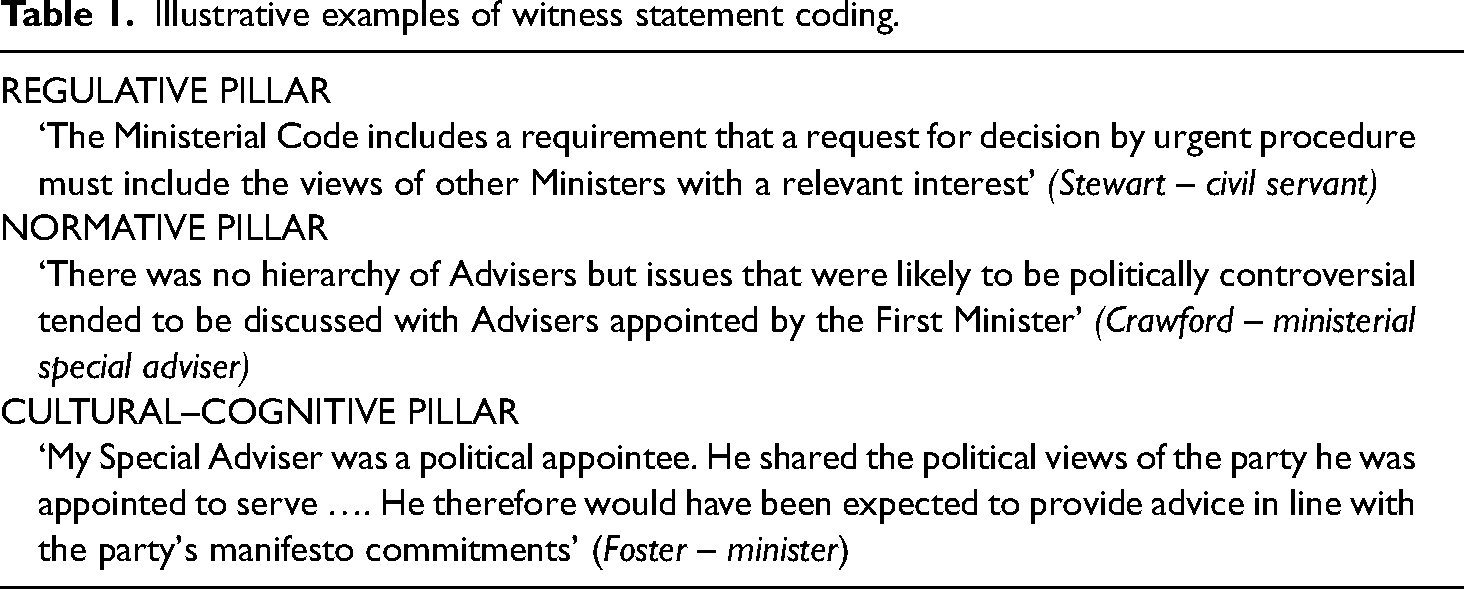
Witness statements were coded deductively against Scott's (2001) three pillars of institutions: regulative; normative; and cultural–cognitive. For illustrative examples of our coding, please see Table 1.
Illustrative examples of witness statement coding.
We applied an interpretivist lens to our overall methodological approach and analysis, to understand, compare and contrast how ministers, civil servants and SpAds individually and collectively explained and made sense of their own and others’ actions leading up to the RHI crisis (Kenny and Ó Dochartaigh, 2021), and how these accounts ‘mapped on’ to Scott's three pillars (Wicks, 2001). We sought to ‘unpack’ and understand the ‘contingent beliefs and actions’ (Bevir and Rhodes, 2015: 19) of the elite actors in this context. We acknowledge the longstanding debate on the degree of agency that bureaucratic actors have in institutional settings (Bach et al., 2022), and that public inquiries can ‘author’ an authoritative account of events in the interests of political power (Kenny and Ó Dochartaigh, 2021). However, we were centrally concerned with what the witness statements reveal about professional relationships in the NI Executive, which was not the primary focus of the RHI Inquiry. When aggregated and analysed thematically, these statements allowed us to derive patterns pertinent to our research questions around relational norms and (dis)trust leading to institutional crisis.
All initial coding was completed by one researcher for consistency, selecting ‘units of meaning’ (Campbell et al., 2013) for analysis. The initial coding process identified and categorised all data pertaining explicitly or implicitly to the regulative, normative and cultural–cognitive pillars. The completed coding was reviewed by a second researcher, generating discussion about queried outliers, before arriving at a shared agreement.
Next an initial set of inductively derived ‘metathemes’ (Lewis et al., 2010) were established under the regulative, normative and cultural–cognitive pillars, capturing key issues and insights emerging from the coding. Team members discussed the suitability and representativeness of these initial themes, with some codes consequently renamed, subsumed, or abandoned. These were further refined, with tentative first findings collectively shared, discussed and renegotiated.
This paper focuses on the ‘normative’ findings. In focusing on the relational norm of (dis)trust, the following section reports and analyses two key themes derived from the data, drawing on illustrative examples from witness statements throughout (see Online Appendix 2 for a full list with identifiers).
Findings: norms, obligations and (dis)trust
The normative pillar is founded upon notions of duty and responsibility ‘that introduce a prescriptive, evaluative, and obligatory dimension into social life’ (Scott, 2001: 64). As such, ‘appropriate’ expectations for individuals and professional groups become characterised and enacted in patterns of behaviour (Wicks, 2001). Analysis of witness statements indicated the extensive reach of normative sensibilities for all three groups within the executive triangle. Summarised, these comprise two themes: (a) distrust norms of strategic information sharing and withholding, pertaining to transparency, control and blame; and (b) how informal hierarchies affect and reflect the relational norm of distrust.
A recurring theme of distrust between departments and divisions was seen to underlie a lack of formal and informal communication and collaboration, with consequences for the ability of civil servants to adequately share information and identify RHI related problems: ‘the two Divisions [departments] variously worked together, debated, disagreed, misunderstood or distrusted one another’ (Mills, civil servant, no.2). This distrust between the departments was evident among civil servants and ministers, often reflecting division along political party lines: the very high degree of distrust between [DUP minister] Simon Hamilton and [Sinn Féin minister] Máirtín Ó’Mulleoir … complicated the normal interchanges between officials, because we had to follow the instructions from Ministerial level, but still progress issues as best we could. (McCormick, civil servant, no. 2)
‘Lateral blaming’ is a notable feature in the civil servant witness statements, with a divide apparent between those involved initially (referred to in some witness statements as ‘Team 1’) and those who were in DETI at the scheme closure (‘Team 2’). Akin to the dynamic between engineers and contractors in the NASA case (Vaughan, 1996), albeit more antagonistic, distrust here is not in itself an overt concern or source of risk, it is routine and ‘normal’.
Witness statements also addressed relationships between SpAds, ministers and civil servants within departments and political parties, with SpAds seen as a critical link in the executive triangle. For example, one civil servant remarked on the: importance of mutual trust in the three-way relationship between a Minister, SpAds and senior officials. Each party in the relationship must be able to rely on that trust existing between the other two parties. The SpAd is an important channel of communication and advice to officials on the Minister's thinking. If officials cannot rely on the existence of trust between the Minister and the SpAd, then the conduct of business will be seriously impaired. (Stewart, civil servant, no. 2)
At the same time, SpAds were criticised for negatively impacting on the transparency of policymaking and communication, particularly when relationships were suboptimal. One civil servant explained that ‘communication between officials and SpAds was incomplete and not transparent in relation to purposes and priorities’ (McCormick, civil servant, no. 3), with another highlighting that information sharing could be used strategically for covert purposes, rather than genuine collaboration: On [SpAd] Mr Cairn's ‘tendency to be more open with officials’, this seems a very subjective point. Indiscretion does not equal candour. At the time I felt that the watered-down tiering proposal was a delaying tactic. That wouldn’t support an interpretation that we were operating in an atmosphere of openness. (Mills, civil servant, no. 3)
Relatedly, the RHI inquiry witness statements show that civil servants predominantly formally documented information, meetings and decisions. By contrast, there is evidence of ministers and SpAds intentionally using ‘off the record’ communications which appeared to adversely affect clarity. A key motivation for this appears to be lack of trust in the confidentiality of written information. While not necessarily complicit, senior civil servants were aware of the practice of, and rationale for, keeping things undocumented: ‘The absence of a formal record reflects custom and practice at the time … I think that the largest single factor that led to very limited recording of reasons for decisions was the political parties’ fear of leaks’ (McCormick, civil servant, no. 4). There was a normalised informality at play that was to some extent considered legitimate, given the fraught, distrusting inter-party relations. However, the lack of a consistent ‘paper trail’ left no way of formally signalling alarm and prompting action regarding the RHI scheme.
In addition, formal and informal hierarchies were evidently affording certain individuals particular power and influence in setting norms (Diefenbach and Sillince, 2011). Ministers top the hierarchy, although within ministerial circles there are further subdivisions, with the First Minister taking prime position: ‘No business could be on the Executive Agenda without the permission of OFMDFM [Office of the First Minister and Deputy First Minister]. This “convention” is not recorded in writing anywhere, it is the understood position however and is borne out by practice’ (Bell, minister, no. 2). The hierarchy among ministers is paralleled among their respective SpAds: ‘While there was no official hierarchy of SpAds it was accepted (within the DUP in any event) that SpAds in the First Minister's office were viewed to have seniority’ (Cairns, SpAd, no. 1). This mirroring of ministerial hierarchy among SpAds is framed as a natural consequence of the SpAd role being perceived as a conduit for the minister's own view and position: It is a legitimate part of a SpAd’s role to challenge or constructively criticise advice or policy proposals, or to suggest alternatives, acting at all times with Ministerial authorisation. In essence, such a challenge is no different from a challenge by the Minister. (Stewart, civil servant, no. 3)
This organisational norm of SpAd ‘superiority’ over civil servants by virtue of their close ministerial links was frequently raised as a barrier to civil servant concerns around RHI matters. SpAds, as key ministerial aides, were considered to have the ‘final word’ and the RHI Inquiry witnesses suggested that DUP SpAd delays in closing the scheme occurred despite known policy concerns.
When working effectively, normative practices, and relational norms specifically, enable shared expectations of responsibilities and a clear separation of accountabilities. Problems arise when relational norms create feelings of disempowerment and diffuse accountability for problem identification and solving. Additionally, when informal influences subsume formal directives, the risk increases that anomalies and problems might evade formal detection.
Discussion
This paper asked three questions: (1) how do (dis)trust norms affect Executive relations in NI governance; (2) what role, if any, did (dis)trust norms play in the RHI crisis; and (3) what are the implications for public administration theory? There are limitations to using public inquiry witness statements as data, including the desire of witnesses to self-present favourably and defend their actions. However, we were careful to view witness statements not as statements of fact, but as empirically valuable discursive artefacts situated within NI’s contested policy context (Gibbs and Hall, 2006). This section identifies two key overarching themes that address these questions, arguing that the relational norm of distrust is a salient part of the NI Executive culture. As such distrust played an enabling role in the RHI crisis. Although framed by NI’s distinctive institutional context, the case provides lessons for public administration theory.
Hierarchies and (dis)trust across the executive triangle
The outworkings of formal and informal hierarchies help explain Executive relations and the RHI case specifically. Formalised hierarchies were particularly apparent among civil servants, with witness statements reflecting a very clear distinction between roles at different grades and associated expectations and responsibilities. Equally, the effect of political party regulation on the behaviour of ministers and SpAds was tangible. As the political parties seek to leverage control in the multi-party antagonistic coalition, this routine political regulation has spilled over into departmental functioning, creating informal relational norms of political, rather than civil service, control. Strong informal controls signal a climate of anxiety and suspicion, frustrating organic trust relations that would likely aid cooperation and knowledge exchange (van Berkel et al., 2019).
The significant influence of SpAds in NI’s recent history, and this crisis, indicates their instrumental role in ‘translating’ a logic of appropriateness (Fredriksson et al., 2013) that prioritises and legitimises political norms and control. In this landscape, even civil servants ‘with stunted political antennae’ realised that the DUP and Sinn Féin would share power in NI for quite some time (McBride, 2019: 24). This includes NI’s SpAds, who have exceptionally long tenures for ministerial advisers and therefore form part of the institutional memory of the administration (Yong and Hazell, 2014). In this respect, minister Jonathan Bell's witness statement that ‘ministers come and go but SpAds remain’ is insightful. It reveals how SpAds are both socialised into and instrumental in (re-)creating its operational and relational norms. It also points to behavioural patterns which reinforce the dominant coalition – SpAds and ministers – thereby diminishing civil servant confidence to challenge politically driven norms (Cooper, 2018; Jávor and Jancsics, 2016).
Civil servants also recognised the tensions within the DUP team, and departmental division along party lines. This required civil servants to juggle independent policy advice with a ‘higher level of real politics’ than civil servants were at ease with (Rouse and O’Connor, 2020: 11), increasingly requiring ‘active conflict management roles’ in a politicised environment (Rouse and O’Connor, 2020: 13). The closeness of the one-to-one minister–SpAd relationship gives SpAds more access, often positioning them – informally at least – ‘over’ civil servants. The result is different ‘circles of trust’ around a minister (Gouglas, 2018). SpAds belong to the inner circle, and they enjoy ‘high levels of trust and exercise high influence vis-à-vis the minister’, while civil servants garner only ‘fragmented trust’ (Gouglas, 2018: 108). Moreover, it shows how informal relational and procedural precedents can, through repeated relational exchange patterns, solidify into taken-for-granted beliefs in how normal institutional business is conducted, even in the face of ‘objective’ risks (Scott, 2001; Vaughan, 1996; Wicks, 2001).
Accountability, responsibility and relational norms in the ‘translated’ Westminster model
The Inquiry's scrutiny into the RHI crisis highlights the complexity of the administration's negotiated settlement and its divergence from the traditional Westminster bargain between politicians and officials. The practices adopted by the parties in centralising the appointment, control and management of SpAds left them wielding significant power. It also encouraged SpAds to see themselves as responsible to the Office of First Minister and Deputy First Minister and their political parties, rather than to their departmental ministers (Coghlin et al., 2020). The findings also suggest that civil servants were reticent to ‘speak truth to power’. As such the organisational actions (or inactions) whereby the RHI became a crisis needs to be understood within the post-conflict settlement context (Helms and Oliver, 2015). As well as securing consensus between political actors, the politician–official relationship initially ‘bore the hallmarks of a legacy of distrust and suspicion’ (Rouse and O’Connor, 2020: 7). As power sharing became embedded this evolved into officials playing active roles in day-to-day management (O’Connor, 2012) while also being side-lined and blamed for failings by politically partisan ministers and SpAds (Carmichael and Osborne, 2003).
While not advocating for a ‘system dominant’ explanation of crisis that minimises individual agency (Jennings et al., 2018), our study supports the argument that there are problems in ‘translating’ the conventional elements of the Westminster system in the consociational context (Rice and Somerville, 2017), which increases the likelihood of crisis. Former First Minister Peter Robinson's comment to the RHI inquiry is illuminating: we functioned in a rough and inauspicious climate and we did not live our lives consulting a rule book at every moment … The nature of the devolved government in Northern Ireland led to the provisions of the code of conduct for Special Advisers being stretched to, and beyond, their limits to make the system of government work in the peculiar structures that prevailed at the time. (Coghlin et al., 2020: 161)
In this context, which goes beyond the ‘routine’ problems of voluntary coalition government (Eichbaum and Shaw, 2010), ‘stretching’ or navigating formal structures and procedures is ‘normalised’. Robinson's comment arguably applies across the executive triangle, reflecting a contradictory and often dysfunctional environment, symptomatic of the difficulties inherent in power sharing arrangements, particularly when distrust is the normal backdrop to many professional interactions. The problem of translating the Westminster model explains why there is often a default to relational norms in the routine business of government in NI. While NI’s administrative procedures and Executive relations reflect many hallmarks of the Westminster system, its consociational political structure is the polar opposite of Westminster's winner-takes-all constitution. This is compounded by the lack of any regulative requirement for collective cabinet responsibility within the mandatory coalition. Coupled with underlying cross-party historical antagonism, this has led to ministers operating departmental ‘party fiefdoms’ (Wilford, 2007), ‘with no consequences for their place in government’ (Birrell, 2012: 55). Indeed, NI’s designation system incentivises division as political parties seek to maintain a share of political power (Rice and Somerville, 2018).
Conclusion
Ultimately, we argue that the ‘radical settlement’ (Helms and Oliver, 2015) of the GFA and the implementation of the devolved, consociational model incubated new relational norms that prioritised and legitimised the agendas of political actors (ministers and SpAds) over civil servants. The RHI crisis demonstrates the effects of the ‘layering of distrust’: firstly, through the structures of consociationalism that mandate and institutionalise adversaries working together despite existing high levels of distrust; and secondly, through the imposition of Westminster conventions on these structures within this adversarial context. The key tenets of the Westminster system, such as the accountability of ministers to parliament and collective ‘cabinet responsibility’ (Diamond, 2013) frequently conflict with how consociational structures operate in NI. Routine ‘work arounds’ through informal SpAd control, bargaining and strategic communication, and the maintainance of departmental silos underpinned by political competition in the paradoxical Westminster-consociational model collectively foster a culture of distrust in Executive relations. This normalising of distrust has negative implications for the effective identification of risk and the emergence of crisis. Behavioural manifestations of distrust – inhibited information sharing, transparency and collaboration – are evident between political actors and across the executive triangle. Corroborating Vaughan's (1996) work, this study confirms that in an institution where in-house contradiction, reactive policy ‘firefighting’ and crisis are relatively common, the threshold for risk and alarm is potentially elevated. In conclusion, we contend that the ‘normalisation of distrust’ (Rice et al., 2022) as a component of relational norms is an important variable when theorising and critiquing the executive triangle and the unfolding of crisis, that scholars may wish to explore in other consociational or Westminster contexts.
Supplemental Material
sj-docx-1-ras-10.1177_00208523231189882 - Supplemental material for A slow-burning crisis: Executive relations and the normalisation of distrust in Northern Ireland's ‘cash for ash’ fiasco
Supplemental material, sj-docx-1-ras-10.1177_00208523231189882 for A slow-burning crisis: Executive relations and the normalisation of distrust in Northern Ireland's ‘cash for ash’ fiasco by Charis Rice, Bernadette Connaughton, Jenny Ratcliffe and Ian Somerville in International Review of Administrative Sciences
Footnotes
Declaration of conflicting interests
The author(s) declared no potential conflicts of interest with respect to the research, authorship, and/or publication of this article.
Funding
The author(s) received no financial support for the research, authorship, and/or publication of this article.

Supplemental material
Supplemental material for this article is available online.
Notes
References
Supplementary Material
Please find the following supplemental material available below.
For Open Access articles published under a Creative Commons License, all supplemental material carries the same license as the article it is associated with.
For non-Open Access articles published, all supplemental material carries a non-exclusive license, and permission requests for re-use of supplemental material or any part of supplemental material shall be sent directly to the copyright owner as specified in the copyright notice associated with the article.
