




Abstract
Much has been written about the changing role of unelected public servants in Westminster systems of government and their relationship with elected officials and the public. However, there are no studies comparing how these three groups perceive the role, and what they expect from public servants. This article provides the findings from three surveys of public servants, politicians and the public in Canada to assess how they view the role of the public servant and how this compares to different conceptions in the academic literature. The study finds that all three groups support the principles of ministerial responsibility and non-partisanship but do not believe that public servants should be anonymous and free from public scrutiny. This raises the question of whether some aspects of the traditional public servant role can be altered while keeping others in place and suggests that advocates for altering the role of the public servant will be most successful if they focus on certain aspects while preserving others.
Points for Practitioners
The principles of ministerial responsibility and public service non-partisanship are supported by the public, politicians, and public servants themselves.
There is a desire among these three groups for public servants to become less anonymous, face more public scrutiny and engage more with external actors.
The public and politicians’ expectations surrounding public servants’ political activities are still unclear, although a large majority of public servants believe they can be politically active outside of work.
Keywords
Introduction
The role of public servants in Westminster systems of governments has changed over the past few decades. Public servants face increased pressure to be responsive to the elected government and are frequently asked not only to implement its agenda, but also to actively support and defend it (Aucoin, Jarvis and Turnbull, 2011; Grube and Howard, 2016; Lindquist and Rasmussen, 2012; Diamond, 2019). The pressure on public servants to be more responsive can be compounded as they face more competition in providing policy expertise to elected government from other actors, including partisan staff, policy think tanks and private research firms (Craft and Halligan, 2020). Citizens now expect to provide more, and direct, input to public servants who are acting as service providers and policy makers, rather than relying solely on their elected representatives (Brock, 2004; Culver and Howe, 2004; Martens, McNutt and Rayner, 2015). At the same time, public servants have the capacity to be more politically active in their private lives than at any time in the past and social media has made it easier for them to publicly express their opinions.
Given these changes, scholars have asked what role should public servants play in Westminster democracies in the twenty-first century? Many have argued for reinforcing core values and making institutional adjustments to strengthen public servants’ traditional role as primarily accountable to elected governments, non-partisan and largely anonymous to the public (Kernaghan and Langford, 2014; Aucoin, 2012; Christensen and Opstrup, 2018). Others, influenced by the tradition of public value management (Moore, 1995; Stoker, 2006; O’Flynn, 2007), have argued that public servants should become outward-looking managers that engage directly with society to create public value and promote democracy (Denhardt and Denhardt, 2007; Grube, 2019). However, there has yet to be a systematic comparison of how public servants, politicians and citizens view the role of the public servant.
This article investigates how each of the groups mentioned above understands the role and what they expect of public servants in Westminster systems of government. It pursues the central research question: is there agreement among the public, elected officials and public servants on which aspects of the traditional public servant role should be maintained and which need to be adapted or abandoned? This will provide clearer direction to discussions and actions related to public sector reform by identifying where there is broad support for change and where there is agreement to maintain the status quo. The article begins by investigating the insights provided by the literature on public servants in Westminster systems to develop several expectations. This is followed by a review of the methods used by the study: surveys of public servants and politicians working at the federal, provincial and territorial level of government in Canada and the Canadian public. The findings, outlined in the subsequent section, highlight that there is much that the three groups agree on. However, they also raise a key contradiction: these groups want public servants to become more transparent and public-facing without compromising the traditional principles of ministerial accountability and non-partisanship. The article concludes by discussing the limitations of the study, identifying potential avenues for future research and outlining the contributions of the study.
Theory and expectations
The literature on Westminster models of government outlines the traditional duties and attributes of a public servant (Dwivedi and Gow, 1999; Dwivedi and Mau, 2009; Kernaghan, Marson and Borins, 2005). Public servants are impartial officials, which applies to their relationship with politicians and the public (Aucoin, 2012). First, public servants are non-partisan which allows them to faithfully provide advice and dutifully take direction from the government of the day, regardless of political persuasion. Second, public servants are impartial in the delivery of public services and programmes, which ensures that citizens are treated fairly and equitably. To ensure this impartiality, public servants are permanent officials that are appointed and promoted based on merit.
Public servants must be primarily responsive and accountable to the elected government. The principle of ministerial responsibility holds that the elected minister is the face of the department and publicly responsible for all activities within it. Public servants are to remain largely anonymous, with limited scope to participate in political activities and an expectation they will refrain from commenting publicly on government policy. Lindquist and Rasmussen (2012) note that scholars tend to advance this ideal model of a professional public bureaucracy independent from politics, while in practice the bureaucracy is closely connected and amenable to the elected government. Yet even the scholarly literature has noted the complex, multiple and changing relationships that exist between public servants and elected officials (Aberbach, Putnam and Rockman, 1981; Rhodes and Weller, 2001). This raises questions about how other models of the public servant fit with the changing circumstances in which they operate.
Political drivers: shifting blame and seeking responsiveness
The context in which public servants conduct their work has changed dramatically in the twenty-first century. The traditional bargain, where public servants provide expert advice and loyally implement the elected government's direction in return for job security and anonymity, has been under strain for decades (Savoie, 2003; Hood and Lodge, 2006; Cooper, 2017). Increasingly, public servants are taking on a public-facing role, frequently appearing at parliamentary committees (Bourgault and Gow, 2022; Grube, 2014), giving public speeches (Grube, 2013), and interacting with citizens and societal groups (Aucoin, 2012). Government ministers are more likely to publicly blame public servants when something goes wrong in their department, violating the principle of ministerial responsibility and public service anonymity (Hood and Lodge, 2006; Savoie, 2003). Indeed, the risk of blame factors into institutional design decisions, as politicians directly control or delegate controversial issues to pre-emptively avoid blame or ensure that they can claim credit (Weaver, 1986; Hood, 2002; Hinterleitner, 2020). To the extent that these institutional blame games prevent policy responses to important societal problems, they can impede democratic accountability and responsiveness (Hinterleitner, 2022).
Public servants face increased pressure to be responsive to the elected government (Aucoin, 2012; Christensen, Klemmensen and Opstrup, 2014; Diamond, 2019). Aucoin argues that this demand for responsiveness and control crosses the line into outright politicization, interfering with public servants’ ability to provide expert policy advice and impartially deliver public services. This new model of public service is commonly known as new political governance and is characterized by constant political campaigning, leaving less room for impartial administration; an elevated role for partisan political staff, who can challenge or even direct public servants; politicized appointments of senior public servants; as well as an expectation of enthusiastic support and active defence of the elected government's agenda (Aucoin, 2012; Bakvis and Jarvis, 2012).
New political governance focuses primarily on senior officials in the permanent executive (Heintzman, 2016; Bourgault and Gow, 2022; Dutil and Migone, 2021). However, concerns about politicization in the public service include government scientists being restricted by the elected government from speaking publicly about their research (Turner, 2013; Amend and Barney, 2016), the use of government communications by ministers for partisan political purposes (Marland, 2016) and the increased role of political staff in advising ministers (Craft, 2016; Craft and Halligan, 2020; Wilson, 2016). It is important to examine all levels of the public bureaucracy to gain an accurate picture of how public servants view their relationship with elected officials.
Public drivers: increasing demands for public engagement and collaborative governance
Characterizations of citizens’ relationship with the public service are complex. There are many studies that suggest that public trust of government has decreased in Western countries (Mettler, 2018, Lerman, 2019, Foster and Frieden, 2017; Roese, 2002). But the public tends to trust front-line public servants more than politicians and senior public service executives (OECD, 2021). Many scholars have suggested that public trust in government is linked to impartiality, which is about fairness and equality in the process of delivering public services (Rothstein, 2011; Suzuki and Demircioglu, 2021). However, changes in society – the rise of post-materialism and individualism in the second half of the twentieth century and the emergence of new public management in the 1990s, which viewed the public as customers of public services rather than citizens – may have fundamentally changed the public's relationship with the public sector (Bouckaert, Van de Walle, Maddens and Kampen, 2002). Some scholars suggest that trust in government is determined by public sector performance, including macro-factors like economic growth and micro-factors like service delivery (Im and Choi, 2016; Fukayama, 2013). Given the potential changes in societal values, it is important to ask, what do citizens expect from public servants?
The public may have changing expectations not just about the services they receive, but also their ability to provide input into government, seeking to more frequently and directly influence decision making (Brock, 2004; Culver and Howe, 2004; Martens, McNutt and Rayner, 2015). Public servants have an important role to play in this as managers of public consultations on policy or receivers of direct feedback from citizens on public services (Warren, 2009; Mayer, Els van Daalen and Bots, 2004). Indeed, the field of participatory governance strives to improve public policies, services, and organizations while, at the same time, enhancing democratic dialogue by directly involving the public (Bussu, Bua, Dean and Smith, 2022).
Governments have devolved decision-making authority and service delivery responsibility to a range of non-state actors including Indigenous Peoples (White, 2020; Hughey, Jacobson and Smith, 2017), private business (Hodge and Greve, 2007; Shaoul, 2011) and non-profit groups (Doberstein, 2016; Levasseur, 2012; 2023). Accompanied by fragmentation within the state, caused by the creation of new agencies and service delivery arrangements (Rhodes, 1994), devolution has led to new collaborative forms of governance that focus on partnerships and co-production, involving networks of actors inside and outside traditional government hierarchies (de Bruijn and ten Heuvelhof, 1995; Bourgone, 2011; Sullivan and Skelcher, 2001). At the same time, new models of the public servant have emerged under the branding of public value management (Moore, 1995; Stoker, 2006; O’Flynn, 2007) and new public governance (Osborne, 2009). Lindquist suggests that collaborative government, public value management and new public governance dovetail in their advocacy for: “more policy and service design based on engagement and delivery with networked collaborations including non-profits, community organizations, and other actors” (2022: 552).
The role of the public servant then involves engaging directly and more frequently with groups and citizens, actively managing networks of actors, contributing to public discourse and mediating disputes. Politics is an essential component these frameworks, rather than something public servants should avoid (O’Flynn, 2007). This model stands in contrast to many traditional values or principles of public administration. If citizens and societal groups provide input and responsibility directly through public servants rather than elected officials, this could strain the principle of ministerial responsibility. In areas where these new societal actors play important roles, public servants may feel direct accountability to them and challenged in their role as anonymous officials. Public servants’ public profile would increase, eroding the principle of anonymity and, if public servants are expected to mediate societal conflicts and debates, remaining non-partisan would become much more difficult.
Public servant drivers: political activity
Public servants have their own expectations of what their role should be and how it compares with the traditional role. Studies suggest that public servants still see many aspects of the traditional role in their work (Bourgault and Gow, 2022; Boyd et al., 2021) and act to preserve it (Grube and Howard, 2016). However, in their personal lives, public servants have greater capacity to be politically active than at any time in the past. For many years, public servants’ ability to engage in political activity, such as running for office or contributing to campaigns, was extremely limited and they were expected to refrain from commenting publicly on government policy (Kernaghan, 1986). Most of these restrictions have been removed, except for running for office. In addition, technological changes mean that government business as well as democratic political discourse are taking place online, which further blurs the division between the public and private spheres (Clarke and Piper, 2018; Grube, 2017; Cooper, 2020; 2022).
Expectations of the study
The above discussion about how public servants, politicians and the public view the role of the public servant leads to several expectations. Given that politician point blame at public servants more frequently and the public demand direct access to government, the expectation is that (E1) politicians and the public will be less supportive than public servants of the principle of ministerial responsibility and (E2) the tradition of public service anonymity. Given politicians’ and citizen's desire for increased responsiveness and citizens’ focus on effectiveness, efficiency and performance rather than fairness and equal treatment, the expectation is that (E3) both of these groups will be less supportive than public servants of the principle of impartiality and non-partisanship. The final expectation is that (E4) this will extend to public servants’ capacity to be politically active outside of their job.
Methods and data
We surveyed the public, politicians and public servants in Canada to examine their views on the public servant's role in democracy. The questions focused on blame and responsibility in government, public service non-partisanship and public servants’ anonymity and their dealings with the public. The survey was developed in consultation with the Institute of Public Administration of Canada (IPAC) and public service commissions at the federal level and in the province of Alberta. In all three surveys, the instrument was presented using the Qualtrics online platform and the data analysis was conducted using Stata software.
The public servant survey was run from 4 May to 7 June 2021. The survey was sent by email, in English and French, to public servants at the federal, provincial, territorial and municipal level. The survey was distributed through IPAC's membership list as well as a survey panel of Canadian public servants constructed for formal survey research. IPAC is a national organization that represents public servants at all levels of government across the country. In the year the survey was conducted the organization had 1603 members. The survey research panel is made up of 1500 public servants at all levels of government across Canada. In total, we received 992 responses. We included only responses from public servants working at the federal, provincial or territorial level to ensure our respondents worked in a Westminster system of government. 1 This left us with 830 responses for our analysis, a response rate of 27%. Our sample comes from public servants that have chosen to be members of a national professional organization or participate in an ongoing research panel. As such, they may be more engaged than the average public servant in the country. However, it is not clear that this would skew our sample's attitudes in a particular way. Public servants could be engaging in IPAC and participating in a research panel because of their desire to become more active and engaged outside their traditional role as a public servant or because of their desire to preserve the traditional role of the public serivce.
An online survey of the Canadian public, aged 18 years and older and citizens or permanent residents, was conducted through the Consortium for Electoral Democracy (C-DEM), a public opinion research institute housed at Western University in London, Ontario. C-DEM incorporated questions on the role of public servants in democracy into their annual Democracy Check Up survey (Harell, Stephenson, Rubenson and Loewen, 2022). The survey ran from 20 May to 7 June 2021 in English and French and the sample size for our module was 1989 respondents. Because the survey was conducted online, a response rate was not reported.
We partnered with the Samara Institute, a non-partisan think tank based in Toronto, Ontario, that studies Canadian democracy, to survey politicians. Samara added the questions about the role of the public servants into their annual survey of members of Canadian parliament, available in both English and French. The email survey ran from 29 April to 30 June 2021. Samara sent their survey to 337 members of parliament. 2 We received 74 responses. While the total number of responses is low, this represents a response rate of 22%. Efforts were made to reach members of all political parties, independents, members in cabinets, those in opposition critic roles and backbenchers. The survey was distributed in hard copy for any members that did not wish to fill it out online to ensure that members that used online technologies less were included.
Findings
The surveys of public servants, politicians and the public create an empirical foundation to investigate the expectations emerging from the review of the theory about the role of the public servant in Westminster systems. We compared the responses of the three different datasets to generate our findings.
E1: support for ministerial responsibility
The first expectation (E1) is that politicians and the public will be less supportive than public servants of the principle of ministerial responsibility. We asked each group: who is most responsible when a government fails to operate as it should (Figure 1). This question does not refer to ministerial responsibility explicitly and could be interpreted as asking who is most likely to make a mistake rather than who should be held responsible. The question was designed to be accessible to all three groups, as the public may not be familiar with the concept of ministerial responsibility. The question gauges where respondents look for accountability, which can be used as a proxy to compare their attitudes towards ministerial responsibility.
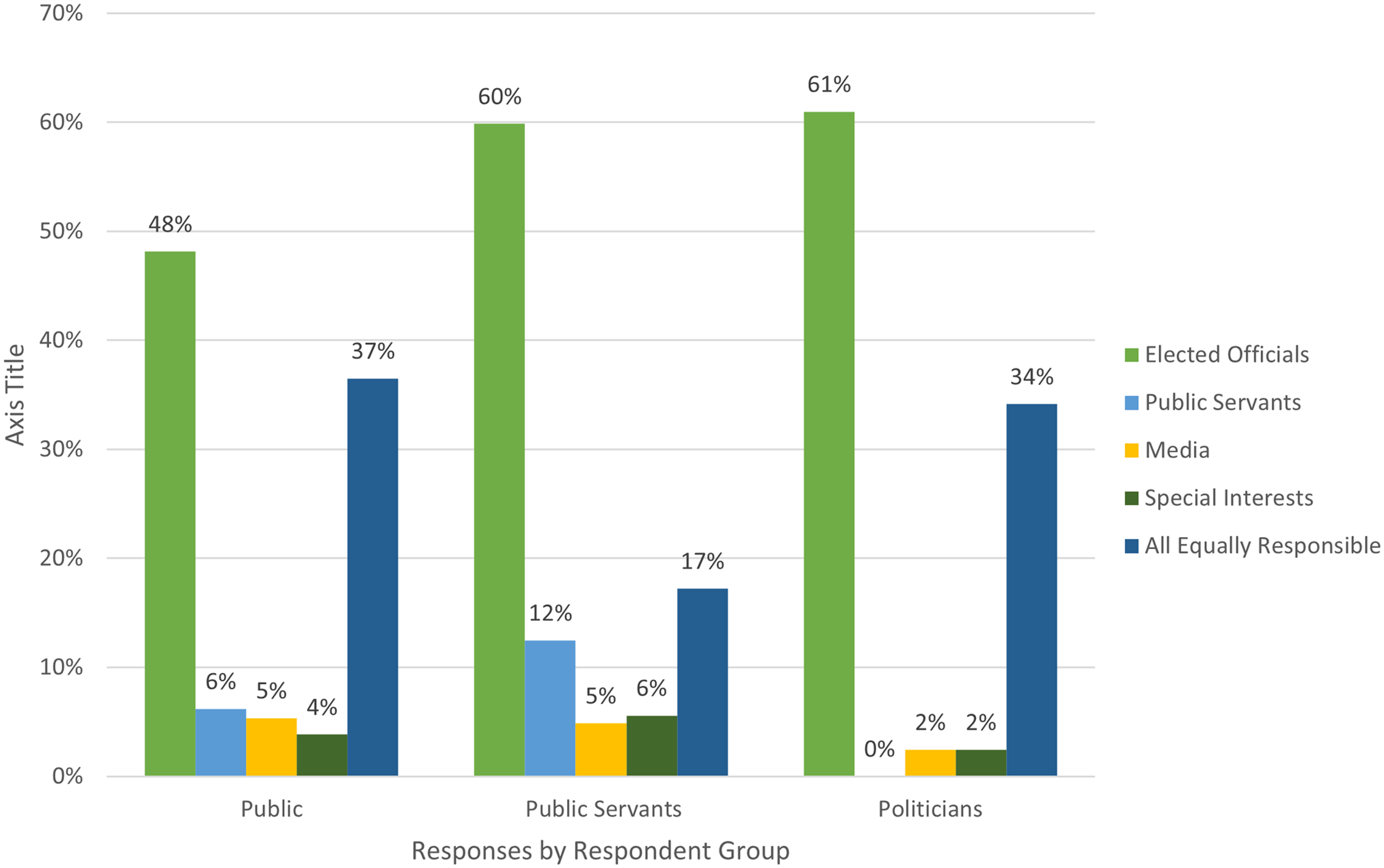
When government fails to operate as it should, who is responsible?
Politicians and public servants were most likely to say that politicians were responsible (61 and 60%, respectively) while only 48% of the public said politicians were most responsible. No politicians said that public servants were responsible (0%), while 12% of public servants and 6% of the public held public servants responsible. The public and politicians were more likely to state that all parties were equally responsible (37% and 34%, respectively) while only 17% of public servants said that all parties were equally responsible. E1 is rejected as politicians were much more likely to hold themselves responsible than any other actor and did so at about the same rate as the public servants surveyed. The public was most likely to hold politicians responsible and held public servants responsible at a lower rate than the public servants surveyed.
E2: support for anonymity
The second expectation is that politicians and the public will be less supportive of public service anonymity than public servants. Politicians (32%) and the public (38%) were less likely to agree that public servants should be anonymous than public servants (43%) (Figure 2). Despite these differences, a majority of each group disagreed with the notion that public servants should be anonymous. In addition, to identify the types of behaviours that would suggest less anonymity, we asked whether it was part of a public servant's job to talk to the media and stakeholders. Politicians (56%) and the public (61%) were more likely to agree that public servants were required to talk to media and stakeholders than public servants (52%). Again, a majority of each group believed that it was part of public servants’ job to talk to media and stakeholders.
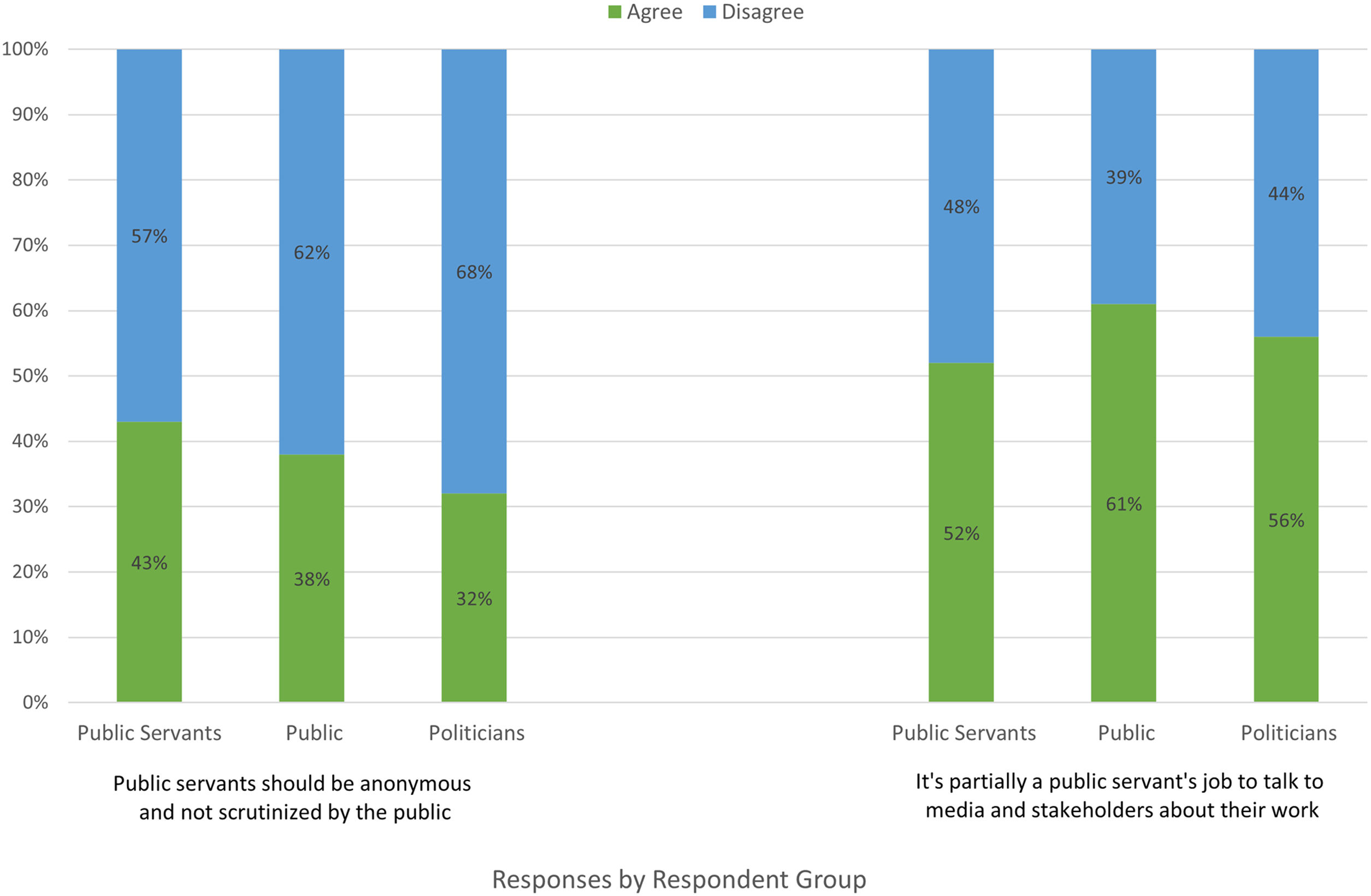
Public accessibility of public servants.
E2 is partially confirmed as politicians and the public were less supportive of public service anonymity than public servants. However, a majority of all three groups were against complete anonymity, highlighting significant agreement among them.
E3 and E4: support for non-partisanship during and outside work
The third expectation is that politicians and the public will be less supportive than public servants of the principle of impartiality and non-partisanship. All politicians and an overwhelming majority of public servants (97%) said that public servants must remain non-partisan at work while the public (87%) was less likely to agree (Figure 3).
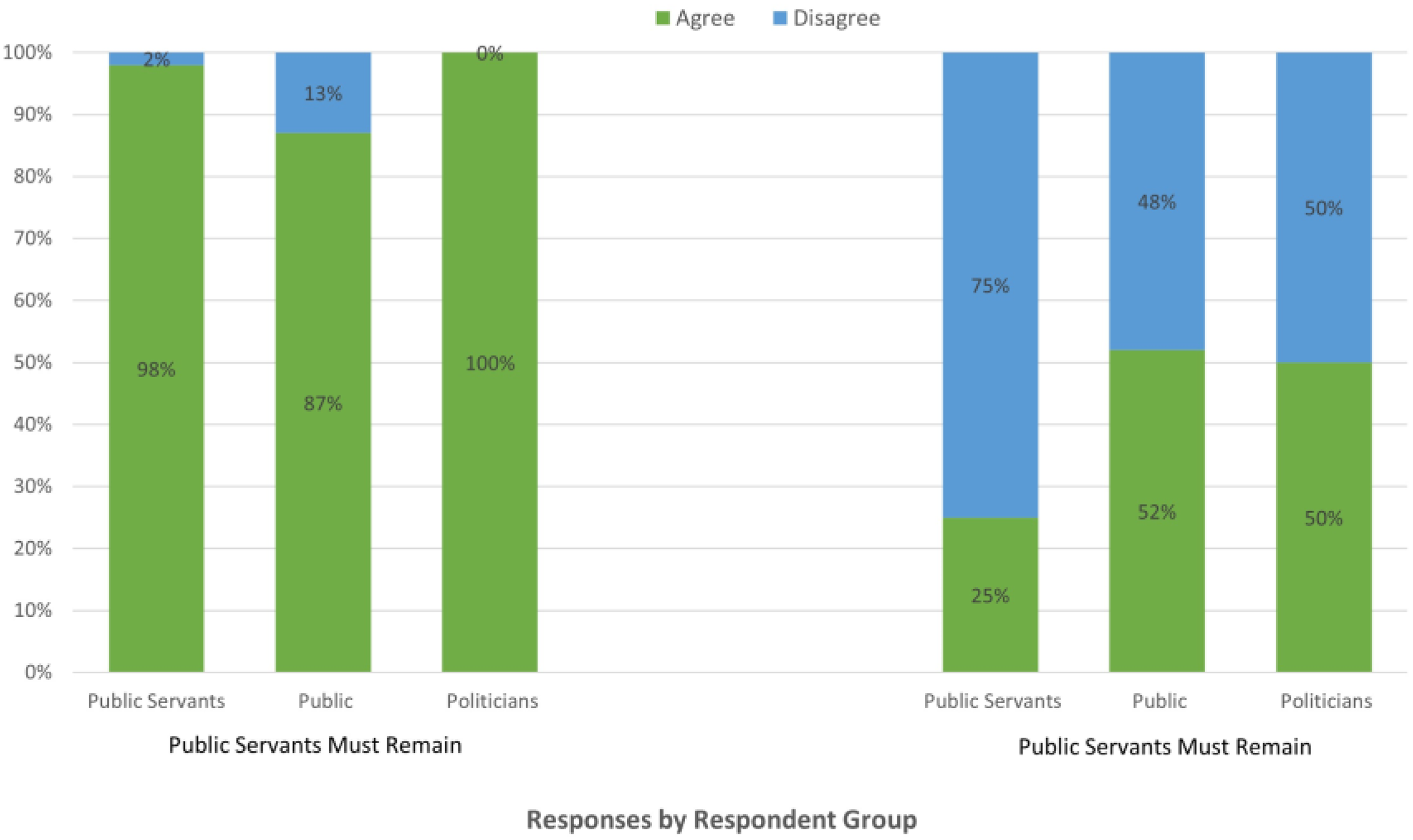
Non-partisanship of public servants during work hours and outside work.
E3 is rejected as public servants were not more supportive of non-partisanship at work than politicians and only slightly more than the public. However, there was less agreement among the groups on public servants being non-partisan outside of their work. E4 suggested that public servants will be more supportive of their capacity to be politically active outside of their job, compared to politicians and the public. Politicians (50%) and the public (48%) were split on whether public servants should be non-partisan outside of their work (Figure 3). E4 is confirmed as only 24% of public servants agreed that they should remain non-partisan in their private lives. Thus, there appears to be significant differences in the expectations that politicians and the public have compared with what public servants expect from themselves in relation to their personal political activities.
Discussion
The empirical findings result in several insights into the expectations of public servants in twenty-first century Westminster systems. The findings highlight where there is support among all three groups for traditional public service principles, where there is agreement for moving away from them and where there is disagreement among the groups.
Widely supported values: ministerial responsibility and non-partisanship
The concept of ministerial responsibility enjoys support from all three groups. Indeed, public servants, rather than politicians or the public, were the most likely to point the finger at themselves when something went in government, and all groups primarily placed blame at the feet of politicians. This finding suggests that public servants might be holding themselves to a higher standard internally than is expected through external accountability mechanisms. However, more research is required to further test this finding and explore possible explanations. Given that there are many instances where elected officials have attempted to shift blame to public servants or others, politicians may be more likely to hold themselves responsible in theory than in practice. However, all three respondent groups believed, at least in theory, that the connection between citizens and their elected representatives is the primary means of achieving democratic accountability. This suggests that attempts by government ministers to pass blame to their officials when something goes wrong in their department will encounter push-back from their colleagues or citizens.
There is a strong desire among public servants, politicians and the public for public servants to remain non-partisan. Despite arguments about the breaking of the bargain, public service politicization and the increased role of political staff, all three groups strongly supported the requirement for public servants to be non-partisan in their work. There is no desire for the top ranks of the civil service to be replaced or subordinated to political staff or become more partisan themselves and change with the political administration, like in the US system. Indeed, all politicians surveyed supported public service non-partisanship, even though elected officials in government are frequently identified as the main actors responsible for compromising this principle. Thus, it is important to understand how and why politicians’ behaviours differ from their beliefs regarding the non-partisanship of public servants.
Reducing anonymity and politicization: lessons from the Covid-19 pandemic
Support for ministerial responsibility and non-partisanship among public servants is not accompanied by support for public service anonymity. Although there was more support from public servants for anonymity, a majority of all groups believed that public servants should not be free from public scrutiny and it was part of their job to engage with external groups. It has always been part of public service jobs to interact with the public in various capacities. However, the traditional model of the public servant did not prioritize public engagement as a foundational principle (Lindquist, 2002). The strong consensus among all three groups that were surveyed suggests an expectation that public servants become outward looking managers that deal more frequently and directly with citizens, stakeholders and the media. With heightened demands for transparency in government and a more direct role for citizens, public servants’ direct involvement in political and democratic processes appears to be appealing to the public, politicians and public servants.
The expectations of the three survey groups align with the public value management and new public governance models, which suggest that the public servant's role should be to engage directly with the public and societal groups by brokering interests and leading public discourse (O’Flynn, 2007). The primary challenge of moving to this model is determining whether it will contradict the principles on which there is still strong support among the public, politicians and public servants. As public servants become more visible and increasingly work with societal groups and citizens, it stands to reason these actors will hold them responsible when something goes wrong. This would contradict the principle of ministerial responsibility. Less anonymity will also increase the chances that public servants will be drawn into politicized debates.
For example, during the Covid-19 pandemic top public health officials in government became household names by providing daily updates on case counts and hospitalizations. As a result, they faced public criticism and political attacks when announcing public health measures and restrictions (Horton, 2020; MacAulay et al., 2022). The increased blurring of accountability can undermine ministerial responsibility as elected officials attempt to avoid blame for their decisions. It also undermines trust in public servants and diminishes their capacity to provide effective analysis and advice as they are drawn into the realm of partisan politics.
It could be argued that high level public health officials already have a more public and complex role compared with the average public servant. Indeed, even before the pandemic, scholars noted the contested role of chief medical officials of health as advisors to elected governments and independent professionals who communicate and advocate for public health (Fafard, McNena, Suszek and Hoffman, 2018; MacAulay, Macintyre, Yashadhana, Cassola, Harris, Woodward, Smith, de Leeuw, Palkovits, Hoffman, Fafard, 2022). However, front-line public servants working in health care were publicly identified and exposed to harassment and attacks when providing public health services and education (Kuhlmann, Brinzac, Czabanowska, Falkenbach, Ungureanu, Valiotis, Zapata, Martin Morena, 2023; McKay, Heisler, Mishori, Catton and Kloiber, 2020; Cukier and Vogel, 2021).
It could also be argued that the pandemic was a unique crisis leading to heightened political and public scrutiny over policy decisions. However, at the very least, a more public-facing role for public servants means that remaining non-partisan will become a more challenging and nuanced proposition compared with adhering to absolute principles like never commenting on government policy.
Contending expectations of public servants: political activity outside of work
Complicating the dilemma described above is the reality that politicians and the public are split on whether public servants should be non-partisan outside of work, while three-quarters of public servants believe that they can be politically active in their private lives. If public servants are expected to become more public facing in their work, the line between the official duties of their job and their personal political activities could become blurred. This grey area has the potential to undermine the non-partisan public servants if it is unclear whether they are speaking or acting in their capacity as government employees or private citizens. Before substantial work on redefining the role of the public servant is undertaken, the findings of this study suggest that more work needs to be done to develop a shared understanding among the public, politicians and public servants about how public servants should behave outside of their work.
Conclusions
This study is methodologically distinctive because much of what we know about the role of public servants relies heavily on case studies with a small number of interviews or smaller surveys, typically with long-serving, high-ranking public servants (see Savoie, 2003; Aucoin, 2012; Grube and Howard, 2016; Elston, 2017 for examples). This survey research provides a different approach to answering fundamental questions about the role of the public servant that complements existing research.
A limitation of the study is that all three surveys were confined to Canada. While the insights will be useful to other Westminster systems of government, there are undoubtedly differences in the systems and populations in Britain, Australia and New Zealand that warrant further studies. Future studies should involve a comparative analysis across different Westminster systems to broaden the scope of the inquiry and identify unique characteristics of individual systems. Another limitation, as noted earlier, is that developing questions that are accessible to all three different groups is challenging. Conducting focus groups and interviews with politicians, public servants and citizens, either together or separately, would allow for pre-session information and education to ensure a common understanding across the groups that allows them to provide their perspectives.
There is significant agreement among the public, politicians and public servants about the role of public servants in Westminster systems of government. Indeed, most of our expectations about public servants having different views than politicians and the public were rejected by the evidence. However, the three groups support some traditional values of the public service, like ministerial accountability and non-partisanship, and not others, like anonymity. To the extent that these values come as a package, it will be difficult, if not impossible, to change some without compromising others. However, moving beyond the level of general principles, it is important to look for institutional changes that might establish a better balance between the values of public accessibility and transparency and political accountability and non-partisanship. The findings of this survey suggest that there is agreement among the primary groups involved in democratic governance in a Westminster system to try.
Footnotes
Acknowledgements
The author would like to acknowledge the helpful comments of the two anonymous reviewers, as well as Andrea Migone, Evert Linquist and Christopher Cooper who reviewed an early draft of the article. He would also like to thank Victoria Matejka and Savannah Ribeiro for their research assistance with this article.
Declaration of conflicting interests
The author declared no potential conflicts of interest with respect to the research, authorship, and/or publication of this article.
Funding
The author disclosed receipt of the following financial support for the research, authorship, and/or publication of this article: This work was supported by the Social Sciences and Humanities Research Council of Canada, (grant number 430-2020-00378).
