




Abstract
Although numerous studies have confirmed the existence and possible limitations of the equivalent framing effect in performance information evaluation, few studies have examined the conditions under which this framing effect works or does not work. This paper explores the equivalent framing effect of citizen satisfaction in the case of poor government performance by using two investigation experiments, and examines the boundary conditions of this effect in terms of performance information sources and trust in government. The results show that citizen satisfaction is higher when performance information is framed positively, rather than negatively. The findings demonstrate that the equivalent framing effect of citizen satisfaction is moderated by performance information sources and trust in government. This result indicates that equivalent framing effect has a certain fragility, showing heterogeneity with different sources of performance information and different levels of public trust in the government.
Points for practitioners
Truthfully reporting poor performance is the basic requirement for local governments. This study reminds government staff that, on the one hand, low performance is not a scourge, and small changes in poor performance reports may significantly change citizen satisfaction. On the other hand, it is not a panacea to improve citizen satisfaction simply by changing the presentation of performance information. The government should make more efforts to improve the public's confidence in performance information and the government.
Keywords
Introduction
Performance evaluation is not only a core component of public organisation management but also a long-term concern of policy practice and academic research. The reporting and disclosure of government performance information constitute essential means for strengthening political accountability and deepening the level of democracy (Ospina et al., 2004). Performance evaluation also forms the basis for the satisfaction of citizens and managers with the organisation and any subsequent decision-making (Calmar and Morten, 2015). Performance information provides a benchmark for performance evaluation by citizens and helps people decide the extent of the evaluation and judgement of public sector services (Dowding and John, 2012).
Citizen satisfaction is a mental state that arises after encountering a public service and contrasting that with previous experiences (Oliver, 1980). It is the extension of the concept of customer satisfaction in the field of public management (Shah and Maniam, 2009). Under the background of the new public management movement, citizen satisfaction is used as a standard of government service performance (Bouckaert et al., 2005; James, 2009). Among the existing theoretical explanations of the relationship between government performance information and citizen satisfaction, the cognitive–psychological model provides a more comprehensive explanation for citizens’ use of performance information (Calmar and Morten, 2015). According to the model, in certain situations, the evaluation of citizen satisfaction is not necessarily related to the actual objective performance of public services. This deviation may occur for various reasons, such as the methods used to gather performance information. For example, citizens’ dissatisfaction with the government may sometimes be attributed to political differences and not necessarily low service quality or poor performance (Jilke and Baekgaard, 2020). In the cognitive psychological model, it is believed that citizens’ unconscious biases in public performance evaluation lead to biased satisfaction evaluation. People hold unconscious and often negative attitudes towards public service providers (Marvel, 2016). Small changes in the presentation of performance information may considerably influence citizens’ evaluation of public services (James and Moseley, 2014; Olsen, 2015). The valence of performance information can have a substantial impact on citizens’ perception of public services – even despite the performance being the same.
An increasing body of literature has confirmed the existence of the equivalent framing effect in performance information evaluation, with some studies having found the potential limitations of this effect (Belardinelli et al., 2018). Unfortunately, little is known about the conditions under which this effect works. In fact, there is highly relevant literature in psychology which reveals the fragility and heterogeneity of equivalency framing effects. They occur less frequently than many believe (Druckman, 2001; Miller and Fagley, 1991). Under certain specific conditions, such as the sex (Fagley and Miller, 1997), age (Gächter et al., 2009), personality (Levin et al., 2002) and cognitive ability (Peters and Levin, 2008) of respondents, and problem characteristics (Bless et al., 1998), the possibility of the equivalent framing effect differs. In the field of public management, although some studies have found that the framing effect in public decision-making is moderated by several factors including subject factors and information factors, such as value orientation, knowledge level, interpersonal communication, emotion, frame characteristics and information use types (Belardinelli et al., 2018; Druckman, 2010; Shi et al., 2014), only a few studies have discussed the conditions under which the equivalent framing effect plays a role in the performance information evaluation of public managers (Belardinelli et al., 2018). However, there is little reflection on the vulnerability and heterogeneity of this effect in the performance information evaluation of ordinary citizens. Indeed, while citizen satisfaction depends on the government performance information provided by relevant departments, if citizens do not trust the performance information or local government, change in the presentation of performance information may not have much of an effect on enhancing satisfaction. Therefore, it is necessary to explore whether the equivalent framing effect of citizen satisfaction still occurs when performance information originates from different sources or citizens’ trust in government changes.
Improving citizen satisfaction often depends on better reporting of the efforts and achievements of government agencies in public services. Local governments also provide performance evidence of the government's good service through various channels. However, the results of performance information cannot always be positive. Truthfully reporting neutral and even poor performance is the basic requirement for local governments to receive responses from citizens. The existing research focuses on medium- or high-performance situations (Belardinelli et al., 2018; Olsen, 2015). Less attention has been devoted to understanding the conditions under which the equivalent framing effect works in the situations involving poor government performance.
Based on this, we believe that the construction of a performance information frame in the context of poor performance provides a good example to examine the change in citizen satisfaction based on the cognitive-psychological model. Our research has made the following contributions: first, we have added to the literature on the factors influencing citizen satisfaction. Most of the existing studies have explored the formation mechanism of citizen satisfaction based on medium or good performance information. However, this study provides evidence to understand how citizens form satisfaction evaluation based on poor performance information. Second, this study examines the boundary conditions for the equivalent framing effect to affect citizen satisfaction, prompting scholars to focus on the premise that the equivalent framing effect can affect satisfaction evaluation, such as strengthening the performance evaluation of an independent third party and improving public trust in the government. Finally, our study inspires scholars and managers to reflect on the potential vulnerability of behavioural policies that can play a boosting role. Although the behavioural insight strategy based on the theory of bounded rationality can improve citizen satisfaction to a certain extent, such an effect has a certain fragility and cannot affect the structural factors affecting citizen satisfaction. For example, minor changes of performance information can improve citizen satisfaction but cannot completely solve the fundamental problem of poor performance.
Literature review and hypothesis
The equivalent framing effect and citizen satisfaction with poor performance
Equivalent framing is an effect of decision-making which was proposed by Tversky and Kahneman (1981) in the context of the prospect theory. It implies that in interpreting and processing information, individuals may be affected by how information is framed. When people respond to two logically or objectively equivalent but different expressions, the framing effect comes into play. According to the equivalent framing effect, various parameters can be used to present performance information, and these can be expressed as multiple variants of different ‘objective equivalent descriptions of the same problem’ (Levin et al., 1998:150). For example, describing a situation with success rather than failure influences evaluation and decision-making because a positive frame leads to a more favourable evaluation than a negative frame (Belardinelli et al., 2018; Kühberger, 1998). In terms of government performance evaluation results, negative information, compared to positibe information, always tends to attract the attention of various subjects and trigger more discussions, which tends to deepen negative stereotypes of the government. Owing to this, the public tends to make non-objective negative evaluations (Zhou and Bao, 2021). Therefore, an alternative and less rational model may be needed to describe how people judge satisfaction in the face of poor performance information. This cognitive bias may be used to improve satisfaction. The equivalent framing effect effectively solves this problem due to its concise heuristic boosting strategy and intervention effect.
Studies on framing effects in performance evaluation have focused on the use and evaluation of performance information of public managers (Belardinelli et al., 2018). A few studies have also focused on the equivalence framing effect of citizens in public service evaluation. Olsen (2015) investigated the importance of equivalence framing in understanding how satisfaction measurement affects citizens’ evaluation of public services. He determined that exposing citizens to a patient dissatisfaction measure led to more negative views of public service rather than exposing them to a logically equivalent satisfaction metric. However, in Olsen's research design, he focused on the framing effect under conditions of high satisfaction or neutral satisfaction. Shinohara (2022) found no links between poor performance and service satisfaction and trust in politicians and administrators. However, it should be noted that he did not explore the positive effects of poor performance on satisfaction.
In this study, we focus on the equivalent framing effect of citizen satisfaction in the situation of poor government performance. We infer that for the same objective poor performance evaluation information, the valency of using positive framing or negative framing is different. Since respondents often encode by the valency behind the information (Levin and Gaeth, 1988), positive valency generated by positive framing can easily arouse respondents’ positive memories and associations with public services, such as high-quality services, efficient and professional work, and perfect facilities. In contrast, negative valency generated by negative framing can easily arouse respondents’ negative memories and associations with public services, such as poor-quality services, long waiting times and unpleasant experiences. Consistency in such information framing and association arousal influences the public's evaluation of satisfaction with public services, thus producing the equivalent framing effect. Therefore, we propose the following hypothesis:
H1: Citizen satisfaction is higher when performance information is positively, rather than negatively, framed in the case of poor government performance.
Performance information sources and the equivalent framing effect of citizen satisfaction
Studies have demonstrated the equivalent framing effect in citizen satisfaction evaluation. However, we still know little regarding the conditions under which this effect works. In public decision-making, the framing effect is moderated by many factors, such as subject and information factors, which may include value orientation, knowledge level, interpersonal communication, emotion, political information, framing characteristics, information use types and information source (Belardinelli et al., 2018; Druckman, 2010; Shi et al., 2014). Among these influencing factors, the source of performance information is an important variable. Citizen satisfaction depends on government performance information provided by relevant departments. However, if citizens have no faith in such performance reports and performance information, these efforts or achievements may not influence or enhance satisfaction. Therefore, it is necessary to determine whether the equivalent framing effect of citizen satisfaction evaluation occurs when the performance information originates from different sources, such as government agencies or independent experts.
The extent to which information sources influence performance evaluation results has always been a focus of research in performance management. Studies in different disciplines, such as accounting, public management and psychology, have highlighted the importance of performance information sources in performance evaluation. Compared with information obtained from independent non-governmental sources, citizens are more sceptical about high performance that is self-reported by government agencies (Grosso and Van Ryzin, 2011; James and Petersen, 2018). Moreover, compared with non-profit and private organisations, citizens tend to associate the government and other public sectors with bureaucracy, inefficiency and low productivity (Hvidman, 2019; Marvel, 2016). They also tend to make more negative judgements on the same performance information received from public organisations (James and Van Ryzin, 2015).
In the process of government performance evaluation, performance information available to the public is often opaque and one-sided. In this uncertain situation, the source of performance information, including framing knowledge and credibility, often becomes an essential basis for a subject to make rapid judgements. Druckman's (2001) information source credibility hypothesis showed that if people think that the source of information in the framing is reliable or the person who publishes the framing information is reliable, then their decision-making is more vulnerable to the influence of the frame, thus demonstrating the framing effect. Due to the diverse objectives and complex operations of public sector organisations, it is difficult for the public to understand their internal operation logic. Therefore, when the public has to evaluate the performance of government organisations, the information provided by the information sources they trust and their stereotypes of the government considerably influence decision-making (James et al., 2020). From this premise, the second hypothesis follows:
H2: Information obtained from independent experts makes the equivalence framing effect stronger than information obtained from the government.
Trust in government and equivalent framing effect of citizen satisfaction
A significant number of behavioural public management studies have proved that exogenous variables, such as the presentation and construction of performance information, influence citizens’ interpretation of information content. More importantly, the public's performance evaluation is impressionable (James, 2011; Olsen, 2015). If the public's views on the public sector vary from individual to individual, public organisations may not necessarily carry a common stereotype of poor performance (Hvidman, 2019). As far as citizen satisfaction is concerned, although it is highly dependent on government performance information provided by relevant departments, if citizens do not trust performance information or even the government, any operation on performance information may not have much of an effect on enhancing satisfaction. In the previous argument of Hypothesis 1, we pointed out that the reason we predict that the performance information obtained from independent experts has a stronger equivalent framework effect than the performance information obtained from the government is that the performance information from independent experts is more credible than the performance information from within the government (Druckman, 2001; James et al., 2020). In this section, we hope to further test the hypothesis that the equivalent framing effect of citizen satisfaction depends not only on the credibility of performance information, but also on citizens’ trust in government.
Among the influencing factors of the relationship between government performance information and public satisfaction, trust in government is a variable that scholars pay more attention to. Limited studies regard it as a mediator variable (Alkraiji, 2020; Mishra and Abdullahi, 2020; Mishra and Momin, 2019; Park and Blenkinsopp, 2011; Wang and Niu, 2020), while few studies consider it a moderating variable of government performance affecting citizen satisfaction. Generally speaking, previous studies have paid insufficient attention to political factors, such as trust in government, that affect citizen satisfaction (Jia et al., 2018).
Trust in government is an evaluation of ‘whether or not political authorities and institutions are performing in accordance with normative expectations held by the public’ (Miller and Listhaug, 1990:358). Scholars have conceptualised it as a product of citizen preferences regarding governmental process and outcomes. This judgement reflects beliefs about the trustworthiness of the government. Moreover, an extensive psychological literature suggests that citizens’ prior attitudes and beliefs affect how they perceive and interpret new information (Baekgaard and Serritzlew, 2016; Baekgaard et al., 2017). People with more positive beliefs about the public sector tend to perceive positive information about the public sector (Baekgaard and Serritzlew, 2016). Information consistent with individual beliefs or value orientations is easier to activate, and these views are easier to think of in decision-making, which leads to the strengthening of the framing effect in public decision-making (Schemer et al., 2012). Research in political psychology shows that framing effects are generally limited or entirely absent on issues where voters have strong and settled attitudes. Research on communication psychology has also found that trust in government plays a moderating role in the influence of news framing type on the public's attitude towards government policies. In a study regarding a tobacco high tax policy, those who exhibited a higher level of trust in government tended to support the policy more than others (Hye, 2015).
This study regards trust in government as a moderating variable of a performance information frame affecting citizen satisfaction. We are of the view that it is a short-lived and unstable solution to change the satisfaction evaluation of citizens by changing the expression of poor-performance information. It is closely related to citizens’ trust and confidence in government. Shepherd and Kay (2014) documented that under high government confidence, the possibilities of public understanding of and participation in crises and disasters decrease, with individuals having low participation being more vulnerable to the impact of the equivalent framing effect (Druckman, 2010; Levin et al., 1998). Therefore, it can be further speculated that when citizens have higher trust in or expectations of the government, the evaluation of their satisfaction is also more vulnerable to the impact of the equivalent framing effect, and the manipulation of equivalent poor performance information can produce positive results. In terms of the relation between the equivalent framing effect and citizen satisfaction in the context of low government trust, Du et al. (2022) found that under a negative framework, citizens with low trust in the government may be reminded of their powerlessness and lack of resources, rendering them less inclined to act. This may mean that in the satisfaction evaluation, the trust of these citizens in the government is so much less (Busemeyer, 2022) that there is no room for negative bias, even though some studies have reported negative bias in the satisfaction evaluation (Cantarelli et al., 2020; Olsen, 2015). When citizens distrust or lose confidence in the government, the manipulation of performance information presentation may not be conducive to the improvement of citizen satisfaction.
Therefore, we predict that the possibility of the equivalent framing effect depends on the public's trust in government. The influence of the equivalent framing effect on citizen satisfaction shows different trends with the change of trust in government. When the public trusts the government, a positive frame can more significantly improve citizen satisfaction than a negative frame, and the equivalent framing effect is more obvious. When the public mistrusts the government, the difference between the positive frame and negative frame on citizen satisfaction is smaller, and the equivalent framing effect is less likely to occur. From these considerations, the following hypothesis arises:
H3: A higher level of trust in government makes the equivalence framing effect stronger than a lower level of trust in government.
Study 1: experiment on food safety supervision
Experimental design
The experiment was a between-subjects design. The independent variables were a performance information frame and a performance information source. First, we provided the background information and performance evaluation results about food safety supervision in the county where the participants lived in the previous year. In addition to providing introductory information such as the purpose and significance of performance evaluation, the main purpose of the background information portion was to manipulate the two levels of the independent variables of performance sources (superior government and independent experts). The performance result information showed the performance of the county in the past year through quantitative data such as ranking and expert scoring. The primary purpose was to manipulate the two levels of the independent variables in an equivalent frame (positive frame and negative frame).
Manipulation of poor performance
‘Poor performance’ in this paper refers to the performance results with lower objective scores in the government performance assessment. Because the same objective absolute performance scores cannot effectively distinguish good or poor performance, we use the measures of relative position (percentile rank) to manipulate poor performance. Apart from those who participated in the study, 30 college students were randomly selected and were asked to read the relevant background materials about food safety governance. Then, if the performance of food safety governance of a county was to be evaluated, they were asked to write what percentage of that county's performance was lower than other counties in the province. Finally, the final ranking value of poor performance was determined according to the average number of percentiles answered. The average percentile rank was 29.6. Considering the convenience of operation, we selected the 30th percentile rank as the final standard value of poor performance.
The performance information frame was the most important independent variable in this study. According to the previous prediction results and manipulation methods of Belardinelli et al. (2018) and Olsen (2015), for the positive frame, it was emphasised that the performance of the county where the subjects are located ranks 70th among 100 counties. For the negative frame, it was emphasised that the performance of the county ranks 30th from the bottom among 100 counties.
Performance information sources were divided into two levels: the superior government and the independent experts. Different sources of performance information was manipulated by setting different performance evaluation subjects. The manipulation of the superior government was emphasised to be ‘an evaluation team composed of relevant departments of the provincial government’. In contrast, the manipulation of the independent experts was stressed to be an independent evaluation committee composed of experts from universities, social organisations and other fields.
The dependent variable of this study was citizen satisfaction, which is often confused with public satisfaction and government satisfaction. In a broad sense, citizen satisfaction includes not only satisfaction with the public services provided by the government but also the satisfaction evaluation of government departments. However, in prior studies, the measurement of citizen satisfaction has mostly been based on the single measurement method of the former; that is, satisfaction with the public services provided by the government (James, 2009; Welch et al., 2005). We opine that citizen satisfaction with public services in a certain field and with the government or government institutions are two different dimensions of satisfaction evaluation. Satisfaction with public services in a specific field does not necessarily equate to satisfaction with the government or government institutions, although there may be a strong correlation between the two. Therefore, this study measured citizen satisfaction from these two aspects to investigate whether citizen satisfaction with the performance of public services in a certain field can strengthen satisfaction with the whole government. A Likert 5-point scale was used, with ‘1’ being ‘very dissatisfied’ and ‘5’ being ‘very satisfied’.
Participants
Five hundred and fifty college students from a university in China participated in the experiment. Invalid data from 26 subjects were eliminated, and the valid sample number was 524. To ensure a balance of different groups, we considered classifying the participants in terms of sex, grade, major and other control variables. The results of the balance test showed that there was no significant difference in the above control variables among the four experimental groups. This means that the random assignment of experimental participants was successful.
Results
The equivalent framing effect of citizen satisfaction in the context of poor food safety supervision performance was considered. We counted respondents’ scores in the positive and negative frames on the two dependent variables of satisfaction. The results showed (see Figure 1) 1 that the scores and standard deviation (SD) measures of the positive and negative frame groups on food safety supervision satisfaction were 3.06 (SD = 1.03) and 2.59 (SD = 0.90), respectively, and the scores of government satisfaction were 3.12 (SD = 0.96) and 2.62 (SD = 0.94), respectively. Both satisfaction scores reached a statistically significant level (p < 0.000). Citizen satisfaction under the positive frame was significantly higher than that under the negative frame, thus verifying the equivalent framing effect of citizen satisfaction under poor food safety supervision performance.
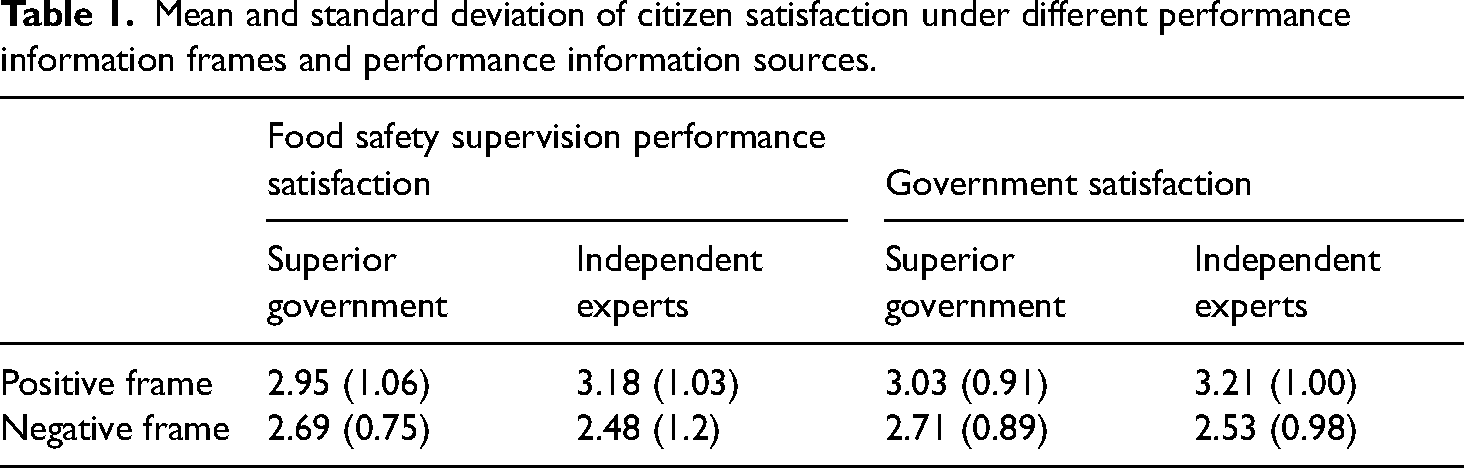
The moderating effect of the performance information sources was examined. We counted the scores of positive and negative frame groups on the two satisfaction indicators under different performance information sources (see Table 1). The results showed that the interaction effect between performance information frame and information sources was significant (p < 0.05) in both satisfaction indicators. Compared with performance information from superior government departments, the equivalent framing effect is more pronounced when the performance information comes from independent experts. Thus, Hypothesis 2 was verified. Figures 2 and 3 more intuitively show the moderating effect of performance information sources.
Mean and standard deviation of citizen satisfaction under different performance information frames and performance information sources.
Study 2: experiment on environmental pollution governance
Experiment 2 was conducted further to verify the equivalent framing effect of citizen satisfaction evaluation and to expand the results of Experiment 1. First, the scope of samples was expanded, making them more representative. Second, the public service situation was expanded to verify the stability of the equivalent framing effect under environmental pollution control scenarios. Third, the stability of equivalent framing effect under the background of poor performance is investigated from the perspective of trust in government.
Participants
In Experiment 2, we collected data through the Credamo questionnaire survey platform. Credamo has provided scientific research and education data services for teachers and students in more than 1800 universities around the world. The service has been used by scholars from top universities such as New York University, Hong Kong University of Science and Technology, Peking University and Tsinghua University.
In this study, Chinese samples in the platform were selected as respondents. The reason why we chose the Chinese sample is that China has been implementing a ‘vertical governance’ or ‘pyramid’ administrative management system, which increases the incentive effect of the government and officials by strengthening the horizontal competition of local government performance, which has always been the characteristic of local government governance in China (Li and Zhou, 2003; Zhou LA, 2007). Under such a performance evaluation system, the emergence of poor performance is an inevitable normal state, which provides an appropriate example to investigate the relationship between framing effect and citizen satisfaction. A total of 1218 people with independent Internet Protocol (IP) addresses completed the survey. After deleting invalid responses, 1173 valid data were obtained. Each respondent received a service fee of US$2. The participants covered 31 provinces in China.
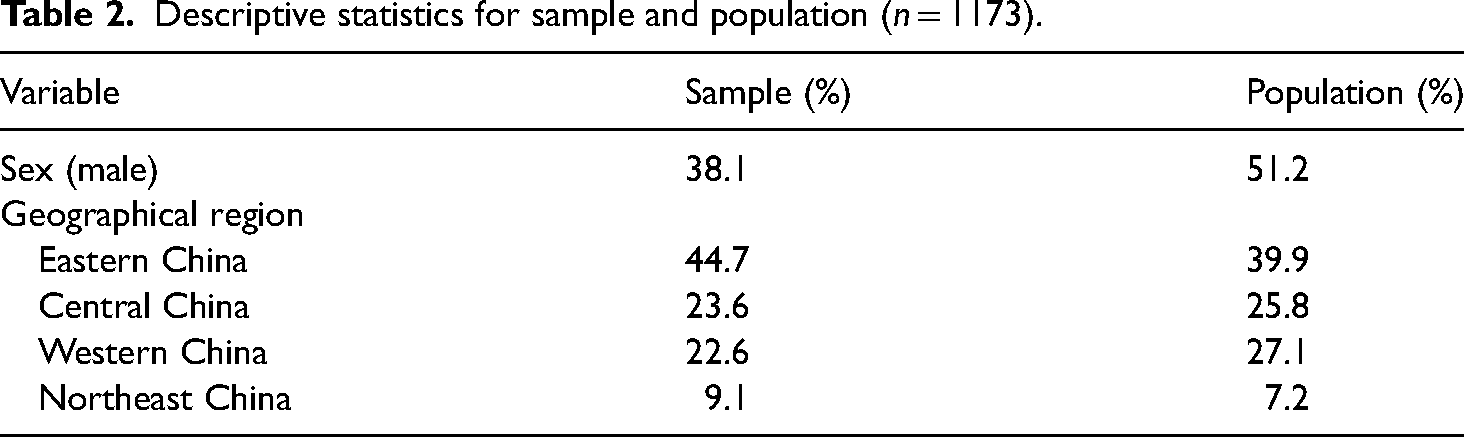
Table 2 provides the description of the sample, and shows the statistical results of two important demographic variables compared with the recent Seventh National Census in 2020: sex and region. 2 It can be found that although there is an inconsistency between the sample distribution and total population in terms of sex ratio, there is a very high representation in region of residence.
Descriptive statistics for sample and population (n = 1173).
We randomly assigned the participants to the positive and negative frame groups using the random block method. The balance test showed that subjects under the two experimental conditions did not show statistically significant differences in most control variables, which shows that the randomisation in our experiment was successful.
Experimental design and variable measurement
In Experiment 2, the performance information frame was considered the independent variable. The manipulation method is the same as in Experiment 1. Since the main effect of the performance information source was not found in Experiment 1, we only considered the information source of ‘superior government’ in Experiment 2 (which is the primary way for the Chinese government to disclose the performance of environmental pollution governance at present).
As for the measurement of trust in government, we learned from the practices of Kim (2010) and Kim and Lee (2012) and measured it through a single item: ‘Please indicate to what extent you trust the local government to operate in the best interests of society.’ While one item may not capture different aspects of public trust in government, this item can assess the extent to which citizens have confidence in public institutions to operate in the best interests of society and its constituents (McAllister, 1995). The item was rated on a 5-point Likert scale ranging from 1 (‘don’t trust at all’) to 5 (‘trust a lot’), with a higher score indicating greater trust.
The measurement of citizen satisfaction is the same as in Experiment 1.
Results
The framing effect of poor environmental performance governance on citizen satisfaction was examined. We counted the scores of respondents under the positive and negative frames on the two dependent variables of satisfaction. The results showed (see Figure 4) that the scores of the positive and negative frame groups on environmental governance performance satisfaction were 3.19 (SD = 1.11) and 1.67 (SD = 0.77), respectively, and the scores of government satisfaction were 3.33 (SD = 1.14) and 1.92 (SD = 0.83), respectively; moreover, the scores of satisfaction were statistically significant (p < 0.000). Thus, citizen satisfaction under the positive frame is significantly higher than that under the negative frame.
The moderating effect of trust in government was examined. The results showed that the regression coefficient of the independent variable reached a statistically significant level (β = 0.794, p < 0.001), the regression coefficient of the moderating variable also reached a statistically significant level (β = 0.542, p < 0.001) and the regression coefficient of the product term also reached a statistically significant level (β = 0.431, p < 0.001). Thus, it can be said that the relationship between the performance information frame and environmental governance performance satisfaction is affected by trust in government, which plays a positive moderating effect. Figure 5 shows the moderating effect.
Further, we used the same method to test the moderating effect of trust in government in the performance information frame on government satisfaction. The results showed that the regression coefficient of the independent variable reached a statistically significant level (β = 0.642, p < 0.001). The regression coefficient of the moderating variable also reached a statistically significant level (β = 0.580, p < 0.01) and the regression coefficient of the product term also reached a statistically significant level (β = 0.421, p < 0.001). Thus, the relationship between information frame and government satisfaction is affected by trust in government, which plays a positive moderating effect. Figure 6 shows the adjustment effect more intuitively.
Discussion
Through the two experiments, this study systematically discusses the equivalent framing effect of citizen satisfaction in the context of poor performance and examines the boundary conditions of this framing effect from the perspectives of performance information and government trust. First, we found that the citizens’ satisfaction evaluation in the context of poor performance has the equivalent framing effect, implying that the positive poor performance information frame can lead to higher citizen satisfaction, and the negative poor performance information frame can lead to lower citizen satisfaction. The equivalent framing effect also has a spillover effect. Second, such an equivalent framing effect has a certain fragility, showing heterogeneity with different sources of performance information and different levels of public trust in the government. Performance information from third parties and more public trust in the government have promoted the occurrence of the equivalent framing effect.
The findings offer three broader implications for public managers and future research. The first implication involves our understanding of poor performance or poor performance information. Although poor performance is not something anyone wants to face, it is not a scourge. The study reminds government staff and researchers that small changes in poor performance reports may significantly influence citizen satisfaction. Second, although minor changes in performance information descriptions can lead to a major change in citizens’ views on government satisfaction, this change is often fragile. The government should make more efforts to improve the public's confidence in performance information and in the government, which is a more important and stable method to improve citizen satisfaction. Third, and more importantly, our research reminds academic researchers that although we have found positive effects of the equivalent framing effect, we cannot rely too much on improving citizen satisfaction in poor performance situations simply by changing the presentation of performance information. This strategy is not a one-size-fits-all solution. It has conditions and limitations. In contrast with the positive effect of framing on individual consumption behaviour, in the public opinion field, we need to be more alert to the negative connotation of the equivalent framing effect because it implies that distributions of public preferences are arbitrary, and that political elites can manipulate popular preferences to serve their own interests. The behavioural insight based on information supply and presentation is not a perfect panacea and should be used with caution (Weimer, 2020). Public managers’ choice preference for decision plans based on different frameworks in the performance information report may lead to ‘deviations’. Therefore, we should find an alternative scheme to offset the equivalent framing effect (Belardinelli et al., 2018).
Limitations and directions for future research
Nevertheless, this study also has some limitations. First, the ecological validity needs to be further improved. In real life, performance information's presentation and influencing factors are often complex. These diversified performance characteristics and influencing factors may affect citizen satisfaction to some extent, which poses a threat to the external validity of the study. Second, we only investigated the equivalent framing effect under the poor performance situation with a percentile value of 30. However, poor performance is not a point but an interval. Whether there are differences in the probability of the framing effect of public satisfaction under different levels of poor performance situations (such as a percentile of 5, 10, 20, 40) is a question that needs further consideration.
Supplemental Material
sj-docx-1-ras-10.1177_00208523231173128 - Supplemental material for Is citizen satisfaction affected by the equivalent framing effect? A study based on situations involving poor government performance
Supplemental material, sj-docx-1-ras-10.1177_00208523231173128 for Is citizen satisfaction affected by the equivalent framing effect? A study based on situations involving poor government performance by Gao Xuede, Wang Qian, and Shen Xiyun in International Review of Administrative Sciences
Footnotes
Data availability statement
The authors confirm that the data supporting the findings of this study are available within the article.
Declaration of conflicting interests
The author(s) declared no potential conflicts of interest with respect to the research, authorship and/or publication of this article.
Funding
The author(s) received no financial support for the research, authorship and/or publication of this article.

Notes
References
Supplementary Material
Please find the following supplemental material available below.
For Open Access articles published under a Creative Commons License, all supplemental material carries the same license as the article it is associated with.
For non-Open Access articles published, all supplemental material carries a non-exclusive license, and permission requests for re-use of supplemental material or any part of supplemental material shall be sent directly to the copyright owner as specified in the copyright notice associated with the article.
