




Abstract
Establishing government agencies outside ministerial departments is frequently justified by a need to safeguard agency autonomy. In addition to ‘formal agencification’, that is, erecting formal barriers between agencies and ministries, agencies are also frequently (re)located physically distant from ministries to both signal and strengthen agency autonomy. However, we know little of the effects of physical location and distance on agency autonomy. Using two large surveys from 2006 and 2016, this study examines how geographical location and distance affect agency autonomy. Our study establishes that agency autonomy is only weakly associated with physical location and distance, and is much less important than political salience. Whereas a conventional claim is that agency autonomy may be strengthened by physically (re)locating agencies at arm's length distance from the core executive, our study suggests that physical (re)location represents an ineffective administrative policy design-tool when applied to agency autonomy.
Points for practitioners
Physical distance between agencies and parent ministries is only remotely associated with agency autonomy.
Physical location thus represents an ineffective design-tool if the purpose is to increase agency autonomy
Introduction
A generic puzzle in public policy and administration (PPA) is the relations between ministerial departments and semi-detached agencies (Verhoest et al., 2012). During the last couple of decades, we have witnessed a transfer of government activities to agency-like organizations semi-detached from ministerial departments, labelled ‘agencification’. Governments have established agencies at arm's length from ministerial departments to handle regulatory and administrative problems both at the national (James and van Thiel, 2011; Pollitt et al., 2004; Verhoest et al., 2004) and international level (Egeberg and Trondal, 2017). Decades of agencification have attracted considerable scholarly attention, accompanying a rapidly growing literature on agency histories, reform experiences, and the effects of agencification. In this research, a recurrent theme has been agency autonomy (Bach et al., 2020; Christensen and Lægreid, 2006; Egeberg and Trondal, 2009, 2017; Maggetti, 2012; Maggetti and Verhoest, 2014; Lægreid and Verhoest, 2010; Pollitt and Bouckaert, 2004; Pollitt et al., 2004; Verhoest et al., 2010).
Still, a noticeable void persists in this literature, which pertains to the general lack of studies of the spatial dimension of agencification. Although an old topic of administrative science (e.g., Gulick, 1937), the effects of agency location and distance from ‘mother ministries’ is surprisingly overlooked by PPA scholarship (see Vogel and Hattke (2022) for a systematic review). The absence of the spatial dimension in the literature on the effects of agencification is puzzling for two reasons. The first is, because agencification is frequently directly associated with processes of geographical relocation, that is, moving agencies physically from the capital where government ministries reside, towards peripheral cities. Arguments for relocating have been to reduce corrupt behavior by increasing social distances between principals and actors, to smooth regional inequality by moving high competence jobs outside the capital, to reduce budgets by moving civil servants to less costly locations, and to unclog the larger cities through decreasing commuting to the center of the capital (Economist, 2019; Jeon and Lee, 2021, Faggio, 2019; Marshall et al., 2005; Wang and Liu, 2022). Geographical location and relocation of government institutions also tend to mobilize more attention and resistance from stakeholders than, for example, (re)organizing such institutions (Meyer and Stensaker, 2009). Intense protest from employees seeing their jobs moved to another geographical area, in alliance with local politicians fighting against moving jobs out of the municipality and county, are recurrent.
Second, practitioners often justify contested agency relocations by claiming that physical distance would underpin the autonomy of agencies from their ministerial departments. For instance, when the Norwegian government decided to move several government agencies from the capital Oslo, the responsible minister claimed that ‘the agencies would gain stronger independence outside of Oslo’ (Norman, 2004: 98, authors’ translation). The minister argued in the succeeding parliamentary debate that ‘relocation is good agency policy because it contributes to increased de facto independence’ (Hommen, 2003: 39, authors’ translation). The geographical dispersion of government agencies was thus considered as an instrumental device in administrative policy. Similarly, the European Commission occasionally views geographical dispersion of European Union (EU) agencies as part of its administrative policy toolkit (Ebinger et al., 2011). During the last couple of decades, agencification has become a persistent phenomenon in the EU (Busuioc et al., 2012; Ongaro et al., 2012). More than 30 EU agencies have been established and have become geographically spread throughout the European continent. Agencification at EU-level not only has contributed to a consolidation of executive powers of the Commission, although at arm's length distance from political oversight by Commissioners (Egeberg and Trondal, 2011b), but also made the EU’s core executive geographically scattered. With reference to the geographical localization of EU agencies, the European Commission has argued: ‘[T]he fact that regulatory agencies are spread around the EU, whilst executive agencies are housed in Brussels or Luxembourg, is just the most obvious symbol of their very different relationship with the Commission’ (European Commission, 2008: 3). The Commission also considers that the agency's geographical seat is a constituent element of the basic act, which is the legal foundation when establishing an agency, and should therefore be included in it (Chamon, 2016: 64; European Commission, 2005: 4; Szapiro, 2005: 3). With these points in mind, it is surprising that there are few studies on the effects of the spatial or geographical dimension on agency autonomy (for an exception, see Egeberg and Trondal (2011a)).
This study aims to fill this void by studying the effect of physical distance between agencies and ministries on agency autonomy. Autonomy entails the ability of an actor to convert one's preferences into authoritative decisions, without external constraints (e.g., Maggetti, 2007). By assuming that actors are likely to act on the basis of the autonomy they perceive to have, the analysis examines the perceived policy autonomy of agency employees vis-à-vis the parent ministry, as measured on the following dimensions: (a) interaction intensity, (b) the importance of the ministry when making decisions, and (c) and the weight given to steering signals from the ministry.
The study is based on two large-N surveys among Norwegian government agencies in 2006 (N = 1452) and 2016 (N = 1963). Since the Norwegian central administration encompasses agencies that are located both in the capital (Oslo) and in peripheral cities, this constitutes a valuable research laboratory on the effects of agency location. In addition, since the political cleavage structure in Norway has an inherent spatial dimension (center–periphery), this study might be considered a most likely case of the effects of spatial location and distance on agency autonomy (Rokkan, 1999).
An analytical framework
Agencification signifies a transfer of government activities to administrative bodies vertically specialized outside ministerial departments, as well as new establishments. Historically, government portfolios have been organized as vertically integrated governmental structures, in which government portfolios are arranged as ministerial departments, and/or as vertically specialized structures in which government portfolios are divided between cabinet-level departments and decentred agencies (Trondal, 2014; Verhoest et al., 2012: 3). Across time, agencies have travelled in and out of ministerial departments, often in recurring patterns (Aucoin, 1990; Hood and Jackson, 1991; Pollitt, 2008; Verhoest et al., 2007). By an agency we mean an administrative body that is organizationally detached from a cabinet-level department, permanently responsible for public tasks at a national level, staffed with permanent civil servants, financed mainly by the state budget, and subject to public accountability routines. Although respective ministers keep overall political accountability for agency activities and results, agencies enjoy both de jure and de facto autonomy from their respective ministerial departments as regards decision-making (Maggetti et al., 2022; Pollitt and Talbot, 2004; Verhoest et al., 2012).
Studies show that formal agencification has noticeable effects with respect to political steering and bureaucratic autonomy. Egeberg and Trondal (2009, 2018) show that agency officials pay significantly less attention to (policy) signals from executive politicians than do officials in ministerial departments. Thus, vertical organizational specialization of the government apparatus matters for agency autonomy. This relationship seems also to be robust when controlling for portfolio, public contestation, officials’ rank, and time (Egeberg and Trondal, 2009).
Geographical relocation is a form of physical agencification, where the essential element is increased geographical distance between the agency and the core executive and their ministerial departments. Drawing on studies of interaction between individuals within groups and organizations (Olson and Olson, 2000), between members in geographically distributed teams (Hinds and Mortensen, 2005; Polzer et al., 2006), and between organizations in policy networks (Sohn et al., 2020), interaction seems to decrease when physical distance between actors increases. The basic causal mechanism explaining this is that small physical distances lower the threshold for direct contacts between persons or groups. No matter what other channels of communication are available, studies suggest they are not capable of completely substituting the richness and ease of direct social interaction that physical proximity facilitates (Olson and Olson, 2000). Consequently, the first hypothesis proposes – ceteris paribus – that:
There are, however, two caveats to this argument. First, studies suggest that the effect of physical distance on interaction is graded according to the type of physical distance. Kraut et al. (1990) show that physical distance between floors in the same building is more disruptive to interaction than distance within the same floor, while distances between buildings are more disruptive than distances within buildings. Thus, it is plausible that the main effect of physical distance on interaction is realized by separating agencies and the core executive within different buildings, and that additional geographical distance, for instance location in different cities, is less important. Second, the (limited) research on physical distance and interaction also suggests that it is mainly personal and direct face-to-face interaction that is affected (Olson and Olson, 2000). With digital communication platforms in governments, it is plausible that physical distance becomes less important for direct interaction over time. Moreover, a waning effect of physical location on interaction is likely to be observed during the last decades owing to increased telecommuting and remote work. If this argument holds, we expect a weaker effect of physical distance on interaction over time. A second hypothesis is thus derived:
Additionally, physical (re)location is often used by political leaders to symbolize political priorities. Locating an agency remotely vis-à-vis the core executive may send a signal that the two entities are, at least partly, disconnected. This in turn may increase the perceived or psychological distance between employees in the agency and the core executive. Psychological studies on persuasion and social impact suggest that perceived physical distance also makes it more difficult for an actor in a relationship to change the opinion of the other (Latane et al., 1995; Moon, 1999). Transferring these findings to the relationship between an agency and the core executive, we may suggest that physical distance will make it more difficult for the core executive to persuade agencies in matters where they hold adjacent preferences. A basic premise in much PPA research is that agencies are established as professional bodies that prioritize expertise over other concerns (Ossege, 2016; Verhoest et al., 2012). This may, however, come into direct conflict with political wishes and needs for compromise (Jacobsen, 2006). In such instances, agencies located at a geographical distance may give less heed to political signals, as well as the other way around – such that agencies enjoy less influence on political decisions. This argument leads to the third hypothesis:
The arguments leading up to these hypotheses do not control for variation between agencies.
First, each agency has different task profiles with different attributes, making some of them more political salient than others (Wlezien, 2005). Although the concept of political salience has mostly been used in electoral studies, it is equally relevant for studies of the relationship between agencies and the core executive. Studies suggest that the political salience of an issue affects interaction between experts and decision makers. For instance, political salience of an issue leads ministers to prefer direct ministerial control over the arm's-length principle (Dudley, 1994), produce more elaborate political accountability procedures for agencies (Koop, 2011), have more intense consultation between experts and US congress members (Fagan and McGee, 2020), and limit the possibilities of professional staff employed by the European Parliament influencing political decisions (Dobbels and Neuhold, 2013; Neuhold and Dobbels, 2015). Thus, we may expect that the political salience of the main task of an agency may ‘override’ any effect of physical distance. In sum, the higher the political salience, the denser the interaction between the agency and the core executive, and the more emphasis is likely to be given to political signals from the core executive. Second, agencies are also hierarchical organizations with different responsibilities allocated to different levels inside of the agency. Consequently, both interaction and emphasis given to signals from the core executive may vary between hierarchical levels within the agency. Studies show that interaction between agencies and the core executive is most intense among top officials (Egeberg and Trondal, 2018; Verhoest et al., 2012). Thus, the effect of physical distance is likely to vary between hierarchical levels. It is plausible that the effect of physical distance is strongest for employees at the lower levels because they rely on informal information and contacts owing to their limited access to formal decision venues. It may also be that the effect will be weaker for lower-level staff since their direct contacts with ministers and ministries probably are less intense in the first place. As it is difficult to predict a priori whether the effect of physical distance – if any – will be stronger or weaker at the higher than at the lower echelons of the agency, we do not propose a specific hypothesis.
Data and methods
The research context (the Norwegian central administration) is characterized by ministerial primacy where subordinated agencies are subject to political control and administrative accountability from the responsible minister. Whilst Norwegian ministries are secretariats for the political leadership (Christensen and Lægreid, 2006), agencies are mainly responsible for advising ministries and being technical helpers, but are also essential ingredients in the political processes when preparing, implementing, and administering policies.
The analysis benefits from two large-N questionnaire studies conducted among Norwegian government agencies in 2006 and 2016 (N-total = 3415). Both surveys were fielded to agency officials at the ‘A level’, which includes staff having non-clerical portfolios and with at least one year in office. The surveys were distributed to a randomly selected sub-sample of every third official. In 2006, the sample consist of 1452 respondents (response rate = 59%), while in 2016 1963 respondents provided valid responses (response rate = 60%). The number of respondents in the following analyses will be somewhat lower owing to missing data on specific variables. The high response rate is, moreover, a guarantee for high representativity of the sample, even though there are varying response rates between agencies (although none are lower than 50%). The representativity on the variables hierarchical level, gender, and age is high. The data do not constitute a panel, and it is thus not possible to study individual changes over time.
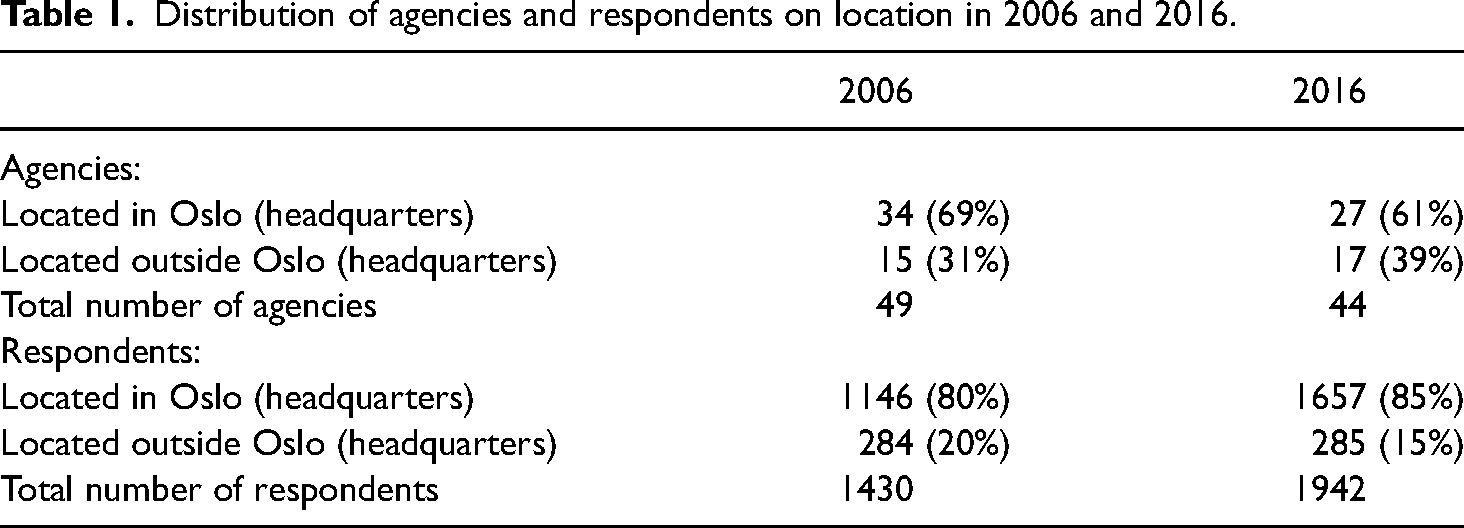
The independent variable – physical distance – was measured by mapping the addresses of all agencies present in the two surveys, and is coded in three different ways: (a) as a dummy, with 1 being located outside the capital (Oslo), and 0 indicating location in Oslo, (b) as travel distance in minutes between actual location and the capital by using Google maps and shortest travel time, and (c) as the distance in kilometers (straight line) between the location and the capital. Agencies located in the capital were coded as 0 also on the measures (b) and (c). Location is identified by the address of the agency headquarters (HQ), even though the activities of several of the agencies are geographically distributed to multiple locations. The effect of this variable should thus be interpreted as changes when physical distance increases between the agency and the parent ministry. Table 1 shows the distribution of number of agencies and number of respondents located in and outside the capital in 2006 and 2016.
Distribution of agencies and respondents on location in 2006 and 2016.
Three items were selected to measure agency autonomy vis-à-vis the parent ministry. The first (‘interaction’) consists of two questions regarding contact with: (a) political leaders in own ministry, and (b) civil servants in own ministry. Response alternatives range from 1 (never) to 4 (approximately every week). The bivariate correlation between the two is low (Pearson's r = .40 (2016), .46 (2006)), and Chronbach's alphas are .52 (2016) and .58 (2006), indicating that having contact with the political level constitutes a qualitatively different phenomenon than having contact with ministry officials. We thus decided to keep both as separate dependent variables. The second item (‘weight to signals from parent ministry’) is tapped by two questions formulated as the weight given to signals from: (a) political leaders in own ministry and (b) civil servants in own ministry when conducting daily work. Response alternatives range from 1 (very little) to 5 (very much). The bivariate correlation between the two is high (Pearson's r = .69 (2016), .72 (2006)), and Chronbach's alphas are .81 (2016) and .83 (2006), indicating that signals from the ministry are regarded as equal to signals from the political leadership of the ministry. The two items were then merged into one summative variable. The third item consists of one question concerning the importance of the parent ministry (‘importance’) when central decisions are made within the agency's policy field. Response alternatives range from 1 (little importance) to 5 (great importance).
We thus measure individual perceived autonomy from the parent ministry, and it is assumed that these perceptions reflect the de facto autonomy of the agency they are working in. A statistical check (intraclass correlations) indicates systematic clustering of perceptions at the agency level. Although the ICCs are not large (ranging from 0.3 to 0.8 (2016) and from 0.6 to .12 (2006)), they are significantly different from zero at the .05 level at both times. This partially supports the assumption that individual perception of autonomy at least partly reflects agency autonomy.
In addition, two variables are included as indicators of political salience. First, it is tapped by one question in the survey: ‘To what degree is your policy area a topic in the public debate?’ Response alternatives range from 1 (very little) to 5 (very much). Second, it is tapped by distinguishing between agencies that are mainly regulatory or non-regulatory. Acknowledging that the brute distinction between regulatory and non-regulatory institutions is never clear-cut (Lobel, 2012; Yasuda, 2022), we expect that regulatory agencies, in general, generate more political attention owing to their direct role in implementing and administrating regulatory policy. Regulatory agencies are defined as agencies with tasks devoted to developing and elaborate laws (named ‘directorates’ in Norwegian) and/or to supervise and sanction rules and regulations (named ‘tilsyn’ in Norwegian). Non-regulatory agencies do service provision, such as Statistics Norway, Norwegian Industrial Property Office, and the Children's Ombudsman. Following from this, 18 of the 58 agencies are defined as non-regulatory. Finally, vertical specialization is measured by the respondent's hierarchical position, ranging from advisor/specialist (1) to leader of department or higher (4). Table 2 displays the bivariate correlations between the variables in 2006 and 2016.
Bivariate correlations (Pearson's r) and univariate statistics (mean. standard deviation) for dependent and independent variables N2006 = 1425–1453. N2016 = 1942–1966.
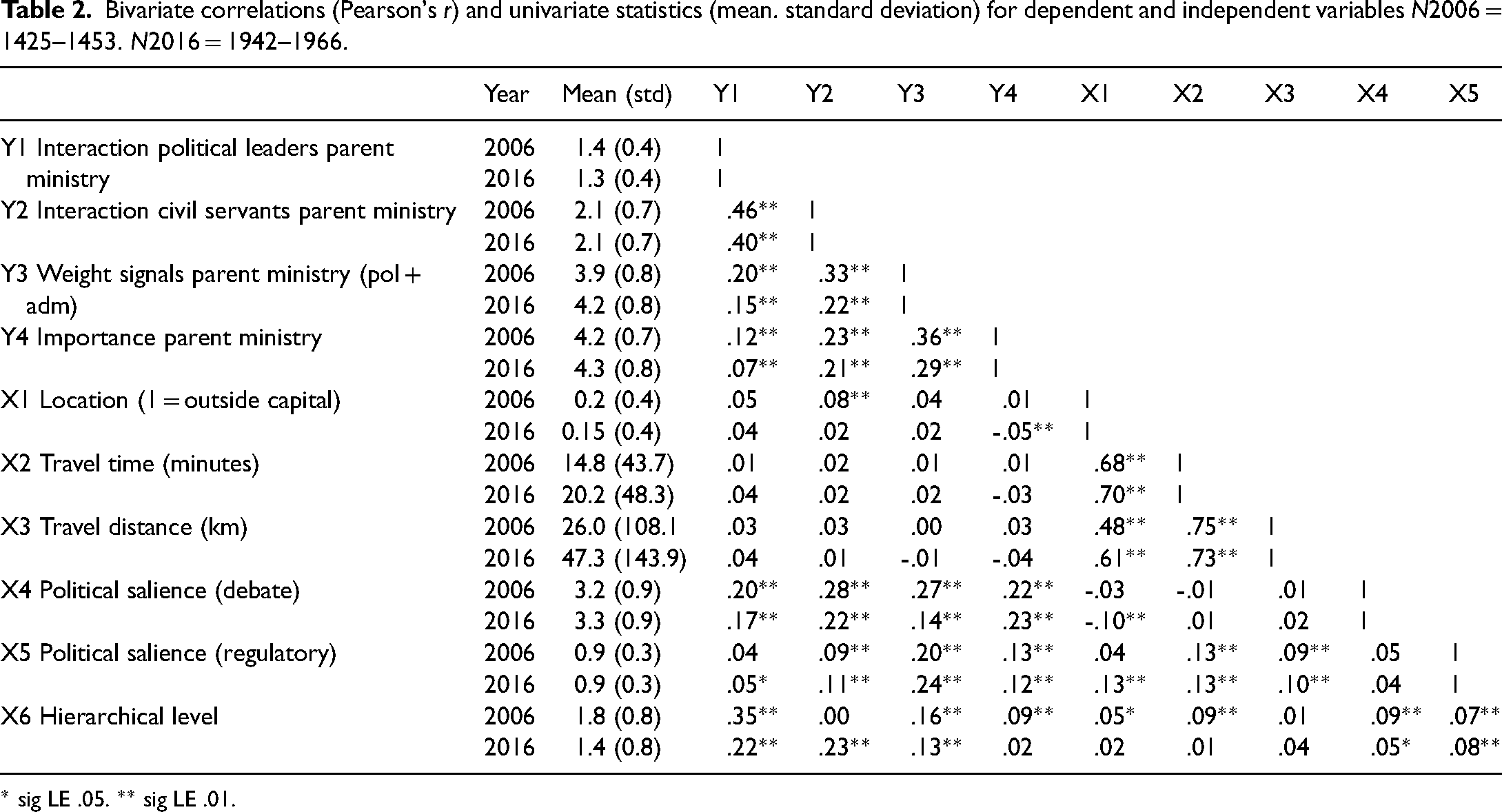
* sig LE .05. ** sig LE .01.
Multilevel regression (maximum likelihood). Coefficients (standard error).
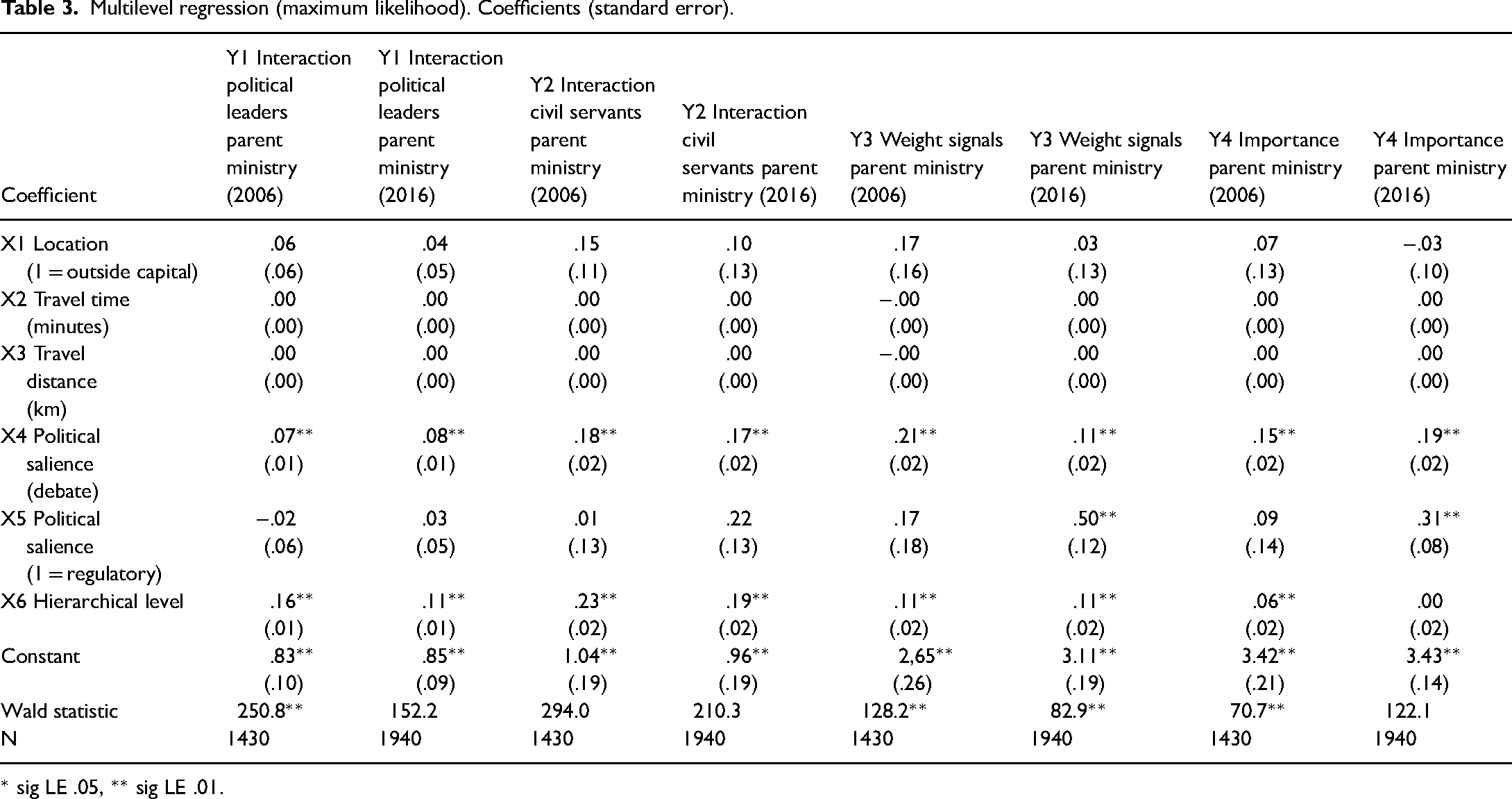
* sig LE .05, ** sig LE .01.
The univariate statistics indicate high stability on most indicators. There is a significantly higher number of lower-level civil servants in the 2016 sample than in the 2006 sample. The correlations between physical location/distance and the dependent variables are weak and mostly non-significant with two exceptions (more interaction with civil servants in the parent ministry in 2006, and less importance given to the parent ministry in 2016). Agencies located outside the capital Oslo reported less public debate on their work in 2016, but not in 2006. This may be owing to the intense debate on the geographical relocation of four agencies during the period of observation.
There is a two-level structure in the data: civil servants embedded in agencies. To check for significant clustering at the agency level, the intraclass correlation coefficient (ICC) is estimated for all four dependent variables in both years. The ICCs are not large (see above), but large enough to justify the use of multilevel analysis (MLA) (LeBreton and Senter, 2008). Likelihood-ratio-chi-square tests for the variation between the intercepts are also significant at the .01 level. As MLA gives us the possibility to control for unobserved characteristics of each agency, we decided to opt for such an analysis.
Results
The general equation to be estimated is:
Table 3 suggests no statistically significant effects of agency location and distance on any of the dependent variables at the two observations points. Consequently, agency autonomy seems not to be affected by their geographical location and the physical distance and travel time between the agency and the parent ministry. The table does, however, show low but statistically positive effects of both hierarchical structure and political salience (both by the subjective measure of public debate and the objective measure of regulatory versus non-regulatory agency) on agency interaction with the ministries, and thus agency autonomy. Several robustness tests were conducted. First, we entered the three main independent variables separately and in different combinations, then the control variables separately, finally comparing them with the full models. The results are almost identical to the bivariate correlations displayed in Table 2, and do not alter the results in the full models. Second, we compared the MLA model with ordinary least squares (OLS) regressions. The coefficients and significance levels were strikingly similar, as well as the R2 from the OLS compared with the Snijder/Bosker R2 at level 1. We also had the possibility to compare changes in the four dependent variables for those agencies that relocated geographically during the study period, i.e., an approximate test of the effect of relocation. Five of the agencies existing in 2016 were physically relocated at the beginning of the 10-year study period. This subsample counts 115 respondents in 2006 and 112 in 2016. The analysis (available from the authors on request) provides no results contradicting the main findings reported in Table 3: physical relocation has no or marginal effects on agency autonomy. There are changes in observed interaction, weight to signals from the parent ministry, and perceived importance of the parent ministry when taking decisions in own policy area, but these follow similar paths over the study period for both relocated agencies and agencies located in the capital during the study period.
Conclusion
When delegation of tasks to independent agencies started gaining momentum with an ever-growing number of agencies being delegated far-reaching responsibilities (i.e., decision-making and quasi-regulatory tasks), anxiety arose at the possibility of them escaping democratic accountability and control. Scholars pointed to the possible consequences of locating authority and administrative capacity in the hands of agencies operating at arm's length from democratic control and appointed agency heads who cannot easily be held accountable for their actions (e.g., Christensen and Lægreid, 2006; Curtin, 2005; Dehousse, 2008; Egeberg and Trondal, 2017; Everson, 1995; Flinders, 2004; Pollitt and Bouckaert, 2004; Shapiro, 1997; Verhoest et al., 2010; Vos, 2000, 2005; Wettenhall, 2005; Williams, 2005). Several studies of de jure agency autonomy and accountability have been provided (Chiti, 2000, 2009; Vos, 2000, 2005) while fewer studies of de facto autonomy are available in extant literature (but see Busuioc, 2010a, 2010b). This bias moreover reflects a general divide between PPA and legal scholarship (Vogel and Hattke, 2022: 6). Several studies have examined the autonomy of such agencies from their parent ministries, both de jure (e.g., Chiti, 2000, 2009; Vos, 2000, 2005) and de facto (Bilodeau et al., 2007; Egeberg and Trondal, 2009; Overman and van Thiel, 2016; Verhoest et al., 2010; Verhoest et al., 2012). This literature stresses how agency autonomy derives from the constitutive rules on which agencies are based and the legal framework in which they are operating, as well as organizational and institutional characteristics. Yet, the vast literature on agencies has so far not examined the effect of geographical location on agency autonomy. Even though agencification tends to be combined with geographical relocation (Marshall, 2007; Marshall et al., 2005; Faggio, 2019; Saetren, 2016; Trondal and Kiland, 2010), a systematic review of PPA literature (Vogel and Hattke, 2022) suggests that no studies have analysed whether physical distance between the agency and the parent ministry has consequences for agency autonomy.
The main conclusion to draw from this study is that physical distance also over time is remotely associated with agency autonomy, and is much less important than political salience. This is in line with previous studies (Egeberg and Trondal, 2011a) suggesting that agency (re)location does not make a significant difference for agency autonomy, agency influence, and inter-institutional coordination. Consequentially, our study does not support either Hypothesis 1 nor Hypothesis 3. As physical distance does not have any significant effects on any of the dependent variables neither in 2006 nor in 2016, we are furthermore not able to detect any effect of the time dimension. Thus, the data does not provide any support for hypothesis 2. Focusing on the relationship between agency officials and their reported interaction with and perception of their parent ministry, the study gives no indications that physical distance decreases institutional interaction, nor does it systematically increase psychological distance resulting in giving less emphasis to signals from the parent ministry. This might partly be because government agencies are already semi-detached and highly specialized bodies whose ‘need’ for being steered, or coordinated with others, is modest.
This ‘non-finding’ is interesting, with direct consequences for government policymaking. In short, even if agencies are geographically relocated, their place and role in the central administration are not profoundly affected. Although direct and face-to face interaction may decrease with increasing physical distance (something we do not have data on in our study), the total interaction is not affected, neither positively nor negatively. We also show that the importance of the parent ministry is not affected by the physical distance of agencies, and in the cases where we were able to study change over time, we do not find significant differences between those being relocated during the study period and those located in the capital physically close to the parent ministry. However, since the study does not provide panel data, we are not able to establish changes at actor-level. However, we can measure aggregate or combined numbers of respondents within each agency.
One underlying assumption in agency literature is that agencies do what their creators want them to do. The observations presented in this study challenge this conventional claim as regards the effect of physical location of government agencies. Despite agency (re)location tending to be justified by increased agency autonomy, our study establishes that agency autonomy is only weakly associated with the physical location. This ‘non-finding’ does not only have implications for theory but also for practice: whereas a conventional belief is that agency autonomy may be strengthened by physically relocating agencies at arm's length distance from the core executive, our study suggests that physical relocation does not serve as a valuable toolkit of administrative policy. Physical location indeed represents an ineffective design-tool when applied to agency autonomy.
The current study, and the conclusions derived from it, add to a still rather meagre body of research on the role of physical location and geography in PPA scholarship. However, the findings are limited to one national setting, to agency personnel, and to one way of operationalizing autonomy. The results suggest how agency employees perceive their room for maneuver. Since autonomy is relational, additional data on ministerial personnel would enrich our knowledge on the role of physical distance substantially. We moreover suggest that similar research should be conducted in countries with different geographies and administrative structures and cultures, as well as bringing in other measures of autonomy. The inclusion of qualitative research designs may also widen our understanding of under what conditions – if any – physical distance/proximity bias the autonomy of agencies. Together, such studies should outline institutional geography as an important new subfield of PPA scholarship.
Footnotes
Data availability statement
Data are available at Norwegian Centre for Research Data (NSD).
Declaration of conflicting interests
The author(s) declared no potential conflicts of interest with respect to the research, authorship, and/or publication of this article.
Funding
The author(s) received no financial support for the research, authorship, and/or publication of this article.
