




Abstract
In recent years, governments have increased their efforts to strengthen the citizen-orientation in policy design. They have established temporary arenas as well as permanent units inside the machinery of government to integrate citizens into policy formulation, leading to a “laboratorization” of central government organizations. We argue that the evolution and role of these units herald new dynamics in the importance of organizational reputation for executive politics. These actors deviate from the classic palette of organizational units inside the machinery of government and thus require their own reputation vis-à-vis various audiences within and outside their parent organization. Based on a comparative case study of two of these units inside the German federal bureaucracy, we show how ambiguous expectations of their audiences challenge their organizational reputation. Both units resolve these tensions by balancing their weaker professional and procedural reputation with a stronger performative and moral reputation. We conclude that government units aiming to improve citizen orientation in policy design may benefit from engaging with citizens as their external audience to compensate for a weaker reputation in the eyes of their audiences inside the government organization.
Many governments have introduced novel means to strengthen citizen-centered policy design, which has led to an emergence of novel units inside central government that differ from traditional bureaucratic structures and procedures. This study analyzes how these new units may build their organizational reputation vis-à-vis internal and external actors in government policymaking. We show that such units assert themselves primarily based on their performative and moral reputation.
Introduction
In recent years, governments have aimed toward strengthening their collaboration with citizens in policy design, therefore readjusting procedures of policy formulation (Tõnurist et al., 2017; Romero Frías and Machado, 2018; McGann et al., 2018, 2021; Olejniczak et al., 2020). Next to new methods and instruments in policy formulation, these efforts have also brought novel units inside ministerial bureaucracies. They come under different names and differ from other units inside the bureaucratic organization, and employ unconventional tools such as, e.g., pilots, experiments, nudging, and data analytics (Olejniczak et al., 2020; Mergel, 2019; Fleischer and Carstens, 2021; Evans and Cheng, 2021). As a result, a ‘laboratization’ of central government has begun, which may enable novel forms of collaboration toward external actors such as citizens but also challenge interactions between government entities.
As many others, the German federal government has committed itself to more citizen-oriented policy design to enable “new ways of (not only digital) collaboration, e.g., across sectors or authorities” (BKAmt, 2019: 18–19; see Kernaghan, 2005). New units have been established to innovate the citizen orientation in policy formulation that deviate from the existing palette of formal structures, also in their methods and ways of working. Whereas some of these novel citizen-oriented units address specific policy challenges, others have a more generic mandate for improving the means of government policymaking, yet oftentimes focused on digital tools (Williamson, 2015; Mergel, 2019).
This paper addresses the organizational reputation of these novel units and asks how it contributes to their role in executive politics. As these units depart from pre-existing formal structures, mandates, and working methods inside ministerial bureaucracies, they require their own and distinctive organizational reputation. Organizational reputation refers to the relationships that organizational actors establish with the various “audiences” in their environment (Carpenter, 2001). We argue that novel units inside a government organization are particularly interested in establishing and maintaining their organizational reputation. On the one hand, this reputation is necessary to establish their role in executive politics and to support them in exerting influence in the policy process. For their internal role in government, not only internal audiences are relevant but also external audiences that have regular interactions with other executive units. On the other hand, this reputation is needed to reinforce their innovative mandate and methods. Given that the prerogatives of a ministerial bureaucracy do not provide much leeway for deviating from traditional bureaucratic structure and behavior, organizational reputation can transport and solidify their innovativeness.
Our paper aims to study how especially novel units in government establish their organizational reputation and utilize it to shape their role in executive politics. Current research is particularly interested in the relationship between bureaucratic reputation and autonomy (Busuioc and Lodge, 2016; Busuioc and Lodge, 2017; Carpenter, 2001; Bellodi, 2022). Researchers have also discussed the importance of reputation for inter-agency relations and collaboration (Blom-Hansen and Finke, 2020; Busuioc, 2016; Maor, 2010; Moynihan, 2012). Most empirical applications, however, have focused on delegated agencies (for an exception see Blom-Hansen and Finke, 2020). We show that the bureaucratic reputation framework is also suitable and useful for distinct organizational units inside ministerial organizations if they are novel to a given government organization and depart from institutionalized structures and procedures.
From a bureaucratic reputation perspective, novel citizen-oriented units need to develop their organizational reputation rather rapidly, addressing various audiences. Inside the bureaucracy, other units within their parent ministerial department are a crucial audience for their reputation, ranging from those units close to the political leadership to the large number of policy units in the line hierarchy tasked with policy design. Other ministerial departments are important audiences as well, as the executive builds upon cross-departmental interactions and collaboration to complete their tasks in policy formulation. Outside the bureaucracy, citizen-oriented units are mandated to engage in innovative ways to interact with external stakeholders and especially with citizens. These audiences may express very different expectations toward the novel units and their reputation. Whereas other bureaucratic entities may demand little deviance from existing structure and procedure to reduce their own transaction costs when engaging with these novel “animals in the zoo” (Hood 1986: 183, 188), external audiences may seek easier access to the ministerial bureaucracy and policy design, extend their relationships to adjacent units next to the novel ones, or expect a new and innovative handling of tasks that explicitly deviates from other parts of their parent ministerial department.
We investigate two novel citizen-oriented units inside the German federal government, which is widely regarded as close to the Weberian ideal type and therefore well suited to ascertaining the organizational reputation of novel units, as they are supposedly different from the organizational structure. The two units are the Policy Lab on Digital Work & Society (DW-Lab) inside the Ministry for Labor and Social Affairs and the Citizen-Centered Government Unit (CCG-Unit) inside the Federal Chancellery. Based on expert interviews with unit officials and other actors in regular contact with these units as well as a media and document analysis, we assess and compare the organizational reputation of these units throughout the first years of their existence. Our findings show that the organizational reputation of these units varies. The DW-Lab is strongly linked to societal groups and has built a broader reputation than the CCG-Unit oriented toward internal government actors. Patterns of reputation result in different roles and influence in executive politics. Whereas the DW-Lab gained and expressed substantial policy influence—also setting issues on the agenda—the CCG-Unit acted rather as a backend and service entity that shaped policies more indirectly (e.g., by pushing novel methods for identifying alternative policy solutions).
The remainder of the paper is structured as follows. The next section provides our theoretical argument and explains how the bureaucratic reputation framework may be applied to units inside government organizations. The following section provides a brief context of the German federal bureaucracy to inform our case selection. The empirical analysis is a presentation and comparison of our case study findings, along the key theoretical dimensions of organizational reputation. We conclude by discussing the advantages of a reputation framework for understanding bureaucratic behavior at the core of governments and for scholarly and practitioner debates over innovative units in governments.
Organizational reputation and executive politics
Bureaucratic reputation is an established theoretical perspective to understand and explain bureaucratic behavior, usually of regulatory agencies (Carpenter, 2010). To begin with, organizational reputation is an exogenous assessment and encompasses “symbolic beliefs about an organization—its capacities, intensions, history, mission—and these images are embedded in a network of multiple audiences” (Carpenter, 2010: 33). Thereby, organizational reputation is transactional, and it connects distinct audiences in an organization's environment with organizational behavior. The bureaucratic reputation framework has been most often applied to empirical research on how public sector organizations manage their audiences, thus focusing on “external behavior” (e.g., Lee and Van Ryzin, 2020). However, organizations’ internal structures and decision-making processes are relevant for understanding their reputation management (Carpenter, 2002; 2010). Some have described this as “organizational politics” (Blom-Hansen and Finke, 2020). Once public sector organizations engage in reputation management, they need to allocate resources, engage in adaptations of internal organizational procedures and structures, eventually triggering intended and unintended organizational dynamics (Blom-Hansen and Finke, 2020; Maor and Sulitzeanu-Kenan, 2013).
We argue that organizational reputation is also crucial to understand bureaucratic actors’ roles in executive politics. For organizational units inside government organizations, their reputation is inherently embedded in their parent organization's reputation. However, empirical research examines different organizational units such as the directorates-general of the EU commission, conceptualized as different branches of a regulatory administration (Blom-Hansen and Finke, 2020). Moreover, recent scholarship on formal structures of government shows a variety of organizational palettes, yet only very few units can be regarded as structural outliers (Carroll et al., 2020; Bertels and Schulze-Gabrechten, 2020). Most of these units have been established rather recently and thus may require a distinct reputation to fulfil their mandate and succeed in executive politics. Whereas internal audiences may question their capabilities to follow bureaucratic procedure and ensure the achievement of government goals, external audiences may experience these units as novel access points into the process of government policymaking. Executive politics is populated by a plethora of external actors, yet most of them are incorporated via standing participation processes involving interest groups, think tanks, consultancies, and other private sector stakeholders. These novel units innovate by engaging with other actors, most notably citizens, and they set up new participation formats. However, their needs in organizational reputation are likely to be phased out throughout their evolution, the more they amalgamate with their organizational environment over time.
The organizational reputation of bureaucratic actors has been characterized across four dimensions (Carpenter 2010: 57), emphasizing that public sector organizations engage with different audiences having different expectations and demands (Overman et al., 2020; Maor et al., 2012; Moschella and Pinto, 2019). Hence, the reputation framework focuses on organization's relationships and many empirical studies analyze organizations’ strategic communication, including deliberate silence, to understand reputation (Maor et al., 2012; Gilad et al., 2013). The dynamics of reputation management also matter for units inside government organizations. These units can engage in establishing durable connections with their audiences, respond to audiences’ demands in deliberate and strategic communication, and benefit from certain organizational features of internal structures and procedures that allow them to achieve their reputation. Differentiation of dimensions in organizational reputation highlights that public sector organizations often manage ambiguity as they face political environments and audiences. Carpenter distinguished four ideal-typed dimensions: (1) technical or professional reputation; (2) legal-procedural reputation; (3) performative reputation; and (4) moral reputation (see also Overman et al., 2020).
Professional reputation refers to the technical skills, analytical capacities, and competencies of organizational actors. For regulatory agencies, professional reputation enables the preclusion of the behavior of other regulatory agencies in their field and is regularly linked to debates about bureaucratic expertise (Overman et al., 2020). For units inside ministerial departments, professional reputation can be expected to have limited variance, given rigid rules and frameworks for bureaucratic behavior entrenched in civil service systems, although some structural features relate this adherence to professionalism. On the one hand, units are regarded as “structurally innovative” (Scott and Davis, 2007) when they facilitate the collection of information from different parts of their parent organization, other organizations, and external actors. On the other hand, the empirical literature on policy analytical capacity at the micro-level of bureaucracies shows that there is variation in the knowledge and skills that individual ministry officials may possess, what measures are available (e.g., in recruitment and career development to enable this capacity), and how and which competencies are distributed within and across central governments (Considine et al., 2014; Howlett, 2015; Wu et al., 2015).
Legal-procedural reputation rests with organizational actors’ compliance with procedural standards and due process. For regulatory agencies, formal rules guide decision-making and ensure the credibility of actions. Similarly, the inclusion of evidence and the management of relations between the regulator and other actors, considering potential regulatory agency capture, are traditional means of legal-procedural reputation. Ministerial units engaged in policy design in central government likewise follow legal rules and procedures related to executive coordination and ministerial responsibility. In addition, civil service systems and other rules for collaboration may shape the procedural reputation of single units and their parent organizations (Batory and Svensson, 2020). Given the strong interrelations between bureaucratic procedure and the underpinnings of the bureaucratic profession, these two dimensions of organizational reputation may also be partly overlapping for government units.
Performative reputation relates to means–end relations in performing public tasks and the ability of organizational actors to fulfil mandates efficiently and effectively. In the realm of regulatory agencies, these decisions are regulatory output and decisions that need to add value to regulated actors and relevant audiences. Often, governments formulate specific objectives to guide organizational performance. Ministerial units do not necessarily measure and share their performance on a regular basis. Nevertheless, especially newly established units may need to show congruence with average performance or outperformance, compared with other units in their parent organization to sustain their credibility (Fichman and Levinthal, 1991).
Moral reputation rests with an organizational actors’ compliance and commitment to normative values and standards with respect to their tasks and task fulfilment. In the regulatory state, these standards range from the transparency and protection of citizens to ethical behavior and the congruence with public interest (Carpenter, 2010). Scholars have argued a strong moral reputation benefits regulators, as it secures their existence and sets them apart from corporate entities (Overman et al., 2020). Similarly, units in ministerial organizations, especially unorthodox entities with unique structures and procedures need to establish and express their moral reputation—behaving ethically and morally responsibly and justifying their nature, instruments, and role in executive politics.
The German federal bureaucracy as an unlikely environment for citizen-oriented units?
The German bureaucracy is considered as a prototype of a Weberian bureaucracy, characterized by hierarchical structures, formalized responsibilities, and rule-based processes, resulting in a high degree of fragmentation and specialization (Weber, 1922). The internal organization of federal ministries is left to their ministers as an expression of their constitutional ministerial responsibility (Böckenförde, 1964, 147), leaving room for the establishment of new organizational units that deviate from the prescribed line organization. Recently, the German government created novel organizational units that deviate from the line organization in their methods as well as their overall orientation toward citizens. By creating these citizen-oriented units, the federal government aimed to inject innovative methods into policy formulation, most notably those involving citizens directly in the design of government policy. They provide constant access points for citizen inclusion but are also tasked to promote this orientation explicitly in their own policy work as well as implicitly by distributing knowledge about citizen inclusion in policy formulation across the federal bureaucracy.
Our empirical study focuses on novel citizen-oriented units created with mandates and organizational features departing from the Weberian ideal, thus using Germany as a “critical case” (Flyvbjerg, 2006: 14), as these units are very likely to be perceived as particularly alien by their internal and external audiences as compared with other countries. In more detail, we compare two recently established units with an explicit citizen orientation in their remit (see Table 1). These units have been selected because they exist for a limited period and have been explicitly addressed in the federal government's action plan for ‘open government’ as it regarded ‘open collaboration’ between the government and citizens as a novel activity in executive politics (BKAmt, 2019: 18).
Case selection.
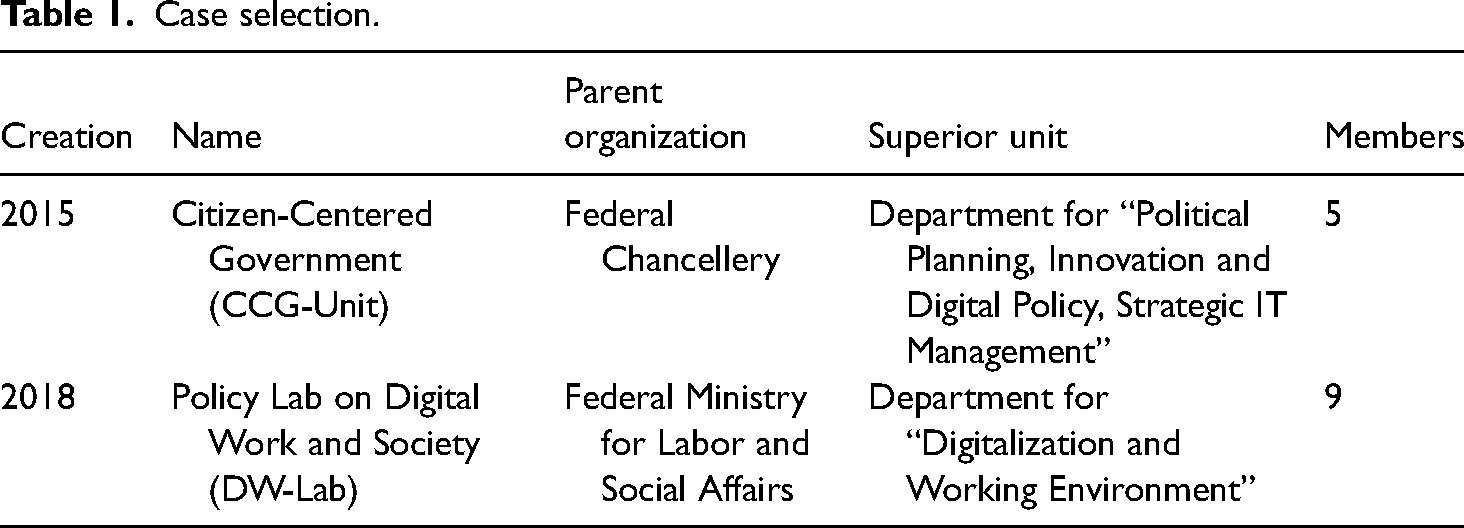
The Policy Lab on Digital Work & Society at the Ministry for Labor and Social Affairs has been established as an “interdisciplinary and agile organizational unit that combines the functions and working practices of a traditional think tank and those of a modern future lab”. This unit aims “to identify at an early stage new fields of action arising for the Labor and Social Affairs Ministry as a result of digitalization and other trends (…) and to develop new approaches to solutions for the working society of the future” (BMAS, 2021). The Citizen-Centered Government Unit at the Federal Chancellery seeks to “support Federal ministries, the Länder and subordinate authorities to develop citizen-centered solutions” (BReg, 2020), employing empirical methods from psychology, educational research, or economics.
The CCG-Unit was established in 2015, whereas the DW-Lab was created in 2018. Both the DW-Lab and the CCG-Unit were formally created via internal decrees and subsequent recruitments of members. Both units include mostly policy officials trained in the social sciences and thus have fewer officials trained in law, which is still the dominant educational background among German ministry officials. However, this organizational feature is even more noticeable in the CCG-Unit. None of its staff members had worked in government prior but instead in academic positions and think tanks, illustrating the strong methodological focus of the unit (INT1). In the DW-Lab, more staff members had pursued traditional administrative careers before joining this unit (INT4). Both units are formally organized as a regular unit inside a line department. While the CCG-Unit runs policy labs for other actors inside the federal bureaucracy and thus facilitates citizen orientation across government, the DW-Lab acts as think tank for digital topics inside its parent ministry.
The main distinguishing feature between the two units is their formal mandate. The CCG-Unit intends to provide methodological support to federal ministries and agencies in citizen-centered policies and DW-Lab focuses on a specific policy area and applies its methodology according to its projects. Thus, the CCG-Unit is primarily a tool used in different contexts, while the DW-Lab has a more strategic, political mission. The two units thus represent different approaches to citizen-centered units and are therefore interesting to compare in terms of reputation.
For our empirical analysis, we conducted five expert interviews of officials from both units (INT1, INT3) and other units with regular interactions with our selected units (INT2, INT4, and INT5), and triangulated them with an analysis of public and government documents as well as media coverage. These include the 11 final reports of the policy labs conducted by the CCG-Unit, 12 press releases, the German federal government's Open Government Action Plan, and parliamentary documents.
Empirical analysis
Professional reputation: generalists v. (legal) specialists in executive politics
Both units are composed of policy officials regarded as generalists, who are capable of quickly familiarizing themselves with new issues and with a broad range of methods—beyond traditional legal analysis. This composition is particularly important for the CCG-Unit, whose major task is to design and conduct temporary lab-projects with flexible thematic focuses (INT5). In contrast, the DW-Lab supports its parent organization with substantial policy expertise, and its composition enables it to think “out of the box”, challenging prevailing legal logic in the German ministerial bureaucracy to identify and formulate policy alternatives (INT4). This peculiar composition has triggered skepticism, especially among other units inside the government bureaucracy (INT4).
The CCG-Unit conducts lab projects, mostly with external partners, to expand the application of methods and to manage its workload. Hence, consulting firms and research institutes are commissioned to conduct these projects. In the initial years, projects were frequently carried out independently to demonstrate the feasibility and purpose of the methods used, especially through the rest of the central government organization. Later, external service providers were increasingly contracted to conduct, but not conceptualize, the policy labs. Thus, the CCG-Unit continues to design the policy labs autonomously. Similarly, the DW-Lab drew on external expertise or support, mostly from academia, labor unions, and individual activists, and on technical support from external IT agencies (INT1, INT2, INT3, and INT5). Hence, it was collecting different professional expertise than other units inside its parent ministry, leading ministry officials to wonder, “think tank? Does that mean we didn't think before?” (INT3). More generally, though, this differentiation in expertise caused much skepticism as it complied with prior expectations toward such novel units (INT3).
The professional reputations of both units are similar yet differ from that of the rest of the government organization. Following their composition and capabilities, they gather, systematize, and assess information from different sources and serve as hubs for external expertise. At the same time, they may not comply with internal expectations of legal bureaucratic behavior, although this perceived weakness strengthens their professional reputation through external audiences seeking access and alternative means to collaborate with government, beyond traditional and legal bureaucratic procedures.
Procedural reputation: new procedures complementing and confronting a legalistic process of executive politics
According to its Weberian tradition, the German ministerial bureaucracy follows primarily a legal logic of action; thus, all unorthodox units applying different methods and tools to support and provide policymaking face considerable skepticism (INT1). Hence, the legalistic German ministerial bureaucracy with its strong focus on rule-following, conformity, and the comprehensiveness of regulations challenges the key procedures applied by the CCG-Unit following social science methods. Unit members would ask: “What could disrupt the causal relationship? What might be an alternative approach? What works in practice or real social behavior” (INT1) and thus confront the traditional legalistic process in executive politics. There are also barriers in communication with other units, as empirical findings collected via lab projects or social science methods can be difficult to communicate to policy officials trained as lawyers. The “basic mindset is still relatively alien to the ministries” (INT1). Attempts have been made to counteract this barrier by implementing flagship projects and triggering “word of mouth” (INT1), emphasizing the usefulness and effectiveness of the social science methods used. Usually, there is no conflict with demands from the political leadership as the lab project managers are usually less concerned with generic political goals, rather with the concrete design of policy measures. Collaboration with the CCG-Unit is also voluntary, it is initiated upon the request of the ministries or through an initiative of the CCG-Unit. Thus, the unit identifies areas where they can apply their methods and proactively approach the relevant units in other ministries to offer their services (INT1, INT2, and INT3). Accordingly, the CCG-Unit is proactively layering novel methods onto the process of executive politics, complementing the traditional procedures of government policymaking.
The DW-Lab explicitly aims to deviate from the “silo logic” of the ministerial bureaucracy by initiating debates before the drafting stage of a new policy, thereby including civil society and other stakeholders in the process proactively (INT3). Whereas other line units with policy responsibilities maintain long-term relationships with the most relevant organized interests and often keep a distance to civil society as well as to individual citizens, the DW-Lab follows an opposite approach and deems the active involvement of citizens in policymaking as a core objective. Accordingly, it confronts the traditional legalistic process of executive politics, yet for a particular set of policy issues managed mainly by its parent ministry.
Moreover, the DW-Lab develops new policy ideas in addition to the government's legislative program for the ministry's policy area, yet for these tasks, they follow the procedural requirements of the pre-existing more legalistic bureaucratic procedures: “We have file numbers […] We cannot document the results of our work in modeling clay” (INT4).
To summarize, both units depart from the dominant pre-existing legal logic of procedure inside central government, this novel procedural approach may benefit their reputation if they successfully generate outputs and benefits for other government actors engaging with them and participating in their projects. Units with regular external audiences, especially in civil society, have welcomed this procedural approach because it allows them to be attuned with these audiences’ experiences and expectations.
Performative reputation: citizen orientation as novel performance in executive politics
The number of projects carried out by the CCG-Unit is limited due to its size, affecting its ability to design and carry out projects. The unit's workload is also limited by skepticism among actors in central government, as noted above, and by resource constraints among these actors, who may not have extra time and personnel available to engage in new projects and have their own core mandates in policy formulation. Over time, the partial outsourcing of project execution helped to increase the number of projects (INT1; INT2; INT3; INT5). According to the CCG-Unit, no other unit inside the federal government carries out similar methods, except a few federal agencies, especially in financial regulation and information security that apply risk assessments and other practices (INT1). Concisely, the CCG-Unit's core audiences within central government perceive the unit as “nice to have” (INT1) but not indispensable (INT1, INT5). Actors who carry out lab projects and thus collaborate closely with the unit are often interested in the results and seek to implement the implications of these findings (INT1).
The DW-Lab is set up to support its parent organization through providing an open space for developing novel policy ideas and for collaborating with external actors from civil society, including conducting research activities. Moreover, the DW-Lab provides expertise in digital policy and is thus involved in many internal decision-making processes within their parent organization that are related to this issue area. In some cases, it is also involved in interdepartmental coordination (e.g., during Germany's 2020 EU Council Presidency). In addition, the DW-Lab is formally responsible for employee data protection policy and, in this respect, resembles an ordinary unit (INT4).
As mentioned, the DW-Lab faced hostility by other units across the federal bureaucracy. Yet these negative expectations by their internal audiences were recognized by the unit, which aimed to address these concerns by making explicit why it exists, why its working methods are important for achieving its results, and why it will have a positive impact on other policy formulation activities. Similarly, the CCG-Unit aimed to communicate its achievements more directly and regularly toward its external audiences, by organizing events and utilizing social media more strategically (INT2).
The range of topics dealt with by the DW-Lab has expanded over time. While DW-Lab initially focused on the general development of labor market policies in the “digital revolution”, over time it engaged also in the areas of platform economy (particularly crowd work) and artificial intelligence in social policy and administration (INT4). Its dual mandate to coordinate and formulate digital policy, while also providing space for new policy ideas for other policy processes, has risked “cannibalization” of time and human resources, mostly at the expense of creative, open-target work, as the classic administrative responsibilities also require a “classic” approach from the unit's point of view. At the same time, only limited resources are available. (INT4). Agile working methods become increasingly difficult to apply due to the growing size of the unit, contradicting the idea of the DW-Lab as an experimental space in the ministerial bureaucracy. Nevertheless, the DW-Lab has considered itself to be the first major example of a “flexible, digital policy work unit,” regarded as important for the ministry's public image (INT4). As digital policy is a cross-sectional policy issue, the DW-Lab is regarded as a hub of expertise for these issues and to counterbalance other ministerial departments (INT4). The DW-Lab’s focus on Work 4.0 can be regarded as a substantial “policy counterweight” to the Ministry of Economics’ initiatives on Industry 4.0, as they often focus on the same topics from a different angle (INT4). In this respect, DW-Lab can also serve as a resource for policy expertise in political competition.
In sum, both units under scrutiny act as support units. Whereas the CCG-Unit mostly performs these tasks for other units in central government and has already succeeded in continuing after two general elections, the DW-Lab provides comparatively more policy-oriented advice and perform these mandates with a stronger orientation toward their parent ministries and its policy executives’ agenda. Whereas both the CCG-Unit and the DW-Lab engage in regular interactions with external actors, academics, consultancies, think tanks, and civil society, the DW-Lab especially gains value with these audiences (as the CCG-Unit mostly commissions the inclusion of external actors into their lab projects).
Moral reputation: exercising novel citizen-orientation in executive politics
Throughout the initial establishment of the CCG-Unit, there was fierce media coverage, mainly due to the behavioral science orientation of the unit (especially the so-called nudging), which was referred to as “a particularly insidious form of coercion, in which the state manipulates and patronizes the citizen without democratic control and thus ultimately shapes its model citizen” (Dams et al., 2015), epitomized by the yellow press as: “Merkel wants to hire psycho trainers” (BILD 2019, quoted in Falk et al., 2019: 4). As can be expected, the unit's members were convinced that it was “not doing anything bad, but acting in the interests of the citizens” (INT1). Nevertheless, the external view expressed a confrontation of the novel unit with established moral norms of appropriate organization in government and yet the unit took some time to respond, eventually opting for a transparent documentation of each of its projects, also to address concerns within the government organization about its methodology (INT1). This initial criticism toward the CCG-Unit may indicate its early moral reputational weakness, oriented toward its alleged non-compliance with pre-existing moral standards of its organizational environment.
However, given the circumstances of its creation, the CCG-Unit also became an “advertising vehicle” for a novel approach to policy formulation. It advocated that evidence, facts, and science need to get recognized differently in the policymaking process than before and that citizens should be addressed more directly and frequently (e.g., Michels, 2011; INT1, INT2, INT3, and INT5). Moreover, this new citizen orientation has been linked to the increasing relevance of digital tools in the public sector but also a deliberate attempt by the federal bureaucracy to gather evidence on policy addressees’ attitudes and ultimately to increase citizens’ support for government policies.
In comparison, the DW-Lab involved civil society directly from the start, not only to provide evidence but also to increase the ministry's responsiveness to citizens’ concerns. In particular, it utilized collaboration platforms and policy events to invite these external audiences and engage with them. Whereas the traditional way of policy formulation had mostly included organized interests via formal hearings, written advocatory statements, and evidence sent to policy officials inside the ministries, the DW-Lab offered direct citizen participation in policy formulation (INT4). Although these direct interactions with citizens also departed from the moral expectation of appropriate decision-making in the federal bureaucracy, they were also continuing exercises for expanding the substantial foundation for policymaking in their parent ministry's policy areas.
To summarize, both units departed from existing expectations for appropriate bureaucratic behavior, especially owing to their regular contacts with citizens and civil society. The CCG-Unit faced external and internal pressure, as its goals and methods appeared morally indefensible. Since its inception, it has invested resources in persuading other government actors that its methods and procedures are valid and appropriate. Over time, the “moral outrage” of parts of the public and stakeholders from the early days of the unit disappeared. The other unit did not experience these strong responses and potential weak moral reputation. Rather, it provided moral gains for its parent organization, as it served as a crucial and novel access point for civil society and other external actors.
Conclusion
In this article, we analyze the organizational reputation of novel citizen-oriented units inside the German federal bureaucracy over the past years. Our empirical results show that these units serve as crucial arenas for generating policy ideas, with a novel and explicit inclusion of citizens and civil society. Following the bureaucratic reputation framework, our findings indicate that both units under scrutiny faced ambiguous and rather incompatible expectations from their various audiences. Yet they managed these challenges by leveraging their weaker reputation vis-à-vis internal audiences and gaining a stronger reputation toward their external audiences. Given the governments’ explicit agenda to strengthen the citizen-orientation in policy design, they thereby safeguarded their role in executive politics, despite limited formal competencies.
However, the atypical organization and methods of these units—compared with the rest of the German federal bureaucracy—also led to conflicts with their internal audiences, mostly because of their alleged non-compliance with the existing legalistic logics of the bureaucratic process. Accordingly, their professional reputation vis-à-vis their bureaucratic counterparts has been weaker, whereas their external audiences regarded these features as an asset. Similarly, both units experienced skepticism, primarily from actors inside central government, about how they layered alternative procedures onto the dominant legal procedures and thus suffered in procedural reputation, although the DW-Lab also benefitted from its formal policy responsibilities, for which it participated in traditional bureaucratic processes. Both units fulfilled their mandates and achieved their performative reputation toward all audiences, although the DW-Lab was re-assessed more regularly when interacting in inter-ministerial coordination. In contrast, the CCG-Unit has been rather exempted from such performative evaluations. Furthermore, the DW-Lab engages in regular direct interactions with citizens and civil society and thus generates a performative reputation toward this external audience, whereas the CCG-Unit commissions projects organized by others, and thus cannot showcase its performative reputation directly. Moreover, the CCG-Unit experienced initially a lower moral reputation than the DW-Lab with its internal audiences while the DW-Lab faced no such challenges. In summary, both units partly disappointed their internal audiences’ expectations for professional and procedural reputation, yet they satisfied with their performative and moral reputation toward their external audiences.
Our empirical analysis shows the interactions between different dimensions of organizational reputation, especially for novel units inside government organizations that seek to develop their own reputation. Whereas professional and procedural standards and expectations are mostly raised by internal audiences, which is a rather monolithic set of bureaucratic actors following the same notions and underpinnings of the Weberian ideal, the performative and moral reputation is much more strongly built in the views of external audiences, most notably because of the citizen orientation of these novel units. Given their mandate to include citizens into the policy design process, these government units may leverage their performative and moral reputation for gaining influence in executive politics.
In the views of their internal audiences, both units were widely regarded as unique yet not as indispensable elements of central government. Their mandate and corresponding application of novel methods to include citizens into the policy design is a crucial organizational feature shaping their reputation vis-à-vis internal and external audiences. More importantly, their formal affiliation and composition supported their stronger performative reputation vis-à-vis external audiences, while challenging their professional and procedural reputation from the viewpoint of internal audiences. Furthermore, organizational resources were utilized to strengthen a weakened moral reputation. It follows that the organizational reputation literature interested in delegated authorities may further investigate the variation in organizational features and how these features interplay with organizational reputation.
Lastly, our paper shows that the bureaucratic reputation framework is highly suitable for studying units inside government organizations, especially those novel units that are mandated to depart from pre-existing organizational structures and procedures—and are thus in strong need of generating organizational reputation. As such, our findings are not only relevant for those government organizations following the Weberian ideal that may experience the emergence of units with an explicit citizen orientation but also to other government organizations transforming their organizational palette.
Footnotes
Declaration of conflicting interests
The author(s) declared no potential conflicts of interest with respect to the research, authorship, and/or publication of this article.
Funding
The author(s) disclosed receipt of the following financial support for the research, authorship, and/or publication of this article: This work was supported by the H2020 Societal Challenges (grant number 726840)
