




Abstract
We extend the current literature on barriers to women’s entrepreneurship by providing the perspectives of women entrepreneurs’ lived experience of governance and public policies designed to support entrepreneurship, in France and England. The research draws on primary data comprising interviews with 75 French and English women entrepreneurs as well as secondary data. The research suggests that in France the system of governance is relatively more supportive, whereas in England there are less favourable views of bureaucracy and the conditionality of financial policy instruments, which in turn create unintended outcomes. We extend current understandings of gendered public policies and governance.
Points for practitioners
The public policy and governance context in France offers relatively more support for women entrepreneurs than in England. There is a potential for policy learning in how to support women entrepreneurs.
Financial policy instruments such as social welfare payments may affect women entrepreneurship.
Bureaucracy creates time and opportunity costs for women entrepreneurs, which have a gendered impact if they are single parents and have dependents.
Introduction
Globally, the proportion of women entrepreneurs remains lower than that of men (Global Entrepreneurship Monitor [GEM], 2022). Although successive GEM reports have shown that in many countries women’s entrepreneurship is increasing, particularly within social development policy areas, men continue to dominate the entrepreneurial sector with a gender gap in total entrepreneurial activity (TEA) (GEM, 2022). This is despite women entrepreneurs being as successful as men in sustaining a business once established (Rose, 2019). The study explores the extent to which the governance and public policy context supports women entrepreneurs.
We locate the research in France and England, which have similar size economies and rates of entrepreneurship (Eurostat, 2021). There has also been a history of cross-border economic and political cooperation between England and France (Church and Reid, 1999), although this is taking on increased complexity given the post-Brexit policy landscape (Bailey et al., 2019) . Thomas (2006) emphasises the need to improve economic collaboration and policy learning between the countries. The study therefore offers an opportunity, comparatively, to explore the extent to which the policy and governance context of England and France supports women entrepreneurs with potential for policy learning.
Women entrepreneurs continue to face barriers, with access to finance often the biggest challenge to start and grow their business (OECD, 2013; Orhan, 2001; Rose, 2019). Gender bias and access to business support, mentors and professional networks are further barriers for women entrepreneurs (Halabisky, 2018; OECD, 2013; Rose, 2019). This study moves beyond the discussion of these barriers to examine the governance and public policy context and the extent to which it supports women entrepreneurs, which is the aim of the study. We therefore contribute contemporaneous empirical data to current understandings of women’s lived experiences of entrepreneurship and debates around gendered governance.
The contribution of the article is three-fold. Firstly, the research addresses a research gap with a comparative study of the governance and public policy context, in France and England, and the extent to which it supports women entrepreneurs from the perspective of women’s lived experiences. Secondly, the study draws upon the disciplines of public policy, business and gender studies to understand the barriers to women’s entrepreneurship. Finally, we illuminate insights into an underexplored facet of the extant literature, that is an unintended outcome of governance and public policies for women entrepreneurs, in particular the bureaucratic quagmire of financial benefit schemes that are supposed to provide support, but rather create disincentives. Furthermore, we contribute empirical data that suggests the gendered nature of governance – an under-researched area (Johnston, 2019).
The first section of the article contextualises the study and the locus of the research. The second section outlines the public policy and governance contexts in France and England. The third section outlines the research method and the fourth describes the findings. We conclude, based on the empirical research, that French public policies and governance appear to have better outcomes for women entrepreneurs, offering insights as to why this may be the case.
England and France: Context
Scholars have explored and compared the English and French contexts in terms of examining political and administrative systems, multi-level governance (Kuhlmann et al., 2014; Kuhlmann and Wayenberg, 2016), local economic development (Cole and John, 2001) and co-governance through state and non-state partnerships (Bode, 2006). Yet there has not been research on the extent to which the policy and governance context supports women entrepreneurs, which this research seeks to address.
Entrepreneurship develops from local or regional levels (Malecki, 2018). Thus, to understand how the policy and governance context supports women entrepreneurs, the context of regional/local governance and support for local economic development is of importance. In terms of functional responsibilities between central and local governments, there is a differentiation between the extent to which central and local governments execute their respective responsibilities separately and largely independently from one another, or whether the levels interact strongly (Kuhlmann and Wayenberg, 2016). The UK has been characterised as a ‘separationist model’ whereas France has a ‘state-centred integrationist model’ where state authorities, through their local offices, are involved in the conduct of local government tasks (Kuhlmann and Wayenberg, 2016). France’s local self-government has a codified constitutional status, whereas in the UK, local government does not have a constitutional status and undertakes responsibilities explicitly assigned by parliamentary legislation (Kuhlmann and Wayenberg, 2016). Presumably, this offers local government in the UK less autonomy than in France.
Since UK devolution there are different multi-level governance arrangements and local government functional areas of responsibilities in devolved polities (Jeffery, 2006). England, as one of the four nations of the UK, has a different set of governance and public policies to Scotland, Wales and Northern Ireland. In England governance and funding to support entrepreneurs are a form of political expression in ‘how entrepreneurship and self-employment as a means to promote economic growth’ are expressed in public policies (Debus et al., 2017: 340). At the local level in England (as opposed to Scotland, Wales and Northern Ireland), Local Economic Partnerships (LEPs) play a key role in local economic development and have much more autonomy in local policy and service delivery (HM Government, 2018). This was part of the UK government’s localism agenda to devolve power and functions to local institutions and communities in England (Evans et al., 2013). In France, there is a conviction that the territories are administered and developed according to local interests with a process of decentralisation that has strengthened local authorities with representatives having access to national decision making (Demazière and Sykes, 2020). Therefore, it is an integrationist model with vertical integration of state, regional and local offices (Kuhlmann and Wayenberg, 2016). Thus, this comparative study of women entrepreneurs’ lived experiences in England and France offers an opportunity to explore the extent to which differing governance models support or hinder women entrepreneurs through various policy instruments, with a potential for policy learning.
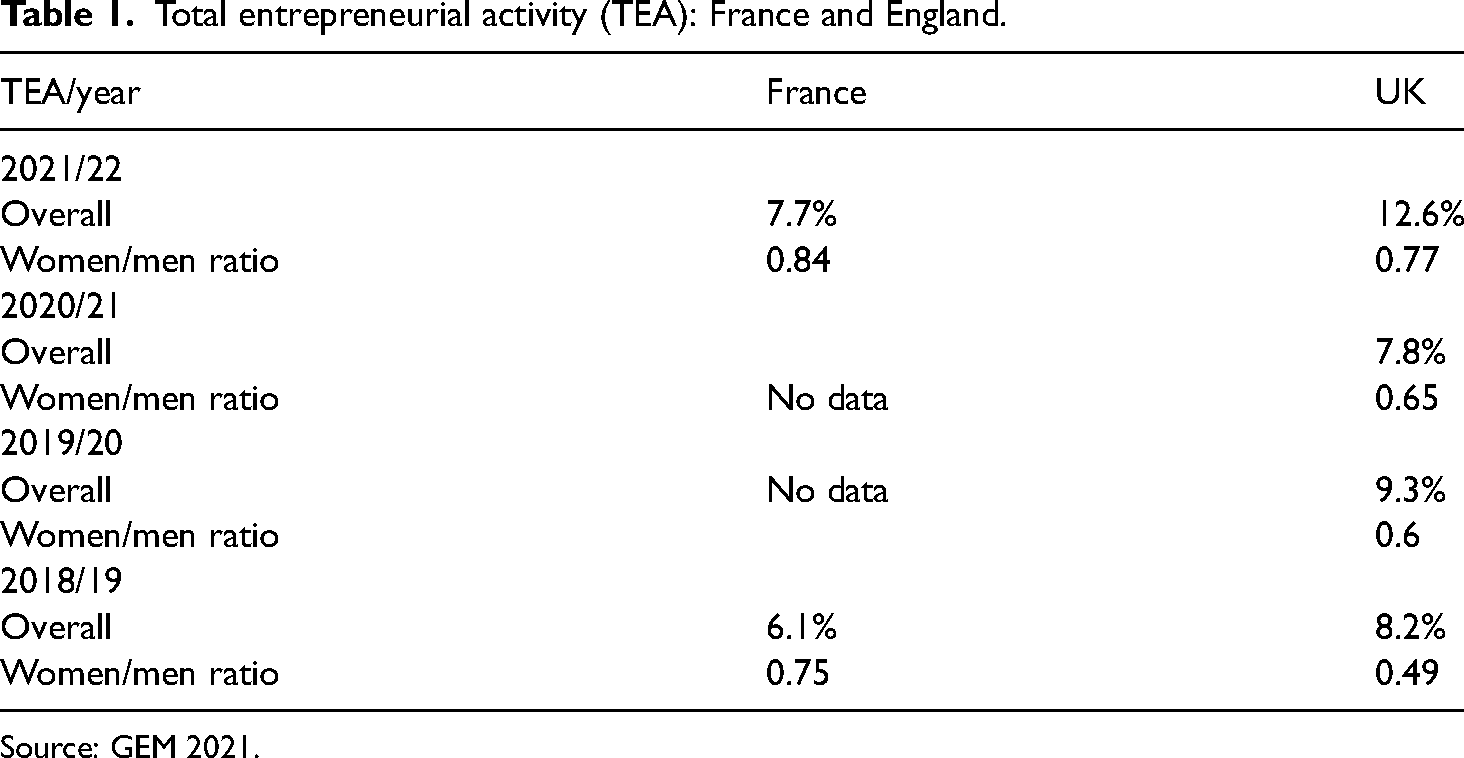
The evidence suggests that France appears to have relatively more success in women’s entrepreneurship. According to GEM (2021) data, gender equality in entrepreneurship is better in France, but there is consistently less entrepreneurial activity than the UK with a lower TEA, which suggests an easier pathway to entrepreneurship in the UK (Table 1). Thus, even though it appears that the barriers to entry are lower in the UK for entrepreneurship, as evidenced by the higher TEA, the comparison of women with men entrepreneurs shows a higher proportion of women entrepreneurship in France than the UK. The research therefore seeks to contribute to understandings, particularly within the context of public policy and governance, of why France has more relative success in women’s entrepreneurship, casting light on factors that explain the variance between France and England.
Total entrepreneurial activity (TEA): France and England.
Source: GEM 2021.
Public policies and governance context
Since the 2008 Law on Modernisation of the Economy and the Nouvelles Opportunités Économiques (NOÉ, New Economic Opportunities), intended to boost growth by removing structural and regulatory obstacles, the French government has implemented several policies for inclusive entrepreneurship (OECD/European Union, 2018). In 2013 a National Plan on Women’s Entrepreneurship was developed through different regional action plans such as le Plan d’Action Regional (PAR) to support women’s entrepreneurship. It was extended to 2020 as part of the first inter-ministerial plan for professional equality (OECD/European Union, 2018). In March 2021, the Ministry for Gender Equality, Diversity and Equal Opportunities in partnership with Bpifrance (which finances businesses at every stage of development with credit, guarantees and equity) signed a new Framework Agreement on Women’s Entrepreneurship for 2021–2023 (Communiqué de presse, 2021). The aim is to support the creation or takeover of a business; foster a new generation of partnerships within regions; increase funding for women entrepreneurs; address gender bias; and mobilise all stakeholders involved in business creation to coordinate and promote actions in favour of women’s entrepreneurship (Communiqué de presse, 2021).
In France there are regional plans to support women’s entrepreneurship, derived from the national framework, which include awareness-raising to support the creation or takeover of businesses and post-creation; support access to finance; the development of actions in fragile territories (particularly rural areas and urban neighbourhoods); and the promotion of women’s entrepreneurship through training and communication (Communiqué de presse, 2021). Thus, France has specific national policy instruments to support women’s entrepreneurship, which are implemented through state and non-state partnerships at a local level to address regional/local needs – suggesting an integrationist approach.
In England, the government launched the ‘Investing in Women Code’ to support industry and government to better understand barriers to women’s entrepreneurship, and to motivate businesses, banks and the financial sector as signatories to the code, to address inequalities (HM Treasury, 2021). The government formed a partnership with signatories in the financial sector, specifically the British Business Bank, UK Finance and the UK Business Angels Association to collect data on how to better to support women entrepreneurs. There are no specific public policies to support women entrepreneurs (compared with France), rather support for businesses is through the LEPs, which were established in 2010 in England under a localism policy agenda to let ‘a thousand flowers bloom’ (BBC, 2010). Central government initially invested £18.5 billion (Carr, 2015), then £12 billion during 2015–16, and £9.1 billion during 2020–21 through Growth Deals negotiated between government and LEPs (House of Commons Report, 2021). The LEPs therefore received a substantial amount of government funding and autonomy (Carr, 2015). This investment, autonomy and policy agenda arguably would make it easier for businesses to establish and grow.
Thus, in England, a main feature of governance to support local business development is LEPs to ‘enable and encourage local ownership and leadership of action to address local economic priorities’ (Department of Business, Innovation and Skills, 2010: 11). There are currently 38 LEPs in England with Boards consisting of local private and public sector organisations with the private sector playing a key role (PWC and Smith Institute, 2015). As Pike et al. (2015) argue, LEPs operate as de facto business-led, arms-length organisations securing the interests of local business elites. Policy documents state that LEPs should remain autonomous and operate as a self-regulating sector to drive improvements in governance and delivery (HM Government, 2018), with a consequence that there is limited public accountability (Pike et al., 2015), but they reflect, as per LEP Board membership, the local economic priorities with a focus on larger industries and corporations.
LEPs are involved in setting the policy agenda such as the provision of housing to provide for an expanding and accessible workforce, and education and skills development to service human capital needs for local industries (PWC and Smith Institute, 2015). There is a lack of data on the financial support that LEPs offer to women entrepreneurs. Government and the private sector, through intermediary institutions of LEPs, appear to preserve larger industry interests across a wide variety of policy domains, but there are currently no specific policy instruments to support women entrepreneurs.
In contrast, the French context, in support of entrepreneurship, is more accessible for women entrepreneurs and responsive to regional differences. For example, there are policy instruments such as the PAR and ‘priority’ neighbourhoods of the City Policy (QPV), and there are commissions such as General Commission for Territorial Equality (CGET), replaced in 2020 by the National Agency for Territorial Cohesion (ANCT), which developed a guide to good practices to promote access to employment for women in QPV and rural areas, respectively. The ANCT guide has seven commitment actions to support the development of women’s entrepreneurship in rural areas, such as adapting childcare hours (CGET, 2019). In addition, there are non-state associations such as ADIE (Association for the Right to Economic Initiative) that supports the unemployed, who do not have access to traditional bank credit, to start their business, and therefore targets low-income entrepreneurs. These policies provide microloans, support entrepreneurs applying for start-up grants and provide advice on business management, administrative requirements, marketing and legal issues. The French context involves state and non-state actors, in regional or localised chambres, in the delivery of this support.
Fostering financial support for entrepreneurship is a major area of public policy support in France, and a considerable amount of this financial support is targeted at the unemployed (OECD/European Union, 2018). In 2013, nearly half of the public expenses in support of business creation were targeted grants paid to jobseekers starting their business (Assemblée Nationale, 2013). Other policy instruments include: ACRE (aid for the creation or takeover of companies), which is partial exemption from social security charges to support businesses during the first year of activity depending on the amount of earned income, enabling beneficiaries to claim other forms of financial support; and NACRE (new support for the creation or takeover of businesses), which is financial assistance in business creation. In addition to these policies, entrepreneurs under certain conditions can benefit from social security benefits such as ARE (unemployment benefit to help people return to work), which is an unemployment benefit to help citizens return to work, ceasing when the beneficiary undertakes a professional activity, whether salaried or not, in France or abroad, and the RSA (active solidarity income), which is also an income support that can be received before and after setting up a business.
The French government has also introduced a system of single maternity leave allowing women entrepreneurs to benefit from a leave aligned with that of salaried employees through the 2019 Social Security Financing Law (Portail Auto-entrepreneur, 2019). Women entrepreneurs can combine two financial support benefits: a lump-sum maternal allowance paid in two instalments and a lump-sum daily allowance for business interruption with the duration of maternity leave compensation extended to 112 days. Although this helps women entrepreneurs with dependent children, the methods of calculating daily allowances differ and are based on the average of the last three years’ annual working income, which many women entrepreneurs in the nascent stage of their business find difficult to achieve.
In England, financial support for entrepreneurs is through the New Enterprise Allowance (NEA), which supports beneficiaries to start or develop a business and allows for mentoring. There are eligibility criteria linked to other benefits such as Universal Credit, Jobseeker’s Allowance or Employment and Support Allowance. A successful applicant could receive a weekly allowance over 26 weeks, and can apply for a loan to help with start-up costs if the business is less than two years old. To apply for an NEA an applicant has to consult a Jobcentre Plus work coach, who will review the business idea and help the application process. Universal Credit depends on the earnings of a beneficiary, and reduces as earnings increase. Self-employed beneficiaries of Universal Credit report their income and expenses each month, and their actual profit is deducted in the calculation of their credit payment. Thus, the more women entrepreneurs earn, the less Universal Credit they receive, which is a risk and disincentive.
In comparison with France, in England there are no specific policy financial instruments to support women entrepreneurs. According to Redman (2021), the social welfare system in England is designed for work activation with less focus on education or (re)training and more on encouraging rapid labour market (re-)entry through negative incentives pertaining mostly to (threat of) benefit suspension/termination and mandatory work activity. The system therefore has conditionalities attached to it and is not designed to support entrepreneurship, but rather to incentivise entry into formal, paid employment.
More recently, owing to the Covid-19 pandemic, the UK government launched a number of financial support schemes (e.g. the Self-employment Income Support Scheme, Bounce Back Loan Scheme, the Coronavirus Business Interruption Loan Scheme). In contrast to France, none of these schemes are specific to supporting women entrepreneurs. According to the Women’s Enterprise Policy Group (WEPG, 2021), current policies ignore women entrepreneurs, such as the Self-employment Income Support Scheme, which does not take into account women entrepreneurs who work part-time alongside an existing job to support their income. The Government ignores the fact that most women entrepreneurs are home-based and are therefore ineligible for many grant schemes (WEPG, 2021). In England financial support for women entrepreneurs tends towards government working with the financial sector as signatories to a code. However, the government’s own data show that women still receive less financial support (HM Treasury, 2021). Many policies are not specific to address the barriers that women entrepreneurs face and could be interpreted as inequitable, entrenching and exacerbating gender inequality.
Research method
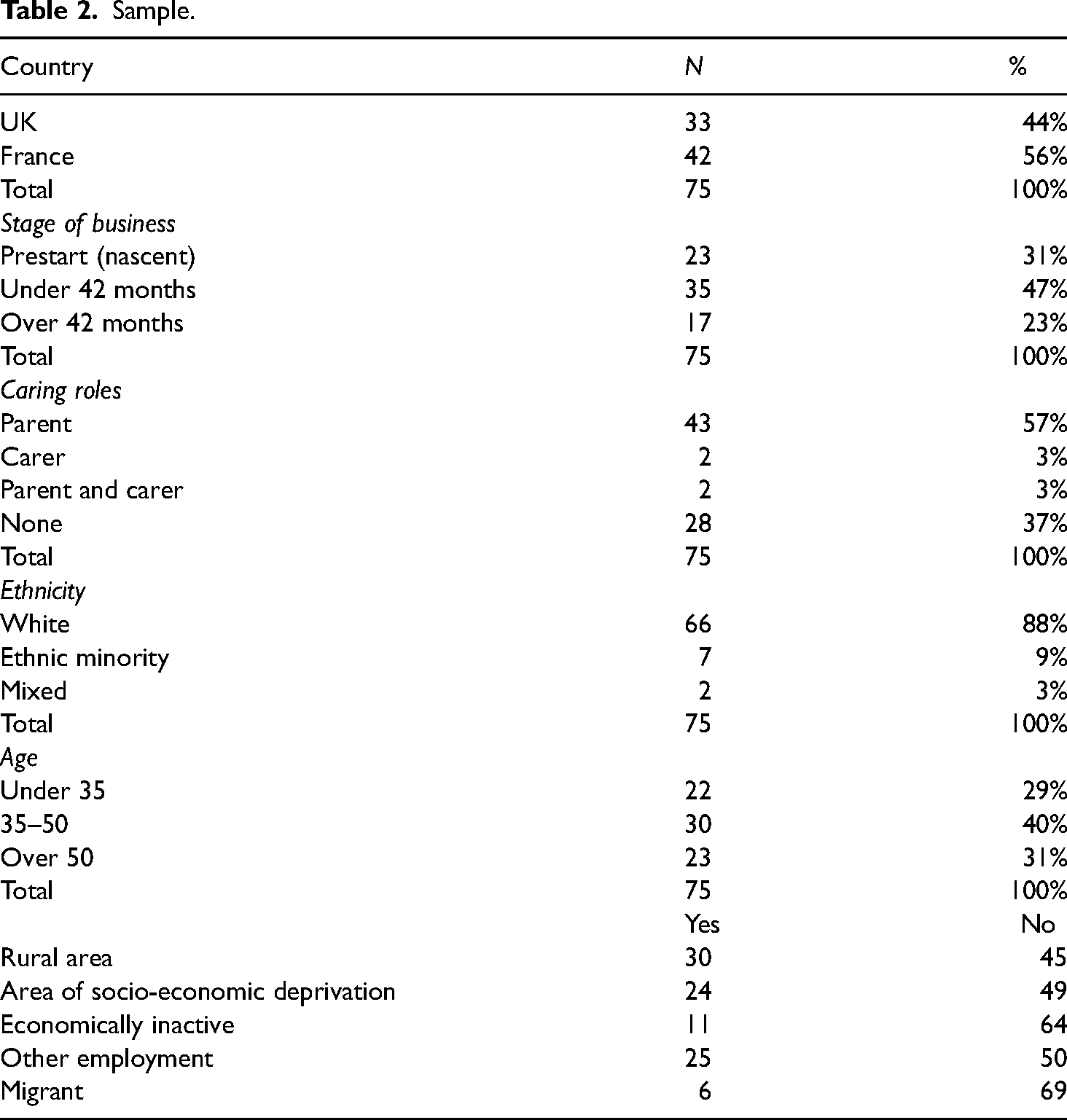
The first phase of the research involved a review of literature and secondary data such as public policy documents, reports and statistics. The second phase of the research involved the collection of primary data involving interviews with 75 women entrepreneurs in England and France. Women entrepreneurs were recruited from a European Commission-funded training project, which was advertised through media outlets, banks, loan institutions, government agencies, voluntary sector organisations, chambers of commerce, trade associations and universities as stakeholders involved in an entrepreneurial environment. At the time of primary data collection, the number of women who attended the training sessions totalled 300. From this population, the sample of 75 participants was drawn. A stratified sampling method was used to ensure that the sample included women entrepreneurs: from rural and urban areas; from areas of socio-economic deprivation; with a mix of qualification levels; with other forms of employment; with disabilities/health conditions; with migrant status; from different race groups; with different economic activities; with caring responsibilities; of various ages; and at mixed stages of business operation from start-ups and new businesses (under 42 months) and more established businesses (over 42 months). The final sample is illustrated in Table 2.
Sample.
The semi-structured interviews were conducted during 2019 and 2020, and ranged from 30 min to an hour in duration. Interviews were conducted in participants’ native language. French interviews were translated into English by a professional service. The research followed the ethical protocols of the University of Portsmouth with participation in the research being consensual, voluntary, confidential and anonymous. The interviews and findings were corroborated by the experts on the external committee of the project. The questionnaire included three sections: (1) reflections of entrepreneurial journey with questions such as their motivation for starting their business; (2) public policies and governance questions such as extent of financial support, opinions on the policy environment, the availability of finance and access to markets, any other resources for business support, and perceptions of stakeholders, etc.; and (3) specifics about business support from stakeholders such as the type of interactions (e.g. financial, training, advice, etc.), the quality of interactions, the reasons for perceptions of the quality, quantity and type of support, and the effects of the support on their business and personal lives.
The interviews were first categorised and analysed according to thematic codes, which were grounded in the literature review, i.e. barriers to women’s entrepreneurship. To ensure triangulation, the interviews were also analysed using term-frequency and term frequency-inverse to document frequency then analysed using a co-occurrence matrix, which is the representation of terms that are linked to each other based on a number of occurrences across all interviews. This enabled the identification of central terms, clusters of terms, dominant terms, terms that have the highest number of linkages and also terms that are linked to each other or have closeness, which resulted in a clustering of terms into themes. The data for England and France were also compared using Python to identify terms that appear in the respective country data. This involved checking terms across two sets of data to identify terms that do not appear in the other set. These clustered and frequency terms became themes, namely barriers, services, support, perceptions and attitudes of support services, the fit for purpose of services, and the impact on women entrepreneurs. Finally, the data was coded using NVivo according to these themes. The next section presents the main findings mobilising anonymised quotes to highlight and evidence the lived experiences of women entrepreneurs.
Findings
Most English interviewees stated that there was a lack of support from government. They were frustrated with the complexity of bureaucracy and red tape. This was less evident for French interviewees (Figure 1). Throughout the research, English interviewees stressed the frustration of navigating the bureaucratic quagmire, which resulted in financial and opportunity costs to their businesses. Interviewees in England frequently mentioned HMRC, which was associated with the bureaucracy of allowances, benefits, taxation, expenses and regulatory codes, as the following quotes illustrate: There were issues when it came to the HMRC … I was having issues trying to work out exactly what was needed … I was trying to phone through to the helpline, just because I wanted to double-check what I was doing before I did it … And the person I was speaking to on the end of the line, it was male and it was an older male and he was obviously quite dismissive of why I had called up. (ENG-9)
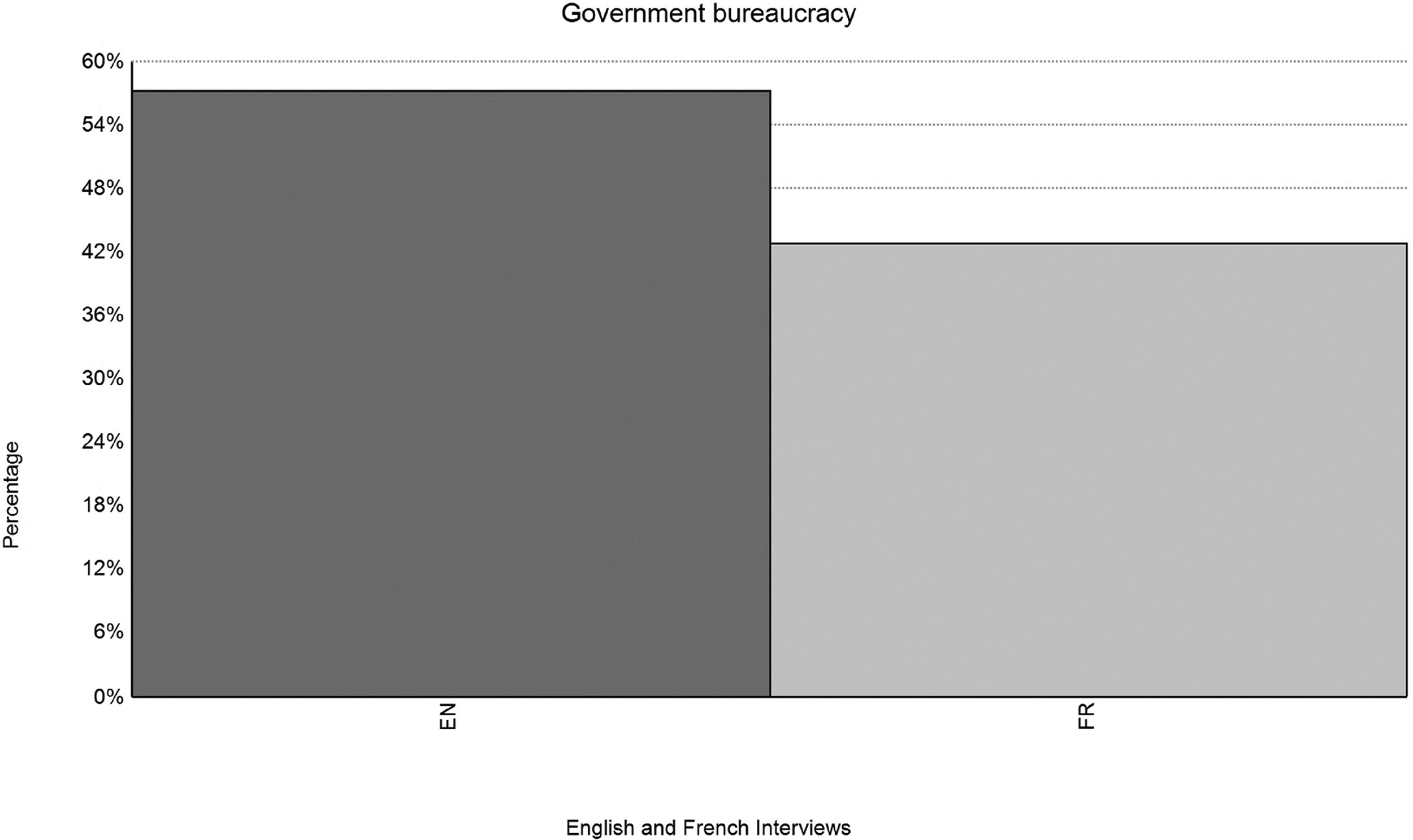
Bureaucracy: England and France.
… opening up a bank account is straightforward, but then identifying a SIC code is not, because the government office no longer provide help and support with SIC codes. So, the way that I found out what SIC code I would be was to basically Google other people who did something similar to what I do and then go into Companies House and find out what SIC code they chose for their company. (ENG-25)
The quotes demonstrate that English interviewees found government bureaucracy alienating, overly complicated and not user-friendly. Comparatively, the frustration with bureaucracy was less evident with French interviewees: I went to Pôle Emploi, Force Femme, ADIE, and the business cafes in Caen that take place one Thursday morning a month. I made the creators’ morning of Pôle Emploi in a collective way I did a training to create my website … I did the Force Femmes support programme … I did the internship at La Chamber des métiers this internship was on 3 days … And I’m very happy to have been there because I came out with a thumb drive where we have our invoice templates, our estimate templates, accounting charts, income statements. (FR-7)
I went to a lot of meetings on business creation. There were a lot of them in Île-de-France. With CCI, with chambre des métiers. I created the business in Île de France region with help from chambre des métiers. There, they provided preparation courses, installations and start-up. Personally, I was really happy I did it … Pôle Emploi. Actually, they got in touch with me when I created my file with them and they wanted to check up on what I wanted to do. I told them I have a micro-enterprise and that I really needed to find a job. So, after describing the enterprise they told me, ‘Go see, so and to go see this and that.’ Frankly, they started to become a point of reference. (FR-9)
Most women entrepreneurs were caring for dependent children or elderly parents, and navigating bureaucracy increased their time poverty and opportunity costs to their business.
The French interviewees received relatively more government support than their English counterparts, particularly from localised networks consisting of state and non-state actors, providing a support network for business creation and growth. In stark contrast, in England, women entrepreneurs were not aware of their local LEP or when seeking support from their local LEP experienced a lack of support for their type of business with a preference for heavy industries or larger corporates. According to an interviewee: I did contact the LEP, I thought I might have some funding because they were offering a grant and that was quite disappointing. Because they were offering a grant to businesses and when I called them, they told me that it was more about capital funding for services and they wouldn’t offer you funding for your marketing, for your staff … all they were thinking of was giving capital for machinery and all that, so what about businesses who provide services, the service industry? So, we don’t fall within that category, I’m not going to the group for machinery because that’s not what I do. (ENG-29)
In comparison with France, where interviewees frequently referred to the support they received (Pôle emploi), in England LEPs were less frequently mentioned for business support by women entrepreneurs (Figure 2).
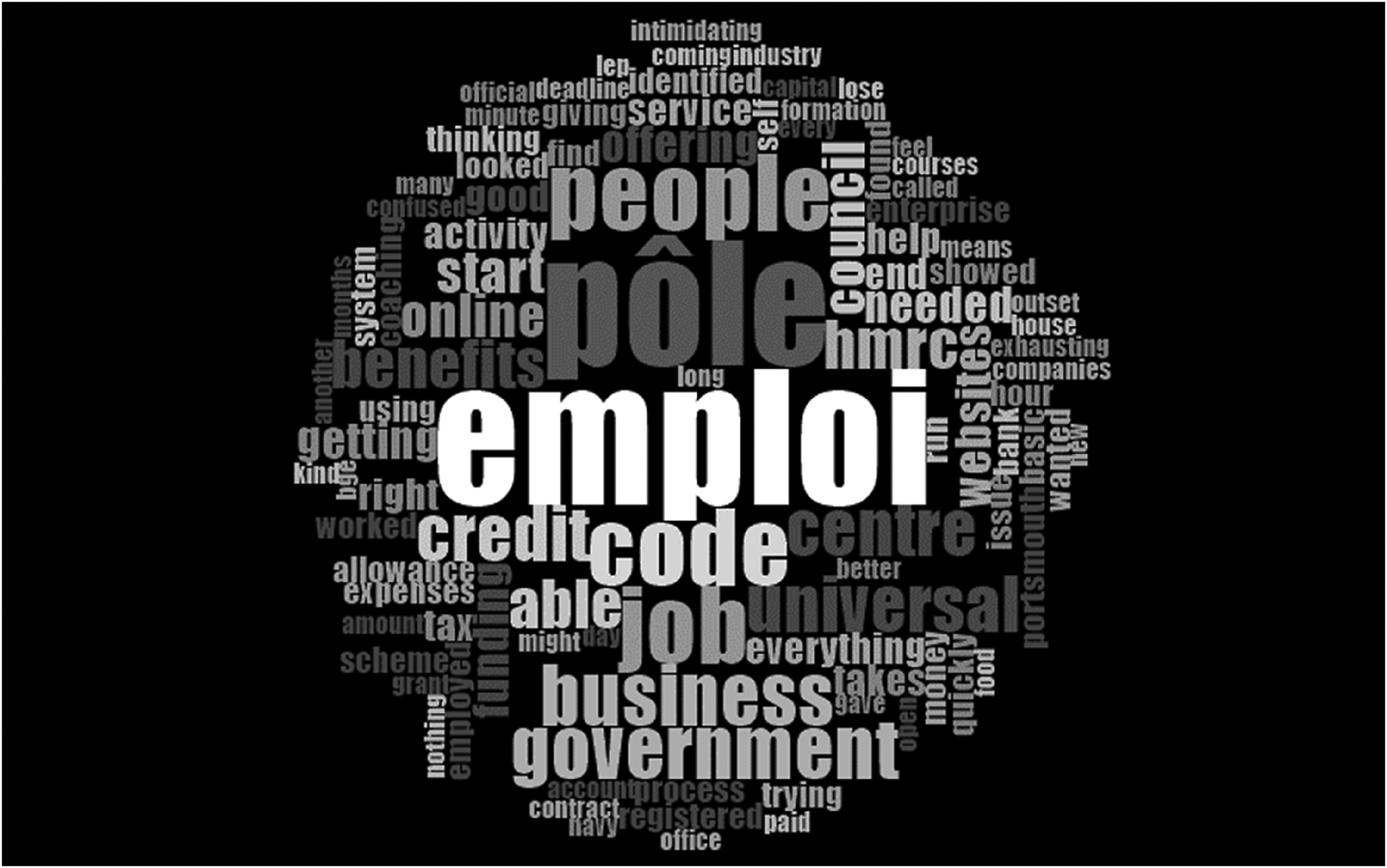
Support services.
Many interviewees were concerned that once they began generating an income from entrepreneurship, they would lose financial support. In France, for example, interviewees were most concerned about ARE and ACRE, which cease when engaged in a professional activity, whether salaried or not. They therefore did not want to start their business before the allowance ended as it would jeopardise their business, but at the same time, if they waited for the end of the allowance, they could be exposed to financial risks if the business did not generate sufficient profits. Women entrepreneurs could only access other financial support under certain conditions when ARE ceased. ACRE poses a challenge in that the support is provided for the first year of the business, providing exemption from social security contributions, but after three years of exemptions they would have to repay the funds. Interviewees accessing this allowance found it an enabler and that the financial assistance was particularly helpful for single parents. Interviewees also mentioned NACRE as an enabler for their business that could compensate if conditions were met. However, the number and requirements of various financial support benefits made it difficult for interviewees to understand what they were entitled to, and many feared losing the marginal income from the loss of one allowance if they accessed another.
Similarly, in England financial support and allowances were confusing and unclear, and interviewees stated they risked the loss of income: according to the Jobcentre I have a job … I had a ten-minute interview with the Jobcentre, which turned into about 45 min, because they now don’t know what to do about a zero-hour contract … So again, I was with a different work coach than before and again, he had to go ask about four or five different people within the Jobcentre about this and he said that he had three different responses to how it could go through the system. So, I’m back to square one with, I don’t know if I’m going to be paid at the end of the month … for the amount of work that I am genuinely putting into this, that I then can’t claim from the business, because there’s no money there, and to then have what’s left taken off. So, it’s a bit of a horrible situation for me. (ENG-11)
I am eligible for the New Enterprise Allowance. So, you only have a year from when you start on the NEA to hit the minimum income floor, which is basically your minimum wage. If you don’t hit it they tell you that you have to find a normal job, they tell you to quit. (ENG-37)
Although, interviewees in France and England mentioned the conditionality of financial policy instruments, the opportunity cost in navigating the bureaucracy of the governance environment and accessing financial support was expressed more frequently by women entrepreneurs in England than in France. In France interviewees tended to receive more support in navigating bureaucracy and received support that may not necessarily be strictly business related. For example, a French interviewee described how at Pôle emploi she was helped out of a domestic violence situation. This may partly be due to a network of civil society organisations, which can offer this support. Meanwhile in England, the provision of services is through financial institutions and Jobcentres, which may not necessarily be concerned with the lived experiences of women entrepreneurs, but rather geared towards work activation.
A further finding was the type of businesses that received financial support. The interviewees often started their business to address a need based on their lived experiences within a community. These businesses often had a social mission or attempted to address a socio-economic issue within their community, and tended to be social enterprises and co-operatives. The businesses were localised to ensure proximity to home in order for interviewees to care for dependents. However, the majority of the interviewees with a social mission business model found difficulty in accessing loans because the model was rarely understood; given that women are more likely to engage in setting up a business with a strong social mission (GEM, 2022), this also becomes a gendered issue. There appeared to be a bias to financially support businesses with perceived lower risk, even when such perceptions may be erroneous in the longer term. For example, an interviewee in England stated that she was encouraged to establish a beauty salon rather than a coaching service for women seeking employment: they don’t care, they don’t analyse my business proposal … it’s not actually a genuine business encouragement, and I don’t really think the system is set up to do that, it’s literally ticking boxes and paying lip service to supporting entrepreneurship. There is nothing the guy that I speak to knows either about business or my business … he’s got no business skills whatsoever and he’s the only person I see. (ENG-21)
Discussion
The extent to which French and English public policies and governance support women entrepreneurs is nuanced. In France, there appears to a decentred, localised system of chambers with state and non-state actors, collaborating to support women entrepreneurs. Importantly, non-state actors have experience of entrepreneurship to advise and offer support to women entrepreneurs, even beyond specific business support needs. Thus, there is a collaborative advantage of understanding women entrepreneurs’ lived experiences (Strokosch and Osborne, 2020).
In Normandy, for example, an initiative called Ici je Monte ma boîte (‘Here I set up my company’), draws upon of networks of chambers of trade, commerce and crafts, Social and Sustainable Enterprise, the Institute of Small Business and Entrepreneurship, ADIE, Initiative Normandie and France Active to offer free personalised support to entrepreneurs, which acts as a ‘one-stop shop’ of accessible support, specific to women’s lived experiences to help navigate bureaucracy. The initiative is supported by the Normandy regional government and all of its network partners in order to promote the long-term success of these businesses. The support is therefore aimed at business creation with each entrepreneur provided with a dedicated person who liaises with the partners that can support the business. This support involves project diagnosis and preparation, setting up a financing plan and follow-up for three years. Entrepreneurs are offered honour loans, Coup de Pouce, a guarantee to facilitate the use of a bank credit and training. These networks within France also serve to influence policy, and hence there is support for women entrepreneurs in national and regional plans (e.g. PAR) and through policy instruments (e.g. ACRE). The integrationist governance model and localised partnerships create supportive and accessible services for women entrepreneurs, especially those with specific needs.
In contrast, although England has a decentred structure, for example in the form of LEPs, the governance model does not offer much support to women entrepreneurs. LEPs have been criticised for their lack of gender diversity on Boards, and are more reflective of the economic areas they represent, being biased towards larger businesses rather than entrepreneurship. Thus, despite the role of LEPs in supporting local businesses, much of this support is to heavy industry and corporates with not much support to entrepreneurs. Indeed, the LEPs’ own network was critical of its lack of representation and support to women entrepreneurs (LEP Network, 2021). At present public policies and governance in England are steered by established private sector organisations, with little scope for women to access business support and influence policy, rather there is a bias towards larger industries and corporates. This poses a barrier for women entrepreneurs. According to an Organisation for Economic Co-operation and Development (OECD) report (Halabisky, 2018), a main disadvantage for women entrepreneurs is the sector in which they operate. There is often a concentration of women entrepreneurs in stereotypical ‘feminine’ sectors such as care, catering, cleaning and beauty services, while men are more likely to operate in larger construction, transportation and manufacturing sectors (Halabisky, 2018). This gendered segregation results in preconceived notions that if a women entrepreneur ventures beyond these preconceived stereotypical ‘feminine’ sectors then they are perceived as a risky investment (Halabisky, 2018).
High levels of bureaucracy as experienced by English women entrepreneurs could arguably be experienced by men as well. However, our research suggests that the effects of bureaucracy are experienced more acutely by women, echoing the findings of Hechavarría and Ingram (2019), who found that women are more positively impacted by ease of entry into a market with supportive government policies. Furthermore, other scholars have found that bureaucracy is a barrier for women entrepreneurs (e.g. Treanor and Henry, 2010; Huarng et al., 2012; Panda, 2018), yet the research on why this is the case is lacking and our research provides empirical insights suggesting that women, owing to societal mores, undertake most of caring responsibilities with a gendered division of labour (Sullivan, 2018). For example, women in our study expressed the difficulties of balancing time between caring for dependents and starting a business. Thus, bureaucracy exacerbates time poverty where women are attempting to balance work and family roles. Furthermore, women entrepreneurs in England expressed frustrations with bureaucracy more than their French counterparts who have more accessible, localised supportive services.
Both English and French women entrepreneurs expressed the frustration with the conditionality of financial policy instruments. The system creates disincentives for women to take financial risks as a marginal increase in income from entrepreneurship results in a decline in benefits, which for single parents and those living on a marginal income impacts their livelihood, care for children and the sustainability of their businesses. The time limits of some payments are not cognisant of the length of time necessary to establish a business and the interactive effects with the reduction of benefits creating unintended outcomes, which disincentivises women entrepreneurs, particularly for those in England. The bureaucracy of benefits to create a business is complex, not user-friendly and confusing, creating time and opportunity costs. Although in France, interviewees often received advice on financial support and how to navigate bureaucracy for their specialised needs, in England there was less evidence of this type of support. Jobcentres appeared to be biased towards encouraging women entrepreneurs to enter full, paid employment rather than supporting their business with interviewees often expressing their frustration with the lack of support and understanding of their business from Jobcentres and loan institutions.
Conclusions
The undervaluing of women’s contribution to the economy as well as the barriers to women’s entrepreneurship continue to disadvantage and exclude women. Yet the public policy and governance context, and the extent to which it supports women entrepreneurs, is largely under-researched, particularly from a comparative perspective. It is here where this study makes a contemporaneous contribution to the extant literature about the gendered dimension of bureaucracy with a potential for policy learning.
We addressed a research gap as to the reasons for the gendered dimension of bureaucracy. The study found that in France, in comparison with England, public policies and the governance model are more supportive of women entrepreneurs. Although in both countries, financial policy instruments with conditionalities created barriers, in France, women entrepreneurs received more support through the governance model of regional and local networks of state and non-state partnerships, while in England there was less support resulting in further barriers to business creation and success. Furthermore, in England, there tends to be a bias towards supporting larger, established industries and corporations, often steering policies and institutions to support these interests, which we argue is gendered. In England there is evidence of gender-blindness in the public policy and governance context, partly because women are excluded from policy-making and institutions (Johnston, 2019) such as representative institutions (e.g. LEPs) and financial support schemes (e.g. Growth Deals and Bounce Back Loans), while France tends towards an inclusive integrationist approach, which our study suggests may be helpful to women entrepreneurs.
The study holds the potential to influence public policy by raising awareness of the gendered impact of public policy and governance with evidence to suggest that a more inclusive and integrationist governance approach, which includes those directly affected by the policy, offers the potential to achieve intended policy outcomes of supporting women’s entrepreneurship.
Footnotes
Data availability

Declaration of conflicting interests
The author(s) declared no potential conflicts of interest with respect to the research, authorship, and/or publication of this article.
Funding
The author(s) disclosed receipt of the following financial support for the research, authorship, and/or publication of this article: This work was supported by the European Commission (European Union, Interreg France (Channel Marche).