




Abstract
The ways in which subnational governments develop and deliver distinctive policies is central to our understanding of effective multi-level governance systems. The existing literature focuses on institutional autonomy and the formal powers given to subnational governments but this is only one side of the story. Success also depends on the way in which policy actors deploy their powers, resources and legitimacy. This article presents an empirical analysis of two contrasting attempts to develop distinctive policy frameworks at the subnational level. It demonstrates the importance of looking beyond formal institutional powers and paying attention to policymakers’ political skills and visibility, as well as the strategies and tactics that they employ in deploying formal powers. It highlights, in particular, the need for subnational governments to focus on those issues where they can make a difference and to exploit their nodality within policy networks to foster collaboration with state and non-state actors who bring complementary resources.
Points for practitioners
A subnational government’s success in pursuing distinctive policy agendas depends on the issues it decides to focus on and the way it chooses to deploy the formal powers and resources available to it. There is little point in investing time and efforts in pursuing issues that national governments are unwilling to cede control over. However, where they are given a degree of autonomy, subnational governments need to exploit their pivotal position in policy networks to foster collaboration with a range of state and non-state actors who bring complementary resources.
Introduction
Over the past 30 years, many countries around the world have looked to decentralize power from national to subnational 1 levels in response both to political demands for greater recognition of regional and local identities within larger states, and to the perceived failings of a ‘one-size-fits-all’ approach to governing. However, the flow of decentralization has not been uniform and there have sometimes been tendencies back towards centralization (Ladner et al., 2016: 6). In the UK, for example, after two decades of increasing devolution to Scotland, Northern Ireland and Wales, the creation of common frameworks to replace those provided by the European Union (EU) post-Brexit has raised significant questions about a potential redistribution of power in favour of the UK government at the expense of devolved governments (see, for example, McEwen et al., 2020; Mullen, 2019). The distribution of powers between levels of governments may therefore be blurred and contested, especially where – as, again, in the UK – decentralization is relatively recent and/or asymmetrical.
The ability of subnational governments to use their powers distinctively is therefore a live issue for policymakers and researchers. The questions of ‘When do subnational governments succeed in getting things done?’ and ‘What conditions are required in order for a subnational government to successfully develop distinctive policies that best meet the particular needs and priorities of their citizens?’ lie at the heart of debates about devolved governance and the case for and against increased regional and even local autonomy. They are also central to our understanding of effective policymaking and policy delivery within multi-level governance systems.
Much of the existing literature addresses these important questions through the lens of institutional autonomy, and focuses on the formal powers available to subnational governments. This matters but is only part of the story. This article shows how subnational governments’ choices about deploying their powers, resources and legitimacy are key to good governance. It illustrates this through a detailed empirical analysis of two contrasting cases of attempts to develop distinctive policies – on homelessness and alcohol pricing – by a relatively new devolved administration that illustrate both the potential for and obstacles to effective governance at the subnational level.
The first section of this article argues that there is a gap in the current literature that requires more attention to be paid to the ways in which subnational governments choose to deploy the formal powers and other resources that are available to them. We then briefly outline our methods before presenting two case studies of attempts to develop distinctive subnational policy frameworks that met with contrasting fortunes. We show how and why one was broadly successful while the other was aborted. The article concludes with a discussion of the implications of our findings for understanding effective subnational governance and future research on this topic.
Powers and policy tools
In recent years, the ‘formal powers’ approach to understanding subnational government is probably best represented by Hooghe and Marks’s Regional Authority Index (Hooghe and Marks, 2016; Hooghe et al., 2016). This seeks to map the political authority – defined as ‘the capacity to make legitimate and binding decisions for a collectivity’ (Hooghe and Marks, 2016: 29) – that is exercised by subnational governments in two domains: shared rule and self-rule. ‘Shared rule’ refers to the share that a subnational government has in the exercise of authority within the country as a whole. ‘Self-rule’ refers to the authority exercised by a subnational government within its own territory. In general, self-rule delimits a subnational government’s ability to set and achieve its own policy objectives, and the Regional Authority Index uses five criteria to measure it (Hooghe and Marks, 2016: 36–37): ‘institutional depth’ is the extent to which a regional government can make policy decisions independently of the centre; ‘policy scope’ is the breadth of regional policy competence; ‘fiscal autonomy’ and ‘borrowing autonomy’ define aspects of a regional government’s ability to raise money; and ‘representation’ refers to the presence and basis of a local legislature, and its relationship to the regional government.
Hooghe and Marks’s index largely focuses on constitutional rules. As such, it is complemented by classifications of the means by which subnational (and other) governments can develop and influence policy. These are often considered in terms of ‘tools of government’ – the resources, mechanisms or arrangements applied to bring collective action to bear on public problems (Salamon, 2002: 19). Numerous typologies have been developed to analyse these tools (John, 2013; Margetts and Hood, 2016) but the ‘nodality, authority, treasure, organization’ (NATO) model (Hood, 1983; Hood and Margetts, 2007) offers one of the more comprehensive and straightforward classifications. It divides the tools of government into four broad categories. ‘Nodality’ is ‘the property of being in the middle of an information or social network’ (Hood and Margetts, 2007: 21), and thus being able to gather, shape and disseminate information. However, it can extend beyond information exchange to the active fostering of collaboration among different actors and, importantly, between government and non-government actors (Connell et al., 2017, 2019). ‘Authority’, that is, ‘legal or official power … to demand, forbid, guarantee, adjudicate’ (Hood and Margetts, 2007: 5), allows governments to make decisions that bind other actors. ‘Treasure’ is the stock of ‘monies or money-like substances’ (Hood and Margetts, 2007: 78) available to fund services, individuals and organizations, and to buy collaboration. Finally, ‘organization’ is a government’s own material resources and staff that enable it to take action itself (Hood and Margetts, 2007: 102).
These are useful models for classifying and comparing subnational governments. It is possible to devise indicators of ‘formal powers’ that take some account of how those powers are used; for example, the EU’s Local Authority Index (Ladner et al., 2016) is explicitly based on the Regional Authority Index but indicates the discretion that a local government has over spending by identifying the proportion of central grant revenue that is unconditional. However, to understand how a subnational government deploys powers and policy instruments in practice requires a more dynamic framework that can incorporate the effects of policy choices and the interactions between different government and non-government actors. For this reason, this article analyses the effectiveness of subnational government using two concepts articulated by Wanna (2014). Wanna (2014: 566) suggests that the power of regional political leaders depends on an interplay of ‘context’ – which he defines as ‘institutional arrangements and the degree of structural autonomy, the availability of resources and capacities, the legitimacy and political capital of regional institutions and actors vis-à-vis national or federal ones’ – and ‘circumstance’ – defined as ‘the type of issues addressed or confronted, the visibility and political skills of the local leaders, and their strategies and tactics’.
We apply these twin concepts to analyse case studies of devolved policymaking in Wales that had contrasting fortunes, and demonstrate their value in explaining the ability of subnational governments to formulate and achieve distinctive policy objectives and the constraints upon this. Our approach has affinities with, but is distinct from, the concepts of ‘governance capacity’ (Silva et al., 2018) and ‘territorial policy capacity’ (Cole et al., 2018). ‘Governance capacity’ emphasizes governments’ ability to use their policy and organizational tools to aggregate diverging interests, coordinate decision-making and maintain consensus and political legitimacy over time, and has largely been applied to cooperative governance by associations of municipalities, where intergovernmental dynamics operate horizontally. In contrast, our focus is the governing capacity of a single subnational government within a vertical subnational–national hierarchy. ‘Territorial policy capacity’ incorporates elements relating to party and leadership capacity and territorial praxis but is less concerned with the tools of government at a subnational government’s disposal than our analysis. In some respects, our approach is closer to that of Kuhlmann and Wayenberg (2016), who suggest that the conditions for decentralization may be understood in terms of administrative traditions and local governmental traditions, the characteristics of the policies being devolved, and the effect of external pressures and actor constellations.
Data and methods
To advance understanding of what influences the ability of subnational governments to develop and deliver distinctive policy agendas, this article provides an empirical analysis of two contrasting case studies of policymaking by the Welsh government. The first case study focuses on reform of the statutory framework for homelessness services in Wales. The second case study analyses an attempt to introduce statutory minimum unit pricing (MUP) – a price per unit of alcohol below which alcoholic drinks cannot legally be sold – as a means of reducing harmful excessive drinking in Wales.
The article is based on evidence from four main sources: a review of literature on the development of subnational government in Wales; an analysis of documentary sources; semi-structured interviews with the key policy actors in each of the case studies; and two workshops with key policy actors – one at the start of research focused on the overall policy context and identification of potential cases, and a policy reunion at the end of the study with a sample of actors to test our findings and conclusions.
The cases were selected following documentary analysis, one-to-one interviews with elite actors in the Welsh government and the initial workshop. We tested the findings from our literature review with these interviewees and workshop participants, and sought their views about potential case studies that would best illustrate the potential for and constraints on the Welsh government’s ability to develop and deliver policy responses that are distinctive from those of the UK government. In this way, a shortlist of potential cases identified from the interviews was narrowed down to two examples that were seen as offering contrasting insights but exemplifying the key challenges and opportunities for effective subnational government in Wales.
Reform of the statutory framework for homelessness services was generally regarded as having achieved many of its key aims (Fitzpatrick et al., 2017) and showed the potential for the Welsh government to develop a distinctive policy response to a long-standing ‘wicked issue’ that was common to all four countries of the UK. By contrast, the attempt to introduce MUP was abortive and thus illustrated the limits to the Welsh government’s ability to enact change. These two cases were selected because they displayed different combinations of contextual and circumstantial factors that might explain the difference in outcomes. Homelessness reform was indisputably a devolved responsibility, had no real direct implications outside Wales and involved almost exclusively Welsh-based actors who accepted the legitimacy of the Welsh government’s claim to make policy in the field. By contrast, MUP sat within a potentially ambiguous area of devolved competence, had cross-border and supranational implications, and involved a more disparate group of actors, including some whose primary focus lay outside Wales and who disputed the legitimacy of the Welsh government as the competent authority in the field. This contrast allows us to explore the effect of context and circumstance on a subnational government’s ability to pursue distinctive policies.
In both cases, we analysed consultation papers, reports and research produced and commissioned by the Welsh government and other stakeholders before and during the immediate policymaking process, together with official records of policy debates in the National Assembly. We then conducted semi-structured face-to-face or telephone interviews with 22 actors closely involved in the policy debate and reform process on a non-attributable basis (see Table 1).
Interviewees and policy reunion participants.
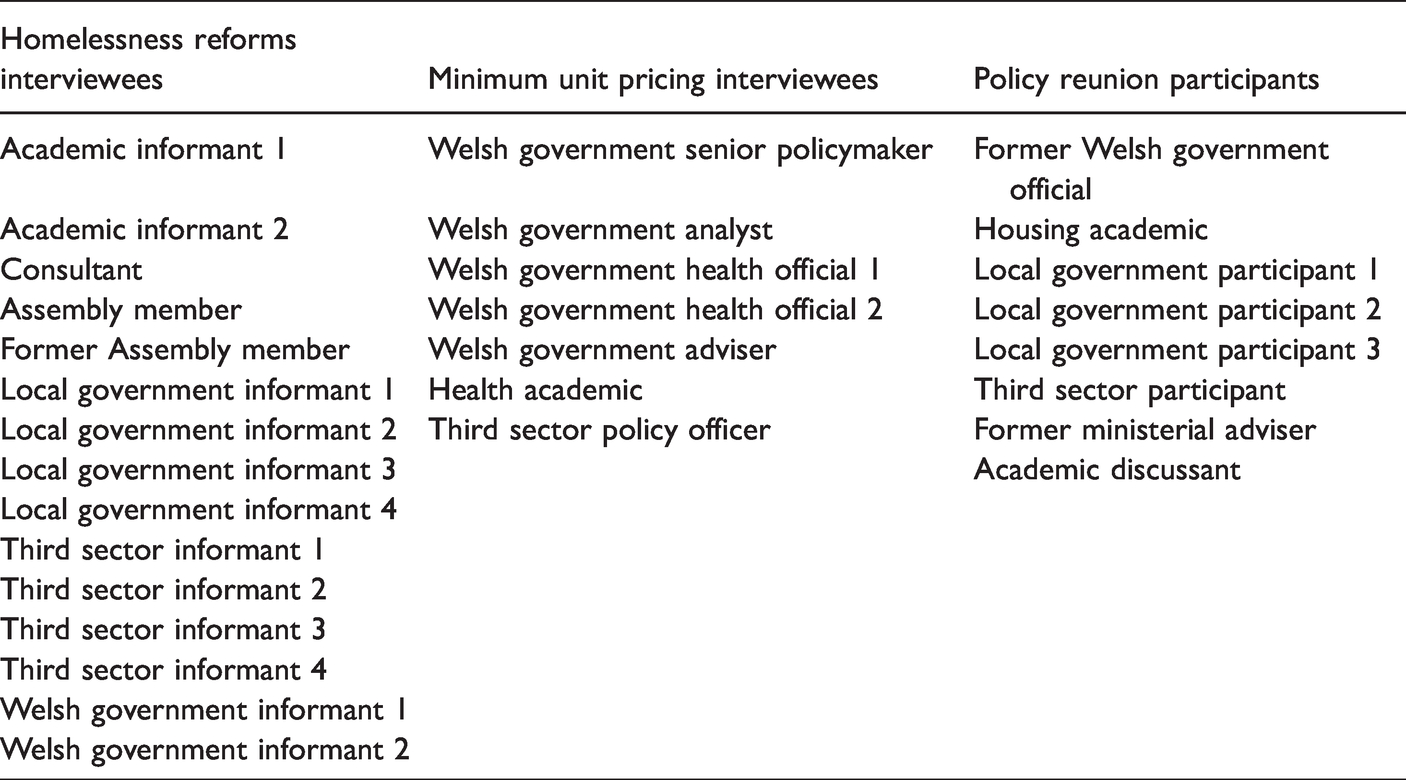
Initial participant selection focused on key actors identified from our documentary analysis and knowledge of the sectors. We complemented this with a ‘snowball’ sampling method to include others who were identified by interviewees as key actors (Devine, 1995). Interviews were recorded and transcriptions were shared with interviewees for factual corrections or clarifications (of which very few were requested). Transcripts were then subjected to thematic analysis, both manually and using NVivo. All of the key actors in the homelessness policy community in Wales were actively involved in the research. For the MUP case study, we secured access to actors from government, academia and the third sector. We were unable to obtain interviews with actors from the alcohol industry despite repeated requests, but were able to analyse their objectives and tactics from the documentary sources.
We convened a policy reunion of key participants in the homelessness reforms but decided not to pursue this approach in the case of MUP because of the difficulty of securing participants from the alcohol industry. Policy reunions (also known as witness seminars) bring together key participants in a particular historical or policy episode to reflect in a structured way on their experiences (Rutter et al., 2012). Although the method has its limitations (Centre for History in Public Health, no date), it can produce rich data that, alongside other evidence, illuminate issues such as the motivation, assumptions and dynamics of groups and individuals. At the request of participants, who were all still active in the sector, the discussion was conducted under the ‘Chatham House Rule’, which allows information disclosed in a meeting to be used freely on condition that the identity of the participants is not revealed (Chatham House, no date). The reunion was audio recorded and the data coded using a manual thematic analysis to identify principal themes. A draft report was shared with interviewees for factual correction or clarification.
Rules, capacity and legitimacy
As explained earlier, ‘context’, as defined by Wanna, consists of the rules under which a subnational government operates, its capacity and the legitimacy that it enjoys within and beyond its territory. Drawing on a review of existing literature and our interviews with key policy actors, this section analyses how these apply to subnational government in Wales. This provides the important backdrop for our two cases, which analyse what Wanna describes as ‘circumstance’, namely, the issues that the subnational government in Wales has prioritized and the skills, strategies and tactics that it has deployed to make the most of the rules, resources and legitimacy that are at its disposal.
Devolved government in Wales derives from a series of Acts passed by the UK Parliament since the 1990s. The Government of Wales Act 1998 transferred responsibility for key areas of domestic policy (notably, education, health, social care and housing, as well as some aspects of skills, agriculture and transport policy, but not the criminal justice system or welfare policy) from the Welsh Office, a department of the UK government, to an elected National Assembly for Wales. An executive responsible to the National Assembly, now known as the Welsh government, was established in 2001 and the National Assembly became Senedd Cymru or the Welsh Parliament in May 2020. 2 Full primary legislative powers were devolved to the National Assembly in 2011 and the Wales Acts 2014 and 2017 devolved some taxation and borrowing powers.
In terms of the Regional Authority Index, Wales therefore possesses a substantial degree of self-rule on all five criteria. 3 However, the Westminster Parliament retains the right to legislate for Wales in devolved as well as non-devolved matters, and there is potential for different interpretations about which policy issues fall within devolved competence. Furthermore, at the time of our case studies, UK legislation specifically required devolved legislation be compatible with EU law (under section 3, Wales Act 2017). The context of policymaking in Wales is therefore characterized by complex multi-level interdependencies that are open to challenge from and are influenced by the decisions of a range of actors at both the UK and EU levels.
To apply Hood and Margetts’s typology, the Welsh government’s formal ‘authority’ in devolved matters is equivalent to that of the UK government’s over the equivalent matters in England. It has very limited control over the amount of its ‘treasure’ because approximately 80% of its total expenditure of just over £18 billion per annum is derived from a block grant from the UK government (Welsh Government, 2019). However, it has discretion over how this funding is distributed between functions, so it can choose to prioritize different services and issues to the UK government. Its ‘organization’ is more limited: it has a comparatively small civil service staff and public services are often delivered by other public bodies or third sector organizations. However, there is potential to compensate for this by skilfully exploiting ‘nodality’, a practice that may be facilitated by the small size of Wales and of its policy communities (Connell et al., 2017). Nodality has been a key tool both for the pre-devolution Welsh Office and the devolved institutions that succeeded it. Both have practised an ‘informal and consultative’ (Greer and Jarman, 2008: 186) style of working predicated, in part, on the small size of the country and the limited policy development and implementation resources that they possessed. Devolution territorially rescaled the focus of policy actors in Wales (Keating and Wilson, 2014: 853; Keating et al., 2009: 57, 58). To some extent, as Wyn Jones and Paterson (1999: 182) predicted, this was driven by the Welsh government in order to broaden the basis of support for devolution and, as Royles (2007: 48) argued, to mitigate the strain placed on the new institutions’ resources by the acquisition of new responsibilities.
Nodality is enhanced by political capital and legitimacy, and in this respect, the Welsh government’s position has improved over the last two decades. In 1997, the majority in favour of creating devolved institutions was wafer thin, with just 50.3% of voters in favour on a turnout of just 50.1% (Dewdney, 1997). By March 2020, more than two-thirds of Welsh adults favoured retaining or increasing the Welsh government’s powers (BBC, 2020). Overall, the Welsh government has therefore become better placed to engage the institutional and corporate actors whose cooperation it needs to govern effectively and deliver on its policy objectives. However, this did not happen uniformly across sectors. Historically, the administration, economy and even geography of Wales have been closely integrated with those of England. Consequently, Welsh business interests, especially larger businesses and multinationals, have tended to focus their attention on the UK government level and view policy divergence as a threat to the stability of a unified UK market and regulatory framework (Keating et al., 2009: 57). This reflects the practices of large business interests elsewhere in Western Europe (Keating and Wilson, 2014: 854). Rumbul (2016) argues that many Welsh interest groups and civil society organizations have similarly tended to look towards, and to be (under-)resourced from, London. Therefore, the ‘engaged actor legitimacy’ of Wales’ devolved institutions, though stronger over time, remains complex and cannot be taken for granted.
Skills, strategies and tactics
As described earlier, for Wanna (2014), ‘circumstance’ is about how and with what success actors deploy rules, capacity and legitimacy to shape and deliver their policy agendas. Our case studies need to be seen in the context of the Welsh government’s acute awareness of the limits to its formal powers, capacity and popular support, which fuelled a strong desire to pursue distinctive ‘Welsh policies’ (Rawlings, 2001: 483). Between 1999 and 2010, the Labour-led Welsh government consistently sought to establish a distinctive ideological position from that of the ‘New Labour’ UK government. It spoke of ‘clear red water’ (Morgan, 2002) between the two, emphasizing a more statist approach that rejected the market-led public service reforms championed by the Blair government and retained a range of universal benefits that were abolished in England. During the following decade, including the period covered by our case studies, the political and policy differences between the Welsh and UK governments widened as the Conservative Party took control at the UK level and pursued a policy of austerity, involving deep cuts in public spending.
First case study: homelessness reform
In 1999, when housing, including homelessness policy, was devolved to the new National Assembly, Wales inherited a framework that required local authorities to provide housing for homeless persons who met certain criteria. Welsh policymakers could only make marginal changes to this and produce strategies and guidance to shape practice. When the National Assembly was given full legislative powers, the Welsh government began preparing primary legislation on homelessness, which eventually became Part 2 of the Housing (Wales) Act 2014. This gave local authorities additional duties to help people threatened with homelessness to keep their homes, and to provide people who were homeless with secure interim accommodation. Our study focused chiefly on the period between 2009, when the Welsh government publicly identified the need to reform the existing statutory framework (Welsh Assembly Government, 2009), and 2015, when the new framework came into force, with some consideration of earlier developments that established the context within which reform took place.
As statutory homelessness services were administered by local authorities to local applicants, the reforms had no significant direct implications outside Wales, and they did not affect, and were not affected by, supranational bodies. The extent and implications of the reforms therefore fitted neatly within the ‘rules’ governing Welsh devolution. The reforms were also within the Welsh government’s ‘capacity’ to deliver. It was required from an early stage that the reforms be achievable without additional expenditure (Welsh government informant 1) but because the Welsh government was already funding homelessness services, there were basic resources available to administer the reformed framework: it could be argued that ‘You’re already spending money on this.… You might as well use those resources in a more sensible way’ (academic informant 2). By itself, the Welsh government’s very small Homelessness Policy Team might have struggled to develop the policy and prepare local authorities for its implementation but it was able to extend its capacity considerably through a skilled exploitation of nodality. The interplay between nodality, treasure and authority was also important. The Welsh government’s position as a principal funder of homelessness services provided a basic incentive for local authorities and the third sector to participate in networks, and as its formal authority increased with the further devolution of legislative powers, the incentive became stronger.
These factors contributed to the political capital that the Welsh government possessed in this case. The ‘legitimacy’ of the Welsh government as an actor in this field was underpinned by the unambiguously devolved nature of housing and homelessness, though this does not mean that all actors initially supported the proposal for new legislation: the local authority sector originally argued that guidance would be a better way to change practice (third sector informant 1). Nonetheless, the key actors in Welsh homelessness policy – local authorities and third sector organizations – directed their actions at a Wales rather than a UK level, and were encouraged to do so by the Welsh government’s pursuit of a collaborative approach to homelessness policy: We’ve always worked very well with the civil servants in Welsh government on homelessness and so these ideas have been developing in quite a shared way I think over a period of years. (Third sector informant 2) It’s that big tent thing we tend to do in Wales, isn’t it, which can work well … I would give [the then Homelessness Policy Team leader] and his … team … lots of credence really in terms of being open to the co-production. (Consultant)
There were several factors that led the Welsh government to make homelessness one of the first issues that it chose to enact primary legislation on (Mackie, 2015). These included a growing ‘prevention turn’ in thinking about homelessness policy, accentuated by the need to respond to increasing demand, which was resulting in more households being placed in often costly and unsatisfactory temporary accommodation.
As these issue-specific factors came to the fore, wider political and institutional developments provided the opportunity and impetus for legislative change. Welsh ministers were keen to use the National Assembly’s new primary legislative powers, in part, to show that they needed them: I think the message that was out there from … the head of the government, was, ‘We’ve got these new powers. We need, in a sense, to take advantage of them to demonstrate that we can make a difference in Wales by sort of responsible use of these powers.’ (Welsh government informant 2)
Second case study: MUP
Our case study focused chiefly on the period between the publication of the Welsh government’s Public Health Green Paper (Welsh Government, 2012) and 2015, when draft MUP legislation was withdrawn (Welsh government analyst) in light of a challenge to the legality of similar Scottish legislation under EU competition law, and the then UK government’s argument that the legislation was beyond devolved competence. The Welsh government considers alcohol (and other substance) misuse to be primarily a public health matter (Welsh government health official 1; Welsh government health official 2), a view that was challenged by UK policymakers. Although some of the early research that led to the emergence of MUP as a prospective health policy tool had been commissioned by the UK Department of Health, the UK Home Office, responsible for criminal justice, saw the problem as one of crime, disorder and licensing, and it was this view that prevailed (Hawkins and McCambridge, 2020). This divergence of views between the two governments had implications for the Welsh government’s legal capacity to address it. If excessive drinking was a public health matter, the Welsh government could legislate on it because health is devolved. If it was a matter of crime, disorder and licensing, it was not devolved and the power to legislate remained exclusively with the UK government.
MUP also raised questions about the geographical boundaries of devolution. Welsh legislation would apply only to alcohol sales within Wales but could have wider implications. Major alcohol producers and retailers that operated across Wales and England particularly objected to the effect of differential pricing on their marketing and business models (Welsh government health official 1). Furthermore, as the Scotch Whisky Association’s challenge to the Scottish legislation showed, MUP might have had supranational implications in terms of the UK’s obligations to abide by EU competition law.
If MUP was considered to be a devolved public health matter, the Welsh government possessed the formal ‘authority’ to enact legislation on it. ‘Treasure’ was not an obstacle: MUP, in itself, was unlikely to incur significant money costs to develop and implement. The Welsh government did not possess the ‘organization’ to implement MUP, but it secured assurances that local authority trading standards officers could and would undertake enforcement: [We asked] trading standards people … ‘When you go out into supermarkets and local shops and things, and you're looking at pricing, you're looking at product safety, how much more onerous would it be for you to check whether something is being sold below an MUP?’ They said, ‘It wouldn’t be too onerous, yes, we could do that.’ (Welsh government health official 1) We began to get the [drinks] industry writing in and saying ‘see you in court’ when we first began to show we were intending to bring MUP about … I wouldn’t have characterized very much of what I’ve seen [in my job] as threatening, but I would say that the tone of their correspondence was unambiguously of that nature. (Welsh government senior policymaker)
In developing and implementing their homelessness legislation, Welsh ministers and officials in Wales could use ‘circumstantial’ tactics and strategies that built upon their ‘contextual’ strengths, notably, a largely consensual and participative approach to policymaking that complemented a comprehensive set of steady relationships with actors within the Welsh homelessness policy community, which had been developed over time. These relationships were explicitly and deliberately developed, both across the sector as a whole (Welsh government informant 2) and in relation to identified key actors, such as the political leadership of the local government sector. By contrast, in the case of MUP the circumstantial assets that the Welsh government possessed – the visibility and political skills of Welsh ministers and other policymakers – may have been effective in securing the support of sections of the policy community, such as academics, health professionals and third sector organizations, but they appear to have had little traction with significant opponents of MUP. The UK government’s willingness to challenge Welsh MUP legislation on the grounds of legitimacy further strengthened industry efforts to oppose the Bill.
We lack evidence on whether the UK drinks industry lobbying influenced the UK government’s intervention in this policy debate, as it did in other alcohol reform efforts (Holden and Hawkins, 2012), because we were unable to secure interviews with industry informants. However, in Scotland, where both health and alcohol licensing were clearly devolved, industry opponents nonetheless challenged the Scottish government’s legitimacy in the matter, first by promoting the idea of a ban on sales below the level of tax and duty payable on the drink (which would have made it a tax measure and therefore non-devolved), and then by appealing to EU competition law. This enabled them to engage in venue shopping (Baumgartner and Jones, 2009: 31–38; Holden and Hawkins, 2012) by moving the argument about MUP from the Scottish political arena, where they had not prevailed, to the UK political arena and to the courts, where they hoped to succeed. The ongoing court proceedings over the Scottish law, coupled with the UK government’s questioning of Welsh devolved competence on the issue, strongly inhibited the Welsh government’s capacity to introduce MUP. Ultimately, the material, financial and political resources required to defend the policy were deemed prohibitively high in conditions of uncertainty over the fundamental legality of MUP in the EU.
Conclusion
Frameworks such as the Regional Authority Index, and typologies of policy tools such as the NATO model, can help to facilitate analysis of the range and nature of the formal powers and resources available to a subnational government. However, to understand subnational policy capacity properly we need to take account of the dynamics and interactions between policy actors at different levels and in different sectors.
Our case studies demonstrate that analysing the interplay between rules, capacity and legitimacy, and skills, strategies and tactics, gives richer insights into the conditions under which subnational governments make a difference. These considerations will be specific to particular institutional settings and policy areas. Although they shared a common institutional context and were almost contemporaneous, the outcomes of the two policies examined in this article were shaped by differences in the national and international context, and in the relationships and legitimacy that the Welsh government had in respect of other actors.
We found that an important determinant of a subnational government’s ability to enact distinctive policies is the extent to which its deployment of its powers is accepted as legitimate by ‘engaged actors’. It may be that this is especially the case where, as is the case in the UK, the national government retains powers to intervene, or where the framing of a policy can be manipulated to allow venue shopping by campaigners. Nevertheless, subnational governments can use distinctive policymaking to enhance their legitimacy, as we demonstrated by our case study of homelessness reform, where there was a strong desire to show that new legislative powers could be used effectively. Additionally, while nodality can be used to enhance formal powers, our two case studies suggest that it is much more effective when other actors accept that a government possesses those powers and has a right to use them.
Policymakers at the subnational level, then, need to base their strategies on an appreciation of how their powers, policy levers and relationships interact with one another in any given case. In our example of homelessness reform, the accretion of formal powers by the Welsh government, and the lack of a competing authority outside of Wales, incentivized other actors to collaborate – which, in turn, rendered the Welsh government’s formal powers much more effective. In the case of MUP, the Welsh government had formal powers but its lack of perceived legitimacy in the eyes of other actors who were able to appeal to the UK government and/or European Commission laid it open to a potential challenge that, it decided, would prove too costly to fight, even though it believed it might win.
Future research could usefully test whether our findings apply in other countries and other policy domains to contribute a richer understanding of changes in specific policy areas and further advance understanding of effective subnational governance. Similarly, more research into the factors that shape national governments’ thinking about when to intervene in subnational policy initiatives would be valuable. For policymakers, the key insight from our analysis is that when deciding whether to pursue a policy, it is wise for them to not only take account of the formal and informal powers and levers at their disposal, but also consider how interactions between them, as well as the strategies of other actors with a stake in that policy, may affect the outcome.
Footnotes
Funding
The author(s) disclosed receipt of the following financial support for the research, authorship, and/or publication of this article: This work was supported by the Economic and Social Research Council (Urgency Grant Number ES/N00745X/1).
