



Abstract
This study examines the institutionalization of information technologies for policy formulation by investigating the case of eNAP. The digital tool was introduced in the spring of 2018 with the aim of supporting and improving sustainability impact assessments (SIAs) within the German Federal Government. Applying a neo-institutional perspective, this study shows how a tool like eNAP is embedded into prevailing regulative, normative, and cultural–cognitive structures. Findings from 10 semi-structured interviews indicate that the application of eNAP varies according to intra-ministerial coordination practices and portfolio-specific information-processing schemata. Overall, the tool serves to translate the abstract regulation to conduct an SIA, as well as to translate the vague norm of “sustainability” into a concrete assessment requirement, thereby helping increase policy officials’ awareness of sustainability goals. However, consistent with previous studies, great importance is not attached to SIAs in policy formulation, and prevailing norms and routines make the implementation of eNAP to increase the use of evidence or in-depth considerations of policy alternatives and their consequences unlikely.
Information and communication technologies (ICTs) provide new opportunities to support ex-ante policy evaluations. Practitioners enforcing ICTs for impact assessments should take a comprehensive perspective on the institutional context because both formal organizational structures and implicit expectations, habits and routines affect how policy officials use these tools. Technology alone does not improve policy evaluations, and a misfit between regulative, normative and cultural–cognitive institutional elements can lead to merely symbolic displays of impact assessments through the means of digital tools.
Keywords
Introduction
Regulatory impact assessments (RIAs) are an important element of Better Regulation reform efforts and involve the ex-ante evaluation of policy proposals’ consequences, both intended and unintended. Over the last three decades, the use of RIAs has rapidly expanded across OECD and EU member states and is regarded as a key instrument to achieve better-informed, effective and transparent decision-making (Adelle and Weiland, 2012). Yet research on the practical implementation of RIAs has identified a variety of difficulties, ranging from a lack of resources to insufficient organizational and political support, which often result in an assessment procedure of low quality and narrow scope. These deficits also concern sustainability impact assessments (SIAs) that are additionally challenging because, first, the complex and multidimensional character of sustainability entails a considerable degree of uncertainty about policy consequences and, second, the assessment of long-term impacts depends on the underlying assumptions about causal relationships between different UN Sustainable Development Goals (SDGs) (Jacob et al., 2009). In the digital governance era, information and communication technologies (ICTs), defined as a diverse set of electronic tools to “transmit, process, store, create, display, share or exchange information” (UNESCO, 2007: 1), provide new opportunities to support policy formulation processes and have been argued to enable the assessment of a wider range of policy alternatives and their consequences (Höchtl et al., 2016).
In 2018, the German Federal Government introduced an electronic sustainability assessment tool called eNAP that was developed to help policy officials assess the impact of a regulatory proposal and identify potential interdependencies with other policies based on the goals of the Sustainability Strategy (German Federal Government, 2018a, 2018b). eNAP is the first prototype of a larger RIA module created in collaboration with the Federal Chancellery and the Federal Ministry of the Interior, Building and Community (hereinafter referred to as the Federal Ministry of the Interior) and one of the first ICT tools designed to facilitate SIAs in European countries. This tool thus allows for unique insights into the challenges and opportunities of institutionalizing ICTs for prospective policy evaluations.
Because tools like eNAP are far from widespread, research related to ICTs’ potential and their impact on RIAs is rare, if not non-existent. Previous studies have been concerned primarily with the diffusion and adoption of RIA and SIA (Adelle and Weiland, 2012; De Francesco, 2012; Radaelli, 2004; Veit, 2010; Wiener and Ribeiro, 2016), their different types of use in the political process (Dunlop et al., 2012; Hertin et al., 2009; Rissi and Sager, 2013), or factors determining the scope and quality of RIA and SIA implementation (e.g. Adelle and Weiland, 2015; Piesker, 2014; Russel and Turnpenny, 2009; Veit, 2010). At the same time, the literature on public sector digitalization primarily addresses local governments and citizen–state interactions, neglecting the internal digitalization dynamics of central state bureaucracies and the ICT-enabled evaluation of policy options before their adoption. Given that ministerial departments are crucially involved in the legislative process, this study seeks to illuminate the use of ICTs for policy formulation and how they are embedded into existing institutional structures. Hence, the aim of this article is to analyze how prevalent institutions related to SIAs affect the implementation and use of digital tools for conducting impact assessments, thereby focusing on the early stages of adoption. Examining the institutionalization of eNAP early in its implementation will give valuable insights into the way crucial institutional arrangements shape the use of ICTs for policy design. To that end, the paper will first provide some context on RIAs in Germany and introduce neo-institutional theory as the theoretical lens for this case study. The subsequent section will describe the methods used and present the case of eNAP, after which the paper will turn to the empirical analysis and present the conclusions.
Regulatory and sustainability impact assessments in Germany
In Germany, efforts to implement ex-ante impact assessments have been undertaken since the 1960s; however, it was not until 2000 that the RIA was included in the Joint Rules of Procedures of the Federal Ministries, obliging them to anticipate both intended and unintended effects of new laws and regulations (Piesker, 2014). In 2009, the RIA was extended by anchoring the SIA to the Joint Rules of Procedures, enshrining the evaluation of potential environmental, economic, and social consequences of legislative proposals (German Federal Government, 2018a). More precisely, the long-term developments and consequences of the planned regulations must be assessed regarding their adherence to the German Sustainability Strategy and the global SDGs.
However, RIAs in general, as well as SIAs in particular, are weakly institutionalized because they lack effective control mechanisms and binding guidelines regarding their scope and methodical procedure (Adelle and Weiland, 2015; Jacob and Weiland, 2012; Piesker, 2014). Although the Federal Ministry of the Interior published impact assessment guidelines with recommendations for techniques and instruments, they are not binding for other departments, and the ministry in charge of the legislative proposal decides how to carry out the RIA. Only the results and conclusions of the RIA are published on the cover note of the regulatory proposal, while the underlying assumptions and methods are not publicly available (Adelle and Weiland, 2015; Veit, 2010). Usually, the assessment is employed when the legislative initiative is already at an advanced stage because regulations often result from decisions made earlier in the political process that are not subject to an impact assessment, such as coalition agreements.
Similarly, the consultation of other relevant ministries during the SIA process is rare (Adelle and Weiland, 2015). Information on potential impacts and alternatives poses a means of gaining power in the political negotiation process because successfully enforcing a law is associated with greater legitimacy than a full-scale impact assessment (Veit, 2010: 318f). Consequently, RIAs are used primarily to justify a planned regulation instead of anticipating impacts or discussing alternatives; intra-ministerial demands and routines thus do not include in-depth assessments. Rather, the RIA procedure—from the ministerial unit up to the political leadership of the ministry—is characterized by a process of filtering and reducing the amount of information because higher-level units prefer to receive already coordinated proposals (Veit, 2010). Such perceived expectations of political leadership are important, given the increase in the functional politicization of the civil services (Fleischer, 2011). In summary, ministries were shown to “decouple” their formal structure from actual RIA activities in that they formally comply with the RIA but notate pre-set phrases instead of considering policy alternatives (Veit, 2010). Yet another factor pertains to information-processing capacities, which decline at higher levels of the ministerial hierarchy and are further constrained by time restrictions, a lack of human resources, and insufficient methodological knowledge and skills, all of which impede comprehensive and full-scale RIA implementation (Piesker, 2014).
Although the Parliamentary Advisory Council on Sustainable Development formally reviews the SIA as conducted by the ministries, the Council's recommendation is non-binding for parliamentary committees, and the Council does not conduct content-related assessments in a narrower sense. It reviews only whether relevant SDGs are discussed. In the 18th legislative period, the Parliamentary Advisory Council on Sustainable Development (2017) considered approximately 92% of SIAs to be formally sufficient. In practice, however, German RIAs focus primarily on legal, budgetary, and administrative impacts while marginalizing sustainability matters (Adelle and Weiland, 2015).
Theoretical background
The digitalization of public sector organizations creates new opportunities for RIA processes, with novel ICT tools promising to expand the information base and enable the consideration of a wider set of policy alternatives and their consequences. However, studies of ICTs at the intersection between organization science and technology emphasize the importance of not abstracting technology from the institutional context in which it is embedded (Orlikowski and Barley, 2001: 148) and suggest that the deployment of ICTs within organizations is shaped as much by normative beliefs and cultural practices as by technical characteristics and opportunities (Currie and Swanson, 2009). In other words, behavioral patterns of ICT use must be examined against the backdrop of institutional stability, which is generated not least by “common understandings that are seldom explicitly articulated” (Zucker, 1983: 5). Only recently, van der Voort and colleagues (2019) attenuated the widely held assumption that all relevant information provided through ICTs is processed toward a common purpose. Examining the use of big data within government organizations, they pointed to institutional mechanisms such as organizational incentive structures and politically driven priorities, illustrating that in reality, policy-making does not necessarily adhere to a sequence in which information gathering precedes decision-making.
This study relies on neo-institutional theory to examine the role of institutions in the implementation of eNAP. Neo-institutionalism has evolved through critiquing formerly dominant models of rationality that conceive social action as being determined by goal-oriented and instrumental actors. Emphasizing that such models underestimate the institutional underpinnings of individual behavior, Meyer et al. (1994) see
the “existence” and characteristics of actors as socially constructed and highly problematic, and action as the enactment of broad institutional scripts rather than a matter of internally generated and autonomous choice, motivation, and purpose. (p.10)
The sociological perspective of neo-institutionalism thus focuses on the institutional environment to explain organizational behavior, pointing to the emergence of legitimacy imperatives that guide individual and collective action. Legitimacy is an “anchor-point” (Suchman, 1995: 571) in neo-institutionalism and plays a key role in allowing for the creation, maintenance, and change of institutions.
Following the observation that organizations within a field tend to become similar, early studies emphasized the power of isomorphism, arguing that organizations adapt to certain structures and processes owing to regulative, normative, and mimetic forces (DiMaggio and Powell, 1983; Meyer and Rowan, 1977). Yet organizations often decouple their formal structure (“talk”) from operational procedures (“action”), thus signaling compliance without actually aligning with outside norms (Brunsson, 1989). Another stream of research employs an “organization as institution” perspective, emphasizing institutional pressures from the inside of organizations (Zucker, 1987). Such perspectives focus on how institutional elements (i.e. structures, actions, and roles) emerge and affect behavior within organizations, stressing the power and legitimacy of common understandings and shared meaning systems.
According to Scott (2008), institutions are composed of three pillars, each of which provides a distinct basis for legitimacy (see Table 1). The regulative pillar describes formal rules, such as laws and regulations, as well as informal rules and guidelines that regulate and constrain behavior (Scott, 2008). A central component of the regulatory pillar is the use of coercion via political or organizational authority to secure compliance by employing mechanisms of surveillance and control. In contrast, Scott's normative conception of institutions emphasizes the role of norms and values in guiding social behavior. In addition to more general codes of conduct, normative institutions can take the form of standard operating procedures and practices that are considered to be normal and legitimate. These institutions are “both internalized and imposed by others” (Scott, 2008: 56) and reflect expectations for the appropriate behavior of actors in a given situation. Unlike laws and regulations, normative forces operate according to a logic of appropriateness (March and Olsen, 1989) in which members of a collectivity feel socially obliged to comply.
Regulative, normative, and cognitive elements of institutions.
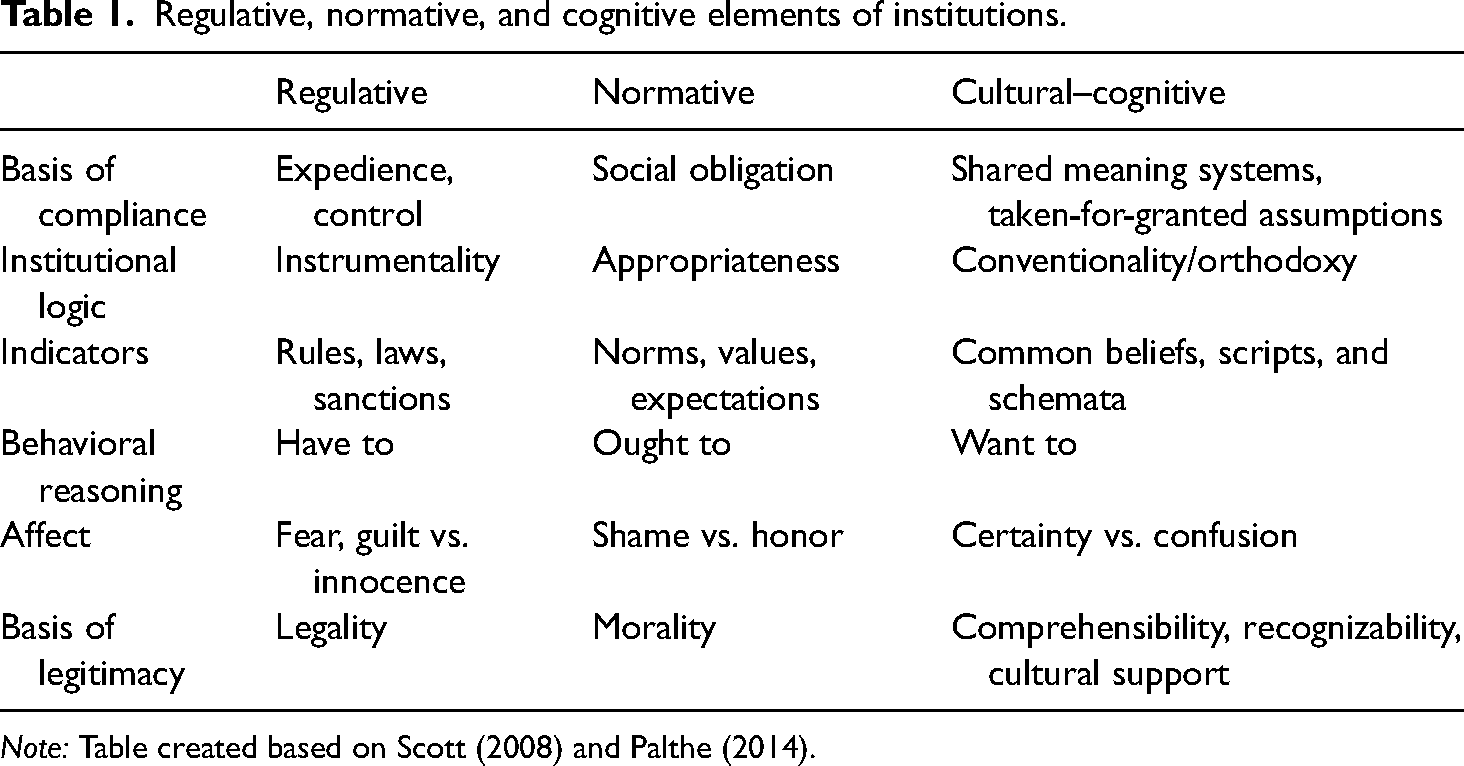
Note: Table created based on Scott (2008) and Palthe (2014).
Lastly, the cultural–cognitive pillar comprises shared meanings and logics of action (Scott, 2008). A central component of this pillar pertains to scripts and schemata that serve as a frame of reference by which people interpret the world around them. They become reflected in institutional habits, routines, and traditions, narrowing eligible courses of action; deviating from such schemata may lead to uncertainty or confusion (Scott, 2008: 59). Similar to the notion of passive, “vicarious learning”, evoked through exposure to another person's experience at work (Gioia and Manz, 1985: 528), cognitive scripts are retained and reproduced across generations of organizational actors and thus enacted unconsciously. In other words, actors do not consider non-compliance (Mahoney and Thelen, 2010), which stresses the central role of taken-for-granted assumptions. As pointed out by DiMaggio (1997), cognitive schemata tend to be stable and persist even in the face of equivocal or inconsistent information. Therefore, substantial change is often difficult to achieve because it requires the redefinition of deeply rooted interpretative schemes (Powell and DiMaggio, 1991). In order to achieve genuine change, organizational members thus have to internalize the premises of change, that is, adapt to change because they want to, not because they have or ought to (Palthe, 2014).
In practice, the three institutional pillars combine in various ways, and identifying their relation to one another remains an empirical question (Scott, 2008). According to Scott (2008), “When the pillars are aligned, the strength of their combined forces can be formidable” (p. 62), while the misalignment of pillars can lead to confusion, uncertainty, and conflict.
For example, research concerned with the institutionalization of knowledge use for policy-making purposes in the health sector has identified normative and cultural-cognitive dimensions as major drivers for strengthening knowledge flows between policy actors (Koon et al., 2020). Accordingly, the introduction of digital tools, such as health technology assessment programs, is based particularly on normative elements, appealing to mechanisms of social pressure and seeking to promote shared routines, protocols, and beliefs regarding the incorporation of knowledge in policy design. Yet enforcing the use of knowledge as a commonly understood demand often proves to be a slow and challenging process. The analysis of ICTs for policy formulation therefore requires the careful contemplation of legitimacy imperatives that make up the institutional environment of policy officials both within and beyond their organization. As emphasized by Currie (2009), organizations are subject to both internal and external institutional pressures and the joint reflection of these threads can provide great explanatory power for digital change outcomes.
Methods
Case selection
The present case study was carried out as part of the H2020 research project TROPICO that investigates how governments are transformed to become more open, innovative, and collaborative. Using a case study approach allows for an in-depth understanding of the research phenomenon in its natural setting and offers the opportunity to acquire a detailed picture of the institutional forces operating in the introduction of ex-ante policy evaluations (Miles et al., 2013). Selecting the case of eNAP, this study examines one of the first ICT tools introduced in Europe to enhance the SIA and thus provides unique insights into the chances and boundaries of ICTs as a means for Better Regulation. eNAP was introduced in 2018 and is part of the eLegislation project, a large-scale project that seeks to digitalize the federal legislative process (German Federal Ministry of the Interior Building and Community, 2019). The tool was designed to support legal units across all ministries to facilitate and improve the SIA (German Federal Government, 2018b: 22). Its development and implementation followed a centralized approach, as it was created and introduced in collaboration with the Federal Chancellery and the Federal Ministry of the Interior. The latter is responsible for implementing the eLegislation project and can, according to the Joint Rules of Procedures, provide recommendations and guidelines for conducting RIAs.
eNAP is a web-based tool that is not restricted to use in the government IT system and therefore did not require the development of extra software. The structure of the interface is derived from the German Sustainable Development Strategy, which is based on the 2030 Agenda for Sustainable Development and comprises 17 SDGs. As of 2019, these goals are measured in 38 areas using 66 key indicators (German Federal Government, 2018b). For each of the 38 areas as well as the six principles of sustainable development, the user has to decide whether they are affected to a “noteworthy extent” and when selecting “relevant” give a brief explanation of at least one of the area's indicators. To that end, eNAP also contains information on indicators, such as definitions, goals, and recent statistics, and it structures the assessment by visualizing the progress made. The order of assessment can be determined by the user, allowing them to move freely between different goals and principles; however, the assessment can be completed only after each of the areas and principles is defined as “relevant” or “not relevant”. Thus, eNAP aims to improve SIA quality and facilitate the identification of potential consequences and interdependencies between policies (German Federal Government, 2018b: 22). However, eNAP is not intended to make the SIA more data driven. Rather, it seeks to achieve a qualitative consideration of environmental, economic, and social impacts. Other RIAs, such as those used in Austria and Switzerland and by the European Commission, require much more extensive, quantitative assessments but encounter a variety of problems or are barely implemented in practice (Adelle and Weiland, 2015; Jacob et al., 2009).
Data collection and analysis
The analysis relies on 10 semi-structured interviews conducted between October 2018 and March 2019. The selection of interview partners followed a purposive sampling approach to ensure the inclusion of actors most relevant to the research subject, complemented by a chain-sampling approach (Ritchie et al., 2013). As noted earlier, the case study was conducted during the early introductory phase that is often crucial for the further course of ICT systems and at which time prevalent institutional forces become particularly visible. During that period, ministerial units responsible for coordinating sustainability matters and SIA activities within the ministry played a major role in integrating eNAP into the assessment practice. Additional interview partners included ministry officials involved in legislative drafting and actors involved in developing eNAP as well as in the Parliamentary Advisory Council on Sustainable Development. To achieve a cross-sectional sample, reference persons across all federal ministries were approached, and the final sample of participants covers almost all portfolios of major legislative activities. In addition to the interview data, documents, such as press releases or user manuals, were used to inform the case study; however, no documents that reflect internal communication or coordination processes were available.
The interview guideline covered questions on the background and development of eNAP, and asked for formal and informal rules (i.e. organizational structures, guidelines and directives) with regard to SIA procedures, including actors to be involved, hierarchies to be considered and accountability mechanisms. Questions also referred to the importance attached to SIAs and the introduction of eNAP as perceived by the interviewee as well as typical SIA procedures and coordination routines, incentives to use the tool, the SIA implementation via eNAP and benefits, burdens, and challenges. Data analysis followed a two-step coding approach, applying deductive coding during the first cycle and rearranging and condensing the interview data as part of the second cycle to create broader themes or categories and search for general patterns across the data (Miles et al., 2013). During the analysis, indicators as specified in Table 1 were used as a frame of reference: intra-ministerial structures and SIA directives enforced by control and sanctions were classified into the regulative pillar; and the normative pillar was assigned data on standard operating procedures and practices, thus capturing what policy officials feel they ought to do. Finally, data addressing unquestioned decision-making premises, data pointing to (un)certainty, or incentives for voluntary use were attached to the cultural–cognitive pillar. Through this categorization, the three institutional pillars served as a lens through which to interpret the data; however, it is not the claim of this paper to create a definite, indefeasible classification. Rather, empirical data interpreted within the frame of one pillar may also exhibit characteristics of another. The following section turns to the empirical analysis structured around the three institutional pillars described by Scott (2008).
Empirical analysis
The regulative pillar: the crucial role of organizational and procedural structures
eNAP was introduced on a voluntary basis and the ministry in charge of a legislative proposal decides how to carry out SIAs. Like impact assessments in general, the SIA is dominated by the Department Principle (Jacob et al., 2009) that is stipulated in the German constitution and specifies that each Federal Minister—within the guidelines specified by the Federal Chancellor—conducts the affairs of their department independently and according to their own responsibility. Over recent decades, the department principle has gained importance, thus altering the relationship between the Federal Chancellery and ministries that seek to push back the Chancellery's attempts to exert influence (Fleischer, 2011). Therefore, intra-ministerial rules and guidelines were found to be of major importance for the deployment of eNAP. More precisely, ministerial SIA regulations vary regarding who must be involved in the SIA process or must countersign the results of the assessment. Thus, the ministries differ regarding the role played by the ministerial unit in charge of sustainability matters in coordinating and double-checking the SIA results as prepared by policy officials who have drafted a given law or regulation. In some cases, getting the approval of the sustainability unit is mandatory (in which case the unit concerned with cabinet and parliament matters does not accept the draft if the sustainability unit was not consulted beforehand; int_3, int_4, int_10), but in other ministries, the role of sustainability units is more informal. They may offer their advice, but it is not mandatory to follow it (int_9), or they may be approached by policy officials to provide comprehensive support but have to deny the request owing to a lack of human resources, therefore giving only some general advice (int_8).
Some coordinating units hope that eNAP will facilitate intra-ministerial coordination by reducing the time spent on control loops. Those working in units whose approval is mandatory tend to be more pessimistic about the use of eNAP. For example, one interview partner expects that employees who do not have much time and cannot find a relevant SDG at first glance will continue to simply call the unit, regardless of the availability of eNAP. Another coordinating unit pointed out the following: After all, we are helping with the formulation of the sustainability assessment and they can make things easy, they say “we do not have to think about that, that's what [the coordinating unit] is for”. (int_5)
The formal organizational structure within each ministry may thus impact how extensively policy officials engage with the tool. Moreover, the location of responsibility for coordinating the ministry's sustainability matters and SIA at the executive level—in addition to making it mandatory to consult this unit—facilitates the creation of a clear overview of and control over SIA activities across divisions and units within the ministry, compared with a horizontal control mechanism. A coordinating line unit not formally involved in the SIA process reported having difficulty establishing horizontal networking structures and being informed about SIAs only when the Parliamentary Advisory Council found these SIAs to be insufficient. Because a formal request of the Advisory Council to repeat an insufficient SIA is made publicly and puts the respective lead ministry under scrutiny, most interview partners appreciate eNAP for providing reassurance that SIAs are conducted properly. In other words, the fear of admonishment by the Council serves as a major motivation for policy officials to use the tool.
Thus, SIA regulations within most ministries primarily target formal compliance with the Joint Rules of Procedures and Parliamentary Advisory Council. The latter's review remains solely formal and involves no narrower or in-depth assessments. Considering that the Parliamentary Advisory Council on Sustainable Development (2017) had to examine 769 legislative or regulatory drafts during the 18th legislative period, an in-depth examination of each would hardly be feasible. Already, it is only possible to cope with the high number of proposals because the members employ their own resources (int_7).
The normative pillar: increasing awareness of the sustainability strategy
As mirrored in the lack of SIA specifications, prevalent norms and values within ministries do not place high importance on the Sustainability Strategy and impact assessment. Rather, the SIA is treated as a necessary step to “tick off” at the end of the legislative process: It is not yet in people's mind to think from a sustainability point of view, rather sustainability is an afterthought, added at the end of the process. It is therefore, in fact, just the completion of a bureaucratic exercise. (int_4)
In line with prior research on RIAs in Germany, the SIA is found not to be subject to the inter-ministerial coordination process; rather, most interview partners emphasized that they engage in a permanent dialogue with relevant actors during the policy formulation process anyway. Hence, the assessment is conducted for an already coordinated policy proposal, justifying it ex post. As one coordinating unit noted: The sustainability impact assessment is conducted by the responsible lead ministry, and the other ministries do not, I think, take a closer look at that. At least I am not aware that we were ever asked by [ministerial] units: “Look at this sustainability impact assessment, isn’t it a little weak or insufficient?” (int_9)
The SIA is perceived mostly as a minor part of the overall impact assessment and in some cases has even been “overlooked” (int_3, int_8). A main objective of the tool, therefore, is to inform ministry officials about the national sustainability strategy, sensitizing them to matters that fall outside their area of expertise and the topics handled by their unit. After all, policy formulation in ministries is highly specialized, and not all policy officials preparing legislation are aware that some goals of the strategy might concern their policy work. eNAP can thus be understood as a means of extending officials’ consideration of policy proposals by increasing their awareness of sustainability matters. On the one hand, there is indeed broad consensus that eNAP will increase awareness of the sustainability strategy and knowledge of the SDGs: We all have time pressure and everyone has a little bit of the tunnel vision. […] When going through eNAP completely, one was at least asked to consider every one of the 17 goals (int_5)
However, any evidence that eNAP will lead to the use of more information to change the substance of policy and incorporate considerations of unintended effects is weak and equivocal. While some interviewees agree that eNAP will make it easier for officials to detect goal conflicts and anticipate their consequences, others assume the detection of such interdependencies to be coincidental. eNAP unfolds primarily in an indirect manner by sensitizing ministry officials to the sustainability strategy. This effect may be strengthened by the design of eNAP since it requires the user not only to explain why a certain SDG is “relevant” but also to explicitly determine that it is “not relevant” otherwise. Several interview partners associate a psychological barrier with choosing “not relevant”; that is, the interviewees found it easier to say nothing at all about a given SDG than to explicitly decide that one of the indicators is not relevant to the draft: Those saying “not relevant” for the tenth time will probably wonder at some point: “Is my proposal even relevant for anything?” I find that a little provoking, the box, “not relevant”. […] If one permanently describes himself as irrelevant for sustainability, he also is irrelevant with regard to the matter itself. (int_4)
To strengthen this effect and improve SIA quality, eNAP should be linked to an effective vertical control mechanism within ministries, thus creating an incentive and further encouraging the comprehensive consideration of SDGs. Throughout the introduction of eNAP, the political leadership within ministries devoted little attention to the tool, reflecting a weak commitment to SIAs. In a nutshell, policy officials preparing a law or regulation face two opposing norms, that is, an externally imposed sustainability norm, manifested in the SIA requirement and, on the other hand, standard operating procedures within ministries that are considered “normal” and legitimate and do not include an in-depth impact assessment. By specifying what is expected regarding SIA implementation, eNAP can be understood as an attempt to harmonize and standardize the assessment process, ensuring that ministries comply with minimum standards and institutionalizing the SIA more strongly, that is, shifting the logic of appropriateness.
The cultural–cognitive pillar: reducing uncertainty in sustainability matters
Because the SIA and sustainability matters are not given high importance in the legislative process, most policy officials had only a vague awareness that the SIA has to be conducted as part of the RIA and that this assessment should in some way refer to the Sustainability Strategy. Sometimes, however, they did not even know that the strategy existed, and those who were not already engaged with the subject of sustainability were easily overstrained by the requirement to conduct an elaborate and comprehensive SIA. It was also due to the high degree of uncertainty that policy officials often used pre-set phrases such as “The regulation is in line with the German Sustainability Strategy” or simply copied a sentence like this from another legislative draft (int_8). While such decoupling—a process in which ministries formally comply with the SIA but do not conduct a comprehensive assessment—can be interpreted as legitimacy-maintaining behavior to satisfy conflicting norms, it also reflects uncertainty and confusion at the individual level, resulting from a misalignment between ministries’ internal and external institutional frameworks.
By facilitating access to information relevant to SIAs and structuring the procedure, eNAP standardizes and simplifies the assessment, thus reducing uncertainty and re-aligning the institutional elements of the SIA. In general, eNAP has been appraised as a useful supporting tool that guides policy officials through the SIA and helps them structure their thoughts. Overall, clicking through eNAP to read the content of the strategy is considered to be more pleasant and convenient than working all the way through a book more than 200 pages in length.
However, the tool is considered valuable for ministries typically associated with sustainability in the first place, such as the Federal Ministry for the Environment, Nature Conservation and Nuclear Safety or the Federal Ministry for Food and Agriculture. Similarly, interviewees across other portfolios have repeatedly pointed out that the same set of SDGs usually apply to their respective division or ministerial unit, which is why they do not reconsider all of the SDGs for a new draft. These findings point to the importance of taken-for-granted assumptions on the regulative matter and officials’ area of expertise. Such schemata are unconsciously enacted, determining aspects of the sustainability strategy that policy officials pay attention to, and how these officials interpret and use the information provided through eNAP.
This is all the more important considering that officials often lack the time get familiar with novel ICTs. During the user workshops, the tool was noted to require much input before it is possible to complete the assessment. After all, with eNAP, the SIA can be completed only once all 38 indicators and six principles of sustainable development are assessed. That the tool's overall structure was nonetheless retained can be considered a deliberate decision, reflecting the objective of eNAP to increase bureaucratic officials’ awareness of sustainability matters that fall outside their immediate area of expertise. At the same time, emphasis was placed on eNAP's ability to facilitate the assessment to ensure that employees actually use it.
During the development of eNAP, the distinction between a “considerable impact”, “impact”, and “no impact” was also discussed, instead of simply identifying SDGs as “relevant” and “not relevant”. Although this distinction may sound less subjective, it nevertheless necessitates the definition of a considerable impact, which it is hardly possible to quantify across indicators (int_6). The tool's ability to point to typical interactions between indicators and, for example, stimulate users to think about consequences for the environment or energy consumption when stating that a legislative draft is relevant to economic growth was also discussed. Such a feature would, however, require a strong scientific basis and make the assessment process much more complex, probably overstraining policy officials’ capacities. In that sense, an uncertainty-reducing effect primarily relates to meeting the formal SIA requirements, while an in-depth consideration and analysis of consequences does not constitute an internalized logic of action. eNAP serves mainly as an instrument that translates the vague norm of “sustainability” into a concrete assessment requirement. Hence, while stipulating the SIA in the Joint Rules of Procedures and establishing the Parliamentary Advisory Council as a control mechanism are measures based primarily on the regulative pillar, the introduction of eNAP targets the normative and cultural–cognitive pillars, seeking to increase awareness of the sustainability strategy.
Conclusion
This study examined how prevalent institutions related to SIAs in the German ministerial bureaucracy affect the implementation and use of a digital tool (eNAP) in its early stages of adoption. The results indicate that prevalent norms and practices together with their taken-for-grantedness shape and constrain the use of eNAP. This is because inconsistent norms within and outside ministerial bureaucracies create a poor fit between regulative, normative, and cultural–cognitive institutions, leading to a symbolic display of SIA procedures and the pragmatic use of eNAP. Because the SIA is not attributed great importance in legislative processes, eNAP encourages formal compliance in which policy officials’ attention to SDGs is shaped by their area of expertise and profession. So far, the tool has had an indirect effect by reducing uncertainty about how to proceed with the SIA and facilitating access to SIA-relevant information, thus sensitizing ministry officials to the sustainability strategy.
While examining ICTs early in its implementation is fruitful to assess the impact of prevalent institutions, this case study is not capable of capturing the evolution of institutional dynamics over time. Longitudinal studies may expand on findings from this study to provide a better understanding of the relation between institutional pillars and how they evolve to unfold the full potential of ICTs in policy formulation. At the end of 2019 and thus after the investigation period, the State Secretaries’ Committee for Sustainable Development enforced eNAP as the mandatory and default instrument for conducting SIAs across all ministries (Parliamentary Advisory Council on Sustainable Development, 2020). Considering the significance attached to the Department Principle that was long regarded an impediment for more progressive RIA approaches, the binding character can be interpreted as quite a remarkable step, reflecting the growing importance of sustainability norms. It remains to be seen, however, whether this institutional constellation transforms into assessments beyond a merely formal compliance.
It would further be promising to investigate how cognitive schemata operate in the use of ICTs and examine how public servants process (in)consistent information retrieved from ICTs, e.g. by relying on experimental methods. This is all the more important considering that observing unconsciously enacted schemata through expert interviews is possible only to a limited extent. Lewin et al. (2012) discuss ways for policymakers to assess how much confidence to place in different kinds of evidence when evaluating policy options. Yet insights into ICTs for ex-ante policy evaluations stem primarily from health systems research and should be expanded to other policy fields. To increase the external validity of this study's findings, it would further be valuable to comparatively examine the role of administrative traditions for implementing ICTs in ex-ante policy evaluation. Lastly, future research may investigate how policy officials can be “nudged” (Thaler and Sunstein, 2008) to include ICTs in their routines, thus strengthening the cultural–cognitive legitimacy of ICTs change. As demonstrated in this study, this type of legitimacy is the strongest and most essential but the most difficult to achieve (Suchman, 1995).
Footnotes
Acknowledgements
Earlier versions of this paper were presented at several conferences and workshops, I particularly thank Sylvia Veit, Michael Haus, and Maarten Huisman for their constructive comments. Moreover, the article benefited significantly from the insightful feedback I received from Julia Fleischer, Markus Seyfried, Lise Rykkja and Steven Van de Walle. Finally, I would like to thank the two anonymous reviewers for their valuable and helpful comments as well as the interviewees for their time and kind cooperation.
Declaration of conflicting interests
The author declared no potential conflicts of interest with respect to the research, authorship, and/or publication of this article.
Funding
The author disclosed receipt of the following financial support for the research, authorship, and/or publication of this article: Horizon 2020 Framework Programme (grant number 726840).
