



Abstract
This article introduces the ‘House Model’, an integrated framework consisting of four data governance modes, based on the urban and smart city vision, context, and big data technologies. The model stems from engaged scholarship, synthesizing and extending the academic debates and evidence from existing smart city initiatives. It provides a means for comparing cities in terms of their digitization efforts, helps the planning of more effective urban data infrastructures and guides future empirical research in this area. The article contributes to the literature examining the issue of big data and its governance in local government and smart cities.
Points for practitioners
Data is a vital part of smart city initiatives. Where the data comes from, who owns it and how it is used are all important questions. Data governance is therefore important and has consequences for the overall governance of the city. The House Model presented in this article provides a means for organizing data governance. It relates questions of data governance to the history and vision of smart city initiatives, and provides a typology organizing these initiatives.
Introduction
Modern cities are ‘datafied’ (Meijer, 2018). Data is central to modern citizenry and is likely to originate bottom-up from the carriers of mobile phones, the users of dash-cams and sensors, and not just from a top-down, central governance structure. Digital-era governance can be centralized through the integration and centralization of government processes, or it can be decentralized and public services organized around the needs of the citizens (Dunleavy et al., 2006; Margetts and Dunleavy, 2013). Urban data is a key feature of digital-era governance and how it is planned can substantially determine the outcome of modern governance systems (Brown and Toze, 2017). An issue facing policymakers is, then, how to plan urban data to ensure citizen participation in the co-production of solutions in public service design and delivery.
Today, local governments’ attempts to manage urban data have mostly flourished in the form of smart city initiatives (SCIs). The global market for smart city solutions is estimated to grow with a compound annual rate of more than 28% and is forecast to be worth US$2.27 trillion by the end of 2023 (Netscribes, 2018). Evidence suggests that smart cities are heterogeneous in terms of their governance outcomes. While previous studies have highlighted this heterogeneity (e.g. Hollands, 2008, 2015; Neirotti et al., 2014; Söderström et al., 2014), less attention has been paid to the characteristics that give rise to such differences and, from such an analysis, to providing policy guidelines on the design and planning of more effective initiatives.
This research synthesizes fragmented views about the institutionalization of urban data and provides a more coherent framework for understanding the strategic planning of SCIs. This framework, named the ‘House Model’, draws upon a government-sponsored research project into questions of governance and data infrastructure (Kawalek and Bayat, 2017). The study relies upon the key principles of engaged scholarship (Van De Ven, 2007, 2018). The framework is developed through insight gained from direct discussions with practitioners, plus evidence across the literature, and was validated as part of engagement with a government agency.
Based on emergent findings, the framework brings together factors such as urban and smart city vision, context, and big data technologies, which, alongside different data arrangements, form an assemblage. The merits of such a framework are threefold: first, it provides a lens through which cities can be compared through their digitization efforts; second, it sketches a roadmap useful to those policymakers who are in the process of designing and planning an SCI; and, third, it provides a foundation for future empirical research into the issue of governance in SCIs.
The main contribution of this article is to the literature examining the issue of data governance in local government and smart cities (e.g. Gupta et al., 2020; Micheli et al., 2020; Paskaleva et al., 2017). Figure 1 depicts the agenda followed in the article. The article is organized as follows. The second section provides an overview of urban digitization and its potential impact on urban governance, and reviews the data governance literature. The third section elaborates on the definition of the smart city. The fourth section introduces the House Model. Finally, the last section concludes and provides recommendations for future research.
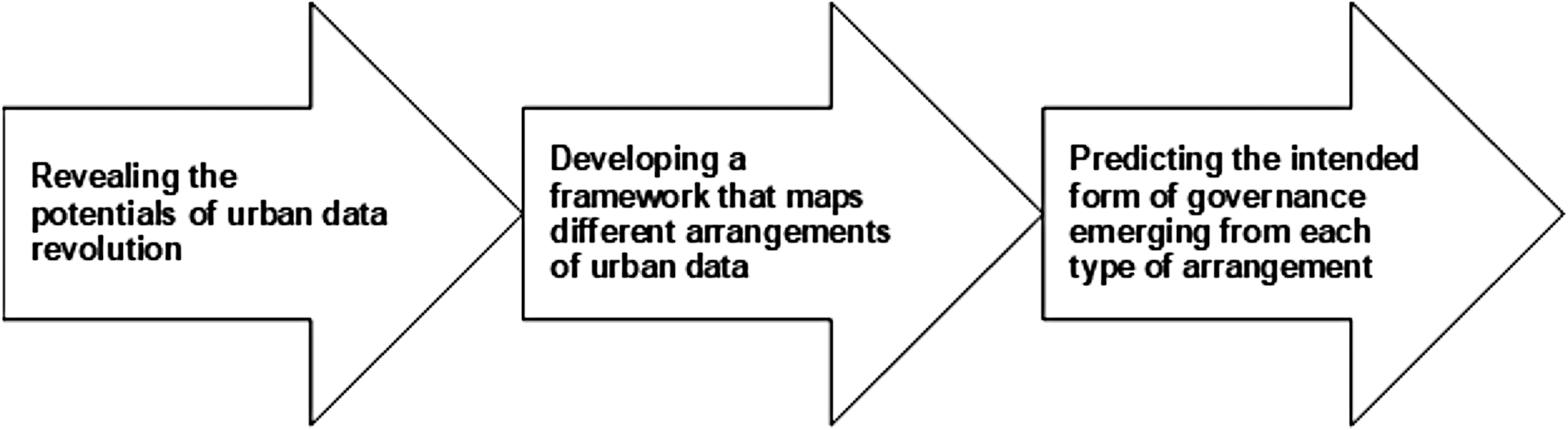
The agenda followed in the article.
Digitization, data and urban governance
We consider urban data infrastructure to be any combination of digital assets, processes and agents that facilitate the flow of data within an urban area. A new juncture in relation to urban data infrastructure has been reached with digital systems, such as embedded sensors, general-purpose algorithms, Wi-Fi, smartphones, cheap storage and cloud systems. As such, formal city institutions have much greater access to data for the development of policy and administration, though other stakeholders are also increasingly significant. Corporate platforms (e.g. Apple iOS, Android, accommodation platforms, taxi platforms, car companies, logistics companies, etc.) possess valuable data about the city, community or charity, while political interest groups have more data of more sorts, and citizens themselves can access and generate data.
This newly available data is dispersed, widespread and exchanged across numerous platforms, and can be utilized by firms that may have had no prior involvement in the governance of the city. Apple, Google and Uber are examples; data held by these corporate actors concerning movements in a city might be much more accurate than any similar information owned by the local government. Access to data can, then, determine who wins a competition for delivering services or who manages a service, and, at the larger scale, control of how transportation works in any given city. Thus, the role of algorithms in urban life represents a new and potentially ‘wicked’ problem (Andrews, 2019). As such, stakeholders such as information technology (IT) corporations play a more central role (through data ownership and access, as well as algorithms) in modern governance processes.
In the context of this study, urban governance refers to processes through which citizens, and public and private actors, collaborate over decisions concerning the implementation and management of urban policies and actions. Within this framework, the level of government influence on urban governance is increasingly determined by its ability to marshal the strategic deployment of urban data. This is pivotal in making sense of the changing face of urban governance and where the place of government would be within that transformation (Margetts and Dunleavy, 2013). This is because cities are experiencing socio-technical transition from ‘the level of the organization – or the chain of organizations – to the level of the urban system’ (Meijer and Bolívar, 2016: 394). In its contemporary form, as proposed by Johnston (2010: 122), governance moves beyond ‘questions of how to best manage government institutions to how to design smart governance systems [beyond government institutions] with the appropriate incentives and rules to harness and coordinate the enthusiasm and capabilities of those governed’. This is less about strengthening the effectiveness of government institutions and more about government's involvement in building a ‘governance infrastructure’, a major part of which depends on the strategic employment of urban data.
Citizens of and in data
Within this idea of a ‘governance infrastructure’, citizens themselves play a multidimensional role, beyond and in addition to traditional modes of democratic participation (Linders, 2012; Meijer, 2011). Citizens utilize the instruments and sources of data from corporate platforms and independent sources, utilizing data with regard to issues that concern them, albeit that studies suggest different patterns of participation in different geographies.
Reflexively, citizens are also the primary subject of data in SCIs and affect data through both their actions and their dispositions towards being observed and represented within platforms. Such big data we entitle ‘citizen-enabled urban data’ (CEUD). It is associated with technologies that can harness the data of millions of citizens in urban spaces. There are three features of this trend that make it important: first, CEUD is massive in scale and mostly comes in an unstructured format (e.g. text, voice, photo, video, etc.); second, there have been advances in technologies that process such data; and, third, the data is not entirely acquired or managed by any single source, but comes from multiple sources. It is realized that, increasingly, the operational efficiency of urban infrastructure and services relies on the depth and breadth of that CEUD and the mechanisms through which it is collected. Considering that local governance is concerned with the delivery of urban services to citizens, then data should be at the centre of debates about urban governance.
SCIs represent governments' attempts to determine what data needs to be collected, how it needs to be collected and who will own and have access to the data. Hence, the way the SCIs reveal themselves in practice can have wide implications for urban governance. This link, however, remains less explored in relation to data and not understood in the form of an integrated framework. Moreover, ‘Lack of knowledge, and practical understanding, of alternative data governance models’ in relation to CEUD has recently been highlighted as a shortcoming in the literature (Micheli, 2019: 2).
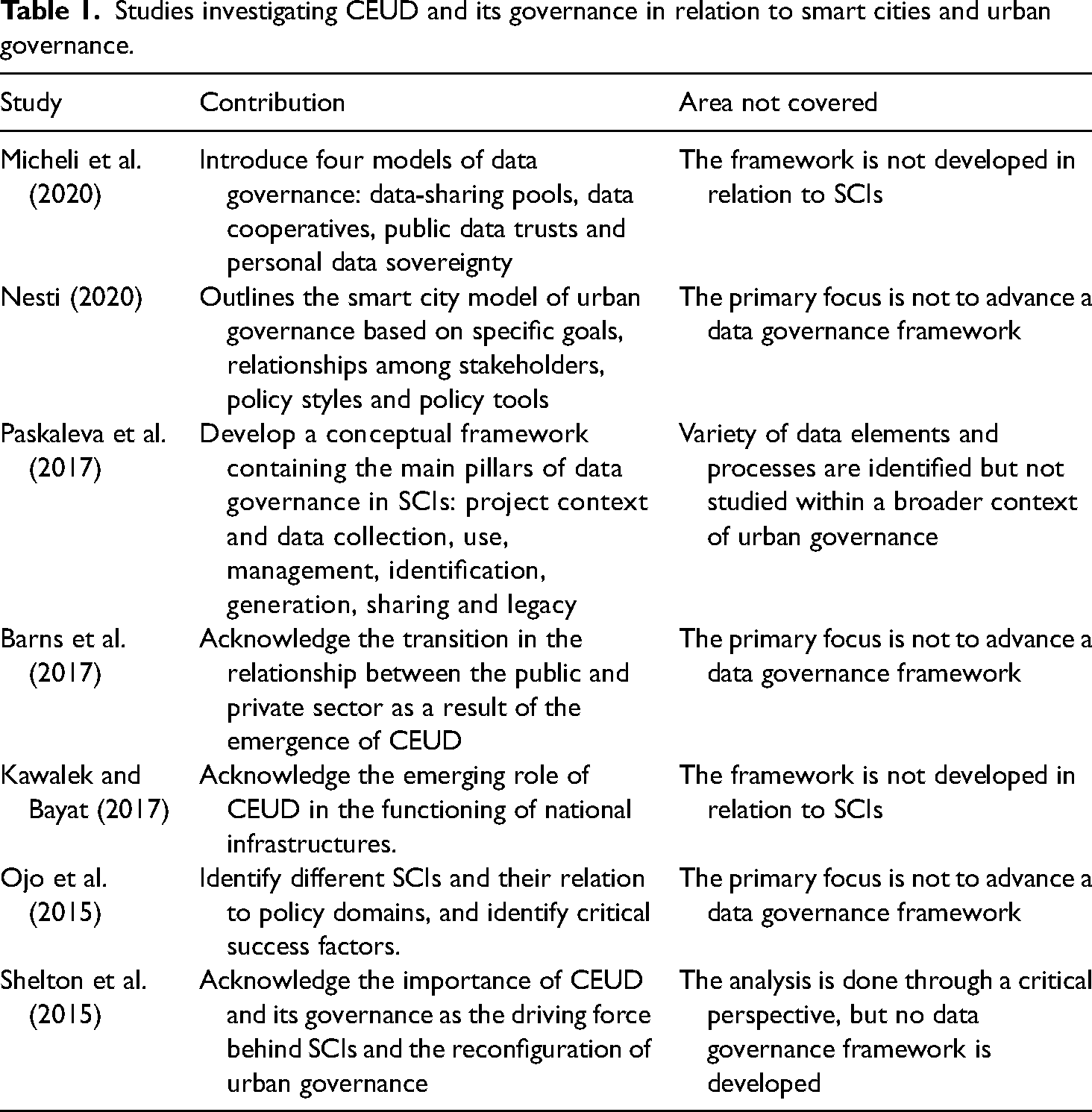
To be able to identify the existing data governance models of CEUD, we initiated a literature search, beginning with a forward and backward citation examination of Meijer and Bolívar (2016). Furthermore, we expanded the search to journal articles in Web of Science, Scopus and Google Scholar that are concerned with the issue of governance in smart cities. The search yielded 67 relevant papers. From this collection, we focused on papers discussing CEUD and its governance. While there are a significant number of studies that consider data governance as an element within smart cities (we identified 19 such papers), there are only a handful of studies that examine CEUD and its governance from a strategic standpoint and in relation to smart cities or urban governance. Table 1 summarizes the findings of these papers.
Studies investigating CEUD and its governance in relation to smart cities and urban governance.
The smart city in definition and practice
The ‘smart city’ is most commonly defined in terms of its building blocks (e.g. technology, stakeholders, infrastructure, etc.), the outcomes that it is supposed to achieve (e.g. sustainability, economic growth, etc.) or a combination of both. This complexity is reflected in a definition provided by Ruhlandt (2018: 1): Smart cities are a multi-dimensional mix of human (e.g. skilled labor), infrastructural (e.g. high-tech facilities), social (e.g. open network linkages) and entrepreneurial capital (e.g. creative business activities), that are merged, coordinated and integrated into the fabrics of the city using new technologies to address social, economic and environmental problems involving multi-actor, multi-sector and multi-level perspectives.
This multidimensionality continues in the way these initiatives unfold in practice. Masdar City (initiated in 2006) in the United Arab Emirates and Songdo International Business District (initiated in 2001) in South Korea are the best-known examples of newly built smart cities. Both have attracted acclaim and criticism (see, e.g., Cugurullo, 2016). Similarly, the government of Saudi Arabia has ambitious plans to develop ‘New Future’, or NEOM, as a new, sustainable urban settlement enabled by digital technology.
Today's major global cities provide an alternative theatre for the smart city concept. Barcelona, Berlin, London, Shenzhen and Tokyo are among many famous cities associated with SCIs. In India, in 2015, the government launched its ‘100 Smart Cities’ mission, based on an agenda of urban renewal and sustainability. Yet, these existing cities readily exemplify the complexity of questions of governance and urban data in established urban settlements. Pertinent is the example of Quayside in Toronto, Canada. This was to be developed in partnership with Sidewalk Labs, part of the Alphabet conglomerate. Many citizens had concerns. Bianca Wylie of a residents' campaign group named ‘Block Sidewalk’ highlighted the issue of data: We have not been talking about the fact that it is normalising massive data collection or even asking whether anyone wants this thing at all. No one here has asked for a sensor-laden neighbourhood…. Our waterfront must be developed for the benefit of the citizens of Toronto, not the shareholders of a Google-affiliate.
Sidewalk Labs retreated from the project in 2020, blaming its financial non-viability (Doctoroff, 2020).
Prominent commercial firms seeking to develop and market the smart city concept include Cisco, Deloitte, McKinsey and IBM. The latter took out a trademark on the phrase ‘smarter city’ in 2011, which provided the genesis of a critique of the motives and meanings of SCIs by Söderström et al. (2014). These firms contrast with public and communal movements into SCIs, including urban open data movements, European Living Labs and Sharing Cities projects. 1 To date, the notion of a smart city has been appropriated as a narrative device in a number of contexts, but a framework to understand this theoretically in a wider context has yet to be developed.
The strategic planning of smart city initiatives: a conceptual framework
This section presents the House Model, a conceptual framework that helps interpret a governance-focused strategic planning of SCIs (see Figure 2). The model is developed under the principles of engaged scholarship (Van De Ven, 2007, 2018). This is based upon the insight that the integration of theory and practice requires a deep form of research that combines both rigour and relevance (Pettigrew et al., 2001). This leads to an integration of analyses based upon variances and process. The former accounts for antecedents and consequences, while the latter accounts for changes over time. When these are understood in the context of a complex research problem and setting, they enable the assessment of findings through their generality, that is, their ability to apply across a broad range of contexts. The House Model was thereby developed through insight gained from direct discussions with practitioners, plus evidence across the literature, and was validated as part of engagement with a government agency.
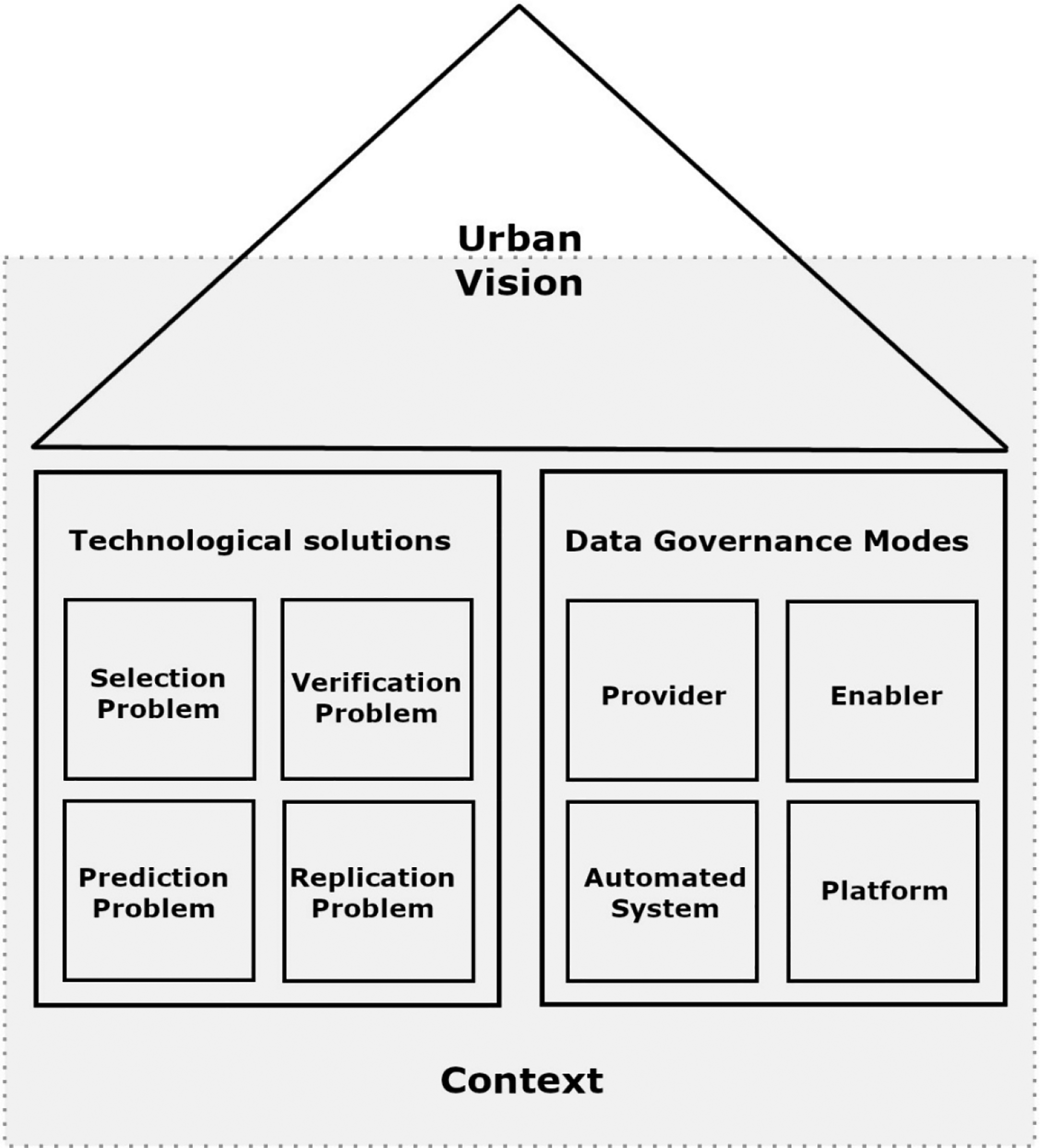
The House Model.
This agency operates at the level of national policy and the engagement took place through detailed, open-ended interviews with two officers in November 2017. Two years later, a second agency engaged in the process and provided further critique to validate the framework. This second agency was responsible for delivery of SCIs in a major city in the UK and featured a hybrid representation of council officers and community representatives. An initial interview of two hours took place with its director, through which he was asked to provide examples of the action of the House Model within his city or others of which he had experience. This was to validate its concerns; generality was explored by assessing whether examples could be provided to illustrate the issues of data governance addressed by the model. Subsequently, a focus group took place among five members of the agency, through which they critiqued it for clarity and completeness. This focus group lasted for two hours and included representation from a grass-roots community project dedicated to ‘maker’ innovations. Based on emergent findings, the framework brings together factors such as the urban and smart city vision, context, and big data technologies, which, alongside different data arrangements, form an assemblage. In the following, we present the components of this model.
The importance of context
SCIs are commonly studied by reference to technological advancements that facilitate the integration of data about the physical infrastructures of cities. This omits the fact that contextual factors determine the adoption, use and the intended outcomes of data and technology (e.g. Tan et al., 2020; Young, 2020).
Context can embody factors such as existing governance challenges, policy frameworks, the built environment, history and all the formal and informal institutions. Several studies have acknowledged the importance of context in shaping the technological, organizational and policy aspects of a city (e.g. Angelidou, 2014; Caragliu and Del Bo, 2012; Nam and Pardo, 2011; Neirotti et al., 2014; Ruhlandt, 2018). Is Rotterdam the same as Barcelona, or Barcelona the same as NEOM? Are the goals of a project that seeks to share information about meteorological and environmental phenomena best governed in the same way as those of a project that algorithmically controls vehicular access to downtown precincts? The general potential of the smart city concept requires governance to be contextualized. As such, a more selective approach to data collection and use is proposed here.
The smart city vision
For newly built smart cities, there is the promise of perfect alignment between the smart city vision and its daily reality. In practice, this alignment may be elusive as the city comes into use and other pressures are brought to bear on urban life in the city. Does the population arrive as intended? Are transport systems used as planned? Do new citizens behave as foreseen, or do they extemporize in ways that have implications for the vision of the new smart urbanity? In the alternative case of existing cities, a SCI gains momentum only when it is placed in a broader milieu and its vision is aligned with the overall vision of the city. For example, the city of Copenhagen places its smart city ambition in the broader context of becoming a carbon-neutral city (Robertson, 2019).
Angelidou (2014) notes tension between national, regional and local strategies for developing a smart city. This struggle has roots in how the vision of the city is framed. There may exist conflicting expectations and objectives among administrations or stakeholders at different levels (global to local). Some cities set ambitious targets in order to meet global socio-economic and environmental metrics, and imagine a more international and competitive brand, while others value locality and set visions that address local problems. The process of defining a shared urban vision is dynamic but predominantly influenced by this polarity of global forces and local demands. The importance of this ‘multi-level’ tension is shown in the case of several cities in Sweden (Andersson, 2010; Gustavsson and Elander, 2012; Rutherford, 2014) and also emphasized in a study of Rotterdam (van Waart et al., 2016). The implication of this is that the information and communication technology (ICT) of the smart city is used hierarchically within the city, between institutions and then out into networks beyond the city boundaries (Meijer et al., 2016).
Neirotti et al. (2014) provide evidence that there is no dominant worldwide smart city model, but rather at least two models: one focused on a technology vision; and one that focuses on a vision of social inclusion and welfare. This is also noted by scholars who provide a critique of the techno-centric, infrastructure-focused vision of the smart city and its ability to deliver on promises, such as social equity, sustainable growth or environmental protection (Glasmeier and Christopherson, 2015; Hollands, 2008, 2015; Kitchin, 2014; Shelton et al., 2015).
It can therefore be summarized that working out the boundaries and implications of alternative visions of a smart city is problematic and closely tied to the dimensionality of the urban vision. The case of Barcelona shows this. Documented by De Hoop et al. (2018), Barcelona negotiated a turn between smart technology controlled by the democratic, institutional and corporate bodies of the city, and a more grass-roots and participatory emphasis on direct urban democracy arising from communal action. The turn between these two emphases was marked by the replacement of Mayor Trias (2011–2015) with Mayor Colau. In Trias's term, an acclaimed vision for a ‘smart’ Barcelona was developed. This was to be characterized by open data protocols, automated street systems, fabrication laboratories (FabLabs) and a city operating system ‘that would interconnect information from across the multiplying sensor networks and data gathering platforms in different city administration departments, and hence boost the ability of city authorities to observe and manage their intelligent city in real time’ (Hoop et al., 2018). A clear implication of the project was that it would be associated with the tech-savvy, that is, those interested in a strategic vision of a globally significant, technological city. In a restive political environment, this was ultimately partial and inadequate. Trias's replacement, Mayor Colau, came to power after a campaign concerned with overcoming evictions and debt. Under Colau, a smart Barcelona would manifest an alternative, cooperative ‘solidarity economy’ that was partly enabled by digital technology but concerned with the prosaic pressures of sharing food among the needy and of fighting evictions. As De Hoop et al. (2018: 43) summarize: Activists saw two different cities: the elite Barcelona using smart city as a brand in its neo-liberal competition for capital – a city rendered into an efficient and convivial location for mass tourism and the global knowledge economy; and the Barcelona of neighborhood activism, struggling to build from below what they considered to be a more democratic urbanism capable of addressing issues and problems considered inherent to the neo-liberal model.
As De Hoop et al. (2018: 45) further argue, the newer, grass-roots emphasis in Barcelona is for people to participate ‘not as data points, but as co-designers’.
The smart city vision grid
The smart city vision grid depicted in Figure 3 presents a classification based on the overall vision of cities and their vision to become smart. The vertical axis illustrates the dimensionality of the urban vision discussed earlier and is useful in marking the level at which that vision is negotiated. The polarity in the smart city vision is represented on the horizontal axis between highly infrastructure-focused and highly citizen-centred smart city visions. The vision of the new cities of Masdar, Songdo and NEOM is of centralized data control. In the abandoned Toronto project for Quayside, there were similarities, though the centralized governance there was provided by a partnership between a city government and a corporation, rather than through a traditional city government. Among traditional cities undertaking SCIs, there is a mixture of governance priorities in places including Barcelona, London and New York. Within such settings, CEUD is likely to be highly significant, upending the centralized emphasis of governance. This is because of the ubiquity of digital technologies held by citizens and the fact that they sometimes even initiate or lead SCIs. Therefore, the use of data in such a context potentially represents the empowerment of citizens and a shift in the governance arrangements and power relations of the city. Barcelona is a marked example of this.
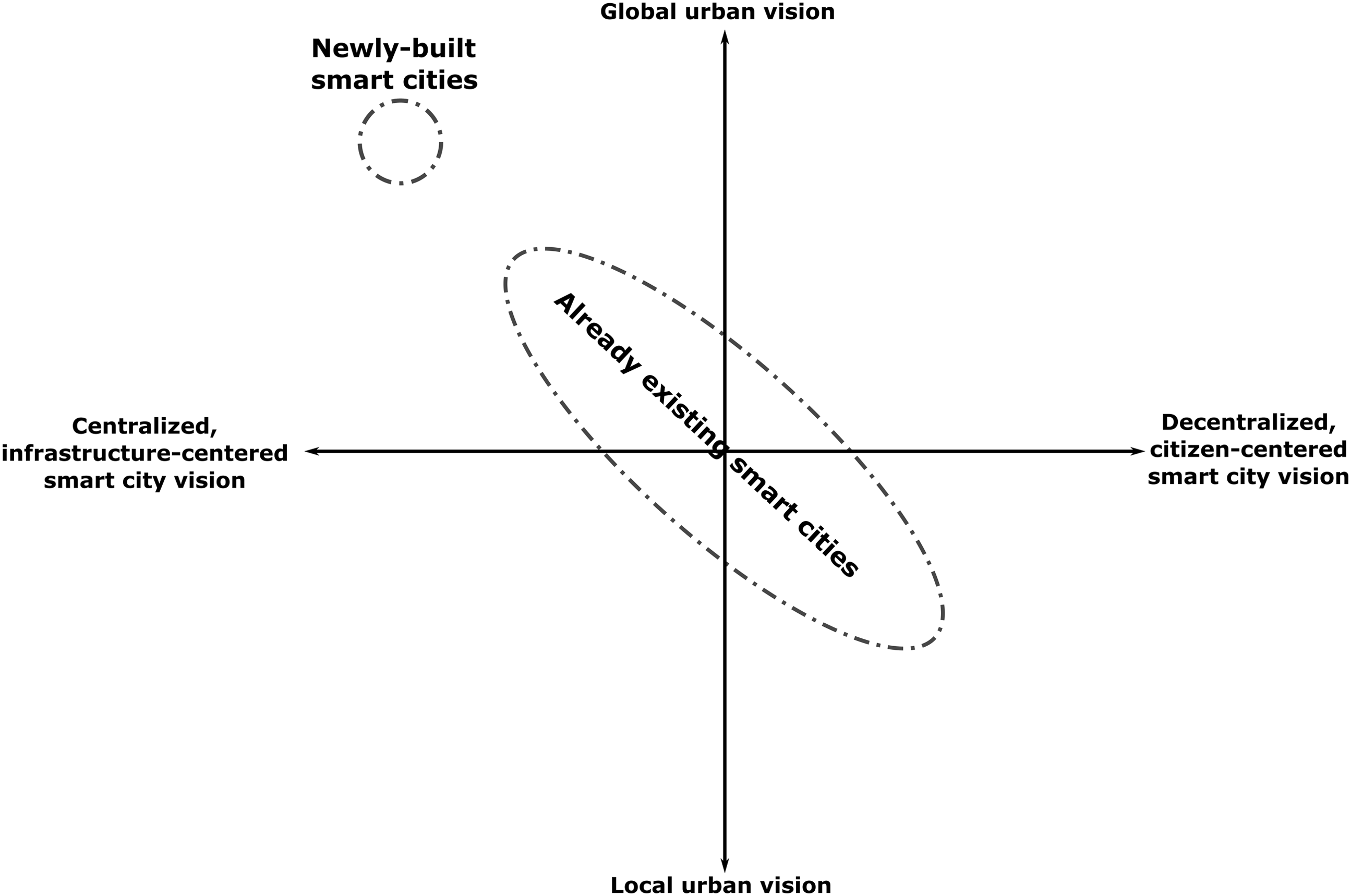
The smart city vision grid.
Technological solutions
SCIs rely on the implementation of several data technologies. These technologies help in the collection, integration, validation, real-time analysis and reporting of a massive amount of urban data. Table 2 presents an overview of the technologies and the type of problems they can solve. The expectation is that technologies are utilized in bundles and that, combined, they provide solutions to the problems identified in the third column. The bundling effects among technologies make prioritization for investment complex, and choices will depend substantially on the data governance modes described in the following section.
Data technologies and their applications.
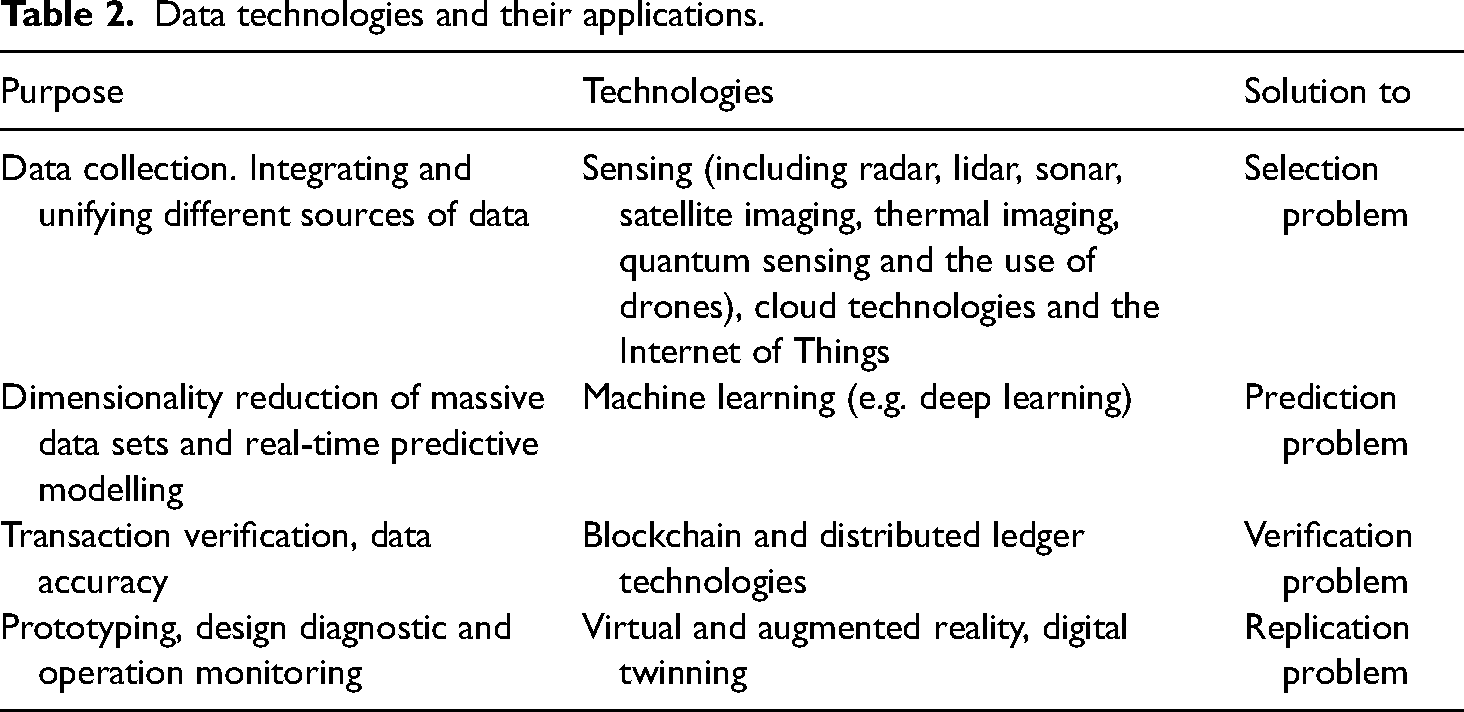
In the third column, the ‘selection problem’ refers to the problem of making the most relevant data accessible. The ‘prediction problem’ encapsulates that range of problems where an outcome is predicted using highly dimensional data. The ‘verification problem’ is concerned with the veracity of records and problems where it is hard to establish the validity of data through accurate tracking of a sufficient number of prior transactions. The ‘replication problem’ is related to a range of problems where pattern matching or learning is vital to the performance of a system but is costly or difficult within it.
Data governance and strategy
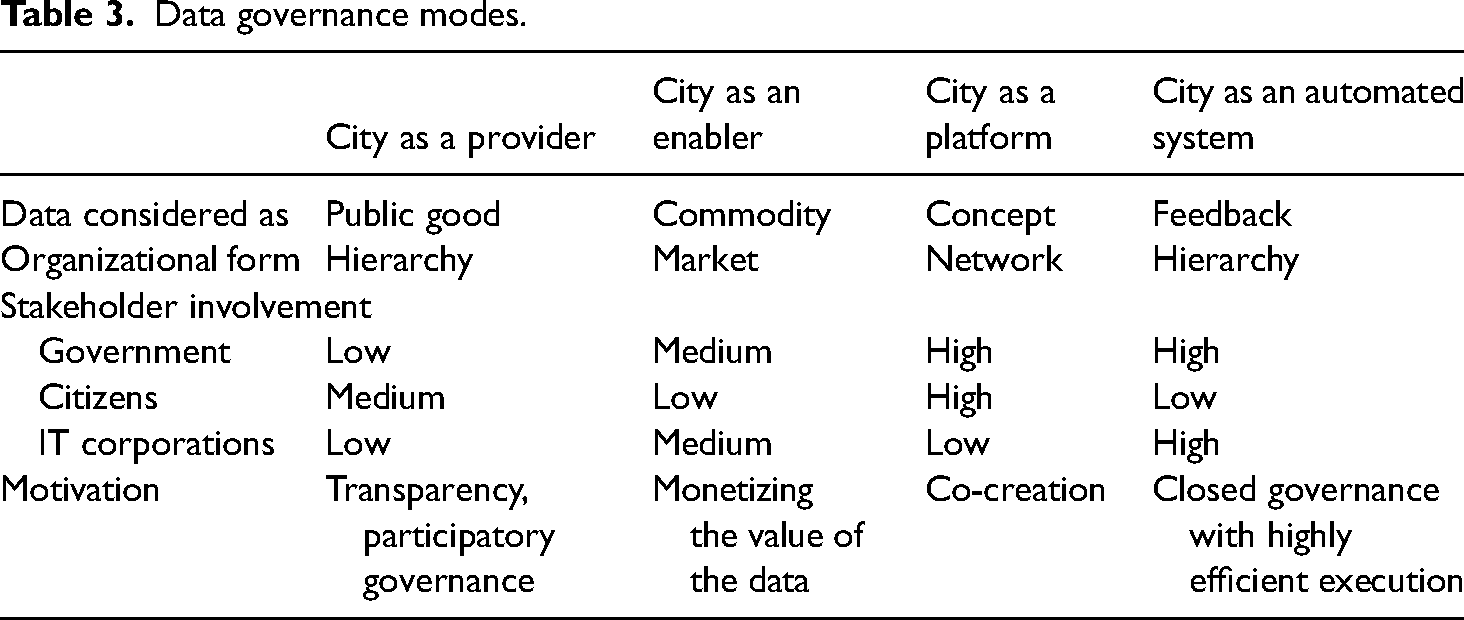
The notion of the smart city is multifaceted because there exists no single, universal way of making a city ‘smart’ in practice (Neirotti et al., 2014). Different forms of governance exist and each embodies certain elements of technology, data and stakeholders. These stakeholder groups are governmental institutions, citizens and IT corporations, and the different governance strategies imply different permutations of their contributions. Yet, in all cases, ‘access to and control over data has become a strategic asset for cities’ (Almirall et al., 2016: 145). CEUD will play an elevated role in the smart city versus the traditional city, and its access and use will be increasingly consequential across different interests in the city. This research adopts a social science-informed perspective of data governance that investigates CEUD through its influence on the power relations between various actors (Micheli et al., 2020). It provides a typology that formalizes the governance modes around four major themes. The typology describes the governance of CEUD based on the way that the concept of the city is conceived.
City as a provider
The first and most common form of data governance is the designation and release of urban data as a public good. A part of this is data that is generated in relation to public infrastructure. The rationale behind such initiatives (commonly referred to as ‘open data initiatives’) is that releasing such data enables accountability and transparency, facilitates evidence-based decision-making, and enables a form of participatory governance (Grimmelikhuijsen and Welch, 2012).
In this conception, the city is the only provider of the data. The data itself can be used for different purposes by citizens, bodies such as non-governmental organizations (NGOs) and the private sector. Although the provision of data is subject to public request and scrutiny, a hierarchical approach is used to maintain control over the type of content that is released and over issues relating to data privacy. Today, such government-led open data initiatives are ubiquitous at both the urban and the national levels in cities and countries around the world. The future development of such initiatives will be influenced by the scale of CEUD. This brings both challenges and opportunities for the government but can also ultimately foster the participation of citizens (and other stakeholders) even beyond sharing government-owned data.
City as an enabler
An alternate approach is for city managers to provide a unified data marketplace. The concept of an enabler recognizes that local government is not the only entity that has data that is important to the needs of cities. Much of the urban data is in the control of the private sector (e.g. telecommunications, platforms and logistics), semi-state organizations (e.g. public transport franchisees), research organizations and individuals themselves. Faced with this additional complexity and potential, the role of city managers is to design a data marketplace so that there is exchange among suppliers and users, and the optimal value of the data is realized by participants in the market.
In this category, data is considered as a commodity and exchanged via the medium of the market therein. While data privacy is still of concern, the main emphasis in on facilitating more efficient use of data by a greater multiplicity of interested parties, potentially leading to more data-driven innovations and to economic growth. Examples of this approach include the Data For London 2 and Copenhagen City Data Exchange 3 initiatives.
City as a platform
In this approach, city governments seek to develop a network of different providers and users in order to manage a research agenda within the network. Research questions and their answers might be attained through this kind of closed or semi-closed environment that relies upon only certain parties and data. Typically, this will be known as a ‘lab’. A lab allows cities to bring data providers together in order to answer specific policy issues or questions, and is therefore pro-active and managed through formal research governance.
This formal research governance is concerned with issues of quality in terms of inputs, outputs and process, as well as being concerned with the interface with urban policy mechanisms themselves. Designing an appropriate ecosystem and providing the right incentives demands a high level of government involvement (at least in the design and maintenance phase) and enriched collaborations and partnerships between the public sector, private sector and citizens (Baccarne et al., 2014). In this sense, data itself can be considered as embodying a concept. The co-creation processes turn the concept into valuable innovations, helping in the delivery of public services (Ansell and Gash, 2018; Ansell and Miura, 2020; Baccarne et al., 2014; Scholl and Kemp, 2016). Given that the data is shared within geographically bounded areas and mostly within communities, concerns around data privacy and security are negotiated locally.
City as an automated system
A fourth approach is to develop highly automated and intelligent closed systems that support both the real-time working of the environment and an ongoing process of analysis and learning about the optimization of this environment (Kitchin, 2014). This ‘smart’ environmental model is illustrated in the ‘city dashboard’ concept but also extends beyond this to higher levels of automation. Effectively, the concept applies whenever sensors and monitoring systems are utilized for the real-time management of a facility or a geographical area. Regulated algorithms might determine many things that potentially have political or economic ramifications (e.g. who has access to physical space, road space, natural environments or services). Smart automata will learn through artificial intelligence about issues within their scope, for example, the best movement of emergency vehicles, plant interventions, patterns of lighting or refuse collection. As data generates the behaviour of infrastructure, it can be said that ‘data is infrastructure’ (Kawalek and Bayat, 2017) and needs to be maintained and managed through a formal approach, analogous to the way that physical infrastructure itself is managed. This kind of system is necessarily closed since data quality is key, but the system will also support learning and can be integrated into an overall governance framework alongside the other roles of cities mentioned earlier.
New algorithmic and storage advances support the collecting, merging, visualizing and analysing of massive amounts of data. The smart city architecture promoted by IT corporations normally relies upon this type of hierarchical arrangement. The closed governance structure provides real-time monitoring of all the infrastructure to which it is linked. This comes at the expense of issues such as privacy, ownership, flexibility and transparency (Kitchin, 2014). Table 3 summarizes the data governance modes in terms of the interpretation of data, level of government and stakeholder involvement, the organizational forms employed, and the motivation behind each category.
Data governance modes.
The hybrid data governance arrangement
In practice, SCIs will be realized as hybrid data governance arrangements, whereby a combination of data governance modes are put in place, yet the degree of emphasis put on each of these modes depends critically on the context and the vision of the city. For example, as presented in Figure 3, a positive relationship between a globalized vision of the city and a more centralized smart city vision is expected in the case of Masdar City, which, in turn, could lead to a hybrid arrangement with a greater focus on the city as an automated system. However, cities with a legacy of democratic participation and leadership are expected to emphasize transparency, privacy and citizen engagement, and choose a hybrid arrangement heavily invested in the city as a provider, as seen in the case of Colau's Barcelona. Within these parameters, privacy is negotiated as a further issue, being key to the institutional power relations in cities (van Zoonen, 2016). Centralization implies the assignation of data rights, but the exact nature of these rights, and what they reveal about citizen behaviour, is still contested and remains an issue to be resolved in each SCI. Where data is decentralized (e.g. city as an enabler), it might be envisaged that privacy is retained by citizens, but, again, this has to be negotiated, as CEUD itself is often derived from large data platforms.
Conclusion
The transition to a digital era governance of cities is tied to the strategic utilization of urban data. The House Model presented in this research locates urban governance at the centre of local governments' attempts to manage urban data. The arrangement of data underpins each kind of SCI and is fundamental to it. The planning of SCIs starts with envisioning the emerging forms of governance of a city given the choice of the CEUD arrangement. SCIs have only come into existence as a result of big data technology bundles that can process massive amounts of urban data (‘technological solutions’). The outcome of a SCI is, then, determined by the city's context and its vision for the future.
While the House Model went through a cycle of review in order to establish its plausibility as a theoretical explanation for practitioners seeking to plan SCIs, its viability in different contexts is something that we could not test within the scope of this study. Therefore, a key limitation is the lack of large-scale empirical data to test the House Model. The model lists several key variables that are important in the strategic planning and development of SCIs. Using data on various SCIs around the world, further research could explore each component of the House Model in more detail, shedding new light on how these components individually, or in interaction, can predict the outcome of SCIs. This could result in a more refined version of the model. It is also envisaged that further work could extend the scope of the model, consistent with the norms of engaged scholarship, so that it delineates variances related to privacy and security in the context of different SCIs. Overall, it is anticipated that with further development, issues such as those of privacy and security will be incorporated into the House Model, and its value with thereby be enhanced.
The central idea that the smart city is a representation of the way a city institutionalizes urban data merits further attention. The typology that presents the four data governance modes introduced here can create the basis for comparing and clustering SCIs. Finally, progress in smart city research has been considerable on the theoretical front but not so significant on the empirical side. An engaged model of research is potentially appropriate to address this shortcoming and is worth further attention and scrutiny in this setting.
Footnotes
Declaration of conflicting interests
The authors declared no potential conflicts of interest with respect to the research, authorship and/or publication of this article.
Funding
The research was funded by a grant from the National Infrastructure Commission, Ministry of Housing, Communities & Local Government, London, UK.
