




Abstract
Digital-era governance is one of the central challenges of the twenty-first century and marks a fundamental paradigm shift in public administration. Based on the concepts of collaborative capacity and organizational maturity for co-creation, this study explores the factors that determine municipal administrations’ capacity to engage in digitalization-related collaborations. Using unique survey data from 720 Swiss municipalities, this study investigates the relevance of intra-organizational and extra-organizational factors in stimulating local governments’ likelihood of engaging in cross-sectoral and inter-organizational partnerships to implement the digital transformation. It reveals that extra-organizational impulses by digital change agents and stakeholder demand—in contrast to intra-organizational resources—are highly influential factors for municipalities to engage in digitalization-related collaborations. This study presents novel insights into the specific barriers to change and the success factors of co-creation in the process of municipalities’ digital transformation to inform theory, practice, and policy design.
Keywords
Introduction
Following profound societal and technical change, digital-era governance is argued to become the dominant paradigm of public administration in the twenty-first century, and it relies on the fundamental digital transformation of public administration (Layne and Lee, 2001; Margetts and Dunleavy, 2013). Digital transformation describes the sociotechnical change associated with applying digitizing technologies and it entails fundamental socioeconomic transformations across individuals, organizations, and institutions of the public sector as well as its impact on society as a whole (Dąbrowska et al., 2022; Tilson et al., 2010). Digitalization offers enormous potentials for improving essential aspects of civil service provision and work in administrations of all sizes and on all levels of government (OECD, 2020; Vial, 2019). It allows the implementation of innovative technical solutions in citizen-state interactions and increases organizational efficiency and citizen satisfaction (Hammerschmid et al., 2019; Vial, 2019). Digital solutions expand the accessibility and quality of civil service provision irrespective of temporal or spatial constraints, they reduce administrative burden, and increase citizen autonomy (Bernhard et al., 2018; Bertot et al., 2010).
Despite these many benefits, the process of digital transformation entails various challenges such as demanding the transformation of organizational structures and institutional logics (Edelmann, 2022), substantial investments in technical infrastructure, and staff training to build new competences (Gasco-Hernandez et al., 2022; Steiner et al., 2021). Consequently, the digital transformation demands fundamental changes throughout the whole organizational ecosystem of public administration and it goes beyond technicalities, which may be solved by resource transfers such as ITC outsourcing and installing interoperative technical systems (Gottschalk, 2009). Rather, the challenges lie in building organizational capacities to facilitate the adaptation of digital technologies and in creating a digital mindset in order to accommodate the rich potential for benefiting the general public (Dąbrowska et al., 2022; Heuberger, 2020; Mergel et al., 2019). While the age of austerity is argued to function as an additional incentive for reform (Ladner, 2017), overcoming these obstacles posits a particular challenge for small public administrations on the local level of government (i.e., municipalities) they often lack the necessary human and financial resources to master the digital transformation (Hornbostel et al., 2022).
One particularly promising way to overcome these challenges is engaging in digitalization-related collaborations—both within and across sectoral boundaries—to pool mutual capabilities, share information, and thus co-create effective solutions beneficial to the general public (Bryson et al., 2006). Co-creation entails sharing resources in various forms between many affected and relevant actors—such as public and private organizations but also relevant stakeholder groups such as citizens and advocacy groups—to solve complex problems through a creative and participatory process (Ansell and Torfing, 2021). A first step towards this constructive resource sharing is collaboration. Digitalization-related collaborations and partnerships alleviate the burden of digitalization by standardization, which reduces costs, e.g., by exploiting economies of scale and by reducing complexity, and by leveraging positive network-effects that facilitate inter-organizational learning to overcome barriers to change (Bryson et al., 2015; Ferro and Sorrentino, 2010). While collaboration is key to addressing tangled and complex problems (Rackwitz et al., 2021), engaging in these digitalization-related collaborations is often particularly challenging for small, local-level administrations because they tend to lack the necessary organizational capacities (Hornbostel et al., 2022; Mettler, 2019). Yet, as the direct touchpoint between citizens and the state, municipalities play an essential role in policy implementation and have considerable autonomy particularly in countries with decentralized administrative structures such as Switzerland, Germany, and Austria (Ladner, 2017; Steiner et al., 2021), which makes understanding the barriers and success factors of collaboration for the digital transformation of municipalities even more important.
Although prior research highlights “that digital transformation within the public sector is not a task to be fulfilled by public administration alone” (Mergel et al., 2019: 12), there is little research assessing the impact of internal organizational factors and external impulses on municipals’ capacity to accomplish the digital transformation through engaging in digitalization-related collaboration that goes beyond mere interoperability (Gottschalk, 2009). On the one hand, prior lines of qualitative research indicate that local governments’ capacity to achieve digital transformation collaboratively is driven by their organizational maturity for co-creating—based on their capacity to overcome political, structural, and cultural barriers to change—on the one hand (Di Giulio and Vecchi, 2021; Jukić et al., 2022). On the other hand, research also indicates that external impulses such as citizen demand and digital change agents may facilitate and incentivise digitalization-related collaboration (Mergel et al., 2019). Against the backdrop of this discourse, we developed a theoretical model exemplifying hypothesized relationships based on recent conceptual and qualitative research to synthesize both lines of research. We opt for a quantitative approach to test these previously conceptualized relationships with an original large-N dataset. This quantitative approach allows us to add substantial insights to the existing qualitative and conceptual research streams while controlling for various contextual factors to derive important generalizable implications for bureaucracies beyond specific case studies.
Based on the concept of collaborative capacity as the outcome of organizational maturity for co-creation, this study closes the previously highlighted research gap with a special focus on extra-organizational impulses for digital transformation (see e.g., Jukić et al. (2022), Di Giulio and Vecchi (2021), Mergel et al. (2019), and Tangi et al. (2020)). We explore both internal and external factors and consider collaborations within the public sector and across sectoral boundaries, responding to recent calls for research by, among others, Dąbrowska et al. (2022), Mettler (2019), Mergel et al. (2019), Vial (2019). We analyze unique nationwide survey data on the status quo of the digital transformation of N = 720 Swiss municipalities raised in January 2022. This quantitative data allows us to assess the relative weight and impact of the factors affecting municipalities’ collaborative capacity for digital transformation and assess the field in its entirety, building upon a rich basis of prior qualitative research.
The remainder of this study is structured as follows: In the next section, we briefly discuss the relevance of collaboration for the digital transformation of the public sector. Based on a literature review, we derive hypotheses on local governments’ organizational capacity to engage in digitalization-related collaborations. We then present our methodology and empirical design, describe the survey data, and the results of hypotheses testing. The study concludes with a discussion of the findings’ implications for theory and practice.
Theory
Collaborative governance and digital transformation
As mentioned earlier, co-creation aims at developing innovative solutions to grand societal challenges by involving relevant and affected actors from state, market, and the civil society who share their tangible and intangible resources. This generative perspective on public governance allow the creation of platforms and entry points between these actors to facilitate their collaborative interaction and find novel solutions for reforms of grand scope (Ansell and Torfing, 2021).
Unsurprisingly, inter-organizational and inter-sectoral collaboration has emerged as a key strategy for governments to facilitate the successful implementation of the digital transformation (Edelmann, 2022). Solving complex societal problems requires that public organizations shift their default approach to problem solving from gathering information internally toward a collaborative network culture that allows sharing possible solutions across institutional and sectoral boundaries effectively and efficiently (Dawes et al., 2009). This boundary-spanning approach of multilateral collaborative governance entails “the processes and structures of public policy decision making and management that engage people across the boundaries of public agencies, levels of government and/or the public, private and civic spheres to carry out a public purpose that could not otherwise be accomplished” (Emerson and Nabatchi, 2015a: 18). Public organizations, including municipalities, increasingly use the affordances of digital technologies to facilitate such a network culture essential for the digital transformation. In this sense, collaborative governance is facilitated by digitalization but the digital transformation in itself also relies on the collaboration between state agents and private agents, making public administrations’ capacity to collaborate and co-create—in the sense of resource sharing and pooling—both within and across sectoral boundaries a cornerstone of the digital transformation (Jukić et al., 2022; Vial, 2019). What factors determine this capacity to co-create in the case of local administrations?
Collaborative capacity to co-create the digital transformation
Organizations’ capacity and likelihood of collaborating and co-creating can be understood as the outcome of two clusters of factors that may alleviate or hinder it: intra-organizational and extra-organizational factors.
Following Jukić et al.’s (2022) model of organizational maturity for co-creation, intra-organizational factors concern an organizations’ maturity for co-creation the digital transformation, its organizational and its staff’s capacity to co-create but also the conditions related to the general organizational environment, which may hinder or encourage collaboration (Jukić et al., 2022). In the context of municipal digital transformation specifically, these intra-organizational factors resonate with the concept of collaborative capacity, which describes organizations’ or individuals’ ability to establish, maintain, and successfully act in collaboration to achieve a specified goal, both within as well as across sectoral boundaries (Aschhoff, 2018).
Extra-organizational factors are impulses for change that originate from outside of the organization or span organizational boundaries. These factors may help overcome established barriers to the digital transformation. Examples of extra-organizational factors are disruptive technological advances, demand for change by civil, private, or political agents, but also fundamental shifts in the wider political and institutional environment that help soften prior barriers to transformation or further incentivize digitalization-related collaboration, for instance, as a form of crisis response (Mergel et al., 2019; Tangi et al., 2020).
In the following sections, we explain why certain factors of both clusters are likely to be most highly relevant for determining municipalities’ collaborative capacity to co-create the digital transformation and we derive hypotheses based on the resulting conceptual model (summarized in Figure 1). Conceptual model and hypotheses.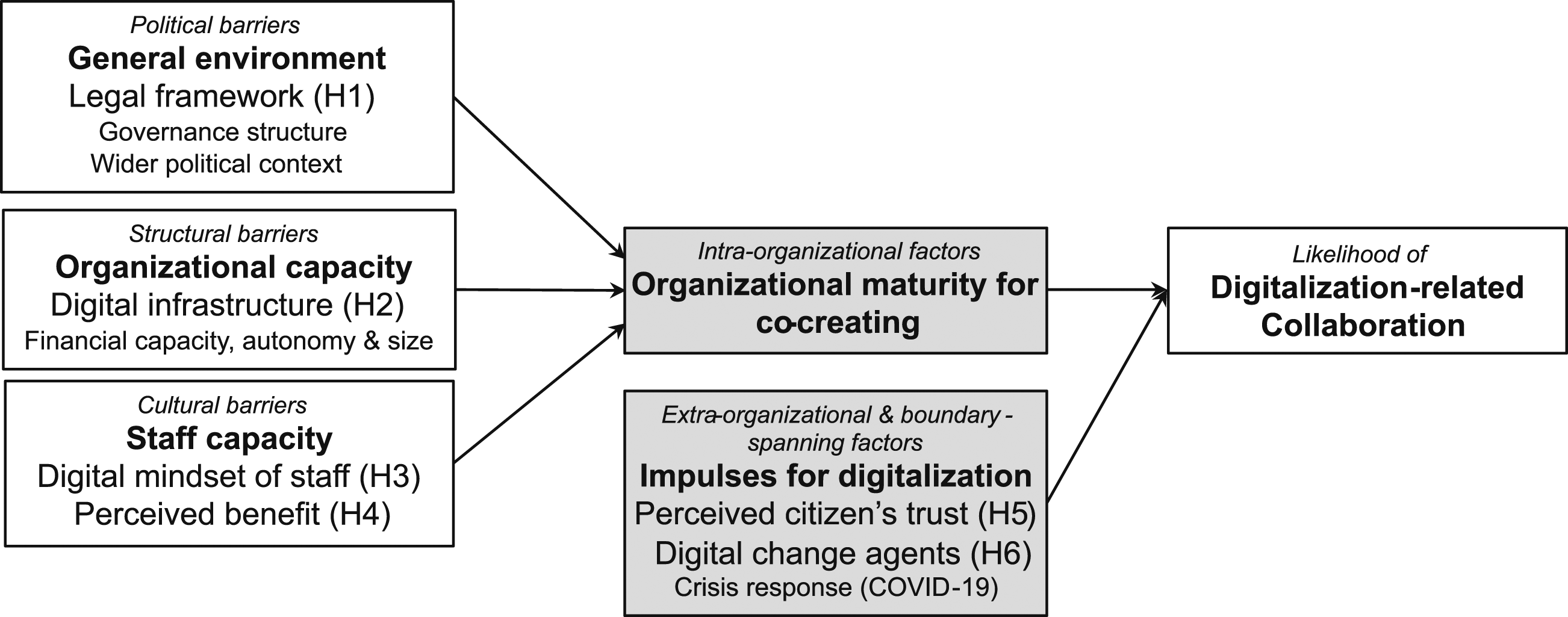
Organizational maturity for co-creation: intra-organizational factors
First, we identify intra-organizational factors. Based on prior research by Tangi et al. (2020) and Jukić et al. (2022), public organizations’ drivers and barriers of co-creation in the context of the digital transformation can be subsumed into three types of factors that significantly impact organizations’ maturity for co-creation: (a) contextual factors, (b) organizational-level factors, and (c) individual-level factors.
Contextual factors relate to the general environment in which the public organization is nested. Local governments’ capacity to engage in digitalization-related collaboration is limited by environmental and institutional boundaries set by the politico-administrative context. Collaborations are subject to both competitive and institutional pressures that significantly affect their formation and long-term sustainability (Bryson et al., 2006). Besides political initiatives (Ferro and Sorrentino, 2010) or favorable institutional constitutions such as funding affluence that increase organizations’ discretion to engage in inter-organizational collaborative networks (Lang and Brüesch, 2020: 1092), the legal regulatory framework defines the boundaries of how public administrations on the municipal level can engage in digitalization-related partnerships (Margetts and Dunleavy, 2013). Qualitative research by Jukić et al. (2022) stresses that public organizations’ maturity to co-create the digital transformation is contingent upon the appropriateness of their wider political and normative context—such as affirmative legislation and a strong will to co-create—which may either pose barriers or support collaboration. If follows that:
On the level of the individual members of the organization, collaborative capacity increases if agents perceive that the digital transformation yields tangible benefits to citizens or if organizational members assume that it is useful and beneficial for the overall functioning of the municipal economy. However, two individual-level aspects are argued to be particularly important due to their motivating and sense-giving property: staff’s digital mindset and the perceived benefit of the digital transformation in relation to the burdens it entails for both organizational members and citizens (Jukić et al., 2022; Rackwitz et al., 2021: 101).
A digital mindset refers to agents’ individually held beliefs about the nature of resources available within themselves and the nature of resources available within their organization in the context of digital transformation (Solberg et al., 2020). Policy makers and public managers alike recognize that fostering a digital mindset through the incorporation of critical soft skills such as resiliency, inner strength, strategic thinking, and a collaborative spirit are crucial for achieving the digital transformation (Fischer et al., 2022; Morman, 2019). Agents’ beliefs concern the extent to which a person’s ability to learn and use new technologies is fixed or malleable, whereas the contextual beliefs address the extent to which the “technological change is composed of finite resources that must be competed for—versus expandable resources in which all parties have the opportunity to gain” (Solberg et al., 2020: 107). Consequently, the degree to which local governments’ personnel have developed and internalized such a digital mindset affects the success of collaborative initiatives to implement the digital transformation because the (absence of) a digital mindset will create variance in the way the workforce makes sense of and engages in (or withdraws from) digital transformation initiatives (Solberg et al., 2020: 106). Besides financial resources, the availability of human resources—specifically dedicated and highly engaged personnel—determines the scope and intensity of collaborative efforts. In this context, Lang and Brüesch (2020) stress that leadership exercises particularly important functions, namely fostering a shared vision and problem perception among their followers to motivate them to proactively partake in the necessary collaborative tasks and processes.
The prevalence of technology in employees’ professional lives affects their professional identity, their interaction with co-workers, and the structuring of their work in organizational settings (Colbert et al., 2016). The affordances of technology and new work can entail burdens associated with the learning costs of using new technologies and may even aggravate the perceived technological burden, foster alienation, and increase stress (Fischer et al., 2022). Therefore, it is incumbent upon the leadership to mitigate the strain on the personnel and accentuate the benefits of enhancing collaborative capacity. This will also lower the perceived burden of the digital transformation and increase staff compliance and motivation to tolerate the strain associated with technological change (Colbert et al., 2016; Vial, 2019). In contrast, elevated awareness of the benefits of digitalization and collaboration increases the maturity for co-creating digital change (Jukić et al., 2022). It follows that
Impulses for digitalization: extra-organizational & boundary-spanning factors
We now turn to the second cluster of factors: impulse for collaborative digitalization efforts that emerge from the outside of the organization or span organizational boundaries. Organizations’ collaborative capacity is dynamic and can be substantially affected by external impulses related to both gradual societal change and rapid procedural disruptions due to changing stakeholder demands, e.g., service users’ and political agents’ expectations about civil service performance but also about larger societal developments and crises (Vial, 2019).
This adaptation process is challenging for bureaucrats and public leaders alike because new forms of work entail psychological burdens and switching costs. Digitalization-related change creates new job demands (Hammerschmid et al., 2019) and collaboration risks (Hansen et al., 2020; Weißmüller et al., 2021). This may result in barriers to change and hinder collaboration motivation because the civil service workforce is between a rock and a hard place: they need to develop a new set of skills and competences within an often already challenging work environment characterized by red tape and austerity (Hornbostel et al., 2022); at the same time, they need to cope with pressure by civil society and political agents calling for rapid reform (Steiner et al., 2021). This external pressure is associated with psychological costs. However, Bakker and Demerouti (2007) show that such job demands may be alleviated by psychological resources, particularly by experiencing that citizens trust in civil servants’ capabilities to handle the digital transformation. This means that civil servants who feel trusted will be able to draw on this psychological resource, despite many challenges. Consequently, citizen trust may effectively function as an extra-organizational stimulus that strengthens municipalities’ collaborative capacity by reducing mental burdens and resistance to change, suggesting that:
Given that transformation is the outcome of impulses and demands for change, it is important to acknowledge that organizational behavior relies on the actions of individual agents. For instance, the advent of the COVID-19 pandemic has disrupted prior institutional logics and led to a greater governmental commitment to overcome tangled problems through the enhancement of organizations’ capacity to work with the civic sector, the private sector, and other organizations in the public sector (Gabryelczyk, 2020; Vial, 2019). As the pandemic revealed deficiencies in municipal digitalization, civil and political stakeholders have become particularly vocal in their demand for digital transformation to motivate an increase in municipalities’ digitalization-related collaborative capacity, effectively acting as digital change agents (Fischer et al., 2022). Furthermore, bottom-up initiatives driven by local agents and communities increase political demand, which may promote collaborative efforts among and across different levels of government (Mettler, 2019: 184–185). While research acknowledged that excessive politicization may undermine an organization’s progress along the path toward digital transformation (Gabryelczyk, 2020), the role of digital change agents, such as citizens, vocal civil servants, politicians, and public leaders is crucial for facilitating change and the establishment of innovation-friendly administrative cultures because they stimulate the organizational and environmental factors that make collaboration possible, hence increasing external demand for change (Edelmann, 2022).
In line with prior research on general resistance to change by Oreg (2003) and on the success factors of public sector reform by Klemsdal et al. (2022), recent research on the barriers and drivers of the digital transformation by Mergel et al. (2019) and Tangi et al. (2020) indicates that digital change agents are particularly strong promotors of change. In a study conducted in the Netherlands, Tangi et al. (2020) highlight that external and individual agents’ impulses may be the main motivation for the digital transformation in many public organizations. High profile public servants may take on the role of advocates for digitalization-related co-creation and thus accelerate the digitalization process substantially (Jukić et al., 2022; Mergel et al., 2019). These ideas are in line with prior qualitative case study research by Di Giulio and Vecchi (2021) who highlight the “role of embeddedness, understood as a pro-active role played by key agents and their capacity to use persuasion and positive incentives to create and maintain trust in the public domain” (Di Giulio and Vecchi, 2021: 21). Particularly cross-sectoral collaborations “are more likely to succeed when they have committed sponsors and effective champions at many organizational and political levels who provide formal and informal leadership” (Bryson et al., 2006: 47), making digital change agents particularly relevant. It follows that
Method & data
Local government digitalization: the case of Swiss municipalities
We explore the relationship between inter-organizational and extra-organizational factors with local government’s capacity to engage in digitalization-related collaborations by analyzing original quantitative survey data from Swiss municipalities. As the smallest institutions of local governance, municipalities are “the nucleus of state and society” (Steiner, 2000: 169) in Switzerland, providing various important administrative services to citizens. Compared with other European countries, Switzerland has a large number of municipalities and they enjoy a high level of autonomy. Consequently, Swiss municipalities are generally regarded as the main institutions of policy implementation, located right at the intersecting cross points between the federal state, the cantons, and their citizens (Steiner et al., 2021). While gradual territorial reforms have reduced the number of municipalities from 2’899 in the year 2000, today Switzerland’s 8.6 million inhabitants still live in a fine local grid made of 2’148 municipalities of various sizes (ranging from 32 to 420’217 inhabitants) as of January 2022, the month in which the data were raised (BfS, 2021). Swiss municipalities are a particularly interesting case to understand digitalization-related collaboration capacity on local-level government due to their numerous policy responsibilities and high level of autonomy (Keuffer, 2018). In Switzerland, municipalities provide a plethora of street-level services to citizens. As the main executory organs between state, cantons, and citizens, municipalities’ immediacy in citizen-state interaction explains why Swiss citizens often identify closely with their local municipality—more than with their canton or the state (Steiner, 2000). In contrast to administrative entities in most other European countries, Swiss municipalities enjoy an exceptionally high degree of autonomy despite their relatively small sizes (Ladner, 2017). For instance, they generate most of their income through levying their own taxes, they design the structure and form of their administration independently, and they implement any task that does not fall within the domain of the cantons or the federal administration with a large degree of autonomy. Typical municipal responsibilities are, for instance, citizen services, any integral administrative and managerial tasks such as budgeting and accounting, raising local taxes, organizing, and personnel management, local public transport and policing, but also essential fulfillment of public tasks such as granting municipal citizenship rights to foreign residents, public construction and procurement, as well as primary education, social welfare, utilities, waste, energy, and water management, culture, sports, and social assistance (Steiner et al., 2021: 118–120). Due to this large variety of responsibilities, many administrative reforms are implemented directly by the municipalities (Steiner, 2000). It is hence essential to study the municipal level to understand success factors and barriers to the digital transformation in Switzerland.
Data
We test our hypotheses by analyzing a unique dataset from a nationwide survey on the status quo of digital transformation in Swiss municipalities raised in January 2022. Data were collected by approaching the municipal clerk (“Gemeindeschreiber”) of each of the 2’148 municipalities of Switzerland personally by mail invitation. We asked the municipal clerk or, alternatively, the municipalities’ digital officer to reply to the survey to profit from their expert knowledge regarding digital-era governance in their municipality. There was no monetary incentive, and participation was strictly anonymous and voluntary. To maximize the response rate, the survey was made readily available in each of the three Swiss national administrative languages (German, French, and Italian); participants could respond either by filling in an online survey (by scanning a QR-code or by entering a link to enter an online survey in their language of choice) or by returning the paper-and-pencil version complementing our invitation. Combined with an array of both descriptive and control measures, this survey yielded data of a representative sample of N = 720 Swiss municipalities and captured relevant intra-organizational and extra-organizational factors as well as boundary-spanning impulses for pursuing the digital transformation collaboratively. Scale-based responses were measured with a seven-point Likert-type scale ranging from 1 (completely disagree) to 7 (completely agree); other items such as the two dependent variables (described in the following section), some descriptive characteristics, and socio-economic items are binary (1 = applies; 0 = does not apply); see Online Appendix for more detail.
Dependent variables: public and private sector collaboration
We use two simple binary dependent variables to capture municipal engagement in co-creating the digital transformation through collaborations. The first dependent variable asks whether municipalities engaged in collaborations with inter-organizational partners—i.e., other municipalities, their respective canton, or other public sector institutions—in digitalization-related partnerships (public-sector collaboration). The second dependent variable asks whether the municipalities engaged in such digitalization-related collaborations with partners from the private sector (private-sector collaboration). Furthermore, in case such collaboration existed, we asked respondents to further specify the type and institutional level of collaboration with two open response items. These items were coded inductively to the best explanation to create categories as to further capture the quality and nature of municipalities’ digitalization-related collaborations. The open responses also serve as a reliability and precision check, allowing us to control whether respondents actually specified collaborations—in contrast to, for instance, outsourcing or other contractual arrangements—which increases the validity of the empirical findings.
Independent variables
Synthesizing the concept of organizational maturity for co-creation (Bryson et al., 2006; Jukić et al., 2022) and the procedural impulses and barriers for achieving the digital transformation (Dąbrowska et al., 2022; Mergel et al., 2019; Tangi et al., 2020; Vial, 2019), we developed eight novel scale measures to capture municipalities’ organizational and their staff’s capacities, burdens, and resources related with the digital transformation, building upon recent methodological examples of municipal survey research by Bernhard et al. (2018) and Schwab et al. (2019); see Online Appendix for more detail. Prior to fieldwork, all measures were pretested with a group of four municipal clerks from small, medium, and large municipalities from the canton of Bern, Switzerland. These practitioners were asked to provide expert feedback on the online questionnaire items, particularly with regards to their plausibility, reliability, and completeness as to maximize objectivity and measurement validity, following best practice advise by Carpenter (2018).
Organizational maturity for co-creation: intra-organizational factors
The theoretical model suggests three clusters of barriers that may impact municipalities’ organizational maturity for co-creating the digital transformation. First, political barriers are associated with municipalities’ general politico-administrative environment and manifest in the current legal framework that governs municipalities’ practices of policy implementation. We capture the sufficiency of this legal framework with a three-item scale concerning regulation, innovation friendliness, and flexibility to test H1.
Second, structural barriers may impede municipalities’ organizational capacity to co-create by collaboration. Particularly, we assess municipalities’ digital infrastructure with an eight-item scale measuring system interoperability, software quality, and smart work to test H2. Furthermore, municipalities’ financial capacity and size are controlled for, following recommendations by Jukić et al. (2022).
Third, barriers associated with organizational culture are assessed to measure the impact of the staff’s capacity to co-create the digital transformation. Specifically, we assess the degree to which the municipal staff has internalized a digital mindset, i.e., a positive attitude toward digitalization and agile work practices to test H3. This variable was measured with a six-item mean-scored scale comprising openness to modern technologies, innovative thinking, and a positive error culture in relation to digitalization efforts. Municipal staff’s e-fitness was measured with a five-item scale covering perceived changes in productivity, procedural quality, and municipal resourcefulness in the context of digitalization. Lastly, we captured the perceived meaningfulness of digitalization by measuring municipal digitalization’s perceived benefit for citizens and the perceived benefit for the municipal economy (i.e., the private sector) with two single items to test H4.
Impulses for digitalization: extra-organizational & boundary-spanning factors
Perceived citizens’ trust in municipal digital competences was captured by asking about the degree to which the municipal administration enjoys an elevated level of trust from the local population regarding data quality, security, and professionality with an original four-item scale to test H5. The impact of digital change agents was captured by asking about which stakeholder groups or agents actively advocate for digitalization in the municipality, allowing us to test H6. Providing seven explicit choice options, i.e., local government executive members, the municipal clerk, head(s) of the administration, department directors/supervisors, external experts, municipal administrative staff, or citizens as well as one open response item, respondents were asked to indicate all applicable options. This resulted in a count measure ranging from min. = 0 to max. = 8. Given that the data for this study were raised during the Covid-19 pandemic, we explicitly control for citizens’ increased demand for municipal digitalization in the wake of the COVID-19 pandemic with an original four-item measure. This allows us to capture the variance introduced by this extraordinary impulse for change and separate it from the impact of the other two extra-organizational and boundary-spanning factors.
Construct validity
We tested the aforementioned multi-items scale measures for construct validity by conducting exploratory (EFA) and confirmatory factor analysis (CFA) using maximum likelihood estimations, following Hinkin (1998); we further conducted Harman’s single factor test for endogeneity. These procedures revealed that common source bias was not an issue and that the scales were sufficiently distinct. Furthermore, construct validity was satisfying although convergent validity was limited for some measures (reported in the Online Appendix), underlining the appropriateness of the scales for the Swiss context. To control for common method bias caused by latent factor(s), CFA trait/method modelling was applied with all main study variable items and an unobserved latent factor following best practice recommendations by Podsakoff et al. (2003) and Richardson et al. (2009). Structural equation modelling revealed no significant relationships of the study variables with a hypothesized latent unobserved marker, corroborating the reliability of the findings presented in the subsequent sections.
Sample characteristics
Sample: municipalities
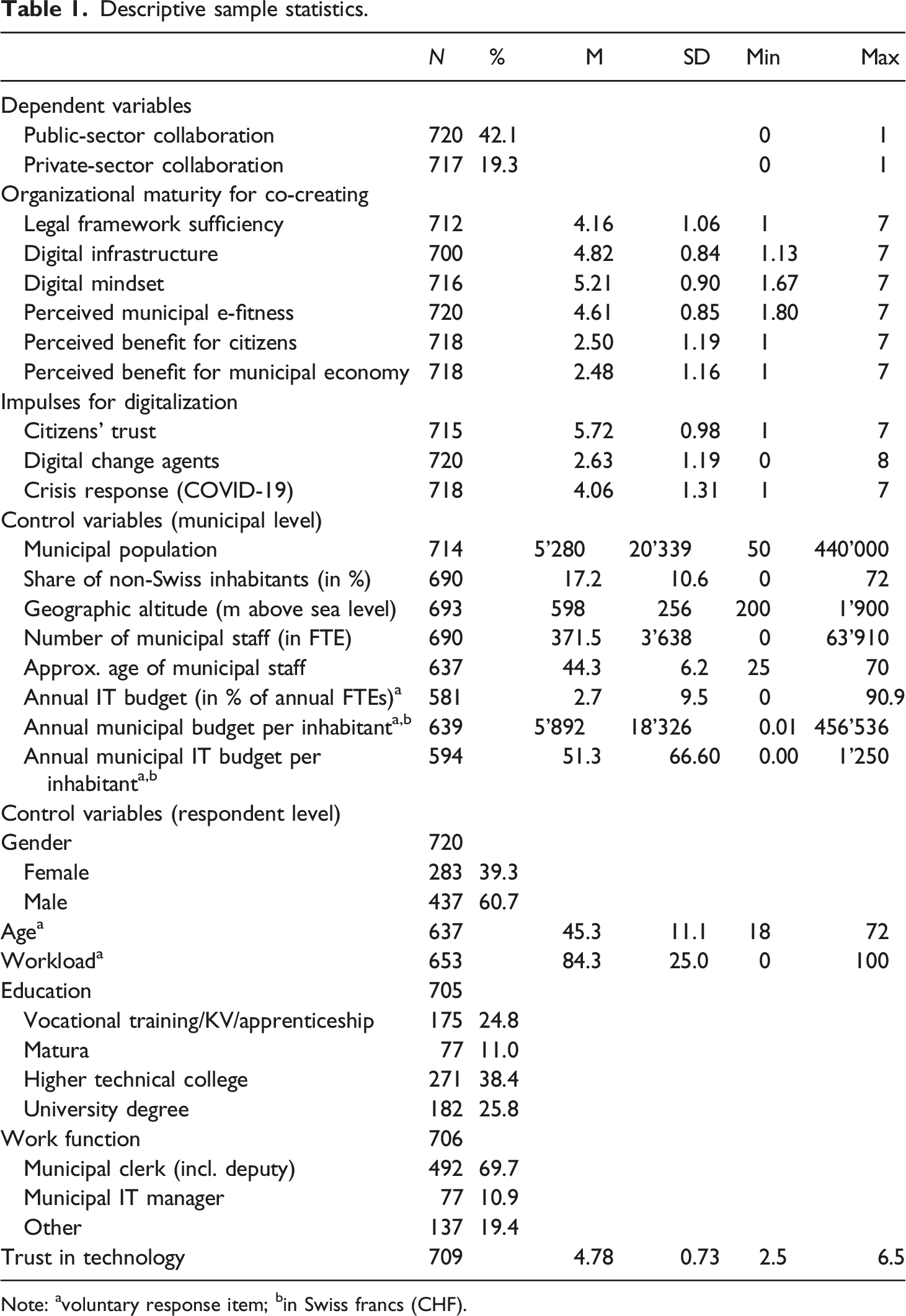
Descriptive sample statistics.
Note: avoluntary response item; bin Swiss francs (CHF).
The sampled municipalities are diverse and cover the full demographic and geographic spectrum of Swiss municipalities, ranging from 50 inhabitants (or less) to 440'000. The average share of non-Swiss citizens amounts to M = 17.2% (SD = 10.6%; range: 0–72%). The sampled municipalities are located between 200 m and 1'900 m above sea level (M = 598 m; SD = 256 m), indicating a high degree of representativeness of the spatial distribution of Swiss municipalities. The approximate average age of their administrative staff is M = 44.3 years (SD = 6.2 years). Most municipalities are small, with 59.6% reporting that they have 0 to 10 full-time equivalents (FTE) in total administrative staff. Our data also include large municipalities, with the number of municipal staff ranging between zero and 63'910 FTE. These descriptive characteristics resonate well with municipal survey data from 2017 by Steiner et al. (2021: 87), who assessed that the workforce of the Swiss municipal core administration amounts to 43.9 employees on average, but this data is highly skewed by a few very large municipalities; the numerous small municipalities of less than 500 citizens have on average only two core administrative employees.
Financially, the municipalities in our sample are relatively secure but remarkably heterogeneous regarding their financial affluence. In 2019, 72.7% of the municipalities in our sample reported a budget surplus in their financial statements, dropping to 71.5% in 2020. Presumably due to the worldwide COVID-19 pandemic, in 2020 and 2021, this share fell to only 54.5% for the year 2021, indicating that some of the sampled municipalities were severely affected by the pandemic. The municipalities that disclosed their budgets (n = 639) reported that the mean municipal administrative budget per inhabitant is CHF 5'892.- (SD = CHF 18'326.-), however this figure varies between (less than) CHF 0.01 and CHF 456'536.- per inhabitant. Similarly, dedicated municipal IT budgets vary drastically across municipalities, with a mean of CHF 51.30 per municipal inhabitant (SD = CHF 66.60), but ranging from zero CHF to an IT budget of CHF 1'250.- per inhabitant. Over the last 5 years, most municipalities’ IT staffing has remained constant with a small tendency for growth. 70.4% of municipalities report that IT staff (in FTE) has remained the same. 18.7% of the municipalities saw an increase in allocated FTE, and only 1.9% of the municipalities sampled saw a decrease in allocated FTE. Comparing municipalities’ number of staff across all departments with their number of IT staff indicates that the average share of IT staff is only M = 2.7% (SD = 9.5%) of all FTEs but within a wide range of zero to 90.9%.
Sample: respondents
Respondents are on average 45.3 (SD = 11.1) years old, they are predominantly male (60.7%), and they received relatively high levels of schooling and tertiary education (64.2%). Respondents hold above-average levels of trust in technology (four-item short scale adapted from Gulati et al., 2019; M = 4.78, SD = 0.73; Cronbach’s α = 0.522, AIC = 0.215); see also Table 1. Our sample of respondents mirrors Steiner et al.’s (2021: 94–95) findings regarding municipal clerks’ socio-characteristics1, providing further support for the validity and reliability of our data. In most cases (80.3% of responses), we were able to directly reach the municipal clerks or the municipalities’ digital officers as intended. 69.7% (n = 492) of respondents are municipal clerks (or their deputy), 10.9% are the respective municipality’s digital officers or the central IT managers of their municipality. The remaining 19.4% of respondents are political agents on the municipal level, municipal civil servants, or secretary staff. Respondents’ average workload amounts to M = 84.3% (SD = 25.0%) of a full-time equivalent, indicating high municipal involvement and topical expertise, which points toward high reliability of the information provided by these respondents about their respective municipality in the survey. Language response distribution represents the distribution of the Swiss populations’ three administrative languages (German: 68.4%; French: 26.5%; Italian: 5.1%) (Lüdi et al., 2005). 51.5% of the respondents used the online survey option, while 48.5% (n = 349) participated by using the paper-and-pencil form. We relate the slightly higher share of online responses to these options’ relatively higher technical convenience. Balance testing revealed that responses did not vary significantly regarding distribution channel preferences.
Findings
Descriptive results
Types of collaborations
42.1% (n = 303) of the municipalities in our sample engage in digitalization-related collaborations with other public agents, such as other municipalities or institutions of public administration. These collaborations primarily concern partnerships on the cantonal level (64.7%), or collaborations with other municipalities in their local region (32.5%). Only 2.8% of partnerships are Swiss-wide collaborations. Respondents specified these collaborations in an open question that allowed multiple inputs, resulting in n = 435 specifications in total. Qualitative coding revealed three categories of collaborations.
First, the majority of collaborations (n = 240, 55.2%) exists to afford partnering municipalities to perform specific administrative tasks that specifically include citizen interaction or citizen services collaboratively and hence more efficiently. Most responses in this category concern specific identifiable administrative tasks such as managing construction requests (n = 65, 14.9%), registering migration and relocation (n = 45, 10.3%), handling local taxation (n = 16, 3.7%), or collaborating in various information sharing activities relevant for citizens, such as providing tourist information, sharing geo data, harmonizing official announcements and sharing websites, or coordinating digitization activities in local schools (n = 49, 11.3%). Additionally, a considerable number of municipalities (n = 65, 21.5% of municipalities; 14.9% of open responses) collaborate with other municipalities to operate advanced smart service portals, where citizens and local businesses can access and receive comprehensive information and administrative processes online, following the one-stop shop approach.
Second, municipalities collaborate with each other to synchronize and streamline specific internal administrative tasks and processes (n = 49, 11.3%). These concern, for instance, digital archiving (n = 19, 4.4%), business process management (n = 15, 3.4%), and project management processes (n = 15, 3.4%), both within and across organizational boundaries.
Third, a large number of responses (n = 146, 33.6%) indicate that collaboration allowed municipalities to benefit from overarching economies of scale—without being limited to specific administrative tasks—through the strategic exchange of digitalization-related expert knowledge and best practices (n = 21, 4.8%), collaborating in multi-dimensional network incentives for digital standardization on the cantonal level (n = 90, 20.7%), or by exploiting technical economies of scale by running data centers collaboratively and merging their IT services to achieve redundancy, and reduce the risks and costs of IT procurement.
These percentage can be deemed reliable and realistic since they correspond well with survey data from 2017 showing that 40–50% of Swiss municipalities regularly collaborate with other municipalities to realize economies of scale in civil services provision, for instance regarding organizing elderly care, water and waste management, or public transport but also regarding IT services (61.8%) and IT procurement specifically (49.6%) (Steiner et al., 2021).
Collaboration with private partners is less frequent: Only 19.3% (n = 138) of municipalities maintain digitalization-related collaborations with private sector agents. Specifically, these cross-sectoral collaborations concern digitalization-related public-private partnerships (24.3%), project committees2 (33.7%), recuring conferences and workshops for cross-sectoral knowledge exchange (49.1%), and consultancy (3.6%).3 Since prior research indicates that 27.6% of Swiss municipalities regularly engage with private organizations for their IT-based services (Steiner et al., 2021), it is reasonable to assume that the percentage of municipalities engaging in collaboration and resource sharing activities—in contrast to the regular purchase of services—would logically be lower, lending plausibility to these outcomes.
Independent variables
With regards to the intra-organizational factors that facilitate collaboration, the legal framework is deemed sufficiently supportive for digitalization-related collaboration (M = 4.16, SD = 1.06; α = 0.736, AIC = 0.482). Municipal staff have internalized a digital mindset to a high degree (M = 5.21, SD = 0.90; α = 0.839, AIC = 0.505). Municipalities are rated high on their organizational digital e-fitness scale, indicating that municipal staff perceive relatively low burdens with regard to the practical challenges of digital-era government (M = 4.61, SD = 0.85; α = 0.699, AIC = 0.317). On average, municipalities’ digital infrastructure is regarded as sufficient (M = 4.82, SD = 0.84; α = 0.720, AIC = 0.243). However, respondents perceive the benefit of municipal digitalization for citizens (M = 2.50, SD = 1.19) and the municipal economy (M = 2.48, SD = 1.16) as surprisingly low, indicating that the motives of benefiting civil society may not serve as a motivational, sense-giving resource that may otherwise motivate engaging in digitalization-related collaborations. Perceived citizen trust in municipalities’ digital capabilities is high (M = 5.72, SD = 0.98; α = 0.840, AIC = 0.567). The COVID-19 pandemic has further increased citizen demand for digitalization (M = 4.06, SD = 1.31; α = 0.822, AIC = 0.535). On average, respondents identified M = 2.63 (SD = 1.19) different digital change agent groups as active promotors for the digital transformation in their respective municipality.
Hypotheses testing
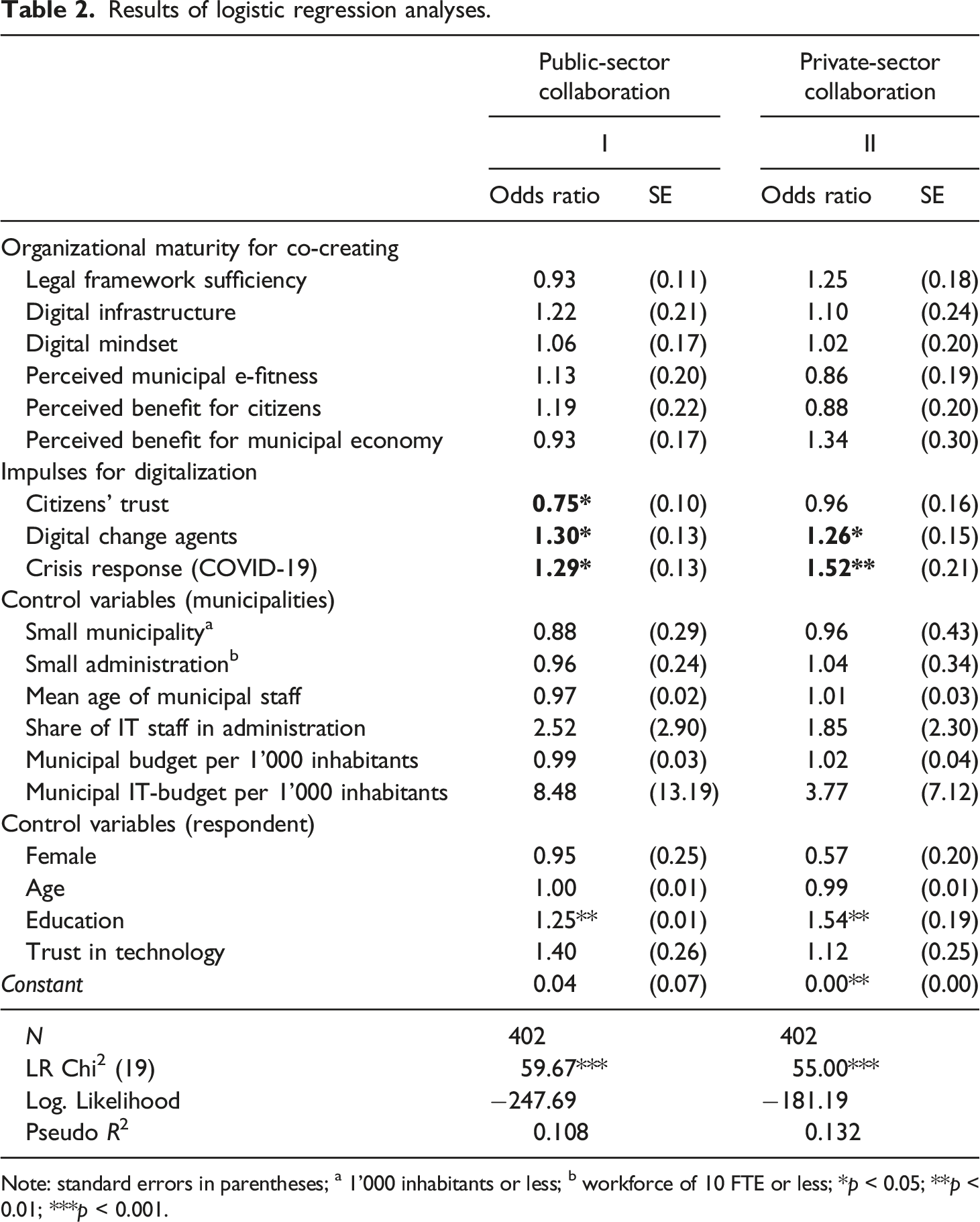
Results of logistic regression analyses.
Note: standard errors in parentheses; a 1’000 inhabitants or less; b workforce of 10 FTE or less; *p < 0.05; **p < 0.01; ***p < 0.001.
Theory suggested that local governments would be more likely to engage in digitalization-related collaborations if their legal environment provides sufficient support (H1) and municipalities’ digital infrastructure was adequate (H2). Both hypotheses find no support, neither for public sector nor for private sector collaborations (H1: public sector: odds ratio = 0.93, p = 0.555; 95% CI: [0.74–1.17]; H1: private sector: odds ratio = 1.25, p = 0.124; 95% CI: [0.94–1.66]. H2: public-sector: odds ratio = 1.22, p = 0.255; 95% CI: [0.87–1.70]; H2: private sector: odds ratio = 1.10, p = 0.669; 95% CI: [0.71–1.69]). Focusing on individual-level factors concerning municipal staff, literature suggested that local governments would be more likely to collaborate if personnel held a digital mindset (H3), and if the perceived net benefit of digital transformation was positive (H4). Again, the data reveals no significant relationship between these two factors and municipalities’ likelihood to engage in collaborations (see Table 2), so that both hypotheses find no support.
Turning to extra-organizational factors, we hypothesized that citizens’ trust in municipalities digital competences would serve as a reassuring resource and hence increase the likelihood of collaboration (H5). We find that citizens’ trust, indeed, affects collaboration likelihood but only in case of public-sector collaborations and, in contrast to our expectations, higher citizen trust is associated with a lower likelihood of collaboration (odds ratio = 0.75, p = 0.039; 95% CI: [0.58–0.99]), providing no support for H5. Lastly, H6 suggested a positive relationship between the prevalence of active digital change agents and collaboration capacity. H6 finds support because municipalities likelihood of collaboration with public sector (odds ratio = 1.30, p = 0.011; 95% CI: [1.06–1.59]) and private sector partners (odds ratio = 1.26, p = 0.047; 95% CI: [1.00–1.57]) increases significantly with the amount of digital change agents. Furthermore, increased citizen demand for digitalization in the wake of the COVID-19 pandemic has significantly increased both within-sector (odds ratio = 1.29, p = 0.014; 95% CI: [1.05–1.57]) and cross-sector collaboration (odds ratio = 1.52, p = 0.002; 95% CI: [1.16–1.99]).
Discussion and conclusion
The goal of this study was to explore the essential factors that enable or hinder digitalization-related collaboration of public administrations on the municipal level. Using a unique large-N dataset of Swiss municipalities, this study advances our understanding of the barriers and the success factors of co-creation in municipal digital transformation by showing that municipalities’ collaborative engagement to achieve digital transformation mainly relies on impulses external to the organizations. While this is in line with ideas from the general change management literature (e.g., Oreg, 2003), prior research on the digital transformation of public administrations mainly stressed the importance of intra-organizational and environmental factors as necessary conditions for lasting change (Jukić et al., 2022; Mergel et al., 2019; Tangi et al., 2020; Vial, 2019).
Given that prior research stressed the importance of organizational maturity, our novel findings are particularly relevant. One explanation for the absence of the predictive impact of the general environment (H1) and organizational capacity (H2) is the generally high level of administrative quality and performance in Swiss municipalities and a high degree of standardization (Steiner et al., 2021). Intriguingly, this study’s municipal data on actual collaboration efforts reveal that collaborative capacity does not primarily rely on financial, legal, or motivational factors but that change is contingent upon disruptive impulses, such as (1) the ad hoc COVID-19 crises responses, which stimulated digitalization, as well as (2) individual change agents who actively advocate for the digital transformation.
First, the expert survey participants explicitly stressed that the ad-hoc measures to contain the disease—resulting, for instance, in home office mandates and restrictions in face-to-face contact between citizens and administrators in municipal civil service provision—forced impromptu digitization which significantly expedited municipal digitalization. This result echoes recent findings by Ansell et al. (2021), Gabryelczyk (2020), Fischer et al. (2022), and Todisco et al. (2022), who pointed out that the advent of the worldwide pandemic in spring 2020 resulted in fundamental changes in workplace processes and routines worldwide, accelerating digitalization in public administration toward remote and smart work. Yet, it is important to note that the survey data does not capture the precise starting point of the digitalization-related collaborations studied so that no causal relationship between the onset of the pandemic crisis responses and an intensification of collaboration efforts can be derived. Rather, the significant correlational relationship between COVID-19 responses and an increased likelihood of engaging in digitalization-related collaboration underlines that—from a reform perspective—crises are not only threats to existing solutions but they also open up windows of opportunity to accelerate change and motivate collaboration, particularly on the local level of government (Ladner, 2017).
Second, the result that external stakeholders and citizens’ demand is significantly associated with municipalities’ likelihood of engaging in digitalization-related collaborations indicates that external stakeholder demand is indeed a crucial factor in stimulating reform in local government. This result resonates with prior research on the impact of stakeholder demand for administrative-managerial and political reforms by Keuffer (2018) who found that it is not Swiss municipalities’ autonomy per se that stimulates reforms but rather the constraints that stem from this autonomy in combination with austerity and social, economic, and political demand for change that will lead to reform.
Furthermore, the lack of evidence on a significant relationship between intra-organizational factors that are suggested to impact organizations’ collaborative capacity and their actual engagement in partnerships (i.e., the legal framework, the digital infrastructure, the workforce’s digital mindset, and the perceived net benefit of digitalization) points toward the issue of inertia typical for public bureaucracies. The current study complements and consolidates prior quantitative research by Tangi et al. (2020), which showed that the digital transformation of Dutch municipalities was mainly driven by external stimuli as well, suggesting that local public administrations mainly rely (and strongly respond to) exogenous inputs that create sufficient external pressure and a sense of urgency to overcome barriers to reform. Although Tangi et al.’s (2020) study relied on a relatively small sample (n = 48) from the Netherlands, the fact that the current large-n study from Switzerland reaches similar conclusions indicates that the impact of external stakeholder demand is indeed an important factor in local governments’ digital transformation that may generalize across national and local contexts, although more comparative cross-cultural research is encouraged in the future. Furthermore, the current study measures the impact of external and boundary-spanning change agent involvement as such and does not further stipulate the quality of their input. Future qualitative and case-based research is encouraged to investigate whether change agents from civil society or advocacy groups mainly provide impulses for change by amplifying stakeholder demand or whether they facilitate change by contributing their intangible resources as knowledge brokers and informed experts and hence co-create change through resource transfer.
Our finding that Swiss municipalities’ digital transformation is mainly stimulated by external impulses for change corresponds with recent conceptual research by Edelmann (2022), who stresses the importance of digital change agents and a participatory culture to achieve public sector digitalization in a dynamic process of co-production and creative co-destruction. To the best of our knowledge, our study is the first empirical evidence in direct support for this call to participatory action. Given that the significant impact of the external and boundary-spanning change agents in our data is not necessarily afforded by fully horizontal power relations between all involved actors—as proposed in Ansell and Torfing’s (2021) ideal-type definition of co-creation—the case of Swiss municipalities may be interpreted as a form of nascent and emergent co-creation. Switzerland’s unique tradition of participative policymaking and governance is particularly strong on the municipal level. This participatory principle may explain why change agents in this case can stimulate digitalization-related collaboration efforts effectively despite contributing their creative or disruptive intangible impulses cross-hierarchically and potentially non-formally.
These novel insights directly respond to calls for research to identify barriers and facilitators of municipalities’ partnership engagement for digitalization (Bryson et al., 2015; Vial, 2019) and are particularly relevant for practitioners and policy makers because they illustrate how the origin of digital transformation on the local level of governance may not necessarily spring from within public administrations but that collaborative change relies heavily on external societal and individual stakeholders’ influence. Furthermore, recent research on barriers to municipal digitalization in Germany shows that public leaders in local government are mainly concerned about the perceived lack of monetary and HR resources as a barrier to collaborative transformation (Hornbostel et al., 2022). However, our findings suggest that municipal characteristics and resources are not necessarily decisive but rather organizations’ ability to respond to and positively absorb external impulses for change.
Moreover, the finding that high perceived citizens’ trust in the digital competences of a municipality leads to less collaboration is surprising and may indicate that overconfidence in an organizations’ own capabilities may effectively hinder the digital transformation due to a lack of problem awareness. Collaboration facilitates implementing cross-organizational standardization and economies of scale as well as the ideation of innovative solutions for the challenges of digital-era governance (Ansell and Gash, 2007), which means that non-engagement due to a potentially flawed idea of self-sufficiency may hinder transformation efforts significantly.
Our findings underline prior calls by Ansell et al. (2017: 469) and Margetts and Dunleavy (2013), who stressed that one central aspect of digital-era governance is reintegration and collaboration across organizational boundaries and that tightening collaboration and deliberation between upstream and downstream actors, including external stakeholders—such as the potential service users and other non-governmental agents—may accelerate the digital transformation through resource pooling. The current study contributes to this co-creating discourse (Torfing et al., 2021) by calling into question the extent to which digital transformation can be achieved by investments into technical solutions only, and whether motivating staff can actually stimulate the success rate of digitalization-related efforts. Simply put: The data suggests a resource-implementation gap, supporting prior findings by Di Giulio and Vecchi (2021), who stressed that agency and direct impulses for change are vital for digitalization-related policy innovation and the digital transformation.
Limitations & future research
As any empirical research, our study is subject to limitations. First, our data relies on responses by a convenience sample and is self-reported data, which may lead to social-desirability bias (Fisher and Katz, 2000). However, given the low degree of question sensitivity, respondents’ anonymity, scale balancing, and the wide non-skewed distribution of responses both with regard to affectively pleasant and unpleasant items (e.g., a perceived lack of citizen trust), it is reasonable to assume that self-serving response bias is not an issue with our data (Kreuter et al., 2008; Watson, 1992). One way to further increase the reliability and validity of survey research would have been to triangulate responses by multiple individuals within the same municipalities. However, this increases the technical complexity of the survey and is likely to reduce the response rate. Given that the risk for response bias is low, the current study balances the inevitable tradeoff between controlling for data quality with feasibility and follows the best practice approach of municipality research in Switzerland—see, e.g., Steiner et al. (2021)—by opting for an expert survey and following a broader empirical lens across the municipal landscape. Future research aimed at investigating the effect of digital transformation efforts within a particular municipality are encouraged to triangulate their data by surveying multiple relevant agents within the respective organization. Furthermore, future research may further differentiate between different types of collaboration in more detail to investigate how inter-organizational and external and boundary-spanning impulses for change may affect the likelihood of co-creating the digital transformation by engaging in various specific types of collaborations.
Second, our empirical design only allows us to make correlational rather than causal claims (Antonakis et al., 2010). Our goal was to explore the relationships between distinct types of internal and external factors that may stimulate local governments’ likelihood of collaborating across organizational and sectoral boundaries to achieve digital transformation using actual field data provided by expert practitioners. While this approach increases the ecological validity of our findings and their value for policy implementation and public management in practice, future research is encouraged to use research designs that allow for the systematic control and variation of stimuli (e.g., conjoint experiments) to infer causal mechanisms. Furthermore, further research into the different types, configurations, and qualities of the digitalization-related collaborations is encouraged.
Third, while we approached each of the 2'148 municipalities in Switzerland individually and offered multiple convenient ways of responding in each of Switzerland’s administrative languages, it is possible that we may have received an inflated number of responses by municipalities in which digitalization is already regarded as a relevant topic, while disengaged municipalities may be underrepresented. However, the respondents, i.e., the municipal clerks who participated in our survey, exhibit moderate levels of trust in technology—again, with non-skewed and wide distribution—and are socio-demographically representative for all Swiss municipal clerks (Steiner et al., 2021), indicating that not only tech enthusiasts participated in the survey. The study’s response rate of 41.2% is considerable, and we succeeded in collecting data from a diverse landscape of Swiss municipalities, leading to high coverage and high representativeness compared with municipal census data (BfS, 2021), indicating that tech-savvy self-selection bias was not an issue. Consequently, we are confident in the reliability and generalizability of our findings, at least for the case of Switzerland. A recent study on the future trends and challenges of municipal digitalization of German municipalities commissioned by the German Association of Municipalities (Hornbostel et al., 2022) stresses that despite the comparatively higher degree of autonomy in policy implementation enjoyed by Swiss municipalities, German municipalities are faced with the same challenges in implementing the digital transformation and that collaboration may be a viable way forward (Hornbostel et al., 2022). We also stress that inter-organizational and inter-sectoral collaboration is one of the most promising strategies for achieving municipal digitalization success. Nevertheless, we encourage future studies to assess the degree of this generalizability by, for instance, by capturing and comparing the stimuli and success factors of local governments’ digitalization-related collaboration capacity across different jurisdictions. Countries with a similar European tradition of administration—such as Austria and Germany—that grant their entities of local government less autonomy in policy implementation would make particularly interesting comparative cases because their institutional and legal frameworks hold up relatively stricter boundaries between public and private organizations, which complicates cross-sectoral collaborations. Other interesting conclusions could be drawn from comparing the Swiss data with such countries and regions that are characterized by a high degree of centralization (e.g., France) so that the citizen-driven bottom-up logic of policy ideation and policy making is less common.
Supplemental Material
Supplemental Material - Collaborating and co-creating the digital transformation: Empirical evidence on the crucial role of stakeholder demand from Swiss municipalities
Supplemental Material for Collaborating and co-creating the digital transformation: Empirical evidence on the crucial role of stakeholder demand from Swiss municipalities by Kristina S Weißmüller, Adrian Ritz and Srinivas Yerramsetti in Public Policy and Administration
Footnotes
Acknowledgements
The authors would like to thank Lisa Trees for assistance with questionnaire design and data collection in the initial phases of this research project.
Declaration of conflicting interests
The authors declared no potential conflicts of interest with respect to the research, authorship, and/or publication of this article.
Funding
The authors received no financial support for the research, authorship, and/or publication of this article.

Supplemental Material
Supplemental material for this article is available online.
Notes
References
Supplementary Material
Please find the following supplemental material available below.
For Open Access articles published under a Creative Commons License, all supplemental material carries the same license as the article it is associated with.
For non-Open Access articles published, all supplemental material carries a non-exclusive license, and permission requests for re-use of supplemental material or any part of supplemental material shall be sent directly to the copyright owner as specified in the copyright notice associated with the article.
