



Abstract
Differentiation in political trust attitudes occurs when citizens distinguish between different political institutions in terms of their trustworthiness. This article explores patterns of citizens’ (non-)differentiation between the local, national and European Union governance levels with regard to political trust. With unique Dutch data, we find that trust evaluations of each pair of governments (local–national/national–European Union/local–European Union) follows a distinct pattern. This suggests that citizens: (1) form more than one political trust attitude; and (2) use different cognitive mechanisms (like cognitive proximity and subjective rationality) to make sense of the political complexities in multilevel governance systems. Although general patterns found at the population level were largely reproduced at the subgroup level, that is, low and high political sophistication groups produced similar patterns of (non-)differentiation, highly politically sophisticated citizens tended to differentiate more – they are more likely to evaluate each governance level ‘on its own merits’. Our results are especially relevant in an era of declining trust, where governments want to regain citizens’ trust but are very much in the dark about which government level (if any) is the main culprit.
Points for practitioners
Citizens, particularly those with higher political interest, more exposure to political information and higher education, tend to differentiate in their trust orientations towards different governments. This suggests that citizens, to some extent, judge different governments in the multilevel system ‘on their own merits’. Therefore, politicians and public managers confronted with declining trust in their jurisdiction should seriously consider whether such a negative trend might not reflect citizens’ dissatisfaction with their governments’ lack of responsiveness to the specific demands of its citizens.
Keywords
Introduction
Differentiation in political attitudes occurs to the extent that citizens distinguish between different attitudinal objects (e.g. executive governments across the multilevel governance structure) in terms of their particular attributes (e.g. their trustworthiness). In contemporary multilevel systems, attitudinal differentiation is by no means self-evident. Political decisions are the result of interactions in complex networks of actors operating at different tiers of government (Bache and Flinders, 2004; Torfing and Sørensen, 2014; Zapata-Barrero et al., 2017). This makes distinguishing between different institutions and their role in joint decision-making a challenging task. Studying differentiation in multilevel systems can tell us whether and how citizens face this challenge and form political attitudes in complex political environments.
Previous studies have suggested several cognitive mechanisms (or heuristics) that citizens may use for this task, such as cognitive minimalism (Zaller, 1992), institutional saliency (Anderson, 1998; Sánchez-Cuenca, 2000; Torcal and Christmann, 2019), cognitive proximity (Dahl, 1994; Vetter, 2002) and subjective rationality (Mishler and Rose, 2001; Muñoz, 2017; van der Meer, 2010). As we explain later, some of these mechanisms postulate that citizens perceive institutions as one monolithic political force, whereas others suggest that citizens (are able to) distinguish between different political institutions.
This article studies attitude differentiation in relation to political trust. Political trust is particularly relevant because it establishes and nurtures the connection between citizens and their elected representatives (Bianco, 1994), and is crucial for democratic legitimacy (Easton, 1975). In this article, we concentrate on political trust vis-a-vis the executive branch of government, which is oftentimes considered as an object-specific form of political trust (see Easton, 1975). Executives are probably the most visible branch of government for citizens and therefore most likely to be identified and distinguished from other institutions within multilevel systems. Hence, if people differentiate between political institutions at different levels of governance, this is most likely with regard to the executive branch.
However, even when we focus on trust in political executives, it remains an open question as to whether differentiation will occur, as trust may be general and not specific for a particular political institution (e.g. Schneider, 2017; cf. Hooghe, 2011). As Wu and Wilkes (2018) have argued, so far, most analyses of trust have focused on levels of trust and on understanding individual differences in levels of trust. They argue, however, that for exploring how individuals trust (e.g. whether their trust is diffuse, attributed in general or specific for particular objects), an analysis of patterns of support in different political institutions is crucial. Just like these authors, this article focuses on the prevalence of response patterns of citizens when asked about their trust in different political institutions, and explores links to cognitive mechanisms that may drive how citizens trust.
For example, cognitive minimalism – as a particular cognitive mechanism – postulates that citizens consider the political system as a monolith and ignore differences between its subsystems. To the extent that minimalism prevails among citizens, trust is a generalized attitude (Hooghe, 2011) and we expect to find a pattern of non-differentiation in the population. On the other hand, if, for example, subjective rationality would be the prevalent cognitive mechanism among citizens, political trust is object-specific, as people distinguish between different trust objects (Fisher et al., 2010; Kelleher and Wolak, 2007), and we expect a more differentiated pattern of trust attitudes in the population.
Thus, research into patterns of differentiation can help in unravelling the nature of political trust and contribute to our understanding of citizens’ attitudinal formation – and underlying cognitive mechanisms – in the complex political reality of multilevel governance. As the research into trust differentiation – which focuses on different patterns in the responses of citizens to questions about trust in different political institutions – has received relatively little attention (Wu and Wilkes, 2018), in this article, we take a number of first steps to lay the ground for more systematized and theoretically informed research on trust differentiation. First, we ask: how do citizens differentiate or not differentiate in their political trust between political executives at local, national and European levels of governance? In answering this question, we link patterns of (non-)differentiation observed at the aggregate level of the citizenry to four different cognitive mechanisms that individuals may use to evaluate governments in a multilevel context.
Subsequently, we also explore patterns of trust differentiation in subgroups of the citizenry, that is, more and less politically sophisticated citizens. We do so because individuals more exposed to political information may be better equipped to deal with the complexities of a multilevel polity by using more nuanced heuristics (Luskin, 1987). Therefore, we ask a second question: how do more and less politically sophisticated citizens differentiate or not differentiate in their political trust between political executives at local, national and European levels of governance?
Our contribution is both theoretical and empirical. First, similar to the approach suggested by Wu and Wilkes (2018), we theoretically link micro-level cognitive mechanisms to macro-level patterns of citizens’ trust in order to shed some light on how these citizens decide on the trustworthiness of political institutions. Second, this research provides new empirical knowledge about the under-studied phenomenon of trust differentiation in a multilevel polity. As several scholars (Morgeson and Petrescu, 2011; Muñoz, 2017) have argued, in such a context, it is necessary to move beyond analysing trust in one type of government and capture how trust is shaped in a multilevel context. We do so based on unique, new data from the recent 2018 Dutch Local Election Studies. This data set allows us to overcome the shortcomings of previous studies focusing on one or two tiers of government (Christensen and Lægreid, 2005; Denters and Geurts, 1998; Harteveld et al., 2013; Muñoz et al., 2011; Schneider, 2017; Torcal and Christmann, 2019) by investigating trust differentiation across three levels of European Union (EU) governance: local, national and European.
Cognitive mechanisms and patterns of trust differentiation
Theoretically, previous research has identified a number of cognitive mechanisms or heuristics that individuals may use when making sense of complex political realities:
cognitive minimalism (Zaller, 1992); institutional saliency (Anderson, 1998; Sánchez-Cuenca, 2000; Torcal and Christmann, 2019); cognitive proximity (Dahl, 1994; Vetter, 2002); and subjective rationality (Mishler and Rose, 2001; Muñoz, 2017; van der Meer, 2010).
These heuristics are postulated causal mechanisms that control the process of citizens’ attitudinal formation. Just like causal mechanisms more generally, a heuristic acts ‘as a complex system that produces an outcome [here, patterns of trust differentiation] by the interaction of a number of parts’ (Pedersen and Beach, 2010). These cognitive mechanisms are postulated – as they are essentially unobservable by conventional social science methods – and we can only infer their causal effects by considering their theoretically expected observable outcomes. Therefore, we will argue how different micro-level heuristics are plausibly related to particular patterns of trust differentiation at the macro-level of populations (research question 1) and subpopulations (research question 2).
Before developing our theoretical arguments, we first distinguish four ideal-typical patterns of (non-)differentiation. We do so on the basis of two main statistical parameters of the multivariate distribution of different trust measurements (e.g. trust in the EU and trust in the national government): (1) differences between relevant means; and (2) correlations between trust measurements. As characteristics of the same multivariate distribution, these means and correlations are not independent, but it is nevertheless important to consider them next to one another because they give information on different aspects of (non-)differentiation. 1 The difference between the means provides an indication about differences in trust levels: do citizens in our population consider some political institutions as more trustworthy than others? The correlation coefficient, on the other hand, tells us to what extent the measures covary or are, in other words, statistically dependent (Denters and Geurts, 1998): do individuals in this population who assign high scores to one trust measure also score high on the other?
Therefore, differences in means inform about whether differentiation occurs (mean unequal) or not (mean equal). Correlations help to unravel how it occurs: its possible underlying mechanism. In combining these two parameters, we can distinguish four ideal-typical patterns of (non-)differentiation. In the following four subsections, we formulate four competing hypotheses (Hypotheses 1a–1d) regarding the impact of particular cognitive mechanisms on the prevalent macro-level pattern of trust towards different governments in a multilevel polity.
Cognitive minimalism
This heuristic is rooted in the consistent observation in public opinion research that mass publics possess ‘minimal levels of political attention and information’ (Sniderman, 1993: 219). Ordinary citizens would pay only cursory attention to politics and, consequently, would typically not have well-considered opinions (cf. Sniderman, 1993). Zaller (1992: 76) argued that ‘most people really aren’t sure what their opinions are on most political matters’; indeed, most of the people, most of the time, just ‘make it up as they go along’. Converse (1964) calls these judgements ‘non-attitudes’. Cognitive minimalism implies that citizens formulate their trust attitudes during the public opinion interview and, injudiciously, randomly assign their trust scores. 2 Hence, in relation to our first research question, we infer that to the extent that trust is ‘produced’ by this particular cognitive mechanism, we should find a pattern of non-differentiation characterized by equal means and weak correlations (Hypothesis 1a) that is a result to be expected when respondents randomly assign test scores.
Institutional saliency
In this heuristic, citizens assess the trustworthiness of different governments on the basis of information about the national level of government, as it is both most salient to European citizens and attracts most media attention. National political trust is then generalized to political institutions at other levels. The attitudes developed for the national level serve as cues or information shortcuts. This is a phenomenon previously identified in the case of second-order elections, where ‘voters base their decision on considerations that were developed for a different policy level’ (Marien et al., 2015: 898). Likewise, citizens would primarily use national political cues when forming opinions about other levels of governance (Hix and Lord, 1997; Hobolt, 2007; Sanders et al., 2012). Opinions on the EU (Anderson, 1998; Hix, 2008; Sánchez-Cuenca, 2000; Torcal and Christmann, 2019), then, would be based on evaluations of the national government’s performance (Ares et al., 2017; Muñoz, 2017). Similarly, attitudes towards the local level would depend on national evaluations (Reif and Schmitt, 1980). To the extent that trust attitudes are ‘produced’ by this second cognitive mechanism, we expect to find a pattern characterized by equal means and high correlations (Hypothesis 1b).
Cognitive proximity
This heuristic – just like the second – is based on the presumption that when facing the complexities of a multilevel polity, citizens use information shortcuts in assessing the trustworthiness of different governments. This heuristic combines two related ideas.
First is the idea that because local government operates in close proximity to the people, it is also the best known and understood, and most trusted (Denters and Klok, 2013; Hansen, 2013; van Assche and Dierickx, 2007), and as a consequence of this ‘unknown, unloved’ mechanism, other tiers of government are less trusted (see, e.g., Muñoz, 2017). On the basis of the same mechanism, citizens can also be expected to trust-differentiate between the more ‘familiar’ national and more ‘distant’ EU levels. With regard to our first question, this implies that to the extent that the proximity argument is correct, we expect to find differences in the means of citizens’ trust: with local trust being highest and trust in the EU – operating at furthest distance – being lowest.
Second, there is also the notion that local government provides a school for democratic governance. This latter idea originates from classic political theory (De Tocqueville and J.S. Mill) but resonates in more recent publications (Dahl, 1994; Vetter, 2002). If local government does indeed perform this function, we expect trust measures (even though their means are different) to be correlated: to the extent that people understand and trust their local government, they are also likely to develop trust in more distant and complex entities at the national and even at the EU level, leading to high correlations. This is what is observed, for example, by Weitz-Shapiro (2008). Hence, to the extent that trust attitudes are ‘produced’ by this mechanism, we expect to find a pattern characterized by unequal means and high correlations (Hypothesis 1c).
Subjective rationality
This heuristic postulates that citizens form trust attitudes towards each level of governance separately. It builds on political explanations of trust as a subjectively rational evaluation of institutions and their performances (Anderson and Tverdova, 2003; Harteveld et al., 2013; Hetherington, 1998; Miller, 2004; Mishler and Rose, 2001; Muñoz, 2017; van der Meer, 2010; van Elsas, 2015). 3
Such evaluations are based on factors like citizens’ affinity with incumbents (Holmberg, 1999; Keele, 2005), or the perceived responsiveness (Armingeon and Guthmann, 2014; Torcal, 2014) and performance of governments (van Erkel and van der Meer, 2016; Mishler and Rose, 2001). With regard to these two latter factors, the literature suggests considerable differences in citizens’ evaluations, with satisfaction being highest at the local level and lowest at the EU level (for the Netherlands, see, e.g., Denters and Geurts, 1998; van der Meer, 2016). To the extent that such evaluations are reflected in trust patterns, we expect corresponding differences in political trust means. Moreover, since citizens evaluate each governance level separately, their trust measures are also independent of each other. In combination, to the extent that this cognitive mechanism is operative, we expect to find a pattern of differentiation characterized by unequal means and low correlations (Hypothesis 1d).
In this section, we have discussed four alternative cognitive mechanisms and formulated four competing hypotheses about the possible ‘outcome’ that is to be expected to the extent that a particular heuristic is used by citizens in the population. As always in hypothesis testing, a particular ‘outcome’ might also be explained by alternative causal mechanisms. For example, the pattern (of equal means and high correlations) that we would expect to find when most citizens use an ‘institutional salience’ heuristic might also be produced by other mechanisms. For example, it might also emerge when cognitive misers prevail and – instead of the hypothesized random-scoring strategy postulated under the cognitive minimalism heuristic – injudiciously assign a randomly selected score to every trust item presented to them. It is the challenge for causal analysis in any domain of study to recognize and, if possible, to evaluate such alternative explanations. 4
For this reason, we will not only consider general patters of (non-)differentiation, but also analyse differentiation in subpopulations of more or less politically sophisticated citizens. We do so because more sophisticated citizens are generally believed to be better equipped to make informed choices by using more nuanced heuristics (Krosnick, 1990; Luskin, 1987). In the next section, we develop two hypotheses about the impact of this factor on the formation of trust attitudes.
Political sophistication and trust differentiation
Political sophistication pertains to people’s political knowledge and interest, as well as to their methods of information processing and their capacity to deal with cognitive challenges (Krosnick, 1990; Luskin, 1987). 5 Previous research has amply demonstrated the relevance of this factor for explaining the formation of people’s political attitudes. Due to this, we include political sophistication in our analysis as an important second step in exploring the formation of trust attitudes.
First, on the basis of the relevant literature, we expect that politically less sophisticated people are likely to use simple, low-cost and undemanding heuristics and problem-solving strategies (Kölln, 2018; Luskin, 1990; Price, 1999), that is, cognitive minimalism. Hence, among the less sophisticated citizens, we expect to find a pattern of non-differentiation characterized by equal means and weak correlations (Hypothesis 2).
Second, we also expect that highly sophisticated individuals will use more abstract, complex and systemic heuristics and problem-solving strategies (Kölln, 2018; Luskin, 1990; Price, 1999). These individuals are the most likely to use the subjective rationality heuristic, and in this subpopulation, we expect to find a pattern of differentiation characterized by unequal means and weak correlations (Hypothesis 3).
Data and measurements
Data
To test these hypotheses, we need trust measurements at three levels of governance (local, national and EU). These trust attitudes should preferably be measured on non-binary scales, as binary measurements (trust versus distrust) allow only for blunt conclusions about differentiation. Finally, the survey should include usable indicators for political sophistication.
To our knowledge, none of the available international data sets satisfies all three requirements, as they use binary scales (Eurobarometers) or are based on trust measures for one or two levels (European Social Survey and the European/World Values Survey). We therefore use the most recent Dutch Local Election Study 2018 (DLES-2018) as a national survey that includes all required information.
The DLES-2018 data were collected around the Dutch municipal elections (March–April 2018) through an online questionnaire sent to a sample from the Longitudinal Internet Studies for the Social Sciences (LISS) panel (7000 individuals in 4500 households, administered by CentERdata at Tilburg University). 6 The LISS panel is based on a true probability sample of households drawn from the population register by Statistics Netherlands. In order to promote representativeness, selected households that were unable to participate as a consequence of lack of access to a computer and the Internet were offered necessary facilities and people were also paid to stimulate broad participation. For the DLES-2018, a sample of 3380 was drawn from the LISS panel of the Dutch adult population. The response rate was 78.5% (N = 2652).
Measurements
Political trust is measured through a direct question (‘How much trust do you have in the following persons/institutions?’). The answers are coded on a four-point scale from ‘no trust at all’ to ‘a lot of trust’. We concentrate on the executive branch of each level of governance, that is, the College of Mayor and Aldermen for the local level, the national government for the national level and the European Commission for the European level of governance.
To measure political sophistication, we follow Luskin’s (1990) approach distinguishing three aspects: their motivation to make informed political assessments; the degree to which they are exposed to political information; and their ability to assimilate and organize such information. The motivation to acquire political information is measured through political interest. Political interest is an internal force driving people to seek relevant information and acquire political knowledge (Chaiken, 1980). This factor is measured by combining self-rated interest in local and national politics (not interested/somewhat interested/very interested). The two-item scores were merged into a four-point scale: 1 (not interested in either level), 2 (not interested + somewhat interested), 3 (somewhat interested in both levels) and 4 (somewhat + very interested, or very interested in both).
Exposure to political information is frequently measured through media exposure. Assuming political information has to be meaningful (Bennett et al., 1996; Neuman, 1986), exposure to traditional media such as daily newspapers serves as a better indicator of political sophistication than TV watching or Internet browsing (de Vreese and Boomgaarden, 2006). We therefore used a question about reading newspapers: non-reader, only local, only national and both local and national.
Cognitive ability is the ability to acquire, process and logically store new information. One can test cognitive capabilities through general intelligence tests (e.g. Gallup Thorndike test), but these were unfortunately not included in the DLES-2018. Instead, we used a question about the respondents’ perceived difficulty of the DLES-2018 political survey, resulting in a five-point scale, where ‘1’ stands for the lowest cognitive capabilities (‘the survey was extremely difficult’) and ‘5’ for the highest cognitive capabilities (‘the survey was not difficult at all’).
In addition to these three indicators, we also included education as a variable in the analysis as a factor related to all three indicators. We recoded the original DLES-2018 measure into a threefold classification of ‘low’, ‘medium’ and ‘high’ education, following standard practices of Statistics Netherlands. 7
Data analysis
Data analysis strategy
We analyse patterns of differentiation in political trust by investigating: (1) the differences in means between trust scores of two governance levels; and (2) the strengths of correlations between trust scores. We conduct the same analysis for each pair of governance levels: local–national, national–EU and local–EU.
As a first check, we determine how many respondents differentiate at all (i.e. assigned different trust scores across the three levels). Second, we assess patterns of differentiation by combining an analysis of differences in means with an analysis of the strength of inter-item correlations. As for the analysis of differences in means, we move beyond mere statistical significance, as in large sample sizes, even small differences in means might return statistical significance (Bernardi et al., 2016). We use Cohen’s d-value as a criterion to assess the substantive significance of statistically significant differences (Bernardi et al., 2016; Rosenthal, 1996). D-values below 0.5 – even when statistically significant – are treated as small differences in means (leaning towards means equality), and values above 0.5 are treated as large differences (indicating inequality of means). Moreover, we assess correlation strengths. Here, following Cohen (1988), we use a rule of thumb that is appropriate for our study’s aim and in line with standard practice in our field (e.g. Anderson, 1998; Denters et al., 2007; Newton and Zmerli, 2011). We consider correlations below 0.5 as weak to moderate and above 0.5 as moderate to strong. 8 On the basis of a combination of d-values and correlation strengths, we can distinguish four quadrants (see Figure 1), and to evaluate our hypotheses, we will position the observed differentiation patterns in the appropriate quadrant.
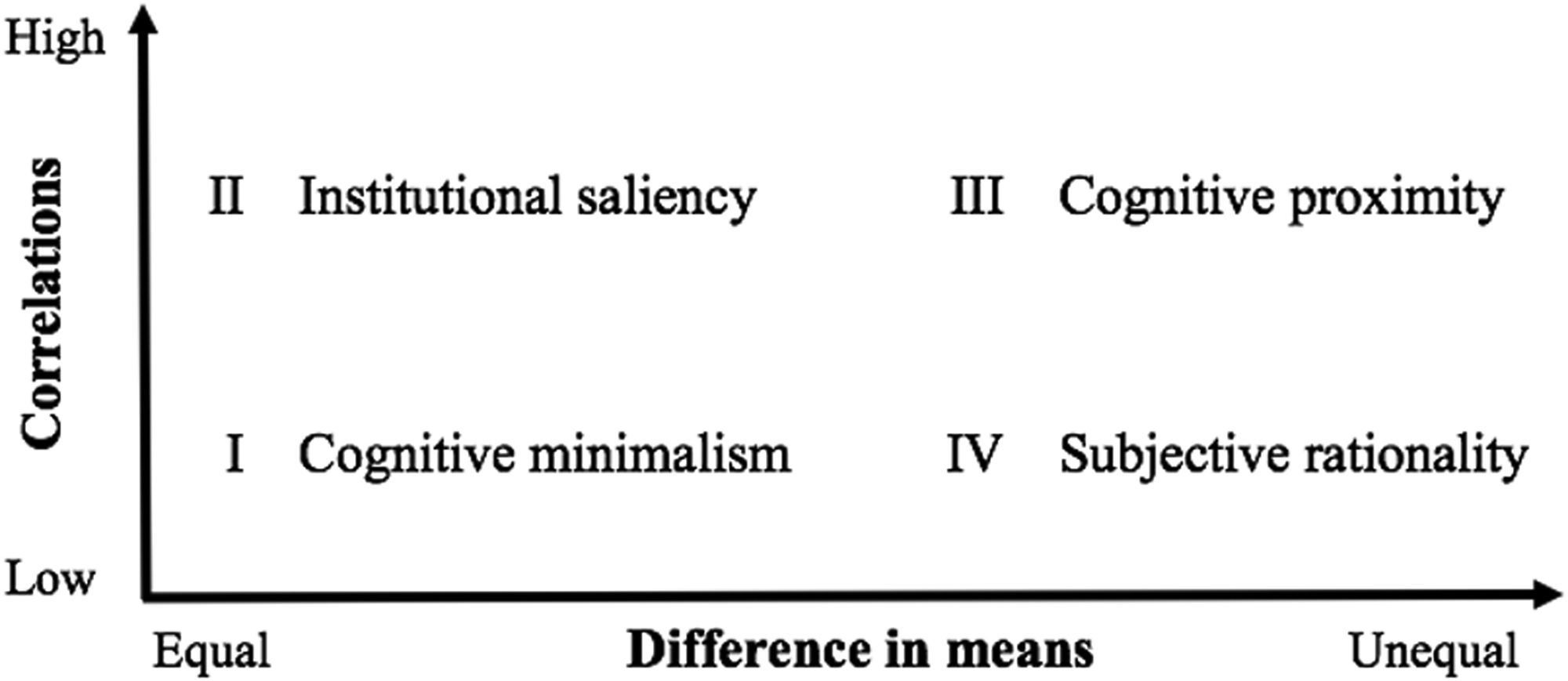
Cognitive mechanisms and patterns of (non-)differentiation of political trust.
We start with analysing the Dutch population at large (testing the competing Hypotheses 1a–1d) and then split the population by political sophistication levels (testing Hypotheses 2 and 3). In this second analysis – for reasons of parsimony – we only compare results for people with the lowest and highest levels of political sophistication. We repeat the same analysis for each of the political sophistication proxies: political interest (1 = ‘no interest’ versus 4 = ‘high interest’), media exposure (no newspapers versus local and national newspapers), cognitive capabilities (low versus high) and education (low versus high).
Political trust differentiation in the Netherlands
Dutch citizens appear to somewhat differentiate between the EU, national and local governments in terms of their perceived trustworthiness. The vast majority of the respondents (89.6%) assign different trust scores for the three trust measures. Dutch people put most trust in their local governments (trust score of 2.71 on a four-point scale) – somewhat more than in national government (2.55) and the European Commission (2.12). Differences between these mean scores are statistically significant (at p < 0.001). More descriptive statistics for the Dutch population at large and different groups of political sophistication, including respective sample sizes, are reported in Supplemental Material 1. 9
Figure 2 presents results for the analysis of the competing Hypotheses 1a–1d. It shows pairwise comparisons of the three trust measures. On the basis of d-values (x-axis) and the correlation strengths (y-axis) we relate each of the pairwise comparisons to the four different ideal-typical patterns of differentiation (see Figure 1).
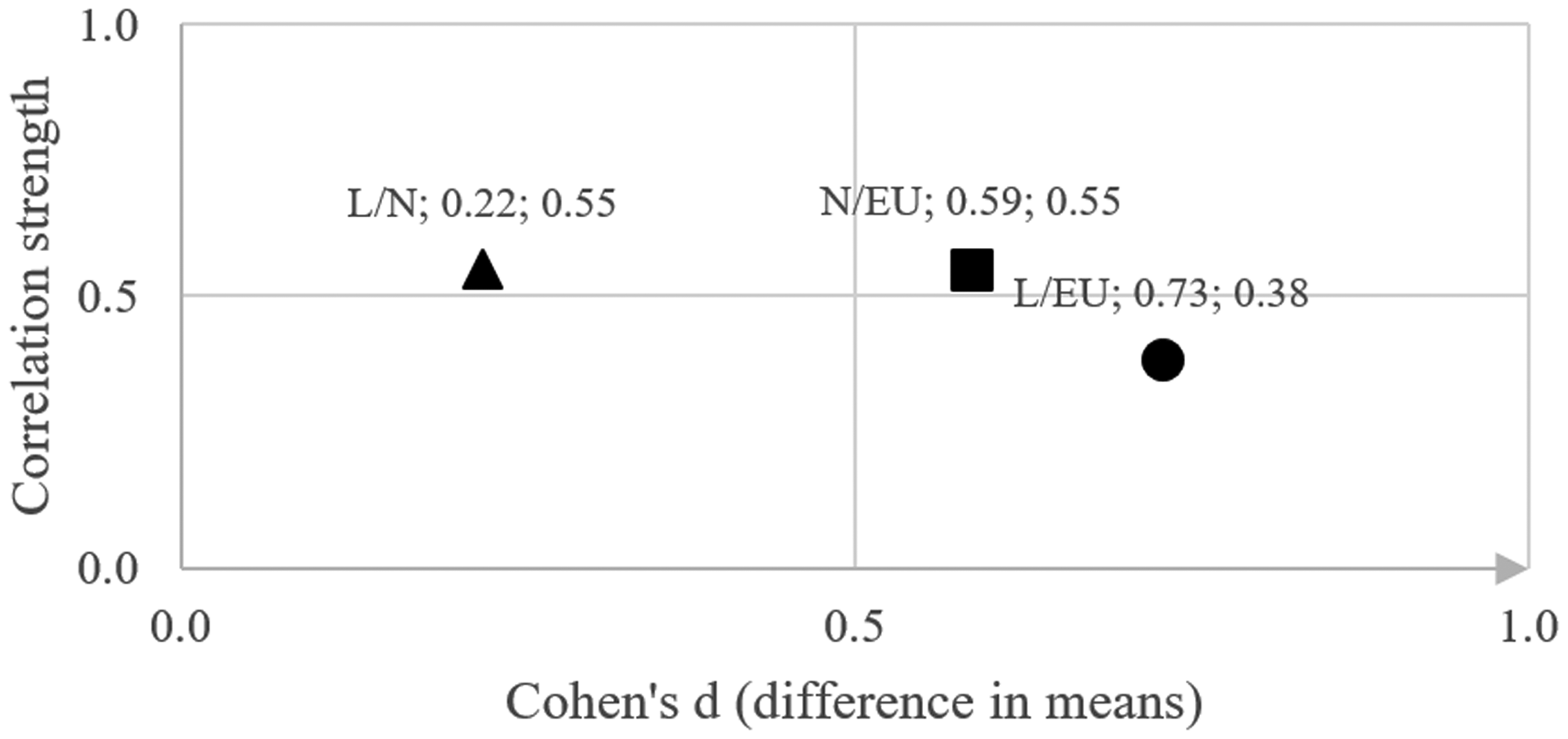
Patterns of trust differentiation: Dutch population.
First of all, it is important to recognize that we do not find the pattern predicted by Hypothesis 1a (similar means and weak correlations). That is, Figure 2 shows none of the pairwise comparisons in the bottom-left quadrant. This suggests that cognitive minimalism is not a dominant heuristic among Dutch citizens. Second, we also see that differentiation between levels of governance that are furthest apart in terms of institutional hierarchy (and cognitive proximity) – the EU and local government – is characterized by a high d-value and relatively weak correlations. This comes closest to the pattern predicted in Hypothesis 1d, which suggests the prevalence of a mechanism of subjective rational evaluations. Third, as for the two other pairs (local–national and national–EU), we find patterns that are more in line with Hypothesis 1b (institutional saliency, i.e., the upper-left quadrant) and Hypothesis 1c (cognitive proximity, i.e., in the upper-right quadrant) respectively. 10 This suggests that in these situations, where governments are relatively close, citizens generally employ information shortcuts, using evaluations based on one level to make trust assessments about other levels.
Low versus high political sophistication
To test Hypotheses 2 and 3, we consider how people with high versus low levels of political sophistication differentiate in their trust attitudes. Table 1 provides a first indication as to whether respondents at least somewhat differentiate, as it reports the percentage of people who do not assign the same trust score to all three levels of government. For three of the four sophistication indicators, the percentage of people who (somewhat) differentiate is higher in the highest sophistication category. All differences between low and high sophistication groups are statistically significant (at p < 0.01).
Percentage of people who did not assign the same trust score to EU, national and local governments.

For Hypothesis 2, we consider the trust differentiation patterns of people in the lowest political sophistication category, that is, with low (1) political trust, (2) media exposure, (3) cognitive capabilities and (4) education (see Figure 3). Contrary to theoretical expectations, even people with low political sophistication do not produce a macro-level pattern of cognitive minimalism: quadrant I of the graphs in Figure 3 remains empty consistently; therefore, Hypothesis 2 is rejected. Different from theoretical expectations, the local–EU trust differentiation is even positioned in quadrant IV (albeit sometimes at the borderline), which corresponds to the pattern of subjective rationality. For the other two pairs (local–national and national–EU), the scores for highly sophisticated respondents fall in quadrant II, suggesting that they use information shortcuts of institutional saliency.
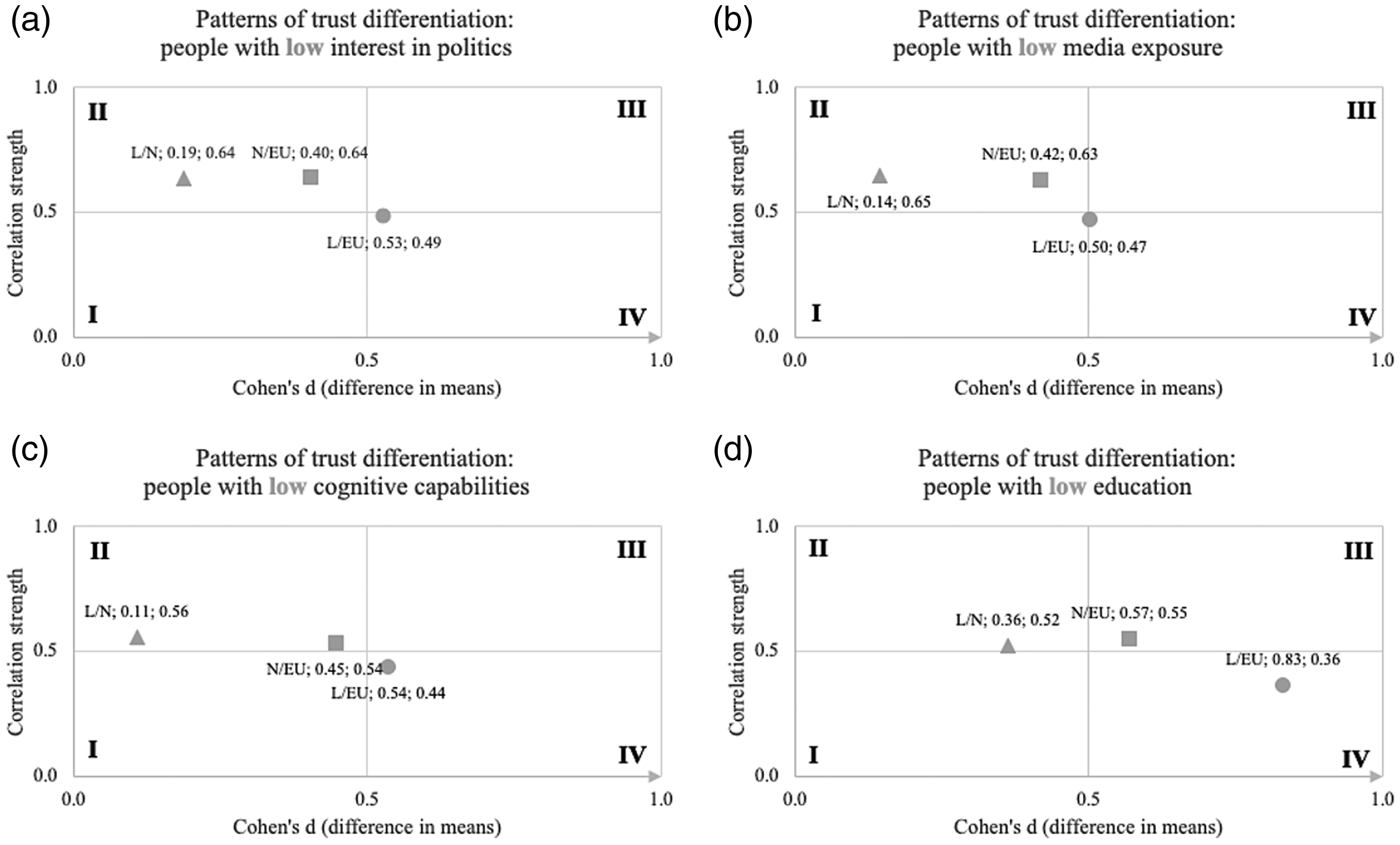
Patterns of trust differentiation: low political sophistication groups
As yet, we do not reject Hypothesis 3, as trust differentiation of the highly politically sophisticated tends to produce a pattern of subjective rationality (high difference in means and weak correlations). Figure 4 shows that local–EU trust differentiation among highly sophisticated respondents consistently fits in quadrant IV. For national–EU differentiation, politically sophisticated citizens are on the border of quadrant III and IV, with rather large differences in means and correlations around 0.50. As compared with less politically sophisticated citizens (see Figure 3), more sophisticated citizens differentiate more strongly, especially in terms of their trust levels (as is shown by higher d-scores) between both the national–EU and the local–EU levels. Just like the low politically sophisticated respondents, when assessing local and national trustworthiness, highly sophisticated respondents end up in quadrant II, which corresponds with the institutional saliency mechanism.
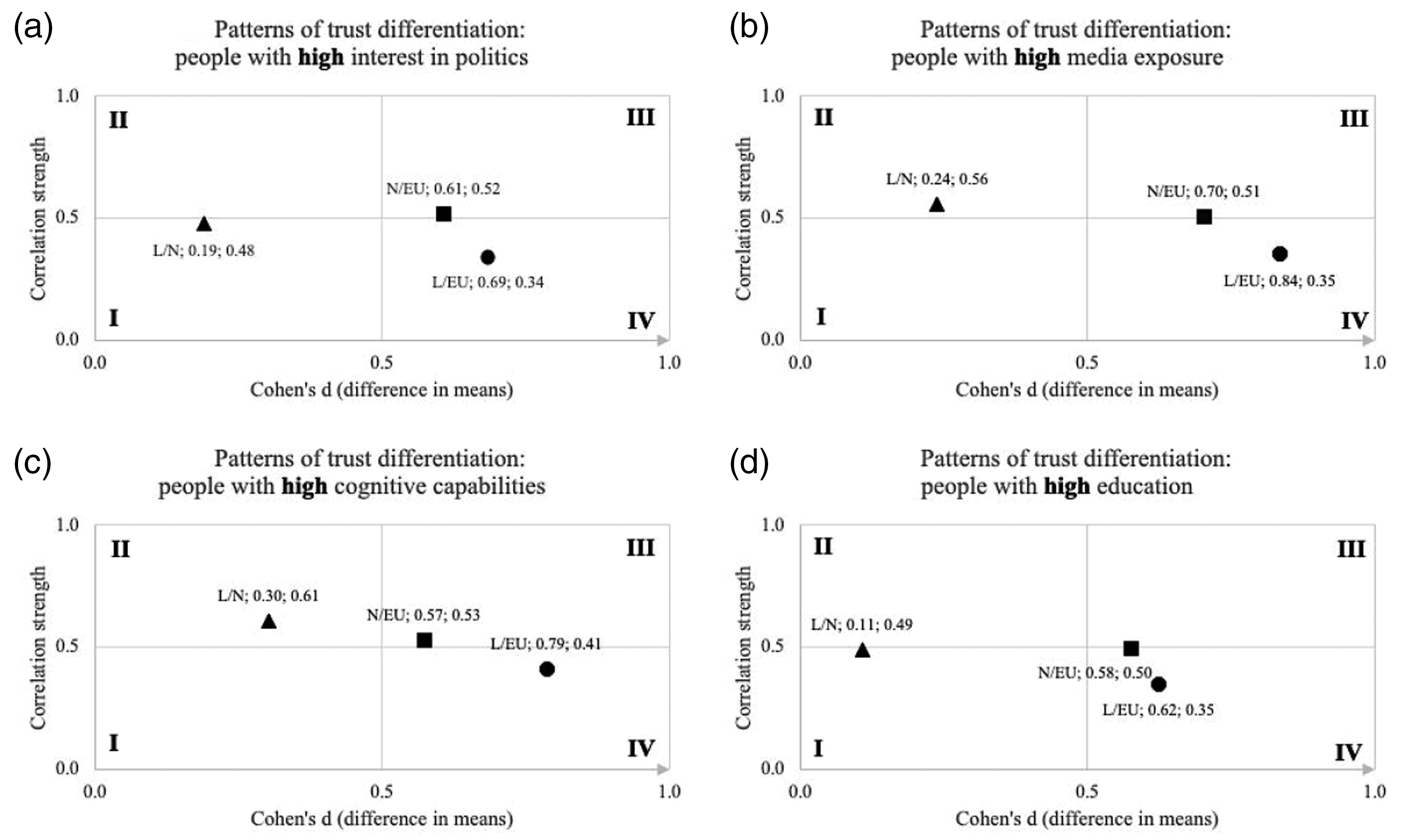
Patterns of trust differentiation: high political sophistication groups.
Conclusions
This article examined citizens’ patterns of political trust differentiation between executives at local, national and EU tiers of multilevel government (research question 1). Theoretically, we identified four logics of citizens’ (non-)differentiation and corresponding statistical macro-level patterns that they might produce at the aggregate level (Hypotheses 1a–d). At the level of the Dutch population, we found no evidence for the prevalence of pattern of cognitive minimalism (rejecting Hypothesis 1a). This confirms the idea that trust in executive governments may constitute a form of specific (rather than diffuse) support (see Easton, 1975; Wu and Wilkes, 2018).
Each pairwise comparison of government levels seems to produce a different trust (non-)differentiation pattern. Local–national differentiation leaned towards the institutional saliency pattern of trust non-differentiation (Hypothesis 1b), pointing to a considerable degree of interdependency between these two levels of governance in the eyes of the general public. This finding also reflects the way in which Dutch local government scholars characterize Dutch central–local relations (Denters and Klok, 2013; Hendriks and Schaap, 2012). National–EU trust differentiation resembled the pattern of cognitive proximity (Hypothesis 1c), reinforcing Dahl’s argument about trusting what is easier to understand and ‘closer to home’. The subjective rationality differentiation pattern (Hypothesis 1d) was the most likely to emerge between the most distant local and EU governance levels. As differences between the size, visibility and capacity of local and EU governments are the most striking, citizens apparently find it easier to differentiate in their assessments of these two governments. Interestingly, each pairwise trust comparison produced a different statistical pattern of (non-)differentiation, which implies that local, national and EU trust are linked to each other in distinctive ways.
We subsequently considered whether these patterns differ for groups of more or less politically sophisticated citizens (research question 2). Analyses showed that even people of low political sophistication do not assign trust scores in a way resembling the non-differentiating pattern of cognitive minimalism (rejecting Hypothesis 2). This contradicts the pessimistic ‘minimalist’ paradigm about mass publics having very little interest or understanding of politics, and thus randomizing their survey responses (Zaller, 1992). In line with theoretical expectations, groups of high political sophistication tended to produce differentiation patterns of subjective rationality (Hypothesis 3). In general, those with high political sophistication differentiate more extensively and more pronouncedly. Trust attitude formation seems, then, to somewhat reflect cleavages in political sophistication (Krosnick, 1990; Levendusky, 2011; Luskin, 1990), though less pronouncedly than one might have expected.
Limitations and future research
Our research used new data and explored patterns of trust in the executive governments across the main layers of EU governance: local, national and European. Although, to our knowledge, this is the first study to comprehensively focus on patterns of trust in these three tiers of government, we also acknowledge that multilevel systems comprise of a host of other political institutions that we do not include in our analysis of (e.g. parliaments, judiciaries, etc.) (see Denters et al., 2007; Newton et al., 2018; Schnaudt, 2019; Schneider, 2017).
Moreover, even though we think that we have developed a useful theoretical tool to analyse trust differentiation, we are convinced that we just took a small step in this article towards developing a better understanding of how people trust in a multilevel polity. Different aggregate-level differentiation patterns – as we have argued before – may be produced by different individual-level cognitive mechanisms. However, more causality-focused research is needed to determine whether the produced patterns are indeed a reflection of prevalent individual-level logic(s). Our results suggest that political trust is specific and that citizens, at least in an established democratic society such as the Netherlands, differentiate in their trust assessments. In both respects, our results corroborate similar findings to important work by Wu and Wilkes (2018). Moreover, we also showed that trust differentiation was more pronounced among respondents with higher political sophistication.
However, as we have argued before, much more work on the determinants of citizens’ patterns of response to trust questions (rather than explanations of levels of trust in a particular government) is needed. For example, if a pattern of identical means and high inter-trust correlations is indeed produced by an institutional saliency logic, one expects that all three trust scores would be primarily determined by the (perceived) performance of the national government. Likewise, it is hypothesized that a pattern of unequal means and high correlations, suggesting an institutional proximity heuristic, reflects patterns of people’s identification with their locality (and more distant jurisdictions). Future research will have to test these implications. Moreover, it should be clarified whether a differentiated pattern – hypothesized under a heuristic of subjective rationality – indeed reflects citizens’ assessments of specific attributes (e.g. the policy performance, the ideology or the responsiveness of political officials, or the nature of the political institutions) of different governments.
Therefore, we conclude that we make – an at least modest – contribution in this article towards a systematic understanding of how people develop trust in different political institutions in contemporary multilevel governance. In subsequent work, we hope to make further contributions to this emergent body of literature.
Supplemental Material
sj-pdf-1-ras-10.1177_00208523211022826 - Supplemental material for Political trust in a multilevel polity: patterns of differentiation among more and less politically sophisticated citizens
Supplemental material, sj-pdf-1-ras-10.1177_00208523211022826 for Political trust in a multilevel polity: patterns of differentiation among more and less politically sophisticated citizens by Dominika Proszowska, Giedo Jansen and Bas Denters in International Review of Administrative Sciences
Footnotes
Acknowledgements
We thank five anonymous reviewers for critically reading the manuscript and providing helpful feedback and advice.
Declaration of conflicting interests
The author(s) declared no potential conflicts of interest with respect to the research, authorship, and/or publication of this article.
Funding
The author(s) disclosed receipt of the following financial support for the research, authorship and/or publication of this article: This project has received funding from the EU’s Framework Programme for Research and Innovation Horizon 2020 under the Marie Skłodowska-Curie Grant Agreement No. 722581.

Notes
References
Supplementary Material
Please find the following supplemental material available below.
For Open Access articles published under a Creative Commons License, all supplemental material carries the same license as the article it is associated with.
For non-Open Access articles published, all supplemental material carries a non-exclusive license, and permission requests for re-use of supplemental material or any part of supplemental material shall be sent directly to the copyright owner as specified in the copyright notice associated with the article.
