




Abstract
The purpose of this article is twofold: to theoretically assess ideational and organizational explanatory factors in the adoption of artificial intelligence policies; and to examine the extent to which the European Union has managed to facilitate a coordinated artificial intelligence policy in the Nordic countries. The study utilizes a mixed
Points for practitioners
The study illuminates how policymakers in the Nordic countries are affected by the European Union when crafting their own artificial intelligence policies. The European Commission profoundly influences the policymaking of member states and affiliated states through the policy strategy of policy framing. The Commission uses this soft measure to nudge member states to comply with the European Union policy framework. Second, the study shows how ‘organizations matter’: variation in national organizational capacities in the Nordic states contributes to variation in national policy adoption. Even though Nordic countries adopt European Union-level policy frames, their implementation is shaped by varying organizational capacities available at the national level.
Keywords
Introduction
The exponential increase in business investment, research and development (R&D) and the technical performance of artificial intelligence (AI) (Perrault et al., 2019) has impelled the idea that AI is central to the ‘fourth industrial revolution’ (Schwab, 2017). A contemporary notion is to believe that AI will transform both modern societies and science at scale (Appenzeller, 2017; Harari, 2017). Such transformative potential is also echoed within the discourse on ‘smart government’ and ‘big data’, in which opportunities often seem endless (Maciejewski, 2017; Šiugždinienė et al., 2019). This has initiated a stark worldwide increase in soft policy, such as ethical guidelines and AI strategies (Jobin et al., 2019). International organizations such as the United Nations (UN), the Organization for Economic Cooperation and Development (OECD) and the European Union (EU) have all started developing AI soft policy. This study argues that the EU, more specifically, the European Commission (Commission), applies soft measures of policy framing in the domains of AI and accordingly sets member states to adopt a common EU-level policy frame. By examining member-state AI policies, this study thus asks to what extent the Commission managed to facilitate a coordinated policy framework within the member states.
In 2018, the Commission launched its first policy document on AI, which was a first attempt to frame a common European policy approach to strengthen Europe’s global position on AI (European Commission, 2018a). In the subsequent coordinated plan released the same year, member states were encouraged to develop their own national AI strategies by mid-2019, which should outline investment levels and implementation measures, taking the coordinated plan into account. Although the exact content and form was left for the member states to decide, national strategies should build on what was outlined in the coordinated plan (European Commission, 2018b). Adopting a disruptive AI narrative, the coordinated plan states that ‘AI is helping us to solve some of the world’s biggest challenges: from treating chronic diseases or reducing fatality rates in traffic accidents to fighting climate change or anticipating cybersecurity threats’ (European Commission, 2018b: 2). The transformative potential of these technologies is (apparently) profound. A collaborative document on AI was also signed the same year by all EU member states, including Norway. The document suggests that signatories should coordinate their AI efforts, continuously facilitate a dialogue with the Commission and commit to regular assessments on progress. The agreed-upon document suggested member states commit to boost uptake in a range of AI-related areas, such as research, education and industrial processes (European Commission, 2018c). To further promote the urgency of addressing AI as a policy issue, the Commission set up the High-Level Expert Group on AI (AIHLEG) in June 2018, tasked with supporting the implementation of a coordinated EU approach and providing policy recommendations for member states.
However, as great expectations in Brussels might easily be dashed in member states, the aim of this article is to determine to what extent member states created AI strategies that build on the EU policy approach on AI. Zooming in on the Nordic region, the article examines AI strategies and organizational policy context in five Nordic countries through expert interviews with key government officials, systematized online data collection and analysis of AI policy documents. While earlier research has shown a ‘Nordic cluster’, with similarities and overlap of AI strategies (van Berkel et al., 2020), relations with the EU are differentiated. Iceland and Norway are merely associated members of the EU via the European Economic Area (EEA), while Sweden, Denmark and Finland are EU members. We would thus expect territorial variation among the Nordic states in their adoption of the EU’s AI policy. Moreover, the Nordic EU member states have also been described as reluctant and awkward partners in the EU (Stegmann and Brianson, 2018), exemplified most recently by the ‘frugal four’ opposing some key aspects of the EU’s COVID-19 recovery fund. Are Nordic states also reluctant adopters of the AI policy of the EU? By applying a theoretical framework that combines ideational and organizational aspects, this study contributes to building bridges within (new) institutionalist scholarship. The article exemplifies this theoretical bridge by observing that national AI policies in the Nordic countries are ideationally integrated into the AI policy of the EU but still differentiated in their organizational adoption of it due to variation in organizational capacities.
The article is structured as follows. The next section outlines the theoretical framework on policy framing and organizational capacities. Then, the mixed methodology applied and the data that have been made available to the study are presented. Lastly, we present key findings and conclude by revisiting the theoretical framework.
Policy ideas and organizational capacities
To reconcile divergent institutionalist approaches and to move beyond conventional notions such as ‘organizations matter’ and ‘ideas matter’, this study shows both how ideas and organizations structure policy adoption, and at what points in the policy process they do. The novelty, increasing interest and sometimes hype surrounding AI technologies provides an important ideational backdrop for our study. Even though AI technologies are, to a large extent, not yet applied, AI policies are already shaping at scale (Jobin et al., 2019), showing that the potentially disruptive effects of these technologies are apparently sufficient to mobilize policymakers at various levels. At the same time, as governments assign staff and resources to produce these policies, the policies also become products of their organizational capacities. Therefore, in studying AI policy adoption in the EU, we argue that ideational framing-based processes spur policy change while organizational capacities influences the scope and depth of national implementation. As such, policy ideas are conceptualized as the independent variable, organizational capacities as the main mediating variable and national AI policy adoption as the dependent variable (Figure 1).
Independent variable: AI as a policy idea
A vast scholarship has explored ideational and constructive processes as potential explanatory concepts in the study of public policy (Béland, 2009; Béland and Cox, 2011; Blyth, 2002; Carstensen and Schmidt, 2016; Fischer and Forester, 1993; Parsons, 2002; Schmidt, 2010). Intrinsically malleable and subject to constant reforming and reframing (Carstensen, 2011), far from all ideas have political impact. Ideas need to be promoted by policy entrepreneurs (Kingdon, 1995), address a critical issue in a seemingly useful way (Hall, 1993) and be framed for broad institutional and normative acceptance (Campbell, 2004). AI is indeed a critical issue and we conceptualize the Commission as a sufficiently powerful policy entrepreneur to frame the AI issue in such a way that incites member states to adopt the issue. The Commission’s communication (European Commission, 2018a), coordinated plan (European Commission, 2018b), coordination document (European Commission, 2018c) and AIHLEG all represent initiatives aimed at coordinating member states’ AI policies. As policy issues are neither neutrally given nor a priori defined, we conceptualize these initiatives as efforts of the Commission to frame the issue, that is, to emphasize certain policy elements and define policy problems, which, in turn, also sets an agenda and biases the policy processes (Daviter, 2007, 2018). As a policy entrepreneur, the Commission has the power to set up ‘normative-prescriptive stories that interpret an uncertain, problematic, or controversial situation into a policy problem that names the phenomenon and implies a course of action’ (Laws and Rein, 2003: 174). As such, the framing of the AI issue bears similarity to the ‘low politics route’ of agenda setting: the utilization of expert groups and formulation of specific policy proposals (Princen and Rhinard, 2006).
Building on work from Carstensen and Schmidt (2016), we suggest that such ideational power is a distinct form of power characterized by the capacity of certain actors to influence other actors’ beliefs and actions through influencing the ideational context that defines the range of possibilities of action. In the specific context, this translates to the fact that the Commission has encouraged member states to create national AI strategies that should outline investment levels and implementation measures that should build on the coordinated plan of the Commission. In line with our theoretical expectations, EU-level policy frames can therefore have the power to reduce policy uncertainty and facilitate coordination by member states, fitted to constructed policy notions (Blyth, 2002).
The articulation of forceful ideas in policy has been described as discursive self-authorization and is a key part in how future-oriented discourse has the potential to bias public organizations and governments towards certain policy outcomes (Schattschneider, 1975; Pälli et al., 2009). The framing of the EU’s AI policies is thus expected to shape the formulations and perceptions of national policymakers. The setting up of the AIHLEG, the declaration of cooperation among member states and the EU coordinated plan are thus all considered to be ways for the Commission to frame the ‘AI issue’. The emphasis of AI as a disruptive technology that is ‘helping us to solve some of the world’s biggest challenges’ (European Commission, 2018b: 2) furthermore bestows the policy with discursive force, significance and temporal urgency. Such ideas translated into policy texts are then invoked as normative premises for member states to establish policies to address AI technology and harness its potential. Implicitly, this means that if a member state does not develop AI policy strategies, this member state is assumed to miss the transformative potential offered by AI technologies. From this line of argument, we derive our first proposition: P1: National policymakers are likely to be influenced by EU-level AI policy ideas, leading to national policy adoption.
Mediating variable: organizational capacity
Policy adoption is assumed to be mediated by the requisite organizational capacities available. An organizational approach is grounded on the assumption that organizational characteristics may explain both how organizations act and how they change. An organizational approach in this study emphasizes how decision processes and human behaviour respond to a set of fairly stable organizational routines (Cyert and March, 1963). Essentially, stable premises for behavioural choices are past experiences encoded in rules and expressed in the organizational structure of a government apparatus (Frederickson et al., 2012; Olsen, 2017; Waldo, 1952). Organizational characteristics of the governmental apparatus systematically enable and constrain public governance processes, making some policy choices more likely than others. A theory of organization is thus also a theory of politics (Waldo, 1952). Among other things, organizational capacities mobilize attention and action capacity around certain problems and solutions while ignoring others, as well as focus attention along particular lines of conflict and cooperation (Simon, 1983: 21). An organizational approach posits that organizational capacities are not merely expressions of symbolic politics (Feldman and March, 1981; Meyer and Rowan, 1977), but create systematic bias in human behaviour and collective decision processes by directing and nudging individual and collective choices towards certain problems and solutions, thereby making certain outcomes more plausible than others (Egeberg and Trondal, 2020; Fligstein, 2001; Gulick, 1937; Hammond, 1986; Schattschneider, 1975; Thaler and Sunstein, 2008).
Contemporary studies in organization theory focus particularly on the explanatory role of organizational structure (Egeberg, 2012; Egeberg and Trondal, 2018). An organizational structure is a normative structure, that is, it is a decided order composed of rules and roles specifying who is expected to do what, when and how (Ahrne and Brunsson, 2019; Egeberg and Trondal, 2018; Scott and Davis, 2016). It suggests how roles, power and responsibilities are distributed, controlled and coordinated. Furthermore, it shapes behaviour by providing individuals with ‘a systematic and predictable selection of problems, solutions and choice opportunities’ (March and Olsen, 1976: 13). While organizational structure does not necessarily predict or determine actual decision-making behaviour, it does make some choices become more likely than others (e.g. Egeberg and Trondal, 2018). As such, organization theory builds on decision theory, with its focus on explaining decision-making behaviour (Simon, 1976). This entails that organizational capacities do not impact directly on society; rather, they have an indirect effect by influencing the policy process and the decisions made within and outside organizations (Ahrne and Brunsson, 2019). Bounded rationality (Simon, 1976) is one of three key mechanisms that connect role expectations to behaviour: the organizational structure helps simplify actors’ cognitive worlds by directing attention towards a selection of possible problems and solutions, as well as ways to connect them. This concept holds that decision-makers operate under three restrictions disregarded by the ‘consequentialist theology’ of economic man (March, 2020: 120): limited information with regards to possible solutions and alternatives; limited cognitive capacity to evaluate and process information; and limited time to make decisions. Consequently, actors opt for a selection of satisfactory alternatives instead of optimal ones and often turn to their immediate environments and available knowledge to find proper choices (Simon, 1976). The second mechanism – the logic of appropriateness – views human action as driven by internalized perceptions of what is deemed appropriate (March and Olsen, 1989). Finally, actors may find that rule and role compliance is in accordance with their self-interest and utility functions. Organizations are thus incentive systems that administer rewards and punishments (e.g. Ostrom, 2015; Simon, 1983).
Therefore, the national adoption of EU-level AI policy is likely to be biased by existing organizational capacities at the national level, which are likely to vary among the Nordic countries contingent on varying organizational capacities in their implementation structures. A second proposition might thus be derived: P2: National policymakers in the field of AI are likely to be simultaneously constrained and enabled by existing organizational capacities. Thereby, policy adoption is likely to be positively associated with the national organizational capacities at hand.
Methodology and data
To map the AI policy at the EU level and the corresponding national-level policy adoption in the Nordic states, a mixed-methods approach has been utilized in a three-step process. First, AI strategies from the Nordic countries were read and summarized in terms of general thrust. These documents were searched in terms of ‘EU references’. The search terms chosen were ‘EU’, ‘trustworthy’, ‘expert group’, ‘European’ and ‘Commission’. The result of the NVivo search queries were then tabulated and graphed. In addition, the results of a policy document analysis were used as information to create a semi-structured interview guide geared towards government officials and key stakeholders in national AI policy processes in the Nordic countries. Informants are indicated by the first letter of their country of origin (e.g. ‘F’ for Finland) followed by a number that specifies the interviewee. Table 1 illustrates the data collection.
Distribution of data sources.

Interviews with key informants were facilitated through online video-conferencing software available with respect to specific privacy regulation in the specific government (Skype, Microsoft Teams and Zoom). The interviews were conducted between March and June 2020, which was during the first major wave of the COVID-19 pandemic, making it hard to get a hold of informants. A total of N = 7 interviews were conducted with government officials and stakeholders central to the AI policy process in Sweden, Norway and Finland. Third, a systematic search on Nordic government web pages was conducted, with ‘artificial intelligence’ translated into the native languages 1 and used as a search query on both parliament and government web pages.
Two caveats are worth highlighting. As contemporary governance takes place in a multi-stakeholder environment, many initiatives in AI are presumably initiated by actors outside governments. Yet, this article is limited to the study to AI policy strategies in the core executive of the state. Second, relating to the novelty of AI policy, it remains to be seen whether adopting the EU policy approach will foster more integrated AI policy within the Nordic countries over time. However, the value added is to theoretically illuminate policy dynamics and causal mechanisms at play between ideational policy framing and organizational capacities.
Findings
This section starts by summarizing the main findings and then explores the data in greater detail in the subsequent subsections. Summarily, we find evidence to support both theoretical propositions, namely, that the Nordic countries are ideationally influenced by the EU in the creation of their AI policies (P1), and that organizational capacity at the national level mediates the scope and depth of policy adoption (P2). We conclude by observing that: there has been an increased policy discourse on AI in Nordic governments and parliaments; all Nordic states except Iceland have created AI strategies; and these AI strategies show substantial discursive similarity with the EU policy approach, meaning that the EU has been influential in promoting a coordinated AI framework. Furthermore, observing variation in national-level organizational capacities across the Nordic countries, the data also suggest that AI policy adoption is mediated by existing organizational capacities.
Results of the systematic web and NVivo search
Through a systematized web searching of the web pages of Nordic country parliaments and governments, we observe that AI was increasingly mentioned in the late 2010s. This is shown in Figures 2 and 3. Chronologically, this also largely corresponds to EU-level developments: when AI is on the agenda in the EU, it is also on the agenda in the Nordic countries.
The fact that the Nordic countries and the Commission increasingly addressed AI policy especially after 2017 does not by itself suggest that Nordic countries have been adopting EU-level AI policy; rather, this could simply reflect global AI developments at the time. Therefore, as a second step, an NVivo word query was conducted within all Nordic AI policies, looking for ‘Europe-specific’ references. Indicating the adoption of EU policies by Nordic countries, we see a substantial increase in word frequency after 2018 at the time when the EU published its coordinated AI policy. Even though some of the keywords exist in former policy documents, the bulk of the referencing to EU policy is found after 2018. Figure 4 shows all national AI policies and how much they referenced each search word.
Results from interviews and policy document analysis
This subsection shows the results from reading and summarizing the national AI strategies, as well as results from our interviews with key informants in Finland, Sweden and Norway. All national AI strategies equally commit to the idea that AI is a disruptive technology and that their respective government should do their best to harness the technology’s potential. All strategies also outline measures for improving investments in AI, as well as its successful implementation. Building on country-specific strengths, the strategies outline how the respective countries should be forerunners, expanding on the temporal urgency promoted by the Commission. The main gist of the national strategies is thus coherent with the EU policy frame. Table 2 shows the characteristics of the Nordic AI policies.
Overview of Nordic national AI strategies.
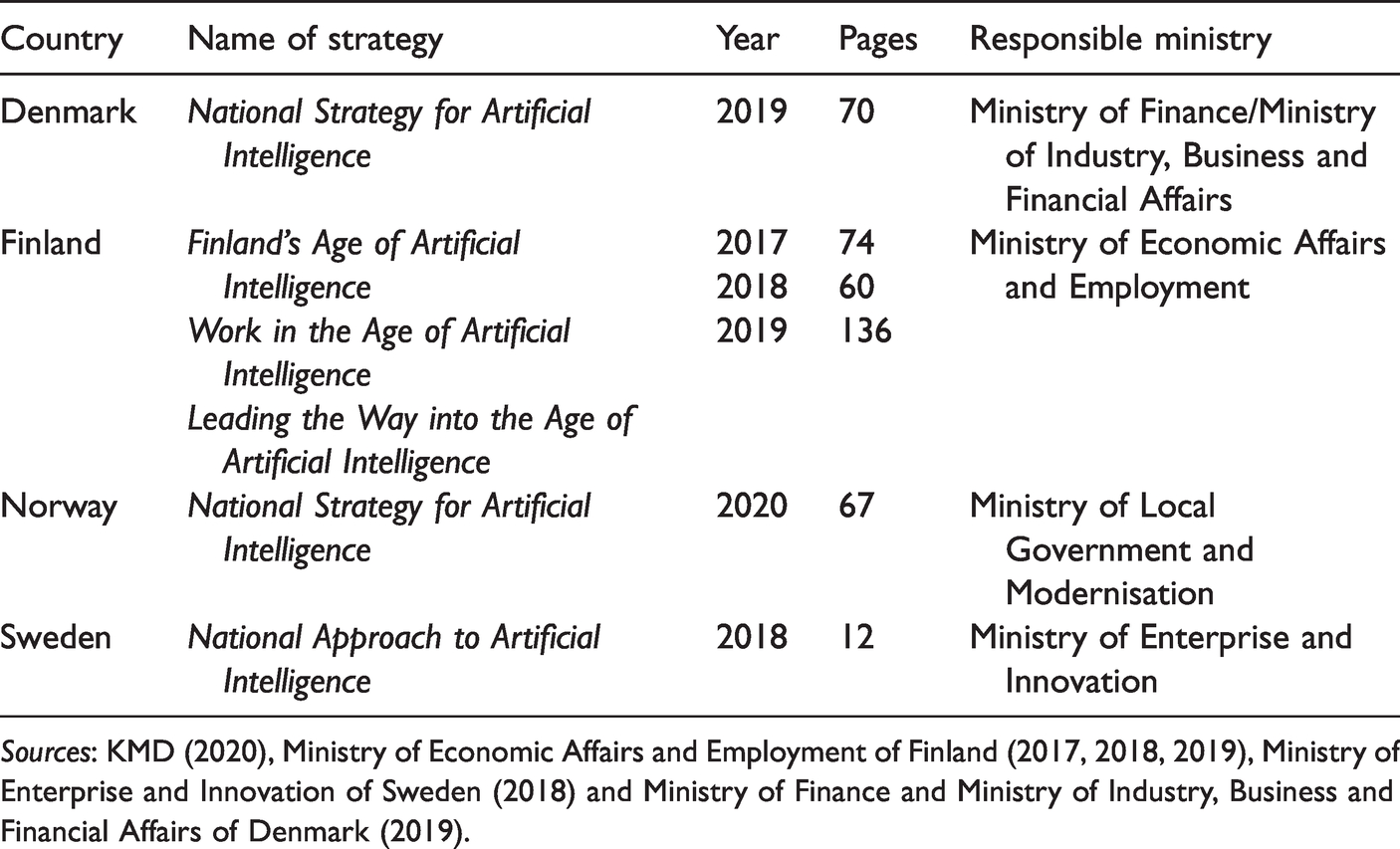
Moreover, Table 2 shows that AI policy documents vary in both their lengths and their ministerial embeddedness. In short, domestic AI policies are supplied by different organizational capacities in different countries. Consequently, we see a significant page-range difference between Sweden’s 12-page AI policy document and Finland’s total of 270 pages published in three AI policy documents. This variation arguably reflects variation in available national organizational capacities. Different countries have different capacities to draft their AI policy in policy documents.
Finland
Many observations suggest that Finland is an eager adopter of AI policy. The Finnish government has issued three AI reports that cover different areas of AI and sketch out the road ahead for Finland. The final report of the Finnish AI strategy includes an organizational chart of the AI programme (see Figure 5). A first observation regards the size of the organizational structure. The sheer size of this organization suggests requisite organizational capacities that would enable the adoption of the EU AI policy. A second observation regards the multi-stakeholder steering group reporting to the Minister of Economic Affairs. The steering group is characterized by a high degree of corporate representation, while the secretariat is represented by government officials. The organizational structure is further divided into five subgroups that oversee five different themes deemed relevant for the AI strategy. In these different groups, we also see a mix of corporate and governmental representation.
When asked about the relationship between the Finnish AI strategy and the EU AI policy, F1 drew attention to the fact that the Finnish were early adopters of AI policy and could thus influence central-level EU policy. Moreover, the Chairman of the Finnish AI Strategy Group was also the chairman of the AIHLEG: F1: The relationship was most concretely through the Chairman of both groups, Pekka Ala Pietilä … he was the closest link and I think that he was elected for the AIHLEG based on his work on the Finnish AI Strategy Group … in a sense, the Finnish Strategy Group was somehow driving the work in the AIHLEG. Q: So, you mean that the Finnish AI Strategy Group had influence over the EU policymaking? F1: Certain influence yes for sure and partially due to the fact that we were maybe one or two steps ahead of some others.
Norway
Norway is a case that features relatively weak organizational capacities in AI policy formulation. As an associated EU member, this suggests that Norwegian AI policy is less likely to adopt EU AI policy. In Norway, AI policymaking has been organized as a writing group consisting of four people from one ministry and a government agency, as well as an interdepartmental working group for feedback on the strategy work. Considering how relatively late the Norwegian AI strategy was published, one informant experienced a stark push not just from the EU, but also from civil society and from within the ministry, and emphasized the fact that Sweden, Denmark and Finland had already published their own AI strategies (N1, N4): There was a push from the industry organizations in Norway. When Denmark’s strategy came out, it was very much the case that, ‘Sweden has, Denmark has – just not us’. This created an agenda – they had an agenda…. If we internally had no AI strategy, we would float without control as a country. We were not so worried about that. We worked towards the EU initiatives – most [of these] areas we already worked on even though they were not gathered in a strategy document. (N1) It has been proven that our strategy covers the areas where the Commission has called for. It is a kind of order to the member states in the coordinated plan and that the strategy created should cover specific areas. Basically, they cover those areas. The Commission has also been busy positioning the EU vis-a-vis China and the United States, and to make visible a major investment in Europe. They have been very much looking for ‘numbers’ – quantification of research, investments, study places, candidates. The Danish strategy or what has been done in Finland has been more relevant as inspiration than what the EU has done. We meet Denmark, Sweden and Finland, the meetings arranged by the Nordic Council of Ministers (NCM) and they are the same people you meet in the EU.
Sweden
The Swedish case is partly different from other Nordic countries with regards to AI policy in two regards: as emphasized by interviewee S2, the Swedish government decided to define the Swedish policy not as a ‘strategy’, but as an ‘approach’, and the length of the document is only 12 pages. One Swedish informant reported the following regarding the strategy and its coupling with the EU: My own opinion is that we are quite governed by the EU and what they do. We respond to it when it has happened.… We [referring to the government offices in Sweden] do not have many deliveries on AI. There is the AI approach but we do not have an in-depth strategy or a target programme that many other countries have. Sometimes you talk about [the national approach] as a strategy, but if you are to be completely correct, it is an approach. (S2) I perceive that the pressure on the government offices comes from others doing something that we act on, so that EU’s AI white paper will, of course, have a big impact. As we do not have a clear strategy and roadmap, other documents will fill that gap. When the EU says we should do these things, we react to it, but we do it when it happens. (S2)
As our informant pointed out, the government offices do not have many deliveries on AI, responsibilities have been delegated to governmental agencies, suggesting a decentralized mode of governance. In 2017, the Swedish innovation agency (Vinnova) was assigned by the government to map out and analyse the implementation and potential of AI in Sweden. In 2019, the Swedish Agency for Digital Government (DIGG) was tasked with analysing how AI could contribute to efficient applications in the public sector. In 2019, Statistics Sweden (SCB) was tasked with analysing the use of AI in Sweden. Also in 2019, the big corporation Wallenberg established a separate AI programme (WASP), awarding SEK4.2 billion to AI research in Sweden over 10 years, both within the industrial sector and within social science. In sum, the Swedish case features an organizationally decentralized design on AI policy adoption.
Conclusions
This study suggests that the Commission has successfully utilized ideational strategies to stimulate a coordinated European AI policy framework within the Nordic countries. Through concrete and persuasive discourses, the Commission has mobilized actors such as the AIHLEG and applied ideational power to define the range of possibilities of the policy responses, as well as the content of such policies, showing a clear case of agenda setting. This has also caused member states and affiliated states such as Norway to create national AI strategies and to adapt their approaches to key tenets of EU policy discourse. However, differentiated organizational capacities across the Nordic states has caused differentiated policy adoption. Policy documents are arranged under different ministries and are of different lengths and detail, suggesting that policy framing at the EU level is filtered through organizational structures at the national level. So, while the EU’s AI framing has penetrated and formed both the form (strategies or strategy-like texts) and the content (central tenets) of Nordic AI policies, the study also observes differentiation along the lines of organizational capacity. Member states that lack organizational capacity are likely to foster weak policy implementation. Thus, great hopes in Brussels are partly dashed in some national capitals. On the contrary, when requisite organizational capacities are installed in member states – as in the case of Finland – we find that EU policies on AI are more robustly adopted.
The study provides insight into the interdependent elements of policymaking and the much-debated notion of transnational actors’ role in national policymaking (see Orenstein, 2008; Stone, 2008), as well as the critiqued (James and Lodge, 2003) notion of policy transfer (Dolowitz and Marsh, 2000). The study shows that AI policy is not created in a vacuum. Policymakers at the governmental level look towards both the EU and neighbouring countries when establishing their own policies. Even EU-level policymakers might strengthen their own policy expertise by recruiting expertise from early adopters, as exemplified by the Finnish case. Such processes can lead to mimetic policy processes and ideational diffusion, but organizational capacities curtail such processes by shaping the process of policy implementation. As eloquently described by Béland (2009: 701), ‘national institutions and repertoires remain central to the politics of policy change despite the undeniable role of transnational actors and processes’.
As a case of EU policymaking, the study also refers to the idea of European administrative integration. Studies of European administrative ‘space’ (see Olsen, 2003; Trondal and Peters, 2013) and ‘community’ (see Siedentopf and Speer, 2003) have been interested in studying administrative interdependence and policy coordination across levels of governance. In the face of more salient political debates and contemporary struggles of the EU (i.e. Brexit, COVID-19 and Eurosceptic populism), this study shows that the Commission’s administrative apparatus robustly coordinates policy through framing despite the perceived ‘crises’ of the EU. The fact that the Commission is venturing into a novel policy area and managed to facilitate a coordinated policy framework shows both a forward-looking and robust side of European administrative integration that systematically ‘chugs along’ in the face of political turbulence and crises.
Since the evidence of this article is empirically suggestive, further data collection is important. It would be of relevance to further study the intricacies of how European policymakers learn from each other within the policy field of AI. Whereas this study covers the Nordic countries, it would also be interesting to expand the empirical scope beyond this. Finally, as AI computers – such as neural networks – are becoming increasingly autonomously ‘intelligent’, their decisions also increasingly challenge human oversight. Since this development is increasingly discussed in the referred policies in terms of ethical guidelines and sound principles for decision-making, future research might examine how computational decision-making might pose challenges for the legitimate implementation of public policy.
Supplemental Material
sj-pdf-1-ras-10.1177_00208523211007533 - Supplemental material for Discursive framing and organizational venues: mechanisms of artificial intelligence policy adoption
Supplemental material, sj-pdf-1-ras-10.1177_00208523211007533 for Discursive framing and organizational venues: mechanisms of artificial intelligence policy adoption by Frans af Malmborg Jarle Trondal in International Review of Administrative Sciences
Footnotes

Note
References
Supplementary Material
Please find the following supplemental material available below.
For Open Access articles published under a Creative Commons License, all supplemental material carries the same license as the article it is associated with.
For non-Open Access articles published, all supplemental material carries a non-exclusive license, and permission requests for re-use of supplemental material or any part of supplemental material shall be sent directly to the copyright owner as specified in the copyright notice associated with the article.
