




Abstract
Although boundaries are typically seen as hampering inter-organizational collaboration, a lack of clear boundaries does not kindle collaboration either. This paper investigates how boundary spanners manage boundaries in inter-organizational collaboration. I draw on data from a 12-month ethnography of an inter-organizational innovation pilot between water authorities and utility owners in the Netherlands. The aim of this pilot was to improve the logistical and budgetary efficiency of renovations on dykes with underground utility systems, through collaboration between utility companies and water authorities. Findings show how pilot staff and participants were challenged by the invisibility of collaborative work: collaboration was undervalued, seen as a nuisance, and not as a core responsibility. Within the pilot potential measures of collaborative success and action were formulated, and participants learned about potential obstacles. This helped participants to see the potential of collaborative work clearer, and formulate collaborations that could move forward in acknowledgement of limitations. This paper contributes to the boundary work literature by proposing that managing the (in)visibility of boundaries is substantial to the competency of boundary spanners.
Introduction
The extensive task of renovating flood-defence mechanisms in the Netherlands requires increased and more structural collaboration between water authorities and utility owners. It may appear odd to face weak collaborations in Dutch water management: the historical threat of flooding is considered to have instilled the Dutch with an inclination to collaborate. From the early 13th century to the present day, the organization of flood protection has required collaboration between, on the one end, regional water authorities and central administrators, and, on the other, privatized companies (Lintsen, 2002; Meyer, 2017; Pye, 2015). Nevertheless, the scattered and incidental nature of collaboration now proves to make dyke renovation projects prone to delays and budget overruns. In the light of the country’s impeding large-scale renovation tasks, stronger collaborations are expected to be essential in achieving timely results and budget adherence.
Previous research into cross-sectoral, inter-organizational collaboration specifically in the domain of flood protection attributes a crucial role to boundary spanners (Edelenbos and Van Meerkerk, 2015; Van Meerkerk et al., 2013): professionals who navigate and negotiate the connections between diverse fields, preparing a joint field for collaboration outside their home organizations (Levina and Vaast, 2005). Also outside the domain of flood protection collaboration between organizations has been identified as a sign of our times (Ansell and Gash, 2008; Bevir and Rhodes, 2016; Hood, 1991; Osborne, 2006; Sørensen and Torfing, 2011) heralded as the solution to wicked problems (Head and Alford, 2015). Boundary-spanning professionals are praised for mending incompatible logics between organizations in these circumstances (Nederhand et al., 2019). Scholars claim these professionals are able to break down boundaries (Williams, 2002), and transcend conflicting differences between parties (Crosby et al., 2017; Thomson and Perry, 2006) using their charisma to build alliances across hierarchies and coalitions (Nederhand et al., 2019).
However, understanding how boundary spanners manage boundaries seems implicitly conflicted. On the one hand, a dynamic negotiation of differences is at the core of what boundary spanners do (Gieryn, 1983; Langley et al., 2019; Quick and Feldman, 2014). This resonates with a more fundamental premise that (re)structuring differences is existential to the process of organizing (Cooper, 1986). On the other hand, researchers claim that boundary work is effective when boundaries are transcended (Williams, 2002; Crosby et al., 2017; Thomson and Perry, 2006; Nederhand et al., 2019). This leads to an implicit hypothesis that boundary spanners operate on a ‘boundaryless’ plane (see Apesoa-Varano, 2013; Marshall, 2003; Tushman and Scanlan, 1981). Others showed professional boundaries enabled collaboration (Farchi et al., 2023) for example to managing ad hoc collaboration (Wolbers et al., 2018). The paradoxical role of boundaries in the context of boundary spanning therefore requires further clarification.
This paper therefore asks the question: How do boundary spanners manage boundaries when organizing inter-organizational collaboration? To answer the research question, I draw on a 12-month ethnography of an inter-organizational pilot. This pilot aimed to organize early-stage collaboration between water authorities and utility owners in the planning stages of dyke renovation. Because dykes in the Netherlands are host to a broad network of underground infrastructure, complications between the interfaces for flood protection and those for utility asset management can threaten the feasibility of renovation tasks. In the analysis I focus on two types of boundary spanners in practice (Levina and Vaast, 2005): pilot staff and pilot participants. Pilot management staff were nominated as boundary spanners, formally assigned with the responsibility of organizing collaboration between organizations. Pilot participants’ professional role did not formally require collaboration with external partners, but they experimented with this in pilot projects. Analysing the work of boundary spanners throughout this case shows how both managers and participants alike were challenged by the (in)visibility of collaborative work: not only was collaborative work marginalized, collaborative goals remained abstract and strategic levels of their home organizations were under-involved. The initiation of a boundary organization, in the form of a temporal pilot project, was a first step that made collaborative work more visible. By seeing the professional boundaries between them, pilot participants could then start collaborating. Professional boundaries enable interfaces for interprofessional collaboration (Farchi et al., 2023; Wolbers et al., 2018). The notion of invisible work by Star and Straus (1999) helps to explain this process.
The ambiguous role of boundaries in collaborative boundary work
It almost seems like we live in boundaryless times, as complex issues push professionals to build collaborations beyond the walls of their institutions (Lash, 1993). Professionals strand in the face of ill-structured webbings of ill-defined, intractable and entangled problems (Alford and Head, 2017; Turnbull and Hoppe, 2019). In the context of wicked problems, it is not clear what normative problem definition could unify the multiple different actors involved, nor what an effective solution to wicked problems could be (Termeer and Dewulf, 2019). Boundary spanning individuals are expected to build bridges that enable inter-organizational collaboration despite different problem definitions. Early on the literature hypothesized boundary spanning individuals are technically competent in their specialization, and communicatively strong (Aldrich and Herker, 1977; Tushman and Scanlan, 1981). They are viewed as valuable sources for new ideas and information, which could be useful to develop new markets (Tushman and Scanlan, 1981). Organizations’ reliance upon these boundary spanners arguably increased as industry services specialized (Aldrich and Herker, 1977).
Administrations are also reaching out beyond the walls of their institutions to co-create public services (Ansell and Gash, 2008; Bevir and Rhodes, 2016; Hood, 1991; Osborne, 2006; Sørensen and Torfing, 2011; Williams 2002). Scholars in the domain of public administration think of boundary spanners as people who probe boundaries, i.e., they negotiate the constraining impacts of divergent professional logics, organizational interests, and problem definitions (Nederhand et al., 2019). Boundaries emerge typically as something negative: simplified the boundary is what stands in the way between X and Y’s collaborative future. Different ideas, institutions and interests stand between professionals (Turnbull and Hoppe, 2019). Competent boundary spanners supposedly manage to ‘transcend’ unhelpful hindrances resulting from for example opposing logics between administrations and corporations, and the varying professional logics (Crosby et al., 2017; Nederhand et al., 2019; Thomson and Perry, 2006; Williams, 2002). This transcendental ‘view from above’ is analytically at odds with the premise and promise of collaborative governance itself, which poses that divergent interests and logics are inherent to collaboration in the face of wicked problems, and are prerequisite to its promising potential (Alford and Head, 2017; Termeer and Dewulf, 2019; Turnbull and Hoppe, 2019).
Paradoxically, while boundary spanners are heralded for ‘transcending’ boundaries by scholars of public administration, scholars in organization studies argue boundary spanners use boundaries. Synthesizing the literature, Langley et al. (2019) formulate a definition of collaborative boundary work as work that happens ‘at’ the boundaries. Boundaries are the demarcations of differences which are reworked in negotiation work (Gieryn, 1983; Quick and Feldman, 2014). Their scholarly perspective builds on a generative conceptualization of boundaries: boundaries as epistemic tools to categorize, identify and organize the world around us (Bowker and Star, 2000; Cooper, 1986). It positions boundaries as existential to any process of organization. The merits of boundary spanners according to this stream of literature consequently lies not in transcending boundaries. Instead, boundary spanners use the boundaries between them to formulate their partners’ unique potential to contribute to the shared goal (Kaplan et al., 2017; O’Mahony and Bechky, 2008; Quick and Feltman, 2014). ‘Ascending’ to higher valued collaborative goals still requires participants bind themselves to a frame of reference; there is no process of organizing when all boundaries have evaporated. While some boundaries seem to be overcome, this is only possible because others have been introduced. The perspective in organization studies proposes boundaries are reworked, not transcended, to reorganize the problem statement so that it can generate a collaborative solution. This can be a helpful reconceptualization to the role boundaries play in collaborative governance.
An ambiguous image comes to mind, of boundaries as hampering ánd generative processes in collaborative governance. Governance literature sees boundaries as obstacles, driven by a definition of collaboration that implies partners leave their own interests behind to pursue higher-order values formulated by the collaborative (Ansell and Gash, 2008; Sørensen and Torfing, 2011; Crosby et al., 2017). This paper builds on the understanding in the collaborative boundary work literature (Langley et al., 2019). In their extensive review of empirical studies, Langley et al. (Ibidem) distill a definition of collaboration not as the sacrifice of individual interests in pursuit of something greater, but as distinct resources like expert knowledge unlocked and re-directed to a set of goals that are not mutually exclusive. Collaboration is envisioned to emerge out of the re-alignment of boundaries, to create resource of organizational potential (Levina and Vaast, 2005; Kaplan et al., 2017; O’Mahony and Bechky, 2008; Quick and Feltman, 2014). Knowing the collective capacity to collaborate is different from coordinating work with others (Orlikowski, 2002): coordination would imply for example water authorities and utility owners align the timing of their renovation work. Collaboration implies renovation work becomes a shared practice.
This paper investigates how boundary spanners manage to get a handle on the ambiguous demarcations of difference, and manage the frictions that generate collaborative potential.
The (in)visibility of boundaries in collaborative work
Going back to the sociological roots of collaborative boundary work, the notion of (in)visible work— as developed by Star and Strauss (1999)— suggests how it is easier for workers to renegotiate the boundaries of their work outside powers of scrutiny. There is a literal dimension to their concept of (in)visible work, as well as a metaphorical dimension. Some work is literally visible through the traces it leaves, while obscuring the invisible investments behind the scenes that went into it (Star and Strauss, 1999). Visible work is explicitly communicated, almost to the degree that the process and outcome are fully transparent and workers can be held accountable for its execution (Hatton, 2017). There is an interdependency between these two dimensions of (in)visibility: the extent to which work is tangible and concrete influences the extent to which those who are in positions of power can see those results and (de)value them (Star and Strauss, 1999). Boundary work can for example result in front line workers ‘cleaning up’ a problem, without leaving a trace to middle management (see for example Apesao-Varano, 2013). Middle managers can therefore develop the idea that collaborations flourish in a boundaryless space, whereas in practice a lot of negotiations are required. Among middle management degrees of invisibility are strategically managed; controlling for example a restrictive flow of information can enhance receptivity to strategic initiatives, or lead to resistance and distrust (Toegel et al., 2022). Boundaries are metaphorical blocks that can build a shield and a stage; these are the (in)tangible frames which order and ‘structure’ the internal system (Cooper, 1985).
In sum, boundaries mediate the (in)visibility of collaborative work. It will therefore be helpful to study how boundary spanners manage the (in)visibility of their work–while keeping in mind there is no ‘full’ picture.
Method
An ethnographic case study is an especially adequate research strategy for getting close to the daily work that shapes boundary work. Zooming in on local micro-processes helps researchers describe ‘the action’ that is visible and well as ‘puzzle with’ ideas and beliefs that are less concrete (Van Hulst et al., 2015). In addition to the rich empirical data it generates, ethnography can be a tool to revisit normative biases when studying complex policy networks through a relational ontology (Bartells and Turnbull, 2020; Cunliff and Jun, 2005).
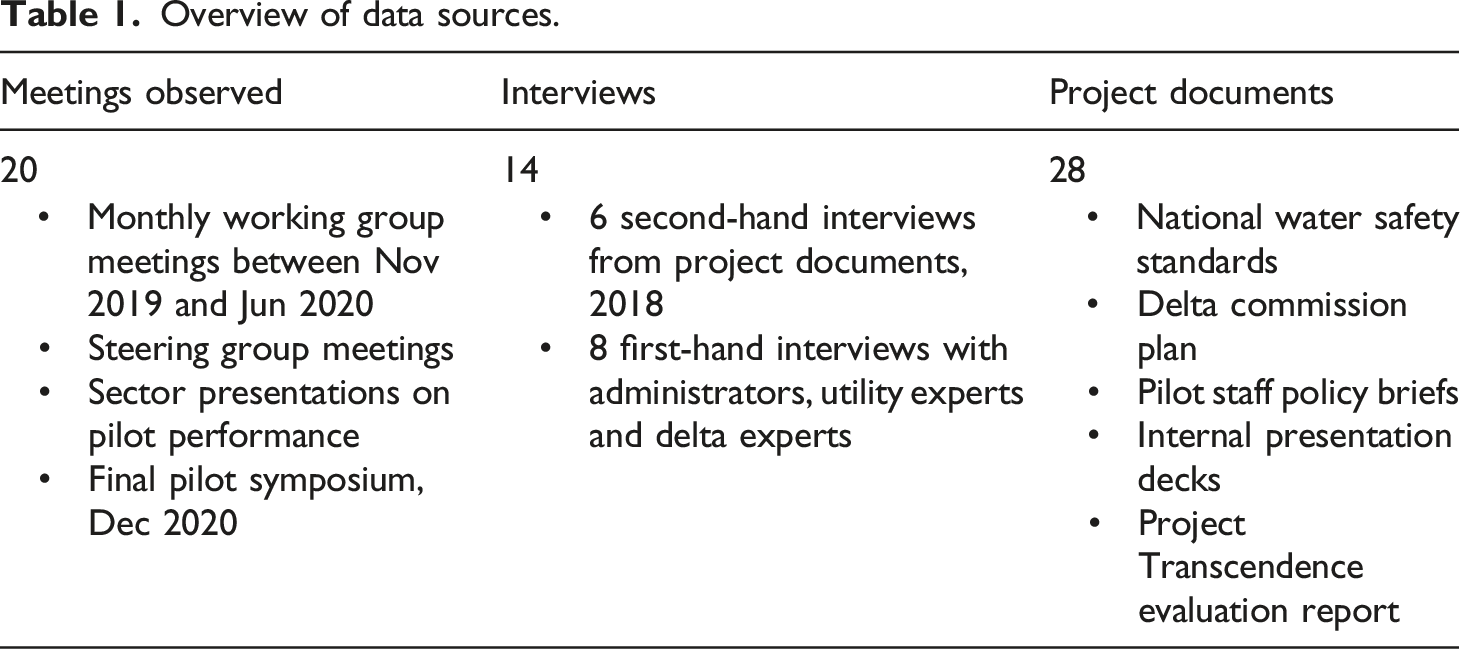
I spent 1 year following the work of the pilot staff and participants of an inter-organizational collaboration between water authorities and utility owners involved in dyke renovation projects. I selected this case based on its ambitions to organize inter-organizational collaboration in a setting known to lack it. This was despite both the sector-based norms and protocols around managing dyke renovations with underground utility systems, and a 2017 change in law that made water authorities liable for the impacts of dyke failure. In 2018, the pilot named Project Transcendence (translated from its Dutch name) was founded. The pilot is initiated as part of the Dutch Programme Against High Water. Between 2018 and 2020, the pilot explored the development of: shared tools for renovation planning and programming, a shared risk model for renovation prioritization, and methods of data sharing to facilitate programming. Additionally, the pilot hosted a training programme to educate water authorities on the work of utility owners. I was granted access to follow the work of pilot staff members from November 2019 through the end of the pilot in December 2020. In this period 42 people participated in the pilot. The pilot was funded by an alliance of 21 regional water authorities, and the Dutch Ministry of Infrastructure and Water Management. Pilot staff worked together with participants from regional water authorities and utility owners. Together with these participants, one working group was formed by project managers and asset managers, and one steering group was formed by the participating organizations’ directors. Collectively, they experimented in pilot projects that prioritized collaborations in dyke renovations with underground utilities.
This pilot was an example of inter-organizational collaboration between public administration and a private corporation. Although the Netherlands liberalized the energy market in the early 1990s (Aartsen and Kunneke, 2001), utility owners maintain a public responsibility: they are obliged by law to guarantee service delivery to their clients. At the same time, the liberalization of the energy market gives utility owners a commercial interest in providing their services. Water authorities, on the other hand, are political bodies tasked with flood prevention. Every 4 years, the Netherlands elects a new water authority board by voting for regional candidates. Pilot participants included bureaucrats tasked to manage dyke renovation projects. Participants from the utility company also held management positions, managing maintenance and renovation on their company’s assets. Generally participants held a degree in engineering, be it in water engineering or technical engineering.
Data collection
Overview of data sources.
Data analysis
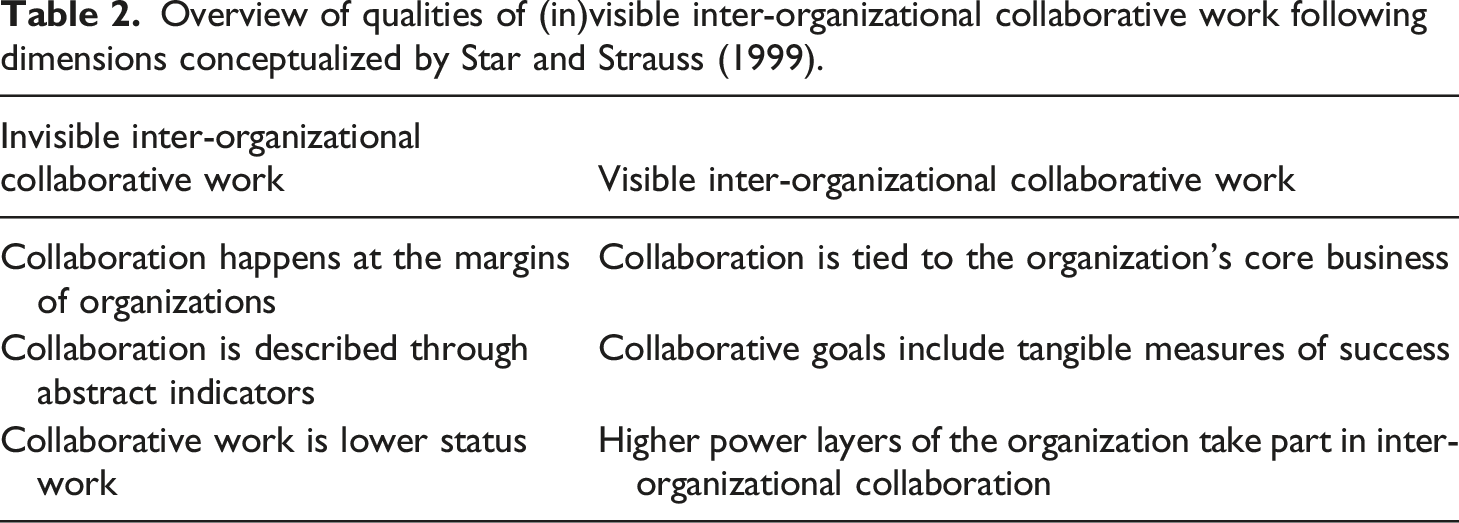
Overview of qualities of (in)visible inter-organizational collaborative work following dimensions conceptualized by Star and Strauss (1999).
Managing the visibility of boundaries around inter-organizational collaboration between water authorities and utility owners
During the 2 years of Project Transcendence, pilot staff was tasked to improve early-stage collaboration between regional water authorities and utility owners. Table 2 shows how the concept of (in)visible work (Star and Strauss, 1999), was studied in the context of inter-organizational collaborative work between water authorities and utility owners. The following sections discuss these segments in greater detail.
Visibility of potential success
‘People had often said it was impossible, what we tried to achieve,’ recounted the pilot leading manager. The pilot was named ‘Project Transcendence’, giving it a mission-like aura. Moreover, staff members and outsiders to the pilot attributed a lot of value to their mission-like mentality. One dyke warden from a regional water authority reflected, ‘When people don’t fundamentally believe in collaboration, they’re less inclined to want it to succeed.’ During their working group meetings, pilot participants who complained about the difficulty of finding partners willing to invest in the pilot’s initiatives were often met with counterarguments the likes of, ‘Professionals have to believe it’s possible because…[they] will have to wade through some pretty stubborn attitudes, that’s part of it’. The director of the Alliance Against High Water continued: ‘Collaboration isn’t just important for improving safety issues [in renovations of dykes with underground utility systems], it’s also our responsibility.’ During work sessions he reminded participants, ‘We have a moral obligation to collaborate’. The pilot name (Project Transcendence) reflected a moral appeal to collaboration as a ‘higher-order’ moral than remaining in sectoral silo’s. As such, it reflected the pilot’s pro-collaboration attitude, perhaps warding-off hard-line sceptics and signalled it a welcoming setting to those with a pro-collaboration attitude.
Perhaps contrary to the pilot’s esoteric name, pilot staff organized bottom-up initiatives that required the distinct capabilities of water engineers and utility asset managers in order to realize tangible results by the end of their term. Confronting scepticism, pilot staff tried to alter participants’ perception that collaboration was not their ‘real’ work. To do so they had to define a measure of success that could be achieved. At the strategic levels of the participating organizations, collaboration was praised but only in abstract terms. There were no concrete formulations of what a successful collaboration looked like. Defining a measure of success, project staff first aimed to develop tools that could save money and time. In its first year, Project Transcendence launched a committee to develop a new method for calculating the likelihood of damage being inflicted on gas pipe infrastructure during dyke maintenance tasks. This was a collaboration of technical experts from water authorities and a utility company. The committee developed a risk model that was tested in one dyke renovation case, saving the project a total of three million euros because renovation work could be delayed. ‘Success sells, […] that’s why we do pilots’, one participant confidently stated during one of their meetings. ‘But how do we make pilot successes scalable?” some sceptics inquired. They worried that tools developed in the pilot would not be adopted on a larger scale due to a lack of mandates among professionals on operational levels of the organization to adopt the developed risk model. The scalability of pilot projects and structural implementation was initially of less importance to staff. Pilots showed elements of the ‘success’ that early-stage collaboration might yield, which was helpful to formulate concrete measures of success that collaborations could strive for.
Visibility of potential collaborative action
‘Almost all risk management files show that renovation of flood defences with underground utilities score high on frequency of delays, and unexpected or additional costs.’ A 2018 policy brief from the High Water Defence Alliance quoted here addressed the lack of early-stage collaboration, between water authorities and utility owners. Already in 2013, this problem had received the attention of the national board of water authorities and the national association for utility owners. Collectively, the two organizations drew up an agreement stating that early-stage collaboration should be the norm. Then in 2017, due to a change in law, water authorities became liable for water safety measures impacting ‘vital and vulnerable functions’ in and around the Netherlands’ flood defences. Such vital functions include the underground utility systems that transport services to rural areas, i.e., energy, telecom and ICT, waste water, and drinking water. The 2017 law stated permeable water defences as acceptable as long as they had little impact on rural communities or vital infrastructures. Water authorities’ responsibility now included a risk assessment of not just the risk of dyke failure, but its impact on the hinterland. These developments could have prepared the hearts and minds of water authorities for cross-sectoral, inter-organizational collaborations for example to gather data on the new parameters. Yet in 2018, pilot staff evaluated how and to what extent policy briefs and agreements had so far had meant a change on the work floor. Their 2018 evaluation explicitly stated what many in the field had already experienced: the ambitions formulated by policies, laws, and agreements remained ‘empty words on paper’.
Reflecting on why water authorities and utility owners continued to ignore their interdependencies, one water authority programme manager explained: ‘Managers think, “Well, you know, I already have too little time, money, and people for the workload as is. And I’m not even being rewarded for going through this [collaboration] misery”.’ Or, in the words of one pilot staff member during a working group meeting: ‘They don’t see this [collaboration] as their core business.’ Project Transcendence was already in its second year when collaborative efforts between water authorities and utility owners were still hampered by the fact that their formal job descriptions failed to mention the responsibility of reaching outside the boundaries of their organizations to collaborate. One initiative of the pilot focused on ‘data sharing for long-term planning’, intending to allow pilot participants from the utility company to share information on the lifespan of utility systems so that dyke renovation projects could be timed to coincide with utility renovations nearing the end of their life cycle. The utility company, however, prohibited the sharing of such information outside their own organization, labelling it as ‘commercially sensitive’. Members of the utility company needed permission from their directorate exchange data for ‘experimental’ purposes. As data was considered commercially sensitive, without such formal permission sharing it was not allowed. Eventually, project staff formulated a contract to outline exactly which utility data could be used and how. This solved the legal issues that prevented data sharing between the organisations, but the prevailing norm remained that collaboration was a nuisance; an additional burden to already busy asset managers, and not part of their formal job description. Consequently, the pilot staff struggled to find motivated participants for their working groups.
‘Both parties are aware they need each other for the challenges we’re facing, but they still live in different worlds.’ In this quote from an interview that was part of the pilot’s 2018 evaluation research, a respondent described both the increased motivation of water authorities and utility owners to collaborate, and their inability to bridge the existing differences between them. This sentiment seemed to resonate throughout the duration of Project Transcendence. While Project Transcendence was able to bring the different worlds of water authorities and utility owners together, the pilot had a deadline. Part of the pilot’s mission was to eventually find permanent organizations to adopt its responsibilities. Staff referred to this ambition as ‘anchoring [the knowledge developed in the pilot]’, and expected this would ensure the ‘continuity of a connection’ beyond the pilot’s end date. ‘We’re looking for ambassadors who want to commit to continuing the pilot. Utility owners, water authorities… they’re all “problem owners”. But so far, they have declined ambassadorship’, one project manager lamented towards the project’s end date. From the beginning towards the end of the pilot, finding motivated professionals to collaborate outside their organizations remained a challenge.
Whereas the problem with collaboration was vividly clear, it took pilot staff quite some effort to make potential of collaborative action visible as a solution - even to those pro-minded participants in the pilot. Facing scepticism from participants pilot staff decided to explore formulating pilot projects that seemed tangible and concrete, and close enough to their participants’ formal job descriptions. Participants connected with the ideal and ambition to collaborate, but in practice did not see how. ,Innovating is not in our DNA, we just want to check boxes. And this is not a pre-programmed trajectory, that makes it tricky for us’ a participant in a workshop shares. Staff organized pilot projects in a manner as close to traditional work flows: starting with kick-off meetings, midterm evaluations, and deadlines for each initiative. These visible markers of familiar project life cycles were accompanied by network presentations, regular meetings, and reports. Communicating about collaborative pilots in familiar traditional project life cycles helped to mitigate the scepticism: it defined a workload, presented a timeline, and gave a predictable frame of reference to an otherwise unchartered terrain. This helped to commit to pilots without unforeseeable risks that could hinder their performance at their regular job.
Visibility of potential organizational differences
Communicating about each other’s differences and peculiarities proved an integral part of the pilot. Getting to know each other became legitimate work, required before any ‘real’ collaborative goals could be formulated. Aware of how little water authorities and utility owners knew about each other, pilot staff set up a training specifically targeting the operational layers of each participating organization, bringing together people from both sectors. ‘Just having them sit next to each other is really the big benefit of this training’, one trainer reflected. ‘Now they at least know who they can call when they want to plan a renovation project.’ By experimenting with a ‘dilemma matrix’, another pilot initiative aimed to map the ‘known unknowns’. This involved an Excel file for utility owners and water authorities to fill out in preparation of renovation projects. Mapping dilemmas along dimensions such as ‘safety’, ‘quality of the living environment’, and ‘utilities and piping networks’, the matrix was designed to show where the strategic ambitions of different organizations overlapped, and where there were conflicts. This tool was conceived as a counterbalance to collaborative goals that had become so abstract they hid away the specific interests of the individual organizations.
‘You can only talk about a balancing of interests if you’ve made the contradictions clearly visible’, one water authority manager shared when discussing the matrix. He continued: Before we can claim success, we have to define a common goal. The weighing of common interests still assumes I know the interests of my individual collaborative partners. But since I work for the water authorities, I don’t really know what the others want. I can only see what’s in the interest of the water authorities—that’s my job. So, when you ask me to design a renovation project, it’s very likely I won’t be sensitive to the wishes of utility owners. (Field notes, November 2020)
The difficulty of collaborative goals, in his experience, was that they were so abstract nobody could be against them. An abstract goal was for example to work together in order to lower the costs of renovation projects for tax payers. ‘Essentially, our job is to protect the Netherlands from flooding without burdening the public budget’, the director added. Within the pilot, this was referred to as ‘social costs’, so to also include clients of utility owners. Yet translating the abstract goal of limiting social costs into actionable targets proved more complicated. Using the matrix participants could identify approximately what abstract goals aligned, and on which issues sensitivities could be expected. Making organizational differences visible enabled an anticipation of potential conflicts, and identify at what level of their organizations these conflicts would occur. As they found out, most issues required strategic decision on for example how to make strategic goals actionable.
After 2 years of trying to initiate strategic collaboration, the pilot was followed up with another pilot to explore inter-organizational collaboration between water authorities and utility owners on strategic levels: one regional water authority agreed to initiate and staff a strategic platform to continue early-stage inter-organizational collaboration between water authorities and utility owners. The chair of this new pilot shared in an interview why the wait: ‘You have to learn how to trust each other with your delicate matters. It’s like peeling an onion. Beneath every layer a new one appears.’ Project Transcendence provided the quiet incubation time necessary for mutual familiarization. Staff reflected: ‘It probably helped that the pilot was close to its end date otherwise, and that they [top management] needed the process to continue.’ Strategic layers of both the water authorities and utility owners were learning about the magnitude of their interdependencies through the exchanges that went on in the pilot. Pilot staff speculated the water authorities initiated a follow-up after all because ‘they’re the owner of the biggest problem area, their terrain hosts many of the underground utilities that require renovation.’ Experimenting through an external platform offered them a safe space to explore potential early-stage collaboration at the strategic level. At the end of the pilot therefore, a platform for strategic collaboration between water authorities and utility owners was launched. Collaboration thus continued beyond the pilot, now including the strategic level.
Discussion
This paper ethnographically investigates how boundary spanners use boundaries to manage inter-organizational collaboration. Boundary spanners are theorized as those professionals who navigate and negotiate differences between organizations (Levina and Vaast, 2005; Nederhand et al., 2019). Their work concentrates on those renegotiating metaphorical boundaries which represent demarcations of differences (Gieryn, 1983; Quick and Feldman, 2014). Answering the research question I use an ethnographic approach, making an empirical contribution to the theoretical claim made by others that there lies merit in studying collaboration on complex policy issues relationally (Bartels and Turnbull, 2020).
Theoretically this study has two main contributions. First, it speaks against the conceptualizations of boundaries (aka distinct organizational interests, expertise or normative positions) as inherently problematic in collaborative governance. Second, it nuances the view that boundary management is predominantly a function of competent boundary spanners taking the front stage as charismatic diplomats. The paper shows boundary spanners can be largely invisible to their own organization. They operate at the margins of prevailing norms, which creates tensions with standard procedures and operations but also frees them to explore alternative views to their home organization.
Organizational boundaries can be building blocks
Temporal boundary organizations can offer a refreshing vantage point to ‘see’ collaborative partners in another light then within one’s own organization. The initiation of the pilot itself signals how boundaries are needed to build temporal organizations dedicated to collaborative goals (Guston, 2001; O’Mahony and Bechky, 2008). The organizational boundaries of the temporal pilot provided first of all the time and space for participants go beyond ‘business as usual’ and secondly constructed a container that allowed skepticism ánd a pro-collaboration spirit. The findings show how boundary spanners rely on boundaries; in this case to get collaboration going, take it out of the informal sphere heavy with predisposition and reluctance, and portray collaboration as ‘real work’. Even though the pilot was called ‘Project Transcendence’, transcendence referred to a moral appeal, not an organizational practice. The pilot setting allowed an opportunity for participants to be frank about organizational differences that they feared could be challenged through collaboration. Without refusing the ‘higher’ morale to renovate dykes more effectively through joining forces, becoming familiar with the limitations to collaborate was central to the boundary work within the pilot.
Second, pilot participants sought to articulate professional boundaries with more clarity. Project management staff was formally responsible to make the pilot successful, and so they had an incentive to translate abstract measures of success to actionable targets that could be tied to the knowledge and expertise of the nominated boundary spanners – the participants of the pilot. Articulated professional boundaries became the interface for formulating potential collaborative action. This speaks to the findings of others who have argued that formally nominating boundary spanners is not likely to be enough to spur inter-organizational collaboration, there need to be ‘boundary spanners in practice’ who do the work (Levina and Vaast, 2005).
In sum, making organizational boundaries as well as professional boundaries visible in this case facilitated boundary management. Organizational boundaries create space to shield boundary spanners from their home organizations, and inspire them to explore connections and potential collaborations. Professional boundaries can form the interface that enable collaboration (Farchi et al., 2023; Wolbers et al., 2018). The findings in this paper speak against the idea that collaborative governance should be conceptualized as a boundary free zone, or boundary spanners as boundary transcending individuals (Crosby et al. 2017; Nederhand et al., 2019; Thomson and Perry, 2006; Williams, 2002).
Competent boundary management
This paper offers a different competency of boundary spanners as communicating the value of distinctive professional expertise (Aldrich and Herker, 1977; Farchi et al., 2013). Scholars in the domain of collaborative governance typically herald boundary spanners for being network champions who build alliances by blurring lines of potential conflict (Crosby et al., 2017; Nederhand et al., 2019; Thomson and Perry, 2006; Williams, 2002). Yet in this case, boundary spanners operated at the margin of their home organization, which gave them the benefit of taking ‘quiet incubation time’ (Star and Strauss, 1999). Managing their (in)visibility to their home organization provided time to anticipate tensions between their innovative practices and the business as usual of their home organizations (Joosse and van Buuren, 2023). Within the pilot boundary spanners were frank to communicate their skepticism to each other. This allowed them to face the realization that it is often difficult to truly ‘see’ each other in boundary work. Competent boundary spanners sensed reluctant attitudes and explicated these in such a way the collaborative process revitalized (Termeer et al., 2013).
Limitations of boundary work
As boundary work flourished at the fringes of organizations, largely invisible to outsiders, this can threaten to deteriorate the potential of boundary work to withstand wicked challenges. In the context of wickedness, ill-defined problem definitions create confusing frames of reference (Termeer and Dewulf, 2019). While boundary spanners in this case oriented themselves towards the problems that hinder collaborations, they were simultaneously asked to showcase the ‘solutions’ they were able to design. Mission claims within the pilot might have resonated with broader Dutch cultural narratives on how for centuries enemies were supposedly united in their battle against the rising tides of the sea (Meyer, 2017) – especially relevant again in times of rising levels of sea water. This broad moral appeal also reflected in the ‘Pilot Transcendence’. However, in practice holding collaboration to a high moral value did not dilute frictions and tensions that problematized the notion of boundary between water authorities and utility owners. Turnbull and Hoppe (2019) argued that without seeing the ideas, institutions and interests distinct to each collaborative partner, it is unlikely boundary spanners will be able to negotiate. But of course the complexity is that there are multiple sightlines intersecting, at horizontal and vertical levels. Partners can hold the same values, but be hindered by diverging pragmatic problems. When negotiations are invisible to strategic levels at the center of organizations, it is unlikely the wicked challenge of adaptive delta management is met with the reflexivity and responsiveness needed (Dewulf and Termeer, 2015).
Future research
Boundary conditions of this research present opportunities to future research. Methodologically I argued the uniqueness of the Dutch case makes it opportune to study collaboration in a field usually lacking it. Future research is needed to validate whether practices identified in this case speak to different contexts as well, given the Dutch is arguably a ‘most likely’ case to see inter-organizational collaboration for flood protection (Meyer, 2017). A multi-level approach would therein be ideal to examine if bottom-up initiatives find their way to more structural implementations (Langley et al., 2019). Theoretically a boundary work perspective can elicit overly agential or pro-collaboration biased explanations (Langley et al., 2019), a danger luring in collaborative governance literature (see for example Ansell and Gash, 2008). Longitudinal follow-up research could indicate whether collaboration in this pilot contributed to structural inter-organizational collaboration, and evaluate to what extent these made dyke renovations with underground utilities more efficient. Termeer and Dewulf (2019) caution scholars evaluative research of collaborations targeting wicked problems easily becomes paradoxical and encourage instead tracing seemingly small but tangible shifts. The risk model can be seen as a small win in this regard (see Termeer and Dewulf, 2015 on the role of small wins in governing wicked problems). Still, it should be noted it emerged in a ‘most likely’ scenario, and this study did not evaluate its effectiveness. Another strategy to articulate the normative effectiveness of inter-organizational collaboration could be to do a comparative evaluations between positive cases and ‘negative’ cases. This contrasting can be helpful to compare cases, but also in general especially relevant to those currently advocating a relational turn (like for example Bartels and Turnbull, 2019). Inevitably, relating to others prevents us from becoming strangers to ourselves. Reflexive scholarship encourages researchers to go beyond reflecting (Cunliffe and Jun, 2005), and trace the webbing of emotions and attachments that shape for example a pro-collaboration bias. Rather than shaming our subjectivity, affect becomes another resource to trace the outlines of the contexts from which we operate. Lastly, collaborative boundary work theoretically builds on early social interactionism (Langley et al., 2019), as does the notion of invisible work (Star and Strauss, 1999). This suggests scholars can walk the middle-path between a structuralist or agential understanding of collaborative boundary work (see for example Zietsma and Lawrence, 2010). Future theorizing on this intricate relation could distill enabling and constraining elements to the manufacturability of collaborative governance.
Conclusion
This study has examined how boundary spanning individuals manage boundaries in inter-organizational collaboration. Boundaries are the ‘demarcations of differences’ (Gieryn, 1983) negotiated in collaborative boundary work (Langley et al., 2019). Through an ethnographic investigation of a pilot collaboration for better flood protection between water authorities and utility owners in the Netherlands, this paper investigates how (in-)visibility of collaborative work was managed to improve early-stage collaboration between water authorities and utility owners in dyke renovation projects. Building on the notion of (in)visible work (Star and Strauss, 1999), the analysis has brought to the forefront how collaborating without ‘seeing your differences’ is analogous to looking for a black cat in the dark. At the same time, boundary spanners often work at the margins of their organizations where they are granted some time ‘behind the scenes’. This makes it easier to invent new ways of working. Boundary spanners managed the (in)visibility of organizational and professional boundaries in their collaborative work. A temporal boundary organization facilitated pilot initiatives with the quiet incubation time and space needed for experimenting with new models, planning tools and data exchange formats. Professional boundaries were brought into view so that interfaces for collaboration could start to be formulated. These findings show how boundary spanners manage the (in)visibility of boundaries around collaborative work.
Footnotes
Declaration of conflicting interests
The author(s) declared no potential conflicts of interest with respect to the research, authorship, and/or publication of this article.
Funding
The author disclosed receipt of the following financial support for the research, authorship, and/or publication of this article: This work was supported by the Dutch Funding Agency NWO under grant number R/002968.
