




Abstract
Red tape is a salient societal problem but there is a dearth of research on how perceived red tape can be reduced. Building on the transparency literature, we hypothesize that higher levels of rationale and process transparency will result in lower levels of perceived red tape. We test our reasoning using a survey experiment. Specifically, we have US citizens rate the level of red tape associated with the burdensome process of obtaining a driver’s license at the Department of Motor Vehicles. We find that providing rationale and process transparency to citizens does not influence perceived red tape. Hence, organizations are advised to look for more fine-grained approaches to reduce perceptions of unnecessarily burdensome rules, while realizing that a certain level of perceived red tape is likely an unavoidable part of bureaucratic functioning.
Points for practitioners
The findings from this study show that merely being transparent about the rationale and process of a burdensome rule is not enough to reduce perceived red tape. Rather, policymakers and managers are advised to gain a better understanding of the different causes of red tape (disentangling genuine concerns from unfounded rhetoric), develop coherent strategies that adequately balance the trade-offs between organizational goals and citizen red tape, and be transparent about these trade-offs.
Introduction
Red tape, which is often conceptualized as unnecessarily burdensome written rules (Bozeman, 1993), has been found to have negative impacts on organizational performance (Brewer and Walker, 2010b; Kaufmann et al., 2019b), employee motivation (DeHart-Davis and Pandey, 2005), and citizen satisfaction (Tummers et al., 2016). Some academic research assumes that red tape can be reduced by, among others, repealing unnecessary rules, minimizing paperwork, and limiting compliance costs (Bozeman and Feeney, 2011; Kaufmann and van Witteloostuijn, 2018). At the same time, a growing stream of literature argues that red tape is mostly perceptual in nature (e.g. Kaufmann et al., 2019a; Stanica et al., forthcoming). This latter conceptualization of red tape implies that changing stakeholder impressions and understanding regarding unnecessarily burdensome written rules may reduce perceived red tape, even if the underlying rules themselves remain the same. This study aims to test this reasoning, building on the transparency and red tape literatures.
The transparency literature includes a wide range of empirical findings on the positive impacts of transparency on public organization decision-making and functioning (e.g. Heald, 2012; Ingrams et al., 2020; Meijer, 2009). To illustrate, the positive impact of anti-corruption policies through enhanced transparency and accountability has been extensively studied (Bertot et al., 2010), as has the positive reward of transparency for organizations in terms of organizational goal clarity (Ingrams, 2018). We hypothesize that providing high levels of both rationale and process transparency can also reduce perceived red tape. Rationale transparency is expected to reduce perceived red tape because rule stakeholders can rationalize that some administrative burdens are a necessary means to an end when they know the intended goal of a rule. In the absence of rationale transparency, rule stakeholders are left to speculate about a rule’s intended purpose (DeHart-Davis, 2009a). Furthermore, process transparency can limit perceived red tape because rule stakeholders appreciate that the rule is a complex product of decision-making and discussion processes when they see the process that underlies a rule. This dynamic reflects some of the positive effects of procedural fairness on assessments of decisions (Tyler, 1989).
We test our reasoning with a survey experiment. We first conduct a pilot study using an undergraduate student sample. Building on the insights from the pilot study, we conduct our main experiment using a TurkPrime sample consisting of US citizens. The basis for the main experiment is the actual procedure for obtaining a driver’s license at the Department of Motor Vehicles (DMV). Many US citizens consider the DMV setting of our study a frustrating source of red tape (Bozeman and Feeney, 2011; Miller et al., 2010). The fact that participants in our main experiment (citizens) are one of the real-life rule stakeholders strengthens the internal validity of our study. Furthermore, whereas existing rule-based red tape studies have used fictitious organizational rules (Pandey and Marlowe, 2015; Tummers et al., 2016), we study a “real” organizational procedure, both in the pilot and the final experiment.
The remainder of the article is structured as follows. We first discuss the nature of red tape and introduce our hypotheses on how rationale and process transparency can reduce perceived red tape. We then present our methods and results, followed by a conclusion section.
Theoretical framework
Pathological formalization and perceived red tape
While red tape can be conceptualized in different ways depending on its origin and impact, most red tape scholars have looked at so-called organizational red tape (Bozeman and Feeney, 2011). Organizational red tape, defined by Bozeman (1993: 283) as “rules, regulations, and procedures that remain in force and entail a compliance burden for the organization but have no efficacy for the rules’ functional object,” is characterized as the pathological part of organizational formalization (Bozeman and Scott, 1996). This means that reducing red tape requires abolishing or changing unnecessarily burdensome rules that negatively impact on the organization’s effectiveness.
The pathological formalization concept has a number of well-known limitations as it only covers the worst organizational rules, does not take into account the worthiness of organizational objectives, and ignores stakeholders outside the organization (Bozeman, 2012). A growing stream of research takes a different approach and conceptualizes red tape as being perceptual in nature (e.g. Kaufmann and Haans, forthcoming; Pandey and Scott, 2002). The perceptual red tape concept also explicitly acknowledges that red tape can differ between stakeholders, both internally (Brewer and Walker, 2010a) and externally (Kaufmann and Feeney, 2014; Tummers et al., 2016). Furthermore, the nascent literature on administrative burden is concerned with the learning, psychological, and compliance costs in citizen–state interactions, rather than pathological government rules and regulations as such (e.g. Moynihan et al., 2015).
Similarly, citizen perceptions of red tape may be shaped, in part, by how street-level bureaucrats cope with bureaucratic control, implement policies, and use discretion when interacting with clients (e.g. Maynard-Moody and Musheno, 2003). Previous research has shown that situational characteristics, such as “the nature of the decision or the policy context, organizational mission and culture, and various structural attributes such as the level of centralization” (Scott and Pandey, 2000: 630), can make it more or less likely that public servants will cut through red tape for their clients. Crucially, the notion of perceptual red tape implies that red tape assessments can be altered, even if the underlying rules remain unchanged. In this light, the literature on rationale and process transparency is particularly relevant for understanding how to reduce perceived red tape, to which we turn next.
Rationale transparency and red tape
An important assumption of perceptual red tape is that those affected by the rule have at least some understanding of the objective a rule aims to achieve. If the objective of a rule is unclear, stakeholders will find it difficult to determine the rule’s effectiveness. Thus, when it comes to the problem of perceptual red tape, information about the rule plays a key role in building perceptions about the rule; however, we cannot assume that the stipulated objectives of a rule are always transparent. Rule objectives may be unknown or obscure from the outset because there are many of them, or because they are illegitimate (Bozeman, 1993). The objectives of a rule may also be lost over time because the people who developed the rule are no longer with the organization and knowledge about the rule’s goal disappears with their departure (Bozeman and Feeney, 2011). Furthermore, incompatibilities between new and old rules can create confusion about which objectives rules aim to achieve (Bozeman and Feeney, 2011).
Rules with unclear objectives are lacking in rationale transparency. Rationale transparency refers to rules that are justified “by means of giving persuasive reasons” (De Fine Licht et al., 2014: 114). Existing research has already looked at the relationship between rationale transparency and legitimacy. For example, De Fine Licht et al. (2014) explored rationale transparency by looking at the effect that transparent decision-making had on a decision’s perceived legitimacy. The authors found that even an ex ante justification for a decision helped to raise perceived legitimacy among stakeholders. Similarly, Porumbescu and Grimmelikhuijsen (2018) found that rationale transparency in a public organization was associated with a higher likelihood of accepting the outcome of a decision.
In these aforementioned works on the effects of rationale transparency, the authors make arguments drawing on the theory of motivated skepticism from social psychology (e.g. Taber and Lodge, 2006). Motivated skepticism is the tendency for individuals to seek justification for organizational decisions when they are perceived as unnecessary or wrong. Such a mechanism is likely to be at work in perceptions of red tape too. In rationale transparency, an act of justification shows to organizational stakeholders that the goal of a rule is intended to be something that rational individuals can agree on, or dispute openly should the justification not stand to reason. It expresses a confidence in a decision and willingness to therein be held accountable (Curtin, 2017). Rationale transparency implies that the goal of a rule is something credible, not esoteric or hatched secretively by senior managers with ulterior motives (De Fine Licht, 2014). This does assume that the rationale provided is perceived as something positive. If recipients view a particular justification as unconvincing or nonsensical, rationale transparency is unlikely to have a positive effect (and may even result in more negative assessments of rules).
To summarize, most empirical red tape studies have paid scant attention to rationale transparency. Yet, rationale transparency is likely to affect red tape perceptions. Learning the objective of a rule can transform perceptions of that rule from bad to good (DeHart-Davis, 2009a), which is why Bozeman (2000) argues that managers should clearly communicate rule purposes. Indeed, research on effective organizational rules, or green tape, has shown that rules with purposes understood by stakeholders are considered less burdensome to comply with and lead to more positive assessments of rules (DeHart-Davis, 2009b, 2017). In the absence of rationale transparency, stakeholders will speculate about a rule’s purpose, often in a malevolent way (DeHart-Davis, 2009a). This leads to our first hypothesis: H1: Increased rationale transparency leads to less perceived red tape.
Process transparency and red tape
In addition to rationale transparency, the literature also suggests that rule-makers can minimize perceived red tape by communicating the process by which a certain rule or procedure was created, which is referred to as “process transparency.” According to Heald (2006), process transparency involves the how of a decision as opposed to the what of a decision. A high degree of process transparency signals procedural fairness (e.g. Herian et al., 2012; Tyler, 1989), which has been found to have a positive effect on an individual’s assessment of both the procedure itself and procedural outcomes. For example, Wales et al. (2010) show that if a judge provides transparency as regards the decision-making process to participants, this contributes to reduced recidivism. Similarly, Dolan et al. (2007) argue that process transparency increases procedural satisfaction and promotes acceptance of unfavorable outcomes.
Another body of research finds that regulation is amenable to improvement through transparency (e.g. Weil et al., 2006). Transparent forms of decision-making, such as consensus decision-making, are positively associated with perceptions of procedural fairness and justice in terms of inclusiveness in a decision-making process (Hearld et al., 2013). Further, Herian et al. (2012) found that higher levels of procedural fairness are particularly effective in improving individual assessment of a procedure if the procedure is of a type that individuals find unclear, such as we would expect for the impact of process transparency on red tape.
The effect of process transparency on perceived red tape also concerns the close association between transparency, accountability, and trust. Process transparency shows to organizational stakeholders that their organizational structures are geared toward responsive learning and potential for change in light of poorly designed procedures and rules. According to Jalilian et al. (2007: 10), accountability suggests that public organizations should answer: for the consequences of their actions, to operate within their legal powers, and to observe the rules of due process when arriving at their decisions (e.g. to ensure that proper consultation occurs). Transparency relates to regulatory decisions being reached in a way that is revealed to the interested parties.
In contrast, a lack of process transparency can lead to uncertainty (Reynaers and Grimmelijkhuijsen, 2015) and create frustration for organizational stakeholders because it signals to them that they have no influence on the rule (De Fine Licht et al., 2014). The perception that a rule is unnecessary or burdensome may thus be mitigated by process transparency. The positive effects of process transparency on how rules and procedures are perceived are likely to result in lower levels of perceived red tape. This leads to our second hypothesis: H2: Increased process transparency leads to less perceived red tape.
Data and methods
Pilot study
We first did a pilot study to test our design. The pilot study—which was created in Qualtrics and administered to a sample of public administration and law students in the Netherlands as part of three undergraduate courses on research methods in social sciences—is based on the procedure used for registering for exams at a large Dutch research university. This procedure was identified as entailing a high level of red tape after informal consultations with university teachers and students. The procedure itself consists of a written rule document with eight sections that references many other rules and procedures, including the university’s education and examination regulations. We manipulated rationale and process transparency for the procedure (“low” or “high”), which resulted in four treatments. The precise wording of the manipulations can be found in Supplementary Appendix 1a. 1
We used two different measures for our dependent variable: “red tape.” The general red tape (GRT) scale (Rainey et al., 1995) asked respondents to answer the following question on a scale of 0 to 10: “If red tape is defined as burdensome administrative rules and procedures that have negative effects on the organization’s effectiveness, how would you assess the level of red tape in the exam registration procedure?” We also used the three-item red tape (TIRT) scale introduced by Borry (2016) to capture different dimensions of perceived red tape. Specifically, respondents were asked on a seven-point Likert scale to assess the exam registration procedure in terms of effectiveness, necessity, and burdensomeness. The three items were averaged to arrive at an overall TIRT score. Participants were also asked to indicate their age, gender, and political orientation. Results show that randomization on these dimensions was successful (these results are available upon request). Attention and manipulation checks were included in the survey to ensure the reliability of the experiment.
In total, 178 valid responses were collected. However, 47 participants failed the attention check and/or the manipulation checks, which means that our final sample consists of 131 participants. Our results indicate that the selected exam registration procedure does not appear to entail a particularly high level of red tape. The average GRT score is only 4.82, while the average TIRT score is 3.09. This is an unexpected finding as the number of procedural steps, as well as our informal discussions with university teachers and students, suggested that the exam registration procedure is associated with a high level of red tape. Apparently, the level of red tape in the exam registration procedure depends, at least in part, on who you ask (e.g. Kaufman, 1977). Both the descriptives for the pilot study and the results of a factorial analysis of variance (ANOVA) (shown in Supplementary Appendices 1b and 1c) confirm that transparency does not have a statistically significant effect on the level of perceived red tape in our pilot study.
Main study
The main take-away from the pilot study is that the context of the exam registration procedure does not entail a sufficiently high level of perceived red tape. To address this issue, we selected a setting for our main study that captures a broader red tape context, which is in line with the organizational “cues” approach used by Scott and Pandey (2000: 621). Specifically, we used a procedure for obtaining a driver’s license from the DMV, based on the actual procedure for the state of Arizona. We selected the state of Arizona as our template because its procedure for obtaining a driver’s license is presented online in a clear, stepwise way. The procedure is very similar to those from other US states. 2 We administered the experiment to a sample of citizens rather than students (e.g. Bouwman and Grimmelikhuijsen, 2016; Kaufmann and Tummers, 2017; Kaufmann et al., forthcoming).
We expect the relationship between transparency and red tape to be particularly salient in the DMV context. One of the main causes of red tape at the DMV is the implementation of government rules and regulations, known in the literature as “external control red tape” (Bozeman, 1993; Brewer et al., 2012). The level of external control at the DMV, especially in light of Homeland Security concerns and requirements, can have a particularly direct and noticeable impact on red tape experienced by citizens. To illustrate, in 2008, the Bureau of Motor Vehicles (BMV) in Maine had to implement the Act to Enhance the Security of State Credentials, stipulating how applicants must identify themselves when applying for a driver’s license. When the implementation of this new piece of legislation was discussed in the State’s Legislature’s Joint Standing Committee on Transportation, a senator argued that “these [BMV] rules and regulations seem to have gone almost to a ridiculous level” (Bangor Daily News, 2008). As such, the DMV offers a salient setting where citizens are directly confronted with ineffective (implementation of) external rules and regulations.
Furthermore, the DMV has somewhat of a reputation for evoking feelings of frustration (Miller et al., 2010). For example, Thomas (2013: 788) notes that “the mere mention of departments of motor vehicles—the infamous DMVs—conjures images of long delays and unfriendly service for anyone seeking a driver’s license.” Since existing research has shown that red tape perceptions are driven, in part, by emotions (Carrigan et al., 2020; Hattke et al., 2020), we expect the poor reputation of the DMV to be associated with higher levels of perceived red tape than many other public agencies. In turn, the favorable impact of rationale and process transparency on perceived red tape is likely to be especially pronounced in the DMV context.
We again manipulated rationale and process transparency as either “low” or “high.” For the low transparency manipulations, we decided to explicitly mention the lack of transparency to ensure all participants are aware that they are faced with a low transparency situation. We realize that, in reality, a low transparency situation would usually entail no information being provided at all, but doing so in our experimental context would risk participants assuming that the rationale and process underlying the procedure are comparable to our high transparency conditions, thus negating our treatment effects. The low rationale transparency condition is operationalized as “The DMV did not explain the aim of the procedure,” while the high rationale transparency condition is captured by “The DMV explained that the aim of the nine-step procedure is to promote public safety.”
The low process transparency condition read as follows: “The DMV did not explain how the nine-step procedure was developed.” The high process transparency condition stated: “The DMV explained that it developed the procedure after extensive discussions with state legislators and citizen groups.” While extensive discussions are only part of a decision-making process, adding more detail on this process and thereby increasing the length of the vignette could lead participants to ignore other information that is relevant to the experiment. The full text of the vignettes can be found in Supplementary Appendix 2. We used the same measures as in the pilot study for red tape and demographics.
Finally, the pilot study may have been underpowered due to the limited number of participants. Using the software G*Power (see Faul et al., 2009), we determined that we would need a total sample of at least 639 to detect a small (.02) effect size with 95% certainty. The experiment was again implemented in Qualtrics and administered to a sample of US citizens using TurkPrime (Litman et al., 2017). TurkPrime is a research tool that integrates with Amazon Mechanical Turk (MTurk), which is a crowdsourcing platform that enables researchers to gather data in a relatively inexpensive way (e.g. Bouwman and Grimmelikhuijsen, 2016). Participants were paid US$1.00, and were required to be US-based with an average approval rating of at least 95% and a minimum of 1000 prior tasks approved. Mean completion time for the experiment was just over five minutes.
A number of relevant concerns about the use of MTurk data have been voiced. MTurk users may show ticking-the-box behavior, use bots to complete tasks, lie about their location, or fill out the same survey multiple times (e.g. Jacobs and Kaufmann, forthcoming; Necka et al., 2016). TurkPrime is able to address these concerns by precluding participants from taking the same survey more than once, or using bots. The platform also verifies the location of participants by checking IP addresses. Furthermore, we have included attention checks and manipulation checks to filter out box-ticking behavior. As such, the quality of MTurk data is, at the least, similar to other data-collection platforms (e.g. Sheehan, 2018). Scholars have also pointed out that the modest payments for MTurk tasks may be unethical. To address these concerns, we offered participants compensation that exceeds the minimum federal wage, and were transparent about the duration of the experiment beforehand (which was said would take six minutes to complete).
Data
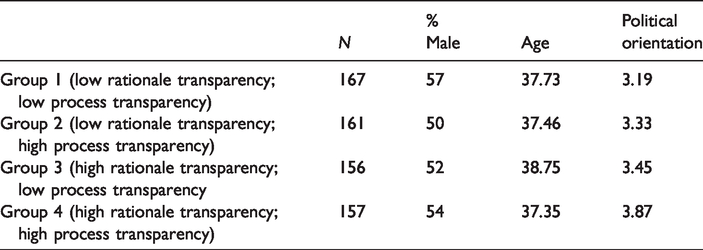
In total, 753 valid responses were collected. Randomization appears to have been successful as we do not find significant differences between the four experimental groups with regard to age (F(3) = 1.66, p = .17) or gender (F(3) = 1.22, p = .30). We do find a statistically significant difference between groups in terms of political orientation (F(3) = 2.80, p = .04), which was measured on a seven-point Likert scale ranging from very liberal to very conservative. To control for this potentially confounding factor, we reran our main analyses using political orientation as a covariate. Results from these analyses are very similar to those reported in the following, and are available upon request. Only five respondents failed the attention check and were removed from the sample and an additional 107 participants were removed from the sample because they failed one or both manipulation checks (85.7% of the respondents passed both manipulation checks). The attention check and manipulation check questions can be found in Supplementary Appendix 3. In the end, we are left with 641 participants. The background characteristics of our sample are shown in Table 1.
Background characteristics of sample.
The TIRT scale, which was adjusted from a seven-point to a five-point Likert scale for survey consistency purposes, has a Cronbach’s alpha of only .59. This is because the burdensomeness item does not scale well with the rule effectiveness and necessity items. Excluding the burdensomeness item increases the Cronbach’s alpha to .73. As a robustness check, we reran our analyses with a two-item red tape measure that includes only effectiveness and necessity. Results of this robustness check are similar to those reported in the following, and are available upon request.
The average GRT score (on a scale of 0 to 10) is 5.96, while the average TIRT score (on a scale of 1 to 5) is 2.66. These red tape levels are relatively low, especially considering how bound in red tape the DMV is said to be (Bozeman and Feeney, 2011; Miller et al., 2010). This finding mirrors earlier studies that question the severity of red tape in organizational practice (Brewer and Walker, 2010b; van Loon et al., 2016), as well as our pilot study results. We return to this issue in our conclusion section.
Results
The descriptives confirm our earlier findings from the pilot study. For rationale transparency, the average GRT score of participants who were provided with information about the rationale of a procedure (M = 5.89, SD = 2.48, N = 318) is only somewhat lower than the average red tape scores of participants who were not (M = 6.02, SD = 2.32, N = 323). Similarly, the difference between the average red tape scores of participants who were given process transparency (M = 5.93, SD = 2.48, N = 313) and the scores of participants who were not (M = 5.98, SD = 2.32, N = 328) is negligible. Results for the TIRT scale are very similar. The average red tape scores of participants who were provided with information about the rationale of a procedure (M = 2.63, SD = 0.83, N = 318) are only marginally lower than the average red tape scores of participants who were not (M = 2.69, SD = 0.84, N = 323), and the difference between the average red tape scores of participants who were given process transparency (M = 2.60, SD = 0.84, N = 313) and the scores of participants who were not (M = 2.72, SD = 0.83, N = 328), is only .12 on a scale from 1 to 5.
The results of a factorial ANOVA, reported in Table 2, confirm these descriptives. For the GRT scale, neither rationale transparency (F(1,637) = 0.44, p = .51), nor process transparency (F(1,637) = .06, p = .82) has a statistically significant effect on the level of perceived red tape. Furthermore, the effect sizes are very small indeed (rationale
Factorial ANOVAs: Effects of rationale transparency and process transparency on red tape.

Conclusion and discussion
We hypothesized that being transparent about the rationale of a burdensome procedure, as well as how the procedure was developed, can reduce perceived red tape. We tested our reasoning with a survey experiment using a sample of US citizens that were asked to rate the red tape content of the procedure for obtaining a driver’s license from the DMV. Contrary to our expectations, the statistical results do not support our hypotheses. That is, higher levels of rationale transparency and process transparency do not significantly affect the level of perceived red tape—either in terms of statistical significance or effect size.
One tentative explanation for our unexpected findings is that because organizational rules often serve organizational goals, being transparent about these goals may do little to address specific citizen frustrations. While few people will disagree with the importance of promoting public safety, being made aware of this goal may not adequately “compensate” citizens for having to fill out stacks of paperwork, having to wait in line for hours, or having a negative general disposition toward government agencies. While numerous studies have identified positive effects of rationale and process transparency on decision-making legitimacy, our findings show that the same general positive effect does not seem to hold in the context of red tape.
Another surprising finding of the study is that the absolute level of perceived red tape is quite low in both the pilot and main study, despite the fact that our selected real-life procedures capture many “objective” red tape characteristics. These relatively low levels of perceived red tape suggest that red tape complaints may be, at least to some extent, rhetorical. In support of this notion, Grimmelikhuijsen (2012: 50) concludes that trust in government is mostly driven by “pre-existing and fundamental ideas about what government does and whether it is benign or not,” rather than transparency. As such, a certain level of perceived red tape is likely inherent to the functioning of bureaucracy (e.g. Kaufman, 1977).
Rather than aim to remove red tape altogether, policymakers and managers can better search for “acceptable” levels of perceived red tape. This means that public organizations need to gain a better understanding of the different causes of red tape (disentangling genuine concerns from unfounded rhetoric), develop coherent strategies that adequately balance the trade-offs between organizational goals and citizen red tape, and be transparent about these trade-offs. Street-level bureaucrats also play a crucial role in shaping the perceived level of citizen red tape as they can use their discretion to make citizen–state interactions less burdensome. Specifically, street-level bureaucrats can help citizens cope with red tape by explaining how red tape can be navigated efficiently, as well as by being understanding of citizen complaints and frustrations.
This study also has a number of limitations. First, we focus on a specific procedure for our main study. This context ensures a high level of internal validity but this high level of internal validity comes at the expense of external validity. This is a serious concern for most experimental studies and we are therefore cautious in generalizing our findings. This being said, the fact that we did not obtain statistically significant results in either our pilot study or main study—despite their differing contexts and samples—gives us some confidence that our findings apply beyond the specific context of the DMV.
Second, we focused on generalized rationale and process transparency but a more particularized approach can also be used. Selective rationale transparency would imply that the rationale to be communicated is contingent on the rule stakeholder involved. Hence, a particular rule stakeholder may be given information about one rationale for a procedure, while another stakeholder is provided with a different rationale. Rather than the fact of rationale transparency in itself, whether stakeholders find a rationale particularly credible or not may make a difference to their perceptions. A similar line of reasoning applies to process transparency. It may be fruitful to connect with public administration research on transparency that considers transparency as a multi-actor playing field where different stakeholders interpret transparency through different frames. This may also require future studies to draw on existing research on framing from the social and political psychology literature.
Third, our focus in the current study has been on how citizen perceptions of red tape are affected by transparency. Notably, much of the existing red tape literature has focused on public servants, not citizens. It could be worthwhile to add to this stream of research and replicate our study in a context that involves public servants. In so doing, it can be determined if the effects of transparency on perceived red tape are different for professionals compared to citizens. Such insights can inform broader strategies for reducing (perceived) red tape for public organizations.
Fourth, our research design is unable to capture changes in levels of perceived red tape over time. Individuals may learn to cope with red tape, which is one possible explanation for why we found relatively low levels of red tape in the current study. For example, citizens may be so used to repeatedly encountering burdensome rules at the DMV that they become somewhat desensitized to the amount of red tape they encounter. Alternatively, individuals may become increasingly frustrated with rules and regulations as they are confronted with various situations involving red tape throughout their lifetimes. Future research could use a longitudinal design to investigate how individuals cope with red tape.
Our results show that rationale and process transparency fall short as an easy, straightforward fix for reducing perceived red tape. Yet, we believe that there are many opportunities for public administration scholars to delve more deeply into the perceptual nature of red tape, and to investigate under which conditions different types of transparency can improve stakeholder assessments of rule effectiveness. We hope that the current study can act as a stepping stone for this type of future research.
Supplemental Material
sj-pdf-1-ras-10.1177_0020852320966037 - Supplemental material for Rationale and process transparency do not reduce perceived red tape: evidence from a survey experiment
Supplemental material, sj-pdf-1-ras-10.1177_0020852320966037 for Rationale and process transparency do not reduce perceived red tape: evidence from a survey experiment by Wesley Kaufmann, Alex Ingrams and Daan Jacobs in International Review of Administrative Sciences
Footnotes
Acknowledgements
The authors would like to thank Erin Borry, Suzanne Piotrowksi, and Greg Porembescu for helpful feedback on an earlier draft of this article.
Declaration of conflicting interests
The author(s) declared no potential conflicts of interest with respect to the research, authorship, and/or publication of this article.
Funding
The author(s) disclosed receipt of the following financial support for the research, authorship, and/or publication of this article: This research was supported financially by the Rutgers University Transparency and Governance Center.

Supplemental material
Supplemental material for this article is available online.
Notes
References
Supplementary Material
Please find the following supplemental material available below.
For Open Access articles published under a Creative Commons License, all supplemental material carries the same license as the article it is associated with.
For non-Open Access articles published, all supplemental material carries a non-exclusive license, and permission requests for re-use of supplemental material or any part of supplemental material shall be sent directly to the copyright owner as specified in the copyright notice associated with the article.
