




Abstract
Background:
Over the past 5 years, the number of Vietnamese migrant workers in Japan has grown rapidly to become the largest group of migrant workers in the country. They hold various statuses of residence and are subjected to multifactorial stressors.
Aims:
The current study’s aim is to investigate the association between psychological distress experienced by Vietnamese workers and their work environment. Another aim is to discuss issues involving migrant workers by comparing the characteristics of workers in the major statuses of residence.
Methods:
The study applied a cross-sectional design, and included a nationwide self-administered online questionnaire that was conducted in Vietnamese in 2022. The questionnaire included the Kessler Psychological Distress Scale (K10), workplace interpersonal factors as well as factors related to work and health. A multiple logistic regression analysis was conducted to investigate factors associated with psychological distress.
Results:
Of 933 Vietnamese workers, 37% were grouped as distressed under the K10 cutoff. Fewer opportunities to speak with Japanese co-workers, lower welfare and workload ratings, and the visa statuses including ‘Technical Intern Training’ were significantly associated with psychological distress. Unexpectedly, those in ‘Engineer/Specialist in Humanities/International Services (ESI)’ category who are deemed to hold better conditions demonstrated the highest amounts of distress.
Conclusion:
Outside of unsatisfactory working environments, differing situations depending on status of residence could produce various sources of distress. The difficult aspects of Japan’s distinct culture seem to contribute to their distress, especially for those who have more interactions with Japanese co-workers. A push for a multicultural society, where migrant workers can pursue proactive life designs of their own choosing, is warranted.
Introduction
The International Labour Organization (ILO) defines international migrant workers as migrants of working age, who during a specified reference period, were in the labor force of the country of their usual residence, either in employment or in unemployment. It estimates that 169 million people in the world were international migrant workers in 2019, up 12.7% from a 2013 estimate. These workers constitute 4.9% of the global labor force (ILO, 2021). In recent years, Japan has been actively accepting many migrant workers to fill labor shortages in industries involving unpleasant, dangerous, or otherwise difficult work that domestic workers generally avoid. According to the Japanese Ministry of Health, Labour and Welfare, there were about 1.82 million migrant workers in Japan as of October 2022, surpassing the previous record. Vietnamese workers made up the largest portion of migrant workers at about 25%, followed by workers from China, the Philippines, and Brazil. The number of Vietnamese workers has almost doubled in the past 5 years, due to the common interests of Vietnam facilitating economic nomads and Japan’s need for laborers.
In addition to the physical and public health of international migrant workers (Tomita et al., 2010; Ujita et al., 2019), issues surrounding the mental health of these workers have been well documented (Abubakar et al., 2018). Migrant workers are regularly subjected to multifactorial stressors such as acculturation, language barriers, prejudice, discrimination, harassment, excessive overtime work, low wages, and exploitation. Regarding Japan, a survey commissioned by the Ministry of Justice in 2016 revealed many migrants had experienced discrimination and prejudice (Center for Human Rights Education and Training, 2017). A systematic review showed that chief barriers to mental well-being among migrants to Japan were language difficulties, being female, and lack of social support (Milleret al., 2019). ‘Karoshi’, a Japanese word that literally means ‘death from overwork’, and suicides among migrant workers have received increased media attention. Barriers to accessing healthcare professionals could also affect their mental well-being (Takubo et al., 2020).
Migrants to Japan work under various statuses of residence, placing them in a broad range of work environments. While those holding working visas are granted the same rights and privileges as Japanese workers, interns working with ‘trainee’ visa statuses and students who need to moonlight do not. They run the risk of becoming highly vulnerable ‘invisible workers’ in jeopardy of being exploited. As such, it stands to reason that psychological distress levels will vary in line with the status of residence held by these workers. The main aim of the current study is to investigate the association between the psychological distress of Vietnamese workers and their work environments. Another aim of this study is to compare the characteristics of workers in major statuses of residence and discuss issues involving migrant workers in Japan.
Methods
Study design and subjects
The study applied a cross-sectional design and a nationwide self-administered online questionnaire in Vietnamese was conducted. The subjects were recruited through social media posts conducted by a general incorporated association, TAIHEN Network. The survey was conducted between Aug. 6 and Sept. 6, 2022, when Japan was in its ‘seventh wave’ of the COVID-19 pandemic. During this period, recruitment messages were posted 3 times to a platform that included approximately twenty thousand Vietnamese followers living in Japan. Vietnamese who were 18 years or older and were working or had worked in 2021 or 2022 were included in the study. Only people who had read the acknowledgement of the study and agreed to participate were able to move on to the questionnaire. Data were collected anonymously. The ethical review board of International University of Health and Welfare approved the study protocol (No. 19-Io-183).
Questionnaire
In addition to general characteristics and basic information, the questionnaire included questions to measure psychological distress, workplace interpersonal factors, work-related factors, health-related factors, and other factors.
General characteristics and basic information included sex, age categories, status of residence, educational attainment, hometown in Vietnam (Northern/Central/South), marital status, Japanese language proficiency, length of residence, occupational categories, and monthly income. Japanese language proficiency was estimated by the level attained on the Japanese-Language Proficiency Test, which is the standardized criterion-referenced test to evaluate and certify Japanese language proficiency for non-native speakers.
Psychological distress was assessed using the Kessler Psychological Distress Scale (K10) (Kessler et al., 2003), which has cross-cultural validity and the Vietnamese version is validated with a high level of internal consistency (Nguyen et al., 2016; Truc, 2010). The K10 is comprised of 10 questions about negative emotional states in the previous 4 weeks, and each item is scored on a 5-point Likert scale (1 = ‘none of the time’ to 5 = ‘all of the time’). The sum of these scores yields a possible score ranging from 10 to 50.
Workplace interpersonal factors regarding their impression of Japanese co-workers were assessed by four questions such as, ‘Do you often speak with Japanese co-workers?’ (item ‘Conversation’), ‘Do your Japanese co-workers help you when you need?’ (item ‘Support’), ‘Do you spend your private time with Japanese co-workers? (Going out with them on holidays, invite or being invited to home for dinner, etc.)’ (item ‘Private time’), and ‘What do you think about communicating with Japanese co-workers?’ (item ‘Thoughts about communication’). The subjects were asked to choose one item on a 4-point Likert scale for each question (for example, 1 = ‘not at all’ to 4 = ‘very often’ or ‘always’ for the items ‘Conversation,’ ‘Support,’ and ‘Private time’ and 1 = ‘don’t want to communicate’ to 4 = ‘want to communicate very much’ for the item ‘Thoughts about communication’).
Work-related factors were assessed by the Employee Workplace Survey (EWS). The original full version of the EWS was developed by the Japanese Ministry of Health, Labour and Welfare to measure employees’ subjective assessments of their workplace environments. The survey consists of 35 questions with a 5-point Likert scale (1 = ‘strongly disagree’ to 5 = ‘strongly agree’) to assess seven domains of work-related factors (Career, Relationship, Discretion, Reward, Contribution, Welfare, and Workload). With permission, we translated the survey from Japanese into English and Vietnamese and reduced the number of questions to 14 (two questions for each domain) to produce the brief version of the EWS. We used this brief version for this study. The average scores of two questions were calculated for each domain. The EWS in English and Vietnamese are available in Supplemental Materials.
Health-related and other factors included self-perceived health, the presence of sleep problems, experience of psychological screening before leaving Vietnam, experience of injury and its degree, experience of seeing a doctor in Japan, number of medical checkups received in Japan, and distress related to the COVID-19 pandemic. Distress related to the pandemic was measured by the modified version of the Tokyo Metropolitan Distress Scale for Pandemic (TMDP) (Shiwaku et al., 2021).
Data analysis
Factors associated with psychological distress
The subjects were divided into two groups according to the K10 scores using 20 as the cut-off. While no universally agreed categories exist for K10 scores, we consider a total score of 20 or more as reflecting mild or more distress, as suggested in the information paper by the Australian Bureau of Statistics (Australian Bureau of Statistics, 2012).
To overview the difference of characteristics between the two groups, descriptive statistics were calculated by chi-square tests for all factors obtained from the questionnaire. Then, to investigate factors related to the psychological distress, a multiple logistic regression analysis was conducted with K10 groups (non-distressed or distressed) as the dependent variable. As the independent variables, we selected workplace interpersonal factors (four questions), work-related factors (seven domains of the EWS), and health-related factors (self-perceived health, presence of sleep problem, experience of psychological screening before leaving Vietnam, experience of injury and its degree, and the TMDP score). To adjust the analysis, other factors (sex, status of residence, hometown in Vietnam, marital status) and data converted into continuous value (age, educational attainment, Japanese language proficiency, length of residence, monthly income) were also included as independent variables. All data were analyzed using EZR for Windows version 1.61, an R-based software (Kanda, 2013).
Differences by the status of residence
Based on our empirical assumption that living and working conditions differed depending on the status of residence and played a role in any psychological distress, we compared K10 scores and other related factors in the four most prevalent statuses, namely, Student, Technical Intern Training, Specified Skilled Worker, and Engineer/Specialist in Humanities/International Services (ESI). The difference of mean K10 scores were evaluated by analysis of variance (ANOVA), and descriptive statistics were calculated for other factors.
Results
After excluding invalid data with obvious errors, data for 933 Vietnamese workers were eligible for analysis. The mean of the K10 scores was 18.3 (SD = 7.7). Using the cut-off, 588 subjects (63%) were grouped as non-distressed and 345 (37%) as distressed. All data obtained from the survey are shown in Table 1.
Demographics and clinical information for participants.
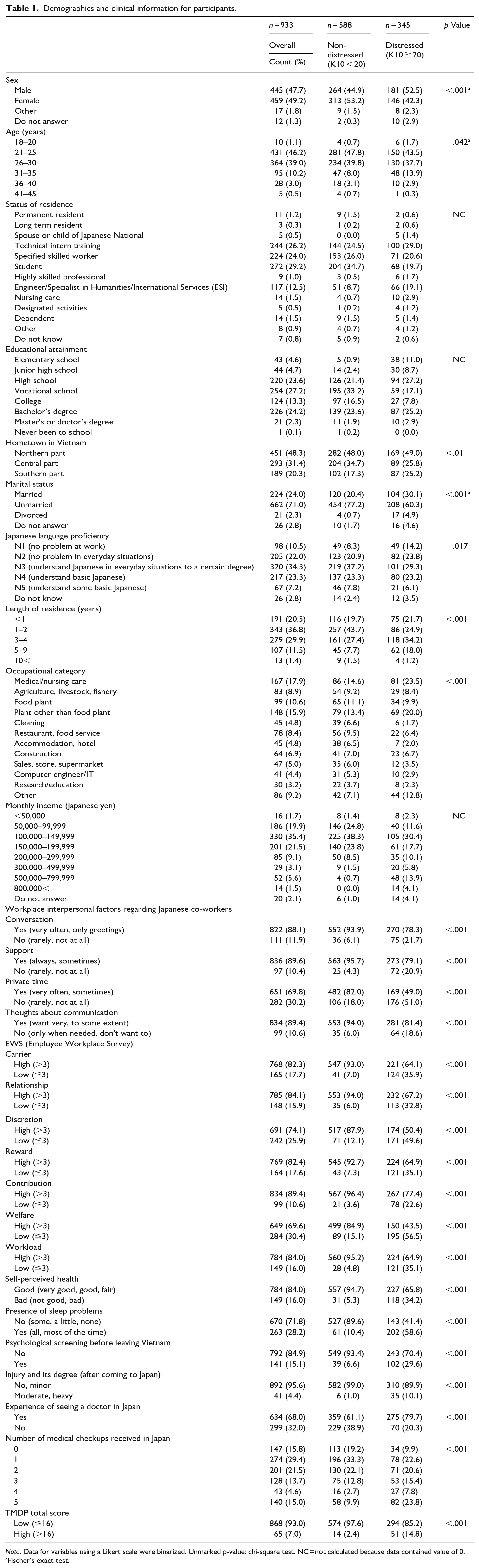
Note. Data for variables using a Likert scale were binarized. Unmarked p-value: chi-square test. NC = not calculated because data contained value of 0.
Fischer’s exact test.
Factors associated with psychological distress investigated by multiple logistic regression analysis
Results of the multiple logistic analysis to explore factors associated with psychological distress are shown in Table 2. The area under the curve was 0.939 (95% CI: 0.924–0.955).
A multiple logistic regression analysis of factors associated with psychological distress.
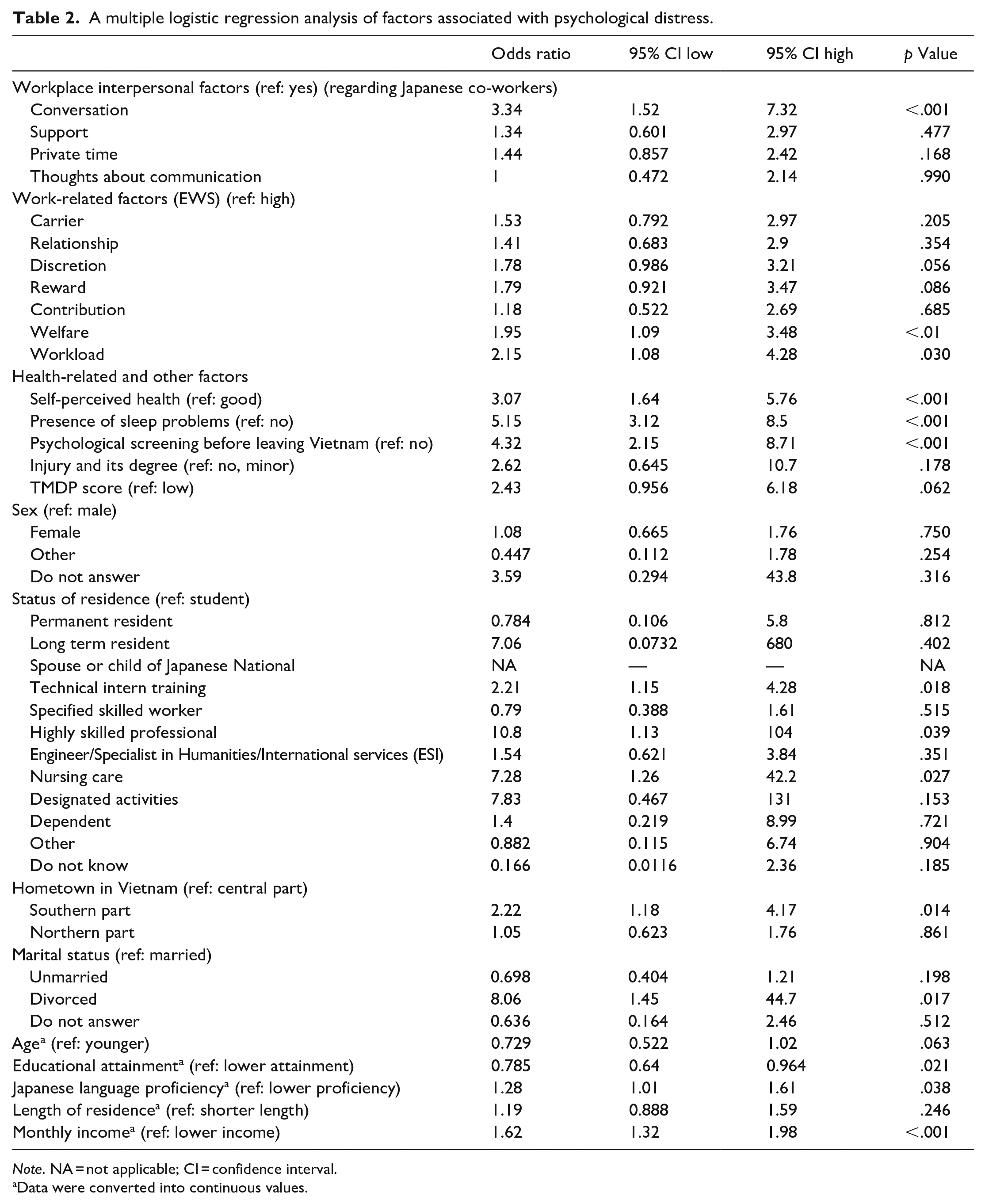
Note. NA = not applicable; CI = confidence interval.
Data were converted into continuous values.
The factors significantly associated with psychological distress were fewer opportunities to speak with Japanese co-workers (OR: 3.34, the item ‘Conversation’ as a workplace interpersonal factor), ‘Welfare’ (OR: 1.95), and ‘Workload’ (OR: 2.15) as work-related factors, and lower self-perceived health (OR: 3.07), presence of sleep problems (OR: 5.15), and experience of psychological screening before leaving Vietnam (OR: 4.32) as health-related and other factors. Furthermore, factors and variables used for adjustment were also found to be significantly related. As for the status of residence, those in Technical Intern Training, Highly Skilled Professional, and Nursing Care grounds were in higher distress when compared with Student. Coming from the southern part of Vietnam, divorced, lower educational attainment, better Japanese language proficiency, and higher monthly income were also related with distress.
Differences by the status of residence
Among the various statuses of residence, Student (n = 272), Technical Intern Training (n = 244), Specified Skilled Worker (n = 224), and ESI (n = 117) constituted 92% (n = 857) of the total subjects. The mean K10 scores and the survey data of our interest are shown in Table 3.
Differences by the status of residence.
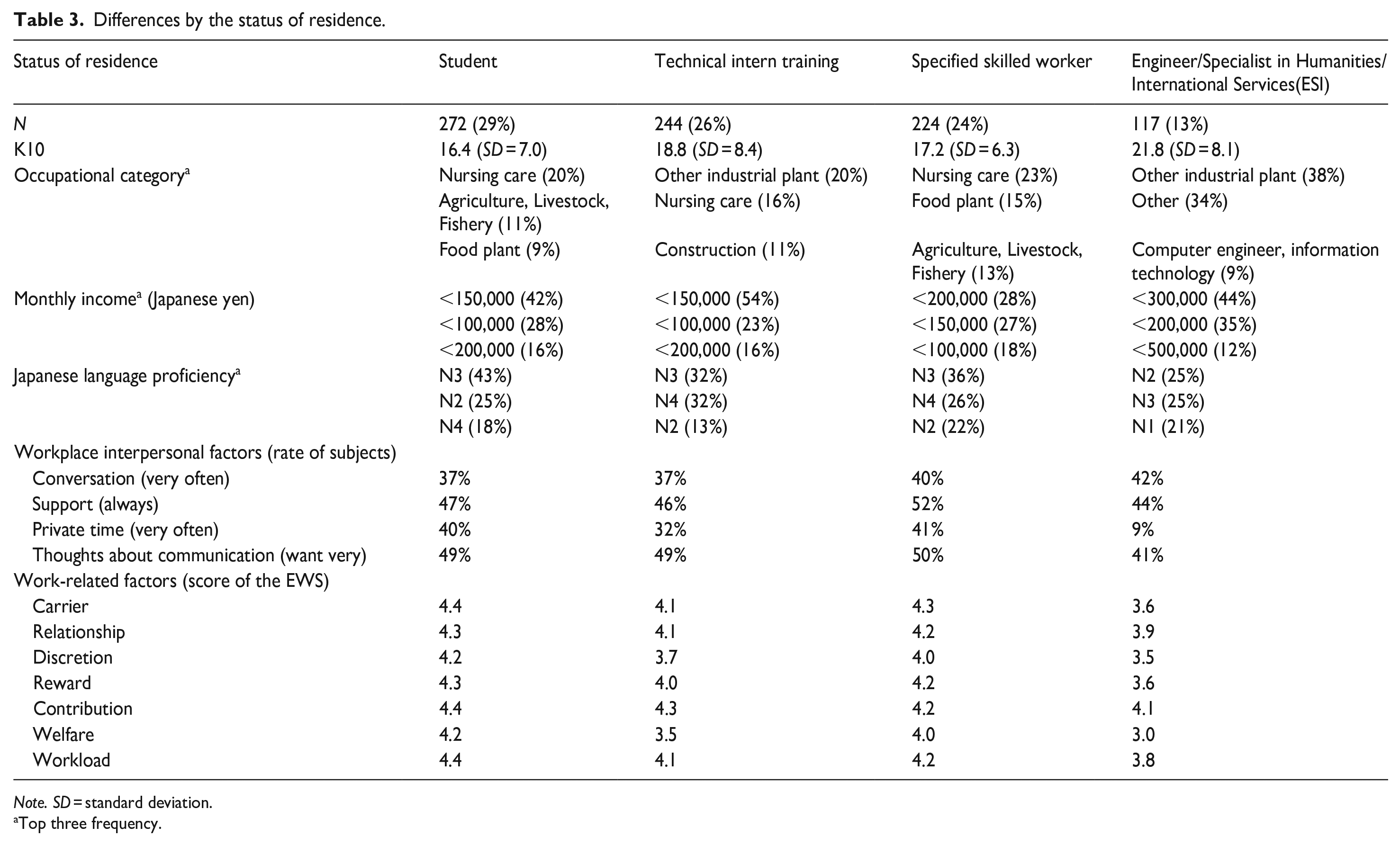
Note. SD = standard deviation.
Top three frequency.
The one-way ANOVA with post-hoc Tukey HSD detected a main effect for status of residence, F (3,853) = 16.16, p < .01, and revealed differences between ESI versus Student (p < .001), versus Technical Intern Training (p < .01), and versus Specified Skilled Worker (p < .001), and between Student versus Technical Intern Training (p < .01). For other factors shown in the table, ESI demonstrated relatively distinctive features compared with other statuses. Notably, they had much less private time, fewer wanted to communicate with Japanese co-workers, and were less satisfied with their workplace environments.
Discussion
Psychological distress measured by K10 and associated factors
The mean of the K10 score of the Vietnamese workers in this study was 18.3. A study reported that the mean K10 score for Japanese workers was 16.7 (Yamada et al., 2016). Although comparing K10 scores of different cultural groups in different settings needs caution in interpreting, it is presumable that Vietnamese workers are suffering from some degree of psychological distress in Japan given the overall hardship of working abroad.
As for workplace interpersonal factors, fewer opportunities to converse with Japanese co-workers were associated with their distress, which is consistent with another study investigating workplace communication (Honda et al., 2016). Although other factors didn’t reach statistical significance in the multiple logistic regression analysis, less support from and less private time to spend with Japanese co-workers were apparent in subjects with distress. On the other hand, nearly 90% of the subjects appeared to desire proactive communication with Japanese co-workers (Table 1).
As for work-related factors, the domains ‘welfare’, and ‘workload’ were associated with distress (Table 2). While 84.9% of subjects in the non-distressed group felt they had satisfactory level of welfare from their workplace, only 43.5% of subjects in the distressed group felt so (Table 1). Likewise, while only 4.8% of subjects in the non-distressed group gave lower ratings to workload, 35.1% of distressed subjects did so. The association between these factors and psychological distress appears to serve as a reflection of the current conditions for Vietnamese workers. For example, even for Japanese women of a childbearing age, workplace welfare is widely considered inadequate (Bumpass et al., 2009). This situation is clearly worse for migrant women, who not only face language difficulties, but are also at a disadvantage in institutional and constitutional context due to their gender and foreignness. Since migrant workers are less likely to receive support from their families and relatives, greater involvement of Japanese co-workers and better social support are warranted.
As for health-related and other factors, the current study also found coming from the southern part of Vietnam or experiencing a psychological screening before leaving their country were associated with distress. Although no clear conclusion can be drawn from this finding, it is possible that difference in social background in their home country is associated with the perception of distress. For example, being educated about mental health may help them become more aware of their own psychological well-being and distress. Our group’s recent cross-sectional study for Vietnamese workers in Japan revealed that they were in need but unable to seek help from healthcare professionals (unpublished data). Their distress may be reduced through strategies to promote mental health awareness and seeking help.
The association of distress with status of Technical Intern Training, Highly Skilled Professional, and Nursing Care suggests that there are differential factors depending on status of residence. Better Japanese language proficiency and higher monthly income were unexpectedly associated with distress. As discussed in the next section, these findings may reflect how migrant workers with high skills and high Japanese language proficiency felt greater distress despite receiving higher salaries because of an expectation within their workplace culture to work and perform at the same level as their Japanese counterparts.
Status of residence
The present study demonstrated differences in the degree of distress depending on the status of residence (Table 3).
The significantly higher levels of distress seen in ESI compared with what was seen in other statuses of residence was somewhat unexpected. Within Japan, foreign residents with this status are generally considered ‘white-collar’ workers. They are expected to work as equals with Japanese co-workers and supposed to receive similar levels of salary and welfare. Indeed, their salaries appear to be higher than those with other statuses. However, they appear to spend less private time with Japanese people, and gave lower ratings to work-related factors, especially for welfare. These findings might be a reflection of their dissatisfaction with how they have been treated and they may perceive that they have been discriminated against in their workplaces.
Migrant workers with the status of ESI might have actual stressors stemming from working in Japanese workplace culture (Uezato et al., 2023). Japan is said to be a collectivistic society and people there have relatively distinct communication styles (Matsumoto et al., 1998; Meyer, 2016). These features are some of the most extreme among countries in the world, placing Japan in a culturally unique position (Meyer, 2016). For example, their conversations are highly contextual and their thinking is rather linear than dialectical (Hall, 2000; Yama & Zakaria, 2019). Japanese people tend to avoid emotional expression (Matsumoto, et al., 1998), interpersonal conflict and confrontational language (Moriizumi & Takai, 2010). Their conflict style in disagreement negotiation is more indirect even when compared with culturally similar Asian countries (Lee et al., 2013). Workplace relationships are hierarchical in nature (Meyer, 2016). For migrant workers with the status of ESI, particularly among those with higher Japanese language proficiency, these features might be perplexing and frustrating because they are expected to be more attuned to Japanese workplace culture than those with other statuses of residence.
For trainees in Technical Intern Training program, psychological distress could be associated with more practical stressors. Established in 1993, this controversial program is nominally aimed at transferring Japanese technology, skill, and knowledge to developing countries by accepting foreign laborers as ‘trainees’. However, this program has been criticized for the fact that trainees are substantially used to make up for labor shortages in factories, nursing care and construction as shown in the current study and not necessarily to impart technical skills to laborers (The Bureau of Democracy, Human Rights, and Labor, U.S. Department of State, 2023). Furthermore, as they are designated as trainees and not workers, they are prohibited by the government from changing their workplace or field, are not allowed to be accompanied by their families, and need to return to their home country after no more than 5 years. These restrictions have been the source of various problems including breach of contract, unpaid overtime, violation of human rights including instances of physical abuse within the workplace, sometimes resulting in trainees running away from training implementation agencies (The Guardian, 2019). According to the Japanese Ministry of Health, Labour and Welfare, more than 600 technical intern trainees dropped out of the program because of pregnancy or childbirth in the 3 years until 2020. A survey by the Immigration Services Agency of Japan in 2022 reported one-fourth of the trainees had been told by dispatch or supervising organizations, or training implementation agencies that they needed to leave the country if they became pregnant (The Yomiuri Shimbun, 2023). An increasing number of trainee suicides have also been reported (The Mainichi, 2018), underlining how arduous their working conditions can be. Although language difficulties were not identified as an aggravating factor for distress in the present study, it is generally a barrier to mental well-being for migrants (Miller et al., 2019), thus also for trainees in Technical Intern Training program who have relatively lower levels of Japanese language proficiency. In April 2023, a Japanese government panel proposed a draft to scrap the training program and create a new system to address these issues (The Nikkei Asia, 2023).
The Specified Skilled Worker is a new status of residence introduced in 2019. The main purpose of this status is to supply foreign human resources to industries that are experiencing extreme labor shortages. Trainees under the status of Technical Intern Training who have satisfactorily completed their programs are eligible to switch to this status in the same field without taking occupational skill exams and Japanese proficiency tests. There are two status types of Specified Skilled Workers: type (i) and type (ii). Type (i) is often compared with Technical Intern Training due to its similarity. While migrant workers under type (i) are allowed to change to other job categories in the same field or to other similar fields, the period of stay is limited up to 5 years in total, and family members are not allowed to accompany the trainees. Although type (i) can switch to type (ii), which allows workers to be accompanied by family members and become eligible to stay in Japan permanently by repeating visa renewals, it is very rare. As of the end of December 2022, only 8 migrant workers were under type (ii), while 130,915 remained under type (i) according to the Immigration Services Agency of Japan. Given the similar circumstances and findings of the current study in Specified Skilled Worker and Technical Intern Training, similar predicaments are speculated to be shared by these two statuses.
Regarding students, the number of international students in Japan declined to 231,146 as of May 2022 due to restrictions in place from the COVID-19 pandemic after reaching 310,000 in fiscal 2019. The number of students from Vietnam was 37,405, ranking second after China. In March 2023, the Japanese government set a target of having 400,000 international students by 2033. While setting a nominal goal to facilitate international exchange by investing in human capital, the Japanese government expects them to work in the country after they graduate, having them to change their status of residence mainly to ESI. Under Student status, they are allowed to work part-time for 28 hours at most per week. While the subjects with student status in the current study demonstrated the lowest psychological distress among the four other statuses, they still have several issues that could be a source of their distress. Most students have paid a substantial brokers fee and are in debt for it, and they need to keep paying for tuition thereafter. Being a diligent student and working for 4 hours per day is presumably a heavy burden. However, contrary to the ‘diligent’ image of a foreign student, the media has frequently reported on the presence of ‘sham students’ and associated stakeholders. For example, one report claimed that the vast majority of Japanese language schools face applicant shortages and recruit young Asians as sham students to send to companies, who exploit them as cheap labor without the need to provide social welfare (Idei, 2019).
Acculturation and adaptation
The finding that migrants with the status of ESI, who possess a greater chance of obtaining permanent residency, demonstrated higher distress levels than those in the other three statuses (Student, Technical Intern Training, and Specified Skilled Worker) is intriguing and suggests there are different modes of acculturation and adaptation between the statuses. Berry proposed four different acculturation orientations based on two tendencies, namely, the tendency to maintain one’s own cultural identity and the tendency to establish interactions with the other cultural groups (Berry, 2001). Acculturation orientations of migrants in ESI must be ‘separation’ or ‘marginalization’ since they tend to interact less as demonstrated in the questions for workplace interpersonal factors (less private time with Japanese co-workers, less of a desire to communicate with Japanese co-workers) (Table 3). On the other hand, acculturation orientations of migrants in the other three statuses are likely ‘integration’ or ‘assimilation’ since they have a higher tendency to interact. Because they are under less pressure to assimilate due to a lower possibility of obtaining permanent residency, integration (although temporary) would be more attainable. These different modes of acculturation orientations might be causing differences in the degrees of distress.
Japan’s government appears to be experiencing a dilemma of craving a workforce of migrant workers and of granting rights of permanent residency. It has traditionally implemented strict immigration policies that anticipate concerns among conservative people that the Japanese cultural identity could be destroyed by immigrants. However, the recent theory of cultural evolution based on Berry’s model might ease their concerns. By using dynamically explicit model of acculturation, Erten demonstrated that a multicultural society where immigrants and their host culture stably coexist is more likely if individuals readily engage in cross-cultural interactions, and if host individuals are more culturally conservative than immigrants (Erten et al., 2018). Therefore, in Japan where people prioritize conformity and social harmony forming a collectivistic society, a multicultural society is feasible under the condition that greater cross-cultural interaction among individuals is encouraged.
Berry’s acculturation theory may not exactly be applied to the migrants in the three statuses since they are only allowed to stay in Japan temporarily, although students have chance to stay longer if they change their status to ESI. Nevertheless, appropriate adaptation to the Japanese culture is essential for their mental well-being. In recent years, perception of temporary migration has been changing, as the Global Commission on International Migration (GCIM, 2005) stated that ‘the old paradigm of permanent migrant settlement is progressively giving way to temporary and circular migration’. According to Gallup surveys in 119 countries in 2009 and 2010, 26% of adults worldwide say they would like to go to another country for temporary work. This figure is nearly twice the 14% worldwide who say they would like to migrate permanently to another country if they could (Ray & Esipova, 2012), suggesting that migrant workers in Japan may not necessarily be hoping for permanent residency, rather they want to take advantage of temporary residency pursuing proactive life design of their own choosing. While considering ‘the option of introducing carefully designed temporary migration programmes as a means of addressing the economic needs of both countries of origin and destination’ (GCIM, 2005), a carefully designed migrant-centered program which goes along with an individual’s life plan would benefit their mental well-being. In Japan, the number of migrant workers is still very minor (2.7%) and national sentiment toward them has yet to be formed. While xenophobia against migrant workers is emerging in some countries, Japan is expected to show the world a transnational model that fits the current mode of acculturation and adaptation for migrant workers.
Limitations
There are several limitations to the current study. The subjects analyzed in the study may not represent the entirety of Vietnamese working in Japan because they were recruited through social media. Thus, data may be biased with people active on social media that simply wanted to complain about their working environment. Because K10 was self-administered online, it may not represent important aspects of psychological distress, and the cross-sectional design of the study obscures the causal relationship between distress and the proposed factors.
Conclusion
Despite its limitations, this study clarified the association between psychological distress and the working environment of Vietnamese workers in Japan. Notably, communication with Japanese co-workers and welfare appear to be key factors that should be considered for their psychological well-being. As seen in Vietnamese with the status of ESI, psychological distress might increase if they are expected to work at the same level as Japanese workers in a foreign culture. However, regardless of their status of residence, there are more fundamental sources of distress such as the exploitation of cheap labor and violations of human rights. While Japan is suffering from shortage of workers, it is becoming a less attractive country for migrant workers due to the sharp depreciation in the yen against the currencies of other Asian countries, leading them to choose other destinations such as Taiwan. A push for a more inclusive society, where migrant workers are treated as people with their own lives and aspirations instead of merely as laborers, is warranted.
Supplemental Material
sj-xlsx-1-isp-10.1177_00207640231196742 – Supplemental material for Mental health and current issues of migrant workers in Japan: A cross-sectional study of Vietnamese workers
Supplemental material, sj-xlsx-1-isp-10.1177_00207640231196742 for Mental health and current issues of migrant workers in Japan: A cross-sectional study of Vietnamese workers by Akihito Uezato, Kohei Sakamoto, Mieko Miura, Akane Futami, Toshihiko Nakajima, Pham Nguyen Quy, Soi Jeong, Shigeru Tomita, Yoshihisa Saito, Yui Fukuda, Nonoka Yoshizawa and Atsuko Taguchi in International Journal of Social Psychiatry
Supplemental Material
sj-xlsx-2-isp-10.1177_00207640231196742 – Supplemental material for Mental health and current issues of migrant workers in Japan: A cross-sectional study of Vietnamese workers
Supplemental material, sj-xlsx-2-isp-10.1177_00207640231196742 for Mental health and current issues of migrant workers in Japan: A cross-sectional study of Vietnamese workers by Akihito Uezato, Kohei Sakamoto, Mieko Miura, Akane Futami, Toshihiko Nakajima, Pham Nguyen Quy, Soi Jeong, Shigeru Tomita, Yoshihisa Saito, Yui Fukuda, Nonoka Yoshizawa and Atsuko Taguchi in International Journal of Social Psychiatry
Footnotes
Funding
The author(s) disclosed receipt of the following financial support for the research, authorship, and/or publication of this article: The first author received support through grants awarded as PI from the Ministry of Education, Culture, Sports, Science and Technology of Japan (20K10893).

Supplemental material
Supplemental material for this article is available online.
References
Supplementary Material
Please find the following supplemental material available below.
For Open Access articles published under a Creative Commons License, all supplemental material carries the same license as the article it is associated with.
For non-Open Access articles published, all supplemental material carries a non-exclusive license, and permission requests for re-use of supplemental material or any part of supplemental material shall be sent directly to the copyright owner as specified in the copyright notice associated with the article.
