



Abstract
Background:
Our previous research found very high levels of burnout and mental health problems among medical students across Indonesia, in line with rates in many other countries. This study further analyses the data by comparing six different regions of Indonesia to determine any differences between them on such measures and to look for possible explanations.
Results:
Our sample of 1,729 students reported high levels of burnout and ‘mild’ psychiatric illness across all six regions. There were however significant differences between some regions. Sumatran students reported the lowest scores for both the Oldenburg Burnout Inventory (OLBI) and General Health Questionnaire 12 (GHQ12) scales. Sources of stress also varied among regions, with relationships and study the most reported. Further exploration of possible cultural differences is needed as well as prompt mental health support for medical students.
Introduction
We have previously published the results of a large-scale survey of medical students’ wellbeing in Indonesia. This supplementary report describes regional differences and similarities across six main regions of Indonesia. Indonesia is a diverse archipelago nation of more than 300 ethnic groups with a population of 267 million. Just under 10% of the overall population live in poverty (25.1 million) and this is steadily reducing (World Bank, 2020). Life expectancy reached 71 years in 2016 (Central Bureau Statistics of Indonesia, 2016).
Medical education in Indonesia has boomed in recent decades, reflecting the country’s overall economic and societal development over the same period. A small medical education capacity left by colonial powers has steadily been upgraded and increased. In 1984, Indonesia introduced its first national medical curriculum, the KIPDI 1. In 2005, the current competency-based curriculum (CBC) was introduced. The number of medical schools increased from 23 in 1980 to 83 in 2016 and 8,000 students now graduate per annum (Mustika et al., 2019). Well over half of medical schools are private and fees are high, raising questions about access and affordability for many.
Despite the large number of students undertaking medical degrees and the accumulated international concern about the wellbeing of medical students, little evidence is available within Indonesia other than one single site survey comparing students at different stages of their degree (Augesti et al., 2015). A recently published survey of 850 pharmacy students in Indonesia reported higher levels of self-reported severe stress than students in non-healthcare related studies at the same stage (50% against 37%) (Mardea et al., 2020). With the consent of the institutions taking part and with the large sample available, we decided to analyse our overall results further by breaking them down on a regional basis. Our decisions about regions were pragmatic. This is the first study of its type in Indonesia. Our aim was to describe any significant variations in the experience and condition of medical students between regions in this diverse country.
Methods
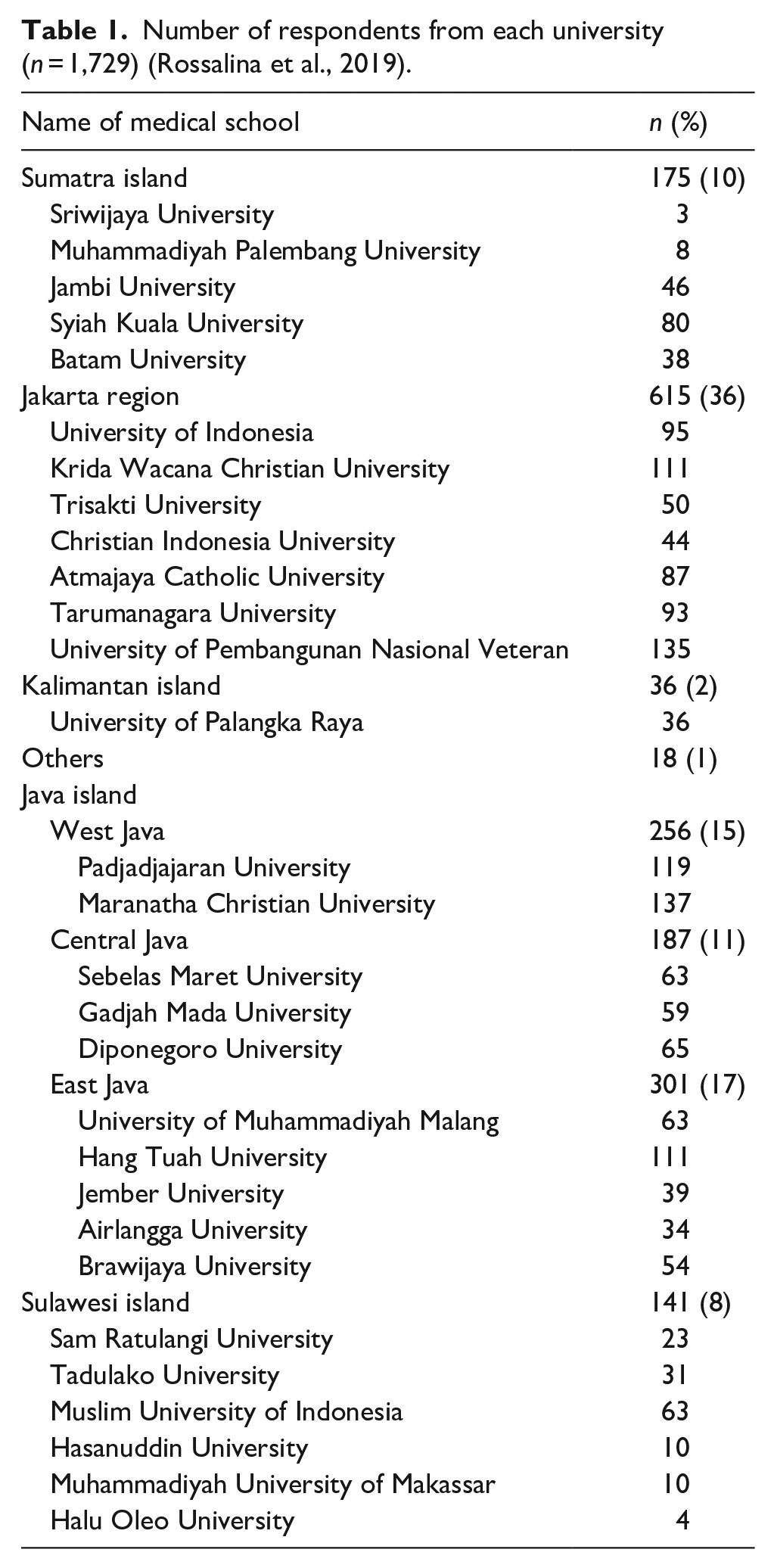
The original survey method involved the use of a fully anonymised internet platform called ‘Typeform’. The survey was sent to 29 medical schools in Indonesia from February to March 2020. It was sent through direct messaging, and students then decided to participate in the survey or not (Rossalina et al., 2019) (Table 1). For this analysis, data is divided into six regions: Sumatra, Jakarta, West Java, Central Java, East Java and Sulawesi.
Number of respondents from each university (n = 1,729) (Rossalina et al., 2019).
We analysed the data per region for burnout, ‘minor’ psychiatric conditions and sources of stress. Burnout was identified using the OLBI (Demerouti & Bakker, 2008) measures of disengagement and exhaustion. ‘Minor’ Psychiatric disorders were identified using the GHQ12 (Goldberg & Blackwell, 1970). Burnout was indicated by a mean score of 2.10 for disengagement and 2.25 for exhaustion (Demerouti & Bakker, 2008). Data were analysed to determine any significant differences using relevant statistical techniques including ANOVA test (Cardinal & Aitken, 2013) and Post Hoc Bonferroni (Dunn, 1959). Bonferroni calculations were considered significant if <5%.
Results
There were a total of 1,792 responses across the six regions of Indonesia. Detailed results of the overall survey are presented in Rossalina et al. (2019), but reported rates of disengagement, exhaustion and ‘minor’ psychiatric symptoms were 93%, 95% and 74% respectively. Mean scores in each region of the OLBI exhaustion-disengagement subscales and GHQ12 are presented in Figure 1. Sumatran students had the lowest mean scores, while West Javans reported the highest score for each measurement. The greatest variation overall amongst regions was with the GHQ12. Despite the variations, all regions exceeded the cut off scores on the validated scales, indicating high overall levels of mental health difficulties and burnout.
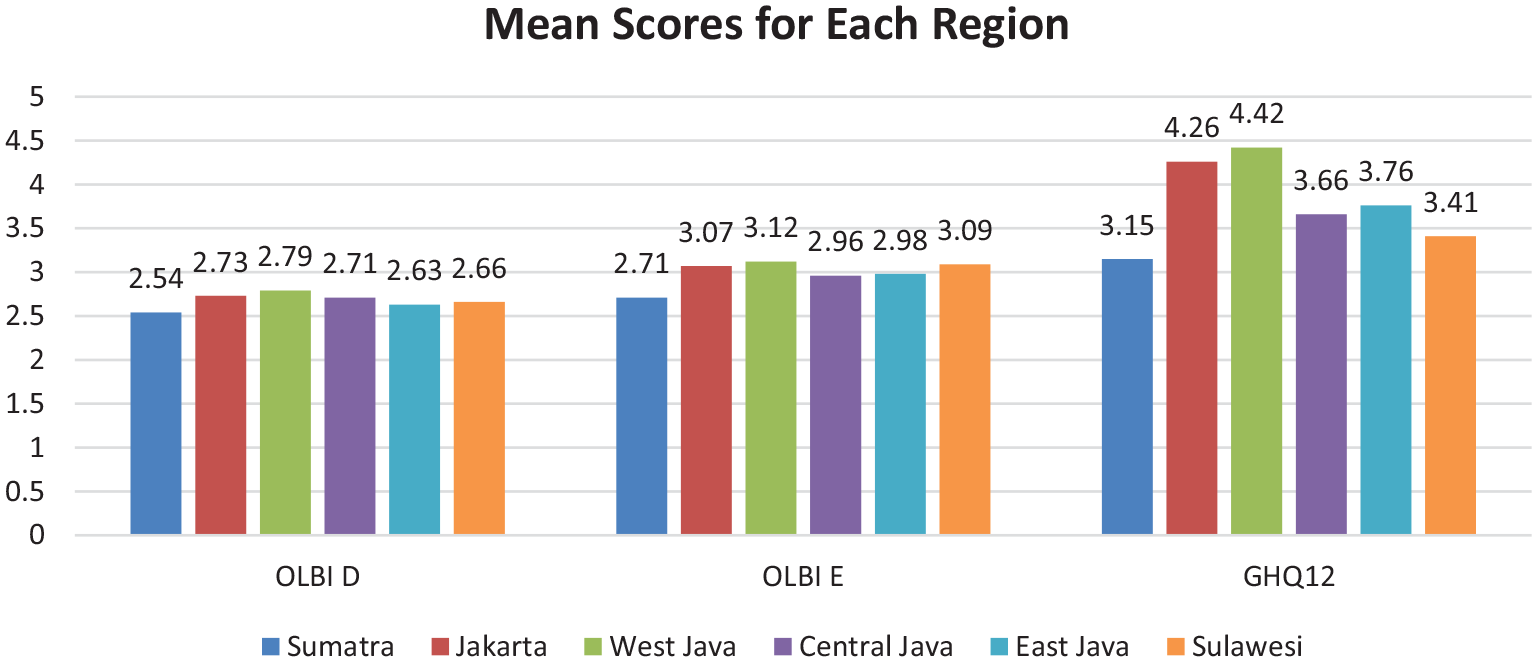
Result of the OLBI disengagement (OLBI D), OLBI exhaustion (OLBI E) and General Health Questionnaire 12 (GHQ12) by region.
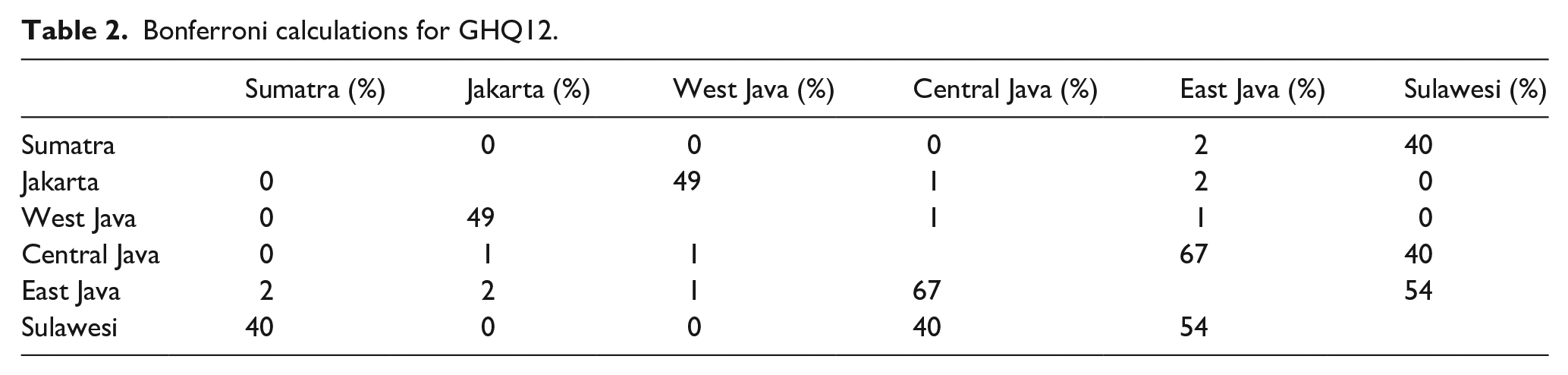
We tested the difference for each region using Bonferroni calculations. Sumatran medical students reported lower scores than all other regions, reaching significance for all others except Sulawesi. The complete result can be seen in Table 2.
Bonferroni calculations for GHQ12.
Causes of stress showed a clear pattern across regions. Medical students generally reported stress from studies (71%) and relationships (46%) rather than from financial (29%) or accommodation (7%) worries. Overall, respondents reported more than one stressor when answering the direct questions in our survey, with cumulative scores of between 125 and 168. Again, respondents in Sumatra reported the lowest levels of perceived stressors, with West Javan students having the highest cumulative stressors.
Discussion
Overall, our large-scale study of students found very high levels of burnout and ‘minor’ mental health problems in Indonesian medical students. This was consistent with recent similar studies from other countries (Molodynski et al., 2021). The same can be said for reported sources of stress, though general levels were lower than most other countries (Molodynski et al., 2021). Concern regarding money and accommodation were especially low when compared to other countries. This could reflect the high proportion of private medical schools in Indonesia and consequently the material resources of those able to attend.
We found variations in both disengagement and exhaustion levels between regions. Some of these differences reached statistical significance but many did not. Differences between mean scores on the GHQ12 were greater, and there were significantly lower levels of psychiatric symptoms in Sumatran medical students than in others, as shown in Figure 1 and Table 3. Variation between other regions was less, though Jakarta and West Java were consistently the poorest performers with higher levels of burnout and psychiatric symptoms.
Reported stressors for each region (%).
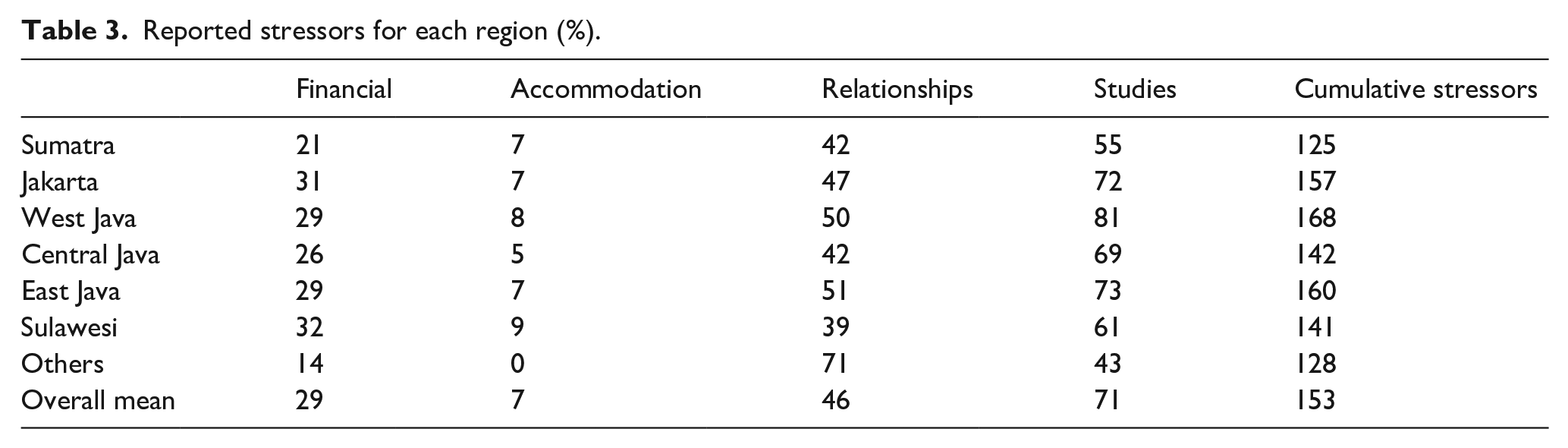
This study was not designed to be able to detect any causation due to its cross sectional design. However, it would appear logical to conclude that there is a relationship between the lower levels of reported stress in Sumatra and the lower levels of burnout and psychiatric symptoms in the same group. Similarly, the study shows that respondents from Jakarta and West Java reported more stressors, higher levels of burnout and more psychopathology.
One of the problems that Indonesia is currently facing is the uneven distribution of general practitioners throughout the country (Laksono et al., 2020). There are also many parts of Indonesia with very few specialist doctors (Meliala et al., 2013). The largest number of general practitioners and specialised doctors are distributed in either Jakarta or Java (Laksono et al., 2020). There are generally higher levels of competition amongst and higher expectations of doctors in these more saturated regions, to the extent that there have been instances where certain specialties have limited further licence registrations for the area. Concerns for the future may possibly explain why rates of burnout and ‘mild’ mental health problems were highest in these areas. This was seen in a similar study in the USA where career planning and concerns about the future contributed greatly to anxiety in medical students (Hill et al., 2018).
An alternative hypothesis for the lower level of burnout among Sumatran medical students could be their lower numbers and thus reduced competition. Another possibility, related to studies being the highest point of concern, would be differences in academic expectations as Sumatran students reported the lowest rates of study related stress.
Data from the Ministry of Education that mapped teachers’ competency standards to national examination levels for high school graduates found lower student examination scores for Sumatra (Ministry of Education & Culture, 2018a; 2018b). Data from the Coordinating Office for Private Universities (2018) demonstrated that four out of the five universities with the highest rates of retakers for the medical competency examination were in Sumatra, with the other being in Sulawesi. It may be that while students from Sumatra are generally less stressed about their studies compared to their peers in other islands, they are more likely not to succeed.
Another possible explanation may be cultural adjustment. Many students come from other cities or even different islands in Indonesia to enter university, especially in Jakarta and West Java. For first year students, cultural differences can be a great shock (Akarowhe, 2018). Alongside these psychosocial adjustments there may be high academic pressure. This has also been described in research with German medical students, where living without one’s family was found to be challenging (Bergmann et al., 2019). Other cultural or social differences might also contribute to the varying levels of burnout require further exploration.
Medical students across all six regions of Indonesia reported high levels of burnout and mental health problems. Our data suggests that those in more highly populated urban areas report higher levels of stress and burnout. The complex interaction between various factors that contribute to burnout needs to be disentangled, and each institution needs to take action to better understand and then to put measures in place to reduce the difficulties experienced by students.
The balance between wellbeing and achieving high standards can be difficult. As well as a lack of mental health support from each institution, some students found themselves unable to develop their own strategies to manage stress and prevent burnout. Qualitative studies have reported some possible strategies on how to cope with medical school which can be classified as active and/or avoidant. Active strategies include cognitive self-rewarding, scheduling plans and socialising. Avoidant strategies include withdrawing from medical discussion with friends, lack of serious relationships and smoking (Abouammah et al., 2020). The establishment of well resourced student support systems as part of a non-formal programme is required to help break the stigma of mental health and also to assist students to get through medical school (Abouammah et al., 2020; Bergmann et al., 2019).
Conclusions
We found low levels of wellbeing and high levels of burnout among Indonesian medical students. Significant differences were found between regions, but all regions had high rates of difficulties. Multiple sources of stress were also observed, which are likely to be the major cause of the mental health disturbances in medical students. Given the lower levels of difficulties in Sumatra, there may be lessons that can be learned and implemented across other regions from the experience there. A coordinated national strategy is needed to support medical students, enhance their wellbeing and protect their effectiveness as our future doctors.
Footnotes
Conflict of interest
The author(s) declared the following potential conflicts of interest with respect to the research, authorship, and/or publication of this article: Dr. Theresia Citraningtyas is a lecturer at Krida Wacana Christian University. Nabila Ananda Kloping is a medical student at Airlangga University. Dr. Theresia Citraningtyas and Dr. Rossalina are alumni from Universitas Indonesia.
Funding
The author(s) received no financial support for the research, authorship, and/or publication of this article.
