




Abstract
Abstract
Existing recommendation systems lack to address the need of several problems in education domain due to the availability of limited information. Study of recommendation systems to facilitate students’ education in their relevant services is being carried out in different perspective. Hence, the objective of this work is to apply existing knowledge for decision making to recommend students during their course registration process in an institution. The situation where more number of experts involves in decision making was influenced by Fuzzy Soft Expert Set (FSES). This work emphasizes the application of FSES for facilitating students’ course registration process assuming that the same course is offered by more number of faculty members during a semester. As more number of experts involved in this process and the uncertainty of the available data, using the Technique for Order of Preference by Similarity to Ideal Solution (TOPSIS) along with FSES was considered. A new methodology FSES-TOPSIS was also applied in this work. The proposed method was accurate enough to enable students to rank the faculty members based on their previous performance and to enroll themselves with the faculty members of their interest. The method proposed here can be extended for various problems of similar nature.
Keywords
Introduction
There are certain mathematical problems in medical diagnosis, business, engineering, etc., that is difficult to solve using conventional techniques. The reason behind this fact is that the statistics that are used to solve these problems are uncertain and in diverse formats. Therefore, the need arises for mathematical techniques to address these issues. Zadeh introduced fuzzy sets in 1965 as one solution to solve the aforementioned problems. In a conventional set, the membership of each element is defined in binary as either a member or not. However, in any fuzzy sets, all the elements possess some degree of membership. Even a non-member element gets different degree of membership. Due to this ability to easily handle uncertainty, fuzzy sets have been studied by many researchers and adopted for a vast range of research domains. Fuzzy set has been combined with various soft set theories to produce more effective models for handling uncertainty. This work aims to use multiple criteria for assessing performance of faculty members who are offering same courses to facilitate students for identifying a suitable faculty member from the available list. A sample case study on the same scenario is presented in this paper to demonstrate the application of FSES.
After fuzzy set theory was introduced by Zadeh,
1
some other theories were proposed, such as rough sets,
2
intuitionistic fuzzy sets
3
and vague sets.
4
The inadequacy of the parameterization tool is the limitation that is identified among these theories, even though these theories have been accepted as fruitful mathematical models for handling uncertainties. In 1999, Molodtsov
5
introduced the soft set as a tool to handle uncertainties, which is free from the previously mentioned difficulty. A pair
The basic introduction and the related works were examined in the section above. Foundations on Fuzzy Soft Expert Sets and the way they facilitate decision making are illustrated in the next section. Followed by this is the discussion on multi-criteria decision making technique TOPSIS. The subsequent section deals with the proposed methodology FSES-TOPSIS with illustration. Finally, the penultimate section discusses about the results followed by conclusions in the last section.
FSES and decision making
In this section, an application of the FSES in a decision-making scenario has been illustrated. In some educational institution, most of the courses might be offered by more than one faculty member. Let us assume that a student wishes to choose one among many faculty members who are offering the same course based on the opinions of other students who have already completed and earned credits for the same course. Assuming that a course is offered by five faculty members the universe is defined as

To illustrate, the following faculty performance evaluation criteria are considered in this case.

Let
Sample feedback data.
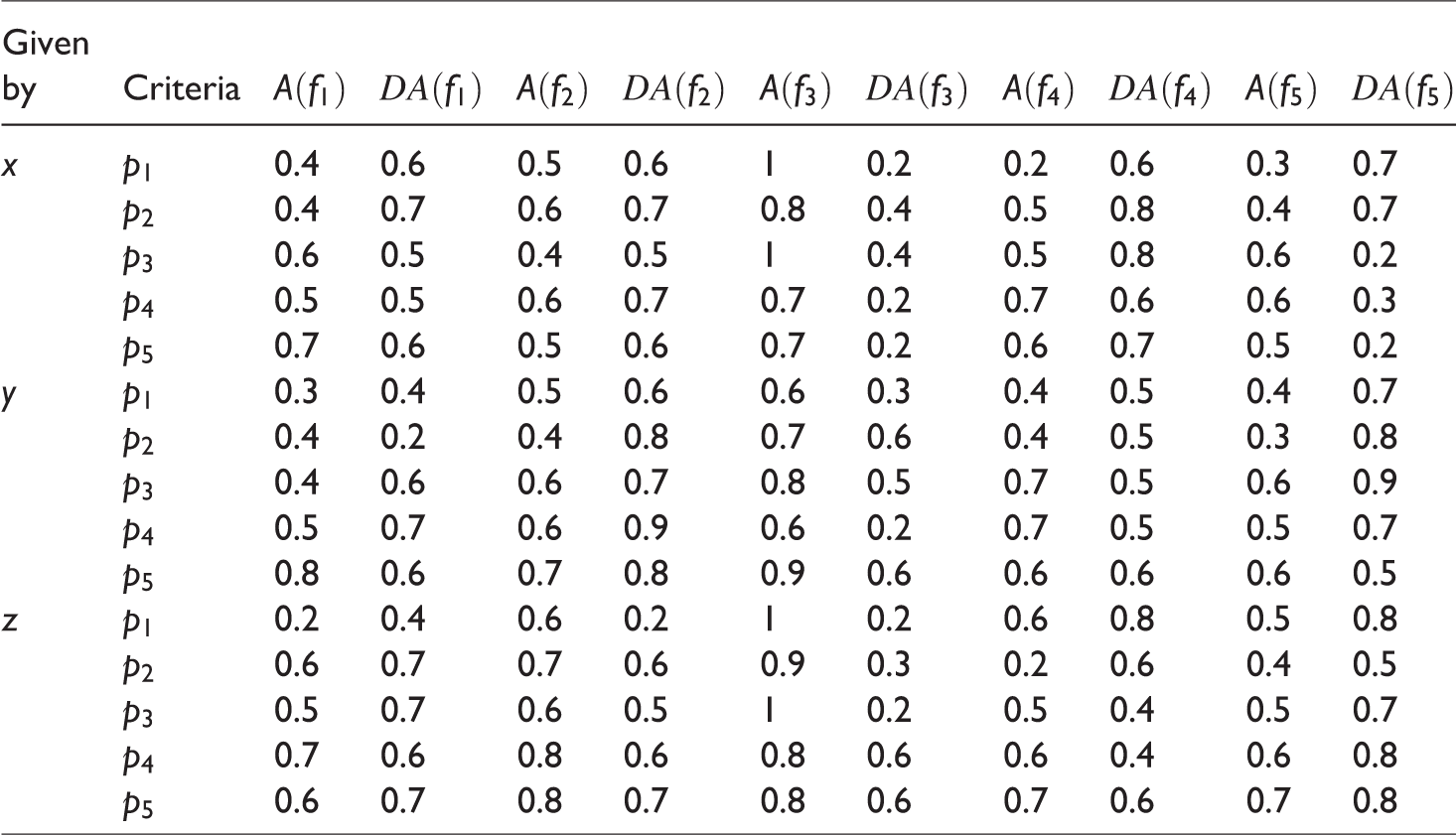
The agree and disagree fuzzy soft expert sets computed using the above table are presented in Tables 2 and 3.


Agree-fuzzy values.
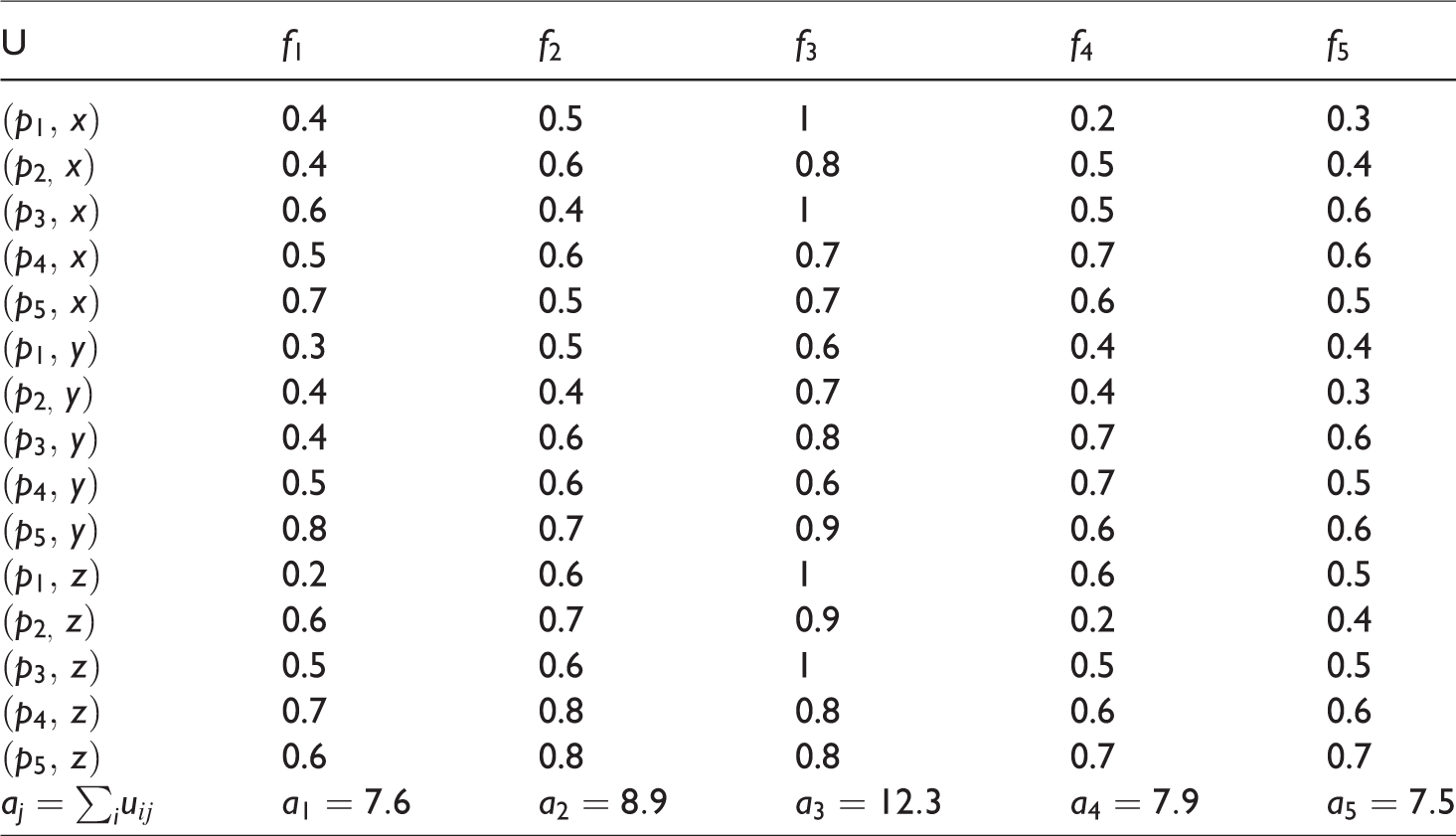
The above FSES
Disagree-fuzzy values.
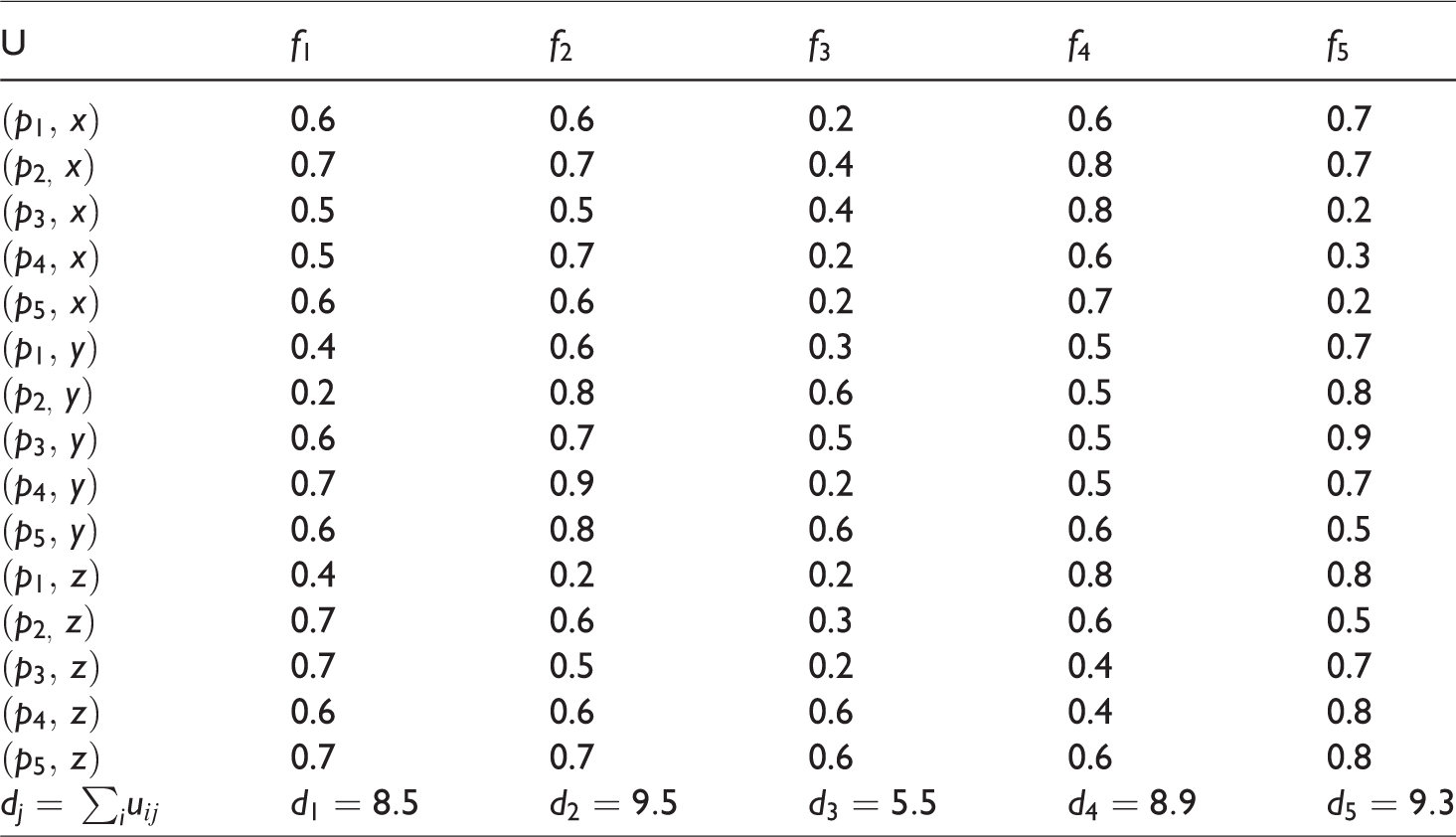
FSES decision making.
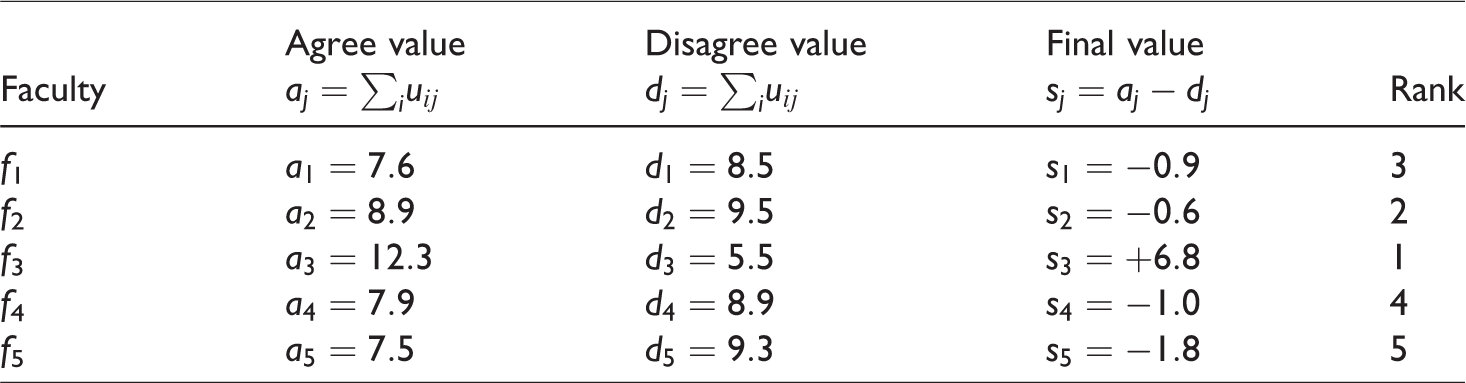
According to Table 4,
TOPSIS fundamentals
Hwang and Yoon developed TOPSIS as a method for multiattribute decision making.
52
The steps involved in TOPSIS are as follows:
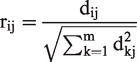
Obtain the decision matrix D for ‘n’ alternatives over ‘m’ evaluation criteria. Compute the normalized matrix Determine the weight Compute the respective ideal solutions viz., positive and negative (PIS and NIS). Find separation measurement over each criterion for the PIS and NIS. Determine relative closeness of alternatives. Order or prioritize the alternatives based on the values that are obtained in step (f).
Proposed methodology FSES-TOPSIS
In this section, a novel approach called FSES-TOPSIS has been proposed. Both agree and disagree fuzzy values from the fuzzy soft expert set are considered for TOPSIS to solve any multicriteria decision-making problem. The proposed idea is to derive the positive ideal solution using agree FSES and negative ideal solution using disagree-FSES. The steps for the process of arriving at the solution are:
Construct the agree-decision matrix Compute the agree-normalized matrix Determine the weighted agree-normalized decision matrix Compute PIS and NIS using Find separation measurements Compute relative closeness of alternatives. Prioritize or rank alternatives.
FSES-TOPSIS and decision making
Assume same universal set U of faculty members and set of evaluation criteria P as


Let
Step 1: Construct agree-decision matrix
The agree-fuzzy values of experts x, y and z are extracted as
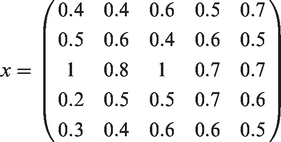
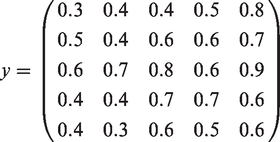
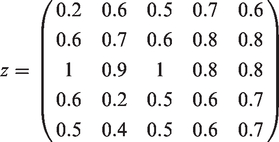
The agree-decision matrix 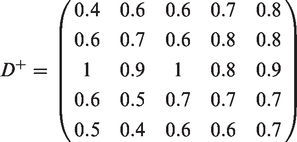
Similarly, the disagree-fuzzy values of experts 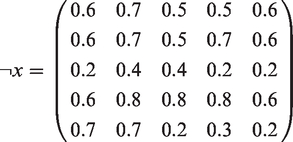
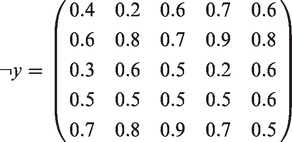
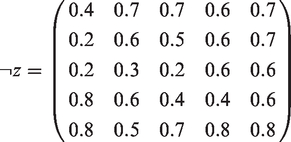
The disagree-decision matrix 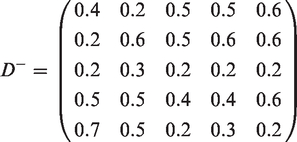
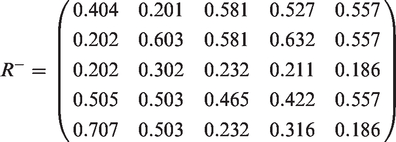
Step 2: Find agree and disagree normalized decision matrices 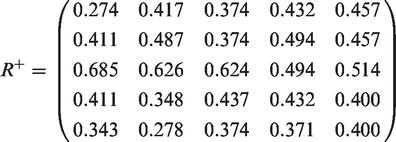
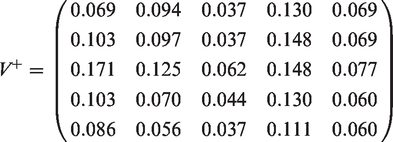
Step 3: Determine weighted agree and disagree normalized decision matrices

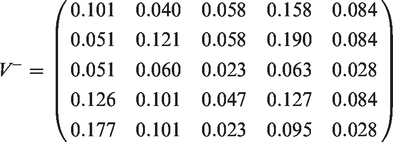
Step 4: Determine the PIS and NIS


Step 5: Compute the separation measurements 

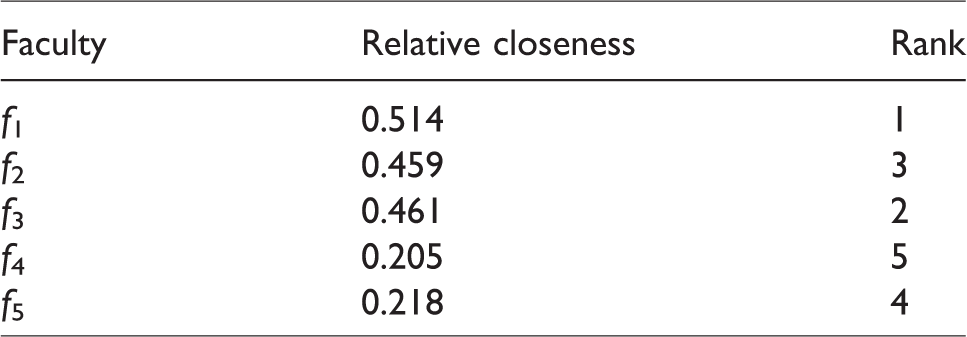
Step 6: Compute the relative closeness of the alternatives

Now, the ranking appears as in Table 5, which gives a different perception on making a decision for choosing a faculty by considering multiple criteria.
FSES-TOPSIS decision making.
Results and discussion
In our case, it was assumed that five different faculty members were handling the same course. Various performance indicators (as shown in Table 1) were used to arrive at basic values of FSES in equation (9). Then, agree and disagree FSES sets were extracted from Table 1. They were presented in Tables 2 and 3 along with the aggregates. Then the process of decision making using FSES was calculated from the aggregated values of Tables 2 and 3. Final result of this computation was presented in Table 4 which shows that the faculty member 3 was recommended to the students as their first choice. To improve the recommendation still further, as mentioned, use of FSES with TOPSIS was equated. Table 5 shows the results of the procedure employed to obtain the values of proposed FSES-TOPSIS method. It was evident that the ideal values used to rank the faculty members were different than the previous results obtained. As more number of criteria are involved in this FSES-TOPSIS method when compared to just only feedback obtained from the students in traditional FSES method, it is evident that this FSES-TOPSIS method would be more appropriate to recommend the students need.
Conclusion
This paper started with the theoretical background of fuzzy soft expert sets with the possible operations. To best understand the same, a simple application of students’ course registration for an institution was considered where it was assumed that the more than a faculty was about to offer the same course and the students need to identify suitable faculty member based on teachers previous academic performance. The traditional FSES method was applied and results were obtained. As this approach only has simple arithmetic, a new idea of combining FSES with TOPSIS was proposed. This method was found to be more reasonable as the number of criteria to rank and recommend the faculty members was more when compared to the normal method. It was evident that both the methods can be used for recommendations in educational domain. As insisted, based on the number of parameters considered to rank and recommend, it can be concluded that the ideal solution would be FSES-TOPSIS method as presented here. Rural students enrolling into higher studies after their school would find it difficult in their initial stages. But our methodology would facilitate them to choose the more appropriate faculty member for their course registrations assuming that the same course is to be offered in more number of batches by more number of faculty members in a very big institution. This would help students to increase their interest in learning by registering with the more appropriate faculty members based on the ranking mechanism proposed in this approach. The same technique can be used to any problems of similar nature for any multicriteria decision making and recommendations.
Footnotes
Declaration of Conflicting Interests
The author(s) declared no potential conflicts of interest with respect to the research, authorship, and/or publication of this article.
Funding
The author(s) received no financial support for the research, authorship, and/or publication of this article.