



Abstract
In every decision-making scenario, the role of parameters is pertinent but it becomes critical for the situations when parameters are ambiguous to be assessed by the experts so this sort of uncertainty is judged by assigning a fuzzy membership-grade to each parameter. The existing literature on fuzzy parameterization is unable to provide an appropriate model which may cope with hypersoft setting, multi-decisive opinions of experts and intuitionistic setting collectively. This shortcoming leads to the motivation of this study. In this paper, fuzzy parameterized intuitionistic fuzzy hypersoft expert set (FPIFHsES) is characterized which is capable to address the insufficiencies of existing models like fuzzy parameterized intuitionistic fuzzy soft expert set (FPIFSES) for the consideration of multi-argument approximate function. With the entitlement of this function, FPIFHsES tackles the real-life scenario where each attribute is meant to be further classified into its respective sub-attribute valued disjoint set. The FPIFHsES is more flexible and the reliable with the deep analysis of attributes in the decision-support system. The characterization of FPIFHsES is accomplished by employing theoretic, axiomatic, and algorithmic approaches. In order to validate the proposed model, an algorithm is proposed to study its role in decision-making while dealing with a real-world scenario.
Introduction
Maji et al. 1 introduced the concept of fuzzy soft set (FSS) as a generalization of fuzzy set 2 (FS) and soft set 3 (SS) to adequate the limitations of FSs regarding the provision of parameterization tool. The FSS not only validates the FSs but also fulfils the characteristics of SSs. It uses the collection of fuzzy subsets rather than a power set merely as the range of single-argument approximate function over the universe of discourse. The researchers Çağman and Karataş 4 introduced the structure of intuitionistic fuzzy soft set (IFSS) with some decision making methods and provided an application of this field. The authors like Akram et al. 5 and Garg et al. 6 made rich contributions for dealing uncertainties under fuzzy set-like models. The SS models emphasize the opinion of a single expert in a single model. But there are certain situations when there is a need for different opinions in different models. Alkhazaleh and Salleh 7 conceptualized soft expert set (SES) to adequate the limitations of SS regarding the opinions of different experts in different models. Ihsan et al. 8 conceptualized convexity-cum-concavity on SES and discussed its certain properties. Alkhazaleh and Salleh also extended their work to fuzzy soft expert set 9 (FSES) by introducing its use in decision-making problems (DMPs). Again Ihsan et al. 10 gestated the convexity on FSES and explained its some properties. Broumi and Samarandache 11 conceptualized intuitionistic fuzzy soft expert sets and discussed their application in DMPs. In 1998, Smarandache 12 generalized SS to hypersoft set (HSS) by replacing single argument approximate function into multi-argument approximate functions. Saeed et al. 13 introduced the fundamentals of HSS and used in DMPs. Ahsan et al. 14 made an analytical and theoretical approach to composite mappings on fuzzy hypersoft set (FHSS) and discussed its certain properties. They also verified ceratin results with the help of examples. Saeed et al. 15 introduced the hybrids of a hypersoft graph and discussed its theoretic operations with generalized results. Saeed et al. 16 gave the idea of neutrosophic hypersoft mappings and used in medical diagnosis. Saeed et al.17,18 studied certain operations and products of the neutrosophic hypersoft graph. Rahman et al. 19 described the structures of HSS like complex FHSS, intuitionistic FHSS and neutrosophic HSS. Rahman et al. 20 gave the idea of convexity on HSS and proved its certain properties. Rahman et al. 21 developed the structure of rough HSS and gave an application for the best selection of chemical material in DM. Rahman et al. 22 made a novel approach to neutrosophic hypersoft graph and discussed its certain properties. Rahman et al. 23 introduced the aggregation operators of complex FHSS and used them in DMPs. They also developed the structure of the interval-valued complex FHSS. Rahman et al. 24 conceptualized the bijective HSS and discussed its applications in DMPs. Ihsan et al. 25 generalized the HSS to hypersoft expert set (HSES) to know the opinions of different experts in different models when attributed sets are further divided into disjoint attribute valued sets. Ihsan et al. 26 conceptualized the structure FHSES and explained the application of DMPs with the help of the proposed algorithm. The contributions of researchers like Siddique et al. 27 and Sunthrayuth et al. 28 are more significant regarding the characterization pythagorean fuzzy hypersoft set, its aggregation operations and applications in decision-making. Musa and Asaad 29 discussed topological structures of hypersoft set with bipolar setting and investigated its several axioms. Debnath 30 conceptualized interval-valued intuitionistic fuzzy hypersoft set and discussed its decision-support system based application.
Research gap and motivation
Following points will explain the research gap and motivations behind the choice of proposed structure:
Çağman et al. 31 conceptualized fuzzy parameterized soft set (FPSS) and applied a vital degree to parameters. They suggested a proposed method to solve the DMPs and gave an application for the best product selection. Tella et al. 32 introduced the structure of fuzzy parameterized fuzzy soft set (FPFSS) and used it for multi-criteria decisions with the help of multi experts assessment. Zhu and Zhan 33 applied this idea in DMPs. Sulukan et al. 34 conceptualized fuzzy parameterized intuitionistic fuzzy soft set and applied in performance-based value assignment problem SS like structures deal with the opinion of a single expert in a model. But there are certain situations where we need different opinions of different experts in one model. In order to overcome this situation without using any additional operation, Alkhazaleh and Salleh 7 gave the concept of SES and then extended it to FSES. 9 Bashir and Salleh 35 combined the structures of fuzzy parameterized with SES and introduced the hybrids of the fuzzy parameterized soft expert set (FPSES) with application in DMPs. They discussed the application with the generalized algorithm of Alkhazaleh and Salleh 7 and compared the results. Hazaymeh et al. 36 conceptualized fuzzy parameterized fuzzy soft expert set and used in decision making. Selvachandran and Salleh 37 extended the of Hazaymeh to fuzzy parameterized intuitionistic fuzzy soft expert set. In 2021, Rahman et al. 38 extended the work of FPSS to FP-hypersoft set by changing the single set of the attribute into multi disjoint attribute valued sets and discussed the applications in DMPs. Rahman et al. 39 extended their work and introduced the concept of neutrosophic HSS with applications in DMPs. Rahman et al. 40 added some more work of parameterization in literature by introducing the concept of neutrosophic set under HSS with different settings like fuzzy, intuitionistic fuzzy and neutrosophic sets. Ihsan et al. 25 extended the work of HSS into HSES by giving an application of DMPs.
It can be seen that the above fuzzy parameterized soft set like models deal with opinion of only single expert. But in real life, there are certain situations where we need different opinions of different experts in one model. To tackle this situation, soft expert set has been developed. However, there are also certain situations when attributes are further classified into their respective attribute-valued disjoint sets. Figure 1 presents the clear comparison of soft expert set model and hypersoft expert set model. It shows the optimal selection of a mobile with the help of suitable parameters in case of soft expert set and suitable sub-parametric values in case of hypersoft expert set. Therefore, there is a need of new structure to handle such situations with multi-decisive opinions under multi-argument soft set like environment. So hypersoft expert set has been developed.
Having motivation from the above literature in general and specifically from to, a novel structure FPIFHsES is developed with certain properties. By using the aggregate operations of FPIFHsES, an algorithm is proposed and applied in multi-attribute decision-making problems.

Comparison of soft expert set and hypersoft expert set models.
Main contributions
Following are the some main contributions of the proposed study:
Some basic definitions of a hypersoft set, hypersoft expert set, fuzzy hypersoft expert set are reviewed from the literature.
Theory of fuzzy parameterized intuitionistic fuzzy hypersoft expert set (i.e. axiomatic properties, set-theoretic operations, and laws) is conceptualized with the support of illustrative numerical examples.
An algorithm is proposed and then validated by applying it in a decision-making based daily-life problem.
The proposed study is compared with existing relevant models to judge the beneficial aspects of the proposed study.
Paper is summarized with the description of its scope and future directions to motivate the readers for further extensions.
Organization of paper
The remaining paper is structured as presented in Figure 2.

Organization of paper.
Preliminaries
This part of the paper reviews the elementary notions in hypersoft expert set theory. In this article,
In 1965, Zadeh
2
gave the idea of fuzzy set as a generalization of classical set (crisp set) to manage uncertain situations. This set utilizes a membership function which maps the set of items to
Fuzzy set focuses on membership values just for managing uncertain situations yet there are numerous circumstances where non-membership degree is important to be thought about consequently to sufficient fuzzy set with such circumstance Atanassov 4 presented intuitionistic fuzzy set as a generalization of fuzzy set. It gives due status to both membership and non-membership values of another option.
Fuzzy set and intuitionistic fuzzy set portray some sort of deficiency in regards to the thought of parameterization tool. To deal with this limit, Molodtsov 3 conceptualized soft set as a mathematical tool to handle uncertainties and vagueness in the data.
In some real situations the arrangement of attributes into sub-attributive qualities as sets is essential. The current idea of soft set isn’t adequate and incongruent with such situations so Smarandache 12 acquainted hypersoft set with address the inadequacy of soft set and to deal with the circumstances of multi-argument approximate function.




1.
2. ∀
Fuzzy parameterized intuitionistic fuzzy hypersoft expert set (FPIFHsES)
In this section, a new structure of FPIFHsES is presented with the help of existing concept of fuzzy parameterized intuitionistic fuzzy soft expert set.

where
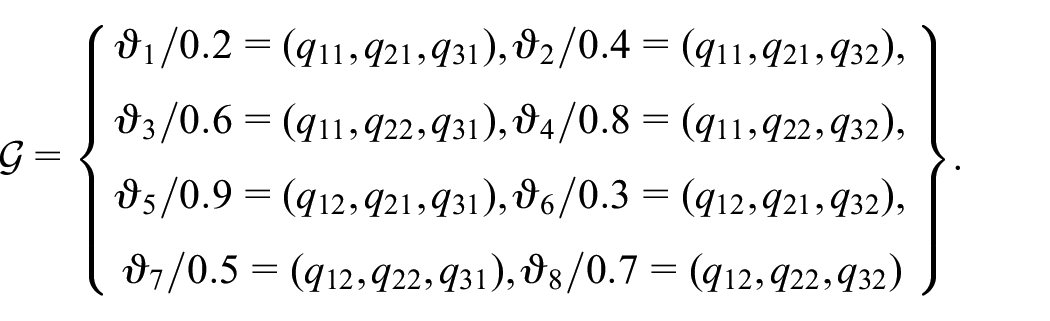


be a subset of
Following survey depicts the choices of three specialists:













The FPIFHsESs can be described as

and

∀


It is clear that
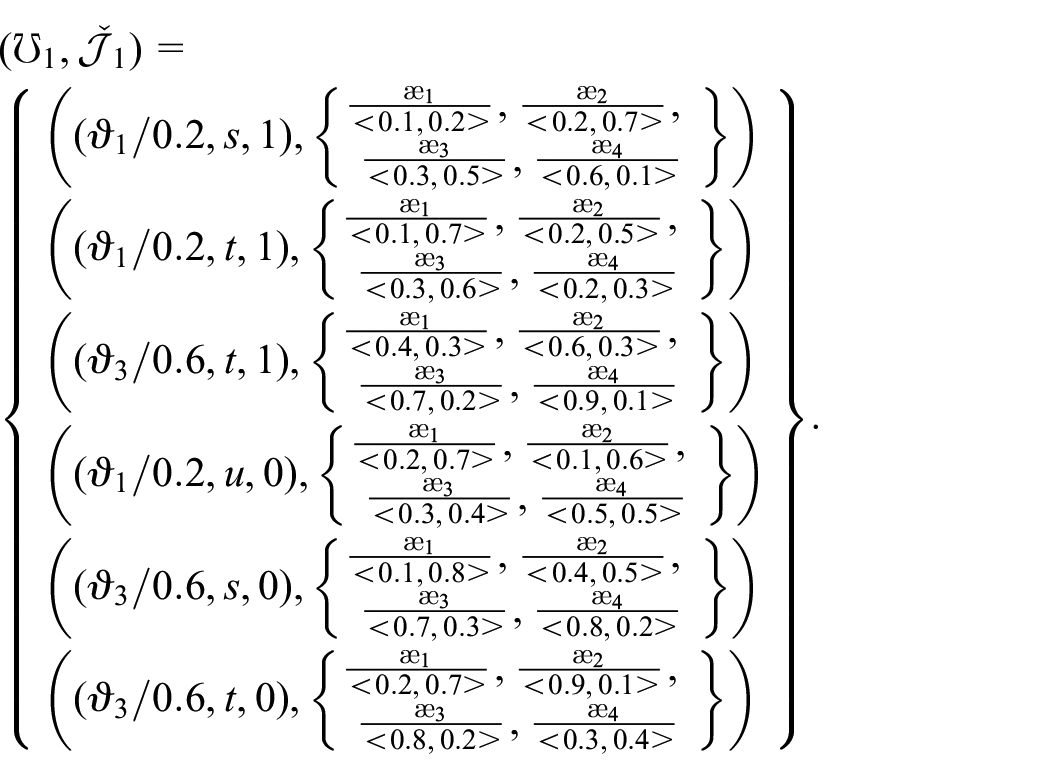


where s is s-norm.


Suppose

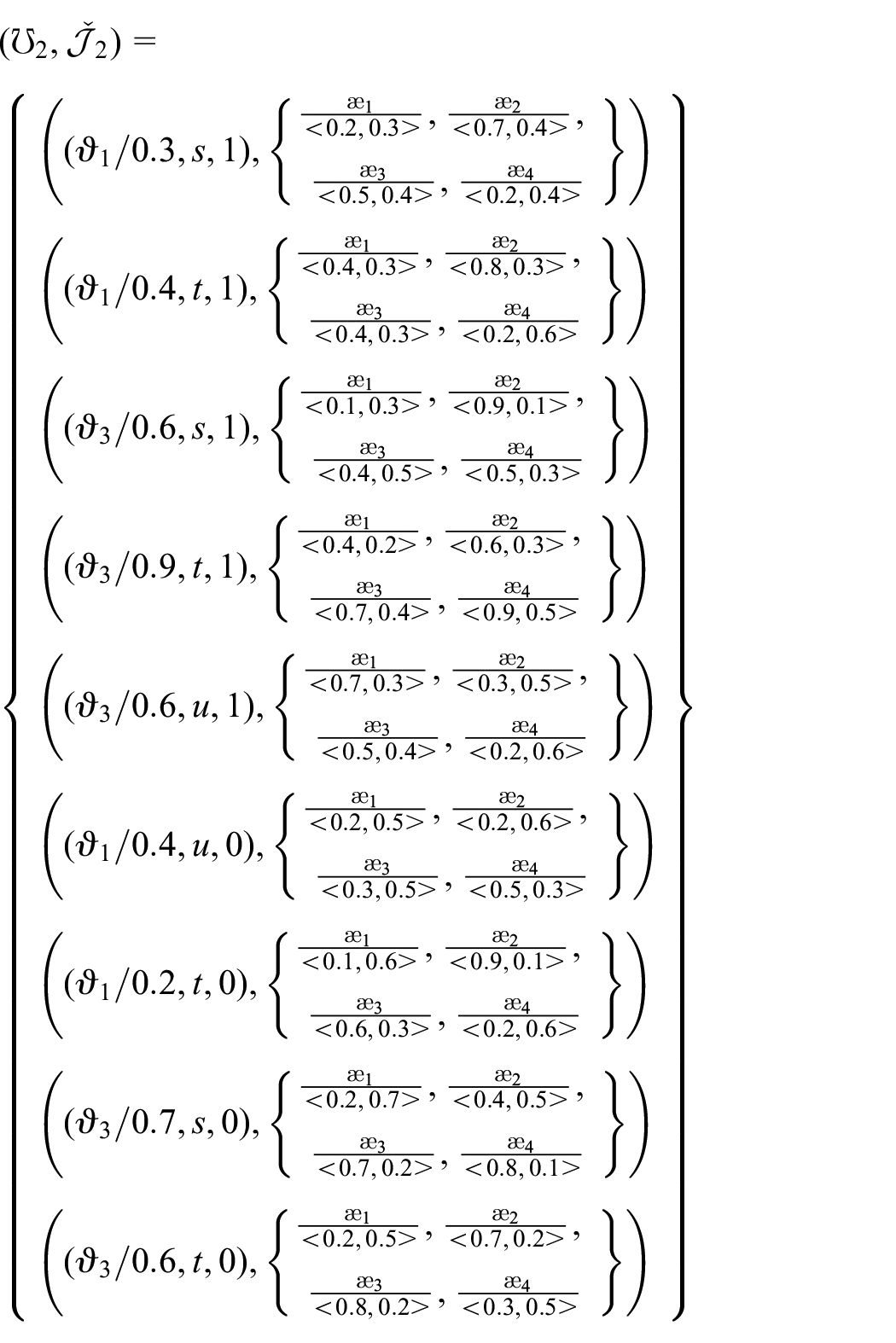
Then


where t is a t-norm.


Suppose
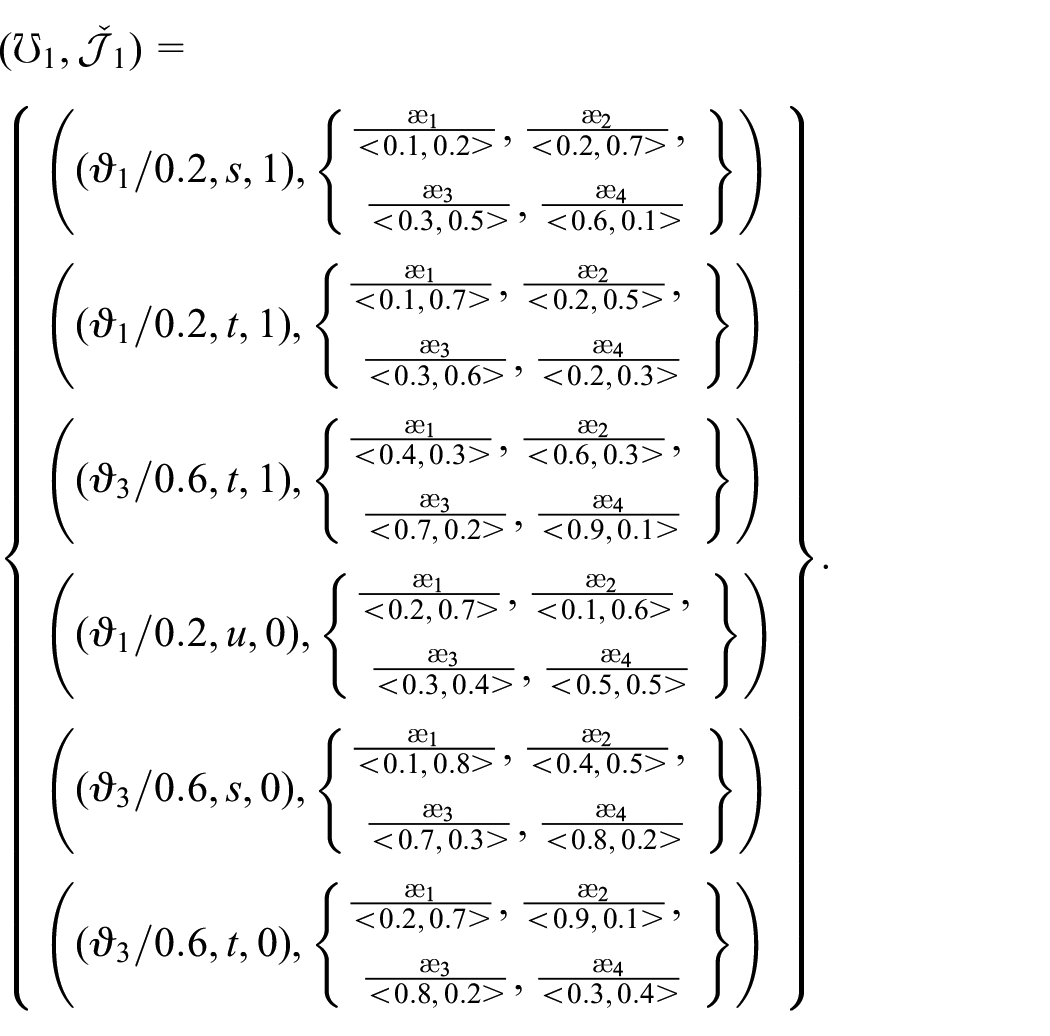

Then


Suppose

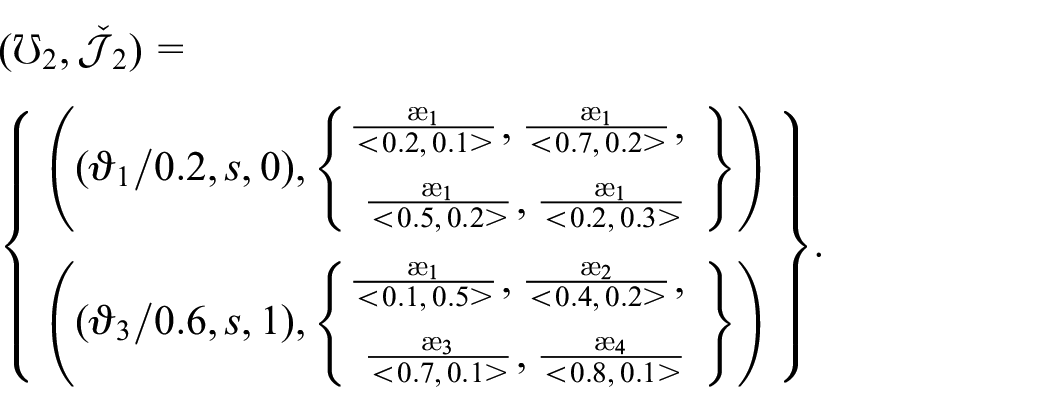
Then
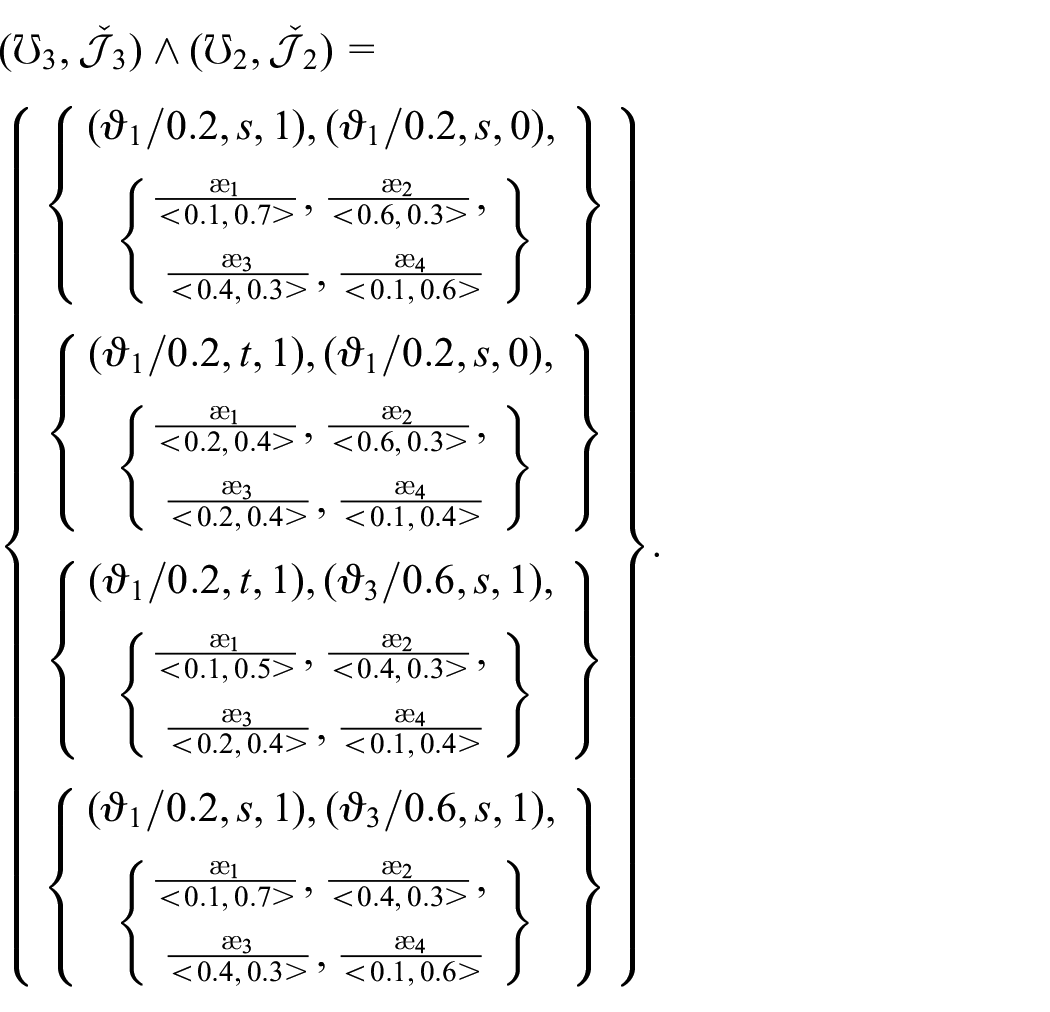


Then


Application to fuzzy parameterized intuitionistic fuzzy hypersoft expert set
In this section, an application of fuzzy parameterized intuitionistic fuzzy hypersoft expert set theory in a decision-making problem, is presented.
Statement of the problem
In product selection scenario, the purchase of an electronics device has become a challenging problem for an individual as well as for an organization. Many adults purchase a automobile numerous instances in the course of their lifetimes. A automobile is a prime purchase. Its charge may be as tons as or multiple year’s disposable income. Its annual running fees may be substantial, which includes the value of fuel, legally mandated coverage premiums, and registration fees, in addition to protection and possibly upkeep and storage (parking). A automobile isn’t always handiest a sizeable purchase, however additionally an ongoing commitment. In different countries, human beings spend a large amount of time of their cars, commuting to work, using their youngsters to high school and numerous activities, using to enjoyment and leisure activities, and so on. Most human beings need their automobile to offer now no longer best transportation, however additionally comforts and conveniences. Mr. John wants to purchase a car from a market for his personal use. He takes help from his friends (Stephen, Thomas and Umar) who have expertise in car purchase.
Proposed algorithm
The following algorithm is adopted for this selection (purchase).
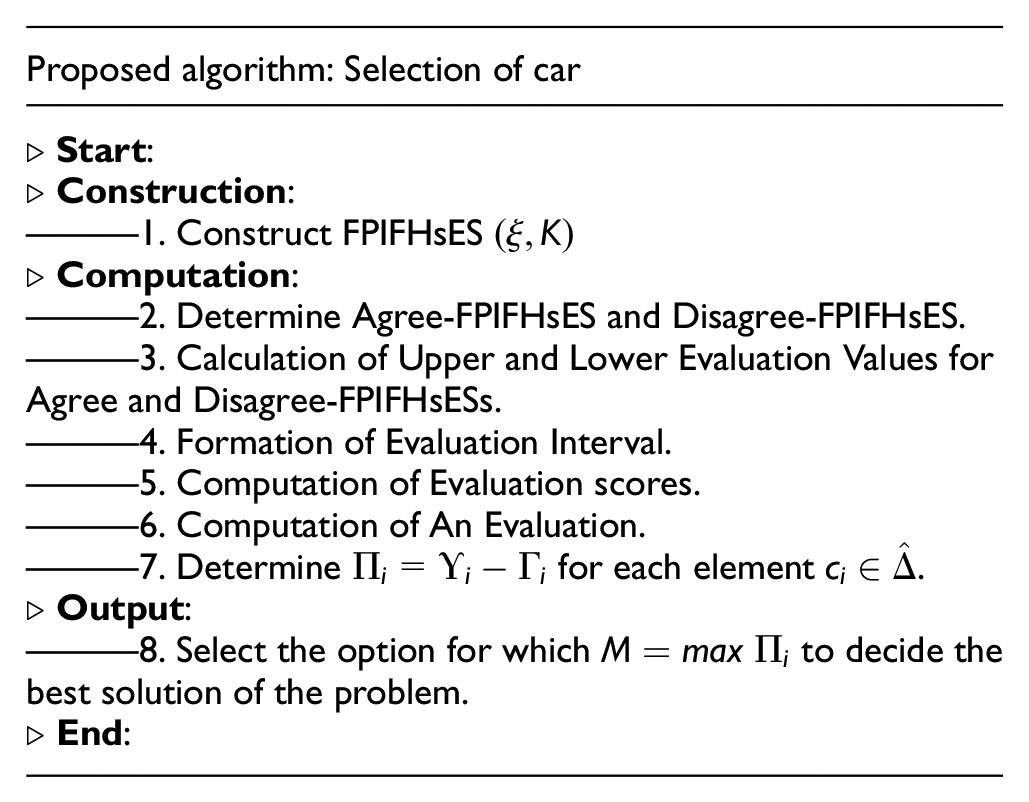
The pictorial representation of this algorithm is presented in Figure 3.
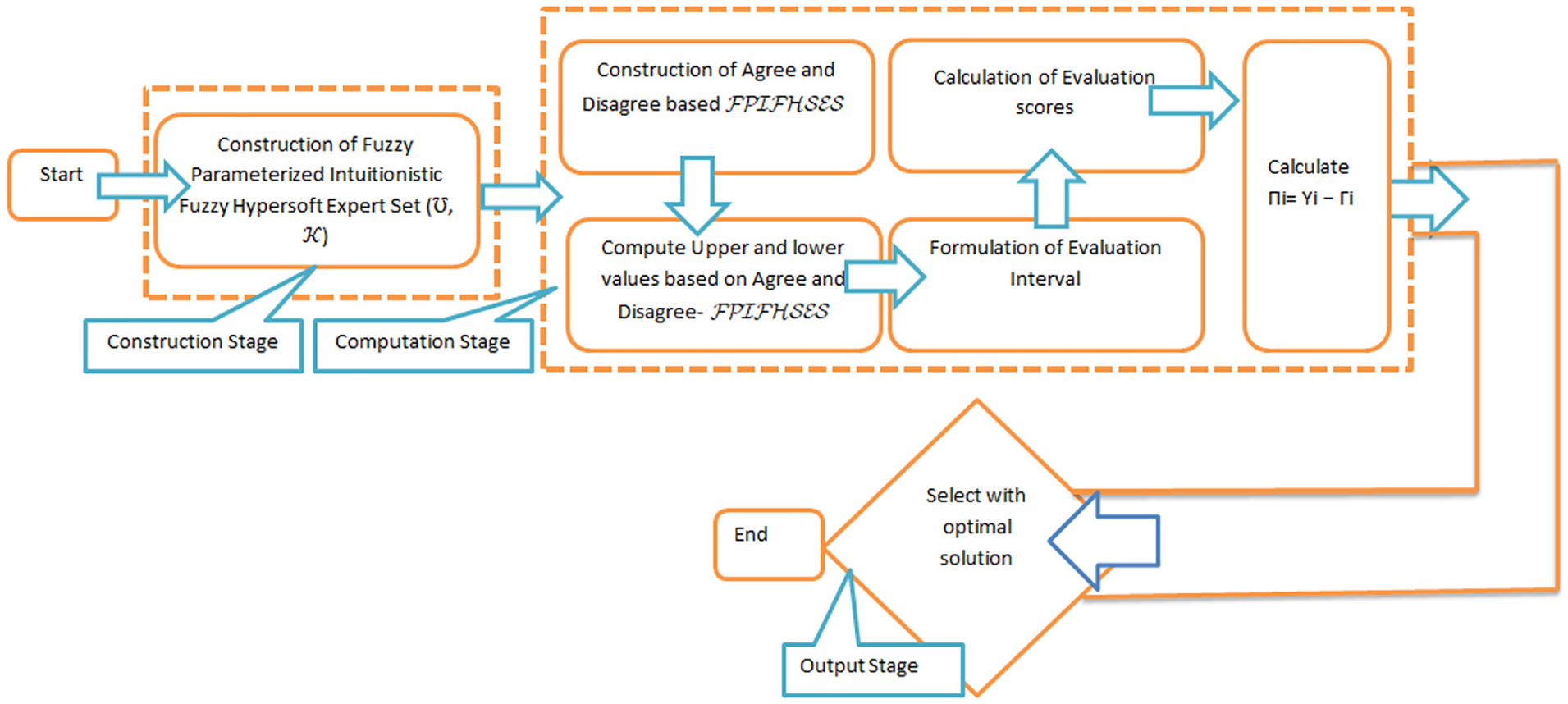
Flow diagram for algorithm.
Operational role of selected parameters
Engine capacity: The expression “cc” represents Cubic Centimeters or just cm3 which is a metric unit to gage the Engine’s Capacity or its volume. It is the unit of estimating the volume of a shape having a size of
Warranty: A guarantee is an assurance that you will not need to pay for any flaws inside that period. A new-vehicle legal guarantee covers you for quite a long time or 20,000 km, whichever starts things out. This guarantee will, as a rule, cover all bad things on a vehicle and is a legitimate necessity for vehicles underneath the extravagance vehicle charge edge of
Color: A warranty is a guarantee from the vehicle maker to amend deficiencies that might happen during the guarantee time frame and incorporates the two sections and work. One significant benefit of purchasing another vehicle is the guarantee, which generally covers you for a critical time frame and a drawn-out An enormous 85% of shoppers report color affects their choice to purchase a car. Regarding vehicles, they are not simply a type of transport any longer; the vast majority consider their vehicle to be an impression of their character. Our decision of vehicle color may be more established in science than we might suspect. Studies have shown those with left cerebrum strength are bound to be sensible and insightful. These individuals are probably going to be more influenced by viable contemplations while picking vehicle tone, for example, how well the vehicle will be found in obscurity and how much soil will show. Those of us with the right mental strength might be more natural and arbitrary in our choices. These individuals are probably going to be impacted by abstract elements, prompting more unconstrained shading decisions.
Price: The car business today is the most worthwhile industry. Because of the increment in discretionary cash flow in both rustic and metropolitan areas and simple money being given by every one of the monetary organizations, the traveler vehicle deals expanded at the pace of 25% per annum in June 2005-06 over the comparing time frame in the earlier year. Further rivalry is warming up in the area with a large group of new players coming in and others like Porches, Bentley, Audi, and BMW all set to wander in Indian business sectors. One variable that could help the organizations in the showcasing of their items is purchasing Behavior of the shoppers. The Buying Behavior of the clients can be examined by knowing their discernments about the vehicles on the lookout and about the potential contestants on the lookout. One such method is by knowing and making a character for the brands.
Mileage: While many human beings keep away from buying automobiles with excessive mileage due to the fact there’s a belief that they’re riskier and greater susceptible to issues, automobiles these days are designed to remain a long way longer. When you purchase a vehicle that already has excessive mileage, the depreciation curve has already flattened, and it’s going to now no longer lower in fee rapidly (the manner a brand new vehicle does). Additionally, due to the fact automobiles are intended to be driven, cars that have excessive mileage have a tendency to be well-lubricated and burn carbon buildup, each of which assists the engine to remain longer. In contrast, automobiles with low mileage frequently aren’t given fluid adjustments as frequently, which can create issues at a later time. The common vehicles withinside the different countries are around 12 years old, which places the common mileage at about 144,000. When you’re figuring out whether or not to buy a used vehicle, you need to compare now, no longer simply its contemporary mileage, but what number of greater miles you may be capable of placing on it to attain that 144,000 common. For example, if a vehicle has 100,000 miles, you could pressure it about four greater years earlier than you’ll attain the common mileage.

Engine capacity.
Application
Let three categories of cars are there which form the universe of discourse
and then

and now take

and


are FPIFHsESs.
Step-2: Construction of Agree and Disagree-FPIFHsESs
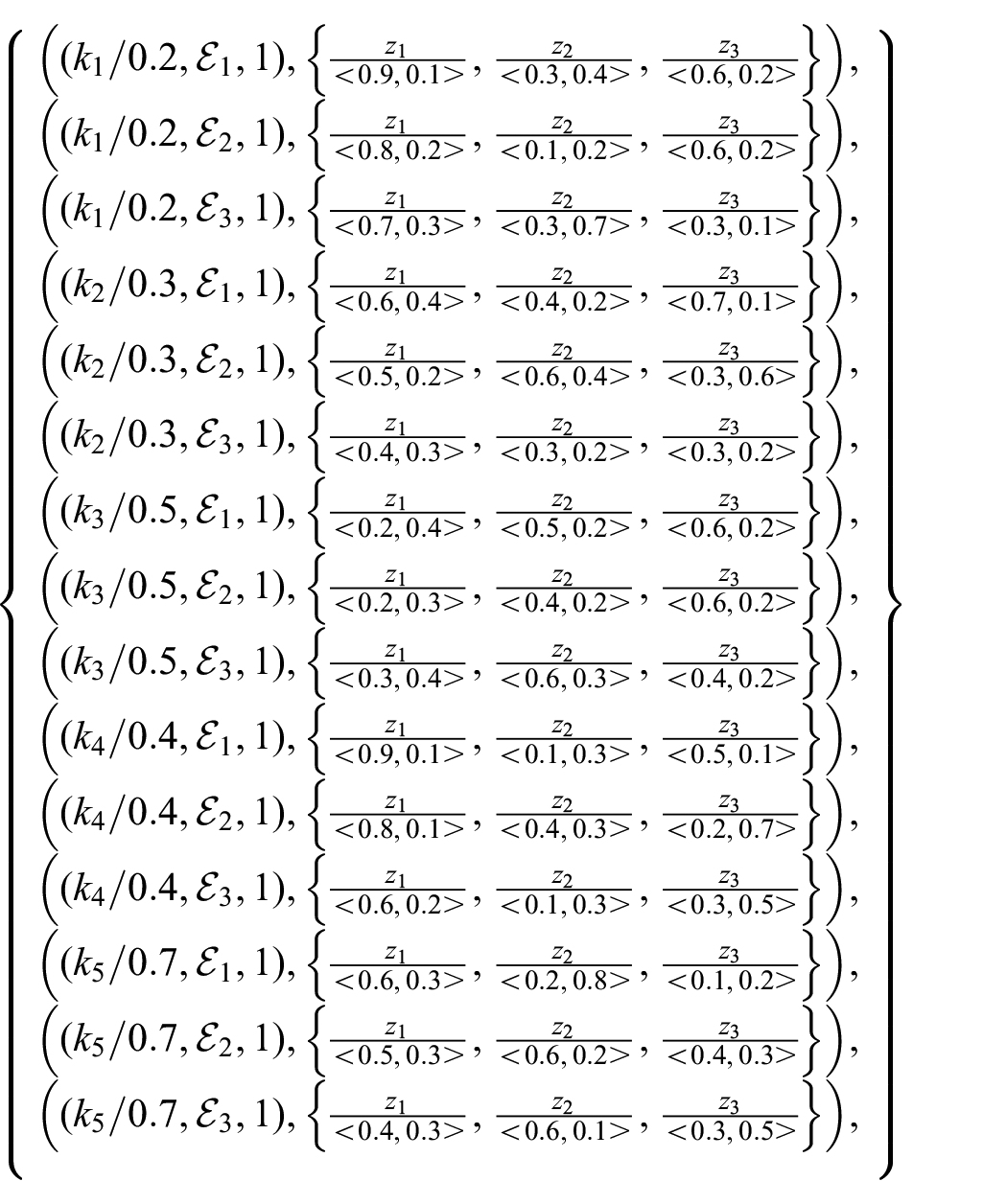
which is an Agree-FPIFHsES.

which is a Disagree-FPIFHsES.
Step-3: Calculation of Upper and Lower Evaluation Values of Agree and Disagree-FPIFHsESs.
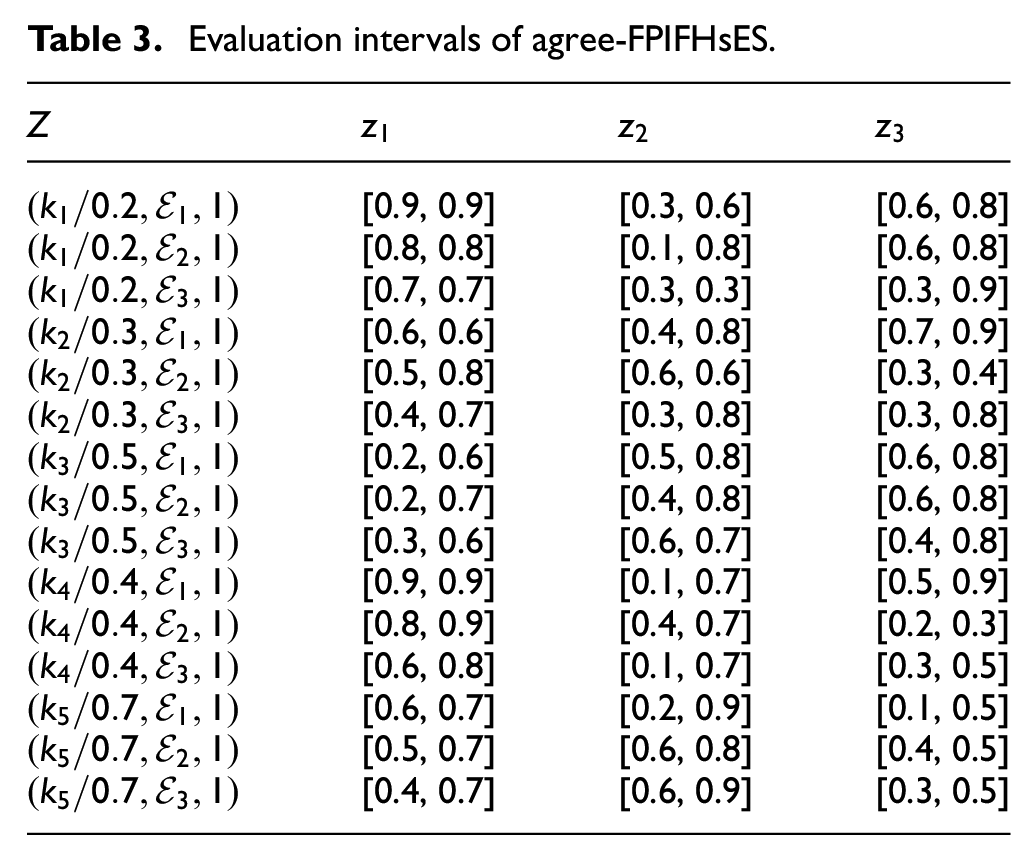
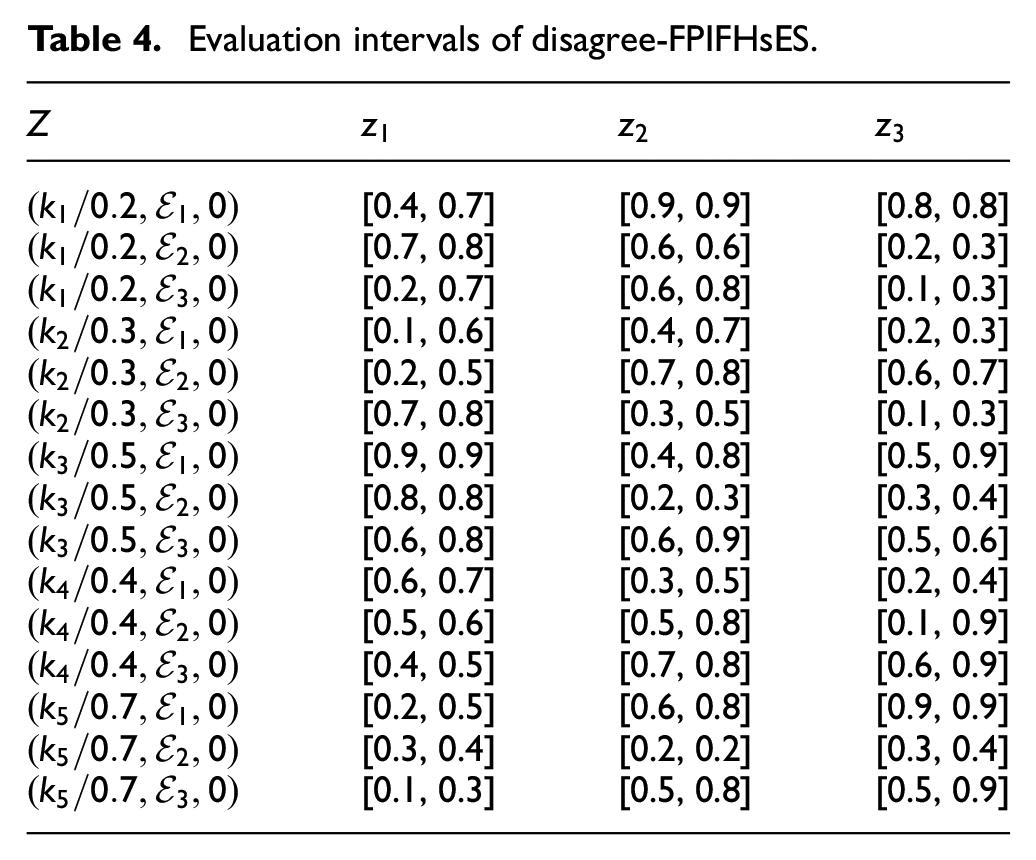
The formulation of evaluation interval, first we have to find the upper and lower evaluation values of
The lower and upper evaluation values of
Upper and lower evaluation values of agree-FPIFHsES.

Upper and lower evaluation values of disagree-FPIFHsES.

Step-4: Formulation of Evaluation Interval
Evaluation Intervals of Agree and Disagree-FPIFHsESs is calculated in Tables 3 and 4
Evaluation intervals of agree-FPIFHsES.
Evaluation intervals of disagree-FPIFHsES.
Step-5: Calculation of Numerical Grades.
we calculate the sum of
Sum of the membership values of agree-FPIFHsES.

Sum of the membership values of disagree-FPIFHsES.

Step-6: Calculation of Evaluation Scores for Agree And Disagree-FPIFHsESs.
In this step, we find evaluation score for Agree-FPIFHsES by as

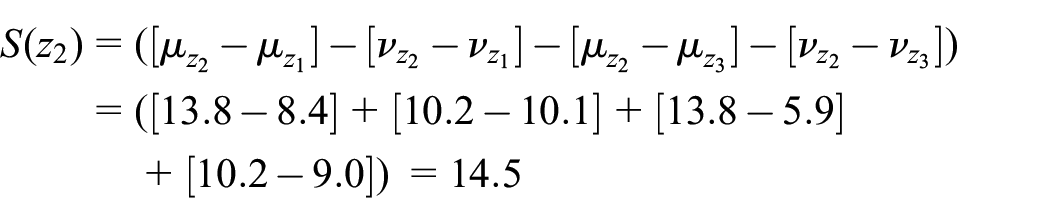

Now the evaluation score for Disagree-FPIFHsES is calculated as


Step-7: Decision
Ranking has been shown in Table 7.
Numerical values of

As
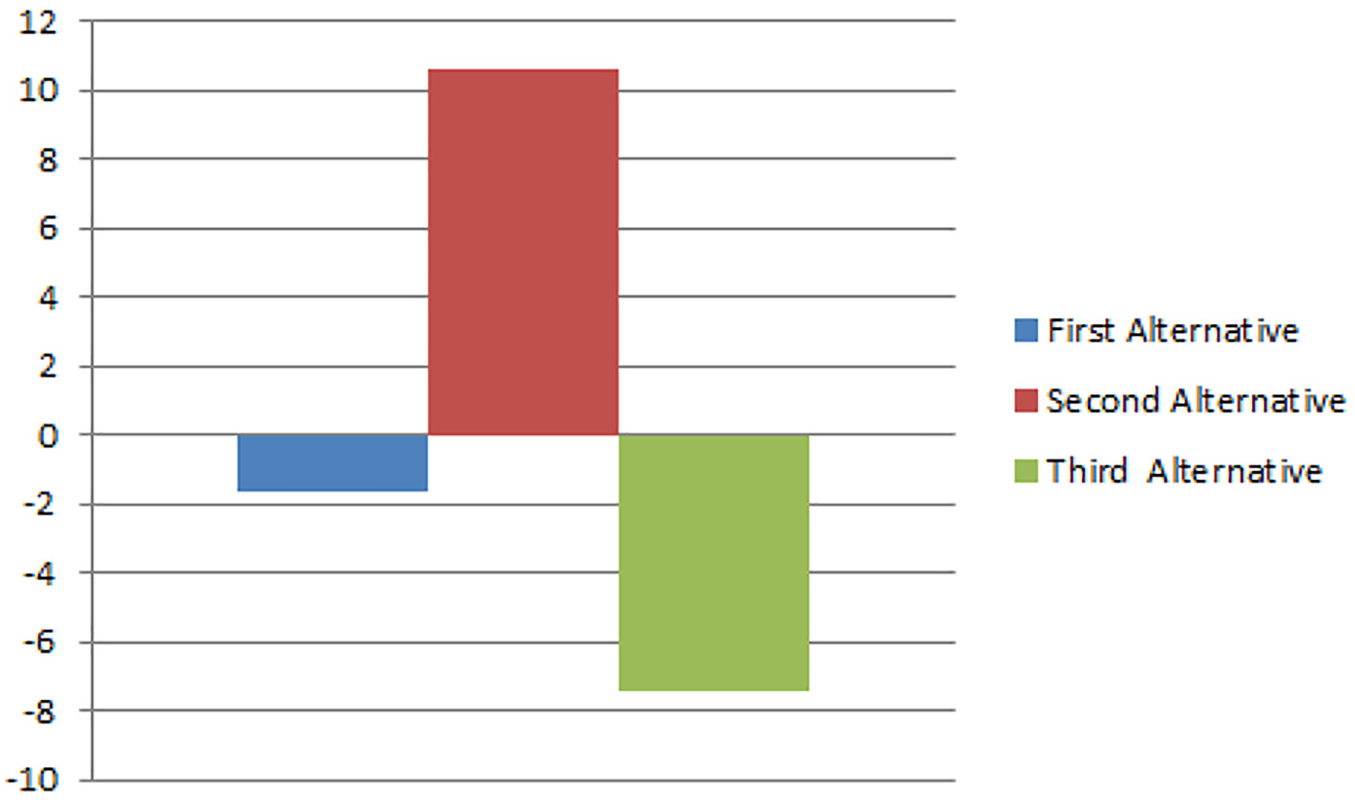
Ranking of alternative for algorithm.
Comparative analysis
A
Comparison analysis.

Discussion
Here a useful discussion has been made about this structure that is, fuzzy parameterized intuitionistic fuzzy hypersoft expert set.
It takes the form of fuzzy parameterized hypersoft expert set if membership and non-membership values are excluded.
It changes into fuzzy parameterized fuzzy hypersoft expert set if non-membership values are excluded.
It changes into fuzzy parameterized fuzzy hypersoft set if non-membership values and expert set are excluded.
It converts into fuzzy parameterized hypersoft set if membership, non-membership values and expert set are excluded.
It reduces to fuzzy parameterized intuitionistic fuzzy soft expert set if single argument approximate functions are used instead of multi-argument approximate functions.
It reduces to fuzzy parameterized fuzzy soft expert set if single argument approximate functions are used instead of multi-argument approximate functions and non membership values are excluded.
It reduces to fuzzy parameterized soft expert set if single argument approximate functions are used instead of multi-argument approximate functions and membership, non membership values are excluded.
It becomes fuzzy parameterized fuzzy soft set if multi-argument approximate functions, experts set and membership, non membership values are excluded.
It takes the form of fuzzy parameterized soft set when membership, non membership values, expert set and multi-argument approximate functions are excluded.
Fuzzy parameterized soft set becomes the soft set when fuzzy parameterization is excluded.
Advantages
Following are the advantages of FPIFHsES.
I The proposed method took the importance of the concept of parameterization along the IFHSES to cope with real-life decision-making issues. The parameterization taken into consideration, mirrors the opportunity of the lifestyles to the extent of acknowledgment and excusal; alongside these lines, this affiliation has excellent capability within the side the authentic depiction in the area of computational incursions.
II The present model points up the main study of parameters along with sub-parameters under the multi-decisive opinions, it makes the decision-making best, flexible and extra reliable.
III The proposed structure holds all the aspects and features of existing models like IFPHSS, IFPSS, IFPSES, IFHSES.
The following table shows the advantages of the this structure that is, FPIFHsES. In this table, FPIFHsES is compared with some characteristics of existing structures which are Membership value (MV), Non-membership value (NMV), Degree of parameterization (DOP), Single argument approximate function (SAAF), Multi-argument approximate function (MAAF), and Multi-decisive opinion (MDO). In the following Table 9 sign ↑ will be used for Yes and ↓ for No.
Comparison under particular characteristics.

From the Table 9, it is clear that our proposed model is more generalized than the above described models.
Conclusions
This paper is mainly aimed to address the limitations of literature to develop a mathematical model which may cope with scenarios having hypersoft setting, intuitionistic fuzzy setting and multi-decisive opinion based setting collectively along with fuzzy parameterization. Therefore the fundamentals of fuzzy parameterized intuitionistic fuzzy hypersoft expert set are established and some basic properties( subset, equal set, not set, agree, and disagree sets) laws pertaining this concept are commutative, associative, distributive and De Morgan and operations (complement, union, intersection, AND, and OR) are generalized. A decision-making application regarding the selection of the best product is presented with the help of proposed algorithm. Although the proposed model is more flexible and reliable as compared to existing fuzzy set-like models however this model has limitations regarding the scenario in which decision makers provide their expert opinions in the form neutrosophic setting that is, three dimensional opinions (truthness, indeterminacy, falsity). Therefore the future work may include the extension of this study to neutrosophic setting to address this limitation. Moreover, this study can easily be applied to other fields of study by adopting other appropriate decision-making techniques like TOPSIS etc.
Footnotes
Acknowledgements
The researchers would like to thank the Deanship of Scientific Research, Qassim University for funding the publication of this project.
Handling Editor: Chenhui Liang
Declaration of conflicting interests
The author(s) declared no potential conflicts of interest with respect to the research, authorship, and/or publication of this article.
Funding
The author(s) received no financial support for the research, authorship, and/or publication of this article.
