




Abstract
Studies indicate that gig workers, one of the leading groups revitalizing labor movements globally, have organized by diverging from traditional union strategies. How do they achieve this in diverse local contexts? Drawing on 21 months of international ethnographic fieldwork with gig workers’ unions in Seoul and Toronto, this article examines how and why these two unions develop different strategies for addressing critical crises. Comparative analysis reveals that while the shared labor process and the multinational parent company drive the unions toward new unionism, different worker subjectivities are emphasized by each union based on specific axes of oppression: working-class citizen men in Seoul and racialized immigrants in Toronto. These union orientations are linked to the unions’ distinct histories, including the biographies of founding members. My argument is twofold. First, to better understand rising gig workers’ organizing efforts around the globe, we must consider both global and local contexts. While gig labor processes push gig workers’ unions to move away from traditional union tactics, two key local factors—the workforce’s demographic makeup and union histories—shape their divergent models. Second, it is critical to understand the process of cultivating solidarity—not only building solidarity itself but also deciding which groups to be in solidarity within the local context.
Introduction
While gig workers are among the leading groups revitalizing the labor movement (Vandaele, 2018), studies of gig worker organizing have shown that traditional union strategies, such as collective bargaining, are limited in their ability to address gig workers’ unique labor concerns (Hadwiger, 2022; Johnston and Land-Kazlauskas, 2018). Most gig workers across the globe face similar structural challenges, such as misclassified employment status, and yet, their organizing strategies vary from region to region (e.g. Tassinari and Maccarrone, 2020). This raises the question—why do workers in different parts of the world develop distinct organizing approaches?
Answering this question requires transnational comparative studies, which are essential for uncovering the local dynamics of global trends, challenging the perception of globalization as natural, totalizing, and inexorable (Burawoy, 2000; Chun, 2009). Despite the global expansion of organized efforts among gig workers, most studies are still limited to a single country or continent. Significant research has centered on gig workers’ unions in European countries (e.g. Woodcock and Cant, 2022), while most comparative research has remained confined to a single continent (Muñoz and Martinez, 2022; Tassinari and Maccarrone, 2017; Webster et al., 2022).
In this transnational and transcontinental analysis, I examine how gig workers’ unions converge and diverge in their tactics, illuminating both commonalities and specificities in the locales where negotiation in the gig economy takes place (cf. Lee, 2020). Specifically, I examine two gig workers’ unions—Rider Union (RU) in Seoul, South Korea, and Gig Workers United (GWU) in Toronto, Canada—both of which have contested the same multinational platform, Delivery Hero. Despite similarities in their labor processes, these unions have employed divergent strategies in building solidarity among local workers. Using the lens of major crises (Lee, 2020) as a vantage point, this article first examines how the two unions’ responses to the COVID-19 pandemic make visible the common labor process that unites them as new unions. Second, it explores how their concrete approaches to crisis events differ as a result of the distinct, intersectional subjectivities of the workers in them. In the case of RU, working-class male citizens comprise the majority of workers, and so the union focuses on class, leaving the male category unmarked. Conversely, in GWU, highly educated but racialized migrant workers form the majority. Consequently, marginalized intersectional subjectivities are brought to the forefront of the union’s organizing strategies. The worker subjectivities emphasized by each union are closely linked to their respective histories and the biographies of their founders.
I define worker subjectivity as the type of worker subject shaped and constructed by specific social, political, historical, and power contexts rather than by individual workers’ identities. Foucault (1979) viewed subjectivity as “an effect of certain types of power” (p. 29), highlighting the mutual constitution between individuals and the social. Therefore, worker subjectivities are not the taken-for-granted self (Vallas and Hill, 2018) and are neither static nor fixed; instead, they are in motion within particular historical and political contexts. In my research, unions play a significant role in shaping workers’ subjectivities and the particular kinds of subjectivity constructed.
RU was founded by individuals with backgrounds in the labor movement, and so a narrow focus on class has persisted. In contrast, GWU’s initial members were mostly newcomers to labor movements. As a result, it has been less constrained by the traditional focus on class, enabling it to incorporate minority populations into broader, intersectional solidarity among marginalized groups. In short, RU constructed solidarity along narrow class lines, while GWU fostered broader intersectional solidarities among diverse workers. I refer to these two approaches as the “class model” and the “multiple marginality model,” respectively, based on the emphasized worker subjectivity.
My argument is twofold. First, to better understand rising gig workers’ organizing efforts around the globe, we must consider both global and local contexts. The gig labor processes shared by workers in the two cities push both gig workers’ unions, operating under the same multinational company, to abandon traditional union tactics. Yet, the two local factors, the workforce’s demographic makeup and union histories, play a crucial role in shaping their divergent models.
Second, I argue for the importance of understanding the process of cultivating solidarity. My findings show that each union developed divergent union models along either narrow class lines or broader intersectional solidarities. Worker solidarity must be constructed, as opposed to naturally arising, and unions play a significant role in not only building solidarity itself but also deciding which groups to be in solidarity with. The role of unions is underlined for gig workers due to their structural and social vulnerability, yet my global comparison highlights how each union differently overcomes those limitations in the context of their local factors.
This article makes two significant contributions to our understanding of gig workers’ resistance both globally and locally. First, it broadens our understanding of expansions in gig unionism by using global comparative ethnography (Burawoy, 2000; Chun, 2009) and integrating the “eventful comparison” approach of Lee (2020). Second, the findings enrich the literature on worker solidarity (Cranford, 2007, 2012; Creese, 1995), showing how union leaders effectively promoted social belonging among members by tailoring their approach to the different intersectional positions of local workers. In doing so, this article also highlights the significance of leadership in shaping labor discourse and forging worker solidarity.
Theoretical framework
The rise of new unionism among gig workers
Scholars have attributed the contemporary decline in union density within developed countries to structural changes, such as a flexible labor regime and financialization (Kollmeyer and Peters, 2019; Vachon et al., 2016). And yet, there is strong evidence that historically disadvantaged workers who were previously considered unorganizable——such as women, immigrants, people of color, and precarious workers—are revitalizing labor movements in both North America and South Korea (Chun, 2009; Cranford et al., 2018; Kang, 2023; Lee and Lee, 2017). Gig work is one of the sectors in which this revitalization is occurring, as attempts to undermine traditional labor protections through the reclassification of gig work have led to new labor unrest (cf. Silver, 2003). 1 Though gig workers face a number of obstacles to organizing, such as the lack of a shared physical workspace, high turnover rate, divide-and-rule tactics employed by management, and vulnerability to capital flight (Lee, 2023; Tassinari and Maccarrone, 2020), organizing efforts among gig workers are increasing worldwide (Chen, 2018; Chesta et al., 2019; Muñoz and Martinez, 2022; Tassinari and Maccarrone, 2020; Trappmann et al., 2020; Vandaele, 2018).
Perhaps the most significant obstacle to gig workers’ organizing efforts is that, in most countries, they are not legally recognized as traditional employees but rather as contractors. This hinders gig workers’ ability to access basic workers’ rights, which in turn hinders their ability to employ traditional union organizing tactics, including collective bargaining with their employers. As a decentralized, contingent workforce, gig workers lack structural power, limiting their ability to disrupt the workplace, and they lack the institutional power required to formally assert their rights within institutional frameworks for their employment status (Bessa et al., 2022; De Stefano, 2018; Schmalz et al., 2018; Vandaele, 2018). While definitions and regulations concerning collective bargaining in the gig economy have not yet been firmly established, even in successful cases, most collective agreements have been implemented with individual platforms at the enterprise level (Hadwiger, 2022). Further compounding these structural challenges, the nature of gig work is often not recognized within traditional trade unionism frameworks (Trongone, 2022).
Gig workers’ unionizing efforts have primarily followed two paths: new unions or traditional unions. While “new unions tend to be recently founded, small, politically radical, non-affiliated to national confederations, and with a militant and bottom-up approach to organizing,” “traditional unions tend to be long-standing, large, politically more moderate (social democratic), affiliated to national federations, and with a more moderate approach to organizing that is more likely to be directed by union officers” (Bessa et al., 2022: 10). Because they face unique labor conditions, gig workers are increasingly inclined to create new union models that diverge from traditional organizing approaches, and efforts to establish organizations that go beyond existing institutional boundaries (Trongone, 2022) are indeed on the rise.
Furthermore, Stinchcombe (1965) argues that new organizations are conditioned by the specific social and historical contexts in which they were founded—specifically, the political, social, and cultural resources available at the time. From this perspective, the new unions discussed in this article may be explained as the product of their founding contexts. This underscores the commonalities between the two cases where the gig workers’ structural conditions and their unconventional union leaders (self-organized grassroots gig workers) might have directed them to new unionism. However, a question still remains: why do these two unions develop different orientations? To delve into this question, I introduce the interplay between worker subjectivity and union strategies.
Following the definitions provided by Bessa et al. (2022), I use “new unions (unionism)” to describe the shared characteristics of the two self-organized groups discussed in this article, RU and GWU. Conversely, I use “traditional unions (unionism)” to refer to existing, mainstream unionism, which tends to rely on established institutional frameworks. Though both GWU and RU are affiliated with large public-sector trade unions in their respective countries—GWU with the Canadian Union of Postal Workers (CUPW) and RU with the Korean Public Service and Transport Workers’ Union (KPTU)—they exhibit distinctive differences from their parent organizations in both their histories and approaches. In addition, considering their grassroots origins and self-organizing, categorizing GWU and RU as new unions rather than traditional trade unions is warranted.
Diverse worker subjectivities and organizing strategies in gig work
Recent literature on gig work has established the importance of considering the social locations of workers, including how gender, race, ethnicity, class and citizenship status shape the complex constellation of work experiences. Specifically, research on the nexus of gender and gig work reveals the gendered subjectivities in the involvement in gig work and experiences with gender-based violence and gender-class dynamics that are uniquely experienced by women gig workers (Ma et al., 2022; Milkman et al., 2021; Penu et al., 2023). In advancing the class dimension, scholars have increasingly focused on the heterogeneity in economic dependence as a key factor in situating gig workers’ diverse experiences (Lee, 2023; Ravenelle, 2019; Schor et al., 2020). Because gig workers have varying degrees of economic dependency on platforms (for instance, some completely rely on platform labor for their livelihood, while others work with platforms on occasion), they experience their rewards, satisfaction, and precarity differently in the gig economy.
A growing body of literature highlights the heterogeneity in citizenship and migration status (Lam and Triandafyllidou, 2024; Maury et al., 2024; Orr et al., 2023; Van Doorn and Vijay, 2024). The consensus in this literature is that the migration border regimes are a key mechanism in making gig labor, forming the emergent precarity of migrants in the global North. While these multiple layers of heterogeneities are essential in the nuanced understanding of gig work, attention to heterogeneities in gig workers’ organizing has been scarce.
Scholarship on organizing efforts in the gig economy has focused primarily on the great variety of organizing forms, such as self-mobilizing, collaborating with trade unions, and alternative associations and cooperatives (Hau and Savage, 2023; Johnston and Land-Kazlauskas, 2018; Panimbang, 2021; Rafélis de Broves et al., 2024). In addition to the structural and institutional limitations discussed earlier (Trongone, 2022), scholars have examined key factors that affect gig workers’ mobilizing forms; sociopolitical factors, such as political traditions and environments, the local availability of support or coordination with trade unions, and legal and regulatory frameworks (Cini et al., 2021; Johnston and Land-Kazlauskas, 2018; Tassinari and Maccarrone, 2020; Trappmann et al., 2020).
The limited research that has addressed the connection between organizing and workers’ multiple positions has focused primarily on migrant workers. Workers’ abilities to engage in power-building strategies are closely linked to citizenship status and language proficiency, coupled with economic dependence (e.g. Mendonça and Kougiannou, 2024). Some researchers emphasize the involvement of migrant workers in unions (e.g. Lee, 2023; Però and Downey, 2024), but others underscore the limited involvement of certain migrant workers for their undocumented migrant status and high platform dependence (Mendonça and Kougiannou, 2024; Tassinari and Maccarrone, 2020). A few studies focus on the discursive strategies of gig unions, highlighting the difficulties faced by precarious migrant workers in seeking public support (Fernández-Trujillo and Betancor, 2022; Però and Downey, 2024).
However, we have limited knowledge about organizing strategies that engage with complex intersectional politics in the gig economy characterized by heterogeneity, where diverse workers are fragmented yet intertwined across the axes of class, gender, migration, and sexual diversity. How do gig workers’ unions decide which groups of workers to organize? Why, and in what local contexts, do gig workers’ unions develop different solutions to that question? To answer these questions, I introduce a new dimension: workers’ subjectivity in gig union strategies by bridging these two critical discussions. Examining global and local crises illuminates how unions address workers’ intersectional subjectivities in divergent contexts.
Methodological approach and methods
Crises as a method
In this study, I specifically build upon Ching Kwan Lee’s (2020) concept of “eventful comparison,” where “events are opportunities for knowledge that can be leveraged by the comparative ethnographer” (p. 158). Critical or disruptive social events enable researchers to better observe the prevailing “order” as it is brought to the forefront by such disturbances. Extending Lee’s insights, I consider multiple crises in Seoul and Toronto, including both a shared emergency and unique disruptions specific to each case. As deviations from the status quo, these crises serve as “signal junctures,” which Rhomberg (2010) describes as a “window or signpost that reveals ongoing structural tensions and opposing currents within otherwise continuous patterns” (p. 1854). Crises like the COVID-19 pandemic, as well as the economic and safety crises in Seoul and Toronto between 2020 and 2023, can be seen as signal junctures that connect local contexts to global trends through events propelled by global forces (Burawoy, 2000). As a critical method, “eventful comparison” takes advantage of moments of rupture to uncover the connected, hidden layers of the social structure. However, “eventful comparison” uncovers tensions that existed long before such crises emerged; the crisis only amplified their visibility, making long-standing tensions more discernible than before (also see Purkayastha and Roy, 2023).
Case and data
My research focuses on two local delivery gig workers’ unions: Rider Union (RU) and Gig Workers United (GWU), operating in Seoul and Toronto, respectively. GWU evolved from a union of Foodora couriers, Foodsters’ United (FU). My fieldwork began with FU, before it transitioned to GWU. In May 2019, CUPW and FU initiated a union drive together. However, mere months after the Ontario Labor Relations Board officially recognized Foodora couriers as dependent contractors, Foodora abruptly announced its departure from the Canadian market. This exit was perceived as an anti-union maneuver (Lee, 2023; Toronto Star, 2020). Following Foodora’s exit, some FU and CUPW members established GWU as an industrial union, organizing local couriers in February 2021.
RU was initiated by a few delivery gig workers in May 2019, marking the inaugural effort to unionize gig workers across food delivery platforms, including Baemin, in South Korea. It received official recognition from the Seoul Metropolitan Government in November 2019 and expanded into a national entity in 2020, establishing multiple branches beyond Seoul. RU has been actively involved in collective bargaining with various companies, including a large platform, CoupangEats (in 2021) and a local delivery agency, Baedareun Hyeongjedeul (in 2019). In March 2023, RU transitioned to a local chapter of the Korean Public Service and Transport Workers’ Union.
I chose these two field sites because both unions share the same parent company, Delivery Hero, providing an opportunity to explore how local dynamics shape gig workers’ unionism as a global phenomenon. As a multinational platform, Delivery Hero has subsidiaries around the globe. While Foodora, the Toronto subsidiary, exited the Canadian market following a labor dispute, Baemin, the South Korean subsidiary, has thrived, securing the biggest market share in the country and confidently negotiating with unions. Nevertheless, both unions have continued to organize workers. In addition, having lived and worked in both contexts for years informed my choice of field sites. This familiarity has allowed for close observation of the contexts, the development of rapport, and the cultivation of in-depth relationships.
The primary data for this article was gathered over approximately 21 months of fieldwork conducted in Seoul and Toronto between 2020 and 2023, involving participatory observations and in-depth interviews. In Toronto, my 11-month involvement began in May 2020, where I served as a volunteer member of an FU committee dedicated to establishing a platform worker-owned co-op, shortly after Foodora had ceased operations in Canada. This fieldwork extended until May 2021, encompassing periods with both FU and GWU and the transition between them. While a significant portion of my participant observation was conducted online, I also engaged in logistical aspects as a courier within the co-op steering committee. The core focus of this article is on GWU, as the majority of the data collected pertains to the transition to GWU and its subsequent initiatives. Honoring a request from a GWU organizer to refrain from including union meetings in my research data, the analysis solely draws upon insights gleaned from interviews with 40 individuals—union organizers and members and nonunionized delivery gig workers—and publicly available discourse.
My fieldwork in Seoul spanned 10 months, from June to December 2022, and then again between June and September 2023. During this time, I volunteered at RU, partaking in internal and external meetings, social gatherings, campaigns, and protests. Despite the shorter duration of fieldwork in Seoul, the relaxation of COVID-19 restrictions in South Korea enabled me to closely observe the union’s operations and its engagement with gig workers and various stakeholders in a natural setting. In addition, I conducted a total of 45 interviews with organizers, workers affiliated with the union and beyond, as well as local stakeholders from civil society and corporate entities.
For this article, all interviewees are referred to by pseudonyms. They were directly recruited through both online and offline platforms, introductions from existing interviewees, and online recruitment posts (e.g. in online communities catering to delivery couriers). Interviews with workers were guided by open-ended questions and focused on how the interviewees interpreted their work and work histories, as well as their current or previous union involvement. While interactions with Toronto interviewees were exclusively online, most of Seoul interviews were conducted in person. These interviews, conducted in Korean or English, spanned one to three hours and were recorded with consent. Subsequently, they were transcribed verbatim to ensure accurate capturing of meanings and nuances. Certain segments from the Korean interviews were selectively translated into English for use in this article.
Following each field visit and interview, I diligently composed field notes outlining interview responses and observations, including nonverbal interactions. In addition, I maintained analytic notes to document distinctive and recurring themes, enabling a deeper understanding of their interconnectedness both within and across cases. This process proved essential for analyzing the distinct challenges encountered by each union and their responses to these challenges. The interviews, field notes, and analytic memos were analyzed using NVivo software, leading to the identification of key themes, such as those related to COVID-19, safety issues, and the various types of union activities. Primary data was augmented with secondary sources, including news articles, union communications, and social media from 2020 and 2024.
Methodological reflection
There are two significant factors that influenced my fieldwork and should be taken into consideration. First, my fieldwork was conducted during the COVID-19 pandemic, which affected both the communities I was studying and my own data collection. COVID-19 was present during both field sites, but it progressed at different rates, and the Canadian and South Korean governments handled the problem in different ways. As a result, unions and gig workers were not affected in the same way in both places, and the pandemic restrictions led to significant differences in data collection for each case study. During my fieldwork in Seoul, pandemic-related restrictions were less stringent and extensive lockdowns were never implemented. Consequently, my fieldwork there involved more traditional methods, including observing union meetings and participating in street campaigns and social gatherings. In contrast, my Toronto fieldwork primarily took place online, although it did include involvement in helping with the delivery tasks for a co-op committee. These differences are also reflected in some of the secondary data, as RU was able to undertake a broader range of external activities than GWU during the pandemic, resulting in differing levels of media attention. However, other secondary data helped to bridge these gaps. For example, while my Toronto fieldwork was conducted at the height of the pandemic (2020–2021), I continued to gather media data post-fieldwork. Also, while the bulk of my Seoul fieldwork occurred after the pandemic’s first wave (2022), the data I collected encompassed participants’ reflections on the early pandemic period.
Second, my own positionality affected my relationships with workers in each context differently. Rapport and relationships are constituent factors of fieldwork, including the constructive aspect of positionality (Burawoy, 2009), where specific contexts and identities such as race, gender, and age influence a researcher’s interactions in field sites. As a highly educated South Korean international student residing in Canada and an Asian woman of color fluent in both Korean and English (as a second language), my positionality rendered me as an “outsider within” (Collins, 1986) at both sites. In Toronto, only one union leader was female, and the majority of members were white. In Seoul, most union members, including the leaders, were men. Even though I am a Korean myself, I encountered significant differences between my life experiences and those of middle-aged Korean male delivery workers. My experience as a woman of color and a newcomer to Canada was also different from most union members in Toronto. My intersectional positionality indicated that I did not seamlessly fit into either field.
Upon commencing my fieldwork in Seoul, I came to realize the significance of the “ethnographic toolkit” (Reyes, 2020), encompassing both visible and invisible tools that I bring into the research environment, including social capital and background. These tools played a crucial role in shaping field dynamics, at times even more so than my intersectional positionality. My familiarity with the practices and language integral to South Korean activism and civil society, gained from my previous involvement in South Korean social movements and networks, proved invaluable. This background greatly aided me in establishing rapport with RU members and navigating the research field. However, during my Toronto fieldwork, I had limited lived experience in Canada. Consequently, my ethnographic toolbox for Canadian contexts was narrower, with less ingrained knowledge of a shared culture to facilitate rapports. This limitation was compounded by reduced opportunities for informal interactions due to COVID-19 restrictions.
The comparative experience added complexity to my relationships within the field sites, shaping the interplay between my intersectional positionality and ethnographic toolkit. The diverse array of ethnographic tools, intertwined with the researcher’s capacity to interpret data through both tacit and formal knowledge (Reyes, 2020), underscores the importance of acknowledging the disparities in time, place, and the ethnographer’s relations within the field sites.
Organizing crises
The section examines similarities and differences in how RU and GWU organized themselves as new unions influenced by their specific local contexts. Both unions positioned themselves as advocates for gig workers, particularly amid the insufficient support provided by governments and companies during the COVID-19 pandemic. However, unique local dynamics—specifically, the demographic makeup of workers and union histories—informed their orientations. While GWU focuses on broader intersectional worker subjectivity, especially among racialized migrant workers, RU emphasizes a working-class male identity among delivery workers. These approaches are shaped by each union’s distinct history, specifically whether the leaders were from labor backgrounds and relatively uniform identities or held diverse experiences and identities.
New unions faced with crises
While many individuals refrained from going to workplaces and restaurants during the COVID-19 pandemic due to safety concerns, delivery workers continued to work on the front line as “essential workers,” delivering food and providing other important reproductive labor. Couriers faced heightened COVID-19 exposure risk because the nature of their work required interacting with multiple individuals per shift. However, because gig workers are categorized as independent contractors in Canada and as “special employees” in South Korea, they were excluded from many of the emergency measures implemented by both platform companies and the Canadian and South Korean governments in response to the pandemic. While labor misclassification is a central issue of gig work in general (Cherry and Aloisi, 2016; Dubal, 2019), the vulnerability of gig workers was starkly exposed during the pandemic. However, this time also highlighted the significance of RU and GWU as new unions.
RU showcased its new unionism by quickly formulating specific demands, urging companies and governments to implement preventive measures for gig workers, including safety protocols, dedicated vaccine sick days, and the supply of protective equipment (PPE). Their rationale emphasized the unique exposure risk that delivery work entailed, but it was also based on a belief that “if such measures were offered to ordinary employees, they should also be extended to delivery workers” (Hyun-Koo). An organizer at RU Hyun-Koo took the example of vaccine sick days, temporary paid sick days applied to those experiencing side effects from COVID-19 vaccines, to describe the couriers’ unique risks and the need to be entitled to the same protections as everyone else:
If it [vaccine sick days] applies to ordinary office workers, we argued, “riders also need it,” and the company accepted it. We made our demands based on the standards of general society. . . . It was when [the platform] companies, we, and the government had no idea what to do. But at least the government presented guidelines and that didn’t apply to us. So, when those guidelines came out, we asked for them to be applied to us. It’s making the protection universal. (Hyun-Koo, RU organizer and courier)
Sang-Hoon, another courier and RU organizer, highlighted in one of his newspaper contributions that vaccine leave was a critical issue for gig workers, who feared that vaccine side effects would make them unable to work. Many full-time delivery workers feared getting COVID-19 vaccines due to the necessity of making payments for leased motor scooters—their main means of labor—regardless of whether they were working or not. 2 Sang-Hoon noted: “It is neither fair nor just to bear the side effects of vaccines differently based on job and class” (Park, 2021a), echoing Hyun-Koo’s argument that COVID-19 protections and support must be distributed fairly across the labor force, including gig workers.
These rapid actions (including organizing the first online press conferences in Korea), yielded positive outcomes: As Sang-Hoon recounts,
“In fact, the Ministry of Employment and Labour sent us masks [following the press conference], almost in excess—it was challenging to manage, nearly the size of a shipping container. We addressed these issues promptly, resulting in some tangible outcomes.”
In addition, Baemin, the biggest platform in South Korea, introduced a temporary and one-time paid sick day for vaccinated couriers, a policy subsequently adopted by several other platforms.
While Seoul’s economy remained open during the pandemic, Toronto imposed stringent lockdowns. Arnold, an organizer and courier at GWU, described the impact the unfolding situation had on gig workers, from “very small things that you don’t even think about affecting our job” to “big ones,” including all the restaurants closing, which was a scenario many had not anticipated. As the pandemic progressed, couriers encountered various, new work-related challenges, such as restricted restroom usage, extended unpaid waiting times at restaurants, sudden changes in delivery types (like heavy grocery loads, resulting in physical strain), and the economic repercussions that accompanied these events.
Justin, who had been a union activist since FU times, shared that organizers were heavily occupied during the COVID-19 emergency initiative, reaching out to “every single gig worker on the fleet” to assess the pandemic’s impact on them and inquire about their needs concerning health, safety, and wages. Zoe, another organizer, detailed the transformations that the union underwent amid the pandemic:
The union changed a little bit when COVID-19 came to Toronto because, I mean, we overnight become essential workers, and so without any PPE, or that comes along with that. That changed the union and put the union in the sort of position of, like, our work in our jobs has to be keeping people alive, right? You have the folks who can’t take the risk of working but who, for various reasons, do not qualify for CERB [Canada Emergency Response Benefit]. And then you have the folks who are going to continue to work. How can you keep them safe while they’re at work? (Zoe, GWU organizer and courier)
The federal government introduced the Canada Emergency Response Benefit (CERB) to offer financial assistance to individuals directly impacted by COVID-19. Initially, there was notable confusion surrounding CERB, particularly regarding the eligibility of independent contractors. Advocating that the benefit be expanded to encompass a broader spectrum of workers, including gig workers, became one of the union’s central efforts. Eventually, the government agreed to extend CERB coverage to include precarious workers, including gig workers, and leaders in GWU organized informational Zoom sessions to assist eligible gig workers in accessing this support.
At the same time that couriers and union organizers were navigating the pandemic, they were struck by another significant crisis—the departure of Foodora, the employer around which they had been organizing. Foodora announced its exit from the Canadian market in April 2020, when the demand for food delivery services was at an all-time high (see Lee, 2023). Zoe reflected on this event, noting that “because they left during the pandemic and the pandemic had already started at that point, [it] just heightened that [the economic uncertainty] to an extreme degree.” She began collecting hiring information from other platform companies and sharing it with gig workers who were seeking alternatives after losing their jobs at Foodora. This turn of events transformed the union into “this very survival-based [thing],” driven by the economic urgency stemming from this dual crisis, Zoe mentioned.
While both new unions played a crucial role in supporting gig workers grappling with the challenges of the pandemic, their approach went beyond the scope of traditional unions by focusing on organizing local couriers who fell outside the social safety net. The actions taken by these unions during the pandemic closely mirrored those of essential workers, as noted by McCallum (2022): mutual aid networks (providing resources or services to workers), self-defense (ensuring worker safety in unsafe working conditions), and social justice strikes (linking workplace demands to social justice). Both unions undertook great efforts to discover available resources and share them with gig workers, exemplified by the advocacy for CERB funds and the dissemination of hiring information (mutual aid networks). Given that gig workers often have minimal resources, this advocacy played a pivotal role in securing the benefits they received. Union organizers also gathered evidence and safety demands from workers and conveyed them to company and government officials (self-defense). Without the support of the unions, gig workers would have been further marginalized and neglected in the broader discourse surrounding the pandemic. In this sense, the unions invented demands that might not have been addressed otherwise. Significantly, the pandemic revealed that labor justice is linked to social justice more broadly.
Two approaches to building solidarity in new unions
In this section, I analyze how UR and GWU employed different strategies for building solidarity during crisis events based on their unique histories and social contexts. In Toronto, gig workers were confronted with the dual challenge of the COVID-19 pandemic and Foodora’s departure from the Canadian market. In response, GWU built solidarity among workers across differences in their intersectional identities using the multiple marginality model, rooted in the experiences of marginalized workers. This approach is shaped by the union’s founding by a group of diverse couriers who were not bound by a singular perspective on unionism. Because these workers did not share a unified perspective and most were not from labor movements, they began learning the fundamentals of organizing through a workshop conducted by the Industrial Workers of the World after coming together as a group (Gray, 2022). In Seoul, gig workers grappled with day-to-day concerns of both industrial safety and societal stigmatization. As a result, RU concentrated on external communication efforts to advocate for the social inclusion of stigmatized, working-class male couriers. With leadership coming from labor movement backgrounds and shared gender and ethnic identities, RU’s class model prioritized class consciousness among gig workers who were mostly from the same racial and ethnic background—Korean male citizens. The following analysis underscores how each union orientation is deeply embedded within unique local contexts, particularly the nature of workers’ marginalization and union history.
Gig Workers United in Toronto: a multiple marginality model
GWU’s intersectional approach to union organizing is clearly stated on their website:
“Migrant workers, women and trans people, and racialized people are disproportionately affected [by] the exploitative working conditions in the gig economy. As a union and a community, we intentionally uplift precarious workers to be leaders in our union. We acknowledge that a worker is anyone who completes deliveries on an app platform; whether they do that on their own account—or someone else’s. All of you may claim space within our union.”
3
(GWU website)
As the above quote shows, GWU’s union activism is geared toward empowering minorities and fostering solidarity among various segments of the workforce: migrant workers, women, and sexual and gender minorities. GWU’s initiatives aimed to enable these workers to “claim space within the union” in response to both the pandemic and the impact of Foodora’s exit from the Canadian market. Their emphasis on creating communities can be viewed as radical care work.
Minority but critical: “fight for the marginalized people that tend to do this type of work.”
Zoe candidly shared the challenges she encountered as a female courier, expressing her reservations about the predominantly male courier community and union. After connecting with one another, Zoe and another female courier initiated plans to establish a dedicated union committee for women and transgender members. Zoe highlighted the significance of gig work for nonbinary and transgender couriers, noting that it entailed less public exposure, allowing them to work while transitioning. She emphasized “the importance of pulling [into the union] people who are not like white men, just everybody else who works this job, and statistically, we all make up a bigger proportion than just the white men.”
While the pandemic entailed challenges for all delivery workers, socially marginalized workers were often disproportionately affected. For example, during the pandemic, public washrooms were mostly closed and restaurants closed theirs to delivery workers. Arnold raised a critical point about the gendered aspect of this issue at a rally outside the Toronto Uber office in March 2021, highlighting the disparity faced by female couriers who lacked alternative options: “You can’t go to the washroom. I am a man, so I can go in the alley, but a lot of couriers are women, they cannot do that. The city does nothing. And Uber doesn’t care.” When asked about GWU’s approach to amplifying the voices of minority workers, including women, LGBTQ individuals, and migrant workers, Arnold emphasized: “Your biggest membership is those groups. The big majority of them are not straight white men. So yeah, if you only focus on the one group that is the minority, then how do we achieve goals?” He elaborated on why he believed organizing marginalized workers was integral to the union’s success:
I think being able to. . . build a community is much more than just “Okay, I only care about my gig.” But being able to say, “Oh, yeah, I’m a gig worker but I’m also an immigrant.” You build more power by, you know, like joining forces with your other communities because there’s a lot of times when we’re doing our thing, we need allies from the general public, it would be so much easier. (Arnold, courier and organizer)
Acknowledging the diverse identities of gig workers allowed GWU to build and strengthen their collective influence, fostering mutual support while recognizing intersectional realities. This approach was an effective strategy to galvanize the union and make it mirror the workplace, which is characterized by heterogeneous identities. Colin further underscored that gig work is inherently intertwined with broader social concerns:
We have to, perhaps, go nationwide, perhaps stay local, but continue to fight the fight that we’re doing. You know, continue to raise the consciousness of people that do this job, I continue to fight for the marginalized people that tend to do this type of work. You know, it does the job itself, but it ends up being tied to migrant workers, nonresident people, and all these social issues. (Colin, courier and organizer)
As Colin’s remarks show, GWU organizers were mindful of these circumstances and the underlying factors fueling the gig economy’s expansion, particularly in their local context. The presence of highly educated migrants or sexual minorities within the gig economy is attributed to their encounters with discrimination in the traditional labor market in Canada. In fact, migrants and individuals from racialized backgrounds constitute the majority of gig workers in Canada (Lam and Triandafyllidou, 2024; Lovei and Hardy, 2024). Thus, gig work is “an integral component of migration infrastructures” (Van Doorn and Vijay, 2024: 1129), on top of the systemic discrimination faced by racialized migrants in Canada (Banerjee et al., 2018; Creese and Wiebe, 2012). Indeed, I observed a significant presence of highly educated migrant workers engaged in gig work in my Toronto sample, which contrasts with the situation in Korea, where noncitizens represent only a minority of gig workers—they are increasing but remain largely invisible. 4 The substantial impact of the pandemic and the exit of Foodora on this specific group of workers in Toronto was anticipated, especially considering that many dependent Foodora couriers in my study were recent migrants.
Jaxon, an early FU member, noted that although the initial group was “pretty much a boys’ club,” there was a mandate to ensure the anti-discrimination initiatives within the union, particularly raised by a few women members (including Zoe). Throughout conversations with GWU organizers, it became evident to me that the union’s leadership displayed a strong commitment to addressing race- and citizenship-based discrimination prevalent among gig workers. This was the case even though most of the union leaders were white (including Zoe and Colin), part of a leadership group composed of both women and men from racialized backgrounds as well as those of white descent. Some of the early union members I spoke with viewed these “identity politics” as unnecessary or even counterproductive, as it did not align with the perceived interest of “most of the couriers,” indicating plural perspectives within the union. This implies that because GWU organizers were diverse and most leaders did not come from labor and social movements, various perspectives on organizing emerged within the union rather than a singular approach. Nonetheless, my findings indicate that the union organizers, at the time of the interview, aimed to cultivate an inclusive environment for socially marginalized workers. 5
Union activism as radical care work
In June 2021, at a university-hosted virtual event that she was invited to speak at, Zoe introduced GWU’s activities and stated that “caring about workers, it’s very much care work.” This care manifested through various initiatives during the crisis, such as a grocery box campaign, a hardship fund, and virtual and in-person social events, sometimes put on in collaboration with local communities and organizations. Below, Zoe further illustrates one of the most notable aspects of GWU’s approach to building solidarity among workers—mutual aid initiatives. Reflecting on the mutual aid projects she and others undertook in the wake of Foodora’s exit, Zoe noted that:
It was a tangible thing that people could see. Because in times of hardship, when we work to meet our community together, it’s meaningful, and so it has actually brought a lot of people to the union, people who want to say like a community, people who are trying to make each other’s lives better. (Zoe, courier and organizer)
Zoe’s interview resonates with Spade’s (2020) concept of mutual aid as a form of care work, which represents radical political involvement. Although mutual aid is often devalued as an alternative to eliciting meaningful transformation, it “is a form of political participation in which people take responsibility for caring for one another and changing political conditions” (Spade, 2020: 136). As care work, mutual aid inspires union members’ active engagement in the political sphere and the social movements in it, which aligns with community-based labor organizing (Cranford and Ladd, 2003).
Jamal, a GWU member, noted that GWU’s grocery boxes were a substantial support system and a motivating factor for his active involvement in the union, a perspective echoed by various other union members, including (notably) many recently arrived immigrants. Jamal also delivered grocery boxes to fellow union members during the time of the interview, exemplifying his commitment to the union. Similarly, Mia, a union member with a temporary work permit, took great pride in her role as a dedicated union member and found fulfillment in coordinating the distribution of grocery boxes. These instances underscore the role of care work and mutual aid in fostering community bonds and shaping union practices. This was particularly crucial for these workers amid health uncertainties and abrupt job losses brought on by the pandemic and compounded by Foodora’s departure.
Several GWU members explicitly expressed feelings of belonging within the union, with Paul mentioning, “the union helps other gig workers to see there is hope, there is a sense of belonging,” and Jad stating, “Not just like food or money, but support, as in even emotional support . . . You have a community to support each other.” These sentiments were particularly relevant for migrant workers who lacked resources and an established community, as Jamal explained:
I’m a newcomer, I don’t have much of a connection. So, it helped me to expand my connection, making some friends. And to feel that I’m supported by someone, so if something went bad with me and I need to find another job or some sort of income or some sort of help, I felt that if someone can help me. (Jamal, courier and union member)
Another union initiative frequently mentioned by interviewees was the array of social events it organized, such as at bonfires, picnics, swimming parties, post-work meetups at bars, and informative workshops on taxes or bike repair. Arnold emphasized that gig work often lacked opportunities to meet co-workers, but the union provided him with the chance to connect with other couriers in person. Many interviewees shared their experiences of loneliness as couriers; sometimes, they had no opportunity to speak a single word to anyone during a shift. For them, social events and gatherings were valuable aspects of the union’s care work.
GWU’s radical care work, as exemplified in its mutual aid programs and social events, represents a form of political advocacy (Spade, 2020). This effort creates a space where gig workers, particularly those with limited resources and working in isolation, can assert their rights as workers and citizens. By empowering workers facing discrimination based on race, ethnicity, and gender identities, GWU fosters a tangible, local community through what can be referred to as a multiple marginality model. This model has the potential to support workers facing intersecting forms of discrimination while driving change in their political conditions.
Practices that foster community and politically empower workers were also observed within RU, including “eating gatherings” for socializing in small groups, annual retreats where local leaders convened to deliberate on union affairs, and volunteer activities. However, the worker subjectivity represented within and cultivated through these initiatives primarily comprised a homogeneous group of gig workers—predominantly working-class males—setting them apart from GWU’s emphasis on multiple, diverse identities.
Rider Union in Seoul: a class model
This section focuses on RU’s expansive communicative initiatives in challenging public stereotypes portraying delivery workers as social outcasts or “outlaws on the road.” While GWU’s public activism in public spaces and legal arenas also undoubtedly contributed to their cause, as documented in the media (Balintec, 2022) and mentioned in the interviews—for instance, when Arnold spoke about the rally against Uber—RU’s undertakings toward external actors particularly stress the worker subjectivity constructed by the RU’s organizing strategy.
RU’s activism involved an extensive use of both analog and digital communication tools, including YouTube channels, online cafés, official statements condemning platform companies and government actions, and press conferences resembling small protests. RU’s significant activities were directed toward external actors, such as unorganized gig workers, corporations, government bodies, policymakers, journalists, civil society groups, and the public, akin to “communicative unionism” (Però and Downey, 2024) that emphasizes diverse communication strategies to engage a wider audience.
The daily safety crisis: “the most dangerous industry in Korea.”
In South Korea, a substantial portion of the gig economy, comprising food delivery among other sectors, has largely thrived by displacing established industries. Initially part of the restaurant sector, food delivery evolved into its current gig economy form during the 2010s within the context of continuously socially disdained status. Traditionally, the food delivery industry was dominated by working-class and marginalized men in which motorcycles and scooters have been associated with criminal activities and delivery work has been historically seen as undesirable or dirty work.
Kanghan, a union member, transitioned into delivery work following his trade company’s bankruptcy but kept this change hidden from his family. While he was able to maintain his income level, a road accident served as a stark reminder that gig work is “not something you can do for a long-term job.” Like Kanghan, several interviewees shared they had concealed their courier work from wives, family, and friends due to concerns about safety on the roads and societal perceptions. Even Dong-hun, a worker and organizer at RU, commented: “I would rather introduce myself as a union organizer, not a delivery worker.”
Industrial safety was a prevalent theme in my interviews, as well as a central concern for the union, echoing scholarship that points out that corporeal harms are closely associated with food delivery labor (Orr et al., 2023). Economically dependent delivery workers in Seoul primarily used motor scooters for work, significantly raising the risk of fatal accidents, as in Indonesia (Rachmawati et al., 2021) and the United Kingdom (Christie and Ward, 2023). The pandemic exacerbated this issue, as job losses led more individuals—especially inexperienced individuals—to enter the gig industry. Woowha, the operator of Baemin, was reported to have the highest number of industrial accidents in Korea in 2022. Shockingly, over half of the 78 workers who lost their lives in traffic accidents in 2022 were couriers (Park, 2023). 6
Many interviewees recounted firsthand experiences of accidents while working for delivery platforms, ranging from minor incidents to severe ones requiring months of hospitalization. These incidents, along with the deaths of their peers, served as both a constant reminder of the job’s inherent dangers and motivation to join the union for them. Kanghan and Wooyoung joined RU following their respective accidents, during which RU provided significant assistance. Sejin, an e-bike delivery worker, highlighted the tragic death of another e-bike worker as a pivotal factor prompting his decision to join the union, underscoring that safety concerns should take precedence over wage considerations for the union to address.
Accident statistics only address industrial safety, but they closely intertwine with social protections for gig workers, shaping another crucial aspect of safety—social safety—as emphasized in the interview with Seungwoo, an organizer and courier. The tragic death of a teenaged delivery worker, who was compelled to work without a motor scooter license by the employer, profoundly affected Seungwoo’s decision to join RU. Despite the circumstances of this incident, both the deceased worker and delivery workers overall received a distressing amount of backlash and condemnation online. Witnessing such unjust criticisms moved Seungwoo to take action, leading him to join RU with the aim of changing social perceptions of delivery gig workers. His primary goal was “enabling riders to be recognized as one of the honourable occupations,” free from condemnation and deserving of adequate protection. He believed that without broader social recognition of delivery work, such unjust treatment would persist. The prevailing negative labels associated with couriers—such as “outlaws on the road” and a job for the “uneducated”—underscore the deep-rooted prejudice and disdain toward delivery workers prevalent in Korean society, illustrating the interconnected challenges of social perceptions and safety concerns.
Advocating for deserving social members
RU actively engaged in addressing the negative public image and social perceptions surrounding delivery workers, aiming to address both the workers’ daily social challenges and industrial safety crises. By employing a variety of communication techniques and staging public events, RU sought to hold accountable the parties responsible for the safety issues (Chun, 2009; Però and Downey, 2024). First, RU used online platforms and in-person gatherings to mobilize gig workers with the objective of reshaping unfavorable public narratives. For instance, the union regularly streamed live videos on their YouTube channel, providing updates on union activities, road safety, and recent governmental policy changes. In addition, they conducted in-person workshops on road safety for couriers and trained union members to serve as safety instructors. In August 2022, I observed a 2-hour educational session held in a ward office in Suwon, part of the Seoul Capital Area, which was attended by nonunionized delivery gig workers. The session, organized through the ward office’s publicity efforts, was led by Hyun-Koo. During the session, he emphasized couriers’ significant role as essential workers, highlighting that they have certain legal rights and the autonomy to address grievances with their employers. He stressed the importance of recognizing both their rights and responsibilities, such as abiding by traffic regulations, to “gain recognition as socially important and deserving workers” (fieldnote, August 09, 2022).
Second, RU directed its efforts toward governments and platforms that contributed to delivery workers’ safety concerns. Collaborating with other labor organizations, RU advocated for the removal of an exclusivity clause in the Industrial Accident Compensation Insurance program, which would allow special employees (including gig workers) to access its benefits. This lobbying initiative proved successful, leading to the removal of the clause in 2022. In addition, RU has pushed for the establishment of a “rider protection act” and a “rider license system” to officially register trained and qualified delivery drivers within the governmental framework, ensuring worker qualifications. Hyun-Koo envisioned that these measures would not only instill ethics and pride among couriers but also address structural issues within the unregulated delivery sector. RU also scrutinized Baemin’s algorithm in both 2021 and 2022 to examine the connection between algorithmic management and labor safety. In a 2022 study, which I participated in at the moderating stage, the results indicated a clear correlation: couriers’ income was reduced when traffic regulations were adhered to, revealing that the platform’s algorithm disincentivized safe behavior.
Finally, RU has undertaken significant efforts to combat the negative public perception of delivery workers. Delivery workers have been prohibited from using residential elevators and directed to use cargo elevators instead, as well as faced suspicion and mistreatment when entering apartment buildings (Park, 2021b). In addition, workers encountered verbal and physical abuse for using restaurant washrooms (Kim, 2021), were likened to dogs on a banner at a local police office (fieldnote, July 28, 2022), and routinely experienced disrespect from customers. These instances of discrimination highlight a social contempt of delivery workers as a form of class hatred. While Sang-Hoon acknowledged the challenges in changing these public perceptions due to the long-held negative attitudes toward delivery workers, he also stressed the significant emotional toll such prejudices took on them.
RU’s efforts revolved around cultivating social belonging and recognition for delivery workers by promoting delivery work as a dignified profession and enhancing existing safety protocols. RU organized demonstrations outside apartment complexes that restricted courier access and staged protests against the police station that disparaged delivery workers by likening them to dogs. Through tactics like press conferences, protests, rallies, and dialogues with policymakers, RU exerted pressure on authorities and companies to enhance safety standards. Some of the union’s efforts yielded positive outcomes, including the police’s removal of offensive banners and a public apology, as well as Baemin’s decision to provide insurance coverage for all its delivery couriers.
Furthermore, by supporting volunteer initiatives led by union members, recognizing outstanding contributions through the “Honorable Union Members of the Year” award for noteworthy deeds like life-saving actions, and offering emergency CPR training, RU aimed not only to boost gig workers’ self-confidence but also to challenge prevailing negative perceptions by publicly demonstrating that couriers deserved social citizenship (Yuval-Davis, 2011). By doing so, they assert symbolic politics, suggesting that the fight against economic injustice for marginalized groups of workers encompasses the public and cultural dimensions, thus representing symbolic struggles (Chun, 2009).
However, while RU’s focus on deserving working-class men benefited certain couriers, workers who did not conform to this group were marginalized within the union, such as migrant workers and women. Although instances of racial discrimination within the movement led one migrant worker to leave it (fieldnote, September 2023) and some Korean female interviewees raised concerns regarding gender-based violence in the industry, RU largely maintained its focus on a homogeneous group of gig workers. Therefore, the dominant workers—mobilized through RU’s organizing efforts, appearing in union materials such as information brochures and represented by the media—were Korean male gig workers who were united by class consciousness.
The RU organizers were aware of these problematic dynamics within the union, yet they approached organizing migrant workers cautiously, partly due to concerns that the union’s action may exacerbate the negative attention toward migrants from the industry. Economically dependent delivery workers felt threatened that migrants would take away their work, which was even exacerbated by the largely ethnocentric Korean social climate and the prevalent racism against developing Asian countries. Thus, RU prioritized only those safety issues that they saw as affecting all workers. It is noted that most of the key leaders and founders at RU came from both mainstream and independent labor movements, which accounts for their prioritization of solidarity among working-class individuals, with a focus on their commonalities as workers.
When asked about the lack of union efforts to organize women workers, Sang-Hoon responded: “In fact, such things [organizing women and other minority workers] are not created through strategic meetings, but when important subjects move, then it becomes an organizing strategy.” Namely, he believed that those workers who came forward must take precedence over the organizing strategies of the union. This is along the same line as the typical food delivery gig worker cited by RU’s main organizers: men in their 30s–40s with limited education, many of whom had been working as food delivery workers before the industry transitioned to gig economy platforms. 7 This demographic was reflected in union membership. While RU’s focus on centering around the worker subject, as Sang-Hoon mentioned above, is a vital organizing principle, it runs the risk of accepting the male working-class subject as a default standard, reinforcing the existing male-dominated mainstream unionism in South Korea. GWU focuses on organizing internally partly because the base of the union was diverse and solidarity among workers does not occur naturally. In this context, RU’s external communication, which emphasizes male working-class subjectivity, is interpreted as assuming natural solidarity inside the union, where the members share racial, ethnic, and gendered belonging; thus, they focus on using union power to effect change outside the union.
Discussion and conclusion
My comparative analysis reveals that the new unions, RU and GWU, developed under the impact of the same global capital, share traits that distinguish them from traditional trade unions. This is particularly evident in their similar labor processes, structural conditions, and the positions of workers in the labor market as independent contractors and special employees. However, the divergence in their orientations—toward a class model in RU’s case or a multiple marginality model in GWU’s—stems from unique local dynamics determined by varied modes of worker marginalization and union histories (see Table 1).
The comparison of two union models.
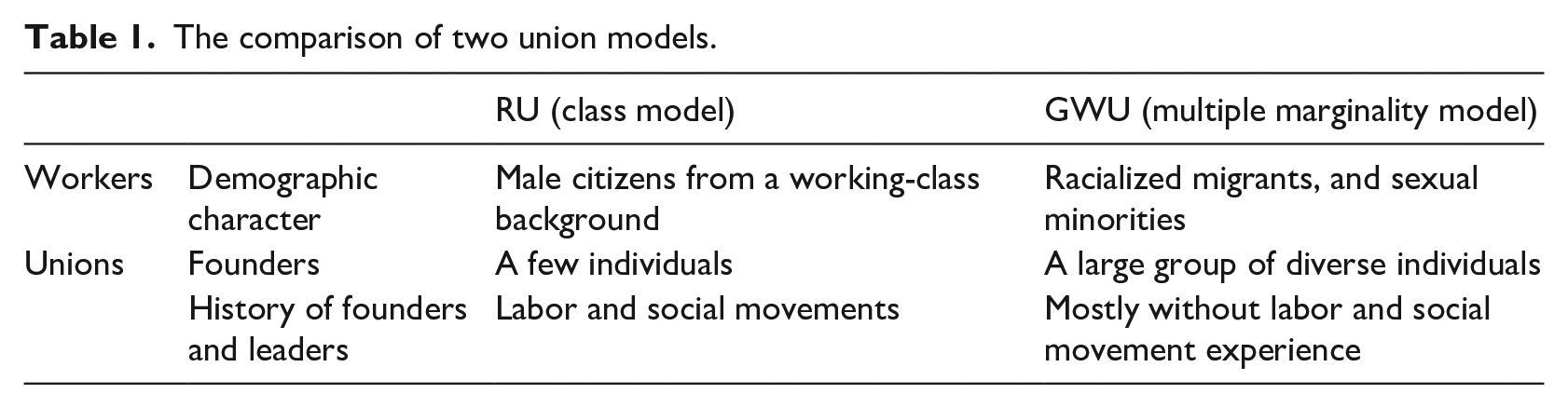
GWU made an effort to create a caring community for migrants, women, and trans gig workers, fostering intersectional solidarity. This orientation explains their efforts to challenge platform companies and confront immigration systems and gender-based discrimination. Meanwhile, RU endeavors to reshape the public perception of delivery gig workers, ending the association of couriers with risk, social disregard, and stigma. This explains RU’s robust efforts to engage with media, journalists, political entities, and policymakers, delivering their message to wider audiences (Però and Downey, 2024).
Through their distinct organizing efforts, GWU and RU construct different worker subjectivities as the basis of solidarity among workers. Recognizing the intersections of structural marginalization experienced by the majority of gig workers, GWU’s multiple marginality model constructs a racialized migrant and sexual minority worker subject in contrast to “white men.” Although GWU’s model highlights the significance and strength of addressing broader political and economic injustices beyond the workplace in organizing heterogeneous gig workers, their organizing efforts might not be visible to the external, as well as to leverage companies and governments. On the other hand, RU’s class model emphasizes narrow class lines among gig workers, aligning this perception with the typical subject representation in the sector: working-class Korean men. RU tacitly assumed the historical norm of male workers as the standard worker subject, but promoting solidarity across diverse identities of workers is imperative in building inclusive unionism and, by extension, a stronger labor movement (Cranford and Ladd, 2003). Given the numerical predominance of male workers in the Korean gig economy, particularly, the role of unions becomes much more pivotal in shaping labor discourses to challenge such norms by politically re/constructing worker subjectivity.
These findings highlight the dynamics between the demographics of local workers and union histories. Gig workers’ subjectivities are diverse and intersectional in both local contexts. However, certain intersectional positions have been either muted or amplified depending on the union model. This variation is explained by combining union leadership’s history and politics with the workers’ demographic makeup. In other words, these two elements—the distinct workforce and union history—are not independent but work together to create unique organizing models.
Nevertheless, these two factors are not necessarily the sole determinants of these union models but are closely tied to their specific local characteristics. For example, the robust history of labor movements in Korea facilitated RU’s ability to effectively and efficiently communicate with the public, which ultimately served as RU’s primary strength. Toronto’s multiculturalism, as well as its prevailing structural racism, added layers of complexity to its labor movements. While during my fieldwork the majority of GWU organizers were white citizens, the local context could potentially pave the way for migrants and individuals of color to assume leadership roles in the future. In addition, both cases are influenced by the broader sociopolitical contexts within which they operate, particularly social movement legacies (see Cini et al., 2021). CUPW, which helped Foodora couriers to organize, successfully organized independent contractors in the past (Fudge, 2005), and RU’s main initiatives were largely in line with the Korean precarious workers’ movement’s legacies and paths.
The data unevenness between the cases differently constituted, temporarily and spatially, is a limitation that presents challenges for comparative analysis. However, it pushes the researcher to continuously reflect and innovate methodological approaches, such as defining cases through time-place combinations (see Tavory and Timmermans, 2020), anchoring them with crises as a central point of comparison (Lee, 2020), observing their evolution over time, and juxtaposing them. In ethnography, where subjects inherently embody the world in which they are situated (Burawoy, 2009), these approaches encourage a nuanced understanding of the unfolding changes within and between cases. In addition, investigating momentous events proves to be a valuable tool in the comparative analysis. For example, Foodora’s exit caused FU to become an industrial union, following a similar strategy to RU’s. 8 The safety concerns diligently tackled by RU may also emerge as a crucial issue for GWU, given the rising prevalence of e-bikes and scooters in Toronto. Despite their ongoing differences, it suggests potential convergences between the two cases over time. We could not gain these insights with an analysis limited to a single time or place.
In light of these empirical findings, first, to better understand the organizing efforts of gig workers around the globe, I argue that we must consider both global and local contexts. The gig labor processes push these two unions of gig workers who operate under the same multinational company to move away from traditional union tactics. However, the two related local factors—the demographic makeup of the workforce and union histories—play a crucial role in shaping their divergent models. Second, it is critical to understand the process of cultivating solidarity—not only fostering the solidarity itself but also deciding which groups should be in solidarity within the context of their local factors.
This trans-continental comparison enhances our insights into the global trend of gig unionism, particularly by investigating how similar unions respond to critical crises in different local contexts, extending the contributions of Burawoy (2000) and Lee (2020). Moreover, it enriches our understanding of worker solidarity, as examined by Cranford (2007, 2012) and Creese (1995), by underscoring the significance of acknowledging the multiple subjectivities of workers in the dynamics of emerging gig workers’ organizing in different contexts. Future research can explore how the global prevalence of gig work may shape the perception of labor movements, in the context of a growing segment of individuals disconnecting themselves from worker identities (see Lee, 2023).
Footnotes
Acknowledgements
I especially thank Cynthia Cranford, Yannick Michelin, Pamela Tsui, Sumin Park, and the Digital Labor working group at the University of Toronto for their constructive comments. I am also grateful to the five anonymous reviewers, two guest editors—Carter M. Koppelman and Carlos Bustamante—and Phillip A. Hough, the editor-in-chief at the journal, for their valuable and generous feedback, significantly improving this article. Finally, I appreciate the union organizers and gig workers from Seoul and Toronto for sharing their stories and insights. This research was presented at various stages, including at the International Sociological Association, Global Perspectives on Platforms, Labor & Social Reproduction Conference, the Graduate Student Symposium at the Global Labour Research Center at York University, the International Colloquium on Working in the Platform Economy, and the International Conference on the Sociology of Korea held at the James Joo-Jin Kim Center for Korean Studies at the University of Pennsylvania. I would like to thank the audience for their critical engagement.
Declaration of conflicting interests
The author(s) declared no potential conflicts of interest with respect to the research, authorship, and/or publication of this article.
Funding
This research was supported by the Dr. David Chu Scholarships in Asia-Pacific Studies at the University of Toronto.
Ethical approval and informed consent statements
This study was approved by the Office of Research Ethics at the University of Toronto (approval no. 00039334) on June 25, 2020. “Participation in this study is voluntary. For your time, I offer a small compensation of $30 (CAD). You are free to decline an interview. If you choose to be interviewed, you may end the interview at any time or decline to answer any questions you so choose without any consequences or any explanation. If you do withdraw from the study, any data you have already contributed will be included in the study unless you prefer it also to be withdrawn. You will be offered the chance to withdraw all the data you participated from the research, even after the interview is finished. Nevertheless, there could be a point beyond which I will not be able to withdraw your data from my research, such as when I have already written up the findings.”

Data availability statement
The datasets generated and/or analyzed during the current study are not publicly available due to the approved Human Ethics Protocols at the University of Toronto. However, they are available from the corresponding author upon reasonable request.
A journal article, Lee, Y. (2023). After a global platform leaves: understanding the heterogeneity of gig workers through capital mobility. Critical Sociology, 49(1), 23-37. which uses the overlapping dataset, has been published and can be accessed at DOI: 10.1177/08969205211055912.