




Abstract
This article recasts the debate over the employment status of gig economy workers as a question about the power of municipal governance. Gig employers are challenging urban regulatory regimes through their disavowal of an employment relationship and their refusal to obtain taxi licenses. As the recent literature argues, there has been a resurgence of municipal power driven by a labor-antipoverty coalition. One might view the gig economy’s independent contractor model as an attempt to circumvent this power. Analyzing the case of gig taxi companies like Uber, this article tracks the response of U.S. cities to a business model predicated on ignoring their regulations. Utilizing original data, this study investigates urban regulatory responses to Uber through descriptive statistics and multivariate modeling. The findings show that almost half of cities failed to regulate. Those that took action had historically greater levels of regulation and faced driver protests—a sign of a stronger labor-antipoverty coalition. Additional evidence indicates a learning effect in which cities became more likely to regulate over time. The article ends with a discussion of how workers and unions are responding to this challenge.
Introduction
The rise of the gig economy has caused a spike in public interest in and debate about whether this employment model benefits workers and society. Much of the discourse around the gig economy has revolved around the issue of employee status. From an employment and labor perspective, the key component of the gig economy is that companies operating in this space claim that those who provide services through their app are independent contractors, not employees (Dubal 2017). Uber, the largest gig company and an example of what regulators call Transportation Network Companies (TNCs), has become a central figure in the discourse on gig employment. Placing this debate into the context of the wider urban political economy, this article suggests that the disavowal of an employment relationship is a challenge not only to urban labor markets, but also to urban regulatory regimes. Beyond employment status, scholars must view the gig economy from the perspective of how corporate preferences dictate and constrain municipal power.
Scholars since Dahl (1967) have asked what authority U.S. cities have to self-govern in the American federalist system. Historically, political scientists and economists have argued that cities have little to no power, a view typified by Peterson’s (1981) City Limits. Peterson argues that the structure of American federalism combined with capital mobility prevents cities from engaging in redistributive politics because doing so risks the flight of capital or taxpayers to the suburbs. A growing body of literature has argued against this theory, noting a general resurgence in municipal power driven by a labor-antipoverty coalition in major U.S. cities (Sachs 2011; Schragger 2016). Even beyond the labor equity concerns of this coalition, the illegal entry of TNCs challenges municipal principles of good governance and the will of cities to enforce their laws against threats of capital flight. Taxi regulations also address broader public concerns around issues of congestion and consumer safety. This article investigates whether, and under what circumstances, cities faced with a challenge to their regulatory authority have chosen to take action. It also studies the role that the progressive labor-antipoverty coalition has played in shaping this response.
To evaluate this phenomenon, this article uses original data on municipal responses to the entry of TNCs to evaluate how cities and their labor-antipoverty coalitions have responded to a well-funded Silicon Valley challenge to their regulations. The companies’ strategies found in the data were typically two-pronged. First, they argued that their employee-free business model meant that they were exempt from local taxi law and employment law. Second, they attempted to preempt local authority by lobbying states to legalize their business model. Over time, this preemption push has proven largely successful. This study examines the initial wave of municipal response to TNC expansion (mostly occurring between 2011 and 2016), offering a snapshot from a time before municipal action was largely preempted by state authority. It evaluates whether cities acted when they had the chance to do so and seeks to understand why they chose the actions that they did. The study explores this through both a descriptive statistical analysis and an ordered logit regression analysis of original data about regulatory response to TNCs. Finally, it discusses how workers and labor unions have responded to the entry of gig companies into their industries in the context of municipal abdication of responsibility.
Overall, this article finds that the processes by which gig economy companies have entered urban labor markets have been chaotic and uneven, as have been the ways in which city regulators have responded to their entry. While there is some evidence that cities with more established resurgent progressive movements were better able to fend off the Silicon Valley challenge, TNCs were largely successful in securing preemption. This preemption push by Silicon Valley, as well as by traditional corporations, has helped usher in a reassertion of state power over municipalities under federalism. In this way, gig companies undermined municipal regulatory authority generally and challenged two decades of resurgent municipal government. Yet the challenges gig companies raised for both workers and the urban infrastructure remain, leaving cities and states compelled to address them.
The Gig Economy and its Impacts on Workers and Cities
To understand how the gig economy impacts municipal governance, we must first understand what it is and how it affects workers and cities. The gig economy—or what some call platform work—is electronically mediated work, where algorithms and other computer technologies match workers with consumers via an online platform or marketplace (Vallas 2019). The gig economy grew out of the sharing economy movement, which served a particularly important function in helping individuals weather the Great Recession in 2008 (Schor 2020). Some scholars argue that the gig economy represents a positive trend in the evolution of work insofar as it provides workers with increased flexibility and control (Sundararajan 2016). A key feature of the gig economy is the claim by gig companies that those who provide services on their apps are not employees, but are instead independent contractors utilizing the gig companies’ electronic marketplaces (Dubal 2017). This classification prevents workers from accessing basic labor protections such as unemployment insurance, the minimum wage, and the right to form a union (Ravenelle 2019). This effort to classify gig workers as contractors has resulted in lengthy legal and legislative battles in the United States and around the world.
This battle has had increasingly important repercussions, as the number of workers in the gig economy continues to grow rapidly. In an analysis of internal Uber data, Hall and Krueger (2017) found that the number of Uber drivers in the United States doubled every six months between 2012 and 2015. It is becoming increasingly clear that the gig economy is an urban phenomenon. While the size of the gig economy remains small at the national level, representing only 1% of national U.S. employment (Bureau of Labor Statistics, U.S. Department of Labor 2017), it has had a much larger impact in urban areas, already representing 3% of employment in San Francisco and Las Vegas by 2016 (Farrell and Greig 2016). Uber is a good example of the gig economy’s urban concentration. While Uber operates in 770 cities globally, 24% of Uber’s business happens in just five cities: New York City, Los Angeles, San Francisco, London, and São Paulo (Grabar 2019). The concentration of gig employment in major urban centers has made these cities important battlegrounds in shaping the future of work and the power of city governments to regulate this work.
The gig economy is, in many ways, nothing new. It represents the latest innovation in continued employment trends in the United States, wherein traditional internal labor markets and Fordist employment models have moved to those built around “flexible” work arrangements (Kalleberg 2009). Flexibility has generally benefited employers and shareholders at the expense of workers—making work more contract-based, temporary, and part-time (Beck 2000). Labor scholars have generally argued that this movement toward “flexibility” generates a growing class of precarious workers (Arnold and Bongiovi 2013; Standing 2011). Outsourcing employment to individual workers as independent contractors who lack basic employment rights serves as the logical conclusion to outsourcing and retrenchment by companies (Wolf 2021), which Weil (2014) has called the fissured workplace. Attempts to classify all employees as independent contractors without the right to form unions similarly reflects a decades-long decline in unionization in Organisation for Economic Co-operation and Development countries (Western 1997). The reasons for the general decline in employment standards for low-wage workers are numerous and include globalization, state deregulation, the rise of shareholder-value ideology, and changes in global production methods (Turner 1991; Wallerstein and Western 2000). Against this backdrop, the gig economy represents Silicon Valley’s technological twist on a general trend.
While it is true that many of the issues that plague gig economy workers arose prior to the introduction of app-based gig work, there are some unique features that the apps bring. In particular, the structure of gig work is a legal and political strategy to exclude gig workers from basic labor protections, even those protections from which other low-wage workers continue to benefit. If governments accept the gig economy’s employee-free independent contractor model, this will have larger ripple effects across the entire economy: traditional retailers such as Walmart are already attempting to incorporate gig-style work to cut back on labor costs (Merrick 2018). The companies’ independent contractor model not only undermines work quality, but also challenges government regulatory regimes.
Municipal Power and Silicon Valley
This article attempts to place the gig economy in the wider urban sphere and considers how it impacts urban governance. Cities in the United States have long been theorized as laboratories of democracy (Dahl 1967). As Schragger (2016) details, the rise of global cities has in many ways decoupled American cities from their states, and even the nation, in terms of economic dependence. This holds true despite the fact that American cities are still politically constrained by the larger federalist system. The decoupling of cities from states and nation has increased the importance of municipal governance for workers and companies alike and has also resulted in an urban progressive movement led by a labor-antipoverty coalition. This movement has pushed redistributive reforms beyond just “global cities,” as progressive forces have “rediscovered” city politics across the country, pushing through long-stalled policies such as increases to the minimum wage and paid sick days. This rediscovery of the city has been accompanied by demographic and political shifts (Desilver 2016) that have jolted U.S. cities to the left, led by mass movements (Hamel 2014) such as Occupy Wall Street, Black Lives Matter, the immigrant rights movement, and the environmental justice movement.
Against the backdrop of cities in which there are urban progressive movements, the gig economy model has circumvented this resurgent municipal politics, often deliberately. As Uber’s own lobbyist explained, . . . in any jurisdiction with the rule of law . . . Uber is better off entering the market with or without permission . . . When regulators then—at the behest of the taxi industry—try to shut Uber down, they turn their riders into advocates and use grassroots political pressure to ensure Uber’s continued existence. (Tusk 2018:109)
In “hostile-to-tech” New York City, he argued that Uber was forced to mimic the city’s progressive municipal politics to “co-opt everyone who normally sided with [Mayor Bill de Blasio], because they didn’t want to be seen as illiberal” (p. 119). They recast their employee-free business model as a civil rights issue to undermine the progressive coalition and appealed to the State of New York to assert traditional federalist constraints upon the city’s forays into redistributive politics and worker protection.
The regulatory dilemma of the gig economy concerns what power cities have to govern themselves. Historically, political scientists and economists have argued that cities have little to no power. This view is typified by Peterson’s (1981) City Limits, which argues that, given the structure of American federalism combined with capital mobility, cities cannot engage in redistributive politics, because doing so risks the flight of capital or taxpayers to the suburbs or other cities. Theorists in this tradition argue that this has become truer over time as a result of globalization. Globalization has forced cities to view themselves as products (Glaeser 2009) for citizens who will vote with their feet, moving from city to city in search of lower taxes (Tiebout 1956).
Scholars working outside of the dominant neoclassical economic paradigm, such as Molotch (1976), argue that even if cities had the economic power to enact redistribution, they would choose not to do so for political reasons. Molotch imagines the American city as a “growth machine,” where entrenched real-estate interests seeking to maximize urban “exchange” value have the greatest interest in local affairs, given the development process, and will therefore come to dominate local politics. Municipalities, which for the most part must rely on property taxes rather than income taxes, thus find their fortunes tied to these land-based elites.
Despite these arguments, over the last few decades, we have seen the rise of a progressive labor-community coalition pushing and advancing an agenda in large U.S. cities. As previously mentioned, Schragger (2016) has argued that this resurgence of municipal governance is due to the phenomenon of global cities and their decoupling from states and the nation. Cities are not actually beholden to mobile capital or landed elites, because capital is in fact dependent on cities and their power of agglomeration. This decreased dependence combined with the rise of place-based urban service economies has given cities more power to regulate. Sachs (2011) argued that the labor movement has been the primary actor leveraging the power. Faced with federal and state inaction, labor began pushing for progressive municipal policies such as Community Benefits Agreements, living wage laws, and paid sick days. While unions have declined nationally, urban unions have in fact grown in political power, scoring large and important organizing victories for place-based service industry positions such as hotel workers, janitors, security guards, and airport workers (Milkman and Ott 2014; Milkman and Voss 2004).
While relative economic power allows larger cities to act more aggressively (Savitch and Kantor 2002), this rediscovery of municipal power has been quite broad across the United States, highlighting the fact that municipal politics has always mattered (Dahl 1967; Trounstine 2009). Cities that followed the City Limits theory were engaging in a political choice, given the lack of evidence that the City Limits model correlates with economic growth (Schragger 2016), that social welfare expenditures have always varied greatly across local governments (Craw 2010), and that politically more “liberal” cities have always engaged in greater social spending (Tausanovitch and Warshaw 2013).
Despite the recent growth in municipal power and the rediscovery of city politics, when Uber entered U.S. cities, it largely did so illegally, without proper permits. Uber claimed that, since they were a tech company, not a taxi company, municipal taxi law did not apply to them. Gig companies do not just “disrupt” those who use the app, but also the economic sectors and the regulatory regimes in which they operate (Dubal, Collier, and Cater 2018). While most U.S. cities have opted to run their taxi systems through private charters, taxis are ultimately public utilities and have historically been regulated as such (Dubal 2017; Mathew 2005). In fact, in the 1920s and 1930s, New York City attempted to take control of the taxi system, as it had with the subway system, viewing taxis as an extension of the subway system (Hodges 2007). Given the illegal entry of TNC firms, one would expect that municipalities would be compelled to enforce their laws, whether out of respect for the law or out of concern for good governance. It is not just workers who are impacted: incumbent firms and regulatory bodies are also losing authority. As Dubal et al. (2018) noted, there are numerous motivations for a city to regulate taxis beyond issues of workers’ rights, including safety, congestion control, and ensuring competition. When cities allowed gig companies to enter without following local regulations, they passively privatized parts of their public transportation systems. And by accepting the independent contractor argument, they tacitly abandoned the aims of the resurgent progressive municipal politics movement.
Gig companies are actively attempting to rewrite employment laws around the world. The National Employment Law Center estimates that Uber spent between $1.4 and $2.3 million a year on lobbying in just five states between 2016 and June 2017, employing 370 lobbyists in those states. Similarly, Lyft spent between $336,000 and $866,000 a year. The amount of money Uber spent on lobbying is more than twice as much as Microsoft and Walmart and over three times as much as Amazon (Borkholder et al. 2018). When viewed from this standpoint, the gig economy model is a counteracting force to the rise of the progressive labor-antipoverty movement and an attempt to preempt city authority. The fight over the gig economy is, in fact, a fight over the right of local governments to engage in local governance, and in particular, a challenge to the ability of more progressive cities to engage in social welfare and employment protection.
Hypotheses
This study aims to understand what was predictive of cities taking a strong regulatory response to Silicon Valley’s attempt to avoid their taxi and employment regulations. This analysis views the TNC business model as a challenge to municipal authority, and in certain cities a strategy for counteracting the rise of a progressive movement. In this way, it incorporates variables that account for cities’ relative political strength and the preferences of capital, labor, and civil society as a means for understanding municipal regulatory response to the entry of TNC firms. Foremost, one would assume that cities with a more robust regulatory infrastructure, with entrenched interests and regulatory bureaucracy, would have the greatest incentive to respond aggressively to this regulatory challenge. In addition, in cities with an insurgent progressive movement, one would assume that an established labor-antipoverty coalition would push policy makers to a more aggressive response. This leads to Hypothesis 1:
TNCs represent a challenge to existing regulatory authority and good governance principles. Cities where this infrastructure is most developed should have entrenched incumbents in the business community and in city government regulatory bodies who oppose TNC entry. In many cities, taxis are big businesses with politically connected garages dominating local regulatory decisions. When this is the case, cities have a greater capacity to regulate. License and medallion systems are often an important revenue source for these cities. The illegal entry of TNCs represents a threat to the authority of these cities and their tax base. In addition, in these cities, municipal authority over taxi regulation would be more established and therefore more insulated from state preemption. Accounting for industry and regulatory incumbent strength results in Hypothesis 2:
One might also expect a learning process between cities as the externalities of failing to regulate TNCs become more transparent over time. For example, consumer protection issues should have become more salient to regulators after the rash of Uber driver assault cases that revealed systemic issues with the company’s background check system (Devine et al. 2018). Social scientists have long argued for the importance of social diffusion processes in understanding the spread of ideas, tactics, and social innovations (Rogers 1962). Social diffusion has been particularly important in accounting for the spread of government regulations (Shipan and Volden 2008) and social movements (Strang and Soule 1998). When Uber first launched in California’s Bay Area, it was hard to predict what the company would become and what problems it might cause for municipal governance. However, by the time Uber entered Montgomery, Alabama, the final city in the study, in 2016, TNCs had entered hundreds of cities around the world, and the problems they created around safety, workers’ rights, and congestion were well established. Given these precedents, cities like Montgomery could also have learned from the examples of how other municipalities responded. As such, we come to Hypothesis 3:
Taken together, these hypotheses provide us with a foundation to test the response of cities to Silicon Valley’s innovative attempts to avoid their regulatory authority.
Data and Methods
This article aims to provide a broad picture of how the United States’ largest municipalities, and the states in which they reside, have responded to the illegal entry of TNCs. To tell this story, this article offers detailed descriptive statistics as well as an ordered logit regression analysis of the predictors of municipal regulatory response. This analysis was conducted on all U.S. cities with populations of 200,000 or more as of the 2017 American Community Survey (ACS), resulting in a sample of 118 cities spanning 37 states (U.S. Census Bureau). 1 Population was used as the metric for building the sample, because population should reasonably mirror the list of cities most likely to attract TNC companies according to their current growth and business models. From this initial sample of the 118 most populous U.S. cities, I removed all cities where TNCs arrived after state regulation passed and suburban cities that lack a clear regulatory authority. This resulted in a final sample of 78 cities in the statistical analysis, all of which had the opportunity to regulate TNCs before state preemption closed this window.
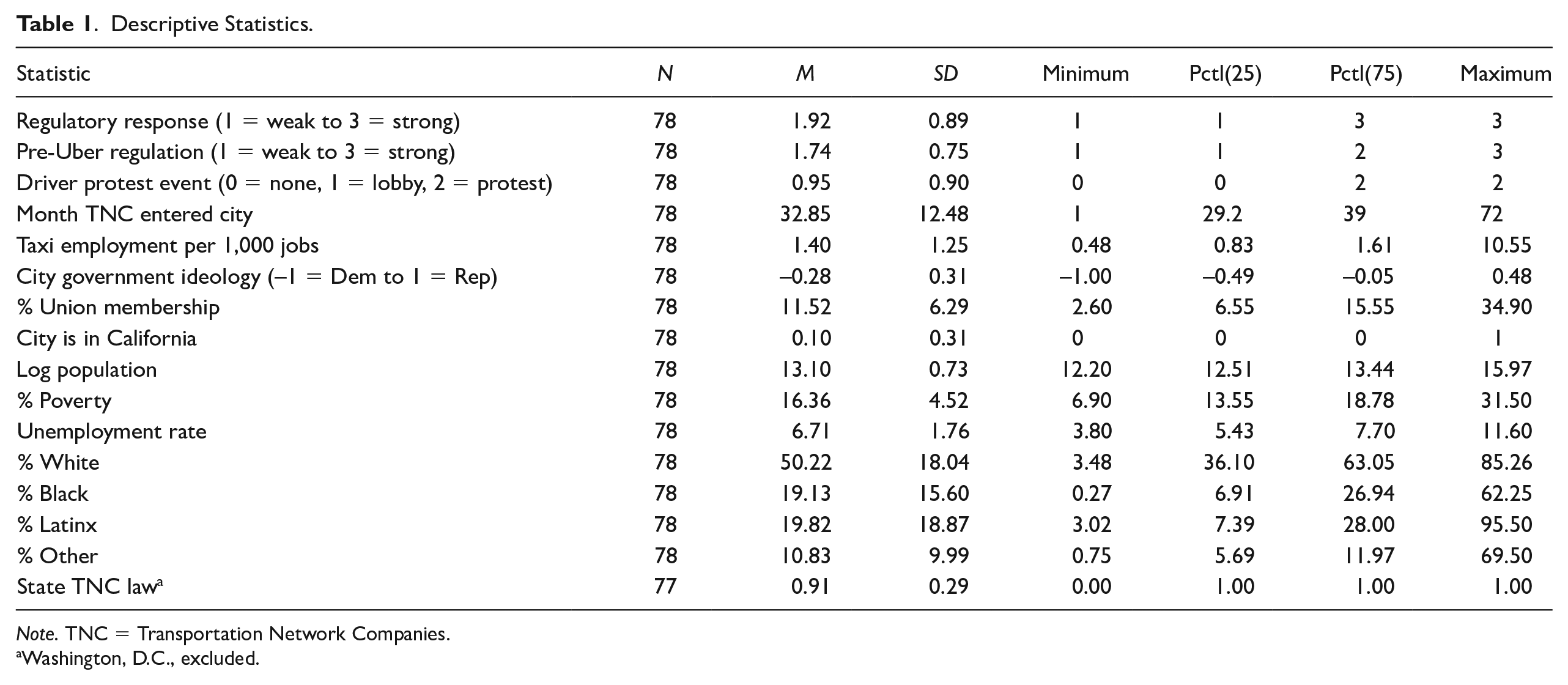
Suburban cities were removed from the statistical analysis for a variety of reasons. First, I found that suburban cities often did not have clear legal authority, as they were frequently controlled by a combination of local and county administrations. Moreover, the vast majority of suburban cities were located in a few counties around Los Angeles and Dallas. Third, I found that suburban cities often deferred to or felt beholden to the taxi regulations of the principal cities around them. For example, in Yonkers, New York, it was unclear whether the city or Westchester County had control over taxi regulation (Zucker 2017). It was also unclear whether regulation mattered, since Yonkers could not regulate rides that started or ended in New York City (Saeed and Lungariello 2015). Finally, and most importantly, TNC companies themselves are primarily concerned with principal cities in each area: just 20 cities contain 85% of Uber’s drivers in the United States (Hall and Krueger 2017). A detailed description of the data is provided below, and descriptive statistics are provided in Table 1.
Descriptive Statistics.
Note. TNC = Transportation Network Companies.
Washington, D.C., excluded.
The dependent variable is municipal regulatory response to the introduction of TNCs. I coded responses into one of three categories: 1 is Weak: 2 is Medium; and 3 is Strong. Weak entails either legalizing TNCs or taking no action. Medium entails imposing some limited licensing standards, such as requiring city—not just company—background checks, or making drivers take the same tests required of municipal cab drivers. In addition, cities that took some enforcement action, such as issuing tickets or attempting to fight against state preemption, were coded as Medium. Responses were coded as Strong in cities that included some form of cap on TNCs or attempted to stop TNCs from entering the market through strong enforcement or a cease-and-desist order. Caps could encompass a limit on the number of drivers, the imposition of large licensing fees and taxes, or limits on fares. I constructed this variable from original data collection, as well as from updating and confirming existing data sources. Tzur (2019) has previously conducted a small study of city responses in the top 40 cities by population. This was supplemented by data collected by Staley, Annis, and Kelly (2018). 2 Finally, I supplemented these sources with my own evaluation of municipal regulation based on the laws themselves and local news reporting, the latter of which I accessed through the LexisNexis newspaper database. This additional coding was necessary because not all cities included in this study were covered in Tzur’s study, and as this is a fast-moving issue, there have been dramatic developments in certain cities since Tzur’s study was published.
Much of the response to TNCs has been driven by unions and their broader communities. To quantify this stakeholder, I incorporated percent union membership at the Metropolitan Statistical Area (MSA) level (Hirsch and Macpherson 2003). 3 Union presence does not ensure that unions were always active on the issue of TNCs. Union presence also does not ensure union connection to taxi drivers, such as in the example of San Francisco, where drivers had lost union representation and become disconnected from the broader labor movement. Therefore, I constructed a categorical variable to account for driver protests of TNC companies and driver activism that is not solely connected to organized labor. This variable was constructed through reporting in major local municipal newspapers accessed through the LexisNexis database. Remarkably, over half of the cities in this study experienced driver protests. A city was only coded as experiencing a driver protest event if drivers actively resisted, whether through major actions like strikes or through simpler actions, such as testifying at city council hearings or lobbying against the entry of TNCs or the conditions faced by TNC drivers. Protests by both traditional cab drivers and TNC drivers were included. I did not count drivers simply expressing complaints to reporters as a form of protest, even though reporters often characterized this as “protesting.” The drivers had to have acted on their complaints. This protest variable was coded with three possible outcomes: no protest, lobbying protest (which includes testifying before or petitioning elected officials), and strong protest (which includes holding a rally or strike).
Finally, as Tausanovitch and Warshaw (2013) have shown, municipal politics matters, and those municipalities where citizens have more Democratic voters do engage in more redistribution and progressive taxation. As such, I used the most recent (2017) municipal ideology scores produced for Tausanovitch and Warshaw’s American Ideology Project to account for city political ideology. The scores present novel measures of municipal policy preferences, measuring the relative conservatism of municipal voters. The scores are generated from national surveys and thus may potentially miss some local nuance or instances of divergent ideologies between national and local political views. For example, city voters may vote for socially progressive national politics but may have more “conservative” policy preferences locally around issues such as housing, taxation, or police reform. Despite these limitations, Tausanovitch and Warshaw (2014) have shown that these scores are correlated with more conservative or liberal local policy outcomes. As such, one would predict that cities with more Democratic voters would be more open to regulating TNCs especially if protests couched the debate in terms of equity, good governance, air quality, and compromised public safety.
To account for local business conditions, I added variables addressing the incumbent regulatory system and the relative size and importance of the taxi industry to each city. Entrenched business and bureaucratic interests had a strong incentive to demand local governments take action to regulate TNCs. The pre-Uber regulatory environment fell into three categories: 1 was coded as permit systems; 2 was restricted systems; and 3 was medallion systems. Permit systems mean that taxi companies and/or drivers are only required to get a permit to operate. Restricted systems mean that the city imposes a cap on the number of taxis entering the market, either through limits on some combination of companies, vehicles, and drivers, or, more commonly, a Public Convenience and Necessity (PCN) requirement. PCN laws require new market entrants to prove that the market requires expansion. Medallion systems mean that the cap on the number of vehicles able to operate in a city is regulated by medallions that can be traded. This creates the strongest incentive for incumbents to keep newcomers out. In other systems, licenses cannot be sold and have no additional value of their own. A stronger pre-Uber regulatory environment is not inherently a proxy for driver unionization. It creates incumbents who would be threatened by Uber’s entry but does not ensure organized drivers and driver protests. This is because regulatory incumbents are not just unions but also owner-drivers and often large garages that hold many medallions. In the 1970s, the National Labor Relations Board (NLRB) ruled taxi drivers working under a lease system were not considered employees, which undermined taxi unions in many cities such as New York City and San Francisco, further weakening the connection between regulation and driver organizing. This variable was collected from my coding, according to the above specifications, of either Staley et al.’s (2018) survey of municipal laws or from my evaluation of local laws. 4
Control variables were included to account for local economic, political, and social factors. To account for the local importance and salience of the taxicab industry, I included the taxicab employment location quotient from the Department of Labor’s Occupational Survey. I used the taxi occupational code (53–3041). The location quotient is the number of taxi jobs per 1,000 jobs in the city overall. This ratio, as opposed to raw employment numbers, more strongly indicates the importance of the local taxi industry to the local economy. 5
Local business conditions in California are more likely to be favorable to the interests of Silicon Valley. As Dubal et al. (2018) have noted, city officials in California are afraid of seeming “anti-tech” and are dependent on these companies for tax dollars. As a council member in Fresno explained his opposition to regulating rideshares despite taxi driver protests: “I told our taxi drivers that would be a non-starter. Our city is friendly to technology” (quoted in Sheehan 2016). I created a categorical variable for whether a given city was located in California. This was necessary because of the unique hold Silicon Valley has on California.
To account for temporal dynamics, I included a time variable, which is the number of months between Uber’s initial launch and the date when TNCs entered a given city. Uber began offering rides in San Francisco and San Jose in April of 2011, which was coded as month 1. Other cities were coded according to the number of months after this start date that Uber or Lyft entered their market. 6 Local economic factors were considered by including the log of population, percent poverty, and the unemployment rate from the 2017 ACS 5-year county estimates. While not uniformly true, in many major metro areas taxi driving is a heavily racialized industry. Thus, I included percent Black and percent Latinx in case regulatory response is shaped by these racialized understandings of the cab industry. These percentages were also derived from county-level estimates from the 2017 ACS 5-year estimates.
Findings
When evaluating municipal response, I found that almost half of cities had a weak response to the advent of TNCs. A map of regulatory response is provided in Figure 1, and the full data on key enforcement variables is found in Online Appendix 1. 7 From this visualization, it is clear that much of California, the southern Atlantic Coast, and the middle of the country opted for weaker enforcement. Meanwhile, the Northeast and Northwest opted for stronger enforcement. The cities around the Gulf Coast also responded strongly to the arrival of TNCs. New Orleans, for example, successfully kept out TNCs for many years until they could study and formulate a set of regulations by which TNCs could legally enter the market (Rainey 2015). This is remarkable, as larger cities such as New York, Philadelphia, and Chicago failed to keep out TNCs while they adopted regulations. It was the strong response of liberal cities in Florida and Texas that kicked off the TNC campaign for preemption.
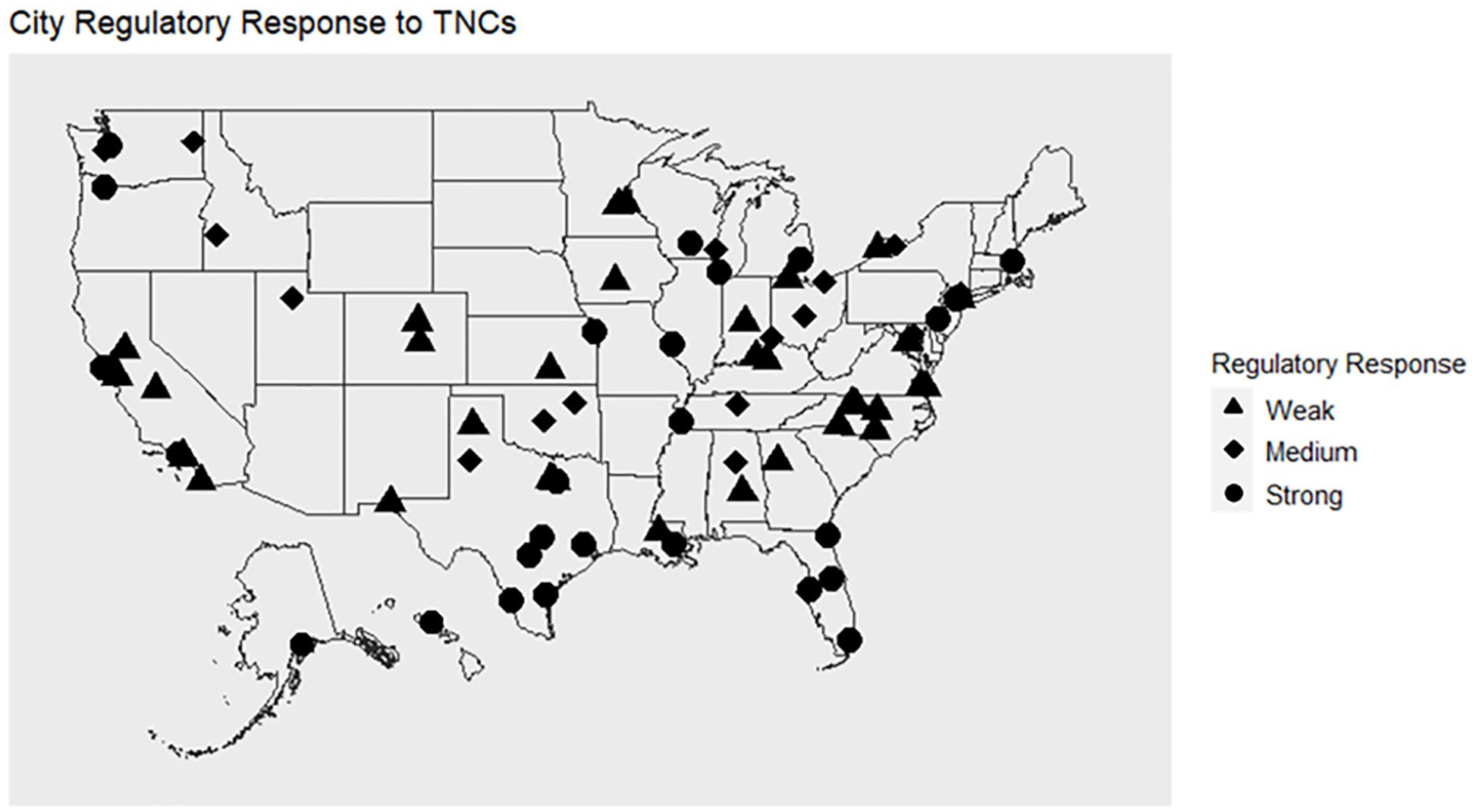
City regulatory response to TNCs.
Descriptive statistics on regulatory response by previous taxi regulatory environment, city size, and the month that TNCs entered the market are presented in Figure 2 to investigate further how municipalities responded to the introduction of TNCs. Evaluating city response by pre-Uber regulatory environment, we find that almost no permit system cities took a strong regulatory response to TNCs. If cities were not regulating taxis before, it is unlikely that they would choose to strongly regulate TNCs. Meanwhile, nearly all medallion cities took a strong regulatory response. Looking at city size, it becomes apparent that large cities were more likely to take stronger action, largely because they had stronger pre-regulatory environments. Mid-sized and smaller cities were evenly split in taking no action or some action, often focusing on consumer protection and safety issues.
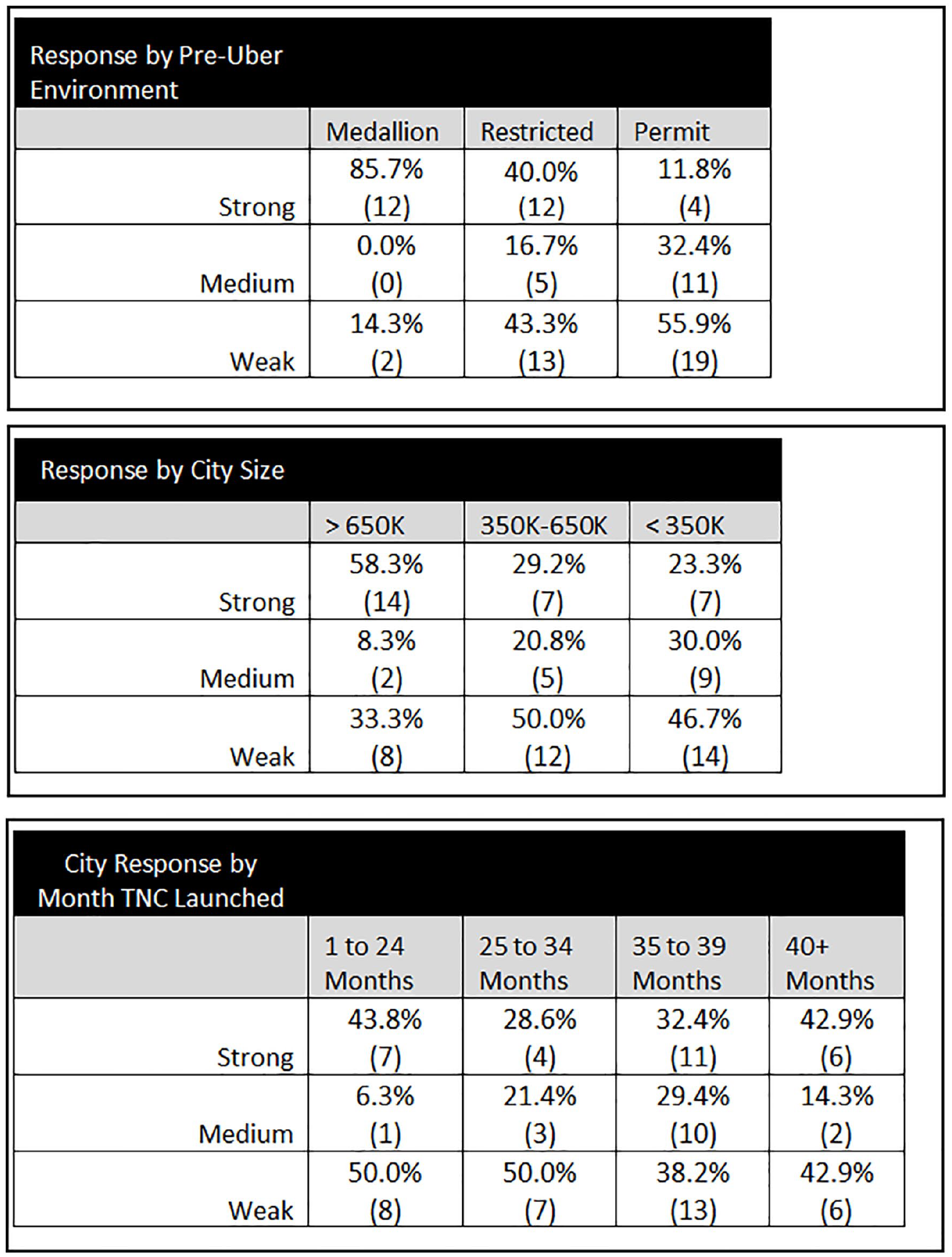
City response to TNCs by select features.
Evaluating the temporal dimension is slightly complicated. Cities where TNCs entered later did appear to respond a little more strongly. This correlation is significant in the regression model. It appears that, over time, a learning process occurred. Cities in the third time group (35–39 months after Uber’s first launch) were disproportionately less likely to take a weak response and more likely to take a medium response. Cities in the fourth group (40+ months) seemed to take either a strong response or no response. Those in the fourth group that took no response were much smaller cities, often in the South, and had weaker regulatory infrastructures to begin with. Also, at this point, state regulatory efforts had become nearly universal, likely discouraging municipal action. That cities over time had greater regulatory responses likely reflects that citizen concerns began to emerge and become more salient to municipal governments, especially with respect to safety questions about the companies’ background checks (e.g., Devine et al. 2018).
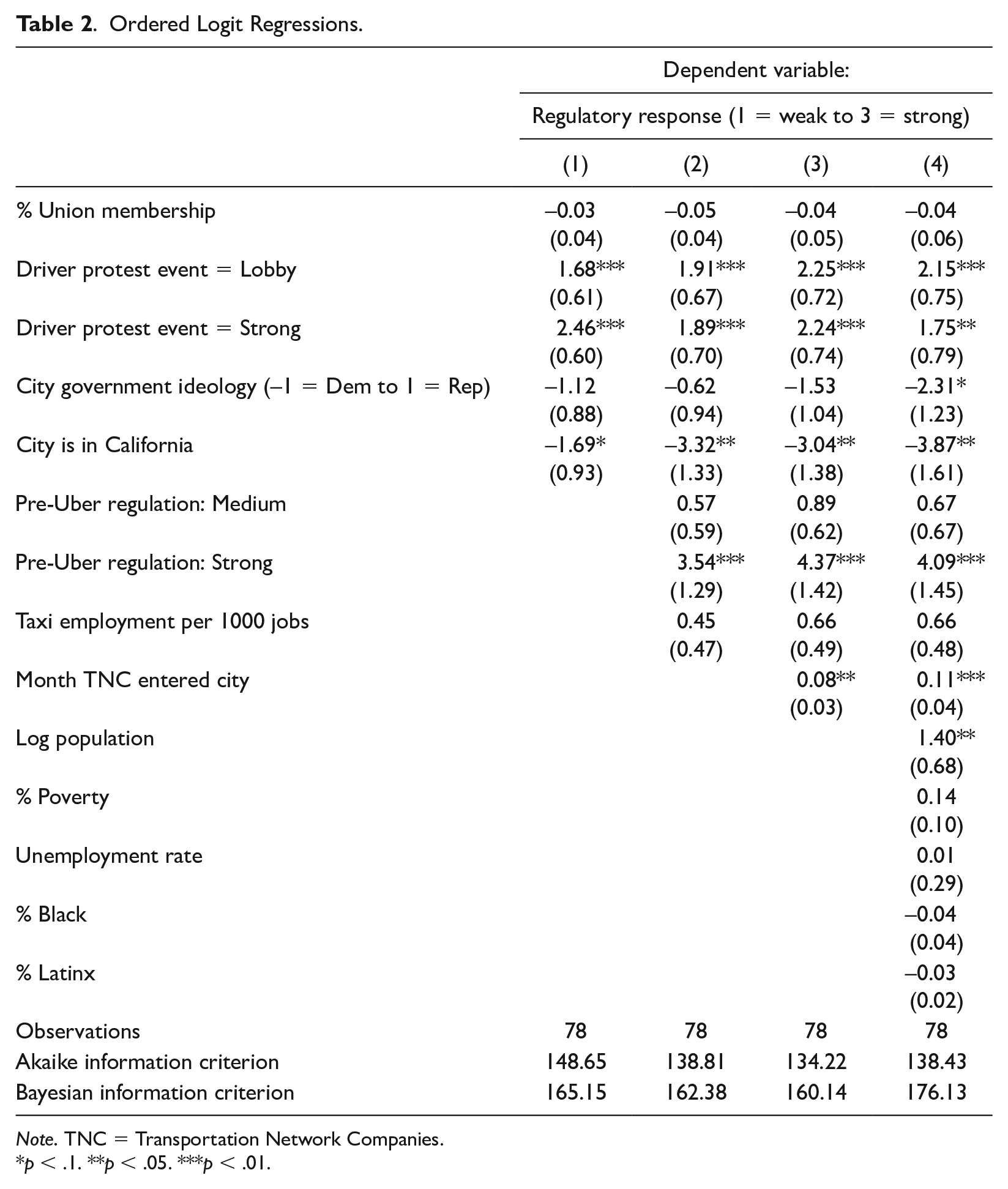
With this broad descriptive picture in mind, we turn to the regression analysis, an exploratory analysis of the predictors of regulatory response. To evaluate the predictors of municipal regulatory response to the advent of TNCs, I fitted an ordered logit model, as there are three possible ordinal outcomes (Table 2). The ordinal outcomes are properly hierarchical, as the medium response, which includes the implementation of measures such as independent background checks, puts more restrictions on TNC authority than the weak response. The strong response, which involves either directly attempting to stop TNC entry or limiting its scope, places a yet greater burden than the medium response on TNCs. These ordered outcomes are analytically similar: the greater the regulation, the greater the financial burden on the TNCs, either through direct financial costs or by making it harder to have more drivers on the road. The proportional odds assumption was tested. 8 In addition, I ran an ordinary least-squared model specification that returned similar results, with city ideology being more significant in the ordinary least squares model (Online Appendix 2). Given the nature of the dependent variables and the proportional odds assumptions tests, this article focuses on the results from the ordered logit specification.
Ordered Logit Regressions.
Note. TNC = Transportation Network Companies.
p < .1. **p < .05. ***p < .01.
While the coefficients are presented in Table 2, for ease of interpretation I present the full model results for key independent variables as predicted probabilities in Figure 3. The predicted probabilities are presented for the impact of these variables on the likelihood of a city taking a strong regulatory response. Given the small sample size, I tried to keep the number of variables in the model to a minimum, but to account for this I have also presented the predicted probabilities for each key variable in all models in Online Appendix 3. This shows that the predicted-probabilities effect sizes did not vary greatly between models.
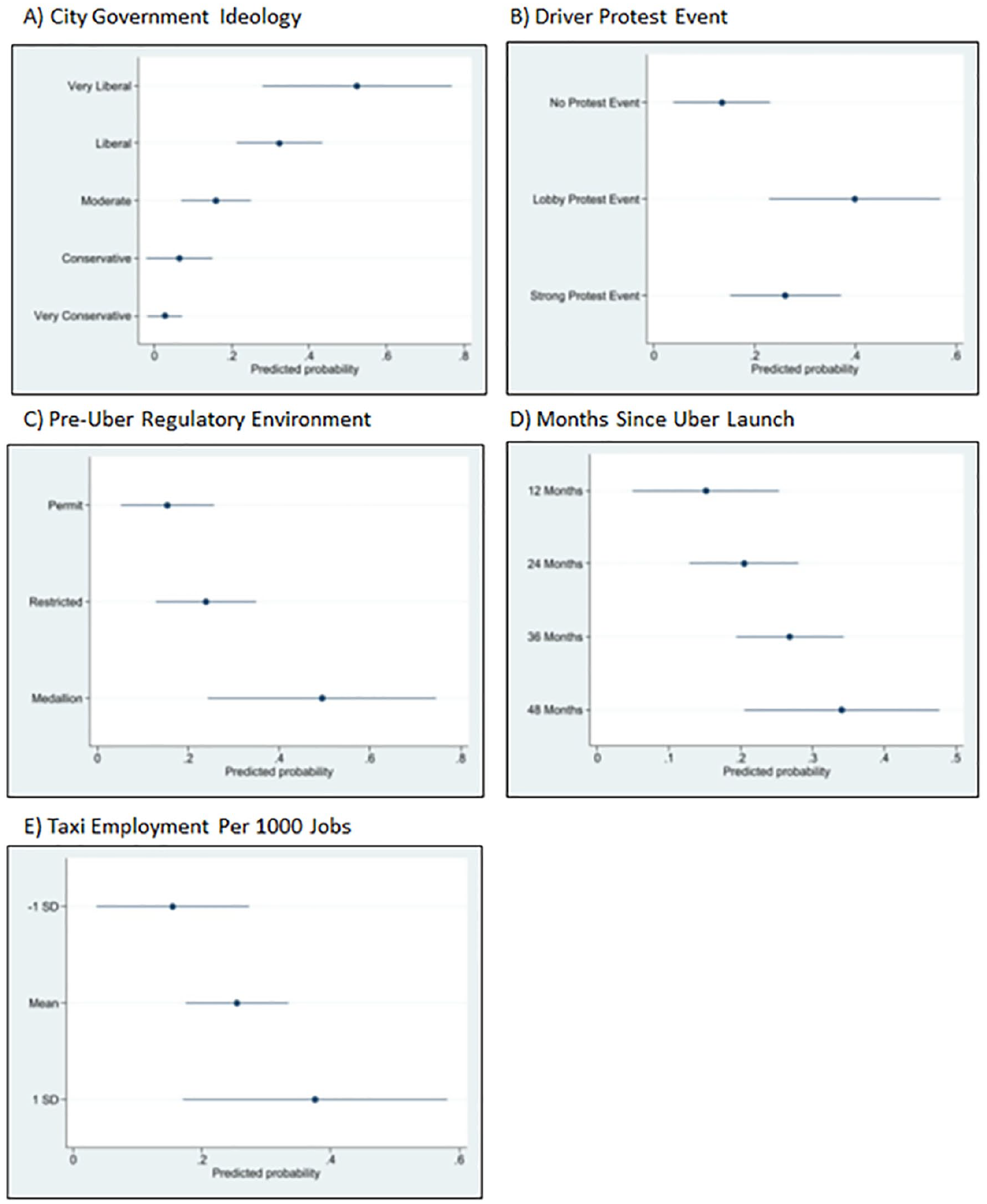
Predicted probabilities from full Model 4 for select variables on cities’ likelihood of taking a strong regulatory response (response = 3) to TNCs.
I ran a stepwise introduction of variables based on my hypotheses. The first model includes the political context variables from Hypothesis 1. The second model adds the pre-Uber regulatory environment and taxi employment location quotient representing the industry and regulatory incumbents from Hypothesis 2. The third model adds the time variable, which Hypothesis 3 suggested would indicate a diffusion effect. And the fourth model adds the economic and race-control variables. The Akaike information criterion (AIC), generally, besides the model with the demographic variables, indicates a better fit throughout the model progression, while the Bayesian information criterion (BIC) goes up, as is expected given the strict penalty BIC puts on adding variables. While these measures do not point to a clearly superior model, the lack of wild fluctuation mixed with the small sample size leads me to evaluate these regressions in terms of trends rather than absolutes.
This analysis confirms and complicates the patterns that we found in the descriptive analysis above. The strongest predictors of regulatory response were driver protesting (either lobbying or stronger action), a strong previous regulatory environment, the month the TNC entered a city, and whether the city was in California. California has cities with some of the most liberal ideological scores, yet largely abdicated their regulatory control. However, as discussed below, the California case is more complicated, as the state has attempted to take a stronger regulatory response, resulting in fierce company resistance. California cities also had a small window of opportunity to regulate before the state preempted their authority.
Hypothesis 1 suggested that cities with entrenched political interests would take stronger action against TNC firms, especially more liberal cities, which would be more likely to have developed a progressive labor-antipoverty coalition. Yet the evidence is mixed. Having a driver protest in a given city was associated with a 40% probability of taking strong regulatory response if drivers lobbied, and a 26% probability if drivers took stronger action. In contrast, there is only a 13% probability without a protest. This indicates the importance of heavily impacted actors expressing grievance. Half of the municipalities experienced a driver protest against TNCs, and these protests happened fairly uniformly across the country. Generally speaking, protesting and sustained organizing against Uber has been greater on the East and West coasts than elsewhere in the country. As increased labor-community protest activity has been a defining feature of the progressive city (Schragger 2016), its prevalence across the country in this study is unsurprising.
In contrast, and counter to Hypothesis 1, I found only weak evidence that local politics matters, and only in the full model. I believe this is because of the learning effect, where over time even more conservative cities in the study took some regulatory response (discussed below). More ideologically liberal cities (outside of California) were more likely to have stronger regulatory responses, with weak significance only in the full model. I calculated predicted probabilities for a city that Tausanovitch and Warshaw would code 100% conservative or liberal, for a city exactly in the middle, and for a city at 50% conservative or liberal. A very conservative city only had a 3% probability of taking a strong regulatory response, compared with a 52% probability for a very liberal city and a 16% probability for a moderate city. Unionization did not have a statistically significant predictive power, and the effect sizes of all outcomes hovered around zero. Furthermore, following the 1970s NLRB decision removing lease-taxi drivers from bargaining units, unionization in the industry has declined, separating the industry from the broader labor movement in some cities (Dubal 2017; Mathew 2005). Overall, the evidence for Hypothesis 1 is mixed, but hints at the importance of the labor-antipoverty coalition in pushing cities to respond strongly to TNC entry if they engaged in lobbying and protesting.
We find some evidence for Hypothesis 2, which stated that more entrenched incumbents compelled a stronger municipal response to the illegal entry of TNCs. Pre-existing regulation was coded as a categorical variable with three levels: permit, restricted, or medallion. The model showed that having a medallion system in place was a greater predictor of a strong regulatory response than other previous regulatory systems. A city with a medallion system had a 49% probability of enacting a strong regulatory response to TNCs, compared with a 24% probability for a restricted system and a 15% probability for a permit system. The ratio of local taxi employment did not have a statistically significant impact on a city’s likelihood to take a stronger response. The reasons that having a medallion system had the greatest impact were likely twofold. First, in such circumstances, taxi company owners may have joined drivers in agitating for TNC regulation. Second, cities with more complicated existing taxi laws may have had greater governmental capacity and a greater number of agencies ready to respond to this new entrant.
Considering Hypothesis 3, there is evidence that cities where TNCs entered later took a more aggressive regulatory stance. Looking at the predicted probabilities, a city where TNCs entered at year 4 was over twice as likely (34%) to take a strong regulatory response than a city where TNCs entered at Year 1 (15%). Cities where TNCs entered at Year 2 had a 20% probability of taking an aggressive response, and cities where TNCs entered at Year 3 had a 27% probability. As discussed above, midsized cities, where TNCs entered slightly later, appeared the least inclined to weak action, and cities became more likely to take a medium regulatory response after high-profile incidents raised concerns about TNCs’ background checks (Bensinger 2019) and insurance policies (Popper 2014). In some cities where TNCs came later, such as Charlotte, North Carolina, municipal governments opted to forego attempting to pass their own regulations due to the rise of state preemption (Portillo and Harrison 2014). The evidence of this model confirms anecdotal reports of cities becoming more concerned with a broad range of TNC issues, beyond just the labor issues, such as consumer safety, traffic, insurance, and other good governance issues. The models found evidence to support Hypothesis 3, indicating that cities were possibly learning from each other.
Finally, evaluating the controls highlights additional dynamics that might have been at play when a city was deciding whether to regulate TNCs. However, given the small sample size, we should view these results as descriptive rather than causal. Furthermore, the additions of these controls seemed to increase standard errors by a fair amount. City size had a statistically significant impact. TNCs stand to have an outsized impact on large cities and their transportation systems, so this result is unsurprising. There was no evidence that poverty rate or unemployment rate predicts regulatory response. Having a greater proportion of Black and Latinx residents was not a significant predictor. Despite the lack of significance, it is interesting to note that the coefficients were negative. This was predicted given the racialization of the taxi industry in some U.S. cities. Further research will be needed to explore these potential dynamics in greater detail.
Can Preemption Stop the Rediscovery of City Politics?
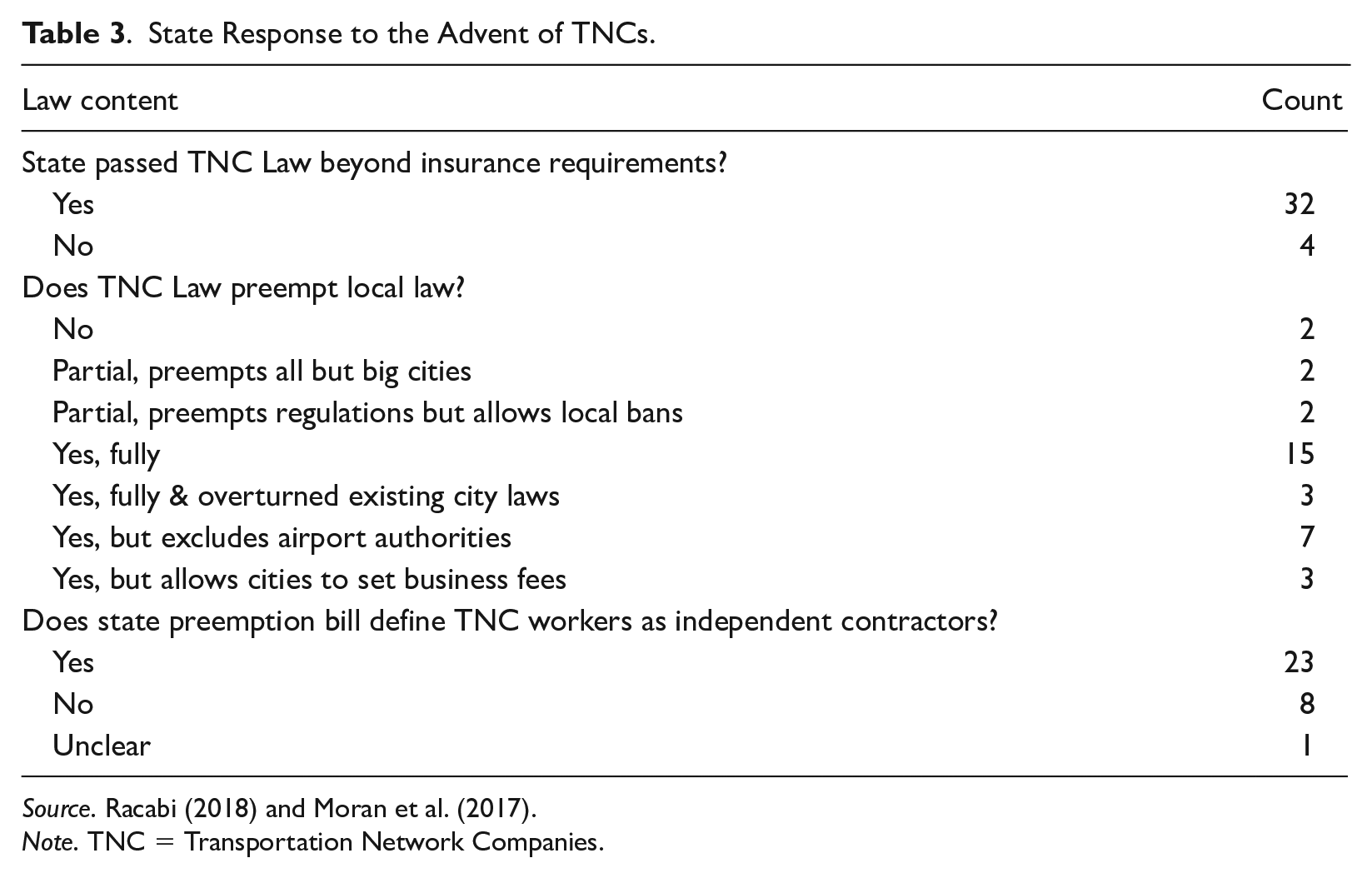
State preemption of municipal authority to regulate TNCs played an outsized role in the story of TNC entry into U.S. cities. From the original sample of the 118 largest cities in the United States, only 78 had an opportunity to regulate TNCs. In Table 3, I examine how the dynamics of state preemption unfolded for all cities in the sample of 118. Preemption stands as a major challenge to the rising progressive city movement and shows how the U.S. federalist system might be able to seriously constrain the resurgence of city politics (Rodden 2019). In more politically liberal cities, preemption was a reactionary strategy to local politics (this was the case in Austin and Miami), but as time went on, the strategy became deliberate.
State Response to the Advent of TNCs.
Source. Racabi (2018) and Moran et al. (2017).
Note. TNC = Transportation Network Companies.
Over time, TNCs pushed preemption as soon as they entered a new state based on their past experiences of resistance in more Democratic cities. The conservative American Legislative Exchange Council is increasingly pushing this preemption strategy to roll back progressive labor victories, such as the proliferation of municipal living wage laws across the country (Grabar 2016). As Table 3 shows, the vast majority of states have now moved to regulate TNCs. As of June 2017, only four states in the study have not passed TNC laws relating to issues beyond insurance.
Nearly all states preempt local ordinances, although in some cases there are carveouts for individual cities. Some state laws also give certain cities leeway in enacting some regulations, especially consumer protection regulations. In Texas and Florida, liberal cities attempted to regulate TNCs only to have their regulations overturned by their conservative state governments. Austin, Texas, initially attempted to aggressively regulate the introduction of TNCs, demanding more rigorous and transparent driver background checks, which ultimately resulted in Uber abandoning the city. TNCs then bypassed the city government and got the Texas legislature to invalidate the Austin law. The TNCs subsequently reentered the city on their own terms (Samuels 2017). Most state TNC laws—23 of 32—similarly restrict employment status, ensuring that TNC drivers are considered independent contractors, not employees (Racabi 2018). Even cities in my study that had an opportunity to regulate TNCs before their states preempted them, such as those in California, often found that this window of opportunity quickly closed. This Silicon Valley strategy has largely been a success and highlights how gig companies leverage state federalist power.
Preemption has left cities in a bind, as they find themselves unable to respond to citizen complaints of safety and congestion or driver complaints of fairness. To level the playing field, many preempted cities have responded by deregulating their existing cab industry. For example, Des Moines, Iowa decided to eliminate its existing taxi laws following state preemption so that traditional cabs could compete. This resulted in a rash of consumer complaints, notably from the business community connected to the tourism and convention industries in the city (Hardy and Elmer 2017). Even California cities that have been reluctant to regulate due to Silicon Valley’s influence have begun to chafe at state preemption. San Francisco recently sued the state, claiming that the preemption of their ability to regulate taxis is illegal, a decision spurred by frustration over the congestion that TNCs were causing in the city (Rodriguez 2018).
While preemption has hampered cities’ ability to respond to local concerns, it is worth noting that state laws vary. State TNC laws tend to focus on consumer protection and safety concerns. As a result, many state laws set fees and background check procedures that are in line with what I code as a medium response for municipal regulation. Furthermore, companies push different policies in different states. While accepting more rigorous licensing requirements in liberal coastal cities, Uber was unrelenting in conservative Kansas, pulling out of the state until the background check standards that they had accepted in other states were eliminated (Lowry 2015). This highlights how different cities and states—depending on their market size and politics—have varying degrees of structural power to respond to the gig economy.
California cities were slow to regulate TNCs and their authority was quickly preempted, but the state nevertheless became the site of greatest resistance to TNCs. First, the Supreme Court of California’s ruling in the Dynamex independent contractor case meant TNC drivers would have been considered employees under state law. The labor-antipoverty coalition led by California State Assembly Member Lorena Gonzales, a former labor leader and organizer, pushed the State Legislature to pass AB5, codifying the Dynamex ruling into state law. In response, Uber, Lyft, DoorDash, and other gig companies spent $189 million on a ballot initiative, Prop 22, which successfully overturned AB5 in the November 2020 election. This was the most expensive ballot initiative in state history. The labor movement has accused the companies of running a deceptive campaign, noting that 40% of people who voted for Prop 22 told pollsters that they thought they were voting to support a living wage for gig workers (Siddiqui and Tiku 2020). Uber and other companies are now pushing laws like Prop 22 in states around the country, as well as in Canada and the European Union.
Meanwhile, the Biden administration has indicated that they are committed to classifying gig workers as employees. The battle over preemption, AB5, and Prop 22 shows that preemption is not a panacea to instilling the gig company business model: the contestation has simply moved to a higher level. Yet, moving the locus of contestation can undermine the labor-poverty coalition, which has typically been urban based. Preemption of municipal authority over TNCs follows other campaigns for preemption to undermine progressive causes, such as the preemption of local living wage laws. Preemption and the structure of the U.S. federalist system remains a persistent challenge to local self-governance and the movement to rediscover municipal politics.
Worker response & the New York city case
Overall, this study found that cities in the United States have largely abdicated their regulatory responsibility, but that some cities with a more robust regulatory environment and entrenched incumbents have been willing to take a stronger approach. The response of workers and the labor-antipoverty coalition to the gig economy sheds light on how these groups are attempting to respond to the illegal entry of TNCs. Examining worker response highlights what the dynamics shown in the statistical analysis looked like in cities and how cities are impacted by preemption.
In New York, the New York Taxi Workers Alliance’s (NYTWA) campaign to organize TNC drivers is particularly illustrative of these trends. The NYTWA, an AFL-CIO affiliate, represents 24,000 drivers in New York City, half of which are TNC drivers. They are the largest union of taxi workers in the country and quickly made the vital decision to incorporate TNC drivers. The NYTWA has used its unique position as a union-worker center hybrid to build a flexible organizing model capable of responding to the disruption TNCs have brought to the New York City taxi industry (Wolf 2021). The NYTWA operates without exclusive representation due to the employment status of drivers, instead utilizing its minority unionism approach to engage in lobbying and direct action, pushing the city regulators to establish de facto bargaining through the city’s Taxi and Limousine Commission (TLC) (Gaus 2014; Johnston 2018; Mathew 2005; Wolf 2021).
When Uber first launched in New York City, it did so illegally. When the city first attempted to regulate Uber in 2014, the company’s aggressive lobbying forced the city to back down. Uber redesigned its app in New York City to implore drivers and passengers to lobby Mayor de Blasio not to sign a proposed regulatory bill. When customers logged onto the app, instead of the typical map of the city showing available cars, customers found themselves confronted with “de Blasio’s Uber,” a map of the city with no cars to hail. Customers were then asked to click through to send a form letter to the mayor (Tepper 2015). It appeared the labor-antipoverty coalition had failed. Uber presented itself as a solution to the city’s struggling transportation system, and a counter narrative failed to take hold.
The NYTWA then began aggressively organizing TNC drivers and bringing them into the union. Importantly, when Uber attempted to push a preemption bill in New York State the union was able to carve out New York City and other large cities in the state from the bill’s coverage. Having ensured city regulatory control, the NYTWA engaged in numerous protest actions against TNCs and began engaging politically with the city council and the TLC. The NYTWA pushed to have TNCs covered by existing TLC rules. This entrenched regulatory system made it far easier for New York City to regulate TNCs, both in terms of political will and logistical know-how. As time went on, the regulatory problems that Uber posed for the city began to come to light. As driver pay decreased, the city experienced a rash of driver suicides, as both traditional and TNC drivers took their lives when faced with the inability to make their car payments or provide for their families (Fitzsimmons 2018b). In addition, Uber faced a customer backlash, with calls on Twitter to #DeleteUber, after Uber attempted to break the NYTWA’s strike of New York City airports in support of immigrants protesting President Trump’s Muslim travel ban (Lopez 2017). Complicating matters further for Uber, a 2018 study by a former New York City Department of Transportation official found that TNCs had increased traffic by 36% in Downtown Manhattan, representing 600 million more miles of motor vehicle traffic in the past three years (Schaller 2018). These forces resulted in the City Council passing a first-in-the-nation cap on the number of TNC vehicles allowed in the city and authorized the TLC to establish a minimum wage for drivers (Fitzsimmons 2018a).
This case highlights how the key forces found in the analysis of municipal response played out in New York City. Faced with the initial failure to act, the NYTWA began an aggressive organizing campaign and built up a labor-community coalition around not just worker rights issues, but also safety, congestion, and immigrant rights issues. They showed that Uber was both an employer and a community problem. This built a broad coalition, which in turn forced the city and the TLC into action. New York City’s existing and already robust taxi regulatory system made it easier for the city to act. In addition, the incumbent employers were also pushing the TLC to put TNCs on equal footing with them in terms of regulation. The city’s liberal politics further made regulation easier, especially after Uber was tied to Trump’s unpopular immigration policies. Finally, protests mattered. The NYTWA held numerous protests and vigils at City Hall following the wave of driver suicides. The #DeleteUber campaign by customers, following the NYTWA’s call for a strike against Trump’s Muslim travel ban, also highlights how protests are important for educating and recruiting customer support. The NYTWA’s organizing and New York City’s response to Uber highlights how organizing, protests, politics, and a more robust regulatory system made the city better equipped to respond to Uber’s attempts to circumvent the agenda that progressive movements had been advancing for the last two decades.
The fight over TNC regulation in New York is far from settled. In early 2021, Uber and Lyft reached a deal with a handful of unions in New York to pass a state preemption bill which would have allowed for a path to a diminished form of union representation in exchange for the drivers being classified as independent contractors (Eidelson 2021). The NYTWA and the labor-antipoverty coalition quickly mobilized building new relationships and alliances at the state level blocking the bill’s passage. This latest effort highlights the continued threat preemption represents to the labor-antipoverty coalition and municipal power. The preemption threat has forced the coalition to build greater power at the state level. The labor-antipoverty coalition successfully pushed the city to reassert municipal regulatory power over a taxi industry for which they had increasingly abdicated their responsibility, but threats of preemption remain.
Conclusion
When gig taxi companies entered U.S. urban labor markets, they did so illegally in opposition to local transportation and employment regulations. While most scholars have viewed the “Uber question” as one of employment status, this article shows that we must also view it as a question of the right to city self-governance. Failure to force TNCs to follow local regulations represented a failure of good governance. In cities with a resurgent labor-antipoverty coalition, the failure to push local governments to take aggressive regulatory response represented a challenge to their movement. We have seen that Silicon Valley’s employee-free business model helped circumvent the progressive movement’s demands for greater worker protections, such as a living wage, paid sick days, and immigrant worker rights. TNCs’ strategic use of state preemption, as seen in the Austin and Miami cases, represents a stark example of how business and conservative legislators can roll back the recent growth in municipal politics. This article found that cities with strong existing laws, which faced organized worker resistance, and where TNCs entered later were more likely to attempt to respond to these companies’ illegal entry. Ultimately, these companies largely succeeded in getting state governments to step in and preempt local authority to regulate TNCs, with a few exceptions to this trend found in cities such as New York City.
Companies like Uber and Lyft have created novel regulatory problems for cities and states in the United States. While governments have focused their response to these challenges on consumer protection and safety issues, sidelining the larger issues of labor rights to the courts, they are becoming increasingly compelled to act more broadly. The recent COVID-19 pandemic and the impacts of Prop 22 have put this issue in stark relief, as states have been forced to extend unemployment benefits to TNC drivers even though companies like Uber and Lyft have not paid the relevant taxes into the system. As the consumer, labor, environmental, and economic impacts of these business models become apparent, citizens are demanding greater response, and regulators feel increasingly compelled to force these companies to help cover the costs of the externalities that TNCs are creating.
Paradoxically, the rise of gig employment in major American cities is simultaneously nothing new and a radical change. As another form of informal, casual, and precarious work, gig employment is a continuation of decades-long trends in the United States since the 1970s. Yet technological innovations have allowed these companies to radically upend the labor process and provided them with an ideological justification to refuse to adhere to urban regulatory regimes. Beyond the legal debate over employment status, cities must decide how they fit technologically mediated work into their regulatory aims around issues including public safety, consumer protection, economic inequality, and climate change. Employment fissuring does not just happen because companies enact it, but also because governments let it happen. Technology, algorithms, and the gig economy are human and social creations of corporations, not value-neutral computer programs. Whether called the fissured workplace, algorithmic management, or preemption, they are all business strategies to avoid not only workers’ demands, but also the regulatory authority of cities to provide consumer protections and to engage in redistributive politics. The fight over Uber is, in fact, a fight over a city’s right and ability to self-govern.
