




Abstract
How can we conceptualize resistance within contexts of detention and extreme asymmetrical violence such as torture prisons? Based on autobiographical accounts of and interviews with former Guantánamo prisoners, this article reconstructs how prisoners dealt with indefinite detention and torture. Based on a dialogue between existing theories of resistance and empirical accounts from Guantánamo, a framework of resistance is developed that operates on three conceptual axes: (1) By looking into the perceptual structure of the detainees’ practices, four modes of resistance are identified: confrontational resistance, concealed resistance, disguised resistance, and internal resistance. These modes vary with respect to whether they can be observed by the camp administration and whether they can be recognized as acts of resistance. (2) By analyzing the situational dynamic of acts of resistance, different degrees of radicalness can be distinguished within each mode. While circular acts seek to alleviate the harmful effects of the environment, transgressive acts seek to end imprisonment. (3) Finally, because circular acts of resistance mitigate specific violations, it is instructive to identify the dimensions of vulnerability that these acts primarily address (corporality, sociality, meaning). Analyzing Guantánamo in such a way does not only open an instructive perspective on detention, torture, and the logics of resistance in the camp but also reveals more general implications for the comparative study of resistance in camps and prisons.
Keywords
Introduction
How can we conceptualize resistance within contexts of detention and extreme asymmetrical violence such as torture prisons or concentration camps? The challenge, it seems, is twofold. On the one hand, one must avoid connotations implicit in many staple concepts of sociology that suggest symmetrical or horizontal modes of sociality. If we conceptualize torture as a form of “interaction,” for example, we run the risk of caricaturing it as a kind of “duel,” “competition,” or “trial of strength,” as if the tortured prisoners could “win” anything (Grüny, 2003: 98–99; Sofsky, 1996: 67, 89). Hence, when studying detention and torture, resistance has to be situated within a radically asymmetrical, vertically governed context. On the other hand, the focus on asymmetry should not mislead us to the unfounded claim that camps reduce the prisoners to their “bare life” (Agamben, 1998) or that torture results in an “elimination” of agency (Sofsky, 1996: 89). As various studies show, even in contexts of extreme domination and violence, such as slavery, totalitarian rule, or concentration camps, subjects resist—even if some of these acts may not be discernible as resistance at first glance (Därmann, 2020, 2021; Därmann and Wildt, 2021; Einwohner, 2022; Johnston, 2012; Langbein, 1994; Maher, 2010; Martin et al., 2020; Millet, 2018; Munochiveyi, 2015; O’Hearn, 2009; Scott, 1985, 1990; van Pelt, 2014; Wachsmann, 2015: 497–541). Thus, when thinking about resistance in situations of extreme domination and violence, the challenge is to walk the thin line between the exaggeration and elimination of agency.
In this article, I take up this challenge by exploring how prisoners resist indefinite detention and torture within the Guantánamo Bay prison camp. Based on a dialogue between autobiographical accounts of and interviews with former Guantánamo prisoners on the one hand and existing theories of resistance on the other, the article presents a conceptual framework that not only classifies the resistant practices of detainees in a systematic way but also provides a detailed understanding of these practices and their different logics. By looking into the perceptual structure of the detainees’ practices, four basic modes of resistance are identified: confrontational resistance, concealed resistance, disguised resistance, and internal resistance. These modes vary with respect to whether they can be sensed by the camp staff and whether they can be recognized as acts of resistance. Moreover, within each of these modes of resistance, specific practices can be distinguished with respect to their radicalness and the dimensions of vulnerability they primarily address. 1
Using this framework, a wide spectrum of resistant practices will be identified and analyzed in the following sections. These practices range from the formation and preservation of tight-knit prisoner networks to intellectual or physical confrontations with the staff, from suicide attempts to individual and collective hunger strikes, from imaginary escapes to anticipations of the afterlife and divine justice, from false confessions to the reinterpretation of imprisonment as a personal trial. Obviously, these practices differ significantly from one another in terms of their goal, line of action, and potential effects. Some, especially the repeated physical confrontations and hunger strikes, seem to conform more to the typical understanding of resistance associated with political conflict, while others, like silent praying or daydreaming, seem inconspicuous and could also be described as strategies of survival, adaptation, or coping. Despite their heterogeneity, however, these practices are discussed here in terms of a broad concept of resistance. What the diverse practices have in common and what qualifies them as resistance, I argue, is that they embody the prisoners’ striving to defy Guantánamo by defending their personal, social, and moral self. Reading the reports of the former detainees, it becomes apparent that these acts are either driven by a clear motivation to resist or are at least fueled by a diffuse oppositional and self-affirming intentionality—even if they do not openly contradict the camp rules. Through diverse and, in some cases, even self-destructive forms of self-assertion, the prisoners try to prove that, as the former detainee Ahmed Errachidi (2014: 125) writes, “there was more to me and my life than being held in Guantánamo.” Underlying this conceptual decision is the argument that resistance must be understood contextually, that is, as relative to the situation in which it is performed. In other words, in a context characterized by asymmetrical violence, intense oppression, and extensive control, one must classify acts as resistance that cannot be labeled in this way in less totalitarian and violent contexts.
The conceptual framework and its theoretical background are outlined in the third section of the article. The next four sections then present an in-depth analysis of the four modes of resistance and their different situational dynamics, unfolding the spectrum of resistance in a systematic way. In the concluding section, I outline some of the broader implications of the argument for current discussions in camp studies (e.g. Bochmann, 2021, 2023; Martin et al., 2020; see also the introduction to this special issue). More specifically, I (1) recapitulate the arguments for and necessity of a contextualist understanding of resistance that takes into account the specifics of each case; (2) argue for a stronger empirical grounding of theoretical statements about the relationship between camps, domination, and resistance; (3) specify key interconnections between resistance and camp governance in Guantánamo; and finally, (4) highlight aspects of the Guantánamo case that may be important for comparative research on camps, prisons, and resistance more generally. Before I delve into the conceptual and empirical complexities of resistance, however, I first need to give some details on the materials analyzed and the methodological challenges connected with them.
Experiencing Guantánamo: empirical materials and methodological challenges
In January 2002, the first of a total of 780 prisoners were transferred to the US prison camp within the Guantanamo Bay Naval Base in Cuba. The camp became a symbol of the “War on Terror,” in the name of which supposedly self-evident principles of the rule of law were suspended. Torture and indefinite detention without trial became a part of the prisoners’ everyday life (e.g. Fletcher and Stover, 2009; Human Rights Watch (HRW), 2008; Physicians for Human Rights (PHR), 2005). The Bush administration justified this with a state of exception after 9/11 and the imminent threat emanating from the detainees (e.g. Anderson, 2018; Neal, 2006). In the US, the camp remains politically and legally contested to this day (e.g. Hajjar, 2018, 2022). Obama failed to keep his promise to close the camp. Trump could not fill it as he was hoping. Biden again pledged to close the camp. Yet, 30 individuals are still imprisoned (as at November 2024) 2 despite ongoing and strong criticisms (e.g. Adayfi et al. 2021; Tayler and Epstein, 2022: 18). Not only has the Biden administration missed the opportunity to close the camp. Former prisoners also fear that the situation will worsen again with the re-election of Donald Trump (Ouaguira, 2024).
Many detainees spent years or even decades in Guantánamo. The present article examines how they resisted detention and violence—not only physically but also, and primarily, in terms of their moral, religious, and social self. This aim entails several methodological challenges. First, the observational approach often used in research on violence (Hartmann and Hoebel, 2020) is unsuitable for this endeavor as the camp’s operations are “contextually invisible” (Nungesser, 2022), that is, perceptually sealed off from the environment. While there are many photos of the camp, they were either strategically disseminated by the US administration itself or are the result of a series of restrictive regulations and censorship applied to the photographs of visiting journalists (Van Veeren, 2011). Consequently, available photos do not show the everyday life and the actual violence in the prison. Furthermore, experiences of vulnerability and resistance cannot be studied visually at all—even if photographs or videos existed—because they are also “epistemically invisible” (Nungesser, 2022).
Therefore, in order to reconstruct the experiences and practices of resistance, a different approach to the field must be chosen. This is why the present study draws on autobiographical materials of former camp detainees. Of particular importance are the extensive autobiographical reports of five former Guantánamo prisoners: British and Pakistani citizen Moazzam Begg (2006) who was held in Guantánamo between 2003 and 2005, mostly in solitary confinement; Murat Kurnaz (2008), a Turkish citizen who grew up and lives in Germany (detained 2002–2006); Ahmed Errachidi (2014), a Moroccan citizen (detained 2002–2007), the Mauritanian citizen Mohamedou Ould Slahi 3 (2017) (detained 2002–2016), and Mansoor Adayfi (2021), a Yemeni citizen (detained 2002–2016). Besides these accounts, I also refer to five interviews published in 2006 by German author and journalist Roger Willemsen (2006). Included are interviews with Jordanian Khalid al-Asmr (detained 2002–2005), Palestinian Hussein Azzam 4 (detained 2002–2004), former Afghan Taliban diplomat Abdul Salam Zaeef (detained 2002–2005), and the two Russian Tartars Ravil Gumarov (detained 2002–2004) and Timur Ischmuratov (detained 2002–2004). The interview with Azzam is 20 pages long; the other four have between 40 and 50 pages.
While the selected materials provide detailed insights into the prisoners’ experiences of violence and resistance, some potential limitations must be considered. It is important to note that the aforementioned accounts—with the exception of Adayfi’s (2021)—cover at most the first 5 to 6 years of the camp’s existence. 5 They also by no means represent the entire camp population, as some groups—such as the Uyghur prisoners—are not included at all, and other groups—such as the Afghan detainees—are included only to a limited extent. Moreover, the reports analyzed here provide little coverage of the less abusive and restrictive treatment of specific groups of Guantánamo prisoners. Some of the detainees experienced less violence and humiliation due to the “level system” 6 established in the camp, which enabled “cooperative” and “compliant” detainees to be transferred to Camp 4, where they received more “privileges” and less harsh treatment. It should also be mentioned that between 2010 and 2012, there was a significant improvement in conditions in the camp due to changes in the political and military administration. 7 The contextualist reconstruction of resistance developed in the following only refers to the materials mentioned above, and thus does not cover the entire camp in terms of time and organization. Further studies therefore need to examine the extent to which the scope of what must be understood as resistance varies not only between cases but also within the Guantánamo case. 8
Furthermore, the materials analyzed in this study are likely characterized by a specific form of survivorship bias. The materials reflect the experiences of prisoners who succeeded in overcoming years of violence, abuse, and humiliation, at least to the extent that they were able to describe these harrowing experiences. At the same time, this means that the experiences of detainees for whom the events were unmanageable, inexpressible, or only expressible in a very different way cannot be included, since they have not found their way in publications. 9
It is also important to keep in mind that, with the exception of Slahi’s (2017) and—in part—Adayfi’s (2021) memoirs, all the reports were written after release—often years after the events described. Moreover, the written accounts and interviews are structured in a comprehensible, familiar, and perhaps even engaging way. One reason for this is probably that in the case of Begg, Kurnaz, Errachidi, and Adayfi, the autobiographical books were supported by journalists or authors. 10 In the personal accounts, we can identify traditional patterns of biographical narrations (e.g. Roux, 2020: 432). In the interviews, we can recognize an interview guide that underlies the narrative structure. It would not be surprising, therefore, if the reports presented the events in an inaccurate or stylized manner. Overall, however, the Guantánamo accounts and interviews have proven to be reliable sources, which can be derived from the similarities between various interviews and accounts, as well as the consistency between these accounts and the reports of lawyers, NGOs, journalists, and researchers (e.g. Allen, 2007; Brody, 2011; Fletcher and Stover, 2009; HRW, 2004, 2008; PHR, 2005; Tayler and Epstein, 2022).
In this study, the materials referred to are analyzed with regard to practices of resistance. The conceptual framework developed in this process results from a series of deductive, concept-driven, and inductive, data-driven steps. Initially, existing approaches, which deal with practices of adaptation and resistance, were applied to the prisoner reports. Since none of these approaches could fully encompass the breadth and the different logics of resistance in the material, the approaches were modified and combined. As the following sections will show, the conceptualization provided allows for an instructive perspective on resistance in Guantánamo. Going beyond Guantánamo, the hope is that this framework can also be useful in order to develop a more detailed understanding of resistance in other contexts (for more on this, see the conclusion).
Research on Guantánamo poses specific challenges with regard to the reflexivity and positionality of the researcher (Breger, 2024: 19–21). Since the field is not directly accessible and I myself have no experience of torture and indefinite detention, I am and remain essentially an “outsider” (Rowe, 2014: 627). Nevertheless, I believe it is possible to find a non-extractive, ethical, and reciprocal approach to the field and the material (Jadallah, 2024: 3–5). In my view, two considerations are central in this regard: First, the material analyzed in this study was not collected on my initiative or for another research project on the persons concerned but was provided by the survivors of torture themselves, who wanted to report on their experiences, especially in order to inform the public about the events and injustices in Guantánamo (e.g. Errachidi, 2014: 80; Slahi, 2017: xlix, 366; Adayfi, 2021: xiii, 302–3, 355). It is their reports and their voices that not only serve as a basis for the analysis but also have a significant influence on it (e.g. with regard to the definition of the term “resistance”). 11 Second, the argumentation presented here is decidedly opposed to those conceptions of domination and power in the context of camps and torture, that—from the outside and on the basis of theoretical arguments—contribute to an objectification of those subjected to torture and assert the “elimination” (Sofsky, 1996: 89) of their agency. This article aims to counteract such analytical distortions through the sensitive and dialogical consideration of survivor testimonies (for more details on this, see the discussion of the “theory-empiricism gap” in the conclusion).
State of the art: conceptualizing resistance—perceptual structure, situational dynamic, and dimensions of vulnerability
In recent years, research has increasingly turned to the topic of resistance (Hollander and Einwohner, 2004; Sutterlüty, 2022). However, as Hollander and Einwohner (2004: 537, 534) note, not only have scholars “recognized resistance in a tremendous diversity of behaviors and settings,” but there is also “little consensus on the definition of resistance.” If we take the research on resistance in Nazi concentration camps as a prominent point of reference, we find both broad and narrow definitions. 12 Some authors limit the term to coordinated and direct acts of prisoners “undertaken to thwart or mitigate” the plans of camp leadership (Langbein, 1994: 52). From this perspective, only such a narrow concept averts “an all-embracing definition” that “blurs the lines between very different acts” (Wachsmann, 2015: 499). Other researchers argue that such a restrictive definition ignores the basic character of the camps. Robert Jan van Pelt (2014: 561), for example, states that “because the camp regime was the ultimate embodiment of a totalitarian continuum that also sought to destroy the private realm, any action that defends even the most intimate sphere must be considered as resistance” (see also the study by Därmann, 2021: 55–58). Crucially, this is a contextualist argument, which holds that resistance must be conceived as relative to the character and goals of the regime or organization under study. Hence, in certain contexts—for example, in dictatorships or prison camps—certain actions would be considered as resistance, whereas in liberal democracies, they are not. This is a central point in the comparative analysis of resistance in camps and prisons.
If we apply the contextualist perspective to Guantánamo, a broad concept of resistance is needed, which corresponds to the totalitarian and destructive character of the prison camp. Guantánamo was not only designed for the detention of prisoners deemed dangerous. In addition, it was not only about forcing prisoners to “cooperate” through physical coercion. Beyond that, “interrogators were engaging in escalating levels of physical and psychological abuse” (Mayer, 2009: 215–216). Importantly, the abuse was “not brought about by ‘excesses’ committed by individual guards and interrogators—although they may have contributing factors in particular instances—but rather by a camp system designed to help interrogators to break the will of detainees” (Fletcher and Stover, 2009: xvii). This system inflicted “complex traumas from multiple life-threatening and highly stressful conditions (physical, emotional, and relational) experienced on a daily basis over a period of months and years” (Brenner, 2010: 480–1). The systematic and pervasive character of abuse is echoed in the prisoners’ reports. They repeatedly emphasize that the camp procedures aimed at “breaking” and “humiliating” them and at “taking everything” from them (Errachidi, 2014: 103, 129; Kurnaz, 2008: 147, 187; Slahi, 2017: 228–229), that they tried to undermine their “humanity” (e.g. Adayfi, 2021: 154, 162–163), their “self-respect and dignity” (Begg, 2006: 207), and their “sense of privacy and honour” (Errachidi, 2014: 129). In short, camp governance in Guantánamo was about establishing a system of constant punishment and fear that not only attacked the prisoners’ physical integrity but also, above all, targeted their identity and agency.
As will become clear in the following, the attacks on prisoners’ identity and agency made use of a broad arsenal of violations against their religious and moral identities, such as the desecration of the Qur’an, the interruption of prayer, forced nudity, or sexual assaults. As the prisoners’ accounts assert, these attacks were linked to widespread Islamophobic and racist attitudes on the part of the staff, which echo the anti-Muslim rhetoric in the aftermath of 9/11 (e.g. Adayfi, 2021: 37, 74, 242, 321–322; Kurnaz, 2008: 186–187; Slahi, 2017: 217, 257–262, 340–341). For example, Slahi (2017: 261–262) states that, especially in the lower-level camps, “the war against the Islamic religion was more than obvious.” Adayfi reports that camp commander General Miller hired a “cultural advisor” who “advised interrogators on how to use our faith against us” (Adayfi, 2021: 196; also 322).
Against this background, I argue that we can and must understand acts as resistance if they attempt to defend a person’s self and agency in radically asymmetrical and destructive social contexts. 13 If these two conditions are fulfilled—a radically asymmetrical, violent, and totalitarian context of domination on the one hand and an oppositional and self-affirming intentionality on the other—then acts and adjustments, which in other contexts would be described as forms of adaptation, coping, or survival, represent forms of resistance. Crucially, however, this broad definition should not lead to a “blurring” of phenomena (Wachsmann, 2015: 499). Therefore, the concept of resistance needs to be internally differentiated so that different logics and forms of resistance can be captured in a nuanced way. By synthesizing different approaches like those of Iris Därmann (2020, 2021), Erving Goffman (1961), Jocelyn A. Hollander and Rachel L. Einwohner (2004), Heinrich Popitz (2017 [1992]), and James C. Scott (1985, 1990), the resistant practices described in the material on Guantánamo can be classified according to three key aspects: (1) their perceptual structure, (2) their situational dynamic, and (3) their relation to specific dimensions of vulnerability. Using these three aspects as conceptual axes unfolds a comprehensive framework that comprises disparate forms of resistance—from radical, self-endangering hunger strikes to clandestine social support to the religious relativization of the camp situation (for an overview, see Figure 1).
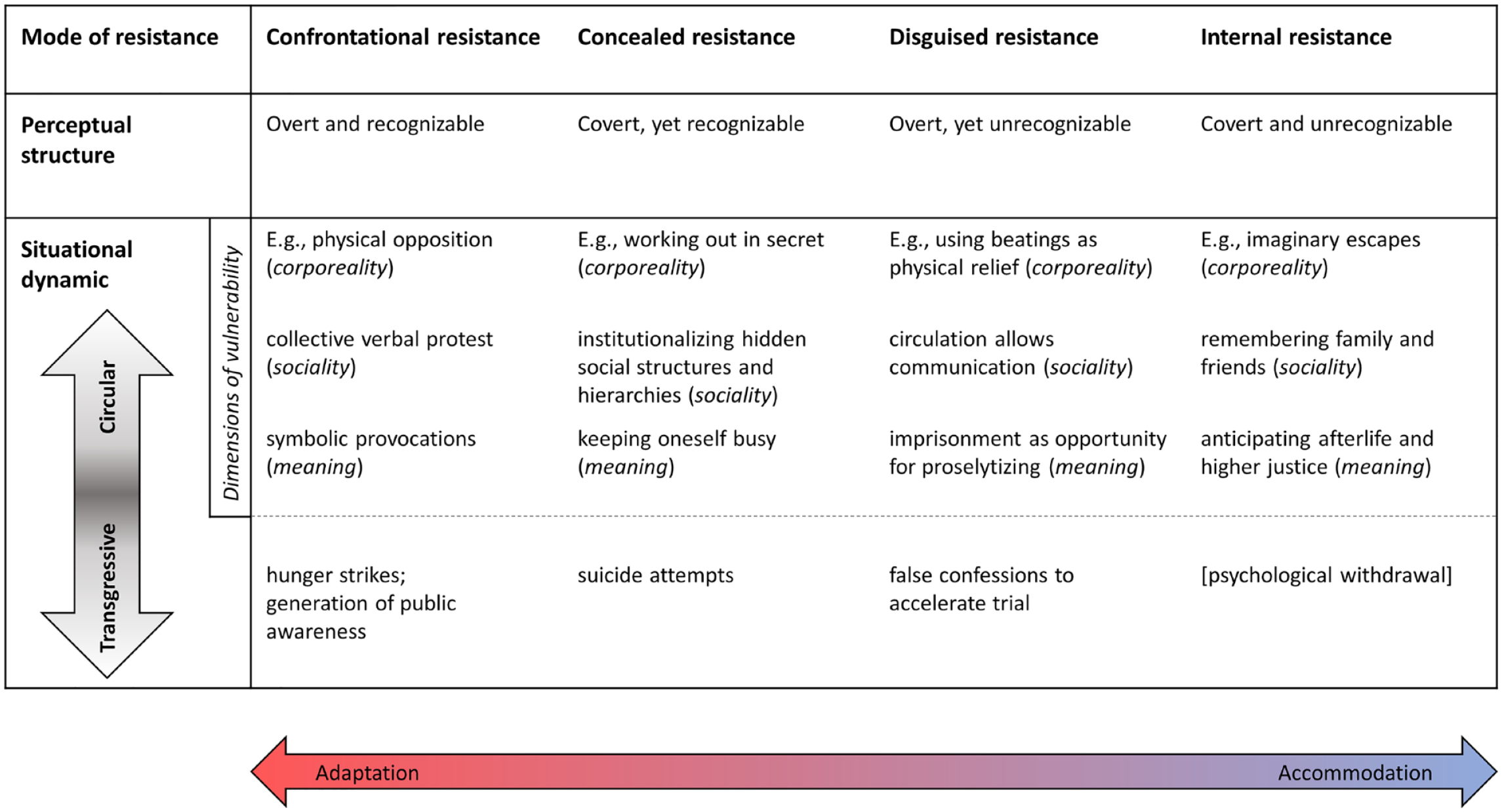
Framework of resistance in Guantanamo.
Modes of resistance
A crucial aspect in research on resistance is its visibility or recognizability. The central question here is whether resistant action must be recognized as such by the other side in order to be considered resistance (Hollander and Einwohner, 2004: 539–41). As Scott (1985, 1990) in particular makes clear using numerous examples, open and public resistance is based on complex socio-cultural and political conditions. Historically, it is “both rare and recent” (Scott, 1990: 198), and even in liberal democracies, it is not always possible (Sutterlüty and Poppinga, 2022). To avoid a too narrow perspective, it is necessary to consider both “the open, declared forms of resistance, which attract attention” and “the disguised, low-profile, undeclared resistance” (Scott, 1990: 198). This holds especially true in an oppressive environment like Guantánamo. Importantly, hidden resistance can take various forms. Different aspects of resistance can be veiled (the act itself, its motives, its initiators) (esp. Scott, 1990: ch. 6), and a distinction must be made between the “visibility” and the “recognizability” of resistance (Hollander and Einwohner, 2004: 539–41).
With respect to Guantánamo, four modes of resistance can be distinguished based on their perceptual structure. The perceptual structure results from the combination of two variables. The first variable refers to the “visibility” or “observability” of an act (Hollander and Einwohner, 2004: 540). If the resistance act is overt, it can be sensed (usually seen or heard) by the camp staff; if the act of resistance is covert, it cannot be sensed. The second variable refers to whether a resistant act is recognizable or unrecognizable (Hollander and Einwohner, 2004: 540), that is, whether the staff can identify a specific act as being one of resistance. In other words, visibility refers to the act, and recognizability refers to the motive of this act. Although “visibility” and “recognizability” have been identified in the literature as important dimensions of acts of resistance, they have not yet been systematically combined. I will therefore use these two dimensions in the following to distinguish four modes of resistance: confrontational resistance (overt, recognizable), concealed resistance (covert, recognizable), disguised resistance (overt, unrecognizable), and internal resistance (covert, unrecognizable). As will become clear, this framework reconstructs the processes in the camp in an instructive way that resonates with detainees’ experiences while also shedding light on the camp’s organizational dynamics.
Situational dynamics
The second conceptual axis of the framework charts resistant acts with reference to what I call their situational dynamic. On the one end of the spectrum, we find practices that follow a transgressive dynamic. Transgressive forms of resistance have their aim outside the situation; they seek to end imprisonment, be it directly or indirectly, instantly or in the long term. To understand why such transgressive acts can be effective even in the context of radically asymmetrical camp governance, it is helpful to take recourse to Heinrich Popitz’s (2017 [1992]: 36–8) reflections on the “antinomy of the perfection of power.” Referring to the “assassin” and the “martyr” as the “symbolic figures of radical resistance,” Popitz argues that even (seemingly) absolute power remains incomplete as the dominated either can try to kill the ruler despite the radical asymmetry of the situation or can force the ruling side to kill them, thereby ending the relationship of domination at the cost of their life. Popitz’s argumentation cannot be applied directly to Guantánamo, as effective violent resistance is not possible, and violence against prisoners is deliberately exercised in such a way that they do not die—at least in most cases. 14 Nevertheless, the following analysis will illustrate that also in Guantánamo, even seemingly complete power remains unstable and, therefore, incomplete in certain respects. 15
Popitz’s reference to the two figures of radical resistance does not only point to the general possibility of transgressive resistance but also to the fact that it can take two opposing directions. On the one hand, the figure of the assassin demonstrates that transgressive resistance can take an active form that seeks to destabilize the organizational framework of domination, for example, by launching a coordinated revolt. The prisoners’ actions are oriented toward the environment. The relationship between detainee and camp, in this case, is one of “adaptation,” to use the terminology of John Dewey. 16 Passive transgressive resistance, on the other hand, as represented by the martyr, is self-oriented. It manifests itself in actions through which the dominated subjects change their own state in order to adjust themselves to the situation, for example, by suicide. In this case, the relationship between prisoner and camp is one of “accommodation.”
Analyzing the reports and interviews of former Guantánamo prisoners, it quickly becomes apparent that transgressive acts are only one, albeit important, group of resistant practices. Looking into the materials, a wide variety of others can be identified. In contrast to transgressive resistance, these do not try to fundamentally change the power structure. Instead, they seek a certain—often temporary—relief on the part of the detainees. The telos of these practices lies not outside but within the camp; they thus follow a circular dynamic. Especially these circular practices are often characterized by a sharp perception of the organizational processes and camp personnel; they use an elaborate knowledge of the cracks and the loopholes in the prison camp in a creative way. As their transgressive counterparts, circular practices of resistance can take different directions of adjustment. This can be seen in Goffman’s (1961: 60–66) analysis of the different “lines” individuals take in order to adjust to “total institutions.” On the one hand, they can “accommodate” themselves in such a way to reduce the environment’s power to injure (Goffman’s notions of “situational withdrawal” and “conversion” describe such accommodative strategies). On the other hand, they can try to “adapt” the environment in order to change or evoke reactions in it that make life more bearable (this would apply to Goffman’s accounts of the “intransigent line” and “colonization”).
To understand how camp detainees resist detention and torture, it is indispensable to systematically take the various forms of circular resistance into account. Yet at the same time, especially the concept of circular resistance confronts us with the thorny question of whether resistant practices might contribute to the continuation of violence and domination. As Hollander and Einwohner (2004: 549) correctly note, “resistance is not always pure. That is, even while resisting power, individuals or groups may simultaneously support the structures of domination that necessitate resistance in the first place.” As will become clear in the following, this is not only a question that emerges from a sociological perspective but also one that the Guantánamo detainees ask themselves and to which they give varying and changing answers.
Dimensions of vulnerability
The force of the violence in Guantánamo results from the fact that the confinement of and attacks on the body often serve not only the immediate infliction of pain but, above all, the violation of other dimensions of vulnerability, like the individuals’ personal territories or social networks, their status as persons, their expectations and life plans, or their moral and religious values. As is shown in the analysis, the varieties of vulnerability are reflected in the varieties of resistance. Therefore, it makes sense to pay attention to the dimensions of vulnerability to which each act of resistance is related. This holds especially true for acts of circular resistance since they do not aim at ending the violent relationship per se but serve to prevent or mitigate specific violations. Hence, in the following sections, a distinction is made within the modes of circular resistance as to which dimensions of vulnerability they primarily address. I will refer to three key dimensions of vulnerability, namely corporality, sociality, and meaning. These dimensions connect vital aspects of the subject’s agency—the body, social self, and individual values and goals—with constitutive aspects of the subject’s environment—its “territories of the self,” social embeddedness, and horizons of expectation. According to this conceptualization, subjects are vulnerable both directly—through attacks on their physical integrity, for example,—and indirectly, through infractions into their personal territories. 17 Conversely, circular resistance is rooted in this vulnerability and strives to defend the subject’s agency and environment against these infractions. By using a specific empirical case, the study can thus substantiate current theoretical insights in the embodied character of agency, sociality, and personhood (e.g. Johnson, 2007; Jung, 2017), as well as in the co-constitution of vulnerability, agency, and resistance (e.g. Butler, 2016, 2020; Gilson, 2014).
The following analysis of resistance in Guantánamo is structured according to the three conceptual axes just mentioned. Thus, each of the four subsequent sections deals with one of the four modes of resistance. Within each mode of resistance, both transgressive and circular forms are identified and discussed. Moreover, in each section, the discussion of circular resistance is structured according to the dimensions of vulnerability. I begin with the modes of “confrontational” and “concealed resistance,” which, to a large extent, correspond to the conventional and narrower understanding of resistance. With the two following modes of “disguised” and “internal resistance,” I then proceed to acts that are often conceived as forms of adaptation, coping, or survival. Even though this may be an adequate description, in a context such as Guantánamo, these actions have to be characterized as resistance as they defy the radically asymmetrical, oppressive, and violent context by defending the prisoners’ agency and self. Looking at Figure 1, the discussion thus moves from left to right.
I protest, therefore I am: confrontational resistance
The first mode of resistance consists of confrontational acts that are conducted to incite a reaction from the camp staff. To elicit this reaction, acts of confrontational resistance must be both overtly performed and recognizable as a violation against the formal or informal camp rules. Because of their direct and openly confrontational nature, these acts are probably the most commonly recognized form of resistance, especially when following a transgressive dynamic. Even narrow conceptualizations would include most of them.
Circular forms of confrontational resistance can be found in many one-on-one conflicts. Regarding the corporeal dimension, these conflicts often take the form of direct physical opposition. Murat Kurnaz (2008: 160–161, 180–183), for example, notes repeated fights resulting from the premature ending of showering or recreation. He also recounts how he managed to knock down a guard despite being chained (Kurnaz, 2008: 182). Ahmed Errachidi (2014: 102) describes how he hit an especially detested guard with a plate when complaining about the unsavory food: “I knew that what I’d done would make him hate me more, but I also knew that showing this kind of resistance was the thing that kept me alive.” One can also find other, non-physical provocations and controversies in the accounts. For example, Moazzam Begg (2006: 206–207) reports how he reacted to some derogatory comments of a soldier who probably thought he could not understand English. Begg, however, came up with a witty retort and, to add insult to injury, let the soldier know that he, the prisoner, “speaks English better than you do.” Mohamedou Slahi (e.g. 2017: 350–354), again, describes how he debated religious matters with certain guards, comparing the consistency of Christian and Islamic doctrines. While the tone is humble, one can see that Slahi takes pride in his intellectual skills and religious knowledge (see also Errachidi, 2014: 135). Reading these and other descriptions, it becomes apparent that the prisoners used conflicts and controversies as opportunities to generate small episodes of meaning through a kind of confrontational affirmation of their self. This might explain why these conflicts seem to refer to fundamental aspects of the prisoners’ selves, such as bodily strength, education and language skills, strong moral convictions, and a belief in one’s own religious steadfastness.
This dynamic of confrontational self-assertion can also be found in collective practices. In many cases, these collective acts were verbal protests triggered by infringements by the guards or when prisoners were taken to or brought back from interrogations (e.g. Adayfi, 2021: 65–67; Slahi, 2017: 60, 213–215; Errachidi, 2014: 87). Khalid al-Asmr (2006: 69) also mentions that detainees protested against the playing of the US national anthem by trying to drown it out with their own shouts and noises. Other forms of collective confrontation took the form of symbolic provocations. For instance, Errachidi (2014: 100) recounts how the prisoners refused to return the plastic spoon and paper plates. Although these objects did not pose a threat to anyone, the guards reacted to this act of collective disobedience by storming into the block, creating “a bizarre scene—grown men scrambling for a plastic spoon.” In addition, as Kurnaz (2008: 192) proudly reports, a group of prisoners managed to hit the despised prison commander General Miller with “a mixture of water and feces,” when he was inspecting their block. After this incident, prisoners further provoked Miller by calling him “Mr. Toilet.” The punishment was, of course, severe (see also Adayfi, 2021: 140–141). Aside from verbal protests and symbolic provocations, we find various collective fights in the material (e.g. Adayfi 2021: 108–111, 144–161; Errachidi, 2014: 129–130). Kurnaz (2008: 212–213), for instance, describes how, following the desecration of the Qur’an, soldiers fired rubber bullets and used tear gas while prisoners used blades and cables from a fan to attack the guards.
Looking at the reports of these collective confrontations, it seems the prisoners were clearly aware that these acts would not improve their situation. In many cases, their situation even worsened because of the punishment. Hence, while collective forms of confrontational resistance repeatedly had a physical dimension, they did not aim at a revolt or even escape. Instead, they were forms of circular confrontational resistance that revolved primarily around the social bonds of the group members and their common effort to defend a sense of meaning in defiance of oppression and violence. “Without my determination to keep on protesting against the things they were doing to us, I’d have lost hope and, after that, my mind” (Errachidi, 2014: 103).
In Guantánamo, hunger strikes were the most important and common practice of transgressive confrontational resistance. The hunger strike challenges the dominating side by means of what Popitz (2017 [1992]: 37) calls “the counterpower of letting oneself be killed.” Similarly, Judith Butler (2020: 202) refers to hunger strikes as a powerful nonviolent practice of resistance that draws its strength from the refusal “to reproduce the prisoner’s body.” 18 Thus, when looking at resistance in extremely asymmetrical conflicts, we not only have to take into account the “weapons of the weak” (Scott, 1985) but also the “weaponization of life” (Bargu, 2014: 14) and practices of “self-weakening” (Därmann and Wildt, 2021: 7; Därmann, 2021): 56). Given these arguments, we have to ask whether the hunger strikes, indeed, were a source of counterpower in Guantánamo.
There have been several waves of hunger strikes in the camp—both relatively early and in recent years (2002, 2005, 2009, 2013, 2017) (Fletcher and Stover, 2009: 74–7; Köthe, 2021, 2023: 339–88; Purnell, 2014; Wilcox, 2015: 48–79). While some hunger strikes were individual acts, many of them were expressions of collective resistance, often involving substantial parts of the prisoner population. Some detainees even went on hunger strike for several years (Köthe, 2021: 57; Purnell, 2014: 275), thus becoming “icons of resistance” (Errachidi, 2014: 169) in the eyes of the prisoners. The physical consequences were dramatic. The strikers turned into “skeletons” (Adayfi, 2021: 323) and looked “like men who’d crawled out of their graves,” their bodies turning “stick-thin” (Errachidi, 2014: 167; see also HRW, 2008: 24).
Hunger strikes in Guantánamo were caused by diverse incidents. Many detainees started or joined hunger strikes because of desecrations of the Qur’an or other religious violations (Fletcher and Stover, 2009: 75; Kurnaz, 2008: 148–52, 188–90; Zaeef, 2006: 227). However, the massive and prolonged hunger strikes, such as the ones in 2005 and 2013, not only aimed at preventing religious violations or improving conditions. Instead, they were also protests against indefinite detention without trial, that is, against the very nature of the camp (Adayfi, 2021: 322; Slahi, 2017: 58–9, 366–7; Zaeef, 2006: 229–230, 234). In the end they aimed at, as Errachidi (2014: 166) puts it, one “main objective—release.”
From the prisoners’ point of view, the hunger strike represented a central tool in their struggle. According to Errachidi (2014: 166), it “was undoubtedly the most serious form of protest against the administration.” Especially in the first months of their internment, the detainees had the impression that this form of resistance could in fact destabilize the camp. Recounting a hunger strike in 2002, Kurnaz (2008: 150–1) writes that he had the impression that “[w]e could bring them to their knees if we all went on hunger strike! They didn’t want us to die.” (see also Adayfi, 2021: 40–1; Slahi, 2017: 58–9). However, only a couple of pages later, his judgment markedly changes: “I soon realized that we didn’t have any real power. It was just an illusion” (Kurnaz, 2008: 154; see also Slahi, 2017: 228). The shift in Kurnaz’s assessment is due to the marked changes in camp governance since November 2002, when Major General Geoffrey Miller became the commander of the camp (e.g. Adayfi, 2021: 89–92; Errachidi, 2014: 88–99; Fletcher and Stover, 2009: 43–45; Ischmuratov, 2006: 126; Mayer, 2009: 202–212; Slahi, 2017: 58–59). To limit the effectiveness of the hunger strikes, the camp administration established or intensified control procedures. Especially artificial feeding and its intensification through the use of “emergency restraint chairs,” in which prisoners were fixed for hours until they had digested their food, gave the staff far-reaching control of the prisoners’ bodily functions (Adayfi, 2021: 201–207; Errachidi, 2014: 167–169; Köthe, 2021: 66–69; Purnell, 2014: 276; Wilcox, 2015: 71–74).
If we focus on the direct confrontation between the prisoners and the camp administration, the hunger strikes did not lead to a substantial change in the radical asymmetry of power. However, the hunger strikes must also be understood as acts of indirect resistance because, as in other historical cases (e.g. Feldman, 1991: 220–221, 230; O’Hearn, 2009: 516–518; Bargu, 2014: 3–5, 10–3), they served to mobilize the public, especially in later years. Reports of the hunger strikes and force-feeding repeatedly reached the media and sparked public debates (Purnell, 2014), which, in some cases, was known to the prisoners (e.g. Adayfi, 2021: 252, 322; Errachidi, 2014: 166). Overall, the effectiveness of the hunger strikes in Guantánamo fluctuated as a result of the complex constellation of the hunger strikers’ determination, increasing experience, and their limited, but nevertheless increasing, possibility of informing the outside world about the hunger strikes on the one hand and the camp administration’s technical, medical, and organizational countermeasures and the prisoners’ increasing health problems on the other. 19
The prisoners also used other strategies to create public awareness and mobilize third parties. Besides the hunger strikes, two of these indirect means of confrontation have been especially significant. First, together with their lawyers, the prisoners managed to put some pressure on the administration in court, although even minor improvements required years of painstaking litigations (e.g. Hajjar, 2018, 2022). Second, the detainees tried to inform the public about their fate—be it through books, interviews, or art. 20 Some prisoners started to write, draw, paint, or sculpture already during their detainment (Adayfi, 2021: 298–310), while others did so only after release. Both the biographical accounts and the artworks were not only ways of fleeing to other worlds or of passing time but also a way of resisting (e.g. Errachidi, 2014: 80) and of retaining a kind of interpretative authority over one’s own life. Writing on Guantánamo, Mansoor Adayfi, (2021: 303) states, “was a way of processing and even reclaiming the power to tell the world who I was in my own words, not the interrogators. They could control my life, but I wouldn’t allow them to define it.”
Creating clandestine micro-territories: concealed resistance
The radically asymmetrical and violent form of camp governance in Guantánamo systematically violates the boundaries and integrity of the prisoners, that is, their “territories of the self” (Goffman, 1971: 28–61). The prisoners can be understood as an extreme case of “a spatially deprived group” almost completely bereft of any “free territory,” which “affords opportunities for idiosyncrasy and identity” (Lyman and Scott, 1967: 237). In response, many techniques of resistance aim to mitigate these violations by secretly establishing “offstage social spaces” (Scott, 1990: 188). Due to their recognizability and the radical asymmetry of camp governance, the clandestine micro-territories have to be understood, using de Certeau’s (1984: xvii–xx) well-known distinction, not as permanent “strategic” territorial gains but as the usually short-lived result of creative “tactics.” 21 A wide variety of concealed acts can be identified in the material. In this section, I will first discuss circular concealed resistance—both in “regular” confinement and in the punishment blocks of the camp—before turning to the cases of transgressive concealed resistance.
Confronted with the constant territorial infractions during “regular” detention, prisoners tried to establish small clandestine “possessional territories” and “use spaces” (Goffman, 1971: 34–35, 38). Creating these hidden micro-territories was a crucial tool in their “fight” against “the dreary monotony of daily existence” (Begg, 2006: 218), which allowed to transform the cell from a place of confinement into a site for physical relief and meaningful activities. Several techniques of physical relief are mentioned in the accounts. Errachidi (2014: 79) describes how he constantly walked “the three steps up my cell and the three steps down.” Some detainees also worked out and stretched when no guard was in sight (Kurnaz, 2008: 144, 146; Slahi, 2017: 295).
The prisoners not only attempted to establish individual territories but also engaged in various social activities, thus creating their own “conversational preserves” (Goffman, 1971: 40) or “interactional territories” (Lyman and Scott, 1967: 240–241). As the cells in many blocks of the camp resembled cages rather than closed rooms, the prisoners were able to interact with one another also outside the communal spaces (like showers, toilets, recreational areas, or the “privileged” communal prison blocks). The prisoners took every opportunity to communicate with one another, sharing news, skills, and stories (e.g. Azzam, 2006: 88–89; Kurnaz, 2008: 144, 147, 151, 163; Slahi, 2017: 44–45, 53–54). Adayfi (2021: 89, 179, 242) names this constant clandestine flow of rumors and information between the blocks the “Detainee News Network” (DNN), which was crucial as the prisoners “didn’t have access to CNN or any other news.” The exchange of linguistic and religious knowledge was of particular importance. Detainees repeatedly describe how they learned other languages in the camp, such as English, Uzbek, Farsi, and Arabic (e.g. Kurnaz, 2008: 147–148, 153; Fletcher and Stover, 2009: 50). In addition, both individually and collectively, many prisoners deepened their knowledge of the Qur’an, often memorizing substantial parts or even the whole book (Begg, 2006: 122, 205; Errachidi, 2014: 134; Kurnaz, 2008: 148, 157–158). Many reports also emphasize the importance of “moments of humor and connection” (Errachidi, 2014: 126; see also Gumarov, 2006). “Maybe our jokes,” Adayfi (2021: 270) writes, “allowed us to see the humanity in each other’s fears.” Errachidi (2014: 125) recounts how he, being a professional cook, “used words to paint delicious meals” for the other detainees who then pretended to taste them. Kurnaz (2008: 158) describes how he managed to create a board game using “pieces from toilet paper,” which he played in secret with his neighboring prisoner through the chain-link fence.
While there were occasional conflicts among detainees, according to Abdul Salam Zaeef (2006: 220–1), “everyone had a very cordial connection with everyone. It was like among brothers, because everyone was oppressed there” (see also Slahi, 2017: 41, 46). This is also evident from the fact that the prisoners cheered each other up when they were taken to or brought back from interrogations (e.g. Adayfi, 2021: 59, 204; Begg, 2006: 207; Errachidi, 2014: 98, 140). According to Kurnaz (2008: 152–154), the prisoners even succeeded in institutionalizing a regulated secret decision-making process. A hierarchy was established for each block, with an “emir” at the top. As these practices demonstrate, the detainees created a dense and concealed network of “mutual support and common counter-mores” (Goffman, 1961: 56). Being “stripped of the support” of their “home world,” they thus opposed the administration’s strategies of isolation by developing not only a shared “solidarity culture” (O’Hearn, 2009) but also rudiments of a kind of bottom-up counter-governance.
Hidden resistance also included certain interactions with the camp staff. The survivors’ accounts reveal different ways in which members of the staff supported the detainees, thereby violating the camp rules. Frequently mentioned are rule-breaking, sometimes lengthy, conversations with detainees, in which guards or nurses expressed compassion or support (e.g. Adayfi, 2021: 46, 70, 219; Begg, 2006: 204–208, 234–238; Errachidi, 2014: 135–136; Kurnaz, 2008: 193–195; Slahi, 2017: 308–309; Zaeef, 2006: 232). In addition, the accounts describe how guards and detainees joked around with each other or that guards gave the detainees additional “comfort items” or a larger amount of food (e.g. Adayfi, 2021: 70, 267–268, 287–288, 305; Kurnaz, 2008: 193–195). Although these interactions involve members of the camp staff, they are nevertheless acts of concealed resistance, since they are against the rules and thus have to be hidden from other (non-complicit) camp personnel. 22 These forms of complicit concealed resistance must be distinguished from acts in which staff members abide to the camp rules but utilize their discretion in the most cooperative way possible. This also includes situations in which staff members carry out their orders but, at the same time, indicate skepticism about them through the way they do so, thus displaying “role distance” (Goffman, 2013 [1961]: 85–152) (e.g. Adayfi, 2021: 219, 239). Both the participation in complicit concealed resistance and the cooperative use of discretion led to the development of nuanced knowledge about camp personnel on the part of the prisoners, who adjusted their own behavior based on their classifications of “good” and “bad” staff members (e.g. Adayfi, 2021: 212, 226, 297; Kurnaz, 2008: 193–195; Slahi, 2017: 312, 326)
If a prisoner was observed (allegedly) breaking a rule, he was often beaten up by the riot squad (IRF) and sent to one of the punishment blocks, where he would be subjected to all kinds of “enhanced interrogation techniques,” as well as to solitary detention (e.g. Errachidi, 2014: 131–132; Fletcher and Stover, 2009: 69–74; Kurnaz, 2008: 146). Isolation was also used as a form of long-term confinement—either to build up additional pressure for the interrogations or to seal off “high-value detainees” from the rest of the camp (e.g. Adayfi, 2021: 49–50, 191–192; Begg, 2006: 195, 258). In solitary confinement, the already enormously harsh conditions of “regular” detention were tightened even more: “In the punishment cells, I couldn’t take more than three medium-sized steps before finding myself in front of the steel door. I was encased in metal, without a horizon, a sense of life and with nothing to see” (Errachidi, 2014: 132).
In these punishment blocks, prisoners pushed the tactics of concealed resistance to their limits. Confronted with radical perceptual, social, and material deprivation, they searched for the most minute residues of meaning. Errachidi (2014: 138), for instance, recounts the following: I collected apple pips just so I could look at them. I used to count the seeds in the core, sometimes there were ten or twelve, usually fewer, and I also counted how many chews it took to finish an apple. I could manage five hundred chews in one apple-eating (for similar practices, e.g., Slahi, 2017: 284; Begg, 2006: 218–219).
Furthermore, even in solitary confinement, prisoners tried to generate social contact. Knowing that other isolation cells were nearby, they could communicate only in a rudimentary way either by whispering (Adayfi, 2021: 93–94) or by shouting, “which was exhausting and sometimes got too much, but since this was the only human contact available, we persisted” (Errachidi, 2014: 148; see also Kurnaz, 2008: 162). Detainees also had secret interspecific contacts. Errachidi (2014: 127) welcomed the company of ants as “a rare sign of life.” Kurnaz (2008: 146, 188) not only enjoyed the presence of iguanas or land crabs but also the birds he fed with breadcrumbs concealed from the guards. “I used to talk to the birds about how strange the world was. They used to be in a cage, and I would visit them, and now the situation was reversed” (Kurnaz, 2008: 160; see also Adayfi, 2021: 27–28, 54, 296–297).
Finally, detainees in the punishing blocks also attempted to regain control over their physical environment. For example, according to Errachidi (2014: 147–148), prisoners in solitary confinement figured out that they could rub rust, which they found near the toilet, against the small windows in their cells to render these untransparent, thus re-establishing at least a minimal control over their “information preserve” (Goffman, 1971: 38–40). Moreover, the detainees tried to combat the deliberately generated cold in the cells. In order to endure the time in the “giant refrigerator” (Kurnaz, 2008: 161), they not only tried to sabotage the air conditioning but also identified the best (or rather the least bad) spot in the cell, the right amount of exercise, and the best use of their clothing (e.g. Adayfi, 2021: 300; Errachidi, 2014: 171; Kurnaz, 2008: 161–162; Slahi, 2017: 240–244).
In many contexts of extreme asymmetrical domination and violence, we find at least two transgressive forms of concealed resistance. Perhaps the most obvious form is what Därmann (2020: 23–33, 2021: 29–50) calls “fugitive resistance,” referring to attempts to secretly escape violence, as practiced, for example, in the context of slavery. In Guantánamo, however, the detainees were painfully aware that breaking out was impossible (e.g. Adayfi, 2021: 158; Begg, 2006: 205; Kurnaz, 2008: 117). Another concealed practice that allows for a very different kind of escape is suicide. Suicide can be conceptualized as a practice of radical accommodation, that is, as a method to end domination through the self-inflicted death of the dominated. For many Guantánamo prisoners, this form of transgressive resistance was a conceivable option (Köthe, 2023: 388–415). 23 Suicide attempts are repeatedly mentioned in the prisoner accounts despite the “strict prohibition against suicide in Islam” (Fletcher and Stover, 2009: 82). 24 For example, Al-Asmr (2006: 68), Ischmuratov (2006: 125), and Kurnaz (2008: 188–189) report that these acts were often connected to desecrations of the Qur’an (see also Fletcher and Stover, 2009: 55–56, 82; PHR, 2005: 52–53). However, it is not clear whether the prisoners actually wanted to die in these situations. Adayfi (2021: 139), for instance, describes a mass suicide attempt by Afghan prisoners as a means to “throw the camp into complete chaos,” thus putting the administration and guards under pressure and stress over a longer period of time. To achieve this, they did not hang themselves all at once, but “did it in waves throughout the day so that the IRF teams and guards would have time to cut down each wave of brothers and take them to the medical unit.” 25
Because they had been deprived of almost everything, prisoners had very limited access to objects that could be used in suicide attempts. For that reason, they tried to hang themselves by using their blankets, bed sheets, shirt collars, or underwear (Adayfi, 2021: 139; Al-Asmr, 2006: 68; Fletcher and Stover, 2009: 55; HRW, 2008: 38; Zaeef, 2006: 227). Nevertheless, it was almost impossible to commit suicide in the camp. Detainees were observed continuously (Kurnaz, 2008: 214; Zaeef, 2006: 227), and those who attempted suicide were transferred to the psychiatric ward and put on suicide watch (HRW, 2008: 33–34; Zaeef, 2006: 227). In addition, cells were specifically designed to preclude suicide, and even the blankets and clothes were produced in a way that prevented them from being used as a rope (Adayfi, 2021: 216; Begg, 2006: 195; Errachidi, 2014: 98, 175).
As these efforts demonstrate, the pressure to prohibit suicides was immense since they were “seen by the military as challenges to its authority” (HRW, 2008: 5). This leads us back to the antinomy of the perfection of power: “The prisoner must be denied a final decision at his own disposal, a last spark of autonomous power . . . The act of killing appears as the monopoly, the privilege of the power holder. Killing oneself violates such a monopoly” (Popitz, 2017 [1992]: 34; see also Sofsky, 1996: 88). The Guantánamo prisoners were thus confronted with the problem—to put it pointedly—of how to survive in a place where “dying is not permitted” (Wilcox, 2015: 49; Zagorin, 2006).
Hidden in plain sight: disguised resistance
The third mode of resistance, disguised resistance, is characterized by a peculiar perceptual structure. In contrast to concealed and internal resistance, it is conducted overtly. Nonetheless, like internal resistance, acts of disguised resistance are not recognizable as resistant practices by the camp staff—at least not immediately. Disguised resistance, in other words, is hidden in plain sight. Because of this precarious perceptual structure, it is not as common as other modes. Still, several circular and even transgressive practices of disguised resistance can be discovered in the material.
Resorting to circular disguised resistance allows prisoners to use camp procedures or even sanctions as opportunities for bodily relief. Slahi (2017: 252), for instance, describes how he sometimes deliberately provoked the officers present during his interrogations, as the physical punishment that would usually ensue allowed him a slight change in the imposed stress position. The short relief “was worth the kick.” Adayfi (2021: 62) recounts that in summer, some detainees “tried to get sent to solitary because it was the only place that had air conditioning and some peace from the chaos of the open cages.” Another variant of disguised resistance makes use of the reinterpretation of physical punishment as something pleasant or interesting. For example, Errachidi (2014: 117) describes how soldiers took him out of his cell in the middle of the night during a torrential rainstorm to punish him: “They wanted me to suffer but, instead, I didn’t even try to resist the rain. I let myself sink into the order of the sky, accepting the softness of its soaking with tranquillity.” Similarly, Slahi (2017: 225–226, 241) reports how he listened attentively to the loud rap music, intended to hurt and provoke the detainees, to forget about his pain for a brief moment.
Guantánamo prisoners also utilized disguised resistance to protect or establish social networks. The prisoners transformed the constant humiliations and violence into a source of solidarity, as “each beating brought all of us closer together despite our differences” (Adayfi, 2021: 65). In addition, as can be seen in several reports, the camp leadership established a system of constant reshuffling to fuel conflicts, prevent social bonding, and intensify isolation (e.g. Ischmuratov, 2006: 129; Kurnaz, 2008: 186, 196–197; Slahi, 2017: 59–60). This reshuffling procedure, however, also afforded opportunities for opposition, as the detainees used it as a means of deepening their knowledge of the camp and of coordinating their protest (e.g. Adayfi, 2021: 61; Errachidi, 2014: 89–93, 147–148; Begg, 2006: 115, 141). 26
Prisoners also used disguised resistance to generate or restore meaning. They did this, for example, by using imprisonment as an opportunity to promote their values. As Errachidi (2014: 135) reports, detainees tried to “draw soldiers to Islam and towards the paradise in which we believe.” Slahi (2017: 350–354) not only reports that he had intense religious discussions with guards. He also influenced one of his former guards, and eventual close friend, to convert to Islam. 27
In the material, we find another important way disguised practices were used to structure the course of events in a somewhat meaningful way, namely false confessions. According to several accounts, during interrogations, prisoners were constantly pressed to confess to supporting terrorist groups or even planning or conducting terrorist attacks (e.g. Begg, 2006: 197–202; Errachidi, 2014: 82–83; Kurnaz, 2008: 163–178; Slahi, 2017: 246–260, 271–281, 318–25). Furthermore, the detainees were often asked leading or trick questions. Facing immense pressure and violence, prisoners began to think up confessions (e.g. Adayfi, 2021: 132–133, 188). In most cases, these false confessions followed a circular logic. “In order to stop torture,” Slahi (2017: 251) notes, “the detainee has to please his assailant, even with untruthful, and sometimes misleading, Intels [sic].” While this disguised strategy often brought about at a short-term relief, it put the confessing prisoner in a difficult situation: “One of the hardest things is to tell an untruthful story and maintain it, and that is exactly where I was stuck” (Slahi, 2017: 229; see also Adayfi, 2021: 50–52, 100). Confronted with this challenge, Slahi (2017: 271–280) used names and information implied in previous questions in order to get a feeling of which direction his confessions should go. He also started to write down detailed confessions not only because “the paper wouldn’t shout in my face or threaten me” but also because this “was a good outlet for my frustration and my depression” (Slahi, 2017: 277).
Aiming beyond temporal relief, false confessions were also used in a more transgressive way. Begg (2006: 197–202) describes that, shortly after his transfer to Guantánamo, he was presented with a six-page “ready to be signed” confession which included all kinds of support for al-Qaida. The interrogators, Begg (2006: 198) writes, pressed him to sign the document; otherwise, he would be “imprisoned for life” or “could face execution.” He read through the pages “in utter disbelief” and found them to be “uninformed and adventurous,” straight out of “cloud-cuckoo-land” (Begg, 2006: 198, 200). Nevertheless, he decided to sign the confession as a kind of disguised ruse. Confessing, Begg reckoned, would accelerate the handling of his case. Moreover, given the style and content of the document, it would be easy for him to show that he did not draft it. “I was imagining the damage this statement could do them in court; it would expose much of their tactics too” (Begg, 2006: 200). As it turned out, of course, the problem with the disguised strategy of false confessions is that it could only work within an effective and transparent legal framework. Although ineffective, this example demonstrates that prisoners tried to use overt yet unrecognizable acts of resistance to promote their release. Thus, despite its precarious perceptual structure, even the unlikely phenomenon of a transgressive act of disguised resistance can be identified in the material.
Defiant minds: internal resistance
The last mode of resistance, which I call internal resistance, is based on mental and emotional accommodations to the situation. As acts of internal resistance are both covert and unrecognizable, they are not discernible from the outside. Because of this perceptual structure, these internal acts do not conform to the ordinary—and narrower—understanding of resistance. However, in line with the contextualist argument outlined above, these acts are understood here as resistance insofar as they serve to counteract the assaults on the prisoners’ self and agency.
Apart from a group of borderline cases, internal acts of resistance are characterized by a circular dynamic and, thus, strive to mitigate the effects of camp life. Crucial practices of circular internal resistance focus on the corporality of the prisoners, that is, either on their immediate physical environment or their very bodies. One way to oppose physical detention internally is to mentally escape the immediate environment and take imaginary delight in the world outside the narrow confines of the cell. 28 This form of internal resistance is exemplified in Errachidi’s report. Recounting his long periods in solitary confinement, Errachidi (2014: 132) writes: “After a while, I invented a technique to give me some respite. In my mind, I’d fly out of my cell and into the world that my imagination would summon up for me.” Over time, these imaginary journeys became a fixed part of everyday life, allowing Errachidi (2014: 132–133) to enjoy nature and the universe. The imaginary communion with the world beyond is loaded with a strong sense of opposition.
Every dawn when I awoke, I’d pray for my imagination to push through the guarded doors and the razor wire and take me beyond. It was from this that I drew my strength. [. . .] The American soldiers had stopped me from going out into the world: well, I could bring the world to me (Errachidi, 2014: 133).
Similarly, Slahi (2017: 24, 146) counts himself lucky because of his “ability to ignore my surroundings and daydream about anything I want . . . How comforting a daydream can be! It was my only solace to help me ignore and forget the evilness that surrounded me.”
The possibility of internal resistance was also used to alleviate violations of sociality. While in the case of concealed resistance, “offstage social spaces” (Scott, 1990: 188) are established by exploiting the physical layout and temporal patterns of the camp, in the case of internal resistance, these social spaces are hidden, as it were, “inside” the detainees, that is, in their memories, interpretations, and imaginations. For example, the prisoners used the memories of friends and family to maintain at least mental contact with their social networks outside the camp. Begg (2006: 145) describes that he repeatedly made use of his memories to fight “the monotony of the days”: “Each night, as I covered my head with the old grey blanket to shield my eyes from the glaring floodlights, I played back in my mind scenes from my old life, several times over.” Memories of religious festivities in the family are another dear memory mentioned by Kurnaz (2008: 185–6). Errachidi (2014: 187) recalls how he inwardly returned to his “loved ones,” imagining, for example, how the family members, especially the children, had changed over the years (see also Adayfi, 2021: 54, 181–182, 344). 29 However, this use of memories and imaginations is an ambivalent practice. For instance, Begg (2006: 145) avoided memories of his father, wife, and children because they were too painful for him. Similarly, Errachidi (2014: 91, 134) reports that thinking about his relatives filled him with worries about his ill son and guilt because he deserted his family. Thus, it seems, at least some lines of resistance may entail substantial potential for further anguish. 30
The Guantánamo prisoners also suffered from systematic attacks on the foundations of a meaningful conduct of life as the administration tried to bar them from activities oriented toward their key values, future plans, or even short-term goals. On the one hand, these assaults targeted the prisoners’ horizons of expectation, that is, the temporal structure of their daily life. In contrast to most other “total institutions,” where the day-to-day business follows a formalized overarching schedule (Goffman, 1961: 6), the Guantánamo prison camp was geared toward deprivation and disorientation, resulting in a life “in limbo” (Begg, 2006: 224). As a result, the prisoners did not have anything meaningful to do, they did not know what would happen next, or when it would happen (Nungesser, 2020: 61–64). The prisoners used different tactics to adjust to this organizational opacity, including tactics of internal resistance. Because they often could not obtain enough reliable information, they tended to narrow their perspectives concerning the camp’s developments. This becomes especially clear if one looks at their temporal orientation.
Imprisonment in Guantánamo . . . wasn’t like the movies where prisoners habitually register the passing of the days by scratching marks on the wall . . . Not us: we didn’t know whether we’d ever be let out, never mind when, and so there was no sense in starting a countdown to freedom. As a result, as time went on, I cared less and less about it except to note when the religious festivals should be celebrated (Errachidi, 2014: 86).
As can be seen in this quote, the restriction of temporal perspective was complemented by the creation of personal rhythms. To oppose the temporal anomy of the camp, prisoners established alternative means of keeping track of time by observing the patterns of meals, the rotation of guards, continuously reciting the Qur’an, counting the calls to prayer (if available), or ritual periods like Ramadan (e.g. Adayfi, 2021: 225; Errachidi, 2014: 78, 105; Slahi, 2017: 282).
An even more radical strategy of accommodation, expressed in several reports, is to interpret the open-endedness and opacity of one’s situation as a positive and meaningful thing. Errachidi (2014: 134) writes that he used his time of confinement to take stock of his previous life, which first led him into a deep emotional crisis but, in the end, turned out to be “the best therapy.” In a similar vein, Begg (2006: 234) writes that “being in solitary confinement for such a long time gave more opportunity than I could have imagined to reflect on my life.” Slahi (2017: 314) even goes so far as to characterize prison as “one of the oldest and greatest schools in the world: you learn about God and you learn patience.”
Attacks on the meaningful conduct of life especially targeted the values of the detainees and their religious convictions and practices. To oppose these attacks, prisoners resorted to a broad, mostly internal framework of religious defense practices. One such method was silent prayer. In many situations, the detainees were denied engaging in the “positive cult” 31 of Islam, such as praying five times daily (e.g. Errachidi, 2014: 114–115, 170; Slahi, 2017: 243–252, 329). To avoid violating one of their key religious duties, they accommodated to the situation by reducing the bodily and spoken aspects of the ritual (e.g. Slahi, 2017: 282–284). This held especially true with respect to the interrogations, not only because these often went on for several hours, or even days, so that prisoners could not conduct their regular prayers but also because detainees used silent or murmured prayers as a way of dealing with the various assaults (e.g. Adayfi, 2021: 202, 238; Slahi, 2017: 228). This is why Slahi (2017: 213) reports that he was relieved when learning from a religious authority in the camp that in such a situation, it is permitted “to pray in your heart since it’s not your fault.”
Silent praying is one vital element within the framework of internal religious resistance that allowed prisoners to put their current situation into a broader, even otherworldly perspective. Similar to what Popitz (2017 [1992]: 38) writes about the martyr, the detainees’ religious convictions allowed for “the relativization of physical existence” that “renders all earthly power provisional and inessential.” This relativization was brought about, for example, by interpreting the incarceration as a “personal trial” and “test of faith” that is not so much about the current life, which is only “temporal,” but about the “afterlife” (Begg, 2006: 152; see also Adayfi, 2021: 104). This temporal logic also becomes evident in passages where the prisoners express their belief in a higher justice and the inevitable “punishment” of their torturers by the “Lord” (Slahi, 2017: 242; see also 280, 351; Gumarov, 2006: 185). In addition, within this religious framework, camp experiences could be recognized as part of a predetermined plan that would become comprehensible only much later. In this vein, Begg (2006: 194) deems “despair” to be “a sin,” while Kurnaz (2008: 187) writes that it “is part of my faith never to give up hope. If Allah was willing, I could be released at any moment” (see also Adayfi, 2021: 136, 225, 329). Conceptualizing suffering as a transient state also helped the detainees deal with isolation from their social contacts. Based on his beliefs, Slahi (2017: 196), for instance, was confident that he would see his loved ones again in the afterlife. One could argue that the prisoners confronted the “problem of unjust suffering,” as theorized by Weber, in a radical form. In this situation, they used a form of “religious rejection of the world,” which rendered “the course of the world” at least “somehow meaningful” and that promised “deliverance from suffering” (Weber, 2013: 353, 327). 32
Considering the techniques discussed so far, two main forms of internal resistance become apparent. On the one hand, there was often a narrowing of perspective concerning the concrete camp situation. This confirms one of the crucial insights of psychological coping research, namely, that “in extreme circumstances such as the concentration camp,” individuals often resort to “a tunneling of vision or restriction of perspective,” thereby focusing on a “smaller and more manageable world” (Lazarus and Folkman, 1991: 199). On the other hand, detainees engaged in a widening of perspective by transcending the situation beyond the limits of the camp—be it in memories and daydreams or through religious anticipations of higher justice or the afterlife. By experiencing their confinement as a personal test, trial of faith, or an opportunity for growth and reflection, the prisoners engaged in a “resistant articulation of meaning” (Koloma Beck, 2021: 100), refusing to be passive victims at the mercy of the political authorities or camp administration. Instead, they tried to retain agency even within their accommodative responses to their environment.
There is a third form of accommodation that could be interpreted as a transgressive form of internal resistance, namely psychological withdrawal. In a way, psychological withdrawal combines elements of the first two forms of internal resistance as it leads to the transcending of the situation by a radical limitation of perspective caused by unbearable stress. As Goffman (1961: 61–62) mentions, this radical form of dissociation can be seen as one possible line of adjustment to harmful environments. 33 In the biographical accounts, the massive psychological deterioration of prisoners is clearly noticeable—for example, in repeated descriptions of depressive episodes, memory loss, and mental breakdowns (e.g. Adayfi, 2021: 343; Slahi, 2017: 157, 181, 276–294, 362; Errachidi, 2014: 139). Probably due to the material’s specific kind of survivorship bias, the prisoner accounts largely focus on temporary psychological issues. However, some interviews and reports also suggest more permanent traumas. Replying to a question regarding mental health problems, Zaeef (2006: 226), for instance, states: “Everyone had to deal with it. No one was exempt from it. But there were different degrees. Some went crazy and lost their minds” (see also Adayfi, 2021: 33; Azzam, 2006: 92; Errachidi, 2014: 139; Ischmuratov, 2006: 133; Slahi, 2017: 346). 34
Psychological withdrawal certainly is a borderline case. On the one hand, it constitutes a severe challenge to existing power relations since the prisoner eludes the camp to a certain degree. Absolute domination, it could be said, presupposes a certain self-control on the part of the dominated. If they become apathetic or act erratically, they can be forced to behave in a desired manner only to a limited extent. This is why psychological withdrawal could be conceived as a transgressive form of resistance. On the other hand, psychological withdrawal lacks the clear motivation to resist or at least diffuse oppositional intentionality, as it is an unconscious accommodative process the detainee undergoes due to overwhelming stress and suffering. Using Hollander and Einwohner’s typology (2004: 544), it could thus be classified as “externally defined resistance” since it is interpreted as resistant only by observers and/or researchers. To highlight this difference to other, more reflexive forms of transgressive resistance discussed in this article psychological withdrawal is bracketed in Figure 1.
Conclusion: Guantánamo, resistance, and camp governance
The analysis presented in this article contributes to the existing literature in camp studies (e.g. Bochmann, 2021, 2023; Martin et al., 2020 and the introduction to this special issue) by opening up new insights into the interrelation of resistance and camp governance on several levels. To conclude the argument, I now briefly discuss four broader implications of the study: (1) the necessity of a contextualist understanding of resistance which considers the specifics of the case at hand, (2) the need to ground theoretical generalizations more strongly in concrete empirical analyses, (3) general dynamics between camp governance and resistance in Guantánamo, and (4) finally, a number of aspects that might be interesting for comparative research on resistance in camps and prisons in the future.
Understanding resistance as relative to (camp) governance
Regarding its specific object of study, the analysis offers a detailed understanding of how Guantánamo detainees resisted the camp’s violence and endured years of detention. By differentiating the prisoners’ activities according to their perceptual structure, situational dynamics, and dimensions of vulnerability, a comprehensive as well as nuanced conceptualization of resistance is proposed. The spectrum of resistance includes diverse acts, following distinct logics. Despite these differences, these acts share a core characteristic: They aim to defy asymmetrical violence and total domination and to create possibilities for self-assertion. The analysis thus highlights the importance of an explicit and considerate definition of resistance, which is often neglected in the literature (Hollander and Einwohner, 2004). In order to grasp the specifics and complexity of the case, it was not possible to apply one of the available understandings of resistance directly. Instead, they were used as “sensitizing concepts” (Blumer, 1998 [1969]: 147–152), which were then adapted and combined. Building on the comparison, combination, and systematization of perspectives, the analysis presented illustrates the importance and usefulness of a contextualist understanding of resistance.
According to this contextualist understanding, the conceptual boundaries of resistance change relative to the form of (camp) governance that prevails in the respective socio-historical context. Applied to the case of Guantánamo, such a contextualist understanding suggests the use of a broad concept of resistance, which mirrors the character of camp governance there. Guantánamo was not only designed for the detention of prisoners or to gain intel through torture. It was designed to break the identities of the detainees, to destroy their private world, and to humiliate and dehumanize them. In such a radically asymmetrical, violent, and totalitarian context, it would be inappropriate to limit the meaning of resistance to the effective disruption of camp operations or to public protest. Instead, in such a context, it is appropriate to speak of resistance if we find acts characterized by an oppositional as well as self-affirming impulse. And this is exactly what we find in the testimonies that were analyzed. In their books and interviews, the survivors report a broad spectrum of often quotidian and seemingly inconspicuous acts intended to prove that they are “more” than Guantánamo (Errachidi, 2014: 125), that they do not permit themselves to be “broken” (Kurnaz, 2008: 187), and that they do not allow their own identity to be “defined” (Adayfi, 2021: 303, 310) by the camp. Time and again, they describe that their goal in the camp was to defend their “self-respect and dignity, at all costs” (Begg, 2006: 207; also 152, 258), to show through their actions that they are “human beings” and not “animals,” and to defend their “humanity” (e.g. Adayfi, 2021: 81, 154, 162–163, 237–239, 310). Over time, this impulse to defy Guantánamo and to uphold one’s moral, religious, and social self became a leitmotif that runs through the survivors’ accounts. Thus, in agreement with authors such as van Pelt (2014: 561) and Därmann (2021: 55–58), I consider many of those acts as part of a broad and diversified spectrum of resistance, which in other contexts would be interpreted as mere instances of coping, survival, or adaptation such as the religious interpretation of the situation as part of a divide plan, the concealing of social activities or workout, or the reciprocal support and encouragement among prisoners.
From the arguments presented, it also follows that this broad understanding of resistance implies conceptual boundaries that result from its two basic conditions. The first boundary arises from the contextualist nature of the concept. If the context under study is less asymmetrical, totalitarian, or violent, the scope of the concept of resistance is reduced. In the case of Guantánamo, for example, this would be relevant with respect to the differences between the “privileged” Camp 4 and other parts of the camp complex, which were primarily described in the survivor accounts. Also relevant would be later variations in the overall degree of repression, especially the improvement in camp conditions between 2010 and 2012. The second condition is linked to the intentional structure of resistance. In order to be regarded as resistance, actions or adaptations must follow both an oppositional and a protective impulse. In the case of Guantánamo, it could be seen that the leitmotif of the various acts of the prisoners was to defend their own religious, moral, and social self against the constant attacks from the camp. Reactions that, while posing a challenge to the camp order, do not conform to this pattern—such as psychological withdrawal—thus lie outside the conceptual boundaries of resistance.
Guantánamo and the “theory-empiricism gap”
The argumentation developed here also contributes to addressing a problem that Annett Bochmann (2021: 1) refers to as the “theory-empiricism gap” in camp research. Her criticism refers to the fact that important and influential theoretical perspectives on camps, such as Agamben’s, focus on concepts of absolute domination and the state of exception in a one-sided and overly generalized way, without taking into account the empirical plurality of camps or the agency and self-governance of camp populations (Bochmann, 2021: 10–20; 2023). Moreover, the analysis presented can also be read as a critical response to the one-sidedness of violence research. So far, most studies in violence research are “perpetrator oriented” (Därmann, 2021: 56; Hartmann and Hoebel, 2020: 67), meaning that they primarily strive for an explanation of violent acts. In contrast, how violence is suffered and resisted is less often at the center of research (Nungesser, 2019a). These two theoretical biases—theoretical overgeneralization and perpetrator-orientation—potentially contribute to misconstruing people affected by violence as “bodies,” “objects,” or “apathetic automatons” (Koloma Beck, 2021: 91–94; Millet, 2018: 1–24; Wachsmann, 2015: 18). As the present study shows, an “elimination” (Sofsky, 1996: 89) of agency can by no means be postulated even for extremely asymmetrical contexts of domination and violence. When looking at torture contexts, it should thus not be assumed from the outset that “the supremacy of power crashes down” on the prisoner, thus transforming them to “a body without a voice” (Di Cesare, 2018: 9, 6). Instead, the limits, possibilities, and forms of resistance to torture must be examined empirically in specific cases. In the case of Guantánamo, an analysis of the biographical materials shows that prisoners possess an effective, albeit limited, form of agency and use it in various ways (see also Breger, 2024: 205–223).
The interplay between camp governance and resistance in Guantánamo
The analysis presented also provides insights into the dynamic interplay between camp governance and resistance in Guantánamo. The reports make clear that the detainees realized that the camp was not a “static place” (Errachidi, 2014: 128) and that it “aged, too, and kept growing” (Adayfi, 2021: 227). In this context, a distinction can be made between dynamics of direct confrontation and those that arose indirectly through the reception of the Guantánamo prisoners’ resistance outside the camp.
With regard to direct confrontation, the materials reveal three ways in which resistance influenced camp governance. First, especially as a result of the early collective protests and hunger strikes, the prisoners describe that they felt a certain sense of power and were able to force negotiations with the camp administration (e.g. Adayfi, 2021: 40–41; Kurnaz, 2008: 150–151; Slahi, 2017: 58–59). This made it possible for them to achieve modified regulations on how the Qur’an should be handled, for example. However, this dynamic seems to have lost its relevance relatively soon, particularly as a result of the change in camp leadership. Instead, there was, second, an adjustment and tightening of camp procedures to prevent resistance. As Errachidi (2014: 178) notes, the camp administration “learned from its past mistakes.” This led, for example, to the prevention of suicide attempts through increased control and the more widespread use of the psychiatric ward or to the discontinuation of the shuffling system that allowed for communication between different blocks. Third, the tightening of procedures was complemented by changes in infrastructure and various “technical fixes.” As has been shown earlier, the selection and modification of cell equipment, for example, made suicide attempts almost impossible. In addition, emergency restraint chairs were used to deal more effectively with hunger strikes.
Resistance and camp governance were also indirectly connected—mediated by the reactions of the outside world. Notably, the legal processes and institutions in the camp were partly reformed in response to the repeated and protracted litigations initiated by the detainees’ families or the detainees themselves through the support of lawyers (e.g. Hajjar, 2018, 2022). To counter the growing public criticism, the military leadership also tried to change the public image of the camp. Strict control over photographic material from the camp and a modified selection of published photos were intended to create an image of humane conditions of detention and lawful procedures (Van Veeren, 2011). Moreover, journalists were allowed access, but they only got to see a very specific facade of the camp, namely selected areas of Camp 4, where the most “cooperative” prisoners with the most “privileges”—such as communal living—were housed. Even within these selected areas, the journalists had no contact with the detainees (e.g. Adayfi, 2021: 215, 227, 281; Kurnaz, 2008: 211). However, this strategy of building a humanitarian facade was in turn challenged by the increasing number of reports, interviews, and art works about and by prisoners.
If we look at the different dynamics between resistance and camp governance as a whole, we can say that the camp structure proved to be robust, especially with regard to direct confrontation, and at the same time, it was flexible enough to adapt to new strategies of resistance. In particular, the strict and brutal regulation of hunger strikes meant that this initially transgressive strategy gradually became a circular form of resistance. Protesting, in the words of Adayfi, (2021: 234–235), became a “job” for the prisoners, which was maintained as a practice of self-assertion but was no longer able to challenge the fundamental order of the camp directly. Hence, while the prisoners could not directly destabilize the camp in itself, in many cases, they were nevertheless able to defy the camp by reaffirming their identity and agency through a variety of circular forms of resistance. Even though some of these circular practices were probably tolerated by the administration and thus integrated into the logic of camp governance, many practices exploited the cracks and loopholes of the camp organization and thus enabled small areas of freedom.
The limits of the administration’s control also became apparent with regard to the reactions of the outside world and, in particular, the legal challenges. Although the litigations often did not achieve their ultimate goal, namely the release of the prisoners, they were nevertheless “critical to penetrating the clandestine detention facilities and bringing to light facts about what the government was doing” (Hajjar, 2018: 316). Overall, the media reports about the camp and, in particular, the hunger strikes, the legal challenges, and the prisoners’ testimonies contributed significantly to the constant and intense criticism of the camp (e.g. Hajjar, 2018; Tayler and Epstein, 2022: 18). The extent to which this changed the course of the camp’s history can hardly be assessed, however (Hajjar, 2018: 319).
Implications for the comparative study of resistance in camps and prisons
Finally, combining the analysis presented and existing approaches provides instructive insights for the comparative analysis of resistance in different camps or prisons. By doing so, different aspects of camp and prison governance can be identified that are likely to have an impact on the spectrum of resistance found in varying contexts.
A first important aspect is the degree of control, which results primarily from the size of the context of domination, its geographical and spatial layout, and the density of surveillance. Scott’s studies (1985, 1990), for example, contain descriptions of hidden practices of resistance such as gossip or the development of complex subcultures of resistance with their own sites, traditions, and rituals that are presumably much more likely within the “large-scale structures of domination” (Scott, 1990: 21) that he investigates than in a clearly delimited and intensively surveilled context such as Guantánamo. In addition, certain forms of transgressive protest such as “fugitive resistance” (Därmann, (2020: 23–33, 2021: 29–50) or suicide seem to be almost impossible in such a context. The degree of control is also dependent on the ratio of staff to prisoner, which is much higher in Guantánamo than in regular prisons. For example, in 2013, there were 1,900 staff members in the camp, which then held 166 detainees, resulting in a ratio of 11:1 (Rosenberg, 2022). The ratio even increased as further prisoners were released. In contrast, even in US high-security prisons, there are between three and seven detainees for every correctional officer. 35 Although this would require further investigation, these differences suggest that not only is the level of surveillance higher in Guantánamo than in US mainland (and probably most other) prisons but also the degree of individual guard discretion is lower as there is a high level of mutual control (e.g. Adayfi, 2021: 338).
The degree of oppression can also differ significantly between camps (see Arendt, 1962 [1951]: 437–459 and van Pelt, 2014 for camp typologies). As the restrictions, interrogations, and punishments show, the degree of oppression in Guantánamo is severe. Accordingly, the prisoners have no opportunities for regular public dissent, as would perhaps be conceivable in large refugee camps where we find something like a “public camp life” (Bochmann, 2021: xv). In Guantánamo, detainees cannot resort to “civil,” but only to “uncivil” disobedience (Därmann, 2021: 21–22, 57–58). The degree of oppression also differs between and within different prisons. Camp 4 in Guantánamo, reserved for level 1 detainees, resembles a regular prison the most—also from the detainees’ perspective (e.g. Adayfi, 2021: 264–265, 275–276). Camps 5 and 6, on the other hand, are more similar to super-maximum security facilities on US mainland, which were also the model for these camp structures (Fletcher and Stover, 2009: 49). According to Amnesty International (AI) (2007: 2), supermax prisons themselves “have been repeatedly criticized by international bodies and US courts as incompatible with human rights and US correctional standards.” While there are similarities with regard to solitary confinement, for example, the conditions in the lower-level camps in Guantánamo are even more severe than those in the supermax prisons. The Guantánamo detainees have been systematically tortured using “enhanced interrogation methods,” have had no access to regular courts, have (with few exceptions) never been charged or convicted, have been even more isolated, and have access to even fewer items or media (AI, 2007: 16–18; Fletcher and Stover, 2009: 49). These differences in the degree of oppression are obviously also highly relevant for the forms of resistance. This can be seen, for example, in the fact that the intensity and nature of resistance in Guantánamo changed significantly when the repression and violence declined markedly between 2010 and 2012. Although there were still conflicts, these were much more likely to be addressed through negotiations (Adayfi, 2021: 277, 283–285, 303).
The possible forms of resistance are also influenced by the degree of segregation. For example, if individuals have to perform forced labor collectively—such as in labor camps or in contexts of slavery—this creates different “interactional territories” (Lyman and Scott, 1967: 240–1) and thus different possibilities for communication and coordination than in camps or prisons that separate detainees more strongly from one another or even use solitary confinement, as practiced in different parts of the Guantánamo prison camp.
Finally, camp and prison contexts can also differ with respect to the “tension” between the inside and the outside world, as Goffman puts it. A reduction in tension can result from an attempted “colonization,” through which “a stable, relatively contented existence is built up out of the maximum satisfactions procurable within the institution” (Goffman, 1961: 62). This perspective is sometimes productive when applied to regular prisons (e.g. Crewe, 2009: 149–57). In Guantánamo, this approach cannot be found in the materials examined here, at least in the early years. The later phase from 2010 to 2012, which Adayfi (2021: 298, 316) describes as Guantánamo’s “golden age,” could be seen as an exception because at that time, the prisoners were able to live together in groups, learn together, and reshape their environment through art to some degree. With the administrative change in mid-2012, this phase came to an abrupt and brutal end, and “life went back to darkness” (Adayfi, 2021: 319).
In another form, the tension between the inside and the outside world can be reduced if prisoners decide or are forced to “convert” (Goffman, 1961: 63), that is, to align themselves with the value system of the inside world. This form of alignment is typical of so-called “re-education camps,” for example. No processes of conversion can be found in the materials analyzed in this study. Rather, it is precisely the common faith of the prisoners and the anti-Muslim character of the camp that contributed to the fact that the tension between the world of the prisoners and the world of the camp remained high throughout. 36 The common faith and the feelings of community and brotherhood it generated also contributed significantly to the fact that, unlike in other camps and prisons, there were apparently no fundamental tensions and conflict between the prisoner groups. 37
Finally, another typical pattern suggested by Goffman (1961: 62) cannot be observed in Guantánamo. As the repeated waves of massive hunger strikes in particular demonstrate, overt and direct protest was not “a temporary and initial phase of reaction” to imprisonment but an important and recurrent practice of self-assertion. Even if its effectiveness changed over time, the “intransigent line” remained an essential feature of everyday life in Guantánamo.
The analysis of resistance to indefinite detention and torture in the Guantánamo prison camp presented here is instructive in several respects. Through an in-depth dialogue between different conceptual approaches and detailed empirical analysis, it helps to rectify one-sided conceptualizations and overgeneralized claims on camps that remain influential in social theory. At the same time, this dialogue paves the way for a systematic and differentiated conceptualization of resistance. Finally, the analysis not only provides more general insights into the entanglements of domination and agency as well as vulnerability and resistance but also opens up comparative perspectives that can inform future research on violence and resistance in camps and prisons.
Footnotes
Acknowledgements
This article is the result of a long research process during which I received valuable feedback from numerous people. For helpful comments and suggestions, I am especially grateful to the members of the “Theory and History of Sociology” research group at the Department of Sociology at the University of Graz, the members of the “Macro-violence” research group at the Hamburg Institute for Social Research (HIS), and the members of the “Social Theory Colloquium” at the University of Bielefeld, organized by Rainer Schützeichel (whom I can unfortunately only thank posthumously). I also received important feedback in the course of presentations in Basel/Muttenz, Bielefeld, Graz, Passau, and Salzburg. A special thanks to the organizers, colleagues, and former Guantánamo prisoners who shared their knowledge at the conference “Camps, Carceral Imaginaries, and Critical Interventions” at the University of Graz in May/June 2024. For the helpful exchange on the topic, I am also grateful to Max Breger, Larissa-Diana Fuhrmann, Eddie Hartmann, Thomas Hoebel, and Sebastian Köthe. Finally, I would like to thank the anonymous reviewers, the guest editors of the special issue, Annett Bochmann and Andrea Purdeková, as well as the IJCS editor Phillip A. Hough for their helpful criticisms and comments.
Funding
The author(s) disclosed receipt of the following financial support for the research, authorship, and/or publication of this article: The author acknowledges the financial support by the University of Graz.
