




Abstract
The article examines the power of materiality in the context of refugee camps, demonstrating how local orders and global governance are intricately interwoven within the material domain. It draws on ethnographic fieldwork conducted in Burmese refugee camps in Thailand to illustrate how sociomateriality can establish spaces of exclusion and associated memberships through their practical implementation, but at the same time permit flexible forms of local manifestations. These aspects represent the tangible realities that people, both ordinary camp residents and local authorities, navigate and achieve in their local public camp life. By means of detailed observation of three distinct camp situations—namely, interactions of membership, checkpoint practices, and the temporary suspension of public camp life—the article argues that mundane sociomaterial practices can both produce and undermine the political intentions of architects to realize materialities of exclusion. Nevertheless, despite their partial and incomplete nature and the capacity of people to circumvent them, the materiality of exclusion is maintained and persists. By elucidating these dynamics, the article contributes to the existing literature that emphasizes the importance of understanding camp governance through the lens of sociomateriality.
Introduction
The article makes a valuable contribution to the existing body of scholarly work informed by the material turn, demonstrating the potential of analyzing materialities in the context of refugee camp governance (Abourahme, 2015; Dudley, 2010; Hicks and Mallet, 2019; Peteet, 2005; Ramadan, 2013; Scott-Smith and Breeze, 2020). This perspective posits that power relations and governance are not solely a result of human agency; rather, they are shaped, formed, and regulated by the interactions between humans and non-human entities, including objects, the infrastructural and material world. 1 Scholars have put forth the argument that the materiality of the camp is illustrative of global politics (Abourahme, 2015; Ramadan, 2013: 65). The presence of characteristic objects and infrastructures, such as fences and checkpoints, but also temporary building materials are an integral part of the closed camp formation exemplifying the extraterritorial and exceptional character of these spaces (Abourahme, 2011; Bochmann, 2023b; Brankamp, 2019; Hamilakis, 2017; Meiches, 2015).
However, scholars have demonstrated that the built environment and materiality of exclusion only possess the potential capacity to actualize political exclusion (Meiches, 2015: 488; Oesch, 2017: 110). They show, for example, how the relationship between materiality and temporality is produced and reshaped by the improvised tactics of camp residents (Abourahme, 2015; Ramadan, 2013: 65). The materiality of the camp serves as to establish delineate spaces and demarcations, yet simultaneously permit flexibility, resistance (Turner, 2022: 54–55), and elastic elements of the camp (Meiches, 2015). This article contributes to these debates through an analysis of Burmese refugee camps in Thailand, answering the question of how the material and the social are interconnected and how much power the materiality has in creating these camps as exclusionary spaces. This study presents a series of empirical findings which demonstrate how materialities contribute to the formation of camp governance and the associated social order but also how the political objectives and the intentions of the architects behind the materialities of exclusion are locally circumvented.
I present a series of observations that demonstrate how the materiality of exclusion is both produced and circumvented. The initial observation, which concerns the categorization of camp members, is centered on the production of local memberships, the processes through which they are (re)produced in local interactions, and the manner in which they are connected to the materiality of the camp. The second observation concerns the ways in which the materiality of exclusion becomes visible and maintained at the border checkpoints through the barrier objects, yet is simultaneously bypassed and ignored by the locals: residents and border guards alike. The third observation, which concerns the performance of a total institution, demonstrates that a typical total institution, which is characterized by the exclusion of its members from their environment and strict regulation and control, is performed and realized in exceptional circumstances.
Moreover, this article is linked not only to the material aspects of camp life but also to ongoing research that continues to highlight the multiplicity and heterogeneity of power relations in camps. These studies describe camp governance as multiple, plural, hybrid, and contentious (Maestri, 2017; Oesch, 2017; Ramadan and Fregonese, 2017). Nevertheless, the global order of statehood, and the so-called humanitarian regime are discussed as the primary motors of the production of refugee camps as extraterritorial spaces of exclusion/inclusion (Agier, 2011; Hyndman, 2000; Janmyr, 2013; Turner, 2010; Verdirame and Harrell-Bond, 2005), for example in terms of its legal and political orders (Bochmann, 2023b; Oesch, 2017). Refugee camps as spaces of exclusion are a consequence of the global state order (Haddad, 2008; Janmyr, 2013; Malkki, 1995b). Concurrently, refugee camp studies demonstrate that there are multiple local orders and microstructures that cannot be explained by these global orders of membership and exclusion/ inclusion structures alone (Bochmann, 2021; Jansen, 2018; McConnachie, 2014; Turner, 2010). The extraterritorial character of camps does not preclude their interconnections and interdependence to their local and wider environments. These local connections at the social, economic, and legal levels are even necessary for the camp’s continued existence (Jacobsen, 2005; Jansen, 2018; McConnachie, 2014). However, how exactly are these local orders related to global governance, and how do different levels or scales intersect and impact social actions on the ground?
I contend that an analysis of sociomateriality 2 and the materiality of exclusion enables us to examine camps via a micro-level analysis, adopting an approach that is both empirically focused and situated within a specific locality. Concurrently, this approach allows us to contextualize camp studies within broader global networks and entanglements (Abourahme, 2011; Ramadan, 2013). In this context, the term materiality of exclusion is used to describe the tangible objects and infrastructure that contribute to or reinforce exclusionary practices or policies within a specific context. The sociomateriality of the camps plays a role in the formation of exclusionary spaces, as evidenced by the presence, maintenance, and repair of barbed wire and checkpoints. 3
It goes without saying that, camps incorporate mechanisms of inclusion and membership (Oesch, 2017; Sigona, 2015). Those residing in the camps are able to benefit from the status afforded to them as members of the camp. Such benefits include the receipt of humanitarian assistance, the opportunity to pursue basic education for children in the native language, and access to basic healthcare. Furthermore, the relative assurance of continued residence in the camp without the constant threat of police scrutiny, financial penalties, or deportation that people from Myanmar in Thailand outside of the camp face depending on their legal status (Pobsuk, 2018) is of significant importance. However, I argue that these mechanisms of inclusion are established as a result of the mechanisms that exclude camp residents from integrating or settling on a long-term basis. Inclusive mechanisms are established as a result of exclusion and the materiality of exclusion.
From the perspective of empirical analysis, I understand the materiality of the camp not as something symbolic, temporary or purely political here; rather, as something very concrete and tangible that people on the ground deal with and locally accomplish on a daily basis. 4 The materiality of the camp as an extraterritorial space is something people (not only camp residents but local authorities on site as well) must work with to establish their local social orders within their daily (inter)actions. I demonstrate how this exclusion and opening is not a paradox but rather a localized, practical achievement by both non-human and human actors on the ground. These sociomaterial actions may be perceived as improvised or provisional, however they become routine and daily actions that prove to be stable and solid.
While camp materiality undoubtedly establishes limits and exclusions, it also permits and generates various forms of mobility outside the camp. Camps serve as sites of confinement, yet simultaneously allow for mobility. However, the materiality of exclusion endures, despite its partial and incomplete nature, and the capacity and power of migrants to circumvent these materialities, I argue that even though the materiality of exclusion is bypassed locally, the sociomateriality of the camp reinforces a long-term temporary exclusion to a particularly high degree, thus co-producing and contributing to the maintenance of the global order, where every person must belong to a specific territory (Malkki, 1995b: 496). The article provides empirical support for the argument that materiality plays a powerful role in reinforcing the global state system.
At the beginning of the paper, I discuss the topic of refugee camp governance and show how refugees and refugee camps alike are a consequence of the global order and thus of the territorial state-organized world. Furthermore, I introduce the findings of previous works that deal with materialities in the context of refugee camps and present the specific case of Burmese refugee camps in Thailand. I then briefly explain the theoretical and methodological background of my study. At the heart of this article is the presentation of various social phenomena that I was able to observe on-site, which express the power of local microstructures as well as the materialities of immobilization and their circumvention. Finally, I discuss the implications of my findings in terms of its key features and limitations.
Global governance, encampment, and materiality
Global governance and the production of interim border spaces
The demarcations into states and the global norm of the sovereign decision by states to give people (no) legal status at “their” territory guarantees the constant creation of refugees, stateless people, or “others” (Haddad, 2008: 56). This means that the production of refugee or stateless people is an act inherently co-produced by the global nation-state system. Camp institutions are temporary built to take care and control these people but also, to put them on hold (Malkki, 1995a: 230). They are built for people who cross state borders but are denied a legal status by the hosting states and unwanted on its territory (Arendt, 1943, 1962: 420). Camps are therefore understood as part of the global border infrastructure because the construction of refugee camps are not solely a result of regional or state decisions, conflicts, violence, or disasters but also of the world’s demarcation into states (Arendt, 1943, 1962: 420–422; Haddad, 2008: 56) or as the social anthropologist Liisa Malkki pointed it out “the national order of things” (Malkki, 1995b: 495). Camps are border waiting spaces. In consequence, camp residents as well as camp institutions are assumed to be an exception and an anomaly (Agamben, 2002; Arendt, 1962: 420; Malkki, 1995b: 495) disrupting the symbolic national order wherein it is assumed that everyone should belong to a territory and a people (Malkki, 1995b: 496).
Related to this global state order perspective, camps are conceived as a purely transitional or interim legal solution to facilitate the reinsertion of those concerned into the state system in future (Abourahme, 2011; Papoutsi, 2021: 102). However, refugee camps tend to persist beyond the duration of temporariness (Abdi, 2005; Agier, 2011: 72; Bauman, 2002: 114; Jacobsen et al., 2020; Malkki, 1995b). The average refugee camp remains standing for at least 20 to 30 years (Devictor and Do, 2017: 335; Loescher and Milner, 2005). Yet, there are also refugee contexts that last much longer than this, such as Palestinian refugee camps in Lebanon, Gaza, and the West Bank (Peteet, 2005). Also the refugee settlements at the Thai-Burmese border that were established in the late 1970s, officially in 1984, then transformed into camps in the 1990s, have been lasting much longer and serve as case study for the article (Bochmann, 2021; Dudley, 2010; McConnachie, 2014). But even though camp institutions often last long-term, the temporary character is one of the reasons why camps are built with a materiality of exclusion. In order to maintain the “camp bubble”, the demarcated borders and the temporary housing materials create not only extraterritorial spaces, but also spaces of exclusion.
The “refugee camp collective” is produced and categorized as “needy”—passive and apolitical people who stand outside the sphere of citizenship and of social, legal, as well as state belonging (Agamben, 2002; Arendt, 1962; Elford, 2008; Verdirame and Harrell-Bond, 2005). And even though many ethnographic studies have proved the opposite to be true, pointing out that camp residents act very powerfully and have significant agency (Bochmann, 2021; Holzer, 2015; Jansen, 2018; Lischer, 2005; McConnachie, 2014), only the apolitical and “needy victim” categorization legitimizes the presence, influence, and authority of the humanitarian regime (Agier, 2011; Hyndman, 2000; Malkki, 1995b; Nyers, 2006). These are some of the reasons why state actors, international organizations such as UNHCR, IOs, and NGOs financed mainly by the US and European states are described as being the stars of the camp-governance show (Agier, 2011; Hyndman, 2000; Turner, 2010; Verdirame and Harrell-Bond, 2005). Jennifer Hyndman (1997) even describes camps as “sites of neo-colonial power relations ” (p. 17). But camps are not only governed by states and humanitarian organizations.
The political complexity including the diverse actors relevant for camp governance has been described by many scholars (Bardelli, 2015; Katz, 2017; Maestri, 2017; Meiches, 2015; Oesch, 2017; Peteet, 2005: 31; Ramadan and Fregonese, 2017): Thus, refugee camps are a par excellence case of the definition of global governance (Barnett et al., 2021: 2) because “in place of sovereign state control, power, and governance are exercised in the camps by a plethora of institutions and organisations with multiple and plural sovereign actors in place.” (Hanafi and Long, 2010; Peteet, 2005: 31; Ramadan, 2013: 69).
While the plural governance dynamics previously mentioned also apply in the context of Burmese refugee camps in Thailand, 5 refugee representative organizations play a significant role here—distinct from other UNHCR-led camps. This has (1) historical and regional reasons but is also a result of (2) Thai politics toward the camps: Before the camps were formed, different ethnically constructed groups formed small self-governed village like settlements along the border at Thai territory in a quite welcoming environment by local Thai villagers (often of same ethnicity and language). Only later, when the 50 initial small settlements merged into large camps, aid organizations played an increasingly important role. A consortium of aid organizations took over the provision of care/control in the camps. But their cooperation with refugee and camp committees with ties to political actors in the home region continues to this day (Bochmann, 2021; Brees, 2010; Dudley, 2010; McConnachie, 2012).
This situation is in the interest of the host state, which enforces a minimum presence of international organizations in the camps. It also corresponds to the politics of the camp bubble: Problems are to be solved within the camp itself whenever possible (Bochmann, 2023b). The refugee committees also have an interest in upholding this policy because it allows them to manage, administer and govern the camps to a certain degree themselves. Currently, seven camps are represented by the Karen Refugee Committee (KRC) and two by the Karenni Refugee committee (KnRC), each individual camp is represented by a Camp Committee (CC), within which various section committees are at work (such as a housing construction committee) in representing residents from the section. 6 Nevertheless, international organizations play a powerful role in the camp, for example by providing aid such as food rations and building materials.
But these plural political orders with multiple actors involved does not necessarily depict how exactly these exceptional camp spaces are arranged locally on the ground (Bochmann, 2021; McConnachie, 2014; Oesch, 2017). Scholars conclude that it is essential to analyze the everyday politics and material practices of refugees because the camp space is more than a tool of political actors (Ramadan, 2013: 74–75). Dalal (2020) describes and suggests to look at different types of encounters in refugee camps such as humanitarian-refugee (Agier, 2011; Holzer, 2015; Lischer, 2005), refugee-refugee (Hyndman, 1997; McConnachie, 2012), and refugee-non-human encounters (Dalal, 2020: 215). The article focuses on the latter and the growing scholarlily work on human-nonhuman encounters in camps (Abourahme, 2015; Dalal, 2020; Dudley, 2010; Hamilakis, 2022; Oesch, 2017; Peteet, 2005; Ramadan, 2013; Scott-Smith, 2022; Turner, 2022).
Camp space and materiality
By focusing on the material world, scholars show how in different refugee camp contexts camp spaces are recreated and modified in everyday life (Brun and Fábos, 2015; Dalal, 2022; Hicks and Mallet, 2019; Mould, 2018; Scott-Smith and Breeze, 2020). Particular attention has been paid to home-making practices as an important way of dealing with displacement (Brun and Fábos, 2015; Dudley, 2010; McConnachie, 2014; Smith, 2016). Julie Peteet (2005: 94) most prominently shows in her study how residents innovatively produce their peculiar social place and how they spatialize their identities. She builds her study on Henri Lefebvre (1992) who identifies three elements of spatiality. Espace perçu is the given space, in which social practices take place. This is subordinated to the espace conçu, meaning the planned space by architectures or others. However, users of these planned spaces do not simply fit into their planned model unquestioned. Rather, people use the framework left to them to produce their own space through everyday practice, which Lefebvre calls espace vécu. Accordingly, Peteet (2005) uncovers the intended symbolism of place-making and shows how people “impose their own imprint on the space and meaning of the camps in ways which if not oppositional to the apparatus of control, at least served as obstacles to its full realization.”(p. 93).
Relating to Bruno Latour, both Adam Ramadan (2013) and Nasser Abourahme (2015) focus on space and materiality in the camp context and conceptualize camps as a “material assemblage”— which brings subjects, objects, people, and things into mutually constitutive relationships. Latour’s starting point of assembling the social is in line with Lefebvre’s third element, in which the material world is understood not only as a product of social processes but instead objects are recognized as co-producers of the social (Latour, 2005). Thus, it is the sociomateriality of the camp (and not just human adaptation to materiality) that emphasizes the co-creation of camp governance by both human and non-human members.
Connected to that, scholars highlight the interconnection between the already-mentioned temporary nature of the camp and its materiality (Abourahme, 2015; Dalal, 2022; Dudley, 2010; Hamilakis, 2017; Ramadan, 2013; Scott-Smith, 2022). Abourahme (2015: 212) shows in his study how the camp is not derived from political-legal structures but represents rather a relationship between temporality and materiality that is constantly in flux. Particular objects, infrastructures, and materialities such as temporary housing materials, the fence, or camp checkpoints are understood as an integral part of camp governance and formation (Abourahme, 2011; Bochmann, 2023b; Hamilakis, 2017; Meiches, 2015).
This also applies to Burmese refugee camps in Thailand where state policies impose restrictions, for example, signs in front of camp entrances describe these spaces as “temporary shelter areas.” Similar to other camp context, fences with barbed wire encircle the camps, and camp houses are allowed to be built only with temporary materials such as bamboo and leaves, which differ from other camps where other temporal materials such as canvas/tents or prefabs are used (Katz, 2017; Scott-Smith, 2019, 2022).
Scholars argue that the build environments and materialities of exclusion only have the potential capacity to create political exclusion (Meiches, 2015: 488; Oesch, 2017: 110; Scott-Smith, 2022). Camp architecture may contribute to underlying systems of power inequalities (Scott-Smith, 2020: 317) and may create limits and demarcations. But also the same time materialities allow flexibility, elasticity, and resistance (Meiches, 2015; Scott-Smith, 2022; Turner, 2022: 54–55). In her analysis of different types of camps in Europe, Irit Katz (2017: 14) posits that the attempt to subvert the force of life is constantly met with initiatives that circumvent these constraints, an aspect that is observable in Burmese refugee camps as well. Abourhame (2015) even shows how materials can lead to unintended consequences that deviate from broader political-legal plans.
This article builds on the above discussed studies by examining the sociomateriality and how social order and governance is hereby produced. The material world, infrastructures, and objects are understood as co-participants in camp governance. I would like to contribute to the debates by empirically demonstrating how the materiality of exclusion in camps allows for both elasticity and mobility while also restricting movement and fostering concentration (Abourahme, 2011; Meiches, 2015: 492; Turner, 2022: 57). The point is not to dismiss human action in camps, rather the opposite, to show that human actions and governance in this context is always interwoven with the “material” of the camp. But before I capture the sociomateriality of the camp, it is important to understand some of the thoughts of Ethnomethodology, to which Latour explicitly refers to and which is the theoretical and methodical starting point of this study (Garfinkel, 2002; Garfinkel et al., 1970; Latour, 2005).
Ethnomethodology, ethnography, and sociomateriality
An ethnomethodological informed ethnography may pursue diverse avenues of inquiry; nevertheless, its fundamental objective is to examine the order-making performances of participants. This entails focusing on the local accomplishments of those under scrutiny within a social context in which they engage in the act of producing social order (Garfinkel, 1967, 2002; Garfinkel et al., 1970; Lynch, 2007: 485). Ethnomethodologists aim to determine the formal principles and mechanisms via which participants structure, coordinate, and order both their own actions and those of others in meaningful ways (Garfinkel et al., 1970: 337). These indications and revelations of meaning given to their interaction partners via both verbal and nonverbal forms of communication are understood as assistance to understanding, thus forming the objects of analysis. The process of sense-making is, as such, not something private or done in people’s heads but is conceived as a public and social process (Meyer and Schareicka, 2009). With Georg Simmel (1917) social reality is recognized as a phenomenon in progress and interaction (Bochmann, 2021: xix), since it is permanent (ongoing), situational (local), audiovisual (through listening and speaking, perceiving and acting), generated, confirmed, and further developed in the course of interaction (Hammersley and Atkinson, 2019; Lynch, 2007: 489).
This perspective has limitations regarding research and the production of findings. Social phenomena that are not observable and do not pass through the eye of the needle of situation and interaction remain analytical invisible (Hirschauer, 2001: 226). As a result, researchers are faced with the problem that inequalities and power relations (such as gender, ethnicity, but also materiality) that already exist before the situation of interaction—that is, the ones extra-situational, historically sedimented, and biographically layered—cannot initially be considered as a starting point of analysis. The researcher is not allowed to simply transfer power relations or power constellations to the situation based on individual’s perspectives of participants or her own prior knowledge. This restriction—constituting the principle of ethnomethodological indifference (Garfinkel et al., 1970: 337)—is massive, because it demands that the researcher should not explain the behavior of individuals based on that prior knowledge of social structures or on the knowledge of individuals about social structures, but only with reference to what is observable in the situation at hand. Such “decontextualized” research may be accused of concealing the privileging of certain actors along social-structural categories of difference. But to obtain knowledge about the production of power and not to presuppose certain structures, imposing such an enormous methodological restriction is indispensable. It allows us to demystify factual phenomena such as camp structures, institutions, or borders and, moreover, to better explain how they come about or how participants make them what they are (Bochmann, 2023a: 24).
In accordance with this premise, ethnomethodological research is closely linked to those approaches that make it possible to reconstruct social events from their “natural” situations of occurrence. Therefore, long-term ethnographic research, participant observation with precise observation protocols regarding situations and interactions—using audiovisual recordings thereof that are as “natural” as possible—are among the standard methods deployed here (Garfinkel, 2002; Lynch, 2007; Meier zu Verl and Meyer, 2022; Pollner and Emerson, 2001).
During my stay in the camps and the Thai-Myanmar/Burma border, where I worked around 16 months between 2011 and 2016, I recorded for example the loudspeaker announcements, I produced audio(visual) data at its border checkpoints, on the distribution of rations, during meetings occurring between local-government actors in the camps and at market and in shops. 7 In addition, I collected reports and documents produced by organizations governing the camps (particularly and most systematically the reports by the consortium and KRC), but also state law and regulations regarding the camps. The analysis of the material follows ethnomethodological principles such as exploring ethnomethods and the ongoing local accomplishment, analytical indifference, following a sequence analysis, situational reflexivity, there is “order at all points,” and the need to always be context-sensitive (Bergmann, 1988; Garfinkel, 1967; Lynch, 2007; Meier zu Verl and Meyer, 2022; Moerman, 1988; Sacks et al., 1974).
To understand the sociomaterial world, ethnomethodology is helpful because of its focus on examining ethnomethods, which are the ongoing, methodic production of social orders by members (Due, 2023; Raudaskoski, 2023). This perspective enables to study how human action is interwoven with the material world. In addition, the Latourian arguments enable to see this larger context including broader power relations and to include these aspects in the analyses of situational and interactional context (Latour, 2005). I argue sociomaterialities, as I present them in the following, enable this link to be ascertained.
Observation I: materiality and membership categorization
The architecture and infrastructure of the camp are different from those in the surrounding villages with similar population sizes. 8 As previously argued, a typical material characteristic of refugee camps worldwide—also in the case of refugee camps in Thailand—applies the permanent temporary. The Thai government, for example, prohibits durable building materials that could indicate permanent residence and excludes non-combustible building materials such as cement or wooden houses with long lasting roofs.
Consequently, the type of material used for construction of the houses in the camp is basically bamboo with walls and leaf thatch roofing. The bamboo houses are fragile to withstand the heavy rainfalls and flooding during the rainy season and the fire out brakes in the hot season. As a result, people must regularly repair or rebuild their houses. Although these materials are not intended to last over 2 years without any pre-treatment, materials are available locally in every season, people know the building materials and are able to rebuild houses themselves. 9 For the construction of public buildings such as clinics, schools, camp and section offices, food ration storage buildings, more durable materials such as cement for the floor, wood and metal for the roof are allowed to be used. Due to the turnover rate in the camps, with people arriving and departing regularly, there also exists a thriving real estate market. In addition to the density and quantity of bamboo housing in camp areas, is the omnipresent posters by aid organization (e.g. advertising for resettlement as mentioned in a following interaction but also other programs).
While some camps are located on main roads, many are located in remote areas but building practices are similar. I focus in the following on the camps located in more remote areas and nearby a river. The camp’s remote location, situated in an area with limited and extremely difficult accessibility and no road connections, serves to reinforce the materiality of exclusion.
The following observations introduce exemplary interactions in terms of membership between people living in the camp and those visiting the camp. These interactions show empirically how camp materiality creates a camp collective related to homogenizing processes (Arendt, 1962; Goffman, 1961; Malkki, 1995a). Collectives, human differentiations or categorization are developed out of different social processes, as pointed out by many scholars (Barth, 1969; Lepper, 2000; Moerman, 1974, 1988; Monk, 2022). I show how camp collectives are locally created based on the interactive production of memberships and how this is related to the materiality of the camp.
The first interaction brings us to one of the larger shops in the camp, specializing in packaged food from Myanmar and Thailand. Traders from both Burmese and Thai towns regularly come to camps to sell products. In this shop, Thai products are imported by the owners themselves from Thai towns while products from Myanmar are procured through traders who travel between Burmese towns and the camps. On one such occasion, one trader from Myanmar wants to sell a toy—a small plastic airplane, as an allusion to access to resettlement—with the words: “This is for your camp children, they can play already: how to go to America.” The shop owner did not directly respond to that comment but at a later point in time, when the saleswoman had long left the shop, the owner commented to herself, to me, and ultimately to her husband who was also present: “She thinks we can go to America because we live here, but we cannot.”
The merchants’ advertising slogans employed to sell specific objects are “recipient designed,” (Garfinkel, 1967; Goodwin, 1981; Sacks et al., 1974) which is to say that the means of promotion is adapted to their customers in the camp. Even if the person the recipient design was aimed at did not have access to the camps’ resettlement program (only the ones that were part of a particular registration process in a specific timeframe in the camps), the classification from the outside (i.e. the perspective of the Myanmar trader) remains. People from outside categorize those living in these camp spaces as people who have the chance to resettle to “America.” This interaction shows how membership categories (“camp children”) and devices (“go to America”) are interactively established with reference to the site of the camp, through the spatial environment and camp materiality people live within.
This interactive membership categorization is also illustrated by the words exchanged between two female relatives, one of whom was only visiting the camp (and lives in Myanmar) while the other grew up in the camp. They had last seen each other years ago. The categorization made by the woman from outside (“you are a camp women, now”) is accepted and even expanded by the camp resident with the words: “Yes yes, you know I was a camp child, now I am a camp woman and a camp teacher.” This was a response of the younger women to her relative who had previously said during their conversation that her cousin had by now grown up and became a “camp woman.” In this conversation during a walk to the river near the camp, both interactively categorize the camp resident as a “camp woman” without specifying what this exactly means. Still, the women assume a kind of homogenization process to occur on-site that categorizes a woman (living in the camp) as “camp woman” (or “camp teacher/child”). The categorization is additionally one that is produced interactively but not rejected. This interaction illustrates interactive human categorization processes with references to the camp environment.
While in the first interaction the categorization devices (resettlement) of camp residents are rejected, in this conversation camp membership is interactively produced, accepted, and even expanded. The interactive production of camp residents’ overstated homogeneity—by both the foreign perspective and the self-perspective have a reciprocal influence back and forth. With interactive reference to the camp, the categorization process is co-produced by the materiality of the camp only visible by locating these interactions in the local material context. The specific sociomateriality is not only experienced and activated by people who live there but also to visitors, those who live outside the camps.
In sum, entering the camp area is clearly different from entering the surrounding villages or towns. The materiality and infrastructure of the camp therefore co-produce these interactively created memberships in a very distinctive way. The opportunities and access to camp infrastructures (the resettlement programs and buildings, schools, clinics) that are denied to “outsiders” also reproduce distinctions that are only possible through exclusion from the state order. Membership categories are produced interactively by outsiders and camp residents linked to the camp materiality. Camp materiality serves, therefore, as a kind of driver to produce social categorizations.
Observation II: local circumvention of the materialities of exclusion
The camp is supposed to be a closed-off area. 10 The camp border architecture and infrastructure are arranged in a way that establishes a materiality of border demarcation and exclusion. There is a barbed wire around the camp and checkpoints that allow controls of entrance/exit. The checkpoints, with fences constructed from metal and bamboo nearby, are delineated by red-and-white marked wooden objects, indicating enclosure and control. The wooden sign, displaying opening hours of the fenced area on a large tree trunk (Figure 1), additionally shows that controlled passing is temporally limited. No access should be granted outside of opening hours.
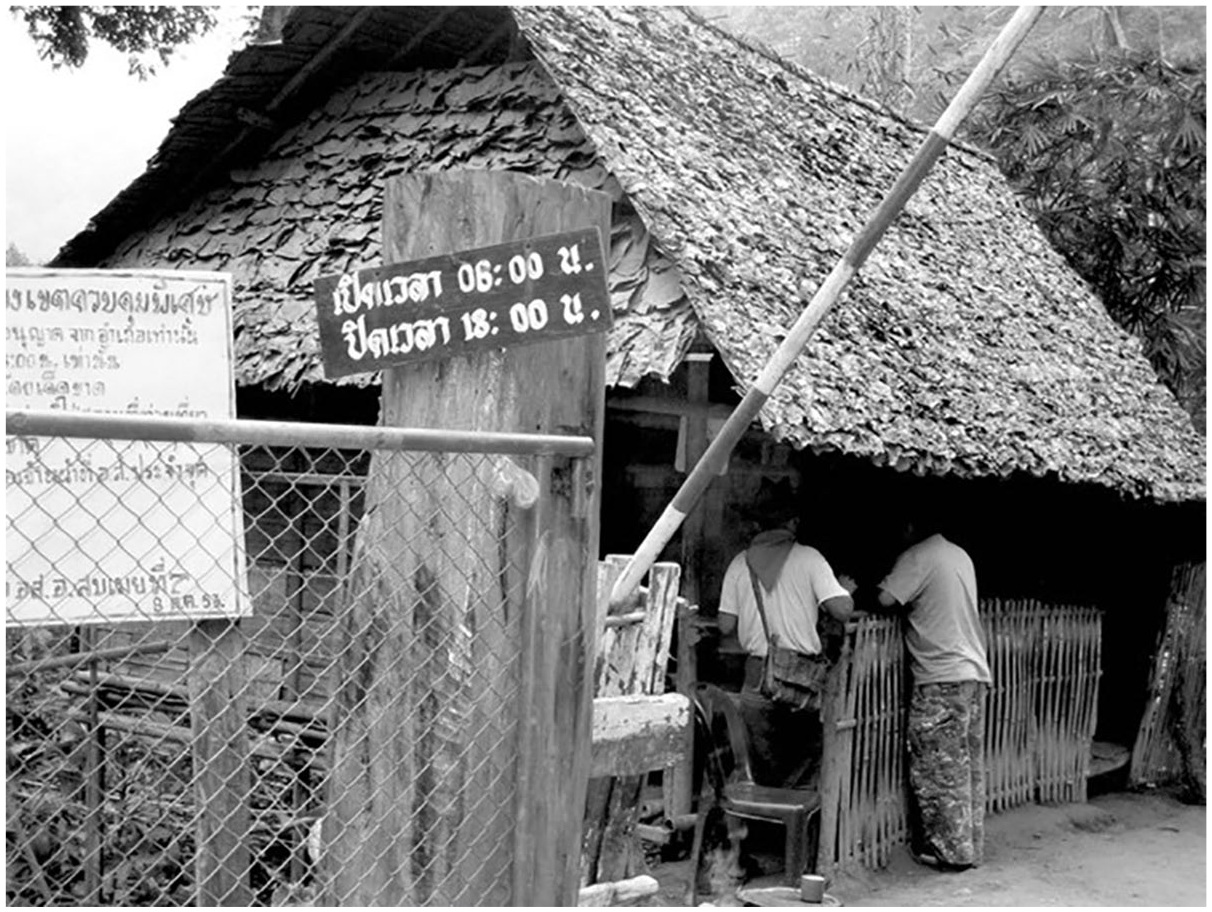
Materiality of exclusion.
And even if these materialities and border infrastructures have already partially crumbled (particularly the barbed wire further away from the checkpoints), they are regularly repaired. The infrastructure of encampment is maintained but also in need of maintenance. This is where sociomateriality becomes pertinent, as the maintenance but also the activation or deactivation of infrastructure is contingent upon human actions and vica versa. The fence requires human construction and ongoing maintenance while at the same time a materiality of exclusion is difficult to maintain without objects and infrastructure. In the following, I demonstrate how the functionality of the checkpoint materiality, as a form of exclusionary materiality, relies on human assistance and explore the interaction between people and material elements, as well as the consequences when this interaction is absent.
The described materialities are activated by two different groups with a daily presence at the checkpoint in being border guards or border personnel. One is a paramilitary group called Or Sor who report to the camp commander, who is the current Thai district official in the region. Or Sor represent the local Thai authorities (that is why they are locally called “Thai soldiers”), have Thai citizenship and are often recruited from the local area surrounding the camp. But then, there are also the camp-security officers. The latter is made up of camp residents who formally report to the internal camp management and leadership (the camp security officer or camp leader)—the elected camp representatives who live in the camp as well. The camp-security represent the camp authorities and are camp residents typically from Myanmar/Karen state originally.
The camp border officials often speak the same language: as noted, Or Sor members are often from the local region, where many Thai citizens also speak one of the Karen languages that most of the camp residents in my place of research have as their native tongues. This makes it possible for relations to be established and interactions to take place between the respective border guards. There is also intermarriage between Thai border staff and camp residents. 11 Nevertheless, the whole is made up of separate constitutive units, as also reproduced by the different buildings found in the area around the checkpoint. However, processing and regulations are handled jointly—albeit with different interests.
Many different people as well as vehicles—motorbikes, jeeps, trucks—and products cross the checkpoints daily. All actors involved in producing the social order of the refugee camp must pass through this eye of the needle that is the perimeter checkpoint. Some use this entrance or exit regularly, such as ordinary camp residents, traders, or members of refugee committees; some do so irregularly or seldom, such as representatives of international donors or state military from Bangkok. Multiple camp encounters are observable here.
The checkpoint is also a place of coming together, socializing, and exchange, as Abourahme (2011) describes it in the case of Palestinian camps. The game Chinlone (cane ball) is for example regularly played here by the border guards and camp residents—sometimes in mixed teams, sometimes in separate ones. These social events at the checkpoint also allowed me to make observations regularly. When I observed closely, the daily crisscrossing and regulatory practices at the checkpoint, I noticed permeability in different ways. Passing the checkpoint is part of multiple regulations but also nonregulations where materialities of exclusion are not activated.
Ordinary camp residents are subject to active nonregulation border practices. Systematic registration, documentation, or regulation and control of human mobility are not practiced for them. During the crossing practices of pedestrians and motorcyclists, not much happens. Nobody slows down when passing the checkpoints, there are no rituals—such as an exchange of glances between border guards and passersby. The border guards do not prevent anyone from entering or leaving the camp. No practical control or regulation is observable. Both pedestrians and motorcyclists carry goods into the camp in plain sight, for all to see. People engage in the import and export of products, such as leaves for house roofing, which they can carry on their bodies. Although such activities are officially forbidden, they are a normal practice. Loudspeaker announcements are made regularly on this matter, and during section meetings (where local section leaders and members convene), people also are reminded that such actions are prohibited:
(. . .) And then we always make a comment about this point. If you go to the forest to cut bamboo and wood . . . they again gave us a warning when we attended the meeting (with Thai state authorities).
In addition, there is a construction team in each section that decides who needs new material for the construction of houses, each section has a committee that looks at the houses and orders material from the aid consortium in case it is necessary. Still, people as seen when passing the checkpoint also go to the forests nearby and collect material from the local environment.
In sum, the materiality of exclusion represented by the checkpoint, as border infrastructure, is not locally activated by both the camp residents and the border guards. Indeed, the (border) objects, like the gate, present obstacles that need to be navigated. But the material elements, serving as manifestations of exclusion or at least control, do not assemble with human practices (Figure 2).
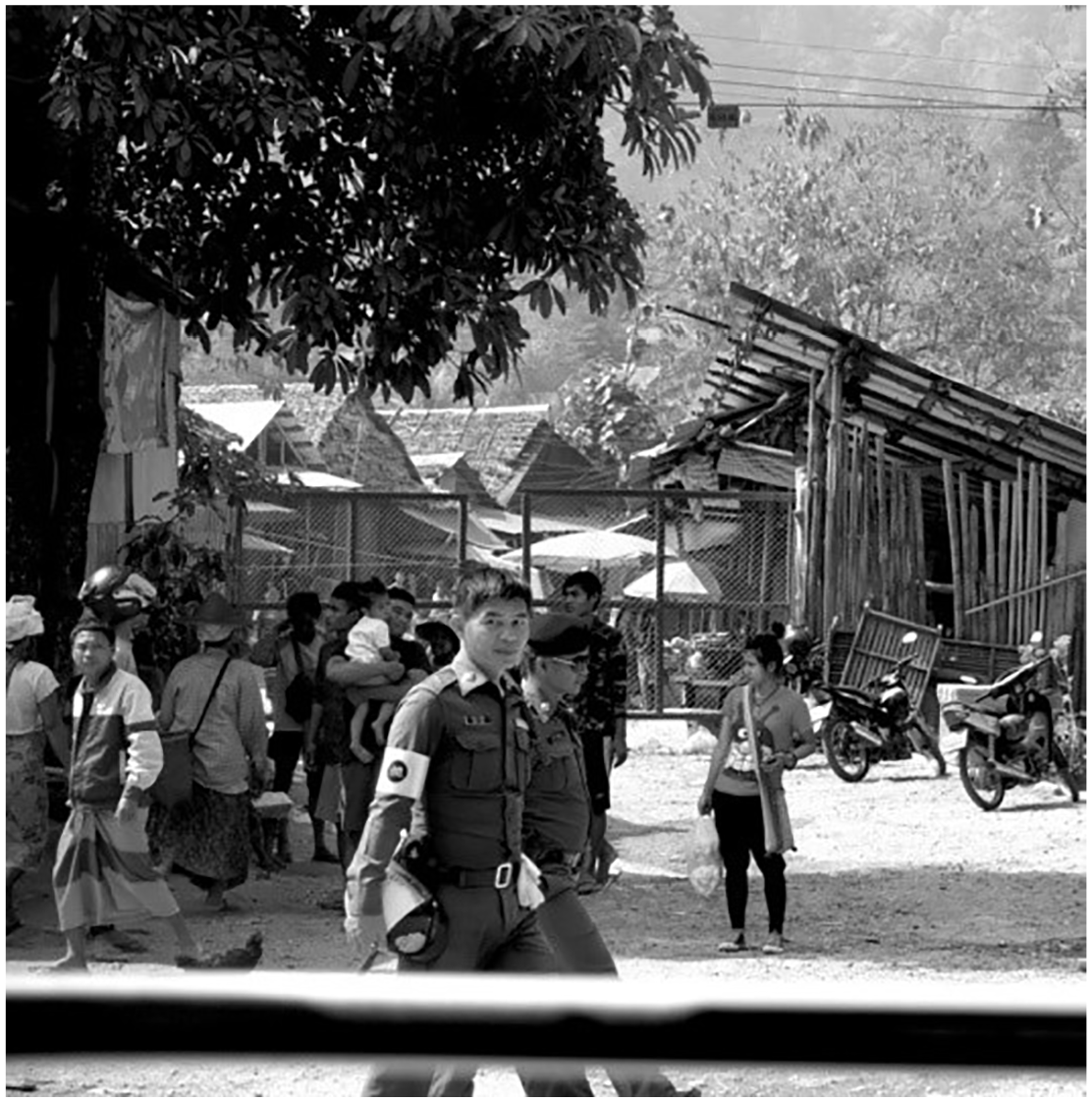
Materiality of exclusion and the circumvention.
However, the situation differs from the daily passage of bigger vehicles such as jeeps and trucks, depending on who is entering/leaving the camp. For business people selling products in the camps, for example, there are local arrangements with both groups of border personnel, who essentially collect a kind of local tax for the crossing. For aid organizations and for the refugee committees there are local agreements as well at the regional and national ones, which include additional registration in a book which is in the checkpoint. These document registrations are usually (with exceptions) observed and controlled by either the Or Sor or the camp security. The transporting of relief supplies to the camps, which are relatively difficult to reach because they are not connected to roads, is always dependent on negotiations between aid organizations and local, regional as well as central state authorities. But they also have an additional registration process with camp security and camp ration leaders. For bigger vehicles, in comparison to camp residents passing by, the materiality of control is activated by the assembly of human and material elements of control.
The checkpoint situation and practices illustrate how the materiality of exclusion is generated through checkpoints and fence architecture as well as infrastructure maintenance. But these barriers become permeable, dissolve, and are bypassed during normal everyday practices. Not only do small informal openings and gaps in the fence allow mobility outside the camp for trading and collecting products. Rather, the materiality of exclusion is actively and routinely ignored (in the case of people and motorbikes) or established and reactivated as a sociomaterial control mechanism (in the case of bigger vehicles). The sociomateriality of the camp does not restrict mobility but partly controls mobility. However, in the following I show how the materiality of immobility, enclosure and exclusion is reaffirmed and practically activated.
Observation III: the performance of the total institution
Higher-ranking authority figures visit the site every two to three months, dedicating a few hours of meetings with local stakeholders such as members of the camp committee and Or Sor leaders and gaining an understanding of the overall situation in the camps. In these situations, both authorities and residents adhere strictly to the regulations, such as those dictated by state governance technologies. For example, the materialities of exclusion, which aim to maintain the camps as enclosed territories. Practically, this means that camp residents, as well as motorbikes and other vehicles such as private jeeps bringing products to the camp, are neither present nor are they passing through the checkpoints. These temporary restrictions are also announced in advance via loudspeakers for the camp public:
12
Listen, this is an announcement for the area! Tomorrow no vehicles are allowed to travel outside or in the camp area. Again, Announcement for the area! Tomorrow no vehicles are allowed to travel.
In these “control” scenarios, the checkpoint situation transforms into a situation where the materiality of exclusion is activated through human performance. However, the temporary suspension of public camp life, such as passing the checkpoint, extends beyond this checkpoint situation. That is why I understand these instances not only as a practical reactivation of the materiality of exclusion but also a practical performance of a total institution (Goffman, 1961) in camps because in these situations, normality—the course of public camp life—is interrupted and suspended. It is a temporary suspension of public camp life.
It is notable that there is absence of human movement, as well as the passage of vehicles, including cars and motorbikes, within the confines of the camp or across the designated checkpoints. Motorbikes and jeeps are hidden behind covers and within larger camp buildings. The shops, which are located at almost every house on the main road of the camp, and the markets are closed. Furthermore, the public transport system, which are created by residents themselves, through which up to thirty boats arrive at and leave the camp with products and people on a normal day, is shut down for the duration of such visits. The flow of goods, the export and import of products and human mobility outside and inside the camp is interrupted during the shutdown.
The performance of the materiality of exclusion by residents and local soldiers and authorities alike is situational, taking place as soon as authority figures are set to appear who disturb normal everyday routines. The presence of these authorities enables the enforcement of border closures, thereby creating the impression that the camp is a place where mobilities and economic exchange are non-existent. Moreover, in the event of non-compliance with the relevant official regulations, these authorities have the power to enact sanctions, which include the imposition of fines, warnings, or the confiscation of vehicles. The mobility and economy of public camp life are rendered virtually invisible and is temporary suspended. The two photos (Figure 3) exemplify these two contrasting situations of the normality of public life and the performance of the total institution.

Public camp life versus the performance of the total institution.
Outside of these temporary restrictions, my observations highlight and clearly show the structural and corporeal circumvention of materialities that are geared toward immobility. The camp space is created through materialities of exclusion, but it does not prevent people from leaving. Simultaneously, this practically and locally accomplished silencing and freezing is part of public life because the total institution and the materiality of exclusion must be performed again and again, even if only from time to time. Consequently, it is also integrated into what is overall considered the social order of the camp by those concerned. This ensures the materiality of exclusion and its practical human activation persist. Despite these local and obvious circumvention practices, the camp materiality of exclusion and of immobilization is in existence. These aspects are not mutually exclusive. The sociomateriality of exclusion is produced at different levels, exemplified here at the checkpoint, but must be maintained and reactivated, yet can also be ignored.
Concluding remarks
At the outset of this article, the concept of the materiality of exclusion is outlined as a consequence of the global state order and the territorial state-organized world, wherein every human is assigned to a territory and a populace (Haddad, 2008). When people deviate from this global order, one answer is to confine them in camps until they are reintegrated into the global system (Arendt, 1962; Haddad, 2008; Malkki, 1995a, 1995b). Camps are therefore constructed with the intention of temporariness and exclusion. The envisioned temporary nature of this exclusionary materiality, which frequently extends for decades, is a product of the global order. Many camps around the world are, for example, properly demarcated most visibly by fences with barbed wire to keep the temporary and exclusive character. The fence symbolizes state power and materializes these exclusions. Yet, this political and legal structuring fails to elucidate the specifics of how this temporary materiality of exclusion manifests on the ground, including the nature of local camp orders and microstructures. This is why this article’s attention is directed to sociomateriality, as it enables the comprehension of global and state governance on one hand, and local orders and interactions on the other hand (Ramadan, 2013).
Through the sociomateriality lens, we see how people adapt to and live with the camp’s architecture, for example by making the camp their home (Brun and Fábos, 2015; Dudley, 2010; Peteet, 2005). We also see a shifting of borders, control, and demarcations. The built environments and materialities of exclusion only have the potential capacity to actualize political exclusion (Meiches, 2015: 488; Oesch, 2017: 110). Camp life depends on interacting with the local environment, which is a necessary element for its existence. The camp materiality and infrastructure may create exclusion and demarcations; but it has limitations (Scott-Smith, 2022), allows flexibility, enables resistance (Turner, 2022: 54–55) and elasticity (Meiches, 2015).
The article builds on these findings and demonstrates how, in the context of Burmese refugee camps in Thailand, the materiality of exclusion is simultaneously activated and circumvented. However, I argue that the materiality of exclusion persists despite its partial and incomplete nature and people’s power to circumvent these materialities. I concur with Irit Katz (2017) that the attempt to subvert the force of life is constantly met with local initiatives that circumvent these constraints. The residents of the camp subvert the materiality of exclusion by circumventing the rules and forming alliances with the local state authorities, who possess a deep understanding of the local situation and also benefit from these alliances. Nevertheless, this maintains the camp as a material manifestation of exclusion.
These local practices of circumvention lack the capacity to dismantle the fence and checkpoints, as well as the broader material manifestations of exclusion. They are only able to circumvent the controlling mechanisms to a limited extent. This inevitability of local agency, interactions and local accomplishment does not negate the camp as a technology of exclusion. Furthermore, the performance of the total institution actualizes, demonstrates and reminds all those present on site of the political-legal intentions of the architects and the intended creation of a materiality of exclusion.
Concurrently, I argue that the circumvention of these exclusionary materialities is locally accomplished not as an open and active revolt against the material conditions of the camp. Rather, it can be seen as an inevitable consequence of sociomateriality. There is no material liberation, rebellion or resistance, but rather the norm of bypassing of the materiality of exclusion. Both, the residents and the paramilitary groups responsible for guarding the camp engage with and reinterpret the materiality of exclusion, while acknowledging that they are unable to change it. The circumventions of exclusion are an integral part of public camp life and are also not particularly hidden behind the materialities, or infrastructures that are intended to be exclusive. In essence, despite the presence of exclusionary elements, people do navigate around them and perceive this as a normality. Camp members (inter)actively work in part in their everyday public lives to break such mobility limitations and the materiality of exclusion/inclusion.
At the same time, it is widely acknowledged that the implementation of the materiality of exclusion is occasionally unavoidable as shown in the performance of the total institution. Consequently, like the bypassing and the circumvention, the materiality of exclusion is regarded as an inherent aspect of the normality of public camp life. Sociomaterial practices are not necessarily related to a form of political agency (Ramadan, 2013: 67) but immanent to the continuous interactions between heterogeneous actors and units (Abourahme, 2015: 212). In this way, my observations diverge also from Foucault’s (1975) panopticon arguments, where potentiality controls are everywhere, here, rather the ongoing local involvement of sociomateriality dominate.
Moreover, my observations suggest that the materialization of exclusion reinforces the notion of membership, collective belongings and the delineation of human categories (Arendt, 1962: 455; Goffman, 1961). It is precisely through the visibility and practices of the temporary materiality of exclusion (and further infrastructures) that the so-called “camp people” both define themselves and are defined by others as being part of a membership category. Consequently, the production of collective belongings and the process of homogenization extend to encompass camp residents in collaboration with other people on site, who are engaged in this production process. Consequently, the materiality of exclusion facilitates the formation of collective bodies with specific attributions associated with them. Therefore, it can be argued that materialities are integrated into local social practices, belongings, and the reconfiguration of membership. Membership needs to be produced locally and interactively but it is linked to materialities. Materiality co-determines life on-site to a very high degree. The camp materiality produces a collective with certain characteristics—liminality, marginality, and inferiority—based on the material regime and the camp infrastructure (which also enables opportunities—resettlement, aid, and education). The materiality (objects and infrastructure) of exclusion makes a significant contribution to establishing and homogenizing the camp collective and to maintaining this homogenization. But this is again linked to the prevailing global order and the territorially organized world where states as sovereigns decide on memberships.
Through the described locally refined forms of materiality, we see that social orders on the ground can look different from what the global governance and the materiality of exclusion/inclusion of such sites dictate—other studies have proven the same (Abourahme, 2011; Hicks and Mallet, 2019; Katz, 2017; Ramadan, 2013). Despite the local and obvious circumvention practices regarding the materiality of exclusion and immobilization, the construction of a collective body remains—primarily through this very space, its materialities, and infrastructures. It is not that one respective level describes and dominates the other; rather, the global is interactively elaborated locally and therefore manifests itself in different ways vis-à-vis the social order. The sociomateriality of the camp reinforces exclusion to a particularly high degree, thus co-producing and contributing to the maintenance of the global state order.
The materialities of exclusion are a pervasive phenomenon that manifests across a range of contexts on a global scale. It is important to note, however, that the mechanisms outlined here are primarily concerned with the sociomaterial aspects of camp settings and may not be directly applicable to makeshift architectures in urban settlements more broadly. The existence of refugee camps is a logical consequence of the current global state order and an illustration of its inherent limitations. Furthermore, it is important to note that the local circumstances and sociomaterial dynamics discussed in the article may not be directly applicable to camps and extraterritorial spaces worldwide. In order to gain an accurate understanding of the sociomaterial fabric of such environments, it is necessary to conduct meticulous and nuanced inquiries. While certain dynamics may exhibit similarities, local peculiarities may diverge significantly. Consequently, case analysis is indispensable due to the heterogeneous nature of camps, there remains a need for more comparative analysis. Through the lens of comparative ethnography with a specific focus on sociomateriality, researchers can uncover broader patterns, similarities, and differences across contexts, thereby enhancing our understanding of camp dynamics on a global scale. This is because the global camp materiality of exclusion and its consequences are often similar, but the sociomaterial manifestations may not necessarily be.
Footnotes
Acknowledgements
The article is inspired by the conference “Materiality of Exclusion” hosted by the archeologists Reinhard Bernbeck and Susan Pollock at the FU Berlin in 2022, as part of which I was asked to give a lecture on the topic of materiality and refugee camps. I must thank the participants of this conference but also Georg Hubmann, who has always supported and shared my interest in materiality, infrastructure, and architecture. I would also like to express my gratitude to my colleagues Andrea Purdekova, Christine Gibb, Stephanie Schneider, Anna-Lisa Müller, and AK Political Ethnography at the Humboldt University of Berlin for their valuable feedback on earlier drafts of the article. In addition, I am also very thankful to the reviewers for their extremely supportive and constructive comments.
Funding
The author(s) received no financial support for the research, authorship, and/or publication of this article.
