




Abstract
Social trust is believed to be beneficial to societal mobilization and the participation in protests. At the same time, state performance, notably of state power structures during instances of social and political protest and change, has an impact on the public perception of and trust in these institutions as well as the assessment of their legitimacy. The police are the most visible manifestation of state authority, which has become particularly apparent during post-electoral protests in Belarus in 2020, when their performance directly influenced and determined further societal mobilization. Based on a mixed-methods design, drawing on interview and survey data, this contribution seeks to shed light on the role of trust in societal mobilization during instances of protest and change in Belarus between 2020 and 2021. One of the main findings is that repression by the regime and its police forces affected both institutional trust and the level of protest mobilization. Protest participation in turn correlates with an increase in social trust.
Introduction 1
Social trust, that is, general trust in people, is believed to be beneficial to political participation (Kaase, 1999; Suh and Reynolds-Stenson, 2018; Welch et al., 2005). Moreover, it has been identified as an important factor in motivating protest participation (Benson and Rochon, 2004). Institutional trust, that is, trust in state institutions, is supposed to be closely linked to both individual and social trust (see, for example, Grönlund and Setälä, 2012). The way state power structures deal with public protest, whether they tend to suppress and demobilize or attempt to co-opt protest movements, has an impact on how the public perceives of these institutions and assesses their legitimacy. The police are the most visible manifestation of government/state authority responsible for public security, and therefore, their performance directly influences perceptions of the government (Hofstra, 2012: 151). The analysis of trust in the police, notably public order policing, is particularly pertinent for gaining a better understanding of the interaction between citizenry and state. Their diverging or converging trajectories can be seen to be emblematic for the wider state–society relationship in flux. This has become particularly apparent during post-electoral protests in Belarus in 2020, when the performance of Belarusian militsiya 2 (police) and special forces directly influenced and furthered societal mobilization (Nikolayenko, 2022). The Belarusian case is therefore, due to the massive mobilization of both the police and the citizen/protester sides, a most suitable case to study the role of “trust” during instances of mobilization. This contribution sets out from a puzzle viewing the preconditions in Belarus in 2020 not necessarily geared toward massive societal mobilization (low social trust and high institutional trust prevailing). However, in the course of 2020, the picture changed with institutional trust receding and social trust, at least among protesters, increasing. With regard to social trust, this happened not only during instances of mobilization (as argued in the literature) but also during longer periods that protesters were exposed to repressions and even episodes of demobilization. Thus, the article seeks to shed light on the role of trust (both social and institutional) in Belarusian societal mobilization between 2020 and 2021. It asks to what degree social and institutional trust dynamics and the interplay between these two types of trust affected societal mobilization during this period (for more details on the understanding of “trust” and the development of both social and institutional trust in Belarus, see p. 9 ff.). The assumption is that social and institutional trust are interrelated, having influenced jointly with police repression (depending on the protest period) both mobilization and subsequent demobilization.
Indeed, the Belarusian presidential election of August 2020 gave rise to the most significant political mobilization since the country gained independence in 1991 (Petrova and Korosteleva, 2021). There has been a combination of factors, ranging from growing social grievances and a rising motivation to resist state paternalism, the unprecedented experience of solidarity as a result of the pandemic, to a greater reliance on digital technology. Belarus, occasionally depicted as “Europe’s last dictatorship” 3 is an authoritarian regime that has not witnessed a democratic change of power since long-time ruler Aliaksandr Lukashenka was elected president in 1994. In Belarus, the militsiya—not the military like in military dictatorships—had gradually developed into a sort of “praetorian guard” for Lukashenka who began to rely and depend on their unrestricted loyalty. 4
During 30 years of independence, the Belarusian population has never been particularly prone to protest and acts of disobedience toward the regime. Prior to 2020, only a small percentage of the population had personal experience of participating in protests and street actions; the majority saw acts of solidarity and support mainly as collective activities initiated from above (Shelest and Centre for European Transformation, 2016). Since heavy fines were traditionally imposed for participation in unauthorized protests, the deterrence factor worked well in the past (see also De Vogel, 2022). Post-election protests in 2006 and 2010 were violently quashed by the police. The first genuine social protests occurred in 2017, when protesters mobilized in order to oppose a tax levied against the unemployed (also known as the “parasite law”). Demonstrations and meetings were organized in cities throughout the country, attracting several hundred to several thousand people at a time. In 2020 then, the willingness to protest increased dramatically (Matteo, 2022). Beyond the visible street protests, the feeling of solidarity and belief in self-organization and self-help, first tested during the Covid-19 pandemic, 5 paved the way for new societal phenomena hitherto unknown in Belarus. Authors analyzing the 2020 events and ongoing protests wrote about “networks of solidarity” and a “new national consolidation” (Astapenia, 2020; Minchenia and Husakouskaya, 2020; Petrova and Korosteleva, 2021). This testified to the break with traditional social isolation and lethargy (“atomisation of people”) and a shift toward new forms of collective reflection—at least in urban settings (Douglas, 2020). Digital technology has also been a decisive factor for the organization and decentralized mobilization of street protests during the post-electoral protests in 2020 (Asmolov, 2020; Onuch et al., 2023).
The security forces struggled to keep pace with the changing tactics of the demonstrators, who gradually began to lose their fear during the immediate post-election period. Protesters repeatedly tried to unmask members of the OMON Special Forces during scuffles, in order to film and identify them. Police brutality, arbitrary arrests, allegations of severe human rights violations and torture, and finally the impunity granted to members of the OMON during the quashing of protests did not achieve the intended effect of deterring citizens from protesting; on the contrary, all this motivated even more people to join the mass protests in the post-election period (Douglas, 2020; Nikolayenko, 2022).
Empirical research on public perceptions of legitimacy of as well as trust in state power institutions in the context of societal mobilization is rare—this is especially true for Eastern Europe and Belarus in particular. Existing studies, in particular those dealing with the 2020 events in Belarus (see, for example, Bedford, 2021; Greene, 2022; Matteo, 2022), lay their emphasis on driving forces, triggers and effects of protest, and the institutional confrontation between society and the authorities. Thus, we know a lot about how civic initiatives and protests movements evolve and build up their potential. Less knowledge exists, however, about how state responses and demobilization efforts resonate in society and what impact they have on social and institutional trust as well as the state–society relations at large. Moreover, the consequential action of authoritarian coercive institutions, such as the police, in times of upheaval remains underexamined (Della Porta and Reiter, 1998; Greitens, 2016). This holds true especially for protest policing and the interaction of public order police with social movements in post-Soviet societies.
While Belarus traditionally used to score rather high in terms of institutional trust (relatively high level of satisfaction with economic progress and social well-being, see Sapsford and Abbott, 2006), Belarusian society has at least during post-Soviet times been characterized by low levels of social trust, a common characteristic of authoritarian regimes (Rivetti and Cavatorta, 2017: 56). Social trust in Belarus, similarly to other post-Soviet societies, is markedly weak (Abbott and Wallace, 2010; Sapsford and Abbott, 2006; World Values Survey, Wave 6 (2010–2014) and Wave 7 (2017–2022)). In the pertinent literature, this is said to be closely linked to the existence of social capital, which was evidently low during Soviet times (Badescu and Uslaner, 2003). In addition, there has been a proven erosion of institutional trust prior to the mass protests of 2020 (Douglas, 2020). Unlike existing scholarship (see, for example, Benson and Rochon, 2004, and Sika, 2023, in this special issue) that found social ties, that is, social trust, among activists to have increased during instances of mobilization mainly, this contribution finds evidence that social trust among protesters in Belarus has also risen the longer the protests endured and protesters were exposed to repressions by the regime, namely the police. The Belarusian case provides evidence that repression by the police further decreases institutional trust. The impression of a higher level of social trust and low level of institutional trust was sustained even until the protests had been practically over. This article hence strives to make contributions both to the general literature on trust in societal mobilization and to the area studies literature on post-Soviet state–society relations.
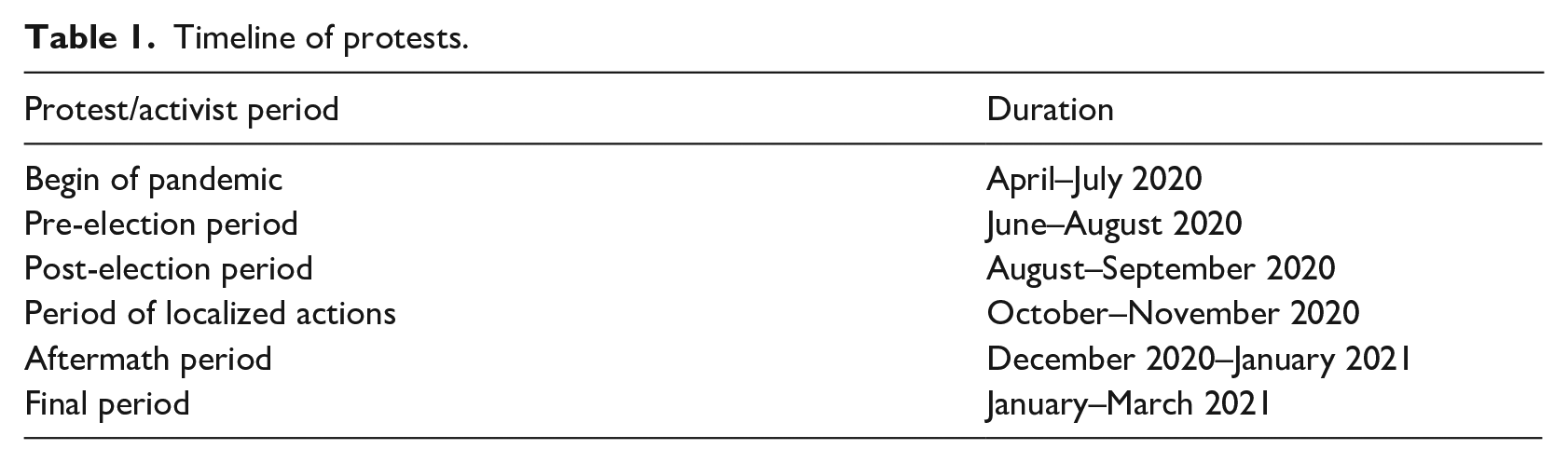
On the timeline of the 2020/2021 uprising (see Table 1), the civic engagement started during the initial pandemic period. Concrete anti-government protests began during the pre-election period, reached a climax in the post-election period, and continued with numerous activities during the civic campaigns period. Then during the turn of the year, in the aftermath period, the movement slowly faded out. The symbolic “Dzien Voli” on 25 March 2021 marked the end of the final period and end of the series of mass protests and mobilization, when the Belarusian opposition-in-exile around Tsikhanouskaya called once more to come out to the streets for “Freedom Day,” but merely a few hundred people showed up.
Timeline of protests.
The first part of the article discusses the perceived legitimacy of police actions as a driving force for institutional trust/distrust. An analysis of trust dynamics in Belarus over time based on survey data will be the focus of the second part. The last and final part draws up conclusions and elaborates on the implications of trust for the results and long-term visions of the Belarusian democracy movement.
Methodology and data collection
Methodologically, this study is based on an analysis of institutional meso-settings (performance of state power structures, namely public order police) and their resonance on the micro-level in the individual and collective (public) perception of institutional behavior and legitimacy. It moreover entails a behavioral approach, in terms of an analysis of the level of social/interpersonal trust and shared ethical values in the Belarusian society.
The study builds upon a mixed-methods design. It combines qualitative problem-centered interviews, conducted in Belarus on the ground and via E-mail/Skype, and quantitative analysis of two nation-wide online surveys realized on behalf of the Centre for East European and International Studies (ZOiS) in December 2020 and June 2021. The personal interviews mostly date from 2017, 6 with a few follow-up interviews that have been conducted via E-mail and Skype and inquired about changes after August 2020 compared to the situation before. The entire sample consisted of a wide range of interlocutors from state-loyal civil society to human rights activists and individual citizens. The 7 interviews represented here are a subset of the entire sample of 25 interviews. They are meant to set the scene, explain the social mood before 2020, and underscore that the decrease in institutional trust has been a gradual process that started way before 2020. Interview data conveys this much better than opinion polls, since polls from those times generally showed steady approval rates for the president and other state power institutions. The survey 7 data from 2020/2021 and regression analysis 8 then show the development and interrelation of trust and protest participation during the period of 2020/2021 and are meant to provide supplementary information on the societal groups that in the course of 2020 lost trust in state institutions, that took part in protests and saw their social trust increase. The survey in December 2020 was the first conducted across Belarus following months of anti-government protests. The survey inquired into the views and preferences of Belarusian citizens at this critical moment and assessed the nation-wide political and social mood. The second wave in June 2021 was meant to check for subsequent changes in attitudes and to confirm prior results.
In the Belarusian authoritarian context, trust is a multifaceted and sensitive phenomenon that is difficult to assess and to measure (with opinion polls bearing limitations). The validity problem in connection with measuring social trust has been discussed widely in the literature (with regard to the object of trust and the radius of the operationalized notions, see Delhey et al., 2011, and with regard to the specificities of societies in the former Soviet region, Badescu, 2003). Two specific problems dominate with regard to the Belarusian case, the first being a generally skeptical and fearful attitude toward opinion polls in society. 9 This requires a particular careful way of reading and interpreting survey results taking this caveat into account. The second problem regards potential variations in the understanding of core terms between urban and rural settings. 10 This is, however, not salient here, because the surveys were conducted online and hence targeted a rather Internet-savvy population in urban settings (see also Note 11).
Legitimacy of police behavior during protests—driving force for institutional trust/distrust?
Trust in the police is among others defined as the belief that the police have “the right intentions and are competent to do what they are tasked to do” (Hough et al., 2013: 7). For the police to be considered legitimate, additionally their power and authority must be recognized and justified (Hough et al., 2013: 7). 11 Thus, trust can also be regarded as a driver of legitimacy.
Trust in political institutions is either said to originate in deeply rooted cultural norms, acquired through early-life socialization (exogenous to the institution as argued by culturalists) or to be derived from the direct experience with institutional representatives and expectations about their performance (endogenous to the institution as argued by institutionalists). Trust and confidence 12 in the police as an institution involves trust in their “procedural fairness.” This concept, derived from social psychology, offers an analytical frame to analyze behaviors in encounters between public and officials, showing how important perceptions of people in contact with authorities are and how they influence their attitudes toward them (Staubli, 2017: 39, for more on “procedural justice theory,” see Tyler, 2006, 2011). According to culturalists, people judge the police’s trustworthiness based on procedures and traditional attitudes than on actual outcomes. Institutionalist approaches (e.g. as found in “police performance theory”; see Jang et al., 2010) argue that in line with attitudinal predictors trust in the police organization is determined by concrete outcomes, such as reduction of crime and protection of values. This corresponds to results from previous studies, such as Mishler and Rose (2001), who studied the variability of political trust in institutions in post-communist societies and revealed that trust is shaped stronger by the perceived institutional performance than by cultural factors. This article’s argument is mainly based on institutional explanations, but also takes into account micro-cultural explanations.
In line with other empirical studies (e.g. Bridenball and Jesilow, 2008) that suggest that a positive attitude toward political institutions and a country’s political agenda entails also confidence in the police, this study departs from the reversed idea that a negative attitude toward the police potentially has an impact on the perception and trust in political institutions in general.
A strand of literature that focuses precisely on the relational phenomena between mobilization and demobilization/repression is the “Repression-Mobilization Nexus,” which employs concepts from the social movement literature, namely political process theory: political opportunity structure, mobilizing structures, as well as cultural frames (see Davenport, 2005, 2007; Hooge and Marien, 2013; Sika, 2020, 2023). The central question of this concept is why efforts by the state to suppress political challengers sometimes results in a decrease, sometimes in an increase but rarely a moderate level of mobilization by social movements and protest backlash. There is consensus in the literature that one problem is the complexity of the concepts of “mobilization” and “repression” that need to be disaggregated (Cunningham, 2007). Another important aspect is the regime type. This is particularly true for the case and regime of Belarus, where repression in the past has usually kept mobilization markedly low. The regime type has an influence on the relationship between mobilization and repression, and, as argued by several authors in this special issue, the level of social and institutional trust. The usual pattern in the repression–mobilization relationship in Belarus was broken up in 2020 with repression for the first time acting as a catalyst for further mobilization (see pp. 16–17 for greater details).
In order to assess the relationship between citizens and state agents, notably the police, this study sets a focus on public order police that citizens have direct encounters with during protests. Protesters and riot police are certainly located at the extreme ends of this relationship. In times of social and political change, these two actor groups, however, clash more frequently in their quest for sovereignty and definitional prerogative over the public space. In democratic societies, protest policing is often characterized by its ambivalent nature and field of tension: on the one hand, the police are supposed to protect the right to freedom of assembly and social mobilization and, on the other hand, they assume the task to ensure and maintain public order and safety (Adensamer and Kretschmann, 2016: 472). Public order policing during assemblies and protests can be judged either legitimate or illegitimate.
Characteristic for policing in the post-Soviet region is the often still dominant public order component and prevailing “securitized” behavior during protest policing and crowd control. Traditionalists have a greater say as opposed to reformers, who recognize the organization of a demonstration as a fundamental right. The police in post-Soviet societies remain one of the least reformed institutions (Marat, 2018), despite the fact that many countries in the region have a record of more or less successful attempts of reforming the security sector. In the case of riot/public order police, this has often been a reaction to prior protests (Douglas, 2023b). Reform processes, whether triggered by internal or external factors, are primarily targeted at territorial reorganization, capacity building and, notably, enhanced police legitimacy. The success of these efforts has varied considerably and persisting problems often revealed to have similar causes across the region (Marat, 2016, 2018). In other words, decades of police reform in the region conducted with the help of international actors have ultimately failed to transform the police from Soviet-style punitive institutions into service-oriented entities (Kupatadze, 2012; Marat, 2016; Sholderer, 2013). Strong central oversight and patrimonial practices remain characteristic for many East European and post-Soviet states (Aitchison, 2016; Hensell, 2012; Marat, 2018). The common Soviet legacy, however, has long ceased to be the only decisive factor in shaping policing 13 practices and techniques (Aitchison, 2016; Favarel-Garrigues, 2003; Taylor, 2014).
One reason why the police still scores poorly in polls assessing trust in state institutions is the perception in society that the police remains part of the general government (Douglas, 2023b). Police in many countries of the post-Soviet realm has had little experience and opportunity to prove that it is a distinct institution (which despite many reform efforts it is often not, continuing to be tightly linked to the respective interior ministries/governments).
With regard to Belarus, due to the lack of externally induced reforms of the security services in the past (Titov, 2021), a high degree of reform resistance and distinct loyalty to the current regime, Belarusian security structures come closest to the Soviet archetype. Public acknowledgements of the reform needs resulted in efforts to downsize and restructure the security services, the real driver having been the need to reduce expenses (Smok, 2012). The improvement of citizen–police relations used to be high on the agenda of civil society groups in Belarus, however not of the government. The citizen–police relationship has been characterized by mutual distrust in the past and thus did the police belong to one of the least trusted state institutions in Belarus. Irrespective of the malpractices and misconduct of other state authorities, the president and his trust rates remained usually exempted. That changed in 2020 as a result of post-electoral protests when the abuse of power by police and other security forces made trust in the police decrease to the point that it directly influenced trust rates of other institutional actors. Defiance and disdain became additional attributes of the citizen–police relationship. Citizens, who during the initial protest episodes (post-election period) came into close contact with the police, indeed lost their faith in the Belarusian state (Douglas et al., 2021).
Trust development in Belarus during societal mobilization (2020–2021)
Situation of social trust
Trust development in Belarus in recent years has been remarkable and unprecedented. Before delving into the implications of a growth in social or interpersonal trust, it is worthwhile understanding what it implies and how it is operationalized.
Social trust, also known as “interpersonal” or “general trust” (Benson and Rochon, 2004; Freitag and Traunmüller, 2009; Welch et al., 2005), is a rather abstract attitude toward people in general, beyond immediate familiarity, including strangers (Freitag and Traunmüller, 2009: 784). This type of trust generally builds upon “individual” or “particular trust” that includes people one knows well, that is, family, friends, and neighbors (Freitag and Traunmüller, 2009: 798). Social trust, in surveys often operationalized as “most people can be trusted,” or “trust in people one meets for the first time,” is regarded as a resource for collective action in the literature on political culture (Badescu, 2003: 121). An important aspect, which is of particular relevance during instances of social mobilization and protest, regards the potential of social trust in easing empathy toward other interests by identification with their own (Badescu, 2003). Indeed, with an increase in social trust, mobilization, coalition-building, and networking can gain pace. This is important to sustain movements and their mobilization (see also Sika, 2023, in this special issue).
As stated earlier, Belarusian society displays a low-level social trust, which has been confirmed not only by the ZOiS surveys but also by the World Values Survey and previously by independent Belarusian surveys (such as conducted by IIESEPS 14 ). In the ZOiS December 2020 survey, over 60 percent of the respondents indicated that they “hardly ever” or “never” trust people they meet for the first time (Douglas et al., 2021).
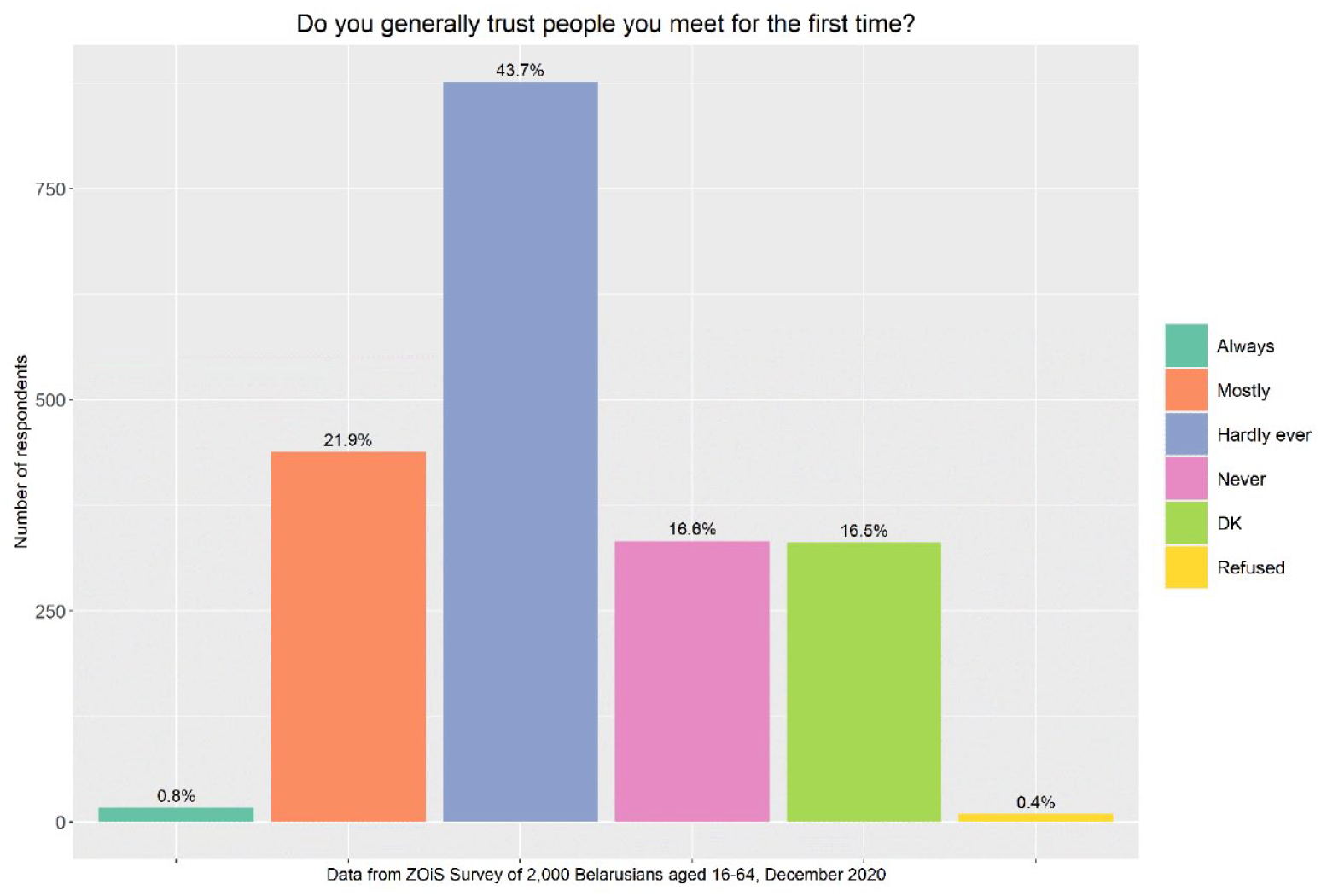
Social trust (ZOiS December 2020 survey, Douglas et al., 2021).
When asked how their trust in others had developed during the past 6 months, the survey data show that almost 30 percent stated that their trust had “decreased” or “somewhat” decreased during the past 6 months in 2020, while only about 10 percent indicated that it had “increased” or “somewhat increased .” Nevertheless, a majority of over 50 percent confirmed that their level of trust in others had stayed the same (Graph 2).
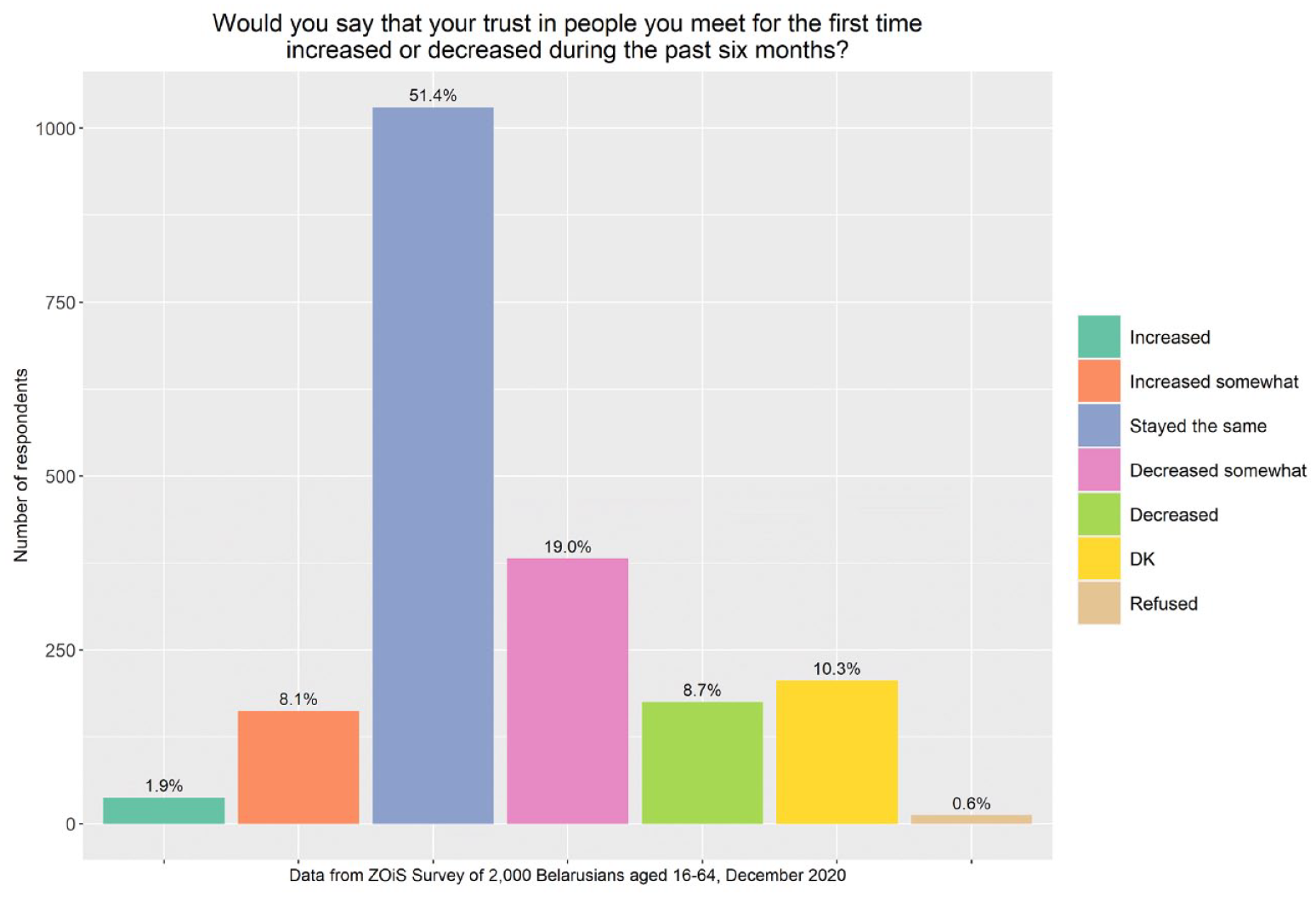
Development of social trust among survey participants (ZOiS December 2020 survey, Douglas et al., 2021).
As follows from regression analysis that is based on the ZOiS survey (see Graph 3 and Note 9 for an operationalization of the variables), social trust has increased, however, in particular among men, residents of Minsk Oblast, younger people, and people who identify themselves as native Belarusian. This can be explained by the fact that unlike conveyed by the media and literature (Gapova, 2021; Navumau and Matveieva, 2021), the 2020 countrywide protests were driven by men and citizens with a strong national identity, concentrated in the capital. Indeed, respondents who indicated that they had participated in previous protests (Graph 3 on the left) and who participated in the protests since August 2020 (Graph 3 on the right), as well as those who had assigned to the category of strong regime critics (low trust rates for the president and other state power structures as well as high trust rates for the coordination council) also reported that their social trust had increased (Douglas et al., 2021; Krawatzek, 2021). People who strongly distrust the incumbent president and the police equally experienced an increase in social trust.
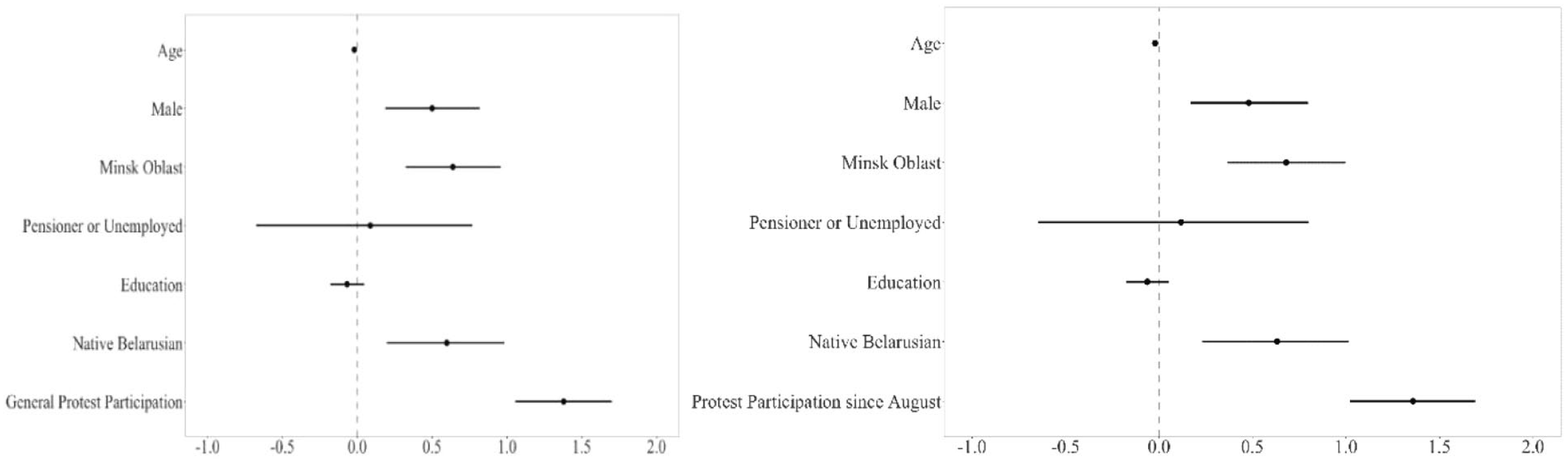
Increase in social trust.
This aligns with findings from the relevant literature (for conceptual findings, see Davenport, 2007; Kaase, 1999, and for similar findings from the MENA region, see Sika, 2020, 2023). Many of these respondents above are people who had been affected to a higher degree by state violence. The experience of solidarity during the protests, especially in the post-election period, made them aware that they were not alone, increasing their confidence in fellow-minded citizens. Strong regime supporters/non-protesters, meanwhile, reported declining levels of social trust (factors here could be a losing belief in the state 15 and disillusion regarding the promise of the “social contract,” 16 etc.). When the same question was asked to roughly the same respondents 7 months later (June 2021), there were hardly any noticeable developments or changes, apart from slight gains for the group that from the beginning displayed low social trust rates and reported that their trust level had decreased during the last 6 months. In other words, despite ongoing repression and decreasing mobilization activity did the level of social trust, notably among protesters and regime critics, remain constant.
Erosion of institutional trust
Previous studies have demonstrated that low levels of trust in state institutions, in particular in its security apparatus, increases the likelihood of mobilization and contentious activities under authoritarian contexts (see Sika, 2020, 2023, in this special issue). Especially among citizens in authoritarian regimes, where socio-economic problems are rampant, institutional trust tends to be lower and motivates individuals to participate in various forms of dissent (Hooge and Marien, 2013; Sika, 2023).
Trust in public officials (e.g. the siloviki, members of state power structures, such as from the police or military) and the entire political class had been low for quite some time in Belarus (Kulesh, 2018). 17 For several decades, the country had portrayed itself as a stable welfare state, promising prosperity for broad levels of the population, and thereby intending to ensure the regime’s legitimacy. However, due to a deterioration of the socio-economic situation, the so-called concept of a “social contract” began to be challenged and the regime began to be driven less by social but more by security concerns (prioritizing the domestic consolidation of the ruling elite, see Douglas, 2023a). Thus, dissatisfaction with the performance of the state and social grievances began to rise. Due to the circulation of unofficial opinion polls in social media during the pre-election period, the Belarusian electorate for the first time realized how low the approval rates of the president actually were. The 2020 official election result was then once again presented as landslide victory for Belarusian president Aliaksandr Lukashenka. However, with a credible presidential challenger in Sviatlana Tsikhanouskaya, this time wider parts of society were not ready to accept the official outcome. 18
Interview data confirms that already before 2020 distrust in the president and authorities in general used to be common, especially among civil society actors, opposition party representatives, and other rather marginalized groups that had a good understanding of but did not represent large parts of Belarusian society. The state in turn also distrusted those actors but also citizens in general, as one oppositionist explained: Distrust in the state power, personally in Lukashenka is huge! For me the litmust test shows: If you are a strong state, if you control the situation, if you enjoy support, why do you fear then the opposition, even one person in an electoral commission? Out of those 65.000 people that have been included into those electoral commissions during the last parliamentary elections [. . .] to my information there have been 33 representatives of the opposition. (Interview representative Belarusian United Civic Party)
A typical support group of state policies used to be pensioners, but that had also changed by 2020: The pensioners, in my opinion, are not a support group of Lukashenka. To clarify, in the past, maybe 10 years ago, we could have said that the majority of pensioners voted for Lukashenka, but today [. . .] we can see that the level of support of the politics that today’s state power conducts, is strongly associated with one single person, with Lukashenka, which does not find the support among those people. (Interview representative “Just World” party)
Overall, one third of the population is said to trust the regime in a steadfast manner, as the former presidential candidate Tatsiana Karatkevich confirmed: According to the most widespread data that exists today, the majority of Belarusians does not trust the state power, yes? But there is a certain percentage that however trusts. They exist as well. A small percentage, but yes they are there. (Interview representative “Tell the truth” initiative)
Independent entrepreneurs belong to a group that lost their confidence in the state a long time ago: “There is no trust in the state power today [. . .] There is also no trust among the group of entrepreneurs” (Interview representative Forum of entrepreneurs “Perspektiva”).
The President’s approval ratings had suffered severe setbacks prior to August 2020. In the years before, the President himself had initiated a number of unpopular measures. They included a tax on the unemployed, which triggered the first countrywide social protests in 2017, 19 the tightening of legislation on the possession of (even soft) drugs, 20 and the restriction in 2019 of young men’s right to defer their compulsory military service. 21 These measures particularly antagonized young people, setting them against the political elites and long-term President. The context of extremely low presidential trust rates provided a motivation for many citizens to support the alternative candidates in the run-up to the 2020 election.
The ZOiS survey confirmed 22 the growing unpopularity not only of the president but also of the state power structures overall (police, including OMON/AMAP, KGB, and judicial system) that have been increasingly associated with the president. These structures have been “distrusted” or “rather not trusted” by more than 50 percent of respondents.
The Coordination Council, 23 the only independent institution in the list, received mixed trust scores. One third of the respondents stated that they fully or somewhat trusted the council, although another 41 percent expressed no trust in it, and about 25 percent did not know whether to trust it or not.
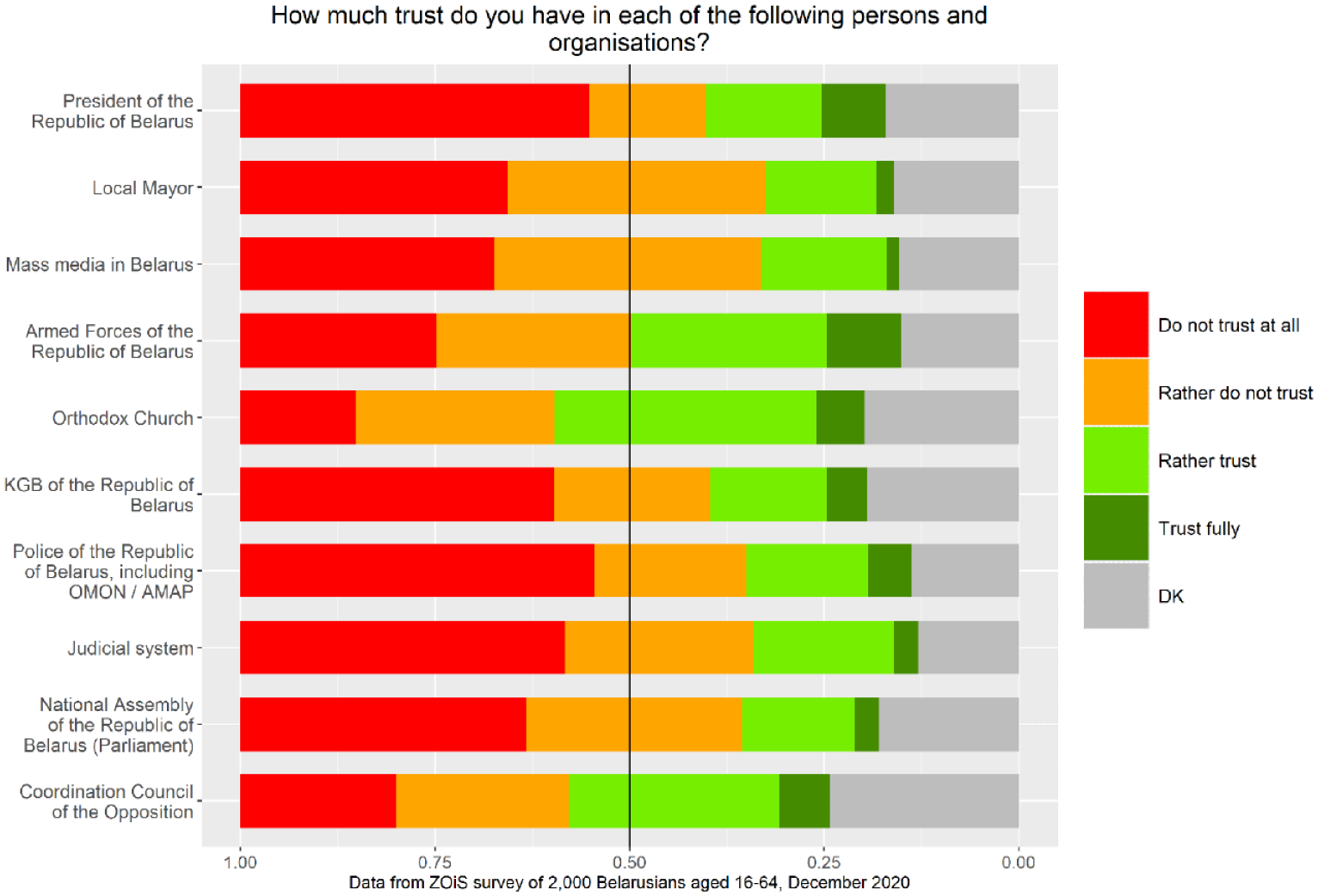
Trust in institutions (ZOiS December 2020 survey, Douglas et al., 2021).
The pronounced distrust in the security apparatus and judiciary reflects these bodies’ unprecedented use of physical and psychological violence. Regression analysis based on the ZOiS survey revealed that trust in the president and the police was generally lower among men, people with higher educational background, younger people, as well as among residents of Minsk oblast (see Graph 5 and Note 9 for an operationalization of the variables).
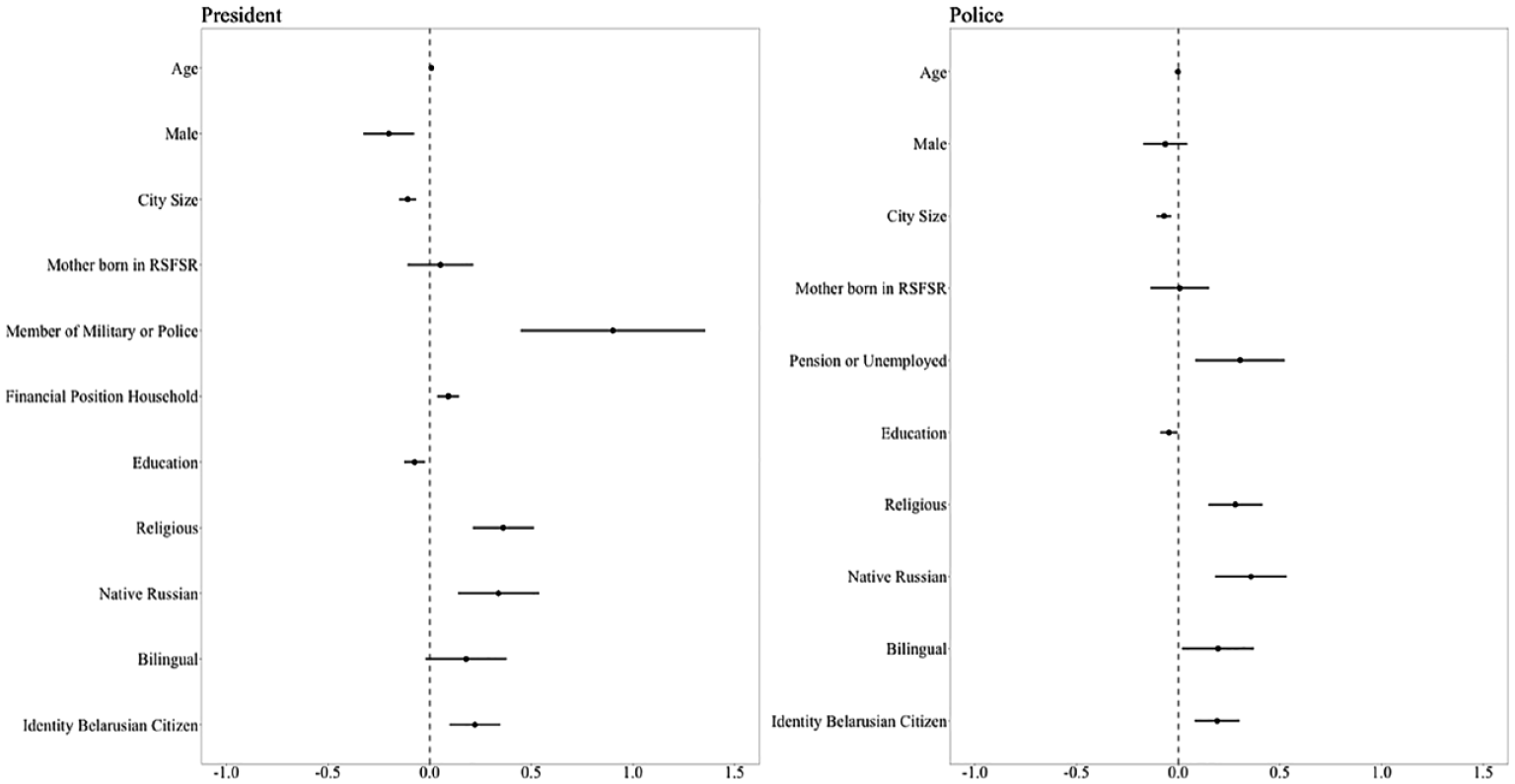
Trust in president and police.
When the same questions were asked to roughly the same respondents 7 months later (June 2021), there were few changes. Interestingly, distrust (“do not trust at all”) in both the President and the militsiya (including OMON/AMAP) saw a decline by approximately 4 percent each compared to 2020. The trust rate for the Coordination Council (“rather trust”) sank by about 5 percent. This obviously does not testify to a growth in trust in the institution of the president or the police, but it may also show some disillusionment with the work of the regime opponents. Moreover, it indicates that due to continued repressions and drastic persecution of people with dissenting opinions in 2021/2022 (ongoing in 2024 24 ), fear in society to say the truth in opinion polls has grown again (see fear factor, Note 7). This result has also been supported by Chatham House Belarus Opinion Polls. Chatham House differentiates in their opinion polls between “hardcore protesters,” “neutrals” (who make up the largest societal segment), and “Lukashenka’s base.” Thus, they confirmed that the average level of trust in the public sector continues to be extremely low, at below 30 percent (with the sole exception of the army, which also scored better in the ZOiS survey). The 6th wave of Chatham House polls, explicitly focusing on the political crisis and citizen–state relations, equally indicated a decline of distrust in most government institutions. 25
State violence as driver for protest mobilization
Widespread personal experience of disproportionate state-induced violence affects how people think about their country’s leadership (Douglas et al., 2021). In the ZOiS 2020 survey, 70 percent of respondents reported to have been “very concerned” or “rather concerned” about the actions of the security forces during the protests. People in the capital and those with low household incomes but high levels of education expressed more concern. The fact that violence is not a new phenomenon in Belarus had been confirmed by the survey as well: Asked how frequently security forces used violence before 2020 to suppress opposition, the largest groups of respondents—26 percent—answered “always,” while 44 percent acknowledged that the security forces were “often” or “sometimes” used to suppress dissent. Particularly, respondents who had taken an active part in protests shared this view. A disproportionate level of violence used to be a problem already before 2020. The fact that the individual behind the mask or under the balaclava remains anonymous lowers their initial inhibitions against using force: “They know that they have carte blanche and that the state will back them up” (Interview representative Belarusian United Civic Party).
The most frequently given reason in 2020 for taking part in protests was shock by the violence against protesters. This underlines the fact that repression in an age of social media is a risky strategy for an autocratic regime, as the circulation of images of violence may encourage even more people to take to the streets, including the parents and grandparents of the initial injured and arrested protesters (Douglas et al., 2021).
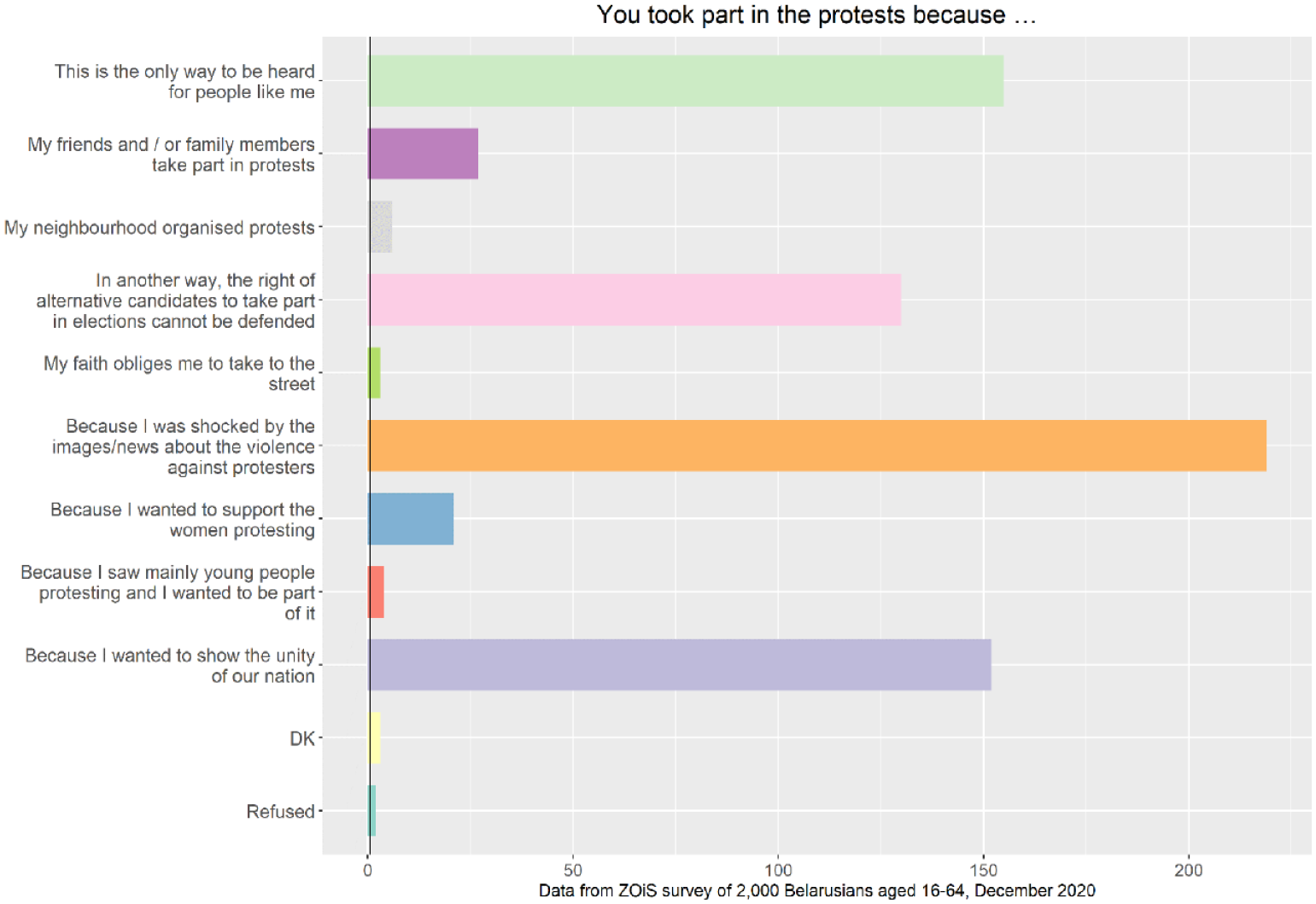
Reasons for protest participation (ZOiS December 2020 survey, Douglas et al., 2021).
In view of the extremely high levels of state violence, around 40 percent of the protesters in the ZOiS sample said they had initially been afraid to join the protests but had gradually lost their fear. About 25 percent either became more afraid the longer they took part in protests or stopped protesting out of fear. In the course of 2021, the continued repression and violence by state power structures (militsiya, prosecutors, and judicial system) turned once again into a deterrent to prevent citizens from mobilizing and offering social resistance. As of 2022/2023, much of the violent repression of citizens had shifted from the streets to pre-trial detention centers and the criminal prosecution system. 26 Regression analysis confirmed that those respondents that indicated to have participated in protests in 2020 or even in previous years rather distrusted Belarusian state institutions. Those that had protested previously or started protesting after August 2020 displayed moreover a higher degree of social trust than before (see Graph 3). In sum, in the post-election period, a high degree of repression resulted in further protest mobilization. The increase in social trust among protesters could have been one factor why repression as a deterrent did not work anymore. However, in the aftermath period between 2020 and 2021, when more and more people got arrested and repression and intimidation remained on a high level, protest mobilization decreased again.
Interrelation between social and institutional trust as well as protest participation
In the relevant literature, a correlation or link is generally assumed between social trust and trust in institutions (see, among others, Grönlund and Setälä, 2012; Kaase, 1999; Uslaner, 2002). Both arguments can be found: that social trust is a basis for institutional trust and vice versa that institutional trust determines social trust. Examples from Nordic countries seem to prove that societies with a high degree of social trust (Norris, 2002: 150/51) display also a higher degree of trust in their state institutions (see Grönlund and Setälä, 2012). Thus, in countries like Norway, Sweden, and Canada, high social trust also goes along with high public confidence in the police (Staubli, 2017: 65). These findings can, however, not easily be transferred. First, this correlation does not necessarily hold true for other, more authoritarian, contexts. Second, the way political participation or societal mobilization plays into this complex is not necessarily clear either.
In Belarus, as presented in the context of the research puzzle in the introduction, for a long time the constellation was a diverging one: the Belarusian welfare state and the promise of economic well-being as well as the perceived legitimacy of a charismatic leader used to correspond with relatively high institutional trust rates. This is in line with the argument of Rivetti and Cavatorta (2017) regarding the tight relationship between trust and economic success and the significance of legitimacy of rulers, with legitimacy being once again the product of the delivery of material benefits. As one representative of the independent Belarusian trade union REP (Radio electronic Industry Workers) explained, “Until today, there are people that trust our government, that continue to trust our president, although he shouldn’t have been trusted from the early days. It is possible that they simply until today believe in these official statistics” (Interview activist REP union). At the same time, the relatively stable low scores in social trust were sometimes interpreted as Soviet legacy and corresponded with discourses on “national nihilism” and the “neo-Soviet narrative” (Bekus, 2010; Marples, 1999).
In recent years, trust in Belarusian state institutions has declined in connection with worsening economic conditions and the perceived revocation of the social contract (Douglas, 2020). A representative of an oppositionist movement explained, “A certain exhaustion about the state of social policies of state power institutions has been accumulated here, and a certain disbelief that they could come up with something new that would change the situation” (Interview representative Movement “For Freedom”). Therefore, a direct correlation between social and institutional trust cannot be derived from the preceding analysis, neither is the one an antecedent nor consequence of the other. Yet, in accordance with Kaase (1999: 1), a different picture emerges when adding societal mobilization or protest participation into the picture. We can therefore conclude from the preceding analysis that the lower the institutional trust the higher the probability for engaging in protest activities. At the same time, a higher social trust rate correlates with the participation in protests (either before or after August 2020). This points to the consequence that trust has been an important factor in societal mobilization and protest participation in Belarus. Nonetheless, this finding needs to be placed under several caveats, namely the qualification of the type of trust and the particular context. Many other factors played into the particular 2020 post-election situation (see Bedford, 2021). This goes in line with other voices in the literature that contend the relationship between social trust and political participation/mobilization to be context-dependent or contingent (Suh and Reynolds-Stenson, 2018: 1484/85). Moreover, specific societal dynamics can simultaneously encourage trust in some area (social trust among protesters), while discouraging it in others (trust in state power structures) (see also Welch et al., 2005: 469). In both cases, trust dynamics are influenced by personal experience: in the prior case, the collective experience with fellow citizens and in the latter the experience of the performance of state-sanctioned institutions. This confirms the assumption that the effects of institutional performance on trust are indirect and mediated at the micro-level by individual perception (see Mishler and Rose, 2001: 55).
Conclusion
The behavior and performance of Belarusian police during post-electoral protests 2020 has been widely regarded as illegitimate. The preceding sections allow drawing conclusions from policing practices on the ground regarding public perception of trust in and legitimacy conferred to state power structures. The decrease in social trust in the course of 2020, experienced by one fifth of the survey respondents, reflects the profound scars that the events following the forged presidential election have left. The increase in social trust among protesters and firm regime critics, on the other hand, clearly has been the result of the novel experience of collective action, solidarity, and ultimately accelerated societal mobilization.
Despite a difficult situation with rather adverse preconditions prior to the presidential election in August 2020 (society neither experienced nor prone to protests, deterrence by highly militarized police and internal forces, as well as a combination of low social trust and high institutional trust rates), the pictured changed in the immediate pre- and post-election periods, ultimately resulting in a massive accelerated societal mobilization. The research puzzle can be explained by the fact that complementary interview and other sources presented in this research revealed that the erosion of institutional trust has been a long-standing underlying phenomenon that may not have been captured by previous opinion polls. As emerges from the regression analyses, on the one hand, the decrease in institutional trust has been a catalyst for the readiness to protest, and on the other hand, the increase in social trust among protesters has been another contributing factor to social mobilization. Both of these hypotheses have been subject to previous research and been confirmed independently from one another. In the Belarusian case, however, these two trust dynamics came together, reinforced each other, and jointly with police repression influenced both the initial mobilization and subsequent demobilization of protests.
Police repression played a different role during various protest periods. It represents a contextual variable that affected both institutional trust and protest mobilization. In the pre-election period, it had a deterrent effect. In the immediate post-election period, it actually had the opposite effect and motivated even more people to participate in the protests. The increase in social trust among protesters may have been one factor (of several) why repression did not work out in the post-election period. Social trust, among protesters at least, remained constant, but in the ensuing periods other contextual variables changed: more and more protesters/activists got arrested and sentenced to long prison terms, the government authorized firearm action, external attention from abroad decreased, and so on. In other words, social trust was important for mobilization during the post-election period, but was not sufficient for maintaining the degree of mobilization and momentum over the period of localized actions and the aftermath period until 2021.
Remarkably, the level of social trust among those who had experienced an increase during the last 6 months up to the December 2020 survey remained constant throughout the second wave of the survey in June 2021—despite ongoing repressions and the discontinuation of protest mobilization. It would be an interesting task for future research on this topic to test for how long social trust rates among protesters actually remain high after protests have abated.
The preceding analysis illustrated that trust, understood as a relational concept, is a collective resource and essential in the formation of social ties (Welch et al., 2005). The quality and intensity of the confrontation between police and citizens shaped the widespread personal experience of disproportionate state-induced violence. Thus, the trust and protest dynamics between 2020 and 2021, read in conjunction, affected the perception of the country’s leadership.
Just as trust in the Belarusian state and its institutions over many years served the regime to prove the validity of the “social contract” and to secure the survival of authoritarian rule (see Rivetti and Cavatorta, 2017), the erosion of institutional, in particular presidential, trust rates in 2020 became the trigger and motivation for societal mobilization. Further mobilization occurred as a result of police brutality and repressive policies implemented by the regime. Ultimately, trust became the driver of an aspired political change and envisioned democratization. The gain in social trust (at least among former protesters) can probably be noted as one of the few things on the asset side of the democratic movement in Belarus.
Footnotes
Acknowledgements
The author is thankful to Nadja Sieffert and Thomas Nawrath for assistance in statistical analysis and the four anonymous reviewers as well as the special issue’s editors for their very helpful comments.
Funding
The author(s) disclosed receipt of the following financial support for the research, authorship, and/or publication of this article: The survey referred to in this article was financially supported by the German Federal Foreign Office.

Interviews
Activist of REP Union, Bobruisk, 12 September 2017
Activist, “Our House,” Minsk, 10 September 2017 (follow-up interview 2021)
Representative Belarusian United Civic Party, Minsk, 8 September 2017
Representative Forum of entrepreneurs “Perspektiva,” Minsk, 5 September 2017
Representative “Just World” (former Communist) Party, Minsk, 11 September 2017
Representative Movement “For Freedom”, Minsk, 6 September 2017
Representative “Tell the truth” initiative, Minsk, 8 September 2017