




Abstract
This article contributes to the knowledge on organizational stratification in higher education by exploring its financial dimension in 21 European countries over the period 2013–2017. Cross-country differences in the inequality of revenues among higher education institutions are considerable. Decomposing inequality indices shows that they are related to the various degrees of institutional diversity in size, research activity, and subject specialization. Financial stratification is higher in countries where revenues are more unequally distributed among universities involved in research, especially those with a broad disciplinary focus. This inequality is in turn driven by the role of third-party funding in higher education financing.
Keywords
Introduction
Higher education (HE) has expanded considerably over the last four decades. With gross enrolment ratios between 50 percent and 90 percent, the vast majority of European countries can now be classified as high-participation systems (Cantwell et al., 2018). The growing study demand has been met by additional supply created at increasingly diverse higher education institutions (HEIs). More recently, the momentum of expansion has begun to slow down, leading to increased competition for students and other limited sources of funding. The role of competition in resource allocation has been further enhanced by changes in HE policies that have deregulated market entry (Dill, 1997), led to the proliferation of rankings and other benchmarking devices (Brankovic et al., 2018), expanded the role of third-party and performance-based funding mechanisms in HE finance (Schulze-Cleven et al., 2017), and increased the institutional autonomy of HEIs in the spirit of “enterpreneurialism” (Jessop, 2017).
Despite the global trend, these policies and processes have varied across countries, in part due to historical legacies (Cantwell et al., 2018). However, there was a common reform rationale: to respond to rising societal demand for HE qualifications without compromising “excellence” in research and teaching (Watermeyer and Olssen, 2016). To limit the resulting fiscal costs, specialization has been encouraged by allocating public resources to HEIs on the basis of their capacity to carry out different core activities (teaching, research, as well as business and community engagement) or to develop specific study programs (Teichler, 2008). This has led to further or reconfigured horizontal differentiation, that is, the diversification of research versus teaching profiles, study fields, and organizational sizes among HEIs in a given country. This happened not only in unified systems but also in binary ones (Huisman et al., 2007) in which universities and applied (vocational) science institutions used to be legally distinct (Meek et al., 1996).
It is argued that market-oriented reforms, combined with expansion itself, have led to the persistence (Boliver, 2015), deepening (Cantwell et al., 2018; Reimer and Jacob, 2011) or emergence (Bloch et al., 2018) of organizational stratification, that is, a hierarchical order among HEIs in terms of prestige and financial resources. In the face of competitive pressures, leading HEIs have greater capacity to adapt to and influence changes and decisions in their policy environment, thereby increasing their relative advantage (Münch, 2014). Empirical evidence from the United States and the United Kingdom suggests that organizational stratification has increased in recent decades (e.g. Boliver, 2015; Davies and Zarifa, 2012; Taylor and Cantwell, 2019). However, little is known about whether similar developments have occurred in other parts of the world, and even less so about the extent and sources of cross-country variation in organizational stratification.
We address this research gap by investigating differences in the financial dimension of this stratification, that is, the inequality in revenues between HEIs in a given country (hereafter financial stratification; FS). As the trends toward greater marketization and scarcity of funding in HE have been common but not uniform, we expect FS to differ across 21 European HE systems, which we analyze using data from the European Tertiary Education Register (ETER) for the period 2013–2017. We ask the following: To what extent are the identified cross-country differences in FS associated with (1) the role of competitive funding sources in the finances of HEIs, (2) the way national HE systems differ in terms of horizontal differentiation?
Studying financial and other aspects of organizational stratification in HE is of increasing social relevance. As a result of historical and recent HE policies, organizational stratification can be understood as an integral part of the institutional setting of HE systems which structures individual behavior and social interactions, thereby contributing to the reproduction of social inequalities (Gross and Hadjar, 2020). Undoubtedly, the transition to high-participation systems has reduced absolute inequalities in HE participation (Jackson, 2013; Shavit et al., 2007). However, socioeconomic gradients in the selection into prestigious universities or fields of study, that is, horizontal inequalities in HE participation, have persisted or have even increased (Boliver, 2011; Davies and Guppy, 1997; Lucas, 2001; Torche, 2018; Triventi, 2013). Thus, the actual range of educational opportunities in expanding systems increasingly depends on the supply of study places in HEIs or programs of different status and quality, as well as on the labor market value of the associated qualifications (Bills, 2016). In more organizationally stratified systems, the stakes in the competition for prestigious and well-financed study places are higher, which can lead to more social closure at upper-tier HEIs and negative consequences for labor market inequalities.
We provide evidence of significant cross-country variation in FS. These differences are related to the extent to which HEIs in a given country have to rely on third-party funding. Horizontal differentiation matters for FS. First, it is lower in countries where HEIs are more specialized. Second, FS tends to be higher where resources are more unequally distributed within a distinct group of large, research-focused HEIs with a wide range of subjects in their portfolio. We argue that this is due to the intense competition for third-party funding in that group.
We begin by presenting a concept of organizational stratification in HE, focusing on its financial dimension. We theorize how country-level FS can depend on the degree of competitive funding and horizontal differentiation, and review previous studies on FS. The third section discusses data and operationalization issues. We then describe cross-country differences using Gini indices and decile ratios as measures of FS, and conduct decomposition analyses to capture the contribution of different revenue sources and horizontal differentiation to FS. Next, we examine whether these can explain the observed cross-country differences. The final section discusses the findings and limitations of the study and outlines future research directions.
Theory and background
Organizational stratification in high-participation systems
Organizational stratification manifests itself in inequalities in financial resources and prestige between HEIs within a country (Bloch and Mitterle, 2017; Taylor and Cantwell, 2019: 7). The higher these inequalities, the greater the stratification of a HE system. On the prestige dimension, those higher up the hierarchy are associated with socially recognized attributes of quality, selectivity, elitism, or research excellence. On the financial dimension, well-resourced HEIs have significant leeway in spending, while those on the other end strive to maintain the scale of their operations.
Although prestige and financial standing need not go hand in hand, they are likely correlated (Davies and Zarifa, 2012: 147; Taylor and Cantwell, 2019: 4). HEIs are status-seekers and aim to maximize their revenue. As typically non-profit organizations (at least in Europe), they tend to spend all their available funds (Bowen, 1980). 1 Higher revenue is therefore associated with higher expenditure on core activities: teaching and research. Spending more on education (per student) can improve its quality, for example, by enabling a lower student–teacher ratio (Archibald and Feldman, 2008). Higher investment in research increases scientific output (cf. Münch, 2014; Pastor and Serrano, 2016). Both in turn increase the chances of success of HEIs in the competition for third-party funding, increase the share of the performance-based part of government subsidies, boost prestige and the value of the credentials awarded. Prestigious institutions that offer high-quality instruction can attract more successful scholars and increase enrollment or selectivity (potentially by charging higher fees; Taylor and Cantwell, 2019). Through these channels, prestige spirals back to the ability to attract more resources, creating a feedback loop that exemplifies a Matthew effect, that is, cumulative advantage whereby those who are already in a privileged position are more likely to achieve further social or economic success (Bol et al., 2018; Schulze- Cleven et al., 2017).
However, the intensity of this mutual enhancement of funding and prestige is not uniform. It can vary according to specific features of HE systems and policies, such as
The competitive orientation of national funding systems, that is, the relative role of competitively allocated sources such as third-party funding and student fees in HE finance;
The configuration of specialization among HEIs (teaching vs research, or by subject/field of study), which may limit direct competition for resources and prestige to groups of HEIs with similar missions and cost structures.
In this article, we focus on the financial dimension of organizational stratification 2 in Europe and examine these two systemic and political features, as they can be expected to shape recent cross-country variation in FS.
Revenue sources and financial stratification
HEIs differ not only in the total amount of resources at their disposal, but also in their reliance on different sources of revenue (Davies and Zarifa, 2012; Taylor and Cantwell, 2019). Moreover, HE systems vary in terms of the role of competition in funding, which is established politically, for example, through public funding allocation rules or legal regulations concerning the capacity of HEIs to increase their revenue through market operations (such as obtaining third-party funding from private foundations). In line with the finance-prestige-enhancing mechanism of organizational stratification described earlier, the prominence of competitively allocated funding in HE finance, as part of the HE marketization is likely to benefit HEIs that are already well positioned.
Private and public third-party funding is granted based on the evaluation of research proposals and past achievements of individual researchers (Bol et al., 2018; Lepori, 2019) and the institutions they represent (Münch, 2014). Therefore, HEIs that are better endowed have a higher research intensity and a higher reputation is more likely to attract such funding. Hence, FS should be higher in countries where, for example, a significant part of block grant funding has been transferred to an independent research funding agency that distributes money based on merit.
Where they exist, tuition fees in Europe are largely regulated by the state, with little room for institutional-level price setting—especially at public HEIs. However, in some private sectors, tuition fees mimic pricing mechanisms, allowing more prestigious and better endowed HEIs to charge more for their services. Where tuition fees are universal, HEIs with large enrolments can benefit from economies of scale in teaching and reinvest more of tuition fee revenue in research or other revenue-generating activities. In addition, upper-tier universities may be more successful in attracting high-paying international students, or domestic students in dual-track student fee systems (Marcucci and Johnstone, 2007).
In contrast, government contributions in the form of block grants are primarily intended to support the maintenance of teaching capacity and basic research infrastructure. They represent the largest share of HE funding in most European countries (Lepori, 2019) and are distributed in a non-competitive manner, unless the allocation is to some extent based on performance-based evaluations of teaching or research (Bloch et al., 2018; Zacharewicz et al., 2019). Hence, the larger their relative relevance, the lower FS should be.
Given these considerations, we hypothesize that (H1) FS is higher in countries where HEIs depend more on competitively allocated revenue sources: third-party funding and tuition fees. 3
Horizontal differentiation and financial stratification
HE systems vary considerably across countries. They consist of different combinations of HEIs: traditional universities, vocational schools offering tertiary qualifications, and newly established public or private HEIs, all of which differ internally in their study program portfolios and research intensity. This horizontal differentiation stems from historical legacies and formal or informal divisions of labor among HEIs with regard to mission and subject specialization. It is captured in legal distinctions within a given jurisdiction (e.g. universities vs non-universities or private vs public HEIs), in expert categorizations of HE systems as a whole (e.g. binary, unified or diversified) that combine information on legal status and activity profile (Huisman et al., 2007; Meek et al., 1996; Shavit et al., 2007), or in categorizations developed for governance purposes, such as the Carnegie classification in the United States.
The concept of horizontal differentiation is aimed to reflect diversity, rather than the hierarchical order of prestige or funding. Nevertheless, some features of HEIs may be regarded as more distinguished, and some activities may result in higher revenues. For example, the vocational sector may be considered as inferior to universities since it does not conduct research or grant doctoral degrees, instead of being recognized for its distinctive teaching mission. Organizational stratification and horizontal differentiation can be intertwined, which is relevant for understanding cross-country variation in FS.
The observed degree of FS may at least in part emerge from financial differences between types of HEIs, which may be due to different public funding schemes and levels in legally separate parts of the system (e.g. universities vs vocational institutions), 4 or to different revenue and cost structures depending on the activity or mission profiles of the HEIs of a given type. Research intensity and subject specialization tend to be the main determinants of high revenues per student in European HEIs (Lepori, 2019). High research intensity is likely to be associated with more incentives and opportunities to obtain third-party funding for scientific or applied research, and leads to higher government subsidies through a performance-based funding component (Zacharewicz et al., 2019). Thus, similar to the US case (Taylor and Cantwell, 2019), FS may be driven by polarization between research universities and the rest. In addition, study programs vary in their cost of provision, with some requiring expensive infrastructure or low student-staff ratios. High-cost programs may be concentrated in specialized HEIs in some countries (e.g. STEM-focused universities in Switzerland), thus contributing to FS. In others, they may be more evenly distributed across different institutions, which limit FS. Therefore, cross-country variation in FS may simply stem from the different degree of horizontal differentiation across HE systems.
However, country-level indicators of FS may mask the fact that inequality in the distribution of resources is actually present only within some more homogeneous types of HEIs. Given the discussion in subsection “Revenue sources and financial stratification,” cross-country differences in FS may be particularly driven by the unequal distribution of revenues among HEIs exposed to competition for funding. Competition for third-party funding is likely to be more pronounced among HEIs with at least some research activity than in teaching-oriented (e.g. vocational) parts of the sector. Institutions with a strong science, technology, engineering, and math (STEM) focus may have varying capacities for securing research-and-development collaboration with business (as a source of private third-party funding), depending, for example, on their geographical location and infrastructure. Because of their research-driven reputation, top-tier HEIs tend to be more attractive for international or domestic students than other research-active HEIs with similar size and subject specialization (Raffe and Croxford, 2015; Taylor and Cantwell, 2019). This allows them to charge higher fees (where legally possible) or to increase the number of fee-paying students. Competition is less pronounced among lower-tier, teaching-oriented public HEIs, which all struggle to attract fee-paying students.
While it is difficult to have a prior expectation on whether inequality between or within types is more relevant for explaining variation in FS across countries, we expect that (H2) revenue inequality will be higher within the types of HEIs that are engaged in research, as they are more exposed to the mutual reinforcement of finance and prestige that drives FS. It follows that (H3) cross-country differences in FS should be mostly driven by inequality among HEIs exposed to competition for third-party funding and tuition fees.
Existing empirical evidence
Studies that quantified organizational stratification were mostly focused on changes over time in the United States (Cheslock and Shamekhi, 2020; Lau and Rosen, 2016; Taylor and Cantwell, 2019) and the United Kingdom (Boliver, 2015; Raffe and Croxford, 2015).
The studies by Taylor and Cantwell (2019) and Boliver (2015) combine both the prestige and the financial dimensions of organizational stratification. Based on indicators that reflect size (enrollment), prestige (selectivity), resources (educational and related expenditures per full-time equivalent student), and financial independence (share of resources derived from tuition fees), Taylor and Cantwell (2019) obtain seven categories of HEIs in the United States, ranging from “vulnerable” to “super-elite.” The proportion of vulnerable institutions, which rely heavily on tuition, and the number of students attending them increased significantly between 2005 and 2013, while the super-elite segment remained stable. Boliver (2015), however, uses a variety of proxies for research activity, teaching quality, economic resources, academic selectivity, and the socioeconomic student mix of universities to show that even if the binary division that existed in the United Kingdom before 1992 has largely been reproduced after two decades of a unified system, organizational stratification is evident within both pre-1992 and post-1992 existing universities.
Raffe and Croxford (2015) focused exclusively on the prestige dimension of organizational stratification in HE. They demonstrated a general stability of institutional hierarchies in Scottish and English HE between 1996 and 2010, despite significant policy changes (particularly toward marketization in England). However, when examining changes in hierarchies within categories of HEIs distinguished by their historical prominence, they find some degree of status reshuffling within the lower tier. Importantly, status differences between categories could be attributed to their subject specialization as captured by different field of study mixes.
Analyzing the financial dimension of organizational stratification, Lau and Rosen (2016) found that resource inequality among US HEIs is substantial, but that changes over the period 2002–2010 were negligible. Cheslock and Shamekhi (2020) studied FS in the United States over a longer and more recent time period (2004–2017) and found that inequality in total spending increased, while inequality in spending per student decreased. These divergent trends can be attributed to rising differences in the number of students, on one hand, and a positive relationship between spending per student and enrollment levels, on the other hand. While the former is due to economies of scale, the latter is largely related to growing disparities in research activity, wealth and prestige.
The only comparative analysis of FS that exists is provided by Davies and Zarifa (2012), who analyzed Gini indices and decile shares based on revenue and expenditure measures from 1971 to 2006 in the United States and Canada. FS increased in both countries, mainly due to changes in the distribution of revenue from tuition fees and private third-party funding, and, in Canada, due to the allocation of provincial grants. This suggests the growing role of competitive funding in shaping FS (particularly in the United States 5 ), although the contribution of these types of revenue components to overall inequality was not analyzed in the article. Overall, FS had increased more in the United States, where HEIs at the very top had become even more separated from the rest, highlighting the importance of considering the tails of the resource distribution in studies of organizational stratification.
The existing empirical evidence provides insights into country cases with a historical legacy of organizational stratification as a legitimate feature of HE. Arguably, other European HE systems have less pronounced status hierarchies and much less financial dependence on tuition fees or private funding in general, which, according to our hypotheses, should imply lower FS than in the United Kingdom and the United States. We contribute to the literature by providing the first evidence on the levels of FS across European HE systems.
While the results of Taylor and Cantwell (2019) and Davies and Zarifa (2012) convey that success in obtaining competitive funding determines the position in the distribution of revenues within countries, the evidence of Boliver (2011), Raffe and Croxford (2015), and Cheslock and Shamekhi (2020) suggest that research activity and subject specialization are relevant for understanding organizational stratification. Therefore, the composition of revenue sources and horizontal differentiation can be expected to generate differences in FS across countries and over time. However, neither of these features of HE systems has as yet been explicitly analyzed together, especially not in a comparative setting. We fill this research gap with our study.
Data and methods
ETER data
Our analysis is based on the ETER database. We use a cross-sectional dataset covering the years 2013–2017, with time averages of financial variables for each HEI appearing at least twice in the relevant period. This allows us to focus on relatively recent cross-country differences while maximizing the number of countries covered, ensuring sample consistency, and including the year 2014, to which the horizontal differentiation classification applies (see below). Sufficient financial information is available for 21 countries included in the ETER.
To ensure data consistency and comparability across countries, we applied a number of sample restrictions (see OS.A3). We excluded HEIs offering only short-cycle degrees (ISCED5) and doctoral programs (ISCED8), HEIs offering mainly distance education, and institutions with enrollments below 200 students, which corresponds to the fifth percentile of the dataset-wide student distribution. Together with the exclusion of extreme outliers in financial measures, this significantly reduces the number of small institutions with special focus (e.g. medical centers and military schools) in the data, which is desirable given their specific cost structures leading to high revenues.
The coverage of HEIs in terms of financial data varies across countries (Table 1). With a coverage of less than two thirds of HEIs, we consider Austria, Belgium, the Czech Republic, France, Italy, Poland, and Portugal as problematic cases. As the lowest coverage of the student population is still 54 percent in Belgium, we do not exclude these countries from the analysis. It is mostly the sector of applied, educational and/or fully private sector that does not report financial data, while the university sector tends to be well covered. 6 This may induce a bias in cross-country comparisons. On one hand, the under-representation of typically less well-funded, lower tiers of HE systems could lead to an underestimation of FS. On the other hand, if inequalities within these segments are lower than in the university sector, the bias would work in the opposite direction. In any case, the results for these seven countries should be interpreted with caution.
Total current revenue of HEIs in 21 European countries.
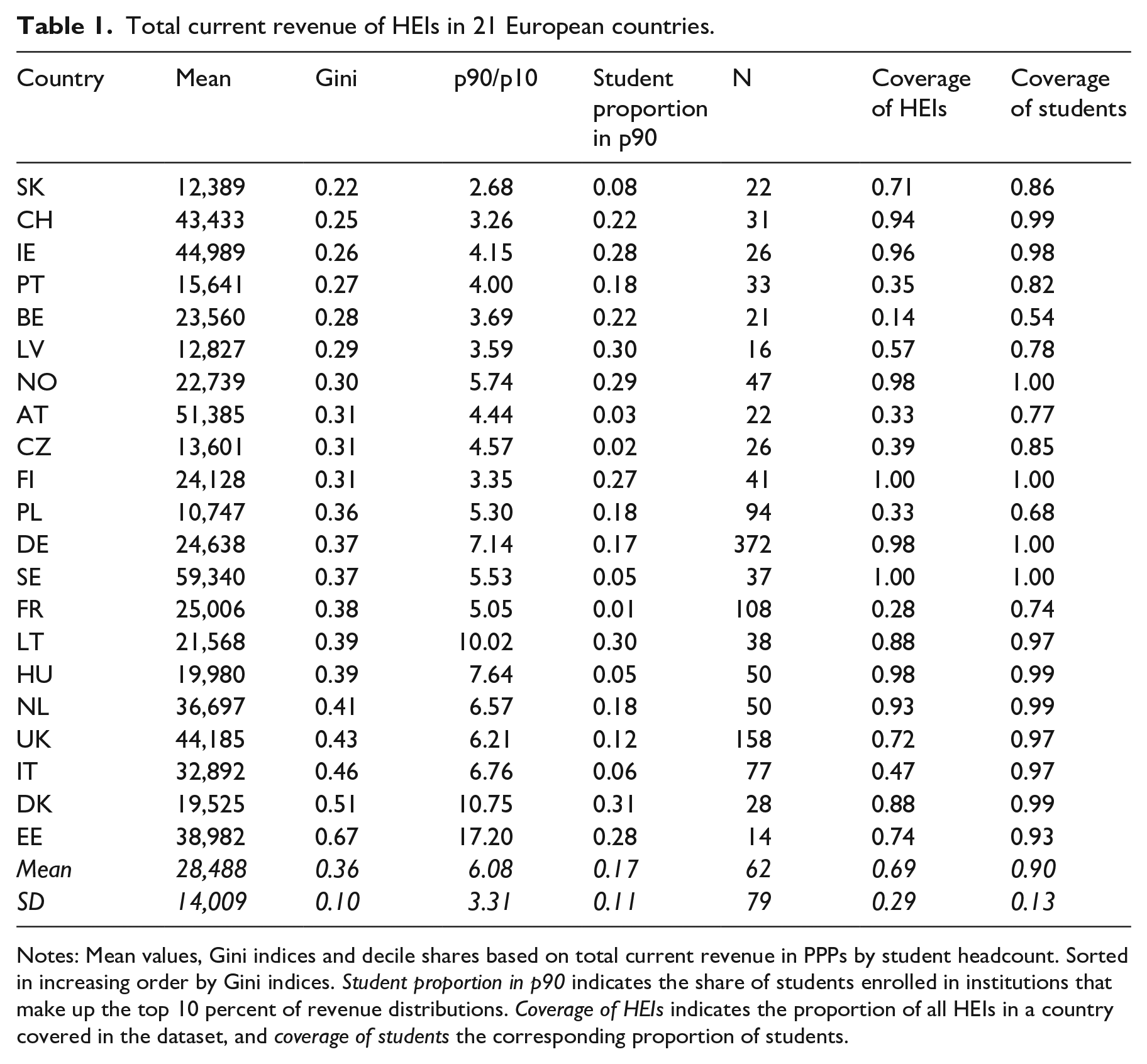
Notes: Mean values, Gini indices and decile shares based on total current revenue in PPPs by student headcount. Sorted in increasing order by Gini indices. Student proportion in p90 indicates the share of students enrolled in institutions that make up the top 10 percent of revenue distributions. Coverage of HEIs indicates the proportion of all HEIs in a country covered in the dataset, and coverage of students the corresponding proportion of students.
Measuring and explaining financial stratification
Revenues
We measure the finances of HEIs using data on their current revenue (expressed in purchasing power parity) for a given year. This variable reflects critical differences between HEIs in terms of the availability of financial resources that shape the quality of research and teaching (Davies and Zarifa, 2012: 147). Revenues can be volatile, for example, due to occasional donations, mergers, or other organizational restructuring. 7 We account for the potential resulting bias by calculating averages of annual revenues over the period 2013–2017 for each HEI. We distinguish between three revenue components (ETER, 2021: 90–95): (1) Core funding is available for the entire institution and is not earmarked to specific activities; it mainly includes government subsidies, as well as institutional donations, rental income, sales, and financial income. Typically, the allocation of core public funding is mostly based on the number of students enrolled at a given HEI, but in some countries, it also includes a research component that is allocated according to performance-based rules. (2) Third-party funding (public or private) is earmarked for specific activities and institutional units. It includes grants from funding agencies as well as contracts and payments for specific research and services. (3) Student fees are paid by households and students due to participation in study programs. The fourth category distinguished in the ETER data—unclassified revenues (those not assigned to the other categories)—are included in our measure of total revenues, but is not discussed.
Horizontal differentiation
Organizations that are traditionally or legally associated with a peculiar type of HEI increasingly differ in their emphasis placed on research relative to teaching, and in the range and type of study programs they offer (Cantwell et al., 2018). We therefore use a recent, data-driven classification of HEIs developed by Lepori (2022) to capture horizontal differentiation in HE systems. 8 It allows for a fine-grained analysis of revenue differences within and between six categories of HEIs that differ along three main dimensions, that is, research intensity, subject specialization, and size in terms of student body: (1) Research universities are doctorate-granting HEIs that have high research output and cover most subject areas. (2) Science and Technology (S&T) oriented HEIs—doctorate-granting, with a focus on natural and technical sciences. They have a research intensity similar to class (1), but a much higher patent intensity, which is related to their subject specialization. (3) Applied Science (AS) HEIs do not have the right to award doctoral degrees, and are oriented toward the natural and technical sciences, which is reflected in the share of students in these fields. (4) Generalist HEIs are medium-sized and multidisciplinary, but enroll the majority of students in social sciences and humanities. The research intensity is lower than in classes (1) and (2), and highly variable. (5) HEIs specializing in social sciences and humanities (SSH) are small institutions, such as art and music colleges, with a high intensity of doctoral training. (6) Educational HEIs are institutions that do not grant doctoral degrees and are characterized by the absence of research and technology output. About half of these HEIs have been founded after 1995 and about half of them are private.
Of these classes, (1), (2), and (4) share the right to confer doctoral degrees and to engage in research. Research activity can correlate with prestige, but it also enables us to differentiate HEIs based on their teaching versus research-oriented missions. These classes can be expected to be more exposed to competitive mechanisms, as they are more involved than other classes in obtaining third-party funding for research. In addition, they typically absorb the largest share of revenue and tend to enroll the majority of students (see Table OS.C3), thus competing for a large pool of students who may pay tuition fees. 9 We aggregate these three classes to analyze whether country-level FS is related to the distribution of revenue among HEIs exposed to competition. However, class (2) includes HEIs whose high revenues may be due to S&T specialization (higher infrastructure and equipment costs). Therefore, we conduct a sensitivity analysis by merging only (1) Research and (4) Generalist HEIs. For comparison, we also present results obtained by merging the other classes (3), (5), and (6).
Normalization
The total amount of HEIs’ finances is only loosely related to its status (Taylor and Cantwell, 2019). It is also an imperfect measure of the actual resources available to an institution, as it does not take into account its size (Cheslock and Shamekhi, 2020). We therefore normalize the revenue data. Based on the assumption that revenues from core funding and tuition fees are primarily used to finance teaching, we use ISCED5-7 student headcount as the denominator. Third-party funding revenue is divided by the number of academic staff (FTE) at each HEI, as most of this funding is directed toward research. Some research-intensive institutions may have a significant proportion of staff who have limited teaching responsibilities, so dividing this component by the number of students could lead to an overestimation of their resources. Due to the mixed normalization of the revenue components, their relative share in the total normalized revenue should not be interpreted simply as the institutional budget structure, but rather as the relative importance of the components in HEIs’ finances, which corrects for the different productivity of efforts financed by third-party funding and the other streams (the average annual research cost per researcher is admittedly higher than the average annual study costs per student).
Inequality measures
To capture resource inequality, we compute Gini coefficients for total revenue, revenue components, and for different categories of HEIs. The Gini index has the advantage of being easy to interpret, and due to its well-defined range (0–1) it is well-suited for cross-country comparisons. Using the Gini index also makes it possible to compare results with the most relevant studies conducted in the US context. However, as a general measure of inequality, it may mask inequalities in specific parts of the resource distribution within countries (Davies and Zarifa, 2012). We therefore additionally report three decile ratios, comparing the top decile with the bottom decile, and comparing median revenue with the bottom and top deciles.
To estimate the contribution of revenue components to country-level inequality, we decompose the Gini index according to the method proposed by Lerman and Yitzhaki (1985).

where
While it is possible to decompose the Gini index to gain insight into the relative importance of revenue components, a decomposition by population subgroup can result in large residual components that complicate the interpretation of inequality within and between population subgroups (Sauer, 2019). We thus use the Theil index in the context of horizontal differentiation. Decomposition by Lepori’s (2022) six classes (and, in the robustness analysis, the three categories provided within ETER) allows us to reveal whether country-level inequality is driven by inequality within (specific) horizontal categories of HEIs or between them.

The Theil index is part of the Generalized Entropy (GE) family with alpha equal to one.
Regression analysis
To provide a tentative explanatory investigation of the relationships implied by hypotheses 1–3, we conduct a simple cross-country regression analysis using the Gini indices measuring FS in the whole system or, respectively, inequality among HEIs with at least some research activity (including and excluding S&T HEIs) as dependent variables. To check how sensitive our results are to the exclusion of the problematic cases, we perform sensitivity tests by excluding Austria, Belgium, the Czech Republic, France, Italy, Poland, and Portugal from the analysis one by one.
Results
The degree of financial stratification in European HE systems
Table 1 shows the cross-country differences in FS based on the average normalized revenues of all HEIs over the period 2013–2017. The average Gini coefficient across the 21 countries is 0.36, which is, as expected, generally lower than in the United States where, depending on the measurement approach and the analyzed time period, the Gini has been found to vary between 0.33 and 0.58 (Cheslock and Shamekhi, 2020; Davies and Zarifa, 2012; Yan and Rosen, 2016). A standard deviation (SD) of 0.1 indicates a substantial variation across countries. With Gini coefficients above the SD range, the United Kingdom, Italy, Denmark, and Estonia stand out as the most financially stratified HE systems, and Ireland, Switzerland, and Slovakia as the least.
HEIs in more unequal systems may or may not be better financed (on average). The correlation between average revenues of HEIs and Gini coefficients is positive but small (ρ = 0.07). In contrast, the correlation between Ginis and top-bottom decile ratios (p90/p10) is 0.85. Thus, FS seems to be driven to some extent by gaps between the tails of the revenue distribution. This finding is supported by Figure 1. The gaps between the median normalized revenue and the bottom decile are negligible in all countries. The revenues of HEIs in the top decile are, on average, twice as high as the median, with only a slight tendency for top-median ratios to be higher in countries with higher Gini coefficients. Nevertheless, the top decile has on average 6.08 times more revenues than the bottom decile (SD = 3.31). The ratio is above the SD range in Latvia, Denmark, and Estonia, with the latter two being among the most unequal countries in terms of the Gini coefficient. At the other end of the spectrum, Slovakia and Switzerland are the most equal countries on both measures.
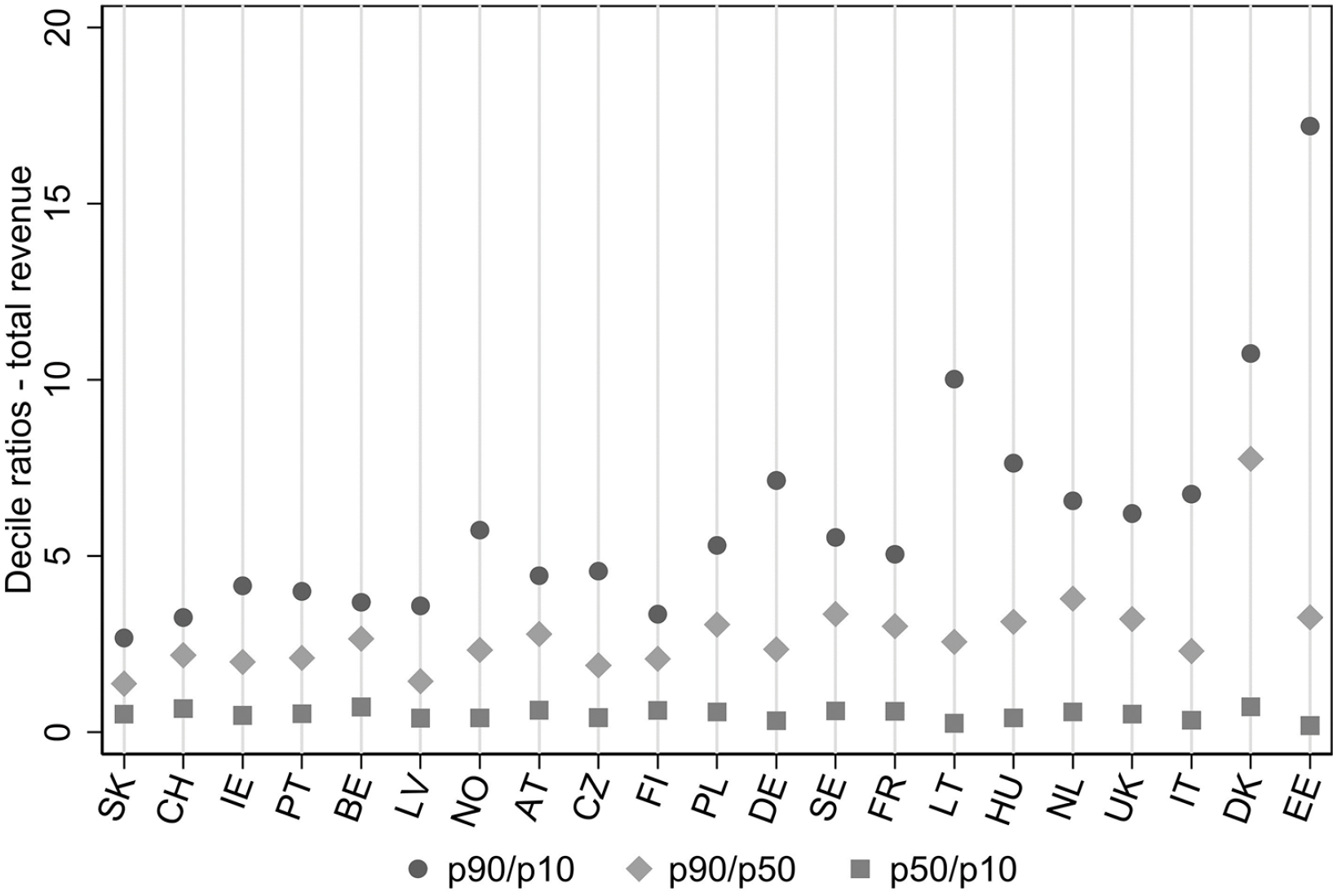
Inequality in total revenues—decile ratios.
The observed country differences can be seen as the cumulative result of recent policy changes as well as historical dependencies that shape the structure and funding of contemporary HE systems. As hypothesized in sections “Revenue sources and financial stratification” and “Horizontal differentiation and financial stratification,” the importance of competitive revenue sources in HE funding and horizontal differentiation are two contextual factors that potentially explain the variation in FS across European countries. We examine their role by decomposing the Gini coefficient to obtain the relative contribution of core funding, tuition fees, and third-party funding to the overall level of FS, and by investigating the relative relevance of inequality between and within the classes of HEIs that are more homogeneous in terms of research intensity, subject specialization, and size.
Contribution of revenue components to country-level FS
Figure 2 illustrates how the Gini coefficients reported in Table 1 are composed of inequalities in different revenue sources (see Equation 1). The specific Gini values for each component and additional information on revenue shares, the Gini correlation and the relative contribution of the components are provided in Table OS.B1.
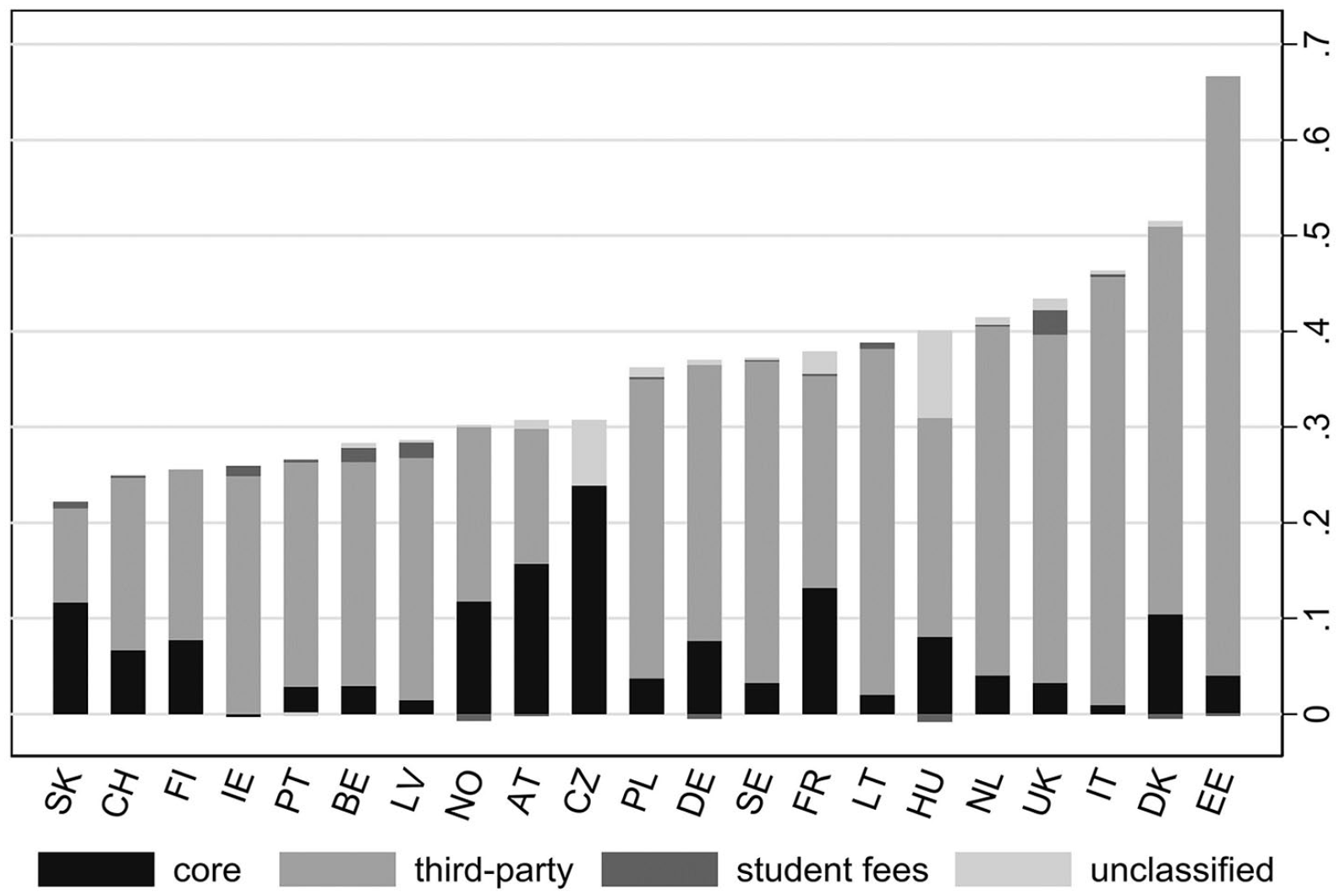
Inequality decomposition (Gini) by revenue components.
Core funding is the most evenly distributed source of revenue, and its high level does not necessarily imply high total revenues. This results in a relatively low average contribution (21%) of core funding to FS. Cross-country differences in this respect stem from the variation in Gini correlations, which range from −0.3 in Ireland to 0.88 in Denmark. In general, countries with a relatively high contribution of core funding to FS, such as Slovakia, Austria, France, and Norway, have varying levels of FS, although none of them can been considered as having a financially stratified HE system.
With an average relative contribution to the Gini coefficient of 78 percent, the allocation of third-party funds emerges as the most important revenue component associated with the level of FS. This is due to both its importance in the finances of HEIs (s in Table OS.B1) and its unequal distribution (G). Consistent with Hypothesis 1, the average Gini, which measures inequality in a given revenue source, is highest for third-party funding (0.49), followed by student fees (0.42), and core funding (0.31). In addition, an average Gini correlation of 0.92 indicates that HEIs with higher revenues from third-party funding tend to have higher total revenues (ρ). Figure 2 shows that the relative contribution of third-party funding tends to increase with the level of FS. However, Ireland and Portugal are clear outliers in the low FS group, and Hungary and Denmark in the high FS group.
Tuition fees play little or no role in financing HE in Europe. Their contribution to FS is therefore negligible. Nevertheless, inequality in this source of funding can be high (above 0.7 in Norway, Germany, and Hungary). It should be noted, however, that this is the result of substantial differences between small niches (e.g. private institutions) that charge higher tuition fees and the majority of HE where they are low or non-existent. In the only case where the share of fees in total HEI revenues is relatively high (20% in the United Kingdom), student fees are centrally regulated in a way that does not allow price differentiation for domestic students, resulting in a relatively equal distribution of revenue from this source (0.24). The Gini correlation in the United Kingdom is positive and significantly higher (0.54) than the average (0.17). In other countries (Austria, Norway, Hungary, Denmark), the Gini correlation can even be negative, suggesting that HEIs with higher tuition fee revenue are not necessarily those with higher total revenues.
The importance of horizontal differentiation for FS
To capture the extent to which cross-country differences in FS are driven by the degree of differentiation in HE systems, we decompose country-level revenue inequality (measured by the Theil index, see Equation 2) by six classes of HEIs (see Section “Horizontal differentiation”). 11 The analysis could only be carried out using the dataset reduced to HEIs existing in 2014. 12 Thus, the country ordering based on FS measured by the Gini changes slightly, but in general does not change our comparative assessments of FS levels (Section “The degree of financial stratification in European HE systems”). Figure 3 shows the relative contribution of inequality within and between classes to FS. Table OS.C1 reports the underlying values, and Table OS.C3 provides additional information on mean revenue, Gini coefficients, number of observations, student population proportions, and data coverage by class.
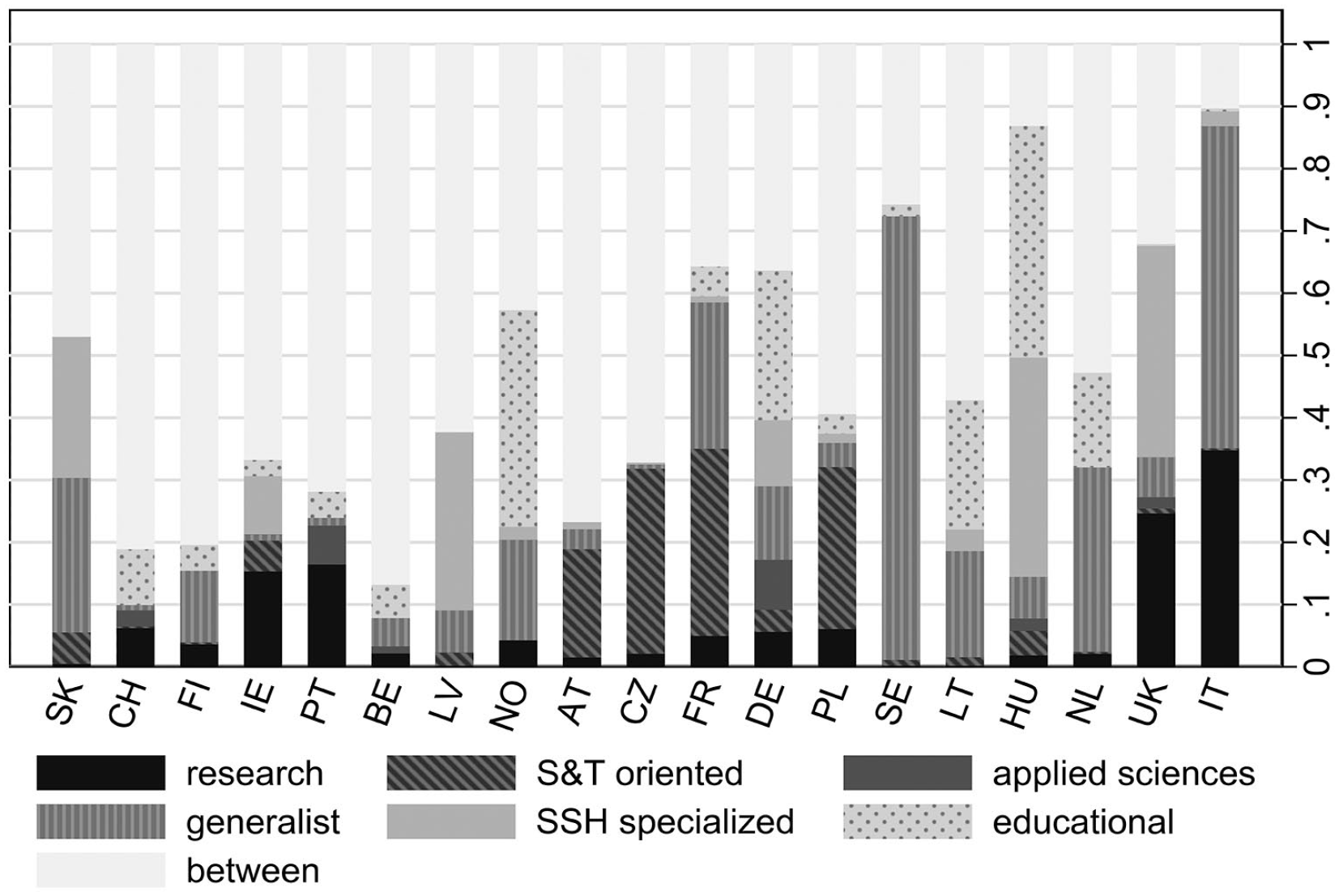
Inequality decomposition (Theil) by the classes of HEIs.
The average contribution of inequality between classes to FS is 53 percent. In total, 11 countries exceed this value, and only three of them (Poland, Lithuania, the Netherlands) do not also have relatively low FS at the same time. Overall, FS tends to be lower in more horizontally differentiated systems, as reflected in revenue gaps between different classes of HEIs. For example, S&T-oriented HEIs in Switzerland (mostly polytechnics) and SSH HEIs (mostly art schools) in Finland are exceptionally well funded. These are clearly cost-intensive and elitist segments, as they enroll only a small proportion of students. However, revenue inequalities within these HEI classes—as well as within other segments enrolling larger numbers of students—are low in these countries.
The flip side of the contribution of between-class inequality is the unequal distribution within more homogeneous classes of HEIs, which tends to be associated with higher FS. However, it is not clear whether there is a systematic pattern in terms of which classes these are. For example, while Germany is an example of each class contributing similarly to FS, Generalist HEIs are the most relevant class in Italy and Sweden. The United Kingdom stands out for the relatively high relevance of the revenue distribution among Research Universities, which receive a large share of total revenues. Inequality within this class is high, implying a steep financial hierarchy. In France and Poland, the distribution of revenue within S&T oriented HEIs is a major contributor to FS.
On average, the distribution within Generalist HEIs contributes the most to country-level FS, followed by Educational, SSH, S&T, Research, and then AS HEIs. Generalist HEIs, which are very heterogeneous in terms of research intensity (Lepori, 2022), have a relatively large average revenue share (23%), and inequality within the class tends to be high. While Research (27%) and S&T-oriented (21%) HEIs also have large (average) revenue shares, they turn out to be relatively equal classes in terms of their revenue distribution. Within-class revenue inequality is highest among SSH HEIs, but can also be high among educational. At first sight, this does not suggest higher inequality within the classes more exposed to competition (i.e. Research, Generalist, and S&T-oriented HEIs). However, aggregation provides a different insight. Table 2 presents Gini indices measuring inequality within different aggregates of classes: in column (1), we pool the three classes with at least some degree of research intensity and medium size, in column (2), we exclude S&T-oriented HEIs as they differ substantially from Research and Generalist HEIs in terms of subject specialization, and in column (3), we aggregate the remaining classes, which make up the group of HEIs much less exposed to competition for funding. In line with Hypothesis 2, revenue inequalities are indeed larger, on average and in 11 out of 19 countries, among HEIs that can be expected to be more involved in competition for research funding and tuition fees.
Gini indices by aggregated classes of HEIs.
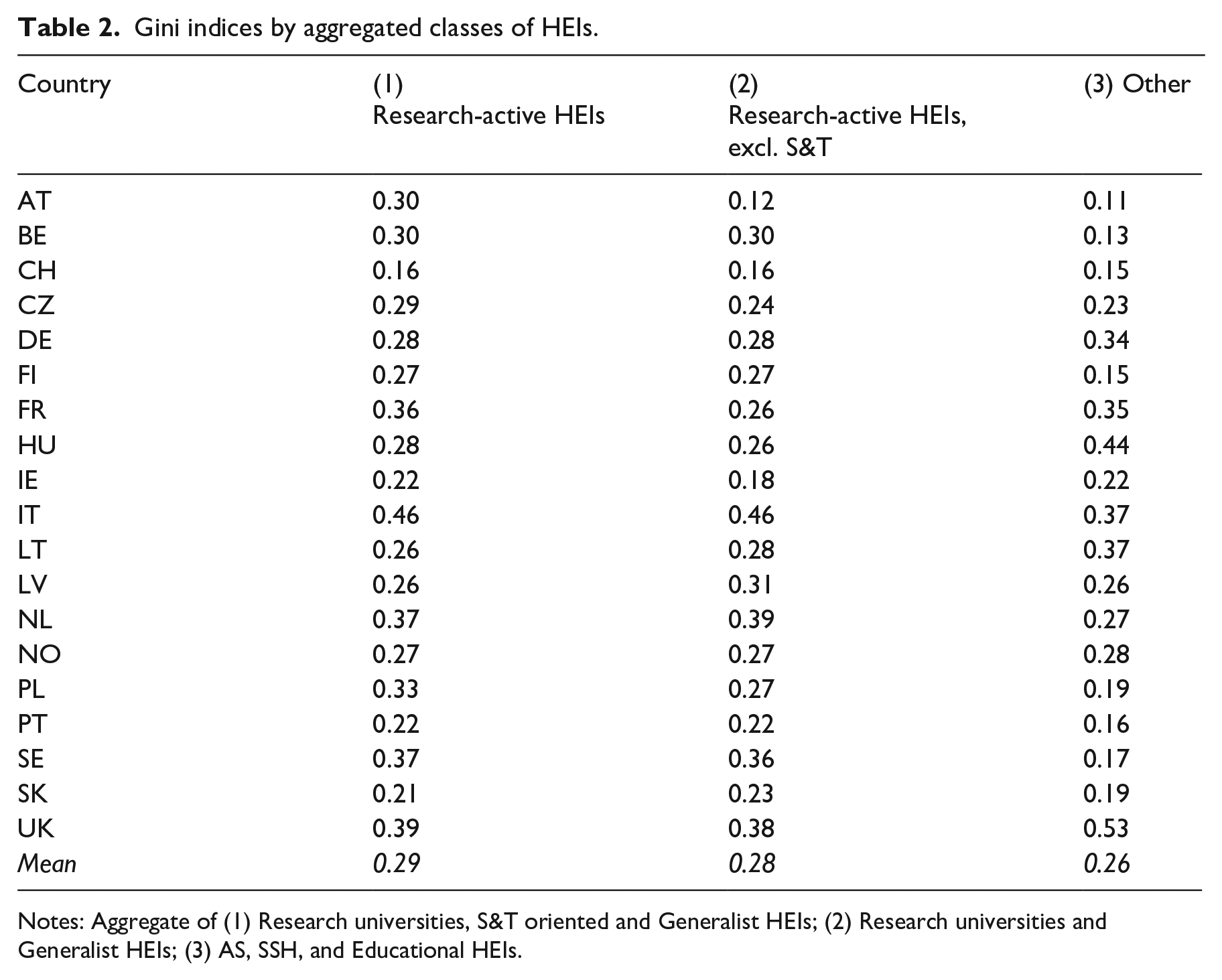
Notes: Aggregate of (1) Research universities, S&T oriented and Generalist HEIs; (2) Research universities and Generalist HEIs; (3) AS, SSH, and Educational HEIs.
Explaining the cross-country differences in FS
Regression analysis offers further insights into the descriptive observations above. We also provide scatterplots of the most important relationships in Figure OS.D1. The dependent variable in Table 3 is the Gini coefficient, which measures FS as reported in Table 1. We test for the relevance of horizontal differentiation by including the relative between-group contribution to FS as obtained from the decomposition by the classes of HEIs (Figure 3; Table OS.C1) as an independent variable in each specification. In line with the descriptive findings in section “The importance of horizontal differentiation for FS,” we consistently find a statistically significant negative relationship between FS and between-class inequality. A one SD (0.23) increase in its relative contribution is associated with a reduction in the Gini coefficient of between 0.05 and 0.03 points, depending on the specification.
Regression results 1—financial stratification.
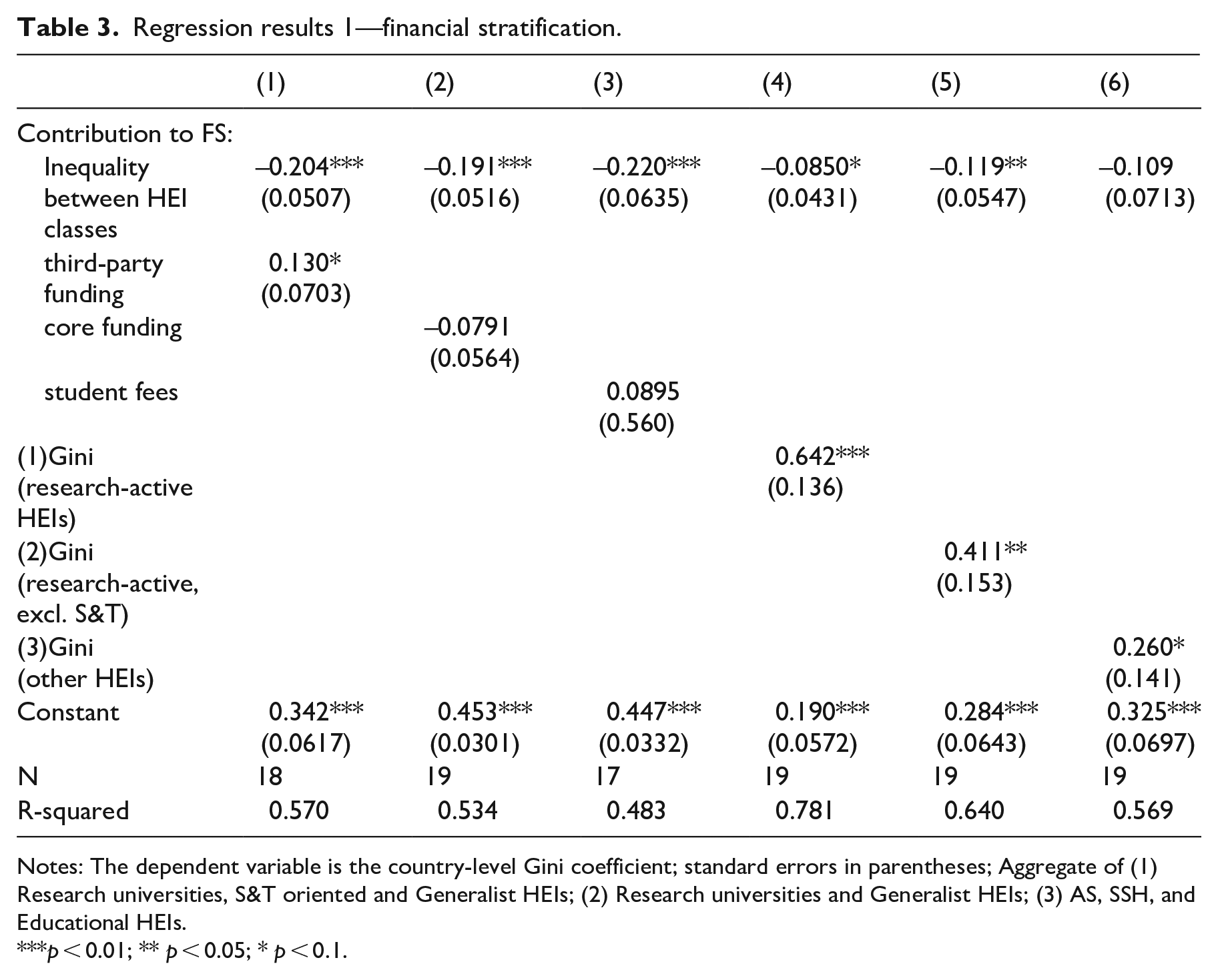
Notes: The dependent variable is the country-level Gini coefficient; standard errors in parentheses; Aggregate of (1) Research universities, S&T oriented and Generalist HEIs; (2) Research universities and Generalist HEIs; (3) AS, SSH, and Educational HEIs.
p < 0.01; ** p < 0.05; * p < 0.1.
In columns (1) to (3), we add the relative contribution of revenue sources (Figure 2; Table OS.B1) to test Hypothesis 1. In addition to being of interest in its own right, controlling for the contribution of inequality between classes ensures that the estimated effect of revenue components is not confounded by cross-country differences in horizontal differentiation. As expected, the relative contribution of competitively allocated third-party funding is positively associated with the level of FS. However, the relationship is only significant at the 10 percent level and is weak: an increase by one SD (17 percentage points) corresponds to an increase in the Gini of 0.02 (6% of the average Gini across all countries). Interestingly, the association between the contribution of core funding and FS is not statistically significant. The same is true for tuition fees, which is not surprising given their minor importance in HE funding in most European countries.
Descriptive evidence suggests that countries with larger contributions from within-class inequality—as the flip side of the between-class contribution—are more financially stratified. To test Hypothesis 3 and to explore whether any particular class(es) of HEIs drive this result, we add the Gini coefficients measuring inequality in the aggregated classes assumed to be more exposed to competition (see Table 2) in columns (4) to (6). 13 We find a positive association between inequality within the combined group of Research, Generalist, and S&T-oriented HEIs and FS at the country level, which is significant at the 1 percent level. A one SD (0.07) increase in inequality among these HEIs increases the overall Gini coefficient by 0.04 points (12% of the average Gini coefficient across countries). The impact is somewhat smaller when excluding S&T-oriented HEIs (column 5), suggesting that the estimated effect is to some extent driven by revenue differentials between HEIs with different subject specialization. However, it is still larger than the estimated effect of inequality within the classes not exposed to competition for third-party funding, which is weaker and only significant at the 10 percent level.
In summary, we found that cross-country differences in FS are related to the relative contribution of third-party funding and to inequalities within those classes of HEIs that are engaged in research, have broader subject portfolios, and are not small. This raises the question of whether these two explanatory factors are related, as might be expected given our finding of an impact of third-party funding on country-level FS. To test this, we use the Gini coefficient, which measures inequality within the combined group of Research, S&T, and Generalist HEIs, as the dependent variable in columns (1) to (3) of Table 4. While a larger contribution of core funding is weakly and negatively related to the Gini, neither third-party funding nor student fees turn out to be relevant. However, as mentioned earlier, subject specialization may confound the estimated effects. Indeed, when we exclude S&T-oriented HEIs in columns (4) to (6), we see that the relative contribution of third-party funding is significant at the 5 percent level and strong: an increase by one SD (0.26) raises the within-group Gini by 0.05 points, which corresponds to 18 percent of the average Gini in this group of HEIs across countries (Table 2). In contrast to the estimates for the whole system, we also find that core funding is relevant for inequality within the group of Research and Generalist HEIs combined, with the estimated effect pointing in the opposite direction to that of third-party funding, and of similar magnitude.
Regression results 2—financial stratification among HEIs exposed to competition.
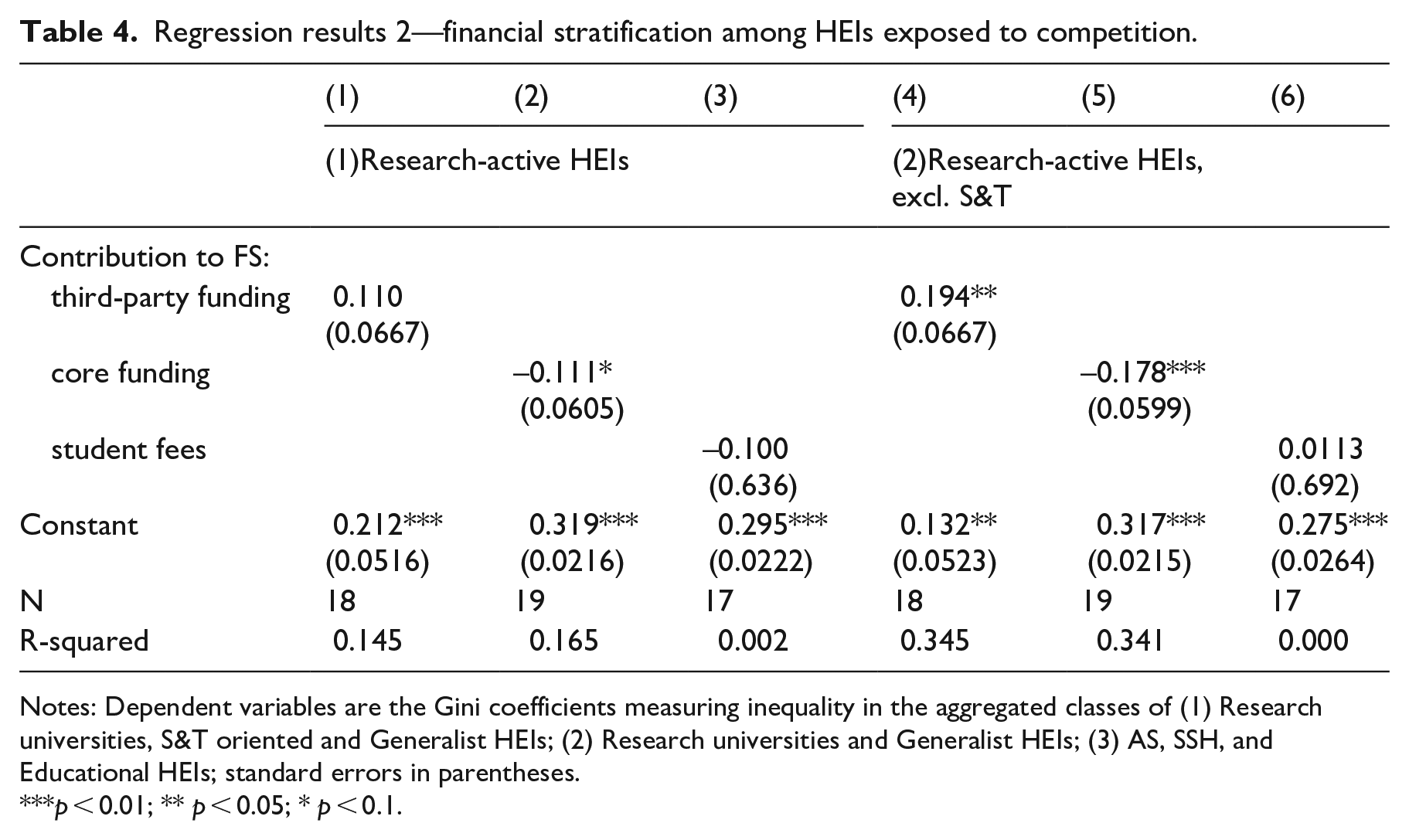
Notes: Dependent variables are the Gini coefficients measuring inequality in the aggregated classes of (1) Research universities, S&T oriented and Generalist HEIs; (2) Research universities and Generalist HEIs; (3) AS, SSH, and Educational HEIs; standard errors in parentheses.
p < 0.01; ** p < 0.05; * p < 0.1.
In seven countries, less than two-thirds of HEIs report information on financial variables (see Table 1 and section “ETER data”). We therefore check how sensitive our findings are to excluding the countries problematic in terms of data quality. The results are presented in the Online Supplement (OS.D.2.). The individual exclusion of Austria, Belgium, the Czech Republic, France, Italy, Poland, and Portugal from the analysis (Tables OS.D.2.2–5) does not change our results concerning the relationships between FS at the system level and the Gini measure of inequality in the research-active (incl. and excl. S&T HEIs) segments, and between the latter and third-party funding. The effect of third-party funding on FS in HE systems as a whole is no longer significant at the 10 percent level when we exclude Belgium, Italy, or Poland, but the effect sizes, standard errors, and R-squares remain relatively stable (Table OS.D.2.1).
Conclusion
Summary and discussion
The purpose of this first empirical study of organizational stratification in the context of European HE was to present cross-country variation in terms of its financial dimension and suggest how it might be explained. We observed considerable differences in the FS of HEIs in 21 European countries. The levels of FS are largely driven by discrepancies between the bottom and top deciles of the revenue distribution. Our main finding is that HE systems that have adopted more competitive mechanisms of resource allocation tend to be more stratified in terms of HE finances. If third-party funding is a relatively important source, revenues tend to be more unequally distributed among HEIs. This is particularly pronounced for research-active HEIs with a general disciplinary profile and, in turn, spills over into higher FS at the country level. Moreover, FS is lower in systems where HEIs are more differentiated in terms of their mission and disciplinary focus. This further highlights the importance of taking into account the horizontal differentiation of HE systems in comparative analyses of organizational stratification.
As hypothesized (H1), we found that FS tends to be higher in countries where it is mainly driven by the distribution of third-party funding. Thus, as institutions become more dependent on third-party funding, the mutual reinforcement of funding and prestige may intensify, leading to greater organizational stratification. The introduction of competitive funding mechanisms is ultimately a political decision. Thus, the cross-country variation in FS should arguably be seen as a consequence of the extent to which HE has been marketized in different countries in response to the expansionary trends.
Tuition fees are of marginal importance for HE finance in Europe. Consequently, we did not find that they contribute significantly to FS. However, it is interesting to note that in some countries, it is the less affluent strata of HEIs that receive more revenue from tuition fees. Some HEIs may be able to compensate for their weaker position in the competition for third-party funding by attracting more students who are willing to pay for their education. However, reliance on tuition fees may also be an indication of the vulnerable position of HEIs (Taylor and Cantwell, 2019).
The distribution of core funding also does not appear to be a relevant factor for cross-country differences in FS. This may be due to the fact that the main purpose of public block grants is to finance teaching and maintain basic research capacity. However, we still found some differences in the contribution of core funding to FS across countries, which could be due to the introduction of a performance-based component in some of them, which—just as third-party funding—is likely to favor well-established and already better-funded HEIs (Zacharewicz et al., 2019). The available data do not allow us to distinguish such components of core funding.
FS is lower in countries where inequality in revenues mainly occurs between classes of HEIs, distinguished by disciplinary profiles, research intensity, and size (Lepori, 2022). Conversely, FS is higher in countries where revenues are unequally distributed within different classes. We argue that this is due to financial inequalities among otherwise similar institutions, which are likely to result from the competitive allocation of funds, allowing upper-tier HEIs to continuously improve their relative position thanks to “Matthew effects” that generate cumulative advantages. HEIs engaged in research are particularly exposed to such forces when they have to compete for third-party funding. More prestigious and wealthier HEIs have an advantage in competing for such funding, because of their symbolic, historically established power, and their ability to attract more successful researchers. Indeed, in line with Hypothesis 2, we have shown that revenue inequality tends to be higher in the aggregated classes of research-active, medium-size universities with broader disciplinary profiles than in other HEIs. Moreover, in accordance with Hypothesis 3, we found the link between third-party funding and FS to be more pronounced in the group of Research universities and Generalist HEIs. Our study provides new evidence on how the theory of cumulative advantage (Bol et al., 2018; DiPrete and Eirich, 2006) applies to the HE setting: competitive mechanisms tend to reproduce, if not exacerbate, inequality because those better positioned are able to prevail.
In many countries, research-active HEIs are not only particularly exposed to competitive pressures but are also the largest in terms of enrollment and total revenue. On one hand, it is hardly possible or efficient to allocate resources to all HEIs for expensive research efforts. On the other hand, there may be equity losses if well-resourced HEIs attract academics who are more likely to succeed in competing for third-party funding and whose research and teaching can contribute to the prestige of the institution. This may affect their HEIs’ relative advantage in terms of educational quality or the labor market value of credentials, with potentially adverse implications for inequality of educational opportunity in the context of social closure at upper-tier universities.
Cases where inequality is high among HEIs with similar specializations and mission profiles are arguably more concerning in terms of social inequality than cases of between-class inequality. A highly stratified system with HEIs catering to different parts of the study population (at different cost levels), might actually be a quite inclusive one. But if FS is high within a given class of HEIs, underprivileged students who succeed against all odds in enrolling, for example, in a research university, may still find themselves in institutions with fewer resources (Lucas, 2001), with consequences for their relative position in the graduate labor market (Triventi et al., 2016). Moreover, particularly in underfunded HE systems, high or increasing resource inequality jeopardizes the quality of teaching at less prestigious HEIs, which negatively affects the range of opportunities available to students from disadvantaged backgrounds, who tend to be overrepresented in the lower tiers (Taylor and Cantwell, 2019).
How consequential FS can be for inequality of educational opportunity depends, as Taylor and Cantwell (2019) show for the US context, on the share of students enrolled in the best-funded institutions. This varies substantially across European countries (see Table 1). While only 6 percent of students in Italy studied in the best-resourced institutions, the share of students enrolled in the top 10 percent is as high as 31 percent in Denmark and 28 percent in Estonia. The case of relatively low-student shares is arguably more concerning, as in this case only a small part of the student population can benefit from the best resourced HEIs. This aspect, which is important for drawing conclusions about the implications of organizational stratification for social inequality, cannot be reflected in comparative assessments based on single country-level indicators such as the Gini coefficient.
Limitations and implications for future research
Problems with data coverage limit the generalizability of our results to the level of HE systems as a whole. The research-active classes, which are the most important for the relationships we are interested in, are well covered in the vast majority of countries, and the sensitivity analysis supports the robustness of our main findings. Nevertheless, future improvements in the quality of financial data in the ETER database would be important to further validate our results. In addition, continuous updates of the database would facilitate the examination of how FS changes over time, and whether this is related to recent policies and broader trends in HE. More complete data on staff and students would allow us to examine the question of the extent to which cross-country differences are a consequence of different national standards for student–staff ratios and specialization in programs requiring smaller classes.
We contribute to comparative sociology by advancing the understanding of FS in European HE as a structural feature, wherein inequalities in student opportunity manifest (Gross and Hadjar, 2020). The presented findings strengthen the case for more research on organizational stratification in HE and its relevance for social outcomes, such as inequality in the graduate labor market or social closure at elite institutions. Our study can support such efforts in making more informed choices about the study design. For example, we have shown that refined classifications of HEIs based on input and output data (Lepori, 2022) can be more revealing with regard to actual institutional hierarchies in complex HE systems than parsimonious, but arguably outdated distinctions such as between universities and colleges of applied sciences (ETER, 2021). Finally, the creation of a comparable indicator of the prestige of HEIs remains a major challenge in comparative research on the causes and consequences of the interrelated dynamics of financial and prestige inequality in European higher education.
Supplemental Material
sj-docx-1-cos-10.1177_00207152241233476 – Supplemental material for The financial dimension of organizational stratification in European higher education
Supplemental material, sj-docx-1-cos-10.1177_00207152241233476 for The financial dimension of organizational stratification in European higher education by Krzysztof Czarnecki and Petra Sauer in International Journal of Comparative Sociology
Footnotes
Acknowledgements
At various stages of development, the authors’ ideas and findings were presented at the ISA RC28 meeting in London (April 2022), the research seminar organized by the Institute for Research on Socio-Economic Inequality, University of Luxembourg (December 2021), and the seminar at the German Center for Higher Education Research and Science Studies, DZHW (February 2022). The authors would like to thank the participants of these events for helpful feedback. Special words of gratitude are owed to Benedetto Lepori for the provision of data, and to Kai Mühleck and Krystian Szadkowski for their suggestions to a later version of the article.
Declaration of conflicting interests
The author(s) declared no potential conflicts of interest with respect to the research, authorship, and/or publication of this article.
Funding
The author(s) disclosed receipt of the following financial support for the research, authorship, and/or publication of this article: We thank the Luxembourg Ministry for Higher Education and Research (MESR) for its generous funding support which has enabled this research to be conducted within the (LIS)2ER initiative to intensify inter-institutional collaboration between LIS and LISER. Moreover, the authors would like to acknowledge the financial support for their research stays at DHZW (Sauer) and LIS (Czarnecki), during which a vital part of this research has been conducted.

Supplemental material
Supplemental material for this article is available online.
Notes
References
Supplementary Material
Please find the following supplemental material available below.
For Open Access articles published under a Creative Commons License, all supplemental material carries the same license as the article it is associated with.
For non-Open Access articles published, all supplemental material carries a non-exclusive license, and permission requests for re-use of supplemental material or any part of supplemental material shall be sent directly to the copyright owner as specified in the copyright notice associated with the article.
