



Abstract
This editors’ introduction into the themed issue of IJCS dedicated to the analysis of comparative survey work on national identity and globalization presents a very brief overview of core hypotheses from the five articles collected in the issue. The articles offer a variety of new, rather differentiated insights into how individual-level national identity attitudes and sibling concepts like belief in national superiority, patriotism, and nationalist chauvinism are related to societal-level variables that tend to vary with exposure to aspects of globalization, such as migrant influx and economic competition. Aside from the focus on those new contributions, the introduction also offers a few observations on the challenges that the wider national identity research field still faces. Given that the field is dealing with several overlapping attitude concepts, this centrally concerns a partial lack of conceptual clarity, which sometimes translates into ambiguous operationalizations and incomplete or imprecise explication of theoretical mechanisms. We conclude that the contributions of the themed issue, with their careful attention to particular aspects of measures and multi-level processes, may serve as another stepping stone for overcoming at least some of those challenges in the future.
Keywords
The present special issue of IJCS on “National Identity, Nationalism, Patriotism, and Globalization” is a sequel to another special issue of this journal that we edited about 5 years ago, under the title “National Identity, Nationalism, and Attitudes Towards Migrants in Comparative Perspective” (Schmidt and Quandt, 2018). For social science researchers, attitudes toward immigrants appear to be a sort of self-evident correlate of national identity and its component concepts nationalism, patriotism, and identification. These components have been subsumed, for example, under the terms “national attachment” as an umbrella concept for the emotional connection and readiness for support to the imagined community of the nation, and “national identification” in the narrower sense of subjectively belonging to said imagined community (Anderson, 1983). In that first special issue, much of the attention of the invited contributions therefore was on the exact mechanisms that connect identity attitudes and anti-immigration attitudes, often including micro-macro links through the contextual level. Another focus was on the application of adequate statistical methods that would allow us to increase our confidence in the substantive results obtained.
With this new special issue, we have now moved the focus toward “globalization,” which is obviously a much wider topic than anti-immigrant attitudes. One reason for that shift of focus was the hope that widening the view to include further substantive correlates implied by globalization might enrich the understanding of the established national identity concepts in themselves even further. But mainly, we reacted to the widespread notion that an increased demand for positive national identification might be a reaction of citizens to seeing their societies under new forms of stress. More specifically, exposure to globalization in its various appearances would supposedly undermine formerly solid conceptions of how one’s society works and what everyone’s position in that society is. The notion here is that national identities were on the rise in a “backlash” reflex, because long-standing social positions were being eroded, which would also be related to the increase of populism and voter support for right-wing parties. Even more recently, going far beyond the rather gradual group identification processes within societies that may correlate with globalization, the Russian invasion of Ukraine and the recent terrorist attack of Hamas on Israel with its potentially ensuing war(s) have brought large-scale violent conflict between nations and nation states back to the agenda. There can be little doubt that such conflicts are the largest boosters to collective identities that one can imagine, primarily for the parties to the conflicts, but indirectly raising the salience of national identity for many noninvolved societies as well. Foundational research is more than challenged by pursuing such developments at the speed in which they are presently unfolding, but one relevant reaction certainly is to move national identity into the role of a dependent or at least moderating variable, whereas in the context of anti-immigrant attitudes, especially nationalism was usually seen as a causal precedent to those.
The contributions delivered in response to our call for papers have indeed provided new insights, both on the understanding of the sub-dimensions of national identity and on their relationships with external concepts. And indeed, several contributions have national attachment in a role as dependent or moderator variable, not at as predictor. Before we give a brief recount of the contributions’ core setups and some results, we take the liberty to present some of our own, selective observations about relevant current trends and issues in the field of national identity research. A more exhaustive overview can be found in Mylonas and Tudor (2021).
Criticisms of established instruments and statistical models measuring national identity
The first of these observations is that the established ways of conceptualizing and measuring national identity and its sibling constructs (e.g. patriotism and nationalism, civic and ethnic understanding of nationhood, national pride …) have long been subject to severe criticism because of terminological vagueness, which, to make things worse, is combined with diverse and sometimes ambiguous operationalizations. If anything, that criticism has become even more pronounced since we reported this for the introduction to the 2018 special issue (see Schmidt and Quandt, 2018, for a list of several review papers making such observations; Mußotter, 2021). Unfortunately, the conclusions to be drawn from these critical observations are far from suggesting a dominant solution. For example, one established pair of terms is that of patriotism versus nationalism (e.g. Blank and Schmidt, 2003). “Patriotism” describes an attachment to one’s own nation that is held without devaluing others, and is often hypothesized to derive from pride in democratic or social achievements of the nation as a social group, and is then juxtaposed to “nationalism,” where a perceived superiority of the own nation over others is at the core, presumably growing out of a need to elevate the self-esteem of national ingroup members (Cichocka and Cislak, 2020). This pair has long been used in a somewhat binary sense, as describing two alternative ways of having a positive attitude to one’s own nation, yet with different normative implications and with different associations with other attitudes and behaviors, and notably, measured by separate sets of questions. Mußotter (2021) and Bitschnau and Mußotter (2024) recount most of the critical aspects of that usage and conclude that this pair of terms is far from binary and clear, but they do not suggest stable solutions yet. Mußotter (2023) very recently proposed one modification of the established measurement “tool set” that separates nationalism, patriotism, and democratic patriotism as a further component, and where she also drops the previously used items and references to the term “pride” that had proven particularly problematic (Meitinger, 2018). Furthermore, she now uses items formerly used to measure identification for the operationalization of patriotism, which is a substantive shift. She found a stable three-factor solution, but the revised instrument still has to undergo further testing in additional representative samples. A last issue concerning measurement is the validity and cross-cultural invariance of the items to measure nationalism, patriotism, and national identity. In the last 20 years, survey methodologists have introduced and proposed the use of cognitive interviews besides normal pretests to test the understandability of the items by the respondents (Beatty and Willis, 2007). Meitinger (2018) and Meitinger et al. (2023) showed the relevance of this approach employing items of the International Social Survey Programme (ISSP) national identity module and demonstrated the problems of validity of these items which were not detected by normal pretests and statistical procedures like factor analysis.
Another, quite different, issue relating both to measurement and the adequate statistical tools has received a good degree of attention: Bonikowski and DiMaggio (2016) proposed an inductive modeling strategy that they employed over an extensive set of items, which elsewhere are usually assigned to separate national identity components. Their argument is that all these components constitute a larger syndrome anyway, where the components are not meaningfully and consistently cognitively separated in the respondents’ minds. So, technically, the components would not represent conceptual “dimensions” that could be reproduced in the data with a variable-centered approach as most prior applications pursue it by employing factor analyses (Muthen, 2002; Muthén and Muthén, 2000). According to Bonikowski and DiMaggio (2016), statistical modeling should allow for inductive perspectives and can, at best, hope to empirically identify typical patterns in how different groups of respondents think about the questions. This leads them to apply latent class analysis (LCA) as a person-centered, typological approach. By that, they produce a classification (of US American) respondents into five types, for which they demonstrate some plausible associations with a set of external criteria. However, a reanalysis conducted by Eger and Hjerm (2022) has shown that the LCA in Bonikowski and DiMaggio (2016) was incorrectly conducted and that their conclusions must be considered to be more or less arbitrary. It appears that there is no solution strategy in sight that would allow us to distill a statistically viable classification from the available data with so many, closely related items while not making prior theoretical assumptions about their composition and relations (Finch and Bronk, 2011). Several, relatively recent, works therefore attempt to reconcile the dimensional approaches of statistical analysis with the notion that patriotism, nationalism, and national identity form a contingent “attitude syndrome.” A theoretical analysis discussing the relation between the ethnic–civic distinction and the nationalism–patriotism distinction and their possible connections can be found in Piwoni and Mußotter (2023). An empirical test with a structural equation model employing ISSP data was done by Raijman et al. (2008).
The role of intensity and salience of national identity
In an alternative line of thought, Kasianenko (2022) has proposed to put various identity components into a common framework. She uses a theoretically informed ordering of the components from “weak” to “strong,” thereby making the implied degree of intensity of nationalistic feelings the common core dimension. She then tentatively validates this ordering through a Mokken scale analysis on data from several Eastern European countries. How this proposal stands up to closer scrutiny and in other applications remains to be seen, especially with Mokken scaling creating the least strictly defined and only ordinal type of multi-item scales.
The notion of ordering national identity concepts by the degree of “intensity” instead of by the established multi-dimensional distinctions appears in other recent work, too: May (2023) uses LCA to analyze a very large set of survey samples from many countries and from three time points in regard to the “ethnic” versus “civic” framing of national belonging. Like Kasianenko, May uses a theoretically defined subset of national identity-related items; in her case, those that are traditionally used to measure the ethnic and civic dimensions of national identity. Her approach in using LCA allows for both country–time specific and general classification aspects to play out in the results. She finds that, empirically, there is no clear distinction between ethnic and civic types of reasoning about nationhood in a large majority of countries when the concepts are measured and analyzed at the respondent level. Rather, there is a consistently recurring exclusionary type of respondents who use all available criteria to reject any kind of otherness in the nation, prominently including the traditional ethnic reasoning but also any civic criteria that allow exclusion of others, whereas at the less exclusionary end, there is a more diffuse mixture of reasoning patterns, with few respondents reaching universal degrees of full “civicness,” or showing no exclusionary thinking at all. There are distributional differences in the types across countries that are well interpretable at face value, and that are in line with the established understanding that national identity framings are extremely contingent on national settings anyway, but those will require careful further investigation and theoretical underpinning to fully validate the results. In summary, it seems that we know quite well how to describe strong and chauvinist nationalists in simple terms – they are strongly devaluing and rejecting outgroups, and that also appears to be what constitutes their commonality across cultures. However, we still struggle much more to arrive at a consistent concept (or multiple concepts) and operationalizations of how the more moderate forms of national identification such as political and cultural patriotism or the boundary framings of civic and ethnic types can be defined, understood, and measured in comparative ways.
The results reported above lead us to a second, connected observation: Both the ordering of the components of the attachment type from weak to strong and of the framing type from inclusive to exclusive have the commonality that the pole with high intensity (of attachment and exclusionism) is conceptually easily defined and can empirically be rather well determined, whereas the opposite, nonintense poles are defined mostly by the absence of attachment or exclusionism. There is not much positive, unequivocal empirical representation of that absence outside the nonaffirmation of attachment or exclusionism. Heinrich (2020) even asserts that on theoretical grounds alone, conceptions of national identity are inherently connected to the rejection of others, but not to positive definitions of who belongs to the ingroup. We would like to add yet another perspective to this, which is on one hand quite obvious, but on the other hand tends to be not mentioned very much in national identity research: National identity is not the only game in town as far as collective identities are concerned, and its individual-level salience must not be taken for granted. Evidence for this comes from a variety of directions, beginning with work on the relationships of national and European or cosmopolitan identities (e.g. Aichholzer et al., 2021; Bayram, 2019; Guglielmi and Vezzoni, 2016; Hadler et al., 2012), which overall finds that national and multinational identities can either positively reinforce each other, or neutrally coexist, or compete and crowd each other out. The specific outcome is not arbitrary, but contingent on a lot of different determinants and contexts. Furthermore, there are also collective identities without any relation to the geographical, historical, and political delineations of a nation that might have equivalent or higher salience to the individuals. While we are not aware of studies that systematically assess the relative salience of different potential collective identification objects, it seems plausible that, for example, religion, or even lifestyle and consumption preferences (Strizhakova and Coulter, 2019) could offer similarly salient identification anchors for many. That would not only be substantively relevant but would also have implications for how well questionnaires can measure national identity dispositions: It could easily be that for respondents with a low cognitive and emotional salience of national identity, it is difficult to give consistent answers to sometimes long-winded item batteries or to potentially vague single items. Instead of reporting attitudes clearly on the “nonnationalist” side (and should respondents with low salience of national identification be there at all?), they might then end up giving, for example, an inconsistent set of center-of-the-range responses that are basically nonattitudes (Zaller and Feldman, 1992) and might be explained by the satisficing approach (Krosnick et al., 1996; Roßmann, 2017). If on top of the well-known context dependency, lack of salience is a real problem in measuring nonextreme national identities, neither conceptual clarifications nor improved question instruments are likely to achieve reliable measures that work for the complete population, especially not in comparative settings.
Increasing prominence of national identity across social science subfields
The third observation is that, despite the challenges of achieving satisfactory measures laid out in the previous paragraph, the concept of national identity has in recent years actually become somewhat popular in quantitative research (Mußotter, 2021), even outside political science, political sociology, and political psychology, where much of the earlier work originated. Within political science, the topical focus has been extended to also include populism as a close correlate of varieties of national identity (see, for example, Bonikowski et al., 2019; Filsinger et al., 2021), where a close and almost natural, but still not universal, proximity of right-wing populist and chauvinist nationalist attitudes is the dominant observation, with the more “civic” versions of national identity often having the opposite associations with right-wing populism. But one of the most interesting recent examples comes from research on the COVID-19 pandemic. In that context, a positive national identity has been used to predict support for anti-COVID-19 measures, such as contact restrictions or vaccination campaigns (Chen et al., 2022), but interestingly, also as a criterion variable for a successful social recovery after the collective trauma of the pandemic experiences (Ellena et al., 2021).
Incidentally, this resonates well with the notion that increased national identity is subjectively sought for in the presence of external threats to previously held certainties, thus closing the circle to the initial notion behind the call for papers for the present special issue.
Overview of the papers
The core aspects of the contributions to this issue are presented in Table 1.
Overview of the contributions and their analytical focus.
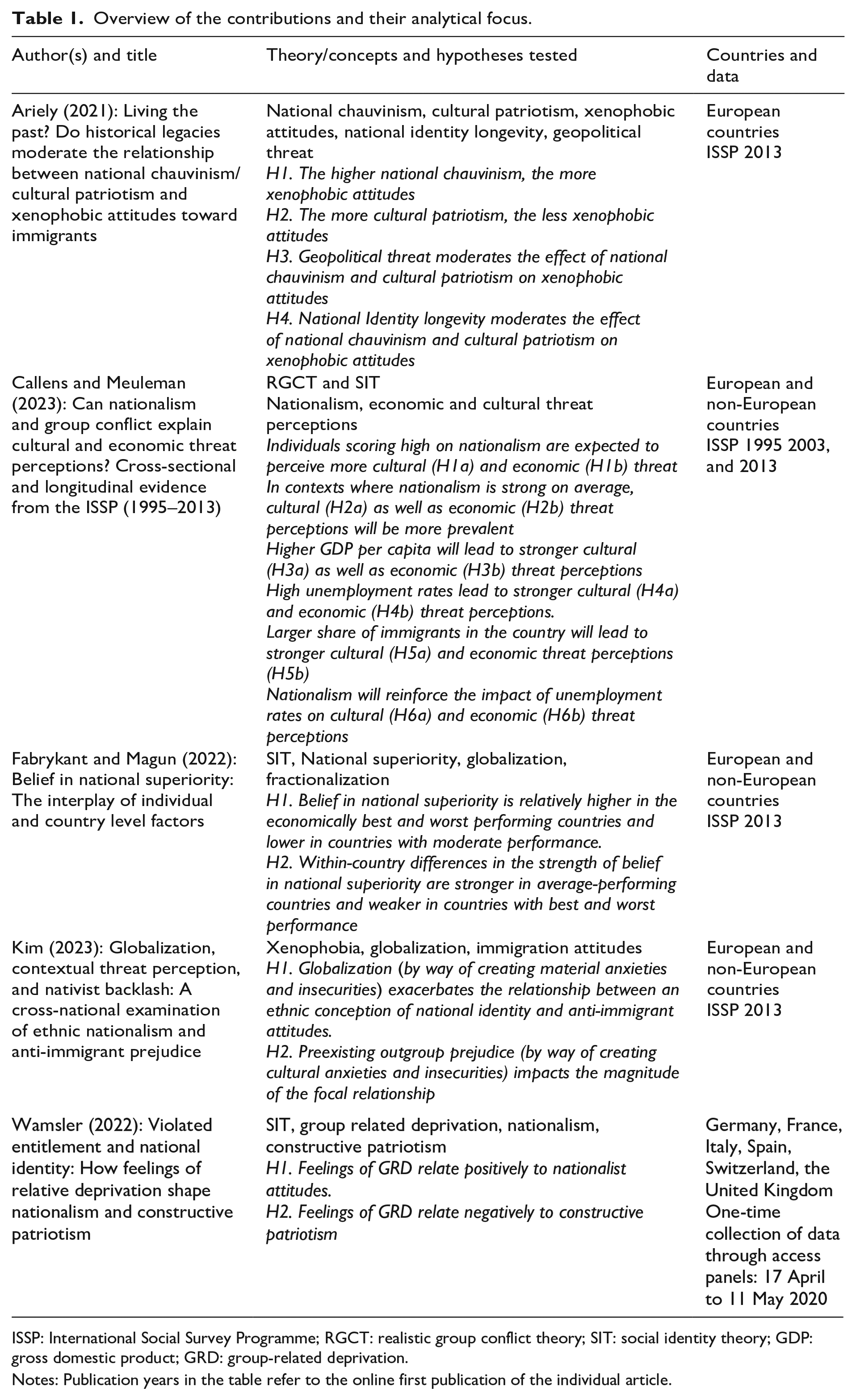
ISSP: International Social Survey Programme; RGCT: realistic group conflict theory; SIT: social identity theory; GDP: gross domestic product; GRD: group-related deprivation.
Notes: Publication years in the table refer to the online first publication of the individual article.
The contributions have clearly taken up the call’s broad notion of “identities in societies under stress” in a variety of analytical approaches, but all share the commonality of analyzing comparative survey data from recent decades. Seen in combination, the collected contributions walk us along various links of a potential explanatory chain between societal level conditions, and again, xenophobia as the dependent variable positioned farthest to the “right” in a path diagram. Central conditions of interest at the societal level are, for example, a society’s exposure to globalization (Kim, 2023), the societal level of wealth (Fabrykant and Magun, 2022), or historical trajectories toward building the nation (Ariely, 2021). The studies then investigate the effects of those conditions on belief in national superiority (Fabrykant and Magun, 2022) or on xenophobia (Ariely, 2021; Kim, this issue) at the individual level, and mostly find at least partial confirmation of their hypotheses: Countries with shorter histories of their national identity tend to have more chauvinist and xenophobic reactions to perceived threat, and exposure to globalization tends to increase xenophobia, net of other factors.
The explanatory pathways which the various studies investigate do vary in the specific hypotheses that they aim to test, but most of them in some way refer to the same framework of social psychological group identification mechanisms (social identity theory, Huddy et al., 2001; Tajfel and Turner, 1986). A core element in several of the contributions, as a dependent variable of forms of national attachment (Callens and Meuleman, 2023) and as a predictor of xenophobia (Kim, 2023), are subjective threat perceptions in relation to economic and cultural changes (especially those connected to migration), which is a common line of reasoning of the extant literature in the field. While this is not at the core of those two contributions, they confirm prior findings that chauvinist nationalism and civic or cultural patriotism, with proper statistical controls, have opposed relationships with variables such as threat perception or xenophobia. Much less common are the foci chosen by Wamsler (2022), who looks at group-level relative deprivation (employing a direct measurement of such feelings of deprivation!) as a psychological driver behind chauvinist nationalist sentiments, and by Fabrykant and Magun (2022), who look at the relationship of national wealth and belief in national superiority. The findings of both contributions clearly point to (in particular, chauvinist) nationalism acting as psychological compensator for perceived disadvantages. This mechanism has always been one of the possible interpretations under the association patterns postulated by social identity theory. But it might give the applications that pursue the line of reasoning through group threat theory a particular twist: If nations are socially constructed, “imagined” groups, as Anderson (1983) asserted, then the perceived external threat does not only operate in relation to preexisting group identities, it also has a part in defining and creating, or at least further entrenching, identities for the group members that believe to be the target of the perceived threat. This “constructivist” effect feeds back to results that, for example, Kim (2023) finds from his multilevel analysis, when he reports that it is more the cultural aspect of globalization that predicts xenophobia than the economic aspect, and to Callens and Meuleman (2023) with their results on longevity of national identity that we interpret to mean that the more recently established and thus probably culturally, cognitively, and emotionally less stable-nationalities are more likely to fall into xenophobic reaction patterns.
An outlook beyond the current special issue
This brief overview of some insights from the contributions to the present issue in our view also points to further research challenges that may not have received sufficient attention yet, but that would invite further work in the field to continue examining what the contributions collected here have developed. A first challenge is of theoretical nature, and consists in mapping out a more complete conceptual network of the forms of attachment such as nationalism, civic and cultural patriotism, national pride, ethnic/civic framings, and competing identities, to continue the work we have mentioned earlier. Furthermore, the picture of how those components relate to their already identified predictors (such as globalization processes or historical preconditions) and consequences (such as group crystallization and xenophobia) has been enriched by the work in the current issue, but is still not complete. The identification of further such external relationships might also help in clarifying some of the criticized ambiguities in the concepts and their operationalizations. One important challenge related to this would be to work out more precisely the mechanisms by which the national-level conditions interoperate with micro-level attributes (Gërxhani et al., 2022). To give one example, despite formulating some hypotheses about such mechanisms, the contributions in the current issue have mostly not yet directly tested how, in terms of the sociological and psychological mechanisms, the societal-level conditions such as globalization or migrant numbers transfer to individual-level attitudes. More concretely, to what degree is it a sort of automatic human reaction to respond to information about migrant influx with increased anxiety and with a reflex to enhance one’s own group identity by attributions of superiority? That kind of interpretation would in fact be compatible with the relative deprivation mechanism articulated by Wamsler (2022) in his contribution, if that were taken as a singular driver (we stress that Wamsler makes no claim whatsoever to have given an exhaustive description of the mechanisms by pointing to relative deprivation). Or should we follow the line of reasoning that, for example, Kim (2023) offers in his theoretical introduction, by which the conscious framing of public discourses by political actors or the media with negative attributions to immigrants provides a necessary condition for such reactions to arise, in analogy to what Hadler and Flesken (2018) have found for the link between political rhetoric and ethnic or civic conceptions of nationhood? That kind of theoretical explication and its empirical implementation would also require bringing in even more measures and more types of data, for example, about the cognitions of respondents, about the communication of political elites, and about why and when political actors find it attractive to increase the salience of national identities.
We sincerely hope that the two special issues—the first in 2018 and this one in 2024—stimulate further such research into improving the conceptualization and measurement of the different facets of national identity on the individual level, into the incorporation of contextual societal factors and the underlying social mechanisms like collective history, and into combining them in adequate analytical models.
Our special thanks go to the contributors of this special issue: Gal Ariely, Marie Callens, Marharyta Fabrykant, Harris Hyun-soo Kim, Vladimir Magun, Bart Meuleman, and Steffen Wamsler, who were willing to accept several rounds of revisions, often with more than two reviewers. We also want to wholeheartedly thank the reviewers, who invested much time and energy into constructive and detailed reviews. Furthermore, we want to thank the IJCS’s editors, David Smith and Phillip Hough, for their continuous support of this project, their time and patience, and the excellent cooperation over the whole period of publication of both special issues. Also, we want to thank Lisa Trierweiler for her excellent editing of the introduction. Finally, we want to thank our student assistants, Celine Hudak and Jasmin Schickel, for their work in editing and formatting this introduction.
Footnotes
Correction (May 2024):
Article updated online; for further details please see the Article Note at the end of the article.
Funding
The author(s) received no financial support for the research, authorship, and/or publication of this article.

Article Note
The following updates were made to this article:
The text “national pride” has been replaced as "belief in national superiority" in abstract, keywords and “Overview of the papers” section.
In the “Overview of the papers” section, the sentence “The studies then investigate the effects of those conditions on national pride (Fabrykant and Magun, 2022) or on xenophobia (Ariely, 2021; Kim, this issue) at the individual level, and mostly find at least partial confirmation of their hypotheses: National pride is highest for low-income individuals in mid-income countries; countries with shorter histories of their national identity tend to have more chauvinist and xenophobic reactions to perceived threat, and exposure to globalization tends to increase xenophobia, net of other factors.” has been updated to “Countries with shorter histories of their national identity tend to have more chauvinist and xenophobic reactions to perceived threat, and exposure to globalization tends to increase xenophobia, net of other factors.”.