




Abstract
This article investigates how climate activists engage in building trust in public debates and local political conflicts over green transition. The article applies the empirically grounded concept of “climate translators” to study the challenges of intermediary trust-building by both independent climate activists and institutionally embedded activists who aim to stimulate climate policy change at the local level. In Denmark, municipalities endorse activists as climate translators to promote civic participation and deliberation. In Germany, activists have developed more conflict-oriented translation models based on direct-democratic campaigns and advocacy work outside institutions. We discuss these varied strategies of trust-building as they emerged in different contexts.
Keywords
Introduction
For scholars who study the significance of trust in democratic processes of participation, conflict and decision-making, the climate crisis, and the accompanying processes of green transition present some urgent political questions. The climate crisis will entail significant transformations of many aspects of life in late-modern societies. This will happen both through efforts to mitigate carbon emissions and through more or less forced adaptions to the adverse effects of a changing climate. These changes are likely to generate both winners and losers—or, at least, feelings of upheaval and loss among many people and communities, some of whom may attempt to resist transition in various ways (Forchtner, 2020). In parallel, however, there are growing numbers of people who feel that the green transition is moving far too slowly and who engage in different kinds of climate activism to increase the pace of change. Increasing polarization puts state institutions under pressure to innovate and establish new ways of maintaining civic trust in democratic decision-making. Consequently, there is a need for research on how European societies can make decisions on and implement the green transition, and adapt to climate change in democratically acceptable ways. This not only pertains to the macro or state level, but also to regional, municipal, and neighborhood levels, where intermediation processes between individual citizens and civil society, on one hand, and state authorities on the other hand, are manifested in a variety of ways.
The central contribution that our study seeks to make is to explore empirically the translational, intermediary dynamics of trust-building in (conflictual) interactions between movements and the state. In doing so, we focus in particular on grassroots democratic organizers and climate activists who intermediate and translate politically between the state and citizens. In the literature on democratic innovation in social movements, scholars have drawn attention to the work of activists who build interpersonal bridges of trust across different groups through deliberative and participatory processes and translational practices (Doerr, 2018; Felicetti, 2016; Fernandez, 2020; Stevenson and Dryzek, 2014; Wood, 2012). Here we define “translation” by drawing on Doerr’s (2018) conceptual focus on the “critical third” intermediary position, and focus on the institutional translating work of activists who advocate movement claims toward state actors in the context of participatory and deliberative democracy. Doerr (2018) studied how local global justice activists in Europe and the United States brokered democratic conflicts on local environmental politics and other issues by intervening as “political translators” in participatory or deliberative democratic assemblies involving elected city council members, bureaucrats, and economic interest groups. In this article, we leverage Doerr’s (2018) work to explore “climate translation” as a set of grassroots democratic practices that aim to broker relationships of mutual trust through dialogue and co-creation involving climate activists and municipal officials. Drawing on the literature on insider–outsider activists and organizational brokers in social movement studies (Abers, 2019; Diani, 2003; Tarrow, 2005) and research on democratic innovation (Doerr, 2018), we use the term climate translation as an encompassing category to capture how activists advocate toward municipalities to persuade local decision-makers to promote climate-friendly or green transition policies. As will be shown in our empirical analysis, translation is also an empirically grounded term that climate activists use in describing their work of brokerage, negotiation, and discursive interaction with local political institutions.
Our research aims to investigate the “critical third party” position of these “climate translators” based on their self-perception of conflict dynamics of political and social trust in interaction between the broader climate movement and the state. We build on previous cross-national comparative research on dynamics of trust in conflict, showing how public debates on policy change may foster greater mutual understanding between civil society and state authorities, or deepen mistrust and pre-existing ideological divisions between different parts of society and regional and national state authorities (Wolff, 2022). We also consider the limits and the complexity of translation processes as part of participatory dialogue, which may in fact involve complexity, failure, and conflict (Konopásek et al., 2018). Several sociologists of social movements have studied dynamics of trust, highlighting the contentious dynamics of participation, emotions, and conflict within deliberative politics and public discourse broadly defined (Dryzek et al., 2003; Polletta, 2016; Rossi, 2023). In contribution to previous valuable studies on democracy and trust (e.g. Kołczyńska, 2020), here, we do not claim to measure generalized political trust in institutions (see also Rossi, 2023). Moreover, as a somewhat restricted contribution to empirical research on trust in the specific context of discursive dynamics of conflict within public debate as such (Wolff, 2022; see also Polletta, 2006), our case study is particularly interested in and restricted to understanding place-specific dynamics of conflict intermediation that attempt to build trust in green transition within varying political contexts of public debate.
We assume that trust-building in democratic institutions can occur through conflict, contention and open expression of political opposition through public protest (Deitelhoff and Thiel, 2014; McAdam et al., 2001). In conceptualizing trust, we assume that conflict and differences of opinion are the backbone of democratic trust-building through movements (Wolff, 2022). Moreover, as sociologists and empirically oriented democratic theorists, we assume that trust is constructed strategically in the process of contentious politics and public debate, relying both on moral and cognitively styled, as well as an embedded, emotional dimension and involving complex emotion work within political discourse (Jasper, 2018; Rossi, 2023). Accordingly, trust is dialogically constructed and discursively destroyed creatively within the political process of public deliberation, negotiation, and contentious politics.
We suggest that state actors’ search for citizen support and trust in democratically legitimate green transition processes creates opportunities for environmental activists to act in various ways as “climate translators.” We assume that climate translators need a minimum level of political trust to collaborate with local state authorities toward green transition. Thus, in this article, we examine how such climate translators perceive issues of trust and distrust in interaction between citizens, civil society, and local public authorities, and how they strategically mediate between these actors to foster institutional trust advancing citizens’ participation in green transition policy.
By way of disclaimer, note that here we do not aim to study empirically state actors’ trust in civil society. Moreover, we shall show empirically how climate translators can create or enhance trustful relationships between climate activists and political institutions by translating between and across different institutional political and cultural ideological contexts and lifeworlds.
Moreover, several US-based social movement scholars and political sociologists have provided important work on the institutionalization of movements (Amenta, 2003; Banaszak, 2010), from which we take insights for understanding the cross-national differences of state inclusion of social movements, which is more contentious in our German case studies compared with those of Denmark, as will be shown (Meyer, 1993). Stephen Epstein’s (1995) work on AIDS activism shows how medical institutions played an important part in establishing relationships of trust between state actors and social movements where grassroots medical science knowledge provided activists with an important tactic. This work is valuable for our research, where science for climate activists represents a device for mobilization, institutionalization, and implementation, as well as in terms of the dynamic between institutional insiders and extra-institutional tactics used by activists. Rather than studying dynamics of movements working toward institutionalization (Amenta, 2003), our theoretical contribution is interested in brokerage work (Diani, 2003) in the very process of ongoing conflicting interactions within political deliberation broadly defined as public discourse (Polletta, 2006, 2016; Wolff, 2022). This theoretically driven research interest in studying trust within ongoing public debates is inspired by a discursive sociology of participation (Polletta, 2006) and the new Frankfurt school of social and political theorists studying dynamics of “trust built or destroyed within public discourse” (Deitelhoff and Thiel, 2014; Forst, 2022; Wolff, 2022).
Our discursive sociological perspective on trust-building within public discourse (Polletta, 2006) is inspired by sociologists and democratic theorists interested in trust dynamics built and destroyed creatively within contentious public debate and deliberative politics broadly defined as public discourse (Polletta, 2016; Wolff, 2022). We assume that activists rely on a broad, contentious strategic repertoire of public pressure (Rossi, 2022), which combines conflictual forms of public protest with dialogically styled forms of advocacy, and deliberative and participatory democracy and co-creation (Felicetti, 2022; Polletta, 2016).
With a distinct focus on one particular dimension of trust dynamics in the (limited) context of public debates (Wolff, 2022), our contribution is distinct from previous work by Williams (2023) on trust and political opportunity structures, and by Kołczyńska (2020) on democratic values, education as related to political trust, taking a broader perspective. Moreover, previous studies have shown that contentious campaigns and public conflict have the (dialogical) potential to increase trust of ordinary citizens in advancing new policies through the broad public deliberative process mobilized around a referendum campaign, which increases citizen information about demands and goals of climate movements and policy makers (Della Porta et al., 2017). Providing a cross-national comparative perspective interested in dynamics of trust in conflictual interactions, we will discuss how, in Germany, it is only through more contentious repertoires of activism like direct-democratic referendum campaigns that political elites are compelled to listen to citizen voices; in Denmark, however, institutionally embedded climate translation practices enhance the political inclusion of climate activists in a context shaped by an overall supportive institutional environment for climate activism. Here, as a result of a carefully prepared contentious process of public deliberation organized by independent climate translators operating outside institutions, mutual understanding between representatives and citizens grows, through both pressure and persuasion.
To build our argument on trust-building through intermediation and conflict translation, we proceed as follows. First, we situate our research, providing further background to the politics of green transition in a (northern) European context, and we outline what we consider to be the relevant state-of-the art research in the literature on social movements and trust in relation to the green transition. We then briefly characterize the political-cultural and institutional contexts of our two national settings and how they impinge on the practices and self-perceptions of climate translators. Following this, we outline our methodological approach and provide an overview of our interview data and the field work we have conducted at local digital citizen forums in Denmark and Germany. The substantive empirical contribution of the article is an exploration of the perceived challenges and conflict-relational strategies of trust-building based on interviews with climate translators. In the theoretical perspective of the Special Issue, we show how the climate translators in all of our case studies initiate by building interpersonal relationships of political trust through dialogue, yet some strategically adapt their repertoire to form more contentious trust relationships, where their attempts at mediating horizontal interpersonal relationships of trust fail (cf. Introduction Special Issue). Based on our empirical case studies, we discuss the climate translation practices in relation to political trust-building in green transition politics.
Background: the European green deal, the climate movement and the need for trust
In 2019, the European Union (EU) Commission presented the “European Green Deal,” in which the member states agreed to make Europe the first climate-neutral continent by 2050. In particular, the Green Deal aims to ensure a socially just transitional policy and is now also enshrined in the European Climate Law, which was passed in 2021. While we can observe that the growing bottom-up pressure from civil society and the climate movement has been complemented by mounting top–down political ambitions from the EU level, the actual implementation of the Green Deal still presents giant political and economic transformation challenges across Europe. Such transformational challenges pertain both to the technical transition as well as the public acceptance and legitimacy of the oncoming changes. These pressures make it attractive—at least in principle—for liberal democratic state institutions to cooperate in various ways with climate movement groups to ensure public support for the transition strategies (Cassegård et al., 2017; De Moor et al., 2021; De Moor and Wahlström, 2019). Trust research shows that deep ecological and societal reforms require high levels of trust between citizens and institutions, particularly regarding trade-offs and policy decisions that imply democratic conflict as a result of opposing interests (Warren, 2018; Wolff, 2022). Country-case studies show how a broad variety of grassroots climate justice groups and non-governmental organizations (NGOs) engage with public authorities—ranging from the municipal to the nation-state level—to perform as brokers or intermediaries of organized citizen empowerment (Payne and Hart, 2020). Civic efforts to engage in intermediating and building trust from the bottom up toward the implementation of green transition have become manifest in, for example, local democracy projects and participatory governance, or by organizing direct-democratic referendum campaigns and deliberative mini-publics, as well as mediating local conflicts on green transition. As mentioned in the “Introduction” section, we suggest conceptualizing some of these intermediary efforts to build trust through different modes of civic engagement as “climate translation.”
Research on the European climate movement has focused primarily on its attempts to influence state policies “from the outside” through a repertoire of protest and contention (for a review, see De Moor et al., 2021). This valuable body of research, we contend, has paid insufficient attention to the disruptive relational dynamics of trust in democratic processes. Trust is built, destroyed, and rebuilt in communicative political processes and, besides contentious confrontation, activists also engage in negotiation, dialogue, and intermediation with the state, which requires various degrees of trust in the political process (McAdam et al., 2002; Weipert-Fenner et al, in press). We aim to fill the gap in the relational dynamics of trust in conflict by drawing on theories of brokerage, translation, intermediation, and insider–outsider activism in contentious politics taking place within public discourse (Abers, 2019; Polletta, 2006; see also Banaszak, 2010; Diani, 2003; Doerr, 2018).
Empirically, we focus on climate activists negotiating (conflictual) interactions with the state to advance solutions for green transition politics locally. In particular, we focus on how such collaborative efforts are critically dependent on translational practices, establishing and maintaining some degree of trust between civil society broadly defined and state actors. We will include in our empirical analysis the fact that some of the institutionally embedded civil society climate translators campaigning for climate justice are paid by municipalities, which raises the question of political power of insider activists within the state (Abers, 2019). Based on our analysis of the self-understanding and empirical practices of these political actors, we investigate the different ways in which climate justice activists are intertwined with municipal institutions.
Through our investigation we uncovered that, while climate translators arguably perform what we consider functionally equivalent tasks in Denmark and Germany, respectively, they do so in different political-cultural and institutional settings. The Danish government has taken upon itself the task of implementing the EU Green Deal and making its country climate-neutral within less than a decade. Other newly elected governments with similar policy goals, like Germany, face polarization, radicalization, and contestation of progressive green transition strategies from right-wing populist parties and climate-denialist movements. We contend that this comparative perspective adds valuable nuance to our understanding of climate translation, while we are, of course, aware that our analysis is intimately tied to those specific contexts.
Climate translation—inside or outside the state?
In our study, we follow Abers’ understanding of activism as extending to activism within state bureaucracies as part of broad repertoires of strategies of movements, which include contentious and dialogically styled intermediation strategies (cf. Rossi, 2022). Moreover, climate translators can be “intermediaries or brokers” in various ways, either as publicly endorsed civil society consultants or as more independent brokers connecting different civic groups outside institutions (Diani, 2003). While we do not distinguish categorically between neutral bureaucrats and political activists, we selected case studies empirically in a way to allow us analyze the differences between climate translators who are embedded within the state, in comparison with those independent climate translators who work outside institutions for civil society groups, NGOs, and social movements. In particular, we will investigate empirically the relational quality of trust-building depending on the positionality of various climate translators vis-à-vis state institutions and bureaucracies. Thus, we consciously selected case studies in which the activists we studied are either (1) “insiders” embedded in local political institutions, or (2) independent activists working for civil society groups. In varying case studies, we examined independent groups of grassroots activists who serve as advocates of citizen voices, or politically engaged “climate translators”: civic intermediaries who see their engagement with municipalities as situated and coming from within a broader grassroots democratic movement for climate justice.
Scholars have explored how bureaucrats can act as “activist bureaucrats” (Rich, 2013), “inside” or “insider” activists (Banaszak, 2010; Olsson, 2009), and “institutional activists” (Abers, 2019; Pettinicchio, 2012). In focusing on policy translation between social movements and the state, we follow Abers’ (2019) definition of (climate) activism as extending to activism within state bureaucracies. Moreover, environmental movements have long histories of “institutional activism,” as activists taking jobs within government and bureaucracies “with the purpose to propose the political agendas or projects proposed by social movements” (Abers and Tatagiba, 2015: 73).
Given our research focus on local democratic innovation through social movements (Della Porta, 2020), we conceive of trust as a quality of social relationships between groups and individuals and institutional actors, which is built over time through repetitive discursive interaction. This trust may be either “horizontal,” between different civil society actors and their allies, or “vertical,” between civil society actors and representatives of the state (Introduction, Special Issue). In Europe, several quantitative studies show that climate justice street protesters such as Fridays for Future share high levels of horizontal trust in climate science. They thus seek cooperative alliances with critical experts to push governments to implement policy goals and “listening to sciences” in order to tackle climate emergency (della Porta and Portos, 2023; De Moor et al., 2021). However, we contend that the existing literature on trust within the climate movement has paid insufficient attention to the relational dynamics of intermediating trust between the movement and the state and its representatives.
Our relational perspective focuses on how such intermediated relations of trust depend critically on institutionally embedded environmentalist bureaucrats (Abers, 2019) or environmentalist movement leaders outside institutions (Diani, 2003). These may assume positions as intermediary brokers (Diani, 2003; Tarrow, 2005) or, in the context of participatory democratic negotiations with policy makers, operate as independent or institutionally embedded political translators advocating citizen access, transparency, and inclusion (Doerr, 2018).
Relational dynamics of climate translation and third-party power position
In focusing on the tensions between movements and the state and the politics of climate translation, we are especially interested in how climate translators bridge the gap between municipal policy ideas and citizens’ ideas and demands toward green transition, communicating across boundaries of ideology, status or other cultural and institutional barriers (Diani, 2003: 107; Fernandez and Gould, 1994; Gould and Fernandez, 1989). The climate activists in the cases we studied were third-party actors with “double identities,” 1 intermediating between the state and civil society. Hence, we have devoted a sizable share of our research efforts to conceptualizing and investigating the perceived opportunities, conflicts, and impediments to building horizontal, grassroots democratic trust among different local actors toward green transition. Given that in some local conflict scenarios trust is also “lost” by climate translators in attempting to build horizontal, interpersonal bridges, we also investigate how climate translators cope with hostile actors, and how they choose to combine dialogue and more contentious strategies in order to stir conflict with city officials intending to advance direct-democratic referendum campaigns toward more extensive green transition policy locally.
Climate translation in different politico-cultural contexts
In this section, we briefly outline the most significant contextual differences. Denmark—from the perspective of contentious politics interested in trust-building through public participation and democratic innovations—reflects a case in point for an open, accepting, and discursive opportunity structure for environmentalist movements (Soneryd and Wettergren, 2017). The country designates itself as a global frontrunner in climate change adaptation and explicitly aims to become a role model and a scene of social experimentation. This pertains not only to the development and implementation of climate-friendly technological solutions, but also to social innovations, such as new modes of public engagement (Burck et al., 2020), which is articulated, for instance, in the Danish government’s “Climate Plan” in the following passages: The Government is of the opinion that Denmark must inspire transformation by leading the way . . . We must demonstrate that it is possible to implement a green transition that supports growth and welfare. And we must develop the green technological solutions the world needs. (Regeringens Klimaplan, 2020: 4, author’s translation)
2
The passage is explicit about Denmark’s “ambitious” pathway to transition (Regeringens Klimaplan, 2020: 4), which implemented several high-stakes state-sponsored democratic participation and civic engagement projects at regional, local, and national levels during the period of our analysis (2019–2021). The consensus-based institutionally embedded approach toward citizen deliberation in Denmark is reflected, furthermore, in how the Danish government organized an official citizen climate assembly modeled as a deliberative “mini-public” to consult citizens on its green transition strategy in a “consensus”-oriented mode (Tønder, 2020). Following the model of the government’s climate assembly, a dozen Danish municipalities in the period of analysis actively pushed for citizen engagement, participation, and citizen deliberation on climate-friendly local policy, initiating their own local deliberative mini-publics and climate citizen assemblies.
In comparison, Germany reflects a more contentious and somewhat closed discursive political opportunity context for social movements that are interested in mediating and translating citizen dialogue with institutions toward green transition policy. Merkel’s government arguably provoked a radicalization of climate justice protests through its inactivity or ambivalence toward green transition (Haunss and Sommer, 2020). In addition, the German government has not created a climate citizen assembly or any comparable means of public engagement. German civil society organizations in 2020 initiated a national climate citizen assembly to deliberate on implementing the aims of the Paris Agreement. However, the assembly had only a limited and symbolic role given its lack of governmental support. Meanwhile, the Ministry for Transport pushed through contested legislation for building over a hundred new highways, leading to mass protests in several states; the Ministry of Energy implemented the continued exploitation of coal mines; and state governments led by the Christian Democratic Union, in coalition with the Greens or SPD, advanced large state projects and heavy infrastructure measures to support highways, as well as the oil, gas, and car industries.
Another conflict-generating issue in the German political context is the lack of trust and the unwillingness of German state officials to enter into dialogue with civil society, as a result of economic interests and conflicts of interest, in that government actors are closely entangled with car and energy companies opposed to green transition and the concerns of climate and environmentalist movements (Haunss and Sommer, 2020). Historically, Germany’s cultural and political context of contentious public debates on climate change reflects a long-term contentious national political context since the 1960s and 1970s, based on violent clashes between the state and a social movement advancing environmental concerns (Haunss and Sommer, 2020). In the context of growing citizen distrust toward state officials, the demonstrations of climate justice activists and the Fridays for Future mobilizations have triggered increased awareness of the legitimacy of the need for green transition and social trust in the movement during the government’s brutal repression of mass climate protests in their attempts to prevent the construction of new highways or extraction of coal in several German states (Haunss and Sommer, 2020).
As a consequence of these politico-cultural differences rooted in various national histories of consensus-oriented or contentious politics in the fields of energy and transportation, we note that independent climate translators in our case studies in Germany were third-party social movement actors operating outside the state, while in Denmark, embedded climate translators were “insider activists” employed full-time or on a temporary basis as consultants by the state (Abers, 2019). Based on our comparative empirical interest in understanding how trust is built and destroyed in conflicts about climate change, we aim to investigate how trust can be built in conflicts about green transition through the intermediary work of independent or embedded climate translators, who use their interpersonal networks and their social movement experiences in consensus-building and conflict mobilization to build trust toward green transition in organizing democratic innovation and local civic engagement.
Data and methods
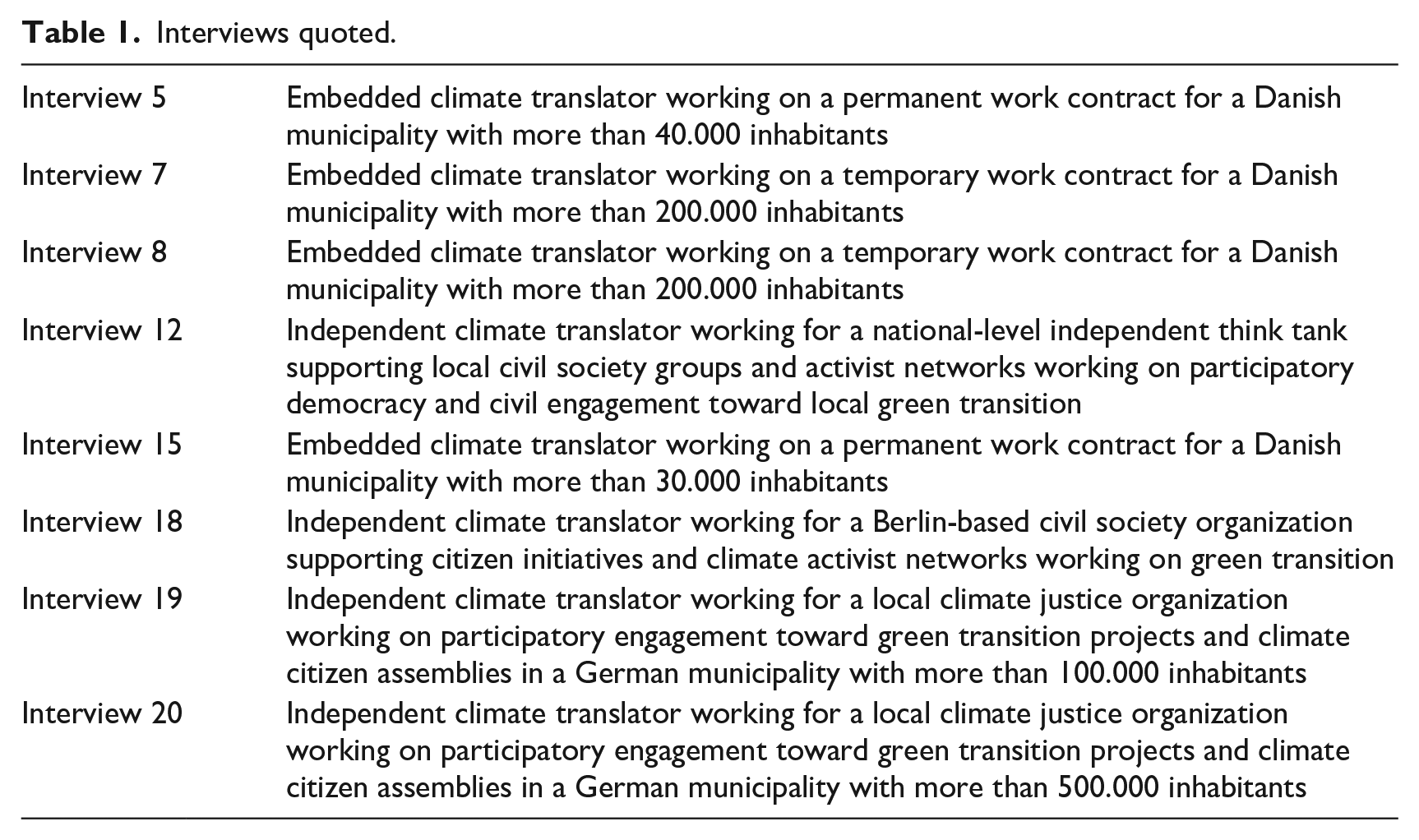
Our conceptual and empirical reflections on the climate “translation work” of social movements in advancing local democratic innovations are based on fieldwork and 20 semi-structured qualitative interviews with climate activists in Denmark and Germany. Among the sample, 10 interviewees were German and 10 Danish climate activists. All interviewees engaged closely in local political negotiation with municipalities regarding strategies of green transition. The majority (12 interviewees) worked independently within civil society organizations, while six (all based in Denmark) worked for municipalities, either self-employed or based on temporary employment contracts. Interviews were conducted in English and German, with most of interviewees fluent in English as a second language.
For our fieldwork and our interviews, we theoretically selected eight municipalities as “best cases” for providing lively local democratic debates involving climate activists and civic groups in local decision-making about green transition. Based on initial expert interviews with climate activists and scholars working on democratic innovation and green transition (e.g. Hoff and Strobel, 2013), we selected four Danish and four German municipalities, which included four larger industrial and post-industrial or capital cities with over 200,000 inhabitants (including Berlin and Copenhagen), as well as four smaller rural or post-industrial municipalities in different regions (Sealand and Jutland for Denmark, and East and West Germany).
We are aware of the limitations of our data collection and sample size, which makes it hard to generalize our findings, because of its small size. The selection of interviews reflects our theoretical interest, as previously described, in local “best cases” of municipalities where climate activists engaged in a continuous, long-term attempt to build bridges and cooperate with local political institutions to find local political solutions for the issue of green transition. This was a restricted number of cases for each country, given the political challenges of building sustainable state-movement cooperation across time in a more or less contentious political discourse on climate justice in the European Union (De Moor et al., 2021).
Given our theoretical interest in various relationships of trust, our selection of smaller and larger cities allowed us to introduce more comparative situations, where we expected larger cities to present more anonymous trust relationships than cities with fewer inhabitants. While it would have been interesting to focus also on trust-building at the national level, we had to restrict our analysis to the local level, where our case studies complement valuable previous single-country case studies by providing a cross-national comparative perspective. To recruit additional interviewees and acquire more background information on practices of cooperation in our selected cases, we carried out a total of 30 hours of digital participant observation, participating in social movement or municipally organized events (Zoom meetings, online conferences) in the local cases to study the debating of local green transition strategies. Our observational data collection was useful from the perspective of triangulation (Curato and Doerr, 2022); it allowed us, as analysts, to situate the impressions gained through our expert interviews in the broader discursive perspective of socially embedded political discourse with varying participants and organizers of citizen participation in the form of climate citizen assemblies, as well at direct-democratic referendum campaigns.
Based on our comparative case study research design, the semi-structured interviews with the selected 20 climate translators helped us, through interpretive analysis, to analyze and condense what we consider to be some “ideal-typical” differences in the context-specific local practices of climate translation across the two national contexts. The sample of selected interviews presented here is based on our theoretical interest in distinguishing between (1) institutionally embedded, and (2) independently organized climate translators. Obviously, our interviews also exhibit notable variation within each national context. Most importantly, all interviews in Germany worked outside the state and outside political institutions for independent NGOs and civic groups; all interviews in Denmark were institutionally embedded in the sense of temporary or permanent employment contracts or consultancy work for municipalities. Operationalizing the research question based on our interest in the perceived challenges, opportunities, and strategies of intermediating trust toward green transition, we considered whether climate translators were institutionally embedded or working independently in their interaction with the local municipalities and civic associations, as well as the level of conflict and mode of contention in the settings where climate translation takes place.
Findings based on our case studies
Denmark: institutionally embedded climate translation
In Denmark, a vanguard of a dozen smaller and larger cities, including Aarhus and Copenhagen, have hired locally networked environmental activists as civil society advisors in recent years to accompany and communicate their climate and transport transition policies. We find that institutionally embedded climate translators have used their insider position within municipalities to reverse, implicitly or explicitly, hierarchies between bureaucracies and to facilitate information and citizen access in local public debates and policy implementation toward green transition. We find that in their institutionally embedded and officially sponsored position, however, they did so by avoiding taking an explicit, protest-oriented activist position. Moreover, embedded climate translators used their mediation skills and contacts with both civil society and municipal actors to build horizontal, interpersonal trust across boundaries of formal status and bureaucratic hierarchies. In their self-perception, climate translation is based on careful listening and intermediating consensus or compromise that promotes climate-friendly policy in situations where polarization and hardened lines of conflict blocked such policy within the “normal” political process. One such actor, Carsten Christiansen,
3
is a community-based environmental activist with 30 years of experience in the Danish environmental movement. He is now a permanent “official climate ambassador” in a small town near Copenhagen. As he explains in the interview, Christiansen sees his job as open translation work, building relationships of mutual trust by brokering consensus between different political parties and citizens with varying “conservative” or progressive ideas and affinities: I consider myself as a mediator or a translator, you might say. I try to listen, to understand. Then I try to advise both citizens and politicians interested in green transition about what can be done. For example, we sent an application about tiny houses . . . this will appeal to a lot of green people who want a green lifestyle or alternatives. Yet it may seem a little hippie-like to conservatives, who may think this implies they don’t pay a lot of taxes and in the municipalities and they might think it isn’t completely legal. There are a lot of regulations and my job is then to make ends meet. A concrete example is that we build these tiny houses in an open process, it’s completely transparent, anybody can apply for these tiny houses. Then I shift to arguing that there is actually a study showing that tiny houses will brand Koege as a green city and, in order to get the right people in, I try to include the local parties. If I get the funding, it’s another argument . . . as a comment before everything started, the mayor actually said that she wanted something about tiny houses and permaculture and a school forest in there, so that already sets a horizon.
4
Importantly, in this quote, the Danish climate activist, working in close cooperation with a local mayor in his municipality, perceived his position as that of a “mediator or translator,” negotiating consensus toward green transition on behalf of what institutional decision-makers wanted. The quote also reflects an institutional power relationship as, in a way, this embedded climate translator restricted his own capacity for fostering progressive consensus solutions toward green transition policy by listening to what the mayor had “set as a horizon.” At the same time, the mediation position endorsed by the municipality gave this consensus-broker the leverage and the creative potential to negotiate with conservative and liberal cities and different political parties with the aim of connecting decision-makers and citizens with climate activists in Denmark, actively helping social movements to shape the implementation of European climate goals at the local level.
Embedded climate translators’ critical third power position with limited impact
Another finding from our interviews is that institutionally embedded climate translators (through their work for municipalities) perceived that they had developed a distinct “third” positionality between institutions and civil society organizations. For research on trust-building through social movement intermediaries, this critical third positionality, linked to an in-between mediation position of climate translators between state and citizens, is interesting. All of the local climate translators we interviewed in Denmark report both the critical influence of their work on city administration and politics, and the translation difficulties that arise. This is how a climate activist in her mid-20s talks about her work as a temporary climate mediator in a large Danish city: I always feel torn between different worlds. Now I earn money with my work and I do the same as before [as a volunteer climate justice activist for an environmental organization]. In my new role at the municipality, I still find it hard to communicate to my boss why exactly we need a green transition strategy so urgently. It’s as if I need to speak different languages in mediating dialogue between the municipality and citizens. And our role is then to translate different ways of thinking and also about challenging images, regarding the ways in which my colleagues (at the municipality) imagine citizens, for example. If they know what citizens are missing, they just to need to give them the right instruction. It’s also about different narratives. People are very consumption-oriented and the municipalities are more technically oriented. That means it is sometimes hard to translate.
5
Despite her criticism of the “technical” narratives and mindsets of urban politicians and administrators, the interviewee is aware of her own limited influence as an embedded climate translator, “translating different ways of thinking” and challenging officials’ stereotypes about ordinary citizens.
Embedded climate translators did not lose their ideology or their commitment to the climate movement, despite assuming a distinct intermediary position between the movement and the state. Note that trust-building for climate activists cooperating with Danish municipalities was, first of all, a critical political task of translation where these embedded activists helped local bureaucrats understand “why we need green transition so urgently.” At the same time, the critical third positionality lies in the task of embedded climate translators, paid by local authorities to monitor the implementation of local plans for climate neutrality by politicians and administrators, to ensure that input from citizens is taken seriously. For example, climate translators supported civil society associations in organizing municipal citizen climate assemblies as deliberative mini-publics. They also monitored the implementation of the ideas put forward by citizens at these events for local politics in line with the European Green Deal. A climate translator from Jutland reports in an interview: In principle, the municipality is open to people from outside, and yet the climate plan was a little lacking in transparency. At our municipal climate assembly people deliver input, then they all post their ideas, but what actually happens with their input? The actual debating process and the political decision-making process [occurs] after the citizen assembly [. . .] That’s why it’s good that there is someone who takes care that this is not being decided behind closed doors. That’s our role. My colleague and I see ourselves as mediators.
6
With regard to external political opportunities facilitating the work of climate translators of building trust across a wide range of actors, including the private sector, all interviewees in Denmark perceived the electoral victory of a new government in 2019 as a favorable opportunity for climate-friendly policy change. However, according to interviewees, while government change created new discursive opportunities, it did not necessarily increase opportunities for state funding for a climate justice policy. Here is what a climate translator in a medium-sized town near Copenhagen said, The Danish government’s embracing of climate-friendly policy is extremely important. I haven’t seen a lot of money coming in our direction yet, but there is a discourse shift with the new government. It has never been easier to talk about politics than now. A lot of people understand it’s not fun and it will cost a lot of money . . . It’s not the government, it’s the big foundations who provide money toward enhancing green transition.
7
Even if it is shown here that state funding in Denmark could still be expanded, it can be said that Danish cities actively support institutionally integrated climate translation work. The activists employed by individual municipalities as consultants, for a limited or unlimited period, saw their critical political power of translation between the city and the citizens as inspiring democratic mediation work, promoting transparency, participation, and citizen access. Trust-building for climate activists working together with municipalities in Denmark’s consensus-oriented political context entailed the fostering of communicative understanding (1) between officials and citizens, and (2) across different ideologies and political party lines.
Germany: independent climate translators in contentious arenas
In comparing Denmark and Germany, the first noticeable finding is that Germany has lower overall funding budgets for urban climate policy because of the structural budget allocation of these policies to the national level (Sturm, 2018). The scope for action of German local politicians in terms of climate policy is therefore less than that of their Danish colleagues. Unlike Denmark, civil society climate translators in Germany, therefore, were not institutionally employed or supported by municipalities, but worked and acted independently in non-profit associations or environmental organizations that supported local climate activists with their expertise.
A climate translator from an independent civil society organization, who works for climate movements in West and East Germany, also points out this structural disadvantage, and how it leads to insufficient contact and connections between citizens, stakeholders, and institutions: One problem is that, due to national legislation, cities have very little creative political agency [. . .] in the budget of larger German cities there is not so much financial leverage. That’s why our role is to convince, to find out, what local civil society groups want [. . .] There are different cultures, one really has to intervene as mediator, what’s at stake is really translation. For example, very few of the people who consult us regarding local energy transition have previously talked to the CEO of their local public energy company.
8
As in Denmark, this extract from an interview with a professional staff member working for an independent NGO shows that climate translation in Germany is understood as mediation work aimed at dialogue between “different cultures,” between civil society groups, parties and elected decision-makers debating green transition strategies for the local level. Unlike their neighbor to the north, however, local climate translation in Germany usually means unpaid civil society work in a conflict-ridden political environment with few government funding opportunities.
We argue that the intermediation of trust was not only blocked because of the structural lack of funding for climate policy at the local level, since climate activists in Germany also lacked pre-existing experience of building networks of institutional collaboration with public or private energy companies and municipalities. Compared with Denmark, another notable finding from our interviews is the perceived absence of relationships of trust between German climate activists and municipalities in debating green transition strategies for ideological conflicts. In larger and smaller cities, our interviewees (all of whom work for independent climate justice groups or NGOs) report deep ideological rifts and “religious struggles” between civil society, political parties, and local administrations over questions of implementing climate neutrality or green transition. In an environment with a lack of institutional funding and willingness to compromise, independent, local civil society climate translators learn to convey proposals from citizens for climate, energy, and transport transition policies only behind closed doors. As reported by a climate activist from a large industrial city in Hesse, who has been active for 20 years in West Germany: You need the right feel for what you say and what you don’t say. With radical groups, I need to avoid particular framings. When talking to political parties, I also need to strategically avoid immediately mentioning contentious issues. We also cannot express our solidarity with more radical forms of protest. Regarding the climate goals of our city, we have created a systematic catalogue of political claims, but we don’t communicate it with the outside, especially not with politicians. We are credible cooperation partners for politicians, which also means that it is extremely important for us to be taken seriously as a political actor. [. . .] After all, we are volunteers, not professionals.
9
Our findings confirm, as in the case of Denmark, the critical third positionality of mediators for those climate activists among our interviewees in Germany, who mediate and negotiate in a distinct critical third position between citizens and municipalities, even though they are not paid. Moreover, our interviewees in Germany distanced themselves from more “radical” climate activists. They did so, apparently, as a way to build trust with institutional politicians who actively distrust climate justice activists and the more “radical” parts of the movement (“We are credible cooperation partners for politicians” . . . “We need to be taken seriously”).
At the same time, all of the independent climate translators in Germany reflect on the reluctance of municipalities to implement Green Deal policies and engage in dialogue with civil society. The majority of the interviewees reported learning processes in dealing with a culture of distrust in political institutions, like this civil society climate translator from a large German city: Because of my long-term civil society engagement and also because of my job as a social scientist, I am often like a bridge between people, but my knowledge is not only used positively in our city. Two years ago, the mayor called to meet with me. It was a good conversation, but then I was blocked by politicians. Suddenly, the phone line was constantly engaged and then a leader of one of the administrative departments at our municipalities in charge called me, and she was outraged about me developing ideas regarding climate politics directly with the mayor. First, I apologized to her, then I took a deep breath and I asked her why she was yelling at me. Then we were on an equal footing again. Meanwhile, I got a better understanding of how internal political conflicts intervene in climate politics.
10
Instead of quickly building “bridges” between citizens and municipal decision-makers, as in Denmark, the climate translators active in Germany often had the experience that they have to adjust their political persuasion work to an institutionalized culture of distrust in a political environment burdened by administration and party politics. After their attempts to mediate with the city administration or broker consensus and mutual understanding between civil society, climate activists, and citizen representatives failed, in the cities we examined. Climate movements often chose direct democratic tools, such as the so-called climate citizen referendum, introduced in dozens of German cities. 11
Strategic adaptation: translation in contentious political contexts: referendum campaigns
As they see it, independent climate translators in Germany adapted their initial open intermediation attempts at building horizontal, interpersonal trust through consensus-oriented dialogue and cooperation with the municipality following repeated failure because of resistance from local politicians or city administrations. Shifting to the strategy of contentious public participation, they chose direct-democratic referendum campaigns, which opened up the possibility of involving citizens in long-term political dialogue on climate policy issues.
In terms of patterns of trust-building, this means a strategic adaptation toward a contentious way of building citizen trust in abstract, generalized democratic procedures (direct-democratic referendum), rather than horizontal dialogue with institutions. Contentious referendum campaigns are a strategy for climate activists to promote proposals for green transition locally, asking a city council to directly consider political claims by citizens expressed in a referendum campaign on the issue of green transition (cf. Della Porta et al., 2017). In terms of political context, note that climate referendum campaigns in Germany require local politicians to be open to political dialogue and communicative trust-building with civil society, as there are rules and regulations set by the federal state on how referendums can be used. In addition to the required signatures, several federal states are also setting up legal barriers to holding referendums. Trust is built during direct-democratic referendum campaigns, when local climate activists exchange ideas with experts for direct-democratic referendum campaigns, collect signatures from citizens and ultimately enter into conversation with local administration and politics. This is how one employee of the Association for Citizens’ Action for Climate Protection describes it: The great thing about referendums is that they are helpful for things that the city council does NOT want. It’s about conflicts of interest. The city council and many cities already have prepared climate plans, but they are shelved. The exciting thing about a referendum [campaign] is that civil society needs to convince many people outside of the green bubble, otherwise one doesn’t reach the necessary number of signatures. Furthermore, the cooperation of the city is required, as the city will have to implement it. This still doesn’t mean that it is actually being implemented once it’s been passed. That’s why negotiations with the city council are always important. I would describe it as a charming interplay between consensus and conflict culture, since the pressure [through signatures] is necessary so that negotiations [with local politicians] get started [. . .] This is oftentimes a translation process.
12
For social movements and climate activists in Germany, climate referendum campaigns that promote local proposals toward green transition goals offer an alternative to consensus-oriented dialogue between citizens and politicians when decision-makers in a local context do not strive for a dialogue with civil society groups or citizens. Trust-building through referendum campaigns on climate politics in Germany involve the work of contentious political translation, which combines persuasion with “conflict culture”; in the cases we studied, referendums were used by climate translators only after the continuous failure of previous attempts at consensus-oriented dialogue with local politicians and administrators on the issue of green transition. Nonetheless, further interviews suggest that referendums provide social movements with a robust means of effecting political dialogue by combining contentious referendum campaigning with negotiation at several layers of administration and politicians, thus opening up opportunities for long-term translation work. By campaigning for several years, climate translators could often achieve rethinking on the part of city politicians. According to one climate translator, The climate plan is often nothing but a piece of paper, while a referendum campaign leading to a direct democratic climate referendum is always binding. [. . .] The success of these direct democratic climate referendums cannot be measured directly. But the coal energy plant in Kassel will be shut down five years earlier than planned following the local climate referendum campaign, and Mannheim now, after all, is not going to start a gas energy plant, which certainly has something to do with the local citizen climate referendum campaign, but the exact causal impact [of climate referendums] is hard to measure. An energy plant was also shut down in Hamburg.
13
Our findings on local “climate translators” in Germany show, in comparison with Denmark, how social movements can also work outside institutions to actively build trust for the implementation of green transition and climate goals locally. Public campaigns are often followed by long-term mediation work in a “charming interplay” between consensus-oriented dialogue with institutions, and conflict-oriented direct-democratic means, featured in the broad repertoire of critical political translation.
In sum, our German case studies have shown how, for climate translators, a lack of funding and local collaborative connections between climate civil society groups and institutions implied that building horizontal bridges for dialogue on green transition was structurally difficult. While German climate translators tried to build a direct, dialogue-oriented, interpersonal trust relationship like their colleagues in Denmark, they ended up choosing more contentious strategies of trust-building. We assume that by looking for a grassroots base of citizens who support a referendum toward green transition, they engaged in building a contentious trust relationship, trying to build a constituency, an abstract group of citizens that would allow them to build political trust toward green transition through a referendum.
Conclusion
This article focuses on the discursive construction of trust and distrust through local democratic innovation and public debate mobilized in the field of social movements working on climate change. In doing so, the article empirically examined the intermediatory work of independent climate activists and institutionally embedded climate translators who advance green transition processes and citizen access locally, through their interaction with the state. While our Danish case studies showed the horizontal construction of interpersonal networks of trust in an open, dialogue-oriented process of participation and climate assemblies, our German case studies document the destruction of interpersonal trust in conflict. While it would have been interesting to trace empirically the building of interpersonal relationships of trust through participant observation and more interview data, our findings here focused uniquely on the self-perception of climate translators and their strategic adaptation to the local context and political opportunities for intermediating trust in conflicts about green transition.
Interviews quoted.
The theoretical contribution of our article has been to think conceptually about how activists’ politically engaged practices of translation and intermediation build political trust, in both consensus-oriented and contentious political contexts. In selecting various cases, with more friendly and hostile political opportunity structures, we could show how climate translators adapt their strategic repertoire of intermediation in setting up dialogically styled climate citizen assemblies (as in our Danish case studies) or direct-democratic climate referendum campaigns (as in our German case studies). In both Denmark and Germany, the activists whom we termed “climate translators” aimed to build interpersonal relationships of trust; when this grassroots democratic attempt toward green transition failed, German climate translators shifted to a more contentious strategic repertoire, combining direct-democratic pressure (climate referendums) with advocacy toward citizens and municipalities. German climate translators used what Edwin Amenta (1998) may term an extra-institutional “assertive” tactic as a vehicle for trust-building and mobilization. To be sure, our findings, based on expert interviews, indicate that climate translators in Germany did not use referendums instrumentally, but as a pedagogical tool for grassroots democratic education in a particularly contentious process of public debate on the climate (Della Porta et al., 2017; De Moor et al., 2021).
Much work on democracy and deliberation in movements has investigated “leaderless democracy” or neutral deliberative facilitators, but institutionally embedded climate translators take advantage of their insider position within municipalities to use a variety of contentious strategies for progressive political work. Our empirical comparison discussed the relevance of deep-seated local political conflicts, ideological disagreement, and distrust as impediments for the building of interpersonal trust relationships through grassroots civic engagement. Climate justice activists who organize direct-democratic referendums or initiate deliberative and participatory mini-publics on green transition in Denmark and Germany are not elected and yet they have a critical third positionality and (limited) leverage as critical, political agenda setters and trust-builders, connecting citizens to local representatives and state bureaucrats. A key contribution of our article to research on political trust built in conflicts about green transition is to highlight the emotional, connective dynamics of trust-building through the ongoing, critical, third-party intermediation of engaged climate translators. In Denmark, embedded climate translators used their horizontal trust-building capacities, often over a number of years, in order to encourage companies and consumers to open up to dialogue about green transition with bureaucrats; they have built local climate assemblies for citizens to learn to express, engage, and potentially overcome fears of state intervention toward green transition, which may affect people’s welfare and well-being.
By contrast, our comparative study of Germany also provides new insights into the dynamics of distrust and political conflict, which can also be an outcome of failed attempts at building mutual understanding through deliberative dialogue and can lead social movements to choose to build relationships of trust vertically, in the opposite direction. Moreover, research on democratic innovation shows that social movements often build relational trust from the bottom up, through horizontal interpersonal connections. This was also the strategy of the interviewed German climate translators, who initially attempted to build trust with local bureaucrats. However, our German case studies have shown how vertical trust emerged through the experiences of failed processes of constructive dialogue. While Danish local state bureaucrats and municipalities trusted climate translators, it was not to the same extent as experienced in Germany. Thus, the experience of distrust on the side of bureaucracies led German climate translators to choose a covert strategy of political claims, contrasting with the open, dialogical approach of consensus-building that their Danish colleagues described.
Our empirical findings contribute to an intermediary understanding of political trust, constructed through democratic conflict and collaboration, which involves civil society climate translators negotiating citizen access because of local democratic innovations in the area of green transition. Our article adds to research on trust and contentious politics by revealing the adaptive, intermediary strategies of climate movements in translating progressive policy toward green transition by developing varied repertoires of horizontal versus more confrontational vertical practices of trust-building. We also discussed the complexities and the failures of translation (Konopásek et al., 2018). Moreover, we were able to show that independent climate translators in Germany encountered a culture of distrust based on deep, local ideological conflicts, scarce resources, and a lack of interest in dialogue with civil society on the side of municipal actors. Learning to accept their failure to build dialogue horizontally in interpersonal interaction with institutions, German climate translators reached out to national NGOs and used climate referendum campaigns as direct-democratic strategies. We argue that these climate translators built political trust in conflict contentiously where they sought out a new consistency—an electorate—to legitimate and change existing power structures that were blocking local green transition processes.
Our empirical findings seem to suggest—not surprisingly—that there are various political and discursive opportunity structures for citizen engagement in advancing local green transition processes across the two countries. In summary, what we have observed suggests that in the Danish context, climate activists—as institutionally embedded climate translators—can claim public resources for civic engagement by promising, through their intermediary practices, a smoother and relatively conflict-free implementation of New Green Deal initiatives. By contrast, in Germany, independent climate activists (1) have to self-fund their local practices of civic engagement toward green transition and (2) need to leverage different tactics (including more confrontational strategies of climate translation) to break through the incumbent interests in local politics. These differences in state versus civil society relations may be attenuated further by the fact that (at least until the most recent 2021 election in Germany) the Danish government and political system seemed more (as a matter of degree, not categorically) attentive to the fact that green transition is both inevitable and increasingly popular among (growing parts of) the citizenry. Hence, the Danish political system had started to address the legitimacy challenges of green transition earlier, and had a stronger political-cultural tradition for conflict mediation.
Even though our findings predate Russia’s war against Ukraine and the rise in energy costs, at a time of foreseeable climate catastrophes, the ability of social movements to mediate translation critically could sustainably strengthen the democratic legitimacy, ability to act and resilience of municipalities. However, this also requires the political will of cities to cooperate with non-institutional civil society climate translators, which was still a learning process for many German cities. Our finding of a difference between the consensually embedded climate translation style in Denmark and Germany’s contentious movement organizing direct democratic-referendum campaigns suggests the existence of a variety of democratic mediating practices to help activists in building trust in green transition processes. The institutional power of Danish climate translators linked to an in-between power position is a central finding. Scholars have shown how civil society organizations can become co-opted when the state embraces (and funds) them (Stevenson and Dryzek, 2014). However, in Germany, where NGOs are kept at a distance from policy-making, leading them to become much more adversarial, the attempts of independent climate translators to mediate green transition did not necessarily lead to a push for change. The critical intermediary work of institutionally funded climate translators under the conditions of a broader social consensus helped Danish industrial cities, such as Aarhus, to play a pioneering role internationally in the implementation of European and international climate goals. While Danish cities bear all the costs of public participation processes on climate protection issues, in Germany, independent civil society associations often bear the costs of the application and formulation of citizens’ requests. Future research should determine, through international comparison, whether and to what extent civil society climate translators can promote a culture of trust for dialogue and successful cooperation, even in polarized local political contexts, in order to counter the time pressure of climate policy issues for democracy.
Regarding the democratic legitimacy of green transition politics, these results show how climate activists use political conflicts in the municipalities studied to stimulate more opportunities for citizens to participate and to have their voices heard in local climate policy change debates with the help of direct-democratic citizens’ referendums (cf. Della Porta et al., 2017). In Denmark, municipalities actively use the knowledge of social movements and institutionally involve experienced activists as climate translators. In the cases studied, German municipalities showed less institutional desire to engage in dialogue or collaborate with independent NGOs and grassroots climate activists as potential civil society climate translators at the municipal level. How do climate translators differ from other climate justice activists? Our findings show that the activists who self-consciously assumed intermediary positions as brokers between institutions and civil society to advance green transition processes locally were of different ages and from diverse professional backgrounds, and had previous experience in mediating trust in conflicts involving diverse groups. Danish institutionally embedded climate translators who are pushing green transition policy had previously been engaged in civil society groups. They highlighted their distinct professional position based on the fact that they were paid, and they discussed the difficulties in translating citizens’ voices and interests for more powerful institutional stakeholders in institutions. Also, in Germany, where many climate translators were notably not paid by municipalities and strategically combined collaboration with direct democratic and contentious litigation strategies against municipalities, climate translators emphasized their professional expertise, and some strategically avoided being perceived as “radical” climate justice groups.
Footnotes
Appendix 1
Contextualization of interview data set: Among in total 20 interviewees, 10 (in total) worked as institutionally embedded consultants or employees paid by municipalities, all of which were located in Denmark. In comparison, none of the interviewees based in Germany worked for the state or for municipalities. Moreover, all German interviewees (in total, 10 interviewees, based in towns in Western and Eastern Germany) worked outside of the state. In detail, five German interviewees worked part time or full time in independent NGOs, while the remainder worked as volunteers in local civil society organizations in various parts of Germany.
Acknowledgements
The authors are grateful for the helpful comments by three anonymous reviewers and by the editors of the Special issue Trust and Social Movements Federico Rossi, Nadina Sika, Irene Weipert-Fenner and Jonas Wolff, their colleagues in the ConTrust SI workshop, and Liv Egholm. Their gratitude goes to the ConTrust excellence initiative who made possible the writing phase of this project.
Funding
The author(s) disclosed receipt of the following financial support for the research, authorship, and/or publication of this article: The research on this article was made possible by ConTrust, the Excellence Initiative of Goethe Universität Frankfurt.
